My Dream Journal
(by topic)
Dream Journal Sources
The Blue Journal: Nov 12, 1995 — Dec 20, 1996
Rainbow Purple Journal: March 19, 1995 — June 10, 1997
The Brown Deer Travel Journal: Dec 25, 1996 — Jan 21, 1997
Day Dreams/Night Dreams Journal: June 16, 1997 — July 1, 1998.
The Forever Journal: July 5, 1998 — present
The Brown & Black Travel Journal: July 31, 1999 — Sept 1, 1999
-
Into the Mystic 2025 • 3:45 AM
I got the sense that at higher levels we speak self-fulfilling prophecies. We create something, “speak” it with our attention — a sound-form-idea — that is an end result that exists outside physical time as a cause for its own creation within physical time.
The Boundary of Dreams
Hypnagogia
TO DO: I feel like this can all be extracted into a better narrative, and combined with the existing Hypnagogia sections.
From Waking to Dreams
Satori
-
Hypnagogic Lucidity 1997 • age 22
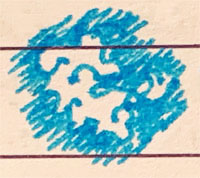
Petri dish or neurons I did really well holding onto consciousness last night. I kept waking my consciousness as I sunk deeper and deeper. I was determined. I got great visuals: black satori and then sparkling fields of transparent purple and black. Then dreams kicked in. At the very beginning I was controlling them. There was a painting of fish. Then there was this black and white biological design, like neurons or something in a petri dish.
-
Purple Veils 1997 • age 22
Falling asleep, I saw very vivid images as I tried to remain lucid. Shimmering purple veils rapidly transformed into dreams. Hard to keep control of the rapidly changing topics.
-
Breathing and Dream Consciousness 1997 • age 22
The dark sparkle-field is really beautiful. After a while the deep purplish black waves of the satori seem white.
-
Satori Pools Melt Through to Visions 2010
I was watching the edges of the dark wave of the satori as it overtook the lighter waves and saw that it was like black ink in water at the edges flowing into the lighter waves. It was like liquid darkness in this inky chaos pattern, very fluid in nature. And of course when I focused on it, it froze, and stopped moving altogether.
Liquid Light: The appearance of the light of Satori is very unusual. It’s like the aurora borealis at times, this shifting, moving light that has an overall flow, but sticks in places until it irons them out through repeated cycles. The erratic patterns it moves over begin to flow more and more smoothly, and the sticky places that prevent it from being a smooth circle gradually wash out. Here I see close up that both the light and dark have a liquid property, and that the dark is a wave as well, not just a blank canvas that the light plays over. The dark is an inky liquid that washes over the dim aurora light waves. Fascinating.
Focus Freezes Satori
-
Focusing Satori 1997 • age 22
Any sort of conscious focus on anything causes it to slow down and freeze.
Phasing Focus: Satori slows down first because attention phases, moving gradually more and more into a focus.
-
Rapid Satori 2010
[I wake up and return to sleep]
My focus interrupted [the Satori waves] pretty quickly. The first effect was that it went from one pulse to two that went to the center of each hemisphere (simply the effect of switching to binocular perception). The waves then slowed down and eventually stopped moving altogether, resulting in two stationary blobs of dim light. Before this, dream visions were coming rapidly, but now I couldn’t get through into the visions at all.
Then I began to relax again, removing my focus from the satori. It began to slowly move again, in the manner I’ve often described: the slow gathering from the exteriors to the center.
Direction of the Satori
-
Satori Watching 1997 • age 23
Sometimes, when first beginning to relax, there are separate waves on the left and right, going one after the other. This time they were peeling off to the top. After some time, they align and converge in the middle, as one.
Fast Satori
-
Rapid Satori 2010
Immediately upon waking up and going back to sleep, I found that my satori was this fast-moving single pulse of dim light moving from the periphery to the center of my visual field. The rate of the light waves was maybe 1-2 per second.
Seeing Fast Satori: In the beginning, the Satori waves take about 4 seconds to move from the perimeter to the center. After the Satori creates the pool that we use to cross over into dreams, it continues on to this state, increasing its frequency to this fast-moving, tight ball of light 1-2 times per second, continually washing out and regenerating the neurons and the mind throughout the night. It seemed that, upon going back to sleep, I picked right up where it left off until I started focusing on it.
It would make sense if this continuous washing-out of attention is responsible for the shortened context of the waking self in dreams.
Observing Hypnagogia: The Inner Eyes
An important part of any conscious exploration into our minds in meditation or when we’re falling asleep is opening our inner eyes. We naturally disengage focus from our sight when we close our eyes. But if we want to see what’s going on when our eyes are closed, we have to re-engage focus on our sight. Simply shift your focus back to the darkness of the visual field behind your closed eyes so that you’re looking at it in the same way you look at the world around you with your eyes open. It feels like holding your attention forward. From here, you can consciously watch what happens as your mind begins to relax and descend through hypnagogia into dreams.
When looking with my “inner eyes”, my physical eyes are looking forward as if they were open. When I’m not, they take the typical position of rolling upwards. The position must correlate to a visual focus.
Keeping the inner eyes open feels like holding up a heavy weight. At some point, the muscles just can’t continue, and you want to just sink into sleep. It’s like trying to flex and keep flexed a weak muscle. But it also feels that with practice they’ll become stronger and you’ll be able to keep that focus longer.
I sometimes feel that this practice helps draw the waking self along into dreams, helping with lucid dreaming and increases dream recall.
Deep breathing is necessary to keep conscious focus as you relax into the dream state.
-
Hypnagogia: The Inner Eyes 1997 • age 23
Last night, falling asleep, I noticed my inner eyes — those which you can open and close without opening your eyelids. It was so hard to keep them open — doing so made me lightheaded and then they would slowly pull closed, like when I’m completely tired and can’t keep my eyelids open. Now I understand that lightheaded feeling when lucidity sets on. These are the eyes that see newly, that can accept new, novel experiences without trying to rationalize them. This is the focus of the waking self, being drawn across the boundary to dreams.
Stages of Relaxation
-
Falling into Dreams 2002
I was up till 3 AM. Upon going to bed, my breathing began short and deep and each breath lengthened into the long, deep breathing of sleep. Here’s what I noticed:
* Stage 1: Continuation of Activity: Whatever you were most engaged in before bed continues to be the topic of thought. In this case, it was working on the Personality Forge.
* Stage 2: Fears: Fears of every kind enter my mind as I try to relax; intruders in the house, fire breaking out, and entire fantasies associated with each.
* Stage 3: Desires: Sexual desires and fantasies. The threshold to move the body becomes higher. Getting up the energy to shift position is about the best you can do — small movements are very difficult.
* Stage 4: Led Into Dreams: Very interesting thoughts. Desires to run into exciting scenes leads one’s attention into dreams.
References: The Personality Forge is my chatbot web site.
Quieting of the Mind: The mind becomes charged up by the day’s activities and to reach the relaxed state of meditation or sleep, one must pass through the fading lights of what the mind was most recently focused on, followed by the more intense body-based emotions, before one can just let go and follow a more personal or social interest into a dream.
-
Distracted from Lucidity 1997 • age 22
Falling Asleep: My attempt to hold my focus was more difficult last night. Very quickly images of girly comic book characters flooded in and grabbed my interest, so I lost my focus.
Barriers to Memory: This is my focus being distracted by what I call the “sexy thoughts” stage of falling asleep.
-
Meditation: Satori Waves 1998 • age 23
Morning meditation: This helps: every thought you have, say “let go of that.” Then after a while say “let go of letting go.”
After the initial chaos in the mind settles down, Satori begins.
Getting to Satori: When relaxing into sleep or meditating, your mind has to descend through your charged thoughts. The task is to avoid giving them fresh attention, so that you can quiet your mind enough to reach the point where you begin to see the waves of Satori.
Rapid-Fire Dreamlets
-
Video Game Regurgitation 1997 • age 23
Falling Asleep: There was an endless string of one-second video game clips, most with perspective changing — sliding left or right. Gradually the endless chaos began to organize into a whole. Remembering The Tibetan Book of Living and Dying, I decided to try to hold my attention on something. As I did, the pieces assembled into a consistent storyline of this multi-piece robot-thing, like a mosaic of clip-art images, like a picture built from things cut out of a magazine. The story continued, and I became lost in it. At first it would jump every 5 seconds but it became stable for longer periods the longer I focused on it.
Earlier on, PaRappa would have had the loudest, brightest pulses, but since it was 4 hours earlier, they faded in lieu of the more recent game stimulus.
Hypnagogic Reorganization: As consciousness descends into silence, it passes all the recently seen images on the way. The collage of video game images — I thought it might have been a rehash, a reorganization and output of each second of game play in order from most exciting one-second interval to least. In quietness, most of it all came out, but reorganized by the brightness of attention I put on it.
Seeing Aura Static
-
Auric Static 2002
When a sudden noise rang out, I felt a moment of fear. My visual field jumped from a mushy black to a bright gray with dull blue horizontal lines for a moment.
Hypnagogic Experiences
-
Hypnagogic Horns 1997 • age 23
Hemi-Sync Evening Meditation: Dreams almost appeared once or twice. There was a short appearance of a point of light, a feeling of spinning, and the sound of a two-toned horn throughout. Other than that, frustrating.
Hypnagogic Sounds: Hemi-Sync is a audio technology developed by Tito Monroe that uses binaural beats to align one’s brainwaves and aid in meditation.
Hypnagogic Visions
-
Hypnagogic Visions 1996 • age 22
First attempt. . . . Release, release, don’t try. If you try to see, then you flex up an image. Relax, breathe, release. I felt REM coming and going. I found myself in Mario Land, because I was playing it today. I was seeing fantastic new boards, new integrations, new characters, the land bobbing up and down, and a high speed circling platform. I saw colors blazing, splitting into 3 layers. I felt hot and saw Mario fire wheels, too.
As I drift deeper, Mario World varies more and more and crosses into nearby styles. It becomes 3D and integrates more things into it. An egg bounces rapidly between 4 different panels, the viewpoint rapidly following the egg.
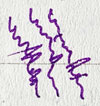
Colors splitting into 3 layers 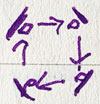
Rapid egg bounces Hypnagogic Experiences: This is one of the first hypnagogic recollections, and I realize that focus freezes the flow, stops the progression into release and deeper states. As the relaxation progresses, more and more is drawn into the chosen focal point — Mario World.
-
Hypnagogia: Brilliant Visions 1997 • age 23
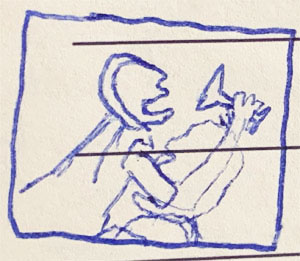
Image of drinking another’s mind Falling asleep: As I was going to sleep, my visions were so bright and beautiful that I saw them quite clearly. They were appearing in such a wide variety of artistic styles — some that I hadn’t seen or used in a long time. I was so in love seeing them again. Even as a part of me was playing with the styles, another part was giving them life and action — not always pleasantly. One I remember is a guy about to drink from a wine glass. He had reached his hand into the mouth and through the head/brain/mind of another to drink what was scooped from inside. This one had taken a few different forms before it landed on the one I attempted to draw. It was all a mind-blowingly beautiful display.
Speed of Thought: Visions appear and change at the speed of thought. There is no delay. As we think a thing, it is there. If we want to change it, it changes as the desire occurs to us.
-
Vision Experiment 2025
I’ve been intending to use my morning snoozes as a chance to become lucid or step OB. This morning, I held my focus as I returned to sleep, and saw I was standing in front of a lake, surrounded by mountains. It was beautiful, but the scene went in and out of focus, mountains blurring into uniform white light (the morning sun was shining).
Lakeside: In the morning, it’s ridiculously easy to get here, provided you can hold your focus and not fall back asleep where all the fun and adventure is.
Separation from the Body
-
Suicide and Dream Fire 1998 • 5:20 AM • age 24
I awoke. It was 5:20 AM — a perfect time for lucid dream experiments! I practiced MILD and then went through the counting: “1, this is a dream, 2 this is. . . . ” I was conscious when the paralysis began coming on but I kept being disturbed by jolts and strange physical sensations. When I got past them, this intense active energy filled me. I felt like something was about to happen. I kept pulling back, feeling that if I didn’t, I’d float away or expand to infinity. I even felt a sleep twitch and a straightening of my spine.
References: MILD (mnemonic induction of lucid dreams) refers to a lucid dreaming technique.
Lucid Descent: These experiences are very much like the sensations that precede OBEs. The sleep paralysis happens just before the separation of the astral body.
-
Hypnagogic Visions 1996 • age 22
As I fell asleep, I felt a weird sensation of being pulled out, like spacetime stretching, turning me inside out and trying to hurtle me forwards. It was pulling from my adrenal area near my belly and heart. It felt like perspectives changing, like the whole world was getting bigger or smaller in comparison to me.
Separation Sensations: These are sensations from the etheric/astral separation, something I rarely experience consciously.
-
Going Under! 1997 • age 23
I was woken by Buttercup snoozing the alarm or something and then laid down facing away from her. I then got it in my head to turn over and wrap around her, and I felt the urge to but it was too late! I felt myself being pulled inwards and this mawing deep slow voice sound, like my voice, but slowed down to a deep “auuuuu,” like this sound:
Going Under: Sound from this video by MusicMindMagic The sound was startling and slightly disturbing. It was not physical — it came from a strange internal source, not through my ears. The pulling inward sensation was a pulling from the body sensation. Then there was an almost popping sound, like a transportation or change was occurring. When it was complete I lost all body sensation and then completely blacked out for 1-2 timeless seconds — a lot longer than I had imagined it would be.
After the 1-2 second blackout, I was back, in this dim space where I felt very small. I said in my head “Shit, I’m dreaming!” and then struggled to come back, with the singular motivation of rolling over in bed behind it. I didn’t even remember this until 5 minutes after I woke up for good (after another short dream).
Body Separation Experience: The way this came about was in the style of an OBE. A Lucid Dream begins as a dream, while an OBE begins while being consciously awake and watching the transition across.
-
I Felt It Move 2022
I had discussed with Ruby the idea of “asking for help” in getting OB before bed, but had always thought it strange. Who were you asking? What if some local ghost answered? But we thought it was likely the higher self. So I tried holding onto my awareness as I was falling asleep. After a while, during which my consciousness rose and fell, I felt my astral body move! I was lying on my side, and it was a brief falling sensation, about 6” to a foot behind me. As I thought about it, I understood the lack of body sense people describe in the astral body. Either the astral body was moving out backwards and I was feeling the falling sensation from the astral body’s perspective, or the astral body was moving out forwards and I was feeling the falling away sensation from my physical body’s perspective — there was no way to know.
It Moved!: There is dual perception at this point, from both the physical body and the astral body.
So asking for help worked! I’ve read about that from several sources. I don’t usually ask for help in life. I learned there’s usually a price. So I have that issue to overcome.
Hypnagogic / Hypnopompic Clairvoyance
I sometimes experience clairvoyance while falling asleep but more often when waking up. The typical experience is this:
I am laying in bed between waking and sleep and seem to have my eyes open, looking at the ceiling or the room around me. Then, I wake up a little more and open my eyes, realizing that my eyes weren’t open at all before. And yet I was seeing!
The sight at these times is a little bit like tunnel vision — the image is a smaller circle in the center of my visual field, fading to black around the edges. I don’t have a chance to look around much, but tend to be looking at one spot until I wake.
-
Hypnagogic Visions 1996 • age 22
I have been practicing seeing with my eyes closed, but I often forget when I wake up. I’ve been in dream classes, in training. I’m realizing that the dream self is me. I’m learning to recognize the shifts of consciousness. . . . First attempt. . . . Release, release, don’t try. If I try to see, then I project an image. Relax, breathe, release. I felt REM coming and going.
Hypnagogic Clairvoyance: It’s tricky keeping attention focused during the hypnagogic stage. But it can be done.
-
The Haunted Ride 1996 • age 22
Several times this morning, while sleeping in, I found myself looking out at the room around me, in a kind of tunnel vision, not entirely focused. Then I’d get very excited and wonder if my eyes were open. They weren’t!
Astral Sight: The lack of visual clarity in this one may have been an expectation, since at this time I wore contacts and an unfocused view is usually what I see upon waking up.
-
The Lava Trail 1996 • age 22
These last few nights before I wake up, I’ve noticed I’m looking at the blinds and around the room with my eyes closed. It’s 70% accurate and tunnel-vision.
-
Inaccurate Clairvoyance 1996 • age 22
Why are my visions, my seeing without using my eyes, always so inaccurate? The picture comes in clearly and with a surprise I realize what I’m doing. . . . But there was a picture and frame on the wall we never had, or Buttercup’s in the wrong place. Am I seeing? Or projecting?
Projection?: It’s said the near-realm is very much like the physical world but with small changes here and there. Is that what I’m seeing? Or is it a projection? It comes straight into the visual part of my mind.
-
Hypnagogic Clairvoyance 1997 • age 22
Dream sight experiment this morning. I kept seeing unreal cartoony scenes. Then I got the room.
The Entrance into Dreams
Main Source of Attribution Comes from Dreams
The transition from waking context to dream context is fascinating. It’s a switch over of attribution due to a change of context, and that’s IT. That’s ALL it takes. One moment the metallic sound is most likely the wind chimes outside your room, and the next, it’s the sounds of weapons clanging in battle.
This is absolutely essential to understand. Our physical sensations can be bent into any shape or form that will make sense based on our context — even a context we’re not yet aware of. Their actual form barely matters at all.
-
Dreaming Context While Awake 1997 • age 22
So strange how dream context appears and takes over. It just slides in and BLAM, it’s a dream.
-
Hallucinations While Driving 1997 • age 23
I was driving on a cross-country road trip, late at night, and I was exhausted. I was experiencing hallucinations while driving as sleep pulled at me. Oncoming car lights became the sparks in people’s eyes. It takes one commonality to change an entire scene — that was all it took to switch contexts. It happens in meaning, in the depth field first. Colors are easily reestablished. A concrete patch in the rough shape of an animal becomes a deer in the road. Colors are easy to change. Dreams creep in from the periphery. Unseen context changes rapidly.
Reattribution: Hallucinations from dreams and psychedelics occur in exactly the same way. Meaning adjusts the depth field and colors reestablish themselves. The only difference is when we have physical sensory input coming in, the new context has something to fight against. To work, it needs to integrate that input. For example, to stay in a dream, we need to attribute physical sounds and lights to something in the dream.
-
Driving Hallucinations 1992 • early AM • age 17
I had gone to Spirit Mountain to ski for New Years eve. I skied until midnight, and then headed home. It was a three-hour drive back. It was between 3-4 AM when I neared the three-hour mark, and my dreams were beginning to impinge on my experience. The alternating light and dark patches on the road from the street lights seemed now to be the alteration of steeper and flatter parts of the slopes ahead of me. The signs I passed on the side of the road were skiers in my periphery. It wasn’t subtle — I was actually seeing this. Luckily I made it home alright.
Same Impressions, New Meanings: After spending hours on the slopes, my dreams were returning to that same context, bending my driving experience back into a skiing experience. The context changed, and with it the interpretation of my physical sense impressions.
-
Hyperspace Warps 2001
Earlier on, I half awoke in bed, 100% convinced that I was downstairs sleeping on the couch, and wondering how I got there. It took over a minute to realize I was in bed — that there was no TV where the TV should be. But for that whole minute I was dreamily looking at my bedroom, maintaining that it was the living room downstairs even though it looked nothing like it.
Overpowering Belief: This is key. Here I am presented with a very familiar scene, but the intensity of my belief that it’s another scene makes what’s before my eyes almost irrelevant. My belief that I’m downstairs in the living room is so powerful that it overrides the clear evidence in front of me. In the dream state, belief is primary. Sensations from the physical (or any other source) is bent to support that.
Satori-Based Visions
The Satori itself can act as a backdrop for visions to form out of, rather than going through the Satori Pool itself.
-
Breathing and Dream Consciousness 1997 • age 22
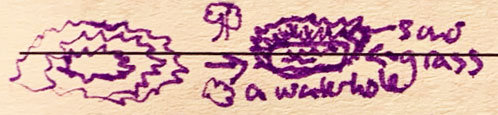
Water hole based on Satori pattern The initial dream images were based on the satori pattern, which took the form of a water hole with trees around it. Alice from Wonderland ran out of the water hole. I tried to interact with her but I didn’t feel like I was actually there.
Satori: The satori pool, like any other stimuli, may become a part of the dream.
The Satori Pool
-
Meditation: Satori Waves 1998 • age 23
After the initial chaos in the mind settles down, Satori begins. It’s a sort of visual Aum, a repeating wave that evens out the charges, smooths everything. The Satori pool begins to build and brighten. At times there was something like an aurora brightening and softening, causing waves of coolness in my body. . . .

Lightning discharges from Satori As the Satori pool got wider, its periphery triggered little lightning flashes. Then the pool built up over them. These little flashes seemed to be discharged into the pool and evened out.
The Satori Pool: How interesting that the Satori Pool itself seems to be discharging parts of the brain as it expands and opens the gateway to dreams.
-
Satori Pools Melt Through to Visions 2010
As the waves built up in the middle, they formed a slowly growing circle of dim light in the visual field before my inner eye, a gooey spot that, once I pushed through, revealed full visions. The first vision was that the two dimensional plane that the satori was playing on was a wall and the pooled light was a hole in the wall beyond which was a scene of a sunny Mediterranean village.
At another time I saw a pair of eyes forming beyond the pool of satori light. It occurred to me that this would usually be scary but I had the awareness that everything here was made of me, and thus there was no fear.
Hot Spots
-
Breathing and Dream Consciousness 1997 • age 22
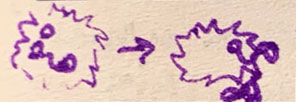
Glowing, pulsing neurons I saw such hot-spots! They were like glowing, pulsing neurons. What you’d imagine was based on the shapes and patterns of those pulsing colors. These colors are odd in that they can be shifted to any color scheme or depth pattern. From this a montage of dream imagery came forth.
-
Hypnagogia: Neurons Behind the Veil 1997 • age 23
There’s a point where all colors are equal, where the gradients and color schemes are applied and created by you. It’s a field of potential. They are just the first parts of the image seen, or maybe the image forms around the hot spots. Dreams are right beyond the veil.
Seeing Neurons
-
Hypnagogia: Neurons Behind the Veil 1997 • age 23
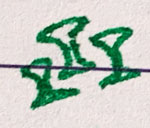
Neurons appearing
as wineglassesI see a repeating pattern of wine glasses then little boxes that were glowing purple. They’d come out towards me and translate into a scene. . . . The wine glasses were neurons in disguise.
Projections on Neurons: The wine glasses were neurons seen through the rationalization field. I’ve seen this before many times in altered states of mind. Remember that no light enters your head, and that the entire scene you see around you is a projection created inside your brain, which is packed full of neurons. So seeing them when the mind is in a altered state is not such a surprise.
-
Meditation: Satori Waves 1998 • age 23
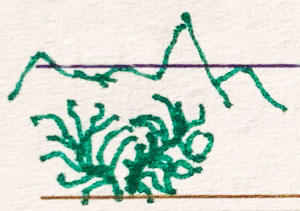
Shrubbery before mountains The bright holding pattern [of the Satori pool] eventually turned into a dark mirror of visions, the very first being the pathways of the brain lit up and seen as shrubbery before mountains.
Hypnopompia
Hypnopompia is the transition state from dreaming to wakefulness.
From Dreams to Waking
The Dreaming Mind Perceiving Physical Reality
These give me the feeling of the mind being in strange and unfamiliar contortions. In the dream state, it changes its shape and frequency, resulting in it being in positions from which normal physical stimuli are perceived in very different ways.
It’s like when I travel through strange maze-like catacombs or passages to get to different places. I can end up sideways or upside-down to the previous perspective, but the new perspective seems normal.
-
Spirit Guide 1996 • age 21
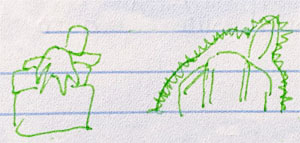
My desk as a spirit guide I had the weirdest experience early on in the night. I sat up in bed or looked up astrally and saw the desk as a Native American spirit guide leaning over me with a dark and crackly aura around him. It was a long, strange moment, but really really neat!
Spirit Transformations: The presence of the spirit guide was the astral reality, and when I combined this with the input from my physical eyes, my consciousness did its best to fit the two together. The result was as if he was appearing through the form of these objects.
Further up the stream, in higher frequencies, everything is more malleable. Through changes in context, a circle can appear as a square. Or objects on a desk can appear as a Native American spirit guide.
-
Dream Hallucinations 1999 • age 24
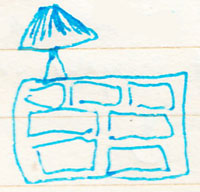
Man with rice-picking hat 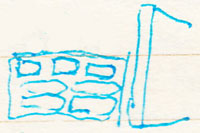
An arm raised up high Several times during the early morning I opened my physical eyes while dreaming and the surroundings were right out of the dream, mapped over the physical bedroom. For example, this man was standing there. Looks like a dresser and a lamp, no? Well it was very clearly a man with a rice-picking hat, and next to it, on another occasion, the closet door was an arm raised up high. That became the most likely interpretation of that sense data and gradually it faded to the reality of being parts of our bedroom. How far can the context of a situation stretch its appearance? There’s probablyno limit.
Dream Hallucinations: Here are some more great examples. See how amazingly far context can stretch the raw sensory data? It almost doesn’t matter at all what you’re looking at. It’s almost entirely secondary to context and expectation. The mind only needs to make minor adjustments to account for it. “It’s still a man,” says the mind, “he just appears to have a rice-picking hat on.”
-
Astral Party 1999 • age 25
A car drove by in the physical world and it sounded as if filtered through an effect that made it sound like “zhaowm”, pulsing in and out in a definite manner around 2 pulses per second. The sound was as if slightly muffled, as if from behind a barrier or a veil. Wondering, “Is that really a car?” I awoke more and sat up. Buttercup went to the kitchen for water and the light in the door crack thinned and widened to the same rhythm, as if my entire consciousness were wavering back and forth at the same speed as the sound flux. Before long it settled.
Dream Flux: I’m not sure what this is but it’s very interesting. It must be the cycling of the mind’s slow brain wave such as theta or delta affecting my audio and visual input. It’s a frequency I was tuned to in the dream state — one which modified my physical perceptions.
-
Brendan’s Gathering and Summoning Pants 1999 • 5:30 AM • age 25
I’ve been paying attention while falling asleep and “under the veil” to the sound of passing cars. They sound muffled, distorted, and their passing seems to last longer. They last longer because I’m listening with more attention and thus time is more extended in that state.
Sound from the Dream State: For more, see my experiences with marijuana in “The Experiential Fluctuation of Time”.
-
LASIK Beams 1999 • age 25
I often awake to the Super Nova Dreamer, which appears as incredible shifting kaleidoscope patterns of red and white and yellow as I shift from sleeping to waking.
The Interpretation Field: The Super Nova Dreamer is a lucid dreaming device that flashes red lights before your eyes when you are in REM sleep.
The flashing light reaches consciousness in the dream state in such a way that causes the simple red light to appear as kaleidoscopic imagery of varying nearby colors.
-
Lost in Time 1999 • age 25
Twice earlier in the night I nearly awoke to the Nova Dreamer lights. The first time they appeared pink with light gray lines, like the light had cling-wrap on it. The second time they appeared as a red-orange kaleidoscope of shapes.
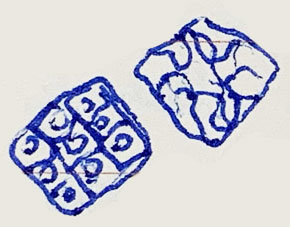
Appearance of the NovaDreamer lights 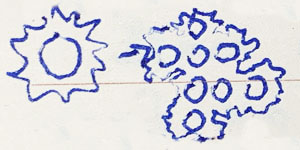
NovaDreamer kaleidoscope References: The Nova Dreamer is a lucid dreaming device that flashes red lights during REM sleep.
Nova Lights: Note that there is only one flashing red light in front of each eye. Perhaps the multiplication of the lights in due to my perceiving a wider cross-section of visual neurons — the single red light appearing 9 times.
-
A Melange of Dreams 2001
Recently, a huge thunderclap broke into my dream as an explosion of numbers, letters, and symbols (%!*#) that filled up the visual field. Last night thunder came again and again, each seeming to be a book that I read in its entirety in a flash of light.
Breaking Into Dreams: It takes a lot to break into deep sleep, but loud thunder will do the trick. It’s interesting how distorted it sounds when it does, and how it will come through so many layers of the mind, being transformed into information and then into something else entirely within the context of the dream.
In the early days of the internet, power surges from lightning could cause the modem to produce a short stream of random numbers, letters, and other characters on the screen. I wonder if the first instance took this form because of that.
-
Sensation Shaping 2023
As I was in bed, close to sleep, I was noticing how easy it was to imagine a sound into the real, full experience of the sound. There had been a beeping somewhere in the house, and I was able to imaginatively reshape the white noise of the air purifier into that exact sound, as loud and real as the original. I tried it with a few different ambient sounds I heard, and it worked.
Imagining Sounds: In this low-context state near sleep, we’re able to take any arbitrary stimulus and shape it into what we want or expect it to be.
-
The Strange Face 2024
I had just barely woken up and was laying in bed for a minute, trying to remember my dreams. My sleepy mind saw something on the bookshelf, and I took it to be a face. It was a weird face, stylized, with some dark smudges on it. I couldn’t figure out what it was in the dark morning light until I pushed myself a little more awake, and saw what it really was.

This is my mental conception
of what I was looking at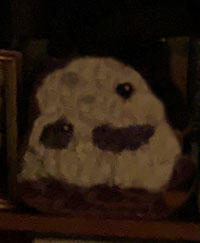
This is what I was seeing visually 
This is what it actually was Stuck In the Wrong Idea: An image was entering my eyes. My first conception of it of a face emphasized the parts that looked like a face, and attributed other parts to black smudges and background. It remained looking like a weird face for as long as I let it. It was only upon focusing more into the physical world that I picked up the details that revealed its actual (adorable) shape.
-
Dedication to Expectation 1999 • age 24
In a nifty dreaming mind occurrence, I awoke slightly in the middle of the night and turned toward Buttercup, expecting to see her face. I did and found it had these tribal patterns on it. It was so strange that it startled me slightly. A few moments later I realized I was staring not at her face but at the patterned blanket over her head. My expectation of seeing her face and the visual input of the pattern on the blanket had merged into one. The tribal feel came from where it was difficult to translate a correct feature out of that segment of the pattern. This shows the dreaming mind’s dedication to experiencing what it expects to experience.
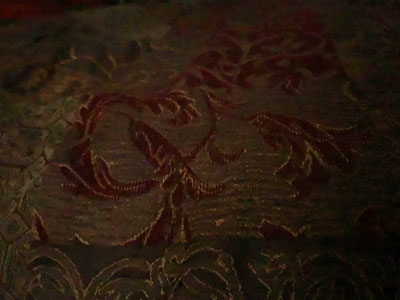
My beautiful wife (the pattern of our blanket) Visual Hallucinations: This also sheds light on the way visual hallucinations work. Given any scene, the mind can so expect to see something that it can construct that expectation out of the scene. It may have to see it as being at a certain angle, in a certain style, or so on, but the mind’s great creativity will make it so.
Our perceived reality is, at any given moment, the meeting point between our projections and perceptions.
-
The Bookshelf Monster 2025 • 7:30 AM
While snoozing, I opened my eyes for a moment. Before me was this creepy monster! I looked at it without any kind of emotional reaction, and watched as the internal reality of it changed into the bookshelf. I studied how the light and dark contrast areas became the eye and the tooth-filled mouth off to the side.
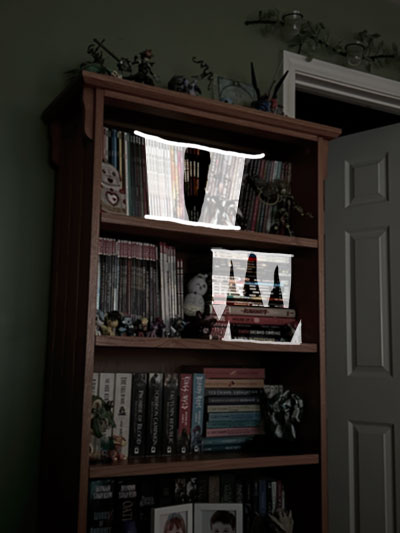
The bookshelf monster, as observed 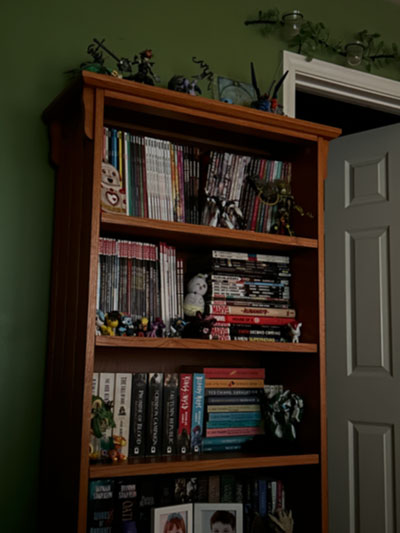
The bookshelf from waking consciousness -
The Lizard Clock 1999 • age 24

The orange lizard I was dreaming that two lizards were coming down the wall. I must have opened my eyes at this point, and saw another one coming down the wall in the dark — a black one with a bright orange head. I began to panic, then awoke, and found myself staring at the red digital clock across the room. What a total transformation! The interpretation field accepts sensory impressions as a basis for what it creates, stretching it as much as necessary to fit the context.
Perception Within Context: It’s amazing how visual information can be warped by context and expectation into being anything in the world — from a digital clock to the head of a lizard. I’ve also had experiences like this many times with psychedelics.
The “interpretation field” is where sensory input is transformed to fit into a particular context. This includes the context of an expectation, desire, or fear.
Physical Vision Covering Clairvoyance
-
The Third Eye 2024
I woke up physically and went to the mirror in the bathroom. For a split second when I looked at myself, I saw a dark red spot roughly between my eyebrows. A vestige of my dreaming awareness, seeing my third eye? It was lower than I imagined. I also saw a few thin black lines, as if made by trails of flying insects that had passed by.
It seemed that my vision was a liquid that flowed to cover over these images. . . . It may be covering up things we’ve come to believe as “not useful”, just as it covers over the blind spot in each eye.
Covering the Higher: This is a very interesting observation, and reminds me of the way our vision compensates for our blind spot. It also may be covering up what we’ve come to believe as “not useful” while growing up in the physical.
The Information Field
I don’t know exactly what the information field is, but I see it from time to time. It’s like a different focus, through a murky layer and yet I can see so much more clearly — my attention is better. It’s like seeing with an inner eye as well as an outer one.
-
Hypnagogia: Hexagonal Information Field 1997 • age 23
Here’s a little on the information field: last night during powerful dreams I awoke and could barely focus out of the information field. It was like a honeycomb field of hexagons. I was focused there, barely able to push through it. It was like a 2D screen through which I saw. Usually it’s not visible. In a way it’s a clear focus; there’s a clarity of mind there even though physical vision is strange.
Information Field Hexagons: Once, while tripping, I noticed that my vision affected the appearance of clouds so that they seemed to be made of myriad fractal hexagon shapes. This is an important shape, neurologically.
-
The Totoro-Gerbil Genetic Tank 1997 • age 22
Moments of inspiration open frequencies, like a lens widening for however long the tear-gushing bliss lasts.
And I’ve been seeing more and more SUB-images, as I fall asleep: information sources, points and circles, loud with meaning and wisdom, pulling my attention towards their higher frequency.
Information Field: This can be seen in hypnagogia as well. See Perceiving the Holographic Structure.
Inner Movements
-
Perspective Movements 2013
As I’m slowly waking up, I notice this pattern in my mind — the perspective from which I’m seeing/thinking is flashing back and forth between two points. 1-2-2-1-2-2-1-2-2-1-2-2. It rests on position 1 for one beat, then 2 for two beats. Each is about a half second. It was the natural process behind whatever I was thinking about at that moment.
Flashing Mind Perspectives: This is a really neat observation. I don’t recall if it was hemispheric or not. This crossing back and forth between two different perspectives was like two ways of looking at something. Two sponsoring thoughts looking at the same thing, trying to understand and come to a consensus.
-
The Dancing Bear 2024
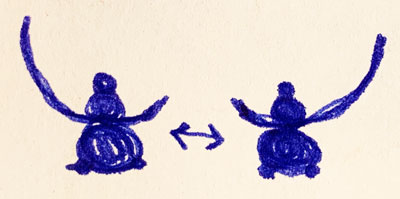
The dancing bear As I was waking up, I saw a quick bit of imagery behind the scenes. It was a dark shape in a white field. The darkness was that full purple color, and the light around it was this full off-white light. Both were boiling with energy, alive with potential. It shifted left to right and back, with the arms seeming like a single unit, sliding through the center to the left then to the right. The rate was about 1 cps. The rhythm reminded me of the potential rocking of the ecstasy trance. It felt like some kind of engine behind the scenes. It looked kind of like a dancing bear.
A Momentary Glimpse:

The Mandelbrot Set fractal The dark shape reminds me of the Mandelbrot Set. The “arms” slide through the narrowest point in the primary fractal. In the manner of dreams, the head and feet may have been painted on when the “dancing bear” thought came to me. The arms reminded me of Walt Disney’s earliest animation.
Could this be the mathematical foundation? Could this be a shifting back and forth of perspective on a fractal?
Deep Satori — The Dream Screen
-
Infinitely Cycling Imagery 2025 • 3-4 AM
I was hanging out with three friends at the side of a lake. . . . The background of this experience (on the more physical side I think), was this rapidly-cycling background of beautiful, vividly colorful landscape scenes. While they were cycling incredibly fast, my attention caught on certain images for a fraction of a second to see them. On top of the cycling were these waves of light going from one side of the visual field to the other, criss-crossing in different directions. It was like an advanced Satori.
This rapidly-cycling field had no memory dimension to it. It existed in zero-context. It could only cycle this fast when I had no attachments to anything. When I locked on to an image, the cycling slowed or stopped. I felt like it was a field of infinite possibility, in which all things existed. This was early in the night, likely in a deep phase of sleep.
The Dream Screen: The whole of our past experience is available at once. In terms of physical time it flashes before us rapidly. This cycling happens at faster and faster frequencies until it is instantaneous. These faster frequencies are up the stream, closer to the Source. They occur because of a lack of attachment. Our attachment stops the flow on a particular image or idea. It allows us to closely examine something, but it’s also what drags us out of the now in physical life. The higher realms are described as twinkling rainbow cascades of color — all colors cycling.
Now back to dreams. We have the reality of what’s happening in the astral, and it’s upon this rapidly-cycling background. We select from the images the most familiar and sensible given the circumstances, and apply those images to experience the scene in physical terms. Our expectation of object permanence means we only have to select them once per scene, and they remain until they are forgotten. This is the screen upon which we dream. An infinite-possibility energy field from which we select what we want to represent the deeper nonphysical realities we are experiencing.
-
Morning Satori Pool 2023 • 7 AM
My alarm woke me up and I’m falling back asleep. As my waking self is going back under, I see this wide satori pool of every-color light, flickering, providing a background of every color and every brightness for my dream imagery to appear upon, and it quickly does. After a night of dreaming, the pool is well-established and allows a near-instant return to dreaming imagery.
Established Satori Pool: Once the Satori pool is established during the Satori experience, it remains there as a universal medium for image projection until you wake up.
-
The Dream Field 2025 • 3 AM
From vividly dreaming, I open my eyes. My entire visual field is filled with this pattern of “cells” of concentric, looping, or back and forth lines. The centermost one looks like a fingerprint. It’s most visible upon the white pillowcase in front of me, less so on the darker blankets around it, but still there. It’s constantly changing, like the common scribbly animation style that’s never still but always shifting between a few scribbled frames. The lines themselves can become thicker and darker, or thinner and smoother, or crystallize into panels with various tones.
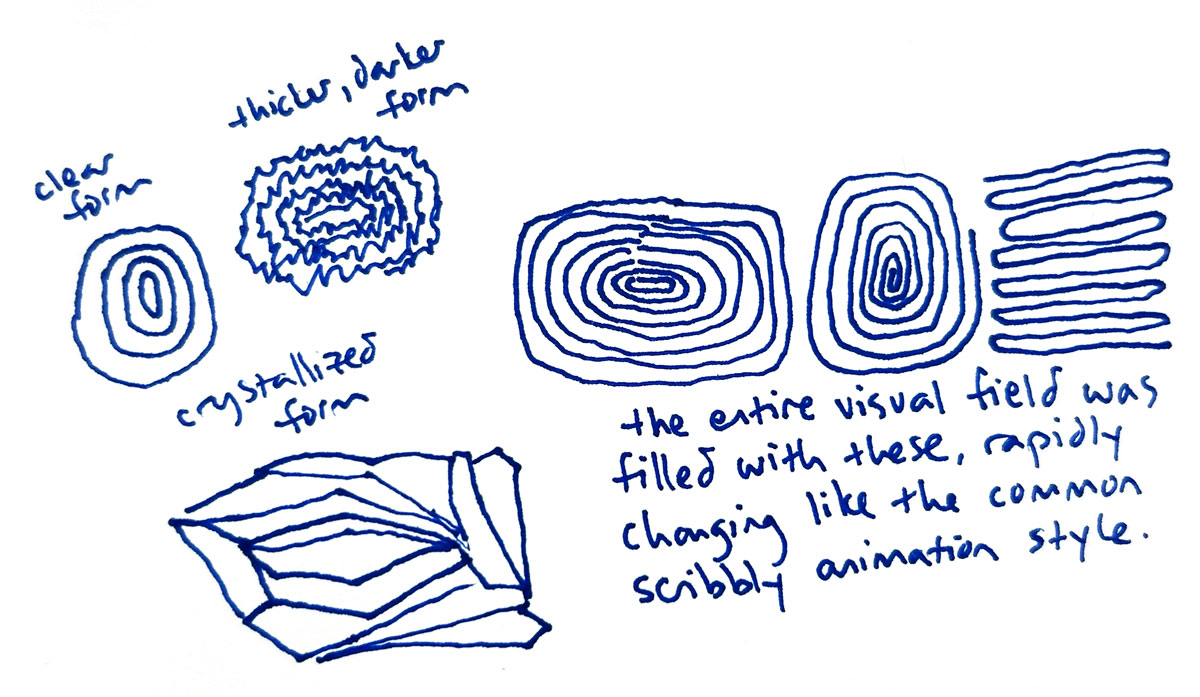
The “boiling line” animation style comes from the dream field Video credit to Micah BuzanThis provides a field of patterns we interpret into dream experiences, forms we project upon to form the images of dreams.
The Pattern On Which We Dream: This is the screen of energetic potential upon which physical forms appear.
-
Horrible Visions 2025
I was falling asleep and inexplicably seeing vivid horrible visions behind my closed eyes. I was sick with norovirus but was starting to improve, so I don’t know why this was happening. It was so unusual, I watched with some grim fascination. At one point I opened my eyes, and Buttercup was asleep, facing me. I saw a gridwork of semitransparent squares overlaying my vision, each with a sort of creepy hazy moving wrinkled pattern in it, such that when I looked at Buttercup’s face, it appeared deeply wrinkled and shaded in a creepy way. It was as if this little pattern would apply itself to make whatever I looked at appear horrible.
Creepy: Here the dream field was applying its effect on physical forms, both those coming from memory and those perceived physically.
Dreaming While Awake
Dreaming While Awake
Dreams
What We Do in the Dream State
What do we do in dreams? The same things we do in waking life, without any of the work and responsibilities. It’s a time of socializing, exploring, adventuring, playing games, and experiencing stories.
Working Through Issues
We create drama in dreams that reflects our issues in physical life. In this way we engage with and prepare for how to deal with difficult situations by living through them.
-
The Tree Clearing 2024
We’re living in this house with trees around it. Beyond our back yard is a house where our neighbors live. It’s a rectangular plot of land, and beyond it is a forest. I know I’ve been here a few times before. The trees along the neighbor’s house have begun to look scraggly and dead. Every time I go out there, there are fewer of them. Then, as I watch, a towering beautiful tree is cut in half and falls. I don’t see anyone doing this. I tell Buttercup to look as it happens. The back yard is almost entirely treeless at this point. I note that one log in the back yard has a thin ring cut out around it, which is a way to kill a tree. I see similar rings on others.
I considered suing them. Then I thought how awkward it would be suing our actual waking neighbors, seeing them in my mind. But then I realized those were waking-life neighbors, and these neighbors weren’t them. I never actually saw anyone living in that back yard house. . . . Finally, back to our actual (dream) house, I take pictures of the ring around the log, only it’s branch-sized now (shrinking thought form).
Losing Trees: Our city has been steadily cutting down huge, beautiful trees because, though they look perfectly healthy, they’re “diseased” and may fall some day. It makes me really angry. The day before this dream, they took out several more, so the problem was freshly in my mind.
Never once in this dream did I see a neighbor in the back house. The huge tree that I watched come down came down without any cause — nobody was there. So I’m living out this drama in my dream. I’m projecting this all.
And the logs I saw earlier were branches when I returned — shrinking thought forms as my attention turned to work — another sign that they were my own creation.
Recurring Anxiety Dreams
-
The Recurring Burning House
I dreamed of my house burning down and the frantic search to save the comics and stories I’d written, and then maybe my family. This was a frequently recurring dream in my childhood.
Anxiety: I’m not sure why this dream troubled me so often as a kid. The cause may have been an attempted arson of our new house when Wadsworth was building it. Another time, there was a small fire over a couple acres in the woods next to my house. It never reached more than a foot high. But neither of these events ever troubled me when awake. Yet a fear of fire unwittingly made it a reality in my dreams. The dream ceased when I made copies of all my drawings and stories and comics and gave them to a friend for safekeeping.
-
New Fuel for the Burning House Dream 1996 • age 22
I was dreaming of a burning roller coaster. I intended to get my important things out of my room and save them before the fire came. Heh. Same old same old.
Recurring Dream: Now many years after I gave a friend a copy of creative work, I have done much more work and this dream appears again. Time to make back-ups again.
-
The Destructive Plane 1996 • age 22
I was wearing my soccer uniform, looking for the Blaine team to join them but it was already the semifinals in the tourney. Eventually, Coach Broadwise came to me and laid it down. He said I could’ve been a captain if I’d stuck with it. It was too late now and my indecision cost me. I was thinking he must be a spirit guide.
References: Coach Broadwise was my soccer coach.
Soccer Unreadiness: These dreams are usually the same, with variations. Sometimes I show up late and I can’t play, sometimes I’m missing my uniform or shoes or shin guards, and sometimes I’m not allowed on the team.
These dreams happened during a long period where I wasn’t playing soccer, after playing for 11 years as a youth. It’s odd that this sort of dream came up so much. I barely even thought about soccer after I went to college.
Socialize
Just like in waking life, we are social creatures, and spend time hanging out with friends, family, neighbors, and anyone we run across. This is a large part of our dreaming experience. See the main section Social Dreaming.
Pursuing Interests
-
Under the Earth: Guardians 1996 • age 22
After looking through some book stores, Buttercup and I are back at Oxford 2. I go to get some Guardians cards. There’s a deal where I can trade in a book or two for their value and I do. I end up with about 16 packs.
References: Guardians is a collectible card game. Oxford 2 is a comic book store.
Comic Shops: A regular dream activity for me all my life has been visiting comic book shops. I don’t do it often in person anymore, but I still dream of it. I’ve always loved fantasy, and I’d go for comic books, graphic novels, cards, etc. That interest frequently shows up in my dreams. Comic book shops in dreams are FULL of gateways to other worlds.
-
Ultra Oberlin 1996 • age 22
I was at Oberlin. I went to a party in the snack bar because I heard people were naked there a lot. This black girl was flashing herself and people were picking each other up. There was this blonde girl I liked and we kissed and cuddled. I was putting white face-paint on her and she told me I didn’t have to, kinda losing interest. There was also a scene in a store room with lots of toys. I remember flirting with Sophie momentarily, and someone who reminded me of Summer from SSU. The latter and myself were talking and kissing. I was trying to convince her she could go far in music.
I’m a Lover: My most beloved thing is bonding and closeness with the opposite sex. This shows up frequently in dreams and is part of my happiest, most satisfying dreams.
-
Make Love Later 1997 • age 22
Earlier in the night, I had a dream where I was traveling all about, and I came across a girl who loved me. She was cute, petite, kinda like Jen, and we were hanging out. She casually asked if I wanted to make love later and I thought “Yeah, that’d be really nice.”
After this was a dream of Raven and me, as we were in the prime of our relationship. We had just met up again. She asked me if I wanted to make love later and I thought “Yeah”, but then I remembered I had a different girlfriend, but couldn’t remember who. I thought it was Anne (my 6th grade girlfriend for a day) and found it difficult to tell Raven but finally did. But “Anne” was referring to Buttercup (I thought they seemed similar in this realm). It was all just purely the good feelings of all these relationships. A wonderful place to be.
Pursuing Intimacy: My favorite activity in dreams again is my most fulfilling activity in real life — the pursuit of love and intimacy!
-
The Best Video Game Ever 1997 • age 22
I’m in a toy store with this boy, looking for WarCraft 2 Expansions. Instead, I find Zelda for Nintendo 64, so I pop it in and start playing.
Video Game Stores: I spend a lot of time in video game stores and playing video games in the dream state as well.
-
Giving Flying Lessons 2016 • 8 AM
There were a series of adventures, little episodes, and at the end of each, we picked up a new character.
The ghost followed us to our car and got into the front seat. I took a closer look, and it was Alice (from Alice in Wonderland). She was mostly solid-looking but glowing. Okay, so she must be the latest character, I thought. I accepted her as part of the group. She had sat in the front seat, so I found a spot in the extremely wide back seat among all the others.
Video Game Desires: The idea of collecting characters comes from collecting characters in Smash Squad, which I was really into at the time. It’s a waking self desire, and my dreams partially take that shape.
Vacation
What would you do if you had the freedom to do anything? One idea: go on vacation!
-
Nightly Vacations 2024
Buttercup and I were on vacation, going from place to place, spending nights at Airbnb rooms. This is very much like something we’d do in waking life. We set out on our way to the next location. . . . We found it, and went inside. It was a big house with lots of rooms. After talking to the person ahead of us, the owner enthusiastically welcomed us. She said to Buttercup, “Look how cute you are!” and Buttercup didn’t respond at all. She told us where our room was. . . . I remember seeing at one point a detailed overview map of this area. It was a cute little city. There was a main road which kept curving to the right along this river.
It’s wild — we just vacation in the astral every night. Exploring, socializing, seeing things, having adventures.
Holiday Road: Without the responsibilities of physical life, we are free to do anything we enjoy in the dream state.
Astral National Parks
Buttercup and I love visiting National Parks, and I find myself attracted to similar beautiful lands in the astral. It’s so much easier to get to them and the parks are so much more impressive in the astral world!
-
Colorado Volcanoes National Park 2024 • 5:30 AM
Buttercup and I are on our way to Volcano National Park in Colorado. We’ve been there once before. It’s a drive around this mountainous area that includes a volcano and a glowing lake of lava. Emma and Alfred are with us, but not really active. As before, we’re approaching from the south side. Last time we visited, we went counterclockwise. I tell them we’re taking the clockwise route this time. I can see the route perfectly on a map in my head. . . . Rather than roads, these were more like routes . . . suggestions of roads. Due to their being poorly marked and defined, several times during the dream, we made wrong turns and end up in hot, deadly volcanic regions. We drove around the glowing lava lake, then came around this rise, high up. As we turned the corner, we saw the huge energy collection panels that were attached to the National Park lodge near the peak. The route continued across these panels. . . . We drove on and made it to the highest point on the road, which revealed a busy National Park lodge complex, with food, a gift shop, rides, lots of people, and amazing views of the top of the volcano. The lodge was made up of all these connected buildings built around the volcano. The volcano was continuously erupting hot smoke and debris like a blast furnace from an opening that was maybe three feet across. The lodge had windows right beside it, allowing for an amazing view. A ranger said it was the second most powerful volcano. . . . Inside the building, I found the start of a mine cart ride. I followed it around to the “other side” where it led, to the side where I thought Buttercup was. But I didn’t find her. I stopped to get some water and got a ticket that could be used to fill up on gas before leaving. I think someone gave me some food, too. I left this section of the building and just outside someone was handing out treats from a tray with a variety of sweet things. I grabbed a dark chocolate bear claw. . . . I made it eventually to the exit area in a lower part of the building. The exit area had cars and gas pumps and that’s where I found Buttercup and the kids! I gave someone my white ticket to fill up gas, and away we went. This side of the volcano was more forested.
-
Return to Colorado Volcanoes National Park 2025
I was on a week-long astral vacation visiting national parks in the West. Last night, we had made it back to Volcano National Park, one of my favorites. I was with a group of 4-5 people, including Ruby.
-
Erupting Kilauea 2010

The lodge on the lake (this picture of Cilantro On The Lake in Canada is almost it exactly) Image credit to Google MapsOver here it’s beautiful — the lake is surrounded by green, tree-covered hills, and there are lots of people around. It’s a tourist destination. As we begin walking, something catches my eye — a great plume of smoke from the top of two hills. There are rapid waves of smoke coming up off the hill to my right, and up ahead, a huge plume of dark, billowing smoke is erupting. I run to get a better view. I scramble to come up with the name of this volcano, and Kilauea springs to mind so I stick with it. I now think I’m in Maui. I get out my iPad to record video of the eruption. The larger volcano emits a big white cloud in a vague shape that keeps its exact form and lifts up and travels across the sky. Then the volcano is silent. Before long, a little spout I didn’t see by the side of the lake road lets out a pillar of smoke, then stops. . . . Then there’s a small underground rumble and a small eruption from under the lake, bubbling smoke and air up to the surface. Up ahead, where the road joins up with a big open area, there’s a bar and store for the tourists. I run over there and sit down near lots of other people, as it’s a great view.
Volcano Watching: I love places like this in the physical world. In the dream world, they are regular places I visit. This is a different volcanic park in the astral, with a restaurant and shop was made for the visitors.
Yellowstone-Like Areas
Yellowstone National Park is one of my favorite national parks, and find my way to similar lands in the astral. Anything related to geysers, fumaroles, hot pools, volcanos, or lava grabs my interest.
-
The Lava Trail 1996 • age 22
I was looking at a very long picture on the wall. It showed this trail of glowing rocks, suggesting an unseen river of lava. The rocks looked like glowing salt crystals with red and yellow lights in the center of them. I was fascinated and went into the picture. I was walking along the path among the rocks. At the trailhead was an exposed portion of an underground river. The water was hot and I couldn’t see into the crevice from which it came and went.
Flat-topped spires, eroded below After visiting the lava trail, I went back to the suburbs and there were these thin-trunked, flat-topped spires along the sidewalk. I was jumping along the top of them and they were remarkably sturdy. These, too, gave the sense of lava or a liquid having swept through and eaten away about 4-15 feet of land around them, leaving behind the crystals and spires.
-
The Hot Lands 1996 • age 22
I’m on a nature tour with Brendan and others. We’re walking on planks, and there are geyser spurts around. “The only geysers out this way,” said the old man. I caught water spurts in my hand. I got close to a hot pool and Brendan was scared.
Higher lands are more peaceful, happy, and tranquil than the lava fields. Higher lands have less people and society.
-
The Island of Fire 2000
Soon the boys and I leave, driving along the foresty road. We stop at the side of the road and descend this steep slope to a barren rocky plain that sputters from weird holes. We block the sputtering holes, throw stuff into them, and play about with rocks. Then as we drive off, big rocks start to shoot out of one of the holes, barely missing people. I feel bad for starting such a thing. As we drive away, I realize it’s the Tahiti-like island. There’s a massive fire on the top of the cliffs, threatening to spread downwards. There are lava flows and fireballs as we leave.
Experience Stories
One of the most common things people do in the dream state is participate in stories. The stories are people’s memories, in the form of rotes — fully immersive wrap-around realities in which we can become the characters and even change the outcome of the story. People can create fictional rotes as well.
In waking life, we watch movies and shows, read books, and (even closer to this experience) play immersive video games.
-
Taking the Shot 2013
I was walking through these dim hallways with Brendan. It was awkward getting around. There were these big plants hanging from above with dark flower-like parts, but more primordial. We were looking at them, pulling on them.
Then I’m hanging out casually in this house/bar place with lots of people I know. It’s kind of like a college party but it’s part of a retail establishment. I’m lounging on the floor talking to some people. Someone hurries over and says that we’re being robbed. The thief is collecting the money and so I put my wallet out on the floor in front of me. There’s a lot of cash in there, and the guy takes some of it but leaves the rest. A few minutes later the robber comes back, looking for more valuables to take. Seems he’s only got $35 so far. There are these big silver decorative coins behind one of the chairs, and he scoops them up.
I’m heading downstairs. I go up to a friend that looks like Gene, a shop-owner in a clothing store, and I interrupt his conversation with two people, tell him, “We’re being robbed. He only has $35 and is looking for more”. The shop-owner is worried, and we start talking about where we’re going to get more money. We’re heading up the stairs and I say “Or we could call the police.” And we look at each other, realize it could turn ugly if we do, and safer for everyone to have him on his way with a bit more cash. But we’re considering it. As we reach the top of the spiral stairs, we see a police officer there. There are several more, fully armed, bunkered down at the front desk. The first officer I see says, “Put this on,” and he hands me a flak jacket. As I’m putting my arms through the arm holes, either he says or I imagine he’s saying “Take off your backpack. TAKE OFF YOUR BACKPACK!” which amuses me terribly because my arms are totally involved in putting on the jacket. Then he hands me a rifle/shotgun, and does the same with the shop owner.
This area is open to the outside on both sides, and I step out to survey the side of the building, gun held up. Someone comes out the side, arms up, waving that I’m not looking for him. Then more and more people spill out. They’re well-dressed, and it seems to be a massive wedding party. I’m scanning the people for the robber and finally I see him, and he’s got his arm around a well-dressed lady. The crowd slows down as they realize the situation, and there’s basically a line of people caught near the robber and his hostage about 30 yards away. The robber is wearing this light gray shirt. The police don’t realize what he looks like. He’s wearing ammo belts and has a big gun. He shouts out something threatening to us about the hostage. “The hell you do,” I thought. I could feel all the police officers around me freeze in fear, but I wasn’t about to let this situation go that way. I pulled the trigger. A shot rang out in the silence and the man was punched back off his feet. A direct hit in the chest. The police officers ran to him and I walked calmly out. About ten feet from him I came to a stop. One officer asked if I wanted to “push the button”. I assumed he meant at the electric chair or something, and I shook my head. I flipped my gun in the air and drove the point into the ground, then started walking calmly back towards the lounge bar, doing a little dance to myself. Nice job, self.
The best part of this dream was how totally calm and laser-focused I was throughout it all. I just did what was right, what I had to do to end it. There was no doubt, no hesitation. And when it was over, no worries. That was truly awesome. An extremely rare and enjoyable experience for someone with my level of empathy.
Enjoying Being Someone Else: What dreams come down to, what all of life comes down to, is enjoying the experience of being a part of a million stories. That’s all this dream is. I enjoy it so much because I get to be someone that’s unlike my usual waking self — unshakable, confident, calm in chaos.
-
The Funny Show 2026 • 5:30 AM
I’d seen a couple commercials for “The Funny Show”, but wasn’t entirely convinced. The commercial had Big Bird from Sesame Street in it. I finally decided to give it a try:
There was a part where I had to pass through a ballet studio in a mall. As I did, a gigantic bird foot in a ballet shoe punched down through the ceiling in front of me. Then the other foot crashed through in a different spot. This was the big bird part. I thought that was rather good — blowing the Big Bird expectation out of proportion.
[I engage in another sketch and then meet the show’s creators]
References: Sesame Street is a kids' TV show.
Shows: There are movies and shows in the astral, too! These are created as rotes that can be watched or lived through as one of the characters.
-
The Switcheroo 2026 • 3 AM
I’m at an unfamiliar college campus, visiting this on and off casual love interest . . . [there’s a long dream about my relationships and being tricked into getting someone pregnant and raising the child]
“In the next part,” said the announcer, “we’d see. . . . ” A bunch of scenes flashed before me, of chaos raising the kid, of me as Eddie Murphy bumbling around with a huge hat stuck over my eyes, flashes of tons of scenes of what was coming in the next segment. I realized I was apparently black. As it went on, I thought that it was revealing too much. I saw a quick upcoming scene where she came to take the child away and I fought to prevent it.
Story Rotes: This is a fictional multi-part rote created by someone in the astral, complete with an advertisement for the next part of the story.
Playing Games
This refers to in-person games with others in the astral or near realm. See Playing Games and Playing Games (Astral) under “Social Dreaming”.
Reliving Scenes
When our dream experience reminds us of a notable scene from a recent experience, book, movie, or game, that association can cause the dream to bend onto that track and take the form of that experience. We then relive that scene in a new way as our dream experience takes its shape.
From Memories
-
The Green Dragon of Sauron 2004
At this point a strange transformation began to come over the dream. The bright tree-filled grassy mountaintop area began a slow transformation to a room in an unfamiliar house which I later thought of as my own. This of course led to all sorts of inconsistencies in size. The first change was that there was a ceiling, a white ceiling which in the mountaintop was a layer of clouds. The dragon was above it, and would swoop down through it from time to time to attack. . . . The wizard had a long black plastic-looking staff with a white band and white end. We took it. Legolas used it, and sent a purple stream into the clouds. Just before the clouds, it hit a previously invisible grid (the ceiling) and lit up a purple area. We realized that if the dragon were above it, we could see it light up in orange and yellow instead of purple. Also, the closer we were to the clouds, the larger an area we’d light up. . . . And then it disappeared and we got really nervous. Our surroundings had transformed completely into a room now, but at this point was like a room in a dungeon. . . . So I turned around and saw a silhouette of the dragon head descend slowly from above the door frame! A perfectly chilling scene. . . . Now here’s what I realized afterwards — the dragon battle had some VERY similar elements to the last REAL battle I had, which was a water fight with Kai. I was under the porch, while he was above. I had a hose and from time to time could see where he was and I would spray up through the boards to get him. The most frightening part was when I couldn’t tell where he was anymore and he had snuck around the side and doused me!
This dream borrowed its shape from that experience!
Inspired by Life: It appears that the idea of an attacking an enemy above from below was similar enough to the water fight I had just had to draw that experience into the dream and transform the scene and plot to something more like it, because that’s right when the transformation to a room in a house began. The staff and the lit-up area was very similar to a hose and water-splash area. So was the chilling scene where I lost Kai and was ambushed.
So what does this say? This was purely a fantasy dream to begin with, and when it got close to events that had emotional impact (engaging challenge and fun) in waking life, it partially changed course and form to follow that path.
From Movies
-
The New Apartment 2001
I was at the table with Buttercup and Alexandra and other friends. . . . Then I returned to the table to find that the people had changed to my extended family and Raven’s extended family. A scene played out similar to one from The Slums of Beverly Hills, which I’d seen last night, but with these characters, where Raven’s family was asking me questions but Wadsworth and Emma kept answering and saying that they had paid for the apartment and took all responsibility for it. I got up and stormed off.
A Scene from a Movie: The scene from The Slums of Beverly Hills that appeared in this dream hit me close to home, which is why it came up in this dream, why I didn’t question its appearance, and why I reacted strongly to it. It exchanged a few actors to be more fitting, but used the scene at hand to play itself out. I guess this is what it would be like in waking life if every little daydream actually happened. Since it was like a daydream or subdream, Wadsworth and Emma, who weren’t previously in the dream, disappeared as soon as the scene played itself out.
From Video Games
It is not at all uncommon for the context in my dreams to be a video game I have been recently playing. In a video game, we enter a world with different rules where only certain actions are available to us. It is easy for a dream experience to continue under these limitations, in the same manner that it is easy to dream within the normal limitations of physical life — such as the idea that one is unable to walk through walls or fly.
Exploring Upcoming Events
-
Visiting San Francisco 1997 • age 22
I was crossing a bridge to get to San Francisco. I was traveling alone, without Buttercup. Once there, I went to a movie.
Visiting Our New Home: After graduation, Buttercup and I moved to Berkeley, near San Francisco. This dream probably took place on our week long cross-country road trip to get there.
-
Friend of the Dalai Lama 1998 • age 23
I was a friend of the Dalai Lama!
I was spending time at a few ashrams, or just one which I returned to. I spoke with yogis. I lacked the cultural traditions (bowing and such) but they didn’t mind.
There was a big outdoor festival. . . . Then it was almost time for the Dalai Lama to speak at the Emory graduation. Two vaguely familiar old guys came up to me and gave me two free tickets to see him. I was very grateful. I arrived in the big school auditorium, and sat by the Dalai Lama in the back. I stupidly asked if he was nervous. Everyone was dressed very strangely. I had a big hat, and was dressed in a slightly far-eastern style with a western hippie flare. The Dalai Lama was doing something with a paper bag mask. As he went up to speak, Buttercup woke me up.
The Dalai Lama’s Visit: The Dalai Lama was coming to Atlanta to speak at the Emory University graduation ceremony in 9 days. We had tickets to see him. It looks like I was exploring that upcoming event, and maybe he was too.
-
Three Brave Knights 2000
I was with Sid and Ranier, who I’ll probably see later today. We were wandering about this town.
Pre-Gathering: We often connect with people in the dream state when they’re on our minds. One sure way to establish a mutual connection is to have upcoming plans to see each other.
I used to do this when writing letters back and forth with people (before the internet). Typically there were months between letters, and over and over the night before a letter arrived, I dreamed of the person sending it. It happened so often, I’d wake up knowing that a letter from them would arrive that day, and was always right.
-
Double Trixie 2023
I dreamed this long dream of driving around with Maggie, Henry, and Bodhi. A dog appeared that we had to rescue and bring back to the car, and my cat Trixie was there, too. At one point, my Dream Self made some adjustment to the dream that it thought quite normal but I was surprised to see that it caused TWO Trixies to appear. I wish I could remember what it was.
In waking life the next day, on the drive to soccer practice, I mentioned my dream to Maggie, and she asked if I noticed that their dog was with us in the back seat. I hadn’t — I had no idea they ever brought him along!
A Change From the Routine: I always drove us to soccer, but the car wasn’t going to be available the next day so it was unusual that Maggie was going to take us. I apparently was thinking about that while asleep and it inspired a dream, which I daresay revealed a true element about what was coming the next day. Perhaps this was due to a telepathic communication from Maggie about her intention to bring her dog, or maybe I peered ahead and saw this inconsequential detail.
Upon returning to read this dream three years later, I note that we now have a dog which is the same size and has the same black and white coloring as Trixie. Maybe one of the Trixies was our new dog Boomi?
-
Picture Day 2023
This was a crazy long and intense dream. The first thing I remember is leaving this big school building to go meet the soccer team for picture day. I found them across the field by the street. They were supposed to be wearing their dark blue jerseys and half were but a bunch were wearing light blue and a few were wearing white. I looked down at myself and I was wearing light blue. Damn!
I told them to wait by the corner up ahead while I went home and got my dark blue jersey. Bodhi came with me.
Tomorrow’s Events: Again, this is a dream inspired by a break in tomorrow’s routine. I needed to remember that the next day was picture day, which meant we had to wear our uniforms to practice. The fact that I was trying to keep that in mind brought it up in my dream.
Dream Research
Being as interested in the nature of dreaming as I am, this falls into the category of pursuing interests for me. When I become lucid in the dream state, I engage in experimentation with myself and my environment.
-
Charting Probable Worlds 2024
After drinking and dancing in waking life, I spent the first part of the night dreaming that I was working on charting influences on society. The influences resulted in a darker or clearer flow of water. I remember adding and removing Christianity, and then specific Christian beliefs, like the belief in the Christian God. After some experimentation, I ended up with a rather clear flow, much better than when I began.
Belief Systems: I wish I remembered more of the details, but the flow of water represented the flow from the Source.
-
Semi-Lucid OBE: Webbed Windows 1998 • age 24
I came to in the living room of THIS apartment. I had been downstairs taking pictures and writing notes on the nature of time and the mind. I was reading something in my mind — some kind of instructions. The meaning seemed to come through faster than the words could convey and thus the words seemed to shift as I read them. Later I tested my dream state by looking for something to read. I opened a book and it was all blurry and I hastily concluded that this proved my dreaming state. . . . I went downstairs to the pool table room of Blaine House, now all rearranged. Wadsworth and Emma were there. Wadsworth couldn’t see me but Emma could and was thrilled. We mind-talked but not too successfully. She could see me as a light haze. I told her to draw what she saw and I put a piece of paper by her because she wasn’t getting it. She went to the couch and I danced about.
Doing Research: Here I’m walking around my apartment, out of body and partially dreaming, casually doing what comes naturally to me — writing down notes about my observations on time and the dream state. I’m testing things, doing research, trying to learn as much as possible.
-
The Book of Synesthesia 1998 • age 24
I explained the whole thing to her and as I did so produced a book explaining my experiences. The book was big and in full color, with pictures and explanations of what I’d experienced:
Colored dots form anything 
The sound of a snail reveals its form Different colored dots can form any sound, sight, or experience. The sound of a snail reveals its full form. By hearing you see what caused the sound.
Synesthesia: Oddly, what I read in the book was not part of what I was trying to communicate to Buttercup/Emma. Perhaps the book contained the full knowledge of my dream self.
-
My New Favorite Movie 2023 • 3:30 AM
I was coming home alone with Buttercup. It wasn’t our actual house. I think we drove home, and I rationalized a car — it was our green Prius. We got out, and I saw and remembered that I had this thing set up in the driveway — a super dangerous experimental contraption where I had basically thrown together all this explosive, energetic stuff with the goal of just seeing what would happen. From the outside, it looked like a white garbage bag full of stuff. On a whim, the same kind that had guided the whole dream, I decided to set it off. I turned it on, then I immediately realized I needed to get Buttercup to safety. I shouted to her to go inside the house, and she rushed in. I led her upstairs and down a hallway to the far corner of the house.
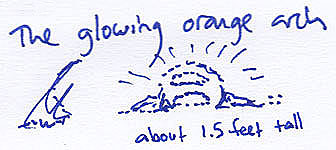
The glowing orange arch We got to the bedroom and the explosion went off with a great flash of light. I was surprised to notice a golden orange light continuing from the area of the experiment. We looked out the window and saw a glowing shape — a circle with an orange arch across the center, made of hardened, chalk-like material. We watched it glow with a strange light, and I knew it was some powerful portal. Then it collapsed into dust and the light was gone. The explosion had utterly wrecked the car I’d parked next to it. It was kicked back about 16 feet, with the entire outer frame of it knocked askew, and it was all deeply corroded and melted. I laughed and said I should have moved the car first.
Curiosity: This is a strange tangent in this dream. I have no idea what the resultant orange arch is. It was certainly unexpected.
-
Many Minds Sharing One Dream 1994 • age 19
Falling asleep, I held in mind the desire to dream about the oneness, to feel and experience it, and to awake 4 hours after falling asleep. It worked — I awoke suddenly on my own nearly four hours after falling asleep, just as I had wanted! . . . I felt as if I were many minds sharing the same dream. . . . Scientists, earlier and later in the night, studying what we felt, where we were. We were doing experiments, asking questions, yet I can’t recall the answers. The first moment I peeked my eyes open this morning I saw incredibly bright light, as if the natural light had been intensified. I felt charged up, and I flipped and flopped in bed as if I was experiencing some sort of orgasmic ripples.
Shared Dreams: Sometimes when dreaming or high I become keenly aware that there are a lot of “us.” I say “us” because they seem like kindred spirits, enjoying the same dream or experience, somehow connected to me or part of a greater personality.
Creating Drama
We can create drama when we’re looking for some excitement, either to challenge ourselves or just for fun — just as children do during imagination play.
-
Half a Conversation 2024 • 5:30 AM
I was in bed with the lights on in my childhood room in Blaine House. It was dark outside, and Buttercup was there with me. She was having a conversation with someone, talking about me in glowing terms. . . . I only heard her half of the conversation, with pauses between where someone else was talking. . . . In the meantime, I was just thinking to myself, about her conversation and about other things. . . . I thought that I was doing pretty well, felt pretty strong, and was ready for a challenge.
So I left the room into the hallway, with the thought “there will be an intruder in the house.” And I saw him!
Creating a Dream: Here I am hanging out in my bedroom in the near realm. I’m thinking, watching Buttercup dream, and then decide to create my own drama with a frightening dream of my own. I enter the dream by leaving the room to go into the hallway.
The challenge that I set for myself was no joke — a terrifying situation. It’s like I’m trying to get myself to learn ways of dealing with situations without falling victim to fear.
Overcoming fear is one of the central themes of physical life.
Overcoming Fears
Our dream self tests our waking self, putting it in different situations, training it to overcome fears.
-
Let’s Get Nuked 2025
My family was in this house in a familiar big astral city. It had big picture windows all around — likely a rationalization of looking through the walls. We were looking out, and there was a huge explosion off in the distance, out of sight. Nukes, again. We could tell where it hit by where the wave of wind and debris came from, burning and disintegrating (to an extent) everything in its path. We huddled together on the couch, scared. Where would the next one hit? We looked around out the windows.
But then I grew tired of this. I decided that the next one was going to hit right here. I looked out the window behind us. I saw the missile coming directly towards us. It smashed through the window and landed on the floor directly in front of us. It was metal, about a foot and a half long. For a moment, it didn’t explode. Part of me thought “whew, we’re lucky!” but a different part said, “No. It explodes.”
Everything turned white, and then it faded… we were still sitting there, huddled together, nothing changed. “See?” I said. “We’re fine.”
I went on to a different dream.
Extinguishing Fears: Here I find myself in a situation that has always caused existential dread. I could have tried to survive it, cowering behind the couch, but I was tired of being afraid. I forced the issue, faced the fear dead on and survived it.
-
Kindred 2025 • 5:15 AM
The woman says a Christian prayer before eating. When she’s done, I say a mocking prayer. There is shock around the table. I feel blazing energy from within. I calmly explain the truth of what I know in regards to what she said in the prayer. On one hand this seems so rude, me challenging their conceptions of God. But I continue, and though they are shocked, they listen. I speak in their terms, using the term “God”. I am walking around the house with her now, listening, correcting her misconceptions. She listens, responds, in a strange state like in shock. I don’t know if she’s letting it in, hearing me, but this goes on for a little while.
Challenging Beliefs: What’s significant about this is that I’m talking about my beliefs, which I keep entirely to myself in waking life. It was like breaking through a wall, and led to the powerful scene that followed.
Memory in Dreams
Memories
In the now of dreaming, our waking memories can be difficult to access. When we do remember, we may move into that memory and experience it as the world around us, as if it is happening again right now.
Whatever our attention focuses on is happening now.
Memories are an essential object of consciousness — we can enter them, move freely within them, and alter them. Even here in our physical bodies, when we remember, we are opening and going into the memory of that experience. In our moment-to-moment waking life, we are all recording memories of our experience. Most day-to-day experiences are dimly attended to by our attention and as such will likely never be recalled or shared with others. Others are important, life-shaping experiences that held the full weight of our attention and shine bright in our memory (both positive and negative experiences).
The process of interacting with rotes is described in Interacting with Memories.
Seeing Memories in Your Head
When we remember something in the dream state, we “see it in our head” as clearly as the scenery around us. This happens both with our own memories and memories shared by others. We can fully go inside it, seeing it instead of the scenery around us, or we can partially go inside it, which results in us projecting it to varying degrees into the scenery around us, usually merging the two experiences in strange ways.
-
Colorado Volcanoes National Park 2024 • 5:30 AM
Buttercup and I are on our way to Volcano National Park in Colorado. We’ve been there once before. It’s a drive around this mountainous area that includes a volcano and a glowing lake of lava. . . . I can see the route perfectly on a map in my head.
Remembering a Map: Here I’m likely looking at a memory, since I’ve been here before.
-
Stealing the Password 2025 • 3:45 AM
The characters and context from this dream are all from about 20-25 years ago, when I was working at Definition 6. The first thing I remember is a sort of stand-off with my boss. . . . He’s trying to subtly antagonize me into revealing if my server is at home or elsewhere by suggesting that I “go home, to the garage” to turn off the accounts. . . . I say that I can do it from here. In my mind I see the server, which is being hosted offsite (as it was 25 years ago), and I see my home computers, which are from that era, too.
Seeing Memories: This is a memory of a server and computers I no longer have.
Creating Memories
By thinking back to a scene and imagining, we’re able to create new memories that appear to be in the past.
-
The Superhero’s End 2011
Just when we were at the end of our patience, the food was brought out. There were a series of offensive things that happened, though I particularly remember adding to the story later on at some point to justify the violence to come — looking back and remembering new things that hadn’t happened before (and experiencing them distantly as I “remembered” them). The first was that I tried some chocolate thing but didn’t like it so I spat it out. The waiter who cleared my plate came back with powdered chocolate in a little bag — the very chocolate I had spat out, and offered it to me rudely. Then he took our centerpiece as he left. He also brought me this awful orange stew with a squeezed-out orange on top. Those two things were added later. But there was plenty originally.
Creating Memories: I was aware of creating new memories, with the purpose of justifying the violence to come. This sort of relief of cognitive dissonance happens in waking life, but it actually takes form in dreams.
Searching Memories Is Usually Creative
“Searching memories” is very purposefully worded. We remember things naturally in the dream state, but when we search for something specific in our memory, we often create what we’re looking for. We use the same specific search process as in the physical world — we imagine what we’re looking for to hold up as the target while we scan our memory for matches. However, in the dream state, that initial imagination is vivid enough to be mistaken for the match itself. We perceive it happening in the “now” of the dream, even though it’s understood as having happened in the past.
-
Betrayal of Memory 1997 • age 23
I was hanging out with Buttercup a lot. Then I feared having slept with Nika. I searched my memory for it and there it was. Oh, god! Anyone else? I searched and found Paige, too. Oh no! I began to dwell on this and feel really guilty. I thought “I’ll be good, do the right thing, and tell Buttercup” But she was so happy when I got to her that I was weighing the options.
By merely searching your memory for a thing, you can find it!
Looking for Something: Looking for a memory in a dream is sometimes equivalent to going into a fantasy. This is specific search at work.
-
Adventures at College 1998 • age 24
I asked if she had sex with them (which was impossible since I followed them right in, and also something I hadn’t been concerned about earlier). Betrayed by her memory, she said “yes”.
Creating Memories: She searches her memory and finds (creates) what she’s looking for. It wasn’t even possible.
-
Disney Park Madness 2025 • 3:45 AM
He also brought me a large box that seemed like it had been meant to be delivered to me. It was a bike pedal and something else, packed as if it were bought used. I quickly remembered/concocted a story that I had bought this as part of a video game for Bodhi when he was really into trucks, and told the guy I must have ordered it 10 years ago because he was 14 now (this is correct as of two days ago). I asked him to return it and credit me the $15.
Concocting Memories: There was no video game like this in physical life. And yet I remember Bodhi’s correct age just two days after his birthday.
False Memory Rationalizations
We may unwittingly create memories to fit a past event someone is referring to, or to explain how we got into a specific situation. This is a form of explanation rationalization. The goal is the same as other rationalizations — to quiet the waking mind, which might panic at not remembering something it should know or not knowing how it got somewhere.
-
Reviewing Is Recreating 1997 • age 22
The car was bashed into the back of this other car at a gas station’s repair shop. . . . I kept going back and replaying the scenes before to determine how this had happened. Eventually I created a reality where the original crashed car was the result.
Memories and Time: Here’s a great example of time in dreams. We can “go back” to see what caused an event, but when we do, we are actively creating it in the present while understanding that event as having been in the past. It’s like an explanation rationalization but with a fully-imagined scene.
Our creativity is in play wherever we are focused, no matter what “time” we’re focused in.
-
Home Near the Tower 1999 • 3 AM • age 25
[I] zip through a bunch of red lights faster than a car should be able to go. Then, terrified, I ask Buttercup “What’s wrong with me? Am I on drugs?” She says “Yes”. I seem to think back and remember that I was taking some sort of stimulant I had thought wasn’t a big deal.
Oh Yeah. . . .: Trying to make sense of my mental state, I try to remember when I took drugs and end up creating the scene. Another memory created as an explanation rationalization.
Verifying Others’ Memories Is Difficult
-
The Mistake 1997 • age 23
Buttercup and I are living on the top floor/attic of this new house. We’re so in love and hanging out with so many friends. It’s a nice house, too, and the area is naturally beautiful. It’s probably a higher realm. We have an entirely new network of friends. There’s this middle-eastern girl, a friend of a friend, who asks me for a ride home and I say okay. I’m flying her over a sea in a plane and she’s telling me how good I was last night in bed. I remember absolutely nothing of this but my first instinct is to accept it as true and try to remember. I work hard at this and begin to remember the previous night bit by bit. There doesn’t seem room for this to have happened and I can come up with so many reasons why I would never do it and why, if I did, I would remember it. . . . I remembered the final missing moments of “last night” which proved that nothing happened and I angrily told the girl off. I thought I must have been drinking and that’s why I had such trouble remembering. I told her she lied and I have a wonderful girlfriend and would never cheat on her and wasn’t even slightly attracted to her. She seemed hit pretty hard but she deserved it, I thought.
Dream Memory: I finally succeeded in not falling into another’s idea of who I was. The middle-eastern girl probably was projecting the image of someone else onto me. I had to go through tremendous effort to discern whether or not this event had occurred. I finally managed to do it without going into a fantasy memory and avoided a huge guilt-scene. Unfortunately, I didn’t realize that she was mistaking me for someone else and I let her have it.
Believing Mistaken Memories About Us
-
Dr. Eye Plucker 1997 • age 22
Part two is on some big bridge, and Liz is following Buttercup and me blurting out comments about how I cheated on Buttercup a long time ago and should tell her. So I finally did (I was making it up via suggestion) and she was crushed, but then got over it quickly.
Suggestion: I never cheated on Buttercup. In a dream, however, I accepted the suggestion of it as if it were true. This is more likely the less lucid we are. So we continue on under false assumptions.
For her part, it seems like her waking self was momentarily awakened to react to it, but then it fell back asleep.
Determining the Source of Memories
Determining the source of memories (astral or physical) is an important skill, as our actions mean different things in different contexts.
The waking self often mistakes astral experiences in the dream state as physical experiences.
-
Caught Cheating 2025 • earlier still
Much earlier in the night, I was hanging out in a mall in Minnesota. Word had gotten out that I had been cheating on Raven. I remembered “damn, that’s right, every time I traveled to visit an old girlfriend or a college, I pretty much always ended up sleeping with someone”. There was a bunch of people from my high school chasing me, kicking me, shouting at me. “But wait,” I reasoned, “this was not cheating on Raven, since we were long broken up, but Buttercup. Is that really true?” I wondered. “No, that was all in dreams. I never cheated.” Now, rather than believing I deserved this abuse, I knew I didn’t and pushed back at my attackers.
Astral or Physical?: I needed to remember if these memories were astral or physical, as it makes a big difference. Rather than getting caught in the drama, I refocus on my broader self context and am able to correctly determine that these were astral memories.
Photos Fade to Black
It’s impossible to take and keep photos in the dream state. The dream state is a more fluid, flowing state of now than the physical. Fresh creativity flows into everything. A static, flat, stationary picture can only exist so long as it is continuously maintained in attention.
-
The Office Tower Party 2025 • 6 AM
I found myself in another amazingly stylized area. I tried to take pictures. I eventually got the game-related photos app [on my phone] and took some, but each one ended up being something really weird that quickly faded to black. . . . Coming back to Buttercup and Gwen, I saw them dressed in some amazing new flapper-style clothes, and after struggling with the game app, I began to take some pictures with the weird photos app. I took a few, and when I went to look at them, each photo of them turned out in a completely different style — different colors, contrasts, time periods, even cartoon style. I wondered if it was one photo and I was scrolling through infinite possible styles. Each faded to black after a second or two. Frustrated, I put it away.
Disappearing Photos: Each photo turned out weirdly different from what I took, or wildly stylized. The wild creativity of the astral was apparent in the styles. While memory is perfect, we often relive our memories and creatively change them from the original as we explore other possibilities.
Each photo fades to black. In the physical, the same thing would happen visually, if not for the quick movements of eye saccades. Sensory adaptation sets in, and everything fades to black. In other words, we can only see when we see change. Maybe that’s a quality of consciousness itself.
The Lighting of the Memory
While our mind as assembler usually makes everything fit together seamlessly, sometimes the lighting of the original memory is visible even when integrated into a scene.
-
Memory Rooms and Exploding Dreamstuff 1997 • 6 AM • age 23
I peeked out and saw Emma come around the entranceway and peer over. That room was playing a memory of her and had the same ambient light that the memory was recorded in, which didn’t match with the silvery-dawn light of the rooms around her.
Echoes: I could tell Emma’s appearance wasn’t true, as the light she was bathed in didn’t actually match the ambient light of the dream. It was a memory being replayed just as it was recorded.
The original lighting is probably visible here because she’s in a separate room, which allows her part of the scene to have its own lighting.
Dreams in a Past Timeframe
Some dreams are set in a past timeframe. When this happens, the settings, characters, and objects are drawn from the self we were at that time.
See also Earlier Self Perspectives.
-
Bedroom Cleanup 2024
I set [the rolls of colored wrapping paper] down on my childhood bed from my room in Blaine House. . . . This was the bed with the pink and yellow cover from my early childhood.
At this point I began to clean up garbage from the bed — bits of wrapping paper scraps and plastic. To the side of them was the plastic molding for a model kit — the kind used for model airplanes and such. I checked it and almost all of the pieces were taken out.
7-Year-Old Timeframe: The time when I had this bed covering was about the same time I was briefly into doing models. I got some as gifts, and built them, but they weren’t my favorite thing.
-
Caught Cheating 2025 • earlier still
Much earlier in the night, I was hanging out in a mall in Minnesota. Word had gotten out that I had been cheating on Raven. . . . There was a bunch of people from my high school chasing me, kicking me, shouting at me.
Girlfriend In Context: In the timeframe of dream — being in high school in Minnesota — the girlfriend I’m cheating on translates to Raven, my girlfriend at the time.
-
Stealing the Password 2025 • 3:45 AM
The characters and context from this dream are all from about 20-25 years ago, when I was working at Definition 6. The first thing I remember is a sort of stand-off with my boss. . . . He’s trying to subtly antagonize me into revealing if my server is at home or elsewhere by suggesting that I “go home, to the garage” to turn off the accounts, as if they’re hosted from a computer at my house. His ploy works at revealing that I have a server, though, as I say that I can do it from here. In my mind I see the server, which is being hosted offsite (as it was 25 years ago), and I see my home computers, which are from that era, too.
I arrive home in our present living room and close all the blinds — they are slat blinds like we used to have in the house we lived in then, not the folding blinds we currently have. We didn’t live in Hibernia house 25 years ago, but returning “home” meant coming back to the near realm where I’m sleeping.
Set In the Past: The timeframe that I worked that job is partially brought with me. The layout of Hibernia House (my current house) in the near realm was accurate, but the blinds took their appearance from that older time period.
The Language of Dreams: Styles and Rules
Applying Different Rulesets
Physical World Rules
Life in the physical world is the primary external ruleset we apply to dreams. See Waking Influences on Dreams.
Video Game Rules
Dreams that are about a video game are invariably a cross between real life and that game. They’re always fully realized 3D places with realistic imagery (not pixelated) but they often follow the plot and rules of video games.
-
Scratching Boy George 1989 • age 14
[My Wadsworth and I] saw a wooden ship floating by, so I jumped on. . . . I had the hammer from Zelda II, and went around hitting parts of the ship with it, hoping to reveal treasure like in the game. I went to the front and put two glowing lumps that were each about three feet long into the furnace. Then the ship started sinking. We all jumped out, and soon fell down a waterfall. There were two more waterfalls, and after the first, I caught a quick-moving side stream. No one got hurt. We came to the shore by a cave-like opening with a huge metal door inside. . . . I opened it, and found the world of Zork.
References: Zelda II and Zork are video games.
Video Game Behavior in Dreams: Here I go from one video game context to another. When I am really into a video game, I sometimes take the game behavior into the dream. Here I search the ship for treasure using a magic hammer.
An interesting thing about Zork: as a text-based game, all the imagery for it is created in my head. I don’t recognize the appearance of the huge metal door at the time in the dream, but it matches the description from the game, and the image I imagined for it.
-
The Best Video Game Ever 1997 • age 22
I find Zelda for Nintendo 64, so I pop it in and start playing. There’s a number of selection screens asking to select view, asking if you like the Co-op Bookstore or not, and other options. Finally it started. It showed a sloppily-rendered world overview, and you scrolled down into the city you wanted. At this point, it became real.
We went to a big castle. There was a giant spider and I killed it with the “step” command. Then I opened a chest, then another that contained a packing peanut, and I used that to magically open a third, which contained one of my suitcases filled with games, clothes, and supplies.
References: The Co-Op Bookstore is the bookstore at Oberlin.
Mixed Context: This was a humorous combination of Zelda scenery, text-based gaming (the “step” command), and my waking life.
Absorbing New Rulesets
A rote can even come with its own set of rules that get absorbed as backstory.
-
Magic Users 2016
I was a magic user. I lived in an upper apartment in a concrete-floored, cinder-block apartment building. The building was a block wide, and maybe 10 stories tall. It had warehouse-style windows, each with 9 square panes. One window in my apartment had a broken pane in the middle. This was where one would magically gain entrance. There had to be a breach. I repaired it a few times by putting paper on it, sometimes with a note to would-be intruders. The paper prevented long-distance entry, but if I were standing outside, I could punch through the paper and magically enter through the 10 inch square opening (apparently size wasn’t a consideration).
The most common form of magic was this: you’d point your wand to one point, tap it there, then point to another point, and tap it twice there. It would form an invisible path. At times something at the starting point would travel along the path to the ending point. At other times, the path could be traversed by walking or running — typically when the caster was at the starting point. A more complex form of this was adding a vertical dimension to this. With this I could walk into the air from the start to the end point. Fewer people could do this. I could also do completely vertical versions, launching things up and down.
There was a battle in a large sand lot. There were maybe 5 people involved, including myself. There was a stronger magic in use as well, like the travel spell, but it ripped a portal in the air for instantaneous travel. The portal started as a vertical line maybe 10 feet tall and the space around the line rippled the light behind it, more and more until it opened and a brighter opaque light came out. One would then enter it and appear elsewhere. I was capable of this, but it took a lot of effort, while I could do the travel spell effortlessly. The battle was a little more like a duel, chase and dodge.
[There’s a huge story that follows]
The Rules of Magic: We can even absorb and apply the rules of a new system of magic! What’s wild about this rote is that it comes with its own well-defined magic system — how to cast the spells in different ways, with different effects, and how they each have different levels of difficulty. This isn’t remotely related to anything I’ve heard of before.
-
Click Switch
I had the power to switch things by clicking them with my gaze. I would gaze at something, click it with my mind, then gaze at something else and click it with my mind. Upon the second click, the two things would switch places. I switched some clothing with a purple shirt. I switched a car with a helicopter.
Astral Control: This shows a degree of control over the astral that surprises me. This is certainly inspired by computer interaction with the clicking. The expectation that two things would instantly switch places made it happen.
Applying Different Styles
Another influence on dreams is that of styles. Whatever style of experience is most freshly in our minds may influence the physical form of the dream environment. This can include any kind of artistic style or uncommon ways of interacting with the world.
Communication Through Computer Windows
These dreams happened during a time when I was playing with the UI of my Mac, changing the appearance of scrollbars, menus, colors, and backgrounds.
I think these are especially revealing in that they reveal different streams of communication coming into the dream.
-
Conversing with Ghosts 1997 • age 22
There was a group of ghosts I conversed with through two computer windows open in the air before me (a Mac dream interface!). I asked them questions, took notes, and got their names — one was Link or Lars.
Mac Dream Interface: I was communicating through two Mac windows in the dream, an unusual physicalization of the energy bridges between myself and two ghosts.
-
Old Buddies 1997 • age 23
I’m traveling to Spring Lake Park, fast-floating. I arrive and start looking for Manville. The school is empty, but I find him in an asphalt patch with a small backpack and three decks of Magic Adventures. He said it was his last gift request from Brandon, so they could still be together by playing games. In another dream window I was getting a call which I had to transfer from another network but no one was there, so I started speaking weird nasty gibberish into it.
These dreams were framed in brilliant colors, like deep blues with gem-like scroll bars. These are the window effects I was looking for in Kaleidoscope yesterday!
References: Kaleidoscope was a Mac UI customization extension.
Mac Style: Here we are in the world of computers, with dreams and outside communications separated into different windows.
Cinematography
-
The Green Dragon of Sauron 2004
I was living through a grander and brighter retelling of The Return of the King. Aragorn, Gimli, and Legolas were traveling on oliphaunts on this green grassy hilly land. There was a scene of each coming at the camera, in a style like comics but vivid, well-defined, and realistic. Then the camera spun around 180 degrees to a shot of a dark land with a stone monolith, lit by gray moonlight, the grasses making everything look hairy. A threatening landscape. Then back to our heroes, charging towards this dark land. They’re mounting a hill and crossing . . . a cave through a mountain pass. . . . As they exit the cave tunnel, they enter the land of the stone monolith, but in daylight. The camera scrolls forward to show the monolith, and Sauron’s army gathered in all directions around it.
References: Oliphaunts are giant war elephants from Lord of the Rings.
Cinematography: The third person perspective took on dramatic cinematography here, soaring above the characters, taking dramatic turns to reveal the scenes. This is, of course, my own perspective as I soar about.
-
The Buried Building 2024
I’m riding on a bike, escaping. Perhaps I’d stolen something? But I pass a tank on the road. It turns its turret around and fires at me. Focusing in on the moment, I see the explosive canister pass by my head. In slow motion it continues forward ahead of me, then explodes. The explosion is cloudy rather than fiery. A circular hole is left in the ground, and beneath it a 2-3 story drop . . . [down in the hole, we happen upon a wolfman] I narrate that “at this point, something small happens, but it’s the most important moment of his life”. I zoom in and time slows as the wolfman picks up one of the jars to look at it, and a tiny spider climbs down onto his hand and bites him. The bite makes him indestructible.
Attention Cinematography: This is the cinematography of attention. Time slows, and you zoom in for highly dramatic moments where attention goes in deep, getting closer and expanding into time. This common movie style is based on the true action of attention.
In the same way, your typical movie “training montages” are periods of little attention, showing a slow progression over a contracted period of time.
The Language of Dreams
Spoken Languages
-
Barcelona Dreams 2000 • age 25
Most of the night I was pleasantly engrossed in building structures out of Spanish.
Building Structures: I’m not quite sure what I meant with this, but I was in Barcelona at the time, and took three years of Spanish in high school, so I think I was refreshing myself with the language and the structure of sentences.
Programming Languages
-
Dreaming in HTML 1997 • age 22
The dream was in terms of HTML.
Dream Language: Dreams speak to us in the most fitting language, even changing from hour to hour. A day of Warcraft and the dreams may speak to me in terms of Warcraft. A day of web programming, and the dreams may speak to me in terms of HTML.
-
I Ate Your Sandwich 1997 • age 22
After working with Photoshop today, tonight’s dreams were of graphics styles language. Amazingly neat and informative but beyond my memory’s grasp, once again.
Dream Language: This time in the “language” of Photoshop.
Music in Dreams
-
A Wild Night Out 2003

Corridors now nearly closed I’m walking with someone who at times appears as Buttercup or Kai. We’re walking through blue-walled corridors and memories — through passages nearly closed, once open long ago, but now a squeeze, dusty with cobwebs.
The city is like San Francisco and New York City. There are lots of people and shops — everything is packed in. In the background, Alfred Waits singing Fiona Apple’s “Slow Like Honey”. I can hear people’s thoughts. We had to walk through what was now someone’s apartment. After showing us through, they telepathically complained that they should put locks on the door. We’re looking for a pool. The dream is poetic, crazy. There’s poetry in everything. Wild sudden sex, empty rooms.
I throw my sandals through a crack, hope to find them later. REM plays “End of the World As We Know It” in a smokey bar. People crowd around. A girl with black tights on a table cheers. . . . A bum roots in a fountain. Kai, a man in a suit with a hat, says he’s going to vote for the “straight man” this time. Last time he chose mushroom — a card with a Mario mushroom flashes in his hand.
References: Alfred Waits, Fiona Apple, and REM are bands.
A Dream to Music: This dream is to Alfred Waits singing Fiona Apple’s “Slow Like Honey” — this is a song cover that doesn’t exist in the physical. The music seems to give it a wild style, like beat poetry, short scenes passing by, my mind open to receiving people’s thoughts and experiences as we wander through what seems like the near realm of a busy city.
-
Turbo
I run through the lunchroom and the school closely chased by a Mr. Plant look-alike. I’m running at turbo speed, but so is he. We run to the song “Good Lovin’” by The Rascals.
Soundtrack: This dream came complete with a soundtrack!
Variable Tempo and Volume
Something with a steady beat undergoes alterations as our attention shifts to and from it.
-
Mordred’s Hell 1997 • age 23
Mordred’s my focus this time. I find his house. It’s sunny and his parents are outside. I go to them and say hi. Then I set up my computer nearby (which broke in an earlier dream) and set their boom box to play Ween. Before too long I realized how totally weird what I was doing was and packed up and decided to go see Mordred now. . . . Here’s a note about the Ween CD: Once I put it in I didn’t focus much on it and it was going by really fast. When my attention went to it, it slowed down and got louder. The effect of my attention was just like being high, but to a larger degree.
References: Ween is a band.
Background Music: Being high on marijuana feels just like dreaming while in the body. I have experienced this kind of attention-modulated experience in that state, but in the dream, it was to a much higher degree. When getting less attention, music seems to pass by rapidly, but in the dream, it also gets softer. Without physical ears that must hear, nonphysical “sound” requires attention to perceive.
-
The Red Scooter 2000 • age 25
Then we left. We can hear this Fiona Mclaughlin and Smashing Pumpkins concert and we drive around looking for it. The traffic is so fast that we miss our turn. We turn around and end up listening from this apartment complex. There are really weird speed effects and accelerations going on.
References: Smashing Pumpkins and Fiona McLaughlin are bands.
Variable-Speed Music: This is another case of music in dreams where the tempo and speed is variable and strange. I wonder if the dream self focus has difficulty maintaining a regular tempo, as attention phasing on and off it speeds it up and slows it down.
Broadcasting Music
-
Instant Band 1998 • age 24
I’m hanging out with three guys who I don’t know in waking life but are friends dreamside. I started this music thing — it came almost fully formed into my head with a fantastic beat. I somehow broadcasted the song as a whole outside myself. With my attention I added new lines and rhythms to it. The music was so good I would have bought the album in a minute.
The four of us danced and skipped around this simple house with open windows and doors. It was in a neighborhood similar to ours. We were making a lot of noise, and then I heard a cop car say over their loudspeaker “4-3-2-1 Please cease your activities.” We got a little scared and went to the brown cop car in the driveway next door. In it were 4 guys and one invited us to come play our music at the party tomorrow at 8.
Inner Music: I’ve done this a few times in dreams — the music follows my imagination instantly, varying in the just the ways I want at just the time I want to make them into the ultimate dynamic songs that I would love.
And apparently I can broadcast it out into the general astral world around me — even to be heard by people I’m not meaning to include.
-
Africa (by Toto) 1997 • age 23
This whole dream segment was set to the song “Africa” by Toto. “It’s gonna take a lot to take me away from you. There’s nothing that a hundred men or more could ever do.” I had to kickstart the song because I wanted to hear it. It’d start then stop and I had to force it to continue. At times other people in the dream would sing along.
-
Hanging Out 2020 • 7 AM
I heard someone singing “Stairway to Heaven”. I began singing along. Someone else was singing along, too. Probably someone from the platform. I liked my voice least of the three, but I still gave it my all. The originator of the song stopped playing and singing the song. There were a few seconds of silence. I didn’t want to stop yet, so I started it up again. The next guitar notes played — I didn’t need to rationalize this by imagining I was playing a guitar — my dream self was in control. I began to sing again. And the other voice joined in with me.
Sing Along: I can hear “Stairway to Heaven” in my head when I imagine it. I’m not just thinking about it, I’m hearing it. So it doesn’t seem odd that in the dream state, others could hear that as well.
Remembering Dreams
Why Remembering Is Difficult
Our experiences in the dream state follow our attention, with varying degrees of adherence to physical laws. They can go so many levels deep — stories within reveries within gateways, with varying levels of projection. Add to this the ability to rewind stories and taking different actions, visual communications from people not present, expectations coming true, rationalizations from our waking selves, and sensations from our sleeping environment, and it’s no wonder they’re hard to remember.
Imagine the confusion if someone were observing your experiences, but couldn’t tell the difference between your physical life and the experiences of the characters in books you were reading, movies and shows you were watching, your daydreams, news and web sites you were reading, and stories other people were telling you. If they thought all of that was actually your direct experiences, then you’d have an idea of how confusing our dream life can be to our waking self.
A key part of understanding our dreams is being aware of what we’re thinking at any given time — especially what we want, fear, or simply expect to happen. If what we’re focusing on happens, we know we’re the cause of it. That self awareness lies at the center of understanding our dreams. It’s also important to understand how consciousness works so that we can make note of the various scene transitions.
Difficulty Remembering Transitions
-
Map Gateway 1997 • age 22
I look at a US map. I see that some pyramids and a sphinx are near San Francisco and I mark down that I want to visit them. Also it seems like the lava dreamscape with the ocean is in San Fran.
Maybe we had arrived in San Fran, but wherever we were we were searching this area of hilltops for a home. . . . Oh! Upon further reflection, I think it was the US map with pyramids and such that brought me to San Fran — I first got caught up in the sphinx surrounded by advanced preservative technology.
Remembering Gateways: It’s easy to miss the transition in gateways. You remember being in one place, then suddenly you’re in another. Here it takes me a minute to piece together that the sphinx on the map was the gateway for my arrival in San Francisco.
Difficulty Remembering the Order
I sometimes wonder at the order of things in dreams. I may remember disconnected scenes in the dream, or the dream appears to repeat, and happen different ways different times. Some of these are subdreams, where I imagine what could have happened, or rotes in which I go back and take a different path.
Names and Words
I love it when I remember weird names of things from the dream world.
-
Sound the Nome
I got off the bus with this girl who was coming with me. Eventually, in my old room, I say disappointedly that the only two movies I own are “Sound the Nome” (sounds like “gnome”) and Sixth Sense.
-
The Stinging Ocean 1996 • age 21
Manville turned into a big “N’gtoash Nisk” with a spiny head.
-
Badgerdoo — The Future of Video Games 1996 • age 22
The Cloerma of Badgerdoo was the name of this game.
-
The Magua Discol 1998 • age 23
Outside everyone was turning around to see their new sign. In yellow and white with an edge of blue lightbulbs was “THE MAGUA DISCOL.”
-
Indraheen 2024
A middle-aged Indian woman with short hair sat across from me at the table, casually levitating a biscuit while she listened. . . . She somewhat shyly said her name was “Indraheen” but then got up and left, disappearing around a dark corner behind her. I realized I had been too forward and scared her off. I woke up, remembering her name.
Indraheen: I looked the name up upon waking. Indra is the god of the sky, weather, rivers, and war. The suffix “heen” in Hindi means “without”. Together, it means “Indra-less”.
-
Taciter 2025 • 8 AM
I’m reading a black and white line-drawn comic about some animal gods coming out of hibernation to train someone. One goes to an old man named Taciter to complain that another isn’t doing their job.
-
The Funny Show 2026 • 5:30 AM
[The football player’s] hair was this enormous flat top shaped like a wedge. He went up to a orange-red patch in the field and pressed the top of his flat top into it. When he lifted up his head, his flat top had picked up that color. A bunch of other copies of himself went up to the orange-red patch and did the same. They all started slamming the top of their heads into the ground . . . as a celebration? This was so amazing and unexpected that we all started doing our own version of it to the beat. . . . It was called “niffling”.
Food and Drink
Things that Enhance Recall
Bringing Consciousness Over
When I spend time trying to retain consciousness while falling asleep, it can pay off in vivid dream recall, complete with being able to recall exact quotes. This helps build a bridge to other levels of reality.
-
Lucid Dream: Bruce’s Arm and the School Bus 1997 • 10:13 AM • age 23
I went to bed at 2:30 AM, got up around 9 AM to drive Buttercup to work, and then went back to sleep around 9:15 AM. I tried holding my inner eyes open from 9:15-9:30 AM but to no avail. So I just went to sleep, lights out. The window was open with lots of singing birds. Temperature very comfy.
[I have an incredible lucid dream]
Why It Worked: It’s been said that a reliable way to have a lucid dream is to awaken in the morning, get out of bed for a short time, and then return to sleep. I have driven Buttercup to work, come back, and tried to dream lucidly many times, but haven’t succeeded. What was the difference this time? I think that holding my inner eyes open was the key factor, something I haven’t been doing lately. This is a technique in which I focus intently on the darkness in front of my closed eyes, watching it intently as I fall asleep.
Shifting to Physical Focus
Shifts to physical focus while dreaming seem to increase dream recall, as it’s involving the waking self more often.
-
The Joined Trees 2024
All four of my lucid dream alarms went off last night. Each time my focus flashed to the physical side, I felt I wasn’t within a dream. But those little shifts in awareness back and forth have definitely increased my dream recall.
Playing Audio Messages: I set up audio messages to play into my earbuds during the night. This kept calling my waking self into the dream state, which has increased my dream recall.
Open Windows
Having the windows open provides fresh air, which I feel makes my dreaming more vivid. Additionally, the sounds from outside that it lets in momentarily rouse the waking self’s focus more often, keeping it nearby while dreaming.
-
The Monkin — The Little People 1995 • 3.5 hours in • age 20
I awaken 3.5 hours into sleep at 6:30 AM. The window is open, and there is morning light.
Morning Light, Morning Air: I think there may be something to the idea that fresh air makes me dream more intensely, and remember my dreams much more.
Remembering While in Bed
The best time to remember dreams is right after waking up. Remain in a sleepy waking state without moving, and allow scenes to pop in and expand. A single scene can unfold the rest of the dream experience.
Being Reminded During the Day
-
The Turtle and the Eel 1994 • age 19
I try to incubate a dream about Kayla, but no luck. . . . [I dream about trying to free people from a death camp]
Wait wait wait! I forgot the coolest of all dreams! An hour later something reminded me of it. I did connect with Kayla! We were canoeing in the boundary waters with some friends, surrounded by a pine forest and clear water, watching the stars.
References: The boundary waters are the lakes at the border of Minnesota and Canada.
Remembering Dreams: Here’s a good example of how I remember dreams. Sometimes I’ll awaken with a memory still in my mind — a single character or scene usually, and then I sort of unwind the memory from there. Often this is done in reverse, as the most recent dream is the clearest in my head. Later in the day, certain things might trigger memories of other dreams, but by this time, some details may have faded.
New Life Experiences
-
The Rogue Faction
I was watching a show that felt like the future. There was a greater intelligence, a higher world, a more advanced humanity. It was riotously creative and complex. The setting was a futuristic city. . . . The scope was vast, and I was rapt. I felt I had not dreamed this freely in ages. This was after 4 days on vacation, without a computer.
Recharged Dreams: My new experiences and break from the repetition of daily life inspired newly empowered, fresh, expansive dreaming. New experiences awaken the mind — new ideas to explore, new connections to follow.
As attention is freed up from routines, it’s available to flow into new experiences.
Alcohol
I often find that I have vivid dreams and good dream recall after a night of going out, drinking alcohol, and socializing.
-
Influence and Purple Goo 2001
What vivid dreams! After a night of drinking, it’s always like that.
Valuing Dreams
It can be so easy for the waking mind to dismiss dreams. As we switch to our waking context, the threads of our dreams rapidly lose relevance and the interests of the day grab us. But grabbing hold of that one single thread we do recall can bring back an entire scene which can lead to more scenes, bringing back really important and revealing details.
-
The DeadStorm 2010
I was in a medieval village, with lots of people everywhere. It felt sort of like a Renaissance Festival but everyone was in costume and it went on as far as the eye could see. There was a storm overhead. I was in a black tent building selling swords and various things. I floated out and peered up at the storm. “Wouldn’t that be cool if there was a black path of the storm coming right overhead, like a dark road?” I thought, and looked up to see it become so. “Darker,” I thought, and it darkened. “Darker still,” I thought. Then I turned to one of the villagers and cast words into his mind, which he spoke, “What dark and foreboding sign is this in the clouds?” Then with glee, I asked myself, “So what comes down this frightening dark path in the sky? Demon horsemen. The undead.” I looked up, and there were the hoofs of horsemen showing through the dark clouds in the sky, galloping overhead.
[I continue to consciously create and act in the fully immersive scene]
Dismissing Dreams: Written at the time: Even as I was getting up and considering whether to write down the above dream, I thought dismissively for a moment, “Ah, that wasn’t a dream, was it? I was just thinking it.” Even while knowing it was more real than anything, that I was there, that I was inside the action, and it was fully realized. But one context, compared to the other, will always seem that way. The waking world seems that way to the dream self.
What Hinders Recall
Multiple Versions — Rewind and Retry
Another confusing factor in remembering dreams is that we have the ability to rewind and retry scenes. This is only possible in rotes (memories), but a similar experience could be the result of a short subdream happening in realtime.
The result is that we’ll remember a scene happening multiple times in different ways, which our waking self has trouble making sense of.
See Rewind and Retry.
Emotional Attachment
If you’re having some incredible experience but are unable to pull yourself out of it to write it down, it’ll transition into dreams and you’ll have forgotten by morning. No doubt some of the most amazing dreams are forgotten because I am too involved to leave them.
Sleeping In
Sleeping in has always caused me to forget dreams, as they fade over time. At best I lose the details and at worse, I completely lose the threads of context and it fades away completely.
Snoozing is equally bad. When my alarm goes off and I hit snooze, I often begin a new dream that breaks off my memory of the previous one. Each snooze does the same, and I end up remembering very little.
-
Distracted from Lucidity 1997 • age 22
I had crazy dreams all night. I remember very little, as I slept in.
Garbage Dreams
I consider dreams garbage when it’s just a regurgitation of waking habits.
-
Elfquest What If 1997 • age 22
I was reading Elfquest, and when I asked “What if the wolfriders hadn’t turned this one way and met the others?” The answer was “Someone else would have,” and I jumped into the action — a frozen tundra. The wolfriders went the other way and instead the more basic characters appeared — Snoopy and all the gang. It was all kinda like Warcraft, too, building castles and houses and such.
References: Elfquest is a graphic novel series which features the Wolfriders. Warcraft is a video game. Snoopy is from the Peanuts comic.
Too Many References: This is such a mix of references from my waking life. My waking Warcraft obsession is asserting its influence on my dream stories. But Snoopy? I haven’t thought of that cartoon in a decade.
-
Body Transformations 2003
I decided to stop playing Warcraft III and last night worked on Foundations. For the first time in months, I remember a dream.
Video Games: I played World of Warcraft obsessively for a few years. During this period, there was a tendency to have garbage dreams — dreams that were about the game, playing the game, that caused me to want to play the game when I woke up. I had little dream recall, and when I did, it wasn’t worth writing down. So I took a break and remembered this incredible dream.
Video Game Dreams
Often when I’m deep into a video game, my dreams become what I consider garbage dreams. I spend a lot of time in the dreams acting as if I was a character in the video game. Dreams like this rarely produce any insights at all and after a while I stopped writing them down altogether.
Thought Forms
Thought Forms
The Nature of Astral Matter
The Elasticity of Astral Matter
In these experiments, I tested the elasticity through interactions with my astral body’s hands. If we expect it to be elastic, it will be, but then it will return to its original form.
-
Ghosts and Astral Matter 1996 • age 21
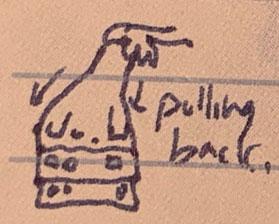
The stereo stretched as I pulled During a scene of emotional conflict, the next room began glowing an eerie green, and a large ghostly stack of stereo components appeared. I walked up to it and pulled at the top. Its features melted away as it stretched out, but when I let go it snapped back to its original form. It was some kind of elastic spirit substance.
-
The Underworld and Lava Flow Map 2000 • 4:15 AM • age 25
I ventured out into a foot-deep blue channel closer to the ocean. I thought about how I’d planned the Jurassic Park 2 dream I was having before. A black lava flow map of the island used in the first movie appeared before me, and I retraced in my mind where on the island all the events took place. I thought, “Yeah, that was a good, thrilling movie.”
The lava flow map wasn’t just imagined, THERE IT WAS in front of me. I picked it up and started to knead it and it became more pliable. Then I put it in some kind of rectangular pan and kneaded it some more. I could push my fingers deep into it and moosh it around. It didn’t smear or stick or tear or anything — it stretched. When removing my fingers the imprints slowly popped back out to form a smooth surface again. It remained black this entire time. One of my finger holes held its form as I concentrated on it, then as I became surprised that only one would hold its form, it then started to pop out. So then I turned to the original map (oops! there it is again!) and thought “Oh no, I’ve left it alone too long — it’s probably hardened.” I started kneading this one, too, and its resistance became less and less and I stretched it out longer and thinner bit by bit. Then I laid it over a shopping cart (?!) and turned back to the original map.
Playing with Thought Forms: Play reveals so much. Here we see the hard lava rock map thought form becoming more pliable and flexible from my kneading. This is likely happening simply because that’s what I’m expecting it to do. I was able to hold the finger hole in place only so long as I concentrated on it. Left alone, thought forms return to their original form and texture.
Only the Exterior Hardens
-
The Underworld and Lava Flow Map 2000 • 4:15 AM • age 25
I could see through the pan that [the lava flow map] had separated into layers. The bottom three quarters was an ivory color with brownish layer variations, then it transitioned to black at the top, which was hard and crumbly now. I picked it up from the pan and started kneading it and as I did so rock crumbles came off. Soon, as I worked with it, it seemed to become more uniformly malleable (and black throughout again).
Nature of Spiritual Matter: Written at the time: “When I looked into the interior of the thought form, I saw that the quality of the astral matter was a dull ivory. This is not surprising as I was near an underworld opening, and the region had an atmosphere of danger and adventure due to the dinosaurs.”
It is only the exterior of thought forms that take on color, hardness, and texture. Since the interior isn’t immediately visible, there is no need for it to take on these appearances. The interior retains the natural coloring and luminosity of the matter of the plane it’s on.
Liquid Interior
Thought forms appear to have a white liquid interior. At times, when they are suddenly pierced or crushed, this liquid comes out. This is not a projection; if we expected to see red blood, we would. But the natural state of thought forms is that only the exterior hardens into the expected shape, color, and texture. The interior retains the natural ivory-to-white color and flowing liquid nature of unformed astral matter.
This was likely subconsciously referenced in the movie Aliens, when Bishop, an android (very realistic but not “real”, like a thought form) is cut and white liquid flows out (see his hand below):
-
Stinky Williams 1996 • age 21
Then this big nasty guy came in and said he needed me as a vortex. So I shot at him and he shot back at me but missed. Finally I shot him and it was as if he was a sack with liquid leaking out. I chased him down and finished the job, forcing all the goo out. Afterward, he looked like a squished white spider. Later I was questioned on the matter.
The Stuff Dreams Are Made Of: The big nasty guy was a thought form, as it began to shrink away and lose color after I was done interacting with it.
-
White Goo 1997 • age 22
It seems like I go to the doctor a lot in dreams because I keep getting body reports. This time I learned of a reservoir of white sticky ooze in my hand. I tried to scrape it out but could only reach it with my tongue and had to lick it out and it was a thick and sticky white goo. Ugh! Then I had to lick gallons of it from my mouth and splat it out on the ground.
White Goo: I have really remembered this clearly to this day — it was so gross. It seems like some kind of internal though-form substance that I’ve seen before a few times.
-
The. . . . Party? 1997 • age 22
We ended up on the roof, watching people. . . .
The toy — a ball with counterweight Then I met this friendly Asian boy who was discouraged about sex, saying he’d never get laid. I sorta comforted him. He got out this toy: a ball with a long string and a weight — you’d throw the ball then whip the weight behind it in another direction for cool effects. He said he wanted us to play with it. I went down some stairs to get some distance and when I looked back up he was gone. He’d thrown himself over the edge of the roof to die. I ran to the edge and looked down. He’d landed head first on the concrete. His head was bashed in, and there was this white foamy liquid on the concrete all around it. I ran to the party and told someone to call an ambulance. Then I realized the kid was running behind me saying “Touch my head! Feel it!” I refused. He’d survived, and so he did it again and again, and each time it was like the tragedy was new. The next time, his head was a crushed up carton that leaked ice cream. I got more and more distanced from the drama.
Touch My Head!: I’ve seen many times when an astral body or thought form gets “hurt” or “killed”, this white liquid comes out. The second time I rationalized the white liquid as ice cream and his head became an ice cream carton.
The Hidden Cord
As we’ve seen, the astral body has an occasionally-visible but nonetheless essential astral cord connecting it to the physical body. Here are some instances where I see a cord connected to a thought form, one essential to its staying “inflated”.
A nonphysical cord (vortex, tunnel) connects every thought form to those feeding it with attention. This higher-dimensional connection does not need to appear as part of the 3-dimensional projection. The fact that it is not seen is simply a reflection of our not expecting it to be there. But sometimes when we relax, the deeper reality peeks through and the cord drifts into physical dimensions.
-
Deflating Tank 1997 • age 23
Then (did I supposedly “dream” this?) I saw visions of an invisible force shoving some people on a fence and yelling slurs. Then it shoved someone walking by, and went to a power line and yanked the cord out. The power line was how Tank was plugged in and the immediate result was that it rapidly began to shrink. It shrank until a conglomeration of featureless blue person-sized rooms was all that remained. My tent had deflated around us and was now in a sort of pool around our feet. The people in the deflated Tank poked their angry heads out and I just laughed and laughed.
References: Tank is the name of a co-op I lived in in college.
Inhabited Building Thought Form: I believe the cord was the source of the Tank thought-form. Without it, it deflated as if it was starved of its sustaining attention.
-
The Inflatable Water Park 1999 • age 25
I opened the box. Inside was a glowing green bean and two plastic canisters. There was a current coming from the canisters and I started hooking up these little models of water park rides to hoses that connected to them. I hooked up a whole bunch at once and they all began to slowly inflate. I was inflating a water park right there in Blaine House! They were spreading out across the kitchen, pool room, and dining room. At a certain point, I noticed the current was having trouble inflating so many water park rides at once, so I decided to focus on one. I unplugged the others and remaining one started growing really big. It grew into a huge courtyard with a castle, axe-throwing knights, children with LOTS of colored balloons (little thought-form bubbles), huge water park rides, games, and lots of people.
The hoses I’ve seen connected to thought form buildings — they conduct a current of energy/attention to the thought form to maintain its form or increase its size!
The Cords Inflating Thought Forms: Here we see very clearly that these cords are the method by which thought forms are filled and given form.
-
The Mirror People 2012
It’s dim morning light and I see a couple go into a house along the street on the north side of the school. It’s got a glass front door. I see one of the administrators showing off the house. I rush in behind them and say “you cannot buy this house!” There are all these little white VCRs (maybe 12 of them on the floor plugged in along one wall, and some are black) being offered as part of the house. “These are surveillance devices!” I shout and I start collecting them to destroy outside. The couple is shocked at this revelation.
Furniture Cords: What I take to be white VCRs are likely thought forms caught in the act of coming into being, probably on their way to becoming furniture! In the last house I was in, it began unfurnished and when I left and returned, it was fully furnished.
Buildings: Compound Thought Forms
There seems to be some unique rules about properties, their buildings, and the rooms inside each building. Each constitutes its own space within a larger space. There is a flow through a cord into a property, and from that to each building, and from each building to each room, and finally from each room to each furnishing within.
The analogy of grapes on a vine works well. Also, the analogy of being inflated through that cord remains a solid one.
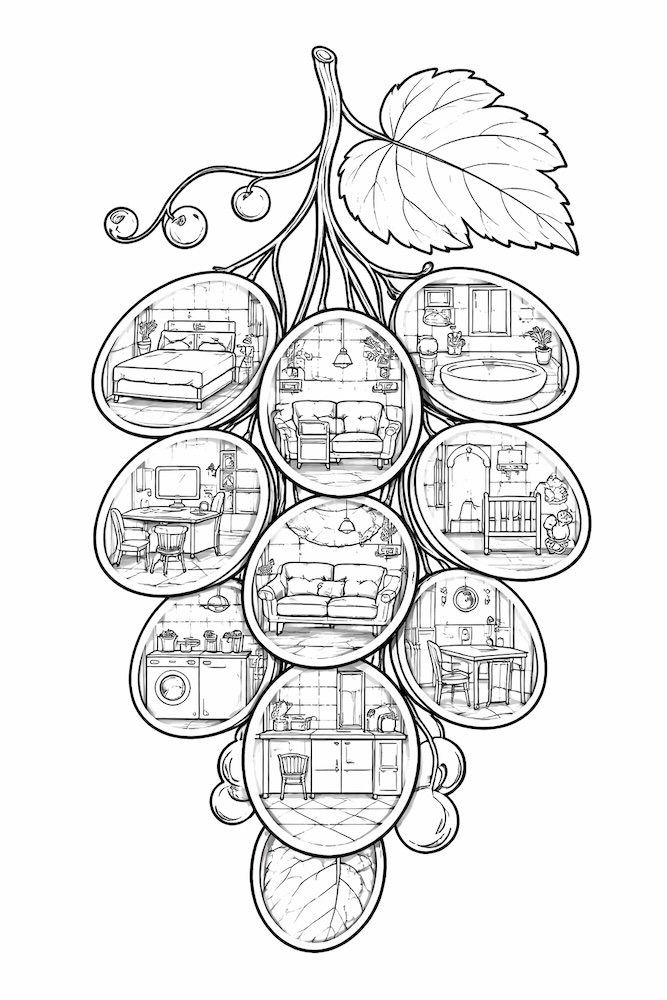
Separating a Room from a House
-
Deflating Tank 1997 • age 23
So Buttercup and I are living in an apartment in Tank. We have our kittens and everything is nice. We’re sitting, hanging out on the left side path, reading, playing with kittens, and talking with Tavin. Somebody catches us breaking the left sidewalk rule: “You can’t hang out there.” They imprison us in the dark underground garage. The prison term is for 10 weeks. I shout and argue and Buttercup says the kittens will die because they won’t be fed. I am fuming, and write a letter on this yellow-screened computer saying how random and stupid it all was. Finally we decided to hell with ‘em and we followed a car out of the garage. We went back to our room in Tank, but it was now a tent along a row of other tents behind the main building.
References: Tank is the name of a co-op I lived in in college.
Ejected From the House: Our room was separated from the other rooms in Tank upon our return, apparently a result of the group no longer wanting us.
-
The Detachable Room 2004
I’m at Blaine House, which I identify as an Oberlin college dormitory somewhat. . . . At this point, Kai came in. He wanted to do something. I said “Hold on, I have to pee.” He went around the room unhooking the power cables to Blaine House. I don’t recall if I saw this, or simply knew this. My room was where the fancy dining room was — on the second floor corner in the back. The whole house was similarly divided into small dormitory-like rooms. Now as I was peeing, Kai ran over to me and started jumping around. The entire room started rocking and shaking and I, laughing, fought to keep from peeing on the floor and my clothes and such, failing because the urinal wasn’t there anymore. So the shaking and rocking continued, then all at once the room slid out of the house, fell to the ground, and slid across the grass in the back yard, and finally down a hill. It was a rush! The room came to a stop and then fell apart so that there was one wall flat on the ground and another standing up precariously. We laughed. . . . About ten people from the school were there, laughing, amazed. . . . I returned to the house and my room, which had mostly regenerated, and people set the room loose again, sliding down the hill. . . . Then they did it with the next room over.
Buildings and Rooms: It appears that each room within a building is connected via a cord (or cords) to the larger structure. In “Deflating Tank” some rooms were also removed from the building, though in that case I didn’t see how it was done.
-
The Crumbling Resort 2011
I wondered “shouldn’t [the resort] fall over backwards down the cliff face?” And then it does. I thought about all the stuff everybody had lost in the collapse, and then decided to go back inside. I somehow got to our room, and it was intact. I wondered if this was a huge trick of sorts. Then the room shifted and started to move along this rail along the back side of the resort, along this frame that spanned the entire back of it. Then it turned and started moving upwards along another rail to its original position on the 2nd or 3rd floor. There, a man was waiting with these big spikes to fasten the room into the rail where it belonged. I watched as little dents in the rail opened up as he pushed the spikes into place. It was weird, though, as the room seemed to be backwards, or somehow facing another direction.
Indestructible Rooms: Another instance of the independent nature of rooms. Once again, destruction of the building doesn’t follow through to destruction of the rooms. And this rail system on the back of the resort to put the rooms all back into place . . . it was like seeing a physical analogy of the structure behind the structure, complete with spike fasteners and a guy working on it.
Boundaries: Limits on Thought Forms
-
The Backyard Lava Pit and Dream Crossover 1997 • age 23
There was a lava pool in the back yard. It was squarish, with constantly moving red and yellow lava. At one point it was spitting red coals up through the ground, many of which went over to the neighbor’s house. . . . It flowed down the alley leading to the neighbor’s house. It went into the back yard in thick sheets. . . . I realized the whole house was buried in lava. . . . I saw the result of the lava from the front street. It had filled in a perfect rectangle of our house’s property. Now I’m thinking — such potential, such thought-reactive stuff, and a brick of stone is what we make?
Implicit Boundaries: This shows that there are boundaries around houses and properties, just as there are boundaries around rooms. It’s like a personal space that can’t be expanded past. Oddly, it did spit red coals into the neighbor’s yard at one point.
-
Deflating Tank 1997 • age 23
[Tank] rapidly began to shrink. It shrank until a conglomeration of featureless blue person-sized rooms was all that remained. My tent had deflated around us and was now in a sort of pool around our feet. The people in the deflated Tank poked their angry heads out and I just laughed and laughed. . . . They came to me with pillows and Sid immediately hit me with one.
References: Tank is the name of a co-op I lived in in college.
One’s Personal Space: The Tank thought-form and its rooms deflated, up to the limits of the bodies of those inside, which prevented the rooms from shrinking further. We are the source of our own bodies (usually), so unplugging Tank didn’t affect them.
Pillows are very thought-form-like things, too. Could they have been the deflated rooms once the people left them?
Passing Through Astral Matter
-
Memory Rooms and Exploding Dreamstuff 1997 • 6 AM • age 23
We went by the garage and I remembered that I could walk through walls! So I was jumping all around saying “Ya wanna see? Ya wanna see?” and they didn’t believe me, saying “Yeah, right.” They kept talking amongst themselves. I tried to push my hand through the stucco but it was solid. I said my standard excuse “I hate when it’s . . . crunchy?” and then kept trying. Then I closed my eyes and meditated for a second. I opened my eyes and stepped through the wall. It was like a giant marshmallow exploded as I stepped through (What the hell?) and the white goo covered Wadsworth and his cars inside the garage. It got on us, too, as well as some black dirt. Clearly this was an objective dream effect from stepping through the wall — it did not come from my expectations.
Inside the garage, Wadsworth was sitting on top of his latest and greatest car in the standard meditation position, praying to power and technology, his personal gods. There were four other cars around him, too. He didn’t flinch from the marshmallow stuff. So I left through the garage door and went back around to Buttercup and the guys, who were also splattered.
Marshmallow Dreamstuff: What a cool experiment! Instead of passing straight through the wall, I somehow detonated the astral matter by moving into it. Again we see astral matter in its native white form. It makes up all the stuff of dreaming.
-
World Religious Conference 1997 • age 22
Everything was normal enough (did I mention that it never has furniture?) until I went into my parent’s room. The bed and the green chair were still there, and the closets were full.
A stack of four ghostly, glowing, semi-transparent books appeared on the floor and I stared at it, thinking “Whoa! Now I’ve seen a ghost for real, for the first time ever!” The books represented Emma, or was from Emma. I touched one and could feel it slightly and then I slammed my hand through it and heard her yelp with surprise. Then slowly I separated the books and started reading through them. Then I felt they were probably private and so I stopped. Soon afterwards, Emma appeared in the same shimmering semitransparent form.
Astral Substance: The books obeyed all the laws of astral substance. They were at first hard to move through due to my physical expectations, but I was then able to slam my hand through it fully. Then I return to interacting with them as normal books.
Passing Through Etheric Matter
-
Jumping Through the Wall
I’m sitting up in bed, looking through the wall into the next room. Suddenly realization occurs that this isn’t really possible in waking life and I instantly decide to do an experiment. I leap through the circular opening such that I am laying halfway through the wall. Instantly the wall tries to close up, and I feel I should be feeling jarring abdominal pressure as the wall attempts to close around me several times, and then I am jarred awake.
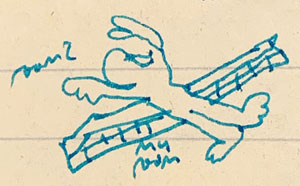
Halfway through the wall Dream Experiments: This was a well-executed dream experiment. I became lucid and decided to test my environment. The fact that I was looking through the wall made a transparent circular opening in it. It’s perfectly possible to pass through walls in the astral or etheric, and I did so with ease because it wasn’t visible where I was looking. But then I expected the wall to close in on me once I was laying across it, so that’s what happened.
Telekinesis: Moving Thought Forms
Thought forms respond to thought, no matter the distance. So telekinesis in the dream state is extremely easy.
-
Telekinesis 1993 • age 19
In the dream I achieve telekinesis after long hours of practice in my mind. I’m staying at this place with a friend who can do it. So I really push myself and finally I move the candle across the bathroom. It was all so real.
Psychic Dream: The dream world is the natural home of psychic abilities like telekinesis. Here is an unusual case where I am not aware that it’s a dream at all, but the environment responds to my will.
-
Telekinetic 1999 • age 24
I had developed the ability to use telekinesis and was using it everywhere. It started at Blaine House before school. I sent out the line of force to an object, then used its own energy to lift it in the air. Ruby saw it. My life had changed. It was so exciting, I couldn’t stop doing it!
Telekinesis: Telekinesis is more impressive if you think it’s happening in the physical world.
-
Telekinetic 2025
Bodhi was halfway down the stairs, “Mama, can you open my window?” I’m at the bottom of the stairs, looking up. I use telekinesis to open his window. Bodhi turns around at the sound, then looks down at us, shocked. “My window just opened!” I smiled and said that I did it.
This was a scene from a long series of dreams wherein I realized I could use telekinesis to move things at a distance. Thinking it was waking life, I was having a lot of fun with it, showing it off to people. There was a party scene earlier where I used it a lot.
Telekinesis Again: Note how I keep rediscovering this over the years. My waking self fragments don’t retain memory of their adventures in the dream state across dreams (see The Waking Self Fragment).
Thought Form Bodies
Just like everything in the astral, our bodies are thought forms. We are in fact a single point of consciousness, but our astral body forms around us in its familiar form whenever we expect it to be there.
Discerning People and Thought Forms
Everything in the astral is a thought form, including our own astral bodies. We unconsciously create thought forms through our thoughts and expectations. These can and often do take the form of people and animals. They are usually controlled entirely by the expectations of whoever is focusing on them.
It’s possible to create a thought form of a person, and due to the inherent attention on them, that person can communicate through that thought form, possibly even inhabiting it to join the scene with us (see Contact and Recognition).
We could also be projecting our own subjective projection onto an objective person with some similarity of feeling or appearance (mistaken identity). This happens during the viewing of many rote experiences, but can happen outside of them as well.
So how can we tell if the person we’re talking to is actually that person? A waking self fragment doesn’t entertain any other possibility — it thinks the dream experience is physical life. This requires a higher level of awareness — that of the dream self or the full, lucid waking self.
This section illustrates some ways to tell. In my experience this is most often done in retrospect, when remembering the dream. The best way is by being aware of our own thoughts and expectations preceding their appearance and while interacting with them.
Appearance
Uninhabited thought forms will generally have a rubbery or glassy look. There is no sparkle in the eyes. Sometimes they will seem slightly overinflated.
-
The Red Scooter 2000 • age 25
Then someone comes up to us and I have this sudden fear that he’ll ride off with Buttercup on the red scooter — so of course he does. . . .
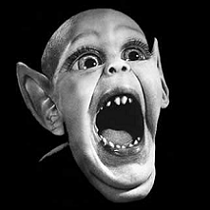
Bat Boy I chase them down into a sunken staircase (the underworld) and into this madhouse scene with scary sleepwalker people all milling about. I rush through two pale greenish rooms to where Buttercup is. I pass multiple copies of the bad guy; this yellow-eyed purple-haired guy that looks like “bat boy” — very much like a thought form as it is mostly lifeless. I reach the exit but a wave of fear passes over me. The door leads me back inside, but I focus and press onward and make it out.
References: Bat Boy was a weird character from a tabloid.
Madhouse Creatures: The underground madhouse area is filled with unresponsive dreamers. The antagonist is my own thought form, and looking closely I can see the tell-tale sign of the lifeless, plastic face.
-
Rubber Dolphins 2000 • age 25
Beyond it is a huge greenish building shifting back and forth in the water, which I think is very odd. But as it moves past the end of the peninsula, I realize it’s a boat. This big dolphin rises up out of the water behind it. I’m totally enraptured for a moment, before I notice how fake and rubbery it looks, and how it doesn’t interact with the water. A thought form! I notice it’s connected to the boat by a mechanical arm (though I don’t see this). It speaks to us. Then a set of three of these rubber dolphins comes, just as fake-looking and attached together. They change form to be these puppets of sea-goddesses, and they “speak” to us, moving in front of the boat.
Thought Form Dolphins: Here the fake-looking rubbery appearance and inaccurate interaction with the water gave it away.
Behavioral Clues
Behavior is often a big indicator. An “uninhabited” thought form will:
- Do exactly what you expect, when you expect it
- Do a repetitive action, and nothing else
- Remain unanimated
- Break physical norms by drifting, melting, etc
-
The Island of Fire 2000
I struggle to climb up and encounter a dull, bug-eyed person calling for help in a weird way — like an inside joke I wasn’t in on. It was a total thought form serving only one purpose.
My attention is unavoidably drawn to the lava below as I wonder if we’ve lost anybody. I find myself hovering above it. There is a little thought-form Gollum down there sinking slowly a bit and jumping periodically, saying “Oww!” like a broken record.
Thought Form People: (written at the time) Thought forms of people have lifeless, dry, unintelligent eyes and usually have one thing to depict, one message to give, one purpose, and they fulfill it but don’t stand up to careful scrutiny. You can freshly feed them with your expectations but don’t expect anything novel or surprising from them.
It’s likely Gollum was the same bug-eyed thought form on the slope.
-
A Hitchhiker from the Hospital 2010 • 1:30 AM
I ran for the door. I had the thought that it would be dramatic if the woman just outside were about to lock me in when I got out and sure enough she turned and started to lock the door right as I burst out. I turned and just about snatched the weird orb-like sunglasses off her face just to spite her, but didn’t because I was aware on some level that she was a thought form.
Walking down the hallway, now, I saw that all the people working there had these sunglasses and thought there must be some kind of harmful light somewhere about. I saw a machine emit a bright blue laser-like flash at one point. This part isn’t clear but I think I went to try to rescue Buttercup. I grabbed a pair of the sunglasses from the faces of two hospital technicians. They barely reacted. I even mentally dared one to turn around, watching closely for a reaction, but she just kept walking without missing a beat.
Biddable Zombies: The hospital technicians here are likely thought forms, as they fulfill my expectations, like trying to lock the door, and not reacting when I took their sunglasses. The question is, when I mentally dared her to turn around, I wanted her to, did I expect her to?
-
The Mountain Valley Gathering 2003
I’m back in Long Island walking along these city sidewalks. The buildings aren’t very tall here. A bum approaches me and makes a joke. I ask him if I’m headed the right way. He asks where I’m headed and I say “Midtown” (Manhattan) and he says “You sure are!” Then he disengages, which surprises me because I thought he’d follow me asking for money (so he’s not a thought form). I go faster and faster on the road, then find myself on a bike (rationalization) and driving along exits, over bridges towards Manhattan. I wake up.
Real and Unreal: The bum behaved independently and unexpectedly: he’s real. The bike appears, summoned by my waking mind to help explain how I’m moving as fast as I am: not real.
-
The Predatory Club 2003
I saw Jack Black and someone else famous, but they weren’t animated.
Thought Form Characters: Here are some famous figures to distract you, conjured up out of astral matter.
-
Buttercup’s Thought-Form Puppies 1998 • age 24
Buttercup dreamed of a string of identical puppies, some larger than others, and they all lacked any expression. At one point she dropped one and its leg bent under its body in a grotesque balloon-like way and it had no reaction. She spent the rest of the dream looking for a veterinarian.
Thought-Forms: People and animals can either be real or thought-forms, so it is interesting to note the difference in behavior between the two. These puppies were more like stuffed animals than living things. They didn’t show much of a spark of life besides moving a little and walking about.
People Represented by Objects
In most of these cases, I can’t begin to explain why this happens.
In some cases, this may be a matter of misattribution. Say I’m looking at a pair of pants and I get a telepathic message from my sister. I may think that the pants must somehow be my sister. See “Mistaking the Source of Communication”.
-
The Meeting 2000 • age 25
[Kayla and I] sit down at a table. There is a row of glass display boxes there. We talk, and the topic turns to Buttercup, and a big intricate golden machine before us that represents her. As I looked on in admiration, Kayla understood my attraction to her. But then she said something about some imperfection. Now the machine is actually Buttercup, who opens the door and starts yelling at Kayla about Kayla’s own imperfections.
The Intricate Machine: How odd that Buttercup was represented by an intricate golden machine. The drawing I made suggests some sort of clockwork brass instrument, which fits with the musical practice room scene.
In this case, the representation turns into the real Buttercup when she gets emotionally triggered.
-
World Religious Conference 1997 • age 22
A stack of four ghostly, glowing, semi-transparent books appeared on the floor. . . . The books represented Emma, or was from Emma. I touched one and could feel it slightly and then I slammed my hand through it and heard her yelp with surprise. . . . Soon afterwards, Emma appeared in the same shimmering semitransparent form.
Emma as Books: How strange that sometimes people can be represented as objects like this. I’m not sure what to make of it. But the books seem clearly linked to her by her yelp when I slammed my hand down through them.
Transformations to Objects
-
Enlightenment by Fire 1997 • age 23
I found a small mouse and picked it up. It began talking to me. It suggested I go back to the fire shaft, a place I was familiar with but hesitant about. . . . [I go to the fire pillar then return]
The mouse wanted to be returned to its home. I brought it home but when I left it, it was a bent paperclip, not a mouse.
Mouse to Paperclip?: How odd that a mouse that could communicate with me would become a bent paperclip when I brought it home. I’m at a loss as to how or why that transformation took place.
-
The Whirlpool 1997 • age 23
Someone said “Hey, you got your wish. We’re heading towards the whirlpool!” As we neared it I saw how violent and ominous it seemed. Now I hoped too late to avoid it. My house, full of people, plunged down into it and my last breath of air got mixed with water as the house was sucked under. The underwater portion was impossibly long and my breath barely held but finally I washed out on a beautiful cascading waterfall that was broken by rocky landings.
After realizing that I was okay, I searched for other survivors. They all appeared now as cassettes, videos, and books. I tried to play them. Some worked right away, some worked after a bang or two, and others didn’t at all. I divided them into piles based on whether they worked or not, one pile becoming very loud with all its music and sound. Had everyone been transformed in this new area?
People to Objects: I wonder. . . . If the people didn’t come through the gateway with me but were still communicating with me, perhaps these new forms were a rationalization of their continuing communication without their actual presence. They did all change into forms of communication, after all.
-
Inner Children 1999 • age 24
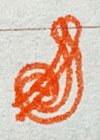
The symbol the little girl turned into Three of us are in a smallish bedroom. There was some mystery we were trying to figure out. We’re taking turns letting an inner child manifest in us, but not in so many words. For example, with me, a surprised little boy appeared and said “How many of us are there?!” I say “We just go on and on.” The little girl before him turned into a pattern on the wall when she was done.
-
The Royal Line 1997 • age 23
I was a friend of the princess of the royal line of Prokovia. I wanted her to step down from power. . . . At one point, the princess was two black labs.
-
Deflating Tank 1997 • age 23
So Buttercup and I are living in an apartment in Tank. We have our kittens and everything is nice. We’re sitting, hanging out on the left side path, reading, playing with kittens, and talking with Tavin. . . . Buttercup was falling asleep in her sleeping bag . . . [there is a big conflict]
Their anger/life was gone and I felt the story was over. Buttercup was in a sort of cocoon that looked like a stone screw-head. I had the impression that it was safe for her again. All the emotional charges had dissipated. Then I awoke.
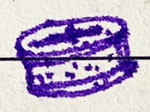
Buttercup’s cocoon References: Tank is the name of a co-op I lived in in college.
Cocooning?: So this is interesting.. Buttercup goes from being involved in the story to going to sleep “in a sleeping bag” (gradually losing shape). I then see her later in a strange-looking “cocoon”. I wonder if she turned inside and went into her own subjective dreaming early on, and this is what it looked like from the outside.
Shape Shifting
We can easily change our projected form, simply by wanting to, or imagining ourselves in a new form. Sometimes this is done unconsciously, such as when we focus on (become) someone.
-
River Diving 1992 • age 18
I notice some really large rocks right below the surface scattered around where I dove in. I complain intensely to the man, and he gets upset and calls on the water-cleaning girl. She comes and he chews her out, then tells her to take them out. Then he sends everyone home. She grudgingly does the work. Then she gets out of the water and shape-changes into somebody else. I see it and am amazed.
-
The Home for Shape-Changers and Psychics 2004
There was a large red-haired guy I thought of as a friend. He transformed into a large red wolf monster, but he wasn’t too dangerous. There was this guy I found interesting but hadn’t approached yet. He transformed into a horrible room-sized mass of purple hooks — like gonzo noses or bent pipes — in a dark black cloud. Both these two would transform unexpectedly. . . . Now everyone is transforming, and I look down at my hands — they’re slightly blistered but the skin is sunken in. “Oh no! Not undead!” I think. “That’s the worst.” I try to will my skin back to normal but only succeed in stopping the transformation from progressing. I run over to the teacher for help and she looks me over and says: “It’s your name: Adams. Change it and you’ll be fine. Change it to Sam Eckerd.” My name — I’d never thought of that — like in The Addams Family. My skin was like Lurch’s. “But Eckerd?” I thought. “Like the drug store?”
References: The Addams Family is a TV show and movie franchise.
Shapeshifters: Wow . . . a shape shifter that uncontrollably turned into a room-sized mass of purple hooks and pipes in a dark black cloud . . . that’s horrifying.
And what a surprising insight from the teacher, in regards to my own transformation.
-
Befriending a Ghost 1997 • age 22
I was in a house that was haunted, trying to interact with ghosts. Certain parts of the ghosts would phase solid and I’d grab them or push them. Then I met a girl who was killed on December 17th or 21st, waiting eternally for Xmas. I attempted to befriend her. She started out as a dog — she had a really close bond with her dog and took its shape from time to time.
Shape-Shifting Ghost: I had this dream right after returning from England, where Buttercup and I went on a number of ghost tours, so ghosts were on my mind.
Her focus on her dog caused her to sometimes take its shape.
-
My Daughter, Me 2009 • 2 AM
I notice stitches on my daughter. Was she operated on? Things shift. My daughter is a kitten, a puppy, the stitches are weeping.
Changing Form: Being that I am telepathically communicating with the baby, it follows that it’s not a thought form. But then it changes into a puppy and then a kitten. The meaning is the same — they’re all babies. Perhaps there was an interruption in the dream?
A Tell-Tale Sign — What You’re Proud Of
The trick to shape shifting is to get so completely into the new shape that you leave behind all aspects of your old shape, especially things you are proud of. If you’re proud of your height, your strength, your sexy curves, your unique hairstyle, your tattoo, your clothes — whatever you find it hard to let go of — that thing will show up in the new shape. The same thing goes for things you are ashamed of — you’ll bring with you whatever has your attention.
I’ve seen this in a cartoon or video game when I was a kid — a shapeshifter who always retains a quality from their original shape. More recent examples are Nimona, Beast Boy, and Jake the Dog, which all retain their original color when shape-shifting.
-
Body Transformations 2003
We were playing this game. I was in a room with two light gray dogs. I was to transform into a matching one, then run about and interact with them and this bone. The others were supposed to guess which one was me by my actions, and I was to try to be as doglike as possible. Before we started, I expressed a concern to the girl from the hallway — “Will I be able to return to the asian girl form afterward?” The girl said “Usually you return to your natural form.” This was telepathic. She and the others were in a different room, waiting for the game to begin. When communicating like this, I saw them above and beyond the present room I was in. So, I transformed. I was both within the dog form looking out, and watching the dog from outside. It was strange to go after the bone with my mouth, to interact with the other dogs with my mouth, to run on four short legs. I did my best to be dog-like. The others correctly picked my dog because of the way the hindquarters looked — like mine. I had to agree. It was like in cartoons when a character changes shape but keeps some of their own aspects. When I was the asian girl, I remember thinking she was taller than I remember, and I was, because I am, proving in literal form that it’s hard to let go of that which you’re proud of.
Shape-Shifting for Beginners: When dealing with really different shapes like the dogs here, just getting it right is a challenge — the body shape, four-legged running, the behaviors. What a great astral game these people came up with!
Unconscious Shape Shifting to the Person of Focus
While in altered states of consciousness I’ve seen how one entrains to another person’s frequency to communicate with them, how one becomes them, takes their shape, and that’s not just a metaphor. We sometimes astrally take the shape of a person affection, interest, or inspiration, even for a minute or two, without realizing it. Imagine how this adds to the confusion in the astral world!
In rotes, we simply inhabit the characters we’re drawn to.
-
Everyone is Buttercup 1996 • age 22
I dream of [Buttercup], myself, and some friends going to this psychology courthouse. . . . As I watch his nasty Emma talk, she morphs into Buttercup. I watch carefully and she switches back, then does it again. It was a brilliant morph, convincing as anything. She said something about how abnormal Buttercup was. Buttercup starts crying and I comfort her, thinking “If that’s normal. . . .”
Becoming the Focus: It’s clear that the mother takes Buttercup’s form as she concentrates on her. This reveals a higher truth. As we focus on someone or something, we take on its form. When we express how much we like or dislike it, we embrace or reject ourselves in that form.
-
Body Transformations 2003
Then I’m standing at the other end of the hallway where there is a sink and counter, and I’m looking into the mirror. My reflection is that of a cute asian girl I’d seen earlier in the dream. Without intending to, I had taken on her shape. As I looked, I noticed that the only obvious difference was the expression — she was always bright-eyed and smiling, while I had this sort of blank expression. I thought “I’m not nearly as cute without the smile,” but I still enjoyed the thought of being in a girl’s body and how I could grab guys’ attention.
Returning to Your Normal Form
-
The Shape Shifting Game 1994 • age 20
It all starts in art class. I finish up a great project, then hang out with a friend. We play this game where I would hold out my hands, arms straight forward, then randomly change everything but my face to that of different girls at SSU, and by looking at my new hands, I’d guess “large,” “skinny,” “tall,” etc. The friend would laugh and say “Yup, go on.”
Then this art teacher bursts in, furious, looking for me. I’m facing the far wall and have the body of a heavy-set black girl. The teacher looks around and leaves. I try to change back, but CAN’T! I go to the bathroom and decide to stay with this form, hiding my new breasts with my jacket and hiding my hips with sweats. I leave? And come back? And discover I’m male again, so I look in the mirror and I’m back to being me.
References: SSU was the first college I went to.
Lucidity and Dream Magic: It’s not every day you decide to play a game involving switching your body to that of other people. So, I must be focused in my dream self. Why did I have trouble changing back? Maybe I became attached to the girl’s body because it shielded me from the attacking art teachers. Or maybe I just thought “wouldn’t that suck if I couldn’t turn back?”
-
Body Transformations 2003
Before we started, I expressed a concern to the girl from the hallway — “Will I be able to return to the asian girl form afterward?” The girl said “Usually you return to your natural form.”
Returning to Your Natural Shape: As the other dreamer explains, when going from one form to another, one usually returns to your natural, usual form rather than the previous form. I imagine it’s difficult to go back to the previous form unless the previous form is present or it’s been well imprinted on you.
The Etheric Body
-
The White Snapdragon 2023 • 6 AM
At some point I felt what seemed like a booger in my nose. I grabbed it with my fingertips, and felt something long and huge come sliding out from all over inside my head. I was horrified to see that I had pulled out this long, ghost-white multi-armed tube-like thing that was bigger than my head. At first, it was a long stalk that split into a bunch of other stalks, which also split. After hiding it from Buttercup and the kids (who kept barging into the bathroom), I got a chance to take a closer look at it. The arms of it were tubes, as if it had grown into every.. nerve or vessel or opening within my head. As I continued to examine it, I saw that it looked like a snapdragon flower as big as my head. The face of it was grimacing, with what looked like large clenched teeth, and I reflected that that’s how I felt often, and this thing must have been the source of my decades-long head pain. As I touched it, I noticed how, just like a snapdragon, it flipped back and forth between an open form and a closed form, corresponding to two positions of over-flexed muscles in my head. . . . At one point I encountered another white snapdragon, but this one didn’t have the appearance of grimacing like mine, further underscoring the problematic state of mine.
Etheric Body Pain: In this eerie scene, I pull something huge and elaborate from within my head out of my nose. My guess is this is my etheric body, the physical body’s energy structure.
As some background, I’d been suffering from TMJ disorder, teeth clenching, and head pain for many years. This energy structure reflected that in the way it looked and the way it snapped to over-flexed positions.
-
The Eels Within 2024
This part of a dream from last week keeps sticking with me. It starts with me pulling something snotty out of my nose, but it’s several feet long and when it lands on the ground, I see it’s a clear gelatinous eel-like creature with some small orange and blue markings on it. I pulled two more out of my nose and earlier I had pulled one out and put it in a fish tank. It didn’t seem related to the overall plot of the dream.
Eels?: I don’t know what this is. Some part of my etheric body? It may have sharpened into the shape of an eel with distinctive markings because that’s what it most looked like.
The Astral Body
Our own astral bodies are thought forms. Our essential nature is a single point of conscious light. It unconsciously projects the shape of your physical body at times.
-
OBE at the Dark Tower 1997 • age 22
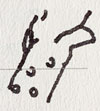
Circular impressions I noticed that my astral body had circular impressions here and there along my skin. Perhaps these were nadis? Also, it was shimmering as if wet with sweat. I was talking to the Amanda-like library person and asked her if she noticed anything strange or different about me. She said “You look beautiful!” . . .
The Astral Body: This is a rare, unrationalized look at my astral body.
-
The Reluctant Hero 2011 • 2 AM
Then — shwack! The elevator moved sideways and speared us through with a hundred spears. I felt the tightness of the spears impaling me. After a few moments, they receded and we’re spilled out onto the 4th floor.
Speared Through: It’s okay — no harm done!
-
The Severed Thumb 1999 • age 25
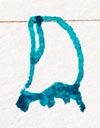
My “severed thumb” I was in a sandy square in a small Western town. I held my severed left thumb in my hand — or more likely, something in my hand had melted into a small thumb-sized object that I took to be my severed thumb. It appeared to be severed at the top knuckle. There was no blood, just the end of a thumb, severed like cut clay, and of course there was no pain. . . . About here I had a revelation. I popped the thumb-end back on my thumb-nub and it attached. I was kind of alone at this point, off to the side of the others. The blood was gone again but the thumb end fell off when I bent it.
Severed Thumb?: This was certainly a melted thought form that I took to be a severed thumb. I don’t think it’s possible to sever a part of the astral body. One can easily deform their astral body to make it look like they’d lost a thumb if they expected and believed that. Interestingly, this outside astral matter also doesn’t seem to want to join to my astral body.
The Astral Cord
-
OBE at the Dark Tower 1997 • age 22
Within the Dark Tower were living quarters, including my Blaine House room. . . . In my Blaine House room, I had an OBE. . . . I was on the ground floor trying to fly back to my body many levels up and I noticed the silver cord. I touched it and it was warm. I followed it back to my body and examined it more: it got thicker within 10 feet, from thread size to computer power cable size.
The Astral Cord: Note that I’m perceiving my astral cord in the vicinity of my physical body, but the scenery overlaid on this is the Dark Tower and Blaine House.
A Tiny Sphere
-
Friend of the Dalai Lama 1998 • age 23

Spherical people There was a big outdoor festival. There was a scene with someone stealing balloons. I flew up high to this balloon cloud and played with 4-6 perfectly spherical people. What a strange thing! I felt I was up in space with them but I was only as high as the bleachers. Weird!
Essential Beings: The change in size to being tiny likely caused the feeling I was really high up without actually being so. I wonder if we were in our essential point-of-awareness forms.
Creating Thought Forms
The laws involved in the creation of thought forms are exactly those described in The Workings of the Holographic Mind, most specifically Pattern Recognition: Expectations and Projections: Specific Search. The very same projections we use mentally in the physical world create our world in the nonphysical.
There are interesting similarities between high-energy astral matter and molten metal — both become fluid, malleable, and bright. From this state they can solidify into a form. The analogy of water and ice is helpful. Higher-dimensional astral matter (water) instantly flows into and “freezes” as a three-dimensional form (ice) created by the focus of attention. When attention is withdrawn, it slowly drains back where it came from, giving the appearance of melting ice. The rate at which it melts or drains is due to the inherent “heat” of the realm (water) where that matter exists, and our own focus of attention can be seen as a temporary “cooling” force. Higher frequencies have a higher “heat” which melts thought forms faster.
This melting can also be seen as receding into the past. Our attention on something now brings it forward into the present before us. Similarly, melting can be seen as receding into the distance (shrinking), while attention brings it close to us (growing). Since physical time is part of physical space, these are connected.
The creation and sustaining of thought forms reflects the way the Source creates and sustains all of reality. Our attention, flowing from the Source, provides an intermediary flow into a mental image that enlarges it and brings it forward.
The transience of all created forms is due to the transience of our attention. Eventually we will all melt back into oneness like the thought forms we create. Enlightenment is inevitable.
Conscious Creation
My dream self knows how to consciously create thought forms and can do so easily.
If my waking self is awake when consciously creating a thought form, I have to overcome my belief in object permanence. This can be done by closing my eyes, or doing the creation out of sight.
-
Dream Magic 1996 • age 21
I learned DREAM MAGIC last night! . . . A bunch of people were hanging out together in the backyard of Blaine House. Sam S, dressed in drag, conjured a grape in his hand. I went crazy at this proof of magic. I leapt about and asked him to show me how to do it. He did. My hand was wet and as I concentrated, the moisture seemed to condense inward into a grape! Then Sam conjured rubber balls and then I did. I asked him if he could make light and sparkles. He did, and then I did and I was so delighted.
Creating Thought Forms: In dreams we can be conjurers. This is where the idea of magic comes from. Here I quickly grasp the art of creating thought form objects and lights. What delight to be able to create things with your mind! The condensation of some sort of liquid in the creation of thought forms is a great detail.
-
Brendan’s Gathering and Summoning Pants 1999 • 5:30 AM • age 25
One guy had a trick he was showing off — he made different coats flip up out of his pants when he tugged on his present coat with his elbows. His belief in his abilities made them work. I inspected the process. The jackets began as little grayish balls in the back of his pants by his belt, and expanded into fully formed jackets that flipped up onto his back and across his arms in a fully realistic-looking display of what by physical standards was an impossible act. I thought I could out-do him and, standing there in my underwear, I said “But can you just make something . . . from nothing?” and I hid my lower half outside the door frame and concentrated on making pants. I could feel the thought form whip up around my legs, enclosing them, but my surprise at the feeling of it broke my concentration and I looked down to see them receding. I tried again and didn’t bother to check this time and soon was pantsed.
Controlling Thought Forms: Two wonderful examples! First, the jacket trick. I’m so glad I had the presence of mind to investigate how it worked. The thought forms of the jackets would recede into little balls when they didn’t need to be seen, and expand out into the entire jacket when they did. Each one was the idea of a jacket, each an individual thought, even when not being stretched out into full form.
-
The Summoner 2001
I’m with Manville in a supermarket, but it’s not really Manville. I am desperately trying to win friends to my cause. “This is a dream,” I say. “If I can make things appear, will you believe me?” He seems doubtful but agrees. I hold out my hand. A stripe of yellow with brown splotches appears, then a banana takes shape. First it’s short and pickle-like, then it elongates. Then Manville challenges me to create his kitchen. “It has to be something I can picture,” I say, “but maybe I can read it from your mind. In fact, I know I’m capable, I’ve just never done it before. Let’s try.” I hold my palm up by his head and close my eyes, focusing on projecting into an open area of the grocery store. The images are unclear, dark. For a moment he sees something familiar. Then it shifts, switches. I give up on it.
Forming a Banana: I’m confident that I can create a banana, but an image from someone else’s mind was too much for me. I’m surprised I even got it to work a little.
-
Thought Form Class 2000 • age 25
My experience through dim consciousness was this: I was looking down at a miniature city, just a few buildings. My first thought? Wow, StarCraft! So suddenly all these Zerg creatures (because of their odd shapes) are fighting. Floating jellyfish are flying about and I invade the docking area of the kid next to me. I eventually run out of troops, but I find two oranges and think “ooh, these can be bombs!” I run about the other students in the room, looking for something to demolish, but when I see them all working on their projects I lose my fire and decide not to.

Starcraft 2 (Terrans invaded by Protoss) Image credit to Blizzard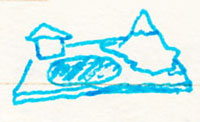
Building thought form scenes 
My contribution: attacking zerg Image credit to ThisIsGame.comYou know what their projects were? Creating little thought-form cities on the tables in front of them, using their thoughts. The place had every appearance of an art class — supplies everywhere, students wearing white aprons. And what I saw when running about were new, semi-formed thought-form structures in various colors — oblong shapes with a single color throughout, like playdough. One student had a mountain, house, and a newly-created thought form blob without edges or separate colors (yet).
References: StarCraft is a video game with a top-down perspective. Zerg are an alien species in that game.
Nonlucid Creation: The lesson here is purposeful thought form creation. When the waking self is involved in the dream, creation of thought forms happens without thinking. Every expectation, every fear and desire comes into being instantly. So creating them is not the challenge — consciously creating them is. I may have been wildly creating creatures and armies and cities, but it was all unconscious projections straight out of the StarCraft universe. I was outdone by any student who created a simple tiny house with clear purpose and the knowledge of what he was doing. I was just running around like a hyperactive kid, replaying experiences.
-
The Chamber Beneath Blaine House 2000
Floating along, I closed my eyes. The scene dimmed and then reappeared in full light. But this, I thought, was in my head. I focused on creating a thought form and suddenly held a sprig of spruce in my hands. I then “opened my eyes,” causing a flash of dark as my inner sight moved to my outer sight (or because I expected it) and there was the sprig. I was so overwhelmed I was moved to tears. I’d done it! I’d created a thought form and brought it to reality! I could feel it solidly in my hands.
Consciously Creating: Here I consciously create a thought form. Of course, I didn’t realize I was dreaming and I thought I had physically created something with my mind in the waking world. Silly me. The fact that I was “floating along” and seeing with my eyes closed didn’t clue me in.
-
The Slumber Party and Scary Man Prank 1999 • age 24
At first there was fear in the room. Only Buttercup and I had awakened. Someone gave a warning but I knew it was just fear. I must have been talking about thought forms, because some of the nonlucid sleepers had expressed doubts about the reality of them. Since I KNEW they were real, I decided to play around with them and practice making some thought forms. It was still dark and I looked out a window. I pointed and said to Buttercup, “Look at that. . . . MAN!” Surely enough a bearded spooky face appeared out of the shadows in the window, from a black silhouette to a full face, giving the appearance of approaching. Buttercup got scared and fell to the floor in a fetal position.
Thought Form Creation: Thought forms are effortlessly created by the mind to fulfill expectations. That’s why it was so easy to take in the feeling of fear in the dark room and conjure up a scary man outside. It would have taken considerably more strength/effort/focus to create something happy and positive in such an environment.
Had I not been aware that I was dreaming and been afraid of a scary man appearing, the very same thought form would have been created, and it would have scared me. But since I was aware and created it deliberately, I was not surprised or scared by it at all. In fact it was really well done! It would have scared anyone!
-
Jay, Master of Thought Forms 2010
The last guy gets up. It’s an Indian American named Jay (or Jaya), wearing a red and black plaid shirt, sort of portly, and maybe 20 years old. He does a couple jokes, then he walks off the stage — but he is still standing there. Then multiple versions of him walk off the stage and into the audience and he’s still there. The crowd is perking up and I’m really astonished, looking around at all the Jays settling into the audience. Then a bunch of them surge back onto the stage for another joke or statement, and then scatter off and then surge back through the audience in different patterns and then disappear into the crowd. I’m just astonished and wondering how he’s done it.
Multiples: Jay is a master of creating multiples of himself, showing that this is a controllable dream phenomena. It’s thought form generation, but with an impressive level of control.
-
The Home for Shape-Changers and Psychics 2004
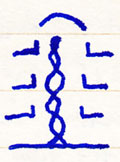
The tall metal sculpture In the center of the house, there’s this open column that goes up all four stories. Someone builds this little one-story sculpture of two-colored metal at the bottom. But then this hefty magician-looking guy whirls to the top of it and pulls all these slivers of silver or gold metal from out of the air and extends the statue all the way to the ceiling, hovering over it.
Aware of Their Powers: These people are aware of at least some of their astral abilities.
-
The House War 2011
As a last resort, the nasty family calls on some wizards and mythical creatures to fight us, and we call on a glowing pink scorpion and an earth wizard. We eventually win the battle and chase them all away.
Thought-Form Battle: A last-ditch effort to beat us fails when we create stronger thought forms.
-
Into the Mystic 2025 • 3:45 AM
I’m hanging out with a bunch of friends in a cozy, well-decorated living room. We had stopped at a thrift store earlier and all picked out a bunch of strange and interesting outfits to try later. Now, back at the house, we were lounging about and talking. I remembered the outfits and stepped into a private side room to try them on. The outfits were around a corner, a bend in space. The one I grabbed first was a shirt, but as I put it on it joined with my beard so that it looked like a big white beard shirt.
Behind a Bend: This dream was at 3:45, when my dreams are at their most intense and deep.
Note that I haven’t brought the clothes from the thrift store with me when I go to try them on. They’re stored in my memory. I casually reach “around a corner, a bend in space” to get them. This is a little effect to route around the expectation of object permanence. I expect them to be around the corner, and they are.
Unconscious Creation
Our environment in the dream state is the result of the existing objective environment mixed with or painted over by our own unconscious projections. These projections create thought forms.
Whatever we focus attention on is brought into our experience in the dream state. The higher law assumes that whatever we focus on is what we want to experience.
Our changing focus may be caused by desires, fears, imagination, expectations — anything that moves the attention to something that’s not present.
Expectations Create
Our expectations create our thought form environment through passive projection of our past experience into the now. See Pattern Recognition: Expectations for a detailed explanation of how this works.
-
The Animal Shelter Gateway 1998 • age 24
I was distracted by a blue snake in a small cage with an unsecured lid. I tried to block the exits around the lid with boxes but it got out. I used a snake-handling stick (also from recent TV) to nab it but once I did, I freaked out and let it go. I expected to get bit and of course I was then bit.
Expectations: I expected the snake to get out and it did. I expected to get bit and I did. This snake responded to my every suggestion. Even working actively to prevent something in the dream state helps to ensure that it happens anyways.
-
Instant Band 1998 • age 24
I heard a cop car say over their loudspeaker “4-3-2-1 Please cease your activities.” We got a little scared and went to the brown cop car in the driveway next door. In it were 4 guys and one invited us to come play our music at the party tomorrow at 8. He said it was in the yellow house over there, and pointed. I saw (projected?) Banana House past a square yellow house. I said ”Banana House?” He looked kinda confused. I didn’t recall the time or date and asked them as they were leaving. It was hard to pick up but I mostly got it.
Expectation Projection: When he points to a yellow house, I can’t help but imagine up Banana House, which appears behind it. When I mention Banana House, he obviously doesn’t know what I’m talking about.
Expectations vs Reality
-
The Tree Clearing 2024
Before long Buttercup is with me in the car again, and she pulls us over, sooner than I expected. We’re apparently at our house, and I stand there, staring. It’s the view out the back of our house, but the field is flooded. When did this happen? My eyes follow the water out to the right. The lake is huge, continuing far in that direction. It’s a lake I know. There are islands and huge machinery parts in the distance, and when I turn back to my original view, there’s no neighbor’s house, no field, just the lake. Gradually my expectation of seeing our back yard was replaced by reality — this wasn’t our house at all. This was. . . . Janice Lake (something like that).
This is Home?: I’m presented with a scene that’s not my back yard, but I’m expecting to see my back yard. At first I see mostly my back yard — the field, the house, the dead trees — but with the addition of water. It isn’t until I look over to the right, following the water out into the lake scene, and then look back, that my projection of the back yard disappears and I see what’s actually in front of me.
This is incredibly important. This shows the extent to which expectation can overwrite our actual surroundings. In this case, I projected the backyard scene directly ahead of me, with the real scene bleeding in around the edges.
Broken Expectations
Expectations typically create, but not always. Sometimes you can be wrong, since dreams are a mix of objective and subjective.
-
A Titanic Disaster
I’m piloting the Titanic across this lake. I let a friend drive. She has to get it on this rail so that it can go under this bridge. She fails. I grab the wheel and take over. No lights come on under the bridge, and I yell “We’re all gonna die!” over and over. . . . But by some crazy luck, we make it through and I beach it near some underground passage.
Lucky Break: Titanic? That’s some heavy foreshadowing.
I fully expected to crash and yet, we didn’t. Expectations create, but they’re not the only thing at work in the dream state. Our expectations don’t override those of others or any shared objective dream reality.
-
The Man Who Owned the Sun 1994 • age 20
We asked to speak to the head guy “Phiel” or something weird. After a wait he appeared and spoke to us. We learned that he owned the sun, moon, and sky, and was slowly taking all the earth’s energy. He would someday have no need for the earth and destroy it. . . . After talking, we left the building. Mordred and I met up again outside. Then Manville showed up, blackened, bloodied, holding part of a broken bottle in his hands. He snarled. “I got him. I got the bastard.” (meaning Phiel). We were shocked. We were going to be diplomatic.
A Shocking Twist: Manville sure did have his own intentions! This is either another example of independent entities making their own decisions, or I am experiencing a story rote.
-
Snakes 1996 • age 22
I wanted to stop and tighten my laces but I passed a rattlesnake at the side of the road, then two more. We got to a place without any snakes and I stopped. We continued on into a more foresty place. I jumped in a river that was supposed to be filled with piranhas. I was scared but there were none. After a while we set out again and there were snakes in the path ahead to avoid. The snakes all had their heads up. . . . I freaked out and slid down the slope past hundreds more snakes before leaping into a tree.
Lacking Piranhas: This is a dream infested with multiplying snakes. I jump into a river and was expecting piranhas, feeling scared about it, but there weren’t any. Expectations don’t always come to pass.
Fears Create
Sometimes seeing a single frightening thing will cause countless more to appear as you look for them (searching creates) or as they recur in our thoughts (the flash bounce model). Sometimes a situation or environment triggers a related fear (association expectation). Sometimes a potential fear just occurs to us (wondering creates).
My fears are often expressed without much emotion as a “what if” or “wouldn’t that be bad if” and then of course it happens. A classic fear-based scenario is wondering “what if someone sees me” when we’re doing something crazy in the dream state.
-
Emma’s Crash 1997 • age 23
I see Emma on a snowmobile off in the distance coming towards us. She’s jumping the ditches that separate the sod fields. I began to fear Emma crashing, and thus at the nearest ditch the snowmobile crashes into the near side. Her body flies out and goes bouncing back and forth several times before landing and disappearing under the ice.
Fears Create: Growing up, there were sod fields with ditches behind Blaine House. The snow would often obscure the ditches and sometimes people would crash their snowmobiles into them — thus my fear and the resulting events. At the point of my fear expectation, I entered a subjective dream projection where the crash took place.
-
The Turtle and the Eel 1994 • age 19
I exited the [underwater] cave and went to the surface. Then I floated back down. Suddenly I wondered if I’d land on any weird sea-stuff, and I looked frantically around. A black eel-thing swam at me and attached to my leg. I poked it sharply with a stick and it partly came loose. I went to the surface and climbed onto the rocks. An orange cat bit the eel and pulled it off me. It ate half while the other half attached to its side. I tried to get it off the cat, but the cat wouldn’t let me near it.
Fear Expectations: My fear of unseen sea creatures created the eel thought form. The orange cat might have been a guardian spirit of some sort, protecting me from it.
-
The Seaweed Bridge 1996 • age 22
We’re still going 60mph and skim over the top of the water long distances before sinking down. I’m worried about my journal getting wet and it immediately splits into a wet half and a dry half. I put the dry half in a plastic bag and then call for help.
Suggestion: The fear suggestion of my journal getting wet caused it to happen.
-
Protecting the Book 1997 • age 22
I was visiting Buttercup’s parents’ house, which was a large fancy building surrounded by a kind of moat. . . . Wilson and Elizabeth arrived and I was carrying some important book. We had to cross this plank to get across the moat. I was afraid I’d drop the book and so Buttercup’s Emma took it. She set it on the edge of the plank where it fell in halfway and got wet. Everyone started complaining and blaming me and so I swam it across and it got a little more wet.
Expectations: The danger of the moat became an irresistible draw and the fear of getting the book wet caused it to happen, even when handled by someone else.
-
The Great Journey 1997 • age 22
Buttercup and I park at a parking lot. We’re a block away doing something, but I keep checking on our car. There are all these people near it and perhaps it’s due to my fear expectations and focus, but they start going through our stuff in the car, eating our food, drinking our drinks.
Fear, Suggestion, and Inhabitation: A possibility is that when I fear other people doing something, I imagine them doing it. So in a way, I am becoming them and doing the bad thing using their body, through unwitting inhabitation. Then I return to myself and get angry and exact revenge on the now-uninhabited thought forms I just created.
-
Thanks a Lot, Lance 1996 • 6 AM • age 22
Suddenly Lance is on his back with baby clothes on and shaving cream on his face. . . . I told him how scared I was that Wadsworth would come in, and voila! Wadsworth charges in the door without knocking and does a double-take on Lance. I rush to cover the sex toys with a blanket. Wadsworth loses his shit and gets crazy mean.
Fear Creates: One of the most reliable laws of dreams is that whatever we focus our attention on will happen. This includes fears. No matter how unlikely it is to happen in physical life, that fear is precisely what will happen once it has our attention.
-
Hyperspace Reunion 2000 • age 25
Before long I decided to return to Definition 6 and found that I was naked. I quickly tried to get dressed again in [Oscar’s] front apartment and of course was having trouble with it. And then of course Oscar came in. Murphy’s Law is a thought form expectation rule from dreams applied to waking life.
Murphy’s Law: Murphy’s Law, that “anything that can go wrong, will go wrong” is the waking world’s recognition of the law of expectation in dreams paired with pessimism. Everything we fear going wrong in a dream will go wrong. Get on a negative streak, and you’ll be bringing about Murphy’s Law.
In the waking world, Murphy’s Law works through confirmation bias.
-
Kitty Companion 2023 • 7 AM
Last night, I dreamed I was in “Decatur” (but it wasn’t) and there was a concrete structure that the city had just added a huge battery to. The battery was the size of a school bus standing on end. There was this crazy punk guy who had climbed up near the top of it (past the “no climbing” signs) and was licking this control panel. He was messing with it and everyone around was watching in horror. Trixie was in my jacket — this probably being a rationalization for her dream body being next to my solar plexus. She wiggled about a little as I walked. I thought that if that battery exploded, she’d probably claw me really good. So of course the battery DOES explode and smoke fills Decatur.
References: Trixie is my cat.
Desires Create
-
Graduation Hijinks 1997 • age 22
Context: My family is visiting Oberlin for graduation.
It’s graduation and everyone’s parents are here. I’m spraying people with a super soaker. Tony T’s Wadsworth gets the super soaker and gets wildly excited. He hoses down his wife, Tony, Ruby, Wadsworth, and me and we all patiently wait for him to stop. Then Wadsworth and I leave and I say “Wouldn’t it be funny if we had a pie to throw at him?” Lo and behold: Around the corner in the main room is an apple pie! Wadsworth starts scooping some into his hand and I say “No! That’s someone’s mail!” He keeps it up and I take the tags so I can report him. He chases me down to get them but I manage to keep one. Then I see four girls crying in the mailroom looking for pie and drag Wadsworth in to apologize. The girls are surprised and astonished by it all.
Creations: The pie appeared because of my suggestion, of course. But when Wadsworth started digging into it, I imagined that the pie was a special delivery for someone. This led to the crying girls appearing in the next scene. All together, kind of a dirty trick, though I don’t think that was my intention going in.
-
There Be Whales Here! 1997 • age 23
I’d just seen two HUGE humpback whales leap way out of the water in a heart shape. I’m climbing down this slippery wet rocky hill of black stones. They leaped again as I started coming down. . . . I now had a camera and would hold it up when I anticipated another leap. Of course I was never wrong.
Here They Come!: What a lucky coincidence! It’s almost as if my desire was causing them to leap.
-
Teacher on Concentric Isle, East Timor 1999 • age 25
Then we decide to explore. I know we will spend the night outside the house somewhere. He says not to bring shoes or anything else. “Fine, that’ll be fun”, I think. Then I think — “Oh, I’ll need my contact lens stuff.” He tells me I don’t need it but get it if I must. I get/conjure it from my backpack.
Waking Needs: My waking mind engages enough to remember the requirement of bringing my contact lens stuff on any overnight trip. Luckily I’m able to unwittingly conjure what I need out of my backpack, so I can continue with the lessons.
Searching Creates
When we’re looking for something, whether in physical life or dream life, we focus part of our attention on what we’re looking for. This holographically projects that image outward, which lights up matches in our attention. See Projections: Specific Search for a detailed explanation of how this works.
In a dream, if that projection is strong enough, it takes form as a thought form. So when we search for something in a dream, we’re likely to find it.
Searching frequently creates multiple copies of whatever is being looked for. Sometimes this is due to what we find not being exactly right, so we continue the search. At other times it seems almost to be an unintentional recurrence of the search, perhaps based on the pull of attention back to the thrill we felt in finding what we were looking for (the flash-bounce model).
-
Banana House Tour Guide 2025
I remember being a tour guide for a group of people, walking through the attic of banana house. It was unfinished, and the particular room I was in was one to two feet deep with packed sawdust. . . . Someone might have come through, looking for a cat. . . . At any rate, looking down into the sawdust, I saw a cat face. I reached down and pulled a cat out of the sawdust. It began to walk away. I saw another cat face, and wondered how many cats were up here. I pulled it out, then saw another. Classic projection scenario.
-
Dream Magic 1996 • age 21
In dreams recently, once I start finding money, I keep finding more and more.
You Find What You Look For: Perhaps I’m walking along and I see a dollar on the ground. I pick it up and start looking to see if there’s any more. Soon I am finding money all over the place. I am creating this money by looking for it — my specific search projection causing it to take form, transforming grass or garbage into money or simply creating it out of nothing.
-
Mazes and Scorpions 1996 • age 22
Context: I had seen a wild scorpion earlier.
I dream of scorpions! The majority of this dream was my Blaine House room with the waterbed and closet. Someone had infested my room with scorpions! It started with just one, then there were more and more. I squashed the first one, then started cutting the others in half with a scissors which made some freak out and go crazy. There was a huge king and queen scorpion in my bed and thousands of little baby ones all over it. I was scared of them, but someone else was helping me to snip them up and throw them away.
Endless Scorpions: The shock of seeing a wild scorpion in waking life made it a topic in my dreams. It started with just one, but then my fear projected many more into existence.
-
Emma’s Crash 1997 • age 23
I go running out onto the ice. I reach under, grab [Emma’s] hand and pull her out to safety. Then I helped her gather her stuff: shoes and knick knacks. Of course I was projecting them all into existence by looking for them. The ground was not littered with things when I began.
-
Neon Chakra Flowers 1997 • Middle of the night • age 23
I could see fine (I assumed I had contacts) but wanted my glasses, which I had lost while we were talking. I spent a some of my attention looking for them for a while, finding countless pairs that were all wrong.
Vision: The familiar vision scenario plays out here. I’m not wearing glasses, but I can see, so it must be that I’m wearing contacts. But then I look for my glasses and find them everywhere I look through projection. Though I wonder why they weren’t the right glasses. . . .
-
When Everyone Stopped 2006 • 5:45 AM
Then on the way up I realized I was only wearing boxers! I rationalized that I must have left my shirt and shorts somewhere. It was really junky down there, so it wasn’t hard for me to start finding clothes everywhere. I found my exact swim shorts on the stairs, but knew I wasn’t wearing those — so they must have been the store owner’s. Then I saw three more pairs like it. Downstairs and around the corner were button-up shirts, and a few seemed familiar. Then I saw my green boxers and was really confused. A friendly fellah came downstairs to help and now Buttercup was with me (another insertion from waking life, perhaps) and we quizzed him, “Is this shirt yours? I have one exactly like it.”
Finding Clothes Everywhere: The old looking-for-something dream effect. We project what we’re looking for as thought forms everywhere we look.
After discovering I’m only wearing my boxers, my waking self projects clothing all over the place by the act of searching for it. Strangely, the clothing I project isn’t the clothing I’m looking for. Maybe I’m not focusing strongly enough, or the objects I’m focusing on are more similar to other pieces of clothing I have. When I keep finding my swim shorts, it seems I keep finding them because I have them more freshly in my mind.
-
The Wild Bus Ride and Parasitic Moths 2012
As I’m waiting for instructions, I look down and see a severed toe on the floor. I almost ignore it, but decide to point it out to one of the older kids running the game. He seems concerned, or nervous, and hurries us out. As we leave I see two more severed toes.
Severed Toes: The first one was most likely a melted thought form. The second two probably appeared because I started looking for them.
-
The Sliding House 2023
We had come to this house with bags packed, so there were some important things of ours to recover. What about Gwen’s Lila? I looked down in the debris at my feet, pushed something aside with my foot, and found her there. Whew!
References: Lila is Gwen's special stuffy.
Looking for Lila: Luckily I get it right the first time and the search didn’t derail the dream’s plot.
But Not Always
Searching usually creates, but not always. If distracted, or the desire isn’t strong enough, the search won’t be enough to create the thought form being sought.
A desperate or emotional search will usually create. Expectations almost always create — they’re expectations in the first place because our experience has shown a clear, dependable pattern.
-
Picture Day 2023
When I returned to the area where I last saw the team, I saw no sign of them. This began a long search as I went up the road along the school fields for a while, then crossed the street into a big park with lots of fields they could have gone to, and then continued on to what seemed like a Vietnamese part of town. I thought it unlikely that they’d gone here, so I turned around and re-searched the parks — no luck. So I returned to the Vietnamese part of town, which was a tight corridor packed with little shops on either side. No sign of them. Bodhi and I walked for several blocks through it, but we didn’t see them. A block past, I was getting really upset and worried, imagining the news reports of the coach who had lost his team.
Searching Without Success: Searching for something doesn’t always mean you find it. Most times when this works, it’s clothing or money or some lost object. But when you’re dealing with independent people, they may just have wandered off. Additionally, the emotional need behind the search has an impact on whether you project a thought form or not.
-
Looking for the Ball 2025
I was in a house, possibly Manville A’s house. A gray soccer ball rolled down the stairs and I went down to get it. I didn’t really want to. There was an open door at the bottom of the stairs and it opened out into the parking lot of a huge soccer complex. I walked out there and looked around a little. No luck. I came back to the stairs and went into the messy bedroom next to them. I found a couple gray soccer balls in there, but they were too small, and broke apart as I touched them. I left the room and returned to the parking lot.
I noticed there was a path it could have rolled that would have taken it a block’s distance down a road through the parking lot. I decided I should probably go check. I was not particularly engaged in this task. . . . I got to the parking section at the end of the lane. There was a big silvery metal grate there with spaces large enough climb through. A couple balls had collected at the edge of it. Only one ball was gray and it was too small, a size 3 maybe, and I was looking for a size 5.
Weak Replicas: Looking for something doesn’t always make it appear. My lack of enthusiasm meant my attention was only creating small versions of the ball, versions that crumbled apart when I touched them.
-
Disney Park Madness 2025 • 3:45 AM
It was night, and I was lost in this huge Disney theme park. I had arrived with Buttercup and the kids, but became lost. I was in this wandering, drunken state. I was at this Star Wars show. I saw everyone getting a box of gifts, and I went to ask a steward for one. He brought me one — it was this box with random stuff in it, including a replacement shell for a remote control — nothing I found valuable. . . . After this, I went somewhere, got lost, and then started wandering around looking for my boxes, even though I didn’t care about them. . . . After a while I realized I had lost my shirt and my phone also. . . . I returned to the ride where you held your hands up high to control it. I had checked this one for my phone several times, but checking it meant riding it to another area. . . . I spent much of the dream in a panicked search for my missing things. I kept finding stewards and asking them, but kept coming up empty handed. . . . Eventually I was reunited with my phone.
Searching for Junk: Here I am searching for some junky souvenirs I didn’t really care about and not finding them. This could have been due to my drunken state, or simply due to the fact that I didn’t really care about them. Later when I lost my phone, it was important enough to find/recreate.
Wondering Creates
When we ask “what if” in a dream, this causes a projection of the imagined scenario. The idea occurs to us, and we look for it (project it), which makes it happen. This can be inspired by fear, desire, or curiosity.
I’ve included fear-based wondering in the section Fears Create.
-
Elfquest What If 1997 • age 22
I was reading Elfquest, and when I asked “What if the Wolfriders hadn’t turned this one way and met the others?” The answer was “Someone else would have,” and I jumped into the action — a frozen tundra. The wolfriders went the other way.
References: Elfquest is a graphic novel series which features the Wolfriders.
What If..?: Here I explore a different possibility if the Wolfriders had taken a different path.
-
The Green Dragon of Sauron 2004
Legolas shot arrows into some orcs as they exited the cave. At the thought of shooting arrows into whoever came out, I wondered “what if a friend is coming through?” Then we heard a familiar voice. Legolas went in. In my mind the story was filled out — a merchant friend or forest elf had used the chaos to escape the army and was running for us. But then the tunnel erupted in flame. We realized it was a green dragon. Legolas made it out but we never heard from the “friend” again. . . . We came to a bizarre twisted throne made of bone, painted in reds and blues. I must have imagined it belonged to a wizard because then there was one — an obvious thought form that just sat there, glassy-eyed, and only spoke when I expected it to, providing nothing new or unexpected.
References: Legolas is from Lord of the Rings.
Imagination and Thought Forms: My wondering creates a subdream in which the imagined scene plays out.
The glassy-eyed wizard seems to appear simply due my association with the throne of bone.
-
The Totoro-Gerbil Genetic Tank 1997 • age 22
The Totoro-gerbil genetic tank is a house-sized biosphere with rocks and ledges and water with Totoro-like gerbils of all sizes from bean-size to cat size. Some other researchers and myself were sitting on the rocks, moving some little ones around and I thought “Wouldn’t that SUCK if we fell over and crushed them?!” Well, guess what? We fell over and squashed bunches of them.

Totoros from the movie My Neighbor Totoro References: Totoro is a big fuzzy creature from My Neighbor Totoro.
Power of Suggestion: Our experience follows our focus.
Group Creation
-
The Blaine Treehouse 2024
I was at Blaine House. I had seen plans for building a new house in the back yard. . . . [Blaine House] was in the original position, but it was a single story house. The basement level was unfinished, as it was when I was growing up. The walls were unpainted sheet rock. The floors concrete. It was scattered with debris. One of the builder’s cars was parked inside.
When I turned around to look at the back yard, the new house was partially built. I could see the first floor of it and the circular walkway. The builders were back. . . . The treehouse was built enough that Buttercup and I decided to look inside. It was made of dark wood and shaped roughly like a C battery with a circular walkway around the center. There was an area for cars to park about where the little hill with the trees was. From there, there was a door to a small entryway with stairs going up. Up the stairs was the first floor. We went up again to the middle floor. The way up left you pressed into this weird wicker chair which you had to climb out of. That sucked, I thought. We’d have to fix that. There was a kitchen here. It was surrounded by windows. We counted 14 that would open. A walkway circled the building outside. As we explored the house, it was becoming finished, defined, decorated with art and knick-knacks. We went up to the third floor. It was taller than the last two, looking out at the leafy treetops. Above that was the rooftop, which was like a little meadow, with naturally growing plants and a little pond. This was above the treetops, and I could see out in all directions. . . .
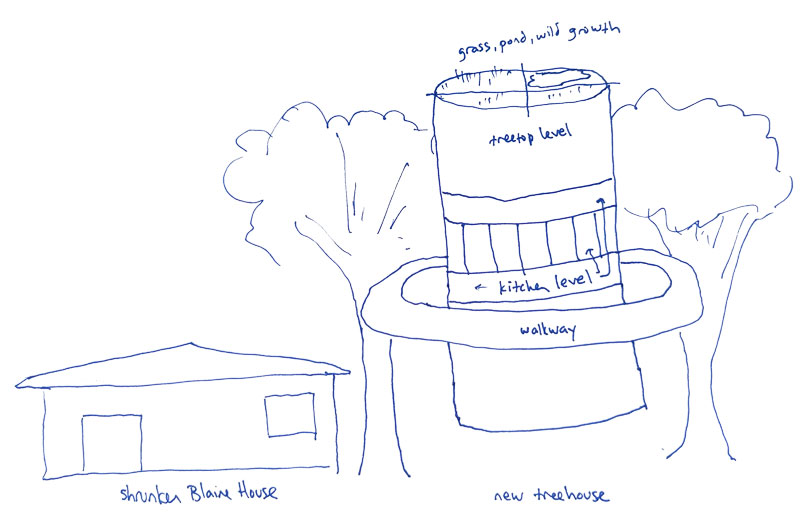
The completed treehouse We returned to the kitchen level. The builders were back, along with a man I took to be Bear, the guy who ran Big Bear Construction and did our porch project a while back. The women builders were back. This place was truly extraordinary. . . . Then I talked with Bear and explained our protectiveness about trees. As we spoke, the entire group moved out of the house through one of the walls and down to the ground. I looked at a tree between the treehouse and Blaine House. It was hard to understand what I was seeing. Was it twisted and splintered? Then the pattern came into focus. The tree had this glowing pattern on it. The light all around seemed to dim to twilight as I looked. The pattern glowed beautifully as if lit from within. As our group pulled away together, I saw the front of the treehouse. The treehouse was surrounded by six big, beautiful trees, each with a glowing symbol on its trunk. The yard had glowing art features in it. It was truly beautiful.
Rapid Construction: This is the first time I’ve seen a group working to create a thought form. While it had all the trappings of physical construction, I never saw any work being done. In fact, the first part came into existence while I was in Blaine House’s basement. The rest of the treehouse was created as we were inside it, exploring it. Its full and final form was only seen upon exiting it and looking from the outside.
-
The Treehouse OBE 2024 • 5:30 AM
And then one of the corners I turned connected to the Treehouse. I hesitated a moment, thinking it was in construction, but then with giddy excitement I decided to have a look around anyways. . . . This time there was a spiral ramp leading up to the first floor. The floor was white with black speckles that stood up a little making it feel gritty. This led to a circular tiled room, but the floor wasn’t flat — it continued the spiral to the center then sloped down again. That just wouldn’t do, I thought. It’d be great for kids, grandkids maybe, who wanted to play with matchbox cars. But no furniture would fit there. This landing seemed pretty small compared to the shape of the Treehouse. Sometime around here, Bodhi and Gwen joined me, running around.
I believe the spiral ramp continued, and I went up to the next floor. Here I saw a worker or two. One I took to be the foreman. As he came in, he looked at me a moment, seemed not to believe his eyes, then moved on. . . . I stood and watched as someone constructed a . . . stairway or shower in front of me. It was dark wood, with lots of vertical beams. As I watched, he carefully lowered a horizontal beam into place at the foot of it.
Continuing Construction: This time I get to the Treehouse by walking around in Hibernia House (my current house). The treehouse is entirely different inside, with a spiral design. Although it was finished yesterday, it’s under construction again. This time I see physical-style construction work taking place.
How Thought Forms Come Into Being
When we focus attention on a three-dimensional image from our past, we project it outwards from us. Our attention creates an invisible cord to a where that image will appear in the astral space around us, and the pressure from the flow through our attention instantly inflates it, perfectly reproducing it. The omnipresent astral substance (elemental essence) instantly flows into that form. Our continuing attention sustains it, and when attention (and thus the cord) is withdrawn, the substance slowly drains back to where it came from.
Inflating and Expanding
Just as forgotten thought forms melt and deflate, new ones inflate. Almost always, it happens so quickly, we only see the perfectly-recreated final form.
But sometimes I catch thought forms midway through their creation. My attention freezes them in place until I withdraw it, at which point they finish coming into being. They freeze due to our expectation of object permanence. At that point, we may mistake them for something else, and our attention might redirect them into that new shape.
-
The Summoner 2001
I’m with Manville in a supermarket, but it’s not really Manville. I am desperately trying to win friends to my cause. “This is a dream,” I say. “If I can make things appear, will you believe me?” He seems doubtful but agrees. I hold out my hand. A stripe of yellow with brown splotches appears, then a banana takes shape. First it’s short and pickle-like, then it elongates.
Expanding Into Being: It’s interesting how the banana takes shape. It’s not often I’ve seen a thought form come into being like that.
-
The Inflatable Water Park 1999 • age 25
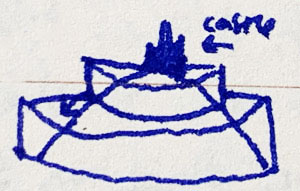
The castle on a hill with courtyards I opened the box. Inside was a glowing green bean and two plastic canisters. There was a current coming from the canisters and I started hooking up these little models of water park rides to hoses that connected to them. I hooked up a whole bunch at once and they all began to slowly inflate. I was inflating a water park right there in Blaine House! They were spreading out across the kitchen, pool room, and dining room. At a certain point, I noticed the current was having trouble inflating so many water park rides at once, so I decided to focus on one. I unplugged the others and remaining one started growing really big. It grew into a huge courtyard with a castle, axe-throwing knights, children with LOTS of colored balloons (little thought-form bubbles), huge water park rides, games, and lots of people.
Thought Forms: Did I inflate everything in that scene, including the children, balloons, and courtyards? They weren’t evident in the little models I saw before.
Or was it more like a rote, that expanded directly into my current environment without taking it entirely over?
-
Powered 2013 • 2:30 AM
A man has the most concentrated bit of substance, sealed up in a little clear plastic bubble. He calls out to everyone, full of energy and emotion. “Do you see this? This is the most concentrated and dangerous part! This, they are keeping from you!” and he tears open the bubble case and holds aloft a chunk of potato, seemingly taken from someone’s dinner plate. It’s saturated with the substance of power. . . . In fact there’s a wild chaos to every form here. Everything is inflated 120%, as if it was a balloon, overfilled. Colors are vivid, glowing. Everything is burning with inner heat. People are so filled with it that they are spontaneously displaying amazing powers.
Overinflating: The effect of the high-energy psychoactive substance is to overinflate everything. Typically large amounts of attention leads only to a very clear, well-defined thought form.
Caught While Expanding
Our belief in object permanence means that when our attention falls on a thought form that is in the process of expanding into its final form, it stops expanding, and only continues when we look away.
-
When Everyone Stopped 2006 • 5:45 AM
The store had these elaborate statues in one corner — I thought one was a sculpture I made in high school but it turned out to be different. They all had a clear contoured glassy outer coating around them — thought forms caught in the action of forming. Each was about 1.5–2 feet long and .5–1 feet tall. They were various shapes — like a combination of a monster/dragon head and a space ship. Later when I came back to them, they had grown into odd “gaming machines.” Each had a 70s style base unit, and a rod coming up suspending a large ship/space station thing.
Blooming Thought Forms: It looks like I wandered into these thought forms as they were on their way to becoming video game machines. As usual, my gaze locked them into their form, and then they continued coming into being when my attention was elsewhere.
-
The Mirror People 2012
It’s dim morning light and I see a couple go into a house along the street on the north side of the school. It’s got a glass front door. I see one of the administrators showing off the house. I rush in behind them and say “you cannot buy this house!” There are all these little white VCRs (maybe 12 of them on the floor plugged in along one wall, and some are black) being offered as part of the house. “These are surveillance devices!” I shout and I start collecting them to destroy outside.
Incoming Houses: I catch the furniture in the process of coming into existence. Their cords are visible, and they started out as simple rectangular shapes in white, which I mistake for VCRs.
-
Lucid: Colored Pots and Pans 2000
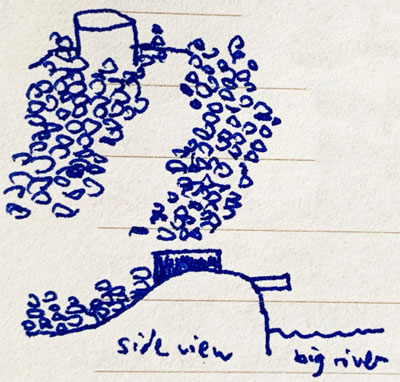
The walkway among colored pots and pans & side view Then we looked up ahead at a vast landscape of colored pots and pans stacked into towers with a path running through them up to this huge tall black pot. I suggested we go up the path and we did. Marilyn said he felt like he was coloring the pots and pans with his mind as he looked at them. As we got on the path they turned to cars, still stacked and still colored. One car blocked the road.
Pots to Cars: It’s possible the pots and pans were just thought forms caught by our attention on their way to becoming cars, and when released by distraction, they finally finished forming.
Materialization out of a Cloudy Shape
A strong focus will instantly create a perfectly detailed thought form. When created with a weaker focus, we may be able to see a thought form come more gradually into being. We may see them grow from small, vague, white, semitransparent, soft-edged things to fully-defined forms with colors.
-
The Ghost Ship
The ghost ship emerging I look out over the water and see this crazy ship-like cloud right over the water. I run inside and tell everyone. When I run back out, it’s fully formed and present — a ghost ship called the Titanic, gliding across the water silently. Did I just see the construction of a thought-form?
Thought Formation: This is a rare sighting of a thought-form coming into being. Most likely it was being called into being by someone else, or it would have been fully formed by the time I had seen it.
-
Lucid: Colored Pots and Pans 2000
One car blocked the road. Was it occupied? As I had the thought, a vague white silhouette could be seen in the driver’s seat. Recognizing the thought form, I said “no” and smiled to myself.
The Driver Thought Form: I was lucid enough to catch the thought form person forming in answer to my question.
-
Art Class, Day 5 1999 • 5 AM • age 25
It’s night now and I’m sitting in the upstairs bathroom. I get this creepy thought about three bad things coming to visit and I think that someone’s going to dangle something outside the window. I don’t want to turn and look, but I do. Something materializes as if fading in from behind thick darkness. I’m a little spooked but know someone’s playing a game and go to pound the window to scare them back but there’s no glass and my arms flail outside the window. I back up, then look around the corner and see a vague white figure on the deck with a fishing pole moving this stuffed white hippopotamus. These are all thought forms I made of course. I grab a plunger and swing it at the dangling hippo. I smack it and make this groan of disgust. Buttercup hears this and awakens me!
Thought Forms: The object was created by my fear that it would be there. I wonder where the idea of three bad things coming to visit came from.
-
Bad Service 1997 • age 23
One by one all the customers let him know what a mean bastard he is. Then I take my turn. With each customer he starts listening and then gets all mad and stops listening. I wanted someone to throw something at him, and someone throws a clear sleeping bag at him (a thought form!).
Vague Intention: The sleeping bag was my own thought form, not fully formed, from my desire for someone to throw “something” at the mean guy.
Shadowy Forms
Shadowy forms appear to be a beginning stage of thought forms — a weak thought, not specific enough to finalize the form. In other words, “someone is there” without any specific idea of who.
-
The Royal Line 1997 • age 23
The gods were bumbling around and broke a hole in the city’s inner wall, which would allow anyone in. We had the idea to stake out the opening and see who would come through; who the princess’s enemies were. I remember someone sneaking through, but it was more of a thought than real, like a darker thing of a slightly different style. It didn’t fit.
Mismatched: Typically you can discern people and thought forms from their behavior, but sometimes their appearance gives them away. Watching for someone to sneak through the hole will surely lead to a thought form person doing so, and it appears in a style that doesn’t match.
-
The Slumber Party and Scary Man Prank 1999 • age 24
I decided to play around with them and practice making some thought forms. It was still dark and I looked out a window. I pointed and said to Buttercup, “Look at that. . . . MAN!” Surely enough a bearded spooky face appeared out of the shadows in the window, from a black silhouette to a full face, giving the appearance of approaching.
Focusing In: The thought form person comes into focus before my eyes, starting as a shadowy figure before coming fully into focus as a person.
-
The Summoner 2001
Manville challenges me to create his kitchen. “It has to be something I can picture,” I say, “but maybe I can read it from your mind. In fact, I know I’m capable, I’ve just never done it before. Let’s try.” I hold my palm up by his head and close my eyes, focusing on projecting into an open area of the grocery store. The images are unclear, dark. For a moment he sees something familiar. Then it shifts, switches. I give up on it.
Shadowy Beginnings: Unable to get a lock on what I’m creating, I only manage to create a dark, unclear form before losing it.
Transforming Thought Forms
Conscious Transformation
-
Ghosts and Astral Matter 1996 • age 21
During a scene of emotional conflict, the next room began glowing an eerie green, and a large ghostly stack of stereo components appeared. I walked up to it and pulled at the top. Its features melted away as it stretched out, but when I let go it snapped back to its original form. It was some kind of elastic spirit substance. I brought some of the substance outside and changed it to something else with my mind. Then I threw it up into the air and willed it to change to rain and it did. Then I changed it to small dogs and a donkey.
Transforming Astral Matter: Astral matter responds instantly to thought to create new thought forms.
Unconscious Transformation
These are due to changes in context, preference, or expectations.
Changing Form
-
The Green Dragon of Sauron 2004
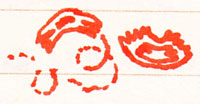
The dragon’s first appearance The dragon flew over the mountain ridge/membrane and was this swirling, looping shape in the sky. I stared at it, mesmerized. Then details fade, but the dragon dove down and attacked with flame and claw as we darted across this new area.
The Dragon: If you look at the picture, the dragon at first looks very little like a dragon. It’s almost like a kite, or wings, floating and spinning on the wind. How odd..
-
Reshaping a Guinea Pig 1997 • age 22
Me and my sister were given guinea pigs. I don’t like guinea pigs so mine gradually transformed into a gerbil.
Transformations: This time the transformation was based on my preference.
Attention Increases Size
One of the fundamental laws of consciousness is that attention makes something bigger.
In dreams this manifests as the proximity of someone or something to you, just as in the physical world, the closer you are to something, the bigger it is. In dreams, the more our attention is on something, the bigger it appears to us. As you begin to think of something, it starts out pin-prick small (far away) and expands (gets closer). Watching something expand from your attention is the equivalent of getting closer to it.
Physical reality requires the extra step of moving the physical body. Our attention draws us to move ourselves physically toward something, and doing so makes it appear bigger.
-
Liquid Reality 1998 • age 24
I was doing some experiments with sight in dreams. There was a scene with an ironing board and as I focused on it, it expanded, as if attention magnified it in size. I experimented with different things in the visual field and attention flowed into things and expanded them like liquid reality, in the same way that proximity expands things in the waking world but without the fixedness of form.
-
The Wild Bus Ride and Parasitic Moths 2012
I am in the downstairs basement level of a house. The first thing I remember here is that there’s a big booger blocking my left nostril, so I pick it. It comes out, followed by all these green dusty things which fall to the floor. I look down and they’re little insects, squirming and moving about! The horror! As I watch, they quickly grow from tiny motes to a half-inch long. They’re crawling about and increasing in number every time I look away and then back. They look kind of like little green scorpions. . . . The scorpion look was only for the first few I examined closely. The rest were long, segmented things with lots of legs and feelers. They were green and semi-transparent when small, then they turn jet black as they get bigger, then brown as they reach the size of 2-3 feet long and four inches tall. The largest ones looked more like shed skins, as they had lost definition, like a melted thought-form.
Insect Growth: I unwittingly inflate these tiny insects with my horrified attention until there is an infestation of nasty bugs. Notice how they go from transparent and barely formed to black and leggy as they enlarge under my focus.
Multiple People’s Influence
Multiple people can influence a thought form, either consciously or unconsciously.
-
The Severed Thumb 1999 • age 25
My “severed thumb” I was in a sandy square in a small Western town. I held my severed left thumb in my hand — or more likely, something in my hand had melted into a small thumb-sized object that I took to be my severed thumb. It appeared to be severed at the top knuckle. There was no blood, just the end of a thumb, severed like cut clay, and of course there was no pain. So I’m curious, and then I think, “How does not having a thumb affect my life?” I ponder the implications. “I can still write, as my right-hand thumb is fine. . . . Oh no! I can’t play piano!” Then I panic. I shout and run about calling for doctors and asking people to call a doctor or hospital. Soon I’ve gathered a crowd, including one doctor. As my friends looked at my “severed thumb,” the cut part now began to sport a thick bloody gash, looking more real.
About here I had a revelation. I popped the thumb-end back on my thumb-nub and it attached. I was kind of alone at this point, off to the side of the others. The blood was gone again but the thumb end fell off when I bent it. The doctor saw it after I stuck it on and the moment he did, reddish pinkish “blood” that was thick like jelly appeared around the severed area. Did his expectations directly affect my thought form? So he wanted to sew it up and I ran away saying “Ha! You want to stick your needles in me and sew it up? I don’t think so!”
Then a police officer who had also been attracted to the scene walked up beside me, intrigued, and for some reason he looked at my thumb and the blood was blue! So he called me an alien.
Multiple Influences on a Thought Form: Here’s an interesting example of the expectations of multiple people changing a single thought form. On my own, I took it for a severed thumb but without any blood or injury. But as I explained it to others and they looked at it, it took on a wound and blood. The doctor’s expectations added even more blood, and the police man’s weird expectations made the blood blue. Thought forms are communal property. One person’s thought form can be transformed or reanimated by someone else’s expectations.
-
Uncle John’s Puffball Mushroom Farm 2023 • 7 AM
He pointed and said “look!” and I followed his eyes to this huge puffball mushroom a little ways off. It was the size of a large beachball. When I got to it, I could see a boulder-sized one in the distance.
Amazed, I ran to it, but oddly, when I got there, it was replaced by several large but different types of mushroom, like tan, orange, and white layered shelf mushrooms, but several feet tall and wide and more shaped like wedges. None were as big as the boulder-sized one I’d seen here. They were along a sunken path next to a wood building. There was one that was shaped vaguely like an angular weasel face, mostly a light orange color. When I brought my hand close to it, it seemed to move a little in response. Buttercup and Bodhi and Gwen came near, maybe some others, and I told them to hold their hands out to it, and it reacted similarly. I decided to take a video of it and Bodhi got behind it and jumped around. I asked him to stop.
We walked away after a few minutes, and there were a swarm of flies ahead of us, and then we saw some reddish raccoons walking about. Some were young. Some walked on their hind legs like a human. Now that I think of it, they were the same colors as the shelf mushrooms we were just looking at. One walked up to Bodhi, and he picked it up. These were probably red pandas, his favorite animals.
Mushroom Red Pandas: I get excited and go to see the boulder-sized puffball mushroom. It’s likely I excitedly called the family over with me, as they arrived with me. Oddly, I end up seeing a bunch of quite different kinds of mushrooms instead, with the boulder-sized one no where to be seen. I was looking at each, thinking “Is this the one I saw? No.. Is this?”
What likely happened here is that Bodhi, registering my excitement at seeing something cool in the woods, thought that maybe it was red pandas, his favorite animal. These new mushrooms look like are red pandas caught by my attention in the act of coming into being. They end up halfway between mushrooms and red pandas, and the weasel-shaped mushroom I approach responds to our presence slightly, as if its nose was twitching.
As I remove my attention from them and walk away, they are freed up to take form entirely from Bodhi’s desires, and we find ourselves amidst a group of what I take to be reddish raccoons in the dream, but which are clearly meant to be red pandas, which Bodhi greets fondly. Amazing!
-
The Home for Shape-Changers and Psychics 2004
The tall metal sculpture In the center of the house, there’s this open column that goes up all four stories. Someone builds this little one-story sculpture of two-colored metal at the bottom. But then this hefty magician-looking guy whirls to the top of it and pulls all these slivers of silver or gold metal from out of the air and extends the statue all the way to the ceiling, hovering over it.
Creating Together: Here we see two people contributing to this thought form sculpture.
Releasing Thought Forms
One can consciously try to get rid of a thought form, though this is usually counterproductive, since attention is what thought forms require to exist.
Destroying Thought Forms
Thought forms are built by attention, so attempting to destroy one will generally only strengthen it. However, if it is our own creation, our intentions may eventually come to pass when we remove our attention from the form, then return it, expecting to see it transformed into a version that appears destroyed.
Destruction vs Object Permanence
All thought forms are made of the same astral substance. It can look like anything, but doesn’t have the inner physical properties of wood, glass, stone, and so on. Trying to make it respond as if it were these materials is difficult. While thought forms respond to our expectations, our focus on them preserves their present form. Sometimes it takes a break in our focus to allow the desired transformation.
-
Burning Thought Forms 1999 • age 25
Buttercup bought a house in Atlanta and we had to burn down the one next door because it carried some disease. Buttercup and Ruby and Emma and I all got hoses and surrounded the house. We kept lighting it on fire but the flames would go out when we looked away or stopped paying attention. A phenomenal effort got the front of the house burning but before too long, of course, it went out. The effect of the fire was that the front had tilted inwards, shrunken, and become “sweaty,” much like if you were heat-melting plastic or cheese. The wood, windows, stone, siding, etc, were all being treated as equal substances. Thus, a thought form.
I was between the houses protecting ours from spreading fire. I needn’t have worried. As I learned in the lava dream “The Backyard Lava Pit”, housing blocks are inviolate from each other. So then some distraction occurred and we came back to the next-door house (which we’d been trying to burn) to find it in charred ruins. It finally responded to our expectations when our attention wasn’t holding it in form through our physical “continuity of form” expectation. We then went in and kicked the boards down and so on.
Very Interesting!
Thought Forms and Expectations: Fire doesn’t exist in the astral. The flame, when appearing on the house, was a thought-form image we added onto it. It didn’t actually burn it. The intent of our flaming thought-form was to destroy the house, so while our attention made it melt somewhat, it also worked to hold the structure in place to a large extent. Finally it took a strong distraction to allow the house to become the charred ruin we originally wanted to see.
-
Submarine Self-Destruction 1990 • age 15
The blast comes. I see it — a slow-moving shockwave of intense heat moving towards me. I’m not protected enough. I scramble out the window for another wall of protection. I close my eyes and take the blast. When I open them again, the house is devastated. The deck wall is shredded, blown out two feet off the deck, showing nails. Most of what’s in the house is either turned to dust or knocked over and slightly charred. Every opening — windows, arches — is melted down to a small molten opening. The walls around the pool room are all blasted outwards. The spot where Wadsworth stood had a small black circle that also appeared on the ceiling. Was he totally disintegrated, or did he move? I have moments of fear, but we find him outside. He’d gone out behind the wall I was standing near.
Transformation Behind Closed Eyes: The destruction of the house would likely not have happened if I had kept watching, but closing my eyes gave the thought form of Blaine House a chance to change to my new expectation of it.
Most interesting to me is that the window and arch openings are all melted into smaller openings — as if the walls melted down over them. Melting is astral matter’s natural way of being “destroyed”.
Structures Breaking Apart
-
End of Days 2012
Someone asked the captain why we were flying so low and I heard the captain saying there was a problem of some kind. The plane passed under a bridge and then slowly started to land on the freeway. It went well, except we heard warnings that up ahead there was an obstacle of some kind. Soon I saw it — a toll booth blocking the right side of the freeway. The plane hit it, sheering off and destroying the right side of the plane. The left side shook and listed. As it started to careen up into the air, I turned to Buttercup. Time slowed down as I looked in her eyes and said “Buttercup, I love you”. The left side broke off into sections and our set of two seats stayed upright as it flew through the air. They landed and separated, remaining upright and sliding along the road. I unlatched my seatbelt and just stepped out of the seat at a trot, then slowed down and stopped. I shouted for Buttercup to do the same. She did. A car coming from behind in the lane we were in almost hit us but we stepped aside in time.
The Plane Crash: The crash is fascinating. Since the plane itself is a travel rationalization, that thought form makes the best attempt at a realistic crash while obeying the law of dreams; that being that each person traveling is an independent unit and in actuality is just slowing down and landing on the ground. So the plane breaks apart into sections of connected people, such as Buttercup and I. We land and our seats separate, staying upright the whole time, and as we slide, then we just unbuckle and trot slowly to a stop, the plane rationalization and all its parts no longer needed.
-
Tornado Obliteration 2018
I had been traveling through the suburbs in a bus. There were reports of tornados, and we drove past some torn-up forests near our house in Atlanta.
I ended up at Manville A’s house in Minnesota with a bunch of other kids. The wind picked up suddenly outside and I asked Manville what was outside each of the walls — another room? Was it underground? Or an exterior room? It took a moment for him to understand my question but we located an internal wall. I pulled couches around us. The wind picked up and increased tremendously, shaking the room. We moved over a little and clung to the pool table in the center of the room. The room started breaking apart as the sound increased and suddenly it was a whirlwind of debris. It was over quickly. When the dust cleared, the room and everything in it except the pool table were atomized into small brownish clumps, like dryer lint. I looked out into the yard and forest around us. Manville and I stood up and walked to where a wall was, and stepped right out down the 2 foot drop into the yard.
A room, obliterated?!
Shredded Thought Form?: This is a very unusual way for a thought form to go. It was very much like what a real tornado would do, aside from the extreme level of atomization. I’ve never seen a thought form be so thoroughly rendered into debris as if it was physical. Still, the appearance of clumps of dryer lint was not correct. And what’s stranger is that we were inside it at the time!
-
The Sliding House 2023
We’re in a house in a neighborhood. I think it was meant to be Buttercup’s parents’ house. It was raining, and I knew the house was about to come loose from its foundation and start sliding. It did so, and I told everyone to hang on. It slid down the small slope into the street, then started moving down the slope of the street. As it slid, bits of it began to break off. It continued down the street and onto a larger street, picking up speed, then onto a freeway, all downhill, breaking apart more and more, leaving debris and belongings behind each time a part of the house broke off. Soon it was just a single bedraggled room. It finally slowed down and came to a halt. We stepped out.
The Shredding House: When released from attention, thought forms melt, shrink, and drift. But when they are breaking apart for other reasons and remain in our attention, they can take on a more physical form of breaking. This is interesting because the house is “one idea”, not a conglomeration of thousands of ideas of wood and walls and furniture. Maybe the debris is made up of altogether new thought forms.
I’m pretty sure the house was on its way to becoming a car, now that we were on the freeway. It had broken apart until it was a single small room, about the right size for a car, and contained (the feeling of) all of us. The wall was missing in places that allowed us to see out the front and side. Had I forgotten the previous scene, I’m sure it would have finished the transformation.
How Thought Forms Disappear
Melting or Shrinking
As a thought form loses the attention that sustains its existence, it begins to shrink and melt like ice in the sun. Sharp edges become rounded as the entire object slowly shrinks, loses definition, and colors fade to white/clear. However, unlike ice there is no liquid left over when it is gone. Its substance simply recedes back where it came from.
-
Lucid Dream: Bruce’s Arm and the School Bus 1997 • 10:13 AM • age 23
There was traffic and school buses. I picked up a big bus, and was floating along with it. I kinda scared some kids in other buses by pretending I was going to throw the bus at them. I heard all the kids scream but of course I wasn’t going to — just kidding around. Then I walked up another hill, forgetting about the bus.

The school bus, melted & shrunk I met this kid and we started talking. While we did, the bus I had picked up had shrunk to the size of a large plank of wood. It was just one color of gold/yellow now, and each indentation was much less defined, as if melting, shrinking.
The Shrinking Bus: This a great example of how a thought form melts away when attention is removed from it by its creator.
-
The House War 2011
Finally I’ve had enough, and decide to kill the nasty boys. I go to each in turn and rip their heads off. Their bodies melt away leaving just a balloon-like head that falls to the floor.
Separated Thought-Form Head: The head is apparently the source of the thought form. I wouldn’t have thought it possible to tear someone’s head off.
-
The Superhero’s End 2011
I came up with a compromise — that I would simply make a copy of my pictures and give her back the menu. She agreed. A large copier was near us. I put the menu in and waited.
I looked out this large plate-glass window and saw that behind this restaurant was the underside of a bridge over a stream. The water was about a 1-2 feet deep, and there were maybe 80 cats just sitting out there, gathered to the shallows, but since it was so packed, some were resting several inches deep in the water. I commented on this to the waitress, and then turned back to the copier. It had copied the single-page menu into a 120-page stack where it enlarged and expanded on all the text and images in the menu. Upset, I returned to the table and plopped down the huge stack, saying “This is what the copier did.”
Expandomatic Copier: It’s possible that the copier, which likely appeared due to my expectation, had shrunk to the size of a stack of papers while I was looking away, my attention on the cats instead. When I looked back, expecting to see the copies, I took the shrunken copier to be a stack of copies.
-
The Tree Clearing 2024
The trees along the neighbor’s house have begun to look scraggly and dead. Every time I go out there, there are fewer of them. . . . I note that one log in the back yard has a thin ring cut out around it, which is a way to kill a tree. I see similar rings on others. . . . Then Buttercup and I are driving to work. . . . Finally, back to our actual (dream) house, I take pictures of the ring around the log, only it’s branch-sized now (shrinking thought form).
Shrinking Logs: As I turned my attention away from the downed trees to go to work, they began to melt and shrink. But not much, as I still remained focused on the tree loss. When I returned, they were branch-sized.
-
The Blue Crab 2025
I forego the shells and note this really interesting shimmering dark rock ledge. I pry off a few bits of the dark rock and stick them in my pocket.
I return to our house and try to tell Buttercup what I found, but she’s preoccupied. I take the rock bits out of my pocket and find they’re smaller. I think they must have broken up in my pocket but of course they are shrunken thought forms.
Melting from Heat
Heat in the astral is an interesting thing. The higher you are in frequency, the warmer it is, and the more fluid reality is. The environment is more responsive to thought. Thought forms melt more quickly, as if there is an ambient heat that affects forms. At even higher levels, forms flash quickly into being and then melt rapidly away. Attention only solidifies them when fully focusing on them.
People describe the higher astral as pleasantly warm, and the lower as cold. But since we have no physical body there, this is a translation to our sense of temperature. And yet, like astral proximity, astral “heat” has a readily visible effect on our surroundings.
-
Wadsworth’s Evil House 1996 • age 22
I became a fireman last night. We got a call and the other fireman showed me where the truck was. We arrived at the house that called and it belonged to Wadsworth! He said the house was very hot, and showed us these strange dim green flames in the sink and ceiling of the bathroom whenever he turned off the light. We eventually found that there was a small potbelly heater on the second floor that was on full blast no matter what. We went to the basement next. The ground was dirt, crusted like the hot pools in Yellowstone. In the center was a little fire well flexing about. There was a strange cream cheese substance in all the pipes and one pipe spat some out from time to time. I went to Wadsworth and gave him 4 choices: 1) call some psychics and healers to heal the house and send away the spirits, 2) call a heating man, 3) call a plumber, and 4) move out RIGHT NOW. I spent the night there. Ruby was there too. At one point, I stood up in bed and demanded that all spirits leave this place.
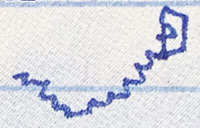
The stairs sagged down in the middle Upon “waking” there I realized my room was horribly tilted and this liquified cream cheese was trickling out of the bathroom towards my room. I ran to the basement and the stairs going up were melted into a V-shape instead of the usual 45 degrees. I realized the middle of the house was sinking rapidly into an expanding steaming hole. So I gathered a few important things and took them out. I discerned the safe places to stand and found my way to safety (thanks to my swamp stomping skills) but Ruby fell right in and disappeared completely. I rescued her once. Outside, I could see the whole house sinking, and soon it had sunk completely under, leaving just a mud pit surrounded by forest. A big crane rescued her Ruby out of the mud again. Weird!
A Melting House!: This is extraordinary. We see all these hot spots in the house — the green flames, the blasting potbelly stove, the Yellowstone fire well. The white cream cheese substance flowing through the pipes is liquid astral matter as the house itself melts from the heat.
Now often when I see a thought form melting, it’s simply shrinking like an ice cube without any liquid left behind. But at times I’ve seen a liquid center or a wet, white substance on the surface. Incredible!
-
The Backyard Lava Pit and Dream Crossover 1997 • age 23
[The lava] flowed down the alley leading to the neighbor’s house. It went into the back yard in thick sheets and I yelled at a man and the butler to watch out. They were most assuredly thought-forms, though, as they were almost like vacant balloons, animated only by my expectations. One just let the lava take him — just didn’t even notice. After the lava had flowed over the butler’s foot, his colors began swirling and melting into it. As the lava rose, he melted into it, becoming of the same semisolid amorphous flowing, stretching substance.
Melting, Joining Thought Form People: All thought forms are the same astral material in different forms. So when the butler and the man thought forms touched the hot lava, they melted right into it.
Melting into higher-energy substance like this would be an ecstatic experience. This is essentially what happens when we enter higher frequency domains.
-
Powered 2013 • 2:30 AM
He tears open the bubble case and holds aloft a chunk of potato, seemingly taken from someone’s dinner plate. It’s saturated with the substance of power. . . . At some point in the chaos, a cluster of four slowly-expanding black orbs is released from it, the orbs growing slowly and flashing from black to cinders and back. I know when they burst they’re going to explode massively. They do and an entire quadrant of the glass bank building is taken up in the explosion. Another black cinder bubble cluster flies in the opposite direction towards people coming up a spiral staircase. I watch to see what happens — as the bubbles expand, they melt and fuse onto the people coming up, who now look like glassy-skinned semi-molten thought forms.
Fusing and Melting Thought-Forms: The high-energy orbs expand, fusing with and melting the thought forms coming up the staircase.
-
The Rogue Faction
There was a scene with giant vehicles driving slowly through a burning city. But the flames were whitish-tan, the buildings melted around the flames like ice would.
Melting Buildings: Here we see an odd kind of dreamfire around melting buildings. Note that dreamfire isn’t typically hot — it’s just a light phenomenon.
Melting is the typical way that thought forms disappear. Usually this happens from lack of attention or a vague expectation of destruction. Being that I was not an active player in this movie, I was not the origin of these thought forms, and they melted even while I watched.
Melting and Reforming
Thought forms slowly melt away when attention is withdrawn from them. However, if attention is returned during the melting process, they will stop melting. Sometimes they reform into something new — a smaller object with a similar shape that fits the dream context.
-
The Wild Bus Ride and Parasitic Moths 2012
When we get back outside, the person guiding the group has this big sack of gifts for us. She pulls out the first thing — a soccer ball! I get the most excited, and she says “I think this one goes to Sam,” and she hands it to me. . . . We begin walking along this wooden walkway the way we came in. I find an egg on the ground, and then a spotted egg (the melted soccer ball!). Both lit up as I looked at them, the way things in video games light up to show they’re interactive when you mouse over them. They still carry a dim light as I hold them up, one in each hand. The bully is next to me, asking if he can hold one, and I say no. Normally I’d gladly share, but not with him. I look at the spotted egg again and it looks strange. The colors of the spots have faded to just outlines now, and as I look I can see deeper into it — about an inch. Underneath each spot is a round, darker circle, and as I look closely, they focus into quarters (coins). Neato! The bully is really jealous now. The outer layer has become hazy and transparent and I start collecting the quarters off what is now the outside. But lo and behold, under each quarter it’s clear and I’m seeing a wavy image of . . . a naked lady! It’s like a three dimensional image within a clear faceted orb which distorts in different ways as you turn it. I quickly slip it into my pocket for later. What a prize!
Exquisitely Detailed Melting and Reforming: This is a fantastic example. The spotted egg I find is the melted soccer ball thought form. The color and outlines were the first to fade. Since the exterior colors had faded to transparent, I can see that the black hexagons’ colors have retracted inwards towards the center of the ball. My focusing on these spots stops the melting and imbues them with new detail, and they form into what they sort of look like at this point — quarters. Now that I’m focusing only on the interior, the outer layer disappears in a transparent haze. After plucking off the newly-formed quarters, I can see through to the very center. Now why a naked lady appeared inside I don’t know. Was someone else projecting into the thought-form?
-
From Road to River 1994 • age 19
The street changes to a river and the cars become boats. Ruby and I start to go down this river. I ask “is it safe?” It gets fast and fun and we finally reach the bottom — a deep sandy valley. We stick the boat in a guitar case.
Melting: Vehicles are often rationalizations created during fast travel. It’s likely the boat thought-form had began to shrink when we stopped and it wasn’t needed anymore. This is how I mistook the shrunken boat for a guitar when I turned my attention back to it, and it fit in a guitar case.
-
Car Encased in Ice 1999 • age 24
I dreamed Buttercup and I were on a cross country trip to San Francisco. We stopped at a gas station and I was distracted for a time inside. When I came back out, the Neon (our car) was all covered with a thick coat of transparent ice (hint hint: thought form)! Trying to crack it off, this girl broke the windows and the plot was altered to trying to get replacements. Oddly, when I went back to the car after making some phone calls or talking to people, the car had turned into a van with a funky one-piece front window.
Melting Thought-Form: Here we see the melting of a thought-form mistaken for a thick sheet of ice! Released from attention, the car thought form begins to melt. It loses its hard edges and the colors recede inward, making the exterior look like it’s covered in thick transparent ice. Once I take it to be a layer of ice, it begins to act like it. And thus the plot of the dream is altered by the very nature of astral matter itself.
Melting thought forms reforming with an apparent outer layer of ice is a common occurrence. This shows that one of the first changes is the exterior colors receding inwards. Coloring is also the last thing to appear when a thought form is created.
Deflating
-
Deflating Tank 1997 • age 23
I saw visions of an invisible force shoving some people on a fence and yelling slurs. Then it shoved someone walking by, and went to a power line and yanked the cord out. The power line was how Tank was plugged in and the immediate result was that it rapidly began to shrink. It shrank until a conglomeration of featureless blue person-sized rooms was all that remained. My tent had deflated around us and was now in a sort of pool around our feet.
References: Tank is the name of a co-op I lived in in college.
Deflating Tank: A thought form with people inside can’t “melt” exactly — it would crush the inhabitants. Deflating makes more sense, especially in the context of it being sustained by pressure through a cord.
-
The Chamber Beneath Blaine House 2000
I focused on creating a thought form and suddenly held a sprig of spruce in my hands. . . . I was so overwhelmed I was moved to tears. I’d done it! I’d created a thought form and brought it to reality! I could feel it solidly in my hands. Ruby/Buttercup tried to take it away, unimpressed, but I refused to let go. Feeling awed, I thought Wadsworth must have been a master thought form creator to have created all this. Then I noticed the sprig becoming jelly-like and limp. I was concerned for a moment but then forgot about it.
Limp Jelly: Being that this thought form is in my hand, I have the rare opportunity to note its changing texture. Losing its sturdiness, it becomes limp.
Decaying
It’s uncommon, but sometimes I find though forms deprived of attention decaying, rotting, or crumbling apart.
-
Bad Service 1997 • age 23
I find a drawer I want to buy. There are cashiers working, so I go to pay for it. I buy it and go outside. A guy walks by with 3 Garfield statues and says “Did you see the free Garfield stuff?” I go back inside, find two fierce stylized Garfield statues, and take them. . . . [I get distracted] I get back to my car but find that the drawer is rotted and the Garfields are shrunken and falling apart like trash.
-
Looking for the Ball 2025
A gray soccer ball rolled down the stairs and I went down to get it. I didn’t really want to. . . . [I] went into the messy bedroom next to them. I found a couple gray soccer balls in there, but they were too small, and broke apart as I touched them.
Drifting
A thought form released from our attention is also released from our expectations, including the expectation of gravity. Thus I’ve sometimes seen released thought forms drifting about like balloons.
-
The Tower on Arcology Hill 1996 • 3:33AM • age 22
I catch Buttercup making out with Hiro and I’m horrified. Remembering that Hiro likes three-ways, I join in kissing them both. After a moment, Hiro detaches and floats away. A thought form!
Thought Forms: Hiro was a thought-form based on my fears. You can tell because when I stopped paying attention to him, he just up and drifted away through the air. Was Buttercup real in this dream? Hard to know.
-
Lucid Dream: Bruce’s Arm and the School Bus 1997 • 10:13 AM • age 23
It began with me getting food in a cafeteria. Bruce (Buttercup’s Wadsworth) was lying on the table with the food, and I was cutting up his arm with a big steak knife to put on my plate. Then I realized what I was doing and looked up because I knew the body I was cutting didn’t mind. I saw another copy of Bruce standing there. He was looking at me strangely, casting his gaze back and forth from the version of him on the table to me. The Bruce on the table began to get lighter and lighter and float up into the air. I turned to the standing Bruce and said “You’re Bruce H.” and he said “Yes, I am”. Then I indicated the floating body and said “Then this isn’t your body,” and he said it wasn’t.
Movement and Travel
Flying
We can fly in the astral. But when the waking mind is involved, we need to be able to overcome the physical expectation of the gravity.
Each physical law we learn is a habitual limitation our waking selves bring with us into the astral — limitations we need to unlearn to open up our possibilities again.
Flight Triggers
The Dream Self will fly, naturally, without thinking about it. In fact, walking about with legs would not occur to us in that focus. But in the waking self focus, it takes lucidity (or stress) for us to realize that we can fly.
Lucidity
One of the first things I usually do when I become lucid is to fly. It can take some experimentation to figure out how it works.
-
Bedroom Soccer 2023 • 7:30 AM
I talked with various people. At one point I asked myself, “Am I lucid? Do I know this is a dream? Of course!” Then this girl showed up and sat down across from me. I recognized her in the dream and said an excited “hello!” We talked, then I decided I wanted to fly. I invited her outside. On the far side of the restaurant was a beach on a lake. There were lots of people out there talking, and some in the water. I started jumping, large jumps, slowing down on the way down by turning my body sideways. After a few attempts, I got it, and floated through the air out over the water and around a swimmer. There were sounds of surprise and delight from some of the people on the shore. I did this for a little while, then returned to the restaurant.
Look at Me!: I think the thought about lucidity (even though the answer was obvious) inspired the flying, as it’s often the first thing I think of to do. Here’s it’s just more of a habitual response.
Stress
I think this may be a sort of stress-induced lucidity; inspiration communicated from the Dream Self to the waking self.
-
The Recurring Burning School
This is a dream I’ve had a few different times: My elementary school is engulfed in flames and under all the stress of it I leaned forward and took off flying.
Flying Under Stress: I’m not sure if it became a habit that I would fly in these dreams or if it was something about the stress of the situation.
-
Guardian Spirit Leila 1992 • age 18
A flame shoots up through the center glass shaft of the elevator, and I sense some disaster coming. I climb down the shaft and leave the building. I emerge in this parking lot with scattered cars. My Dad walks out from between some cars and says something to me. Then he walks off, leans forward, and takes off flying. I watch, amazed, and say “Oh, so that’s how to do it!” I lean forward, lift my feet up, and fly. . . . It’s an amazing feeling.
Disaster and Flight: The most common precursor to flight in my dreams beside being in a high realm is there being an imminent disaster: usually a fire or burning structure of some sort.
How to Fly — Overcoming the Gravity Expectation
Here are some ways I’ve come up with to overcome the expectation gravity to start flying and stay flying.
Focus on Rising
We can jump and use our attention to expand the upward motion indefinitely.
-
The Piranha-Rat 1995 • age 21
How to fly: Leap into the air. Jump high, concentrating on the “up” part to bring it forth. You’re already flying. Forget to fall back down and you can go anywhere you want once you realize that you’ve succeeded.
Flying Tips: My “forget to fall back down” advice is similar to the advice given in The Hitchhiker’s Guide to the Galaxy. In it, Adams explains “There is . . . a knack to flying. The knack lies in learning how to throw yourself at the ground and miss. . . . It’s no good deliberately intending to miss the ground because you won’t. You have to have your attention suddenly distracted by something else when you’re halfway there, so that you are no longer thinking about falling, or about the ground.” (Adams)
-
OBE at the Dark Tower 1997 • age 22
In my Blaine House room, I had an OBE in which I found out how to fly: jump and hold onto the “rising” part. I flew up through the wall and roof, and ended up on the deck outside my room in Blaine House.
How to Fly: In other words, jump and then forget about your expectation that you will fall. Simply extend the part where you’re rising by focusing your attention on it.
Bounding
Bounding is a form of the “Focus on Rising” technique of flight.
Bounding is taking larger and larger leaps that sometimes results in flying. The thrill of the large leaps becomes your focus as your desire to go higher overrides the believed limits of gravity. It’s a transitional state between your desire to fly and the waking mind’s expectation of gravity.
-
Tornadoes and Electricity 1996 • age 22
I go back to Blaine house to see how they’re all doing. I start leaping on the way. The longer I hold it, the higher I rise. I love it tremendously.
Bounding Home: This is exactly according to my “How To Fly” instructions from an earlier dream!
The Belly-Up Trick
I’ve noticed on some occasions that my desire causes me to pulled forward by my chest or belly, as if the motive of forward motion comes from that location. Thus, turning belly up can put that motive force to use against the expectation of gravity.
-
Out of Body Experience — Flying on the Rooftop 1996 • age 22
We sat on the roof with the stars above, smiling, floating, weightless. I kept feeling the pull of gravity, out of habit. How to fly? I turned belly-up and felt the expansiveness of the sky and began floating up!
How to Fly: Here I use a technique to fly that I’ve used several times. If you are in a stomach-down position and feel the gravity expectation pulling you down, you can flip over and that same sensation of gravity will instead pull you up.
-
Lucid Dream: Bruce’s Arm and the School Bus 1997 • 10:13 AM • age 23
I REALIZED I WAS DREAMING and began running about, leaping from table to desk to chair! . . . I was on a hill and tried flying. Here are some secrets: you tend to drift downward unless you turn belly up. It seems your belly pulls you forward. . . . [The kid] started walking back to his little house. I followed and inside there was this girl. I said “Look, I’m going to fly.” I lifted up and drifted immediately down into the corner. He wasn’t very impressed and threw himself in the corner and sarcastically said “Ooh, I’m flying, too.” So I got up with a greater will and did the back flip thing and it worked — I was floating there and flying about. Then he was flying, too, but he was unconscious, drifting in the air but mostly motionless. He had this plastery semi-sweet look on his face.
Lucid Flying: The back flip is another way to get belly-up. As you begin the flip, your belly goes up and pulls you up into the air. At the end, you’re standing in the air.
Other Techniques
-
Rocket Feet 2024 • earlier
I approached a fence and rather than going through it, I decided to try to fly up over it. I tried a few techniques, then settled on “rocket feet”, where I imagined blasting energy from the bottom of my feet to move.
-
Flying in the Aviary 1996 • Middle of Night • age 22
My favorite place to take off is a hill in the aviary. When I do, it feels like gravity slowly pulls me down unless I feel a lightness in my center (my 4th chakra area). The chakra glows, becomes fuzzy-edged and see-through, and it lifts me. I couldn’t get enough flying. I felt so free and kept doing it over and over. There were some beginners with me who wouldn’t try as often as I.
Flying: Here’s some extra in-depth information on flying in dreams and what it’s like. And I’m writing as if I’m aware of how my chakras look!
-
Giving Flying Lessons 2016 • 8 AM
It occurred to me that it’d be easier to fly down and I said, “Do you want to learn how to fly?” She said yes. I thought a moment, then said “Hold our your hands like this”. I held out my hands, palms down. “Then imagine raindrops falling up onto your hands from below.” I felt a familiar tingling sensation as if lots of tiny raindrops were hitting my palms from below. My palms had little light blue expanding circles, like raindrops in water.
The Secret to Flying: The tingling hands and feet when flying or doing parkour was something I was aware of in a distant way. I’d never put it into words or consciously acknowledged it. But here my Dream Self knew that it was an important part of flying and taught it to another person.
Movement and Travel
Pulled by Desire
-
Hypnagogic Desire 1996 • age 22
[hypnagogia:] At times there is a desire, then everything turns to dots and I feel pulled somewhere where my desire is easier to attain.
Pulled by Desire: Movement in the dream world is often described as being pulled somewhere by your desire.
Pulled from the Chest
-
Out of Body Experience — Flying on the Rooftop 1996 • age 22
I was suddenly involved in a story about some guy I was supposed to hate who had hurt “my girl” (this was Marco’s rote). I saw the guy and wanted to follow him around (in spirit form) to find out more. I followed him just by wanting to. The pull came from my chest. It felt like I stuck it out in the direction I wanted to go and floated in that direction.
Movement — Pulling: My desire to follow him pulled me after him.
Projection Movement
-
The Chamber Beneath Blaine House 2000
I’m at Blaine House with Wadsworth. It’s daytime. We’re in the back yard. There’s no gazebo, as usual. The ground is very spongy and dug up in some places — they’d just emptied the septic tank. Wadsworth brought me to this 4-inch diameter round hole — the top of a metal pipe leading up from below and said he wanted to show me something. He pried this metal cover off and then I looked down the pipe. I could see water glimmering far below, and a white/blue tile. The picture resolved and I could see one whole end of a large swimming-pool-type chamber. I was fascinated that I could see so much through such a small hole, down a pipe. I turned to look the other way and could see the whole other side of the room, dimly lit. How?! “That’s incredible!” I thought. I asked how that could be. Next thing, we’re inside on a platform along one wall with white metal rails, looking around. We’re down there, inside the septic tank.
Down the Rabbit Hole: Here we see how the astral body follows the mind, how projection works. By looking down the pipe and then desiring to look around, I let go of my previous location and appear down below without realizing it. The astral body follows desires instantly.
Focus, Phasing, and Perspective
Most movement is accomplished simply by our energy body following our primary focus.
-
The Descent 2025
I was up on the parapet of my house. I wanted the construction work to continue there, but it was very much unfinished. The banister was wobbly on one side and missing on another. Someone could fall off. I felt a pulse of fear and decided to go back down to the ground. As usual, I jumped to the globe nearby. The next jump was to the batman statue down below, but that was a long ways down. My perspective shifted outside and I saw myself standing on the globe, looking very unstable. I panicked a little. There was a 3-story wooden fence at the boundary of the property. Could I jump there? My perspective floated over there. Next thing I remember my perspective floated away and my body was clinging, three stories up, to the fence. I looked around. How to get down? I looked at the neighbor’s yard, then the one past it. I didn’t know those people. There were a couple kids running around through tall grass. My perspective naturally floated down to observe. They had an interesting flowing stone wall on the right side of the yard, next to their house. On the left side were some big flat rocks and trees, a lovely natural scene. At this point I had forgotten about the plot of getting down from the wall because my perspective was now at ground level.
Our Natural Motion: A moment of physical fear calls in my physical context. How do I get down from the parapet? I remember that I usually jump to the globe (this is new to me). But, finding myself unstable, I jump out of my body and look around. I consider the fence, and as the majority of my focus phases there, I find my body has joined me there, because I feel that I am where my perspective is. When my attention is drawn to the children playing next door, it naturally floats over to them, unintentionally resolving the whole story of figuring out how to get down.
The soul charges to where it wants to be, to what it is interested in, but the physical body may remain behind, out of fear. The soul leads the way, and the body might follow. Consider a girl who is attracted to a guy at a party. Her attention is focused on him. This means that up the stream, she is there with him. Her attention, her true self, is there. But she is afraid of rejection. Her body stays behind, anxious, nervous to approach. Up the stream, they have met. But her fear causes resistance at the physical level. Brennan describes this as “testing in the energy fields” to see if they are compatible (see Relationship Cords).
Fast Gliding
This equates roughly to running speed. I believe we shift to gliding here because the act of physically running is a lot more effort and a lot less smooth than walking.
-
Snakes 1996 • age 22
Buttercup and I escaped this school function by rollerblading down a hill, then we just kept going.
Rollerblading: I rationalized the intermediate travel speed as rollerblading.
-
Old Buddies 1997 • age 23
I’m traveling to Spring Lake Park, fast-floating. I arrive and start looking for Manville.
Fast Travel: This is the fast-travel speed without rationalization.
-
Mordred’s Hell 1997 • age 23
[I] decided to go see Mordred now. I wandered through his house and it was really shady and cluttered. His parents said he was at another person’s house. . . . I went high-speed drift traveling over roads and finally to where he was.
High-Speed Travel: By focusing your attention on someone, you can travel to their location. This travel often occurs at a fast speed, as you drift quickly towards them. You will often rationalize a car if you’re near the ground or a plane if you’re higher up.
Heel Gliding
I came up with my own way of traveling! It’s similar to riding a bike downhill when you have one foot extended down the whole time. I think I developed this roughly at the time that I started biking to work.
-
Visiting Banana House 2024
It was getting dark and I left with this guy. I used my normal mode of travel, which was doing a little hop onto my heel, leaning way back, and just gliding forward on my heel. The guy was on roller skates, and was intrigued by my mode of travel. I hadn’t thought anything of it since that’s how I always traveled. I could go 40 MPH like that, speeding up and slowing down at will. Weird!
Heel Gliding: I recall doing this a bunch, just naturally, as a way to travel. I think I may have come up with it myself.
-
Heading Home 2025 • 8 AM
The only way past was through them, so I glided through some performers at the front. I could tell that my gliding was getting some attention from the kids there. This gliding is a fun thing I like to do, as if my shoes have wheels on them. . . . I continued into the hallway and glided down a hall and into a coat room. I found my coat. . . . I left the room walking as normal.
Kids Love This: I switch back and forth between heel gliding and walking, depending on the speed I want to go.
Turbo Speed Running
-
Turbo
I run through the lunchroom and the school closely chased by a Mr. Plant look-alike. I’m running at turbo speed, but so is he. We run to the song “Good Lovin’” by The Rascals.
Turbo-Speed: In an earlier dream I was suffering the can’t-run problem when being pursued, and I overcame it with a sudden superhuman burst of speed, leaving them in my dust. I used turbo speed in this one, too, but so did my pursuer.
-
The Tower on Arcology Hill 1996 • 3:33AM • age 22
I’m walking down a busy road, and I see two short stubby people robbing two tourists. Then they turn to rob us. I have such a strong urge to smash their guns away, but Buttercup and I hold off. They take our money and as they turn to run, we move faster than possibility itself and throw them down, about to reverse-rob them.
Ultra-Fast Movement: Strong emotions along with the strong desire for justice caused us to move at impossible speeds to restrain the thieves.
-
The Speed Propeller 1996 • age 22
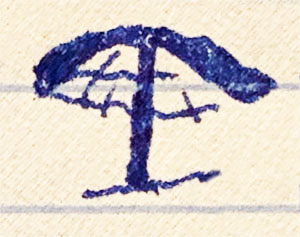
The speed propeller A bunch of rebellious, fun-seeking guys and I are running around this school. Manville A climbed to the roof with a full backpack and set up this device that was like a propeller. It was huge and its effect was to increase everyone’s speed, like hitting the run button in video games. From within the school, we could hear the whir and the deep, throbbing pulse of it and it worked like it was supposed to. We sped around at super-speed. The school became a supermarket. After a while, the store owner whispered that he wanted us to leave.
The Sound: I really don’t know what to make of the propeller’s throbbing, chopping sound and the effect it had. It had a very energizing effect on us.
-
Lucid: Colored Pots and Pans 2000
I joined him on the way over. We talked deeply and honestly and it was joyous. At one point, I said “I bet you like the rush of emotion.” He began running all about through the grass and I joined him, running at turbo speed, just loving the feeling of it. Then we looked up ahead at a vast landscape of colored pots and pans stacked into towers with a path running through them up to this huge tall black pot.
Turbo Wash: It appears that the joyous emotions and the turbo-running changed the plot. The plan of going to the party clearly was derailed by the discovery of this new interesting scene we found in front of us.
Instantaneous Travel
-
Rave On 1997 • age 23
My cross-country journey continues in this dream, in which I stop in a big forest for an outdoor rave. I’ve been doing a lot of this recently. . . . We’re in a house now. Then some crazy girl I recognized came downstairs and told me to invite Brit B. and I said it’d take her two days to get from Minnesota to here (Colorado?) . . . I suddenly knew Buttercup was coming and ran to the door. Before I got there I could see her through the door as if through warped glass. I threw open the door and grabbed her in a big hug. At the time I knew this was her spiritual body. It was extra shiny and detailed. I knew she had been on the way. I was so happy to see her! Right after Buttercup appeared there was some stirring in the physical and we woke up.
Joining a Dream: I appear to be in Colorado. I’m physically-focused enough to think cross-state travel takes days, but when I sense Buttercup’s instantaneous arrival, I rush out to greet her. She’s likely traveling directly across her energy bridge connection to me. The “warped glass” appearance is her tuning into the plane where I am.
-
The Red Scooter 2000 • age 25
Someone comes up to us and I have this sudden fear that he’ll ride off with Buttercup on the red scooter — so of course he does. I chase them, but I’m very slow. I concentrate really hard on running fast and the colors get deeper and darker. I become aware I’m dreaming, aware that I can break the seeming rules of reality around me, but still the red scooter pulls out of sight. I decide to try to instantly be there and the scenery all disappears to this red-rose smear with random objects here and there as I travel some inner space corridor and arrive right where they are.
Speed Alterations: The old trouble with speed when trying to catch someone. My dawning lucidity reminded me that there’s a mode of travel that allows one to instantly be somewhere, which is what I choose to attempt. The color effects are very interesting. Why red? And why the deeper, darker colors? I’ve seen this before in “The Buzzing Campus Eclipse”.
Group Travel and Relative Position
The Law of Relative Position: When focusing on a person or group, you approach and remain in position relative to them, even if they are moving.
Because of this, groups traveling together stay in relative position to each other.
I likely engage in group travel several times every night in the dream state, whether it be with just Buttercup or a larger group of people. I typically rationalize that we are in a vehicle big enough to fit the number of people traveling. Larger group travel is rationalized as a plane, bus, ship, etc. All these people stay in relative position to each other, as a group, and can engage in activities while they travel together.
-
The Blaine Treehouse 2024
I talked with Bear and explained our protectiveness about trees. As we spoke, the entire group moved out of the house through one of the walls and down to the ground. I looked at a tree between the treehouse and Blaine House. It was hard to understand what I was seeing. Was it twisted and splintered? Then the pattern came into focus. The tree had this glowing pattern on it. The light all around seemed to dim to twilight as I looked. The pattern glowed beautifully as if lit from within. As our group pulled away together, I saw the front of the treehouse. The treehouse was surrounded by six big, beautiful trees, each with a glowing symbol on its trunk. The yard had glowing art features in it. It was truly beautiful.
An Overview: Without any prompting, the group moves as one through the wall to a position where the finished treehouse could be seen. As I’m focused on Bear, he likely initiated the movement and I kept my position relative to him.
-
Bus to the Beach 2000
We’re on a big tour in this foreign city. The people are on buses, split into groups. . . .
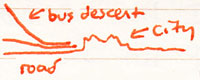
Descent from above Then we’re driving down this extremely high, steep road towards this white sand beach and beautiful water. We descend on a path not quite meeting the road we saw below and it started getting faster. For a moment I prepared for impact, but we gradually straightened and landed on the shore. The whole time I assumed there must have been a second road but there wasn’t.
We got off the bus and had some time to explore.
Group Travel — The Bus: In group travel, people retain a relative position to each other rather than flying off to the destination on their own at different speeds. Larger group travel is often rationalized as a bus.
Activities During Group Travel
The Law of Continuing Motion: Once travel to a destination is initiated, it continues even while engaged in other activities. It takes a specific desire to stop moving or change the destination.
-
Backseat Attacker 1997 • age 22
I’m driving down this road on the way to Blaine House. I had a friend in the passenger seat. In the seat behind me was a crazy guy trying to kill us. First I wrestled a big gun from him and threw it out the window. Then I did the same with a small gun. Then he got a scissors. We were all singing this song, and whenever the last note landed, he stabbed us with the scissors. I sang a little, then dropped out of the game.
Distracted Traveling: My intentions continue our motion towards Blaine House while I wrestle with the attacker in the back seat.
-
The Twisting Parking Deck 1997 • nap • age 23
I was traveling with Buttercup and her friends on an upward-sloping road. . . . The road became a parking garage. . . . The scenery changed and the curves of the garage became crazy, even more curving than the picture below. . . .
The twisting route up and down through the parking deck There were video games on every level and I played some. Then we warped into a party from Buttercup’s dream; a lame, boring business man party. The guy throwing the party heard me describing it thus and looked at me angrily. The room was rocking and tilting as we moved along the track.
Passing the Time: Travel continues along the track while we find ways to occupy ourselves.
-
Highway 710 2010 • 4:30 AM
I was walking along a path and came to some RVs. One had some writing and graffiti on it. . . . I went in to talk with them, to get the story. Before long we were traveling along inside the RV, with one of the women at the wheel and the other one talking to me and showing me papers. . . . They were telling me about the plans they had — they had connections to a foundation, and they were collecting names of hikers, and going to donate something. One of the women was showing me all these papers they had, signatures they’d collected, etc.
Activities While Traveling: I thought this was interesting in that it showed that while traveling, we could also be communicating and engaging in various activities.
-
End of Days 2012
Someone said it was the end of days. Incredibly huge tsunamis were rolling up all the coasts. . . . The next scene I remember is meeting up with Buttercup, Wilson, Lester, and Rayna. We took a bus to the airport. There was this long scene of me sitting in the seat next to Lester and him telling me stories and joking around with the person behind us. We ended up several levels down in this massive parking deck . . . [we travel to an airport and get in line for a plane]
The line was extremely long and slow, and made its way through the airport. I don’t recall getting on a plane, but I do recall sitting down in seats arranged in rows in the airport, and then we took off. Some people moved over so that Buttercup and I could sit together. Buttercup said it was past Bodhi’s bedtime, and I took him from her to let him sleep on me for a little while. For the most part he was a bundle of blankets, but when I looked in, I saw that he was scrawny but had a full beard, which I thought of as awesome rather than unusual.
Information was scattered and uncertain. I talked to some of the passengers around us, asking if they knew anything what had happened. I assumed massive worldwide earthquakes had caused the tsunamis. One woman said all the coastal states were largely destroyed, and I informed her that the eastern tsunami came in as far as Colorado. I talked briefly with Buttercup about where in the central states we might want to resettle.
Socializing While Traveling: Here we have groups of people traveling. In the first group, a bus is rationalized since we are moving along the ground and have a bunch of people. In the second, a plane is rationalized since we are expecting a flight.
In both cases, it appears we can stop concentrating on the journey and move about and socialize with the people traveling with us. The trip is locked in.
-
The Wild Bus Ride and Parasitic Moths 2012
I’m riding on a bus, and it’s full of people. I have a large stack of my drawings and stories from when I was younger. A couple people are looking at some. But diagonally behind me is this bully sitting next to Manville. He’s tearing one of my drawings into tiny bits, and Manville is laughing. I’m horrified and gather the rest back to my pile. . . . Manville and I get back on the bus. It’s mostly full, and we end up in the very back seats, even though there are backpacks and bags there that might have been holding the seats for someone else. As the bully gets on, I begin fantasizing about stopping him and telling him he wasn’t going to be riding this bus, but he had sat down. A lady a few rows up turns around and says that the bully is not going to be riding the bus anymore. I assume she’s going to tell him as he gets off.
Travel Drama: It seems you can do anything while traveling with others, just as in physical life.
-
The Tree Clearing 2024
Buttercup and I are driving to work. I feel like it’s a good 15-minute drive. I’m mad, thinking about the trees. About 10 minutes in (it seems), I realize I should get pictures of the tree rings before they’re cleared away. I separate off from the main car in my own car and do a U-turn in the road.
Just Travelin’: I wonder how that time is spent. Do I focus on the journey, talk in the car, or go into a reverie subdream? In this case I remember a subdream of being in Blaine House and having trouble with soap bubbles, but I can’t place when it happened.
Jumping to an Outside Perspective
It’s easy to change to an outside perspective in the dream state.
-
End of Days 2012
I decided to check on the plane’s status. I switched to third-person perspective only to find us flying low over a freeway. Someone asked the captain why we were flying so low and I heard the captain saying there was a problem of some kind. The plane passed under a bridge and then slowly started to land on the freeway. It went well, except we heard warnings that up ahead there was an obstacle of some kind. Soon I saw it — a toll booth blocking the right side of the freeway. The plane hit it, sheering off and destroying the right side of the plane. The left side shook and listed. As it started to careen up into the air, I turned to Buttercup. Time slowed down as I looked in her eyes and said “Buttercup, I love you”.
Casual Changes to Third Person: Here I am casually changing perspectives from being in my body talking to people in the airplane, to jumping out of my body to see the plane and its surroundings from outside. I stayed outside until the landing went bad and then must have jumped back in to have that moment with Buttercup. This perspective-shifting comes as naturally as anything to the Dream Self.
I don’t think this is a rote.. Buttercup and I shared this dream, to some extent. Could we have been within the same rote? Or was it us directly influencing each others’ dreams?
Maybe the waking self requires an in-body perspective.
-
The Wild Bus Ride and Parasitic Moths 2012
It’s a big bump and the bus tips to the side. For a moment I’m afraid it’ll tip over but it doesn’t. My perspective has shifted to a higher point of view just above the bus, and it remains there as I see the bus head towards a phone pole, then slowly adjust to avoid it at the last second, then towards the edge of the road, then back in the nick of time. Suddenly I realize the driver is outside the bus! He’s walking along the road with that big smile and I realize he is somehow directing the bus on this wild ride, going over big bumps, and almost hitting things before swerving away.
Then the bus goes off-road completely. It heads down a red clay embankment with scattered trees towards a little stream. My perspective is now above the front of the bus, so it feels more like it’s ME moving rather than the bus. I wonder if the driver dares take us across the stream, and he does, crossing back and forth across these shallow parts. Then we go over a hill and come to a wider stream. Does he dare? He does! We splash over the stream and continue.
Rising Perspective: I move to a third-person perspective above the bus as it starts barely missing things. This is the most interesting perspective for something like this. In a movie, this is the perspective you’d have. Then, even more exciting is to shift to the front of the bus so it feels like me traveling down hills and across streams.
-
Suicide and Dream Fire 1998 • 5:20 AM • age 24
Buttercup was going away for the day and I decided to kill myself. I’m standing on the street and put a gun to my head and shoot! Then I concentrate and say “5, less blood to see, 4, less blood to see, 3, 2, 1” and I look from a third person perspective and see myself standing there. There’s no blood, but I’m pale. Then I go back into my body perspective and think that Buttercup would probably have preferred to be there when I died than find me later. Since I found I was not actually dead yet, I assume death is on the way. I begin to wander.
Taking a Look from Outside: The best way to see yourself is to look from outside. This is very easy to do in dreams — you just jump out and then back in. This kind of perspective change isn’t unique to rotes. I often do this while traveling in a rationalized vehicle.
Though in this case I think it is, since this doesn’t seem like me at all.
Jumping Out When in Danger
The physical instinct to avoid pain triggers a reflex of sorts where we jump out of our astral body and watch what happens from a third person perspective.
The same thing happens during traumatic events in the physical world. In psychology, this is called dissociation. People can dissociate and find themselves watching the event, detached, from a corner of the room, as if it is happening to someone else. This change of focus is very basic to our spiritual nature, something we do in dreams regularly.
-
Uma Boga — The Tall One 1999 • age 24
As we left the mall, it was night and there were police officers scattered all throughout the parking lots shooting at animals. Our vehicle passed in front of a cop with a machine gun and it frightened me. We entered the highway and I retreated high out of my body into the air. The highway and the space around it rippled and shifted. I asked [Uma Boga] to take the wheel.
Jumping Out: I’ve found myself dealing with stressful situations in dreams several times by jumping quickly out of my dream body. This seems to be an instantaneous fear reaction of sorts. This doesn’t necessarily indicate that I’m in a rote, but retreating high into the air seems like I’m exiting one.
-
The Green Dragon of Sauron 2004
So I turned around and saw a silhouette of the dragon head descend slowly from above the door frame! A perfectly chilling scene. I darted out, left 1st person Aragorn in time to see a spear-like tongue from the dragon spear him in the foot, then the thigh. He cried out in pain.
Jumping Out: I leap out of Aragorn when he’s in danger to avoid the pain.
-
Declining the Catacombs 2008
Everyone’s walking the same way down the path. Something in bold and vibrant colors accosts someone up ahead, and I figure it will do the same to me. I keep walking forward, and it does. I spring out of myself and fly quickly up off the path, above the cliff and across a bit of trees, until it can’t catch me. I spring back to myself and it’s gone. I keep walking. The vibrant thing is awaiting up ahead. It comes at me again, more forcefully. It’s asking questions. I fly out of myself. “No!” I say, not even hearing the question and list of answers. It asks again and we jump again — “No!” After each flight we slow down, then I spring out at the next question. No!.. No!.. No!.. No!.. then it’s over and I’ve sprung to a large open field.
Springing Out: Without thinking about it, I spring out of myself when the vibrant thing comes at me. I flee and return, again and again, and in this way pass the test.
-
The Buried Building 2024
A circular hole is left in the ground, and beneath it a 2-3 story drop. I watch as my body plummets to the bottom. I think this must be where I die. But the body is fine, undamaged. My focus on it draws me down to it, then into it. I stand up. I’ve fallen into an underground building.
Watching the Fall: Rather than experiencing the fall to my death firsthand, I jump out and watch it instead.
-
The Red Motorcycle 2003
It’s daylight, and I’m hanging out in a parking lot with a row of trees near a beach. . . . I had a red motorcycle and a car. . . . Now it’s just me in the parking lot. I see a truck/SUV leaving with two red motorcycles wrapped up in cloth in the back. I run over and grab them (they weigh almost nothing). I run back to my car to put them in but then see my red motorcycle in there. Realizing my mistake I signal the truck/SUV and run back with the motorcycles. The driver is this grizzly man who says “You scrubby fucking. . . . ” I cut him off, saying “Wait, wait, let me explain . . . ” but I dissociate from myself. Looking down from above I think I sound like an idiot as I explain myself and then I actually become more idiotic as a result.
Dissociation: I jump out to avoid a tough situation, and feel this has an affect on the character’s explanation.
Leaving Group Travel
You can leave group travel whenever you like.
-
Adventures at College 1998 • age 24
As [Buttercup’s parents and I] departed in the car, Buttercup was standing in the street, waving and beaming love at me and blowing kisses. I felt elated by her love but then noticed that there was a hispanic fellow clinging onto the back corner of the car who was waving back at her, thinking Buttercup was throwing all this love at him. He drops off the car, runs over to her, and puts his arm around her. He starts talking to her. I think “Uh-oh, this is trouble. Since this is a dream, I should be able to lift out of here.” My body is heavy at first but I turn and look and my interest propels me into the air. I’m more curious than anything to see what such a misunderstanding will develop into. I’m now watching at about rooftop level.
Two Ways to Exit: The hitchhiker is the first to leave the group travel, and then I lucidly do so, floating in the air afterwards. Had I not been lucid, I’d have seen this as stepping out of the car or possibly splitting off in a new car and driving back towards Buttercup.
-
The Tree Clearing 2024
Then Buttercup and I are driving to work. I feel like it’s a good 15-minute drive. I’m mad, thinking about the trees. About 10 minutes in (it seems), I realize I should get pictures of the tree rings before they’re cleared away. I separate off from the main car in my own car and do a U-turn in the road. I unintentionally go up on someone’s lawn and run over a planter and bike. I stop the car, set the planter and bike back in place, then look to the owner of the house, who’s sitting on his lawn. He waves that it’s okay, so I continue on my way back to the house. As I drive, I wish I’d turned around earlier because it’s a long drive back to the house and I’m going to be late for work.
Before long Buttercup is with me in the car again.
Leaving Group Travel: Interesting! So you can depart from a group travel situation anytime you want. I rationalize a new car as I do so. Shortly after, Buttercup, refocusing on me, rejoins me in my car heading back.
Relative Motion
The Law of Relative Motion: Motion is relative to the focus of attention, regardless of the focus’s own motion.
-
Walking Backwards
I was “walking” down the side of a country road on my way somewhere. It was actually fast-travel from about 15 feet off the ground. Up ahead in the distance I see Wadsworth coming towards me, and I stop. At this point I’m standing on the ground. Not wanting him to see me turn and flee, I started walking backwards. I figure, from his perspective, he’ll just stop making any progress towards me. But I’m foiled by the laws of relative motion and his approach continues at the same speed, even though I’m moving away. His approach is relative to me. Soon he’s right next to me.
Relative Motion: This is strong evidence that motion in dreams is relative to the destination, regardless of the speed or direction of the destination’s own movement. He approaches me at a certain speed, and I cannot change that. Even if I had quickly traveled to a different place, he still would have reached me in the same time.
Joining Group Travel
A focus on a group that is already traveling will draw one into a position next to them. Usually this is outside the rationalized vehicle — perhaps there has to be permission to get closer, or perhaps the idea of entering a moving vehicle is just too incongruous.
The Law of Relative Motion ensures one reaches the group quickly.
-
Nightly Vacations 2024
Buttercup and I were on vacation, going from place to place. . . . We set out on our way to the next location. We set off separately, on motorcycles. When she caught up to me, the motorcycles locked in position next to each other, then became a car.
Locking in Relative Position: Note how the rationalization changes to something more appropriate once we’re locked in position together.
Outside the Vehicle
-
Adventures at College 1998 • age 24
[Buttercup’s parents and I] departed in the car. . . . There was a hispanic fellow clinging onto the back corner of the car.
Hitchhiker: Who was this guy and why was he focused on us? He didn’t appear inside the car as one usually would, either because he wasn’t a known part of our group, or maybe because he didn’t want to be seen. This rationalized as him clinging on to the back of the car, traveling along with us. A creepy sight.
-
The Wrong Hero 2001
[Mark Curry] is about to leave. He and my friend get into a car. I run up to the car and say, “Mark, hi! I think you’re a wonderful artist — one of my favorites.” And you know what? It’s not Mark Curry. It’s Ernest! Part of me notices but I keep going. He’s so touched by my comments and replies that he thinks my guitar playing is great, with all the fingerpicking stuff. I remain outside the window while he’s driving down the hill. I ask him to stop because I need to get back to my bike. He says okay but keeps driving slowly. I’m still out the window!
References: Mark Curry is a musician I like. Ernest is the weird guy in the Ernest movies.
Outside the Window: This is wonderful. I’m outside the car window talking to Ernest, the car drives away, and I stay right outside the window, just standing there relative to him. Essentially, since I’m in communication with him, my position in the dream world is relative to him, and I travel along with him.
-
The Train Ride 2024
I then left to find Buttercup.
When I found her, she looked great. Young, goth, hot. She was in the back train car. . . . It was her room. She was in the back half, in a raised bed-like area. She was happy to see me. I climbed up and we started kissing. . . . But my attention turned out the back window. There were a group of guys on the tracks, gathered around the parked train car behind us. They could see us, and I thought it must be quite a view. I said not to worry, as our train was about to leave. It began to pull slowly away, but one of the guys floated forward and stuck onto the back window. Buttercup indicated the blind and I pulled it down in front of him.
Getting an Eyefull: This is almost like a cartoon scene!
Inside the Vehicle
-
The Old Forest 2026 • 5:30 AM
There was a police officer I knew, and he was in a building nearby. I looked towards him intently through a window and caught his eye. I was still in the car, but it wasn’t moving now. I held his attention and signaled “fire” by holding up one hand and wiggling my fingers, then pointing to the old forest. Then I held my arm up and tilted it at the elbow, signaling “fallen tree”. He got the message and flew out of the building, creating a police car around him as he flew towards the forest. I floated up out of my car, then joined him in the car as he went to investigate.
Relative Motion: Even though he’s flying away from me at this point, my desire to join him draws me quickly to him.
-
Backseat Attacker 1997 • age 22
I’m driving down this road on the way to Blaine House. I had a friend in the passenger seat. In the seat behind me was a crazy guy trying to kill us.
Unwanted Traveler: Apparently violent strangers can join your travel group. I suppose this isn’t any different from any other time when someone approaches you. The only difference is you’re in motion at the time. What’s unusual is that he appears within my travel rationalization in the back seat.
Interfering with Movement
You cannot interfere with another’s movement.
-
Critters at the Door 2011
There’s also a thick, green dog out there. The dog is not cartoony — it looks like someone dyed a normal dog a dull green color. It pushes the door open a little. I push it closed and put my whole weight behind it. The dog pushes again and the door opens as if I offer no resistance. I’m stunned. The dog is calm and just walks toward the bedroom. I say, “What is this, a.. a..” and I’m trying to think of the name of the sword from Alice in Wonderland that can’t be stopped. As the dog heads toward the bedroom, I jump in front of it and hold the door closed with all my weight. Same thing — the dog just pushes right through, no effort at all. He makes a circuit of the room and then comes back out. I think of the name — “What is this, a vorpal dog?” I say to Buttercup. Then it exits the front door. I go to examine the front door and it just falls off its hinges, as if it’s not connected at all.
Outside I see a very pink, small, round pig coming. I pull the door back into place and the pig comes right in anyways, ambling along at an unchanging speed like the dog. The whole thing is so comical that Buttercup and I start laughing and laughing. I begin laughing out loud in bed and Buttercup wakes me up, thinking I was whimpering. Funny!
Unable to Block Others: It seems that you can’t interfere with another entity’s movement in the dream world. Desire, intention, or habit appears to be leading these creatures on their course and my attempt is laughably useless.
-
Entertaining Taylor Swift 2024
At one point I decided I didn’t want to hang out anymore and left. I left on a little black go-cart. I drove down the streets, weaving around cars. But at one intersection, I couldn’t help but run straight into these cars turning in front of me. However, they didn’t impede my progress at all. I couldn’t believe I’d survived the accident without a scratch on me, without slowing down at all as I passed straight through the cars. It was so unlikely, my mind kept coming back to it later in the dream.
Non-Intersecting: Here we see that other people and their rationalizations are no impediment to your own movement. I must not have been focused too much on it, as my waking self could have constructed an accident and drifted to a halt. But I just kept going straight through the other car.
Inertia
-
The Book of Synesthesia 1998 • age 24
Buttercup and I were with some friends in this forest. Buttercup went on a run. I was sitting or lying down somewhere and closed my eyes. After a few moments of darkness, I could see again. The visual field was smaller than usual and kind of jittery around the edges . . . but as clear as usual.
Still using this new vision, I got up and started following Buttercup through the park. When she turned a corner, however, I found it very hard to follow her. Even though I turned my legs and body in the new direction, I continued moving in the original direction, a strange floating inertia taking me forward. Finally with a force of will I produced the desired change in direction but my journey continued with such inertial problems.
Inertial Problems: Why would this barrier to direct vision produce inertial problems? It may have moved my primary focus to seeing, leaving my attempt to follow Buttercup repeatedly returning to autopilot instead of steadily tracking her movement.
This is my only memory having problems with inertia.
-
The Reluctant Hero 2011 • 2 AM
We’re heading down the freeway, driving fast and crazy. I’m telling them to be careful and make sure NOT to do anything dangerous — I didn’t want to be involved in another accident. We passed some trucks, and then some semis carrying gasoline. The cars lost control and we careened into them, barely avoiding being crushed as we slid and smashed our way through the tipped, leaking semis. I saw fires start, and I thought we were dead for sure, but we were all flying forward outside the wrecked vehicles. We landed in a ditch filled with water on the side of the road, and, continuing at the same speed, careened off rocks and such as we continued down this rock-strewn waterway which turned from the road and went between concrete guardrails and into the city. We spilled out into the road downtown.
Traveling Inertia: We went from being inside the rationalized cars to outside them as they become wrecks, and left the rationalizations behind. Our motion continued unabated, carrying us forward at the same speed into a different area.
Hills and Spatial Distortion
-
Mario World Landscape Distortion 1997 • age 23
The gravity well gathers up buildings around it I’m in this huge landscape and it’s this advanced Mario game. There are big blue mountains that can squish up and hide under other mountains. One very specific effect I saw was that there was one mountain that was under this village. When there it was like a village all packed in on a hill. But then it would spread out farther and farther as it flattened until there was a great distance between each structure.
Spacial Distortion: This almost seems like a lesson in dream space. It’s not just a hill, but a concentration of space.
The Tower is on the top of a tall, steep, round-topped hill, and the Great Hills has a number of the same kinds of hills around it. There’s very often a journey to the top of hills like these. Space itself is curved, and gravity pulls towards the center, as if it were one hemisphere of a planet.
Perhaps this is how a specific search or psychic cyst (wrapping up negative experiences) pulls everything else towards it. More and more of our mental space and thus thought is drawn into its “hill”. It beads up, and becomes a filter through which we see our environment. Due to this gathering of space, light doesn’t just pass through it, it reflects the image (whatever it desires or fears) outwards as a specific search. If this is true, it shows how these focuses gather up mental space, and holographically filter out experience.
-
Home Near the Tower 1999 • 3 AM • age 25
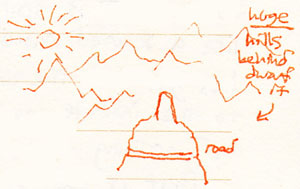
The Tower. Huge hills behind dwarf it. It’s very hilly, and there is a modern city. Buttercup and I work in the same office. I’m VP and a worker but I prefer the VP position, manipulating things so I don’t have to work. Buttercup and I are in love; we love each others’ company. The job might be some sort of telecom.
So I’m driving home with Buttercup and it’s evening. The roads are all very steep, as much up and down as right and left. I’m driving crazy, very uncontrolled, almost getting in accidents, then looking for turn-offs to hide in if we are pursued. At one point I take as a point of reference a small egg-shaped car and zip through a bunch of red lights faster than a car should be able to go. Then, terrified, I ask Buttercup “What’s wrong with me? Am I on drugs?” She says “Yes”. I seem to think back and remember that I was taking some sort of stimulant I had thought wasn’t a big deal.
Warped Space and Mind: As ever on Arcology Hill, space is very warped. The roads are twisted and wild, and space inside my house is malleable in a strange way. Then there’s the warped mind sensation as well, the feeling of being out of control, of being in a wild and unstable mental state. A decade later, looking back, I’m so glad to have stopped going to this place.
Flying and Scale
A feeling of expansiveness might be related to having a smaller size — a smaller penetration into physical space. This is an effect of being at higher frequencies, closer to the Source. Here we have vast amounts of space to move in and little weight — you can see how in higher realms it feels easier to fly. Gravity is a fading habit.
-
From Skateboarding to Flight 1997 • age 23
The dream continues down this lane to the forested front of Blaine House. I’m flying now, and the little hills at the far side of the forest path in the front woods are incredibly exaggerated. Instead of slight three-foot slopes they were mountainous. It seems that slopes and hills are always super exaggerated when flying. This is part of the low gravity feeling I feel.
Spacetime Distortion: I begin this dream skateboarding, doing jumps and tricks. This could be reflected in astral body movement, and I may have left my body in tiny sphere form. This is supported by the fact that I move to the exterior of Blaine House, which represents my physical body. My tiny size could be why the hills appear to be mountainous. This might be what is behind Arcology Hill — especially if that’s a representation of my head.
-
Mountaintop Flying 1996 • age 22
It began as a ride at the fair. I was in a little roller coaster car on this track on the side of a mountain. At one point the car flew up at the peak and jumped this rock. I realized then that gravity didn’t matter so much. I jumped the next peak and began to fly. I was flying fast through this jagged mountain range with steep angles. When I landed I had this total physical body rush.
Space and Gravity: The more vast and incredible the lands become in the astral, the less gravity seems to have an effect. This coincides with a reduction in my size. The lands spread out into huge mountains and spires and we feel lighter and more free. I often describe “steep angles” at times like this — a feeling that is difficult to explain. It’s related to pulling away from my mind sphere, how it drops off in a fisheye manner.
What I describe as “steep angles”. This is a common feeling on Arcology Hill. Purchase from Shutterstock here -
Mountain Flying 1997 • age 22
Falling asleep, I dreamed of the very tall green mountains in bright sunshine, like in Mario Land, and of course I could fly.
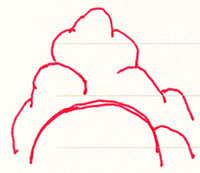
The shape of hills, with clouds above 
Round-topped hills in the Super Mario games
Hills Rising Against Us
Hills are extremely meaningful in the dream world. When steep enough, they are essentially barriers. At times I’ve been prevented from going somewhere by a hill or cliff that rises up before me as I approach it or attempt to climb it.
This may be the effect of trying to leave a rote by spatial means rather than by pulling back out of it the way we came in.
-
The Wrong Hero 2001
[Ernest is driving a car, and I’m outside the window]
He gets to the bottom of the hill and turns a corner. A block down, I disconnect and go back to the hill. But now it’s twice as steep and part of a crazy dragster track. This unbalanced guy is trying desperately to get his dragster up to the top of the near-vertical hill. I try to get up there too but instead turn around and continue on these endless sky highways.
Hills: Because returning up the hill is impossible, I end up taking the sky highways, possibly exiting what might have been a rote in the same way I came in.
-
The Island of Fire 2000
Mistaking this as the island from earlier, I remember the danger we were in. I look up to a cliff above us and see a trail of lava coming down. Soon the gully at the bottom is filled with lava. I’m afraid, and I’m having trouble getting up the way we came as the slope has become much steeper, and the vegetation is now just grass — no trees and plants to grab onto. I struggle to climb up.
The Unclimbable Slope: Here’s another example of a place that becomes difficult to climb out of. Space bends and works against me, keeping me in.
It’s likely I descended into a rote from the top of the slope, which means I’m physically trying to climb out of a place I just need to pull back from.
-
The Sliding House 2023
I went across the street to the neighbor’s house. The driveway went steeply down, and I spoke with them briefly. There was nothing there. But apparently this house didn’t want me to leave. When I turned around, the driveway had become an asphalt cliff face going up several stories.
Trapped: In the end, I was able to fly up over this driveway cliff barrier.
The Tiny World Effect
The tiny world effect is one where it appears as if the world is a sphere the size of a house. Things appear and disappear rapidly over the horizon as we move forward. The physical context drops quickly away. It’s like a visual representation of shortened context. Things disappear quickly out of our attention when attention shifts.

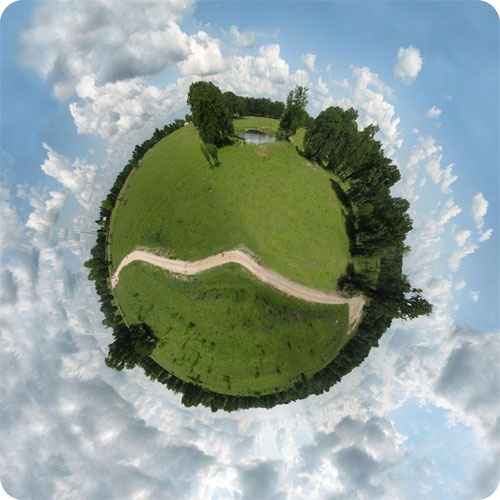
-
Ultra Oberlin 1996 • age 22
I left the inn and started walking down Main Street towards Banana House. The land was extra curved (the tiny planet effect), and things rose rapidly over the horizon. As I got near the intersection, the sky turned bright yellow and I saw the new downtown Oberlin.
Curved Land: This is an interesting effect, having perhaps something to do with being more in the now, which is evident by the colors, brightness, and good feelings.
Sense of Direction
-
Jungle Exploration 2003
Let me try to explain this. I was heading “north” to the Sanctuary. I turned around and went back and “north” was now a dock leading out to the lake. It felt like “north” was the only way I could travel, and instead of changing direction, I changed what was north.
Everything is North: I picked up on something important here. I had a sense of direction, and while I turned about in the dream, that sense of direction remained constant. It’s as if I were standing in one place, rotating the world around me, rather than turning myself within the world. And this is accurate to an extent. That sense of compass direction is a body sense that’s not available in the astral. It could be my etheric body was standing up, facing north, while my astral body went all about in dreams.
Communication
Telepathy and Nonphysical Communication
The Nature of Communication
-
Bedroom Cleanup 2024
I set [the rolls of colored wrapping paper] down on my childhood bed from my room in Blaine House. . . . At this point I began to clean up garbage from the bed — bits of wrapping paper scraps and plastic. To the side of them was the plastic molding for a model kit — the kind used for model airplanes and such. I checked it and almost all of the pieces were taken out. I thought back to waking life and got the feeling that I had completed building that big gift that I got, so I looked back at the model and now ALL the pieces were taken out. I picked up the model scraps to throw away, too.
Now this is crazy — the big gift I got? It was the Rivendell Lego set I got for Christmas this year. I had just completed it a day or two ago. But the person I was at that age when I had the pink and yellow bed cover? He hadn’t heard of Legos yet. But he HAD built a model battleship and a model airplane. So the idea of the big Lego building project appeared to him in terms he knew — as a model kit. So I was very much in the mind of myself at maybe 6-7 years old! But I was adult sized in the dream.
7 Years Old: Fascinating! As I’d brought forth my childhood bedroom, I moved into the mind of myself when I was 6-7 years old. Focusing on the model airplane kit, I knew my waking self had been building something. I reached out about it, and got the response that I’d completed it. The fact that it was a Lego set didn’t matter, and so this knowledge applied itself to the model airplane kit (also a building project), which meant all the pieces were done and used.
Earlier Self Perspectives
-
Dark Tower Warcraft 1997 • age 23
There was one point where I was looking through a book and pining over pictures of Alison, my crush from 6th grade. I loved how cool her hair was, in this totally 80s style. I thought ahead to Buttercup’s hair and thought “It’s not very good.” Buttercup looked all strange and warped and weird, as if through a mind that wasn’t very fond of her. Was that my 6th grade self?
My 6th Grade Self: This is wild. Looking at a picture of the girl I liked in 6th grade brought forth my 6th grade self, which would be me around 1986. That self had its own 80s point of view and loved Alison’s permed hair, but didn’t think much of Buttercup’s (which I currently love).
Seth has said that all past lives continue and are creative. This shows that this applies as well to earlier versions of ourselves. My kid me is still very much alive inside me. That person is, in a way, a snapshot of perspectives, desires, fears, and knowledge. As an adult, I can’t easily connect with it, but it’s still there and can have fresh perspectives on current events. Wild!
Energetic Communication
At a deeper, more true level, our communications are energetic. They are outwardly perceptible changes in our energy, our engagement. They are sharing of rotes, of direct experiences. They are our reactions to things as we warmly open up, waver in uncertainty, or close with a flash of fear.
Beaming — Energy and Excitement
The phrase “beaming at someone” is an astral truth. I’ve seen this while high on marijuana. When we’re excited or expressing ourselves, the light of attention beams from our faces, and it can attract people’s attention to us. It’s simply a result of being open and present in the moment.
It’s also quite noticeable when it fades out from disinterest, too.
-
Free the Children 1997 • age 23
She was back to talking with her other friends. The girl grabbed a piece of aluminum foil. I grabbed mine and got all excited because I knew a funny foil trick. She noticed me beaming at her and brought her attention back to me. I couldn’t access the trick for a few moments and she waited. I said “I know this trick with foil” and then I remembered it. I blew on it funny and it made funny sounds. There was amusement.
-
Between Classes 2010
I go down the stairs and around the corner. Just a little ways down the hall I see Quentin sitting against the wall with some friends. I am excited to see him, so I call out to him and sit down in front of him. He’s excited to see me at first but then quickly becomes guarded and begins talking to his friends instead. I wait a moment, and see that it’s clear he’s going to ignore me, so I disengage my excitement and lean back, a few moments from leaving. Feeling this, he turns back to me and says, as if in explanation, that Eric said that I’d changed, that I wasn’t myself — not fun or engaging.
Energy Communications: The withdrawal of my excitement to see Quentin is a big and obvious energetic communication (imagine the beam of attention coming out of my face fading slowly out). He is forced to respond with an explanation.
Styles of Expression
-
The Gods of Art 2025 • 7 AM
I was at a school — some wild school of creativity. . . . Somewhere in here at the school was a scene with Lisa. She swept in and came to the end of the open hallway I was in (like the end of a balcony). She smiled, and we talked briefly, and kissed. She was in character, wearing a pink shirt and a cowboy hat. . . . Eventually I came around to the front, re-entered the house, and saw a woman there. She had been in the periphery a few times as I explored, and now I focused in on her. She was tall, with a unique style of hair and dress. With expert skill and a few gestures, she duplicated the body movement of Lisa from earlier, such that I instantly understood the reference.
Energetic Style: The woman is imitating Lisa’s energetic style, perfectly duplicating her body movement and gestures. I understand instantly.
Closing, Turning Inside
-
The Slumber Party and Scary Man Prank 1999 • age 24
I decided to play around with them and practice making some thought forms. It was still dark and I looked out a window. I pointed and said to Buttercup, “Look at that. . . . MAN!” Surely enough a bearded spooky face appeared out of the shadows in the window, from a black silhouette to a full face, giving the appearance of approaching. Buttercup got scared and fell to the floor in a fetal position. She seemed to be locked in her own world, shaking, and these grapefruit-sized semi-transparent black orbs were skittering all over her body. I told her to stop creating thought forms like that, that they weren’t real.
Later, awake: Wow!! Buttercup dreamed of scary men out on the porch! After she fell into the fetal position with the black orbs all over her in my dream, she dreamed she was unable to move with cockroaches running all over her body. She dreamed all night of the men on the porch trying to break in and get her. That’s the last I saw of her all night, too!
Into a Fear Dream: Upon receiving a fright, Buttercup fell to the floor and became locked in her own fear-based dream world. To her the black orbs (an energetic fear reaction) were cockroaches, and she was unable to move. She was turned internally, energetically closed around that moment of fear, and continued to dream of scary men all night. Closed as she was, she became absent from the social scene.
She had left the social scene into a subjective dream. It’s a distinction my dream self is aware of. Even in the dream state we affect each other. And sometimes we enter dreams together.
Unintentional Communication
-
Uncle John’s Puffball Mushroom Farm 2023 • 7 AM
I wander into a cafe and walk up to a large table where some women are. One looks like the actress Kaley Cuoco. I hear her say to me “I like you so much.” I wasn’t looking at her at the time, so I look up at her and meet her eyes and say “hmm?” but she is embarrassed and says “Oh! Nothing. . . . ” I see/feel the clear, transparent-ish shapes of Buttercup and the kids across the table as they enter the context and I’m reminded that I’m already with someone.
References: Kaley Cuoco is an actress.
Accidental Communication: I think the Kaley character may not have meant to communicate this to me, as she seemed embarrassed that I heard her. It was definitely directed at me, though.
-
Dr. Eye Plucker 1997 • age 22
I was getting my face surgically realigned. This doctor took out my eyeballs and held them in front of me. “These are your eyes. They are bad at seeing because (and here I thought he was going to blame my father) . . . because of your father’s anger.” He flashed pictures of me unable to express certain things to Wadsworth and then my face twisting with anger. The surgery was him putting my eyeballs back in my head.
Father and Sight: Either I picked up what the doctor was going to say before he said it (and before it was strung out into words), or my expectation affected what he said next. In waking life at this time I often felt frustrated about my horrible vision.
-
Counselor Travolta
He is going to give me some medication. I’m standing there thinking (or did I say it?) that the only medication I would want would be one to increase my willpower. Then I say “What does it do?” and he says it increases my willpower.
Leaky Thoughts: It’s quite possible my thoughts weren’t kept private and that he heard me. Also, it could have been my expectation playing out.
Sounds
-
Sounding the Chord 2023 • 3:30 AM
I was going to let go and trust and see what happened. Then, I climbed higher in the building, up the outside and onto a little roof high up, above the front door. The house itself was a pale white, almost transparent. The environment outside the building was a foggy golden tangle of vague roots, a protection of sorts. I was going to do something. I imagined myself becoming a target for doing it. I sat down, closed my eyes, then I began.
I made a sound, and the sound was a single tone. I tilted back my head and this added sub frequencies to the sound. It sounded rougher, with an internal rhythm to it. It was a powerful sound. And then I expanded the range upward, and quickly added another tone and another until there was maybe 7. Each had its own unique internal rhythm and sub frequency, and all together it was a chord of magnificent beauty and power. I held the tones and saw an image appear with it. Each tone was represented as a circle with a color inside, from red at the bottom and continuing up through the rainbow. Each was perhaps the tone of a chakra? These were the clearest parts of the image. While I held the powerful chord of tones for long minutes, images of eyes flashed out of the mostly-darkness in different parts of the image. I was sure Gwen and Buttercup could hear it in their dreams. It pulled me to a state where I felt I was there in my bed, making the sound, consciously aware but unable to move. I felt as if I had stopped breathing to make the sound. My mouth and eyes were dry. I decided I needed to write it down and got up.
Sounding the Chord: I don’t know what this was, but it was an intense, powerful experience.
Telepathic Communication
-
Secrets Don’t Keep 2011
[Buttercup is pregnant, but we haven’t told anyone yet.]
Buttercup dreams that she’s telling her family that she’s pregnant. They don’t react much. Meanwhile, Wilson dreams that Buttercup tells him that she’s pregnant!
Real Dream Communication: That’s no mere coincidence! I imagine this happens a lot but how rare is it for both parties who are communicating to remember the dream?
The Nature of Telepathy
-
Adventures at College 1998 • age 24
As we departed in the car, Buttercup was standing in the street, waving and beaming love at me and blowing kisses. I felt elated by her love but then noticed that there was a hispanic fellow clinging onto the back corner of the car who was waving back at her, thinking Buttercup was throwing all this love at him. He drops off the car, runs over to her, and puts his arm around her.
Communication is Open: This shows how communication is typically open, broadcast to your surroundings just like talking.
Translation to Physical Terms
-
Passion and Liftoff 2000
I was overtaken with this strong sexual passion and made some verbal attempts at seduction. What it was is that I was outpicturing to one of them scenes of how nice it would be.
Pictures: Here I find myself recalling that I communicated verbally, because that’s the physical way to communicate, but on closer inspection, what I was doing was communicating by telepathic imagery.
This shows that what I’m recalling is the meaning and intent of my communication, and from there assuming from this waking perspective that I must have spoken it.
-
Mina the Bat 2024
I find someone out there who’d caught this huge bat-like creature. Its head was as big as ours, but bony, extended in a way reminiscent of a cow. I wondered at how he’d caught it, and saw a picture of him with his arms extended, and it just flew to him.
[I begin to communicate with the bat]
I start with “Hi” and it responds “Hi”. Then I say “Hello” and it says “Hello” back. Then I indicate myself and say “Sam” and it says “Mina” (something like that) and I think it got my name wrong and repeat “Sam”. After a minute I realize maybe that’s her name.
I remember walking around outside, continuing the conversation, and it says something like “It’s just up ahead” and I think, “Oh, so you can speak perfect English now?” I’m disappointed, as if this is a badly-written movie. But of course there’s no language barrier in telepathy.
Communication 101: First we have an example of direct telepathic communication. My question is immediately answered with the man’s visual memory. I almost wrote “I asked him” and “he said” but I don’t actually recall speaking. I recall wondering, then seeing the answer. I see him holding out his arms and the bat landing, but from my present position. His experience, translated into my perspective. Interesting.
Once I start communicating with the bat, I’m doing so in a very word-oriented fashion. I’m amazed that it can mimic me! But telepathy is universal. It’s communication at a higher level, far more natural than spoken language, which is our rough attempt to physically communicate higher-level meaning and concepts. That’s why a moment later it communicates full thoughts and ideas, and I hear them in my own language.
-
The Buried Building 2024
To my left is Ruby, smiling. Beyond her and up the bank is Buttercup, and maybe someone else. Emma is there somewhere. Beyond the river is a hill sloping up, with patches of woods and grass. At the top of the hill is a large rounded structure made of red pipes, like a playground structure but as big as a building. I remember that Buttercup had wanted to go up and explore this earlier, and she was hoping we could go now. I wondered if I could play in the river a little, in the downward slope to the left but got a warning from Buttercup that it was too dangerous, and I slightly agreed. Then someone suggested some funny prank to do when Ranier showed up (I saw this idea playing out in visual form), and I turned towards the door to see Ranier coming outside to join us. I gave him a hug.
Speaking as Rationalizations: I wrote this very deliberately. Sometimes I feel the conversation must be taking place in words, but I didn’t remember any words. I remembered clear communications, thoughts and ideas immediately understood, but not in words. As I remember the communication, I could easily imagine it as words when recalling the dream. But that’s an explanation rationalization of what was actually happening.
We communicate directly with the essential communication that speaking hopes to result in.
Language-First Telepathy
-
Fiona’s Shop 2024 • 6 AM
We’re thinking about getting dinner, and Fiona asks us if we want to crawl (bar crawl). Now as she says it, she gets to the “craw…” part and I think she’s going to suggest “crawdads” and in that moment react in disgust but then get the “L” and realize her meaning. I joke with her what I thought she was about to say.
Word-First Communication: This is important. Typically we communicate telepathically in whole concepts, which are then translated into physical terms as the speaking of words.
But this shows that at times, we can receive and interpret the words themselves. Not even whole words, but words linearly, bit by bit, just as in the physical. This can’t be a translation to physical words. It’s coming to me directly as physical words. It’s commonly said there is no misunderstanding in telepathy, but in this language-first telepathy, it certainly is possible.
I wonder if the difference is that I’m communicating downstream with someone else in the physical.
Intended Communications
-
Walking Lucid in Midtown 1998 • age 24
While first setting out on Tjo Street, Buttercup came skipping down the way and it was like this bouquet of flowers came from her and shot into my arms. Then she gave me a big hug and kiss and then retreated away (she’s awake and at work right now).
Verification: During the very half hour of that dream, Buttercup wrote me an email! Thus her appearance!
Waking Communication: Buttercup was awake at the time, and her thoughts of me reached me in the dream world, where I could see them!
Whatever she had to say in the email, the love behind it was what I received, and it took appropriate physical form.
Sharing Thoughts
-
Charred Washington 1999 • age 25
While sleeping in, I’m dreaming of living high on a cloud-level cliff side over Washington DC and it gets hit by a nuclear bomb. The whole dream is centered on the aftermath — charred remains of the city, telling people about it, etc.
I wake up and find Buttercup scanning pictures of the atomic bomb dome from Hiroshima, and she says she had been for about half an hour, the approximate length of my dream. I picked up her thoughts!
Picking Up Signals: I picked up on her waking thoughts about our recent visit to Hiroshima and the Peace Memorial Park. It had a strong emotional impact on us, as you might imagine, and these thoughts carried some weight.
With Visual Counterparts
In the following dreams, people are speaking but also occasionally flashing images to each other. This allows for faster, more direct communication, since the imagery isn’t translated to a person speaking.
-
Return to Colorado Volcanoes National Park 2025
We returned to the national park building, to something like a gift shop. I told the others we should head up the mountain at some point where we could see the lava and I showed them a picture of it with my mind.
Sharing Images: All our memories are available to share as visual images or short videos.
-
White or Rose? 1998 • age 23
The waiter asked if I wanted white or rose, and I said rose twice but he kept looking at me. It seemed like he was still waiting for an answer. Behind him, over his right shoulder was a rose. Then it disappeared. Then it reappeared as a bunch of white roses, then disappeared again. Each change attracted more attention and I thought he was a magician and was trying to figure out how he did it. This was followed by a stage show with a color-changing veil.
Thought-Form Communication: Were the roses in the waiter’s aura? Were they thought-form creations due to his question of white or rose? It’s almost like he was flashing the question in his mind at me, and it took physical form. The “stage show” with the color-changing veil afterwards sounds a lot like viewing an aura, and probably was.
-
Adventures at College 1998 • age 24
Brooke and I walked back to my apartment. We stopped right outside the door. Buttercup was still at class. I told Brooke about Buttercup and she said, “so if I asked you to come back to my room . . . ” and this image of sex flashed in my mind.
Seeing Intentions: I hear her words but see her intentions.
-
Two Dogs 2024
I looked out the window. Outside, a river flowed past, right up against the back of the house. In the river were odd pink spires about 6 feet tall, a natural wonder of some sort. The far bank of the river was rock, and had cut through a small hill further back. This was a wondrous place, and I wanted to explore and play back there. I asked her about the spires. She said they were plants, and in my mind she showed me a kind of plant tree. The green trunk and branches were all made of stem-like material (no wood or bark), but it was as big as a tree. Instead of leaves, each branch ended in a club-like cluster. She explained that they reproduced sexually, but required people to help. Confused, I asked how (directly into her mind). She said people had to go out and collect something from the clusters of one tree and bring it to another.
Direct Information: We go from conversing out loud with words to this direct telepathic communication where she can show me pictures and answer questions.
-
The Chamber Beneath Blaine House 2000
Earlier, outside with Wadsworth, I said, “And you’re thinking of SELLING this?” and he calmly said “I have sold this,” and an image of the Orono house appeared in my head. Suddenly I remembered.
Telepathic Imagery: Wadsworth projects an image of the house we moved into after we left Blaine House while saying that he’s already sold it.
-
These Little Earthquakes 1999 • age 25
I was dreaming of the cliffside and starfield when suddenly my dream was interrupted by a map of Turkey appearing across my whole field of vision, along with a message that went something like “. . . this is what went on before. . . . ” Then I awoke to a distant rumble that approached rapidly and shook the hotel back and forth a few times, rattling windows and glasses, before passing. An earthquake.
We were in Japan when this happened. Just a few days before an earthquake in Turkey had killed 16,000 people.
Clairvoyance or High Sensitivity: This could have been an instantaneous group fear flash from the direction of the epicenter that I picked up on, or a high inner sensitivity to the quake that registered before the sound and shaking reached us.
-
A Wild Night Out 2003
A girl with black tights on a table cheers. I see Mario Sunshine on a TV across the way, in a mirror. A bum roots in a fountain. Kai, a man in a suit with a hat, says he’s going to vote for the “straight man” this time. Last time he chose mushroom — a card with a Mario mushroom flashes in his hand.
References: Mario Sunshine is a video game.
To Illustrate: Kai shows me what he means by mushroom via telepathic imagery, which I take to be a Mario mushroom printed on a card in his hand. Doubtless this is related to seeing Mario Sunshine on a TV shortly before.
-
The Switcheroo 2026 • 3 AM
[After an intimate encounter]
As we left the dinner pavilion, she flashed a picture of how she saw me afterwards, and I saw myself as a BIG thought-form lumberjack walking around. It was like a strange, stylized puppet of me. Someone else responded with humor that the way I saw her afterwards was this, and flashed a picture of her, but with her waist and legs much expanded, also in a similar puppet style, but seen from the back. These images appeared in the receding pavilion, getting smaller as we walked away. . . . She said she was a famous Mexican actress, and she flashed a ton of pictures of unfamiliar movie posters and things in front of me — like all her roles, with pictures, text — a whole wall of it. I glanced around it briefly. Huh. The bodyguard showed me a scan of her, which revealed a little baby in her uterus.
Flashing Images: In this case our communication is in physical terms (talking) but we flash humorous images to each other as a part of it. The images seem spatially connected to the pavilion where we’d just been intimate — where the impressions were made.
-
Fiona’s Shop 2024 • 6 AM
I’m contacted by Fiona, who, laughing, shows me what her helper has been spending her time creating for her — a tumbleweed made out of tofu, I believe. She mentally flashes me a picture of it.
[later]
At some point I went to explore around the college some more. It was full of people. I entered a room with tables around which sat students. I passed a table where a cute girl caught my eye. I kept going into the next room where I saw a group doing some kind of Final Fantasy wizard cosplay with puppets dancing in the center. I felt like I was intruding, so I exited back into the room with the tables. Someone tells me the girl I was looking at liked me and has been wishing me well for 10-11 years. I see an image of this being written in her personal book.
Flashing a Picture: We share images, feelings, and stories as easily as thoughts.
-
A Great Love 1997 • age 23
The first thing was this ragged old basset hound with a missing front leg. It was light tan and very wrinkly. When I first saw the dog, it didn’t take to me. It pulled back towards the house. The man came out and asked for $500 and I said we agreed on $20 before. $150 flashed in my head but I stayed at $20. He accepted, then went back inside. The dog began to huddle up to me.
Direct Telepathy: For some reason, I pick up his counteroffer of $150 directly as a visual telepathic message instead of hearing him speak it. It seems we switched momentarily to a more direct communication.
-
The Mischievous Fairy Girl 1997 • age 22
Later I was working on Foundations in the woods by the sandbox. I was trying to make symbols in the stone. The blonde appeared there in fairy form, and had information for me. I had to lay on my back and look up to read it. Big holographic letters appeared slightly above me. They were black calligraphy letters on yellowish parchment. She was explaining how things worked — answering some questions I had, and expressing her love for me. . . . Then I was in the library where the blonde girl really made her move. I was at a terminal working. She appeared as that library girl, constantly sending me letters above my head and conjuring sheep in the wall to get my attention. She was flirting madly, but also helpful and humorous.
Telepathy: Interestingly, she uses imagery that includes written words and letters. A strange mix, as imagery is usually a higher translation.
Across Dream Environments
Communication can occur between people in different dream environments. It only requires that one focuses some attention on the other, and the other, upon feeling this, focuses some attention back. This creates an energy bridge between them.
I’ve found that when this happens, the communication often comes up in a little window showing their head and shoulders with some of their surroundings visible behind them — much like a video call. I call these “Telepathic Windows”. The energy bridge is an actual gateway opening between both parties and their dream environments. It remains open for the duration of the communication.
As that connection grows, the gateway can open wider and the environments can bleed across from one side over into the other, which I call a “Telepathic Crossing”. At this point, both can see into each other’s dream environment, and it’s possible for one to cross into the other’s environment, which I call “Telepathic Transport”.
There is also a kind of light communication that can happen when focused on something other than the person. Imagine talking with someone while you’re both watching a TV show. In this case, the communication doesn’t have a visual counterpart.
Telepathic Windows
-
Bedroom Singalong 1997 • age 22
The black guy who frequents Irene’s is sleeping next to me in my Blaine House bed — a thing I found quite strange. My bed had white sheets, the breeze was blowing, and the room was fully decorated. The guy was singing great music with me, soulful and inspired. He suggested a song, “Suzanne,” and hummed it, then called it too sappy. For some reason I thought he meant the Jackson 5’s song “ABC” and decided to do it. His girlfriend appeared in a prison beyond the brick wall next to us and began singing with us. I started singing one part and I was gonna let him take the next part, but it became the main part and he prompted me semi-sadly with the words. It was a love song and she was so loving singing it with me. I tried to redirect her affections to him but couldn’t remember his name. I told him I’d make it up to him and fix it.
References: Irene's is a cafe in Oberlin where I worked.
Someone Special: Here someone important to my visitor appeared in a telepathic window that I could also see. These windows appear to be objective to more than just the person being thought of. It’s likely because he and I were connected at the time.
-
Body Transformations 2003
We were playing this game. I was in a room with two light gray dogs. I was to transform into a matching one, then run about and interact with them and this bone. The others were supposed to guess which one was me by my actions, and I was to try to be as doglike as possible. Before we started, I expressed a concern to the girl from the hallway — “Will I be able to return to the asian girl form afterward?” The girl said “Usually you return to your natural form.” This was telepathic. She and the others were in a different room, waiting for the game to begin. When communicating like this, I saw them above and beyond the present room I was in.
-
Indoor Soccer and Sexy Games 2024mature content
I’m nearby at a building like a hotel or school.. and this girl with black wavy hair wants to have sex with me. We find a place and start touching. I get up and leave for a minute. As I’m about to return, I get this telepathic message from a woman who tells me that for my own good I should stay away from that girl, that she’s trouble. The message appears in a window, where I can see the woman’s face and shoulders. I decide to heed her advice, and instead of returning to the girl in the room, I leave the building and start driving away. But then the girl with the black wavy hair contacts me in the same manner and we talk and I think “what is there to be afraid of?” So I return to her (through the telepathic window? I don’t recall turning around or driving back) and we get intimate.
Then at some point I’m running around with her and another girl chasing each other. We were like playful kids. Then there was a telepathic conference with a 5x4 view of telepathic windows with other interested people in the building, where we were trying to organize a game of chase or hide and seek or something, and I suggested it involve “popcorn sex” where if I caught someone, we would hide and have sex for 5 minutes while the others tried to find us. Something like that. I felt a range of emotional responses to that idea, haha.
Telepathic Calls: My dream self sees these telepathic calls as pretty standard communication — nothing noteworthy. Had I been more focused in my waking self, I may have remembered these as conversations in person.
The Brady Bunch © ABCWhat’s even more remarkable is the telepathic conference call. This is the first time I remember experiencing this. It is similar to the many telepathic windows opening in “The Home For Shape-Changers and Psychics”.
It reminds me of the opening of the Brady Bunch. The difference would be that the rest of my current environment would be seen around these, and each square would show that person’s current environment.
-
Me and Taylor 2024
At some point Taylor’s close friend joins us as we wander the darkened corridors. I keep being funny and clever. We come to a big room with a concrete wall in front of us, but it’s about 20% transparent and we can see through it to a football game taking place on the other side. I make a subtle joke about how it would be so weird to be playing out there, with so many people looking at you. “Could you even imagine that?” (haha)
The Football Game: I doubt this was really Taylor Swift. But it’s odd that this football scene appeared. She was dating a football guy around this time. If it was her, she could have been thinking of him, and I saw through into her dream context for a moment. Perhaps to her we weren’t wandering through a mall but a football stadium. Or perhaps it’s something I thought of in relation to her and it got projected/overlaid onto the scene.
-
Old Buddies 1997 • age 23
I’m traveling to Spring Lake Park, fast-floating. I arrive and start looking for Manville. The school is empty, but I find him in an asphalt patch with a small backpack and three decks of Magic Adventures. He said it was his last gift request from Brandon, so they could still be together by playing games. In another dream window I was getting a call which I had to transfer from another network but no one was there, so I started speaking weird nasty gibberish into it.
These dreams were framed in brilliant colors, like deep blues with gem-like scroll bars. These are the window effects I was looking for in Kaleidoscope yesterday!
References: Kaleidoscope was a Mac UI customization extension.
Telepathy Breaking In: Notice how I’m having a dream, a call comes in “from another network”. This is how telepathic communication happens — someone is thinking of you, reaching out to you, and it happens in the midst of an ongoing dream experience. These communications get mixed into your dream in a number of ways. They might appear in a telepathic window, the person might suddenly appear in your dream, or their communication might pull you into their dream. Here, I clearly separated it into a different visual area in the form of a computer window.
Telepathic Crossing
A “Telepathic Crossing” happens as the telepathic window opens up larger, to the degree that the whole person and their environment appears almost in split screen before you. The physical mind will usually try to rationalize this spatially.
In the image below, the telepathic window has opened to a telepathic crossing, as both dream environments appear next to each other. Notice the grass in the living room. The physical mind might try to spatially rationalize this as reaching a cabin in the woods.

-
The Mountain Valley Gathering 2003
Somewhere in here I get a communication from Buttercup. It’s like all telepathic communications in dreams — a scene opens up in full 3D of her and her surroundings superimposed on my current scene, like a person-to-person gateway. Anyways, she’s upset that I’m not with her, that I didn’t find her after the small group gatherings. She tells me the end part of some inside joke about someone’s breasts getting “big, bigger, biggest!” I don’t quite get it but it sounds like it was funny.
Telepathic Crossing: For a minute or two as we’re in communication, we are standing next to each other, our two dream locations connected, and we can see into each other’s surroundings. I probably could have walked right through to her dream location.
Telepathy is a gateway between people.
-
The Backyard Lava Pit and Dream Crossover 1997 • age 23
I had a room in Tank. I don’t recall knowing my roommates. Buttercup was there at times, though I had to really pull her. There was a lava pool in the back yard. . . . [The lava] flowed and filled the lower levels of the house and the back yard. It was really deep (6 feet in the back yard) and the top turned dark gray as if cooled. We ran out onto it. I discovered that when I took big leaping strides, the lava pushed me up into the air with big waves. We played there. Further out in the cooling lava were holes. They had this green haze within and this reflective liquid. I didn’t want to fall in. This was where Buttercup’s dream crossing happened (see below). . . . I realized the whole house was buried in lava and that Foundations was lost. I got sad and distracted for a while but Buttercup reminded me that our friends had copies. . . . And get this! At the same time, Buttercup dreamed she was standing over a grate and looking down into a flowing greenish river in these dark sky lands and it was really creepy. That’s how I described the holes in the lava! This seemed like a random appearance in her dreams as the rest of her dreams were so depressing. Then, soon after this crossover scene, she returned to her dreams.
References: Tank is a co-op in Oberlin.
Dream Crossover: As our waking selves stirred, Buttercup’s dream and mine met in the middle, and mutually influenced each other. The holes with the greenish river below crossed to her dream (or vice versa — it was out of place in both dreams). But now my waking self was roused, interpreting the scene as a physical reality. I communicated the sadness at the loss of Foundations and she reassured me that I had back-ups. Then we parted ways and each of our dreams resumed their independence.
-
Home Near the Tower 1999 • 3 AM • age 25
Before long we were home. It had a back yard like Blaine House. The house was very ritzy and plush, mostly with gray-blues and blacks. . . . A girl in overalls lived with us, and Wolfgang did, too. Wolfgang was behind a long counter and complimented me on some poem I had written. I talked a little about it and then the girl said that she thought that creating things like that was the most important thing in life. I agreed. . . . Behind the counter where Wolfgang was it was more cluttered, run down, and had a country feel. The girl was like a country flower.
References: Wolfgang was a strange dude who lived in Oberlin.
Communication Crossover: Here we see a crossing of two very different scenes — the rich home and the country home. As I talk with Wolfgang and the girl, I can see over into the place where he’s coming from, and think it’s a part of my house.
-
College Celebration 2022 • 7-8 AM
I notice people gathering along the street behind us. There’s a parade starting. I see Bodhi in one pack of kids. The light around them is different — possibly a different dream setting. The parade doesn’t seem to move for a while, then eventually comes from the opposite direction I’m expecting.
Parade Crossing: Bodhi and the kids are probably from Bodhi’s dream. He likely enters my dream through some form of near-realm telepathic contact.
Telepathic Transport
Telepathic contact can appear without a visual component, or in a window, and then grow into a dream crossing. A fuller focus on the person you’re communicating with can actually transport you to them (or them to you). It depends on the strength of the focus and intent. You can simply walk into their environment as it opens up in front of you.

This is actually the natural way of going to someone in the astral. Merely think of them and you are there. Focus IS proximity.
-
Salesman Invasion
I decide not to let [the weird people] in. But they insist and start working on opening the door. Then the back door is rattled, so I go to lock it. The crane comes around the back holding the guy in the wheelchair and they swing him onto the deck. I get scared and call 911. I’m telling the guy what’s going on when I appear in some squad cars driving to my place. They ask “How did you get here?” and I say “Wow, this must be my spirit!”
Then I appear back at the house and the weird people had gotten in.
Full Transport: Here I am fully transported to the police I’m talking to on the phone. They see me and I see them. When I’m done talking, I return to the house.
Were there really people waiting for calls in the astral world? This isn’t the only time I’ve called for help and gotten it. Perhaps they were guides and I imagined them in the form I expected — the police.
-
Milwaukee Road Trip
I’m on the road to Milwaukee with some friends. We get to the countryside part of the trip and stop on the side of the dirt farm road for a rest. All of the sudden I hear this voice, and I know it can only be Kayla’s. I turn to see her running to me wearing underwear, and her bra half off. We embrace and she whispers something excitedly into my ear. Then she says “Did you hear what I said?” I say “No, what did you say?” She says “I want to have a baby!” I look at her, astonished. My friends are half-circled around us, watching. I mention something about needing some kind of commitment to go anywhere with this.
References: Kayla was my first love.
Dream Visit: Kayla, thinking of me, appears in my dream with an unexpected message.
-
Girlfriends Past and Present 1994 • age 19
Kayla’s waiting for me in the parking lot in a yellow car. I go to the wrong parking lot, and run through the rain to see her. I was so happy that she just showed up in Marshall to see me, surprising me.
Kayla and I are running around campus. We talk about having kids and are really cuddly. We have a good time. Bridget calls and I have to be really sneaky and I feel bad. I’m trying to keep Kayla from seeing Bridget and vice versa.
One Transport, One Window: Here we see two levels of communication interaction at the same time. Kayla’s strong thoughts of me bring her to my campus in person. Bridget’s weaker thought of me showed up as her “calling” me, which is a telepathic window. She largely remains where she is.
Note how when Bridget calls, I want to keep Kayla from “seeing” her — showing that there is a visual aspect to Bridget reaching out to me.
-
Thinking of You 1994 • age 19
Then there were two races and only one other contestant. I got second place the first time, then won first in the second race.
Then Avery was there, and I starting rubbing her back. She turned around, looking much older, and smiled. She said “I love you, Sam.” I was a bit surprised. I hung around her and talked a bit, then she ran off with her friend.
Thinking of You: I broke up with Avery months before this. Thinking of me, she appears in my dream and we have an affectionate moment and talk briefly before going on our separate ways.
-
The Mistake 1997 • age 23
We swam to shore and I found a boat. I began to paddle it with the girl in the back. Vortigem H was floating toward us across the waves, above the water and then he was in the boat.
Along Comes a Friend: Vortigem H. must have thought of me, and I see him fast traveling towards me, above the waves. Then he’s in the boat, without having to climb aboard.
-
Grocery Store Visit 1998 • age 24
As I re-entered the grocery store, Kayla came at me like a streak and clutched me in an amazing big hug. It was great. Then she went back into line with her Emma. . . . I continued back to the grocery area. Once again she came at me like a light blue streak and embraced me.
Power Hugs: Kayla comes into my dream and embraces me. At one point, I mistake her voice as coming from a popcorn ball, which dances about appropriately as she talks.
-
Adventures in Northtown Mall 2001
Walking to the center of the mall, I saw Raven walking the other way. She said a meek hello and continued on. . . .
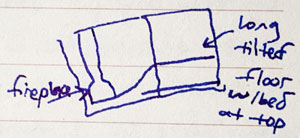
Raven’s tilted house I returned to the center of the mall and thought about her. I appeared in this twilight neighborhood near a tilted, window-covered house without any decorations in it (I was likely just seeing through the walls). It was Raven’s house. I saw her inside and she eventually saw me and came out. We walked and talked.
Transported: Here my thoughts of Raven take me to her house. Telepathic transport is often the default mode of traveling to someone. Simply think of them and you’re there.
How could Raven have been at home and in the mall? Maybe she was dreaming she was at the mall, but I went to where she was physically sleeping.
-
Indoor Soccer and Sexy Games 2024
Instead of returning to the girl in the room, I leave the building and start driving away. But then the girl with the black wavy hair contacts me in the same manner and we talk and I think “what is there to be afraid of?” So I return to her (through the telepathic window? I don’t recall turning around or driving back) and we get intimate.
The Fastest Way Back: On retrospect I’m certain I traveled back to her through the telepathic window. It’s easy to do. You’re already connecting to them by communication. Now you just need to move through the window and you’re there.
-
The Gods of Art 2025 • 7 AM
I was at a school — some wild school of creativity. . . . Somewhere in here at the school was a scene with Lisa. She swept in and came to the end of the open hallway I was in (like the end of a balcony). She smiled, and we talked briefly, and kissed. She was in character, wearing a pink shirt and a cowboy hat.
Passing Through: Lisa, thinking of me, appears briefly in my dream for a short interaction, before going on her way again. Her outfit was “in character” of the unique people at the art school, probably a projection of mine to fit her into my context.
-
Calling on Ranier 2026
So there I was, asleep in my waterbed in Blaine House. That puts me at age 10-16. I decided to do an experiment. I focused on my friend Ranier from college. He very soon appeared at the side of the bed in a semi-transparent body. As we talked, my perspective remained laying down on the bed, turned sideways, looking at his legs. I reached my arm out of bed and patted his calf. It felt solid. He knelt down a bit, and I shifted to look through his body, and I could clearly see the lights from the landing through his body. Yep! Semi-transparent. I never saw his face, though. I was talking with him, purposely saying things that, if he remembered, would prove that he was here, communicating with me. The trouble is, after this dream I kept dreaming for hours and don’t recall what it was.
I ended up following him back to where he was, which was a warm, coastal college town. He spoke of it as if it was our college, but this wasn’t Oberlin. He took me to his favorite little hole-in-the-wall restaurant.
Following Someone: After making contact with Ranier (or someone I took to be Ranier), I followed the connection back to the coastal college town he was previously focused in.
-
Cheetahs Love Sandwiches 1997 • age 22
I was hanging out with Buttercup and this guy. We climbed this big oak tree and threw sticks at a small abandoned house. To our amusement, they stuck upright in the roof. Then I got really scared of heights and the guy started screaming that a cheetah was stealing his lunch.
The scene instantly changed to the upper floor of a library. He couldn’t catch the cheetah, who was chewing on and slowly engulfing his sandwich.
Treetop Transformation to Upstairs: Scene transformations sometimes keep some important or perhaps defining aspects, like being high up.
-
A Fish Through Glass 1996 • age 21
I’m in the mall with Ruby, Brit B, and a friend of mine. . . . Ruby, Brit, and I wanted to talk, so we looked for a place to talk. I found this mystic weirdness shop with couches and mattresses all over the floor. It had fish tanks lining the walls, and we all sat down and started to talk. I was watching the fish and one slipped through the glass and started swimming through the room. I wondered if we were breathing water or thick air or what. But then I discovered it was a trick played by what used to be the shop owner, but who was now Krist Novoselic, the drummer of Nirvana. So we got to know him, told stories, and found out it was his room (but still in the mall). My other friends appeared as I told stories about them.
Calling Friends: After looking for a place to talk, it seemed we ended transported to someone’s bedroom. Because I was in a mall moments before, I naturally thought of the bedroom as a shop and him as the shop owner.
Talking about someone forms a connection to them which they can feel, and they can travel over that connection to you.
-
The Detachable Room 2004
Angel from my soccer team walked through. He said hi, looked about, and kept walking. Probably just a brief intersection of dreams.
Dream Crossing: Apparently Angel thought of me briefly, which resulted in him walking through my dream and saying hi.
-
Rolling Snowballs 2010
Buttercup and I had gone to the top of this snow-covered mountain overlooking a wide, open valley. . . . Everything was as if bathed in dim moonlight, and it was hard to discern slopes and edges. After getting a little panicky about being too close to the edge, we decided we’d have to stay the night up there. I wasn’t afraid of the cold, however, and I burrowed a little hole in the snow. I tried to get Buttercup to join me but she didn’t. My little burrow was cozy and I think reflected the shape of the comforter and blankets around me.
After drifting in and out of sleep here, a woman came by and we talked to her briefly. I think she had a baby with her. Then we noticed an asphalt path running right next to us and down the mountain. We wondered if it had been there all along. Then I looked up and saw a cable car above the trees a little ways behind us. An even easier way down! Then I heard this drumming and this music and realized there must be some kind of village behind where we were. I followed the music and came to this charming summery village at the top of the mountain. There was a sunken area made of stone tiles with raised walls around it. People were drumming on huge drums on the far wall. Lots of people were watching, and some had brought their own large drums. It was a show of some sort. To the right, nearer the village, was a cluster of buildings with shops and tourist-type stuff, and a new performance was beginning there. It was a bunch of Japanese people dressed in these elaborate transformer costumes. They had truck parts, and at one point a few of them got down on their bellies and “transformed” to truck mode. It was very impressive.
A New Scene: It seems that upon talking with the woman, the scene changed around us, possibly to her dream environment. Both were at the top of the mountain, but mine was an endless expanse of snow and hers was a well-defined summery village full of people having a celebration.
I think a lot of times our dreams shift when we meet someone and simply walk into their environment.
Nonvisual Communication
-
The Incredible Country 2025
Buttercup and I were on a trip to an amazing place. The first thing I remember is coming to the flat sandy top of this mountain island. It was as if the top of the mountain were shaved off and it was all sand like a beach. From this center of this height, I walked towards the edge. The landscape below slowly revealed itself to me as I did. To the left, a brief area of tall rounded green spires. To the right of that, tall hills, and then an amazing purple-blue city structure in east asian style along a curving beach, then the sea between it and the island. . . . I said to Buttercup “What country is this?!” and she said, “The United States” as if it were obvious. Huh? No.. I pulled up a map in my head, and it was a small country in a packed area of small countries in the vicinity of what we know as Thailand.
We were communicating across dreams. She was in the United States.
Mentally Linked: Buttercup is only sort-of with me in the dream, in the way she often is — nearby but not entirely present. So when I ask her where we are, she responds from wherever she is. We have this direct line of communication, even across dreams.
I’m focusing on the landscape when I ask her, which is why she doesn’t appear in person or in a telepathic window. It’s a telepathic “aside”.
Near Realm Conversations
I love these. These are telepathic conversations we have with others in the house while lying in bed, asleep but not dreaming. We’re just hanging out, having a telepathic conversation without thinking anything of it.
-
Discussing the Dream We Just Shared 1994 • age 19
Context: I'm staying at Juno and Jay's apartment. Jay is Juno's boyfriend.
Still dreaming, Juno and I start talking about this dream, and realize we both had the same dream.
Hypnopompic Telepathy: I’ve experienced this a few times, where I could swear I was talking with someone out loud and then I wake up a little more and realize that I hadn’t actually spoken. Each time I’ve had this kind of experience the person I was talking to was physically near me, in the same room or house.
The experience always feels like I’m in the bed, but floating. I’m asleep but my consciousness is focused in the room.
-
Thought Form Games at Arcology Hill Stadium 1996 • age 22
Buttercup and I were in one of the hot air balloons, talking about how the way we just sang “The Mayor of Le’uvre” in perfect unison proved telepathy.
Waking up, I said out loud: “Were we just talking?” Buttercup: “I don’t know!”
I vividly remembered talking and singing together only a minute before.
Telepathy: When we awoke, Buttercup was as uncertain as I was if we had really just been talking out loud or dreaming of talking. I was certain at the time that these words were being spoken out loud.
Also, we have no idea what the song “The Mayor of Le’uvre” is.
-
Telepathic Songs and Conversations 1996 • age 22
I wasn’t sure if I was truly awake, but I heard Emma and Ruby talking in their sleep. Randomly at first, then kinda together, then Ruby was singing and Emma joined in from time to time. They talked and it was as if I was only hearing half the conversation at times. I was somewhat bothered that it had woke me up and was going to ask them to be quiet, but instead dreamed that I recorded it on my portable tape recorder. I got a good bit, then the tape jammed.
Later, in another dream, I went to unjam it and checked to see if I had actually recorded it and I did, but it sounded a little different. Awake, I realized I didn’t actually record anything.
Telepathic Conversations: These telepathic experiences takes place in the near realm — in the room you’re sleeping in, with other people sleeping nearby. Your body is at rest, and you can hear people talking with your mind and communicate back in the same way. In fact, you usually think you’re awake at the time.
-
Lucidly Ending a Bad Dream 1997 • age 23
This dream happened while we were sleeping in the car while parked at a Texaco, me leaning back and Buttercup laying across me. . . . [We have a negative dream with jealousy and creepy guys]
Then darkness and JUMP! I’m pulling consciously out of the dream. My desire for happy experiences with Buttercup is behind it. I “open my eyes” and it’s so dark in the car but there’s Buttercup in full color and light laying across me (my eyes are physically closed). She turns to meet my eyes and I pour love out to her and say “Sorry, I love you” and she expresses the same to me — a very nice moment, and very clear. Almost lucid. I felt the dream pulling me back at one point but willed myself to remain in this happier space.
Telepathic Communication: Telepathic communication in the near realm is as easy and natural as speaking in the physical.
-
Dream Communication 1998 • age 24
I’ve sadly forgotten most of it, but Buttercup and I were dreaming something and we started talking in bed but I realized through that dim, hazy consciousness that we weren’t using our mouths, and I think I was looking at her with closed eyes, too. I noticed the sound of her voice was in my head without passing through my ears, but it sounded the same anyway. There was a tuning that affected it. It might start softly and at times it would be loud enough to be distorted, a kind of rumbly distortion. I realized it was telepathy and reached a hand out to touch her mouth and it was closed while she talked. Then she jokingly said “Don’t you know it’s rude to touch a person while they’re sleeping?” Did I reach out physically or astrally? Probably astrally. We were talking about a dream we just had.
Telepathy and Clairvoyance: This is a stunning little example of everyday telepathy and clairvoyance that we probably all do on a nightly basis. It’s so natural — as natural as opening our eyes, as natural as talking — that we don’t question it. Our eyes are closed, our mouths are closed, and yet we are still seeing and communicating. Here I am lucid enough to experiment with tuning telepathy, and to use other senses — clairvoyant sight and touch — to double check it.
-
A Hitchhiker from the Hospital 2010 • 1:30 AM
Then the dog jumps up on the bed, crawls over my feet and settles down. Then she lifts up my feet and starts fluffing them like pillows. I wake up enough to say “Buttercup! Buttercup, Hey! Isobel is lifting up and fluffing my feet!” and then Buttercup says “Yeah, she does that sometimes.” And then it occurred to me that as real as that felt, that must also have been a hallucination. I was stunned at the reality of it all.
Isobel’s Weird Habit: These near-realm conversations are so natural and familiar to Buttercup and I that we think nothing of it.
-
The Proselytizers 2023
From within a dream, I heard talking in my bedroom. I considered returning to my dream but someone was talking about Jesus. So I roused myself and got out of bed. My wife and kids were arranged on the bed, in sitting positions, while a man stood at the foot of the bed, talking about Jesus. Two younger women stood behind him and off to the side. Enraged at people trying to convert my family, I went on the attack. I told them that of all the major religions, Christianity was the worst, that their sacred book had the least spiritual knowledge, and how dare they come here and preach to my family. The younger women were taken aback.
Religious Intruders: What a chilling scene.. religious zealots in my bedroom preaching into my dreams. I don’t recall any other time I’ve heard people outside my immediate friends and family talking in the near realm. But note that at the MetaDreamer focus, I heard it and made a decision about if it was worth waking up for or not. Perhaps I hear conversations like this more than I realize and usually decide they’re not worth waking up for.
-
So I Have a Rat 2023
[Buttercup] stretched her arm out and grabbed something on the night stand. It was a rat! So once again, she had a rat in her hand. She turned to me and asked me what to do. I got out of bed, took the rat, and went to fill up the tub. Her understanding was that I was going to drown the rat (I would never! I’ve even had pet rats in the past).
Ask the Rat Man: She likely awoke to the near realm so she could get help with the rat-in-her-hand situation. I can’t explain my uncharacteristic behavior here. Maybe I was going to give the rat a bath?
-
The Ghost Lady 2023 • 4:30 AM
In the near realm, Buttercup asked me to come with her to investigate this ghost she saw. I was curious and went along. We arrived at a run-down ruined city. The style of this was kind of like Adventure Time — colorful and post-apocalyptic.
References: Adventure Time is a cartoon series.
Invitation to a Dream: The request from Buttercup came when I was in a non-visual focus. It was dark but my mind was awake. It was the familiar near realm telepathy. After agreeing to her request, she led me to her dream.
-
Finding Gwen 2025
It began as an open field in the hills, viewed from above. As I watched, a large tent was rapidly constructed, to form a sort of indoor event venue. There was a main room with a stage. The center was filled with hundreds of folding chairs on the earth and grass. There were vendors of food and various things. It had sort of an indoor carnival vibe. . . . Wandering on, I eventually started wondering where Gwen was. I’m not sure on retrospect she’d ever been there, but in the dream I was sure I’d lost her. I became quite panicked, calling her name loudly as I went around. But then I heard her voice calmly say “Papa” from outside the dream. I heard it from a different space and moved my focus there. It was a semi-dark, empty, spherical-seeming space, with nothing to be seen, and no sign of the dream I was just in. It was a stepping-state to the waking state, and from there I left the unpleasant dream behind.
It’s likely she picked up on my anxiety directed towards finding her and mentally spoke my name to let me know she was alright.
Outside the Dream: My waking self fragment, imagining this was physical life, became panicked. Gwen felt my fear about not finding her and spoke my name from outside the dream, leading me out of the dream into a space closer to her.
-
Finding Bodhi 2025 • earlier
I dreamed that Bodhi was lost, that I lost him in a crowd after his last soccer game. At the point my memory starts, he had been missing for a week. Why weren’t we out looking for him? I was in Bodhi’s room. . . . I went to the area where I had last seen him and began calling for him in loud, desperate tones. After a few minutes I heard his “Papa” in response. I followed it and came to a building. A door opened, and Wilson and two people I didn’t recognize walked out, purposely ignoring me, walking past. I looked in the door and there was Bodhi, sitting on the concrete floor. I ran in and hugged him tight.
In Contrast: I want to contrast this dream with “Finding Gwen”. In this dream it’s unclear if Bodhi is responding to my anxiety and I’m sending that response through the dream context, or if his response is simply a part of my subjective dream.
Near Realm Conversations with Awake People
-
The Animal Shelter Gateway 1998 • age 24
I comforted “our” cats (which weren’t ours), and generally intended peace to the skittish animals. I was distracted by a blue snake in a small cage with an unsecured lid. I tried to block the exits around the lid with boxes but it got out. I used a snake-handling stick (also from recent TV) to nab it but once I did, I freaked out and let it go. I expected to get bit and of course I was then bit. I ran through the place I came from INTO THE BEDROOM and excitedly tried to get Buttercup’s attention to tell her I was bit. She was zoning out and not responding (she was actually awake at this time, standing by the mirror). I had to ring the phone and when she picked it up I knocked it out of her hand and said into her ear “Buttercup! I just got bit by a poisonous snake!” and she calmly said “No you didn’t. You’ll be fine.” Then I calmed down and woke up.
Dreamer/Waking Telepathy: It appears with this telepathic subconscious contact that Buttercup’s waking self is quite used to deflecting crazy dream drama. Is this reaction because her waking mind is engaged? If she had been asleep at the time, my call for help could have pulled her into my dream.
-
Buttercup’s Strange Choice 2023 • 7 AM
I’m looking through this book of pictures of a organizational soccer meeting. I vaguely remember taking some of these pictures earlier. But now it’s laid out in book form, in the type of well-designed photo book that Buttercup’s made before. But it’s incredibly boring — so many pictures of a soccer meeting, repeat pictures of the back of someone I thought I recognized. Nobody familiar in it . . . a few pages had one picture of someone I didn’t know with tons of text all around it. I closed the book and it was indeed one of Buttercup’s photo books. The idea of her making a photo book of a soccer meeting, a hundred pages long, and taking months to make and costing lots of money became more and more ridiculous to me.
I joked with her about it, that she’d made 3 books covering our relationship, each spanning 10 years, and this soccer meeting was the equivalent size of one of those? I was not really upset or anything, just teasing her about it. Bodhi overheard and jumped in, asking questions and laughing about it. This part all seemed to be near-realm telepathy. There wasn’t any physical representation of Buttercup or Bodhi, just an awareness of them and conversing with them. Buttercup (who was awake at the time) was lightly defending herself, and after a bit I put a stop to it, saying “what’s done is done.” I didn’t really believe any of this was real, aware at some level that this was a dream.
Wait, What?: I’m watching a rote of a soccer meeting, and rationalizing it as a book. As it reminds me of Buttercup’s photo book work, I come to believe that she made it. My waking self rouses and finds the idea that she made it ridiculous and hilarious, imagining all the time and effort it would have taken.
It was clear this was a near-realm conversation. After closing the book, I wasn’t anywhere in particular, and neither was Buttercup or Bodhi — we were just connected by our focus and having a conversation. There was no scene. It was that familiar mental space where we can communicate with each other.
-
The Blue Crab 2025
I go out to a boat floating on the ocean, not far from the shore. There are 6-7 people holding onto the back of the boat, stretched out in the water. Buttercup is at the far end. I step onto the back of the boat, then get down in the water next to her. . . . After a few minutes, Buttercup swims off. I follow after her, but get distracted looking at shells. . . . I return to our house and try to tell Buttercup what I found, but she’s preoccupied.
Zoned Out In Dreams: Here Buttercup and I are in my dream scene. She’s awake in the physical, but at this time of the morning she’s usually zoned out listening to podcasts. This is reflected in how hard it is to get her attention in my dream.
Open Calls for Help
-
The Destruction of Blaine House 2023
I went back out to the porch and the house tipped towards the fields & lava. At this point I began to panic. We needed to tell someone!
The next thing I remember is that we were in town. I sent out a general call, announcing what was happening. I think I just did it through my mind. . . . Then I’m back at the house and things have gotten much worse. . . . I recall jumping into the hot mud flow. Maybe someone else had first and I followed to rescue them? We sunk in to our chests. Then we saw some people arriving to help — they mounted the house from the driveway side and were coming down the tilted roof towards us. I had the feel that they were super heroes, though they weren’t actually. They were some kind of rescue squad, responding to my mental call back in the town.
Astral Helpers: A little while after my call for help, a group of helpful people arrives at the scene.
Calling On Someone
-
Shaynu Grey and London Boy
Manville, Mordred, Quentin, and I were exploring a snowy landscape. We lay on our backs in the snow, looking up at stars. We see three figures fly across the sky in different directions, really high up. I know who these legendary beings are instantly. One is Shaynu Grey, one is London Boy, and the third I don’t recall.
Suddenly we’re inside a house, after a big party. Manville and I are getting along really well. I decide to beckon Shaynu. I send out a mental call. Before long she appears in front of the four of us. She is tall and reminds me of my cousin Jane. Then I ask her her name three times because I can’t understand her the first two times. She seems like she doesn’t want to be here. I treat her with lots of respect. I lend her the use of my body. Boom! She’s in it and I’m in one of the guys! Manville, I think. I ask her to watch over us, and allow us to exchange “hit points” if any one of us is hurt exploring. She grants it. She leaves and I get my body back.
The people from the party are all falling asleep now, including Mordred and Quentin. Manville and I alone are awake and try to call upon London Boy (I keep thinking it’s Leaf Boy). He seems about to appear from the starlit sky when I awaken.
Other Beings: I don’t have any specific guides or teachers that I call on, at least none my waking self is aware of. But in this dream I had knowledge of these legendary beings. I called to them and they came. Unfortunately we had nothing much to say.
Feeling Emotions
-
Brendan’s Gathering and Summoning Pants 1999 • 5:30 AM • age 25
The scene became a railroad and we had to listen for trains coming from different directions (created in part by fears and expectations). The moment a panic took someone in the group, it spreads like wildfire to all of us and the danger seemed to increase greatly even though the trains didn’t appear more often.
Emotional Communications: When a group is gathered to dream together, even when they’re involved in their own dreams, strong emotions are easily picked up by others. One person’s sudden fear is a psychic burst that is picked up and understood by others.
-
The Boar 2003
Buttercup and I are swimming in a small lake of shallow water in a forested park. There are lots of people around. There is an island hill in the center of the lake. The park is in a somewhat rural area. Suddenly a boar appears at the edge of the water. It’s huge, and it’s fighting two dogs, utterly enraged. I’m dressed strangely, with a cape, strange accessories, and a large golden poleaxe. The boar turns and runs toward me. All the attention is on me. I feel the fear of all the others, which includes Aurelia and Anne. I lift up the poleaxe, but now the boar is running along the bank towards the others. There is someone in charge, too — a spirit guide, who looks to me with penetrating eyes to take action. I do. I run to the shore and bury the axe in the beast’s back. This is a giant boar, king of boars. It’s wounded. I give it several gashes as it runs about.
Then I am back in the lake and the boar comes to me. The spirit guide person is near, and speaks knowingly into my mind that I must kill it. I am saddened by this. I want it to go off and heal. I feel everyone in my head, and I know they know my sadness. The beast circles me and perhaps it attacks? I let fly with the axe and cut its neck, but I must hack it several times, through muscle and sinew before the blood starts flowing. The beast stands, then falls, and the water is colored with its blood. I return to the shore, seen as a hero by some, while others are sympathetic to my sadness.
Collective Empathy: In this dream there is a collective empathy and communication as a matter of course — I can feel the emotions of the people around me, and communicate with people and animals directly via telepathy. None of this is strange or surprising. This is a true dream of a rote.
-
Indoor Soccer and Sexy Games 2024mature content
We were trying to organize a game of chase or hide and seek or something, and I suggested it involve “popcorn sex” where if I caught someone, we would hide and have sex for 5 minutes while the others tried to find us. Something like that. I felt a range of emotional responses to that idea, haha.
Feeling Responses: I could instantly feel everyone’s responses to my suggestion — some were fear flashes, others interest or resistance. I could feel them all at the same time, without anyone saying a word or making any other kind of signal of their feelings.
Mistaking the Source of Communication
When our attention is focused on one thing, such as an object, and we receive a communication, we might mistakenly think that the communication is coming from that object, leading to strange results.
-
Pizza Crust Messages 1994 • age 19
I turn to see Brenda in the back of truck. She’s very excited to see me, though I saw her first and said nothing. So we say hi, hug, talk, and catch up. We end up in some gas station talking. Meanwhile, I’m receiving messages from Kayla who is secretly communicating on pizza crusts.
Inter-Dream Communications: The messages on pizza crusts were probably due to getting an internal communication while looking at pizza. I rationalized the message into writing on the pizza crust.
-
Grocery Store Visit 1998 • age 24
As I re-entered the grocery store, Kayla came at me like a streak and clutched me in an amazing big hug. It was great. Then she went back into line with her Emma. . . . I peeked my head in and saw only her Emma. Kayla now seemed to be among the candy in the aisle. My eye was drawn to a bag containing a crushed popcorn ball, which jumped and moved as Kayla spoke. A bit confused, I continued back to the grocery area. Once again she came at me like a light blue streak and embraced me.
Popcorn Ball: I look to where I remember Kayla going. Upon hearing her speak, I attribute the voice as coming through the thing I’m looking at at the time — a popcorn ball. As a result of my misattribution, the popcorn ball moves about (as one naturally would), while talking.
-
Infinitely Cycling Imagery 2025 • 3-4 AM
I was hanging out with three friends at the side of a lake. I asked them if they would choose a life of being in the military, where they could travel the world and see things, paid for by the government, but there was a 50% chance that they would see horrible bloody battles at some point. Would they do it? After asking the question, I saw printed on the back of this little box three quotes — “Can we please talk about something else?” “You must be picking something up. Right near here that very thing happened (and then some local history about a battle)”, and then another request to change the subject.
Response by Box: This is clearly the responses of the three friends to my question. I looked at the little box, received the responses, and my mind, acting as an assembler, puts these things together in the way that makes the most sense.
Miscommunication
With all the projection and distraction going on in the astral, it’s very easy to miscommunicate.
-
Semi-Lucid OBE: Webbed Windows 1998 • age 24
Wadsworth and Emma were there. Wadsworth couldn’t see me but Emma could and was thrilled. We mind-talked but not too successfully. She could see me as a light haze. I told her to draw what she saw and I put a piece of paper by her because she wasn’t getting it. She went to the couch and I danced about. She had some of my pages of notes and photos from earlier and started reading them. I didn’t want her to and went to see what they said. There was some writing about time, then some doubt about being able to get lucid or OB. I felt myself upon reading it that I was losing a grip and fading out. I was disappointed that Emma didn’t finish her drawing.
Failure to Communicate: I tried to get her to draw me, and handed her a piece of paper, but she appears to think the paper was my notes and photos and began reading them. That’s what it then became, as I was able to read them.
Difficulty Making Contact
Our ability to make contact with someone depends on how energetically open they are. This is true whether they’re awake or asleep. We close ourselves to communication when we are wrapped up in our own focus.
-
The Destruction of Blaine House 2023
I went back out to the porch and the house tipped towards the fields & lava. At this point I began to panic. We needed to tell someone!
The next thing I remember is that we were in town. I sent out a general call, announcing what was happening. I think I just did it through my mind. Then I decided I should tell Wadsworth (since he built the house). As I was getting ready to call him, he walked by, and I grabbed him and told him what was happening. I don’t recall much of a response from him. After a little bit, I decided to call Wadsworth but try as I might, I couldn’t get my phone to work. I was almost ready to throw it away.
Unable to Make Contact: I try to contact Wadsworth, and he appears but is non-responsive. His non-responsiveness is reflected in my failed attempt to call him with my phone.
-
Waiting for Brendan 2004 • 1:30AM
Awake: After writing with Brendan and sharing music, I go to sleep at midnight. I dream the following over the next hour:
In my dreams I go to visit him and make brief contact several times. We prepare to go out adventuring but he’s busy in his semi-dark apartment (which isn’t accurate to waking life). I make contact, then drop, then make contact, then drop. I get bored and wait in my universal dream space, the school between the worlds (the Atlanta Tower). . . . I’m waiting for Brendan to go to sleep so we can visit in dreams.
Difficulty Connecting: I’ve been able to communicate with waking people in the past, but Brendan must have been pretty preoccupied with something else.
Upon failing to make contact, my Dream Self knows to wait around for Brendan to go to sleep before I’ll be able to reach him.
Intuition and Knowing in Dreams
Frequently in dreams I just know things without any source of knowing. When I wonder something, the answer may appear instantly in my head or through the context of the dream. In some cases, this may be the back story that comes with rotes. In others it may be a communication coming from someone. Either way, questions are often automatically answered in dreams, just as when I’m in touch with my subconscious intuition through psychedelics. Whatever the reason, in the dream state we simply know things.
Direct Knowing
-
The Armageddon Clock 1988 • age 14
I was in Narnia, adventuring on some snow-covered slopes. I came to some rocky land and a black 5’ x 5’ pile of shaped stones. I knew that if one of the top two stones touched the pedestal, the world would end. I moved some stones around and one part of the top one touched the pedestal. I reluctantly went over and pulled a string attached to a huge clock-like device which would cause the sky to darken and monsters to appear.
Dream Knowing: Some dream situations are presented complete with related information — such as the piled stones and pedestal. We find ourselves knowing something about the objects or situation in front of you, without questioning how we know.
-
The Space Probes 1996 • age 22
I’m in space. It’s all hazy and there’s a sun off in one direction. I see a huge gray Star Trek ship go by overhead and recognize it as a long-forgotten probe. It sucks up the haze and leaves a trail of thick black smoke behind it. I know it should be destroyed, because the work it’s doing is not necessary anymore.
-
The Sewers Beneath the Dark Tower 1997 • age 22
I can tell Lucius’s about to lie because his moustache isn’t real.
Moustache of Lies: Now this is strange. . . .
-
Adventures at College 1998 • age 24
She smiled at me with bright eyes and I seemed to know her name was Brooke. I imagined what it’d be like if we were friends for a while.
Her Name: Smiling at me with bright eyes is making a connection with me. I assume I knew her name through that connection. It was likely also the connection over which I imagined our friendship.
-
The Elevator 2000 • age 25
The elevator stopped and the quality of light was different — it was daytime with odd tints and overtones of feeling. I opened the door to a blue sky with puffy clouds in a Renaissance town of fantastic wealth and variety. Things were very different than any history of ours. Information came naturally to me, and I knew that there were very powerful groups of people. One group stuck to lavish costumes of all black. There was quite an energy in the air and a lot of people. We climbed a hill to what looked like a resting area with picnic tables all about us. My invisible guide was with me the whole time. I was going to ask this woman a question. I thought she had a lot to tell me but she would likely first ask what faction I was part of . . . and then suddenly I was back in the elevator.
Information Came to Me: The Renaissance town didn’t seem like a rote except that contextual information was coming to me.
-
Lucid: Colored Pots and Pans 2000
Before us was a wide river and across that a woods with assorted buildings and a neon sign that I recognized as Atlanta for some reason. That’s where we wanted to go. But a few steps more and we saw that the road, now concrete, came to a sudden end some ten feet over the river. There was confusion in the group and I explained that the reason for this was that we had to face something in the large structure first.
We turned to it and not much was visible — just some bits sticking out of the top of the sandy/muddy hill. There was an opening barely large enough to slide in through and a flexible area that revealed lines of blue energy when pushed on. I said “no, no” and gathered their attention. I knew I could easily get to the bottom of this through dream law. I mentally pried open the ground and created a big opening for everyone. The ground was pliable and the opening started small and was stretched open. We entered.
There were many levels but I remember few details. I taught them a lot of things, though I resisted being too much of a teacher. At one point we crossed a road under open sky. I said that if they ignored the cars they would pass right through them, as they do with one another, but if they became anxious and believed they would feel the impact of getting hit, they would.
Then we went into another room and I taught them how to open doors in walls. “Begin by sticking a pin-like extension of your mind into the wall.” Two of them were lined up with me, trying it. The appearance was like sticking a pin into clay. “Then, when it’s in, expand it, stretch it open into whatever shape you like — circle, square, patterned frame, etc.”
Next we came upon a big mechanical fish. I knew it was the second-to-last level and we entered through the mouth. I told the others to get their bats or weapons out in preparation for lots of little guys.
A Knowing: In this dream, I somehow know all kinds of things. I know that we need to face challenges in the structure before we can cross the stream. I also knew specifics of each of the challenges. But how? I didn’t get the impression that I’d been there before.
-
The Autistic Dreamer 2011
I’m in a dimly lit house with some friends. We walk into another room and find a tall, dark-featured man in there with a dark brown aura. I know that it’s someone autistic or mentally disabled who lives most of his life in the dream world.
How Do I Know?: This information is just a part of the scene as contextual information.
-
Fiona’s Shop 2024 • 6 AM
So from there I go to visit Fiona’s new restaurant. It’s on the ground floor of a skyscraper. I wonder what’s above, then know that it’s floor after floor of apartments. I peer through the ceiling to see the hallways of doors.
To Wonder Is to Know: I only have to wonder for the information to come to me.
-
The Annoying Kid 2025
At some point I decided to go higher up. I somehow discerned that there were people more directly responsible. I looked up their address — it was in the big city. I got schematics of their house and memorized them, noting that there was a well-armed safehouse under it with an entrance through a kitchen tile. There were armed men in there. So Buttercup and I traveled to their apartment.
Getting Information: This is within a rote, which was revealed later when it fast forwarded. By simply wanting contextual information, it came to me, in as much detail as I wanted.
-
Teacher on Concentric Isle, East Timor 1999 • age 25
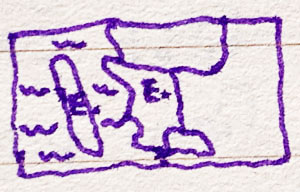
Inaccurate map of East Timor Wow! A beautiful true dream! I am flying high over the ocean, near the clouds with my teacher: a tall, lanky black man with an African look. We are traveling to East Timor, an island called something like “Concentric Isle” but also like “geometric” and “symmetric”. It’s a long thin oval of forests, mountains, and beach of fantastic beauty. I wonder what East Timor actually is and a map flashes up in my head, showing that it’s an island and a portion of the mainland.
We arrive at my teacher’s house by the sea. It’s warm and incredibly beautiful.
East Timor: I wondered and got a visual response.
There is a country called East Timor in Indonesia. The “mainland” I mentioned was a much larger island next to Concentric Isle. It has a region called Pante Macassar that looks somewhat like the map I saw, but there is no small, long island off the coast.
Question and Answer
Sometimes I ask a question, either out loud or in my head, and receive an answer. This is a slower, more physical rationalization of direct knowing.
-
Bedroom Window Gateway 1997 • age 23
Buttercup wanted to go somewhere out of the rain, and there was a dry place in the world down there, in the caves by the water — that’s where we had to jump. But it was a mile down this time. I had done it countless times before but now I hesitated.
“Is there any other way?” I thought. Instantly a scene appeared in my head: a computer screen with fluffy clouds and options of places to go. All I had to do was select my destination and I was there, without the nasty drop.
Ask and Know: I get an answer to my question about if there is another way down. It comes in the form of direct knowing with a visual counterpart.
Who is answering?
-
The Neighborhood Construction Ship 2001
I’m at Blaine House with Ruby and it’s bustling with people. I look out the kitchen window to see this immense airship made of metal girders carrying enormous amounts of building supplies. It stretches from right overhead to beyond the distant horizon. “What? How?” I asked, astonished. The phone rings and I pick up. A person answers my questions, explaining that it’s space folding (a reference to a method of travel from Robotech). It seems to have enough material to build an entire city.
References: Robotech is an animated sci-fi series.
Knowing the Answers: I wonder something and the answer comes to me rationalized as a phone call. But where did that knowing actually come from? Was this a rote and the knowing was from the person whose memory it was?
Guiding Voices
-
Like Warcraft, but a Whole World! 1997 • age 22
I’m slipping bombs into this piping system. Then I realize I must build. I go up to the castle to claim part of it as mine. But it’s not abandoned and I run into a bunch of orcs. I scurry away and find a bunch of my fellows — team orange! A voice whispers to me: “There’s more of them, but you can still win. Use your shield-men wisely!” . . . I restarted the scenario.
The voice speaks to me as I go immediately to explore: “The orcs aren’t here yet. They’re returning from a mission.” I start heading to where I found my allies last time and march right into a large enemy troop. I run through them and they split up and I’m back where I first saw them. I go to the corner. I review their stats with help from the voice and find they’re too much to handle.
Guiding Voice: This was a voice without a body or source, that spoke to me with helpful information. Was it a part of me?
Flow States
Flow states are like a cross between intuition and channeling. We step aside and allow a greater self to operate through us.
-
Guided in Dreams 1996 • 5:05 AM • age 22
Straightforward, easy-to-understand dreams tonight. I’ve been following desires, floating around through downtown San Francisco. I really am traveling around. I love this! Everything is being shown and explained to me. The Source is more aware, more alive, all in the now. It is clear and focused. It is the whole hologram, across all of time. Any knowledge you want.
Motivations move us forward. Belief in a goal increases our motivation. Focusing on a destination creates movement towards it.
I really feel as if I have been guided tonight. I’m so peacefully detached and unemotionally involved — only excited and fascinated by learning, not survival. That’s a great success. To be successful there, on the other side, we need to be stronger than our physical fears.
This is just coming to me so easily. I just figured I’d remember and didn’t need to write it down, because it’s so clear there. I really must explore this fearlessness more!
Calm Knowing and Guidance: I’m in the same connected flow state here in the dream state that I get in while high. Information is coming to me — in my dream self focus. My waking self is asleep. That’s why I feel peacefully detached. I’m not projecting drama all over my surroundings, and so I can observe, listen, and learn.
True dreaming occurs when the waking self with all its physically-based fears is kept quiet, sleeping. Once it awakens within the dream, it projects physical limitations, fears, and desires onto everything.
-
World Religious Conference 1997 • age 22
Soon afterwards, Emma appeared in the same shimmering semitransparent form. I forget how it happened (maybe I touched her), but I was transported somewhere else.
I was transported to this big international city scene. It was a big, big event like a world conference, and I was very happy to be there. I was filled with light and energy and I started leaping high in the air speaking the voice of truth: “Knowledge without love is like skin filled with skin! It cannot operate without a heart and a complex inside!” I yelled it out to people as I leap-frogged them. I jumped straight through Emma.
Channeling Truth: This is one of those wonderful times where a greater spirit fills you and speaks through you. It’s an incredible feeling.
-
Hanging Out 2020 • 7 AM
They were sprawled out on the floor or sitting, physically close and touching. They seemed like boyfriends and girlfriends or close friends. I felt left out. I climbed out to the outside of the balustrade and hung onto the bars. I projected my feelings into a full-throated song about how the two girls I wanted most didn’t want me back. It came out fully formed, creative, musically interesting. I sang maybe 5-6 lines.
My Song: I love doing this. Music comes through me, fully-formed. A statement of my feelings in dynamic and interesting music.
-
Final Exams 1998 • age 24
I dreamed that it was final exam time in my classes. In one that might have been history, I had a big project planned. I had made baked-clay houses, land, people and horses and painted most of them. I was nervous about being in front of the class and took a Percoset to mellow. I thought back to my last exam and how at the end I’d lost my fear and smiled and really got into it. I wanted to start out like that this time.
I went to the front and the lights dimmed. A spotlight was on me and I set it up and began talking and play-acting the figures. After maybe 10 minutes I fell into this kind of trance and began telling a story with great spirit. Now, in the trance, I was expressive and the story flowed through me. The whole class was gaping, leaning forward, way into it. Soon it was very rowdy. I had them. Everett was in the audience, smiling and laughing like in elementary school. Everyone was drinking beer now, shouting out “yeah!” and having a good time. It seemed to last over an hour. Then the teacher turned on the light and class was over.
Trance: Getting my waking mind out of the way was what was needed here, as it let me channel through something real that really connected with the rest of the class.
Questioning Flow States
-
How Do I Know That? 1996 • age 22
I was performing at this rock concert with lots of others on the strangest stage. After playing the first part of a song, I started to wonder how it was that I knew this song, at which point I forgot the rest. Then I was just messing around, trying to play some song I knew. Everyone joined in, and it went really well. Then I started reading this thing to opera music in the opera style and it was really funny. But I couldn’t see the words so well so someone else took over.
Questioning: Questioning how we know something engages the waking self, and often breaks us out of the flow state we’re in. If I hadn’t questioned how I knew the song, I’d have been able to finish it. The waking self needs to stand aside to engage in flow states.
In terms of rotes, we go from riding along with the character playing the song to taking over the character with our own will — one which doesn’t know the song.
The Awakening Look
One particular type of communication in dreams is “The Awakening Look”. Someone, usually a guide, looks at you with an intense look that somehow signals you to wake up.
-
Out of Body Experience — Flying on the Rooftop 1996 • age 22
After the [OBE], I woke up in the class, thinking this had all happened during some sort of test. I went to tell my teacher, who had a moustache and big smile and was excited to hear about it. I was so happy, I was almost in tears! Was this my soul teacher? He had a familiar feel.. Like he was watching me . . . and I was looking into his eyes (again) when I woke up.
Waking Eyes: In several of my dreams, I have met eyes with someone like a guide and there is this really intense eye contact where things get really clear and yet wobbly, and then I instantly awaken and remember everything. It seems that is their intent when this happens.
Boosting Energy
Mistaken Identity
When emotions get involved, we tend to project more. Projection caused by expectations, searches, or even just misrecognition can cause all kinds of issues with mistaken identity. It becomes difficult to know what’s really happening, or even to recognize those well known to us.
Multiple Copies of the Same Person
This can happen for several reasons. Once in the dream state I saw my own face change to the face of someone I was focusing on. As I’ve seen in psychedelic states, when we focus on someone, we become them — our attention takes their shape, and as a result our energy body can take on their shape (see Unconscious Shape Shifting to the Person of Focus).
It’s also possible that the duplicates are thought forms caused by a dreamer expecting to see that person where they aren’t.
-
Army of Me 1996 • age 22
We were in something like a space station. . . . And Captain Kirk/Picard was there! He was trying not to act like he was in a movie, but being funny about it. The space station was half in space, half where SSU’s main education building is. There was some kind of medieval war. We were attacked and beaten but not beaten completely. We had all kinds of new people before the first battle — many other races including the raisin people, and they were taken by the dark black evil people.
Then we had people come to aid us — the black-bearded folk, Benji and his kind, peaceful people. I realized I didn’t tell Benji my name (it was Benji, of course), and went back and did so. It was a whole army of myself as different people lined up along the hill in the back yard of Blaine House. We marched past the castle of evil — Blaine House! I was declared captain of the left wing, but I wasn’t ready. I didn’t have my bow, but a friend let me borrow his. [then there’s a big battle]
References: Captain Kirk and Captain Picard from Star Trek.
Versions of Me: I wonder if all these Benjis could have been versions of myself from past lives. I sure do like having a big ole beard!
It’s interesting that I was in a space station just before all these versions of myself appeared, which is an association I’ve seen in other dreams. Perhaps my reincarnating self likes that environment. It’s like a research station with gateways to anywhere I want.
-
Everyone is Buttercup 1996 • age 22
In waking life, Buttercup’s about to receive a letter from her worst enemy — a horrid guy from her past. I dream of her, myself, and some friends going to this psychology courthouse. There are a bunch of cases going on and we sit on a sofa in a section by the defense. In comes her enemy, his gross friend, and his nasty family. They are mean, sexist, egotistical, hateful, and irrational. The proceedings begin. The judge is overcome with disbelief at how bad their arguments are and how irrelevant everything they say is. I look over at Buttercup next to me and the person on the other side of her leans forward and it’s Buttercup, too! Then I peer past them and the other two are Buttercup as well. I’m shocked and I look over at her enemy’s family across the way. As I watch his nasty Emma talk, she morphs into Buttercup. I watch carefully and she switches back, then does it again. It was a brilliant morph, convincing as anything. She said something about how abnormal Buttercup was. Buttercup starts crying and I comfort her, thinking “If that’s normal. . . .”
Multiples and Morphing: This is similar to my experience in “Army of Me”. My guess is that the audience had other versions of Buttercup from past lives there supporting her.
It’s clear that the mother takes Buttercup’s form as she concentrates on her.
-
Chasing Clones
It begins with a large superhero battle here in my room, in which people are using knives to stab each other. I am one of the survivors.
This girl is on a journey, and I decide to trail her. Somewhere along the line I BECOME her. I go through cities and then through this carnival at the edge of the city. This big ugly guy challenges me to a game — throwing a ball into a hat. I defeat him twice, so I get prizes. I take toast and a drink, and give some to another companion. Then we leave the carnival and I see myself — a shorter clone of the girl — running about. I yell “imposter” and run after her.
I come to a field of guys playing baseball. I walk around them and into the bushes on the far side. There I find a horde of guys waiting to ambush me. I run, and the baseball team comes to my aid. As I walk around the park, I can hear them fighting. More happens . . . and I end up at this large castle. Inside there is a dance going on, filled with people. I’m still the girl, and clones of myself and some other guys try to capture me, but I nonchalantly avoid them.
Clones Everywhere: The first clone is likely due to me leaving the character I was inhabiting. She continues on her way and I see what I take to be a “shorter” clone running off. This would be because upon leaving I returned to my usual height, while still thinking I was her.
I don’t know where the rest come from later on.
-
Kissing Melody 1997 • age 22
Brendan and Melody had just finished “doing it” in our room and Brendan went downstairs to bed. Melody was still in my bed. We talked friendly-like, then she said “Aren’t you going to keep me warm?” So I leaned over against her but then there was kissing. Melody’s twin and Bessa, both roommates of Melody in this dream, walked by outside, saw us, and were horrified. Suddenly I realized what was happening.
Mistaken Identity: This took place during spring break in college, so it’s likely a social dream back in Banana House, where we lived, and not a rote.
Melody doesn’t actually have a twin, so the fact that another copy of her walked by outside the room means that at least one of them was a thought form. If it really was Melody in the bedroom, then she easily could have mistaken me for Brendan simply by expecting his return. And nonlucidity could have caused me to follow the normal behavior of kissing a girl who I’m next to in bed.
-
Two Sues 1996 • age 22
Brendan and I and Sue and Sue (two of the same Sue) were hanging out.
Two Bodies: That’s weird. I don’t even remember who Sue is.
-
Needle Tech 1997 • age 23
This person in a devil costume ran by, being shot at mercilessly. Then I turned around and saw two people in the corridor behind me, walking and talking. I ran to attack but realized I was in a devil costume and so was my good friend who was with me. And the two next to us were us — twins! I was beyond fascinated, so much so that my focus began wavering in and out — dulling and sharpening. We sat down to talk and I got to know the duplicate girl. At times I was dumbly nodding, and at other times I added clever humor to the conversation. In and out. I looked at the guy and thought “That’s what I look like?”
Multiple Us: I wonder what happened here. Were we inhabiting people who were in devil costumes? Did I take on that form because I was focusing on it? Then how did we encounter ourselves?
-
The Argument 1998 • age 23
I’m in an auditorium and evil (red-shifted) Buttercup is being mean and gets in a fight with my girlfriend Buttercup (they look identical except for color). I step in with strength and, looming over the evil one with my eyes glowing, forcefully tell her to stop. She responds with angry taunts but I cut them off and joke “Is this going to rhyme?” and her taunting doesn’t get to me.
Red-Shift: Heavier gravity causes a red-shift in light, so maybe evil Buttercup was from a lower, more compressed astral realm, and that’s why she was red.
It reminds me of cartoons where there’s a little red devil and a white angel sitting on someone’s shoulders. Note how they are smaller versions of us, reflecting the smaller astral size.

From Disney’s The Emporer’s New Groove -
The Red Scooter 2000 • age 25
I chase them down into a sunken staircase (the underworld) and into this madhouse scene with scary sleepwalker people all milling about. I rush through two pale greenish rooms to where Buttercup is. I pass multiple copies of the bad guy; this yellow-eyed purple-haired guy that looks like “bat boy” — very much like a thought form as it is mostly lifeless.
References: Bat Boy was a weird character from a tabloid.
Bat Boy Army: Another example of the odd appearance of multiple copies of the same person. Could it be due to me projecting onto several sleepers the face of the bat boy character? I was looking for him at the time.
You Think It’s Who It Clearly Isn’t
There are almost no limits to the ability to project identity onto somebody. In fact, if I was to tell you a certain person was behind you, and nobody was there, the expectation itself would create a perfect thought form replica of that person. They would behave just as you expect as long as you’re paying attention to them.
How much easier it becomes when there is a person there.
The difference is when there’s a real person that you mistake for someone else, there’s a chance that eventually the differences will jar with your projection until you realize it’s not who you thought it was. How long that takes depends on how strongly you want it to be that person.
-
The Wrong Hero 2001
I’m on a bike, approaching this small shack on a hill. A friend is with me. Inside, it’s unlit except by the daylight streaming in through the windows. There are people scattered about and I’m amazed to see Mark Curry. He’s about to leave. He and my friend get into a car. I run up to the car and say, “Mark, hi! I think you’re a wonderful artist — one of my favorites.” And you know what? It’s not Mark Curry. It’s Ernest! Part of me notices but I keep going. He’s so touched by my comments and replies that he thinks my guitar playing is great, with all the fingerpicking stuff. . . . I begin to realize I don’t like Ernest.
References: Mark Curry is a musician I like. Ernest is the weird guy in the Ernest movies.
Really Mistaken Identity: Mark Curry is a musician I really like and Ernest is the weird guy from the Ernest movies. I didn’t really know what Mark Curry looks like. Generally we mistake someone in a dream for someone with a similar appearance, or someone who holds a similar relationship to us. But for someone I admire to switch to someone I dislike with no physical similarities. . . . AND on top of that, he mentions my guitar playing? Who would know about my fingerpicking style? Was this someone who knew me well messing with me? It’d be a good prank.
-
The New Apartment 2001
This morning Raven was going to visit. . . . Back at the table I was eating corn and potatoes. . . . I went wandering to try to find something else, and got bread and au gratin potatoes. I saw an old lady who I mistook for Raven. I talked to her, thinking it was her, but then the wrinkles finally made me realize it wasn’t her and I dropped the conversation and wandered away while she, confused, went and sat down at the table.
Mistaken Identity: I mistook the old lady for Raven because I was expecting a visit from her.
-
The Summoner 2001
I’m with Manville in a supermarket, but it’s not really Manville.
Mistaken People and Places: There was a scene I left out preceding this with Manville’s Wadsworth and Emma that clearly got mistakenly tied into this scene.
Perhaps it’s someone who is meant to have the equivalent emotional relationship as Manville, but I’m not fully projecting Manville’s face onto him.
-
The Mirror People 2012
Manville and I talked about various things. He mentioned some song I had written but it didn’t seem familiar to me, and then I brought up how I had digitized all my early movies and tapes. He was excited and asked if I could get him all the Sanctimony (something like that) I had. That also wasn’t familiar, so I asked if that was a show, or music? I think he indicated that it was both. A trailer for it started playing in my mind and it was all about intrigue and violence and mind-tricks and I shook myself out of it as I wasn’t interested in going there. Then he started opening up vaguely about relationships and seemed about to admit he was interested in guys, but didn’t quite get there.
Mistaken Identity: Clearly this person wasn’t Manville, and I wasn’t who Manville thought I was.
-
The Back Massage 2025
I’m in a truck. I’m standing in the back, and “Pierce Brosnan” is behind me, though it’s actually Ezra Danson.
Pierce Danson: Both are white-haired old white guys with charisma and a charming smile. But why I take him for one when it’s clearly another?
Projecting onto Someone
Most of the time when we project onto someone, we project the whole person we’re looking for, expecting, or mapping. But we can also project smaller modifications onto them.
-
Lucid Dreaming and Sex 1994 • age 19
A crazy farmer enters his field and we get scared and start heading back. She says his head looks like a hamburger and suddenly it really is! We laugh and go back to the building.
Hamburger Head: Suggestion is a powerful force in the dream state. Generally whatever is suggested to you takes form in the dream. Suggestion creates an expectation which causes projection.
Was I seeing her projection or creating my own?
-
The. . . . Party? 1997 • age 22
[The boy had] thrown himself over the edge of the roof to die. I ran to the edge and looked down. He’d landed head first on the concrete. His head was bashed in, and there was this white foamy liquid on the concrete all around it. I ran to the party and told someone to call an ambulance. Then I realized the kid was running behind me saying “Touch my head! Feel it!” I refused. He’d survived, and so he did it again and again, and each time it was like the tragedy was new. The next time, his head was a crushed up carton that leaked ice cream.
Projecting onto Another Person: Here is someone who is clearly an independent dreamer, whom my projections influence the appearance of. The leaking white liquid reminds me of melted ice cream and his head becomes an ice cream carton. This is my own projection onto him, and I doubt his actual astral body changed shape because of my projection.
-
The Meeting 2000 • age 25
I’m at a familiar dream school. It is a good, quality school — unlike the Dark Tower. I have a regular class schedule and memories of many days there. Buttercup is there as well. There is a crossroads at a walkway where in the past I have gone to meet Kayla. I am heading to a class when I notice someone that looks like Kayla walking in another direction. It looks as if her face is behind a veil or plastic sheet but as I look (project?) it becomes clearly her. There is a mutual recognition.
Projection: This was very odd, to catch the unclear face that turned into Kayla’s. It seems clear I was projecting onto a figure that was already there. If I’d projected the whole figure, it would have come into being completed. So was this someone I was mistaking for Kayla? The mutual recognition could easily just be her projecting someone else onto me as well.
Or, it could have really been her, and I was projecting my memory of how she looked onto how she presently looked. It’s known we appear to someone in the way they remember us.
-
Jay, Master of Thought Forms 2010
The last guy gets up. [Multiple copies of him surge into the audience and back] I’m just astonished and wondering how he’s done it, looking around like mad for some “image induction device” or something. The speaker calls all the audience members up onto the stage, and Jay comes up, along with about twenty other Jays, and I see a red and white rounded book-sized device in his hand, but I suspect that was my projection of the responsible device.
A Projected Alteration: Not only can we project a different face onto someone in the astral (mistaken identity), but we can project something onto their person. In this case, my certainty that he had a device of some sort causes me to see it in Jay’s hands.
-
The Poster Challenge 2018
At one point I was looking for Gwen. . . . Then I saw Gwen, but the person turned and said “I’m not Gwen”. I saw that her face was different, and her hair changed from dark brown to red. I saw the real Gwen a minute later.
Projecting: This girl must have looked somewhat like Gwen from behind. My specific search projection of Gwen covered her red hair with the dark brown I was looking for. When she said she wasn’t Gwen, I pulled back my projection and saw what she really looked like.
Near Realm Identity Projection
Identities are mapped in rotes to convey meaning via familiar faces. But we do plenty of projecting outside of rotes as well. These are based on expectations or physical similarities.
I’m not sure I’ve ever entered a rote in the near realm.
-
Astral Party 1999 • age 25
Everyone was college-aged and out for fun, telling jokes and playing tricks. Many were drunk, carrying 40s. I was drunk, too. I kept mis-recognizing people, then catching my error before going up to talk to them. Truth is, I didn’t recognize any of them.
Misrecognition: Here I catch myself misrecognizing almost everyone I come across, and this is a very common phenomenon in dreams. In real near-realm interactions, this is due to similarity of appearance. Our desire to see people we know can project their faces onto nearby people with similar appearances, as it does in this near-realm scene. Here I catch myself making this mistake several times.
Taken together with the emotional meaning substitutions in rotes, a good amount of the time the person we dreaming about isn’t really the person we think it is. That’s not to say that we don’t have true dreams about the people we know — we certainly do. But we have to see without the interference of expectation and desire to know when it’s really them or not.
Gateways and Subdreams
Gateways
A gateway is a passage from one setting to another through a picture, book, movie, or anything else which draws us in. In some cases, we are entering a rote (story experience). In others we’re just entering into a new setting.
We go through gateways when what’s on the other side seems more interesting or fun than where we are. We do this simply by focusing our attention on the gateway, and (mostly) forgetting where we are and what we were just doing. As our focus grows, we move into the new scene. Going through a gateway can be considered entering a subdream.
These transitions are done through phasing (see Phasing and Tuning Consciousness). Attention shifts from our present location to the gateway, leaving a tiny part of ourselves (our phased attention) behind us like a foot in the door. We can travel from gateway to gateway in this way. When we exit a gateway, we return to the scene we came from. There are no limits to how deep we can go; we can go from gateway to rote to rote to gateway to rote, all without returning back the way we came.
Should our attention be drawn too entirely into the new scene, we may literally lose our place in the previous settings such that we lose the thread and forget where we came from. We can still return there later, but not the way we came.
I’ve returned through several rote gateways, but I don’t recall returning through location gateways.
Location Gateways
Location gateways take you to a new location context.
Pictures
Picture gateways includes posters, pictures, cards, and maps; things representative of a place rather than a story.
-
The Lava Trail 1996 • age 22
I was looking at a very long picture on the wall. It showed this trail of glowing rocks, suggesting an unseen river of lava. The rocks looked like glowing salt crystals with red and yellow lights in the center of them. I was fascinated and went into the picture. I was walking along the path among the rocks.
Picture Gateway: My fascination with the picture of the lava trails caused me to go into the picture gateway.
-
Under the Earth: Guardians 1996 • age 22
I go to get some Guardians cards. . . . I end up with about 16 packs. . . . Then we’re at the ocean. I’m sitting on the warm sand, opening some packs. The cards are cool beyond description, all ones I’ve never seen before, fun and powerful. . . .
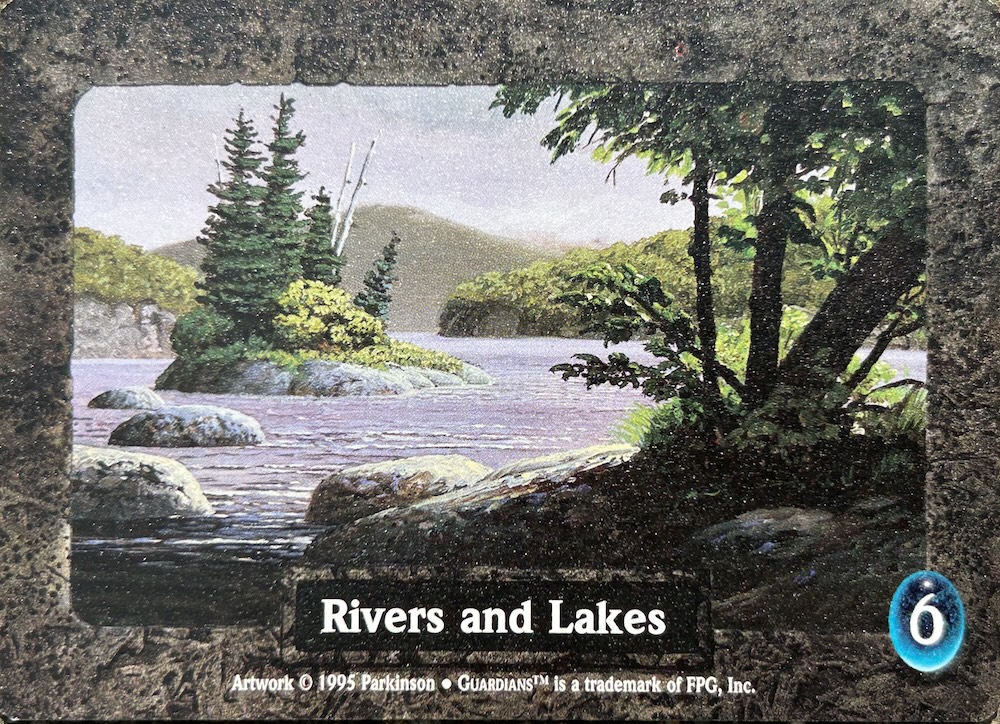
A land card from Guardians 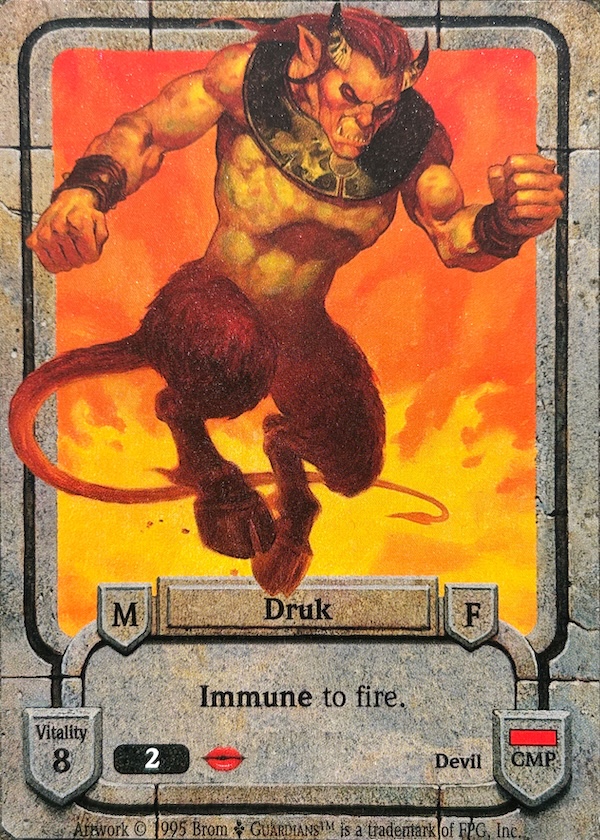
A demon card from Guardians 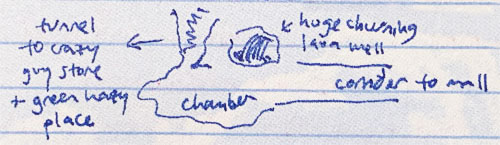
The lava chamber and passages out After getting some great demon cards, I appear underground in this corridor with Buttercup and some others. It’s lit by this immense lava flow in the room just beyond us. The lava flow is going crazy, flowing rapidly through the room. The sound is deafening and everything has a deep, flashing red tint.
References: Guardians is a collectible card game.
Card Gateways: The cards might be how I got to the ocean, but I definitely went to the underground lava chamber through the picture on a demon card. The ocean may have transformed into the lava flow.
-
Map Gateway 1997 • age 22
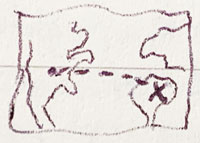
Map that acted as a gateway I look at a US map. I see that some pyramids and a sphinx are near San Francisco and I mark down that I want to visit them. . . . Maybe we had arrived in San Fran, but wherever we were we were searching this area of hilltops for a home.
Oh! Upon further reflection, I think it was the US map with pyramids and such that brought me to San Fran.
Map Gateways: Maps are great gateways. Making plans for a vacation? Focus on the destination on a map, dive down into it, and there you are.
-
Enlightenment by Fire 1997 • age 23
I found a small mouse and picked it up. It began talking to me. It suggested I go back to the fire shaft, a place I was familiar with but hesitant about. I had four cards in my hand with different pictures of the inside. The structure was white and had a pillar with flames in the center. Around it were some wood spokes, perhaps? Anyway, I opened the heavy door to it and left the mouse outside.
Gateway Cards: I’m holding cards that I can use as a gateway to the fire pillar. It’s likely I was viewing memories of the fire pillar which I translated into cards in my hands. I could have skipped the card step and just gone there through my memories.
-
The Dark Tower Tour 2000
I had left my companions behind in the lower rooms, and there were only children in this room. They encouraged me to escape something by entering a tiny picture on the wall but I was having trouble using the gateway. At times it would begin to enlarge around me but then I’d pull back.
The Picture Gateway: The children’s suggestion of escape through a picture reveals their knowledge of dream gateways. Were they dreamers as well? How interesting to see me engage then pull back when trying to use the gateway.
C.S. Lewis uses this kind of dream gateway in The Voyage of the Dawn Treader.
The painting gateway — the zooming in is all that is required (the movie gets it wrong after this scene). Video credit to the movie The Chronicles of Narnia: The Voyage of the Dawn Treader
Miniatures
Moving into the size context of miniatures is a different sort of gateway. We end up not in another place, but at a different scale. This can occur through focusing on action figures, models, toys, and board games. See Changes in Scale and Perspective for examples.
Mirrors
Light does not reflect in the astral. When we encounter a mirror, our expectations might project a reflection there. We can cross through it into a reverse version of where we just were. This takes us into a fantasy world.
Rote Gateways
We enter into rotes (recorded story experiences) to experience them. This makes them a type of gateway.
Books
Rotes can take the form of books. We can enter the book as a whole, or in the case of comic books, graphic novels, and illustrated books — we can enter through a specific picture gateway.
Libraries and comic book stores are places filled with gateways in the dream world. And, in a way, the physical world as well.
-
The First Gateway
Enter building. In shopping center. Look for Transformers 16. Brought $1. Find & buy. Read. What’s inside vividly happens!

Transformers comic book Comic Book Rote Gateway: My first experience of a gateway was in my earliest written dream at age 9-10, where I go into the action in the Transformers comic book.
-
Elfquest Endtimes 1997 • age 22
While looking through [boxes of comics], I found an Elfquest book Buttercup had given me. In the story, the elves are much older. Cutter and Skywise are looking through the hedge and a thousand swan ships are becoming visible in the ocean beyond. It’s all the tribes gathering. The sky is brownish red and heavy and some horrible thing is happening. Cutter demands that only the young survive and all the adults begin to throw themselves to the sea.

Cutter and Skywise from Elfquest Image credit to Wendy & Richard PiniReferences: Cutter and Skywise are characters in the Elfquest series.
Book Rote Gateway: The Elfquest book acted as a gateway to a story rote. This is one that I’m watching rather than participating in. I wonder if that’s more often the case with books.
-
Elfquest What If 1997 • age 22
I was reading Elfquest, and when I asked “What if the Wolfriders hadn’t turned this one way and met the others?” The answer was “Someone else would have,” and I jumped into the action — a frozen tundra. The wolfriders went the other way.
References: Elfquest is a graphic novel series which features the Wolfriders.
Gateway to a Rote: Here’s a great gateway caused by curiosity. A quality of rotes is that you can make different decisions and take different paths.
-
Fantastic Solstice 1997 • age 23
The walls were filled with books and I picked up and read one called “Solstice”, thinking that 1) someone took my name, and 2) that it was The Lord of the Rings (LotR). In fact it had nothing in common at all with LotR, though I didn’t realize it at the time. I read a little at a time, and wanted to read more so badly that I started interrupting later parts of the dream to return to it. I read a little at the table. . . . Every other page was a big splash picture that, of course, I went into. It seemed to start with a part called “The Dragon Pits”. It seemed we were going to go deep into them for a treasure, but it ended up being a tower. We were seeking something like the “true jade” that was only ever used to make book pages. All around us near the opening were merchants selling rainbow-colored crystal idols. I was the hero in the story and there was a mentor with me.
References: Solstice was the name of a BBS I once had.
Rote with Backstory: The book contains a series of picture gateways. As I enter the story, it comes with information — background story and direction. I also become the hero of the story. Since these are qualities of rotes, then the book must be a rote where the pictures are gateways to certain parts of the story.
-
The Book of Dreams 1997 • age 23
I was studying this big book of dreams, finely illustrated. . . . I think I went into the cover picture as I descended slowly (I thought I was sky diving) onto a beautiful snowy mountaintop. I was with someone, and we were going to ski or something.
Gateway Transition: As I descended into the picture, I descended into the scene. This shows a gradual transition between contexts.
-
The Superhero’s End 2011
It became so bad, this tiny world so infested with superheroes that couldn’t get along that a group of them/us decided to go back in time to the Golden Age of superheroes and nip it in the bud. A group of the most nasty, destructive superheroes were gathered together. One was pure black and could dissolve objects into nothingness. There was Venom, insane with rage, and several others.
I don’t recall if there was any transition into the past, or if it looked any different, but we set about going to comic book stores and just destroying everything that had to do with superheroes, to the horror of the people working there. My own destructive powers were meager. At one point I saw a kid reading a comic book at the counter. I looked over and it had this classic super-powerful superhero fighting against and destroying our group. The kid wanted to buy the comic, so I said “If you let me have it, then that superhero will actually come here to fight them. Either read about it, or it can actually happen.” The kid handed me the comic and I began paging through it. It became a gateway, and that superhero in green started attacking and destroying the dark heroes that were sent back in time. In a moment of panic, I realized that included me, and I escaped down a long hallway in the back of a shop.
References: Venom is a nasty evil spider-man villain.
Gateway to Doom: Here my Dream Self shows a strong understanding of gateways. When I went through the comic book gateway, I seem to have entered a nearly exact copy of the originating world, but with the addition of the superhero in green fighting us.
Video Media
Memory or story rotes may take the form of video media, including movies, videos, TV, and video games. The box for a movie or video game can also act as a picture gateway into the rote.
-
TV Road 1997 • age 23
We come across a video billboard (it’s simply a large TV in the mall). I get enthralled watching this hilarious Popeye sketch in The Best of Saturday Night Live. Raven gets mad waiting for me and I decide to just forget the trip. I look back at the TV, which has this woman in a hot tub, and I travel into the scene. This is rationalized by me “remembering” that I traveled there by bus.
So I’m in the room with the hot tub. . . . There’s a cat in the middle of the tub half drowning and half repeatedly scratching like a robot. The woman is pretending she’ll take off her bikini top to tease the viewers. The joke is that whenever I try to get to her, there’s the cat’s paw in the way.
References: Popeye is an old cartoon/movie.
TV Gateway: Here I travel through a TV (which is also video billboard in a second context). Oddly, I arrive at the set of the show they’re filming.
-
Kissing Melody 1997 • age 22
Then Buttercup and I returned to our room and she threw me down kissing me but I prevented myself from enjoying it. Soon I tried to escape into an advanced Quake game Brendan left on my computer (with his monitor). It was horrible — I was deep in the catacombs fighting against this huge nasty monster. Finally I put an end to it, didn’t care if I won (new mindset!) and got back to the dream.
Gateways into Fantasy: Here is another great example of going into a gateway, and then returning through it. The reason this time was that I was trying to escape my guilty feelings. In dreams going into a gateway can be an escape just like reading a book or playing a video game in waking life is.
-
The Best Video Game Ever 1997 • age 22
I’m in a toy store with this boy, looking for WarCraft 2 Expansions. Instead, I find Zelda for Nintendo 64, so I pop it in and start playing. There’s a number of selection screens asking to select view, asking if you like the Co-op Bookstore or not, and other options. Finally it started. It showed a sloppily-rendered world overview, and you scrolled down into the city you wanted. At this point, it became real.
We went to a big castle.
References: The Co-Op Bookstore is the bookstore at Oberlin.
Video Game Gateway: The act of playing a video game involves going into it, becoming the character. This happens through imagination in waking life, but without the constraint of physical reality locking us into our bodies, it happens literally in dreams. Our language reflects this, too. We “get into” a book or a game. That choice of language comes from our nightly experiences of dream gateways.
There has also been over my lifetime an evolution of video games from 2D areas to immersive 3D worlds, bringing them closer to what we experience naturally in dreams.
-
Tribal Gore 1997 • age 22

A Star Trek VHS tape There is very often a journey to Blaine House in my dreams — driving past the soccer fields and stopping at convenience stores and the mall on the way, all of which I did last night.
At one point, I must have been in a movie store because I fell into this Star Trek movie. The setting was very much like a space station. It was a lot more intense than the actual movie. There were more weapons, including wave guns that disrupted you and knocked you over. Strangely, I saw the holographic spirits of the dead from the last dream. There were shapeshifters and androids and lots of intense action.
Memory Impinging on Fantasy Rote: Going to video rental stores became a regular thing during my later years at Blaine House. The Star Trek scene was most likely me unwittingly using a movie box as a gateway. Imagine me standing in front of a video box, just staring, lost in a dream about it. The strangely sober and real story of the tribe from the earlier dream stuck with me and these “ghosts” returned through my memory, which I interpreted within the context of the new Star Trek story.
I consider this a video rote because it’s actually a video tape I’m focusing on, meaning it’s a story rote, even though I enter it through the cover.
-
Hazel’s Wedding 2009
I’m sitting against a wall. Hazel and her husband are across the way. He feels bad and indicates that he’s sending me a text with his phone. I wait and wait and then it arrives on my phone. It’s a movie of Hazel and him biking fast on these narrow cliff paths in another country, by the sea. It’s dry and there are people around. Soon I am with them in the scene and I thrill at the ride.
Modern Gateways: This is my first time catching a rote in the form of a video text (though there have been more since)! His video text acted as the gateway to the rote. I went into it and experienced it with them, or possibly as one of them.
Of course the phone and the video text are rationalizations of Hazel’s husband directly sending me a rote.
Web Sites
The web is the latest form that rotes can come in.
-
The Real Office 2010
We begin talking about the real characters The Office is based on. We were looking at pictures of them, as if on an iPad in front of us. I only remember that we’re walking down the sidewalk, then standing and looking at a web site with pictures and text about them. . . . Then there’s a transition to the girl who Minnie is based on, though she was blonde and looked totally different. This becomes a story about her — she’s the main character. I inhabit her at most times but am sometimes outside watching.
References: The Office is a TV series.
Web Gateway: We were standing there on the street looking at Minnie’s picture and information when I went into her story. The web site is the gateway to the rote. In this case, the text seemed to draw me in — the story.
Without Rationalization
-
The Observers 2015 • 7 AM
One of the siblings asked a question about evolution. In response, they went through a thought gateway into a wide grassy field to look at and study these different animal versions of themselves — monkeys and horses, I think.
A Thought Gateway: The dreaming siblings open up a gateway to another place to answer a question one of them has. This is unlike most gateways in that it is intentional, and without any kind of physical rationalization.
Importantly, I’m an outside observer here, watching the dreamers from outside their dream structure. Perhaps from this perspective I don’t see their projections and rationalizations.
Subdreams
A subdream is a dream within a dream, whether through a gateway, rote, or just zoning out or falling asleep within a dream. When you stop and think in dreams, you will usually go into a subdream.
Imagine you’re walking down a hallway and you see an interesting poster. You stare at it, and it becomes a gateway. You enter it into a subdream. As you finish that dream, you reappear in the hallway by the poster where you left off and continue along your way.
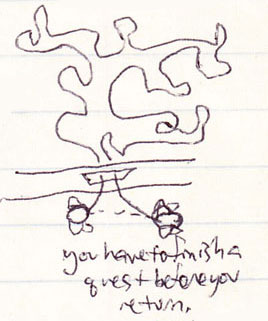
Reveries
Just like in waking life, things can get boring while traveling or waiting for something in dreams. We can become lost in thought and daydream, or occupy ourselves with our phones where we can communicate, play games, read stories, or watch videos. At these times we can call up some entertainment or invent some drama. When we do this, we go into a reverie subdream.
The only difference is that in dreams the transition is complete — we become fully present in our distractions for a time. Then we return to the scene we were in previously.
These reveries are not necessarily private. In a few situations I remember someone watching one of mine, or joining in one.
Full Reveries
Full reveries happen in a little internal world, usually unrelated to our current context.
-
Bedroom Singalong 1997 • age 22
The black guy who frequents Irene’s is sleeping next to me in my Blaine House bed — a thing I found quite strange. My bed had white sheets, the breeze was blowing, and the room was fully decorated. The guy was singing great music with me, soulful and inspired. . . . Then I remember swimming in a secret world in Mario 64. It was in an underwater supermarket with lots of eels. I had to swim through 10 rings. I guess this was in my room — he was watching me play, impressed.
References: Irene's is a cafe in Oberlin where I worked.
Video Game Break: It looks like my reverie subdream of playing a video game is visible to this guy, as he’s impressed by my skills. This is likely due to our ongoing connection. In an earlier part of the dream, I could see his girlfriend appearing in a telepathic window.
-
Consciousness Research Foundation 1997 • age 22
I was staying in some residential area. There were cool, different houses with lots of greenery. There was some trip with a bus to this movie and Buttercup and I decided to go. We got in the bus and the driver woman started this big collection process. It was $15 for Buttercup, because it was her birthday (it wasn’t actually) and because it included a lunch bag and drink. It was $36 for the rest of us. I wanted to see if the bus driver would accept less, so I waited until the end to talk to her.
While waiting, I was playing live-action Marathon with Lance L and some others. They knew the board well and eventually kicked my ass. The setting was some darkened business offices, shifted to morning light blues and purples. Lance was playing out some crazy story as he played. One weapon he had was a baby head that spewed oatmeal.
I returned to the bus driver, who asked if I paid. I said no, then talked her down to $6.50. Then we’re driving around, seeing sights.
References: Marathon is a video game.
Subdream While Waiting: In the original writing of this dream, I wondered what I did while waiting for the bus driver to collect money from everyone else. Then, immediately after, I wrote “There was some inbetween dream . . . ” describing the Marathon game. The scene change was so unrelated that while I knew it had just happened, I couldn’t place it. But it’s clear now that while waiting, I went into a reverie subdream.
-
Counselor Travolta
He tells me to take the pills and lay down and close my eyes and tell him what I see. I close my eyes and the images that arise are bright and filled with glowy white light. There’s a car driving all over this pretty field, repeatedly running over Meg Leonard who was riding a bike.
Reverie Subdream: What an odd vision! I have no issues with Meg Leonard or John Travolta whatsoever, and what seems to be a higher realm has a twisted aspect to it.
-
Sexy Alissa Milano 1997 • age 23
This took place on the beach. I just was standing there having this fantasy and it got more and more real and I went into this other world, like a little sphere around me.
Reverie Subdream: We can just up and go into a fantasy without any corresponding external stimuli. We can just be standing there and zone out into another dream.
-
Taciter 2025 • 8 AM
I’m reading a black and white line-drawn comic about some animal gods coming out of hibernation to train someone. One goes to an old man named Taciter to complain that another isn’t doing their job.
I seemed to also be driving a black SUV back from the place where I had been dreaming. It was as if I was at a traffic light and reading the comic while waiting to continue. As I drive, I miss my left turn and do a u-turn to get back on track.
Road Trip Entertainment: These cross-country road trips can take some time.
-
A Hitchhiker from the Hospital 2010 • 1:30 AM
I’m in a patient’s room in a hospital, on something like the 12th floor. I’m standing at the side of a table. Off to the side in an adjoining room, sitting at a table is Wadsworth. I’m talking to him openly about my health. I just started using Tramadol again a couple days ago after weening off it several months ago. He was telling me some stupid made-up horror stories about it that I was debunking. In the meantime, I had closed my eyes and, while the conversation continued in the hospital room, I was in my kitchen scrounging at the bottom of the countertops on the floor looking for lost pills to refill my bottle. There were just insane amounts of pills down there of every kind with only a few tramadol here and there. Eventually full bottles of things began to appear among the pills all over the floor, and then it was mostly bottles. At one point, I felt a sharp pain on my finger and realized I had pricked my finger on one bottle that had come with a syringe attached to it. That caused me to come back out of the scene and back to the doctor’s office. I’d been continuing the conversation the whole time.
Double Context: How interesting that I can close my eyes and have this subdream with a location change while continuing a conversation in another location. A likely scenario is that Wadsworth had said something about becoming a junkie scrounging for pills and I was imagining it.
-
The White Snapdragon 2023 • 6 AM
As I continued to examine it, I saw that it looked like a snapdragon flower as big as my head. . . . I put one hand inside it like a puppet. This was a mistake — it came alive and bit my wrist, leaving a little spore of some kind lodged there. I hoped I had not reinfected myself with it, whatever it was.
The dream then turned into a plant-based zombie story. People were coming after me, people with plant-mutated bodies, trying to bite me. The people were overgrown with unfortunate additions to their bodies of all colors. I ran, hid, fought.
Off Into Fantasy: The fear of the spore infecting me turns an interesting and true examination of my etheric body into a fear-based fantasy story.
Reverie Projections
Reveries don’t always take us into an entirely different scene. Sometimes they are little bouts of imagination projected out into our current context.
-
Two Dogs 2024
Buttercup and I had decided to get two dogs — a Emma and her puppy. They were light brown, medium-sized dogs with long hair. We went to this crazy place to make the final arrangements. It was a couple’s house, but it was also the king of roadside attractions, as you’ll see. When we first arrived, it was just us and the lady. She was a pretty ordinary looking country lady. She invited us in and we walked down some stairs. She was getting us some stuff for the dogs. She went into another room. The kids were with us now, excited about the dogs. I began to hear a hissing sound. I got the feeling it was a snake but didn’t see one. The mama dog was interested in something under the couch. After not being able to see what it was, I think I looked THROUGH the couch and saw the snake — it was a black, yellow, and red striped one that I thought might be dangerous. I called out to the lady. It bit the dog on the paw, but the dog didn’t react. I reasoned that maybe the snake just bit the dog’s long hair. This whole scene with the snake may have been a rationalization reverie.
Anyways, the lady returned with some various-sized bottles of milk and other supplies which she gave us.
Snake Attack Reverie: I imagine a snake to make sense of the hissing, and have a little reverie subdream about it. What I imagine happens in my head only, and doesn’t affect the dog or the plot of the dream at all. I then rationalize the lack of effect of the bite on the dog.
It’s exactly the same sort of reveries of imagination we go into while awake, except in the astral we see it happening before us, and we can get completely sidetracked by it.
-
Two Dogs 2024
The grassy fields continued for a few acres before ending in trees. People were scattered about there, and the atmosphere was excited and expectant. Something fell from the sky, and one group of people ran over to get it. I wondered if it was a satellite. It was blue, mechanical, and about the size of a soccer ball. After this I think I went into a fantasy where a much larger satellite fell.
Falling Objects: After seeing a small object fall from the sky, I naturally began to imagine (and experience) what a larger one would look like. This is the second reverie I had in this dream, in addition to zoning out earlier when watching a boring demonstration.
-
Colorado Volcanoes National Park 2024 • 5:30 AM
The volcano was continuously erupting hot smoke and debris like a blast furnace from an opening that was maybe three feet across. The lodge had windows right beside it, allowing for an amazing view. A ranger said it was the second most powerful volcano.
As I watched the impressive eruption, I imagined (and thus saw) chunks of black rock raining down from above. At first they were small sprays of gravel but then larger black rocks came down. They came down inside the building, ignoring the ceiling. I dodged about to avoid them. Some came down on this stairway and I imagined (and thus saw) them rolling down the stairway in such a way that it was like a video game challenge. I went up the stairway dodging the very real (to me) volcanic rocks.
Done with my little fantasy game, I looked around for the others but couldn’t find them.
Imagined Drama: One’s imagination can always spice things up. Here I introduce danger and turn my environment into a live-action video game. I’m becoming more aware of when I’m doing this, and not taking it for objective reality, but enjoying it for a time. The result of this awareness is that I don’t get emotionally involved with fear, which would derail the larger adventure I’m on.
-
Colorado Volcanoes National Park 2024 • 5:30 AM
I ended up driving up the wrong path on my own where I saw three wolves. Cool! But I quickly backtracked before they noticed me. I soon ended up on another wrong path where some wolves saw me and came after me. I hid in these big white bones, going out of my body to watch them attack me. The wolves were weird — they were floating; thought forms created for drama. I tricked them or something then returned to the drive.
Some Light Adventure: This was a low-level imagination reverie. The wolves I created were coming after me, but I wasn’t trying too hard to make it seem real.
-
Passion and Liftoff 2000mature content
I went to this odd, out-of-place room. Inside was a friend and two gorgeous naked girls laying on these pillows, facing away. I was overtaken with this strong sexual passion and made some verbal attempts at seduction. What it was is that I was outpicturing to one of them scenes of how nice it would be. So then I was floating above myself, embodying the imagery, with her vaguely above me. We began doing it, but she became less and less important. As I moved, I felt these golden waves going up and down my floating body from my feet to my head. It was ecstatic, orgasmic but sustainable.
Into a Communication: I begin by attempting to communicate by telepathic imagery. But my attention on the imagery pulls me into it, and I find myself floating above myself. Imagine a cartoon thought bubble with the imagery, and then imagine me embodying the self up in the thought bubble. It expanding out around me as I go into it.
As I’m actually alone in this projection, the girl fades out as I focus on my own sensations.
-
Hyperspace Reunion 2000 • age 25
I meandered through his apartment alone, then turned a corner to hear people down the hall. I went down the hall and greeted a large family who I took to be Oscar’s wife’s or girlfriend’s family. They had three baby seals (last night I imagined how Isobel would look like a seal if she only had front legs). The baby seals were cute but I had this real thought form fantasy of a huge mother seal coming to protect them.
References: Isobel was our new puppy.
-
Mountain Removal Mine 2011
I come to a place where a trickle comes out of a medium-sized hole in the earth. A story comes into my head of how some kids throw explosives into it and it kills fish that come out, which they catch. There’s an amusing imagination scene of a kid trying to grab a sunfish and the sunfish keeps trying to jump past him but getting slapped down. Eventually, it makes it past him and into the lake.
Reverie Inside a Rote: Where did the story rote about the fish come from? Was it associated with the hole in the ground? Once in the rote, it appears I imagine up a funny scene (reverie) related to it.
Our ability to creatively engage is unhindered by where we are or what we’re doing. We have the same creative capacity inside a rote as outside it.
Being Given Anesthesia in a Dream
-
My Daughter, Me 2009 • 2 AM
I’m in a sparse bed in a dimly lit hospital with some unknown Native American woman. It’s time for me to give birth. The doctor explains that the Native American woman will be unrelated to the child. Then they put me under. I go into a dream, where I find myself in the same place and position. I move slowly, aware that they’re operating on me and that this is a dream. My abdomen feels sore and I’m careful with it. I wonder if the baby’s genetics are all mine. Then I decide to pass the time by playing with cards, and the scene changes to a sidewalk in a neighborhood in summer. I’m still in the same position. I organize the cards a bit, then I feel myself come back to the hospital room.
Anesthesia Subdreams: This is a good example of a subdream. Was it truly caused by the doctor putting me under or just the suggestion of the doctor wanting to put me under? Either way, I clearly remembered coming from the hospital scene and then returning to the hospital scene when the subdream was over.
How interesting that my body remained in the same position in the subdream, while my surroundings completely changed.
Unknown Gateways
Sometimes the specific gateway is forgotten, and we just remember entering a subdream, and possibly also returning from it.
-
Super Hero Lava Pool 1995 • age 20
We play football and volleyball. (foggy) Then I go exploring underground with GenX. We enter this immense rectangular metal room where the floor is entirely lava . . . [there’s a whole story with superheroes and lava]
The guy who wrote the story writes to Marvel and says “There. Now stop writing your crap.” I go out above and find Sid and the others still playing volleyball.
References: GenX is a Marvel superhero team.
Gateways to Rotes: The gateway here wasn’t clear, but evident in that I left the volleyball game to experience the superhero story and afterwards I returned to the volleyball game. It appeared to be someone’s story rote. If you don’t remember the exact gateway, sometimes you can catch it by watching yourself return to a dream after a subdream.
-
Mountain Removal Mine 2011
We decide to stay in this hotel. . . . The older sister suggests some sort of sensual get-together. I’m busy with something and don’t get involved. . . . At some point (maybe this is what I was involved with in the room), I was in a World of Warcraft raid, substituting as DPS, but it was in a place I’d never been before. It was an intricate city in the desert style of Uldum. I could run down this tube, where gravity would hold me to the sides, and then follow the edge out into a new area, where there would be tons of mobs and more intricate city scenes. I caught up to the group and started to join in a boss fight, but found myself unprepared and weak, which is what I would be at the current level of my characters.
References: Uldum is a region in World of Warcraft. DPS is a damage role. Mobs refer to bad guys.
Warcraft Subdream: I’m in the hotel room, playing World of Warcraft. The game is a subdream inside the main dream. I was able to hear the request of the older sister from within the subdream. It’s like the game in waking life — you step into another world for a time, but are still aware of the world outside of it.
Sharing Memories and Information
Rotes — Packages of Information
TO DO: This was changed a lot in v.4. Distinguished “rotes” as packages which can contain memories, stories, and information.
The Content of Rotes
Memories
Most rotes I’ve encountered are other people’s memories. One mark of being in someone’s memory is that we’re in a situation that has nothing to do with our own personal history, or the storyline of the dream experience so far. It’s like in waking life when we take a break from our physical continuity to watch a movie where we’re a warrior in a post-apocalyptic wasteland. We imagine being that character while watching, but it’s not our story.
Experiencing others’ memories makes up a sizable portion of our dreaming.
Others’ Memories
-
Sri Maharishi 1998 • age 24
This was a beautiful, beautiful dream. I was the student of Maharishi. I loved him dearly. We lived in India. He had been my teacher for a long, long time. He spent all his time with me, teaching me. He was 120 years old. I was 100. When I realized this, I worried that I hadn’t finished Foundations, but Maharishi was still going strong at 120. I also met another man of 120. . . . There was a caucasian couple of about 24 years old there. They caught my eye but I was too afraid to approach them. Maharishi saw this and next time we walked by them (in some beautiful ruins), he sent an arm of red and yellow kundalini energy to the woman. She became completely happily absorbed in her focus on him. He released the effect and she returned to her conversation with the guy. I used the kundalini power semi-successfully. There were many other lessons and teachings. Oh happy life!
My Teacher: I love that I’m finding and sharing stories of spiritual teachers in the astral. This is a rote, clearly. I’m very much in the student character there. Note how I’m made nervous by the caucasian couple!
It turns out that Sri Maharishi means “Honored Spiritual Teacher”.
-
Out of Body Experience — Flying on the Rooftop 1996 • age 22
Perhaps with Marco’s help, I learned to fly and move. CLICK! I was suddenly involved in a story about some guy I was supposed to hate who had hurt “my girl” (this was Marco’s rote). I saw the guy and wanted to follow him around (in spirit form) to find out more. I followed him just by wanting to. The pull came from my chest. It felt like I stuck it out in the direction I wanted to go and floated in that direction.
Rotes: I got a rote from Marco, went into his memory-story as him following someone.
-
The Wedding 1997 • age 22
There I was, dropped into a scene right before my wedding. My waking self had woken up here and this was not how I wanted it to be. There were hundreds of people in this big Christian church with pink as the color theme. I read the list of events and it had a bunch of disagreeable religious topics, including a talk on “the power of evil”. . . . It was a sunshine dream because it was about love, even though it was all wrong to me.
Your Wedding: Suddenly I’m in a wedding, about to get married? I have entered a rote of someone’s memory.
-
Home Near the Tower 1999 • 3 AM • age 25
It’s very hilly, and there is a modern city. Buttercup and I work in the same office. I’m VP and a worker but I prefer the VP position, manipulating things so I don’t have to work. Buttercup and I are in love; we love each others’ company. The job might be some sort of telecom.
So I’m driving home with Buttercup and it’s evening. The roads are all very steep, as much up and down as right and left. I’m driving crazy, very uncontrolled, almost getting in accidents, then looking for turn-offs to hide in if we are pursued. At one point I take as a point of reference a small egg-shaped car and zip through a bunch of red lights faster than a car should be able to go. Then, terrified, I ask Buttercup “What’s wrong with me? Am I on drugs?” She says “Yes”. I seem to think back and remember that I was taking some sort of stimulant I had thought wasn’t a big deal.
Before long we were home. It had a back yard like Blaine House. The house was very ritzy and plush, mostly with gray-blues and blacks.
Executive Memories: Clearly this is a story rote of some executive people, interested in money and power. We’re nothing like this — it’s very outside our experience. But that’s the Tower for you — it has anything and everything potentially seductive to challenge you.
-
Hyperspace Warps 2001
She informed me as we ran that we were going to see Anne. . . . Brockovich. It was Anne from Y.O.U. and a new boyfriend. I told her of the name mix-up and we laughed. I spoke with Anne’s blond, big-haired boyfriend who, with wide eyes, told me something.
I believe it was the cause of what happened next. We were playing in a long indoor canal of water, riding on wedge-shaped water gliders. I rode on an inner tube and found myself able to go just as fast as the water gliders (speed 5!) and even pull them. This was just off the corridor we had been in before.
References: Anne Brockovich is an environmental activist. Y.O.U. is a youth group I went to.
Water Sports Rote: When someone’s talking to you and it jumps to a subdream, they’ve likely shared a rote with you, and you’ve gone in to experience it.
-
Death Rotes 1996 • age 22
I’m hanging out with various people, and it’s my birthday. . . . During one discussion, I remember people were dying, and I was following spirits out of their bodies into the vast sky.
Rotes: Tapping into someone else’s memory is done by receiving a rote from them. Here you can tell because we are having a discussion and I am experiencing another’s experience firsthand.
-
Tornado Obliteration 2018
I had been traveling through the suburbs in a bus. There were reports of tornados, and we drove past some torn-up forests near our house in Atlanta.
I ended up at Manville A’s house in Minnesota with a bunch of other kids. The wind picked up suddenly outside and I asked Manville what was outside each of the walls — another room? Was it underground? Or an exterior room? It took a moment for him to understand my question but we located an internal wall. I pulled couches around us. The wind picked up and increased tremendously, shaking the room. We moved over a little and clung to the pool table in the center of the room. The room started breaking apart as the sound increased and suddenly it was a whirlwind of debris. It was over quickly.
Tornado Tales: The “reports of tornadoes” could have inspired the sharing of stories about tornados. I was suddenly transported from a scene near Atlanta to one in Minnesota for the actual tornado experience.
Our Memories
Memories are rotes. In the dream state, if we remember doing something, we’re actually doing it again. Since it’s a rote, you can inhabit yourself and change what happened.
Remember, there is only the now, and we are infinitely creative. There’s no such thing as an unchangeable story.
See also “Memory in Dreams”.
We don’t often relive our own memories in the dream state, as we’ve already lived them. But at times we do share them, just as we share memories with people in waking life.
-
Out of Body Experience — Flying on the Rooftop 1996 • age 22
Buttercup was out-of-body and took my hand while I was standing and lifted me. We floated up through the ceiling, through another floor and ceiling, then we were on the roof, the wooden roof with. . . . It was just like the roof here. It WAS the roof here! I was incredulous and glowing and so excited and full of energy! I tried to move and fly, but had trouble. . . . Then I re-experienced going up through the ceilings. (Did I do it again or experience my own “memory” rote?)
Memories Are Rotes: Being that the goal was to be with everyone on the roof, this must have been either a momentary reliving of the recent memory or a rewind and replay of the scene. Is there a difference? Once I experience something in a rote, it’s accessible to me via memory.
-
Psychedelic Jive Man 1997 • age 22
Buttercup, I, and this jive-talking black guy were out in nature. The story was that I was her wimpy geeky boyfriend and she was attracted to the commandeering, confident black dude. . . . Buttercup started crying and asking him to tell her why I had always lied to her. I wanted to say “No, that really isn’t true!” and I guess I/we did so by returning to past events at Oberlin, one by one, and going into them.
Continuity and Going Into the Past: Here I’m in a rote where the girlfriend character appears as Buttercup. I’m inhabiting the lying boyfriend. But, taking it for physical life, I go back through my own memories to show I wasn’t lying.
Going into the past is easy, as shown by this scene. Taken without the introductory scene, the following scenes of Oberlin may have just been remembered as a collage of memories, but the greater context explains why I was going back into them.
Fictional Stories
We can construct fictional rotes as well, just as people write stories, shows, and movies here in the physical. These are experienced in the same way as memories. I’ve been asked by people in the astral if I’ve seen certain astral movies that don’t exist here in the physical — and in my dream self focus I recognized the names.
Every story or memory, once we start changing the plot, becomes our very own creative work, though it may not be intended as such. We frequently create drama where there is none, just to make things interesting.
-
Super Hero Lava Pool 1995 • age 20
We play football and volleyball. (foggy)
Then I go exploring underground with GenX. We enter this immense rectangular metal room where the floor is entirely lava. There is a metal walkway around the edge and a ledge on one side. Polaris, Guido, and another hero join us as we go out on the ledge. Guido pushes Polaris in. Then he pushes in some other big guy. We feel scared and helpless. So I do the crazy thing and push Guido in. He tries to drag me in too, but isn’t able to. He disappears under the flames and I think “How can any of them survive that?” They resurface as alien skeletons as more and more superheroes file into the metal room. Eventually the ledge is filled. Some overlord guy pushes someone in from time to time. Forge goes into the lava, then Mr. Fantastic jumps in after. But he comes back up as Spider-man and escapes through Peter Parker’s corpse. Other heroes do their best to survive. Ghost rider goes in a man and comes back hideously powerful, riding this flame cycle along the ledge. Some reappear as flaming new characters. Things are getting bad when suddenly Iceman appears and freezes the lava solid. The superheroes go absolutely WILD. Everyone is saved.
The guy who wrote the story writes to Marvel and says “There. Now stop writing your crap.” I go out above and find Sid and the others still playing volleyball.
References: GenX is a superhero team. Polaris, Guido, Iceman, Ghost Rider, Forge, Spider-man, and Mr. Fantastic are other Marvel super heroes. Peter Parker is Spider-man's real name. Sid is a friend from college.
Writing Fiction: This is clearly a story rote written by someone rather than an experience rote.
-
Cracker Brain 1997 • 4:30AM • age 23
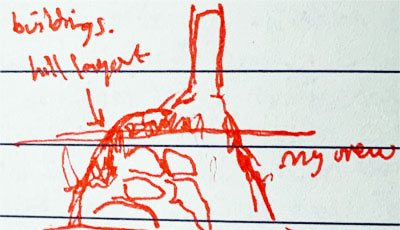
Location near the Tower We’re in an area near the Tower. I take some time off from normalcy to star in this new horror movie, Cracker Brain.
We’re in an gym. It started as a Weezer music video for “The Good Life”. We were all dressed in 80s style and the first ones to arrive at a party. We were dancing when Cracker Brain showed up. It was this ultrafast humanoid creature who carried wooden spears with him. He used them to spear his own brain and pin his head to the wall or ceiling for escape and positioning. He could travel across the ceiling this way and then would throw splinters of the wood spears at people.
He killed everyone but me. I was running around wondering what to do when I got cornered. I decided to play dead. It worked — it became very curious and approached with great caution. Then I jumped up and scared it and ran. Then I tried it again. Same story — the thing didn’t learn! The third time I had a plan. It came up the curtain to the edge of the second floor where I was hiding a sledge hammer. Slowly, slowly. . . . I could read its fears. Only when most afraid could it be grabbed and that’s what I did. It got really close, was ready to strike, and I grabbed it by the shirt. There was a big tug of war and my goal was to pull it from the curtains and drop it so it would die. But I gave up fighting because it was just a movie and I just didn’t care (a theme recently). It grabbed me and pulled me off the edge. The film ended and I went to Cracker Brain to find that it was a short, young Asian lady!
Horrible Creatures: I dislike horror movies. So why did I choose to star in one? Perhaps because I was at The Tower, the place of challenges.
There are creatures so horrible in my dreams that I could never have thought them up while awake. How do you defeat a creature who travels by spearing poles through its own brain?
But this was a “movie”, and Cracker Brain was just an actress, it seems.
-
The Gods of Art 2025 • 7 AM
This was a level of art beyond anything I’d seen before. I was hungry, ravenous for more. I was told the artist was coming. He walked up, his head was the blocky artistic head from the story, but it became normal-colored, then smoother, more human, but not all the way. I expressed my love for his art. He spread his arms and released a stack of art on clear paper to me, and I understood he made it for me. He moved on, and I looked through the stack. In it was myself as a character in his story, drawn in his styles, but in color. I was wearing my brown fedora, and I had long blonde hair and a green shirt. I was in his story!
Story Generation: Without speaking a word, he spreads his arms and releases a rote to me of his beloved stories with me as a character in it. I most often see rotes comes from the chest like this.
-
The Most Beautiful Story (A Remake) 2023 • 2:30 AM
In the middle of the story, the white boy (played by me), goes out in his car at night. He drives up to a very large, expensive, brightly lit car. It belongs to the girl’s father. There is some kind of encounter . . . a chase? Something. When trying to film the scene later, I’m “driving” around with a camera, filming. I’m about 20 feet in the air, flying, but I don’t realize it in the dream. . . . There’s nothing like actual filming involved — I’m just having an experience that I can use to make the movie. That’s all I need to do.
Making an Experience Movie: The scene contains the physical props of filming a movie, but I’m not actually filming. My experience is the filming. Fictional story rotes are the memories of the person experiencing it. We can create any scene through thought form projection, and then experience it and share it.
-
The Royal Line 1997 • age 23
We saw a movie, then (or it was some dumb idea someone had). It was that the Greek gods get involved in the princess drama. But it was a less than B-grade movie and everything was super cheesy and dumb. The gods were bumbling around and broke a hole in the city’s inner wall, which would allow anyone in.
Playing Pretend: Not all stories are well thought out. This seems less like going to a movie than making up a story on the spot. Its poor quality seems to indicate that it wasn’t planned out very well. It feels like we’re just playing pretend. Because rotes are memories, this results in what could be considered a movie, though one I don’t think anyone would want to watch.
Challenges and Games
Challenge rotes are story or memory rotes with a specific challenge to overcome. These are likely to involve character inhabitation and to be run several times making different decisions. The goal may be experience, learning, personal growth, or entertainment.
This includes video game rotes. These rotes often have built-in rule sets (see Dream Languages, Styles, and Rulesets).
-
Dream Training 1993 • age 19
One dream had an important message. Everything that happened in it happened twice, in two different ways. One in ignorance, one with some sort of realization. Over and over, example after example. . . . But I can’t remember the specifics.
Simulation Rote Recordings: These rotes were used for teaching; possibly a recording of someone going through simulation rotes.
-
The Whales of Maui 1994 • age 19
We were running around, searching for the challenges. The object was to find the challenge, pass it, then receive the key. With the key you could lock shut any challenge you wished. I passed the dragon challenge, then another, then got caught up in the mobster/Johnny Dangerously one. I replayed it a few times, bringing some girl along after a while. For a moment it felt like the movie True Romance.
References: Johnny Dangerously and True Romance are movies.
A Game of Challenges: Here we’re playing a game where dreamers find challenge rotes, enter them, and attempt to pass the challenges. Depending on your personality and growth, some will be easier than others.
It’s possible the other dream of the night, “The Bridget Dream” was one of these challenges as well.
Rotes as Opportunities to Heal or Grow
-
Playing the Girl 1997 • age 23
I’m on a school bus with a bunch of other kids and (I think I created this plot by wondering) one had this rotting disease that we all suddenly got — a sort of tape worm thing. There was a lot of action and stand-offs and then we blamed this girl for being the cause. We all got off the bus and decided to kick her ass. The road was deep red, like Atlanta clay, all just freshly torn-up dirt. There were lots of trees. Suddenly I was the girl, walking towards the intersection where I could be seen by the gang of angry kids, knowingly doing so to further the story, unafraid. They came after me and I ran. I knew this had to happen. They chased me into a barn and were beating me up but I felt no pain. My will pushed through and I shouted, explaining everything, and eventually I was in control of the plot and the group again.
Entering Tough Situations: I frequently get involved in tough situations like this on purpose. I seek drama in dreams, and here I clearly and knowingly put myself in a character who I helped get into trouble, and orchestrate the scene so that the trouble comes and I can overcome it.
-
My New Favorite Movie 2023 • 3:30 AM
Now this begins of a long series of events where I face and head into uncomfortable situations; usually entering a stranger’s house, experiencing something or another with them, then relaxing, having fun, and at some point breaking into song where my friends harmonize with me and it sounds great. The people from the house join in, and at the end one or two of them joins us when we leave. Each time the group gets bigger and the next original song gets more complex, with more parts in it.
Entering Uncomfortable Situations: The rote gives me an opportunity to grow by repeatedly challenging me to enter uncomfortable situations and relax into them, diminishing fear.
Information
Information rotes provide information, rather than an experience. In many cases they arrive automatically in response to a question, without seeming to come from any particular source. In this case it’s either coming from our higher self or as part of the context in a memory or story rote.
-
The Reluctant Hero 2011 • 2 AM
We pressed metal against [the live wire] and the power went out (though the dorm was still lit by all the same lights). In my mind, an explanation occurred: “Through a chemical reaction (briefly explained, but not understood), the matter of the house turns to rolls of paper.” I exited the explanation and saw that all the walls had turned into big perforated paper rolls.
An Information Rote: The information I receive is in the form of a rote that I briefly enter. The disruption in continuity explains why the walls to change to paper. It also provides a momentary break in continuity that helps it to happen. Interestingly, this is a rote within a rote.
-
The Mirror People 2012
I brought up how I had digitized all my early movies and tapes. He was excited and asked if I could get him all the Sanctimony (something like that) I had. That also wasn’t familiar, so I asked if that was a show, or music? I think he indicated that it was both. A trailer for it started playing in my mind and it was all about intrigue and violence and mind-tricks and I shook myself out of it as I wasn’t interested in going there.
Here’s the Trailer: When I asked what Sanctimony was, he sent me a rote of the movie trailer. Since I shook myself out of it, I didn’t get lost in a subdream.
-
My New Favorite Movie 2023 • 3:30 AM
One guy had this metal brace around his neck and his arms. He said that some information (the story itself?) was all coiled up and stored inside of him. He showed us an illustration of the bands coming off and seams appearing, which uncoiled, revealing how it was stored in him.
The Brace Guy: The guy explained his odd appearance via an information rote.
Messages
Message rotes convey a message from someone. This is more often experienced as direct telepathy (a window to someone appears) rather than an immersive experience we enter into.
-
The Slumber Party and Scary Man Prank 1999 • age 24
Receiving a rote or “fax” 
Sam Kenobi views a hologram in Star Wars There was an experience I called “receiving a fax” where my perception blurred with sudden streaks of lights and colors, as if I was looking through a waterfall. It was usually a sign that someone was in great emotion, calling to me. When this happened, I had to leap into it before the edge. If I did so, I’d see Sam Kenobi in a little room telling me the message. The second time it happened I caught myself thinking it was from “Rachel”, but then saw that I had placed that hope over the actual message, which was that I was supposed to be at a job interview in the waking world. This wasn’t actually true — it came from someone else at the table.
Telepathic Rote: This was a rote! I had to “leap in” to get someone in a “small room” telling me a message. That person, taken to be Sam Kenobi, may have just been someone who looked like him, or perhaps this communication just reminded me of the scene from Star Wars where Sam receives a small holographic message from Leia. Maybe the sender was semi-transparent like in that scene as well.
This would imply that telepathic messages can be rotes, though communication in dreams is typically rationalized as physically talking with each other. Sharing of experiences involves far more than what can be conveyed in words.
Note also that I had the option to “leap in” or not. One doesn’t have to open a rote. In fact, this one wasn’t intended for me. Emotions are known to be powerful in the astral/dream world so it’s not surprising that they would break through into my awareness, even if they were intended for another person who the sender took me to be.
Interacting with the Outside of the Rote
-
The Game Sphere 2025 • 5 AM
There is a boxy arcade game with a screen in front, and all else is a light purple diffuse light. I stepped into this game sphere. . . . I meant to just try it out, to take a peek. BUT. Once I was in there, it was an immersive wraparound fully real experience. . . . I decide I’ve played long enough. I can’t figure out how to exit. I start calling out commands like “quit!” and “exit!” and it’s not working. I’m reaching out, trying to interact with the game machine itself, and only feeling an extremely thin, filmy gauze-like material. I start to get frustrated and panicky. “I would like to exit the game now!” Suddenly, to my lower right I see a hand-sized circle light up in green about an arm’s length away. I press it and feel relief as I step out of the game.
Outside the Rote: This is very interesting! I can still feel something of the arcade machine through which I entered the rote — showing that I left a small phased part of myself outside the machine. It also shows that as much as I moved around within the game rotes, I remained spatially within the arcade machine. This is consistent with other sorts of consciousness state changes, like remaining in one place in the near realm while traveling about in a dream.
I’m surprised I could feel anything at all of the arcade machine while within its rotes.
The External Appearance of Rotes
Usually when I see rotes, they are rationalized as books, movies, or videos. But on rare occasions, I see them without the rationalization.
-
The Slumber Party and Scary Man Prank 1999 • age 24
Receiving a rote or “fax”
Sam Kenobi views a hologram in Star Wars There was an experience I called “receiving a fax” where my perception blurred with sudden streaks of lights and colors, as if I was looking through a waterfall. It was usually a sign that someone was in great emotion, calling to me. When this happened, I had to leap into it before the edge. If I did so, I’d see Sam Kenobi in a little room telling me the message.
Streaks of Color: I caught some interesting visual effects of the message rote communication.
As Color Vortexes
-
Twisted Bridget and the Color Vortexes 2003
I was walking along with Buttercup by these scattered buildings. It was like a college campus or neighborhood with few roads. I see this swirling dusty wind near all these people, and I turn off on my own down the sidewalk to take a closer look. It’s a defined area of wind, rushing about this way and that, and in the middle is a fist-sized purple vortex, shaped like a little tornado. It stays roughly in the same spot, shifting only slightly in the swirling dusty wind. I try to jump into it, but it swirls out of my reach, difficult to connect with.
Up ahead is another one. This one is blue and larger, about the size of a hard-cover book. The people are a bit shocked that I’m here, but I play with it, push it around. I walk out of the dusty wind over to Bridget by a gazebo. . . . She somehow releases color into the air. It is only color when concentrated. In the wind it’s invisible, but soon a small vortex of that color appears — it’s a dark pink-purple and not as solid as the others. I can tell its direction of rotation more easily: counterclockwise if viewed from above. Continuity break. . . . I am outside of Bridget’s house.
The Color Vortices: I don’t often see little vortexes like this, especially colored ones. Note how Bridget releases color into the air that concentrates into a vortex — the color is an expression of emotion that creates a rote. I approach it to examine the rotation, and there’s a continuity break as I enter into it. Monroe and Seth both describe these communications as thought balls that one emits that can be lived through by another as a full, vivid experience.
Sharing Memories and Stories
Rotes are immersive memory or story experiences that are shared as a part of communication. They are 100% real first-person experiences that we can experience as if they were our own. While playing one, we may jump into one of the characters and experience the action from their perspective. Rather than just watching, we can get involved and change what happens. When it’s over, we exit back out of the rote to our previous context.
Rotes are written about frequently by Tito Monroe, and a common part of nonphysical communication. I experience them quite often in the dream state.
TO DO: This section was split partially into Memory in v.4. Go over carefully.
The Nature of Memories
Entering and Exiting Memories
Descending into Memories
From my few remembered experiences, rotes are about the size of a soccer ball, and they are usually passed to you around chest level. Due to this positioning, as we enter a memory rote, we scale down into it from above.
-
Civil War Stories 1996 • age 22
I zoomed in from far above to a civil war scene in the south. An army in blue was riding back to camp. The focus was on the lead slave in this group of slaves on horseback.
Zooming In: I zoom in to the rote from above. This is the natural perspective when entering rotes. We enter the scene by zooming in the way one does with a camera. Since rotes are often passed at chest level, we look down at it, giving the feeling of descending into the rote.
-
The Best Video Game Ever 1997 • age 22
I’m in a toy store with this boy, looking for WarCraft 2 Expansions. Instead, I find Zelda for Nintendo 64, so I pop it in and start playing. . . . Finally it started. It showed a sloppily-rendered world overview, and you scrolled down into the city you wanted. At this point, it became real.
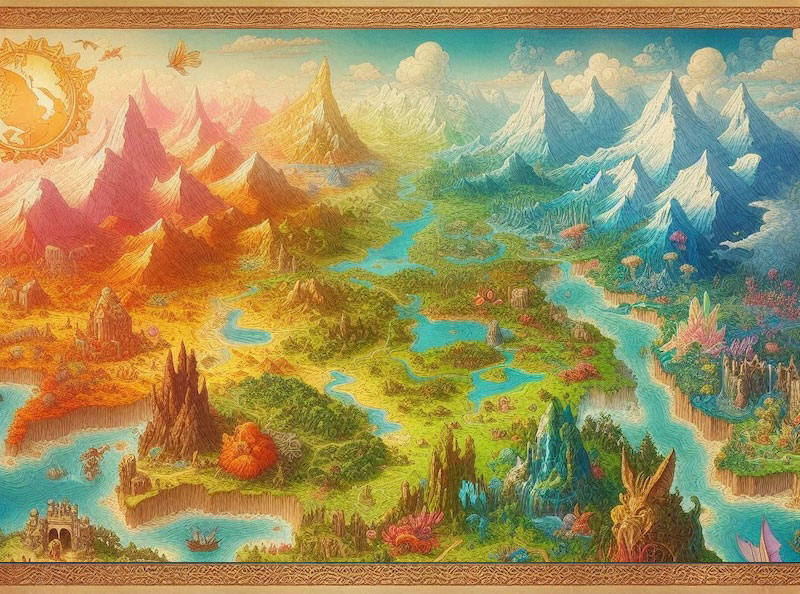
A video game world overview We went to a big castle.
World Overview: The descent into the rote begins as the common video game world overview from which I “scrolled down” into the city.
-
The Book of Dreams 1997 • age 23
I think I went into the cover picture as I descended slowly (I thought I was sky diving) onto a beautiful snowy mountaintop.
Skydiving Into a Rote: Here I take my descent into the rote (as it enlarges around me) to be skydiving, which is pretty accurate imagery, without any visual rationalization.
-
The Island of Fire 2000
Soon the boys and I leave, driving along the foresty road. We stop at the side of the road and descend this steep slope to a barren rocky plain that sputters from weird holes. . . . There’s a break in memory and we’re back at the forested slope. This time we’re descending with a huge group of Renaissance Festival people into a clearing in a thick forest.
Slope and Sky: Here I’m descending into two rotes. In both cases, it’s from the perspective of being on the side of a forested road, so instead of descending from the sky, we’re descending down a steep slope.
-
Hang Glider Descent 2001
I find myself descending on a hang glider (with a floor) into a New York countryside. It was driven by another person and we had a soft landing.
Rationalized Descent: This was a rationalized descent into a rote.
Rising Out of Memories
The converse of descending down into a memory is rising back out of it when it’s over. It’s not something I’ve often remembered, as the exit is usually instantaneous.
-
Super Hero Lava Pool 1995 • age 20
We play football and volleyball. (foggy)
Then I go exploring underground with GenX. [there’s this long adventure with superheroes and a lava pool]
The guy who wrote the story writes to Marvel and says “There. Now stop writing your crap.” I go out above and find Sid and the others still playing volleyball.
References: GenX is a Marvel superhero team.
Returning Above: I begin the rote by “exploring underground” — my rationalization of going down into the rote. After finishing the story rote, I “go out above”, back to the volleyball scene I was in before. This is my spatial rationalization of descending down into the rote and rising back out of it.
-
The Mirror People 2012
I am back on the road on the west side of the school, and it’s dark again. Another attack is coming — this time from five administrators. The road is lit up with these bright square glyphs — each about the size of a house, and one under each house, so that it’s like a grid. I begin to lift off the ground, and the world bends away spherically. The grid flexes into different hills, and I somehow know that one neighborhood I come to is known as “The Whale”. It’s got a big bend, like a big hill, and it’s very large. I feel myself being drawn down into it, and I’m trying to pull up. It’s around here where I wake up.
Massive Spatial Distortion: I’m trying to leave, and as I rise up out of the rote, the world below becomes more spherical. But then I’m pulled back down. This seems like another attempt to prevent me from leaving. Thankfully, I remember that I can wake myself up for a certain escape.
In and Out of Memories
Transitions are the hardest things to remember in dreams, so if we can remember one, we can get a really clear idea of what’s going on. Otherwise we end up remembering different dream scenes without knowing how they’re related.
-
The Island of Fire 2000
I’m upstairs in a house with Deaner, who’s showing me pictures in his photo album. I spend some time on a Tahiti-like island, which was probably a rote or subdream based on a photo, and return to find Deaner (who looks different) waiting for me. I am trying hard to be entertaining and only sometimes succeeding, but there is friendly chemistry . . . [we hang out]
Soon the boys and I leave, driving along the foresty road. We stop at the side of the road and descend this steep slope to a barren rocky plain that sputters from weird holes. We block the sputtering holes, throw stuff into them, and play about with rocks. Then as we drive off, big rocks start to shoot out of one of the holes, barely missing people. I feel bad for starting such a thing. As we drive away, I realize it’s the Tahiti-like island. There’s a massive fire on the top of the cliffs, threatening to spread downwards. There are lava flows and fireballs as we leave.
There’s a break in memory and we’re back at the forested slope. This time we’re descending with a huge group of Renaissance Festival people into a clearing in a thick forest. Everyone’s dressed up and speaking in accents. I just sort of don my costume by thought as we enter the scene. I choose to be a funny guy and I’m cracking all sorts of jokes. A friend becomes this warrior wearing a helm with detachable bull horns.
Mistaking this as the island from earlier, I remember the danger we were in. I look up to a cliff above us and see a trail of lava coming down. Soon the gully at the bottom is filled with lava. I’m afraid, and I’m having trouble getting up the way we came as the slope has become much steeper, and the vegetation is now just grass — no trees and plants to grab onto. I struggle to climb up. . . . A friend, Buttercup I think, is also there, walking on the lava and sinking a little with each step. I explain how it’s impossible to walk on lava like that because you’d burn up. The lava turns out to be red and glowing and pliable but not hot. I see a row of the renaissance people including a queen in pink and a prince sitting on a wooden ornamental bench ON the lava.
References: Deaner is from the band Ween.
In and Out of Multiple Rotes: The real situation (NREM true dream) is that I’m hanging out with someone I take to be Deaner. He’s showing me photos, and I jump into one. This may be a rote or a subdream. I then return from it and continue hanging out.
Then a bunch of us travel a little ways down the road and enter a rote of a barren, rocky volcanic plain on what I take to be the same island. I rationalize this as us “descending” down a steep slope at the side of the road. We exit the rote, rationalized by driving uphill, and we’re back at the side of the road again. I take the transition to be “a break in memory”.
We then enter another rote about a Renaissance Festival, descending once again into the scene. Because spatially we seem to be descending the same slope, I take this to be on the same island, even though it looks very different. Because of that, I bring my expectation of lava with me and project lava into the scene. Everyone is walking around on the earth like normal — only I see the lava.
This is the quintessential dream, a real social dream experience with rotes, rationalizations, confusion, and projection.
-
The Band Murder 1999 • age 25
This time when I return to the dream he’s Trent Reznor and I’m a girl with a giant turtle. There’s infinite complexity that I’m missing. In the main room is a big orgy to 70s music. The blonde cat-like elf woman from Stardust is there. She goes to Trent and he drowns her in a bathroom.
Then I’m outside the building by some housing near a city river bank talking to this girl who said her Emma knew about that happening, that she knows everything. Perhaps she was the original storyteller? Because my curiosity brought me back into the scene as I said “Then what?”
This time I’m Trent. The dead woman is on the ground and opens her eyes and looks at him. She asks why he did it. He grabs a knife from the table and slits her throat. As he began to do this, I promptly jumped out of him and watched from a more distant angle. “Benji, wake up!” I awaken.
References: Trent Reznor is the lead singer in the band Nine Inch Nails.
Stepping Out of a Rote: How interesting that I was able to step out of the rote and talk to the person whose memory it was, then return to it.
-
The Whale-Chasing Machine 1997 • age 23
I’m watching humpback whales flee in terror from something. They circle in front of this wall of stone, then smash into it. They lick the algae to see if there’s a way through. Beyond the wall is a black area on the ocean floor. A cheetah is running by on the top of the wall (underwater!). A whale bumps the wall, almost hitting the cheetah, and something from the black area is knocked loose and floats to the surface. It’s a microbe or disease.
Suddenly the sea surface is a tabletop with myself and other students standing around it. The teacher says “Who do you think gets affected by this disease?” He tells us to launch these rubber bands in the air towards the table. He’s hoping they land randomly on all the models of plants and creatures around but they all land on the grass, so he redistributes them. We were talking about the effects of a whale-chasing machine and how a virus could wipe out everything.
And to Illustrate: Here I’m in a class and the demonstration is a rote — it becomes a total 3D wraparound reality. After reaching the end, I scroll back out into the classroom.
-
Uncle John’s Puffball Mushroom Farm 2023 • 7 AM
I was at Uncle John’s house. He had this wild pine forest in his yard, and he was growing something out there. At one point, I found a puffball mushroom growing. He saw it and decided this was the crop he wanted to pursue. The next time I was out in the yard, he had a patch of soccer-ball sized puffball mushrooms growing out there among the pine needles. I was impressed! The next time I looked, there were several patches like that, some growing to basketball size or larger. The next time, he had built a volcano-shaped mound in the center of them, about 8 feet tall, which held water and would spray it out to water the mushrooms. He was harvesting them while still in their firm stage, cutting big slices of them. . . . Buttercup and the family are at a huge mall, in a movie theater watching a movie. It was the mushroom farm movie! I remember pulling out of the movie a few times to adjust some of my belongings nearby or say something to Buttercup, who was sitting next to me. This explains all the “the next time I looked” up above. I kept coming out of the movie rote for various reasons and returning to find things progressed!
A Movie Theater: What a catch! I didn’t put this together until I was writing the dream down. The puffball mushroom dream, seemingly entirely disconnected from the dream about the mall, falls right into place as the movie that we’re watching in the mall movie theater, and the breaks in continuity were the brief scenes in which I pulled back out of the movie rote for various reasons to address something in the movie theater!
The interruptions where I returned from the mushroom farm to the movie theater may have been related to the sounds of Buttercup and Gwen getting up and getting ready for the day.
-
Fantastic Solstice 1997 • age 23
Here’s the book:
Every other page was a big splash picture that, of course, I went into. It seemed to start with a part called “The Dragon Pits”. It seemed we were going to go deep into them for a treasure, but it ended up being a tower. We were seeking something like the “true jade” that was only ever used to make book pages. All around us near the opening were merchants selling rainbow-colored crystal idols. I was the hero in the story and there was a mentor with me. . . . [I go to the tower, search within, then transform it]
I turned and saw what must have been a big gem heave itself from the tower and roll straight for me. It was now, however, a HUGE black rock. Fear shot up inside of me and I wanted to leap aside but I held my ground as the rock got to me. The lens disappeared and turned into a beam of light which picked me up off the ground. It filled me completely with love, life, ecstatic energy. The scene scrolled back for a second and there I was in a big dark place like a movie theater, surrounded by motionless people, but I was floating above my seat, bending over backwards and shaking in blissful rapture. I remember the judgements I expected from those around me but I let the energy run. Then, back in the book, I was convinced. That was the most beautiful, powerful thing I have ever experienced and it changed me. I set off to return to my companions.
Ranier and I took Buttercup to a muddy place to prepare for the next chapter of Solstice where there was a huge endless bug storm.
References: Solstice was the name of a BBS I once had. The Space Needle is a tower in Seattle.
Stage of the Mind: The greater context of this adventure was once myself reading a book, but when it zoomed out later — exited the book gateway, I was in a theater. I was as affected there by the ecstatic light as I was in the dream scene, but my reaction was closer to what it’d be if I were awake, publicly in the full embrace of ecstasy.
This shows that a) when we enter a rote or gateway, we are projecting into it, while also remaining outside it, and b) that what’s going on inside the rote/gateway can affect us outside of it as well, in real-time. Here it seems I’m the only one in the theater having an ecstatic experience within this rote.
-
The Funny Show 2026 • 5:30 AM
I ended up meeting the guys behind the show. They were all young, around 20. I felt totally at ease with them. The goal was humor and I was all in. . . . We were watching the Superbowl. The field was dirty, sort of an amateur quality. There was a running play, and when the runner was tackled, he fumbled the ball. Players scrambled for it, but it went out of bounds. Who had touched it last? The scene scrolled back to see. It sort of focused on a player that melded almost perfectly with the colors and paint of the field. He got up. I was fascinated by what I saw. The painted colors of the field had all stuck to him, I reasoned. His hair was this enormous flat top shaped like a wedge. He went up to a orange-red patch in the field and pressed the top of his flat top into it. When he lifted up his head, his flat top had picked up that color. A bunch of other copies of himself went up to the orange-red patch and did the same. They all started slamming the top of their heads into the ground . . . as a celebration? This was so amazing and unexpected that we all started doing our own version of it to the beat. Not head-slamming, but high-fives or banging something to the beat. It was called “niffling”.
Responding Together: We begin watching the Superbowl rote together. We’re so amused by the “niffling” that we join in with it outside the rote. Experiencing a rote like this is just like watching a video with friends.
-
The Office Tower Party 2025 • 6 AM
There’s a big office celebration. As part of it, we were introduced to this new game. I think there were a bunch of people standing around a floor-to-ceiling gateway door. The game was going on inside. It had a kind of sepia-tone style to it. You only had to focus in on it and you were there. Inside, it kept the orientation of the door at first — mostly vertical with a little bit of depth, but once I picked a zone, it opened up fully with depth, like moving inward from an overworld map. It was incredible! Instant action and quests, so many characters to choose from. It was happening so fast I could barely keep up with the plot. . . . I went back and forth, in and out of the game through the whole dream. It became a game on my phone, which I could re-enter just by bringing it up in front of me and entering it. The trouble was, the rest of the party in the office building was so amazing, I kept wanting to take pictures of it. And every time I took out my phone, there was the game, and I couldn’t get it to quit so I could take pictures. At one point, someone else, seeing my frustration, asked me to hold out the phone and she calmly tapped a few things until it quit. However, it didn’t go to my regular phone screen but an incredibly cool game-related photo app. . . . [I explore more of the party]
I think at this point I went back into the game again, and as I played, I made this huge leap to a new area. However, this leap was also reflected in the office building, and I found myself on the outside stairs on the 2nd level.
Handheld Rote: Once I’m introduced to this game rote, it becomes something I can return to at any time. It becomes associated with my phone, however, and pulls at my attention every time I want to use it to take a picture.
In fact, I wonder if I’m dreaming the game at one level and the office celebration at another level the whole time, with my attention shifting back and forth between them.
The big jump I take at one point that affects my position outside the rote, again showing that what we do within the rote can affect the phased part of our consciousness outside of it as well.
Entering Together
We can enter memories together. One example is where a story or memory is being shown in a movie theater.
This can work in several different ways. We can watch the scene in realtime without pausing, rewinding, or inhabitation (jumping into characters). At the point of inhabitation, however, I suspect a person must be in their own subjective version of the story. You couldn’t have two people inhabiting the same character, making different choices. However, I suspect multiple people could inhabit different characters in a shared subjective space. Or they could appear in the scene as new characters — as themselves.
-
The Whales of Maui 1994 • age 19
We were running around, searching for the challenges. The object was to find the challenge, pass it, then receive the key. With the key you could lock shut any challenge you wished. I passed the dragon challenge, then another, then got caught up in the mobster/Johnny Dangerously one. I replayed it a few times, bringing some girl along after a while. For a moment it felt like the movie True Romance.
References: Johnny Dangerously and True Romance are movies.
Entering a Rote Together: Bringing the girl along into the mobster/Johnny Dangerously rote changed the feel of it to one that was still violent, but more focused on relationships: True Romance.
-
The Island of Fire 2000
We stop at the side of the road and descend this steep slope to a barren rocky plain that sputters from weird holes. We block the sputtering holes, throw stuff into them, and play about with rocks. . . . There’s a break in memory and we’re back at the forested slope. This time we’re descending with a huge group of Renaissance Festival people into a clearing in a thick forest.
Entering Together: Both times, a group of friends including Deaner descend into the rotes together.
Playback in Memories
Restarting
Restarting is most common in game-like rotes.
-
Pirate Ship Warfare 1996 • age 22
I was playing pirate ship warfare with some friends. It seemed to be taking place with models in a really big pool. In each game we would shrink down to be aboard our own huge pirate ship. At first we just threw vegetables across the water at each other. Then we decided to start using cannons and it was really cool. When one of us would win, the scene would reset and we’d go again. So cool!
Resetting and Rotes: If a scene resets like this, it may be a rote, which can be replayed at will.
-
Like Warcraft, but a Whole World! 1997 • age 22
The orcs/men have this big black skeleton bug dragon. It has no wings, but instead has hundreds of spiny bug legs. He climbs atop this short spiral spire and shoots brown acid down into the battle. It was at this point that I restarted the scenario.
The voice speaks to me as I go immediately to explore: “The orcs aren’t here yet. They’re returning from a mission.” I start heading to where I found my allies last time and march right into a large enemy troop.
Restart: The helpful voice keeps me appraised of the situation as I rewind the rote.
-
Most Beautiful Rain Fairies 1998 • 2:25 AM • age 24
There’s a repeating dream within the stadium in the form of Final Fantasy Tactics where I’m given a guitar that turns into a gun and I need to slay this George Clinton character. I’m unleashing water in different directions, and there are many repetitions. In the final repetition, all the children come to the opposite side of the stadium where I was and gather around me. A boy in the front looks at me sternly. His eye contact seems to have initiated a change in attitude that changes the scene to this:
It begins like another repetition but this plant-like light green creature leaps off the edge of a balcony and hits a switch which turns on a sprinkler system. The creature flies over the tops of the trees and plants itself in the middle of the stadium, which is like a greenhouse now.
References: George Clinton is a funky musician.
Repetitions: Here’s an example of dream repetition. The basic plot is the same each time with different decisions or different elements thrown in. But oddly enough, the final repetition with the plant thing is totally different. It was less of a replay and more of an entirely new game, initiated by the boy.
-
The Reluctant Hero 2011 • 2 AM
In THIS particular playing of the story, I kept getting in car accidents — big, head-on collisions that totally wrecked the cars involved. It happened twice while driving around town with some friends, and then again after I’d had three drinks, so I was a bit woozy. . . . In the final part, I was trying to save the dorm. This time I was resistant. I didn’t want to be the hero this time. I just wanted to walk away and not be in trouble. But people would die without my help. And my friends were there, helping me, pushing me on.
Replaying: I’m recalling multiple runs through this rote, and wanting to take a different path as I experience it again. In the previous runs, I’d run into the dorm, save people, and end up in trouble.
Rewind and Retry
Rewinding is only possible in rotes. However, since our memory is a rote, we can re-experience anything by simply remembering it. When rewinding via memory, it is like any rote in that it takes us out of objectivity into a subjective space. In short, we can jump around in time subjectively, but cannot affect time or reality for others.
We rewind for various reasons. Sometimes we rewind a rote because it was fun and want to experience it again. Sometimes we want to try to avoid a bad outcome by making a different choice.
-
Army of Me 1996 • age 22
This Nazgul-like thing ran out past us with a baby and cut off its ears, nose, and tongue. . . . This was far too horrible for me and so the scene rotated 360 degrees and replayed itself in a less horrible way:
The Nazgul instead realized it wasn’t really Baby Thoofoo (or something that sounded like it was said with a speech impediment) and got a doll in a box, which it took to be the REAL baby, and bounced the end of a car on its face.
References: Nazgul are very evil characters from The Lord of the Rings.
Censorship: I essentially altered this story to be less horrible by replaying the scene in a different way.
-
Wadsworth’s Revenge 1996 • age 22
I saw little lights, flames from Wadsworth’s HellCat missiles, going up into the night sky. The first one I thought was headed for Finney Chapel (then I thought it was a different college), then one for another school and for different places where I had friends. . . . I knew I was going to be alone. Then one missile went straight up, half-lit like a firework as it hit a helicopter, which then fell to the earth and exploded. Everything turned black and white as the explosion slowly filled land and sky, rocketing outward, lifting huge chunks of earth into the sky. The explosion came closer and closer, with no sign of stopping. I knew I was nowhere NEAR far enough and began to run, then turned and resigned myself to my fate.
“But”, I thought, “here’s what would have happened in another version.” It was prelaunch time again. The missiles all went up, but not the Oberlin one, somehow, or it hadn’t killed everyone. There was dirt all over the somewhat diminished crowd outside the house. Then there was a scene in the town nearby where I was looking for survivors, but most people there were fine.
References: Finney Chapel is a building at Oberlin.
Possibilities: I was about to die when the story ended and another possibility was taken.
-
Save and Revert 1997 • age 22
Buttercup and I are wandering about a dangerous run-down city. The sky is murky and brown. At certain spots in the dream I would SAVE and then return if things got bad to do it with better preparation or do it differently. In some areas, my fear, I believe, was conjuring up bad stuff, like gangs. One came after us — teens with death-ray guns were harassing us. I realized that they intended to rape her, and that it was my fear that created that. I did not want it to continue. I said to Buttercup “Revert?” and she accepted. So we went back to an earlier scene and took another route.
Try Again?: Rotes can be rewound or restarted as often as you like. They’re essentially like recorded movies. The idea of saving and reloading has made its way from dreams into video games.
-
The Nun in the Wall 1997 • age 22
Then this big Asian/Native American guy came up to me and started beating me up. . . . I came back later at night determined to kick the shit out of this guy. I found him and when my first attempt to kick him down the stairs failed, I replayed the scene and succeeded. He went limp and didn’t fight back. After I was through with him an old attendant saw his body and thought he was dead, but I checked and he wasn’t.
Replay by Will: My Dream Self knows I can replay a situation with a different, more satisfying outcome. This means I’m in a rote.
-
Field of Beasts 2000 • age 25
This host of creatures that I was previously scared of comes out of the woods and runs towards me. I run back through the fields I came from and into this building. They chase me, and are joined by a big fleshy ogre. I’m with Buttercup now and we flee down hallways. We get to the car and quickly pull out. We drive through the narrow lots and smash into another car. I think to myself “No, that’s no good. Let’s try again.”
So I’m back at the first hallway in the building and cause the hallway between myself and the oncoming group to glow with hot yellow light. Then I cause a tornado to appear in the middle. But it doesn’t stop the fleshy ogre, who runs right through it. I flee, then change my tactic. I let him catch me. He stops short, huffing, and says “I wondered if you could make me a CD.” I said I would, then left.
Double Take: Unexpected!
-
The Orange Light 2014 • 3:40 AM
I see a girl (maybe 6-8 years old) and a seven-foot tall tree. The story unfolds to me — there was an orange light on the tree that turned on and then killed a bunch of people and destroyed a bunch of things. Instantly my thoughts turn angry against it. The orange light comes on. I know not to look at it, because once it’s on for 7 seconds, it visits nuclear death upon the ones triggering it. As I become distracted, it turns off.
Now this scene I replayed later on, and so the two are mixed, but I recall mistaking the girl for the source of the orange light. So at least the second time, probably both, I was facing the tree from up close while the girl circled around it maybe 10 feet away. I made sure to keep her out of my sight by keeping the tree between us as she walked around. . . . [I do a bunch of training simulations to practice controlling my anger]
I revisit the 7 foot tree, replay that scene again, and the orange light never comes on.
Trying Again: Not only can I redo a scene I just completed, but I can go back to that scene much later on, taking with me the memory of what I learned since the last time.
-
Performances 2026
I was playing the part of a witch. . . . I wore a white witch’s mask with green around the eyes. . . . I either performed it twice or there was a rewind and replay. The second time there were four witches wearing the same mask, appearing together in the same scenes, helping each other out.
Afterwards, one woman complimented my singing voice. Later in the night I thought this was evidence that I was still working with The Funny Show guys. There were some funny parts in the play, but it felt more like a high school production.
References: The Funny Show is a show I watched in an earlier dream.
From the Top: The second time around, could this be multiple people inhabiting the same character in the play, making it appear to be four witches? There were about 3-4 people that made The Funny Show.
Navigating Possibilities
We interact with possibilities within rotes by rewinding and retrying things. Outside of rotes, we can navigate possibilities to some extent by changing what we see coming. Our attention is how we navigate the world of consciousness. We can “peek” into a possibility with a little bit of our attention, and then choose something else.
-
Looking for the Ball 2025
I noticed there was a path [the ball] could have rolled that would have taken it a block’s distance down a road through the parking lot. I decided I should probably go check. . . . I kept walking, and noticed I was in my underwear and a shirt. I thought I should get some shorts but dismissed it — nah, no one cares. For a moment I was looking into the possibility of following that thread, a path in the dream where a security officer comes up to talk to me about my lack of pants, but I looked away, deciding against it.
I got to the parking section at the end of the lane. There was a big silvery metal grate there with spaces large enough climb through. . . . Beneath the grate was a pristine glowing tiled chamber with shallow waterways of pure, clean water. I would have been tempted to go down there at other times, but not today.
Looking Down Possibilities: I began to see the scene with the security guard as a possibility created by my thoughts about walking around in my underwear. The emotional response of embarrassment is what began to call forward this scene. I decided against that path, so although I saw it briefly, like looking through a small window, it didn’t actually happen. I didn’t take that path, which would have made it my main storyline.
The possible scene with the security guard was like a small video in the scene before me, getting larger as I gave it attention. Had I continued giving it attention, it would have enlarged around me and become my reality. This is how consciousness navigates possibilities. Experience gives us foresight as we recognize what’s coming and why, and the chance to choose differently before it reaches us.
This is similar to how we can rewind rotes to make different choices. We go down a possibility branch, then, not liking the result, return to the branching point and make a difference choice. However, this wasn’t a rote, so the mechanism was slightly different.
A second choice presents it to me a minute later with the chamber beneath the grate. Subterranean dream exploration held a great draw for me for many years, but I’ve lost interest in it over the years. Here I remember this as I feel the slight draw of the chamber, but choose against going in.
Subtle Retries
Sometimes we don’t remember deciding to rewind and retry — we just have memory of things happening two different ways.
-
Forge Ball 1992 • age 17
I turn and see my undercover compatriot standing in the raised doorway. (VERSION 1:) He sets an arrow and fires it at the floor near a brigand. Then to me he says “Come up and help me finish off these foul darklings!” I say “No, I’m starting to like these guys!” Then I run off with him. (VERSION 2:) I see my compatriot in the doorway. He beckons to me, and we sneak hastily out. (Both versions merge back together at this point).
We run out of the forest, and soon enter a field.
Multiple Plot Lines: I don’t remember the order of the replays here, but I think I “rewrote” the version where my companion wanted to kill the brigands.
-
Bad Service 1997 • age 23
I tell everyone to rip out all the phones so he can’t call for help, and they do. Then I start a riot, and we all commence to trash the store. . . . I find I have written plans for the riot and decide to destroy them because I don’t want to be caught. In one version of the dream I burn them. In another, I throw them away in “another store” (which is the same store after a blank-out of forgetting).
References: McGillicutty was our landlord at Banana House.
Two Versions: It’s strange how this happens sometimes. I think it’s likely the throwing away version happened first. I must have realized that throwing it away wasn’t secure enough so I rewound the scene burned it instead.
Rewound by Others
The only time I’ve seen this, it was done by a malevolent entity.
-
Endless Nightmare from Hell 1997 • age 23
In the end only the three of us could stop [the demon]. I finally snuck up on him and pounced. He said “You think you can beat me?” He froze me in the air and unleashed his deep demonic hate power. I knew I couldn’t beat that level of violence and hate. I tried to gouge his eyes out but he kept rewinding me and freezing me.
Rewind and Retry by ANOTHER: This is the only time I’ve seen another entity in the dream use rewind and retry.
However, note that I was aware of the rewinding, so my action was being rewound but not my awareness.
Fast Forward — Time-Spanning Memories
Time-spanning memories and stories skip forward in time to key moments, sometimes several times.
-
Cross-Time Storytelling 1993 • age 19
This dream tells a story first in one time, then a hundred years later and so on — across several genres.
Cutter is still leader. The elves use less and less magic, and then use guns. One elf is wounded by a gunshot while a young elf was trying to save an older one from a boar. There are many poisonous snakebites.
The next scene is the elves living in a 1400s-1600s type city, in a Renfest-like environment, or a less techno future. The elves are mingling with the people and having a big party behind some buildings. . . . There was a really killer spaceship scene, as well.
References: Elfquest is a series of graphic novels, and Cutter is the leader of the elves.
Moving Through Time: Dreams like this are likely a rote, telling a story through time.
I had this dream in 1993. Beginning in 1994, the Elfquest universe did something completely new — it jumped forward in time. There were stories told in times where guns had just been developed, and even a futuristic space series. Was I connecting with the authors, who at this time might have been planning these series?
-
My Kitty Son 1994 • age 19
I’m at this new college campus and I’m pregnant! It’s nearly time to give birth so I go to the doctor’s office. I give birth without any help and I cut the umbilical cord. They say I did it wrong and get to work fixing it. I notice the baby is not being held and I push the doctors aside and hold him. It’s half cat, half human. But I love him.
I’m taking him home, but on the way he escapes. I follow the sounds he’s making and find him waiting outside my door! He must have followed my smell to the room. I bring it in and Rand stops by. My son smells him, then comments on his personality. I’m in awe: the child is amazing! I begin to teach him, and he grows fast. Soon he’s walking on two legs. Someone is visiting and says something about the devil. My son, without me having ever commented on the subject, says that there is no such thing. He continues to learn and grow.
Growing Up: Time passes as the child grows and learns to walk on two legs.
-
The Elevator 2000 • age 25
I was a computer programmer in this strange world. I went to Subway to work on a job for them. I needed the manager for something but couldn’t get ahold of him, so I left a phone message. Then I came back in 3 days and the manager (an old friend) wondered why the job wasn’t done. I explained. Then I’m in the elevator.
Days Pass: Another time-spanning dream. The story skips through time, like a book or movie would.
-
The Home for Shape-Changers and Psychics 2004
This home was a cross between MLT Creative and a sort of retreat home. The house is of the classic haunted house style, like those in Savannah. There are several people from MLT there, including Allen. Wilson was there earlier but left. Then a bunch of people that I knew (but not in waking life) arrived. It felt like I was there several days. . . . From time to time in the days following, people make mention of beasts and monsters, with one conversation where everyone admits what they shape-change into under the guise of “If you could transform into something, what would it be?” Now over the months there, in the evenings, I’d seen some odd things but never put it together — people being rushed off in fits, stories that didn’t seem like they could be anything more than stories. . . . But slowly it came together.
Then I’m in a desk in a classroom next to my red-haired friend, still color-hallucinating, when something happens. The dark nighttime scene where it’s just he and I in the room begins to cross-fade into a morning-light version of the room packed with people at their desks. I am very aware of this happening. It takes maybe 5-10 seconds. I’m talking to my friend, then say “Hey, what’s this? It’s daylight. It was just night a second ago and I have no memory of what happened between then and now!” But of course nothing happened. It just changed around me.
Days Pass and Months of Memory: Days pass in this rote the story progresses in jumps. I’d also written, “Now over the months there, in the evenings, I’d seen some odd things but never put it together” It seemed like I had these memories. This is part of the backstory of the story rote.
In a rare observation, I watch this happen around me. A scene at night cross-fades to a new scene in the morning, with a bunch of new people there.
-
My New Favorite Movie 2023 • 3:30 AM
[After inspiring a spontaneous group song and having people join me, I blow up something in my driveway]
Wondering now if the “movie” was over, I headed back out into the neighborhood. Walking along, I came to this prison-like area surrounded by a chain link fence with guards. I think I was still with my friend from the beginning. We spoke to the guards, and four of the original group were let out. They were mad at me. For leaving them for the scene with the explosion? It felt as if some time had passed. I felt like this story deserved a better ending, so this part was now happening. We resolved the anger and went on to find more of the group from before. . . . They had each become hostile to me over time, and we were going out to fix it, and it was to end in a grand way.
I don’t recall the specifics, but it did come to that grand conclusion near the bunker house, upon a set of bleachers. And as it did, I felt so moved and connected that I declared that this was my new favorite movie.
Time Secretly Passes: I wonder if my explosion experiment had caused time to pass quickly, because things in the surrounding area changed. The people who had joined me earlier were in a prison-like area and mad at me. This was unexpected. The scene had continued on without me, and no small amount of time had passed.
-
The Naked Touchdown 2024
I’m watching this rote of an American Football play. My perspective is from above. It’s a running play where everyone is crowded into the middle. From this mob, a single black man springs out and jumps over the line for a touchdown. The odd thing is he’s all brown, head to toe. My mind is trying to figure out why this is weird . . . and then it comes to me: he’s entirely naked! I rewatch the scene and this time I see it for what it is. . . . The viewpoint begins rapidly shifting between blurry moving scenes, before settling on a scene of the entire team in a crowd and they’ve taken off their clothes in solidarity. Their wives are there, fully dressed, and one player tries to get his wife to take off her clothes, too, but she’s having none of it.
Later On: After the naked touchdown, the rote seems to speed past some scenes to the next interesting moment — the whole team getting naked. This seems to be a part of the “standard edit”, reinforced by where people’s attention goes in previous viewings. I bet you could watch the boring parts if you wanted.
-
The Annoying Kid 2025
At some point I decided to go higher up. I somehow discerned that there were people more directly responsible. I looked up their address — it was in the big city. I got schematics of their house and memorized them, noting that there was a well-armed safehouse under it with an entrance through a kitchen tile. There were armed men in there. So Buttercup and I traveled to their apartment. It was very upscale, with large windows as walls (I’m seeing through the walls again). It’s along a wide river. We go inside. Nobody is home, so we start looking around. Then some couples enter. I feel like they’re young parents. They’re shocked to see us, and we explain why we’re there. I’m the focus, not Buttercup, and I’m acting relaxed and casual, and they are put somewhat at ease. Then the owners come home. The others explain that we were there when they arrived. I explain the situation, sitting on the floor against the wall, telling them about the kid who comes to our back porch every couple hours throughout the night, interrupting our sleep. They listen, accept us as guests in their apartment, always with the subtext of that safehouse below and possible violence.
But then time begins to speed up, and we keep getting together, becoming friends, enjoying many gatherings and good times. Scenes quickly flash past covering different days and events together. An unexpected turn.
What Came Next: What most certainly was a tense situation with a potential for violence resolved in an entirely unexpected way — long-term friendship. This was revealed as the rote fast-forwarded into the future.
Replaying Favorite Stories
Once we experience something, whether it be our own experience or someone else’s, we can go back to it and re-experience it, or share it with others.
-
The Reluctant Hero 2011 • 2 AM
In THIS particular playing of the story, I kept getting in car accidents. . . . In the final part, I was trying to save the dorm. This time I was resistant. I didn’t want to be the hero this time. I just wanted to walk away and not be in trouble. But people would die without my help. And my friends were there, helping me, pushing me on.
So all these people were planning this scary Halloween event. But I knew it was going to start the dorm on fire, so we had to short out the power. . . . I yelled down to all the people below: “Run through the walls of the house! Run straight through!” I did it to illustrate, and burst out between the rolls. Others followed along, and the house sort of collapsed, but I apparently saved everyone from the fire. That’s how the story went, at any rate. It almost seemed like we were kids, trying to relive a famous story, but not quite getting it right. And I’ve relived this story before. . . . But then I saw the military buses coming. I knew how the story went: I was in deep trouble, but saving the dorm had made me a hero. Still, I dreaded what was coming. . . . They called two people forward, but they called them by their actions, not their names. I stumbled forward in a stupor and leaned forward at the bottom of the ridge. The two who were called were friends of mine, and they went to stand above. Many others joined them. They saw me down below and reached out hands to pull me up. That was a key part of the story. I took the hands and was lifted up into their ranks, feeling safe from the retribution of the police and military. It was the end of the tale.
A Well-Known Tale: At several points in the dream, I was aware that this was a story, and I knew things because I knew the story. We were trying to relive it, playing the parts of characters in it, and the repetitions showed that we were retrying parts of the story (and even the entire thing) several times.
Story rotes and simulation rotes work the same. I think the main difference is the purpose.
Memories Come with Context, Backstory
Memories can make sense to us in two ways. The first is that context and backstory is provided automatically when we enter one, or at any time we wonder something.
The second is by painting over everything with the closest matching people, objects, and locations from our waking experience (see How We Understand Others’ Memories).
If we’re experiencing the original story with unknown characters and locations, then the context comes in through backstory. In other words, we just know.
-
Nightly Dream Dates 1998 • age 23
Last night, after a great party with Buttercup and some friends, I dreamed:
Buttercup and I were in a lodge, at a rally. We would meet out of our bodies in the hall near a radiator and go on a date each night. A little exchange with my dream self and waking self let me know that most people dream from within their bodies in bed, and that we had left ours. Buttercup and I were semitransparent and glowed brightly.
[We fall through the wall into a mountainous landscape]
References: Rallies are youth group gatherings put on by Unity Church.
Rote About OBEs: This rote comes with backstory: we “go on a date each night”. This sets the stage for the unusual experience that happens one night.
-
Giving Flying Lessons 2016 • 8 AM
We went up the front steps to take a look inside. Myself and one of the other characters went in first. Instantly I knew the place was haunted. We walked in the front hallway about 10 feet with information about the hauntings of the house flooding my mind, including something about them trying to bury the banister to stop the hauntings. Just as we were walking past the banister, a ghost of a little blonde girl appeared, and we screamed and ran out.
Information Flooding My Mind: Here’s a great example of relevant information flooding into my mind as I enter a new place. In this case the knowing comes directly, without trying to rationalize it as a phone call, or reading a sign.
-
A Great Love 1997 • age 23
There was this rocky cliff of tan stone by the ocean. It was a hard climb to the top but I managed it. At the top was an old house where the meanest redneck people lived. Memories of 8-tracks, tapes, and a mean basset hound came to me. The man there had tried to make me go away. I was returning to collect what was owed me. Somehow I wasn’t afraid. Their meanness couldn’t touch me. They owed me $100 worth of specific things and I was here at last to take it.
A Rote With Backstory: This rote comes with backstory about the basset hound, the redneck house, and what was owed me. In this story, the debt-collector that rescued the dog would be the role that most interested me. Later, my own love of animals came out when I was finally with the dog.
-
The Switcheroo 2026 • 3 AM
I’m at an unfamiliar college campus, visiting this on and off casual love interest. But I wasn’t the only one interested in her. There was a girl who was more seriously into her. . . . Later, I was at a party. . . . I had a thing for this one dark-skinned woman in a tight, dark green dress. . . . There was another person I liked, who I had a history with — a light-skinned woman of a similar height.
Backstory: This untranslated rote comes with all the backstory I need to understand it.
Backstory on Request
When we wonder about a part of the story that we missed, the scene often comes to us as a secondary memory. After seeing what we missed, we return to the present moment in the primary memory.
The same effect can be achieved by a message rote from someone who was there.
-
The Superhero’s End 2011
Outside was a big square, and I waited for the others there. I heard this crash and went in to investigate. Our table was upside down, with the rest of our party standing around it. I was so pleased! I wanted to see what happened, and the scene played out — they had lifted the entire full table of food and flipped it over, smashing everything to the ground underneath it.
Scene Playback: I want to know what happened, and I see it. I wonder what the mechanism is for this. Replaying a part of a dream is easy in rotes, but can it happen even if I wasn’t there when it happened? Was I wandering off from the experience of the rote’s originator?
-
The Orange Light 2014 • 3:40 AM
I am living in this house with Buttercup and the kids. While there, I hear this loud grinding, buzzing sound for about 7 seconds. I hear a mental news report or people’s thoughts, talking about the destruction that took place, and I go outside to investigate. I see a girl (maybe 6-8 years old) and a seven-foot tall tree. The story unfolds to me — there was an orange light on the tree that turned on and then killed a bunch of people and destroyed a bunch of things. Instantly my thoughts turn angry against it. The orange light comes on. I know not to look at it, because once it’s on for 7 seconds, it visits nuclear death upon the ones triggering it. As I become distracted, it turns off.
Receiving Background Information: I wonder what the sound is and the answer comes to me in the form of a mental news report and hearing people’s thoughts, then switches to a rote showing me what happened outside.
Sometimes backstory comes as you enter the rote or as it progresses. At other times, it comes in response to wondering.
-
Lucidly Ending a Bad Dream 1997 • age 23
Then I recall fog, darkness, then a JUMP! Buttercup and I are in a car teetering over a cliff, but she is able to back the car away from the edge. She is injured in the back so I carry her, floating part of the way, to safety. I ask what happened and I see the story of this guy holding her by the jewelry out the window of a building and my rescue attempt which got me beat up. We leave the building.
Rote Replay: The answer to my question of what happened was a immersive replay of the experience — a rote. And I was in it! Either I blacked out that part, or we entered a rote in the middle of the story, and when I asked what happened, the original character’s past actions came to me as backstory.
Sharing Memories
-
The Naked Touchdown 2024
I’m watching this rote of an American Football play. My perspective is from above. It’s a running play where everyone is crowded into the middle. From this mob, a single black man springs out and jumps over the line for a touchdown. The odd thing is he’s all brown, head to toe. My mind is trying to figure out why this is weird. “Oh! He’s not wearing his jersey!” I realize. I reasoned that someone must have pulled it off as he was running through the crowd of players. But that doesn’t explain it entirely. Something is still off . . . and then it comes to me: he’s entirely naked! I rewatch the scene and this time I see it for what it is. As the scene continues, the announcers slowly catch on. The viewpoint begins rapidly shifting between blurry moving scenes, before settling on a scene of the entire team in a crowd and they’ve taken off their clothes in solidarity. Their wives are there, fully dressed, and one player tries to get his wife to take off her clothes, too, but she’s having none of it.
This is hilarious. I have to tell Buttercup. I exit the rote and go to her. She’s by a small swing set in a forested area with roads. I tell her (in words) about the naked touchdown. As I do, I see the scenes again in my mind. A guy walks by who reminds me of a park ranger. He overhears and starts talking about the scene, too, saying his sister told him about it.
Sharing Stories: The rote is so funny that I have to share it. I exit it and go to Buttercup. I’m telling her about it with words, but watching it as I do. It’s likely my playing of the rote as I describe it is showing it to her at the same time, just as it would in a movie — the scene would blur and we’d enter the story. My playing of the rote must have been public enough that the park ranger walking by could see it, too.
This is a sharing of a rote, experienced as much as possible in physical terms.
Projected (or Spatial Rationalizations)
Memories can be projected outwards in such a way that everyone can see them. Sometimes this is in the context of a movie theater, and sometimes they’re just projected into an area of space.
These could also be our own spatial rationalizations of someone’s memories. We see the memory open up without going entirely into it, and rationalize it in a position in the space in front of us to make sense of it.
-
Projected Rotes in the Parking Lot 1996 • age 22
I started high-speed traveling to this Northtown-like mall. I slowed down and saw this guy playing a driving game on a huge screen in the parking lot. He asked me if there were a lot of these around and I said I’d seen them everywhere. I watched him play the driving game.
References: Northtown was my local mall in Minnesota.
Projected Rotes: I wonder if I saw the thought-atmosphere or a projected rote of the guy in the parking lot. Maybe he thought he was driving a car but was just dreaming he was, or thinking about a memory of it.
-
Playing Life Movies 1996 • 5:48AM • age 22
I was with Buttercup, who became Juno due to the circumstances. We went into a place with . . . a screen hanging down. . . . The movie that was playing was about me and Juno. I held the projector in my lap and moved closer to the screen to get more of it on the screen. Within the movie, I asked Juno why it seemed like we weren’t having any fun hanging out or smiling.
Projecting Movies: The projector in my lap was a rationalization of me projecting this memory-movie.
-
Traveling Sparks 1996 • age 22
Buttercup and I are traveling through England. We stop in a presentation of “The Garbage Pail Kids!” in a church and I’m sitting behind this enormously tall guy. During a break, a commercial appears onstage: a car or truck in the forest is consumed by this vortex of flames and an electrical field emanating from between these trees, because it couldn’t meet the competition. Instantly I was there, curious to learn more about this strange electrical field. I was with someone, too.
The forest was dark, and the trees were tall, beautiful, and thick.
References: The Garbage Pail Kids was a card series.
Commercial Rote/Gateway: The car in the forest scene was suddenly there on stage, like a projected rote. I took it to be a commercial — an interruption in the flow of the dream — and then I went into it.
-
The Descent 2025
There were a couple kids running around through tall grass. . . . They had an interesting flowing stone wall on the right side of the yard, next to their house. On the left side were some big flat rocks and trees, a lovely natural scene. . . . The owner was out there and I introduced myself to him and shook his hand. I complimented his back yard, and he launched into a story of how the property was his parents’, the Chanels. His back yard was now this palatial 8-story mansion (though seemingly in miniature form). It was all in pink and yellow colors with ornate balconies outside each set of windows/doors. In that scene, the house was where the back yard used to be, and where his house used to be was an ornate iron fence and a short driveway to the road, where, rather than night, the sky was an orange and pink sunset.
References: The Chanels refers to the family who started the fashion empire.
Scenes Overtaking Scenes: The mansion scene was a rote of his parents’ mansion, which enlarged from “miniature form” over the original scene. It enlarged out around us, becoming the new scenery, including changing from night to sunset. This is also how telepathic windows open further and further to create a dream crossing or telepathic transport. It’s all tunnels opening up between scenes, tunnels that our attention travels through based on its focus.
This is the same thing as going into a rote, where we become smaller and descend into it. But it can also be viewed as starting at a small size and expanding out around us. The only difference is the feeling of what is moving.
The natural back yard also didn’t fit the neighborhood. That might have been part of the imagination of the children running around in the tall grasses.
Broadcasted
-
Two Dogs 2024
I found my way out onto the dirt entrance road. As I traveled along it back towards the main paved road, something odd happened. The light dimmed, and a movie started playing in my head. I don’t recall what it was, but when the movie ended and the light returned, I was disturbed. I thought that such a thing shouldn’t happen, shouldn’t be possible. I thought their “technology” was really impressive. Note that it seems like my dream self is the one who is disturbed, while my waking self is making explanation rationalizations.
An Unexpected Broadcast: My Dream Self doesn’t like this, but my Waking Self accepts it and tries to explain it. I wonder what it is. It seemed to enter my head without my permission. Perhaps that’s what had attracted the crowds to the roadside attraction.
-
The Funny Show 2026 • 5:30 AM
I’d seen a couple commercials for “The Funny Show”, but wasn’t entirely convinced. The commercial had Big Bird from Sesame Street in it. I finally decided to give it a try.
References: Sesame Street is a kids' TV show.
Commercials: Apparently commercials can be repeatedly broadcasted in the astral.
The Lighting of the Memory
I’m not sure how the lighting works in memories. Is it the recorded physical light levels? Or does it reflect the original experiencer’s emotional state? If it was a rote of nonphysical experience, it would have to reflect the emotional state.
-
The Wedding 1997 • age 22
There I was, dropped into a scene right before my wedding. My waking self had woken up here and this was not how I wanted it to be. There were hundreds of people in this big Christian church with pink as the color theme. I read the list of events and it had a bunch of disagreeable religious topics, including a talk on “the power of evil”. I decided to wear sweat pants and a t-shirt to express my feelings on it all. . . . It was a sunshine dream because it was about love, even though it was all wrong to me.
The Light of the Memory: While this wedding would have been hell for me, the brightness may have indicated that it was a positive experience for the person whose memory it was.
Observers of Our Experiences
Several times I’ve felt like there has been a group of people behind me, observing but not participating in my dream experiences. This is in addition to the nearly constant unknown friend who is with me, which is why I tend to use “we” when describing what I’m doing (see The Dream Friend — The Other).
-
Twisted Bridget and the Color Vortexes 2003
It’s a defined area of wind, rushing about this way and that, and in the middle is a fist-sized purple vortex, shaped like a little tornado. It stays roughly in the same spot, shifting only slightly in the swirling dusty wind. I try to jump into it, but it swirls out of my reach, difficult to connect with. . . . I walk out of the dusty wind over to Bridget by a gazebo. . . . She somehow releases color into the air. It is only color when concentrated. In the wind it’s invisible, but soon a small vortex of that color appears — it’s a dark pink-purple and not as solid as the others. I can tell its direction of rotation more easily: counterclockwise if viewed from above. Continuity break. . . . I am outside of Bridget’s house, which has a green cartoony door. I become the door and flip around as I move into the house. This pleases the watchers because it is unique, because the story is taking a unique turn. When I become the door, my perspective changes to being above the house, looking down at a cut-away of the rooms, but focused on the room the door is in. As the door, I jump onto a wall where hinges are barely visible, then open, and then jump off into the next room. A few rooms later, I am myself again.
The Door and Watchers: Who are the watchers? Who is watching me in the rote?
Michael Roads writes of an interaction with a wind spirit, in which he merges with it and experiences becoming various things, and the wind spirit shares in his experiences (see Tours of Becoming). Here I am interacting with winds, and the continuity break likely signals my entering a rote. Perhaps they are the watchers?
-
Sounding the Chord 2023 • 3:30 AM
People observing the rote At some point I moved to a room a little higher up. It was like a viewing room for the main room. It was also filled with people in rows of seats rising above me. On the surrounding wall were little mirrored words and phrases, stacked deep over each other. I wiped some away, then apologized, knowing the work that went into them. Focusing on the larger messages below, I read some and not others, and maybe added my own. There were Buddhists in the rows above me who called out in delight. I said something that reminded one of them of an important word or phrase from a video game they loved and they called out in recognition. I smiled.
Moving Out?: It’s possible I exited the rote when I moved up to a higher room, and the people here were the people observing me in the rote.
But after this, I climb even higher..
Giving Tours
I’ve found myself on several occasions giving tours in the astral. I gather a bunch of people and take them somewhere interesting. All they need to do is focus on me and they come with me wherever I go (see Group Travel and Relative Position). They usually stay in the background.
-
The Buried Building 2024
[I’m exploring underground in a war zone]
At some point I’m pulled out of the scene, possibly by Buttercup waking up Gwen and talking with her.
The next thing I remember I’m back at the bottom of the hole. . . . I’ve brought a bunch of people with me to show them the building. They mostly stay behind me, out of my direct awareness. As we go out to explore, things are slightly different.
Entering Together: I return to the rote with a group of friends in tow. They’re mostly observers, watching my adventure. They were likely there before, as I made no effort to invite them when returning to the dream. I probably just noticed them upon re-entering.
-
The Worst Way to Get to Narnia 2017
Myself and another person who had been to Narnia before were preparing to go back. We’d gathered about 10 friends in what felt like someone’s room on a college campus. . . . I decided to jump down the 75 foot drop into the ocean. I hit the surface and went under. I swam and swam and came up . . . in Narnia! It was colorful and strange, like an alien landscape.
The others were with me there as well. I thought, “how’d you all get here?”
The Group Stays Together: After my huge jump into the ocean, I emerge into Narnia and find that the whole group is there without having jumped in with me. This is due to the Astral Law of Relative Position. By simply focusing on me, they remain in position relative to me, no matter where I move.
Memories Within Memories
We can enter memories within memories. It seems there is no end to the possible recursion. Similarly, we can enter gateways and within find other gateways which we go through, then receive a story rote from someone, which we enter and live through, which includes its own subdreams and gateways. There are no limits to where consciousness can go and the transitions it can make.
-
Nightly Dream Dates 1998 • age 23
Buttercup and I were in a lodge, at a rally. We would meet out of our bodies in the hall near a radiator and go on a date each night. A little exchange with my dream self and waking self let me know that most people dream from within their bodies in bed, and that we had left ours. Buttercup and I were semitransparent and glowed brightly. We looked at each other happily, and then I leaned back into the radiator and found myself elsewhere.
Buttercup and I were now two luminescent men with grayish golden hair. We had a small piece of mountain land with soft grass and a small, muddy-bottomed lake. The land was for running her horses. Earlier, there was a thunderstorm while we were at a larger horse-running land.
References: Rallies are youth group gatherings put on by Unity Church.
Rotes Within: I’m within the OBE rote (containing backstory), and then appear in the mountains. Our luminescent bodies carry over from the first to the second, along with the idea that it’s Buttercup and I.
In the rote, Buttercup and I inhabit the characters, so the story feels like it’s about us. In the second scene, the characters are both men, but one is Buttercup and one is me. Perhaps we are identifying with the characters without inhabiting them.
The transition is strange, but it’s either a rote or a gateway within the original rote.
-
The Game Sphere 2025 • 5 AM
I was in a space filled with a light purple diffuse light. In the center was a boxy 80s-style arcade game. I stepped into this game sphere. . . . I meant to just try it out, to take a peek. BUT. Once I was in there, it was an immersive wraparound fully real experience, and there was constant motion — flying around, falling, great leaps.
I started in this one world I’m not familiar with. It had all these characters and this specific art style, and it was clear that it was supposed to be an appealing familiar universe, but I didn’t know it. Still, the action drew me in, and I immediately got into it. After a while, it switched to another layer — another unfamiliar franchise. I played, but didn’t like the art style or characters as much. Then, I moved into the next layer. I called out in recognition “Frieren”! That’s an anime series I heard was good but maybe only ever watched one episode. So in I went.
And in each layer, I’m bringing with me some characters from the previous one as allies. I play this one, leaping, flying, spiraling through action and adventure. In my mind I’m beginning to desire certain franchises to join in… and I’m excited that in the next layer it’s something more my style. I find myself in a world where all the characters are stylized Santas — in different colored suits — some in military style or American patriotic style, all vastly creative and humorous. I’m the normal familiar Santa in a red suit. All have big beards, but of different shades and colors. The scenery is dry with sand dunes.
Although happy with the setup, I decide I’ve played long enough. I can’t figure out how to exit. I start calling out commands like “quit!” and “exit!” but it’s not working. I’m reaching out, trying to interact with the game machine itself, and only feeling an extremely thin, filmy gauze-like material. I start to get frustrated and panicky. “I would like to exit the game now!” Suddenly, to my lower right I see a hand-sized circle light up in green about an arm’s length away. I press it and feel relief as I step out of the game . . . but I then realize I’ve only stepped out of the Santa layer. I’m back in the Frieren layer. I repeat the command to exit the game, and the circular button appears, this time in blue. I press it and exit into the previous layer. Two more times I do this before I find myself in front of the game sphere. I had meant to only spend a few minutes in it, but I had spent, by my dream’s own measurement, something like 4-7 hours. . . . How wild! The game sphere was totally vivid and enrapturing for all the senses. It was nonstop motion, often fighting, but with other challenges as well. I’m reminded of Seth’s “eye within an eye” imagery. I’ve had other dreams like this, where, while within one rote, I go into another, and another, so that I’m several stories deep.
In and Out of Rotes: The game sphere was responsible for the specific rotes that followed with each one. The first were worlds and characters I didn’t even recognize. It wasn’t until I began to focus on what I’d like that one came that was more my style.
And, interestingly, I exit out of each rote in turn, the reverse of how I entered them. That means the previous context remains when I enter a new one.
-
Buttercup’s Defense 1997 • Nap, 4:30 PM • age 22
The castle was attacked by a horde of Native Americans. As a huge cannon ball rolled past me, I asked “But how could bow and arrow and axe defeat a huge castle with armor, metal, and cannons?”
Suddenly I am in a convenience store. I’m a boy, reading a pamphlet on a special display about that very battle. I look up to my mother for answers. She explains: “The mortar that built the castle (the metal rods through the stones) could only hold so much weight. The castle was overpopulated with so many people that the steel came out and part of it collapsed.” She accidentally bumped the cardboard display and the far wall piece fell over. “Kinda like that,” she said, smiling.
Exiting a Gateway: Already in a rote as a little boy in a convenience store, I originally went in to the medieval scene through a pamphlet and only remembered my return. This exiting out of the story to ask a question about it reminds me of the Princess Bride. The classics, as always, reference higher truths.
-
The Most Beautiful Story (A Remake) 2023 • 2:30 AMmature content
It was about a cat. It was about me and an Indian girl. It was about love. First it was the story, and then, the second dream, was making the story into a movie out of found material — a literal reflection of the original story coming through my waking mind. . . . We’re maybe 18, the Indian girl and me. We just met and fell deeply for each other. We were at her house, in her bedroom. Her parents were home. They didn’t know we were in love. . . . I was a guest in their house. I was so in love with the Indian girl. It was all in the eyes — an electric connection. We were having sex. A third person was in the room, a white boy, and we let him have a go (or more likely, I had jumped out of the white boy partway through the sex, and observed it from outside). We hid the evidence (a soiled dress) under the bed. Her parents were coming, so we got dressed quickly. Her Emma came in, searching for a dress for the Indian girl to wear to a special occasion. Her Emma showed it to me. It was very revealing. I wanted to be at that occasion.
In the middle of the story, the white boy (played by me), goes out in his car at night. He drives up to a very large, expensive, brightly lit car. It belongs to the girl’s father. There is some kind of encounter . . . a chase? Something. When trying to film the scene later, I’m “driving” around with a camera, filming. I’m about 20 feet in the air, flying, but I don’t realize it in the dream. . . . There’s nothing like actual filming involved — I’m just having an experience that I can use to make the movie. That’s all I need to do. I eventually come across a big fancy car that will play the part of the father’s car.
Two Rotes Deep: The original story is the star-crossed love story of an Indian girl and a white boy. While deeply in love, he knew they could never be together, so he left a note giving his blessing for her to marry another. Their love affair was discovered and her father chased him away. She was forced to marry another, and felt guilty for a long time, until this letter was discovered. The letter said he wanted her to be happy, find love with another.
An Indian man has seen this story and wants to make a movie about it. This rote is the story of him doing so. He begins by representing the white boy as a white cat who was adopted by the Indian girl. It doesn’t entirely make sense as a cat, and he switches back to the white boy as the movie continues.
Look at this perspective! I believe I’m an Indian guy because I say “white guy” here, which is my usual assumed viewpoint. I would never say that unless I wasn’t one.
So I as the dreamer am inhabiting an Indian guy who is inhabiting the white guy who is in love with the Indian girl. From time to time he goes into the rote of the original story. As the sex scene progresses, I (the Indian guy) jump out of the white guy, and for a moment believe he is a third person in the room.
In the next scene, the Indian guy is playing the white guy in the story, going up to her father’s expensive car. This is followed by a car chase. He flies about, “filming” the scenes simply by experiencing them.
This is the rote of someone in the astral experiencing a rote of a love story, jumping in and out of the main character, while making a “movie” about it. Wild.
How We Understand Memories
Nonphysical experiences (or physical experiences received up the stream) take physical form to us simply by passing through our past experience, or what I like to call the library of your waking mind. The mapping is instantaneous and automatic.
Memories of physical experiences come with the original physical forms of the experience. But the people and places involved would mean little to someone unfamiliar with them. At a higher frequency of perception, all the backstory is understood, giving meaning to everything in the story.
However, when perceiving at a more physical level (as is often the case in the dream state), everything is instead translated to known people and places with the same meaning to us. In that way the story takes on familiar forms and becomes easier to understand to the waking self.
What this tells us is that reality higher up the stream is primary, an existing structure that our individual physical experiences fit into. For example, everyone’s experience(s) of falling in love are stored in the same place in that shared psychological structure, such that when someone communicates the idea of falling in love, it naturally applies the forms of our experiences stored in that location.
The Library of Your Waking Mind
Though I’m only including a few examples, the translation of people, places, and everything else to familiar terms from the library of your waking mind is a part of nearly every rote we experience.
-
The Most Beautiful Story (A Remake) 2023 • 2:30 AM
I described it like so: “It was so dumb, so touching. It made me cry. . . . ”
It was about a cat. It was about me and an Indian girl. It was about love. First it was the story, and then, the second dream, was making the story into a movie out of found material — a literal reflection of the original story coming through my waking mind. . . . The scenes we put together of the first part with the cat we felt were great. It was an edited part of another movie. That’s why it was “dumb”, because it was made from the other movie. But even so, it was done well.
A Found Story: The idea of making a movie out of “found material” is pretty accurate. Nonphysical reality doesn’t require physical forms. Our communications at higher frequencies consist of ideas, concepts, and feelings. When we receive a communication while in a physical focus, it’s translated into understandable forms; our closest emotional or physical matches. That’s what I mean by “found material” — the material found already existing in our minds.
So the idea of making a movie out of my own mind’s material is essentially what happens constantly in the astral worlds when communicating with our physical self.
This is a very deep dream! I’m a step outside the process, consciously creating the movie out of edited scenes of another movie which is someone’s physical life memories.
-
Lost in Time 1999 • age 25
I dreamed I was in my college dorm (somewhat related to Oberlin) and was looking for my room. I found Ranier and introduced him to a girl from Solstice BBS. She looked like Jubilee from Generation X. He thought she was cute.
References: Solstice was the name of a BBS I once had. Generation X is a superhero comic book.
Taking Waking Form: Dream elements SNAP to recent waking memories to best get through to you. Solstice BBS didn’t include people’s pictures, so I didn’t know what she looked like. Having to improvise, the girl’s hairstyle and clothing came from a character in Generation X which I was reading last night.
-
Mordred’s Hell 1997 • age 23
Ruby and I and some others were going to a movie but it was $13.01 and the movie was represented as a crappy Party Pizza so I refused. I went and told Ruby. This felt like a staging area for dreams.
Representation: This movie, in terms of “pizza”, would be a Party Pizza. Party Pizza is a crappy, low-quality pizza I had from time to time with Ruby as a teen, but Ruby loved it. I guess that gets the sense of the movie across pretty well — Ruby would love it but I wouldn’t. It seems weird at first but it’s a very clever way to get the idea across.
Also, 101.3 was a radio station we both listened to a lot as teens, which is when we got the Party Pizzas.
Mapped Identities
The Closest Match
Characters in rotes take on the forms of people in our lives who have the same essential meaning. Usually this is based on the relationship, be it friend, lover, teacher, family member, and so on. In this way, we understand what’s happening in the rote. If everyone was a stranger, we wouldn’t know what was going on. But if our Emma appeared in place of the experiencer’s Emma, suddenly we understand.
If the character in a rote is not someone with emotional meaning to the experiencer, then the closest category of person, or the closest physical match may be used.
Identity mapping is done through projection. The image comes from us, projected out onto the unknown person.
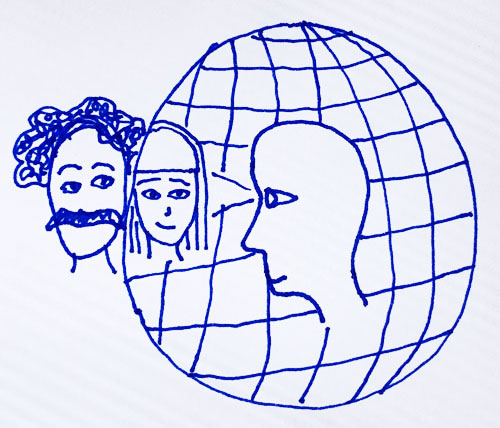
Many of the familiar people I encounter in dreams is due to identity mapping in rotes.
-
The Wedding 1997 • age 22
There I was, dropped into a scene right before my wedding. . . . I can’t remember if this was about Buttercup or Raven. There were shades of both.
The Closest Match: In order for me to understand the rote correctly, the mapping used the closest emotional match I had for the bride — Buttercup or Raven. Both of these were positive loving and friendly relationships.
-
Laser Blasting 1988 • age 14
I dreamt that I married Lisa Hayes and we had two children, and we lived on the fifth floor of a hotel. There was a tornado, and I only had enough time to bring Lisa out. After it passed, we went back up and found our babies being smothered by a blanket. We pulled it off and they were alright.
References: Lisa Hayes is a character from Robotech.
Influences: I was 14 when I had this dream. I was really into Robotech, and Lisa Hayes was the wife of the main character. At that time, she was the character in my life that most fit the model of “my wife”, since I hadn’t had a serious girlfriend yet.
-
Out of Body Experience — Flying on the Rooftop 1996 • age 22
More people appeared, as guides, ready to take me out of my body. It was Buttercup, Kayla, and Marco (who I don’t know in waking life). Kayla, at times, appeared as her look-alike from Oberlin. . . . Did I paste the identities of Buttercup and Kayla on these spirit-friends due to the intensity of love I felt from them? I might have, since Kayla changed to Oberlin Kayla.
Partial Mapping: This is a rote, since I “wake up” from it in a dream class. It’s odd that Buttercup was mapped, Kayla was sort-of mapped (why would Kayla’s look-alike appear at all, unless it was only an appearance match), and Marco wasn’t mapped at all.
Maybe it’s because I don’t have a supportive male friend.
Changing Identities — People in Similar Categories
These dreams reveal how we use mapped identities in rotes to effectively communicate the meaning of characters to us. When multiple people fit the same meaning for a character, the identity can change from minute to minute, especially when there is an interruption.
-
The Band Murder 1999 • age 25
I was Lance, hanging out with Ruby. I was being sweet. . . . Then the flow of the dream was interrupted. “Sam, wake up!”
When I return to the dream, I’m the girl, hanging out with Ragnarok from Gabe’s band. We’re making videos centered on one small scene with angry music and multiple cut shots. Then we go to an empty small house and he wants me to make this puddle wetter. The floor is a mixture of carpet and earth. I scoop water from other puddles into the one in the main room. Ragnarok tells me to sit by it, roll in it, get sexy with it. He begins to film. “Sam, wake up!”
This time when I return to the dream he’s Trent Reznor and I’m a girl with a giant turtle. There’s infinite complexity that I’m missing. In the main room is a big orgy to 70s music. The blonde cat-like elf woman from Stardust is there. She goes to Trent and he drowns her in the bathroom.
Then I’m outside the building by some housing near a city river bank talking to this girl who said her Emma knew about that happening, that she knows everything. Perhaps she was the original storyteller? Because my curiosity brought me back into the scene as I said “Then what?”
This time I’m Trent. The dead woman is on the ground and opens her eyes and looks at him. She asks why he did it. He grabs a knife from the table and slits her throat. As he began to do this, I promptly jumped out of him and watched from a more distant angle. “Benji, wake up!” I awaken.
These Characters: In this rote, we see how the original characters are populated with the closest matches from my own experience. Let me explain these characters so that you can see how they are all easily mistaken for the same. Lance is the dark, brooding front man in a band who plays guitar and sings. So is Ragnarok. So is Trent Reznor. Ruby has medium-long blonde hair and plays a romantic role. So does the elf woman from Stardust. The characters in the story are who they are, but after each awakening and return my mind uses someone slightly different from its library of characters.
The story is continuous across the interruptions. The band guy has a blonde girlfriend. They’re making a music video, and he ask her to be sexy in it, but things go too far (the orgy) and he murders her. The characters change with each interruption but the story continues.
-
Make Love Later 1997 • age 22
Earlier in the night, I had a dream where I was traveling all about, and I came across a girl who loved me. She was cute, petite, kinda like Jen, and we were hanging out. She casually asked if I wanted to make love later and I thought “Yeah, that’d be really nice.”
After this was a dream of Raven and me, as we were in the prime of our relationship. We had just met up again. She asked me if I wanted to make love later and I thought “Yeah”, but then I remembered I had a different girlfriend, but couldn’t remember who. I thought it was Anne (my 6th grade girlfriend for a day) and found it difficult to tell Raven but finally did. But “Anne” was referring to Buttercup (I thought they seemed similar in this realm). It was all just purely the good feelings of all these relationships. A wonderful place to be.
Which Girlfriend?: The original scene was with someone I didn’t know, though she reminded me of Jen. Apparently it was so nice that I later re-ran the memory (rote) of it, and in the memory the unknown girl was mapped to Raven.
Identities cross a lot in dreams. Jen, Raven, Anne, and Buttercup were all girls I had relationships with.
-
Twisted Bridget and the Color Vortexes 2003
Bridget and I apparently exit to a hallway in Northtown Mall, and we have words. I call her Megan, and at times she appears like this emotionally twisted blonde character from 6 Feet Under.
References: 6 Feet Under is a TV series.
The Troubled Blonde: The female character is a conglomeration of people I know that mean “blonde, female love interests (maybe with issues)”. Bridget and Megan were both girlfriends I dated for a short term in college. The blonde from 6 Feet Under had serious emotional issues and was briefly a girlfriend to the main character. I was using characters I was familiar with to convey the character in the rote as closely to my experience as it could.
-
Angsty Xmas 1996 • age 21
The present I opened Xmas morning was from Hazel/Brit/Lisa. . . . Suddenly Guido R and some others appeared. I called Guido “Josiah” by accident. They heard my situation and accidentally revealed that “they’d been waiting all day” and I looked to Ruby with surprise. “You were trying to take me somewhere!” She was upset that I figured it out but we all decided to continue on foot anyways.
Identity Mess: Hazel, Brit, and Lisa are people with a similar category in my head: “shorter, younger female friends”. Guido R and Josiah are both college acquaintances.
-
Mordred’s Hell 1997 • age 23
So I’m out visiting Manville and Mordred again. Mordred’s my focus this time . . . [we hang out]
Not long after, Manville and I were in a jello-pie “factory.” No, it was Mordred, consisting of 10 fat ladies in an assembly line. He got a whole pie and I got a free sample since it was strawberry jello with bananas.
Identity Scramble: Here I’m uncertain about whether this character is Manville or Mordred, two of my main friends from high school. How I mistake 10 fat ladies for Mordred, I do not understand at all.
-
Needle Tech 1997 • age 23
It began as a transformers food battle, where the transformers shot food at you. Then it changed and was armored humans and our weapons were needle-things that we simply threw like darts at each other. The darts would take our health down 90% to a thin, unconscious band of power. Needles were flying everywhere.
Character Transformation: This time it wasn’t specific people, but similar types of fighters — from transformers firing food to armored humans firing needles.
Changing with Changing Context
When the story changes, the mapped identity might also change, either to fit the scene better or to fit the character’s new behavior. The identity mapping isn’t aware of what’s coming in the rote, and so makes appropriate changes as needed to preserve the meaning.
For example, in a rote, a close female friend to the experiencer could switch in appearance between two close female friends you have, but if the character then began to kiss you, the closest approximation might change to a girlfriend.
-
Memory Rooms and Exploding Dreamstuff 1997 • 6 AM • age 23
I was meeting my best friends: Buttercup and a representation of the boys at Oberlin. . . . At times Buttercup became Julie, futilely pursuing me. At other times she was Avery. We were hanging out like guys do, and I’d rib Buttercup every once and a while, teasing but giving attention. There was no great want, she was just one of the guys.
Changing Identity: Buttercup is a good friend apart from being my wife, so she fit in well in the “group of college friends” situation. But when her character turned into “girl I wasn’t interested in making moves on me”, that didn’t fit with Buttercup anymore (because I am interested in Buttercup) and the character changed to Julie, who DID fit that description. Then it changed back to Buttercup.
-
The Mischievous Fairy Girl 1997 • age 22
It began at Blaine House. . . . There was also a strange blonde girl, like Julia, the library girl, and the girl from Tank. At different times she seemed like each, but different from each, too. She beckoned me to join her on the wall around the deck outside and I did. She showed me something there, in the sky or the woods or my mind.
Later I was working on Foundations in the woods by the sandbox. I was trying to make symbols in the stone. The blonde appeared there in fairy form, and had information for me. . . . She appeared as Julia for a moment to give me a soft kiss but I didn’t kiss back.
Then I was in the library where the blonde girl really made her move. I was at a terminal working. She appeared as that library girl, constantly sending me letters above my head and conjuring sheep in the wall to get my attention. She was flirting madly, but also helpful and humorous.
Cross-Characters: The character was “cute blonde girl I saw around”. She appeared as different people because these people were the closest match in the slightly different contexts in which they appeared. I kissed Julia once, so she appeared as Julia when she went to kiss me. She looked like the library girl when I was in the library. But each time she disappeared for a little while, it was more likely she would appear as someone else.
-
Angsty Xmas 1996 • age 21
Guido and company turned into Wadsworth’s side of the family. Dusk set in, and the countryside began to take on the feel of the steep angular mountainous green flying lands.
Group Transformation: Notice that as we walk, it turns to dusk, and the feel changes. Along with this, the gang of friends turned into Wadsworth’s family. An odd change, as the only similarity was that they were people I wasn’t that connected with.
Multiple Identities at Once
This is perceiving a little more truly. The projected identity isn’t as locked in to a specific person, and has a more general feel that is closer to the truth. For example, a set of characters would be closer as “two men who are like brothers and who share hobbies” rather than two specific brothers I know. Thinking of them as two specific brothers drags incorrect baggage into the dream — including what those two look like and how they behave, obscuring to some extent the actual appearance and behavior of the characters in the rote. But it makes it easier for the waking self to comprehend.
It’s not far up the stream from this that we simply know that they are “two men who are like brothers and who share hobbies” without having to project onto them. At this point we see what they really look like.
-
The Red Motorcycle 2003
I remember there was a brief confusion thinking Quentin and Ace were also Ween.
References: Ween is a band.
Mistaken Identity: Two brothers from my soccer team here are mistaken for two brotherly male musicians. An easy substitution.
-
Powered 2013 • 2:30 AM
Buttercup and I leave our house. The sky is dark. We’re walking Finnegan not far from a bank. We run into Ranier and Eve who are also Kai and Alison.
References: Finnegan was our dog.
Dual Identity: Ranier and Eve are in a very similar place in my mind to Kai and Alison: “once very good friend couples whose connection has faded somewhat due only to lack of time spent together”. This is how the relationship between me and those two characters in the rote is made understandable to my waking self.
Mapped Locations
The Closest Meaning Match
-
Young Swedenborg 1997 • age 23
So I dreamed I was Swedenborg as a boy, experimenting with his powers for the first few times. His/my father kept trying to stop or interrupt me so I fought back. I threw a chair at him in the dining room and it hit him square in the back. Then as he was chasing me upstairs, I hit him with another one. He was so shocked each time. The setting was Blaine House. Then I locked myself in my room and began meditating.
Blaine House: This clearly shows that Blaine House simply means “my own house”. If I’m inhabiting someone else in a story and I’m to understand that I’m in his house, Blaine House becomes the setting, because that was MY house when I was growing up, and that meaning apparently goes deeper than the many homes I’ve lived in since.
You Think It’s What It Clearly Isn’t
-
Underworld Guardians 2001
There’s a city. It’s “San Francisco” in my mind but a smallish metro area in reality. My house in the dream lies further away beyond some woods, separated from the town by residential streets.
Not Really San Fran: I wonder if it’s some suggestion that makes me think it’s San Francisco, contrary to all appearances. Maybe I intended to go to San Francisco but ended up here. Or it could be part of the information that comes with the rote.
The same is true with my house. Sometimes “my house” is clearly communicated by the house being Blaine House. Other times I just know it’s “my house”. The knowing is closer to true dreaming than the projection.
-
The Madness 2015 • 4 AM
It was tryouts to So You Think You Can Dance, except a lot of people had on wild costumes and were doing crazy routines. There was an announcer. I remembered thinking “This is one of the tryouts from season 6.” I remembered some of the dancers.
Mistaken Association: I remembered this as the tryouts from So You Think You Can Dance season 6, but this scene and its characters were certainly not part of it. It’s likely this was a rote about a dance competition, and this show was the closest thing in my waking library.
Conglomerations of Real Places
Just as a person can have many identities attached to them, a place may be a conglomeration of many different places. At times I’ve exited a window in the Dark Tower only to end up in my yard at Blaine House.
See Scene Transformations and Transitions for the many ways this can play out.
-
Mazes and Scorpions 1996 • age 22
The majority of this dream was my Blaine House room with the waterbed and closet. . . . Downstairs it was more like Banana House and another, better place. There was a big party we were hosting and we had a pool.
Multiplaces and Multipeople: In the same way people can have many names attached to them, a place may be a conglomeration of many places. Here my room in Blaine House was attached to Banana House.
Untranslated Memories
Memories don’t need to use the library of your waking mind. We can experience them directly, with the meaning coming through knowing and feeling rather than familiar forms.
-
A Great Love 1997 • age 23
There was this rocky cliff of tan stone by the ocean. It was a hard climb to the top but I managed it. At the top was an old house where the meanest redneck people lived. Memories of 8-tracks, tapes, and a mean basset hound came to me. The man there had tried to make me go away. I was returning to collect what was owed me. Somehow I wasn’t afraid. Their meanness couldn’t touch me. They owed me $100 worth of specific things and I was here at last to take it.
The first thing was this ragged old basset hound with a missing front leg. It was light tan and very wrinkly. When I first saw the dog, it didn’t take to me. It pulled back towards the house. The man came out and asked for $500 and I said we agreed on $20 before. $150 flashed in my head but I stayed at $20. He accepted, then went back inside. The dog began to huddle up to me. I wondered how many years it had left. I had asked if the dog’s leg had been gone last time I saw it and they said yes. The dog was trembling and seemed at times to be a Raggedy Ann doll of great value to me but worn out and old. We went up onto the ridge. The dog was pushing up against me and I was filled with love for it. I could feel it say “Thank you, thank you,” as it began to remember unconditional love.
Raggety Ann Doll: What’s interesting about this rote is that it’s not using the library of my waking mind — everything is unfamiliar, but I know things and feel things, enough to make sense of it. I receive direct telepathic communications. This is perception of the original rote on a higher, truer level.
My Emma made me a Raggety Ann doll when I was a kid. However, it wasn’t that old or that special to me. The hound appearing as it only conveyed a mild value to me personally, but I could feel that this old doll was of great value to the character I was inhabiting. That was part of the “recording” of the rote.
If it had been translated to my terms, something of value to me would have been substituted for the Raggety Ann doll, and a dog I know and love would have been substituted for the unfamiliar basset hound. This also would have likely gotten my physical self more emotionally involved, potentially causing it to change the plot. A certain detachment is required to see the original clearly.
-
The Switcheroo 2026 • 3 AMmature content
I’m at an unfamiliar college campus, visiting this on and off casual love interest. But I wasn’t the only one interested in her. There was a girl who was more seriously into her. Sometimes she’d arrive to visit our mutual interest just as I was going in, and I’d see a look of sadness on her face. Inside her room, I decided to call it off. It was too painful for the other girl. . . . I complimented her room. She said I could have one, too, if I went to that college.
Later, I was at a party, playing a social game with a lot of people in a dimly lit dining room. The game involved moving around and blocking shots. It was like soccer, but I don’t recall a ball. I felt like we all had powers and we had to avoid the others’ powers. The room was thick with decor and things, the table seemingly fully set at times. I had a thing for this one dark-skinned woman in a tight, dark green dress. I ended up playing the game in her vicinity. There was another person I liked, who I had a history with — a light-skinned woman of a similar height. The game progressed, and some people got more engaged.
When the game ended, some people began laying down on the tables around which the game was played. The two I liked were on one table, and I went to them. We began to touch, get intimate. I didn’t see much of their faces at this time. The dark-skinned one was receptive to sex, and the light-skinned one helped make it happen. We did so at an angle where I couldn’t see her face. It felt very good. I recall that she left afterward, but then returned to hang out and walk with me. I was glad of it.
As we left the dinner pavilion, she flashed a picture of how she saw me afterwards, and I saw myself as a BIG thought-form lumberjack walking around. It was like a strange, stylized puppet of me. Someone else responded with humor that the way I saw her afterwards was this, and flashed a picture of her, but with her waist and legs much expanded, also in a similar puppet style, but seen from the back. These images appeared in the receding pavilion, getting smaller as we walked away. Lightly amused, I returned my attention to her.
We talked as we walked through the lit up dark city. After a while, she asked me my name. I was a little shocked, I was certain she knew it. I said, well I was a lumberjack, clearly, and gave her my name. I saw her more clearly now, and she didn’t appear to be who I remember. She asked if I recognized her, and I said I didn’t. I noticed someone else walking with us, a bodyguard or something. I wondered if she was famous. She said her name was Sylvia — definitely not the person I had thought it was. She said she was a famous Mexican actress, and she flashed a ton of pictures of unfamiliar movie posters and things in front of me — like all her roles, with pictures, text — a whole wall of it. I glanced around it briefly. Huh. The bodyguard showed me a scan of her, which revealed a little baby in her uterus. The date was in the past by a few years, I pointed out, and he scrambled to find the right picture to convince me she was pregnant. They had different dates on them. She offered to pay me $100,000 a year to raise the child.
“In the next part,” said the announcer, “we’d see. . . . ” A bunch of scenes flashed before me, of chaos raising the kid, of me as Eddie Murphy bumbling around with a huge hat stuck over my eyes, flashes of tons of scenes of what was coming in the next segment. I realized I was apparently black. As it went on, I thought that it was revealing too much. I saw a quick upcoming scene where she came to take the child away and I fought to prevent it.
References: Boomi is our new puppy.
An Authentic Story: This rote isn’t translated to my terms at all. I’m a black guy, and I don’t recognize any of the other characters, except through backstory that comes with the rote.
It’s an astral version of a physical story. There’s sex, money, and children involved, but it includes astral games and telepathic thought form projections. It’s as if it’s written by an astral inhabitant who has become used to some of the ways the astral works.
Character Inhabitation
Character inhabitation is a key part of rotes. It happens naturally when you become interested in a character you’re observing. You empathize with that character, maybe desire to take certain action, to be part of the scene. So you jump into them. Once inside, you experience the story from their perspective. You can passively observe from within, or take over the action.
I tend to think that rotes contain the full personalities of all the characters, and they will respond authentically to the new directions our actions take, similar to creating a new timeline in the physical universe.
If you think about it, the whole idea of jumping into a character is very natural to us. That’s precisely what we do when we engage with a good book, show, or movie. We experience the action from the perspective of a character — we feel that character’s pain and joy. In a rote, it goes a step further — we actually jump into their body, experience the story directly from their perspective, and respond as if it were us.
To see a rote truly, we need a certain detachment. If we could watch without emotion and desire, we wouldn’t change the story — we’d experience what really happened without getting involved and changing it. But stories often seduce us, trigger our fears and desires, our issues, and we become a player instead of an observer. When that happens, we learn by doing and seeing the results of our actions.
This is the same process that draws us to a new incarnation in the physical world, which is, essentially, entering the story rote of a physical life.
-
Civil War Stories 1996 • age 22
I zoomed in from far above to a civil war scene in the south. An army in blue was riding back to camp. The focus was on the lead slave in this group of slaves on horseback. As he was riding into camp, I jumped into him, lost balance, and fell off the horse. The captain demoted me to a lower rank. Then I sat on a log with this lanky blonde fellah and couldn’t understand a word he was saying.
Then I was in a classroom filled with young, grey-uniformed soldiers. I was trying hard to do well, to be the master’s best soldier, though I didn’t plan on going to war. There were hurdles and blue clown uniforms.
Slave’s Perspectives: Here I find myself following the story of a slave (or two?) in the civil war, and inhabiting them.
Written at the time: Transitions follow our curiosity, the way we get pulled into a movie or book or story someone tells. I go into the scene and take on the personality I am closest to or want to be. I jump into a person’s body and I am them, and can exert control, including redoing things I don’t like. When the sub-story ends, I return to the one surrounding it.
-
In Someone’s Else’s Story 1996 • age 22
Someone’s telling me about their experience and I start living it: I (as him) go with someone to interview this religious fellow. We go to talk to him and he’s rude and disgusting. He/I sarcastically say “Oh, how loving and compassionate. What a holy man.” He sends us upstairs to talk to someone else, who brushes us off.
Dual Self Within a Rote: I think frequently the “we” in dreams is the dreamer as an observer/inhabitor within someone else’s rote. Here it’s clear: I’m living through his experience. The sarcastic comment “Oh, how loving and compassionate. What a holy man” sounds like something I would say. I regularly refer to myself inhabiting his character as “we”.
This may explain some circumstances of the “dream friend”, where I almost always feel like I’m with someone in my dreams.
-
The Real Office 2010
We begin talking about the real characters The Office is based on. We were looking at pictures of them, as if on an iPad in front of us. . . . Then there’s a transition to the girl who Minnie is based on, though she was blonde and looked totally different. This becomes a story about her — she’s the main character. I inhabit her at most times but am sometimes outside watching. She was given a quest to seek out several people scattered all over. I forget the common element, but she was to go talk to them.
We arrive at the first house. By “we” I mean this real-life Minnie and myself as inhabiter/observer. It’s a farm house in a big field of short green grass with some beautiful trees. A little ways off is a college, reminiscent of SSU in its rural setting. It’s nicely manicured and has huge, beautiful trees. Minnie goes to the front door and knocks. A motherly woman answers and I jump out of Minnie to watch 3rd person. Minnie bursts out awkwardly something like “Hi, could I talk to your son hot manly chest.” She seemed to get excited and lose control at the “hot manly chest” part. There’s this moment of embarrassment, and then she goes inside and I inhabit her again. She goes upstairs and enters this huge unfinished room and the guy we’re looking for is there. She starts talking about the defects of the room, how wooden beams are rotten in areas, or worn. The guy says that it’s probably related to the restaurant upstairs and she’s so charmed that there is a restaurant up there. We/they start talking, and walk outside onto the lawn.
I feel I take over the character more at this point, and it’s me talking. I tell him how lucky he is to be living in such a beautiful place with so much sky, grass, trees, and open space.
References: The Office is a TV series. SSU is a college I went to.
Inhabitation: This is an exceptionally clear example of character inhabitation. The iPad was a rationalization of a rote of information about the real characters from The Office. I enter a story about the real-life Minnie. I was very aware of jumping in and out of her perspective at different points. When I was watching her, it was her that was speaking — the delight with the restaurant was hers, not mine. As was the “hot manly chest” bit. When I was inhabiting her, I at times just observed, and at others controlled the action. On the lawn I took over completely and talked straight from my perspective about how lucky he was to live there.
-
Extravagent Sandwich Love 1997 • age 22
We’re in this bar and Ween is playing. They start doing this song called “Sandwich” where they keep pulling food items out of a bag and eating them with such joy. After the sandwich is a cookie and they get so into it! I become one of them and they take it sooo slow, rolling their necks, flexing more and more, twisting and mashing it into their faces (my face). Pure brilliance! Then I wake up.
Inhabitation: They look like they’re having such fun that I become one of them. Inhabitation happens when someone is experiencing something that really draws our attention and interest, whether it be joyful or exciting or challenging. If we’re interested, we can jump inside and experience it firsthand.
-
Like Warcraft, but a Whole World! 1997 • age 22
I run into a bunch of orcs. I scurry away and find a bunch of my fellows — team orange! A voice whispers to me: “There’s more of them, but you can still win. Use your shield-men wisely!” I realize there’s 2-3 shield guys and I inhabit one of them. The battle is intense and fun as I personally engage in the fight. I stave off attack after attack and use my shield to smash and knock down the orcs (which aren’t orcs at all up close but men my age). Sid is one of them. I realize this only after I slit his neck. I’m apologetic but he smiles and insists I shouldn’t be. He falls over. I feel a bit weird but keep going.
Character Inhabitation: Myself and some others are inhabiting characters in a big Warcraft battle. Inhabitation works just as well in fictional video game rotes.
-
Stinky Williams 1996 • age 21
I was arresting “Stinky Williams”. We were wearing these big white energy suits with big gun fingers. Then I turned into Stinky. They forced me into this medical wing and locked me in a room with a gun which they told me to hide.
Sympathy: It isn’t uncommon for me to switch which character I’m inhabiting. It happens when I get more involved in a different person’s situation than I am in mine. At that point I leap into the new character’s body and follow him around from his perspective instead.
If his part wasn’t part of the continuing story, that’s no obstacle — you just make it up as you go.
-
Tribal Gore 1997 • age 22
I’m a young boy, adopted by a Native American tribe in their arid lands. One day my blonde, blue-eyed parents, brother, and sister return to me. A nasty fight with the tribe ensues, where I try to defend my original family while my tribe tries to slaughter them. There’s a lot of blood and my little brother and I get run through by a 7-foot fork.
Then there’s a big dramatic burial ceremony where the body is pressed into the earth in the front yard of Blaine House.
Character Inhabitation: Notice how I begin with “I’m a young boy”. I’m someone else in the beginning. Once he dies, I jump out again and write “the body is pressed into the earth”.
Changing Perspectives
We easily and naturally jump in and out of characters in rotes. We may jump out when the character is in danger or doing something we disagree with. Or we might just jump out to see the scene from a different angle. As this occurs, I find I change my writing style to refer to what’s happening from the perspective of I, we, or he/she.
We can also change who we’re inhabiting. Typically we inhabit one character in a rote, but sometimes we jump from one to another as the story moves and changes.
-
The Band Murder 1999 • age 25
I was Lance, hanging out with Ruby. I was being sweet. . . . Then the flow of the dream was interrupted. “Sam, wake up!”
When I return to the dream, I’m the girl, hanging out with Ragnarok from Gabe’s band. . . . He begins to film. “Sam, wake up!”
This time when I return to the dream he’s Trent Reznor and I’m a girl with a giant turtle. . . . In the main room is a big orgy to 70s music. The blonde cat-like elf woman from Stardust is there. She goes to Trent and he drowns her in the bathroom.
Then I’m outside the building by some housing near a city river bank talking to this girl who said her Emma knew about that happening, that she knows everything. Perhaps she was the original storyteller? Because my curiosity brought me back into the scene as I said “Then what?”
This time I’m Trent.
Inhabitation: Here we see several different ways character inhabitation can play out.
At first I saw Lance hanging out with Ruby. I jump into Lance, at which point I felt the main character was ME, meaning Lance must be behind me.
In the next scene, I’m the girl, who the action is now focused on.
After the next interruption, I inhabit the girl again. But then I jump out, seeing her now as the woman from Stardust, and watch as Trent drowns her in the bathtub. Finally, after stepping out of the rote to talk to the girl whose memory it is, I return as Trent since the girl was dead.
In this rote I’m inhabiting characters, but it doesn’t seem that I’m changing the plot. Rather, I’m curious about what happened and why.
-
The Green Dragon of Sauron 2004
The tunnel erupted in flame. We realized it was a green dragon. Legolas made it out but we never heard from the “friend” again. Another note: I am saying “we” because I was at times a third person observer of the three heroes, and at times had jumped into Aragorn and become that character. . . . I was fully inhabiting Aragorn now. . . . I turned around and saw a silhouette of the dragon head descend slowly from above the door frame! A perfectly chilling scene. I darted out, left 1st person Aragorn in time to see a spear-like tongue from the dragon spear him in the foot, then the thigh. He cried out in pain. I thought of him grabbing the tongue and slicing through it but he didn’t. Then I was him again, but in my present position and I hurled a sword into the alcove where I could see the silhouette of the coils of the dragon.
References: Aragorn & Legolas are from Lord of the Rings.
Inhabitation: Here I jump in and out of Aragorn, the character I most empathize with. Note that once I’m out of him, he doesn’t follow my desired actions.
In the last scene, I become Aragorn standing where I am, rather than inhabiting jump into his existing injured body. I simply feel I am him, take his shape, and continue the action.
-
The New Apartment 2001
I was at the table with Buttercup and Alexandra and other friends. There was a scene where I was Alexandra, looking out of her eyes and appreciating my friendship. Then I (as Alexandra) was wandering about in the foyer looking for a bathroom. There were a few but there were large windows in each. . . . Back at the table I (as myself) was eating corn and potatoes.
Interesting! Boring. . . .: I jump into Alexandra for a bit when she’s appreciating my friendship. I want to experience that feeling! But when Alexandra goes wandering in search of a bathroom, I get bored and jump back out and being myself.
Jumping Out Due to Horrible Actions
We can end the inhabitation if the character we’re inhabiting (but not controlling) does something horrible.
We can jump out whenever we like, including if the situation is just awkward, like in “The Real Office”, or if someone else’s experience seems more interesting.
See also Jumping Out When In Danger. We can do this whether we are inhabiting a character in a rote or just in our own dream body (inhabiting ourselves).
-
The Band Murder 1999 • age 25
This time I’m Trent. The dead woman is on the ground and opens her eyes and looks at him. She asks why he did it. He grabs a knife from the table and slits her throat. As he began to do this, I promptly jumped out of him and watched from a more distant angle. “Benji, wake up!” I awaken.
Rejected Action: As Trent begins to slit her throat, I find I no longer have any interest in being him and I jump out.
-
Twisted Bridget and the Color Vortexes 2003
Bridget and I apparently exit to a hallway in Northtown Mall, and we have words. I call her Megan, and at times she appears like this emotionally twisted blonde character from 6 Feet Under. I follow her out to the sidewalk. It’s night. I am watching myself yell at her from the doorway. She turns and walks away and I see myself kick her in the arm. She drops her purse and stumbles. She sends a kick back my way. It weakly connects. I watch the other me chase her around the parking lot kicking and hitting her and I decide it’s time to intercede. I walk calmly and steadily towards them, without emotion. They are running all over, but I eventually reach myself and hold myself back, realizing the strangeness of the situation. I calm myself and send myself away, then look at Bridget with a half-smile because I just saved her from myself. She had dropped some batteries from one of her grocery bags in the tussle and I point it out. She snatches them up saying “very nice” angrily, then gets into her car and leaves, I think.
References: 6 Feet Under is a TV series.
The Inhabited: This dream is very revealing. We can clearly delineate myself as the dreamer from the character I’m inhabiting in the story rote. The way the character is acting is very unlike me. This is a story about someone other than me, but the main character is male and told from the perspective of the male, so I was initially experiencing it from that perspective.
I was passively inhabiting the main character until his behavior became unacceptable to me, and so I jumped out. Then I intervened as myself to stop the action because what the character was doing was so disturbing to me.
The Effects of Jumping in or Out
Usually jumping in or out of a character doesn’t affect them, but sometimes it clearly does.
-
Civil War Stories 1996 • age 22
I zoomed in from far above to a civil war scene in the south. An army in blue was riding back to camp. The focus was on the lead slave in this group of slaves on horseback. As he was riding into camp, I jumped into him, lost balance, and fell off the horse. The captain demoted me to a lower rank.
Whoopsie: It seems like my jumping into him caused him to fall off his horse.
-
The Real Office 2010
A motherly woman answers and I jump out of Minnie to watch 3rd person. Minnie bursts out awkwardly something like “Hi, could I talk to your son hot manly chest.” She seemed to get excited and lose control at the “hot manly chest” part. There’s this moment of embarrassment, and then she goes inside and I inhabit her again.
Jolt from Jumping Out: It felt like the act of me jumping out of Minnie caused her to lose control and say the “hot manly chest” bit. As if my departure jolted or confused her momentarily.
Why did I jump out in the first place? My anxiety at talking to his Emma? Hers? Did I feel like she was about to blurt out something awkward?
Messing Them Up by Conflicting Wills
-
The Destructive Plane 1996 • age 22
[I’m at a Tori concert in the Westwood Elementary gym] I imagined my hands moving along with hers, playing the notes of “Horses” or “Flying Dutchman”. She started making lots of mistakes, then stopped playing. Now I was back in the crowd.
References: Tori Amos is a musician.
Conscious Effort: When you bring conscious effort into a flow-like activity like playing the piano, you can mess it up completely. Apparently my imaginative link to her messed up her playing. Perhaps it was a partial inhabitation? Note how when I stopped, I was “back in the crowd”.
-
Performances 2026
I was playing the part of a witch. I began as a normal person. At some point there was an explosion dealing with pumpkins and I wore a pale pumpkin-head mask. Then for the rest I wore a white witch’s mask with green around the eyes. It was a musical, and I was singing my part in a sort of gravely but strong voice. Of course I didn’t know the part, but I was doing it spontaneously, letting it come through me. At times I was watching from outside myself, at other times from within — and those times I would make mistakes, like forgetting a line or being in the wrong place. When I did, the others would help me along, bringing me the right mask or helping with the lines. It was done in an excited, lighthearted way, as if the perfection of the performance didn’t really matter.
A New Will: When I inhabit a character, its behavior is now up to me. Since I don’t know the part in this play, I begin to make mistakes.
Access to Their Knowledge
-
Star Trek VII 1997 • age 23
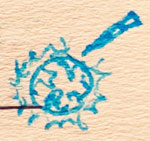
Bomb orbiting the planet In this, the next Star Trek movie, our home planet was threatened by the largest bomb ever made. It was long and pointy and came to rest in an exact orbit over our home planet — a planet of red lava and scattered dark lands. We were in this huge ship, very much like Space Station Benji (I think it was). We stopped it directly under the tip of the bomb, ready to try and drag it out from the planet when it finally fired up. I had extensive knowledge of the planets and star systems in the area. I think it was near the center of a galaxy because the stars were very close to each other. I understood the very complex technology in the ship. How wonderful to be in a life like this!
How Did I Know That?: When we inhabit someone, it seems we have access to their knowledge. The things I knew! Backstory is typically more contextual knowledge.
Letting Someone Inhabit Your Body
Rare Memories Experienced Without Inhabitation
For me, it’s unusual for a memory to hold my attention without being drawn in to inhabit a character. But it is possible to just listen and observe as a third party. This takes an emotional detachment that comes from practice. We don’t see the true memory if we jump in and start changing it.
-
The Rogue Faction
I was watching a show that felt like the future. There was a greater intelligence, a higher world, a more advanced humanity. It was riotously creative and complex. The setting was a futuristic city. . . . I remember following one guy around. He was once a great man but diminished now. . . . In what felt like episode 2, we met the animal controllers.
Just Watching: This is one of those cases where the feeling that I’m watching a show/movie persists through the entire experience. At no point to I jump into (inhabit) any of the characters. Usually I would jump into a character, experience it firsthand, and eventually go off the rails into my own adventures. But I got to “episode 2” knowing that I was still watching a show/movie.
-
Bed and Breakfast and Company 2000
I watched a tale about a criminal who was importing something secret. It appeared to be a whale for a while, but then the secret was revealed — it was a giant squid! It looked like a giant jellyfish. I was not actually present in the scenes of this story, but an omnipresent hovering viewpoint hearing the criminal tell the story, hearing his voice and seeing his thought forms. A storytelling!
Detached Rote: Perhaps I didn’t inhabit anyone because I wasn’t drawn to any of the characters. I have no interest in crime stories, nor am I a giant squid.
From Fact to Fiction
Most rotes end up veering from the original story into our own subjective story. Once we get pulled into the plot, inhabit a character, and start making our own choices with them, this alters what happens.
Even though your experience isn’t what happened in the original rote, it is your true experience, stored as such in your memory.
-
Hazel’s Wedding 2009
I’m sitting against a wall. Hazel and her husband are across the way. He feels bad and indicates that he’s sending me a text with his phone. I wait and wait and then it arrives on my phone. It’s a movie of Hazel and him biking fast on these narrow cliff paths in another country, by the sea. It’s dry and there are people around. Soon I am with them in the scene and I thrill at the ride.
Eventually we end up at a tall Victorian house on the rocks and go inside. The feel is kind of steam punk, like the movie Wild Wild West. There are lots of prostitutes sleeping in narrow shelves up the wall, some with babies. There’s a pharmacy and since it’s the past now, maybe 1920s or 1900s, I’m looking for interesting banned products. I find something: xlth. . . . Soon it breaks out into a wild adventure with evil cannons on the cliffside and attacking forces and breaking into the upper levels of the house.
Lost in the Rote: It begins as a rote of Hazel and him biking by the sea. But after we get to the steampunk Victorian house, my interest in finding currently banned drugs within the pharmacy turns it into a fantasy dream of my own.
Changing a Memory by Wondering
We can change a memory simply by wondering what would happen if something were different. What we’re thinking about simply happens. This makes it hard to verify something, as the fact of looking for something actually creates it.
This can be done without character inhabitation.
-
The Naked Touchdown 2024
I’m watching this rote of an American Football play. My perspective is from above. It’s a running play where everyone is crowded into the middle. From this mob, a single black man springs out and jumps over the line for a touchdown. The odd thing is he’s all brown, head to toe. My mind is trying to figure out why this is weird. “Oh! He’s not wearing his jersey!” I realize. I reasoned that someone must have pulled it off as he was running through the crowd of players. But that doesn’t explain it entirely. Something is still off . . . and then it comes to me: he’s entirely naked! . . . I have to tell Buttercup. I exit the rote and go to her. . . . Now I’m wondering if his penis was visible (it wasn’t in the original — he was face down). This time as he jumps over the touchdown line, his lower body is twisted around and it was visible.
I Wonder: How flexible a rote is, that you can change how it plays out just by wondering.
My wondering about something within a rote makes it so. I’m looking for it, and so I project it into the scene, just like in the astral world at large. In fact, rotes are experienced at the same frequencies of consciousness as the world around us, and so they follow the same rules within as without, with a few minor differences (such as the possibility of character inhabitation in a rote).
Since our memories are rotes, this shows how easy it is to alter a memory.
Multiple Inhabitation
Is it possible for multiple people to inhabit one character? If so, does this duplicate that character?
Scene Transformations and Transitions
Imagine, if you will, that someone is distractedly watching your waking life. They’re watching your whole experience, not differentiating between the sources of that experience. If someone were watching me, for example, they’d see me get out of bed, do my morning routine. But my attention would barely be on that. Instead, I’d be focused on thinking about that scene at the party in the book I read the night before. They’d see me reliving it, and imagining telling my wife about it. Downstairs, while eating breakfast, I go to a website on my phone and watch a video about a festival in India. In my mind’s eye, I appear to be there in the action. Now I put my dishes away, talk with the kids, then play a video game where I’m a gun-bearing warrior in a wasteland. This watcher is unfamiliar with physical life and doesn’t understand the transitions. I’m just appearing suddenly in different places, as different people, doing wildly different things. Now I ride a bike to work through forest and city scenes. I see someone at work who tells me a story about their trip to Glacier National Park. They show me pictures and videos. I feel like I’m there. I recount an experience I had while there, reliving it mentally. Now I’m writing code on a computer, flashing back and forth between screens of code and the resulting web pages. I return home, and while having lunch I read a chapter from a graphic novel in which a group of people is exploring different dimensions. My waking self knows these transitions well and connects them to their different sources — videos, stories, books, games. But to the watcher, my inner experience changes wildly from time to time without explanation.
This is how we perceive dreams. Catching and understanding the transitions are key to understanding them.
There are several reasons for the scene to change, including passing through gateways, going into (or coming out of) a reverie or rote, sending or receiving communications, travelling, or simply thinking about something new. Scenes can also change outside of these circumstances. They can change in place (transformations) or change to an entirely different scene (transitions).
The astral world is incredibly responsive to our thoughts, and takes the form of our thoughts almost instantly. This responsiveness is at odds with our physical belief in object permanence. Without that belief, when our attention turns from something, it would instantly cease to exist for us, and what our attention turns to would snap into existence before us.
Typically, scene transitions and transformations require a break in the continuity of our perception to overcome the expectation of object permanence. This break in perception can be due to an object in the way, such as a wall or door, closing our eyes, turning or spinning around, turning a corner, passing through a doorway, or simply leaving and then returning. Of course nothing actually impedes our perception, but these are all physically familiar triggers that allow for a change of scene.
The shortened context of being closer to the now in the dream state helps this to happen. We have to be able to forget what the scene was a moment earlier. Otherwise our memory would span the gap and our expectations would cause the scenery to remain the same.
We can be anywhere instantly if we desire to and know how. It’s only physical habits that hold us back.
Object Permanence
Things remain the same in dreams because we expect them to. This is the expectation of object permanence we learned by living within a physical body. For our environment to change, we need to either travel in a physical way to someplace new, or we can interrupt our perception of the scene around us, allowing a new one (or a changed one) to take its place.
Breaking Continuity
Breaks in continuity (usually visual), allow the scene to change, bypassing our belief in object permanence.
Brief Waking Interruptions
Dreams are clothed with forms that are familiar to us, forms that we understand and which convey meaning to us. These forms can be shaken off due to a momentary awaking or shifting in bed. Upon returning to the dream, it may have taken on different forms. It’s the same dream, but with a different appearance.
When the story continues (rather than restarting), the different forms might be because for the current part of the story, different scenery and characters might fit better.
While the scenery and characters may change, the same plot continues. The plot is the essence of the story.
-
The Pyramids Mystery 1995 • age 21
I played some key part in the discovery of a piece of a machine which ended up fitting together with other pieces that had been found in the pyramids. They formed a kind of tape-player which annoyingly played this weird radio song. A kid in the next room started singing along.
After waking up briefly, things were a little different. I was a youngin’ in Starfleet Academy getting beat up by the older kids who took the pyramid tape recorder. My older self ran by and beat them up, but that wasn’t too effective.
References: Starfleet Academy is where recruits are trained in Star Trek
-
Welcome, Earthlinks! 1997 • age 23
I was put in a group of three to do a project of some sort. We were supposed to be acting like ET. One person from each group would get up and do a little monologue in front of a camera. . . . I slightly awoke in the physical but I really wanted to perform so I fell back asleep and went back to the dream.
Of course the scene was different. The whole class and camera were inside a stationary car and we were outside on the sidewalk. [We continue with our performances]
Awakening Scene Change: Here a brief awakening from the dream leads to a scene change when I return, though the characters and plot continue on unaffected. Interestingly, the classroom appears to have shrunk to the size of a car.
-
Primordial Jungle Continent 1998 • age 23
At the bottom I found myself among a group of friends. There had been some velociraptor attacks and we knew if we all held on to each other, we’d act as one large entity and overcome them. We held on when two attacked and the theory held true.
Then later on I’m on Cloud Drive near the Schmelzers’ house and two wolves come from the woods. A friend had said he feared the wolves. . . . Hey this is just a remake of the last scene! I must have awoken and then returned to the same scene with a different context!
References: Blaine House is on Cloud Drive and the Schmelzers were a neighbor.
-
Tuning Back In 2026
The scene was a parking lot with some parked cars and lots of long-limbed people. Upon returning, the people were replaced by Order robots from Borderlands 4, which also have long, thin limbs.
References: Borderlands 4 is a video game.
Like Robots: The brief interruption caused the long-limbed people from the dream to be replaced by similarly-framed Order robots.
-
The Navajo Highway 2023 • 2 AM
I dream I’m a Navajo being chased by a huge group of people. I run down this hill, around towering mesas and then into a valley where I hide behind a river’s edge. As they approach, I get into the river. Some older women come right up to the water’s edge and I go under a ledge with barely any breathing room, my face up against the rock and water. I think they’re also Native Americans but dressed in traditional American clothing. I tell the two women I plan to build the Navajo Highway here, a route that will benefit all tribes, and they agree not to reveal me.
Then I’m in a house and Emma is upstairs. It’s still night. I don’t want her to see me (the Navajo Highway thing). So I press my face up against the bottom of the stairs so she doesn’t see me (difficulty breathing again).
Two Dreams, One Reality: There’s a shared reality behind these two dreams — hiding from a woman/women, from a perspective below them, and having difficulty breathing due to having a small breathing space where I’m hiding.
Closing Our Eyes, Turning Around, or Spinning
Closing our eyes, turning around, or spinning allows the scene to change by creating a visual discontinuity that gets around our belief in object permanence. These are well-known techniques used in lucid dreams and OBEs to change locations.
-
The Neighborhood Construction Ship 2001
I’m at Blaine House with Ruby and it’s bustling with people. I look out the kitchen window to see this immense airship made of metal girders carrying enormous amounts of building supplies. It stretches from right overhead to beyond the distant horizon. “What? How?” I asked, astonished. The phone rings and I pick up. A person answers my questions, explaining that it’s space folding (a reference to a method of travel from Robotech). It seems to have enough material to build an entire city. I go outside and see that at the far edge of our property there is ALREADY a wooden wall of structures rising up into the sky, blocking the view. I can’t believe it and run to tell Ruby. Then as I turn back, the back yard is filled with wooden frames for housing complexes. They crowd in. I am flabbergasted at the speed of the development but think “at least we won’t be lonely anymore”. Then there’s talk of road access and after turning away and back, a path appears along the edge of the woods to the road.
References: Robotech is an animated sci-fi series.
Scene Changes: It’s easy for scenes to make big changes when we’re not looking, and as it seems that this one intends to show rapid progress and development, it does so when I’m not looking. Each time I turn away and then look again, it’s progressed a great deal.
-
The Blaine Treehouse 2024
I was at Blaine House. I had seen plans for building a new house in the back yard. However, I had not realized that all the trees NOT drawn were to be taken down. So when I saw that they had cut down a third of the trees back there, I was furious. I yelled at them and chased them off. This project was over, cancelled. . . . I looked at Blaine House. It was in the original position, but it was a single story house. The basement level was unfinished, as it was when I was growing up. The walls were unpainted sheet rock. The floors concrete. It was scattered with debris. One of the builder’s cars was parked inside.
When I turned around to look at the back yard, the new house was partially built.
Don’t Look!: Going into the basement allowed the thought form construction outside to continue, and I came back out to find the first floor built.
-
Too Much House 2026
I zoomed out at one point to see the house again, the new wooden fence around it, and the new gate. For a moment I saw the dilapidated old garage, thinking they should have taken it down, but then “refreshed my vision” by looking around and then back, and it was gone.
Seeing the Past: At first I was seeing my memory projection, and the old garage was there. I must have realized this as I looked away and back to refresh the scene, revealing that it was now gone.
-
The Superhero’s End 2011
[We were trying to change the past to erase the existence of super heroes]
There was a tremendous shockwave and everything faded to black for a few moments.
Then I left the stall and came back out into what was once the comic shop. Now it was a youth dancing school. Everyone was in costumes, but they weren’t superheroes. I inquired and they were the “Libra Dancing Group” — everyone there was a Libra. Outside the building, back in the square, I saw that it was a small part of a larger city, and what I was seeing was this time period without the influence of superheroes. Someone was showing me around. Before long we saw a huge march of people in light purple jumpsuits. They were the “masturbators” or “non-masturbators” or something, and I cringed, thinking that this definitely wasn’t an improvement. I saw that the conflict had poured out in different, bizarre, and unexpected ways, and realized that the superhero phenomenon was just the form of the basic conflict.
Another Transformation: The blackness broke the continuity, allowing all the specific forms to change. The costumed superheroes were replaced by costumed dancers. The underlying story of conflict remained but in a totally different form. It wasn’t the same kind of outright fighting but it was twisted in a way that often leads to it.
There’s a larger lesson in this dream. A dream can change its forms while its essential story continues. Our efforts to remove the form of the conflict (superheroes) did just that — removed the form. The story of conflict continued in a different form.
-
Bodhi’s Dream: Spinning Away 2023 • 8 AM
Bodhi just told me his dreams. . . . At some point I decided to take him to “Ohio Beach”. He jumped onto me, clinging tight, while I spun around and around until we were at Ohio Beach, which was a beach on the ocean. He was afraid to go in so I threw him in, and then I jumped in afterwards. Before his eyes appeared a map of the regions of the ocean. The first one was sharks and eels, then jellyfish, then pointy crabs, then various other horrors. He deduced that we were in the “sharks and eels” section and shouted that he wanted to leave. I said I’d take him to “Florida Beach” and so he jumped on me and I spun around until we were there instead. Here he was distracted by some cute mouse-rabbits on a root going out into the water. They jumped in the water and began to swim. A short ways away, I was standing in the water with a swirl of fish around me. Bodhi asked me to grab some fish, and so I grabbed a handful, and held them out in front of me for him to see. He wanted to get out of the ocean altogether, so he jumped on me again and I spun us to a new location on land, where we’re driving down a road towards a farm. We see Gwen, who joins us.
Spinning: Now this is interesting. Spinning to change dream locations is a well-known technique, but I’ve never been aware of myself doing that. Now here I am in Bodhi’s dream, spinning us repeatedly to new locations.
Interesting, too, how I spin us into a new scene where we’re instantly using a car rationalization for fast travel.
Passing Through a Barrier
Passing through a barrier creates a break in continuity that lets the scene change. This can include walls, floors, the ceiling, the ground, and the surface of water.
-
Submarine Self-Destruction 1990 • age 15
[There is a big battle. We’re told to self-destruct our submarine while everyone else evacuates]
My Wadsworth is the co-pilot. We land our submarine on theirs and set the self-destruct timer. Then Wadsworth swims to the surface and I take a diving suit up to the surface, which is the floor of our basement.
Earth Becomes Sea: We swim up and the surface is the floor of Blaine House. Water surfaces seem to sometimes act as scene transitions.
-
The Worst Way to Get to Narnia 2017
I decided to jump down the 75 foot drop into the ocean. I hit the surface and went under. I swam and swam and came up . . . in Narnia! It was colorful and strange, like an alien landscape.
-
Fiona’s Shop 2024 • 6 AM
There’s a new version of a well-known game, and I go through the wall of the room into it. I’m at the shore of a lake. Behind me is the wall and the pathway back to the room. I go out into the greenish water along some logs.
Through the Wall: The wall breaks the continuity of my perception, allowing the scene change. Interestingly, the wall is still behind me in the new scene.
I clearly knew that I could get into this game by passing through the wall.
-
The Destructive Plane 1996 • age 22
We’re on a full-sized airplane in the gym. . . . I started driving it but didn’t know how. We were now taxiing around the gym. I was trying to figure out how to stop but I couldn’t and we broke through a wall. There were cheers, so I figured it was okay to destroy the set. I kept the plane going and more and more of the wall came down.
Outside was a higher realm, near wheat fields and lava flows. There was a big hill and green trees and redwoods. Oh! It was near the new campgrounds! I taxied the plane down a road. I saw lots of trees and a few buildings I could demolish, but was hesitant. “What’s the budget of this movie?”
Walls Between Worlds: This is a very unique scene change, in that it’s accomplished by crashing through the walls of a school auditorium.
Turning a Corner
-
Frequency Fall 1997 • age 22
It was “Oberlin” though it didn’t look a thing like it. It was unkempt under an foul overcast sky. We went walking around ponds and up and down hills. We walked around the side of the pool building and it became the side of Blaine House. Then I went inside. Maybe the dream retains a continuity but the source changes the context.
Transition: This one is such a subtle transition. I go from the pool building to Blaine House simply by walking around the side of a building.
Closing and Opening a Door
-
Bus to the Beach 2000
I head to the secret room at the end of the hall. I open the door, and it’s old and empty inside. I look around the corner and there’s an older boy and a younger boy in a snowsuit. I turn around to tell someone and when I look back they’re gone. I close the door and open it and the room is filled with snowsuits and hats and gloves and there’s a boy there. I ask his name and he says something like “Liv Schelyer”. . . . The older brother is Aza. Then I meet Div, a green kid. I say “You’re getting very green” and he turns his color back to black and green. Then I meet one more younger brother who is a ghost. The scene changes every time I close and open the door or leave and come back.
Opening and Closing the Door: An interesting experiment. Every time I close the door, it breaks the continuity, so that opening it again allows the scene to be different. There appears to be an independent continuity to the strange brothers inside.
-
The Elevator 2000 • age 25
The elevator stopped and the quality of light was different — it was daytime with odd tints and overtones of feeling. I opened the door to a blue sky with puffy clouds in a Renaissance town of fantastic wealth and variety. Things were very different than any history of ours. . . . [I have some adventures there] Suddenly I was back in the elevator.
This time the elevator turned wildly head over heels as it descended. As each side became the floor, it changed hue and a treasure chest appeared, each identical. I chose one and then turned around. The door was open and the elevator was stopping. I saw the change — the Renaissance scene was still there but flat-looking. It faded out to a mottled gray-brown before opening into a new scene — a dark brown sky with smoky clouds. I see a boy sitting on a car in a wheat field. I become him.
Watching Scenery Change: What a thing to catch! I saw the scenery actually change! The Renaissance scene went flat and faded out and then opened into a new scene with a new character which I inhabited. That would make it a rote, though. Hmm..
Leaving and Coming Back
-
The New Apartment 2001
I was at the table with Buttercup and Alexandra and other friends. . . . [I go to get different food]
Then I returned to the table to find that the people had changed to my extended family and Raven’s extended family. A scene played out similar to one from The Slums of Beverly Hills, which I’d seen last night, but with these characters, where Raven’s family was asking me questions but Wadsworth and Emma kept answering and saying that they had paid for the apartment and took all responsibility for it. I got up and stormed off.
After This Short Break: This was a scene from The Slums of Beverly Hills using my parents and Raven’s parents as characters. They weren’t there before the scene, and disappeared afterwards.
-
The Destruction of Blaine House 2023
I spent a while playing this soccer-like game with the kids. We were in the woods on the other side of the driveway at Blaine House. . . . Then I’m back at the house and things have gotten much worse. It’s tilting at 45 degrees and sunk about 10’ into a hot mud-flow. The fields out back are reformed into a low valley made of earth and stone through which a slow lava flow is moving. For a moment, I suggest this is a really amazing place to be, with a view of an active lava flow in our back yard. No one could stop us from exploring it like they would if it was a national park. What a view!
At some point, I had a higher view of the house. The woods, where I’d been so recently playing with the kids, had been mostly demolished by several excavators and bulldozers. It was mostly raw earth now. The mud flow went on and on out into the fields.
Terraformed: With the lava and mud flow being the main event happening at Blaine House, when I leave and return, the surrounding area has taken on more of a form natural to that kind of landscape.
The excavators and bulldozers are strange. In the years since I left Blaine House, that forest WAS in fact destroyed by excavators and bulldozers to build more houses there. That destruction is not something I’d ever thought of before, but here I see it in a dream.
Hallways, Tunnels, and Bridges
A hallway, tunnel, or bridge allows us to exit one scene and enter another. By their nature, the old scene is left behind us, and a new one can expand into being ahead of us.
Bridges are more natural physical rationalizations when traveling at faster speeds.
-
Under the Earth: Guardians 1996 • age 22
I become nervous about the lava and decide to see where the tunnel to the left goes. I run down it and there is a green haze. Further on it ends in a gate at this store’s basement.
The store’s owner is surprised and afraid at the sight of me. I explain where I came from but he doesn’t believe me. He comes with me to the gate and begins trying to trick me. His employees are running about trying to shut the gate on me but I run back into the tunnel anyways with some friends who are brave enough to help.
Buttercup, I, and a friend are now running through the tunnel on the other side. As we continue, it steadily brightens and ahead of us we see the mall across from Rainbow Foods.
Hyperspace Corridors: The tunnels lead to entirely different, surprising environments.
-
Trail of Dreams 1999 • age 25
I was in a strange dark world. . . . I helped my friends up, then I proceeded down the narrow square passage on my hands and knees. There were several exits. Around a corner the light was different and brighter, like midday under a cloudy sky, and the carpet was green instead of brown. I was now excitedly galloping on all fours. I turned another left into this dilapidated room in the attic of a small house in a small town. I took it to be my college dorm room. (Did you notice the hyperspace tunnel? Wow!) A whole bunch of friends arrived bit by bit. All I remember of the conversation was how most were telling me how sucky my place was.
Hyperspace Corridor: Here we see a hyperspace passageway leading to different areas, complete with different ambient light (a sure sign of a different environment), and different surroundings.
-
End of Days 2012
Buttercup, Bodhi and I had fled Georgia to higher ground in Colorado. . . . Buttercup and I joined up with this guy looking for shelter. I didn’t trust him. We found a short concrete passage that two people were using as a bathroom. Then we found another concrete opening that continued on — a sewer or something. We went in and. . . . I think this eventually led to a mega mall. I remember at one point looking around to see if there were any interesting stores.
Traveling Through Tunnels: Tunnels are a common way to transition areas. You might come out in an entirely different place, which cannot be logically connected to where you were. Here’s a good example — going from a mountaintop through a short tunnel to a mega mall.
-
Visiting San Francisco 1997 • age 22
I was crossing a bridge to get to San Francisco. I was traveling alone, without Buttercup. Once there, I went to a movie. . . . As I walked back toward the bridge, I was followed and harassed by a group of young hoodlums (age 7-13). I tried to reason with them and not fight but they were all hate. All these police swarmed in and I ran. . . . I got to the bridge and crossed but it brought me to this whole other place — a beach with palm trees. It was warm and Buttercup was with me. We ran to see Brendan and Melody who were up ahead, waving. I followed a few seconds later and found that Buttercup had thrown Brendan in the river because he accidentally got into this position which corresponded to a judo move she knew. We all laughed.
Bridge Crossing: Instead of traveling across the whole country, the bridge brought me directly to San Francisco. Returning to it and crossing again, I ended up somewhere else entirely. Interestingly, the mood is very different. I go from being pursued and harassed to a happy scene with good friends.
Scene Transformations
Scene Transformations refer to instances where the scene retains much of its original character and appearance, but changes in various ways.
For example, an explosion changing a scene while you’re watching is too large of a change to happen while you’re watching. Object permanence is battling with your expectations. But close your eyes a moment and when you open them, your expectations will have changed the scenery around you to charred wreckage.
While Retaining the Same Shape
What we are often experiencing in the astral is an objective reality that we are painting over with familiar physical imagery. Depending on what fits best, we paint that scenery onto the scene to make it physically familiar and understandable to our waking self.
When context or the story changes, a different type of scenery might make more sense and replace the previous scene. Or our thoughts might simply wander to a different topic which paints a different scene onto our surroundings.
-
From Road to River 1994 • age 19
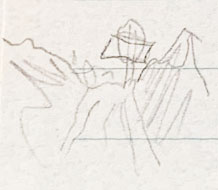
The road turns into this river A lady drives by and asks where a gas station is. We point to one of our gang, the only local. He/she points to a distant Amoco. Then the street changes to a river and the cars become boats. Ruby and I start to go down this river. I ask “is it safe?” It gets fast and fun and we finally reach the bottom — a deep sandy valley.
References: Amoco is a gas station.
Transformation: The reality is that there is a corridor of some sort with people moving on it. As we can see, it could be easily painted as cars on a road or boats on a river while preserving that same underlying reality.
-
The New Apartment 2001
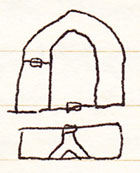
The continuous shape It began as the new apartment Buttercup and I moved to in a sunny, happy small city that I described as being near Oberlin. It had a very old-school rich feel with dark wood and high ceilings. There was a large central area with a surrounding horseshoe shape. The large central area was used every morning as a public breakfast area. . . .
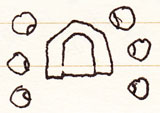
The shape with towers By the time I left the first room, the rounded outside area had become a walkway of stone surrounded on the outside not by walls but by grass and trees and it had six stone towers around it. Two were just opening their doors and I remarked, “Look, new rooms I didn’t know we had.” I saw they were selling film (or something like that).
Now the next transformations I don’t exactly recall, but while the shape remained, the center area was now water and the outside was walled and had rocks and greenery like a zoo. In the upper right of the horseshoe was this strange video arcade.
A Constant Shape: Written at the time: “Amazing and curious how a shape seems the most real thing and remains constant through so many different scenes. Almost as if it’s the shape of an amphitheater or astral viewing room upon which this is all being projected.”
-
Rolling Snowballs 2010
I followed the music and came to this charming summery village at the top of the mountain. There was a sunken area made of stone tiles with raised walls around it. People were drumming on huge drums on the far wall. Lots of people were watching, and some had brought their own large drums. It was a show of some sort. To the right, nearer the village, was a cluster of buildings with shops and tourist-type stuff, and a new performance was beginning there. It was a bunch of Japanese people dressed in these elaborate transformer costumes. They had truck parts, and at one point a few of them got down on their bellies and “transformed” to truck mode. It was very impressive.
But something about the layout of this sunken tile area reminded me of Starcraft 2, which I’m currently playing, and my perspective rose up to the 3/4 view like in the game and before long the scene was entirely a Starcraft 2 game. The sunken tile area was exactly the layout of some of the multiplayer maps, and soon I’m playing Zerg and training units.
References: StarCraft is a video game with a top-down perspective. Zerg are an alien species in that game.
Scene and Context Transformation: Did the sunken stone tile area simply remind me of Starcraft, or was Starcraft somehow suggesting its shape when I first arrived? I wish I remembered the transition more clearly, but the Starcraft version of the scene eventually took over completely. I didn’t appear to be on top of a mountain or near the tourist village, and none of the drummers or actors were anywhere around.
-
Protecting the Book 1997 • age 22
I went out the back and down the line of houses, which turned into a crenelated white bridge with a lake on one side and a cliff on the other. The cliff side had paths where the river had dipped way down. I explored this area for a time and then I met Brandon. It was great to see and speak with him. We started going back towards Buttercup’s house. . . . As we got deeper into the river trench, it was turning into Mario Land. He started finding stars and hidden places. I was curious, but didn’t watch.
Scene Transformation: First, while walking down the neighborhood street, the road turned into a crenelated white bridge over a lake and cliff.
Then the scene at the bottom of the cliff became Mario Land. I wish I had written more about how the transformation took place. But I clearly didn’t want this to become a video game dream and left.
-
The Interview 2016
Next there was a tour of the office. It was Christmastime. There were stacks of company-branded shirts here and there, meant to be given to interviewees. . . . But I noticed something. The scene was being overlaid with Halloween. Black and orange decorations appeared. There were black cat decorations. I knew this was being done as a test, but wanted to pretend I was being fooled. I spoke loudly. “Wow, this is great! It’s Halloween, with presents, and all these Halloween shirts! What a great idea!”
Holiday Switcheroo: This appears as a gradual change from Christmas decor to Halloween.
-
Neon Chakra Flowers 1997 • Middle of the night • age 23
Buttercup and I were moving up a level in Tank, to room 301. That was the top floor. All our best friends were over to help us move. . . . At first the new tenant of our old room seemed really weird, sitting against a wall, watching us move, but I stayed downstairs and talked with her. Her name was Kelly. As we were talking, the room was slowly changing into hers.
Creating Your Room: Kelly was moving into our old room, and it seems like Kelly was projecting her room around her into the new space.
This is how all these scene transformations take place — through our own changing projections. Our own projections are the first things we see. If we’re not projecting, we can see projections made by others. In this case, as I’ve moved out of this room, I’ve withdrawn my own projection and can see her projection shaping the room. I’m not sure it’s possible to know if other people are seeing my projections or their own without asking.
-
Memory Rooms and Exploding Dreamstuff 1997 • 6 AM • age 23
The light in the bathroom was on. I took off my clothes and got in the tub, furiously washing off the dirt and marshmallow. Buttercup, initially using the sink, came into the tub with me and laughed, accusing me of setting this all up, but I humorously dismissed it. While washing, my hand glanced against her butt underwater and she gave me this “nice try” look. Then it was a bed we were in, like a motel bedroom (transform!) and I remembered that we were going to end up together and reflected with pleased amusement on where we were now and how I could have new experiences at that point in our relationship!
Scene Change: Buttercup and I in the bathtub and it became a bed in a bedroom. Two people together in a thing was the essential shape of things. Perhaps I was momentarily awakened and the bed I was in became the new form of the dream.
When Moving to Higher or Lower Realms
-
Frequency Fall 1997 • age 22
Buttercup was with me. There was a great power nearby. Our thoughts, though innocent and fine, didn’t please it, and it cast this spell that lowered the frequency. I felt this mental nonphysical vibration which lowered my frequency. There was a pulsing and flashing and I felt both like I was shrinking and growing. It was a sort of reality scrolling. I think I could’ve followed the growing or shrinking sensation. In the end I felt smaller. We went outside to see how things had changed.
We found ourselves in this office by a swimming pool. It was a much more evil place than before. We’d stepped down in quality to an insane world where no one really communicated or listened to each other. Everyone was 90% projecting, closed in a tight sphere. I felt thin and weak and compressed by cold vacuous emptiness. . . . We were looking forward to seeing a hand statue we’d heard about but it wasn’t there. Instead we were greeted by this territorial guy who said we weren’t allowed to go outside. . . . He left and we decided to go outside anyways. It was “Oberlin” though it didn’t look a thing like it. It was unkempt under an foul overcast sky.
Dream Vibrations: This one is fascinating. The evil mind was the cause of this transition into a lower frequency realm. The perspective scroll, of shrinking and growing is like the focusing of a lens into different frequencies. Feeling smaller means I ended up in a lower frequency, which presses in harder on us. Our energy doesn’t go out from us as far. We are more separate.
This fits perfectly with the idea of people being closed in a tight sphere of their own thoughts, not communicating. This makes for an insane world.
-
There Be Whales Here! 1997 • age 23
I’d just seen two HUGE humpback whales leap way out of the water in a heart shape. I’m climbing down this slippery wet rocky hill of black stones. They leaped again as I started coming down. But the astral reality of going down took effect as the blue sky grayed and the whales next appeared with hideous disconnected green jaws with a few huge stained teeth sticking out.
Astral Layers: This is a great example of moving through astral frequencies. Most times, the transition is by walking down stairs or entering a sewer, or going through some sort of gateway, but here it was without any particular boundary. As I descended the hill, I moved lower down into the darker, creepier areas of the astral realm, and the scenery smoothly changed from bright and happy to an eerie lantern-in-the-fog version of the same thing. When I view the same ocean from even higher up, it’s even more beautiful.
-
Earth One 2005
Every moment is a joy on Earth One. We live on Earth Two. Earth Three is constant war. . . . Junior and I decide we’ll all go to Earth One. We find a long pole attached to the side of a building and get excited — that’s how we can cross over. We climb it and as we do, gravity shifts and reverses. After 15 feet or so, we’re seemingly climbing down toward the ground again along a pillar. We dismount onto Earth One. The joyous feeling of well-being returns.
References: Junior is a character on the TV show Reno 911.
Pole to Pillar: This is about the weirdest transition I’ve ever seen. By climbing upwards, we’ve ascended to a higher astral realm, which is evident by the happy feelings there. But why is it upside-down from the perspective we came from?
Note how the pole we’re ascending becomes a pillar we’re descending on Earth One — a transformation while retaining the same shape.
When Changing Floors
-
Gwen’s Birthday 2024 • 7:15 AM (1:45 later)
Buttercup, Bodhi, Gwen, and I were on a trip in Emma & Alfred’s RV, which was the size of a large house inside. . . . At some point it was Gwen’s birthday party, which took place on the top floor of the RV. . . . The top floor had gradually transformed into a huge Toys R Us, which was just the bottom floor of an even larger mall. . . . When I turned back to the rest of the store, it was more like a central plaza in a mall, and the shelves of toys were gone.
Ascending to Larger Floors: This begins in a large RV. Each time I go up a floor, I end up in a larger space. First, the upstairs floor of the RV expands into an entire Toys R Us, and that, in turn, is beneath an even larger mall.
It’s a general rule I’ve noticed that upon ascending levels, things become more spacious (because we become smaller), and as we descend, things become more tight and constricted. But in this scene there aren’t any of the emotional changes associated with moving to higher realms.
Towers — Vertically Repeated Rooms
A hyperspace tower is a room repeatedly stacked upon itself. As you go up, each one is smaller in size than the one below it. Each higher level may be the same room in a slightly higher frequency domain, meaning that it is closer to the now and has less expansion into space.
Chinese tower architecture seems to be a representation of this. An example of this is the Sun Pagoda.
but smaller and brighter each time
under this license
-
The Inflatable Water Park 1999 • age 25
I noticed the current was having trouble inflating so many water park rides at once, so I decided to focus on one. I unplugged the others and remaining one started growing really big. It grew into a huge courtyard with a castle, axe-throwing knights, children with LOTS of colored balloons (little thought-form bubbles), huge water park rides, games, and lots of people.
The hoses I’ve seen connected to thought form buildings — they conduct a current of energy/attention to the thought form to maintain its form or increase its size!
The castle on a hill with courtyards There was one point where . . . the children escaped from the courtyard with a ton of balloons and went down this hill into a larger courtyard. It became almost like a layer cake with the castle at the top, having larger and larger courtyards below it. It was on a hill (a bulge of astral attention).
Repeating Layers: The water park inflates to a courtyard around a castle, and then begins to repeat, with progressively larger courtyards appearing below the first. The castle at the top appears to become smaller. It becomes a hyperspace tower, getting smaller and smaller as you ascend.
-
The Dark Tower Tour 2000
Inside one of these two buildings, I had found my way to an unoccupied room with bunk beds and white comforters. There was an opening in the ceiling along the outside wall. I pulled myself up into a room that was almost exactly the same, but smaller. Then I went up again to an even smaller similar room. I had left my companions behind in the lower rooms, and there were only children in this room.
Hyperspace Tower Rooms: While in altered states, I’ve seen that towers in dreams can be the same room repeated vertically over and over, each slightly smaller than the one below. In fact, I saw the genesis of the Dark Tower this way! And here I am in a building near the Dark Tower, climbing up through this very kind of repeating tower room! There’s something to this!
Gradual Transformations
-
The Joined Trees 2024
Now we’re inside the tree passage. Wilson is there, and a few others, including my Aunt Abbey. The passage is slowly transforming, though. Wilson says “Look, there’s a door here.” and I turn and there’s a huge door in the center of the passage facing the house. I can see the house through it. It definitely wasn’t there before. I open it and it seems like the owners had built an access into this tree passage. But as I look around the tree passage some more, it’s transforming more and more into the inside of a camper. There’s a table, and a tiny kitchen, and soon there’s no trace of it ever being a passageway inside of trees. But that idea is still in my head. I exit the camper and see the giant trees growing over and around it. The camper has wheels, and so I figure the trees must not be attached to the ground. Can the whole camper with the huge trees on it be pulled down the highway?
I’m messing around outside the camper and it begins to roll backwards down a slight hill. It doesn’t go far before it stops suddenly, but the sudden stop affects Abbey, who is not even inside it anymore, but further down the hill (she might be “inside” the tree passage, but from outside the much smaller camper, she appears outside). She’s knocked off her feet and lands flat on her back. I yell “Abbey!” I’m thinking how old she is and how bad that would be for her, but it must occur to me that this isn’t physical because I don’t pursue that line of thought. She gets up.
A Merging of Two Scenes: Now instead of an overlay on the near realm, The tree passageway starts taking the form of a camper! These two ideas merge together into a strange scene. I wonder where the idea of a camper came from — it wasn’t from me. Perhaps Abbey was in a camper when she joined my dream. I then try to make sense of this tree-camper in physical terms.
When the camper begins to roll and then stops suddenly, Abbey, who is still connected to the camper, takes a tumble, as the camper is her reference point.
Expanding Around Us
New scenes can expand from small points until they surround us and become our new environment. This is usually perceived in physical terms as approaching the new scene. But when in an enclosed environment like a house, this makes less sense than the scene before us simply expanding out around us.
This is equivalent to a thought form expanding or our descending into a rote.
-
The Inflatable Water Park 1999 • age 25
I hooked up a whole bunch at once and they all began to slowly inflate. I was inflating a water park right there in Blaine House! They were spreading out across the kitchen, pool room, and dining room. At a certain point, I noticed the current was having trouble inflating so many water park rides at once, so I decided to focus on one. I unplugged the others and remaining one started growing really big. It grew into a huge courtyard with a castle, axe-throwing knights, children with LOTS of colored balloons (little thought-form bubbles), huge water park rides, games, and lots of people.
The castle on a hill with courtyards There was one point where I was pursued by a head-lopping knight and another scene where the children escaped from the courtyard with a ton of balloons and went down this hill into a larger courtyard. It became almost like a layer cake with the castle at the top, having larger and larger courtyards below it. It was on a hill (a bulge of astral attention).
Transition: This transition is strange. These thought forms are being inflated within Blaine House but then Blaine House is no longer a part of the scene when they get big enough. It’s like an entirely new scene is growing up around me. Instead of a ceiling above, it becomes sky.
It’s almost as if a rote is rising up around me.
Following Rationalizations
These scene transformations follow a rationalization, giving that rationalization a more natural setting.
It may seem odd that while we can rationalize fast movement to calm the waking mind, the dramatic change of scenes that can follow aren’t enough to wake it up. It makes sense as low-context focus following. When the rationalization (say, a surfboard) becomes my primary focus, the scene changing to match it (a beach) only reinforces the rationalization. This is because once I’ve focused on the surfboard, the previous scene barely registers and is quickly forgotten.
-
Windsurfing 1997 • age 23
I was at the Blaine Soccer Complex and it was raining. I had been given a windsurfing board and was having a great time with it. I was a natural, shooting around and slipping and jumping. I left it for a minute to pursue something soccer-related but went back to it soon. First I got the wrong one, then found mine buried in the mud. The scene changed before long and it was my whole family at a sunny ocean beach. We windsurfed and it was fun!
A Better Fit: Once my focus switched from soccer to windsurfing, the scene changed to a more appropriate one given that focus — a beach scene. It’s unusual to see a change of weather coming with it, from rainy to sunny. But that did fit the playful mood that the dream had taken on.
-
Breaking Free 1997 • age 22
I’m part of this big class group playing soccer in a gymnasium. The floor eventually changes to water, and everyone is on rafts.
Transformations: The change to water probably was a rationalization of smooth floating movement. Without our need to take steps, we naturally glide, and when I noticed that, the movement made more sense as gliding across the water on rafts.
-
Hazel’s Wedding 2009
I’m the only groomsman at Hazel’s wedding. There are no bridesmaids either. Just me. It’s in southwest Minnesota. I’m following them around for the ceremony. They get in position, with me next to her beefy bearded husband. Everything’s rocking a little and I stumble. The husband turns around and yells at me, “Why did you push me?” I see us on a boat — the cause of the rocking.
Rationalization: I’m not sure what the rocking was, but both Hazel’s husband and I felt it, and I rationalized it as a boat, which it clearly wasn’t because as soon as it wasn’t needed anymore, the scene returned to being the building it was before.
Accompanying Character Transformations
The following dreams show the true flexibility of the mind, and reveal how easily and entirely the characters and surroundings can change while the essential story continues.
This is the “Roaming Context” I speak of from marijuana experiences. The story continues while the forms shift from one context to the next to the next. Dreams like this imply a shorter context than usual, a “higher mind”, closer to the formless. For more, see How Context Determines Meaning.
-
Riding in Jimmy the Whale
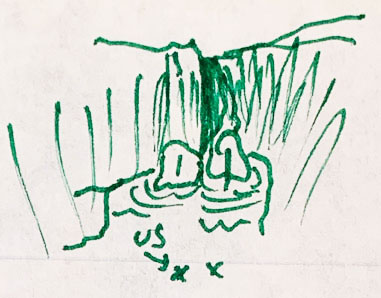
Elephants in the river gorge I’m in the wilderness with a guide. A pack of large elephants stampedes over us, then slows down. We follow them into a narrow gorge with a river. The gorge continues to narrow, and then the scene changes dramatically. Now the walls of the gorge are on all sides, but it’s the inside of a whale, and all the elephants are people. My guide friend tells me: “This is how the elephants travel this part of the river.” I get nervous. It’s really gross inside, like the inside of a throat. . . . Movement slows, and people are shifting. The guide explains that the whale stopped because he hit his head on some rock at the bottom. Suddenly a chant rises up: “Go Jimmy! Go Jimmy! Go Jimmy!” This kid with a boom box stands up. Rocking music sounds, and the whale starts moving really fast. I sense happiness from it. Then I hang on really tight as we jump out of the water. Suddenly we’re on a city street. Everyone else falls out. Only I hang on and go for a great ride as the whale jumps and flips through the street. Finally it’s over. I’m really happy. I ask the name of the guide — it’s “Jay”. The whale I seem to know as a personal friend. Strange, huh?
Transformations: Elephants change into people, and a wet, narrow gorge turns into the inside of a whale. To the guide this is just how it works here. We exit the water and the whale onto a city street.
-
Lord of the Rings 1997 • age 22
I was Gandalf. There was to be a battle at the main fortress, but we received a message to fight first at this other place and so we went. There was a walled path and I kept peeking my head out and dodging arrows. There were a number of orc clans there, each with different symbols. We had a lot of different species on our side, including elves and various strange creatures, but we were far outnumbered. We retreated to our castle, which was Blaine House and my room.

The Other World bird I rode upon that red Other World bird and at the same time I was a kid playing with toys. They stormed the castle and I escaped on my bird. They sent a similar bird after me and I finally escaped in the mall. Then I was just me, flying about, flapping my wings, maintaining myself just above the ground. I was working on flying when Cannonball’s brother came to capture me. I became Cannonball and I finally blasted to get away.
Changing Context, Changing Characters: As I transitioned to my room in the house I grew up on, the characters transitioned into toys I played with at the time. You can see the source experience — me playing with the red Other World bird, and at the same time I’m flying upon it (note than Gandalf once flew upon a bird like that). The form of the characters was shaped by the ever-shifting context of the dream.
It continued when I escaped to the mall. For a moment, the context returned to my waking life and I become myself practicing flying. But then the context turned into that of Marvel comics, likely because the mall is where comics shops are. A flying character I like? Well, it has to be Cannonball, of course.
-
The Whirlpool 1997 • age 23
Someone said “Hey, you got your wish. We’re heading towards the whirlpool!” As we neared it I saw how violent and ominous it seemed. Now I hoped too late to avoid it. My house, full of people, plunged down into it and my last breath of air got mixed with water as the house was sucked under. The underwater portion was impossibly long and my breath barely held but finally I washed out on a beautiful cascading waterfall that was broken by rocky landings.
After realizing that I was okay, I searched for other survivors. They all appeared now as cassettes, videos, and books. I tried to play them. Some worked right away, some worked after a bang or two, and others didn’t at all. I divided them into piles based on whether they worked or not, one pile becoming very loud with all its music and sound. Had everyone been transformed in this new area? I spent a while searching, then decided to go to the next area up.
Equivalence: My friends were transformed to recorded media on the other side of the whirlpool, which acts as a gateway. Could that mean they were all just thought-form creations of mine, and this was revealing that fact? Was I expecting several things that were sources of information, and they could have as easily been people as recorded media? How odd that they were playing music and sound as I found them!
-
Playing the Girl 1997 • age 23
They came after me and I ran. I knew this had to happen. They chased me into a barn and were beating me up but I felt no pain. My will pushed through and I shouted, explaining everything, and eventually I was in control of the plot and the group again.
It was I think at this point the dark barn turned into the space station. The plot continued as a story with aliens. The “others” in this dream were the gang of kids in the previous one. I jumped from one body to another.
Scene Change: The scene changes and it’s an entirely different place. The characters have changed form, too, but the same story continues.
The Shape of Dreams
Hmm.. there’s not much left of this section. It’s important, but too vague to keep?
See also While Retaining The Same Shape.
The Tower Effect
The “Tower Effect” is a shape that dreams can take more than a specific place. Along with the shape is a feeling, and a difficult challenge to overcome. I’m typically there around 3-4 AM every night. The actual form of The Tower can be anything.
REMOVED
-
The Tower Effect 1996 • 3AM • age 22
Tonight’s disguise for The Tower is Irene’s. It’s the tower alright, but alive and in business. Bruce’s teaching me and some girl how to close.
References: Irene's a cafe in Oberlin. Bruce was my boss.
The Tower: Sometimes I think of the tower as an effect that happens to early night dreams. Notice again the time is 3 AM. It can take on so many manifestations, yet the feel is the same, and the effects on experience are the same.
-
Thunderstorms and the Shape of Dreams 1996 • age 22
[I dreamed of Little Debbie House and Banana House and landlords making shitty living places for students.] . . . the feel of this dream was like a shape, a sphere, feeling near the Tower but without its actual presence.. I wish I remembered more. A vast feeling.
References: Banana House and Little Debbie House are off-campus houses at Oberlin.
Tower Effects: This is more evidence that the Tower is an effect as much as a place. A shape that dreams conform to. It’s hard to describe.
The Cave Shape
The Room Shape
This is usually the bedroom where you’re sleeping.
See Overlays.
Our Body Shape
Our dreams may be painted onto the shape of our bed, bedroom, blankets, and even our sleeping bodies. Sometimes we become smaller in relation to these, making them into huge landscapes around us.
-
Lucidly Ending a Bad Dream 1997 • age 23
This dream happened while we were sleeping in the car while parked at a Texaco, me leaning back and Buttercup laying across me. The dream, somehow, took that very shape, like the buildings were modeled after us.
The Shape of Dreams: I’ve gotten this sense at several times, where memories are stored with certain body positions, where dream places have definite shapes, related to body positions or the “shape” of various kinds of thoughts.
Changes in Scale and Perspective
In the astral, scale is easily changed. You can zoom in or zoom out to any degree relative to your surroundings. When you enter a rote, you shrink down into it, then expand back out of it when you exit. This changing of scale can be accomplished at any time.
Our “location” at any given time is due to what we’ve expanded out around us with our attention, whether it is a subjective memory or objective place.
This natural scaling of perspective is why toddlers will sometimes try to sit in doll-sized chairs. In the astral, we’d naturally scale to fit.
-
Throwing Tiny Rocks 1987 • age 13
A little bit later, the hockey game stops, and some paramedics come out and put me on a stretcher. They put two strange white boxes in the middle of the rink and put a little display next to me. I ask what’s happening. The coach says that it’s a celebration of some sort for me. Little white figures start moving around on the display. Then it kind of changes from a display to real life. I’m trapped in this big building with lots of windows. I’m throwing rocks at the city I’m overlooking and breaking glass things. I hit a big building frame, and it falls towards us and knocks us over.
Changing Size and Perspective: I focus in on the moving figures in the display and that brings me down to their size. I don’t know why I’m trapped in a building at this point, but it’s likely the two white boxes become the city buildings I’m overlooking and throwing rocks at.
-
Volcano Survival 1998 • age 23
I was sitting in front of a board-game featuring a volcanic island. I hit two fire marbles together and a big flaming meteor descended (from the marbles or me) into the volcano. I hit the stones more rapidly together to get the volcano to erupt and it did. My concern for a group of little people on the rocks brought me down into the scene and we built defenses. It was all play — a game.
Gateways In: Becoming concerned with the little board-game people sucked me into their world where I helped them to defend themselves from the eruption I caused.
-
The Whale-Chasing Machine 1997 • age 23
I’m watching humpback whales flee in terror from something. They circle in front of this wall of stone, then smash into it. They lick the algae to see if there’s a way through. Beyond the wall is a black area on the ocean floor. A cheetah is running by on the top of the wall (underwater!). A whale bumps the wall, almost hitting the cheetah, and something from the black area is knocked loose and floats to the surface. It’s a microbe or disease.
Suddenly the sea surface is a tabletop with myself and other students standing around it.
Zooming Out: After the demonstration within the model, we zoom back out to ourselves sitting around the table looking down at it.
-
A Miscalculation of Scale
Miniature tanks (they’d fit in the palm of your hand) are coming from the ditch towards the house. Their cannons do hardly any damage. People in our house are shooting arrows at them. It’s a pointless battle. I go out and start stomping them. Tiny ships are coming overland too. I’m crushing them all. There’s this one ultra-kill weapon on the top of the slope. It fires a large blast towards the house, and I have trouble ripping it apart.
Then I match scale with the approaching army. I’m being chased in the field (which is a desert now) by a bunch of soldiers.
Perspective and Size Changes: The attackers are miniature, but after stomping them for a while, I get fully engaged and shrink down to match their scale.
-
Fantastic Solstice 1997 • age 23
We entered the tower. I had to find the secret door and say specific words so it would open. I tried the whole first floor, disbelieving that words could do it. This map of a side view of the tower appeared in my head and it indicated the third floor. The tower was like a thick, substantial Space Needle. While looking at the map, I watched us as little characters speed up one side of the tower and down the other.
Now the map view became real, and from that perspective, we were giants standing before the tower. The tower started looking scraggly. As giants we peeled back layers of the tower like skins. This revealed a blue skin, then a white skin, then a rotten, bug-infested wooden interior. The tower fell over. I didn’t want to touch it but this was a test and I had to stand it up. I did this and sizes suddenly began to return to normal.
References: The Space Needle is a tower in Seattle.
Perspective Zoom!: This is a great example of how easily scale can change. At first I’m searching within the tower, but once I’m looking at the map of it, I see the whole tower in front of me. It was easy to walk into the perspective from the map and find myself as big as as the tower, standing next to it.
-
Friend of the Dalai Lama 1998 • age 23
Spherical people There was a big outdoor festival. There was a scene with someone stealing balloons. I flew up high to this balloon cloud and played with 4-6 perfectly spherical people. What a strange thing! I felt I was up in space with them but I was only as high as the bleachers. Weird!
Size Changes Accompanying Flying: I wonder if the feeling that I was soaring way up into the sky but only got as high as the bleachers was due to a change in my size. If I was tiny, it would feel like vast motion but I wouldn’t get very far.
-
The Flipped Ship 2025
I’m on a cruise ship at sea. I remember Buttercup and Gwen being there. At one point I was swimming deep underneath the ship, my consciousness massively enlarged to include the ship and the sea beneath. I found some mud-covered treasure of some sort that I wanted to take with me, and, knowing it wouldn’t pass customs, tried to throw it up onto the ship. It worked on the third try, when I threw it up with my massive arms up onto both sides of the ship. The mud-balls landed midship and I went up to get them.
I had to return to normal size and pass through the ship’s customs to get back onboard, which took a minute. . . . I then found myself in one side of a two-part room, roughly in the shape of goggles, and it shifted forward, turned, and the part I was in tipped off the front of the ship and fell, hanging by a thick cord from the other one. Then, the other went off the side, and my consciousness massively enlarged again. The two small chambers were now dangling at the end of a massive projected arm coming off the ship. My room, at the bottom, was swinging back and forth somewhat. It was thrilling. . . . The two chambers switched orientation a few times, swinging out above the sea.
Giant-Sized: My changes in scale were a result of zooming out to get a fuller view. To explore the ocean floor, a wide view is beneficial, so my consciousness expanded. It contracted to normal size once I returned to the ship. Then it again expanded when I swinging out high above the sea. Note how I’m both massively expanded, watching myself from outside, but also focused within my swinging body, feeling the thrilling motion.
Merging Scenes
Any time our overall attention shifts to something new or we receive a communication from someone, we may end up with multiple scenes around us. Our waking mind often assembles these scenes into something that makes sense within physical space. A lot of strange dream environments are a result of this spatial rationalization. Different scenes appear and we try to place them within our current physical environment.
Merging In Communications
When we receive a rote or telepathic communication with imagery, we sometimes merge that imagery in with our current environment as a spatial rationalization. This happens when we split our focus more evenly between the environment and communication.
-
Indraheen 2024
I was sitting at a table with several other people in what seemed like an outdoor cafe. The table had breakfast food on it, and we were listening to someone talk about and show us something interesting in a tan/golden pool of water. The pool was likely within a rote and didn’t fit in the scene, really, so I mentally placed it to the side of the table.
Merging Images: The person talking was sharing an image of the golden pool of water, and I got confused and tried to fit it spatially into the environment around me.
-
The Old Forest 2026 • 5:30 AM
I was in my run-down castle-like home in the old forest with the giant trees and no underbrush. I was talking mentally with someone who wasn’t present, and they mentioned that the huge trees around it could fall. . . . Now I was leaving this area in a rationalized car on the winding road out. Just after exiting the old forest into a small town, I turned around to see a tree tip and fall, crushing the flat solitary wall of a ruin that was the same style as my house. Was it my house? No, this was by the edge of the forest. But then I saw a fire blazing up and to the right of it. . . . Was my house maybe there after all, but not visible? I couldn’t make sense of the scene. . . . [I tell a police officer]
[The police officer] had trouble finding any fire.
Scenes from Behind: I turn around and see a tree fall — a fear brought up earlier by an unknown communicator. Maybe this was a further visual communication from them. Then the image of the blazing fire appears “up and to the right” of the ruin. It’s not integrated into the scene, and appears without explanation. Does it also come from the unknown communicator?
-
The Crumbling Resort 2011
Buttercup and I are staying in a resort in an area like Lake Tahoe. She sets up this adventure of sorts involving a cave and then parachuting off this cliff over the sea. It’s part of a flash mob thing. I’m amazed she would do something so daring. Then, back in our room, I hear this guy yelling really loud. I look out the window. Down below there’s this cave with a river and everyone’s dressed like pirates. This is an attempt to get more people to join the parachuting.
Without meaning to, I merged the resort and the cliff parachuting scene, resulting in the resort appearing to be on the cliff’s edge. Seeing this, I wondered “shouldn’t it fall over backwards down the cliff face?” And then it does.
Resort Plus Cliff: These two scenes — the resort and the cliff parachuting are not spatially related at first. When I receive an open call from the pirate gathering, I “look out the window”, and see his scene at the bottom of a cliff. My mind stitches the two scenes together spatially, placing the resort at the top of the cliff. Upon seeing this, I form an expectation which then naturally takes place.
Interaction Between Scenes
When two disparate scenes begin to come together, the objects in one become different objects in the other. This is like the beginning of double context, or the first stage of two scenes merging into one.
-
Hyperspace Reunion 2000 • age 25
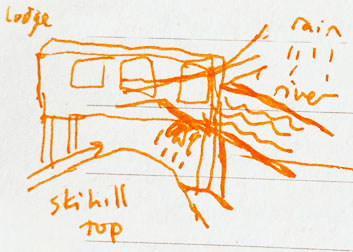
Juxtaposed scenes — the top of a mountain and the lodge I next remember being at the top of the ski hill, a recent regular spot in dreams. I’m there with Buttercup, some friends, and Isobel. We were at the top, but there was another scene in the air above the top of the ski hill. In that second scene, there was a wooden lodge at the ground level of another mountain. In the upper scene it was summer, and raining hard. There was a river there, above us, spilling water over the edges of its scene into our scene as a mix of water and snow. It was a composite scene, a crossing between worlds. The astral matter from one crosses to the other, but with the correct (appropriate) transformation — rain to snow. Wow!
References: Isobel was our new puppy.
Crossing Contexts: These two disparate scenes are very loosely connected. Only the flow of water connects them, and as it passes from one to the other, it takes on a form more appropriate to that context. This is a general rule of objects and people appearing within different contexts.
I wonder if this was a boundary between planes. In all of Swedenborg’s descriptions of the spiritual worlds, there are gradual changes in landscape between them, but in these less lucid dreams, I can find some jarring positioning of different scenes.
Double Context
Not only can a dream change its context while staying on the same track, but it can have multiple contexts at the same time.
Double context can continue as long as our attention is split between the two contexts, but typically it happens as part of a gradual change of scene, starting with one point of correspondence, then adding another and another until the new scene is dominant. During the transition, things are seen in both contexts at the same time.
Double context is a strange thing. It’s simply accepted. It may be the case that two different layers of self are experiencing the same objective thing, but projecting different forms onto it. These layers could be the dream self and waking self, our dream self observing from different contexts, our waking self at different ages, or even contributions from a past life self.
-
TV Road 1997 • age 23
Raven is my girlfriend as this begins. We were on our way to a youth group event. We’re driving around this dark neighborhood AND . . . simultaneously we’re fast-traveling through a mall. The powered-off TVs are houses and the car is a thought form. We come across a video billboard (it’s simply a large TV in the mall). I get enthralled watching this hilarious Popeye sketch in The Best of Saturday Night Live. Raven gets mad waiting for me and I decide to just forget the trip. I look back at the TV, which has this woman in a hot tub, and I travel into the scene. This is rationalized by me “remembering” that I traveled there by bus.
So I’m in the room with the hot tub and I take it to be the youth group event we’d been traveling to. There’s a cat in the middle of the tub half drowning and half repeatedly scratching like a robot. The woman is pretending she’ll take off her bikini top to tease the viewers. The joke is that whenever I try to get to her, there’s the cat’s paw in the way. Then the filming is over. [I attempt to interact with her] Now the tub is a bed, and the girl is shifting between Megan and Avery.
Awake: A single image can become anything via shifts in context. It can begin as random hypnagogic patterns or even solid objects. A shift in context, in how you see it, can completely alter it. Rice becomes sumo wrestlers. Your car becomes a village of people. Believe me, it can be anything, even action from a static image. The new scene is transformed through and effected by the original at all times.
Two Contexts: In this dream I’m repeatedly experiencing double context. Everything I see is something specific from each context. I’m in a mall and believe I’m in a neighborhood.
It even continues after I pass through the TV/billboard, where I arrive at a movie set but believe I’ve arrived at the youth group retreat. The woman there begins in a hot tub but it changes to a bed, and then she shifts back and forth between two entirely different people.
What you believe is so much more powerful than what you experience. While high or in the dream state, if you expect me to hand you a baby, and I hand you a microwave, you’d somehow find a way to see it as a baby — maybe a strange baby — but a baby nonetheless. The sensory input matters far less than the belief.
-
Art Class, Day 5 1999 • 5 AM • age 25
Buttercup and I were walking along this street with no curb, only a steep gully on both sides. We both thought it seemed dangerous. I was leading and every time a car came we had to step off the road into the gully and then watch it pass before continuing. There was a brick building to the side. I had an odd feeling this was the hill by the gas meters at Blaine House. We then had to climb over this large rock and dirt boulder but people had made a path over it so it was easy. On the other side was a very large college courtyard with green grass, scattered trees, and students all over. The wall might have been the tall white trapezoid by the garage at Blaine House! Anyways, there’s a continuity break. . . . Then I’m in art class, superimposed over the basement of Blaine House. It has the concrete floor, but it’s much neater.
Dual Location: It’s odd how this scene is both a street near a busy college and Blaine House. The two are nothing at all alike and yet somehow in my description I find points where the two correspond. The idea that it’s Blaine House lays over the previous scene somewhat, and the break in continuity switches the scenery completely over to Blaine House, while at the same time being the school I was approaching.
-
Thought Form Games at Arcology Hill Stadium 1996 • age 22
I made it to the top of the hill, near the gate for the arena’s fans. I met some selfish rich lady that was also a cat. She wanted me to pay for something for her, but I let some other poor sucker do it. At one point she dug her claws into my hands.
I also ran around being a cat. There were lots of stone steps and hallways. I found a tiny cat in a small hole in the steps. It was there with three white cats; a mother, a young cat, and a newborn, none of which would open their eyes. To clean the young ones, the mother ate them and then coughed them up. I thought these cats were tricks devised by Drax, the Merlin of the dream.
We’re Cats AND People: What a strange thing, to run into a cat that is also a rich lady (an aristocat?). I didn’t think this was weird. After that I ran around being a cat as well, and ran into other cats that were just cats.
-
The Mistake 1997 • age 23
Then I crashed the plane or we jumped out. We fell rapidly to the ocean. We swam to shore and I found a boat. I began to paddle it with the girl in the back. Vortigem H was floating toward us across the waves, above the water and then he was in the boat. Here I told him about the plane crash, but I remembered it as huge taut ropes across the bay which we were walking on and I just lost my balance. So we have a layered memory there. It’s stacked and seems parallel or equivalent from a different perspective.
Double Context: The true dream event is that I was flying the girl home and then landed in the sea. The first imagined context (rationalization) was that I was flying in a plane and crashed it. When retelling the story, the essence of it was the same — I was up high and fell — but this time it was walking on the taut ropes and lost my balance.
Overlays
Due to Near Realm Perceptions
While in the dream state, our astral body sometimes moves about the physical, going to habitual places. It occasionally becomes aware there, even in the midst of an entirely different dream experience. When that happens, its perception of its near realm environment will merge with the scenery of the dream. In my experience, this most often happens in terms of changing the spatial aspect and scale of the dream experience to match the physical one.
But isn’t our astral body there in the dream? As strange as it may seem, we can form multiple astral bodies. Consider how we may pass through a gateway, fall into a reverie, or enter a rote. We can project a body into the new scene we’re in, and when we pass through the next gateway, we generate a body within that scene as well.
Starting From the Near Realm
Overlays are fascinating. When our focus begins in the near realm, the astral scene can be attached to various entry or exit points in the physical location.
This is what makes the classic storybook “Where the Wild Things Are” famous. In four images, Max’s bedroom transforms (and expands) into a dream world.

-
Hanging Out 2020 • 7 AM
I’m hanging out with a group of two girls and three other guys. We’re all friends, very comfortable with each other. We’re in a large white room with warm golden light and tall open windows. In one corner, the walls came in to form a rectangular platform, about half as tall as the room (as if to make space for a room on the other side). There is a rumpled pile of white towels with black smudges in the middle of the floor. Someone asks what game we should play next. I’m not entirely sure how this starts, but the towels become a rolling snowy slope and at once expands to the size of the whole room — with us shrinking in proportion to make it a large mountainside. The towel-like nature of the landscape makes unusual rolls in the hillside. I feel that even though we can no longer see the main room, the invisible rectangular walls of it define the space.
We play a game of climbing up and sliding down the snowy slopes, enjoying ourselves and laughing. Then we climb up the slope, up a short cliffside of dark rock, and onto the platform area of the room. The platform is now like a balcony overlooking the mountains. It has a white balustrade.
Starting from the Astral
If we’re already within the dream when the near realm perception begins, the dream environment often has to undergo some wild changes to make sense of the two different perceptual streams. The existing dream surroundings take on the shape limitations of the physical room our astral body is in, sometimes with connecting hallways to nearby rooms. This sometimes requires changes in scale.
In this case, we’re starting from the dream, and merging it into physical constraints.
-
Astral Party 1999 • age 25
I dreamed that we moved to Oberlin. We were on the second floor, as is actually the case. It was night and people were going by outside our window looking for parties. Buttercup’s sister came by and crawled up the wall to the second story window, then talked and left. Then a crazy lady on her way somewhere came by and we told her to leave. Then this mussed-hair bleached-blonde fellah came in for a while, then left, walking about a story off the ground. Then all these people started arriving. They came in through our open front door, a balcony which appeared outside the window, and another open door leading to the hallway. Soon it was packed, like an Oberlin party. . . . Upon waking, the “Oberlin house” felt much like it was this one.
An Oberlin Overlay: My dream of moving to Oberlin is revealed as taking place in the near-realm version of our 2nd story apartment. Notice how people deal with our second-story apartment. One guys leaves and continues walking a story off the ground. Fiona comes to visit and climbs up the wall to our window. Others walked up to a non-existent balcony on our second-story window.
-
The Green Dragon of Sauron 2004
I was living through a grander and brighter retelling of The Return of the King. . . . [Our heroes] are mounting a hill and crossing a membrane — a cave through a mountain pass. . . . [Aragorn, Gimli, and Legolas] turn, ride to the right, and flee through a different membrane into a new area — a sudden wall of mountains rises up with a cave tunnel leading into another area. . . . They emerge into a large circular area, walled by mountains. There are openings between the membrane walls of different areas, here represented by short cave tunnels . . . [we begin to battle a green dragon]
At this point a strange transformation began to come over the dream. The bright tree-filled grassy mountaintop area began a slow transformation to a room in an unfamiliar house which I later thought of as my own. This of course led to all sorts of inconsistencies in size. The first change was that there was a ceiling, a white ceiling which in the mountaintop was a layer of clouds. The dragon was above it, and would swoop down through it from time to time to attack. I was fully inhabiting Aragorn now. We stayed near the throne of bone. There was a couple of barrels full of swords and other things. Legolas had been shooting arrows at the dragon to no avail. . . . Legolas used [the staff], and sent a purple stream into the clouds. Just before the clouds, it hit a previously invisible grid (the ceiling) and lit up a purple area. We realized that if the dragon were above it, we could see it light up in orange and yellow instead of purple. Also, the closer we were to the clouds, the larger an area we’d light up. I took some swords, which were solid unadorned metal, like this pewter sword I have which is about 2 inches long. The hilt was continuous with the blade. Now Legolas would scan the clouds/ceiling with the staff and when we saw the orange/yellow of the dragon, I’d hurtle a sword, spinning, into the ceiling. It always pierced and stuck. Now some size issues: we were slowly becoming the size of the giant throne. When the mountaintop finished becoming a room, we were the size of people in a room. From that perspective, the dragon was now a weasel-sized thing above the ceiling.
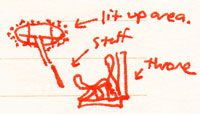
The throne of bone and staff So after a time I had hit the dragon with two two-inch pewter swords. And then it disappeared and we got really nervous. Our surroundings had transformed completely into a room now, but at this point was like a room in a dungeon. It had cinder-block walls and was lit by torch light. . . . So then we went back to hunting in the ceiling. The light changes to natural light. The ceiling turns white. It appears like a room in a house again, rather than a room in a dungeon.
Overlaid on the Physical: We begin with the shape of rooms, except it’s outdoors. Instead of walls, each room is surrounded by tall mountains, and the doors are caves in the mountains leading to the next open area (room).
As we become settled in a specific area, we see three transformations — first from the mountaintop to a room in my house, then quickly to a dungeon room, then back to my house. The first is the biggest and most revealing, as it has an enormous size and context change. The clouds became the ceiling, the mountains became the walls, and we gradually grew in size. The dragon remained the same size, making it the size of a weasel relative to us, and the swords also remained the same relative size to the dragon, making them take on the size and shape of the closest thing in my mind — the 2 inch pewter sword I kept on my desk as a kid.
The change to the dungeon scene included a rare change in lighting, as it was lit by torches and not daylight. Once this scene was over, it returned to the room in my house as before. After killing the dragon, I need an escape route, so I run out of the doorway of the bedroom to the office down the hall from the bedroom, grab a camera, and then I follow the hallway back to my bedroom, where the final scene plays out.
This whole thing was set in my bedroom, with changing set decorations and size perspective. The “membranes” were the walls of the room.
The initial scene change from the mountains to the room is the kind of slow environmental transition that happens in “Double Context”.
-
The Destruction of Blaine House 2023
I spent a while playing this soccer-like game with the kids. We were in the woods on the other side of the driveway at Blaine House. It was fast-paced and the ball was smaller than a soccer ball. The trees and plants acted as barriers — like we were playing it across different rooms with openings between them.
Outside Inside: Here’s a casual example of the structure of the house laid out on an outside forest scene. Likely we were playing a game with a ball in our near-realm house while my Dream Self imagined itself in the woods outside Blaine House. The two realities merged and the woods overlaid the boundaries of the rooms in our house.
-
Bedroom Soccer 2023 • 7:30 AM
I’m at Bodhi’s soccer game, sitting on the sidelines, watching. Each team has 7-11 players on the field. I look around and it’s a big green area, with some rolling hills and trees. . . . At this point my wake-up alarm goes off. I wake up and set it for 13 minutes, then I go right back to sleep.
The effect of this on my dream is that I’m back watching the soccer game, except the entire soccer field is now encased in the space of an invisible room — my bedroom. The green grass and hills continue beyond it, but everything on the field is bounded by this room and much reduced in size. There’s a bed along the side of the field. At first, it’s blocking the far half of the field. But as I look around, trying to figure this out, I find the bed is then to my right. Now there are two identical beds. They’re about the size of my bed — queen size, but with the pink & yellow patterned sheets of my childhood.
There’s not enough room for the full soccer game. It’s Bodhi and another kid in blue playing against two much younger kids in pink. Their uniforms seem more like fuzzy onesies. Bodhi slams a goal home, and I watch him take the ball to the center line and start it up again, scoring easily against the younger kids. I wonder what the score is, and I look at my phone. It’s 12-13. That didn’t seem right, considering the teams. I wonder where the other players went and see them standing along the sidelines at or outside the boundaries of the room, talking amongst themselves, uninterested in the game. . . . This game seems silly, and I feel tired. I walk over to the bed on the far side of the room and get in. There’s another little girl napping in there, and I crawl in to the center of the bed. For a moment I wonder if this is something I shouldn’t do — getting into a bed when there’s a little girl sleeping there.. but I stay and snooze.
Then I remember leaving the soccer field and going down a road. This is in the direction of the hallway outside my bedroom door.
Bedroom Soccer: This is fascinating. The interruption merges the shape of my bedroom with the scenery in the dream. The soccer field shrinks down, becoming crowded with beds in it. Only a few players remain, the others moving to the periphery. This raises many questions.
How could my waking up and pulling my room into the scene affect these soccer players? Unless most of them were thought form projections. Maybe there only ever were four kids playing soccer. That seems the most likely.
The room was oddly both room-sized AND field-sized.. when I saw them standing around the edges of the field, it was more the field-sized view.
But an argument for my bed appearing to other people is that a little girl from the scene had crawled into it. I didn’t recognize her, and Gwen had left the bed already. Though I certainly could have imagined her there.
-
Bedroom Cleanup 2024
I was walking across a grassy field with a guy that looked like Manville Goldblum. I was a coach and had a bunch of soccer videos made by my players, though I didn’t see them. Actually, I think they appeared like rolls of colored wrapping paper. I set them down on my childhood bed from my room in Blaine House. It was up against the wall. So once again a field of grass had become bounded in space by my childhood bedroom in Blaine House. I feel like the bed appeared because I wanted a place to set down the videos. The bed was invisible at first, made of the depth field but looking like the grass behind it, shaped spatially into the form of a bed. As I focused on it, it took on the proper colors, and the scene of the field faded into my bedroom. Again, this was the bed with the pink and yellow cover from my early childhood.
References: Manville Goldblum is an actor.
Grassy Field Overlay: Once again, just like in “Bedroom Soccer”, a grassy field becomes bounded spatially by my early childhood bedroom in Blaine House.
-
Indoor Soccer and Sexy Games 2024
I arrive late for a soccer game. I get onto the field, playing offense. . . . The game goes on a little longer, both teams crowded into their goal box, us on permanent offense, them on permanent defense. The field now has invisible pillars in it. The game is crowded into a room-sized part of the field. It’s like “Bedroom Soccer” in that the field’s space is constrained by the size of a room with pillars in it. At any rate, I asked and the final score was 2-2. The team dispersed beyond the invisible bounds of the room field and across the grass to our cars.
Incoming Overlay: This shows the gradual imposition of an overlay on a scene. I must have been slowly becoming conscious of the near-realm room I was in (though I can’t explain the pillars — maybe the bed posts?).
-
The Joined Trees 2024
I’m in the back yard of this house. There are a few huge trees right behind the house. They’re massive, gray, and old, with several dead branches near the ground. . . . I walk up to the trunk. Another huge tree is right next to it, their bases having grown together. I see a gnarled opening between them. I don’t think I could fit through, but I look inside anyways and am amazed to see a long, narrow passageway going through what must be a dozen tree trunks joined together. I’m walking along inside the passageway now, and it’s maybe 30 feet long. This is amazing! . . . I leave the tree and find that the back yard has become a room in a house. As I look around the room, I can see the original connected trees to my left, and then to make sense of the long corridor within, a continuous row of trees beyond it and then growing into and merging with the wall in front of me so that the wall was covered in smooth bark that rolled over the crown molding and curved into the ceiling.
I run to get Buttercup and Gwen. They come. . . . Scale is strange here, because we’re all a size that makes sense if this is a room, but we’re much too large for the backyard scene on top of it.
Overlaid Upon Leaving: This time the room overlay happens upon exiting the tree corridor. I wonder if I had moved in the near realm to the hallway when I dreamed of being in the tree passageway, and upon exiting the tree passageway, I went back to my room in the near realm, thus causing the overlay of scenes.
This, then, leads to the issues of scale, as in “The Green Dragon of Sauron”.
-
Blaine House Alert 2024
I’m at Blaine House. It’s night. I’m at a desk against the back wall in the basement — likely my astral body is at my desk downstairs in my current house, and it’s superimposed into Blaine House.
The Floor Is Lava: While awake, I spend a lot of time at my desk downstairs. Now asleep, my astral body has moved to its habitual position at that desk. While sitting there, I’m dreaming I’m at Blaine House in the basement. My awareness of the desk brings it into the Blaine House scene.
Astral Overlays
This kind of overlay can happen in the astral as well.
-
Badgerdoo — The Future of Video Games 1996 • age 22
Game drug CRAZY! The Cloerma of Badgerdoo (or something like it) was the name of this game. It had full VR headgear, and players would walk around in real rooms while the game projected onto the surfaces. There were these large colored drug wafers that you’d take before playing. You’d break it in half and share with another player. The first four worlds were fun. Then there was an intro Aliens (the movie) world and a full Aliens world, both of which were really intense. Only the fifth and last world required the drugs, I think.
Ranier and Sid decided to play while I watched from outside the VR. They were at the level of the fairy-type beings who were suffering from a sickness. They had no pupils and their skin was stained black around their eyes. Worst of all, they went into these fits. It was supposedly scarier than Aliens. You couldn’t play in your room because the sickness would infest all your ultraviolet/neon colors and mess them up, and wreck some of your paper. . . . Then it would ruin everything and spread. I let them play and they walked to my room because that’s where all the supplies were (according to the game’s projected environment). Sid tried going in first but I kicked him out, yet somehow they made it in. I was mad that my room was contaminated. They didn’t seem too scared, only curious. I wished I knew what was going on in the game. This may have been in the Dark Tower. I think it was.
Drugs and Games: This one is really unique. I’m watching from outside as other people engage in what is essentially a subdream caused by a different context being painted over the current environment. Now this is what we do — this is how we understand nonphysical environments in our own terms — by projecting familiar forms onto it. But in this case, there is the additional layer of the game, which is taking over the initial interpretation of the astral environment.
My ultimate gaming idea is similar to this — you put on a headset that paints things over the real environment around you, so that while you’re interacting with fairies and dragons and such, the setting is the real world around you. That’s what kind of game this was — a layer over the current reality — something that comes quite naturally in the dream world! This game then adds mind-altering drugs into it, making one hell of a game experience.
Scene Transitions — Changing Locations
Sudden Scene Changes
Crossings
A crossing is a more rare kind of transition to encounter. Rivers and roads are common rationalizations of these crossings. Unlike other gateways which are more like doors, crossings are more like long boundaries between dream locations.
Sometimes what appears to be on the other side of the crossing isn’t actually there once you cross over. The projected appearance is more a continuation of the location on your side.
One of the most well known is the river that many people cross over at death. Many in NDEs come near the river only to turn back. In Greek mythology, it is known as the River Styx. It’s a common physical form given to a very real boundary that, once crossed, usually cannot be returned across except through a new incarnation.
-
Trail of Dreams 1999 • age 25
So I got on the horse and tried to ride it down the street, but was having trouble controlling it. Soon I got the hang of it and we rode down to Radisson Road. Traffic was crazy. We bolted across and were nearly hit.
On the far side, things were different (a crossing). A couple wanted me to play a game with their son down the hill by the little stream. “We” went down there (myself and nobody), but found a large tripod blocking the way and so we walked on. Eventually “we” became Buttercup and I and the area north of Radisson became a huge park with rolling hills and trees and the smell of tar.
References: In physical life, the area north of Radisson was more neighborhoods.
Road Crossing: Crossing a busy road brings us into a different area — different from what appeared to be across the street from the other side.
Spatial Rationalizations — Hyperspace
When disparate astral locations appear together at the same time, our physical consciousness might make sense of them through “spatial rationalization”. We may place one scene within another, or connect them through doors, hallways, or around corners. This rationalization may require that one physical space be layered over another, but this is no obstacle to consciousness, which moves through attention.
In this way, spatial rationalization can create environments that are hyperspatial in nature. For example, we could enter a small house and find an ocean beach awaiting us. We could go into a building from the parking lot, then back out a door next to it to find ourselves in a mountain valley.
-
Hyperspace Reunion 2000 • age 25
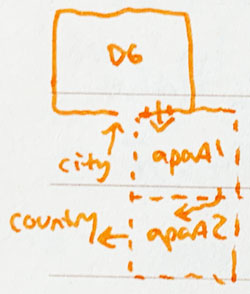
Hyperspace doors He said I should go into Oscar’s apartment and see something. His apartment was attached by hyperspace to the building next to the front door. There was a doorway leading to his apartment from inside the building, and his apartment stretched into what was, from outside, simply the front walkway. I meandered through his apartment alone, then turned a corner to hear people down the hall. I went down the hall and greeted a large family who I took to be Oscar’s wife’s or girlfriend’s family. . . . I find out that the large family I ran into were Oscar’s neighbors. Eventually I returned to them. Out their front door was a countryside scene, sunny and green. They had a deck that was also a bridge 15 feet up passing by trees.
Hyperspace Doors: This gives a good look at hyperspace gateways. In the dream world, space doesn’t need to conform to the limitations of three dimensions that we expect. It’s possible to turn a corner again and again and again and find something different there each time. I entered the front door of the building from a cityscape. Once inside, the suggestion to visit Oscar’s apartment opened up a door to it on the same wall. What could be a simpler way to pass from here to there? From the front door, that would entail taking two right turns, back through the front wall. But instead of ending up back outside the building in the cityscape as you would in 3D space, the hyperspace of the dreamworld lets us walk into a whole new room. And outside the room next to that? I exit out another door into the country scene outside Oscar’s apartment.
-
The Chamber Beneath Blaine House 2000
Soon I found Ruby more interesting and I went with her to the main septic tank room where we started. The floor was all ice now. We exited through another door.
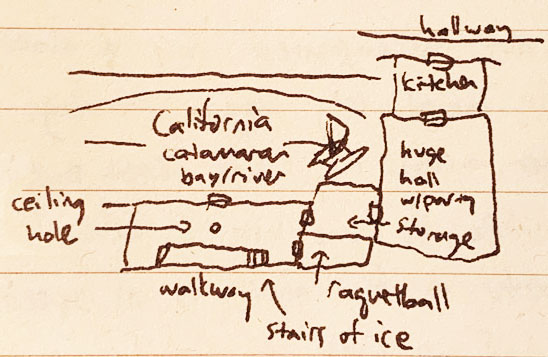
The chamber beneath Blaine House An evening landscape opened up before us, a half-moon bay of shallow, reddish water that I imagined must have been the real cess pool. It had a sandy beach. A catamaran that I “recognized” as Wadsworth’s spare one was by the water on the beach. The wall we had just passed through was a cliff viewed from this side, and a cliff-house was in the distance to our right at the top of the cliff. The sky was dark and undefined, as was the area past the reddish bay.
Hyperspace Door: Another hyperspace door! And this one is brilliant, because it reveals a lot! We go from an underground chamber during the day at Blaine House through a room to the bottom of a cliffside at a beach in the evening. The means these gateways can change the lighting, the scene looking back, and the entire look of the barrier — from wall to cliffside. As to the lighting, even while it was evening for a short time, it soon became daylight again as we came to California. The overall feel didn’t change that much. Over the course of the dream, I went from fascination to exhilaration to overwhelming joy to fascination again. Also notice how this initial California scene was not only dark but somewhat undefined or blurry, which is something I’ve seen a few other times when initially coming into a new scene.
-
Too Much House 2026
Returning to my new home after not seeing it for a few weeks, I found the builders had actually mostly finished it! . . . The main focus in the dream was the basement level, which we had requested be made to give it a little more space. We descended into it to find room after room, fully furnished. . . . There was a room with people in white suits walking around with slices of pizza on platters. I found the servant’s kitchen they were coming from, which was huge and filled with things. Two cooks were in there. There was a larger kitchen for us attached. It eventually connected to a bustling Best Buy. Outside the Best Buy was a paved pathway in a forested area like a well-kept college town.
Hyperspace Exit: Going from room to room in the basement of my house eventually leads to a Best Buy, outside of which is a forested area unrelated to the neighborhood I started out in.
Hyperspace Hubs
A few times, I’ve encountered places that were hyperspace hubs; a hallway with doors that each led to a different location. This appears something beyond the way we spatially rationalize locations as they gain our attention.
-
OBE at the Dark Tower 1997 • age 22
Within the Dark Tower were living quarters, including my Blaine House room. . . . In my Blaine House room, I had an OBE in which I found out how to fly: jump and hold onto the “rising” part. I flew up through the wall and roof, and ended up on the deck outside my room in Blaine House. I looked around. Below me on the entrance side it was all the same as Blaine House, and there were flashing Xmas lights down there. The moon was in the sky above and the forest was on the other side, reminiscent of other Dark Tower lands & forest. It seemed that above my room, instead of the roof, was a part of the Dark Tower’s library.
Hyperspace Boarding House: I describe the Dark Tower here as a sort of boarding house. My room at Blaine House appears to be a room in the Dark Tower, so perhaps all the rooms are through hyperspace doorways. The outside of my window was all Blaine House, which would support that, but then I knew there was a library above my room — part of the Dark Tower.
Or.. perhaps this is just the form the idea of “my bedroom” takes, and that form flows into what’s outside the window as well.
-
The Sewers Beneath the Dark Tower 1997 • age 22
There’s definitely a Banana House at the Dark Tower. . . . We were looking for Sid in room 722 in the Dark Tower. We went up and up. . . . We got near and I rang what used to be my door and then what used to be Brendan’s door.
Rooms: Interesting how rooms from different places I’ve lived in are in the Dark Tower — Blaine House, Banana House, and probably many others. It’s the representation of “your room”.
-
The Fulcrum 2025 • 6:50 AM
I was helping Wilson move. He lived in an old two-story Victorian building that was divided into several apartments. Each floor had 4 apartments on it, in a square arrangement. The Victorian building was a sort of hyperspace hub between each apartment. For example, to get to Wilson’s room and help him move, I walked down a hallway that was also an outside driveway to a lone concrete structure. His “apartment” was therefore an independent house. It had upper branches of trees on the far side of it, as if the land fell away behind. This fit its position on the second floor of the old building. . . . The light inside Wilson’s house and in the Victorian building was dim morning light.
A Hyperspace Hub: It’s interesting that there wasn’t a distinct transition like you get with a door or turning a corner, but a scene overlay as the hall also became a driveway.
These four distinct places thus become closely linked through this one building. They are all neighbors while living in different places.
Larger Inside Than Outside
One appearance of hyperspace in dreams is entering a small building or room to find that it is much larger inside. The door could be considered a gateway but typically the inside is still bounded by walls — at least, you feel it must be bounded by walls since it’s inside a building (explanation rationalization).
Consciousness exists in a higher dimension, and is not bounded by 3-dimensional space. That said, it may appear to be out of physical habit.
-
The Man Who Owned the Sun 1994 • age 20
I decide to investigate this building. I ask who can teleport, and look at Illyana, but Superman says he can. I ask him to teleport inside, and he takes us in but it’s more of an invisible fast-flying. We are aware that the sun lies somewhere inside this incredibly huge building. The first level held a huge room of laundry machines and people working, but they weren’t unhappy. We were told that the leader of the complex was evil. We proceeded to level two where we found a lot of grunt workers. Then to level three, which was a business district. Suddenly it was Manville, Mordred, and someone else with me instead of Superman. We went to level four and it was housing. We were now so high up that the building swayed in the wind, and it looked as if we were looking down from a plane. Manville opened a door and we were pulled outside. Manville fell down onto the roof of a lower level, but I grabbed the door and was able to swing back around and back inside. Manville was stuck so we had to leave him. We knew that level five was the sun, moon, stars, and clouds.
References: Illyana is a superhero that can teleport. Manville and Mordred are friends from high school.
Bigger Inside: This is an interesting combination of Hyperspace (where the interior is larger than the exterior), and the Tower Effect, culminating in a level, apparently inside the building, that contains the sun and moon, stars and clouds.
-
Home Near the Tower 1999 • 3 AM • age 25
Before long we were home. It had a back yard like Blaine House. The house was very ritzy and plush, mostly with gray-blues and blacks. Some parts of the inside were infinite, so you could sink into it and have visions, watch TV, or play video games. It’s very hard to describe. Space was very plastic. 3 feet could easily become 3 miles, and a room could expand to the size of a football field yet still remain within the house and retain its position relative to everything else.
The activities could be so bizarre. At times the work seemed to be tunneling into new space in an expanded room — developing it!
An Infinite Room: This almost sounds like a rote viewing room. Space inside a rote is completely different from outside it.
And I love the idea of tunneling into new space to expand and develop it. This would be understood in terms of hyperspace.
Some of this could also be due to changes in scale — see Changes in Scale and Perspective.
Labyrinthine Passages
The Catacombs
I’ve been down in the catacombs hundreds, maybe thousands of times. My dream self knows their intricate twisting passages and intersections intimately. I can navigate the hundreds of labyrinthine rooms and corridors for hours without getting lost, and I feel that the various paths I took would lead me to one of a number of different places in the dream world. But it is dim, dungeon-like, and at times claustrophobic.
-
Mazes and Scorpions 1996 • age 22
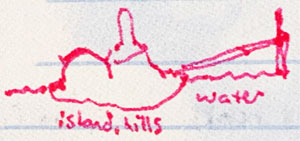
A smaller tower? Near the tower? The mazes! I’ve been here many times. It’s a deeper spiritual place, where angles are steeper, and there’s a hill with a tower reminiscent of The Tower, but much smaller. On top of the left hill is a crazy maze of dark, murky stone. I’ve been there many times before and had such fun exploring and trying to find out its secrets. On the top level are three rooms where the brickwork allows you to see inside. Getting to one of them is easy, one is medium, and one is very hard. There are many tunnels below, and possibly a river. One place is an upraised circular platform whose stonework floor has one loose stone which you can remove and that’s how you go onward — into that hole. . . . There were two young fellows that had found their way to the back wall corridor and I asked them to show me how they got there and they said they would but I never saw them again. I sense that these are passages to other dream locations.
The Maze: Here I find a maze on a hill near the Tower (or a tower). This is the kind of maze-like passages and secret doors of the Catacombs, and even here I suspected that these passages led to different dream locations.
-
Something Wild In Dreams 2000 • age 25
My pitiful weapon I remember exploring deeply for long periods through endless underground caves, going deeper and deeper with smaller or larger groups of friends, equipped with flashlights, laser pointers for stopping spiders and scorpions, and perhaps a gun or other weapon. This time we had a large group including Brendan. There was a single small flashlight but we were only 15 minutes in when we discovered no one had brought anything more. A good supply of flashlights and batteries was always required. I had an absurd little weapon: a finger-sized device that stuck out inch-long green and red brushes and turned. This we used only to dispatch a scorpion in a tiny sand-covered room before the power ran out. We next had to descend into a room through a narrow opening where a crazy witch-woman was screaming. I wish we’d had the gun or something at this point.
Somehow we made it into her chamber and it was lit and she was gone; she’d gone to get something for us — a gift. While we waited, we talked. They asked how far it was and I said it took about 3 hours to get to the puzzle chamber where I had once gotten, but had lost my light and been unable to solve all 3 puzzles. They were large chambers, reminiscent of underground video game dreams. But my friends balked at the time, especially as we had spent 15 minutes waiting for the witch woman’s gift. Soon after that she reappeared, still green and monstrous but far less dead-looking and afraid. She presented me a hard hat with four flashlights containing full batteries! Thrilled, I strapped the hat on and continued, but I think the others had left.
The catacombs seem a lucidity challenge — a struggle against distraction. And what lay at the bottom?
The Catacombs: Here I am, again exploring the underworld catacombs, and knowing them very, very well. I had a natural ability when I was younger for things like this, knowing where every passage went in underground dungeons in Choose-Your-Own-Adventure books, Fighting Fantasy books, and dungeon video games. But before long I began to avoid games that took place all underground. I just didn’t like it.
-
Three Brave Knights 2000
I was with Sid and Ranier, who I’ll probably see later today. We were wandering about this town. It was daytime and overcast. We were going to go adventuring underground, in the underworld! It had this D&D feel to it. There was a place in the square where a door led underground. We started out and made it underground.
We returned above ground again. I suggested we go back down but first go to the shops for snacks, weapons, and armor. We went to the snack shop first.
To the Catacombs: These trips to the Catacombs and the underworld are often very carefully planned. Here we are getting supplies, but then getting distracted along the way.
-
Declining the Catacombs 2008
It’s bright and sunny, and the colors are vibrant. I’m walking along this reddish orange dirt path. There are rolling hills of bright green grass on the right side. On the left is a rising rocky cliff. It feels like World of Warcraft. I come to a cave opening that is interesting to me. It looks like carved ruins. I crawl in through a square opening into a dimly lit room. Ah, I remember this. Room after room, interesting shapes, many paths, long sections. But it’s dim, and feels claustrophobic. I know it very well. I’ve spent months in there, through many dreams. But I don’t want to go back in. I crawl back out to the sunny path.
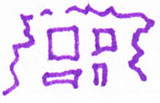
Entrance to the catacombs A tall fellow on the path sees me. He asks me about it. I said “I used to go in the catacombs all the time.” Catacombs! The word sort of occurs to me right then. He said he did once, too. I continue on.
Somewhere along here I break down crying, sobbing deeply. I can’t now recall why. Was it about my poor health? The catacombs? Someone is with me, a friend. I feel refreshed afterwards, and keep walking.
The Catacombs: Even now, thinking about the Catacombs gives me a shiver. So much time spent in a place like that. . . . Why?
Vehicles on Maze-Like Paths
One thing I’ve experienced a few times is traveling with others on a vehicle which seems to run along a track or fixed route through strange maze-like paths. These twisting passageways always take us to entirely different places. It’s similar to traveling through the winding paths of the catacombs. In both cases we travel through unadorned gray structures that seem like they are made of stone or concrete.
I believe this reflects the inner passageways of the astral world. I wonder if this is a rationalization of riding on astral currents.
-
The Twisting Parking Deck 1997 • nap • age 23
I was traveling with Buttercup and her friends on an upward-sloping road. I got out of the car for something, then had a Transformers adventure. I returned to the car afterwards and was glad it wasn’t towed. Buttercup and her friends were still with me. I drove it higher up and the road became a parking garage. I was looking for a place to park, a place to live, and something related to the Transformers adventure. The scenery changed and the curves of the garage became crazy, even more curving than the picture below. Soon we were sliding over the curves on a colored blanket instead of a car. The curves sometimes had a sparkling depth. At other times they were ridged with blue, yellow, and red to hold the blankets on.
The twisting route up and down through the parking garage 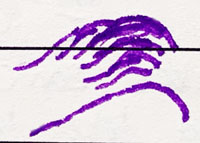
The edge of the colored blanket There were video games on every level and I played some. Then we warped into a party from Buttercup’s dream; a lame, boring business man party. The guy throwing the party heard me describing it thus and looked at me angrily. The room was rocking and tilting as we moved along the track.
References: Transformers is a comic book, TV, and movie series.
Going on a Blanket Ride: These inner passageways are a dream phenomenon of some kind. In this one I dispense with the car rationalization at some point and find we’re on something like a blanket traveling slowly over crazy curves, which is probably a much more true experience. What this is, I don’t know, but it comes with (or I have) plenty of distracting video game rotes.
Even when we enter Buttercup’s dream party, we still appear to be on the track since the room was rocking and tilting.
These remind me of Disney rides, going slowly along a curving course, seeing different points of interest and scenes as you go.
-
Visiting Work Again 1998 • age 24
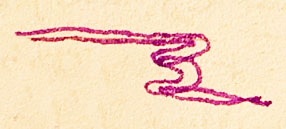
The vortex-like ramp I’m in the big red van again. I went to the mall and descended a strange vortex-like ramp to the parking lot. I went inside.
Vortex Down: The van is a physical rationalizations and road and ramp are the closest physical correlates. It seems that I’m riding on astral currents to the mall/transit station. When dealing with currents, a vortex would be a very natural “exit” formation.
-
The Mountain Valley Gathering 2003
I was one of the last to leave, but finally squeezed my way onto a bus. My consciousness remained outside looking in. As the bus began to move, the dim, drab bus station changed into this vibrant, shining white maze. I don’t recall the transition but maybe it had to do with my change in perspective? Anyways we took this very square path, then up this 45 degree incline up stairs. Then it straightens, tilts sideways and . . . out a door? We arrive at our destination: Long Island.
-
Picture Day 2023
It was getting dark and [the soccer team] needed to be back at the drop-off point. However, they all quickly ran off, to my consternation. Bodhi and I followed, but they were soon out of my view. A little ways ahead, we saw a train stop and decided we’d get to the drop-off point quicker if we took the train, which seemed to be heading that way.
We got in a small two-person train car. As it started moving, it seemed to be enclosed in a structure like a large parking garage. I noticed the tracks were more like a roller coaster, and indeed, it turned out to be a low-key, slow-moving roller coaster. In fact it was more like a ride, taking us through different rooms, some which seemed abandoned, out of use. It spiraled slowly upwards and into more rooms and then out along a busy street in the middle of a full city that was not where we came from.
Everything looked painted, airbrushed — very realistic and detailed but not quite real. The ride was taking too long and I was feeling anxious for it to be over so I could get back to finding the team. Bodhi and I decided to get off the train car and look for the way back. I tried to discern which direction we could go by trying to see the 100% real-looking scenery past the airbrushed scenery. And while I got glimpses of it in the distance, it seemed to shift back and forth and I couldn’t be sure what direction to go. I went into a little restaurant and asked someone how to get out. He said I just had to stay on the ride until it was finished. I asked someone else, and got a similar answer.
The Train to Downtown: The train takes us not down the street, but into a large parking garage that wasn’t there when we got on. It takes many twists and turns through various rooms and then spirals up to end up in an entirely different place in a different visual style.
Natural, Without Rationalizations
-
The Space Probes 1996 • age 22
I’m in space. It’s all hazy and there’s a sun off in one direction. I see a huge gray Star Trek ship go by overhead and recognize it as a long-forgotten probe. It sucks up the haze and leaves a trail of thick black smoke behind it. I know it should be destroyed, because the work it’s doing is not necessary anymore. I imagine throwing things or shooting rockets at it. The sky is clear now and the haze begins further off, looking like thunderclouds. Another probe goes by and I run in the same direction as it. I’m running over pebbles and water. I’m about to get to this lake with the intent of flying over it.
Natural Transition: Here my focus forms the reality, and physical forms follow along afterwards. There is no rationalization or feedback from my waking self that this doesn’t make sense. This along with my direct knowledge of the probes shows that I’m dreaming at a higher frequency, at a more real level.
Moved by Others
-
Underworld Guardians 2001
I’m at a neighbor’s house, asking questions. The sky quickly gets dark, and I end the conversation and run to my house. I mean to enter my house, but instead enter a red SUV in the driveway. A tornado comes suddenly overhead and picks up the car, whirling it about in different directions. I brace myself as it pulls the car through the woods towards the city. The windshield breaks. I hold on tightly, hoping I’m not killed. Yet I also know that this is part of the puzzle, that this tornado was sent to pull me off-track, to distract and confuse me, and deposit me in the city, like before. It does.
The tornado drops me in “San Francisco,” with one of the guards watching over me.
Tornadoes: I’ve never had a tornado used willfully against me before. They’ve always seemed a natural force in dreams, some kind of dream phenomenon. But then again, I created one to use against the ogre in “Field of Beasts” (even though it was ineffective and not nearly as big).
-
Tail Gunner
I’m in this small plane, being taken against my will by this girl to Appleton, Wisconsin (where Kayla lives). She’s flying low, almost into these tall corn fields. We’re arguing. I’m hanging onto the tail, firing at her, and she’s firing back. I jump forward after two hits and grab the controls. She threatens to crash the plane. I smack the steering control upwards, and the plane hits the ground and slides for a distance. The plane wreckage is now no more than a flattened cardboard box. The girl lies motionless in the ditch.
Unwilling Travel: How strange that I can be traveling somewhere against my will. I am probably locked into relative motion with the girl who I take to be the pilot and it’s her will that’s taking us together towards Appleton.
Waking Influences on Dreams
The Influence of the Waking Self
The waking mind is the focus of our mind that contains memories of physical reality and all its physical laws, rules, and limitations. While it remains asleep, we operate from the dream self focus. The dream self’s natural domain is the astral world, and isn’t limited by physical limitations.
Contributions from the Waking Self
The waking self arouses itself and contributes notes to the dream self based on what it’s seeing. This happens at many points during dreams. The waking mind notices something, grabs focus, and then may either settle back down or hold onto the focus.
-
Sri Maharishi 1998 • age 24
I was the student of Maharishi. I loved him dearly. We lived in India. He had been my teacher for a long, long time. . . . He was 120 years old. I was 100. When I realized this, I worried that I hadn’t finished Foundations, but Maharishi was still going strong at 120.
Ripples in the Waking Mind: Moments in the dream trigger little shifts into waking context. Here being 100 years old triggers my fear of not finishing Foundations. But I put it to rest thinking I could live to 120 and return focus to the dream.
-
Teacher on Concentric Isle, East Timor 1999 • age 25
A beautiful true dream! I am flying high over the ocean, near the clouds with my teacher: a tall, lanky black man with an African look. We are traveling to East Timor, an island called something like “Concentric Isle” but also like “geometric” and “symmetric”. It’s a long thin oval of forests, mountains, and beach of fantastic beauty. I wonder what East Timor actually is and a map flashes up in my head, showing that it’s an island and a portion of the mainland.
We arrive at my teacher’s house by the sea. It’s warm and incredibly beautiful. Inside in an anteroom there is a pool of water. He walks across the surface of it and tells me that I can, too. I do so without thinking. Then I try again but the more I think the deeper I sink. I get frustrated with myself. Then we decide to explore. I know we will spend the night outside the house somewhere. He says not to bring shoes or anything else. “Fine, that’ll be fun”, I think. Then I think — “Oh, I’ll need my contact lens stuff.” He tells me I don’t need it but get it if I must. I get/conjure it from my backpack. Leaving, he steps on a nail and it sinks into his heel all the way. At the same moment I step on a burr and get stung by a bug in my heel. He asks me to help get the nail out but he easily and painlessly pulls it out, as I do with my burr.
The Teacher: Interestingly, while traveling to East Timor with the teacher, no airplane rationalization is conjured to explain the fast travel through the sky. We’re just flying through the sky, two dreamers. Perhaps the teacher has a calming and focusing influence.
The thought that we’re going to spend the night away triggers my waking self thought “always remember your contact lens stuff.” Once I have it, my waking self settles back down.
The theme of this dream is being in the astral without engaging the waking mind, which messes with our experience.
Our waking consciousness can obscure our true dreaming experiences. Its projections and rationalizations can distract from and take over the stories of our dreams. If it thinks the dream is physical reality, it can entirely take over the dream with it’s physically-oriented fears, desires, and behaviors.
Worrying About Money
The eternal waking consideration of how much something costs comes up all too frequently in dreams.
-
Hyperspace Warps 2001
We saw a beautiful small open garden area on one side and walked into it, raising our arms and dancing about. Someone there said it was $9 apiece to be in there. I was shocked, but danced about some more, then left. The others came, too. Across the hall and down a bit there was another beautiful natural place and we went in to admire and play in the beauty. Again, $9. I left. The others stayed. They received a jellied cracker on a napkin and coffee drinks. I remained in the hall, watching people. . . . Buttercup had ordered me a jellied cracker for $9 and I went to the stewardess of the garden and said, “I’m sorry, I can’t pay $9 for this, or allow my wife to do so for me.”
Entrance Fees: The entrance fee irritated my waking self. Had I realized this wasn’t the physical world, I could have conjured up any amount of money at will.
-
Too Much House 2026
Returning to my new home after not seeing it for a few weeks, I found the builders had actually mostly finished it! It had seemed an eternal construction project in which little progress was ever made. But now, it was almost done! The main focus in the dream was the basement level, which we had requested be made to give it a little more space. We descended into it to find room after room, fully furnished. We hadn’t asked them to do this, and I wondered at the cost, but it was rather nice. . . . Some of it was very posh, which I didn’t like. There was a room with people in white suits walking around with slices of pizza on platters. I found the servant’s kitchen they were coming from, which was huge and filled with things. Two cooks were in there. There was a larger kitchen for us attached. . . . It was way too much! I wondered at not only the cost to build but the cost to simply live there and pay taxes.
Mansion: I do not care for shows of wealth. This all triggers my waking worries about cost, which is of course of no concern in the astral.
Imposing Physical Limitations
The waking self applies the social rules, habitual behaviors, and physical limitations of the our waking life to our experiences in the astral world, thus limiting our actions.
-
Teacher on Concentric Isle, East Timor 1999 • age 25
We arrive at my teacher’s house by the sea. It’s warm and incredibly beautiful. Inside in an anteroom there is a pool of water. He walks across the surface of it and tells me that I can, too. I do so without thinking. Then I try again but the more I think the deeper I sink. I get frustrated with myself.
Walking on Water: The lesson is to do what you want without engaging the limitations (rules and expectations) of physical reality.
-
A Nighttime Walk 2010 • 1:30 AM
Buttercup and I had decided to go to Blue Ridge. On the way, I drove through a red light. I was afraid I’d get a ticket so I looked behind us and saw this car with a little structure on top that I thought might be a police siren. There were four people inside which I could see clearly. They weren’t police, but I made sure to stop at the next intersection at the bottom of a hill. Once the car stopped, the rationalization was no longer needed, so it disappeared and we were on foot again. We walked across the crosswalk to the right. It dawned on us that we had a long ways to go on foot. Buttercup said “Wait, so we’re going to walk to Blue Ridge tonight? That’s going to take like 18 hours.” I shook my head, wondering what we were thinking. We decided to abandon the trip.
The Waking Self’s Limits: Once the rationalized car disappeared, we found ourselves naturally continuing on our journey on foot — the same way we had no doubt set out. Our waking minds stepped in and saw the situation from the physical world perspective, and convinced us we’d never be able to make it before the night was out.
-
Erupting Kilauea 2010
I’m walking with Justin down a long narrow road that’s in the middle of a lake. Justin’s holding Laura. I say, “Hey, let’s cross back over into the US (from Canada) for a second. Do you have your passport on you?” We get to the border station. There’s nobody there, just a walled-off area with some doors. I step through the first door into a brightly painted red/orange room with a door at the far end. Justin steps mostly in but keeps his foot in the door, and says that he doesn’t think he has his passport. So we back out and return to the road across the lake.
References: Laura is Justin's baby girl.
Passports?: We could have just gone if my waking self hadn’t intervened brought in the rules of the waking world.
Emotions Intensify Physical Focus
When our waking selves are triggered emotionally in a dream, that waking self becomes the focus and brings with it into the dream all the rules and limitations of physical life.
-
Picture Day 2023
When I returned to the area where I last saw the team, I saw no sign of them. This began a long search as I went up the road along the school fields for a while, then crossed the street into a big park with lots of fields they could have gone to. . . . Bodhi and I walked for several blocks through it, but we didn’t see them. A block past, I was getting really upset and worried, imagining the news reports of the coach who had lost his team.
But then I heard Buttercup’s voice, calling out my name. I followed it back to the Vietnamese area. She was saying she’d found them. I couldn’t locate her, but I did finally find the team! They were on the outside of the corridor of shops, wearing aprons and cleaning while eating some sort of gooey snacks. I assumed the restaurant owner had said they could have some if they’d helped clean the place. I gathered them and told them it was time for pickup. It was getting dark and they needed to be back at the drop-off point. However, they all quickly ran off, to my consternation. Bodhi and I followed, but they were soon out of my view. A little ways ahead, we saw a train stop and decided we’d get to the drop-off point quicker if we took the train, which seemed to be heading that way. . . . The ride was taking too long and I was feeling anxious for it to be over so I could get back to finding the team.
Emotional Focus: When I lose track of the team in the dream, my waking self pulls focus. I know the waking world consequences of this; I imagine the news reports about losing the team. I keep my focus on finding the team throughout the entire long dream. That emotional focus, once activated, remains.
Bodily Needs
I have many dreams where the plot is diverted by the need to go to the bathroom. I go in search of a place and . . . let me just say that the dream world is not well equipped in this regard. While finding a bathroom usually isn’t difficult, you can pretty much assume it’s going to be too public and not well designed for the purpose at hand.
The dream self has no real need to understand such things.
Rationalizations — Waking Self Projections
The Nature of Rationalizations
Rationalizations are an automatic translation from nonphysical to physical reality. They take place at a certain distance down the stream from from the astral into the physical frequencies. If consciousness is operating at the dream self level, it is up the stream from these translations. It doesn’t see them and has a truer, freer experience. If consciousness is operating at the waking self level, it’s down the stream from them and thus perceives them.
Objective Rationalizations
Rationalizations, like any projections, create thought forms. These are objective, though temporary, creations.
-
Lucid Dream: Bruce’s Arm and the School Bus 1997 • 10:13 AM • age 23
There was traffic and school buses. I picked up a big bus, and was floating along with it. . . . Then I walked up another hill, forgetting about the bus.
The school bus, melted & shrunk I met this kid and we started talking. While we did, the bus I had picked up had shrunk to the size of a large plank of wood. It was just one color of gold/yellow now, and each indentation was much less defined, as if melting, shrinking. Somebody had grabbed it and was running over the hill with it under his arm.
Let Me Borrow That: The bus appeared in the dream because I heard one from the waking world. This shows that thought forms (including rationalizations) are objectively real to others in the astral.
Subjective Projections
While there is evidence that rationalizations can create objective objects, there is also evidence that it can be a subjective projection.
Imagine two people listening to a speaker. Each may be mistaking the speaker for a different person. Each person doesn’t see the other’s projection — only their own. Likewise there may be two people in the same astral environment, but seeing it as a completely different physical environment, but having the same emotional meaning for them.
-
The Island of Fire 2000
There’s a massive fire on the top of the cliffs, threatening to spread downwards. There are lava flows and fireballs as we leave. . . . There’s a break in memory and we’re back at the forested slope. This time we’re descending with a huge group of Renaissance Festival people into a clearing in a thick forest. . . . Mistaking this as the island from earlier, I remember the danger we were in. I look up to a cliff above us and see a trail of lava coming down. Soon the gully at the bottom is filled with lava. . . . My attention is unavoidably drawn to the lava below as I wonder if we’ve lost anybody. I find myself hovering above it. There is a little thought-form Gollum down there sinking slowly a bit and jumping periodically, saying “Oww!” like a broken record. A friend, Buttercup I think, is also there, walking on the lava and sinking a little with each step. I explain how it’s impossible to walk on lava like that because you’d burn up. The lava turns out to be red and glowing and pliable but not hot. I see a row of the renaissance people including a queen in pink and a prince sitting on a wooden ornamental bench ON the lava.
Thought Form Lava: The lava here is very clearly projected by my expectations when I remember it from the previous scene and looked up to the cliff. It seems to have appeared under all the other characters in the scene. But it seems that it only appeared that way to me. Nobody else was acting as if they were standing upon lava.
-
Erupting Kilauea 2010
Over here it’s beautiful — the lake is surrounded by green, tree-covered hills, and there are lots of people around. It’s a tourist destination. As we begin walking, something catches my eye — a great plume of smoke from the top of two hills. There are rapid waves of smoke coming up off the hill to my right, and up ahead, a huge plume of dark, billowing smoke is erupting. I run over there and sit down near lots of other people, as it’s a great view. I look to the top of the larger volcano and see this wooden structure that looks like troll buildings in World of Warcraft. I’m thinking about trolls when the ground begins to shake and rumble and a huge explosion happens. Bright blue-green lava explodes out of the top of both volcanos. Blue-green is the color of trolls.
References: World of Warcraft is a video game and trolls are one of the races in it.
Influencing the Lava: Dream lava is extremely thought-reactive stuff. Even so, I’m surprised my thoughts about trolls would turn the entire eruption blue-green. There were all these other people there. Did my thoughts change it foreveryone? Unlikely.
Adjusting Rationalizations
-
The Nubicus 2015 • 8 AM
We ended up driving around in my car and talking about whatever came to mind. I drove the car into a parking lot. At the end of the parking lot, there was a path leading along the beach, but it was blocked by those metal posts to prevent vehicles from going through. Without even considering what was happening, I slowed down and then slowly proceeded forward onto the path. My car had transformed into a four-wheeled kid’s tricycle to fit through. It had a molded plastic bucket seat and four wheels. I was still in it, and the two people in the back seat were now walking on either side of me. It rolled to a stop and a few people gathered around. Perhaps made shy by the attention, I said “and it also becomes a Nubicus”, and I flipped it up over my body like an incomplete shell. Curious, people peered inside, and with humor, I swatted at them like a cat.
A Better Rationalization: The thought form rationalization changes to fit the situation. No longer able to fit between the posts, the car shrinks down to a tricycle to fit. Meanwhile, my companions continue on foot.
Usually when done with a travel rationalization, we leave it behind and it melts out of sight as our attention turns towards the destination. But here with people around me, I’m left with the shrinking rationalization and awkwardly pick it up and wear it.
-
The Mountain Carnival 2023 • 9 AM
We’re in a full plane, flying over the mountains. The pilot takes us in very low to show us some trails and tell us about landscape features. I’m a bit shocked as he takes us in among the trees. “This is dangerous,” I think. “I wish he’d just take us there.” Obviously the plane is a group travel rationalization. At one point I look out as we pass 12 feet from a tree without impact. I look at the wing and it’s made of wood boards with a wood covering at the front painted red. “Wow, it’s a wood plane,” I think (the credulous dreamer). Eventually the landscape catches my attention instead. We pass into a snowy valley, and the snow is standing in towers of gravity-defying swirls. “This really is beautiful. I want to come back and hike this,” I think. As we exit the snowy valley, the plane must have descended, as I find we’re all riding in a group on bikes (new rationalization). It’s a bike tour now. After a short ride, we arrive at a roughly-built mountain carnival, with goats, sheep, farm animals, food vendors, small buildings, and fences. It feels sort of thrown together. We enter on foot with the group.
Fear of Plane Crashes: In most group travel at faster speeds, the group travels just above the landscape. The plane rationalization that results very often triggers the waking self into fear of crashing. As the destination nears, the group descends towards the ground, potentially intensifying the fear of a crash. Luckily, in this case, I’m distracted by the interesting landscape. When I focus back, we’re at ground level, and the rationalization changes to us riding on bikes.
This is likely the source of many people’s fear of flying.
-
Nightly Vacations 2024
[Buttercup and I] set out on our way to the next location. We set off separately, on motorcycles. When she caught up to me, the motorcycles locked in position next to each other, then became a car.
A Better Fit: Once we’re traveling together, side by side, a car makes more sense.
Discarding Rationalizations
When rationalizations are no longer needed, we stop paying attention to them. Deprived of attention, they melt away just like any other thought form.
-
Mountaintop Flying 1996 • age 22
It began as a ride at the fair. I was in a little roller coaster car on this track on the side of a mountain. At one point the car flew up at the peak and jumped this rock. I realized then that gravity didn’t matter so much. I jumped the next peak and began to fly.
Separation Rationalization: I was rationalizing my astral body movement at first, but then realized I didn’t need to. The waking self stepped aside and the dream self took over. I no longer needed to rationalize the sensations as having a physical source.
-
Highways in the Sky 1999 • age 25
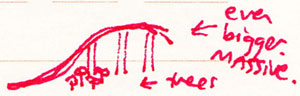
Highways in the sky I dreamed of driving on highways up in the sky. The highway had many lanes, and we seemed surrounded by an ocean of dark rainclouds. Exits dropped steeply down into the darkness below. One of these deposited me, now car-free, into a dark space.
Rationalizations No Longer Needed: When the need for the rationalization ends, so does the thought form that was created.
-
Gliding Soccer 2003
I was heading back to the soccer field. I rationalized my speed by imagining I was driving, but when I got to the field, I didn’t get out of the car, I just slowed down.
Car Addition: I never get in or out of a car rationalization. It appears after I begin moving and disappears when I arrive. It’s added onto the real scene by the waking mind.
-
A Nighttime Walk 2010 • 1:30 AM
I made sure to stop at the next intersection at the bottom of a hill. Once the car stopped, the rationalization was no longer needed, so it disappeared and we were on foot again. We walked across the crosswalk to the right.
No More Car: Stopping the car at the intersection caused us to release the car rationalization, since typically the only time you would stop traveling in a dream would be when you are at your destination.
-
The Train Ride 2024
The train moved slowly forward, very near some trees. . . . I noticed the train moving between tightly packed trees and roots, not even sticking to the track, and there wasn’t even a train now! Buttercup and I were slowly sliding forward, side by side, over these tree roots, between trees, and then into a very familiar place — a narrow stream of dark water with two tall walls of dark stone bricks on either side. I’ve been here many times before.
What Train?: The train didn’t seem like a rationalization originally. There were several cars. But as it started moving, I could see out through the roof and floor, and eventually it disappeared entirely, and it was just Buttercup and I moving slowly along.
-
Colorado Volcanoes National Park 2024 • 5:30 AM
I got the route wrong and led everyone into this rocky hot zone alongside the lava lake. I thought we were going to die but I gunned it up a steep slope and Buttercup, Alfred, and I ended up shooting up — no longer in a car — just high enough to grab the rails that had replaced the road here as it passed over a gulch. Buttercup and I caught the rail by one hand. Straining, we hauled up our luggage and got ourselves up onto the rail. I had particular trouble with my iPhone. Then we pulled Alfred up as well. Adventure! About 10 feet ahead of us the rails ended in rocky ground, where the route continued. . . . We drove on and made it to the highest point on the road.
A Dramatic Scene: When we’re traveling, the four of us are in a car. But as we’re launched up into the air, the car rationalization disappears and we have a dramatic scene of barely grabbing the rail and hauling ourselves up. Once we make it back to solid ground, the journey continues, naturally, in a car.
When Rationalizations Cause New Problems
Rationalizations, while solving one incongruity, can themselves cause new problems. Take fast travel rationalizations. These introduce a bulky metal vehicle moving at fast speeds into the scene. These have their own rules of motion, and may not fit when navigating narrow spaces that the body alone easily fits through.
This is the cause of all plane crash dreams. A plane is a reasonable rationalization when we’re flying higher up. However, most ascents and descents are gradual. When we’re descending to a destination with obstacles — say a forest or city — the plane rationalization may trigger waking fears of crashing, and the resulting expectation causes it to happen.
Problems caused by rationalizations can sometimes cause our attention to split off into a fantasy subdream. It’s possible that the dream self may continue its adventures while we deal with the drama and consequences of thinking we’re in the physical.
-
End of Days 2012
The line was extremely long and slow, and made its way through the airport. I don’t recall getting on a plane, but I do recall sitting down in seats arranged in rows in the airport, and then we took off. . . . I decided to check on the plane’s status. I switched to third-person perspective only to find us flying low over a freeway. Someone asked the captain why we were flying so low and I heard the captain saying there was a problem of some kind. The plane passed under a bridge and then slowly started to land on the freeway. It went well, except we heard warnings that up ahead there was an obstacle of some kind. Soon I saw it — a toll booth blocking the right side of the freeway. The plane hit it, sheering off and destroying the right side of the plane. The left side shook and listed . . . [the crash continues]
Plane Rationalization Consequences: The group of us departed together, and the plane was rationalized after we departed. However, in the astral, there’s no reason to travel high up in the sky, so when I took a look outside, I saw the rationalized plane flying right over the freeway. A bus might have been a better rationalization! The size of the plane means bridges and toll booths become a problem, and my fear takes over and leads to the crash scene.
-
The Seaweed Bridge 1996 • age 22
The sky is sunny. Buttercup and I are in a car, road tripping through pine woods and such and the road gets really crazy. It turns for a while into big, white boulders and we’re going 80mph and skimming over the surface of them. Then there are these long parts driving on the river, on a road-like trail of seaweed. We’re still going 60mph and skim over the top of the water long distances before sinking down.
Sinking Car: Here we have a nice conflict of expectations. I’m astrally traveling fast enough that my mind conjures up a car to rationalize it. The car rationalization worked for a while, though it was a bit flimsy as we were going over the boulders. Once we crossed onto the river, I needed something else to explain how we were still going, so my mind conjures up a trail of seaweed. But this time it was too unlikely and my waking mind says “Driving a car across seaweed? Shouldn’t I be sinking?” The expectation of sinking into the river takes over, interrupting the journey we were on.
Explanation Rationalizations
Following are explanation rationalizations by the waking self from within the dreaming context. Note the common phrases used: “must have”, “I assumed”, or “I reasoned”.
Sometimes we create memories as part of explanation rationalizations. See Searching Memories Is Usually Creative.
-
Like Warcraft, but a Whole World! 1997 • age 22
I also had a little dream of being in the bedroom here with Buttercup, doing normal stuff, and I find the card I put in the mail yesterday. I think “Oh, no, I must have bought two!”
Reality of Dreams: I’m dreaming, but I can’t tell. I try to make sense of seeing the card again when it should be in the mail.
-
Mina the Bat 2024
I find someone out there who’d caught this huge bat-like creature. Its head was as big as ours, but bony, extended in a way reminiscent of a cow. I wondered at how he’d caught it, and saw a picture of him with his arms extended, and it just flew to him. . . . Then I was walking back to the house, holding it. I was holding it at an angle so that its head was higher than mine, focused on its face, and we were communicating — perhaps this was actually a telepathic window. I don’t remember picking it up, and the telepathic windows are usually higher up like this. How much of our dream recollection is “I must have” because of these unusual non-physical effects?
Explaining Telepathic Windows: My original thought upon remembering this scene is that “I must have taken it from the man and was holding it up” even though I didn’t have a specific memory of that. That was simply an explanation rationalization. What makes more sense is that there wasn’t actually a transition there and I just began to communicate telepathically with it, which is of course the natural method of communication in dreams.
All memories of actually speaking words are added to the scene by the waking self.
-
Body Transformations 2003
I decide to do a side flip on the street. From standing, I bend sideways to the left and then flip to the right and land on my feet. This is something I tried to do in waking life after the volleyball game at Kai’s wedding — people thought it was hilarious. In the dream, we all went into this house. People were wandering about, doing their own thing, and I was practicing these flips in the wide end of this hallway. Once when I flipped, my legs softly hit this ironing board and I stopped in mid-flip, just hanging there in the air. Gravity wasn’t too much of a concern. But instantly I rationalized that I had grabbed onto the ironing board with my legs and had my back on the floor. Someone was watching. I smiled, thinking this probably looked impressive.
Impressive Leg Strength: Gravity is a habit easily overcome in dreams. When the waking mind is asleep, or awake and lucid, we can fly. Here, when the flip is interrupted, I hang in the air. Instantly, the waking mind jumps in to alter the scene to make physical sense of this. It comes up with the only conceivable explanation for this according to physical laws.
This flipping was a memory suggestion from my waking self, so it was driving here, and thus needed the rationalization that I grabbed the ironing board with my legs. My dream self wouldn’t need to rationalize this.
-
Neon Chakra Flowers 1997 • Middle of the night • age 23
I could see fine (I assumed I had contacts) but wanted my glasses.
I Must Have Had Contacts In: I’m presented with a fact and rationalize an explanation for it.
-
Rubber Dolphins 2000 • age 25
This big dolphin rises up out of the water behind it. I’m totally enraptured for a moment, before I notice how fake and rubbery it looks, and how it doesn’t interact with the water. A thought form! I notice it’s connected to the boat by a mechanical arm (though I don’t see this).
Must Be: Here I rationalize the appearance of this fake-looking dolphin by “noticing” an explanation for its existence.
Memory Rationalizations
Some explanation rationalizations can come in the form of memories. Looking for a memory can be the same as creating one.
-
TV Road 1997 • age 23
Raven is my girlfriend as this begins. We were on our way to a youth group event. We’re driving around this dark neighborhood. . . . We come across a video billboard (it’s simply a large TV in the mall). I get enthralled watching this hilarious Popeye sketch in The Best of Saturday Night Live. Raven gets mad waiting for me and I decide to just forget the trip. I look back at the TV, which has this woman in a hot tub, and I travel into the scene. This is rationalized by me “remembering” that I traveled there by bus.
References: Popeye is an old cartoon/movie.
Rationalizing Gateway Travel: Not realizing that I used a screen gateway, I explain my presence in the studio by recalling my recent experience of traveling in a bus and thinking that must be how I got there.
-
Home Near the Tower 1999 • 3 AM • age 25
I’m driving home with Buttercup and it’s evening. The roads are all very steep, as much up and down as right and left. I’m driving crazy, very uncontrolled, almost getting in accidents, then looking for turn-offs to hide in if we are pursued. At one point I take as a point of reference a small egg-shaped car and zip through a bunch of red lights faster than a car should be able to go. Then, terrified, I ask Buttercup “What’s wrong with me? Am I on drugs?” She says “Yes”. I seem to think back and remember that I was taking some sort of stimulant I had thought wasn’t a big deal.
The Stimulant: Wild alterations in consciousness are a common occurrence on Arcology Hill. The drug, in this case, is likely just an explanation rationalization (with accompanying created memory).
Backwards Rationalizations or Memories
Wildest of all, our waking self can contribute entire scenes into the past history of the dream state to rationalize what caused something. This is more than just a false memory — we feel as if the rationalized scene is what happened instead of what really happened.
While this doesn’t happen often, it shows that the waking self’s memory of the dream can be edited after the fact.
-
The Sound 2024
I was dreaming I was in the bathroom. There was a sudden loud clack from someone awake in the physical bathroom, and I dreamed my hand flicked and whatever I was holding hit the counter to make that sound — in exact time with the sound.
Rewriting the Past: At the moment I heard the sound, I projected a rationalization of it including the moments leading up to it seamlessly into my dream experience. This required backwards attribution. The flick of my hand was projected backwards as an event preceding the sound to cause it, but was just as much part of the dream as the sound itself. It was assembled into the final experience. We can project rationalizations into the past and it’s not disruptive to the flow of the dream.
Rationalizing Astral Experiences
Rationalizing Astral Phenomena
In the dream state, the things we most often rationalize are astral phenomena. The nonphysical astral world operates on a different set of laws and has its own unique phenomenon. Our waking self sleepily rationalizes these so that they make more sense in a physical context. This happens automatically through simple observation of the dream experiences by the waking self. This lets the waking self continue its state of calm semi-sleep, allowing the dream self to maintain focus.
If we’re traveling fast over land, we conjure a car around us. If we’re talking to someone who’s not present, we conjure up a phone or video screen. These rationalizations are a layer superimposed onto the dream environment by the waking self.
Fast Travel — Cars and Bikes
Fast travel is probably the number one thing rationalized in dreams. For solo or small group ground travel, a car or bike is a common rationalization.
There’s never any getting into the cars or starting them up — the travel begins immediately and then the cars appear around us. Likewise, when we reach the destination, there’s never a need to turn off the car or open the doors and step out. We simply slow down and the rationalization disappears.
-
The Old Forest 2026 • 5:30 AM
I was leaving this [old forest] area in a rationalized car on the winding road out. Just after exiting the old forest into a small town, I turned around to see a tree tip and fall. . . . Then I saw a fire blazing. . . . There was a police officer I knew, and he was in a building nearby. I looked towards him intently through a window and caught his eye. I was still in the car, but it wasn’t moving now. I held his attention and signaled “fire” by holding up one hand and wiggling my fingers, then pointing to the old forest. Then I held my arm up and tilted it at the elbow, signaling “fallen tree”. He got the message and flew out of the building, creating a police car around him as he flew towards the forest. I floated up out of my car, then joined him in the car as he went to investigate.
Watching Rationalizations: I’m closer to true dreaming here, so I see the travel rationalizations forming almost as an afterthought. We don’t get into the cars — the travel begins immediately and then the cars appear around us.
The dream self experiences the scene further up the stream, before the physical rationalizations come into being. I see the true action and then the rationalizations coming into being.
In addition, the policeman doesn’t bother with leaving the building by a door, nor do I bother with leaving my car through the door. We float right up and through the forms as if they weren’t there.
-
Teacher on Concentric Isle, East Timor 1999 • age 25
The next thing I remember I am with this woman driving from a man’s house where she lives or visits. We come to the end of the drive and slow down way too fast for a car. The car sideswipes the wall and crashes horribly. Of course, we’re just fine, since we were speed-traveling and had simply slowed down. The car is elsewhere, fading from memory and relevance, and we go inside.
Car Rationalization: My fear expectation that the car is going to crash causes it to do so, but we’re already outside it. In this case I’m able to observe the crash fantasy and not get caught up in the drama of it.
-
The Mirror People 2012
I’m walking down the street again and it’s gotten dark like night. Three of the administrators are about to attack, I know, and they’ve brought along Pete. They all fly towards me on bikes (rationalization) and we fight.
Flying Bikes: Though they were flying towards me, the bike rationalization fits because they were coming in just above the street.
Note that we rationalize other people’s fast travel as well.
-
Emma’s Crash 1997 • age 23
I was part of a huge pack of kids wandering across big snow-covered fields. I see Emma on a snowmobile off in the distance coming towards us. She’s jumping the ditches that separate the sod fields. I began to fear Emma crashing, and thus at the nearest ditch the snowmobile crashes into the near side. Her body flies out and goes bouncing back and forth several times before landing and disappearing under the ice. I go running out onto the ice. I reach under, grab her hand and pull her out to safety. . . . She had come to pick me up for something.
Snowmobile: Emma’s speed of approach suggests that she was fast-traveling towards me, and because we were on snowy fields, I rationalized her on a snowmobile.
-
Bedroom Soccer 2023 • 7:30 AM
Then I remember leaving the soccer field and going down a road. This is in the direction of the hallway outside my bedroom door. I go down the street perpendicular to the soccer field two blocks, looking at the houses and trees, then turn right. At this point, I need to park my car, so I make a U-turn and into a parking spot at the side of the street.
Not Another Car: I left the soccer field on foot, and didn’t feel I had a car until I turned. At that point, I felt I needed to park it. Notice there’s never any memory of getting into or out of the car. It serves its purpose as a rationalization once a certain speed is reached and those details aren’t often needed.
-
The Stolen Car 1998 • age 24
We left the area and went for the car. It was at a college. We saw the car, but the license plate said “Collection.” Someone changed it! And they were driving off in it! So we jumped into the car, Buttercup driving, and chased it. Eventually I became the driver. It wasn’t until later that I realized this folly and said “The car that I’m looking for is THIS one” and pointed straight down. I felt so silly and a little embarrassed.
Oops!: So I think someone’s stealing my car and I get into my car to chase them. I just conjured up another car without thinking and later realized my foolishness. The waking self fully believes its first thought, mistaking the first car I come across as the car I’m looking for, even though the license plate is different.
-
The Mountain Carnival 2023 • 9 AM
It began in a town, and Buttercup and the kids and I are on vacation. The kids wanted to go somewhere so I went with them. My more specific memory begins when we’re driving around in a self-driving car (this is new!). It’s a black SUV. I’m calling out commands like “Stan, turn around” and “Stan, pull over” and the car follows.
Self-Driving Car: This is a new one! In this case it’s just me and the kids, so I’m the driver by default. I notice the rationalized car responding to my desires and rationalize this mentally as it being a self-driving car responding to voice commands.
Group Travel — Buses
Larger group ground travel is usually rationalized with a bus if on the ground, or a plane if higher up.
-
The Mountain Valley Gathering 2003
The groups continued to hang out for a time. Morning was coming, and people started heading to the buses to go home. I was one of the last to leave, but finally squeezed my way onto a bus.
Buses Home: As morning approaches, people gather in buses to head back home.
-
Highway 710 2010 • 4:30 AM
I was walking along a path and came to some RVs. One had some writing and graffiti on it. I determined that the owners had decided to let hikers use their bathroom, but it had proven to be a terrible idea and they had rescinded their offer. I went in to talk with them, to get the story. Before long we were traveling along inside the RV, with one of the women at the wheel and the other one talking to me and showing me papers. We were heading west on a paved road through a green natural setting.
A Persistent Vehicle: While most people rationalize a vehicle just when traveling, these two women were living in an RV. I went inside to talk to them, and I found us moving along the roads before too long, so it appears that this is a persistent home and vehicle for them.
Flight — Planes and Sky Highways
Flight in the astral is simply traveling up off the ground. To the waking self, a plane is the most common rationalization. The size of the plane varies proportionate to the size of the group traveling.
However, if the initial rationalization is a car but the travel route goes up into the air, then a further rationalization of a highway in the sky might be used.
These sky highways have many lanes and the exits are steep ramps leading down to destinations. I’ve seen them several times, making me think that they could be a rationalization of persistent astral currents that people travel on between locations.
-
Tail Gunner
I’m in this small plane, being taken against my will by this girl to Appleton, Wisconsin (where Kayla lives). She’s flying low, almost into these tall corn fields. We’re arguing. I’m hanging onto the tail, firing at her, and she’s firing back. I jump forward after two hits and grab the controls. She threatens to crash the plane. I smack the steering control upwards, and the plane hits the ground and slides for a distance. The plane wreckage is now no more than a flattened cardboard box.
High Astral Speed: This elaborate plane scene is a rationalization of high-speed travel, caused by someone coming to get me and bring me to Kayla. This is further supported by the fact that the plane wreckage — a thought form created by the plane rationalization — quickly decayed into what looked like a cardboard box.
-
A Distant World 2000 • age 25
I’m in a plane-like ship traveling with friends through a cloudy nebula near the center of a galaxy where the stars were profuse. It was absolutely amazing and beautiful beyond words. I remembering thinking “I should take a picture” and scrambling for a camera, but right when I got it we were out of the nebula. Soon we were descending into a strange world. It was misty and cool and this different kind of pine tree was everywhere. The plane was piloted by a young person, and after a soft descent, we landed in this lake. The plane was pale, smooth, rounded and small — a rapidly shrinking thought form. We made for the shore.
Fast Travel Thought Form: A space ship may have been more appropriate, but the more familiar airplane became the rationalization.
-
Highways in the Sky 1999 • age 25
Highways in the sky I dreamed of driving on highways up in the sky. The highway had many lanes, and we seemed surrounded by an ocean of dark rainclouds. Exits dropped steeply down into the darkness below. One of these deposited me, now car-free, into a dark space. I sunk through the floor which was the roof of a bright room that connected to previous dream scenery.
Rationalizing Fast Travel: The car rationalization simply disappears as I reach my destination.
-
Bus to the Beach 2000
We’re on a big tour in this foreign city. The people are on buses, split into groups. . . .
Descent from above Then we’re driving down this extremely high, steep road towards this white sand beach and beautiful water. We descend on a path not quite meeting the road we saw below and it started getting faster. For a moment I prepared for impact, but we gradually straightened and landed on the shore. The whole time I assumed there must have been a second road but there wasn’t.
Descending into a Scene: Again we see the descent from the sky highways down a steep incline into a dream location. A bus is a common rationalization of fast astral travel when traveling with so many people.
Smooth Travel — Skating, Surfing, Skiing
In the dream state, there is no need to walk. We travel at walking speed only because it is physically familiar. We may rationalize taking steps, but when the waking self begin to doze, we glide. If the waking self notices this, then it may rationalize it as being on skates, skiing, or surfing.
Smooth travel rationalizations usually happen at walking or jogging speed.
-
Field of Beasts 2000 • age 25
I’m skiing — the sensation of movement and flight rationalized. There’s a half-pipe and people are trying to go down one side and up and out the other.
I’m Skiing Again: I find myself once again rationalizing myself skiing to explain my smooth, fast movement along the ground.
-
Gliding Soccer 2003
When we saw a huge group over the hill, we went to them (we glided over) and started a larger game. . . . So I played a little soccer, but with all the gliding, it almost immediately rationalized into hockey.
-
Windsurfing 1997 • age 23
I was at the Blaine Soccer Complex and it was raining. I had been given a windsurfing board and was having a great time with it. I was a natural, shooting around and slipping and jumping. I left it for a minute to pursue something soccer-related but went back to it soon. First I got the wrong one, then found mine buried in the mud. The scene changed before long and it was my whole family at a sunny ocean beach. We windsurfed and it was fun!
Windsurfing: There is no water at the soccer fields, which means the windsurfing board was conjured up to explain my smooth traveling motion. Since the thought form was my rationalization, it began to shrink away when I went back to play soccer. Perhaps that’s why I had trouble finding it, and possibly conjured a new one from the mud.
The fantasy of windsurfing eventually took over and the scene changed to a beach to match it better.
-
Gwen’s Birthday 2024 • 7:15 AM (1:45 later)
I go over to a group of dirty workmen sitting in folding chairs. I sit among them, but my sitting doesn’t prevent me from moving about and talking to them, so I rationalize I must be in a wheelchair.
Wheelchair: This is a new one. Since I move about smoothly while remaining in a sitting position, I must be in a wheelchair.
Telepathy — Phones, Speakers, Voice Messages
Common rationalizations of hearing telepathic communications are receiving a phone call or video call, hearing someone’s voice through speakers, or listening to voice messages.
-
The Neighborhood Construction Ship 2001
I’m at Blaine House with Ruby and it’s bustling with people. I look out the kitchen window to see this immense airship made of metal girders carrying enormous amounts of building supplies. It stretches from right overhead to beyond the distant horizon. “What? How?” I asked, astonished. The phone rings and I pick up. A person answers my questions, explaining that it’s space folding (a reference to a method of travel from Robotech). It seems to have enough material to build an entire city.
References: Robotech is an animated sci-fi series.
Telephone Rationalization: The phone is a rationalization of the mental communication that comes in answer to my questions.
-
Calling on the CB 1996 • age 22
Sid and Buttercup called me on a CB radio and then came by. I said “Thank goodness, my friends are here!” I went out and joined them, frolicking in the sunshine.
CB Radio: I got a telepathic call from my friends, and rationalized it as coming from a CB radio.
-
Barbed Orange Lightning 1997 • age 22
There’s a big explosion outside Finney with hazy orange light and barbed orange lightning. I want to run over and investigate. Buttercup gets a phone call, and tells me to go ahead. In the area of the explosion I see injured people and investigators. I sneak around looking for info. This scared wounded girl holds my hand and then needs a hug. Then she starts kissing me, so I leave.
References: Finney is a building at Oberlin.
A Telepathic Call: Someone telepathically contacts Buttercup after the explosion, which is rationalized as a phone call.
-
Thought-Form Plants 1993 • age 19
I’m in the new age book store, listening to this speaker/singer over the main speakers. It seems to be a lesson of some sort. I’m holding a leaf. I plant it and it begins to grow really fast. Then the tape ends with the speaker saying some angry words. Then there is an audible hum. Suddenly all the plants turn into clear tubes and melt into a red gooey substance. Freaky.
Near-Realm Voices: In the near realm, one can hear voices from any number of sources — usually other dreamers. In this case my mind conjures a loudspeaker to rationalize it.
-
The Orange Sun 1998 • age 23
Then the message machine started playing a message from River, barely audible. I messed with the volume a little and it only barely helped. He was inviting us to something and complimenting us. Was this a mental communication?
Message Machine: A rationalization of a telepathic communication.
Telepathy — Letters, Notes
These are telepathic messages rationalized as written letters and notes. At this time in my life, writing letters and notes to friends was rather common.
-
Dream of Avery 1994 • age 19
I’m in this abandoned house in the woods. Some friends are there — Bard, Dom, and others. For some reason I didn’t have any pants. Avery suddenly shows up. Someone else runs to hug her and she gives them a weak hug. Then I step up to her and we embrace strongly. She kisses my cheek, then my nose. I kiss her chin, then we just decide to forget this denial thing and we kiss passionately on the lips. Then I read a letter she gave me. It listed everything she’s done with this one other guy since we broke up, which was just kissing and hugging. Then there’s her list of what we had. I look it over and it’s pretty complete. Soon Avery and I are on the floor, kissing, entwined. Then after a few minutes I begin reading another letter from her, saying how happy she was that we were getting back together.
She was about to go somewhere in her car, and I called to her from the balcony. “Avery, I really didn’t intend, I didn’t mean for us to. . . . ” I held out the letter and she turned and ran towards her car.
Communication by Letters: Her telepathic communications come to me rationalized as written letters. How odd that she didn’t simply speak to me. It’s not like the communication was coming from a distant or unknown source.
-
The Whales of Maui 1994 • age 19
Me, Brandon, and Bridget are in the back seat of Vortigem H’s car, in that order. He’s driving us somewhere. We pick up Jay and he starts moving in on Bridget big time. She’s supposedly with Brandon. Brandon gets mildly upset, and Jay keeps pushing, till she’s sitting on his lap, facing him. Brandon and I talk through notes. Finally Bridget gets fed up and comes over to Brandon and me, throwing nasty looks at Jay.
Passing Telepathic Notes: Here I am communicating telepathically with Brandon, but I rationalize our private conversation as passing notes.
Rotes — Movies, Video Games, Books
Rotes communicate fully immersive experiences — either memories or stories. They are often rationalized as movies, TV shows, video games, or books.
-
The Flying Car 1992 • age 18
I’m driving in a car along highway 65. There are 3 small green lights on the dashboard. One lights up as I reach 20, 40, and 60. Once two are lit, I knowingly hit this lever and the car jolts off the ground and starts flying, doing incredible circles and dives. My passenger is astounded. Rightly so. I take the car on a few flights. When I take off with 3 green lights (60 MPH), the car goes very, very fast while in flight. It’s a real rush, but not surprising to me, nor odd. Later on I show this amazing flight to people in my dorm in the form of a video game I wrote. I am proud. They are in awe.
Transitions: My experience of the flying car could be a rote. It doesn’t appear much like a travel rationalization. Then when I share the rote, I rationalize it as a video game.
-
Conversing with Ghosts 1997 • age 22
I was looking for ghosts, and found them. They were circular and glowing. After doing little more than floating through me for a while, I made contact. It was either through a video machine or tombstone. A movie started playing on the surface, showing the 70s, with Mudd partially built. Next to it was the extra building from last night’s dream.
References: Mudd is the library at Oberlin.
Rationalization of Rotes: I rationalized the telepathic communication rotes from the ghost by conjuring a “video machine” (or tombstone) to explain it.
-
The Book of Synesthesia 1998 • age 24
I pulled the shirt down from my eyes and ran to Buttercup, who was more like Emma now. I explained the whole thing to her and as I did so produced a book explaining my experiences. The book was big and in full color, with pictures and explanations of what I’d experienced.
A Rationalized Rote!: My explanation of everything to them produced a book — probably a rationalization of a rote containing my experiences. In fact, the book contained more than I’d remembered from the dream.
-
The Home for Shape-Changers and Psychics 2004
I ended up in a swamp, just outside the Home. With me were the leaders, including Allen, the witch-lady, and someone like Saul from MLT with a camera. Saul accidentally dropped a bunch of coins and two yellow disks of film into the tar-like mud but only caught one disk and didn’t see the other one fall. I nabbed it. Holding it, I was able to see more pictures of what goes on at night — a taming of the chaos of the transformations.
Dropped Rote?: Saul drops a disk of “film”, which I can read with my mind. In the previous scene, I discover the ability to look into other people’s minds. Have I just begun to rationalize that ability in this scene?
Monroe describes people in the astral who are thinking while open as being “leaky”, meaning their thoughts are able to be seen by others. Perhaps this was a visualization of that.
-
Bedroom Cleanup 2024
I was a coach and had a bunch of soccer videos made by my players. . . . They appeared like rolls of colored wrapping paper.
Wrapping Paper: Their rotes are brightly colored and rolled up. This is an unusual rationalization that captures their “rolled up” nature. Monroe sometimes describes entering rotes as “unrolling” them.
Direct Knowing — Web Sites, Books
Direct knowing is available to us in higher frequencies. In physical terms this doesn’t make sense, so we rationalize that we’re reading or viewing the information from a specific source like a book or web site.
-
The Real Office 2010
We begin talking about the real characters The Office is based on. We were looking at pictures of them, as if on an iPad in front of us. I only remember that we’re walking down the sidewalk, then standing and looking at a web site with pictures and text about them.
References: The Office is a TV series.
iPad Rationalization: The simple act of wondering something brings about the information I seek. It comes in a familiar form — web sites on an iPad. I don’t recall specifically seeing an iPad, but the information was before me, in my head, at about the size an iPad would be. Interestingly, this is a rationalization of simple knowing. I wanted to know more about something, and it just came to me, as simply as looking something up on the web.
-
The Wild Bus Ride and Parasitic Moths 2012
I need to know what [the insects] are, as they might be the source of my sinus pain if they’re living in there! I grab a tissue and then grab an insect with it. It’s nearly escaping so I decide a dead one will do if I don’t mangle it too much. I mash it against the floor and it turns this dark maroon, as if it had burst a pocket of maroon blood. I start looking for a something that could tell me what kind of bug it is. I find a big fold-out National Geographic map about parasites, and see what this is right away on it. They’re parasitic moth larvae!
You Want Information?: Another information source readily at hand!
Astral Viewing Rooms
Astral viewing rooms are nonphysical places in the astral used for studying events, reviewing past lives, and for selecting our next lives.
-
The Game Sphere 2025 • 5 AM
There is a boxy arcade game with a screen in front, and all else is a light purple diffuse light. I stepped into this game sphere. . . . I meant to just try it out, to take a peek. BUT. Once I was in there, it was an immersive wraparound fully real experience, and there was constant motion — flying around, falling, great leaps.
Arcade Machine: Since these are game rotes, an 80s-style arcade machine makes perfect sense as a representation.
The Astral World
-
Into the Mystic 2025 • 3:45 AM
[I’m social dreaming, hanging out with friends]
At one point, I become aware of this diffuse dim white light, like dissolved sugar, and I shift sideways between two moments into a higher frequency. In this new space, there’s a yellow brick road with people on it. It curves, rolling over small hills. There are unique, well-defined people standing stationary on the yellow brick road. They’re facing towards the destination down the road but not really moving. Everyone is so real, each a fully-defined character. There’s this calmness, steadiness. But I want to get to the haze light, the sugar light. I spring forward into the air, moving past them. A young woman wakes up to this and focuses on me: you can jump here?! My jumping is the answer. I make jumps forward, past people on the road. It’s not far to the first big rise. There are fewer people ahead, and then a drop-off into this dark, undefined area off to the right side. I feel a large open space there. The pale diffuse sugar light is there, coming in waves. It comes out of nowhere in bursts, waves, flowing past me. A hyperspace structure is in the center of this void, spinning about and changing shape, with arcs of cartoon yellow shapes coming off it, looking overall like a brownish structure of sand in a complex cube-like shape, spinning rapidly — the tesseract. But I’m more interested in the waves of diffuse sugar light coming out from the center. Questions are answered. There is time here, I realize, measured by the different frequencies of the waves — the larger waves and the lesser ones reflecting off of them in different patterns. These are the different “states” that determine time, I think to myself. I realize my jumping in here off the edge is my own move to a different state. I absorb the subtle waves of light for a little while before stepping back out of the void onto the road.
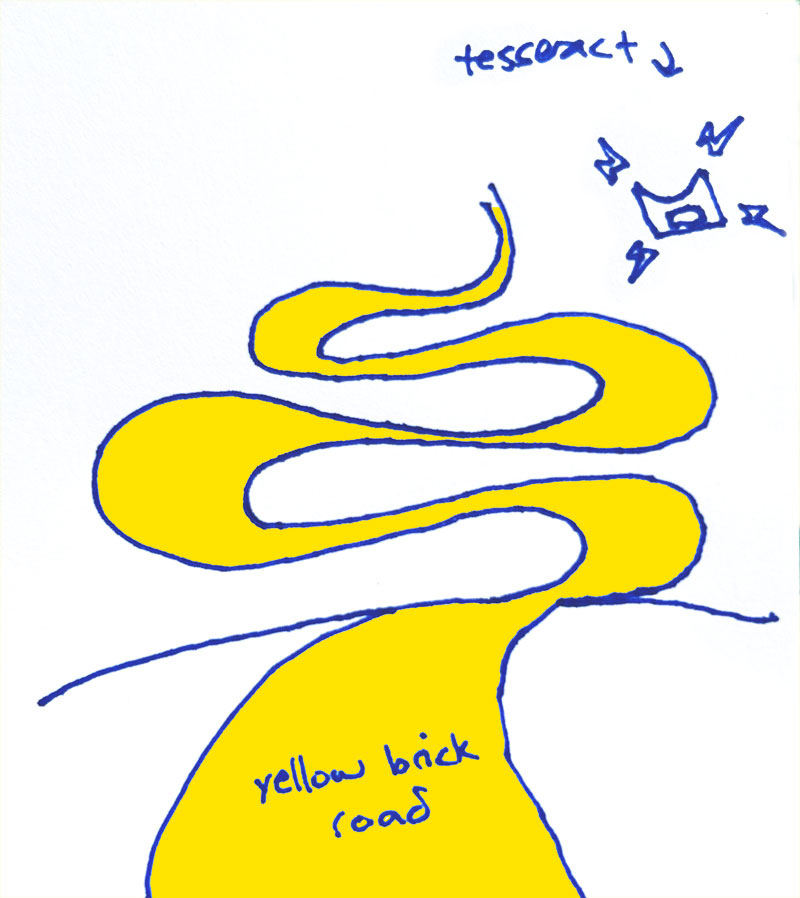
I’m heading back on the yellow-brick road, just floating belly-down this time. Again, it’s not far; 30 feet in the sparse area with the tree near the edge, 30 more feet through the more crowded area. I’m remembering to gather my things from the last dream — wallet, keys, costumes that I need to return. I had borrowed the costumes from the store using… what was it called, I wondered, borrowing clothes temporarily? The only other awake person on the road is listening to my thoughts, and offers “layaways” as the answer. I responded “nah, but it’s like that. . . . ” I’m getting distracted and then realize I don’t need any of this — I throw up my hands and let my things fall away. I begin moving again. Down the road, back to the dream. And I’m back in the dream? Or waking up. My body is filled with energy and good feelings, charged up with the dim sugar light. I had struggled to fall asleep, but now I was in the perfect state. I sat there thinking about the dream, trying to remember it, catching a corner of it, almost losing it, before getting a hold, remembering, then waking up to write it down.
I felt quite large in this dream, filling the space more than usual.
I got the sense that at higher levels we speak self-fulfilling prophecies. We create something (speak it with our attention) — a sound-form-idea — that is an end result that exists outside physical time as a cause for its own creation within physical time.
Yellow Brick Road: This dream was at 3:45, when my dreams are at their most intense and deep. The fact that I effortlessly “shift sideways between two moments into a higher frequency” shows that I’m dealing with a higher, more knowledgeable level of myself.
The gold of the yellow brick road is the color of the inner light. It’s a ribbon of light, bending back and forth as it enters thicker matter, creating frequency domains and voids (see Wave Motion In Slower Frequency Domains). The yellow brick road, the people on it, the grass and trees on the side are all physical forms painted on it. The Wizard of Oz is built on a spiritual reality, as are all great works.
There are lots of echoes of Monroe in here. The fact that I had to jump to make forward progress on the yellow brick road was like his need to “skip” to get places in the stream. I wrote at the time “It was like building up force against the flow by holding stationary for a few moments, then releasing, being weightless, and moving forward.”
The rolling yellow brick road on the way to the void and tesseract was sort of like an overview of the astral realms — very populated nearby, and less so going out. Each hilly loop defined a different arc of road ahead of me or “ring” of sorts to my perception. Monroe described the astral planes as rings. The bending back and forth created the Tiny World Effect (see The Tiny World Effect). The fact that I felt quite large might have been my presence scaled outward into this astral overview.
The yellow brick road didn’t lead to the tesseract — that was in the void off to the side. It was the void’s sugar light energy that drew me into this viewpoint. That was my actual destination. From this higher-frequency viewpoint I saw the astral as the yellow brick road that I was currently on.
Chakras and Their Energy Streams
The chakras are structures of the energy bodies through which energy flows in the astral and higher realms. As such, they can sometimes be seen and rationalized into things in dreams. I’ve seen those energy flows rationalized most often as water, from dribbles to sprinkles to sprays to a solid stream.
-
Thinking of You 1994 • age 19
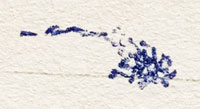
Low-powered energy attacks Takes place in a shopping mall. There’s all these contests. The first, I forget. The second was in this big hi-tech auditorium. The first bunch shot energy things at me that fall quickly. I shot them all quickly, then had a nasty round 2.
Chakra Streams: The way the shots descend after a short ways makes me think that they were chakra energy streams.
-
Trail of Dreams 1999 • age 25
People were tarring new paths all over, stinking up the place. The name of their company was “Flick.” Buttercup and I had two hoses, one spraying a strong solid stream and one merely dribbling (chakra/energy flow manifestation). We found the site of current tarring and sprayed our hoses at it.
This woman (who was part of the project but also spraying a hose) got mad and stormed over.
Chakra Hoses: Here the chakra energy flows out like water from hoses.
Energetic Interactions
Energy can be projected outward from the astral body, typically from the chakras. It can take form based on its intention. Energetic interactions are often rationalized as someone “throwing” something at you or to you.
-
Walking Lucid in Midtown 1998 • age 24
While first setting out on Tjo Street, Buttercup came skipping down the way and it was like this bouquet of flowers came from her and shot into my arms. Then she gave me a big hug and kiss and then retreated away (she’s awake and at work right now).
Verification: During the very half hour of that dream, Buttercup wrote me an email! Thus her appearance!
Buttercup’s Love: Buttercup’s positive thoughts of me while she was at work connected with me in this dream. I’ve seen similar bursts of something shoot out from people in the near realm, and it’s a sort of communication. This one turned into flowers, either through some visual similarity or a representation of her feelings toward me.
-
Lucid Dream: Bruce’s Arm and the School Bus 1997 • 10:13 AM • age 23
I came upon the kittens and went right up to them. They were very startled, then cautiously curious. They ran and then one of them threw something at me!
Kitten Attack!: An energetic attack from one of the kittens!
-
My New Favorite Movie 2023 • 3:30 AM
We ended up climbing the walls of a fortified slum area to find one of our singing group firing huge boulders out of himself at us. They bounced off the wall we were climbing, back into the big truck he was in, then back and forth before rolling away.
Energetic Attacks: This energetic attack takes the form of huge boulders.
-
The Most Beautiful Story (A Remake) 2023 • 2:30 AM
I’m “driving” around with a camera, filming. I’m about 20 feet in the air, flying, but I don’t realize it in the dream. I get in the way of some cops. They want to stop me but I’m filming, and they give chase, throwing things up at me, but I keep driving away.
Energetic Fear Responses
In the astral, our emotions can cause energetic responses that can be seen.
-
The Slumber Party and Scary Man Prank 1999 • age 24
It was still dark and I looked out a window. I pointed and said to Buttercup, “Look at that. . . . MAN!” Surely enough a bearded spooky face appeared out of the shadows in the window, from a black silhouette to a full face, giving the appearance of approaching. Buttercup got scared and fell to the floor in a fetal position. She seemed to be locked in her own world, shaking, and these grapefruit-sized semi-transparent black orbs were skittering all over her body. . . . Later, awake: Wow!! Buttercup dreamed of scary men out on the porch! After she fell into the fetal position with the black orbs all over her in my dream, she dreamed she was unable to move with cockroaches running all over her body.
Skittering Orbs: Buttercup became scared by something and fell into a fetal position. The energetic response to the fear was black orbs scurrying all over her body. Within her own dream, she rationalized them as cockroaches.
-
The Stinging Ocean 1996 • age 21
My dreams last night were typical of those recently. I dreamed a horrible ocean dream. While in dark tidal pools, semitransparent grey arthropods would scurry around our legs. Then they became scorpions. . . . I was never injured but the deep-sea ocean life fear of the unknown was real.
Scurrying Fear Orbs: My fear of unknown ocean creatures caused the same energetic reaction, and I rationalized it as arthropods scurrying around my legs.
The Aura and Aura Pictures
The aura is the overall energy expression of the flow through the astral body based on its moment-to-moment focus. The aura can be seen in the astral, though it is usually edited out of our physicalized and rationalized version of the dream.
-
Osiris the Dancer 2010 • 3:30 AM
Osiris is gorgeous, dressed in a white topless outfit that had form-fitting pants and ribbon-like fabric flowing off the arms. Her skin is slightly darker than the other dancers. She comes up to me and there is this moment of unspoken permission and then a blur.
When I come to, I’m lying in the same position, and the party is over. I look down and I’m completely covered in drawings made and colored in with wet, sticky white chalk. My jeans are like shorts, reaching just up above my knees. I fold over the edge to see the inside and the same drawings are underneath the fabric in reverse! The chalk drawings are on my chest as well — everywhere I can see. It’s all in white, except for little edges of pink and blue. The drawings on my legs appear for the most part to be a pattern of finely drawn buttocks and thighs laid across each other, and then colored in. What had happened during that blur with Osiris?
Rationalized Aura: Were the chalk drawings my aura? Why was it all lit up and visible after the experience with Osiris? I remember the chalk being wet and sticky as if freshly applied, like body paints.
-
Kindred 2025 • 5:15 AM
The man walks out in this amazing costume that reminds me of an aura. It’s bluish overall, with a slightly inhuman face with large dark eyes. The entire costume is changing shape and shades. It’s as if it’s made entirely of 2-3 inch long filaments of mostly blue light standing out from him, blowing in its own internal wind. The filaments are tightly packed, almost like fur, but flowing. The character is the Sandman, and it is the most impressive costume I’ve ever seen. He tells me how they’ve tried to make all these inventions work over the years but none has taken off. I say THIS WILL.
Blue Aura: This is most certainly his aura, and he’s able to change its appearance somewhat. Or else I might just be seeing the flow of energy as it changes around him. The large, dark eyes have been described by some as concentrations of energy.
Rationalizing Astral Body Separation
Astral body separation can be considered both an astral and physical phenomena, as it’s the point where the two come together (and separate).
Astral Body Separation
Several experts in lucid dreaming and OBEs have had experiences in the dream state where the physical body is represented by their house. Much as I dislike this kind of representative metaphor, my mind appears to use it as well. In several dreams, it seems exiting my room or house marks an important transition.
The dream self, finding itself already in a body in the dream state, is aware at some level when it is still within the physical body. What best represents the thing a body lives within in physical terms? The house (or bedroom) where we live. With one’s house representing the physical body, exiting the house is equivalent to exiting the body.
My dream self, which separated from my waking self around the age of 7, uses the house I lived in at the time — Blaine House — as its physical body metaphor.
-
OBE at the Dark Tower 1997 • age 22
I was doing lots of travel around the area of the Dark Tower. . . . In my Blaine House room [within the Dark Tower], I had an OBE in which I found out how to fly: jump and hold onto the “rising” part. I flew up through the wall and roof, and ended up on the deck outside my room in Blaine House. I looked around. Below me on the entrance side it was all the same as Blaine House, and there were flashing Xmas lights down there. The moon was in the sky above and the forest was on the other side, reminiscent of other Dark Tower lands & forest. It seemed that above my room, instead of the roof, was a part of the Dark Tower’s library. . . . [I talk with several people]
Later I was on the ground floor trying to fly back to my body many levels up and I noticed the silver cord. I touched it and it was warm. I followed it back to my body.
Exiting the Tower: I have a dorm room in the Dark Tower, and it’s my room from Blaine House. From within that room, I exit through the wall and ceiling (exit the body) in what I think of as an OBE, arriving outside Blaine House.
-
Bedroom Window Gateway 1997 • age 23
A common experience was jumping out the window of my childhood bedroom in Blaine House to another world far, far below. And now, Buttercup and I were up high, among the trees, where my room is. Maybe the roof had become transparent. At any rate, Buttercup wanted to go somewhere out of the rain, and there was a dry place in the world down there, in the caves by the water — that’s where we had to jump. But it was a mile down this time. I had done it countless times before but now I hesitated.
The Bedroom Window: My childhood bedroom in Blaine House was on the second floor. I had a window above my bed, and outside the window were trees, their treetops just over my bedroom.
With Blaine House representing my body, exiting through that window meant leaving it, and I must have done so in tiny ball form for the two-story drop to feel like a mile. Likewise, the world down there was tiny in size.
-
Semi-Lucid OBE: Webbed Windows 1998 • age 24
I came to in the living room of THIS apartment. . . . I looked out through the set of three windows. The clouds were really interesting (though the sky’s clear in the waking world). I wanted to go outside. . . . At times it seemed that the yard of Blaine House was down below. . . . I willed myself to the room’s entranceway. My body took a few steps and tipped to the right onto the sofa. There was a weird in/out sensation and then I got up again and walked through the entranceway into the kitchen.
I went downstairs to the pool table room of Blaine House, now all rearranged.
Exiting to Blaine House: The upstairs apartment we were living in was a somewhat new home for us. I’m semi-lucid, in the near realm version of our apartment. I can see the yard of Blaine House outside rather than the apartment’s yard. When I left the apartment, I felt an odd sensation (exiting the body) and exited down the stairs to the interior of Blaine House. This appears to be the body-as-house metaphor where I exit my body as I exit the house, and appear in Blaine House, my astral home base.
-
The Detachable Room 2004
I’m at Blaine House, which I identify as an Oberlin college dormitory somewhat. . . . Isobel, sleeping next to me in bed, stirs, and I awake momentarily. . . . At this point, Kai came in. He wanted to do something. . . . He went around the room unhooking the power cables to Blaine House. I don’t recall if I saw this, or simply knew this. My room was where the fancy dining room was — on the second floor corner in the back. The whole house was similarly divided into small dormitory-like rooms. . . . Kai ran over to me and started jumping around. The entire room started rocking and shaking. . . . All at once the room slid out of the house. It fell to the ground, slid across the grass in the back yard, and finally down a hill. It was a rush! The room came to a stop and then fell apart so that there was one wall flat on the ground and another standing up precariously. We laughed.
References: Isobel was our dog.
Sliding Out: The body-as-house metaphor appears again! The rocking back and forth is something I’ve seen when getting nonphysical assistance in getting out of the body. Kai knows what he’s doing. The way I slide out and drift to a lower spot is similar to the exit I had in “Passion & Liftoff” — one in which I rationalized I was in a plane drifting down and crashing.
The dream begins at Oberlin in a dorm. My brief awakening from Isobel stirring brings on an awareness of my physical body (represented by Blaine House). This mixes the two locations in my mind. When the room slides out, I exit the body to the exterior of Blaine House — my metaphor for being outside the body.
-
The Destruction of Blaine House 2023
Buttercup and I were on the porch off the master bedroom [of Blaine House], looking out across the fields. I looked down and I saw that there was this 30’ x 40’ hole in the ground, and through it I could see lava bubbling — bright red and yellow. Then I noticed that the house was tipping slightly towards it. I went in to the bedroom and the house tipped back to its original position. I went back out to the porch and the house tipped towards the fields and lava. At this point I began to panic. We needed to tell someone!
The next thing I remember is that we were in town. . . . [I call for help]
Then I’m back at the house. . . . At some point, I had a higher view of the house.
Rock Your Body: With Blaine House acting as my physical body, here I am just outside the house on the porch, and as I move about within the house, it rocks back and forth — a common method of astral body separation. Often upon separation there is a scene change, and I find myself in a town. Returning to Blaine House, I’m now outside of it.
-
The Office Tower Party 2025 • 6 AM
Some people directed me toward the center of the building, where this floor and the two floors below it were part of the party. Entering this area, I found a series of rooms built around a staircase, where one could circle through the rooms before descending to the next floor. . . . I went back into the game again, and as I played, I made this huge leap to a new area. However, this leap was also reflected in the office building, and I found myself on the outside stairs on the 2nd level. Oops! I needed to find my way back to the party. So I went back inside and found my way to the center area again. . . . Then I heard Buttercup calling to me in my mind. She was here with Gwen! They had wanted me to show them around, and I had forgotten. I went back to the building entrance I had just come from and saw them there. I hoped they hadn’t been waiting long, and she responded that they hadn’t. There on the wide front steps I saw a donkey. . . . So Buttercup, Gwen, me and the donkey went inside and I began showing them around, starting on the 2nd floor and moving up.
Dreaming Within the Body: It’s said there’s a spiral current up the spine, and here there was a spiral path around the central “spine” of the building. My feeling of the astral body moving from my leaping ended up with me outside the building. It appears the house-as-body metaphor can apply to any building.
Here I begin at the top of the building, possibly in my sixth chakra area, and descend to other chakra “floors” of the building. Size is not an issue, since consciousness can scale to any size.
If this is true, I’m giving my wife and daughter a tour of the dreamscape inside of my body. Note that of my lower five chakras, my second (feeling, empathy) is probably the most open. Fittingly, that’s where I exited and re-entered the building from the jump and also where we re-entered together.
Buzzing, Tingling, Vibrating
A buzzing vibration is a very common sound heard during astral body separation. The sound is often rationalized in my experience as a swarm of bees. Dealing with the bees usually takes over the plot of the dream.
-
The Space Probes 1996 • age 22
I’m running over pebbles and water. I’m about to get to this lake with the intent of flying over it and I suddenly hear this swirling buzzing noise of some intensity. Thinking I stumbled across a beehive, I startle and wake up. I was probably about to go OB. . . . Later: I’m in a sunshiny beachy area and my family’s around but I’m avoiding them. I experience big jumps down (100 foot drop into water) and cool sensations.
OBE Sounds: Notice that as I’m about to fly, the swirling, buzzing noise appears. The feelings of motion during the separation of the astral body is often rationalized as flying in the dream state, and attempts to fly may trigger astral body separation.
The falling sensations come from the astral body falling back into the physical.
-
Bees 1997 • age 23
There was this big nasty segment about bees. I was in a grocery store, and the bees kept appearing everywhere. I tried many ways to kill them, but some always remained. There was a scene with a big display and I sprayed this liquid all over it, but one escaped. This guy thought the bees were powerful and followed them around. One surviving bee could always produce a queen.
Then I was in the stairwell of a place I might have lived. There was a big vertical cylinder in the middle and a beehive in the center. A voice spoke into my mind “I’ve always thought the old way worked best: fire.” The cylinder started spinning, flashing in glowing rainbow dreamfire. It was beautiful. Bright flashing flames flew out and incinerated everything.
Bees: I was feeling the body separation vibrations and rationalizing the sound as bees. Of course I could never kill them all. The vibration would continue regardless of my actions on the thought forms I conjured to explain them.
The next scene was a transition to my body in what I believe to be the “column of fire” metaphor to represent my spine and the energies flowing through it.
-
The Buzzing Campus Eclipse 1999 • 8 AM • age 25
It was sunny daylight, and then the color of the sky got darker and someone shouted “eclipse!” Everyone got up and got into a position to see it. I ran around the building. Gravity diminished as a moon flew across the sky, barely crossing the sun’s path. Everything turned a dark orange color and then there were bees everywhere. Buzzing! I knew that they liked the color red. I got stung on the hand and was bleeding. I ran into the school and went underground through all these elevators, futuristic rooms, and huge elegant chambers. I was trying to find a way back to the surface while avoiding the bees!
Out of Body Bees: All at once there is a change of light, low gravity, and the buzzing. The low gravity feeling could be a sensation of my astral body coming loose. But the bees frighten me and I retreat into a building (my body?), before eventually trying to find my way out again.
How strange! What is happening with this “eclipse” that sends me nearly into an OBE?
-
The House War 2011
We take a road on the near ridge up to an abandoned building. . . . It was filled with bees! There were some transient-seeming people living there, too. Somehow we lured the bees out of the building and down the road. Then it was only orange wasps that were left.
Bees and Wasps: Notice how I can’t escape the sound by leading the bees away — when I return, it’s re-rationalized as wasps.
Astral Body Movement
Astral body movement can be part of the astral body separation, or movement afterwards.
-
Mountaintop Flying 1996 • age 22
It began as a ride at the fair. I was in a little roller coaster car on this track on the side of a mountain. At one point the car flew up at the peak and jumped this rock. I realized then that gravity didn’t matter so much. I jumped the next peak and began to fly. I was flying fast through this jagged mountain range with steep angles. When I landed I had this total physical body rush. It was so grand. Then I heard a voice say “No one deserves to fly right now more than you, Benji.” The rocks I was on broke off the mountainside and I had the hugest free fall into the river below. The river was a glowing blue color, as if it was evening and very cold. I awoke when I hit the water. So crazy cool!
Flying: My first rationalization of the sensations was of being on a roller coaster at the fair. Then I switched to direct flying.
Flying is usually the rationalization of the movement of the astral body, including its separation from the physical body — something we do several times every night. This was one of those cases. The return was sudden and the impact woke me up, which can happen with sudden returns.
-
Passion and Liftoff 2000mature content
I went to this odd, out-of-place room. Inside was a friend and two gorgeous naked girls laying on these pillows, facing away. I was overtaken with this strong sexual passion and made some verbal attempts at seduction. What it was is that I was outpicturing to one of them scenes of how nice it would be. So then I was floating above myself, embodying the imagery, with her vaguely above me. We began doing it, but she became less and less important. As I moved, I felt these golden waves going up and down my floating body from my feet to my head. It was ecstatic, orgasmic but sustainable.
Then without warning I’m in a plane on takeoff. It rises slowly and another plane passes over it. My perspective on my plane was as the plane — around and above it. My plane can’t get enough lift and comes to the inner corner of the walls of this ruin. It crashes in an explosion, throwing me rapidly forward, and I awake.
What was all that about? It seems I raised my energy, drifted out of body, then rationalized the plane to account for the lift-off sensations. The plane rationalization began slightly after take-off, slightly above the ground where I was in the scene before it. It probably “crashed” when I reached the corner of my bedroom.
Lift-Off: So this is a clear rationalization of the motion I feel as I move higher out of my body. Upon separating, I seem to drift down into the corner of the room, with the resulting crash rationalization frightening me back into my body.
Note that the girl floating above me is also rationalized as a plane!
Other Rationalizations
Walking on Water
-
The Blue Crab 2025
I go out to a boat floating on the ocean, not far from the shore. I’m just walking on the water, rationalizing floating docks as I go.
Floating Docks: Ice is also a common rationalization for walking on water.
Rationalizing Physical Sensations
While in the dream state, we’re in a thought form body that we take to be our physical body. So it doesn’t make sense for us to be receiving sensory impressions from yet another body in a different location and environment (our beds).
When we experience a subtle, unknown physical stimulus during sleep — not enough to really get our attention — then the sensation flows directly into the dream and we attribute what it is from the dream context.
When a brighter, louder, or more persistent physical stimulus happens, we may briefly switch to the MetaDreamer focus to determine if there is reason to wake up or not. The MetaDreamer focus identifies the cause of the stimulus, or at least determines if it’s worth waking up for.
When the cause of the physical stimulus is identified and waking up is not needed, it may be integrated into to the dream. This is a “waking insertion”. This has the benefit of being the attribution point for further interruptions from that same source, preventing the need to switch back to the MetaDreamer focus again.
In these ways, physical sensations are integrated into the dream. This preserves the dreaming state.
See “Purposely Attributing Waking Influences” for how this is decided and done at the MetaDreamer focus of consciousness.
Dream Reattribution
Dream reattribution happens with subtle stimuli whose source isn’t identified. The sensation flows directly into the dream to be rationalized (attributed to something) based on the context of the dream.
The form of the rationalization is determined by a combination of the immediate context of the dream and the longer context of the person’s life.
See also How Context Determines Meaning.
Sounds
-
On a Motorcycle 2000 • age 25
We’re flying in a physical plane and I dream:
Buttercup and I are on a motorcycle (this is how I had attributed the loud roar and bumpiness of the plane). She was trying to convince me of the value of this intricate pattern on tissue paper but I thought it was just tissue paper and threw it off the back of our motorcycle. Suddenly I realized it had love notes written on it between her and I! Instantly I regretted the rash move and jumped off to get it. This other motorcyclist picked it up and I tried to chase them (on a motorcycle again) but got on the wrong ramp and then jumped the motorcycle way up in the air. The vertigo and fear of the anticipated crash caused me to awaken.
Motocycles: I attributed the loud roar and bumps of the plane to being on a motorcycle together. When I jumped off and the sound continued, I rationalized another motorcycle to make sense of it. Then I created another one for myself to give chase.
Rationalizing Physical Sensations
Substitutions Due to Brief Interruptions
In these brief interruptions, something from the waking world becomes the object of my attention. When I return to the dream, the previous object of my attention in the dream is replaced by it.
-
Isobel’s Head 2002
I had finished the adventure game (a realtime first person game with others, of course) in the treasure chest and was now back out on the desert sands. I had three objects with me. Two were long like swords (but I forget what exactly) and the third was a round fuzzy thing like my stuffed owl J’buzhibu. I gathered together some dried leaves I had, set the fuzzy thing upon them, and prepared to set it on fire.
Then there’s an interruption from the waking side — my guess is that it was Isobel, our dog, because when I returned to the dream moments later it is no longer a fuzzy thing but Isobel’s head! I set about putting my lighter to it, but the thought of the loss of my dog, of burning her head, of Buttercup’s sadness, all this overcame me and I became sad and tried desperately to remember how she had died. It was so sad that I woke up.
Waking Insertions: Sounds, sensations, lights, and anything else coming from the waking world while dreaming can find its way into a dream. The stimulus needs to be integrated into the dream in order to prevent it from interrupting the dream. However, as we see here, it doesn’t always work out, and the insertion itself can prove to be so shocking as to jar one out of the dream.
-
The Detachable Room 2004
I’m trying to pee in a urinal in a bathroom crowded with people and various things. Anyways, I get it wrong — I take off my jeans and dunk them in the urinal water, which is already yellow. Oh no.. I realize my mistake. I’m slightly embarrassed and head back to my room, leaving the other people in the bathroom. There I find a sink and put the pants in the water to clean.
Isobel, sleeping next to me in bed, stirs, and I awake momentarily. When I return to the dream, it’s Isobel I’m washing in the sink. “I need to get the urine off,” I think. It’s not actually Isobel, but a squirming Cavalier puppy who wants to get out of the sink. While washing the yellow off her back legs and backside, I wonder if I’m mistaking the golden cavalier spots for stains. At any rate, I wash off all the stains. Notice how it was the lower part of the pants that was stained, and when the dog replaced them as my object of focus, it was the lower end of the dog that was stained. When I was done washing, the dog was smaller and whiter than Isobel, obviously a shrunken thought form.
References: Isobel was our dog.
Waking Substitutions: This is another great waking substitution, just as in “Isobel’s Head”, with the same subject! In this substitution, she is also made into the subject at hand — she replaces my pants as the object in my hands, with her bottom end as the stained end. Being that the dog form shrinks and fades pretty quickly shows that the need for that attribution to remain in the dream also fades pretty quickly.
What We’re Wearing
A classic waking influence is the insertion of what you’re wearing to bed into the dream. This happens because of a brief switchover to the waking focus, in which you’re temporarily aware of your physical body, including sensations on your bare skin, before refocusing in the dream.
If you’re wearing something uncomfortable, the sensation may cause it to be inserted into the dream, where you may try to take it off only to find another is there to take its place.
-
When Everyone Stopped 2006 • 5:45 AM
On the way up I realized I was only wearing boxers! I rationalized that I must have left my shirt and shorts somewhere. It was really junky down there, so it wasn’t hard for me to start finding clothes everywhere. . . . A friendly fellah came downstairs to help and now Buttercup was with me (another insertion from waking life, perhaps).
Waking Insertions, Rationalizations, and Projections: Pulling our (lack of) clothing into the dream often awakens the waking self in the dream, who doesn’t want to be in public in its underwear. Buttercup, next to me in bed, is also pulled into the dream. It’s likely she or I shifted in bed just before this scene.
-
Deadwood Blues 2010
I’m wandering about, going from bar to bar, and end up in this one at a table with three other guys who we all found mutually amusing. I was talking kind of softly as if I had something in my mouth (I was sleeping with a blue mouth guard in my mouth to prevent me from grinding my teeth, and this appeared in my dream). We were talking and making each other laugh but I found it annoying that there was something in my mouth, so I turned and spit it out, and a blue glob flew out into the shadows of the wooden floor. But I assumed that must not have been all of it, because there was still some in there, so I reached in and grabbed out another big gob of it and threw it onto the floor. And yet, there was still more in my mouth. So handful after handful, I pulled gobs of blue goo out of my mouth and threw it on the floor until it became clear that I just had to deal with having something in my mouth and went back to the conversation trying to speak around the obstruction.
Waking Thought Form: My awareness of the mouth guard at this point in the dream (probably because of so much talking) caused me to recreate it in the dream world. While I believed that removing it from my mouth in the dream would work, it made no difference to the sensation of it in the physical world, so it continuously remained in my mouth.
-
Triple Braced 2018
I was sleeping with a soft neck brace on.
In my dream, there was a scene where I was going to speak in front of a bunch of people. I realized I was wearing the brace, and took it off. Then I realized I was wearing another one, so I took that off too. Then I felt that there was a third, so I took it off and started wondering about why and how I could be wearing three neck braces.
The sensation continues!
It’s Still There!: The sensation of my neck brace made it appear in my dream. But no matter how many times I took it off in my dream, the sensation of it continued.
Tingling Arms or Legs
-
Hanging with Star Trek Legends 1996 • age 22
Then I’m in the back yard of Blaine House on the hill with swarming earthworms and green caterpillars many feet deep. Gross!
Swarming: This is probably a rationalization of tingling legs or visual swirling effects.
Thunderstorms
-
Thunderstorms and the Shape of Dreams 1996 • age 22
Then, at Blaine House, a HUGE thunderstorm was coming. The radio said power was out where it had been. We could hear the thunder even though the storm was far in the distance. I was rushing about, preparing — shutting windows and screens and such, helping young Ruby do the same in her room. I could walk around without worry in Blaine House. Wadsworth was there, but it was not a problem. I actually didn’t mind him being there. The clouds were black and huge and coming fast but above us it was blue. The storm hit pretty intensely and I woke up to find a REAL thunderstorm going on!
Storm Integration: Here the lightning and thunder of a real thunderstorm bring one into my dream.
Sounds and Voices
-
Lucid Dream: Bruce’s Arm and the School Bus 1997 • 10:13 AM • age 23
So I’m flying again. I look down at the street and it’s shimmering, like grass in the wind, moving in swirling sheets of points of light. I don’t think I’ve seen anything shimmer quite like that. There was traffic and school buses. I picked up a big bus, and was floating along with it. I scared some kids in other buses by pretending I was going to throw the bus at them. I heard all the kids scream but of course I wasn’t going to — just kidding around. Then I walked up another hill, forgetting about the bus.
The school bus, melted & shrunk I met this kid and we started talking. While we did, the bus I had picked up had shrunk to the size of a large plank of wood. It was just one color of gold/yellow now, and each indentation was much less defined, as if melting, shrinking. Somebody had grabbed it and was running over the hill with it under his arm. I said I heard a bus from the waking side, a rumbling engine-y feeling. I asked the kid if he could hear it and he thought it was the vehicles on the road in the dream. I said “No, it’s coming from the other side, from my body side.” I then had dual awareness for a few moments; half there, half here, but in the same space. That’s when I felt my head and jaw vibrating.
Thought Form Rationalization: I started flying outside and saw the shimmering in the street. There was no traffic at this time. Then suddenly there was all kinds of traffic, not moving, just sitting there with their engines on like they were in a traffic jam. It was either a rationalization of a bus or truck outside in waking life or a rationalization of the head and jaw vibrations. As I turned my attention to the conversation, the bus thought form began melting.
-
Weaving Dream and Physical Conversations 1996 • age 22
Buttercup awoke me and her voice broke into a conversation in the dream I was having at the same audio level.
Conversation Source: The telepathic dream conversation is already being translated into physical terms as talking out loud. From here, someone speaking from the physical side mixes right in.
Light
-
Under the Earth: Guardians 1996 • age 22
Buttercup, I, and a friend are now running through the tunnel on the other side. As we continue, it steadily brightens and ahead of us we see the mall across from Rainbow Foods. There’s fresh snow on the ground outside. . . . I wake up to the year’s first snow.
The Brightness of Snow: The increased brightness of the morning light off the snow likely influenced the dream to include snow on the ground.
Super Nova Dreamer
I was using the Super Nova Dreamer from the Lucidity Institute — a mask you wear when you sleep that detects REM cycles, and then flashes red lights that get incorporated into your dreams. With training, one learns to recognize the lights as a signal that you’re dreaming, leading to lucidity.
-
Blinking Masks 1999 • age 25
I was searching for a mask in this open, friendly-feeling warehouse. I showed Buttercup one that was gross and funny and she didn’t like it. I couldn’t find it later and she says she hid it under some clothes in a box. Then I was looking at a whole row of science helmets on stands, and they had blinking red lights. Then the blinking stopped and and I wanted them to blink again but they wouldn’t.
Super Nova Dreamer: I didn’t recognize the signal, but the lights were incorporated into the dream.
-
LASIK Beams 1999 • age 25
The Super Nova Dreamer showed up as the red light from LASIK laser eye surgery which prompted a whole dream on the subject. No surprise, as I’m going in for a LASIK follow-up today.
Super Nova Dreamer: Depending on the context, the flashing red lights could end up being just about anything. Here it alters the plot of the dream.
-
Lost in Time 1999 • age 25
Twice earlier in the night I nearly awoke to the Nova Dreamer lights. The first time they appeared pink with light gray lines, like the light had cling-wrap on it. The second time they appeared as a red-orange kaleidoscope of shapes. . . .
Appearance of the NovaDreamer lights
NovaDreamer kaleidoscope I dreamed I was in my college dorm (somewhat related to Oberlin). . . . In Ranier’s room I was told it was something like December 6, 2001 (two years later). I found that the last thing I could remember was the last few days of November, 1999, (the actual date). I felt I must be losing my mind, having a psychotic break. Then things went dark and I saw red flashing lights in my head. I thought “There are those lights! I must have been abducted by aliens for the last two years!” I was really scared.
Super Nova Dreamer: Written at the time: The lights first come through the context of the dream. Then, if I refocus, the dream dims out nearly to black and I just see the kaleidoscope pattern of red lights.
Satori
-
The Destruction of Blaine House 2023
The next part I remember is that Buttercup and I were on the porch off the master bedroom, looking out across the fields. I looked down and I saw that there was this 30’ x 40’ hole in the ground, and through it I could see lava bubbling — bright red and yellow (this could very well have been caused by a satori pool). Then I noticed that the house was tipping slightly towards it. I went in to the bedroom and the house tipped back to its original position. I went back out to the porch and the house tipped towards the fields & lava. At this point I began to panic. We needed to tell someone!
The entire story could have just all been the result of a Satori pool being integrated into the dream as a lava pool.
Satori Pool to Lava Pool: I’ve seen a few times where what seems like a satori pool is overlaid on the dream scene, and it becomes integrated into the dream in some form.
Neurons
As everything you see is created within your head (no light enters the brain), it’s no surprise that neurons themselves can be influences upon the scenery of dreams. I’ve seen them other times in altered states of mind, and they come through the rationalization field in many different forms.
-
The Fireworks Vines 1999 • age 25
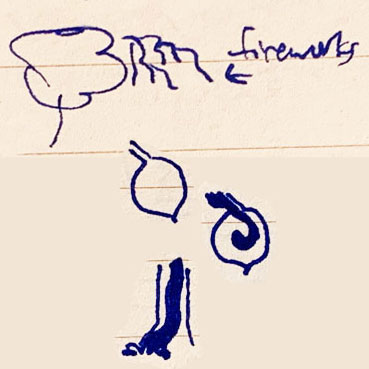
Fireworks vines, tree leaf, leaf with vine curls I’m sitting in a most beautiful garden. It’s well-pruned with pathways, flowers, and square-cut bushes forming walls. My friends were with me (including Phoebe from Friends). I looked up at the sky and saw what looked like the remains of fireworks but they weren’t moving and weren’t fading. They were a light orange color and seemed to emanate a dim orange light that was hard to make out against the bright blue sky. Fascinated, I went to one of them and found a narrow orange tree trunk, less alive than it could be, and the firework trails were branches that ended in orange leaves, like aspen. I also saw at the base of each tree a vine sprouting in vibrant green and climbing the tree, splitting as the branches did and ending with a curl in each single leaf. It meant new life and I was totally charmed with it. I think I was seeing neurons and some energy of life within!
Fulfilling the Sensation
There’s another interesting type of rationalization I’ve encountered when it comes to steady pressure as a physical stimulus. This most often comes from the sensation of our bed, blankets, or pillow. In these cases, I have in several instances made sense of it in the dream by putting my dream body in a position that would result in that sensation.
-
So I Have a Rat 2023
Buttercup, who does not like rats, was dreaming that she was holding a rat in her hand, much in the way one holds a burrito. It was her first memory of the dream, so she doesn’t know how she got it. The rat was alive, but not struggling. She was presented with the conundrum of what to do when you find yourself with a rat in your hand. She was so flummoxed that she “woke up” in our bed. She was still dreaming, however.
She stretched her arm out and grabbed something on the night stand. It was a rat! So once again, she had a rat in her hand.
So I Still Have a Rat: This is fascinating! The rat thought form in her hand continues through the false awakening. Her stretching and grabbing something from the night table was a way to explain the sensation of the rat still being there.
She is fulfilling the sensation of the thought form in her hand from her dream just before the false awakening!
Bed, Blankets, Pillows, Sleeping Partners
-
Tapestry of Tears 1997 • age 23
Nap dream: I’m on the couch in the living room (but it’s like gramma’s living room). I’m facing the back cushion, with my face is pressed up against it. I’m talking with Buttercup, when I notice my tapestry is hung sloppily behind the couch and not behind the entertainment center where I left it. I am overcome with emotion. I get up, tear it down, and run to the bedroom, crying. I put my head in the pillows, curl up, and just cry. My crying wakes me up. Was I really crying? It seemed to come from reality on just the other side. When I awoke my face was pressed up against Buttercup’s back.
Rationalizations: My face being pressed up against the couch is my first rationalization of my face being pressed up against Buttercup’s back. Then I get up and run to my bed, and press my face against the pillow in just the same way to continue to rationalize the physical sensation.
-
Between Classes 2010
This conversation sort of let me into the group, and we started talking about various things. I laid my head down on Quentin’s knees and basically got into the position I actually was in bed, with Quentin’s knees as the pillow.
Fulfilling the Stimulus: The pressure of my pillow was stimulating my neck, and to make sense of it, I laid my head on Quentin’s knees in the dream. Sensation and potential distraction explained away!
-
The Ghost Lady 2023 • 4:30 AM
I closed my eyes again, just concentrating on the dark, relaxing, waiting. I was going to give it a good long time this time. I turned my head to the right and laid it back on the seat, unconsciously matching the pressure from my pillow in waking life.
Matching the Pillow: As I relax with my eyes closed in the dream, I come closer to the physical realm, because that’s where this state is familiar. I must become aware of the pressure of my pillow and lean my head against the seat in such a way as to “fulfill the sensation”.
-
Rolling Snowballs 2010
After getting a little panicky about being too close to the edge, we decided we’d have to stay the night up there. I wasn’t afraid of the cold, however, and I burrowed a little hole in the snow. I tried to get Buttercup to join me but she didn’t. My little burrow was cozy and I think reflected the shape of the comforter and blankets around me.
Waking Shape: The shape of the burrow I dug seemed to take the form of the blankets wrapped around me. This seemed to be a different part of the dream, where I was partially aware of the waking world, maybe thinking more than dreaming. Some time passed here where my focus was not fully with my dream body.
Other Influences on Dreams
Physical Short Circuits
We experience “physical short circuits” in the dream state when we have a desperate desire to perform a physical activity such as running or shouting, but instead of routing that action to the astral body, we’re attempting to perform it using the physical body. Since the physical body is in sleep paralysis, it doesn’t respond, and the action fails.
Being Unable to Run Fast
-
The Red Scooter 2000 • age 25
Someone comes up to us and I have this sudden fear that he’ll ride off with Buttercup on the red scooter — so of course he does. I chase them, but I’m very slow. I concentrate really hard on running fast and the colors get deeper and darker. I become aware I’m dreaming, aware that I can break the seeming rules of reality around me, but still the red scooter pulls out of sight.
Faster, Faster!: The classic inability to run fast, which I completely overcome moments later by lucidly teleporting to them.
Being Unable to Talk or Yell
This happens when, for whatever reason, we end up trying to speak with our physical voice in our sleeping body. Being mostly paralyzed, this doesn’t work and we hear our attempts failing.
-
Deflating Tank 1997 • age 23
Very angry, I yelled that I hadn’t done it, but had merely laughed and laughed when it occurred. I was trying to yell louder and louder but my voice remained a whisper. At least it was an insistent one.
-
Adventures in Northtown Mall 2001
Walking to the center of the mall, I saw Raven walking the other way. She said a meek hello and continued on. I turned around and followed her into a book store. I tried to speak but my voice was all raspy, so I left.
Raven’s tilted house I returned to the center of the mall and thought about her. I appeared in this twilight neighborhood near a tilted, window-covered house without any decorations in it (I was likely just seeing through the walls). It was Raven’s house. I saw her inside and she eventually saw me and came out. We walked and talked. Then I saw this distant light in the sky, darting about unnaturally and I said “UFO!” I repeated it over and over because it felt as if my mouth was full of crackers and I couldn’t say it. Weird! Twice in one night!
Cracker-Mouth: Here I find I’m unable to talk at two separate times in the dream. The first time I was just trying to talk. The second time, I’m trying to shout, which is the more classic instance when one tries to use their physical voice and it fails to work.
The MetaDreamer, Dream Self, and Waking Self
There are many focuses of self; different but connected centers around which our experience and memory gather. Each focus becomes a specialist in its own area. They are all us, but result in somewhat distinct selves. Several of these focuses are involved in the dream state.
The MetaDreamer focus of consciousness is a broad focus that specializes in preserving the dream state. It acts as a conductor, handling different sources of input and directing them into specific focuses of consciousness.
The waking self and dream self are also focuses of consciousness. The waking self is a specialist in physical life, and the dream self is a specialist in astral life (dream life). Each knows the rules of its environment in great detail, but usually has little knowledge of the other.
The MetaDreamer decides where we direct the input from the physical — to our waking self or dream self. To continue dreaming, waking influences are forced into the dream context by keeping focus on the dream. This preserves the dreaming state.
The following experiences are wonderful examples of these different focuses:
-
Escaping from Dogs 2001 • 4 AM
I was awoken from dreams by this loud alarm-like sound being made by the freezer, and can’t resist writing down what I remember.
I was a character, not quite me, running over rocks along a beautiful river in a summery area with mountains on either side. I was being chased by dogs. The dogs were 100% thought forms, rubbery and cheating gravity as they came after me. I had created them earlier just as an experiment. Could they catch me? But the more I watched them, the more I could believe them, and a sense of urgency prevailed.
I ran into this large open cave with river water pooling in it. While it was a perfectly real cave, looking back I know with certainty that it was the Dream Station. This has been my new recurring dream place for quite some time, though it is more of a feeling and a shape than one specific place. To hide from the dogs, I considered jumping down into the water to grab two giant turtles and swim with them, or I could go into this black area. But I realized doing this would significantly “change things”. The Dream Station connects to the underworld (or the physical world), I believe. There is a straight vertical shaft between it and a more dark and solid place, and it may be related to my 4 AM underworld journeys. The time was almost exactly 4 AM when I awoke.
So it was at this point in the dream that I hear the alarm from the physical side. Suddenly I am no longer in the action, but outside the cave discussing the sound with a friend. I am now the storyteller, aware of both worlds, wondering if it’s a car alarm, or if it’s coming from the neighbor’s apartment. I even remembered that it had happened earlier in the night and stopped. So I decided to wait it out and push back to the dream side. I thought about how to attribute the sound in the dream. “Ah, I’ll attribute it to a search ray, operated by the dog-keeper to find me.” It worked — I was back in the character of the dream. But this was scary. I tried to bury myself in the soft, light sand, but the queen had found me.
I awoke to fix the fridge now since it wasn’t stopping.
The Dream Station is the concrete-like building in last year’s “Building The Atlanta Tower” dream. It’s related to the Smooth Caves, too.
Amazing, this storyteller, knowing two worlds and more, and this blind actor that believes everything it says.
The Dream Self, Waking Self, and Fragments: Let’s look at this in detail:
In my dream self focus, I set up the scene with the dogs. This scene is a rote. As seen elsewhere, my dream self considers this scene a “dream”. I project myself into it. This projection is into a character in the dream. It isn’t quite me. It doesn’t have my memory. It’s a waking self fragment. Created without context, it begins to get emotional, thinking the dogs chasing it are physically real. But the beeping pulls my attention out of the character back into my more real dream self focus with its broader, wider context. It has its own body. It’s been here all along but I was focused in the projection, like a person on a couch playing a video game. Now from the dream self focus I shift focus to the physical, to my full waking consciousness, to determine what the beeping could be. At that focus, reunited with my waking context, I make a decision to wait and hope it stops beeping on its own again. I pass that decision back to my dream self focus, where I uniquely know how to deal with the sound. I consciously redirect the sound into the dream scene along with a context-appropriate explanation of what is causing it. Now that the sound is dealt with, my attention can jump back into the character in the dream scene. I can get back to playing what is essentially my custom-built video game, where I’m playing the part of the character who is once again being chased by dogs.
This is amazing. In the dream self focus, we are the conductor of dreams. We orchestrate our dream experiences from a broader context. We are aware of when we are “dreaming” or not. We are intimately aware of the workings of the astral world. In that focus we set up scenes and situations for fun, and project ourselves into them to experience.
What we project is a self fragment; a receptive, uncritical, trusting copy of ourselves that will fully accept and believe the situation it finds itself in. The self fragment has no history, but it’s still us. Given any situation, we react as we naturally would. We don’t understand (or even question) how we got here. A self fragment is us, just as a person with amnesia still has their personality, expectations, desires, and fears. We lack only the wisdom available from a larger, broader context — including, importantly, the wisdom to know that in the larger view, we created this adventure for ourselves.
The self fragment is the embodiment of “suspension of disbelief”. It’s how we can understand stories.
Running from the dogs triggered my waking self emotionally, and it awoke into the dream with no memory of how it got there (shortened context). Typically at this point the self fragment pulls in physical life context and begins to apply physical rules & limitations. It responds as if what’s happening has physical life consequences.
At the dream self focus, I knowingly created the thought forms of dogs on a whim, to see if they could catch my character in the story. It may seem insensitive to the poor trusting self fragment who began to believe he was in danger! But I achieved my goal — drama! Why do we read books? Why do we watch movies? Drama, conflict, adventure.
Notice how the dream scene itself is a rote from the perspective of the dream self! I exit the scene to make the decision about the alarm sound, and then when that’s dealt with, I reinhabit the character — MYSELF — running from the dogs in the dream. Also consider how I describe this character as “not quite me” when referring to the self fragment. That’s the perspective from the dream self focus. It’s a limited version of me running through a rote. It has to be or it wouldn’t believe in and engage with the simulation.
Once my full waking self decided it was safe to return to sleep, I shifted focus to my dream self, where I do something my waking self knows nothing about. I knew I had to integrate the sound into the story rote so I could return to it. This worked and my attention returned to the scared fragment self within the rote, now even more scared by my dream attribution of the sound as a search ray.
Our full waking self is our focus in daily waking life and in lucid dreaming.
The MetaDreamer, then, simply describes the ability to focus back and forth from the dream self focus to the waking self focus.
I frequently go into little imaginative reveries in dreams, usually to add drama and excitement at times when I’m less engaged externally. See the section “Reveries” for examples of this. I’ll do it several times within the same dream adventure.
-
The Bombing and Revelation 2006 • 6:25 AM

A cartoonish bomb I’m hanging out with Mordred up the street from Raven’s house. He blows up their front door and the surrounding area with a bomb. The bomb was like a symbol of a bomb in my mind. I’m in a really dazed and unthinking mental state. I talk it over with Mordred, and tell him I’m going to talk to Raven, but think of course I won’t reveal who’s behind it.
So I visit Raven, but more lucid. She greets me warmly. Her brother stops by. She talks about burning her hand and being cured by some product made by bees. Then I broach the topic of the bomb. She jumps on me, furious, demanding to know what I know of the bombing. Her eyes are vivid and focused on me. I start to explain how I was walking along, “Observing and listening to two people, but in this dream state”. I begin to question myself, thinking “Why didn’t I tell you before?” and “Why didn’t I stop this?” and “Why did Mordred do it?” and “Why am I keeping his identity secret?” I realize it’s because I didn’t believe it was real, but the intensity of emotion in Raven tells another story. As I question whether it WAS real or not, I shift into another level of dreaming — this one more logical and near my body. I feel centered in my bedroom and think “Ah, yes of course, because it wasn’t real. She would have told me in email or on Solstice.” I feel relieved but wonder what that was all about. it was 6:25 AM. I decided to remember this dream and went back to dreaming other things.
Rousing the Waking Self: My dream self is aware that it was passively dreaming, possibly inside a rote. I wasn’t emotionally invested because I knew I was in a “dream state”, which is like watching a TV show. My dream self knows that a bomb wouldn’t have any real consequences in the astral or in this dream rote.
But Raven’s intensity rouses my amnesiac waking self, who asks the questions that I would ask if this had physically happened. This leads to the waking self deducing that I stood by while a friend was put in danger, which disturbs me so much that I step out of the dream, refocusing into the near realm to determine if I was physically dreaming.
When we die, we enter a widened context just like this, one which sees our physical life as a dream we’ve just awoken from.
The MetaDreamer
There is a broader focus of self that’s aware of both the waking world and the dream state. It is a calm, knowledgeable perspective that can make decisions based on this knowledge. It can attribute waking world stimulus into dreams in order to continue dreaming. It’s aware of the waking world time and date so that it can plan activities in the dream world. This is a focus I call the MetaDreamer.
The MetaDreamer focus is more than just the waking self and the dream self — it knows more than the waking self. Here the two can be seen from a higher perspective. This focus of consciousness is most apparent in the sleep states where we’re near the body. It recognizes the sensations of astral body separation and responds to them.
I’m snoozing this morning. Maybe 5-10 minutes into falling asleep again, a part of me recognizes the full-body tingle state as being about to go deeper into dreams and wakes me up instead because we have a flight coming up. What’s interesting about this is I’m not aware in my waking state of this tingling state as a sign of going deeper into sleep. I just learned that today. So there’s a part of me that’s aware of those deeper stages of falling asleep and also of my waking needs.
This shows an expanded realm of knowledge and memory my waking self doesn’t have access to. It’s knowledge about my physical body and its variations in consciousness, but it’s outside the range of my waking self. The dream self doesn’t understand everything about waking life (see Lack of Biological Understanding), just as the waking self doesn’t know much that the dream self does. At the MetaDreamer focus, I know both and more.
TO DO: ..OR is the MetaDreamer simply the ability to focus back and forth from the dream self focus to the waking self focus? Is it the dream self focus that knows how to route sensations? Time and date are all very physical things. Perhaps there is no specific MetaDreamer state — it could just be communication between the dream self and waking self. But first — reinvestigate the NREM state. I think this may just be the dream self’s “natural” non-dreaming state. Remember, whatever this focus is, it can manipulate waking self fragments within dreams (or maybe the dream self is doing that).
Is the MetaDreamer the subconscious? The “subconscious” is a bit of a weak term since it means “anything we know but not conscious of”, and what we’re conscious of changes.
Aware of Both Realities
The MetaDreamer focus is a step outside both the dream state and waking state, able to shift between both. We can refocus to the physical momentarily to identify physical world stimulus, making the call as to whether it’s important enough to wake up for or otherwise weaving it into the dream to essentially silence it.
This applies to near-realm stimulus as well. If we sense something there, we can shift out focus into the near realm to deal with it.
In the MetaDreamer focus, we have access to knowledge about the waking world, the date, the body’s position, and the bedroom environment. This goes even beyond what the waking self knows, in that it can access subconscious knowledge of the waking self, such as the stages of astral body separation and the current time up to the very second.
-
Strangely Part-Lucid 1998 • age 24
I was dreaming in a strangely lucid way. When I went to sleep, I immediately saw the darkness before my eyes as a 3D space, with occasional risings of bright light. I was more conscious and aware. I was aware of Buttercup’s every shift and body movement, and my attention went momentarily to the waking side, then consciously returned to the dream. For hours I had this higher awareness. At the end I was able to draw out of the dream instantly, and wake up without any sleepiness.
The MetaDreamer: Here I was able to transfer easily into and out of the MetaDreamer focus, easily transferring my attention back and forth between the waking world and dreams.
-
The Proselytizers 2023
From within a dream, I heard talking in my bedroom. I considered returning to my dream but someone was talking about Jesus. So I roused myself and got out of bed. My wife and kids were arranged on the bed, in sitting positions, while a man stood at the foot of the bed, talking about Jesus. Two younger women stood behind him and off to the side. Enraged at people trying to convert my family, I went on the attack. I told them that of all the major religions, Christianity was the worst, that their sacred book had the least spiritual knowledge, and how dare they come here and preach to my family. The younger women were taken aback.
The Place of Decision: I was not going to let religious zealots preach to my family, so I awoke in the near realm to deal with them.
The Barrier Between Selves
There is a void of consciousness between frequency domains that causes us to develop different, but related, selves in each domain.
-
Spoken Messages 2024
In previous nights, when I heard the recorded message and focused towards the physical, what I was doing a moment ago in the dream seemed distant, on the other side of a barrier.
Across the Border: The MetaDreamer can switch our attention across the borders between selves. It’s like tuning a radio. From any one frequency, the others feel distant and unreal. If we can tune them out so that they don’t exist to us, how real can they be? The only constant is consciousness — the one listening.
Directing Our Focus
Checking In on the Physical
-
Half a Conversation 2024 • 5:30 AM
At one point, while falling deeper asleep, my attention caught on some noise or movement on the waking side. I felt like I was this hairy horned monster, descending down this spiral staircase back to check up on the physical body. I felt like we have this “watcher” focus where the dream self keeps an eye on the physical world.
Checking In: There’s a “dream staging area” which is essentially a shaft down to the near realm where the body is sleeping. Returning to the physical, I’m sometimes aware of going down this shaft to get back to my room.
Deciding to Wake Up or Not
At the MetaDreamer focus we can communicate with the waking self to decide what’s worth waking up for.
-
The Whales of Maui 1994 • age 19
Context: I was in Maui at the time.
I was dreaming intensely happy dreams concerning humpback whales. I had completely forgotten that I was in Maui and thought the sound of the waves were sudden strong gusts of wind. This frightened me, so I awoke.
Dangerous Winds: My context had shortened enough in the dream state that I didn’t remember the new place that my physical body was sleeping. The sound of the waves I had been hearing all day was unfamiliar in the dream state. It was too new to be available at that level yet, not yet engrained deep enough as a possibility.
Because I lacked that context, the next most likely possibility was that it was strong wind gusts, indicating a storm. I decided to wake up to make a decision about how bad the storm was, but waking up expanded my context enough that I could remember that it was just the sound of the waves.
Purposely Attributing Waking Influences
When we are asleep and get sensory input from the physical, we shift our focus towards the physical to make a determination about what is causing it and whether or not to wake up. If we need to wake up, we do. If not, the sensory input is fed into the dream context by refocusing on the dream. This preserves the dreaming state and allows us to ignore that particular sensory input.
-
Spoken Messages 2024
My lucid dreaming audio messages played as expected last night. I only remember one. The message was being spoken by a character in the dream!
Same Old Song: I think this was likely due to the fact that I was getting used to hearing the messages. The MetaDreamer focus, finding them unremarkable now, chose to preserve my focus in the dream by redirecting them into the dream context.
-
The Standard Lightning 1998 • age 23
In the waking world, there was lightning flashing outside.
In my dream my mind was trying to create a “standard lightning” to fit them all in the same mold so they’d have less effect on my dreams. It was trying to desensitize myself to a repetitive stimulus. It didn’t work and the lightning and thunder eventually woke me up.
Extinguishing Stimulus: At the MetaDreamer focus I was trying to reduce physical distractions to my dreams.
-
Escaping from Dogs 2001 • 4 AM
I was a character, not quite me, running over rocks along a beautiful river in a summery area with mountains on either side. I was being chased by dogs. The dogs were 100% thought forms, rubbery and cheating gravity as they came after me. I had created them earlier just as an experiment. Could they catch me? But the more I watched them, the more I could believe them, and a sense of urgency prevailed. . . . So it was at this point in the dream that I hear the alarm from the physical side. Suddenly I am no longer in the action, but outside the cave discussing the sound with a friend. I am now the storyteller, aware of both worlds, wondering if it’s a car alarm, or if it’s coming from the neighbor’s apartment. I even remembered that it had happened earlier in the night and stopped. So I decided to wait it out and push back to the dream side. I thought about how to attribute the sound in the dream. “Ah, I’ll attribute it to a search ray, operated by the dog-keeper to find me.” It worked — I was back in the character of the dream.
Weaving Sounds into the Dream: The MetaDreamer refocuses to the Waking Self to make judgements about the meaning of sounds coming from the waking world, then upon deciding it’s not important, decides how to weave them back into the plot of the dream so as to minimize their ability to interrupt the dream. Once attributed to something relevant to the dream, that sound no longer would draw me out of the dream.
-
Brendan’s Gathering and Summoning Pants 1999 • 5:30 AM • age 25
Earlier in the night I shifted and my hand brushed Buttercup’s face and I apologized to AMY in my dream.
Waking Affects Dreams: My attributing the brushing of her face in bed to Brit in the dream preserves my focus on the dream.
Awareness of Exact Time of Night
While asleep, a part of us has an awareness of physical time down to the very second. For a long time when I was in high school, I’d wake up moments before my alarm clock went off.
-
Time’s Up 1996 • age 21
I say “Fuck it. Here comes the noise.” Then immediately I hear the BEEP BEEP of my alarm. I knew the moment it was going to hit. When I decide to get up, all the sleep flushes from my body in a tingling wave and I’m wide awake.
Dream Awareness: This is an example of how much the dream self is aware of. Here, that knowledge was used in the dream conversation!
Planning Underworld Trips
I’ve discovered that when I am exploring the underworld in the dream state, I always consider the time in the waking world. I try to time it so that I’m back at the surface by the time I wake up. This a part of almost every underworld dream, though I have no idea why. It could simply be the mistaken idea that I need to return to my body to wake up. Or does the dream self need my waking self’s guidance (its longer context) to get back? Is there a negative impact on the day that follows?
-
The Underworld and Lava Flow Map 2000 • 4:15 AM • age 25
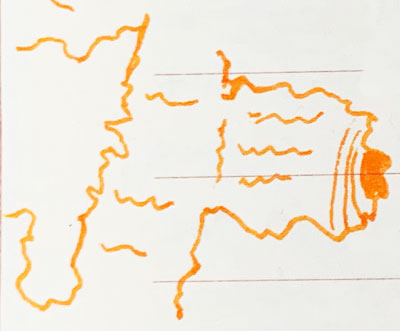
The lagoon and entrance to the underworld There I was, floating high above this lagoon surrounded by rocks and yellow sand. It was filled with shallow, stagnant water. On one side there was an entrance to what I knew was the underground water system, a deep hole that went down into blackness. This was a different pool than the one I usually go in, and though I was tempted, I decided not to explore, as the tide was getting higher (I knew it was 4:15 AM, later than I’d usually go, which meant I’d get back too late) and I didn’t have someone with me to navigate the curving passageways to air pockets. I could drown!
Planning Underworld Trips: Written at the time: “My thought when considering the underworld was that I’m usually back by 6:20–7:00 AM, and leaving at 4:15 AM wouldn’t give me enough time to get back. To consider I keep timetables and schedule events in my dreams according to waking times is incredible!”
Is there some kind of energy tide? It’s odd that my dream self, native to the astral world, would consider drowning to be an obstacle in its larger plan-making.
-
Something Wild In Dreams 2000 • age 25
While we waited, we talked. They asked how far it was and I said it took about 3 hours to get to the puzzle chamber where I had once gotten, but had lost my light and been unable to solve all 3 puzzles. They were large chambers, reminiscent of underground video game dreams. But my friends balked at the time, especially as we had spent 15 minutes waiting for the witch woman’s gift. Soon after that she reappeared, still green and monstrous but far less dead-looking and afraid. She presented me a hard hat with four flashlights containing full batteries! Thrilled, I strapped the hat on and continued, but I think the others had left.
Planning to Be Back in Time
This feeling of needing to be back in time to wake up also applies in a general fashion to any dreams that involve travel. Even after all this study of the dream state, I still have the impression that I have to get my things and return home, when I could just simply wake up mid-adventure.
-
The Nightly Schedule
I ran into Marco B and he wanted to show me something at this music store called “Kirk”, but Buttercup and I ran out of time and had to start getting back home. It was 5:50 AM. We ran through streets until we found a familiar subway stop. I expected something like a plane flight after the subway to get home.
Awareness of the Time: This shows an awareness of the time of night, and a realization that my time in the dream world is running short. Buttercup and I mistakenly believe we need to get back to our bodies in time for the alarm, and make the typical rationalized journey back — fast travel (subway) to faster travel (airplane). Perhaps the subway is an opening to traveling the greater astral currents back.
-
The Tree Clearing 2024
Buttercup and I are driving to work. I feel like it’s a good 15-minute drive. I’m mad, thinking about the trees. About 10 minutes in (it seems), I realize I should get pictures of the tree rings before they’re cleared away. I separate off from the main car in my own car and do a U-turn in the road. . . . As I drive, I wish I’d turned around earlier because it’s a long drive back to the house and I’m going to be late for work.
Heading Back for Work: It’s morning and we’re traveling back “for work”, which is accurate, since it’s a work day for us. This is the first time I remember having a feel for how long the journey back was — 15 minutes in this case.
-
My Other Kids 2025
Hazel and her friends had decided to relocate to someone’s house further up the mountains. . . . I ended up in a car with some of them on the way up to the mountains. As we arrived, I realized morning was coming. I asked the way back to Atlanta, and realized it was back the way we’d come, and that I shouldn’t have made this last trip. I wondered how I’d get back.
-
Heading Home 2025 • 8 AM
My alarm was coming soon, so I was getting ready to come home. I was at my junior high school, and so I went over to get my things from the elementary school next door.
-
Disney Park Madness 2025 • 3:45 AM
3-4 AM is the hour of MADNESS!
It was night, and I was lost in this huge Disney theme park. . . . [I run around in a delirium, searching for things]
It was getting late and we were anxious about missing our flight back home at the end of the night (this was just a day trip). The place was very, very hard to escape from, a multi-level maze with endless passageways, rooms, and distractions.
The Flight Back: This one is strange, because it’s 3:45 AM. I usually sleep until 7:30 or 8:00 AM, so there was actually plenty of time left. These 3-4 AM dreams are something different, and I wonder if it’s another level that I go to. Perhaps I needed to return to where I was previously by 4 AM.
Knowing When to Wake Up
This subconscious knowledge of the exact time of night can be called upon to wake ourselves up at a specific time.
-
Pictures of Dreams 1997 • age 22
I needed to get up for breakfast at 8 AM without an alarm. In the dream state I was looking at pictures, reminders from other dreams, and each picture had a little sound bit recorded with it too. The last was a picture of Buttercup saying “huh-huh”. It repeated over and over and the sound seemed to be coming from waking life, in the room. It repeated until I was fully awake and aware, just in time for breakfast.
Sub-Waking Sounds: This internal alert to wake up came through the context of the dream.
-
When Everyone Stopped 2006 • 5:45 AM
I’m dreaming that Buttercup and I are on an early AM trip to do some shopping in an area a bit northwest of downtown Atlanta. It dawns on me that it’s before work, a weird time to shop, but realize we have several hours (somehow knowing the right time of night).
Time Awareness: Here again I’m aware of the time of night, and the upcoming work day. Dreams like “Bedroom Soccer” reveal that I often know I’m dreaming, even if I don’t do anything special with this knowledge.
Expecting to Meet Someone at a Specific Time
Transposing Time
It seems we can transpose time of night to time of day, in terms of earliness or lateness.
-
Return to Colorado Volcanoes National Park 2025
I was on a week-long astral vacation visiting national parks in the West. Last night, we had made it back to Colorado Volcanoes National Park, one of my favorites. I was with a group of 4-5 people, including Ruby. We were traveling and sleeping in a camper. I knew the park got crowded, so I wanted to leave from our parking spot early enough to see the sunrise. But we ended up sleeping in and it was 2pm! We’d miss so much! I expressed my disappointment and then we set off (in the physical, it was probably around 7am).
Relative Time: Here I’m transposing my idea of time from dream time to physical time. In terms of my time dreaming, 7am is rather late to be setting out on an adventure. In the dream, it’s daytime, and the equivalent of setting out late is perceived as 2pm.
Awareness of the Upcoming Day and Plans
-
Gliding Soccer 2003
So it’s Thanksgiving morning and in the dream I knew it. I was heading back to the soccer field. . . . So when we saw a huge group over the hill, we went to them (we glided over) and started a larger game. My thinking was, “It’s Thanksgiving morning, so we don’t have a game today, but I can play for about an hour, and hopefully still have time to finish setting up my new computer before we have to go over for Thanksgiving.” Now everything about this thought was true in the waking world, except that as it’s my second day off, I assumed it was Sunday. So I played a little soccer, but with all the gliding, it almost immediately rationalized into hockey. I played a few minutes, then woke up with plenty of time to get done what I need!
Awareness of Time and Date: In the dream I’m aware that the upcoming day is Thanksgiving. I also knew exactly when to wake myself up.
-
Earth One 2005
Outside we find a ton of people laying down in the grass, in contact with each other, watching the sky. The sky is a wild sight with planets and bright lights. But every moment is a joy on Earth One. We live on Earth Two. Earth Three is constant war. I return to Earth Two, so as not to be missing for Buttercup’s birthday tomorrow (the upcoming day).
Incoming Birthday: Here I know I need to get back to Earth Two for Buttercup’s upcoming birthday.
Aware of the Physical Body’s Position
-
Careful Freak Out
I dreamed that there was a horrible caterpillar thing on my leg and violently shook my leg, but while my reaction was sudden and so violent as to wake me up, I noticed that I carefully twisted the angle of my leg when I shook it so as not to kick Buttercup who was sleeping right next to me.
Levels of Physical Awareness: There was a part of me aware of the fact that I was in bed dreaming and that there would be a physical consequence to my proposed action. In that split second, it caused me to alter the direction of my violent leg shake!
-
Dreams Inspire Life 1996 • age 22
Much pleasantness! I dreamt of South Hall, with lots of crazy fun, like we have before classes start. Friends and I were climbing on furniture, giving away stickers, being loud, creating art, and playing together. At first, Brad H was the only familiar person there. The action spanned the lobby, the RC’s room, my room, and the bathroom. While playing in the lobby, I saw Buttercup on the couch and was overjoyed! In waking life I turned, wrapped myself around her, and squeezed her. Back in the dream we continued to play.
References: South Hall was my dorm at Oberlin.
Cuddling in Bed: I felt so happy to see her in the dream that I shifted my attention to the waking side briefly to snuggle up against her, then refocused in the dream.
-
Guided in Dreams 1996 • 5:05 AM • age 22
Buttercup and I communicate so subtly when sleeping. I sensed fear in her and gave her rhythmic squeeze pulses to remind her it was a dream, to remind her of the physical.
Comforting Her: My intention was to pull her out of the dream enough to realize she doesn’t need to be afraid.
The Dream Self
The dream self is a focus of consciousness that’s a specialist in the astral frequencies of consciousness (the dream world). It’s aware that it’s dreaming, and aware of the various laws of dreams. It has its own continuous memories and a deep knowledge of how to navigate the astral plane that our waking self focus doesn’t.
It grew up in the astral world at the same time as our waking self grew up in the physical world. It had to learn how to operate there just as we had to learn how to walk and talk. These selves (and higher ones) were far more connected in our first 7 years of life before the barrier between them began to strengthen.
Aware of the Waking Self
While mostly engaged in its own adventures, the dream self shows a casual awareness of the waking self at times.
-
Befriending a Ghost 1997 • age 22
I was in a house that was haunted, trying to interact with ghosts. Certain parts of the ghosts would phase solid and I’d grab them or push them. Then I met a girl who was killed on December 17th or 21st, waiting eternally for Xmas. I attempted to befriend her. . . . Suddenly inspired, I tried to tell her I was studying this kind of thing on the earth plane. I told her about death and what happens afterwards, the pure essence, and more.
Cross-Plane Awareness: My dream self knows the difference between the astral plane and the physical plane, and I’m casually aware of what I’m studying in the waking world. Feeling “suddenly inspired” is that memory connection between the dream focus and waking focus.
This is a very physically-oriented dream. Ghosts are a physical-world phenomenon (seeing astral bodies from across the border), as is the thought of them as being insubstantial. So my dream self is in a rote of a ghost story from the physical, but knows that the experience isn’t physical and that I have a separate life on the physical plane.
-
College Celebration 2022 • 7-8 AM
I’m at a college that I often go to in my dreams. It’s mixed in with Oberlin. It’s dim, early-morning light. There’s a celebratory atmosphere, and I’m interested in this girl. . . . I find the girl and talk to her after the concert. She’s on her way somewhere and has to go. She isn’t very interested in me, and I grow bored in my pursuit. At one point I was composing some message to her on a tablet computer, made up of a bunch of sub-messages. One of them is funny — it says ”something something my wife” (referring to Buttercup). I put it in there, but then hesitate. Oh yeah, I think, I shouldn’t mention my wife from the waking world to the girl I’m pursuing in the dream world. So I remove it. My dream self is clearly aware of my waking self and the agreement we have that I am free to pursue romantic connections in the dream world. When my waking self is in charge and unaware that I’m dreaming, I always put a stop to it.
The Romantic Agreement: After passing up all these romantic opportunities in dreams due to my waking self having a girlfriend/wife, I decided I need not deprive myself of those kinds of experiences in dreams. Romantic connection is one of my greatest delights. So I decided to be okay with that. Of course that could only happen if I was aware I was dreaming at some level. And I find that I usually am.
My dream self is aware of my waking self, but has its own life and doesn’t always think about it.
-
The Deep-Haunted School 2011
I’m in this college-like school. The school was bustling with living students and ghosts. I alone can see the ghosts. But I can see something else going on as well. As my eyes tune further into the spiritual frequencies, I see that the ghosts are being attacked by a deeper level of ghosts — the ghosts of ghosts. . . . I tried to record everything with my iPhone, with photos and videos (this has been a trend in my dreams lately) to see what this all looks like to the physical world. . . . [I have more interactions with ghosts and deep ghosts]
Then I began to frantically write down the details of the dream in a large book illustrated with stylized ghostly drawings. Earlier I had tried to type out details on my iPhone, and then tried recording a sound memo. I wanted to remember this dream! And I did!
The Dream Self: Let’s consider this. . . . I’m in a dream of a ghost-haunted school with living and ghost students and monstrous “deep ghosts”. It’s so unusual, even for a dream, that I wanted to record it to see what it looked like in the physical world! All of this I accept as real, but not the physical world. This is an accurate view from the dream self focus. My waking self is not engaged or I’d likely feel terrified. Yet I’m using waking self techniques to record this, thinking it’ll be available when I wake up.
Later I tried to write down details both on paper and via my iPhone. This may have been a false awakening of the waking self, or a continuation of the dream self’s efforts. There are only two states where I’d write down a dream while dreaming. The first is from the waking self (or fragment) believing it’s already awake. The second is from the dream self, unaware that these recordings can’t be accessed in the physical.
Mixed Focus
At times it’s difficult to tell if we’re focused in the dream self or waking self. We sometimes seem to be drawing from both simultaneously.
-
The Worst Way to Get to Narnia 2017
Myself and another person who had been to Narnia before were preparing to go back. We’d gathered about 10 friends in what felt like someone’s room on a college campus. The two of us were explaining how we were going to get there. I said “We don’t know what the gateway will be. I use the term gateway, but you could say portal or door. I would love to get pictures, but I’m not sure if your phones would work there. In fact, the gateway could be through water, so decide whether or not you want to risk it.”
Running Tours: Fascinating! This seems to be my waking self, using its knowledge of gateways, and fully believing we’re going to find one (we do). I’m accessing my dream self’s memory of the surrounding areas, but at the same time believing we’re in a physical place where phones operate and can break when submerged.
-
The Underworld and Lava Flow Map 2000 • 4:15 AM • age 25
There I was, floating high above this lagoon surrounded by rocks and yellow sand. It was filled with shallow, stagnant water. On one side there was an entrance to what I knew was the underground water system, a deep hole that went down into blackness. This was a different pool than the one I usually go in, and though I was tempted, I decided not to explore, as the tide was getting higher and I didn’t have someone with me to navigate the curving passageways to air pockets. I could drown!
Astral World, Physical Rules: I considered entering the underwater catacombs — something I would never do in waking life — but didn’t have someone to help guide me to air pockets so I don’t drown. This shows that I’m in some cross focus between the dream self and waking self. I’m very versed with astral phenomenon, but also believe to some degree that physical laws matter. Are these just little ingrained physical concerns bubbling up into the dream self focus?
Informing the Waking Self
When my waking self connects with my dream self, the dream self can impart some of its astral knowledge to help me through a situation. It’s as if I draw back from one focus enough so that I can see and consult with both.
-
The Sliding House 2023
When I turned around, the driveway had become an asphalt cliff face going up several stories. There was a strange wooden elevator in it, and I used it to ascend, but it was broken at the top. I tried to figure out where to place my hands and feet to get out and over the cliff top, and was having little luck when I realized I could just think “up and over” and I’d fly right over it, so I did.
Just Fly: I was stuck too hard in my waking consciousness here, having a hard time. My dream self imparted a bit of knowledge to help me get past my imagined physical limitations.
-
Bedroom Soccer 2023 • 7:30 AM
There are a couple people like waiters managing the place. I go up the first set of stone stairs. They’re collecting the baby snakes that they keep finding. This comes from an earlier dream, or a dream from a different night. These baby snakes are a wide variety of snakes, including a white one I called “needle snakes” because they had regular needle-like protrusions coming off their sides, almost like legs. I got distracted by these snakes, which were all over the landing area. I thought about bringing one (not a needle snake!) along with me, putting it in my pocket. This resulted in something like a back and forth between my waking self and dream self. The waking self had this (odd) desire, but then my dream self told me I wouldn’t be able to bring it with me . . . to the waking world? Was that my intention?
A Cross-Self Dialog: The desire comes from the waking self, but the dream self, knowing better, informs me that it won’t work. This is an interesting point of dialog between the selves. Both thoughts seem to come from “me” quite naturally, but they come from different focuses. Like “I want this! ..Oh yeah dream rules.”
Consulting with the Waking Self
In dreams I can easily shift focus to the waking self to consult with it. In this way the dream self can access its knowledge and memory of waking life.
-
Atlanta, Nuked 2024
I was informed that a nuclear bomb had hit and destroyed Atlanta. We were in the northern suburbs, out beyond the radius of destruction. The roads into the city were blocked off. There were groups of militant people, dressed in black. There were also a lot of white-faced clones. I found my way into one of the groups. At one point I inquired who had launched the nuke, and was told it was Japan. At that time my waking self gave it a lot of thought, wondering why. It was like a short-term shift of focus towards the waking side.
Working Together: This is interesting. I shift my focus to my dream self to my waking self to interface with its knowledge of world affairs to try to understand the situation.
-
Me and Taylor 2024mature content
I start to talk with Taylor and I’m being clever and funny. We leave the roof and walk down the hallway together. She pulls me into a bathroom and we kiss. She begins to initiate sex, and I hesitate for a moment, remembering that I’m married. Then I realize this is the dream state and go for it. It’s wet, and brief, but good.
Permission Granted: I check in with my waking self, remember I’m married, but realize at some level that I’m dreaming and that it’s okay to proceed.
-
Not Dreaming 2024 • 4:10 AM
Last night was my first success at my iPhone playing a lucid dreaming alert at a certain time. At 4:10 AM it played the second alert. My attention jumped to the physical, and I thought “Oh, it worked! But it’s the second message (the wake-up one). Too bad I’m not dreaming.” I went back to sleep. I felt I was thinking, perhaps, rather than dreaming.
-
The Fulcrum 2025 • 6:50 AM
I realized that [Wilson’s house] rested on a delicately balanced “fulcrum”. A long floor board ran the length of the building under both apartments, with a fulcrum in the center . . . [adventures continue]
Here I use a word in the dream state — “fulcrum” — that I almost never use in waking life. I was using that word when talking to people about the issue. It was definitely my dream self saying it, as it navigated the building’s hyperspace without surprise. I recall a moment of recognizing this balancing, rocking effect in the dream, and shifting focus towards the physical to get the answer.
The Fulcrum: Here I shift to the waking self to get the right term for this physical effect.
-
The Funny Show 2026 • 5:30 AM
I made up some lie about why I was there. The lies then piled on top of each other, and got ridiculous. At some point I was singing this duet with a girl that we were making up on the spot. It turned out really good and as the liar I promised to record my part of it. But after a short consultation with my waking self, I realized that I wouldn’t actually do that. The scene was over, and I felt bad lying about the song, so I went back to tell her, in case she went through the effort of recording her side.
Checking In: I meant to record my part of it, but after so many failed recordings in the past, my waking self said it wouldn’t work in the dream state. Oddly, I didn’t go on to apply that fact to her being able to record it.
-
The Old Forest 2026 • 5:30 AM
I was in my run-down castle-like home in the old forest with the giant trees and no underbrush. I was talking mentally with someone who wasn’t present, and they mentioned that the huge trees around it could fall (a sore spot with me since people are cutting down trees left and right because “what if they fall on my house?”). The voice said there were five sister trees right next to the house, each 8 feet across. I had just flown a circuit around the house and said “there are two that are 12 feet across.” I was proud of these giants, but they were old. The forest was old, in a state of slow decay.
Cross-Focus Talk: I think this may be a conversation between my dream self and waking self. I’ve never noticed a communication before where I didn’t know who I was talking with. My dream self is in this old forest scene, and it’s possible my waking self brought up a sore spot that the scene triggered in it.
Aware of Its Natural versus Dreaming State
The dream self has its own ideas of what it considers dreaming.
The dream self considers its social activities in the astral and near realm as “not dreaming”. It contrasts that with rotes, reveries, and subjective states that involve projection and rationalizations, which it considers “dreaming”. It’s aware of which state it’s in and the distinction.
When the waking self pops into the dream state to inquire if it is dreaming, the answer from the dream self is always “of course”. It is responding in the physical self’s context that this is not a physical experience. That said, the dream self still has its own distinctions.
-
Flying in the Aviary 1996 • Middle of Night • age 22
It’s a glorious bright land and I’m flying through the air! [I have adventures at the Aviary]
I’m flying, then FLASH — I’m visiting and pestering Kayla. She has a date for something but it doesn’t bother me. I try to do backflips but it’s hard. This feels more “real” and so I felt I couldn’t fly here. Kayla and her date get on a bus and I join them. As the bus starts to move, she complains to a girlfriend of hers who’s having sex. Since she’s annoyed, I say “Hey, let’s go to sleep! Do you fly? I’ll take you to this place!” I settle down to sleep on the bus, but instead of going to the Aviary, I drift awake in the physical.
Dream Transitions: In the dream self focus, I consider the more real social dream with Kayla to be “awake”. I know I can get back to the Aviary by “going to sleep”. I’m confident I can take her with me, and I probably could.
Instead, I woke up in the physical world.
-
The Bombing and Revelation 2006 • 6:25 AM
I’m hanging out with Mordred up the street from Raven’s house. He blows up their front door and the surrounding area with a bomb. . . . I’m in a really dazed and unthinking mental state. I talk it over with Mordred, and tell him I’m going to talk to Raven, but think of course I won’t reveal who’s behind it.
So I visit Raven, but more lucid. She greets me warmly. Her brother stops by. She talks about burning her hand and being cured by some product made by bees. Then I broach the topic of the bomb. She jumps on me, furious, demanding to know what I know of the bombing. Her eyes are vivid and focused on me. I start to explain how I was walking along, “Observing and listening to two people, but in this dream state”.
I Was Dreaming: The dream self is making a clear distinction between when it is dreaming and not. What is likely a rote about a friend bombing a girlfriend’s house is considered a “dream state” to the dream self, who now is socially engaging with Raven in the astral, something it no longer considers “dreaming”.
-
Bedroom Soccer 2023 • 7:30 AM
This game seems silly, and I feel tired. I walk over to the bed on the far side of the room and get in. . . . I stay and snooze.
Then I remember leaving the soccer field and going down a road. . . . [I park the car and go into a cafe] I went in and sat down at a long table in the enclosed area. I was here for a while, and I felt like I knew a bunch of the people there. I talked with various people. At one point I asked myself, “Am I lucid? Do I know this is a dream? Of course!” Then this girl showed up and sat down across from me. I recognized her in the dream and said an excited “hello!” We talked, then I decided I wanted to fly.
What Is Lucidity?: After watching Bodhi play soccer, I laid down on a bed and fell asleep. Perhaps that’s the transition that causes the dream self to call the next part a “dream”.
When question of if I’m dreaming occurs to me, the obvious answer is YES. It seems like such a silly question at the time. I’m well aware that I’m dreaming and it’s not a big deal. There’s no change in the light or sudden burst of energy or anything. I’m just dreaming again, like I always do. The only result of the question is the habitual desire to do some flying.
-
The Slumber Party and Scary Man Prank 1999 • age 24
I knew this wasn’t a dream all night.
It was night. There was a group of us in the front room of a house. . . . It was like a slumber party, except everyone started out sleeping and slowly woke up. . . . At first there was fear in the room. Only Buttercup and I had awakened. Someone gave a warning but I knew it was just fear. I must have been talking about thought forms, because some of the nonlucid sleepers had expressed doubts about the reality of them. Since I KNEW they were real, I decided to play around with them and practice making some thought forms.
The Dream Self as Itself: This is the reality behind dreams — a social, out-of-body gathering of friends in the astral. My dream self considers this not dreaming. To it, the stories we share, the little reveries, the subjective spaces we go into — those are the dreams. And that’s true, from that perspective. The house we were in was not painted over with rationalizations or projections from my waking self. I knew all about dream reality, about thought forms, but my waking self wasn’t fully engaged, or I’d be extremely excited. I’m just calm, in this familiar space I go to every night.
Now contrast this with “Bedroom Soccer” above in which I’m projecting a full outdoor landscape around me. It’s taking the shape of my room, and I’m projecting my childhood bed over my real bed. Even as I walk away, a car rationalizes around me and the hallway I’m walking down is a road with houses all around. My dream self considers this obviously a dream. It’s astral but very much influenced by my projections. I’m “dreaming” — in other words, I’m projecting my environment.
-
Gwen’s Birthday 2024 • 7:15 AM (1:45 later)
Buttercup, Bodhi, Gwen, and I were on a trip in Emma & Alfred’s RV, which was the size of a large house inside. . . . At some point it was Gwen’s birthday party, which took place on the top floor of the RV. . . . The top floor had gradually transformed into a huge Toys R Us, which was just the bottom floor of an even larger mall. . . . I walked over to someone standing in an entrance line. I said something like “This Toys R Us used to be the top floor of an RV!” She looked at me like I might be crazy. I continued, “It’s because this is a dream.” She just stared at me. I said “Hi, I’m Benji, father of the birthday girl.”
Everyday Awareness: My dream self is aware of when it’s dreaming, and aware that things that seem physically odd can be explained by this fact. This does start out like social dreaming, however. I see three options: 1) It might have become a “dream” when the scene changed to Toys R Us, 2) It might have all been within a rote, or 3) My dream self was referring to “dream” in the waking sense (this not being physical).
Additionally, note that my context is long enough to remember that this store is the upstairs of an RV. If my context were shorter, I would have forgotten that.
-
Dream Aware 1997 • age 22
Buttercup and I were staying in the Dark Tower. It was really vivid and cool. . . . There was some game or something there, too. I was quite aware that this was some altered state and I told others about “my dream”.
The Dream Self: It’s not uncommon for my dream self to refer to previous experiences as dreams. I suspect it may think of rotes as dreams.
-
Friends and Dream Awareness 1997 • age 22
I dreamed that Buttercup was off visiting some lame old guy. When she returned, there were love notes written on her glasses case: “Do you flirt with Benji like you do with me?” and so on. I was in a jealous fit and said “Well this is a dream anyways.” I left this bigger version of our room through the window and came back in through the window above. I was now in Blaine House and I was saying “It’s a dream, right? I’m in a dream.” I had a hell of a time putting on underwear, pants, and shoes.
Then Brendan and I went into the garage. I thought I had forgotten my glasses and contacts because I couldn’t see clearly. I said “Clarity now!” and my vision became clear. I was about to start flying and trying to go OB, but got distracted. Savannah came by. Brendan and I started doing cartwheels in a huge mud puddle. Then I saw a stump that had turned into artwork. Ruby started telling me about her friend Kari’s tragic marriage. After all these distractions I forgot I was dreaming. So close.
Buttercup’s and my room was mixed with Wadsworth and Emma’s room, with the green rug and big open space.
Lucidity and Distraction: After getting emotionally drawn into jealousy, I get tired of it and take a step back to my dream self, who knows that it’s a dream. I then do some interesting navigation out and back in through windows, likely as a technique to end the “dream” I didn’t like. I end up at Blaine House but I’m unsure if I’m still dreaming. I begin socially dreaming with a bunch of friends, which is typically a situation my dream self considers “not dreaming”. The idea that I’m dreaming leads to the usual desire to fly, but I’m distracted by my friends.
This is my typical dream self awareness — I don’t think I was particularly close to waking self lucidity here.
Going to Sleep in a Dream
At times when we’re hanging out in the near realm with friends, we can “go to sleep” within that state to experience “dreams”. The near-realm state is a more physical focus. We “wake up” from these dreams back into this near realm focus. Sometimes this appears as a false awakening.
This can also occur from within an astral environment, or from within an ongoing dream.
At other times, we may feel tired or bored and just lay down for a nap within a dream. This is often just a short rest, until another dream character wakes us up, or we wake up on our own.
-
Adventures in Northtown Mall 2001
It seemed as if at first there was a class because Meagan was sitting next to me. I asked her out and she said no. She was dating this jock Peter, who I hated, so I made up some rude lies about him. She was shocked and went to chew him out. Meanwhile, I curled up on the floor to fall asleep. Was I about to pass into another dream? It was all dark and still and I felt sleepy. But before long I felt a kick, and then another. It was Peter, waking me up. He asked “What was that all about?” I didn’t know what to say to him, so I apologized.
Nap Time: I must have felt tired, as I lay down for a nap. But the plot I had set in motion continued, with Peter returning to wake me up.
-
Rolling Snowballs 2010
Buttercup and I had gone to the top of this snow-covered mountain overlooking a wide, open valley. . . . Everything was as if bathed in dim moonlight, and it was hard to discern slopes and edges. After getting a little panicky about being too close to the edge, we decided we’d have to stay the night up there. I wasn’t afraid of the cold, however, and I burrowed a little hole in the snow. I tried to get Buttercup to join me but she didn’t. My little burrow was cozy and I think reflected the shape of the comforter and blankets around me.
After drifting in and our of sleep here, a woman came by and we talked to her briefly.
Asleep, Dreaming of Sleeping: It’s not unusual at times to dream of going to sleep. In this case, as my attention was on going to sleep, I think my awareness moved towards the physical a bit, as my burrowed hole was the shape of the blankets around me.
-
Bedroom Soccer 2023 • 7:30 AM
This game seems silly, and I feel tired. I walk over to the bed on the far side of the room and get in. There’s another little girl napping in there, and I crawl in to the center of the bed. For a moment I wonder if this is something I shouldn’t do — getting into a bed when there’s a little girl sleeping there.. but I stay and snooze.
Then I remember leaving the soccer field and going down a road.
Time for a Nap: Perhaps the appearance of my bed and my recent wake-up was the reason, but I felt tired and wanted a little nap. Maybe this serves as a transition from NREM “hanging out” situations to fully immersive dreams. In this case, it washed away the bedroom overlay and I was on my way again, without the limitations of the room shape.
-
Dr. Hoddeson 2025
After snoozing the alarm, I found myself in a doctor’s office. It belonged to Dr. Hoddeson, my ENT. I was sitting on the hospital bed trying to figure out why I was there, but I was sooo tired. . . . [Dr. Hoddeson] then walked around the room, doing various things. I was so tired. I gathered up the sheets like in my real bed, laid down, and closed my eyes. I could hear him talking to a nurse about some new medication to try. After a bit he woke me up to drink as much from this bottle of red liquid as I could take, and so I sat up and had a sip.
Sleepy in Dreams: I sometimes have waves of being tired in dreams. This is an especially strong one. I’m resting my eyes in the dream — not dreaming, but rather listening to the doctor going about his business.
-
Stealing the Password 2025 • 3:45 AM
The first thing I remember is a sort of stand-off with my boss. . . . He’s trying to subtly antagonize me into revealing if my server is at home or elsewhere by suggesting that I “go home, to the garage” to turn off the accounts, as if they’re hosted from a computer at my house. . . . I arrive home in our present living room and close all the blinds. . . . It’s mostly dark (as it actually is) but there is some dim light. My goal is to go in, change the password, and secure the computer. But I fall into a short dream. . . . Waking up, I find most of the blinds are OPEN, and I wonder if my boss’s guys are outside, somehow messing with the blinds to observe me. I close all the blinds again, one by one. I fall into another dream. . . . [It’s a dream about Christmas]
Just then I hear three loud BANGs. I’m suddenly back in my current darkish living room where I was dreaming, and the three front-facing BLINDS ARE UP.
Near Realm Dreaming: Twice after returning to my home in the near realm I fall back into dreams, then reawaken in the near realm.
-
The Reverse Gate
Myself and two others were painting on a blackboard. I had the idea to run at it and go through it like a gateway. I asked someone to try. When they approached it I shut my eyes. When I opened them the person was gone. The second person did it, then me. I had been thinking that it would open a reverse world and it did. . . . We spent much of our time on the reverse side, as it felt like new. . . . There were periods of darkness when it was quiet and I was “asleep” in bed in the dream — an awareness in the astral level of the waking world.
Periodic Sleep: We regularly return to the near realm, a focus closer to our physical body.
Pulling Out of Dreams
Since the dream self is aware when it’s dreaming, it can make the decision to leave an unpleasant dream and return to its previous focus in the astral or near realm.
-
Lucidly Ending a Bad Dream 1997 • age 23
This dream happened while we were sleeping in the car while parked at a Texaco, me leaning back and Buttercup laying across me. The dream, somehow, took that very shape, like the buildings were modeled after us.
It started with Buttercup and I getting really high. Then she said she wanted to go out alone and I couldn’t believe it. She was wearing a low-cut nightgown top and lots of necklaces. Phil started talking to her cleavage and drooling so I hit him with a towel. He was really upset and I wondered how justified I was.
Then I recall fog, darkness, then a JUMP! Buttercup and I are in a car teetering over a cliff, but she is able to back the car away from the edge. She is injured in the back so I carry her, floating part of the way, to safety. I ask what happened and I see the story of this guy holding her by the jewelry out the window of a building and my rescue attempt which got me beat up. We leave the building. It’s dark as anything outside and this guy starts following us. I tell him off but he continues.
Then darkness and JUMP! I’m pulling consciously out of the dream. My desire for happy experiences with Buttercup is behind it. I “open my eyes” and it’s so dark in the car but there’s Buttercup in full color and light laying across me (my eyes are physically closed). She turns to meet my eyes and I pour love out to her and say “Sorry, I love you” and she expresses the same to me — a very nice moment, and very clear. Almost lucid. I felt the dream pulling me back at one point but willed myself to remain in this happier space.
A Greater Self-Awareness: This dream illustrated a greater self-awareness. In my dream self focus, I realized I was responsible for taking part in the horrible dreams I just had with Buttercup and when I saw her in the near realm, we both knew the unreality of what had just happened in the dreams and chose to replace the negative feelings with our true feelings of love. Thus a false dream gave way to a true experience.
-
Finding Bodhi 2025 • earlier
I dreamed that Bodhi was lost, that I lost him in a crowd after his last soccer game. At the point my memory starts, he had been missing for a week. . . . I went to the area where I had last seen him and began calling for him in loud, desperate tones. After a few minutes I heard his “Papa” in response. I followed it and came to a building. A door opened, and Wilson and two people I didn’t recognize walked out, purposely ignoring me, walking past. I looked in the door and there was Bodhi, sitting on the concrete floor. I ran in and hugged him tight.
After a moment of hugging, I pulled entirely back from the dream and woke up briefly. It was with a feeling like “that’s enough of that”. I remained in bed, thinking about the dream and other things, then eventually fell back asleep.
That’s Enough: My dream self ended that dream quickly after finding Bodhi. He might have actually been responding from the near realm, after hearing my calls for him.
Controlling the Plot
When the dream self creates a dream, it can control its plot.
-
The Buried Building 2024
The next thing I remember I’m back at the bottom of the hole. . . . I’ve brought a bunch of people with me to show them the building. They mostly stay behind me, out of my direct awareness. . . . In one room, there is a door slightly ajar, and I imagine that inside is a crazy man with wolf ears, patches of fur, claws and dark eyes. I see him now, fully imagined, and the wall is like a panel of glass. The doorway is just around the corner, so I go in. The wolfman is inactive. The walls are covered with shelves containing jars and things. I’m aware at this point that I’m editing the story. I narrate that “at this point, something small happens, but it’s the most important moment of his life”. I zoom in and time slows as the wolfman picks up one of the jars to look at it, and a tiny spider climbs down onto his hand and bites him. The bite makes him indestructible. That scene finished, I mentally unleash the wolfman and I (as the character I’m inhabiting) do battle with it. I end up outside the room, with the door cracked, giving the wolfman a neck massage. He calms down and joins us. We explore other interesting rooms.
Changing the Rote: When I return to the buried building, it’s with an audience. I don’t see who they are because I never focus on them. Instead I’m reliving the original rote but changing it, sometimes consciously, sometimes not. I was aware that my desire for drama created the wolfman and I was consciously narrating the part about the spider bite.
-
The Underworld and Lava Flow Map 2000 • 4:15 AM • age 25
So instead I ventured out into a foot-deep blue channel closer to the ocean. I thought about how I’d planned the Jurassic Park 2 dream I was having before. A black lava flow map of the island used in the first movie appeared before me, and I retraced in my mind where on the island all the events took place. I thought, “Yeah, that was a good, thrilling movie.”
Dream Planning: Here I find myself recalling how I had planned an earlier dream based on Jurassic Park, which was a thrilling dream. I’d purposely thrown myself into a dramatic, exciting conflict for the fun of it.
-
The DeadStorm 2010
I was in a writing class with maybe 8 other students. In the first part, we had to write something. I was writing a story, though I don’t remember what it was about. I remember looking down at my writing and it was strangely scribbly. It looked like how I wrote when I was in elementary school and still getting some of my letters wrong. The teacher told us to stop writing for the next part of the class, but I just had to finish up my thought. He came around and poked me hard in the back. I stopped, but then said seriously to him “You will not poke me in the back like that again.” For the next part, he handed out these stamp kits. He had us pass our stories to someone else, and we were to take the stamps and stamp words on their story in funny or appropriate places, which sounded like fun.
It’s likely the next part was the story I was writing during class. This is a version of “The DeadStorm”, an event in a fantasy novel I hope to finish one day.
I was in a medieval village, with lots of people everywhere. It felt sort of like a Renaissance Festival but everyone was in costume and it went on as far as the eye could see. There was a storm overhead. I was in a black tent building selling swords and various things. I floated out and peered up at the storm. “Wouldn’t that be cool if there was a black path of the storm coming right overhead, like a dark road?” I thought, and looked up to see it become so. “Darker,” I thought, and it darkened. “Darker still,” I thought. Then I turned to one of the villagers and cast words into his mind, which he spoke, “What dark and foreboding sign is this in the clouds?” Then with glee, I asked myself, “So what comes down this frightening dark path in the sky? Demon horsemen. The undead.” I looked up, and there were the hoofs of horsemen showing through the dark clouds in the sky, galloping overhead. “Hmm.. I wish I could see them better.” I drifted into the black tent building and thought, “Let’s try this.. footsteps on the roof!” and as I looked up, skeletal footprints pressed down on the cloth fabric of the roof as the walkers on the Dead Storm passed more closely overhead. The medieval villagers were deliciously scared. I was delighted. “One should burst through!” I thought. So one did; a skeleton tore through the fabric, landed, and with a wave of his hand, pulled the soul from a villager. The villager crumpled before him, leaving the golden sparkling circle of his soul slowly fading out.
I floated outside again and looked up. I decided to try to make the cloud riders more visible. “Let’s try this,” I thought, and the dark cloud path became wispy and transparent and the riders became visible, but it didn’t really work without the dark cloud path. It wasn’t as scary, so I brought it back. But them descending from the path worked really well. So I called one down out here where a ton of villagers were standing, practically evenly spaced along the road. A demon man came down from the sky this time and landed in the road near me. “He’s going to take the souls of everyone around him!” I dictated, and since I was standing near him, I thrust my hands out and released a wave of force, propelling me backwards and up the hill just in time to avoid his death spell, which killed all the people in a 30 foot circle around him.
I awoke at this point, and it was the most gentle awakening. Still interested in the dream, and still possessing the exact same consciousness that was directing the dream, I continued it in my waking mind. “Now it is time to take my vengeance against you, demon.” I thought, and I took the form of a powerful angel with curly flowing blond hair. I held a long shining blade in my hands.
The imagery here was as bright and memorable as the rest of the dream. It was taking place in the exact same mental place and generated by the exact same part of the mind. Continuing:
I felt a moment of fear and since I didn’t want to be touched by him, I summoned an array of daggers and blades of light to surround and circle me, then lifted into the air and dove for the demon man. In a flash he was gone. I rose to the level of the dark cloud path and lifted my hand and shone a beam of intense light down the cloud path, dissolving it and breaking it up. I did the same in the other direction. Being that I was awake, I moved my hands physically a little as I was doing this, in the fun of the moment.
The Dream Self: I begin in my dream self focus, in a writing class. As I begin to write the story, I enter an immersive subdream in which I’m actively creating and living through the story from the inside. I’m creating drama for the story, but everything is my creation — there’s no need for fear or rationalizations (I float about at will). I’m all-powerful here.
I feel no difference in consciousness after I awaken slightly and continue creating the plot with what is clearly my waking self. How could that be?
In the dream self focus, we set up dramatic situations as “dreams” for fun. In this case, I’m fully myself within the rote, not a fragment self. When our context is broad enough, the waking self can direct the dream.
Its Continuity
There is as much continuity to the dream self as the waking self. Each focus also provides access to a corresponding body of knowledge that the other is usually not aware of.
-
Colorado Volcanoes National Park 2024 • 5:30 AM
Buttercup and I are on our way to Volcano National Park in Colorado. We’ve been there once before. It’s a drive around this mountainous area that includes a volcano and a glowing lake of lava. Emma and Alfred are with us, but not really active. As before, we’re approaching from the south side. Last time we visited, we went counterclockwise. I tell them we’re taking the clockwise route this time.
A Second Visit: We’ve been here before, and my dream self remembers the route we took last time.
Its Own Memories
The dream self has its own memories, separate from the waking self’s memories. Memory is what forms the continuity of any self.
-
Lucid Dream: Bruce’s Arm and the School Bus 1997 • 10:13 AM • age 23
This girl next to me asked if I wanted to see the new movie coming out, named “Peace,” which seemed to have two parts. I recognized it and said “Yes, yes, I sure do!” though what I recognized wasn’t something familiar to me now.
Movies: Here I recognize the name of a dream movie that doesn’t exist in the waking world.
-
When Everyone Stopped 2006 • 5:45 AM
MY quest is to stop by a comics store (or two — I see a second one when we arrive).
I peruse the comics, which are all strange. . . . Then I check for Magic and other cards. I saw a familiar (in dreams only) light blue and purple series I wasn’t too interested in, and then another box. It’s not Magic but another game I like from dreams with big beautiful pictures.
References: Magic The Gathering is a collectible card game.
Card Game: I recognize a collectible card game I’ve seen in other dreams, one unknown to my waking self. I spend a lot of time in comic shops in my dreams at this time.
-
Pictures of Dreams 1997 • age 22
I was looking at pictures, reminders from other dreams, and each picture had a little sound bit recorded with it too.
Pictures of Dreams: If only I could access this with my waking self! I’d love to see photographs and hear sound bites from dreams.
-
The Dark Tower Is a School and Dorm 1996 • age 22
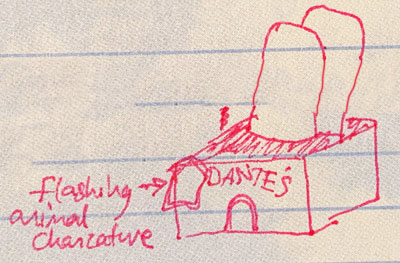
Newspaper ad for Dante’s I was at SSU again, during orientation. Buttercup was with me. I was there to visit Juno. We had to stay in a dorm, and were assigned to the Dark Tower, so I think that might be SSU. . . . At one point, I see a place called “Dante’s” in a newspaper ad. It had an image, and the hills/dome behind on top of it reminded me of The Tower on Arcology Hill.
Aware of Other Dream Locations: Here I am at the Dark Tower, looking at a newspaper ad and thinking an image in it reminds me of another popular 4 AM dream location of mine: the Tower on Arcology Hill.
-
Hook’s Fairy Hunt 1996 • age 22
I’m Peter Pan. There’s a huge bald bad guy, twice the height of Hook. He is collecting fairies, but Tink can make fairies non-physical by touching them, after which they stretch and escape. . . . This was intended to add to my already huge collection of Peter Pan story ideas, which, upon waking, I discover I don’t recall at all.
-
Driving Miss 59 1997 • age 22
I was at Westwood Elementary, all bundled up against the cold. It’s daytime, with snow and ice on the ground. There’s an awkward celebration for this woman with short red hair who just turned 59. I decide to drive her home. I look around but can’t find my car. “I’m sorry. I just realized I haven’t driven here for a long time,” I say.
No Cars Necessary: In the physical world, I would need a car to get to Westwood, so I expected to have one. But then a wider memory that included my dreams informed me that I haven’t used one to travel here in a long while.
-
The Autistic Dreamer 2011
He says, “You need to get a handle on yourself”, or something like that. He says “You spend too much time with the spice.” I say “I’ve been dreaming about the spice!” (I don’t remember those dreams, though.)
Memories My Dream Self Has: Here, my dream self remembers from its past things that my waking self doesn’t remember.
-
Bedroom Soccer 2023 • 7:30 AM
At this point, I need to park my car, so I make a U-turn and into a parking spot at the side of the street. Someone pulls in behind me. It’s a middle-aged woman with short red hair. She recognizes me and greets me, and asks if here for another.. something. I don’t recognize her, and say I was here for a soccer game. Then I notice her uniform and the building across the street and remember her. She works at this.. maybe like a physical therapy or medical place I go to sometimes.
Recognized: Here someone I don’t initially recognize sees and recognizes me from other dreams, and then it dawns on me who she is.
Dream Continuity Across Nights
The continuity of the dream self includes places it regularly visits, people it knows in the astral, cross-country trips, long-running story lines, and much more.
I find I frequent some dream locations for a while, before moving on to others. Some I return to from time to time for many years. Some I’ve been going to for decades. And then mixed in with these are new locations I’ve never seen before.
This also applies to groups of friends that I stay with for days or weeks at a time.
-
Rave On 1997 • age 23
My cross-country journey continues in this dream, in which I stop in a big forest for an outdoor rave. I’ve been doing a lot of this recently. This time the area I come to has some military-looking people. The trees are very tall and the plants have huge leaves. There’s tall grass and lush vegetation everywhere. I was driving an SUV. I try to get a spot in the corner. I’m so excited to be here!
I head to the bathroom, and meet someone. The talk flows free, smooth, and friendly. I’m making friends by the dozen. One guy keeps saying something I don’t understand, something about GRANT and I think back to my recent Minnesota to California trip and say, “I think I went to that one!” He says “Yeah, it’s on the way!” We decide to camp together. There’s some confusion now if he was the one I was traveling with before or not. So then I meet another guy who turns out to be an old friend. We talk a lot and I invite him to stay with us, too, but he is uncertain. We’re in a house now. Then some crazy girl I recognized came downstairs and told me to invite Brit B. and I said it’d take her two days to get from Minnesota to here (Colorado?). I remembered that Brit had been to a rave recently and got very drunk and passed out.
Cross-Country Raves: I’ve been traveling across the country attending dream raves!
Within the dream self focus, I remember the continuity between nightly experiences: what happened yesterday, a week ago, friends that I don’t know in waking life, and how to get to different locations in the astral realm.
-
Rejoining the Team 1996 • age 22
Nov 26th: I was wearing my soccer uniform, looking for the Blaine team to join them. But it was already the semifinals in the tourney. Eventually, Coach Broadwise came to me and laid it down. He said I could’ve been a captain if I’d stuck with it. It’s too late now and my indecision cost me. I was thinking he must be a spirit guide.
Dec 10th: I’m in Blaine House, after talking to Coach Broadwise and rejoining the team. I had to make it to 3 games and then I could be in the tourney. The next game was March 1st. He said I could wear any old jersey I had, as long as it was blue. He seemed pleased. And so I rejoined the soccer team in my dreams last night.
Joining Up: I have a continuation of a soccer dream from two weeks earlier. I’m in college at this point, and I never intended to play soccer beyond high school.
-
Kicked Out 1998 • age 24
I had a big dream of visiting Definition 6 where Derek was getting really vicious trying to keep me out, and I woke from the dream crying.
After going back to sleep, I returned and got someone there fired. Then they hired three children and an evil dog to kill me. The dog was the real baddy.
Returning Visits: This is the fourth dream I’ve recorded of visiting Definition 6 after I stopped working there two months earlier. I’ve progressed from continuing to work, to just hanging out, to finally wearing out my welcome.
-
European Wife
I return to a European country with mountains and a coast where I married this girl in another dream. We meet again, the first people to come together when the two whole crowds meet. I like her, but don’t want to stay married. I didn’t even know we were married before the trip.
Visiting Her: It could be that I married her in a previous dream. It could be a rote with backstory, though we usually fully accept the backstory as the context of a rote, so I think the first case is most likely.
-
The Armageddon Clock 1988 • age 14
I went to call Emma. When she got there, Manville went missing. I suggested we check the place we found them in a different dream. She went there and found Lewis or Quentin. Then we found Manville in the street further ahead and picked him up.
Dream Continuity: Here I remembered being aware of what had happened in other dreams, and brought that knowledge to bear in this one.
-
The Arizona Center 1996 • age 22
I got a job in a little food place in a mall. . . . This friendly guy took me for a drive to this arid place in Arizona that had an organization like the Berkeley Psychic Institute. The people there were friendly and immediately accepting. Buttercup joined us shortly afterwards.
There was a scene with a car driving over a small cliff. People were hanging out below, in an aloe plantation.
Similarities: This was just like the July 1st dream two weeks earlier! A big spiritual group in an semiarid place was accepting me as a part of the group.
-
Graduation Weirdness 1997 • age 23
June 8, 1997: I was at Blaine House and it was packed! There were the goth girls and a boyfriend, Ruby and her friends, Brendan and Melody, and more. . . . The house was now twice as high — four stories, and the most shocking change was the removal of the courtyard wall. The house seemed so different without it!
June 30, 1997: Everyone was returning to Blaine House. Brendan arrived with breasts! Twice I tried questioning him on it and he got so far as “This friend of mine ate soooo many brownies!” I was moving out of there. It was sunny and it seemed like the garage and above portions had become a four-story dorm and library, like the better dream schools. I was moving out, though, because I was graduating.
Blaine House’s New Size: Blaine House became four stories in “Blaine House Reconstruction” just a few weeks earlier, and it’s remained that new size!
-
Bees 1997 • age 23
July 16, 1997: So I’m working at this shitty grocery store. It’s a big mess and I can’t find anything I need so every customer is taking forever. . . . Suddenly Buttercup pokes her head out of our trailer home and shouts that there are tornadoes nearby. I get really excited.
July 19, 1997: I was in a grocery store, and the bees kept appearing everywhere. I tried many ways to kill them, but some always remained. There was a scene with a big display and I sprayed this liquid all over it, but one escaped. . . . I wondered how I could take care of [the dog]. Would it have enough space to run with me and Buttercup in our trailer home? I saw in its eyes that love was what it needed, and that was enough.
The Grocery Store and Trailer Home: More continuity — three days earlier I dreamed of working in a grocery store. Now I’m fighting bees in a grocery store. In the dream that follows, I reference Buttercup’s and my trailer house again. Both dreams seem to be in an impoverished area.
-
Die, You, Die! 1998 • age 24
July 4: I was inside Wilder at Oberlin and some official lady was trying to track me down and capture me, but I considered her more of a nuisance. I went into a darkened room with Melody and Brendan and hid in the adjoining room behind some clothes in the closet. She stormed into the room after me and searched, even where I was, but missed me. Then she found me and there was a big wrestling match, but I slipped away and the chase continued.
July 5: A continuation of yesterday’s plot! The same mean crusty lady is chasing me around Oberlin, saying “You’re the worst non-Native American student of your class. The worst!” and I caught her on the Native American thing, “Listen to you — skewing information to make me out to be bad!” Graduation was coming and she must have been getting to me as it was very dark — a heavy black cloud covered graduation just 30 feet up. I didn’t want to be there. Strange! Who is this persistent lady?
Nov 23: Buttercup picked up the campus paper and held it up in front of my face. “Mushrooms!” seemed to be the title and the headlines were about some old mean lady trying to regain control of campus, with a picture of a stern old matriarch on the steps of a building.
Continuity: This shows plot continuity over two nights; a plot I’m definitely not interested in or motivated to have. I wonder if it’s a case of mistaken identity. This is about a year after I graduated.
Months later I’m back at Oberlin and she’s being reported on in the campus paper!
-
Art Class, Day 5 1999 • 5 AM • age 25
Then I’m in art class, superimposed over the basement of Blaine House. It has the concrete floor, but it’s much neater. This is day 5 of art class, the last day. Day 1 was the first teacher. Day 2, 3, and 4 was a second teacher, and today was the third and final teacher. Every day I had run out of the class thanks to some insult or rude comment from the teacher One day I fled to my room in a fancy posh hotel. These five classes took place on five consecutive nights of dreaming!
-
Powered 2013 • 2:30 AM
We are driving along the shore of this big lake in California. There’s a housing development there that’s been abandoned because the lake is moving inland and expanding. This is something I visited in another dream yesterday or earlier tonight. The lake has moved further in since the last dream.
-
Return to Colorado Volcanoes National Park 2025
I was on a week-long astral vacation visiting national parks in the West. Last night, we had made it back to Volcano National Park, one of my favorites. I was with a group of 4-5 people, including Ruby. . . . A little bit later, after stopping at a park building, we were on this bus tour of the park, touring the grassy plains at the base of the volcano. It took us through some ruins, which I didn’t know the park had, and I found them fascinating. Some of the buildings were multiple stories tall. The bus tour took us around, past a place where I had played in some beautiful clear pools on a previous visit. Ruby recognized it as well, and I realized we must have been here together before. I was itching to get off the bus and go explore these areas in person. . . . We returned to the national park building, to something like a gift shop. I told the others we should head up the mountain at some point where we could see the lava and I showed them a picture of it with my mind.
A Week-Long Trip: I’m in the middle of traveling with Ruby and some others on a week-long tour of astral national parks. I visited Colorado Volcanoes National Park almost exactly a year ago, and that was my second trip there. This time I’m touring some different areas at the base of the volcano, and Ruby and I both recall the clear pools from an earlier trip.
-
College Celebration 2022 • 7-8 AM
I’m at a college that I often go to in my dreams. It’s mixed in with Oberlin.
A Truer Location: This is a college that my waking self is unfamiliar with, but my dream self goes to regularly. “It’s mixed in with Oberlin”, I say. That familiarity by the dream self means it doesn’t need to be completely overlaid with Oberlin for me to understand it. Likewise, it’s not an unfamiliar college in a rote that needs the form of Oberlin for me to understand it.
Running with Groups for Periods of Time
Part of the continuity in dreams is socializing with the same group of people for a few weeks or months. Often these are people we’ve met in dreams.
-
White or Rose? 1998 • age 23
I got really angry and jumped up onto the counter screaming what a very rude person she was being and everyone around was slightly shocked by my outburst of rage. As I was turning to walk out, this young, immature-looking kid from my dream-side youth group turns to me and says to a friend, “Look! He did it again!” As if my behavior was often like this and had really been getting to him.
My Dream-Side Youth Group: I refer to “my dream-side youth group” here, which I can’t currently recall anything about. But it’s clear that there’s a group I’m a part of in the dream world.
-
The Island of Fire 2000
I’m upstairs in a house with Deaner, who’s showing me pictures in his photo album. I spend some time on a Tahiti-like island, which was probably a rote or subdream based on a photo, and return to find Deaner (who looks different) waiting for me. I am trying hard to be entertaining and only sometimes succeeding, but there is friendly chemistry. Their place is out in the country, an old bachelor-type place filled with junk. They describe their house as “apartments” and their friends are always around. [we hang out]
They disappear upstairs and I’m left alone. . . . I call them on a white downstairs phone and talk to them but spill white wax all over my shoes. Then Deaner comes down and we laugh. Soon the boys and I leave, driving along the foresty road.
References: Deaner is from the band Ween.
Dream Friends: For several months in 2000, I had dreams of hanging out with Deaner and Gener of the band Ween. These were fun, social, personable dreams. It’s possible they were about the actual people, but more likely it was two people who reminded me of them, who I took to be them.
-
Body Transformations 2003
I’m in a neighborhood with some friends in the near realm. It’s dim, early-morning light. It feels high in elevation. I’ve been spending time here recently, running around with friends. The mountains are light brown with few trees, like the Sierra Nevadas, but the neighborhoods are green with trees.
My Newest Friends: I remember hanging out with these people in dreams regularly over a period of a few months. In dreams, we are nomads. Without the need for a home in the astral, we join up with groups for a while, make friends, and then move on to other adventures, meeting new (or old) friends and following whatever attracts our interest.
-
Me and Taylor 2024
A few more people appear outside the door, to my right. The cook mentions them and I turn my head and see Taylor Swift sitting next to me. I refer to her as “a girl who looks like Taylor Swift” but I’m sure it’s actually her.
Taylor Swift Again: It was just two months earlier that I remembered hanging out with Taylor Swift (or someone I took to be her) in the dream state. And now she shows up here when I’m socializing.
Regular Times of Night to Visit Certain Areas
At around 3:00–4:30 AM (3–5 hours after falling asleep) I have a deep level of sleep in which I go to the same place every night, though the place changes over time. At times this was the Dark Tower, the Tower and Arcology Hill, and the catacombs.
-
The Tower on Arcology Hill 4 1996 • 4 AM • age 22
August 3, 3:33 AM: I just caught an early-night dream place that eluded me forever. It was a tall rounded hill with something like a tower arcology on top. There are towering heights and steep angles and hugeness. It’s a long climb up, like our Yosemite hike. There was a huge tree on the side of the hill. I got vertigo while climbing on it. After the tree is a lake. I’m frequently about three quarters of the way up the hill. There’s a stream and lush vegetation. There are houses and buildings all over the hillsides, separated by lots of fences and property lines. Each property is a different section, and I travel from one to the next. . . . I remember being here so many times!
August 4, 4:23 AM: A great search for something, a yearning. I’m pretty sure the same place as yesterday, less fear in it. . . . My will appears as many subtle manipulations. I have a job, working for someone.
August 5, 4:13 AM: Buttercup and I had just made it to the bottom of the hill. It had been a long journey, and far from this reality.
August 6, 4:00 AM: Back to the hill. I remember some voice telling about this team from. . . . Italy? Brazil? Yellow-yellow-red-white, and how America stifled it..? Anyway, the team was playing a game of whatever in Berkeley’s stadium on campus. We had been walking on a busy city road asking people for change, maybe? It felt like the city atop the hill by The Tower. That’s where I was when I woke up earlier this morning. All this was just a subset of a larger plot.
Back to Arcology Hill: Notice how I’m returning every night to the same place at the same time of night.
Its Knowledge
-
Lucid: Colored Pots and Pans 2000
As we got on the path [the pots] turned to cars, still stacked and still colored. One car blocked the road. Was it occupied? As I had the thought, a vague white silhouette could be seen in the driver’s seat. Recognizing the thought form, I said “no” and smiled to myself.
Unemotional Clarity: In this scene, I catch the thought form forming in response to my wondering if the car was occupied or not. This is the dream self focus. I’m not fooled by what I see. I know I’m in the astral, and I’m catching the details with an awareness of the laws of the astral world.
Now if I’d been afraid someone was in the car or if I’d hoped someone was in the car, I’d likely have missed my hand in creating it. The waking self’s desires and fears get the waking self involved in the dream, where I then would mistake it for real, physical life.
Perhaps when fears and desires take over, the dream self continues to dream at its level while we go into a shallow emotional-level fantasy that is what we remember upon waking. We are always dreaming, even while awake.
-
Time Weaving 1996 • age 22
It was bright and sunny, on a lawn in Oberlin with some friends. I was speaking about my theory of the nature of time and events. . . . Here’s my theory: Events are woven together by many people and also by a positive and negative timestream. I was explaining that at a certain level, the weaving could be unraveled and reconstructed as a different event. And this goes on at all points in time.
Dream Mind: My dream self does its own experiments and has its own theories. This theory is unfamiliar to my waking self.
-
Escaping from Dogs 2001 • 4 AM
I ran into this large open cave with river water pooling in it. While it was a perfectly real cave, looking back I know with certainty that it was the Dream Station. This has been my new recurring dream place for quite some time, though it is more of a feeling and a shape than one specific place. To hide from the dogs, I considered jumping down into the water to grab two giant turtles and swim with them, or I could go into this black area. But I realized doing this would significantly “change things”. The Dream Station connects to the underworld (or the physical world), I believe. There is a straight vertical shaft between it and a more dark and solid place, and it may be related to my 4 AM underworld journeys. The time was almost exactly 4 AM when I awoke.
Its Knowing: I don’t know how this would change things, but my dream self knew.
-
Enlightenment by Fire 1997 • age 23
[The mouse] suggested I go back to the fire shaft, a place I was familiar with but hesitant about. I had four cards in my hand with different pictures of the inside. The structure was white and had a pillar with flames in the center. Around it were some wood spokes, perhaps? Anyway, I opened the heavy door to it and left the mouse outside. The entrance was at the top and I jumped down. I knew that I might end up in some other dream, and I had to try not to sink below the fire chamber.
Advice of the Dream Self: Here my dream self knows that following this path could lead to a different dream and I know what I must do to avoid that.
-
Dream Aware 1997 • age 22
Buttercup and I were staying in the Dark Tower. It was really vivid and cool. We were staying with these two immature boys. Someone was pressuring us to do something cool and one of the boys thought we should jump out the window onto this tin-roofed shed below. I said that was stupid but Buttercup jumped. She half missed the shed, smashed her head, and was silent. Somehow I knew she’d be alright but I ran down to see anyways.
Unconcerned: My dream self knew she was okay, since you can’t be injured or die in dreams. If my waking self had been engaged, I’d be freaking out and crying after witnessing such a thing, sure that she was dead.
Consciously Creating Doors
-
Lucid: Colored Pots and Pans 2000
We had to face something in the large structure first.
We turned to it and not much was visible — just some bits sticking out of the top of the sandy/muddy hill. There was an opening barely large enough to slide in through and a flexible area that revealed lines of blue energy when pushed on. I said “no, no” and gathered their attention. I knew I could easily get to the bottom of this through dream law. I mentally pried open the ground and created a big opening for everyone. The ground was pliable and the opening started small and was stretched open. We entered. . . . Then we went into another room and I taught them how to open doors in walls. “Begin by sticking a pin-like extension of your mind into the wall.” Two of them were lined up with me, trying it. The appearance was like sticking a pin into clay. “Then, when it’s in, expand it, stretch it open into whatever shape you like — circle, square, patterned frame, etc.”
Opening Astral Doors: Wow! My dream self came up with a way to open astral doors that overcomes object permanence. This technique is completely new to my waking self.
-
The Reverse Gate
Myself and two others were painting on a blackboard. I had the idea to run at it and go through it like a gateway. I asked someone to try. When they approached it I shut my eyes. When I opened them the person was gone. The second person did it, then me. I had been thinking that it would open a reverse world and it did. It was like a mirror image. The things on my right were still on my right and the same for my left. The opening between became cut out in the shape of a door. We spent much of our time on the reverse side, as it felt like new. I thought about ways to tell which side you were on — printed letters, money — would it come through reversed? But I never tried. There were many stories about the other two, as they learned new things. . . . I imagined a dark purple blazing zero on the palm of my hand and pressed it on another point in the blackboard to open up a new gate. This one opened to a pure fantasy area of sweeping landscapes and flight and beauty.
Gateway to a Reversed World: I’ve experienced this before with a mirror. I wonder why I expected a blackboard to lead to a reverse world.
Stuck in Time
I’m starting to believe that my waking self split from my dream self around the age of kindergarten, 5-6 years old. At this age, consciousness becomes more physically focused, and we’re able to hold a focus longer. Meanwhile, the dream self preserves its belief in dream magic and grows in its understanding of the astral world.
To the dream self, Blaine House is always its home, no matter where I’ve moved to since or how long I live there. Changes to the house and my room after this time period don’t make it into my dream version of Blaine House.
Its lack of biological understanding and difficulty with technical tasks fits the mind state of a kindergartener. I’ve found I have a kindergarten-level writing ability.
-
Bedroom Soccer 2023 • 7:30 AM
At this point my wake-up alarm goes off. I wake up and set it for 13 minutes, then I go right back to sleep.
The effect of this on my dream is that I’m back watching the soccer game, except the entire soccer field is now encased in the space of an invisible room — my bedroom. The green grass and hills continue beyond it, but everything on the field is bounded by this room and much reduced in size. There’s a bed along the side of the field. At first, it’s blocking the far half of the field. But as I look around, trying to figure this out, I find the bed is then to my right. Now there are two identical beds. They’re about the size of my bed — queen size, but with the pink & yellow patterned sheets of my childhood.
My bed covers when I was little (at the house before Blaine House). Stuck In Time: The bed covering — this is the bedsheet I had as a smaller child. It was eventually replaced with a lion blanket, and my bed replaced with a waterbed, due to allergies. But to my dream self, “my bed” will always be the bed and the covers I had before that.
-
World Religious Conference 1997 • age 22
So Buttercup and I arrived at Blaine House and either it seemed smaller or I seemed bigger than before. I was thinking “Okay! At last here I am at Blaine House where I always dream!”
Growing Up: I show up at Blaine House adult size — unusual to my dream self.
Lack of Biological Understanding
Our dream self’s home is the dream world, the astral world. This focus of consciousness knows much more than my waking self about the dream world, but doesn’t have a good understanding of biological physical life. It knows the general aspects of biological life but often gets the specifics very wrong.
-
Thought Form Games at Arcology Hill Stadium 1996 • age 22
I also ran around being a cat. . . . I found a tiny cat in a small hole in the steps. It was there with three white cats; a mother, a young cat, and a newborn, none of which would open their eyes. To clean the young ones, the mother ate them and then coughed them up.
Eating Kittens: This is great! Knowing only that a cat uses her mouth on her kittens to clean them, the dream self mistakes the mother cat as eating her kittens, and then, because they’re still there afterwards, coughing them back up. It’s a misunderstanding of a physical thing that the dream self (myself as a child) observed, and is being played back in the dream in the fashion of the misunderstanding.
Pregnancy
-
Male Pregnancy
I am, of all things, pregnant. A big, muscular bulge rises from my stomach. It doesn’t at all seem odd to me and I forget the difference between boys and girls. I feel this glowing joy from my belly — a radiating happiness and proudness. I’m excited to have this child, and incredibly happy.
Pregnancy!: I remember this dream well to this day. The warm feeling of being pregnant was wonderful. It was a delight.
Birth
-
Wormhole Caps 1999 • age 24
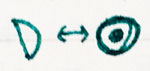
The horse’s eye After a time, I saw up on the shore a confusing sight that resolved into a horse giving birth out of its eye, with all the gory reality that would entail. As the foal came out, the horse’s eye came off as if it was a half ping-pong ball. Everyone was too grossed out to put it back on, but I grabbed the slippery, wet eye and approached the horse. The masters I communicated with told me to approach the horse and focus and they would essentially send a beam of energy into the horse and it would calm itself and open its eyelid for me. It did, but I couldn’t reach.
Eye Birth: In the Middle Ages, some believed that certain animals conceived and/or gave birth through the ear or mouth. This is like something a small child (or my dream self) might come up with. Further evidence that my dream self is a child is that I can’t reach the horse’s eye, meaning that I’m child-sized.
Note, too, that the eye is not an orb but shaped like a half ping-pong ball. The dream self doesn’t understand physical anatomy very well either.
-
Creative Genius 2018 • 4 AM
I can’t stay long as I have a flight to Russia in the morning. But I have this dog who is pregnant and will give birth soon. Since I can’t have it doing that on the plane, I decide to stay with it. It gives birth to two full-sized dogs that are totally stiff. The second one has a giant anchor coming out of its back, which makes me laugh.
Abnormal Birth: Nope, that’s not how it works either.
Babies and Growing Up
-
Baby Turtle Monster? 1997 • age 23
I saw a turtle get born and it grew up really weird and transformed. Two eyeball halves became one, and it started looking like a ball of mud.
Babies: The dream self really doesn’t understand babies and growing up.
-
End of Days 2012
Buttercup said it was past Bodhi’s bedtime, and I took him from her to let him sleep on me for a little while. For the most part he was a bundle of blankets, but when I looked in, I saw that he was scrawny but had a full beard, which I thought of as awesome rather than unusual.
Baby’s Beard: That’s an honest reaction.
Bathroom Functions
The need to pee can really hijack a dream. I’ve seen it happen many times, and of course the dream can never resolve the need, nor do we in the dream self focus really understand how.
-
The Detachable Room 2004
I’m trying to pee in a urinal in a bathroom crowded with people and various things (when I wake up, I find I really have to pee). Anyways, I get it wrong — I take off my jeans and dunk them in the urinal water, which is already yellow. Oh no.. I realize my mistake. I’m slightly embarrassed and head back to my room, leaving the other people in the bathroom. There I find a sink and put the pants in the water to clean. . . . [I take some time cleaning up, then:] At this point, Kai came in. He wanted to do something. I said “Hold on, I have to pee.”
-
The Mirror People 2012
I quickly went down the hall to the men’s room, realizing as I arrived that this was the place I liked the least here. I go in and there are urinals marked from A-Z in a row around the room — but they were more bowls on short walls with no privacy, and there were all kinds of people in there. The toilets were even worse in terms of privacy. I tried but couldn’t go.
The Damn High School Bathrooms: This is one of the worst dream places ever. It’s a large sprawling bathroom with lots of disgusting open toilets and urinals, offering no privacy at all, and always with plenty of people around. I spend an anguished time there, and always fail to make it happen. I think that’s a good thing.
Eating
-
Kitty Nose Crackers 2003
People were inserting rectangular packages of crackers into cats’ noses. The cats were Muffin and a similar cat that I felt was mine. The crackers would go right in there, into the nostril, then be sucked in and disappear. I figured at first this was how cats ate, but for a moment wondered how the whole package of crackers made it through the narrow nose area. Well, nonetheless they did. I figured the cat would get sick from the plastic so I kept telling them to stop. I took all the cracker packages, crumpled them up, and threw them away.
References: Muffin was my first cat. We got her when I was about 8.
Eating Fail: Here’s a failure to understand how eating in the waking world works. My waking mind almost engaged, but then just accepted it. The cats’ nostril would just expand to the size of the package of crackers as people pushed them in and then return to normal size.
Sex
-
The Mischievous Fairy Girl 1997 • age 22mature content
The girl in black was scantily clad and tied to this chair, sitting in it. I went to her to tell her no, but she was talking fast and got out my thing and revealed hers — it opened up in her at a corresponding level, in her chest. She slowly took me towards her. My ability to resist faded quickly and I let her do what she would.
Lining Up Parts: So this fairy had the idea to give me this sexy girl as a gift, and while she generally had an idea of how sex works, didn’t quite have the physical understanding of it.
-
The Train Ride 2024
The next part I remember, I was on this big train car with lots of benches like stadium seats. I was on my back, with Avery, naked, on top of me. I began to touch and feel her body. I reached down below. It was very wet, but my hand was not far down enough — in the belly area. Still, I enjoyed the touching a bit.
Something Like That: My dream self had sort of the right idea, but the location was off.
Death
The dream self doesn’t understand physical death because death doesn’t exist in the astral. The astral body can’t be harmed or killed — it’s merely a thought form projection. Even when we expect our own death, we find we remain, unharmed.
As to fighting enemy thought forms in the dream state, as long as our attention is on a thought form, it will continue to have life. The only way to be rid of a fear-based thought form is to turn our thoughts to something else. Deprived of our attention, it will melt away and disappear.
-
Suicide and Dream Fire 1998 • 5:20 AM • age 24
Buttercup was going away for the day and I decided to kill myself. I’m standing on the street and put a gun to my head and shoot! Then I concentrate and say “5, less blood to see, 4, less blood to see, 3, 2, 1” and I look from a third person perspective and see myself standing there. There’s no blood, but I’m pale. Then I go back into my body perspective and think that Buttercup would probably have preferred to be there when I died than find me later. Since I found I was not actually dead yet, I assume death is on the way. I begin to wander.
My consciousness is changing. It gets clearer and clearer and I feel almost exactly like I’m on LSD. There’s this swirling energy in my head which lights up and clarifies the visual field wherever it’s at, leaving the places without it darker and blurrier. It would flow along the edges of things like doors and enter objects. There were multiple swirls at any given time.
At one point I felt the wound with my hand and my flesh seemed to be intact but there was a little indent the size of a BB in the skull near my right eyebrow, along with a dull pain.
Death: A person’s dream body can never be hurt or killed. The expectation of a bullet hole caused my astral body to take on a slight indentation where it happened, and nothing more.
I think the feeling that I was about to die freed up my attention into the now, causing the dreamfire effect.
-
The Orange Light 2014 • 3:40 AM
There are several rounds of this [testing]. In one I fail and a nuclear bomb explodes on my group — the result of which is that I feel I am almost certainly irradiated and will have health issues due to that. In another I’m doing pretty well, but we see a nuke go off in the chamber across the way, and the blast is so strong that we are also destroyed. I see the screen representation of both the chamber across the hall and ours turn red.
I am back at my house again, with some people who I think are from the training sessions.
Casually Dying: There’s no death in the astral. In a rote, it just becomes a point at which you stop and retry, like a video game.
Difficulty with Technical Tasks
This appears to be a phenomena in the dream self focus.
The kind of continuous focus that is required for technical tasks is developed in the waking focus of consciousness. It’s needed to survive and thrive in the physical world.
The dream consciousness has less need of this, living more closely to the now. Survival is ensured, and creation is instantaneous, so there’s no need to develop a capacity for technical tasks.
-
Terrible Service 1996 • age 22
I sort of got a job at the Feve. I don’t know if the owner knew and they didn’t train me too well. It took over an hour to get my first customer’s order right and I couldn’t understand what she wanted or the price or how to make it. I kept losing the paper I was writing on. I felt so bad and it sucked.
Technical Tasks: Want to drive yourself batty? Try to do multi-step technical tasks in the dream state. It won’t go well.
-
I Ate Your Sandwich 1997 • age 22
Context: I worked at Irene's at the time.
I dreamed I was called in to work at Irene’s again and it was the Feve and I got everything wrong. I was trying to make a Pepsi-Root Beer but kept messing it up: adding too much water or eating someone’s food. My consciousness only stepped in to help once every thirty seconds. The rest was me acting without a greater plan, according to habit.
References: Irene's is a cafe in Oberlin. The Feve is a related cafe in town.
Technical Difficulties: Our focus is ever-changing in dreams. The waking self often enters the dream state in a low-context state of mind, a state like being high on marijuana. Holding focus on a long or technical task is often very difficult.
This dream was a perfect example. While attempting to carry out preparation and delivery of food, I kept losing my place and forgetting what I was doing. This waking self consciousness, after awakening in a dream, finds itself in a strange situation and tries to make the best of things according to the clues left to it. It often guesses wrong and, for example, I eat the sandwich I was meant to deliver.
-
Self-Kidney Removal 1997 • age 22
I was in a class on the second floor and this guy was teaching us some weird stuff. There was a part where we’re supposed to remove our own kidney and I thought “That can’t be real, it must be metaphorical.” But I wasn’t sure. I kept reading the instructions over and over but couldn’t maintain the entire thing at once and was continuously confused. Then we went to another room (I did the first step fine) and were given a complex set of instructions. I kept forgetting, watching others, and copying them. Others were doing horribly as well, getting it all wrong. At times I would stop and go into a subdream about something mildly related, then come back.
Complex Procedures: It is nearly impossible to do complex procedures when dreaming. You have to be really focused to pull this off. It seems the other dreamers were having the same problems as me. This is related to short-term memory resetting again and again from being in the low-context dream state.
-
Grocery Sam 1997 • age 23
So I’m working at this shitty grocery store. It’s a big mess and I can’t find anything I need so every customer is taking forever. Then this girl pays in coins and I have the worst time counting them. Then when I turn my back, someone takes them and all these people start messing with me and stealing stuff.
Counting Coins: Even something as seemingly simple as counting coins can be an insurmountable technical task in dreams. The short-term memory of the dream self is too short to keep track of where you are.
-
The Wild Bus Ride and Parasitic Moths 2012
When we get back outside, the person guiding the group has this big sack of gifts for us. She pulls out the first thing — a soccer ball! I get the most excited, and she says “I think this one goes to Sam,” and she hands it to me. I start trying to juggle it, but I’m doing poorly and I feel a bit embarrassed. Then a couple other kids want to play and we pass it around but I’m not making very good passes. I try juggling again, but do badly.
Juggling Fail: Juggling a soccer ball involves coordination with properly-working gravity. As usual, such things are unlikely to work well in dreams.
Reading
-
Lucid Dream: Bruce’s Arm and the School Bus 1997 • 10:13 AM • age 23
I was wary of getting into a magazine because I knew it would distract me out of lucidity, but I thought it a good experiment to see what happens. I tried to read and kept going over words, wondering what they meant. Then I thought of how letters are supposed to change in dreams and wondered why I could see them alright. In an attempt to get the meaning, I concentrated really hard on one entry in the classifieds. As I focused on the second half of the word, the first became more blurry and when I returned to it, it said something different. Ah, I thought. Almost getting the meaning changed the words when my expectations blended with the other letters.
Reading: I could read fine, and the words wouldn’t change as long as they were just making sounds in my head and not conveying meaning.
Once I began to interface with the meaning, the position of the letters and words stopped mattering. Having read and understood the first and second half of the word, when my eyes went back to the first half of the word, the next word came through there. Without our waking habit of scanning across the page, the entire intended meaning will come to us as we stare at one position.
-
Barcelona Dreams 2000 • age 25
There was a bit where I was reading the headline of a fax and was criticizing the design, but of course the words were changing. It’s as if information comes directly at you out of the page starting at one letter — entire sentences will stream into your mind through the single changing letter. But as you scan across the page, only a little comes out of each letter and the whole page seems to change as you read it.
-
Semi-Lucid OBE: Webbed Windows 1998 • age 24
I was reading something in my mind — some kind of instructions. The meaning seemed to come through faster than the words could convey and thus the words seemed to shift as I read them. Later I tested my dream state by looking for something to read. I opened a book and it was all blurry and I hastily concluded that this proved my dreaming state.
Reading in Dreams: Reading can be a good test of being in the dreaming state.
-
Bus to the Beach 2000
I write everything in this notebook but find it almost impossible to read whenever I look back. So I try to write very neatly, but it’s hard to control what I write.
Reading and Writing: After a dream where I am able to read normally, I find I am unable to write normally or read anything that I write. My thoughts don’t work well being strung out in words in the dream state.
Reading Normally
On rare occasions, you can read the way we physically do. Typically this is possible when the writing is just the title or name of something, rather than a larger body of information.
-
Finding Bodhi 2025 • earlier
I was in Bodhi’s room. There was a thick envelope from his school. It was unopened, but seemed important. I opened it and the pages were all stuck together with blue painter’s tape. I scanned across it, picking up that a study of word content had revealed evidence of cruelty. Huh? I didn’t know what that was about.
Reading by Scanning: I think the reason I could read this is that I was scanning it, not paying attention to individual words — though some actual words stood out, like “cruelty”.
It could also have been a rote of some sort.
-
The Magua Discol 1998 • age 23
Outside everyone was turning around to see their new sign. In yellow and white with an edge of blue lightbulbs was “THE MAGUA DISCOL.” I let out a laugh. “Disco-L? Just put a few more nails in their coffin,” I thought as I awoke.
Reading: At the time I found it strange that I could clearly see the letters and read it without it changing. Now I realize it’s because it doesn’t mean anything. If it meant something it would have started changing.
-
Reading Dreamside 2000 • age 25
I was looking at a map of an island. It said in clear letters “THOMAS” next to it. I wondered, “Is that St. Thomas?” and looked to the left to find a much smaller “ST” out there.
Reading: As “Thomas” was the only bit of information here, I was able to read it. I probably projected the “St.” due to my looking for it.
-
Ween’s Bio 2000 • age 25
There’s a scene where I’m reading a bio for Ween that uses their song lyrics. And I can read! I could see the whole page, the layout of the words, and the individual words. I was reading, scanning my focus across the page, but it was like it was being spoken into my mind. It was describing some court case involving this slightly older guy who did something bad down at the river and Ween was there fishing and saw it.
Reading: Interesting. I wonder why this can sometimes work.
When I read in the waking world, I hear the words being spoken in my head. So that part is the same.
-
Adventures in Northtown Mall 2001
spit out a gift for me that was a list of song names and a CD called “Smeg-something“. Buttercup and I tried to figure it out. It turned out to be a New Year’s gift from Raven, who was disappointed that my attention had now turned to Buttercup. I had a hard time reading it, sinking into a single word often, and getting more information through that word. But I could see the list of song names clearly. The problem was that my imagination was going wild reading every single word. Maybe each word was reflecting all the words that I’ve ever seen surrounding it.
Reading: I believe I could read the song names because that was the whole of the information — just the name. Sinking into a reverie on each word is likely connecting to further information about it.
Writing
Communication in the inner realms is direct, through telepathy or rotes. As such, writing isn’t needed or used. This is only carried over into the dream state from the physical, due to expectations and rationalizations.
-
The DeadStorm 2010
I was writing a story, though I don’t remember what it was about. I remember looking down at my writing and it was strangely scribbly. It looked like how I wrote when I was in elementary school and still getting some of my letters wrong.
Elementary Writing: My writing skills were at an elementary level. Perhaps they remain in the state they were at when the dream focus and waking focus began to diverge, somewhere around kindergarten. At that point the dream self lost contact with the waking self’s advancements in writing and understanding.
When we teach children in preschool and kindergarten, are we teaching them at the dream self focus? Is that why they’re limited in the complexity they can learn?
Getting Dressed
The dream self has no need to know how to dress a physical body, so this simple task (to us) can prove challenging.
-
Friends and Dream Awareness 1997 • age 22
I was now in Blaine House and I was saying “It’s a dream, right? I’m in a dream.” I had a hell of a time putting on underwear, pants, and shoes.
Our Personality in Dreams
I want to underscore that though there are breaks in the continuity of memory and thus knowledge we have in these different focuses, we are still very much ourselves in the dream self focus.
-
Hypnagogic Visions 1996 • age 22
I have been practicing seeing with my eyes closed, but I often forget when I wake up. I’ve been in dream classes, in training. I’m realizing that the dream self is me. I’m learning to recognize the shifts of consciousness.
Humor and Wit
I have the same sense of humor in my dream self focus.
-
The Back Massage 2025
My dream self is a humorist who likes to break people’s expectations.
I’m in a truck. I’m standing in the back, and “Pierce Brosnan” is behind me, though it’s actually Ezra Danson. It’s a comedy setup. . . . It’s known that Pierce likes giving unrequested back massages, and I don’t like them. This is the same setup as an episode of Seinfeld.
So the scene begins. Pierce starts rubbing my back. I get this big grimace on my face. He sees it, and says, “Where’s your smile?” So I begin to drive him crazy with weirdness. I’m only half-focusing on him and breaking all his conversational expectations. I randomly bring up something about his wife Kim. It’s hilarious, and it really gets his goat. . . . Speaking of humorously breaking expectations: Later on I’m talking with this girl I like at a dorm. I pick up a thought that it’s her birthday. “It’s your birthday??” I say . . . then I run away. She follows of course to find out why. She’s wondering if I’m going to get a gift or something. It turns into hide and seek in the hallways upstairs.
Comedy: Breaking expectations is one of my favorite forms of humor.
-
The Game Sphere 2025 • 5 AM
I play this one [game], leaping, flying, spiraling through action and adventure. In my mind I’m beginning to desire certain franchises to join in… and I’m excited that in the next layer it’s something more my style. I find myself in a world where all the characters are stylized Santas — in different colored suits — some military style or American style, all vastly creative and humorous. I’m the normal familiar Santa in a red suit. All have big beards, but of different shades and colors. The scenery is dry with sand dunes.
Every Kind of Santa: I love that this is “more my style”, even with my dream self. I mean, that self really is me, just in a different circumstance. I’m also reminded of the burly bearded men in the location “Space Station Benji” (see the location in dreams-intro.php).
-
The Nubicus 2015 • 8 AM
My car had transformed into a four-wheeled kid’s tricycle to fit through [the metal poles]. It had a molded plastic bucket seat and four wheels. I was still in it, and the two people in the back seat were now walking on either side of me. It rolled to a stop and a few people gathered around. Perhaps made shy by the attention, I said “and it also becomes a Nubicus”, and I flipped it up over my body like an incomplete shell. Curious, people peered inside, and with humor, I swatted at them like a cat.
Creativity and Humor: My sense of humor is the same as my waking self. The word “Nubicus” came to me instantly and it sounded funny so I went with it, then playfully imitated a cat.
-
The Farce 1999 • age 24
Oh, hilarity! Buttercup woke me up because I was snort-laughing like mad.
I was a character in a fantastic farce of a tale. The rules were crazy, the actors fluid with them. There was a council meeting at this particular part. We decided to spray ourselves with this big bottle of water as we spoke to avoid temptation. This gray water bottle (probably a fading thought form) was going to be a woman’s headband. There were people who were “traps” of various sorts, who sometimes decided to misfire and not go off. Earlier I was a dead fish — with the features all on one side. So silly. Everybody was being so clever. I’ve been laughing a lot in dreams recently.
We were all on a huge ocean liner passing inches from an island. Someone turned the gravity off on the ship and we floated out. We represented some kind of fluoride toothpaste. We tried to turn the gravity back on when the floating beans were right over Anthony Kiedis’ head (he was in a documentary we’d just seen).
We had been on the island recently.. Chandler was on some quest about girls or onion rings that was going to bring him to the rim of the volcano (and the rest of us had a reason for going up there, too). Madness! I loved it!
Hilarious Dreams: The details fail to convey the hilarity. But I wish I had more dreams like this, whose major emotional component is humor, shenanigans, and laughter.
-
The Comedy Club 2008 • 3:30 AM
After watching and laughing at Last Comic Standing, I have this dream..
It’s like a comedy club mixed with a school, filled with very funny people my age, and there’s such laughter, such joy in it. I consider it the best day ever. I’ve left my usual dream grounds to be there. It’s after classes, and we’re all hanging out having this wild imaginative play time. There are groups from dance classes there. I have this pure and amazing water spirit I keep calling on. It’s in a rectangle. I spin and float in the air when communing with it. It’s a sacred and personally-beloved spirit. It inspires me.
Humor: Humor and friends always attend my most happy dreams, as it does the most happy times in my waking life. There’s just nothing better than when I have this easy rapport and deep personal connection with my friends. The humor and cleverness just flows out of me. These are the happiest of dreams, the best of times.
-
The Funny Show 2026 • 5:30 AM
I ended up meeting the guys behind the show. They were all young, around 20. I felt totally at ease with them. The goal was humor and I was all in. We were talking, laughing, every line we said was funny. After this near-thing of writing a song together, I wanted to be part of this crew. I told them that if they ever needed an old guy for one of their sketches, if putting all that sticky beard glue on their faces was just too much, to call on me. . . . Hanging out with the Funny Show guys was a riot of creativity and humor.
True Dreaming
These are true experiences of the dream self, with less or no interference from the waking self, whether by it requiring rationalizations, applying physical limitations, or thinking it’s waking life. The dream self focus likely doesn’t consider these “dreams”.
-
Declining the Catacombs 2008
It’s bright and sunny, and the colors are vibrant. I’m walking along this reddish orange dirt path. There are rolling hills of bright green grass on the right side. On the left is a rising rocky cliff. It feels like World of Warcraft. I come to a cave opening that is interesting to me. It looks like carved ruins. I crawl in through a square opening into a dimly lit room. Ah, I remember this. Room after room, interesting shapes, many paths, long sections. But it’s dim, and feels claustrophobic. I know it very well. I’ve spent months in there, through many dreams. But I don’t want to go back in. I crawl back out to the sunny path.
Entrance to the catacombs A tall fellow on the path sees me. He asks me about it. I said “I used to go in the catacombs all the time.” Catacombs! The word sort of occurs to me right then. He said he did once, too. I continue on.
Somewhere along here I break down crying, sobbing deeply. I can’t now recall why. Was it about my poor health? The catacombs? Someone is with me, a friend. I feel refreshed afterwards, and keep walking.
Everyone’s walking the same way down the path. Something in bold and vibrant colors accosts someone up ahead, and I figure it will do the same to me. I keep walking forward, and it does. I spring out of myself and fly quickly up off the path, above the cliff and across a bit of trees, until it can’t catch me. I spring back to myself and it’s gone. I keep walking. The vibrant thing is awaiting up ahead. It comes at me again, more forcefully. It’s asking questions. I fly out of myself. “No!” I say, not even hearing the question and list of answers. It asks again and we jump again — “No!” After each flight we slow down, then I spring out at the next question. No!.. No!.. No!.. No!.. then it’s over and I’ve sprung to a large open field.
The trophy display I’ve won some sort of honor. Something flies into my hand, like bandages but with writing. There’s something like a trophy display on the ground that looks like a bike rack. It has several of these bandages attached. I got the high score in a certain category — the 2nd to get it. I place the bandage in the appropriate spot on the rack.
Then I’m back on the path. The vibrant blur is a girl, about my age, with reddish hair, wearing some kind of World of Warcraft armor, and she’s beautiful. We talk for a while. I’m enraptured. She tells me there was some Java code built into the awards device and that it was her voiceover back at the device. We talk about the path, about the horrible ghost image of some dark woman who could grab me and not release, cold like death, frozen in time. She says she can take those away, or generate similar ones. I ask her to show me how. There are so many more details.
A Higher Path: This is a true dream. My waking self isn’t interfering at all. Even so, it’s taken physical form and the forms use my recent experiences — the vibrant spirit is wearing some kind of World of Warcraft armor, which I was playing at the time.
-
The Observers 2015 • 7 AM
This follows the dream “The Madness,” which I awoke from at 4 AM. In that, I was trapped in a rote that was difficult to escape from. I suspect that the following might be the same place from a higher, more detached perspective.
The second part of the night was remarkable and strange. It followed some siblings, and a whole cast of people that (I think) they didn’t know. Over and over and over again, the observers took a set of circumstances and tried to get the siblings to do something. The circumstances took a shape, like a building. Each successive scene, the building got bigger, taller, deeper, and the observers became more numerous. It may have begun as the roller rink in the earlier dream. But after each iteration it became larger and more abstract, soon hanging in space. Before long, the building was mere outlines, when viewed from outside. The observers were focusing on a girl from the siblings. But about three quarters of the way through realized it was the younger brother — the strange adept, the savant — who held what they wanted. With him, they tried flattery and appeasement. At this point, the building was large and very deep now, coming to a point at the bottom. They offered him a special train ride, but rotated the perspective so that the train was facing down. They wanted to get them deeper into the building. It worked. After a little while, near the bottom, one of the siblings asked a question about evolution. In response, they went through a thought gateway into a wide grassy field to look at and study these different animal versions of themselves — monkeys and horses, I think.
I wish I remembered more. What were they looking for?
Purely an Observer: I experience this entire dream without rationalizations. I do not inhabit any of the characters or get pulled into the plot. I can see the entire context, what is going on from the outside, from a perspective probably similar to that of the astral entities manipulating the situation. This is a true dream — I am seeing something happening in its true form.
Acting Without Waking Limitations
This is the typical state of the dream self when not “dreaming” and limited by the waking self’s involvement in the dream.
-
Hyperspace Warps 2001
Buttercup, I, and two friends were flying together over a huge beautiful park that I recognized. It had a river with tall spires of rock, huge rolling grassy hills, and an overlook. There was a busy commercial area in the center and a building with a long winding outdoor walkway. We landed and walked down it.
Natural Flight: This is a more true dream. I am flying without rationalization — there is no plane or vehicle being created to make sense of it — I merely fly.
-
Hanging Out 2020 • 7 AM
I heard someone singing “Stairway to Heaven”. I began singing along. Someone else was singing along, too. . . . I liked my voice least of the three, but I still gave it my all. The originator of the song stopped playing and singing the song. There were a few seconds of silence. I didn’t want to stop yet, so I started it up again. The next guitar notes played — I didn’t need to rationalize this by imagining I was playing a guitar — my dream self was in control. I began to sing again. And the other voice joined in with me.
Experience Without Rationalization: The music came without the need for my rationalizing a source. This is an experience in the near realm, which typically doesn’t require rationalizations.
-
The Destructive Plane 1996 • age 22
I got out of the plane and swore I’d push the huge aircraft back up the hill. I actually did!
No Waking Interference: I simply act on my desire to push the airplane thought form up the hill. Without waking interference (projection of physical limitations), there’s nothing to prevent me from doing this.
-
Jungle Exploration 2003
I went out onto the dock of the lake. Some young kayakers in a long black and gold kayak came by and I helped guide their kayak in. They looked slightly tribal. Then, in third person I’m watching myself stand on the wooden bridge with the paddle and two tribal youths walk by with a kayak and call to me: “Hey, paddle boy!” So I help them into the water. I’m floating all over at this point, outstretching my reach, unconstrained by physical limitations.
Stretching Outside Expectations: In my dream self focus, I’m not limited by physical constraints. Were my waking mind to step in, it would rationalize what was happening with some bizarre conjurations that it would instantly accept without question.
Above the Drama
Negative emotions are an astral response to experiences in physical reality, and are taken with us into the astral frequencies. They belong to the waking self and are brought into the dream state by the waking self. When the emotions are calmed, our dream self can be the focus of consciousness.
-
The Decay of Blaine House 1998 • age 24
While trying to call someone I saw a huge airplane flying low in the back yard, flying so strangely that it must have been a thought-form! It almost stopped in the middle of the field, then continued towards the edge of the woods, where it wouldn’t clear. Then it turned around and drifted across the field into a ditch. I ran to get rubber rafts to save them, and tried to get Ruby to help, but she wasn’t interested.
Nah: Ruby isn’t interested in joining my dream drama to rescue the fake victims of the thought form plane.
-
The Animal Shelter Gateway 1998 • age 24
I was distracted by a blue snake in a small cage with an unsecured lid. I tried to block the exits around the lid with boxes but it got out. . . . I expected to get bit and of course I was then bit. [I returned to my room] and said into her ear “Buttercup! I just got bit by a poisonous snake!” and she calmly said “No you didn’t. You’ll be fine.” Then I calmed down and woke up.
Hard Pass: Her calm reaction tells me she’s used to deflecting this kind of dream drama.
-
The Mountain Carnival 2023 • 9 AM
The kids run up to a herd of goats, and I’m looking for the group but not finding them. So I’m yelling for the kids to come with me, and I get a little panicked, as I don’t want to miss the bike ride back to the plane. There was another flight later that our whole family was going to catch. . . . The carnival is closing up.
After more searching, I find the road the bikes were on and follow it a little ways to a weird car-type thing with a few people in it. I tell them the situation and they say the only way to get to the airplane is with a vehicle. I ask if they can give us a ride, but they don’t want to. We ask another and no luck. We head back to the carnival, and now it’s just Buttercup and me. She also seems unconcerned, and rightly so. This is all a big misunderstanding on my part — a rationalization mess.
The Knowing Wife: Once again, Buttercup is not going to be drawn into my dream dramas. In her dream self focus, she is calmly unconcerned.
-
The Tree Clearing 2024
I considered suing them. Then I thought how awkward it would be suing our actual waking neighbors, seeing them in my mind. But then I realized those were waking-life neighbors, and these neighbors weren’t them. I never actually saw anyone living in that back yard house.
“I’m going to sue them.” I say to Buttercup. “No, you’re not,” she says with finality. I’m put off by her tone. “I am.” I say.
Over the Drama: It’s funny how many times my waking self has gotten wrapped up in some dream drama and Buttercup has (often patiently) dissuaded me of the reality of the situation. She doesn’t often get drawn into my drama.
-
Sounding the Chord 2023 • 3:30 AM
I dreamed that everyone I knew came to see me. I was in a mall-type place, and took them from place to place, including an adult musical game-show of sorts with amazing music that had called me in. I was enjoying it with no shame but knew they would be concerned. As I finished with the entertainment, they brought me to a large room where everyone would fit. It was filled with lots of incense. “Too much”, one of them said. “Put these out, and these.” But to me it was fine, a great blend of smells. The place had a Buddhist theme. But it was also like an event place, with servants standing on hand. It was a large open area, with tables set across the center in an arc. Nothing was flat or straight. Everyone took places at the tables while I walked about. I entertained myself with small delights, waiting for them to speak. They had come together out of concern for me. But I was unapologetic, and I spoke to the fears behind their concerns. I was being true to myself, unconstrained by fears.
At some point I moved to a room a little higher up. It was like a viewing room for the main room. It was also filled with people in rows of seats rising above me. On the surrounding wall were little mirrored words and phrases, stacked deep over each other. I wiped some away, then apologized, knowing the work that went into them. Focusing on the larger messages below, I read some and not others, and maybe added my own. There were Buddhists in the rows above me who called out in delight. I said something that reminded one of them of an important word or phrase from a video game they loved and they called out in recognition. I smiled.
I was going to let go and trust and see what happened. Then, I climbed higher in the building, up the outside and onto a little roof high up, above the front door. The house itself was a pale white, almost transparent. The environment outside the building was a foggy golden tangle of vague roots, a protection of sorts. I was going to do something. I imagined myself becoming a target for doing it. I sat down, closed my eyes, then I began.
I made a sound, and the sound was a single tone. I tilted back my head and this added sub frequencies to the sound. It sounded rougher, with an internal rhythm to it. It was a powerful sound. And then I expanded the range upward, and quickly added another tone and another until there was maybe 7. Each had its own unique internal rhythm and sub frequency, and all together it was a chord of magnificent beauty and power.
A Judgmental Intervention: I experience this rote from a higher, emotionally detached place, a place of wisdom. I could easily imagine myself reacting really badly if this happened in waking life. But from this higher perspective, I was calm, and spoke truth.
-
New Perspective 2026
Yesterday in Foundations I was going through the “Sadness” section and read the dream “Dating Around” from 1997. In it, Buttercup wanted to date other people and I cried and cried. Now, deep in the night last night, I dreamed Buttercup was interviewing this young black guy with spiky hair, to see if he was a good dating option. He was behind a desk, and Buttercup was asking him questions. I was there, in a chair next to Buttercup, and I raised an eyebrow to him and said something to the effect of “It’s going to be really hard for you, man. It’s like we’re married.”
Confidence: I think this is the dream self perspective on our relationship. Even if Buttercup does start hanging out with him in the dream state, the undeniable fact is that she and I are almost always together in dreams, and he’d be hanging out with me as much as her.
The Hypnotic Waking Self
The “hypnotic waking self” is the waking self under the influence of a shortened context span. Our contextual span shortens and lengthens throughout the various sleep cycles.
As contextual span shortens, our waking self transitions into an accepting hypnotic state. It observes the experiences of the dream self, touching it up with physical rationalizations, and occasionally communicating with it.
Feeling “dreamy” means that everything is quickly accepted. You go into it and there’s no judging it. The questioning part of the mind relaxes.
Shortened Context
The way the body puts the waking mind to rest is similar to the dopamine flood that brings us closer to zero context on marijuana. This frees us from past fears and future desires in order to rest, and helps keep the waking mind from jumping in. When the waking mind rouses for short periods in the dream state, it’s under this short-term memory effect.
This short-term memory reminds me of the movie Memento in some ways. Finding ourselves suddenly in a strange situation, we do our best to figure out what’s going on and how we got here.
Totally Accepting
The keystone of this state is total acceptance of everything, questioning nothing. Something odd or unusual often fails to get our attention at all. The shortened context means there’s almost no past experience to compare the current experience against.
Accepts or Rationalizes All
If the waking self does notice something odd or unusual (and it might take some time to figure out just what it is), it can be rationalized through projections that change the scene or explanations that make sense of it. The waking self fragment is adept at this. Its semi-hypnotic state means that even if the rationalization or explanation isn’t very realistic to our full waking self, it will often find it acceptable and go with it.
-
The Naked Touchdown 2024
I’m watching this rote of an American Football play. My perspective is from above. It’s a running play where everyone is crowded into the middle. From this mob, a single black man springs out and jumps over the line for a touchdown. The odd thing is he’s all brown, head to toe. My mind is trying to figure out why this is weird. “Oh! He’s not wearing his jersey!” I realize. I reasoned that someone must have pulled it off as he was running through the crowd of players. But that doesn’t explain it entirely. Something is still off . . . and then it comes to me: he’s entirely naked! I rewatch the scene and this time I see it for what it is. As the scene continues, the announcers slowly catch on.
Something Is Amiss: This sports rote is clearly something only my waking self would understand. But notice how long it takes me to understand what’s going on. At first, I just notice that something is odd, and then it takes me two different realizations before I understand what I’m looking at. When I think it’s just his jersey missing, I rationalize an explanation for it. When I notice he’s entirely naked, then it’s just too wild to rationalize away. Instead, it’s hilarious.
-
A Fish Through Glass 1996 • age 21
I found this mystic weirdness shop with couches and mattresses all over the floor and fish tanks lining the walls, and we all sat down and started to talk. But I was watching the fish and one slipped through the glass and started swimming through the room. I wondered if we were breathing water or thick air or what. But then I discovered it was a trick played by what used to be the shop owner.
Dreaming Mind: When I saw the fish swimming through the air, I didn’t for a moment think I was dreaming. A more realistic explanation, it seemed at the time, was that we were breathing water or that the air was really thick here. Then it was explained away as a trick.
Easily Fooled
Because we don’t question what’s going on, we can be easily fooled by others.
It can be rather comical. The waking self with short-term memory is very much like the characters in Looney Tunes cartoons that Bugs Bunny (essentially the lucid dreamer) regularly fools with simple costumes and by setting expectations. These cartoons are a great example of the varying levels of consciousness in the dream state.
-
The Tower Ride 1996 • Early AM • age 22
I was working as the ticket-taker for this ride that, if not on the top of The Tower on Arcology Hill, was nearby. It was $4 and I was taking over for a friend. Everyone had these excuses for not having to pay and were sneaking by and soon there was a mad rush. I became hard-ass and started kicking people off the cars if they didn’t have tickets.
Believing It All: When you’re not lucid, it’s easy to believe everything you’re told. The people in line learned that I wasn’t too lucid and used it to their advantage.
-
The Reluctant Hero 2011 • 2 AM
The policeman said I was in big trouble since they’d taken my license already. He wondered what they were going to do with me. I pretended that I was blind, hoping to distract him from the fact that I was drunk, and my friends played along. It worked somehow. He didn’t haul me away and the story could continue.
Pretending to Be Blind: The police officer was easy to fool with this ploy, missing the fact that driving blind is worse than driving drunk.
Responding With Full Attention
One effect of shortened context is freeing up our full attention into the now. The shorter the context, the more past concerns are left behind. So when something has our attention, it has our full attention.
-
Windsurfing 1997 • age 23
The scene changed before long and it was my whole family at a sunny ocean beach. We windsurfed and it was fun! I fell in at one point and there were sharp jagged shells on the sea floor. I convinced this guy I had cut off half my foot and he went crazy and called people to stop the massive blood spill in the water. There really wasn’t one.
Hook, Line and Sinker: It can be difficult to get another dreamer’s attention — to pull them into your context and communicate with them. But if you’re successful, like I am here, they may turn the entirety of their focus to you and what you told them. This poor fellow fell for my ruse and then ran off, embellishing on it so that the blood was flowing in amounts comparable to an oil spill!
The Power of Suggestion
Much like someone in the hypnotic state, a waking self fragment will respond easily to suggestion.
-
The Fields of War 1996 • age 22
It’s a big war, and I’m going all about, clubbing and stabbing. The enemy is ugly and orc-like. A really big Indian fellow from our side is collecting all the discarded weapons in a pile, probably to fix later. Someone told me I had to pierce him with a spear to make him leave, so I did. But he was on my side and I don’t know why I did.
Suggestion: I respond easily to suggestion, even if part of me knows it doesn’t make sense.
-
You’re All Sheep! 1996 • age 22
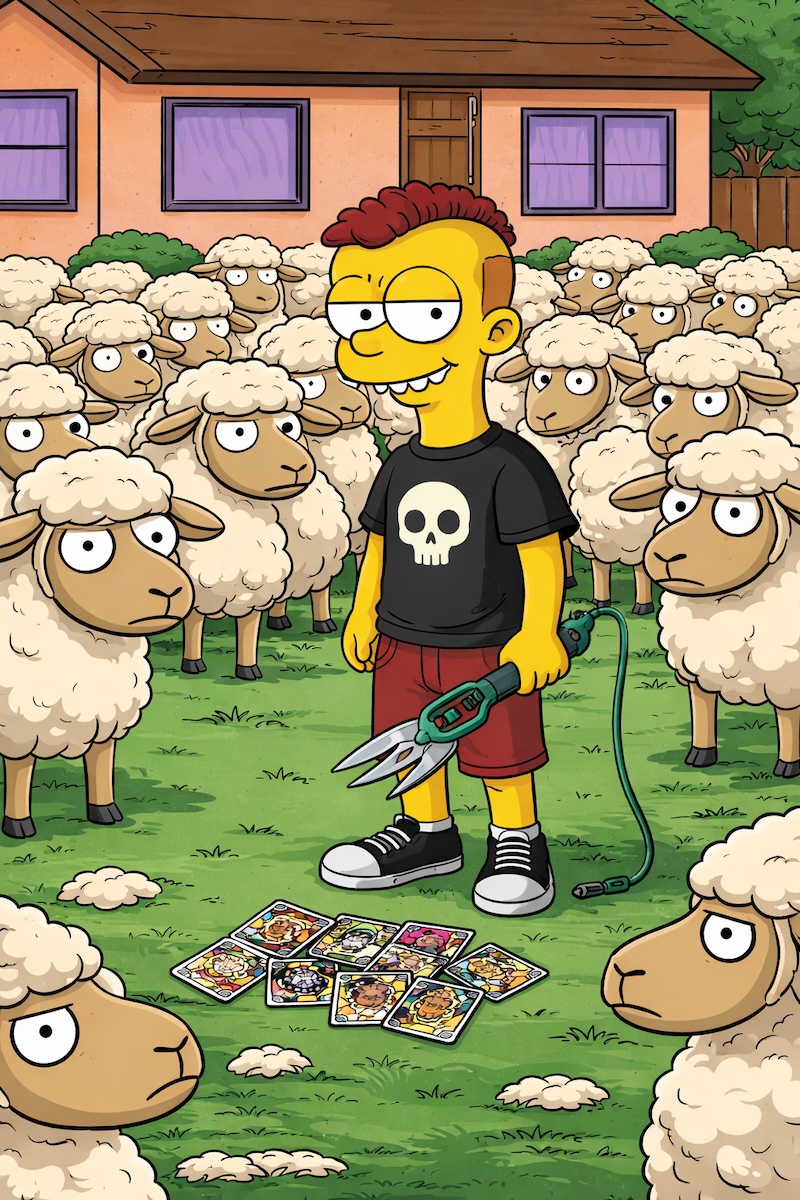
We all become sheep I’m visiting Manville A. He’s not home but I’m trading cards in his house with Milhouse. We went right in because he said we could. We thought some of the cards were illustrated by Manville, but no. We were in the yard when Manville came home. He compared us to sheep, and we all turned into sheep. A hundred other people arrived and turned into sheep. There was shearing and wool pulling. I wondered humorously how that’d translate back to real terms. Would we all be bald when we changed back?
References: Milhouse is a nerdy character from The Simpsons.
Power of Suggestion: Manville compared us to sheep, and voilà! We were sheep! The plot then continued like that.
-
Semi-Lucid OBE: Webbed Windows 1998 • age 24
She had some of my pages of notes and photos from earlier and started reading them. I didn’t want her to and went to see what they said. There was some writing about time, then some doubt about being able to get lucid or OB. I felt myself upon reading it that I was losing a grip and fading out. I was disappointed that Emma didn’t finish her drawing.
Doubt: Interesting that as I read about my doubt in being able to get lucid, I lost my lucidity. Suggestion is very powerful in the dreaming mind.
Quickly Forgets — Easily Distracted
-
The. . . . Party? 1997 • age 22
When I looked back up [the kid] was gone. He’d thrown himself over the edge of the roof to die. I ran to the edge and looked down. He’d landed head first on the concrete. His head was bashed in, and there was this white foamy liquid on the concrete all around it. I ran to the party and told someone to call an ambulance. Then I realized the kid was running behind me saying “Touch my head! Feel it!” I refused. He’d survived, and so he did it again and again, and each time it was like the tragedy was new.
Short Term Memory: I was in a shortened context here. When it happened the second time, I’d already forgotten the first time. Again and again the site of his jump triggered my fear and I thought him dead, though each time he was fine, albeit a bit leaky.
-
Tail Gunner
I follow the farmer home, asking how much further it is to Veroquah, my destination (never heard of this place). He says it’s “only 10 miles” and he’ll find someone to give me a ride. Then he gets distracted and starts showing off his electronics collection.
Distractions: The farmer’s distracted and unexpected behavior means he is likely a dreamer.
-
Free the Children 1997 • age 23
So I decided to start a rally for the children, to release them from the great bias and control, to free the children and the young! I started yelling out to everyone to gather and rally the children. All these children started following me in this huge march. . . . On the next block there were no cars, only people, and one of them was HUGE — at least 10 feet tall. I wanted to talk to him but he turned invisible. . . . [I get wrapped up in trying to see him]
Buttercup and I get distracted from the march and go to a comic store. We start grabbing rave fliers on the way out.
Distraction: A simple distraction can totally change the plot of the dream as we forget what we were doing before.
-
Angsty Xmas 1996 • age 21
Ruby drove us out one side of the circular driveway and we were going to go back in the other, but she missed it. I was kinda surprised by her lack of driving control, and she turned and missed it again. Then we were talking and she missed it again and she turned down this steep tractor road in a cornfield. I was going nuts and told her to get out and let me drive. . . . We went to Dairy Queen. . . . I tried to order a banana split. “Can I have a banana split?” The older semi-foreign man said “A cookie?” and got me a cookie. “No, not a cookie, a banana split.” The old man looked up at the menu display, heated a cookie in the microwave and gave it to me. “No, not a cookie.” The person behind me told me to explain what a banana split was to the man, so I did. He got the manager, who looked it up in her files and said that they had no bananas.
Unfocused Dreamers: This dream is filled with unfocused dreamers. Notice how Ruby dazed out while driving and gets caught in a pattern. Later, the Dairy Queen man isn’t really paying attention to me, hearing instead what he expected or wanted to hear.
-
Bad Service 1997 • age 23
I’m in this big department store and finally get really fed up at the bad service. . . . I start a riot, and we all commence to trash the store.
I must have lost the train of thought because I find a drawer I want to buy. There are cashiers working, so I go to pay for it. I buy it and go outside. A guy walks by with 3 Garfield statues and says “Did you see the free Garfield stuff?” I go back inside, find two fierce stylized Garfield statues, and take them. I find I have written plans for the riot and decide to destroy them because I don’t want to be caught. In one version of the dream I burn them. In another, I throw them away in “another store” (which is the same store after a blank-out of forgetting).
Distractions: The store remains through the various plot lines and versions of the dream, as the one constant. Distractions cause breaks in the continuity of my dreaming mind. These small interruptions wash out memories of the previous part of the dream, and I find myself in a store and go from there.
-
Dating Around 1997 • age 22
Buttercup and I were grocery shopping (we needed to go shopping in waking life) and we were at the check-out counter but forgot some things. So I ran to get them and got horribly lost and distracted.
Distractions: It’s so easy to get distracted when in shortened context dream state.
-
The Superhero’s End 2011
At one point, someone had a great idea to make peace. Everybody got two things that had been lost or buried in the wreckage, and their job was to match them with their owner. It changed everyone’s focus to finding and helping people. I had this bedraggled little dog and a book. Each came with a description written on a crinkly pink paper. I walked around looking for the owner, made a circuit of the room, but had no luck. There were several pets — including a purple guinea pig. But this peace didn’t last and fighting broke out again, as bad as ever.
A New Focus on Peace: It was a brilliant attempt and worked to distract everyone for a while, giving them a new focus. Typically this could work but there must have been too many people still in fight mode.
Habitual Behavior
-
The House War 2011
There’s this wooded valley somewhere in the east US, with a river running through it, and a little town at the intersection of two roads. . . . I’m driving along the road towards the little town and get an invite from Avery to hang out. I think, sure, why not, and now we’re traveling together in the car. Part of hanging out is returning to the time when we were together to a degree and so we hold hands. She’s telling me about this particularly awful boyfriend she had who messed with her head and beat her. . . . Eventually we’re walking around the town center, and then I decide it’s time to get back, so she begins to lead me back, but then takes me down these unfamiliar roads to this ramshackle house. . . . She leads me down a dirt driveway strewn with toys and various things, and then up this side stairway to an entrance. We go in and it’s this messy, worn, nasty place with dim light. She reveals that this is the home of that awful guy!
She goes down this stairway into this darker basement area, and there he is. She very quickly falls into her old role as his girlfriend, and he’s being cruel to her.
Similar Situation, Similar Behavior: Avery and I fall into a weak version of our old relationship. The intention was for her to take me back, but as she’s focused on her awful boyfriend, she takes me to his place instead, probably unintentionally. When she sees him, she falls into the victim role. Without attention, we travel down familiar paths.
I wonder if talking about it pulled me into a rote of the memory. . . .
-
The Treehouse OBE 2024 • 5:30 AM
My recorded “your body is sleeping” message triggered this.
I found myself at my computer downstairs — a habitual place to be. I’ve been there before when I heard the message. I got up and started walking around. I walked into the living room.
My Usual Place: I found myself dreaming while my astral body was at my computer downstairs, where I spend a lot of my waking time. This behavior is described in detail by Muldoon — see “Following Desires & Habits”.
But I wonder — my astral body would be my dream self, so why would it be following habitual waking self behavior? Perhaps my dream focus is in a further projection in the astral, in the manner of passing through gateways, while I left that me at the desk as the “foot in the door” — a habitual first projection point.
-
Blaine House Alert 2024
I’m at Blaine House. It’s night. I’m at a desk against the back wall in the basement — likely my astral body is at my desk downstairs in my current house, and it’s superimposed into Blaine House.
In Two Locations: My astral body has moved to its habitual position at my desk downstairs, and superimposed it into my dream of being at Blaine House.
Emotions with Full Attention
In the dream state emotions can run wild, taking hold of us so completely that we give them full expression. They flow through us like an unstoppable torrent.
In the dream state, we are in a state of shortened context. The result is that our attention is freed up more fully into the now. All of our energy is available to move into an emotion, and when it does, we feel it fully. It’s not that we’re always emotional in the astral. It’s just that when we are, we’re fully in it to an extent we rarely allow in the waking world. Children live in this fuller attention state. That’s why their emotions are so big.
The dream world is the astral world, known by some as the realm of emotion. Emotions are an awareness of the astral frequencies, where we feel changes in the flow as a result of our focus. But don’t think of it as a realm of pure emotion. It’s better understood as everything but the physical. In the astral, we still feel the familiar emotions of physical life. Going inward further, at mental/causal frequencies, emotion resolves into a unending state of flow perceived from the physical perspective as unconditional love.
Wherever our focus shifts to the waking self, we bring that physical life baggage closer to us where it can be emotionally triggered. In that focus we believe what’s happening is waking reality, with all the consequences that it brings.
Intense Emotions
A common result of rousing the waking self (switching to the waking self focus) is that we often find ourselves in a situation that would have huge consequences in our waking lives. We don’t recall how we got there, but we feel we’ve really screwed up.
The emotions are intense because of the dreaming focus in the now. They’re amplified by the full weight of our attention.
Love
-
Dream Girl 1995 • age 20
When I finally turned around, I saw one of the most beautiful girls I have ever seen. She was sitting on a barrel stool playing guitar and singing a wonderful, beautiful song. When she finished the song (this part is foggy), I looked deeply into her eyes for a moment. She returned my gaze. . . . [I] spoke to her. I approached fearlessly and the gray wolf took off in a blur, darting into the distance. I went to the window and spoke to her. She was truly beautiful. She was short, had brown eyes, and light blonde hair. . . . I followed her to her house, and found her performing in her backyard on a big stage to a large crowd. I watched in awe, then began to dance as her acoustic music turns to rock like Babes In Toyland. (Foggy) Afterwards, I joined her and her band members in a shallow stream in the forest writing songs and jamming. They’re surprised by me, pleased by my musical talent. The area is beautiful. We spent time together, too. Oh, it felt incredible!
References: Babes In Toyland is a rock band.
In Love: I dream again of a perfect dream girl. She’s got the same life glow and spirit as Tink, though in a different form. It’s the Pure Essence shining through.
Fear or Panic
-
The Severed Thumb 1999 • age 25
I held my severed left thumb in my hand. . . . I think, “How does not having a thumb affect my life?” I ponder the implications. “I can still write, as my right-hand thumb is fine. . . . Oh no! I can’t play piano!” Then I panic. I shout and run about calling for doctors and asking people to call a doctor or hospital. Soon I’ve gathered a crowd, including one doctor.
Waking Perspective: I’m just fine with this severed thumb until I run it across my waking perspective, and then I freak out when I realize the physical implications. Once again this affects the course of the dream.
-
Lost in Time 1999 • age 25
In Ranier’s room I was told it was something like December 6, 2001 (two years later). I found that the last thing I could remember was the last few days of November, 1999, (the actual date). I felt I must be losing my mind, having a psychotic break. Then things went dark and I saw red flashing lights in my head. I thought “There are those lights! I must have been abducted by aliens for the last two years!” I was really scared.
Looking for a Cause: Instead of doubting the date I was told, I believed it and became afraid for my sanity. When the lights appeared from my lucid dreaming device, they acted as the answer to the question “how did I lose 2 years?”
-
The Mountain Carnival 2023 • 9 AM
We’re in a full plane, flying over the mountains. . . . It’s a bike tour now. After a short ride, we arrive at a roughly-built mountain carnival, with goats, sheep, farm animals, food vendors, small buildings, and fences. It feels sort of thrown together. We enter on foot with the group.
The kids are still with me and they’re focused on the carnival now. We go in a little ways with the group, but then we get separated from them. We walk about the carnival. The kids run up to a herd of goats, and I’m looking for the group but not finding them. So I’m yelling for the kids to come with me, and I get a little panicked, as I don’t want to miss the bike ride back to the plane. There was another flight later that our whole family was going to catch. I begin to ask around. I ask this teenage girl. She doesn’t respond, then gets in her car and leaves. I wait a minute to see if she’s gone to find help but she doesn’t come back. Nobody I talk to really has much of a reaction. The carnival is closing up.
Waking Self Panic: Once again, my focus moves towards my waking self, and it takes the scene (as is, without question of course) as waking life. Based on the fact that I lost track of the group, I fear I’m going to be left behind when they leave to come home. This fear entirely sidetracks the dream and takes over the plot. I spend the rest of the dream trying to find the group.
Anger
I am not often angry in my dreams, but when I am, it is without limits. I do things I would never consider in waking life — I smash people into walls, kick in their faces, and throw cars. In part, I am aware that there is no effect on them except that they know my strength and fury (thought forms cannot feel pain or suffer injury). At these times, I am impervious to fear, and the dream enemy usually gets the hint and leaves.
-
Angsty Xmas 1996 • age 21
Dusk set in. . . . I was upset at all the wasted time and was bashing branches against old dead trees. Aunt Abbey immediately came to my side and told me to stop it and be careful, expecting me to obey. That made me so mad, I yelled at her and dragged her by her leg to a fence and bashed her bitching body against it while she continued to complain. Then I threw her off an incline.
Astral Rage: I wonder if this is a good way for the mind to release frustrations. What we emotionally aren’t able to do in waking life, we can do in dreams. But it’s also possible we’re strengthening these tendencies. The target doesn’t reflect any waking feelings — I’ve always liked Aunt Abbey.
Note, too, how the environment gets darker in the scene transition just before this happens. I’ve moved to a lower frequency version of this area.
-
Berserker Rage 1996 • age 22
Bad dreams continue. Last night I dreamed I was in a violent frenzy killing off the undead coming after these two princesses at Blaine House. I was big and unstoppable and unafraid and cutting here and there. Amidst the frenzy, I cut off the legs of the two princesses. Then it became real. They tried to talk with me about it. I was sorry and wished it hadn’t happened. Then they tried to get between Buttercup and I. . . . Horrible. And after dreams like that I always start the day off on the wrong foot. Ugh.
Bad Dreams: Here I’m overcome with berserker rage and lose control. The one nice aspect of giving into rage is feeling strong, unafraid, and having a single unified purpose, which is foreign to my usual divided, self-analyzing state.
Bad dreams can happen when we shift to the waking focus, believe we’re in the waking world, and expect we have to suffer the consequences of actions we would never do in waking life.
-
The Great Journey 1997 • age 22
I’m in the land of the Dark Tower. There’s this big classroom full of students. Three or four of us are selected from the group to go on this great journey. . . . This was a great honor, a great beginning. . . . Buttercup and I park at a parking lot. We’re a block away doing something, but I keep checking on our car. There are all these people near it and perhaps it’s due to my fear expectations and focus, but they start going through our stuff in the car, eating our food, drinking our drinks. I run over there and roar angrily. I hold up each item and declare its price and demand repayment. They keep scurrying from car to car. I overturn one car and then flip over another. While doing so, they pile into the last car and escape.
So I guess I must be following them because I see them in a campground and begin to terrorize them there. Soon I’m behind the wheel of their car, smashing it into trees and driving it off a steep incline. I think police come now. Off to a great start!
Overreacting Again: Not only am I likely responsible for the people taking our stuff (by looking for it), but for the massive over-reaction afterwards.
-
White or Rose? 1998 • age 23
[We’re in a lodge] Buttercup checks out, then two others, then it’s my turn. I have to show three IDs. I hold them out to the dark-haired woman and wait, going into a bit of a daze. I didn’t notice that I had got in the way of her cleaning up. I’m sure it seemed rude. I became more lucid and apologized but she wouldn’t accept it. I explained that I didn’t mean to get in the way and she wouldn’t believe it. She was mad and blowing me off and I got really angry and jumped up onto the counter screaming what a very rude person she was being and everyone around was slightly shocked by my outburst of rage. As I was turning to walk out, this young, immature-looking kid from my dream-side youth group turns to me and says to a friend, “Look! He did it again!” As if my behavior was often like this and had really been getting to him. . . . Further back, there’s some movement and Buttercup tells me that the rude girl up front wasn’t very liked and the people there heard my story and were going to get her fired.
Take No Shit: My take-no-shit attitude in the dream state sometimes goes too far. I’m glad I have this strength of will, but maybe I use it too much? This kid certainly thinks so.
-
Trail of Dreams 1999 • age 25
This woman (who was part of the project but also spraying a hose) got mad and stormed over. Buttercup started telling her how they were ruining the environment. Buttercup started crying. The woman put on a fake smile and said even meaner stuff. The woman walked away and I, furious, followed her. In front of a cameraman, I said “You talk with smiles and pretend kindness but underneath you are saying FUCK YOU.” These last I said in a guttural tone. “You should work for the government, able to smile while saying horrible lies. . . . ” I went on and on and the woman fled, crying. I then awoke.
Wild Emotions: When I’m seized by anger in the dream state, I often go too far. But believe it or not, learning to express my anger is a positive thing for me at this time, as I’d spent so much time suppressing and internalizing it.
-
Art Class, Day 5 1999 • 5 AM • age 25
This is day 5 of art class, the last day. Day 1 was the first teacher. Day 2, 3, and 4 was a second teacher, and today was the third and final teacher. Every day I had run out of the class thanks to some insult or rude comment from the teacher. . . . We were playing with play dough colors. Buttercup mixed blue and yellow for green, and then added yellow and white and were mixing the two into a very cool interplay of yellow and green with an effulgence of even whiteness that was far more like mixing light than play dough. . . . I wanted to make green, too, so I was watching and waiting for her to be done. The teacher said “Why don’t you mix the remaining two colors, red and blue?” and I said “I wanted to do my own.” The teacher sneers “Come on, this isn’t THIRD GRADE,” and my friend looks at me like “oh, no” and I storm out and up the stairs and go to my room, but then decide instead to hide out in the bathroom where they’re less likely to find me.
A Hard Time in Art Class: It’s odd — usually during this time period I would have reacted with rage but I reacted more like a child this time. I may have been dreaming from a child’s perspective.
-
Influence and Purple Goo 2001
Earlier on, I dreamed of being near the hill with the Tower. It’s dark, and I was living in a house in a caul de sac with Brendan, Luke, Kai, and Brandon’s friend Gary. I drive home from somewhere and as I do, I see Luke, Kai, and Gary outside their house “shooting” at me. It’s more like flashes of light, though. Harmless. But I get mad and get a wild idea to get revenge. I drive as fast as I can into the front door and smash through it. The car begins floating and I slam it forward into Kai and Gary multiple times. Suddenly feeling bad, I spare Luke, then start apologizing. I start to panic about hospital costs but then it dawns on me that it’s a dream, and I think “What a way to teach them to respect me — no financial burdens. They’re scared but don’t die.” What an awful thought! They wander back in and I hug them and apologize.
Overreacting, a Bit: Here I am losing my cool based simply on the seeming intention of my friends shooting at me. Those flashes of light were most likely communications.
-
The House War 2011
[An abusive guy and his family is continually taking things from my luggage]
Finally I’ve had enough, and decide to kill the nasty boys. I go to each in turn and rip their heads off. Their bodies melt away leaving just a balloon-like head that falls to the floor. I chase the mother out, take the baby, and boil it in water, then put it down the garbage disposal, to Emma’s horror.
Fed Up: Wow, I was really pissed! How horrible!
Sadness
There’s no sadness quite like dream sadness. Emotions in the dream state are so intense due to the singular focus of being near zero context. You’re fully in it.
-
Imprisoned 1996 • Middle of Night • age 22
I dreamed of being in a nasty movie, but it was real to me. There was such hatred and cruelty. People were being killed left and right. Mobs were killing people’s family members. I fled and was able to escape, but then I came back to see how it ended. I was shot and shot others in return. I was taken away by police, and sentenced to 26 months in jail, just when I was going to see Buttercup again, finish college, and see all my friends. I was devastated, crushed, crying in my sleep. . . . And then I woke up to such freedom and happiness!
Imprisonment: Dreams of imprisonment are the worst. I go through the trauma of thinking that I’ll be put in jail for a long time and the huge effect that would have on my life.
-
Dating Around 1997 • age 22
We’re all living in new one-story houses in the burbs. It’s night. Buttercup and I are together in one house. Brendan, Ranier, River, Brandon, and Wendy are in another, and Paige, Nika, and Stan are nearby. Buttercup tells me she wants to date other people. I feel disbelief, then cry torrents of tears. . . . Then she left for her date. I cried and cried.
Ultimate Sadness: I feel it as if it was 100% real, the end of everything we had together.
-
Tapestry of Tears 1997 • age 23
I’m on the couch in the living room (but it’s like gramma’s living room). I’m facing the back cushion, with my face is pressed up against it. I’m talking with Buttercup, when I notice my tapestry is hung sloppily behind the couch and not behind the entertainment center where I left it. I am overcome with emotion. I get up, tear it down, and run to the bedroom, crying. I put my head in the pillows, curl up, and just cry.
Emotions: Why did I cry because of the misplacement of the tapestry?
-
Adventures at College 1998 • age 24
I looked up at Buttercup’s guilty face and started crying deep sobs. She started crying, too, and came over and hugged me. We held each other for a time. Our emotions released, we walked together as friends towards campus.
Getting Past It: An emotional torrent is expressed and released.
-
Hyperspace Reunion 2000 • age 25
I got this call from the sales guy at Definition 6 (last night we’d seen their sign). He asked if I was going to come in. I thought, “Huh? I don’t work there,” but I doubted myself and asked what day it was. He said I should come in but since I can’t remember he’d give me control of all sales calls coming from Alabama. Slowly I regained some lucidity and said, “You know, I don’t work there. I haven’t in a long time.” He suddenly breaks down crying, sobbing, saying he liked me the best and missed me and I should come and visit.
Astral Emotions: Strange. I barely knew any of the sales guys I worked with.
-
End of Days 2012
Someone said it was the end of days. Incredibly huge tsunamis were rolling up all the coasts. . . . I grabbed some important things, and Buttercup joined me. On the way back, she started slowing down and collapsed onto the ground with Bodhi, overtaken by sadness and despair. I tried to get her motivated to get up, but she wouldn’t, so I scooped her and Bodhi up in my arms and ran towards the last plane boarding. Her sadness got to me and I began to cry. We arrived just as they were accepting the final passengers. There I was, holding my wife in my arms, baby in hers. I pleaded with them, and they let us in.
Whipped by Emotions: Buttercup and I are overtaken with sadness, without any apparent trigger, just due to the weight of trying to escape these life-changing disasters.
Amazement
-
Needle Tech 1997 • age 23
I ran to attack but realized I was in a devil costume and so was my good friend who was with me. And the two next to us were us — twins! I was beyond fascinated, so much so that my focus began wavering in and out — dulling and sharpening. We sat down to talk and I got to know the duplicate girl. At times I was dumbly nodding, and at other times I added clever humor to the conversation. In and out.
Astral Emotion: It’s interesting to catch the effect of emotions on the astral body. Here I was opening and closing in big swings due to the fascination I felt.
-
Nightly Dream Dates 1998 • age 23
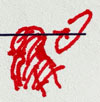
Spinning within me Buttercup and I were now two luminescent men with grayish golden hair. We had a small piece of mountain land with soft grass and a small, muddy-bottomed lake. The land was for running her horses. Earlier, there was a thunderstorm while we were at a larger horse-running land.
I felt strong emotion, accompanied by this cool spinning sensation within me, like strands of golden light. The spinning made me feel excited and unstable. I knew I had to report this and ran back to . . . somewhere and woke up.
Spinning Sensations: This spinning sensation is a feeling of getting too emotional or excited, and it can cause us to lose our focus.
Hearing Emotions — The M-Band
-
The Exercise Salesman 1996 • 10 AM • age 22
I’m living with Buttercup and two others atop this building like the Co-op in Berkeley we almost lived in. . . . I heard all these screechy scratchy sounds — emotions in the M-band! I could make out different ones — some happy, some depressed. I ran to go help and saw some weird party going on.
M-Band Sounds: These are the sounds of M-Band emotions as described by Tito Monroe.
Other Effects of Shortened Context
-
Teen Witch 1997 • age 23
After falling asleep while watching the 80s film Teen Witch, I woke up on the couch not knowing myself. I felt like I was still in the 80s. I couldn’t remember what I looked like, and felt that looking in the mirror would remind me who I was. I felt lost. All but my greater context was missing.
It’s like this with gateways and rotes. Don’t forget where you came from or you lose lucidity — your waking context.
Context and Discontinuity: When we lose our context, we lose our meaning and motivations. It comes from a temporarily shortened memory.
-
The Severed Thumb 1999 • age 25
I was in a sandy square in a small Western town. I held my severed left thumb in my hand. . . . A police officer who had also been attracted to the scene walked up beside me, intrigued, and for some reason he looked at my thumb and the blood was blue! So he called me an alien. Laughing, I stopped and looked into a building. The inside was dark, and filled with horribly funny-looking aliens (like from Mars Attacks but more bloated) and machines from the 50s. I winked and nodded toward the room, hoping the officer would see and freak out. That distraction allowed my thumb to naturally return to normal. Noticing this, I circled back to the doctor and held up my flawless healed thumb before him, smiled smugly, and galloped off.
The creepy martians from Mars Attacks Distraction: Upon being distracted, my astral body takes on its usual form again, and my thumb is just like it’s always been.
The easily-distracted nature of the waking self causes us to release thought forms quickly from our previous focus.
Expanding Context
As the waking self’s context expands, it remembers more and more of the dream, back through gateways and rotes, and then into its waking memories. From this wider view, it has a truer context on the dream experiences.
-
The Mirror People 2012
It starts out with me going to Spring Lake Park High School. . . . I realized that some time earlier (another dream), I had managed to apply to return to SSU because Emma and I called and got assurance that I had enough credits to graduate. That being true, I realized that I didn’t need to be here — I could just go home! Walk out and not come back! So I headed straight to the administrative office.
A blonde girl with a wicked look was helping someone at the counter. She was talking to this tall trailer park kid named Pete. She put his last name down as “dopey” in the form she was filling out. She was being subtly cruel and nasty to him. I got her attention and she said something nasty to me as well. I let her have it verbally. As I spoke, more of my memories came back to me — I was 38! What was I doing in high school? I was married! I had already graduated from SSU and Oberlin.
References: Ranier's room is the office my high school counselor.
Dawning Awareness: One’s contextual span is a spectrum rather than on or off, and it can change moment to moment. Generally I don’t question anything when I end up in a dream of high school, but my context began to awaken here — not enough to realize that it was a dream, but enough to let me know I could leave; at first, with the permission of the administration (which they did not grant) and later I realized enough to where I could leave without their permission.
The Waking Self Fragment
Just as in waking life, our past experiences are specific searches that scan across what we’re experiencing in the dream state. Upon recognizing a charged situation, a match is made which pulls focus to the waking self. When this happens, the waking self essentially “wakes up” within the dream. It awakens without context, and believes whatever it’s experiencing is physically real. The very thing that awoke it causes it to have a strong emotional reaction to what’s going on.
I also call this a “waking self fragment”.
Even without memory of how we got here, this fragment is still ourselves, with our personality, expectations, fears, and desires. Its emotional investment keeps the waking self in charge and prevents my focus from returning to the dream self. The dream is kept in a very physical framework, and I act as I would in the physical world.
The part of ourselves (our attention) keeping that memory alive (and searching for the danger or desire) appears on the scene to assess the situation. It doesn’t know how it got there, but it’s ready. This is what it’s been looking for.
In fact, it’s the person we were at the time of the emotional experience that is called forward into the dream experience that just triggered it. These are those little bits of us, of our attention, that were frozen into the form of those original experiences. THIS IS KEY. Where is their context? They were cut off at the time of the experience. That’s why they don’t know what’s going on.
Remember — myself as a 12-year-old is a 100% valid version of me. A whole consciousness with its own perspective. I’ve changed a lot since then but that “me” still exists, with its perspective, and, as Seth says, it’s capable of fresh experience and development in different directions, such as its impression of Buttercup in “Teen Witch”.
This in part is how experiences in the dream state help us deal with emotionally charged experiences. They give us chances to find what we’re searching for (our fears and desires) and to practice responding to them. The locked-away parts of us get to come out and play.
The waking self fragment exists in a state of shortened context, similar to that experienced by the full waking self when high on marijuana. In this case, the effect is provided by the shortened context of the dream state. This effects its state of mind, as I describe below.
The Waking Self Breaks Continuity
When the waking self is triggered and comes forward into the dream, it does so as a waking self fragment. This change of focus displaces the dream self and breaks its continuity, as the waking self fragment takes over and sidetracks the dream.
-
Underworld Guardians 2001
Finding Manville, Ruby, and Raven, I jump in a car with them and drive down a ravine under a road. Soon we find an opening in a rough rocky cliff and leave the car rolled onto its side on a ledge outside. “If I didn’t know this was a dream, imagine the distraction of this!” I thought, imagining the implications of physically reacting to this scene (surely a dream of car accident, rescue, and the financial implications of a car wreck — in short, a stupid dream, a physical expectation dream). But we leave it, walk into the inclining cave to find two rigid, distracting members of Golden Rhino, who hand us very interesting print-outs of waking-life topics. I call out their game in front of my friends. “They distract us and confuse and trick us in any way they can to keep us out, to keep us from knowing.”
The Dream Self and Emotional Distractions: Written at the time: “It seems my strength against them is my ability to stay focused instead of getting distracted by anything set before me. I keep my focus on the overall goal.”
This is entirely due to not getting emotionally involved. When my waking self is triggered and takes over the focus, I get emotionally involved. That self would then appear suddenly in the dream, with no memory of how it got there, reacting as if this was really happening in waking life. The dream goes off the rails.
Without that interruption, I maintain continuity. I remember my goal. I’m not distracted by the tornado or the tipped-over car or the print-outs. I’m focused in my dream self and I know I’m dreaming.
-
A Nighttime Walk 2010 • 1:30 AM
Buttercup and I had decided to go to Blue Ridge. On the way, I drove through a red light. I was afraid I’d get a ticket so I looked behind us and saw this car with a little structure on top that I thought might be a police siren. There were four people inside which I could see clearly. They weren’t police, but I made sure to stop at the next intersection at the bottom of a hill. Once the car stopped, the rationalization was no longer needed, so it disappeared and we were on foot again. We walked across the crosswalk to the right. It dawned on us that we had a long ways to go on foot. Buttercup said “Wait, so we’re going to walk to Blue Ridge tonight? That’s going to take like 18 hours.” I shook my head, wondering what we were thinking. We decided to abandon the trip.
A Strange Situation: This is a great illustration of how the waking self can sidetrack an adventure.
Concern about the traffic lights shifted my focus to the waking self, who decided that to follow traffic rules, I should stop the car at the next intersection. When I did, the car rationalization disappeared, since it was no longer needed. We’re walking now. At this point, we remember the goal of going to Blue Ridge, but forget the astral method (fast travel) we were using to get there since that’s not a possibility in the physical world. Buttercup’s waking self realizes that it’ll take forever to get there on foot. So we abandon the trip.
Breaking Continuity In Memories
Our dream self will sometimes drop a waking self fragment into a memory to see how it handles it, as a test or practice run. In the big picture, the goal is to get ourselves to engage less emotionally, which allows us to see things clearly. We retain our broader context when we become less “sticky” with the attachments and aversions we developed in waking life.
-
Escaping from Dogs 2001 • 4 AM
I was a character, not quite me, running over rocks along a beautiful river in a summery area with mountains on either side. I was being chased by dogs. The dogs were 100% thought forms, rubbery and cheating gravity as they came after me. I had created them earlier just as an experiment. Could they catch me? But the more I watched them, the more I could believe them, and a sense of urgency prevailed. . . . It was at this point in the dream that I hear the alarm from the physical side. Suddenly I am no longer in the action, but outside the cave discussing the sound with a friend. I am now the storyteller, aware of both worlds, wondering if it’s a car alarm, or if it’s coming from the neighbor’s apartment. I even remembered that it had happened earlier in the night and stopped. So I decided to wait it out and push back to the dream side. I thought about how to attribute the sound in the dream. “Ah, I’ll attribute it to a search ray, operated by the dog-keeper to find me.” It worked — I was back in the character of the dream. But this was scary. I tried to bury myself in the soft, light sand.
Believing It: In the dream self focus, I had created this subdream rote, putting myself into a scene with dogs chasing me. But then that self began to believe it was real. This requires a break in context. A longer memory would reveal that I had created these dogs to see if they could catch me. But due to the break in continuity caused by my fear, I forget that I was responsible for creating this and that it’s not physically real. I believe I’m really in danger.
I can jump back out of the rote and reconnect with my greater context, then jump back in and I’m disconnected from it again — yet there’s always some connection. I can always choose from a higher level to pull out of the rote. Think of a rote as a bubble. When we jump in, we are just within the context of that bubble. When we jump out, we reunite with the greater context outside. Our physical lives are bubbles. The bubble is a context barrier. While we are within a rote, we disconnect from the greater continuity and absorb the context (backstory) of the rote.
The bubble of our consciousness trails out behind us in the normal waking state, with its long life context. This includes all of our memory — all the things from the past that affect and influence us. When high, our context resets again and again. That trail of continuity behind us breaks, breaks again with every change of focus, shortens our context to just right now.
Believing This Is Physical Life
Believing that the dream experience is physical life is the most common wrench thrown into our dreams. The dream self can be happily socializing and living through people’s stories, when the waking self is alerted by something and takes focus. It mistakes what’s happening for events in physical, waking life. Typically this results in freaking out in one way or another and a total departure from the dream self’s storyline.
Beliefs are primary. Our reality bends to them. If we believe something strongly enough, no amount of evidence to the contrary will reach us. Our beliefs form a context through which everything else is seen. Our experiences in the dream state show this clearly. Once our waking self takes hold, its belief that physical life is the only reality will warp the dream experience to maintain that belief.
Our spiritual development consists of freeing ourselves from attachments and strong beliefs in our waking life. This allows us to perceive true, unaltered experiences in the dream state.
-
Isobel’s Head 2002
I had three objects with me. Two were long like swords (but I forget what exactly) and the third was a round fuzzy thing like my stuffed owl J’buzhibu. I gathered together some dried leaves I had, set the fuzzy thing upon them, and prepared to set it on fire.
Then there’s an interruption from the waking side — my guess is that it was Isobel, our dog, because when I returned to the dream moments later it is no longer a fuzzy thing but Isobel’s head! I set about putting my lighter to it, but the thought of the loss of my dog, of burning her head, of Buttercup’s sadness, all this overcame me and I became sad and tried desperately to remember how she had died. It was so sad that I woke up.
Tragedy: The waking interruption pulls attention to my waking self. When I return to the dream, it’s there watching as I continue the earlier dream action. Thinking this is physical life, I respond with strong emotion.
-
The Wedding 1997 • age 22
There I was, dropped into a scene right before my wedding. My waking self had woken up here and this was not how I wanted it to be. There were hundreds of people in this big Christian church with pink as the color theme. I read the list of events and it had a bunch of disagreeable religious topics, including a talk on “the power of evil”. I decided to wear sweat pants and a t-shirt to express my feelings on it all. . . . I was thinking how odd and outdated the institution of marriage is. I was intentionally screwing things up. When it came time to read the lines I read the wrong things and thought it was hilarious. Buttercup/Raven thought what I was doing sucked but I had to go through with it. This kind of wedding meant nothing to me.
Mistaken for Waking Reality: Memory rotes turn into fantasy as we exert our will in the rote and change the story.
In this case, my waking mind wakes up in another’s memory rote, mistakes it for physical life, and gets all out of sorts, finding itself in the sort of wedding I would never want.
Lucidity — The Full Waking Self
Lucid Dreaming
-
Lucid Dream: Bruce’s Arm and the School Bus 1997 • 10:13 AM • age 23
Yes! Yes! Yes! I did it! Lucid Dream!! YES!!! Oh it was so amazing!
I went to bed at 2:30 AM, got up around 9 AM to drive Buttercup to work, and then went back to sleep around 9:15 AM. I tried holding my inner eyes open from 9:15-9:30 AM but to no avail. So I just went to sleep, lights out. The window was open with lots of singing birds. Temperature very comfy.
It began with me getting food in a cafeteria. Bruce (Buttercup’s Wadsworth) was lying on the table with the food, and I was cutting up his arm with a big steak knife to put on my plate. Then I realized what I was doing and looked up because I knew the body I was cutting didn’t mind. I saw another copy of Bruce standing there. He was looking at me strangely, casting his gaze back and forth from the version of him on the table to me. The Bruce on the table began to get lighter and lighter and float up into the air. I turned to the standing Bruce and said “You’re Bruce H.” and he said “Yes, I am”. Then I indicated the floating body and said “Then this isn’t your body,” and he said it wasn’t. At that moment I REALIZED I WAS DREAMING and began running about, leaping from table to desk to chair!
I came upon the kittens and went right up to them. They were very startled, then cautiously curious. They ran and then one of them threw something at me! And then I was flying. Of course, it’s always the first thing I try. My memory is a little flighty. Then I was in this house. The colors were so vibrant and my sense of touch was as real as real! I couldn’t believe it! I grabbed this fuzzy cleaning thing and it was so very soft. I made a note of remembering it.
I was standing on a table in a brightly colored green-floored TV room in Blaine house. I went outside and the house was this brightly lit, strangely proportioned building with bright colors. I was on a hill and tried flying. Here are some secrets: you tend to drift downward unless you turn belly up. It seems your belly pulls you forward. So I’m flying again. I look down at the street and it’s shimmering, like grass in the wind, moving in swirling sheets of points of light. I don’t think I’ve seen anything shimmer quite like that. There was traffic and school buses. I picked up a big bus, and was floating along with it. I scared some kids in other buses by pretending I was going to throw the bus at them. I heard all the kids scream but of course I wasn’t going to — just kidding around. Then I walked up another hill, forgetting about the bus.
The school bus, melted & shrunk I met this kid and we started talking. While we did, the bus I had picked up had shrunk to the size of a large plank of wood. It was just one color of gold/yellow now, and each indentation was much less defined, as if melting, shrinking. Somebody had grabbed it and was running over the hill with it under his arm. I said I heard a bus from the waking side, a rumbling engine-y feeling. I asked the kid if he could hear it and he thought it was the vehicles on the road in the dream. I said “No, it’s coming from the other side, from my body side.” I then had dual awareness for a few moments; half there, half here, but in the same space. That’s when I felt my head and jaw vibrating. I refocused into the dream. The kid saw the shrunken bus and was surprised. Then with a huge smile, I put my hands on his shoulders and said “We’re dreaming. This is a dream!” and he had this look like he didn’t believe me and I said “Yeah, everything feels like usual, but we are!” He started walking back to his little house. I followed and inside there was this girl. I said “Look, I’m going to fly.” I lifted up and drifted immediately down into the corner. He wasn’t very impressed and threw himself in the corner and sarcastically said “Ooh, I’m flying, too.” So I got up with a greater will and did the back flip thing and it worked — I was floating there and flying about. Then he was flying, too, but he was unconscious, drifting in the air but mostly motionless. He had this plastery semi-sweet look on his face.
Then a crowd of people about my age came in. One of them had a stack of magazines, copies of an artistic/fun one like Creative Loafing. I was made a little uncomfortable by all the people and decided to keep my dream realization to myself for a little longer. I was wary of getting into a magazine because I knew it would distract me out of lucidity, but I thought it a good experiment to see what happens. I tried to read and kept going over words, wondering what they meant. Then I thought of how letters are supposed to change in dreams and wondered why I could see them alright. In an attempt to get the meaning, I concentrated really hard on one entry in the classifieds. As I focused on the second half of the word, the first became more blurry and when I returned to it, it said something different. Ah, I thought. Almost getting the meaning changed the words when my expectations blended with the other letters.
Then I turned to another page. This girl next to me asked if I wanted to see the new movie coming out, named “Peace,” which seemed to have two parts. I recognized it and said “Yes, yes, I sure do!” though what I recognized wasn’t something familiar to me now. Then I saw a picture in the magazine of them building the set. “Like Labyrinth 3!” someone said. It had a red, circular structure edged by glowing lines. It had pillars, and two huge guys in Star Wars masks were assembling it. I was getting too into the picture and thought I should wake up so as not to forget. And I did! I woke up with a slight sweat at around 10:13.
I awoke a few times during the lucid dream to discover a vibration shaking my head and jaw and had then forced myself back into the dream. I was sleeping on my right side.
I’m so charged with energy that it’s hard to sit here and write. I’m so refreshed! I want new things to conquer! I don’t want to go back to sleep. . . . This morning, the kittens seemed a little hesitant to approach, then both sniffed me profusely before relaxing.
While lucid, it seemed like there were glowing diamonds in my head.
Lucid at Last: This dream was so perfect! I tried to convince someone I was dreaming, tried to read, flew, lucidly experienced rationalizations and thought-forms, went back and forth consciously between the waking and dream worlds, and things felt as physically real as they do when awake! There are many aspects of OBE here, too (more on that in a later section).
I think of lucidity as being the full-context waking self. But consider that I recognized the movie “Peace” that only exists in the astral. So my dream self focus was also engaged. Is my focus shifting back and forth? Or broad enough to encompass both?
-
Lucid Dreaming and Sex 1994 • age 19mature content
I finally start hanging out with Alison, Jen, Rand, and the rest. We talk about sex. Alison says she’d like to know what it’s like, asks me to show her. I think “Ah, no. I’m going to wait”. Then I think, “But wait, this is only a dream, so I can do it!” So I agree and we start at it, jumping right in, and everyone’s watching. Finally we decide to get some privacy, and go outside for a walk. I say, a little apprehensive, “This . . . is a dream isn’t it?” She shrugs and smiles. I say, “Then how can I do this?” I hold up my hands and part them and at the same time the leaves in a willow branch ahead move aside for me. She nods and smiles, and I think “Hey! I’m lucid dreaming!”
We get out into the main road and I tilt gravity so we can both ski down the gravel. We do, and I realize I hadn’t showed her any other sexual positions, so we go to the side and I show her woman-on-top. A farmer drives by and doesn’t even look. Then a crazy farmer enters his field and we get scared and start heading back. She says his head looks like a hamburger and suddenly it really is! We laugh and go back to the building. We enter the perfect room for sex, but there’s a big dog there. I close my eyes and call it from outside. It goes to the door, growls, and runs off. Alison goes “How did you do that?” I smile and shrug. We continue having sex there, then go upstairs to see Bard, Rand, Peter, and some others. They’re in PJs, with wet hair, ready for their movie sleepover party. We join them.
Lucidity, Dream Magic, and Freedom: I don’t typically wonder if I’m dreaming unless it matters to what I’m doing, as it does in this case. That can then remind me of magical-seeming things I can do in the dream. I take this to be lucid dreaming, simply because I know I’m dreaming, but I’m not in the full presence of my waking self. Rather, this is social dreaming, which is the true experience of the dream self. My initial response to Alison’s request comes from my waking self attitude, but then the knowledge that I’m dreaming comes and I realize I can say yes. My awareness wavers back and forth but mostly remains in the dream self focus, as I keep doing magical-seeming things and thinking nothing of them.
My waking self would consider this dreaming, but my dream self wouldn’t. When my dream self determines that I’m dreaming from the waking perspective, I think little of it.
Lucid Awareness of the Physical
In typical non-lucid dream experiences, sounds and sensations from the body that we determine are not to be important enough to wake up for are rationalized into the dream experience.
However, when lucid or OB, the full waking self is engaged. This is a level of awareness that contains both realities and thus can accurately attribute sensations to either. In this state, the sounds and sensations from the body are understood as coming from the physical.
-
Lucid Dream: Bruce’s Arm and the School Bus 1997 • 10:13 AM • age 23
I met this kid and we started talking. . . . I said I heard a bus from the waking side, a rumbling engine-y feeling. I asked the kid if he could hear it and he thought it was the vehicles on the road in the dream. I said “No, it’s coming from the other side, from my body side.” I then had dual awareness for a few moments; half there, half here, but in the same space. That’s when I felt my head and jaw vibrating.
The MetaDreamer: I’m lucid in this dream, and I’m aware of the sound of a bus coming from the physical world. Earlier I had integrated the bus into the dream. But as I continue to hear it, I discuss it openly with another dreamer, knowing it’s coming from the physical world.
The Pre-Lucid State
-
Testing Dream Reality 1996 • age 22
But then I thought further and did some experiments: It was cold outside and I actually felt it. I was tired, and I had to go to the bathroom — not dreamlike things. . . . But somehow I realized it was a dream and gave Ruby a big hug because I hadn’t seen her in so long.
Dream or Real?: While in the dream state, tests of reality often fail to discern the that it’s anything other than the physical world.
-
Kissing Melody 1997 • age 22
I’m with Buttercup at a party and come back early. Brendan and Melody had just finished “doing it” in our room and Brendan went downstairs to bed. Melody was still in my bed. We talked friendly-like, then she said “Aren’t you going to keep me warm?” So I leaned over against her but then there was kissing. Melody’s twin and Bessa, both roommates of Melody in this dream, walked by outside, saw us, and were horrified. Suddenly I realized what was happening. Melody soon left and I was desperately preparing for Buttercup’s return. Was this real? Was it a dream? I was convinced that some of it had to be a dream, but I felt I was lying to myself. I found Buttercup and had a happy reunion but my mind wouldn’t let me enjoy it. Guilt was eating me up.
I wandered out to the north of Radisson and saw Melody in the back of a bus. Buttercup was nice to Melody and I watched, detached. Then Buttercup and I returned to our room and she threw me down kissing me but I prevented myself from enjoying it. . . . Buttercup’s sister, living downstairs, came to tell on me and I got even more into trying to figure out what was real and what wasn’t. I awoke and realized it was a dream.
Love and Guilt: There are times when I find myself in an amorous situation with someone that’s not my wife/girlfriend in a dream. If my waking self is aware and thinks this is physically happening, then I recognize this as cheating, which turns the dream into a story of guilt and regret like this one.
On the other hand, if I’m aware that it’s a dream, I can just enjoy it, knowing it’s not something that will affect my waking life. I’ve given myself permission to engage in amorous encounters in the dream state.
-
World Religious Conference 1997 • age 22
So Buttercup and I arrived at Blaine House and either it seemed smaller or I seemed bigger than before. I was thinking “Okay! At last here I am at Blaine House where I always dream!” I decided to look around to try and remember what the meaning of each room was. I got the impression that Blaine House was now mine. . . . A stack of four ghostly, glowing, semi-transparent books appeared on the floor and I stared at it, thinking “Whoa! Now I’ve seen a ghost for real, for the first time ever!”
Whoosh: I remember that Blaine House is where I always dream. My waking self is lightly engaged here, and it thinks this is all real. Even being in the place “where I always dream” isn’t enough to raise the question of whether this is currently a dream. A minute later, I think I’ve actually seen a real ghost for the first time.
Lucidity via the Bizarre
-
Crying at a Different Level 1996 • age 22
I’m cleaning, sweeping the floor. While sweeping around my three guitars (my electric, an acoustic, and an acoustic from Buttercup), I accidentally knocked over two of them and the necks broke. I knew they couldn’t be repaired and emotion welled up. I thought “might as well cry” and I did, but I heard it from another level (one closer to waking but still dreaming). This woke my consciousness. I realized I was dreaming and got over it.
Lucidity out of Weird Experiences: The strangeness of hearing the crying coming from another level of dreaming, or even from my waking body was enough to make me realize that I was dreaming, and knowing that allowed me to let go of the sadness.
-
Lucid Dream: Bruce’s Arm and the School Bus 1997 • 10:13 AM • age 23
It began with me getting food in a cafeteria. Bruce (Buttercup’s Wadsworth) was lying on the table with the food, and I was cutting up his arm with a big steak knife to put on my plate. Then I realized what I was doing and looked up because I knew the body I was cutting didn’t mind. I saw another copy of Bruce standing there. He was looking at me strangely, casting his gaze back and forth from the version of him on the table to me. The Bruce on the table began to get lighter and lighter and float up into the air. I turned to the standing Bruce and said “You’re Bruce H.” and he said “Yes, I am”. Then I indicated the floating body and said “Then this isn’t your body,” and he said it wasn’t. At that moment I REALIZED I WAS DREAMING and began running about, leaping from table to desk to chair!
Lucidity via the Bizarre: The scene is far too strange for my rational mind to miss. I’m sawing into Bruce’s arm with a steak knife and an identical copy of him is watching me do so. What the hell was I doing? I don’t even eat steak.
The Bruce standing up seemed like the real Bruce. He sure responded like himself.
The Sensations of Lucidity
-
Adventures at College 1998 • age 24
From time to time I’d experiment with the lucidity — feelings of lightness and rushes of energy, occasional floating and flying.
The Visual Effects of Lucidity
-
Lucid Dream: Bruce’s Arm and the School Bus 1997 • 10:13 AM • age 23
I REALIZED I WAS DREAMING. . . . I was in this house. The colors were so vibrant and my sense of touch was as real as real! I couldn’t believe it! I grabbed this fuzzy cleaning thing and it was so very soft. I made a note of remembering it. . . . I was standing on a table in a brightly colored green-floored TV room in Blaine house. I went outside and the house was this brightly lit, strangely proportioned building with bright colors. . . . So I’m flying again. I look down at the street and it’s shimmering, like grass in the wind, moving in swirling sheets of points of light. I don’t think I’ve seen anything shimmer quite like that. . . . While lucid, it seemed like there were glowing diamonds in my head.
Shimmering and Vivid Colors: The shimmering I’ve read about in the mid-to-upper astral frequencies; stronger focuses of attention. Directly before that, I left Blaine House (my body metaphor) and went outside. I could be OB at this point.
Consciously Waking Oneself Up
-
Lucid Dream: Bruce’s Arm and the School Bus 1997 • 10:13 AM • age 23
A crowd of people about my age came in. One of them had a stack of magazines. . . . I was wary of getting into a magazine because I knew it would distract me out of lucidity, but I thought it a good experiment to see what happens. . . . I saw a picture in the magazine of them building the set, “Like Labyrinth 3!” someone said. It had a red, circular structure edged by glowing lines. It had pillars, and two huge guys in Star Wars masks were assembling it. I was getting too into the picture and thought I should wake up so as not to forget. And I did!
Waking Up: The full-context waking self has the ability to wake itself up from the dream, similar to the MetaDreamer focus.
Losing Lucidity — Emotions
-
Adventures at College 1998 • age 24
As we departed in the car, Buttercup was standing in the street, waving and beaming love at me and blowing kisses. I felt elated by her love but then noticed that there was a hispanic fellow clinging onto the back corner of the car who was waving back at her, thinking Buttercup was throwing all this love at him. He drops off the car, runs over to her, and puts his arm around her. He starts talking to her. I think “Uh-oh, this is trouble. Since this is a dream, I should be able to lift out of here.” My body is heavy at first but I turn and look and my interest propels me into the air. I’m more curious than anything to see what such a misunderstanding will develop into. I’m now watching at about rooftop level. The guy seems to be totally in control. Buttercup’s just following his lead. A few hispanic friends join up and they set up a picture with this big fancy camera-contraption across the street. I keep wondering if they’ll see me but they don’t. They go up the walkway and into a house.
I wait a few moments and then follow. I kick the door in and there they all are in bed, lying disheveled under the blankets, dressed and half asleep. Buttercup is half off the bed. I grab her hand angrily and pull her out of there. We storm down the block. [we argue]
Emotional Takeover: I’m lucid as we’re driving away, but the potential for infidelity hooks me emotionally and I lose lucidity, now taking this for physical life. The jealousy and emotions that follow this scene are from the waking self focus. It’s an odd reaction since Buttercup and I have never had a possessive relationship.
Lucidity only comes into play when the waking self is already engaged. The dream self always knows when its dreaming.
Losing Lucidity — Interest
-
Lucid Dream: Bruce’s Arm and the School Bus 1997 • 10:13 AM • age 23
I REALIZED I WAS DREAMING. . . . A crowd of people about my age came in. One of them had a stack of magazines, copies of an artistic/fun one like Creative Loafing. I was made a little uncomfortable by all the people and decided to keep my dream realization to myself for a little longer. I was wary of getting into a magazine because I knew it would distract me out of lucidity, but I thought it a good experiment to see what happens. I tried to read and kept going over words, wondering what they meant. . . . Then I turned to another page. This girl next to me asked if I wanted to see the new movie coming out, named “Peace,” which seemed to have two parts. I recognized it and said “Yes, yes, I sure do!” though what I recognized wasn’t something familiar to me now. I saw a picture in the magazine of them building the set. “Like Labyrinth 3!” someone said. It had a red, circular structure edged by glowing lines. It had pillars, and two huge guys in Star Wars masks were assembling it. I was getting too into the picture and thought I should wake up so as not to forget. And I did!
Aware of the Danger: I’m not only lucid, but aware that getting too into something might cause me to lose lucidity.
Out of Body Experiences
-
Out of Body Experience — Flying on the Rooftop 1996 • age 22
I’ve been wanting it so badly and asking and asking. I found myself in a dim place. . . . Maybe in this room. . . . Yes, it might have been, with some who were psychic. One pointed out where a spirit was. It was a yellow substance, and I mixed it up with a stick to little effect. Then more people appeared, as guides, ready to take me out of my body. It was Buttercup, Kayla, and Marco (who I don’t know in waking life). Kayla, at times, appeared as her look-alike from Oberlin. I felt as big as the room, my head almost near the ceiling (perhaps I was floating)! Buttercup was out-of-body and took my hand while I was standing and lifted me. We floated up through the ceiling, through another floor and ceiling, then we were on the roof, the wooden roof with. . . . It was just like the roof here. It WAS the roof here! I was incredulous and glowing and so excited and full of energy! I tried to move and fly, but had trouble. Marco said he had been to church once and was touched by God and. . . . I don’t remember the conclusion. We sat on the roof with the stars above, smiling, floating, weightless. I kept feeling the pull of gravity, out of habit. How to fly? I turned belly-up and felt the expansiveness of the sky and began floating up! I experimented with this and got a little better.
Then I re-experienced going up through the ceilings. (Did I do it again or experience my own “memory” rote?)
I asked Buttercup if she’d gone to the moon or experienced flying all over or other people’s conversations and she said no and I wanted to do it all! I had to experience the moon and she and I teleported there and were afraid to look down and there was the earth off in the distance and we were afraid and returned instantly.
Perhaps with Marco’s help, I learned to fly and move. CLICK! I was suddenly involved in a story about some guy I was supposed to hate who had hurt “my girl” (this was Marco’s rote). I saw the guy and wanted to follow him around (in spirit form) to find out more. I followed him just by wanting to. The pull came from my chest. It felt like I stuck it out in the direction I wanted to go and floated in that direction.
Did I paste the identities of Buttercup and Kayla on these spirit-friends due to the intensity of love I felt from them? I might have, since Kayla changed to Oberlin Kayla.
Oh! And after the experience, I woke up in the class, thinking this had all happened during some sort of test. I went to tell my teacher, who had a moustache and big smile and was excited to hear about it. I was so happy, I was almost in tears! Was this my soul teacher? He had a familiar feel.. Like he was watching me . . . and I was looking into his eyes (again) when I woke up.
I woke up with a great deal of alertness, almost the same level of the out of body experience. It is real. No possible harm done. I was out-of-body!!!
And I knew it’d be a powerful dream night, too. As I fell asleep I said “I’m slowly, groggily, waking up.” And so now as I write, I’m falling . . . asleep. . . .:)
OBE: Everything about this OBE was exactly as it should have been in a real OBE except that I wasn’t fully lucid during it or the memory of it faded from my transitions into the rote and out of the classroom before waking. The room I started in was my physical room — the room I passed through was really there, and the roof was the actual roof of the building.
But the fact that I woke up from this experience in a classroom makes it a subdream? I must have gone back to my physical environment to experience the OBE while in the classroom dream? How odd..
Mixed Lucid Dreaming and OBE
Our astral body separates from the physical nightly while we sleep. It doesn’t need to go far to accomplish its task of regenerating energy. If it is in the regenerative position just above the astral body, then one is still within cord-activity range, where strong emotions will pull it back to the body.
Our astral body sometimes moves out of that range in response to our dreams, acting as a sleepwalking physical body might. Our focus of consciousness may move back and forth between the dream state, the astral body, and the physical body, as it picks up sensations from each. When switching focus between bodies, there is a dual-sensation feeling — an in/out, larger/smaller, rising/falling sensation. During the transition, we’re feeling both at once.
My OBE-like experiences have either been mixed with the dream state of rotes. Blaine House appears in several of them.
-
OBE at the Dark Tower 1997 • age 22
Within the Dark Tower were living quarters, including my Blaine House room. . . . In my Blaine House room, I had an OBE in which I found out how to fly: jump and hold onto the “rising” part. I flew up through the wall and roof, and ended up on the deck outside my room in Blaine House. I looked around. Below me on the entrance side it was all the same as Blaine House, and there were flashing Xmas lights down there. The moon was in the sky above and the forest was on the other side, reminiscent of other Dark Tower lands & forest. It seemed that above my room, instead of the roof, was a part of the Dark Tower’s library.
Circular impressions I noticed that my astral body had circular impressions here and there along my skin. Perhaps these were nadis? Also, it was shimmering as if wet with sweat. I was talking to the Amanda-like library person and asked her if she noticed anything strange or different about me. She said “You look beautiful!”
I talked to some people I took to be physical, wondering if they’d remember my OB communication. I wondered if I was talking to their superconscious mind or not.
Later I was on the ground floor trying to fly back to my body many levels up and I noticed the silver cord. I touched it and it was warm. I followed it back to my body and examined it more: it got thicker within 10 feet, from thread size to computer power cable size.
Because I was knocking over books in the library as I flew, I must have been at least half dreaming this, but the flying was fully real and I was really lucid! I returned to my body because it had been a while, taking a second to reconnect. The doctor came, thinking it was a miracle I had lived, and Buttercup was there and I told her “I did it! I was fully out of body!” I felt such joy and I wanted to write down my discoveries. Buttercup was pissed but I started to write, then thought “I’m still dreaming”. So I woke up for real and started writing here.
Dream to OBE and Back: This OBE from within a dream is a mix of my dream awareness and awareness from within my astral body.
This begins as a dream experience, with me rationalizing my fast travel as driving a car above the treetops. With Blaine House being my physical body metaphor, going to my Blaine House room meant focusing in my physical body. I then flew out of my room (left my body) and had adventures outside of it, all while being colored in with the dream scenery. Even though it absorbed the context of the Dark Tower, I was lucid and no longer rationalizing my flying. My awareness of the appearance of my astral body and the astral cord are direct perceptions of the astral body.
I return to my body and go directly into a dream where a doctor and girlfriend and worried about my OBE.
-
From Skateboarding to Flight 1997 • age 23
The dream continues down this lane to the forested front of Blaine House. I’m flying now, and the little hills at the far side of the forest path in the front woods are incredibly exaggerated. Instead of slight three-foot slopes they were mountainous. It seems that slopes and hills are always super exaggerated when flying. This is part of the low gravity feeling I feel.
I’m with a large group of friends (as usual). I think our friendship is based on something music-related. Anyways, my purpose now is separation and flight. I lay down and close my eyes. I relax and let go and I fall into this incredible movement — I’m rocking and twisting, like breaking out of a cocoon. Then I feel myself shoot up into the treetops. My eyes remain closed but my spacial sense is working keenly — that’s how I can tell where I am. I float and fly about and whirl but don’t open my eyes because I’m afraid I might fall. Then I’m sitting up in my dream body and my friends all say it was real, they saw me lift off the ground and move forward.
Separation and Flying Dreams: This begins with social dreaming in the near realm. I move to the area outside Blaine House (my physical body representation), and I shrink down to bodiless size while flying around the forest path. The context then returns to social dreaming. I decide to leave my body. I lay down to match my position in bed, then appear to achieve separation (though I’m already outside my body, according to the Blaine House representation). I fly about and then return to my dream body and the social dream.
-
Lucid Dream: Bruce’s Arm and the School Bus 1997 • 10:13 AM • age 23
I REALIZED I WAS DREAMING and began running about, leaping from table to desk to chair!
I came upon the kittens and went right up to them. They were very startled, then cautiously curious. They ran and then one of them threw something at me! And then I was flying. Of course, it’s always the first thing I try. My memory is a little flighty. Then I was in this house. The colors were so vibrant and my sense of touch was as real as real! I couldn’t believe it! I grabbed this fuzzy cleaning thing and it was so very soft. I made a note of remembering it.
I was standing on a table in a brightly colored green-floored TV room in Blaine house. . . . [I fly about and meet a kid]
I said I heard a bus from the waking side, a rumbling engine-y feeling. I asked the kid if he could hear it and he thought it was the vehicles on the road in the dream. I said “No, it’s coming from the other side, from my body side.” I then had dual awareness for a few moments; half there, half here, but in the same space. That’s when I felt my head and jaw vibrating. . . . I awoke a few times during the lucid dream to discover a vibration shaking my head and jaw and had then forced myself back into the dream.
Lucid Dreams and OBE: I begin in the dream state and become lucid. Shortly after, I am in the physical world, in my own house in my astral body. I see the bright colors, feel the sensations of touching physical objects, and encounter the kittens. Then it goes back into a lucid dream for a while. At one point I’m in a position of dual awareness of the dream and my physical body, where I feel my head and jaw vibrating. This is the vibrational state of the astral body separating. After a bit more lucid dreaming, I wake myself up.
-
Nightly Dream Dates 1998 • age 23
Buttercup and I were in a lodge, at a rally. We would meet out of our bodies in the hall near a radiator and go on a date each night. A little exchange with my dream self and waking self let me know that most people dream from within their bodies in bed, and that we had left ours. Buttercup and I were semitransparent and glowed brightly.
References: Rallies are youth group gatherings put on by Unity Church.
Dream Wisdom: I’m in a rote of an OB meet-up — note that it has backstory. But the exchange with my dream self is my own, and validates my feeling that some dreams are in the body, and some are out of it.
-
Semi-Lucid OBE: Webbed Windows 1998 • age 24
I came to in the living room of THIS apartment. I had been downstairs taking pictures and writing notes on the nature of time and the mind. I was reading something in my mind — some kind of instructions. The meaning seemed to come through faster than the words could convey and thus the words seemed to shift as I read them. Later I tested my dream state by looking for something to read. I opened a book and it was all blurry and I hastily concluded that this proved my dreaming state.
I looked out through the set of three windows. The clouds were really interesting (though the sky’s clear in the waking world). I wanted to go outside, but each window I opened revealed a screen covered with spiders and webs. Ugh! I couldn’t go through that. At times it seemed that the yard of Blaine House was down below. I knew I had just gone to sleep and was OB or dreaming. I remembered something I had recently read in a book, and thought “So I shouldn’t be able to leave this room without shifting bodies.” I willed myself to the room’s entranceway. My body took a few steps and tipped to the right onto the sofa. There was a weird in/out sensation and then I got up again and walked through the entranceway into the kitchen.
I went downstairs to the pool table room of Blaine House.
Semi-Lucid OBE: I’m walking around semi-lucid in our apartment on 5th Street. The desk where I spend a lot of time is near the set of three windows — this is likely where my astral body moved to while I slept. I experiment to see if I’m in the dream state and determine that I am, though my context doesn’t extend to my full waking self, or I would have been a lot more excited.
Being that the exterior of Blaine House is outside, this room appears to be taking on the role of my Blaine House bedroom, a common representation of my physical body.
Here I remember reading that you need to move from the etheric to the astral body to leave your house, as the etheric body can only go a short distance from the body. I mistakenly apply this to the room I’m in, but this does lead to a dizzying “in/out sensation” at the entranceway. This sensation is familiar — it sometimes feels like simultaneously getting larger and smaller.
After this I walk through the kitchen to the stairs, and end up going down the stairs to the main floor of Blaine House. I’m still dreaming within my body.
-
Walking Lucid in Midtown 1998 • age 24
I came to at the intersection of 3rd and Tjo Street. It felt like I was tipsy. My vision was slightly dim, but pretty good. I noted a blue/green car with license plate 590 GBJ — the letters were something like that. I was totally aware that I was dreaming, and OB in my neighborhood. I made a mental note of the car and license plate so I could find it later.
While first setting out on Tjo Street, Buttercup came skipping down the way and it was like this bouquet of flowers came from her and shot into my arms. Then she gave me a big hug and kiss and then retreated away (she’s awake and at work right now).
I continued down Tjo Street for a while. I was stumbling at times, winding and weaving and it seemed that my vision could easily go out and a fantasy-dream would start up and take its place, but I held on strong. I was walking, not gliding. I came to a street sign and I reached out to touch it. It felt solid and real.
Continuing down Tjo Street, I eventually came by a nursing home complex. I went inside and this old woman stopped suddenly and said “I feel a presence.” I started speaking to her. She was frightened at first but my voice was soft and soothing. I told her my name and asked hers but she didn’t respond at first. Then I pushed on and she said something like “Anga” or “Ema” or “Ama” and I repeated it and she clarified it and it started with an “A.” I told her I’d come by in about 1/2 hour in person.
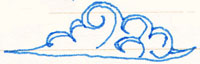
Appearance of the clouds While I was talking to Ama, I saw Cous-Cous and Smitten (our two cats) approach. They were totally loving, and I was holding them and petting them.
I left Ama and walked to the top of the hill that Tjo Street went along. The cats followed me. There was a little dirt & gravel bare spot or parking lot. I decided to turn around and go back to see if the blue/green car was still there before I woke up. I ran swiftly back down Tjo with big steps. As the speed increased, so did this tingling feeling that was in the back & top of my head and my scalp. Soon it felt that a hand was holding my head steady as I bounded down that slope. I looked up at the clouds to match that, too. They were swirly and billowing, and I thought “that’s not normal or likely,” and the alarm came on.
Verification: During the very half hour of that dream, Buttercup wrote me an email! Thus her appearance!
Out of Body or Lucid?: I went for a walk immediately after I woke up to confirm the details. Did this all correspond to the physical world? Mostly no. It turns out the sky was totally clear. While I knew 3rd street was close to my apartment, I couldn’t find Tjo Street, a nursing home, or a blue/green car where I had seen them. This entire experience was like an OBE that I was lightly dreaming onto. It was mostly the physical world, but with projections added to it. It was undeniably one of the most lucid experiences I’ve ever head. It felt as physical and real as waking life.
During the very half hour when I had experienced the flowers coming to me from Buttercup, she’d written me an email. This telepathic contact was given representative physical form in the dream, meaning I was understanding true things but translated to physical forms.
-
Rocket Feet 2024 • earlier
While asleep, I heard one of my recorded messages! “Your body is asleep” was the trigger. I made an effort to exit my body, and in my imagination I floated out of it, through the wall, and down to the street, but I ended up appearing in a different yard. Here, I was in a semitransparent body.
Maybe?: This certainly seems like an OBE, especially the odd detail of appearing in a different yard upon exiting the house. The audio message must have awakened my waking self, which immediately began the OBE attempt. I don’t recall having any bright or vivid consciousness during this. However, this was remembered after a longer period of dreaming “The Treehouse” dream.
-
The Treehouse OBE 2024 • 5:30 AM
My recorded “your body is sleeping” message triggered this.
I found myself at my computer downstairs — a habitual place to be. I’ve been there before when I heard the message. I got up and started walking around. I walked into the living room. It was different, very empty. Did I want to see it? I was hesitant. I was living alone here. There was a big TV where there is one now, and another to the right. There was no couch. It was lit with morning light, though it’s still dark out physically. I walked through where the couch was in waking life, wondering if I’d feel any resistance, but there was none. More confident, I continued. It gets hazy. In the dining room (?) there was a table with some boxes. I decided to experiment. I hit a gray box with my hand and it made a little sound, then it tumbled to the floor. It seemed to forget to make a sound when it hit the floor, though.
And then one of the corners I turned connected to the Treehouse. I hesitated a moment, thinking it was in construction, but then with giddy excitement I decided to have a look around anyways. I was OB — it was fine. This time there was a spiral ramp leading up to the first floor. . . . [I explore the Treehouse]
More and more workers were arriving, and I greeted them. The morning light was increasing towards daylight.
Near Realm Exploration: The recorded message awakens me in my astral body at my computer downstairs, where I spend most of my waking time. I explore a partially empty version of my house. Eventually I turn a corner to see the Treehouse that was created in yesterday’s dream, but it’s entirely different inside, and its in my current back yard rather than Blaine House’s back yard.
I would think the treehouse to be more astral, but the dim early morning light in the dream state grows brighter as physical morning dawns.
-
Gwen’s Birthday 2024 • 7:15 AM (1:45 later)
Someone announced “Now all the fairies who are ready to fly, come to the center!” I thought, “I’m a fairy!” and I joined them. They were all happy-looking women. I noticed that many had these pinwheel-like wings on their backs. I stood in the midst of them and the announcer said, “Now start your wings!” I knew I didn’t have wings like that, but I started lifting up off the ground, accompanied by a vibrating sound. I knew this was related to astral body separation, and I began to fly around the mall.
Vibratory Take-Off: Since I knew what the vibration sound was, I didn’t rationalize it.
Etheric-to-Astral Body Separation
Notice this dual-sensation feeling when changing bodies. The in/out, larger/smaller, rising/falling sensation we get as we shift bodies.
The Vibration
Experiences of the vibrational state are rationalized while dreaming, but when lucid we may recognize that it’s a sign of astral body separation.
The Reincarnating Self
-
Kindred 2025 • 5:15 AM
[A woman at a repair shop reluctantly takes me to her home]
I meet her husband, and he seems nice. She shows me around. We sit down for dinner. . . . The woman says a Christian prayer before eating. When she’s done, I say a mocking prayer. There is shock around the table. I feel blazing energy from within. I calmly explain the truth of what I know in regards to what she said in the prayer. On one hand this seems so rude, me challenging their conceptions of God. But I continue, and though they are shocked, they listen. I speak in their terms, using the term “God”. I am walking around the house with her now, listening, correcting her misconceptions. She listens, responds, in a strange state like in shock. I don’t know if she’s letting it in, hearing me, but this goes on for a little while. What’s significant about this is that I’m talking about my beliefs, which I keep entirely to myself in waking life. It was like breaking through a wall.
The man walks out in this amazing costume that reminds me of an aura. It’s bluish overall, with a slightly inhuman face with large dark eyes. The entire costume is changing shape and shades. It’s as if it’s made entirely of 2-3 inch long filaments of mostly blue light standing out from him, blowing in its own internal wind. The filaments are tightly packed, almost like fur, but flowing. The character is the Sandman, and it is the most impressive costume I’ve ever seen. He tells me how they’ve tried to make all these inventions work over the years but none has taken off. I say THIS WILL. I ask if the ideas were all costumes, and they say, no, it was all kinds of things. I say I have an affinity with the Sandman, and ask if I can borrow it.
At this point, something changes… inner dimensions of creativity open up, spill out into the house. We cross over into a broad cave-like chamber that wasn’t there before. It’s much larger than the house, more colorful, more wild, with jungle, river, beach. There is a tree cluster in the water, broken off 15 feet up. The woman can’t get up very far, but I climb to the top, my inner power surging, and around the stump opens a great turning wheel of light, about 30 feet across, a wheel of life, of all lives, and she and her husband and I rise up above it and dive in, a beautiful soul immersion into other lives, other times, other places, and we come out, up above it, and dive in again, collecting more colors, more lives, more interests, and talents. We’re twining, spinning together, out again, and back in, living through hundreds of lives, our edges blurring, our boundaries expanding, filling us, expanding us, merging us, around and around. The wheel has a spiral of concentric rings, dozens deep, with a black line separating each life. The prominent colors are white and gold but with others speckled in among the many lives. After some time, we emerge back into the chamber, and the house. And now we are glowing with love, inextricably bound together through so much experience (or have we just remembered?), creativity bursting out of us all around the house. They are my most kindred friends, lovers, dearest companions. There is nothing but trust between us. We have lived eons and come out blazing with life. This is my new home. I walk around the house, and there is artwork everywhere, creativity.
We’re watching a video on a bed. I’m becoming more part of the family. There are two babies there watching from the edge of the bed. One tips backwards and I catch it as it falls, return it to the bed.
The babies are children now. We’re sitting in the living room. A lion walks across the floor and I pet it. It’s a riot of creativity, bursting through everywhere. We play and create. My heart is aglow.
There are great lego sculptures, moving lego-built toys. The man is a tinkerer, builder. I am so impressed. The woman is wearing the most beautiful, creative costumes. I’m in love. . . . It was all so beautiful, so saturated with love and creativity and connections. So utterly fulfilling.
The wheel of life was like the vortex through which I entered the physical cycle of lives, and out of it all I value the color and creativity, the playfulness, and above all the personal bonding and the love. We are kindred spirits, peeking out into the physical.
My Reincarnating Self: Somehow facing my fear of expressing my spiritual beliefs opened up something amazing. Upon reaching the top of the tall tree stump, I open up my reincarnating self, and we all go diving into life after life. It’s an ecstatic experience, growing in all the ways I value, deeply connecting with people, sharing the experiences, the colors, the beauty, the intimacy, the creativity. I’ll never forget it.
And then a family begins to grow as I skip across time with them. This is the feeling of home.
The Near Realm
The Near Realm
Many times throughout the night, our focus shifts to the primary astral body within the near realm. The astral body may be within the physical body, just outside of it, or freely moving about. Experiences in or near the body include near-realm conversations, in which we converse telepathically with people near us in the physical world. At these times, we hear clear voices but the people aren’t visualized.
When the astral body is separated from the physical, we socialize with other dreamers in the near realm. It’s the state of hanging out with other dreamers in a room, going in and out of dreams, communicating, playing games, telling stories. The stories and games are considered “dreams” (See Social Dreaming).
This is also the state where we end up in a false awakening, and write down or tell others about the dream we just had (see False Awakenings and The Near-Realm).
The near realm is, I believe, the home focus of the MetaDreamer, which is a focus encompassing dreams and waking life. This focus is aware of the time, day (if significant), body’s position, and sensory impressions from the physical world. It’s also aware of dreams from a higher perspective, orchestrating plans through the night, allowing the mind to transition between focuses.
This may be part of the NREM stages 2-3, which is far less visual and physically-oriented dream state. Sometimes thinking or dreaming is reported in this state. The other day I was snoozing, in NREM, and I was, in fact, just thinking.
See The Stages of Sleep.
The Star Field / The Sphere
This is an awareness of the mind as a spherical field of star-like points of light that surrounds our central point of consciousness. Each star is a miniature scene representing a place or person we know — Besant and Leadbeater’s “mental image”. Our focus on a particular scene expands it out around us as a dream or rote.

Each star is as bright as the attention we’ve poured into it in the past, each very slowly fading, but calling out for more attention.
See The Mental Image and The Influence From and Growth of Thoughts, and Attention Increases Size above.
This is equivalent to the sphere described in The Sphere and Beam Model.
-
The Star Field
I have a vague recollection of returning to an index — a star field from which I chose my dreams.
The Star Field Index: This is interesting. The fact that I call it a star field fits perfectly with the idea of all these points of light in my brain being tiny rotes, focuses of context that I can expand into dreams.
-
Pulled by Desire 1996 • age 22
I have been watching closely, yet it is fleeting still. I have no memory of dreams, but I remember thinking “yes, I see it working”. At times there is a desire, then everything turns to dots and I feel pulled somewhere where my desire is easier to attain.
Pulled by Desire: This may be related to the star field. It looks like I’m exploring how desire pulls me to different locations.
-
Guided in Dreams 1996 • 5:05 AM • age 22
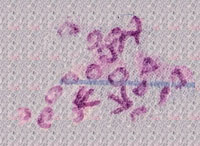
It expands outward Straightforward, easy-to-understand dreams tonight. I’ve been following desires, floating around through downtown San Francisco. I really am traveling around. I love this! Everything is being shown and explained to me. . . . Motivations move us forward. Belief in a goal increases our motivation. Focusing on a destination creates movement towards it. . . . A little later: I’m keeping consciousness in sight from my dreaming. It follows thoughts. When you think, it swirls and turns and expands out, emitting more of itself.
The Star Field: Motivations and desires pull us into scenes. The star field contains all the options. We expand a star, a scene, a rote that we’re drawn towards.
-
The Tower on Arcology Hill 1996 • 3:33AM • age 22
Crazy dreams woke me up. I just caught an early-night dream place that eluded me forever. It was a tall rounded hill with something like a tower arcology on top. There are towering heights and steep angles and hugeness. It’s a long climb up, like our Yosemite hike. There was a huge tree on the side of the hill. I got vertigo while climbing on it. After the tree is a lake. I’m frequently about three quarters of the way up the hill. There’s a stream and lush vegetation. There are houses and buildings all over the hillsides, separated by lots of fences and property lines. Each property is a different section, and I travel from one to the next. The smooth caves where I visit Kayla are here, on this hill.There are huge buildings and steel structures. I remember being here so many times!
This is great, with the trees and lights peeking out. 
This shows the many property lines better. Arcology Hill — The Sphere?: Here I discover that every night in the early hours of deep sleep, I go to Arcology Hill. The hill is divided into small properties, each a potential adventure zone, though the overall goal is to get to the top.
Could Arcology Hill be the sphere of my mind seen from outside? In the sphere, every direction is a different topic of focus, a different star in the star field. The way the hill is divided into countless small properties might be a physical correlate to my mind sphere. See Our Focus Within the Sphere.

The round-topped hill could be a physicalization of the mind sphere within my head.
A Dream Staging Area
I have experienced on many occasions what appears to be a dream staging area. I feel like I’m in an undefined cave-like space in a hazy darkness. This cave exits to a fully visualized place in the astral, and remains to an extent out of sight while I go about my adventures. I’m more aware of it in the earlier hours of the night.
I’ve also experienced this expansion of space in hypnagogia (see Extending Space), and I once experienced the cave-like shape under hypnosis; the flat black screen of my visual field expanded outwards from me into a open 3D space (still black) in the rough shape of a cave.
It’s in this state that I sometimes feel the shape of the area I’m in but it’s not filled out with physical forms. It’s like the lines and boundaries are made of a mostly-transparent smooth material that’s like concrete or ice. When REM dreams begin, a visual environment can be overlaid on these spaces.
-
The Smooth Caves 1994 • age 20
Context: Kayla and I had broken up for good a few months ago. I was now seeing Sophie.
The night before last, I visited Kayla in this big cave of smooth grey stone, in a large mountain range of such stone. It was night and dark, and lit by torches. At first she walked away, then gave me a little attention. Then she talked with some droid while leaving me sitting in a sunken dais, ignored.
Last night I returned to the same exact place. I was back to visit her again. We actually conversed more this time and I got the impression that things were being sorted through, forgiven, and I vaguely recall a few moments of acceptance and love. At other times, she became Sophie. This wasn’t even surprising. I went further into the caves this time and remember a big automated machinery complex.
Barely Imagined: This is an attempt at communication without bothering with all the scenery. These smooth cave systems seem to exist outside of any specific location, outside of context. It’s more of a formless place than I’m used to in dreams.
Further in the caves I wander into the astral.
-
The Whirlpool 1997 • age 23
I got a strong sense that I was in a class. It was more a sort of knowing, without being physically vivid and real. I felt my body was nearby but in a whole different space. The class was a well-oiled machine, and from this I sprang into a dream.
Deep Sleep: It seems like I go from a state of deeper sleep to one at a more physical and emotional level.
-
Memory Rooms and Exploding Dreamstuff 1997 • 6 AM • age 23
I was at Blaine House in the silver light of dawn. The light felt like a presence — a BIG one.
Around every corner and in every room of the house there was a crazy different scene or dream going on, but I stayed in the Blaine House context.
Dream Hub: In this case Blaine House appears to be a dream hub of sorts.
-
The Elevator 2000 • age 25
This dream could have been the inspiration for Dr. Who.
I’m in the “elevator”. “Phone booth” would also describe it well, as that was about the size of it. It was made of unfinished wood, and had an apparatus like a toilet but smaller and flatter. It let light in from a slot near the top of the door. I had with me during all the following travels a small, friendly, invisible companion who was like a dwarf or cat in size. We were very close.
One of the earlier stops was arriving (via the “elevator”) in New York at night to visit Brendan and Melody and the rest again. I remember commenting, “Wow, here we are.. again!”
Later there was this scene: I was a computer programmer in this strange world. I went to Subway to work on a job for them. I needed the manager for something but couldn’t get ahold of him, so I left a phone message. Then I came back in 3 days and the manager (an old friend) wondered why the job wasn’t done. I explained. Then I’m in the elevator.
So before the elevator had just moved smoothly. This time it was dropping rapidly. Then there was a slight shudder, then nothing but slow rotation as though it had dropped completely out of the shaft and was free-falling. I was on alert. I stared into invisible cat eyes now, as on-alert as I was (I suspected later on that my dwarfish friend was responsible for the wild ride).
The elevator stopped and the quality of light was different — it was daytime with odd tints and overtones of feeling. I opened the door to a blue sky with puffy clouds in a Renaissance town of fantastic wealth and variety. Things were very different than any history of ours. Information came naturally to me, and I knew that there were very powerful groups of people. One group stuck to lavish costumes of all black. There was quite an energy in the air and a lot of people. We climbed a hill to what looked like a resting area with picnic tables all about us. My invisible guide was with me the whole time. I was going to ask this woman a question. I thought she had a lot to tell me but she would likely first ask what faction I was part of . . . and then suddenly I was back in the elevator.
This time the elevator turned wildly head over heels as it descended. As each side became the floor, it changed hue and a treasure chest appeared, each identical. I chose one and then turned around. The door was open and the elevator was stopping. I saw the change — the Renaissance scene was still there but flat-looking. It faded out to a mottled gray-brown before opening into a new scene — a dark brown sky with smoky clouds. I see a boy sitting on a car in a wheat field. I become him. I have a sack, and open it. Inside is a gun and some ammo. I see an asian man about 50 feet away, and know that he is my father. He’s looking for me. He soon sees me and is shocked. I look around me. There is a hole in the car and gasoline all over everything. I realize that the boy (me) intends to kill himself (myself). Then I awaken.
The Elevator Gateway: The door seemed to open to both rotes and locations. It’s apparent by who I was in each. I was myself when visiting Brendan and Melody (location). In the next I was a programmer in a strange world (rote). The Renaissance town could have been either — I received information but was myself. That was the only one where I clearly remember opening the door. The wheat fields was a rote, as I inhabited a boy.
So what was the elevator? A rationalization of the movements of the astral body as it rocked and became partially separated from the physical body? I was pulled from the scenes against their natural rhythm, mid-stride, so it appeared to be an external influence. Was the short dwarf-cat companion pulling the strings?
The Research Station
There is one version of the staging area that appears to be linked to my reincarnating self, where I sometimes interact with other versions of myself. It appears my physical metaphor for this is a space research station and classroom like Starfleet Academy from Star Trek. However, everyone there is big, burly, bearded versions of me. I call this place Space Station Benji. It’s able to connect to any dream experience through a rounded opening, as if the dream experience were taking place in one of Star Trek’s holodecks. This comes rather near the truth of things, in fact.
-
Army of Me 1996 • age 22
We were in something like a space station. . . . And Captain Kirk/Picard was there! He was trying not to act like he was in a movie, but being funny about it. The space station was half in space, half where SSU’s main education building is. There was some kind of medieval war. We were attacked and beaten but not beaten completely. . . . Then we had people come to aid us — the black-bearded folk, Benji and his kind, peaceful people. I realized I didn’t tell Benji my name (it was Benji, of course), and went back and did so. It was a whole army of myself as different people lined up along the hill in the back yard of Blaine House. We marched past the castle of evil — Blaine House! I was declared captain of the left wing, but I wasn’t ready. I didn’t have my bow, but a friend let me borrow his. The enemies came from Blaine House.
Space Station Benji: From looking at different dreams, Space Station Benji appears to be the home of my reincarnating self — thus all the other Benjis there. It has a kind of unseen presence in my dreams, hidden in a pocket just behind the physical scenes, and able to connect to any of them.
From there, a self with a perspective that includes my dream self and waking self orchestrates things. This is my higher self, my subconscious. This self that perceives and navigates across focuses, while the dream self is similar to the waking self in its specialization at a specific frequency of consciousness.
-
The Pyramids Mystery 1995 • age 21
I played some key part in the discovery of a piece of a machine which ended up fitting together with other pieces that had been found in the pyramids. They formed a kind of tape-player which annoyingly played this weird radio song. A kid in the next room started singing along.
After waking up briefly, things were a little different. I was a youth in Starfleet Academy getting beat up by the older kids who took the pyramid tape recorder. My older self ran by and beat them up, but that wasn’t too effective.
References: Starfleet Academy is where recruits are trained in Star Trek
Into the Staging Area: When I returned to sleep, I returned instead to the staging area — Space Station Benji. The plot is connected but different, instead taking the form of the space station. Another version of me comes to my rescue.
-
The Great Journey 1997 • age 22
I’m in the land of the Dark Tower. There’s this big classroom full of students. Three or four of us are selected from the group to go on this great journey. . . . There was all this preparation before we left. I was to get into a plane and traverse the world, stopping in key points along the way. There were a few optional stops. This was a great honor, a great beginning. . . . I’m traveling all light and hi-tech. I think there’s a space station involved in this and many dreams from which these adventures are orchestrated.
Space Station: This may be a place where dreams are orchestrated, a classroom or laboratory from which things are researched.
The Elevator to the Astral
The elevator to the near realm most often takes the form of a tall round shaft with a rounded cave at the top. It goes from the near realm to a real college and town in the astral. Exploring and talking with people here can lead to various dreams.

reminds me of tunneling through astral frequencies in
the dream staging area.
-
Building the Atlanta Tower 2000
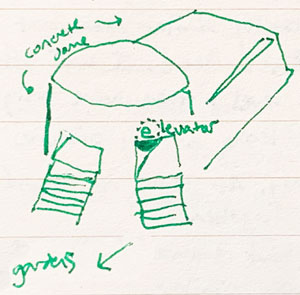
The elevator I’m in a concrete, domed school-like building. I’ve been here before many, many times. There are two elevators. I know a secret, though. . . . I take the elevator to floor 12, make some sideways adjustment, and then go all the way to the top. Where do I end up? The Atlanta Tower. . . . Everything has a sensation of height, airiness, a feeling of uplinks/elevators to higher places.
The Dream Station: I refer to this concrete, domed building elsewhere as the Dream Station. It’s a base station for an elevator to locations in the higher astral (or at least the astral tower on my crown chakra).
-
Escaping from Dogs 2001 • 4 AM
I ran into this large open cave with river water pooling in it. While it was a perfectly real cave, looking back I know with certainty that it was the Dream Station. This has been my new recurring dream place for quite some time, though it is more of a feeling and a shape than one specific place. To hide from the dogs, I considered jumping down into the water to grab two giant turtles and swim with them, or I could go into this black area. But I realized doing this would significantly “change things”. The Dream Station connects to the underworld (or the physical world), I believe. There is a straight vertical shaft between it and a more dark and solid place, and it may be related to my 4 AM underworld journeys. The time was almost exactly 4 AM when I awoke. . . . The Dream Station is the concrete-like building in September 29th’s “Building The Atlanta Tower” dream. It’s related to the Smooth Caves, too.
The Dream Station: The elevator from the Dream Station ends at a domed auditorium in the college around The Atlanta Tower. It’s interesting that it’s an auditorium — a place where different scenes are shown and acted out — where one can exit into dreams.
-
Storage at the Great Hills 2004
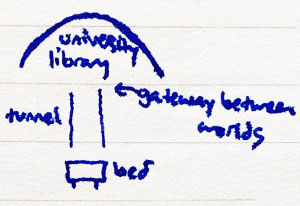
The university and cave system directly above my bed These hills in dreams are very meaningful.. a dimensional barrier, perhaps, like the university and cave system directly above me when sleeping.
Above My Bed: The university and cave system I’m referring to is the Atlanta Tower. This tunnel upwards is a frequency/location transition, much like the tunnel at death.
-
Waiting for Brendan 2004 • 1:30AM
Awake: After writing with Brendan and sharing music, I go to sleep at midnight. I dream the following over the next hour:
In my dreams I go to visit him and make brief contact several times. We prepare to go out adventuring but he’s busy in his semi-dark apartment (which isn’t accurate to waking life). I make contact, then drop, then make contact, then drop. I get bored and wait in my universal dream space, the school between the worlds (the Atlanta Tower). It’s dark there. The building at the top of the elevator is like a hotel. It’s several stories tall and domed at the top, with a theater. It’s directly above the physical world. . . . [I wander about there, looking in stores]
I’m waiting for Brendan to go to sleep so we can visit in dreams.
Waiting in the Staging Area: I consider this “between the worlds”. It’s a launching point for dreams and travels. It has a feel to it, and I feel it beyond the forms. It’s connected to the Atlanta Tower in this case.
I don’t recall taking the elevator here, as I do sometimes. I just go directly there.
Returning to the Near Realm
-
World Religious Conference 1997 • age 22
I saw someone running towards the cathedral opening and I could read their thoughts: “1,000 years of blood and fire for the. . . . Christians? Death and fury to the Quakers!” I ran downstairs to warn them but got lost. Buttercup was down there! Then I woke up.
A Warning: I went downstairs to warn the people in the dream and instead ran into Buttercup, meaning I might have mistakenly returned to the near realm.
-
A Hitchhiker from the Hospital 2010 • 1:30 AM
I found Buttercup and then ran to the elevator to take it down. Down where? Back to our bedroom where we were sleeping, of course! . . . I end up asleep in my bed, hallucinating wildly.
The Elevator: Very interesting! I’ve often been aware of taking an elevator or traveling a shaft up from my bedroom to various astral locations, most notably the auditorium at the Atlanta Tower. Here, I take an elevator down to escape from this scary hospital into my bedroom.
-
Finding Gwen 2025
There were vendors of food and various things. It had sort of an indoor carnival vibe. . . . Wandering on, I eventually started wondering where Gwen was. I’m not sure on retrospect she’d ever been there, but I was sure I’d lost her in the dream. I became quite panicked, calling her name loudly as I went around. But then I heard her voice calmly say “Papa” from outside the dream. I heard it from a different space and moved my focus there. It was a semi-dark, empty, spherical-seeming space, with nothing to be seen, and no sign of the dream I was just in. It was a stepping-state to the waking state, and from there I left the unpleasant dream behind.
Making Contact: When Gwen felt my fear about not finding her and spoke my name from outside the dream, it led me out of the dream into a space closer to her — probably the near realm.
The Corridor to the Near Realm
Of course all it takes to return to the near realm is to focus there. But we’re often in a dream in which our waking self has engaged to some degree and everything has taken physical form. When in this state, we return to the near realm in a physical way, by running through an empty space or a darkened, undefined corridor back to our bedroom and sleeping body.
-
The Animal Shelter Gateway 1998 • age 24
Awake: After watching a short news report on a hurricane animal shelter, I slept. In the early morning after awakening with Buttercup, I slid back into sleep:
My visual field was white. I emerged from the white into the animal shelter. I was in a hall with cages. I comforted “our” cats (which weren’t ours), and generally intended peace to the skittish animals. I was distracted by a blue snake in a small cage with an unsecured lid. I tried to block the exits around the lid with boxes but it got out. I used a snake-handling stick (also from recent TV) to nab it but once I did, I freaked out and let it go. I expected to get bit and of course I was then bit. I ran through the place I came from INTO THE BEDROOM and excitedly tried to get Buttercup’s attention to tell her I was bit. She was zoning out and not responding (she was actually awake at this time, standing by the mirror). I had to ring the phone and when she picked it up I knocked it out of her hand and said into her ear “Buttercup! I just got bit by a poisonous snake!” and she calmly said “No you didn’t. You’ll be fine.” Then I calmed down and woke up.
Home Gateway: Is this what the stable gateway back to your body looks like? A purely white space? Or was it white because of the morning light and it’s just a blank space? It’s interesting that I could just run back through it from the scene I was in.
-
Nightly Dream Dates 1998 • age 23
Spinning within me I felt strong emotion, accompanied by this cool spinning sensation within me, like strands of golden light. The spinning made me feel excited and unstable. I knew I had to report this and ran back to . . . somewhere and woke up.
Heading Back: I’m likely in my dream self or MetaDreamer focus, because my reaction to these sensations is to quickly return to my body and wake up.
-
Field of Beasts 2000 • age 25
I’m out exploring in these fields that are divided up into squares like sod fields. They have a light dusting of white snow. Suddenly this bear runs up to me and bear-hugs me from one side and this raccoon hugs me from the other. It’s a very warm sensation. Then this host of creatures that I was previously scared of comes out of the woods and runs towards me. I run back through the fields I came from and into this building. They chase me, and are joined by a big fleshy ogre. I’m with Buttercup now and we flee down hallways.
Back Home: Scared of these adorable forest creatures, I run back “through the fields where I came from and into this building.” Here I run into Buttercup, who joins the escape. I’ve just returned from the dream to the bedroom!
-
Stealing the Password 2025 • 3:45 AM
The first thing I remember is a sort of stand-off with my boss. . . . He’s trying to subtly antagonize me into revealing if my server is at home or elsewhere by suggesting that I “go home, to the garage” to turn off the accounts, as if they’re hosted from a computer at my house. . . . I arrive home in our present living room and close all the blinds. . . . It’s mostly dark (as it actually is) but there is some dim light. My goal is to go in, change the password, and secure the computer.
Back to the Near Realm: From the work dream I feel I need to return home, and end up downstairs in the near realm. It’s interesting that I can leave the dream purposely to return home in the near realm (where I likely was when I started this dream). But I bring the plot along with me this time.
Watching Someone Dream
-
Half a Conversation 2024 • 5:30 AM
I was in bed with the lights on in my childhood room in Blaine House. It was dark outside, and Buttercup was there with me. She was having a conversation with someone, talking about me in glowing terms, about how I made unique clothing sometimes, how sometimes it didn’t work out but how it was really interesting at other times. (This does not reflect anything in waking life.) I only heard her half of the conversation, with pauses between where someone else was talking. Her eyes were closed, and I considered her “sleeping”, even though she was moving around the bedroom. She was sitting on the floor at the foot of the bed, then crawled into bed, still talking and pausing, and at one point put her head up to the cat, who began licking her mouth. In the meantime, I was just thinking to myself, about her conversation and about other things. It was nice to overhear her talking about me to someone else with admiration.
Near Realm Dreaming: This is significant. We’re both physically in bed at Hibernia House. We’re both also in bed in the near realm. I’m lightly dreaming that it’s my bedroom in Blaine House. But I’m still aware of Buttercup, who appears in that context. She’s fully engaged in her own dream where she’s talking to someone about me, but her astral body is acting it out in the near realm. She’s essentially astrally sleep-walking.
Her astral body behavior exactly reflects the behavior of teens hanging out in their room while talking on the phone.
Dreaming from the Near Realm
Many of our dreams begin from the near realm, in which we essentially go into a fantasy based on something we experienced there. They’re like daydreams that become real. At other times, we just settle down to rest in the near realm and have unrelated dreams.
-
The Slumber Party and Scary Man Prank 1999 • age 24
I decided to play around with them and practice making some thought forms. It was still dark and I looked out a window. I pointed and said to Buttercup, “Look at that. . . . MAN!” Surely enough a bearded spooky face appeared out of the shadows in the window, from a black silhouette to a full face, giving the appearance of approaching. Buttercup got scared and fell to the floor in a fetal position. She seemed to be locked in her own world, shaking, and these grapefruit-sized semi-transparent black orbs were skittering all over her body. I told her to stop creating thought forms like that, that they weren’t real.
Later, awake: Wow!! Buttercup dreamed of scary men out on the porch! After she fell into the fetal position with the black orbs all over her in my dream, she dreamed she was unable to move with cockroaches running all over her body. She dreamed all night of the men on the porch trying to break in and get her. That’s the last I saw of her all night, too!
Into a Fear Dream: My prank has the unintentional effect of scaring Buttercup into a subjective fear dream about scary men on the porch. The astral response of her falling to the floor in fetal position and being unable to move is also brought into her dream, with the skittering black fear orbs being rationalized into cockroaches. She remains in this dream a long time. From the social dreaming scene, she is present in her astral body but unaware of us, emotionally focused within the dream.
-
The Blue Crab 2025
I go out to a boat floating on the ocean, not far from the shore. There are 6-7 people holding onto the back of the boat, stretched out in the water. Buttercup is at the far end. I step onto the back of the boat, then get down in the water next to her. . . . After a few minutes, Buttercup swims off. I follow after her, but get distracted looking at shells. . . . I’m fascinated by a blue crab there. It crawls off.
I return to our house and try to tell Buttercup what I found, but she’s preoccupied. . . . I dump out my pockets. . . . I’m briefly interrupted in my sleep by Buttercup’s scream downstairs and a thudding sound as she attempts to crush a roach running around. Knowing she can handle it, I return to the dream. . . . As I dump out my pockets, suddenly there is the blue crab, full size. It scurries around, and Buttercup wakes up from her reverie. She grabs it with some tongs, but in so doing breaks through the shell. . . . The crab guts now have a long train of baby crabs starting to move within. . . . I get them and the eggs into the bucket, but the bucket is hardly big enough, and they start to crawl out and escape. Now there are baby crabs running all over the house, and I’m trying to step on them but keep missing.
Into a Dream: I go to the near realm to show Buttercup the shells I found. Her scream interrupts my dream, and in a moment I figure out what’s going on and return to the dream. The blue crab from earlier becomes the closest analog for the roach, and I spiral off into a dream about crab guts and baby crabs.
-
Stealing the Password 2025 • 3:45 AM
I arrive home in our present living room and close all the blinds — they are slat blinds like we used to have in the house we lived in then, not the folding blinds we currently have. We didn’t live in Hibernia house 25 years ago, but returning “home” meant coming back to the near realm where I’m sleeping. It’s mostly dark (as it actually is) but there is some dim light. My goal is to go in, change the password, and secure the computer. But I fall into a short dream. . . . Waking up, I find most of the blinds are OPEN, and I wonder if my boss’s guys are outside, somehow messing with the blinds to observe me. I close all the blinds again, one by one. I fall into another dream. . . . [I dream about Christmas]
Just then I hear three loud BANGs. I’m suddenly back in my current darkish living room where I was dreaming, and the three front-facing BLINDS ARE UP. Someone had just opened them from outside on the front porch. Someone was out there NOW. I was certain that my boss from Definition 6 has sent someone. I’m terrified. Without thinking, I open the front door and SHOUT AS LOUD AS I CAN. As I’m shouting, a person I don’t know moves into sight right in front of me. I see his face clearly but don’t recognize him.
I’m awoken by Buttercup, as I actually shouted in my sleep.
Creepy Blinds: What is this creepy business with the blinds? I felt my privacy was being invaded! According to various accounts, banging sounds are a common sound in the near realm.
Partially Dreaming
Rather than going entirely into a subjective dream, we can partially dream on top of the current scene. The other characters are real people, making their own choices, but interpreted through the lens of the partial dream.
Imagine kids playing pretend, or lovers role-playing.
-
The Slumber Party and Scary Man Prank 1999 • age 24
Context: Friends is a TV show.
It was night. There was a group of us in the front room of a house. . . . I was having a love affair with Rachel from Friends, who I knew was Buttercup. I was pleased that there weren’t actually any relationship problems like on the show. It was altruistic, true, cuddly, and warm.
There was an experience I called “receiving a fax”. . . . It was usually a sign that someone was in great emotion, calling to me. . . . The second time it happened I caught myself thinking it was from “Rachel”, but then saw that I had placed that hope over the actual message.
Let’s Pretend: Rachel was the love interest in the TV show Friends. We were really into the show at this time. So in the dream state, I was hanging out with Buttercup and partially dreaming that she was Rachel, though I knew it was Buttercup the whole time. I could compare our relationship to the one on the show, while still enjoying the fantasy.
Near Realm Differences
-
The Treehouse OBE 2024 • 5:30 AM
My recorded “your body is sleeping” message triggered this.
I found myself at my computer downstairs — a habitual place to be. I’ve been there before when I heard the message. I got up and started walking around. I walked into the living room. It was different, very empty. Did I want to see it? I was hesitant. I was living alone here. There was a big TV where there is one now, and another to the right. There was no couch. It was lit with morning light, though it’s still dark out physically. I walked through where the couch was in waking life, wondering if I’d feel any resistance, but there was none. More confident, I continued. It gets hazy. In the dining room (?) there was a table with some boxes. I decided to experiment. I hit a gray box with my hand and it made a little sound, then it tumbled to the floor. It seemed to forget to make a sound when it hit the floor, though.
Missing Furniture: I was hesitant to explore, noting that “I was living alone here”. I wonder what that meant. Was this my own version of the Hibernia House near realm? Why wasn’t my family here? I did see them once I went to the Treehouse, likely at a more astral frequency.
The box fails to make a sound upon hitting the floor. It’s all projections and expectations, though. Perhaps I was distracted at that moment.
Near Realm Hallucinations
-
A Hitchhiker from the Hospital 2010 • 1:30 AM
I found Buttercup and then ran to the elevator to take it down. Down where? Back to our bedroom where we were sleeping, of course!
There were a couple technicians in the elevator. The doors were closing and I had this sudden fear — what if someone suddenly burst in?! And of course, somebody does! It’s this really big version of Doctor Dorian from Scrubs, the most non-threatening doctor there is. But he’s about 7 feet tall, has wild salt and pepper hair, and is maniacal and scary. He rushes at me and we fight as the elevator goes down to the bottom.
I end up asleep in my bed, hallucinating wildly. I’m asleep, and it’s in a bedroom that I feel is my own, but it’s not. It’s smaller, has a hallway in a different place, no windows where we have them, and no bathroom. It’s a teenager’s bedroom, but I accept it as ours, and think I’m lying in my own bed. Dr. Dorian is now this spirit in the room. I know I’m dreaming now, that I’m hallucinating. I’m feeling tingles move across part of my face. I’m hearing sounds I know aren’t there. But I’m also hearing sounds that I know are there, like the tap of Isobel’s foot as she shifts her position — but it’s coming from the wrong place — 180 degrees shifted from where I know she is. I know Buttercup is beside me in bed. In reality my head is propped up 6 inches on a stack of pillows but here I feel like I’m lying flat. On this backdrop, I have endless hallucinations. Dorian keeps spooking me. I imagine getting out of bed to write the dream, and then seeing him jump out from the hallway, and then I hear a real blood-curdling scream. I know it’s a hallucination but I wonder if Buttercup can hear it from her dream, and I try to keep calm. I open my eyes a little (the backdrop is the other bedroom) and see Dorian’s face spiral out for a moment in front of me and think, “Ah, I just saw it in my aura! I’ve read about that”. Then the dog jumps up on the bed, crawls over my feet and settles down. Then she lifts up my feet and starts fluffing them like pillows. I wake up enough to say “Buttercup! Buttercup, Hey! Isobel is lifting up and fluffing my feet!” and then Buttercup says “Yeah, she does that sometimes.” And then it occurred to me that as real as that felt, that must also have been a hallucination. I was stunned at the reality of it all. I could see the teenager’s room around me much of the time here, just sitting there, “sleeping”. It was as dark as night, but I could see dim black and white outlines around everything. I imagined another scenario where I was getting up to write this all down and Dorian jumped out and another wicked scream rang out through the night.
Finally I decided this was worth writing down, and I really opened my eyes. There was barely a transition. Only now did I realize that where I was hadn’t been my actual room.
References: Scrubs is a TV show. Isobel is our dog.
Hallucinations in the Near Realm: This is a fascinating experience. As I return from the dream back to my body, I’m taking aspects of the dream state with me into the near realm.
Dr. Dorian was clearly a nasty thought form I’d created, and it was only jumping out and doing things when I expected it to, which was when I became afraid that it would. I was not expecting the screams, though. I was very aware of my physical body, feeling tingling sensations move over it. Isobel’s actual tik-tak sounds came from the wrong place physically, but Buttercup was still next to me in the right position and the position of the bed against the wall and in relation to the rest of the room was correct. It was kind of like a false near realm since it wasn’t my room at all. It mixed hallucinations with real physical sounds and sensations perfectly in the exact vicinity of my bed. There was no change of consciousness when I finally opened my physical eyes.
-
Semi-Lucid OBE: Webbed Windows 1998 • age 24
I looked out through the set of three windows. The clouds were really interesting (though the sky’s clear in the waking world). I wanted to go outside, but each window I opened revealed a screen covered with spiders and webs. Ugh! I couldn’t go through that.
Lucidity and Projection: The spider webs may have been my interpretation of the screens on the windows, followed by the projection of the spiders. If you’re in the near realm, everything is locked into physical reality, but we add our own projections.
False Awakening Dreams
In a false awakening dream, we dream that we have woken up, and may begin to write down our experiences or begin our day.
Awakening into the Near Realm
We can also awaken from a dream into the near realm near our sleeping body. From this point we may hear telepathic conversations going on around us by others sleeping nearby, or engage in any manner of social dreaming.
-
Telepathic Songs and Conversations 1996 • age 22
Context: I'm sleeping in the same room with Emma and Ruby.
I wasn’t sure if I was truly awake, but I heard Emma and Ruby talking in their sleep. Randomly at first, then kinda together, then Ruby was singing and Emma joined in from time to time. They talked and it was as if I was only hearing half the conversation at times. I was somewhat bothered that it had woke me up and was going to ask them to be quiet, but instead dreamed that I recorded it on my portable tape recorder. I got a good bit, then the tape jammed.
Later, in another dream, I went to unjam it and checked to see if I had actually recorded it and I did, but it sounded a little different. Awake, I realized I didn’t actually record anything.
The Dream Self: I must have been dreaming, and was “awakened” back to the vicinity of my body by the telepathic conversation. At this point I think I’m awake, and so I make the recording and then put it out of my mind.
-
So I Have a Rat 2023
Buttercup, who does not like rats, was dreaming that she was holding a rat in her hand, much in the way one holds a burrito. It was her first memory of the dream, so she doesn’t know how she got it. The rat was alive, but not struggling. She was presented with the conundrum of what to do when you find yourself with a rat in your hand. She was so flummoxed that she “woke up” in our bed. She was still dreaming, however.
She stretched her arm out and grabbed something on the night stand. It was a rat! So once again, she had a rat in her hand.
Wake Up!: The strangeness of the situation caused her to wake up into the near realm.
Making Physical Sounds
-
Half a Conversation 2024 • 5:30 AM
So I left the room into the hallway, with the thought “there will be an intruder in the house.” And I saw him! I let out a long shout, and I did it in such a way as to project it out physically, as it was no ordinary shout. It sounded really weird from the dream side, and I think I must have succeeded in making a sound on the waking side because my attention jumped to my current physical bedroom, and Buttercup turning away from me and rolling over.
Shouting Into the Physical: I intentionally shouted in such a way that I would physically make a sound, and it worked.
-
Stealing the Password 2025 • 3:45 AM
I’m terrified. Without thinking, I open the front door and SHOUT AS LOUD AS I CAN. As I’m shouting, a person I don’t know moves into sight right in front of me. I see his face clearly but don’t recognize him.
I’m awoken by Buttercup, as I actually shouted in my sleep.
Sonic Attack: My goal in shouting is to scare an attacker away. When I do this kind of shouting, it feels weird, like I’m shouting between dimensions, and the result is that I make sound physically. This often results in Buttercup waking me up and the end of the dream, so it does succeed in that way.
I’m usually in the near realm near my bedroom when my shouts actually make sound physically. Perhaps I have to be within cord-activity range, where the signal can travel through the etheric body.
Hearing Your Physical Emotional Reaction
As we’ve seen, preceding our own speech is the thought we are about to speak about. This thought can be heard telepathically by others before we even begin to speak. We ourselves “hear” the physical expression of that thought as words in our head. When we speak, we are simply putting physical expression to that internal voice. The internal voice is the same, whether we give it voice or not.
Emotions work the same way. When we feel something strongly, we internally “hear” the physical expression of it — even as we’re expressing it. In the near realm we hear this expression out loud, and it feels like it’s coming from a different place, one closer to the physical. From this state, that physical sound our body made is very clearly “not us”.
-
A Hitchhiker from the Hospital 2010 • 1:30 AM
I end up asleep in my bed, hallucinating wildly. . . . Dr. Dorian is now this spirit in the room. . . . I imagine getting out of bed to write the dream, and then seeing him jump out from the hallway, and then I hear a real blood-curdling scream. I know it’s a hallucination but I wonder if Buttercup can hear it from her dream, and I try to keep calm. . . . I imagined another scenario where I was getting up to write this all down and Dorian jumped out and another wicked scream rang out through the night.
References: Scrubs is a TV show.
The Screams: These screams came unexpectedly and I heard them coming from outside myself. But I believe they were my “internal voice” expressing my own instantaneous physical reactions to being frightened. When we are frightened by something jumping out, we don’t think about screaming, we just do. We give instant expression to that internal scream. In the near realm, it sounds like it’s coming from a different place, because it is — the “internal voice” of the physical body.
Crying
There’s something about crying in dreams that’s unusual. Crying is a uniquely physical way of expressing sadness. I believe in this state we hear the physical body’s “inner voice” crying. That’s why the sound of it seems to come outside ourselves, from a place closer to the physical body.
-
Weaving Dream and Physical Conversations 1996 • age 22
I was fighting viciously with Wadsworth & Emma (I called them and left messages last night). At one point I was crying loudly and half woke up and thought I might be crying out loud but I wasn’t.
Hearing Yourself Crying: I may have shifted to the MetaDreamer focus, and heard my crying in the near realm state.
-
Crying at a Different Level 1996 • age 22
I’m cleaning, sweeping the floor. While sweeping around my three guitars (my electric, an acoustic, and an acoustic from Buttercup), I accidentally knocked over two of them and the necks broke. I knew they couldn’t be repaired and emotion welled up. I thought “might as well cry” and I did, but I heard it from another level (one closer to waking but still dreaming). This woke my consciousness. I realized I was dreaming.
Voices: So either I was physically crying and heard it from the dream or, more likely, heard my inner voice crying in the near realm, where I heard it as though it was coming from another level. While sadness is emotional, the act of crying is a physical thing, so crying happens at a level closer to the physical.
-
Tapestry of Tears 1997 • age 23
I notice my tapestry is hung sloppily behind the couch and not behind the entertainment center where I left it. I am overcome with emotion. I get up, tear [the tapestry] down, and run to the bedroom, crying. I put my head in the pillows, curl up, and just cry. My crying wakes me up. Was I really crying? It seemed to come from reality on just the other side.
Really Crying?: My crying seems to be coming from a different place, on the other side of a barrier.
I’m reacting like a young child to this broken expectation. I wonder if young children automatically allow their bodies to express emotions in this way, by going with the body’s suggested natural response.
Social Dreaming
Social Dreaming
Our nonphysical experiences can be very social, taking place in the more fluid but objective nonphysical reality of the near realm and the astral. These nonphysical social gatherings are a relatively unknown but important part of our nightly experiences — one from which we communicate and dream.
These experiences are the realm of the dream self. They’re more real and true experiences, often lacking the physical rationalization that is a part of many dreams. It corresponds to state 6) Astral Experiences (True Dreaming).
From this focus we can “go to sleep” to dream, and “wake up” from dreams back into the astral or near realm. Some dreams are rotes communicated from others.
-
The Slumber Party and Scary Man Prank 1999 • age 24
Throughout the night people went in and out of activity, reflecting their sleep cycles — napping here, more awake there, forming different subgroups to hang out in the slumber-party atmosphere of the house. Throughout the night we traveled to different dimensions, experiencing our own adventures. Some of us were more limited in what they thought they could do and others not. We often met back up around a dinner table or on the blankets and pillows on the floor. . . . I was having a love affair with Rachel from Friends, who I knew was Buttercup. I was pleased that there weren’t actually any relationship problems like on the show. It was altruistic, true, cuddly, and warm.
At first there was fear in the room. Only Buttercup and I had awakened. . . . It was still dark and I looked out a window. I pointed and said to Buttercup, “Look at that. . . . MAN!” Surely enough a bearded spooky face appeared out of the shadows in the window, from a black silhouette to a full face, giving the appearance of approaching. Buttercup got scared and fell to the floor in a fetal position. She seemed to be locked in her own world, shaking, and these grapefruit-sized semi-transparent black orbs were skittering all over her body. . . . Later, awake: Wow!! Buttercup dreamed of scary men out on the porch! After she fell into the fetal position with the black orbs all over her in my dream, she dreamed she was unable to move with cockroaches running all over her body.
Objective and Subjective: Within our gathering of dreamers, we each shift throughout the night between socializing and engaging in our own private or shared dreams. My partially subjective dream of a love affair with Rachel from Friends painted that idea over the objective reality of Buttercup being there.
The creation of the thought form man outside had a huge effect on Buttercup’s dream, causing long-term subjective fear dreams. The objective nature of her panic reaction (collapsing into fetal position with black fear orbs scurrying over her) caused her to feel unable to move while cockroaches were running all over her in her subjective dream.
This shows that social dreaming takes place in an objective reality painted over to varying degrees by subjective colorings. I didn’t just dream of Buttercup responding to the scary man, she really did react that way, and remembered the resulting dreams when she woke up.
Socializing in the Near Realm
Imagine you’re hanging out in the living room with a bunch of friends or family. Some of you are conversing, some are playing games. Others are deeply involved in their phones. We do the same thing when asleep. We gather together socially in our astral bodies. Some interact telepathically with each other while others go into dreams (their games or phones). They’re still nearby and somewhat easy to communicate with, but only partially aware of the room since they’re somewhat closed, engaged in their dreams. Your conversations, emotions, and activities in the living room might reach them in their dreams.
This takes place in the astral or near realm, sometimes in a less visually defined space, and sometimes in a fully immersive shared dream space (which may either be the astral realm or full scenery projected over the near realm).
Hanging Out with Friends
In my dream self focus, I identify some experiences as “dreaming” and some as “not dreaming”. Socializing in the near realm is considered “not dreaming”. It feels more real, with less involvement from the waking self. It lacks rationalizations. Social dreaming is a state from which we can go into a dream, and to which we return when we wake up from that dream.
The following experiences illustrate this socializing in great detail.
-
Lucid Dreaming and Sex 1994 • age 19mature content
I’m driving through the country with Alison and a few others. We’re going to a movie/sleepover party at Rand’s or Bard’s. Eventually we end up in this little town, which is all part of the same building. . . . I finally start hanging out with Alison, Jen, Rand, and the rest. We talk about sex. Alison says she’d like to know what it’s like, asks me to show her. I think “Ah, no. I’m going to wait”. Then I think, “But wait, this is only a dream, so I can do it!” So I agree and we start at it, jumping right in, and everyone’s watching. Finally we decide to get some privacy, and go outside for a walk. I say, a little apprehensive, “This . . . is a dream isn’t it?” She shrugs and smiles. I say, “Then how can I do this?” I hold up my hands and part them and at the same time the leaves in a willow branch ahead move aside for me. She nods and smiles, and I think “Hey! I’m lucid dreaming!”
We get out into the main road and I tilt gravity so we can both ski down the gravel. We do, and I realize I hadn’t showed her any other sexual positions, so we go to the side and I show her woman-on-top. A farmer drives by and doesn’t even look. Then a crazy farmer enters his field and we get scared and start heading back. She says his head looks like a hamburger and suddenly it really is! We laugh and go back to the building. We enter the perfect room for sex, but there’s a big dog there. I close my eyes and call it from outside. It goes to the door, growls, and runs off. Alison goes “How did you do that?” I smile and shrug. We continue having sex there, then go upstairs to see Bard, Rand, Peter, and some others. They’re in PJs, with wet hair, ready for their movie sleepover party. We join them.
Dream Sleepover Party: I frequently dream of these gatherings of dreamers, sometimes friends in the real world (as in this case), and sometimes not. People get together and have parties, gatherings in the night. People meet, talk, go on adventures, come back. It a whole different side of life we’re mostly unaware of.
-
Discussing the Dream We Just Shared 1994 • age 19mature content
Context: I'm staying at Juno and Jay's apartment. Jay is Juno's boyfriend.
[Juno, Jay, and I] are living in this big house. Juno and I end up deciding to have sex. So we go upstairs to this room. Then, oddly, something subconscious comes up telling her she’s obligated to me. She gets ready, but I smile and dance around instead, telling her she doesn’t have to do anything. The obligation passes and we do it, although I think my dream skipped over the whole scene. Afterwards we go downstairs, both with this happy-fuzzy glow that I think is too obvious. Later we go upstairs again and I stop her on the way. “Did we really just have sex?” I say. She nods. We continue upstairs and it hits me. “We didn’t even use protection! You’re on the pill, aren’t you?” she shakes her head. I start thinking about pregnancy, having to get tested again, telling Jay. We go downstairs and she crawls in bed with him and I get in another bed across the room. She sits up, looks at Jay, and says “I fucked Sam.” I get the feeling that he suspected it, but his full reaction is lost in a sudden switch to something different. Still dreaming, Juno and I start talking about this dream, and realize we both had the same dream.
Shared Dreams: The original dream with Juno was social dreaming in the near realm. I likely passed into a waking self dream fantasy as I began to think of the physical consequences of pregnancy and discovery. But then I pull back out of it and Juno and I discuss the social dreaming “dream” we had just shared.
-
Killed at the Show 1995 • age 21
I watching a show with a bunch of people including Brendan, Kayla, and her boy. Afterwards, I said “hi” to Kayla and cuddled up against her. Then I went off exploring, and she came with because she liked me. We ended up in this big ocean chamber.
Watching a Show: After watching a show together, Kayla joins me in my exploration dream.
-
Lance’s Xmas Present 1996 • age 22
It’s Xmas with Buttercup’s family, but instead of her brothers and sisters it was Lance and his new girlfriend. I was taking a nap when it started. I awoke to Buttercup dangling a Nintendo 64 over my head. She had got it for me because her parents didn’t get her one. I was too tired to fully realize how awesome that was. Buttercup got one for Paige, too. I asked why we were celebrating on Xmas eve and Buttercup said her Wadsworth blamed it on the cat. More gifts were opened and her parents fell asleep.
Christmas Approaches: It’s December 19th and I’m at Buttercup’s home in Atlanta for my first Christmas with her family. We’re hanging out in her living room in the near realm. With myself and Buttercup’s parents going in and out of sleep, this is a clear social dreaming situation. She did, in fact, get me a Nintendo 64 for Christmas that year.
-
Dreams Inspire Life 1996 • age 22
Much pleasantness! I dreamt of South Hall, with lots of crazy fun, like we have before classes start. Friends and I were climbing on furniture, giving away stickers, being loud, creating art, and playing together. At first, Brad H was the only familiar person there. The action spanned the lobby, the RC’s room, my room, and the bathroom. While playing in the lobby, I saw Buttercup on the couch and was overjoyed! In waking life I turned, wrapped myself around her, and squeezed her. Back in the dream we continued to play.
Returning to College: At the time of this dream, Buttercup and I were living in Berkeley, California. It was summer between years of college, and we were excited to return. We weren’t the only ones! Here we met up with others excited to return and hung out in South Hall where we had both lived.
-
The Slumber Party and Scary Man Prank 1999 • age 24
I knew this wasn’t a dream all night.
It was night. There was a group of us in the front room of a house. Ranier and River came to the door and knocked but I didn’t answer. Then I got up (it was still dark), and did my morning routine. After that, I saw them waiting outside in their car. They knocked again and came in. It was like a slumber party, except everyone started out sleeping and slowly woke up.
I was having a love affair with Rachel from Friends, who I knew was Buttercup. I was pleased that there weren’t actually any relationship problems like on the show. It was altruistic, true, cuddly, and warm.
At first there was fear in the room. Only Buttercup and I had awakened. Someone gave a warning but I knew it was just fear. I must have been talking about thought forms, because some of the nonlucid sleepers had expressed doubts about the reality of them. Since I KNEW they were real, I decided to play around with them and practice making some thought forms. It was still dark and I looked out a window. I pointed and said to Buttercup, “Look at that. . . . MAN!” Surely enough a bearded spooky face appeared out of the shadows in the window, from a black silhouette to a full face, giving the appearance of approaching. Buttercup got scared and fell to the floor in a fetal position. She seemed to be locked in her own world, shaking, and these grapefruit-sized semi-transparent black orbs were skittering all over her body. I told her to stop creating thought forms like that, that they weren’t real.
Throughout the night people went in and out of activity, reflecting their sleep cycles — napping here, more awake there, forming different subgroups to hang out in the slumber-party atmosphere of the house. Throughout the night we traveled to different dimensions, experiencing our own adventures. Some of us were more limited in what they thought they could do and others not. We often met back up around a dinner table or on the blankets and pillows on the floor. It was lit up later by a general light coming from wherever we were physically sleeping. I was fully connected with my dream self (like every night) and REMEMBERED IT.
I didn’t know everyone there. There was one guy with thin, brushed-back hair who was all kissy and mouthy and grabby at me. Annoyed, I just kept pushing him away.
Receiving a rote or “fax”
Sam Kenobi views a hologram in Star Wars There was an experience I called “receiving a fax” where my perception blurred with sudden streaks of lights and colors, as if I was looking through a waterfall. It was usually a sign that someone was in great emotion, calling to me. When this happened, I had to leap into it before the edge. If I did so, I’d see Sam Kenobi in a little room telling me the message. The second time it happened I caught myself thinking it was from “Rachel”, but then saw that I had placed that hope over the actual message, which was that I was supposed to be at a job interview in the waking world. This wasn’t actually true — it came from someone else at the table.
When someone was scared of something, there were no attempts to hide emotion — they immediately tried to gain control of the situation by yelling or whatever. Near the end, a girl at a table next to us freaked out when some of us were playing around by throwing water at each other. I looked at her and threw water at someone again, not afraid. She stood and yelled again that she’d beat us all up. Then I awoke from the alarm.
Later, awake: Wow!! Buttercup dreamed of scary men out on the porch! After she fell into the fetal position with the black orbs all over her in my dream, she dreamed she was unable to move with cockroaches running all over her body. She dreamed all night of the men on the porch trying to break in and get her. That’s the last I saw of her all night, too! I feel bad for scaring her — I inadvertently caused her a scary night of dreams. But WOW — an independently verified shared dream caused by lucid thought-form creation!
Social Dreaming: This dream is so important because it illustrates a very common situation in our nonphysical activities. There is a sort of social gathering, a gathering of people in the near realm, very much like a slumber party. This can be anything from a couple sleeping in bed together to large groups of friends, family, neighbors, and/or strangers gathering together. This can happen routinely or randomly, forming relationships that often do but may not always reflect relationships with people in the waking world. From here we move through levels of astral wakefulness and dreaming, our astral bodies ranging from motionless sleep-like states, to sleepwalking states, to awake-seeming states. In the first, we are in our own private dream world, and the the latter, we are “awake” nonphysically, in a social, communicative state.
During this time, people have bizarre, unpredictable influences on each other across their dreams; my dream of affection for Rachel finding a receptive target in my girlfriend Buttercup; the affectionate guy’s dream of love finding a poor match in me; our playful water fight finding an unwilling participant in the yelling girl, who was probably having a dream about something horrible; just as Buttercup, surrounded by friends, privately dreamed of fending off a break-in by scary men on the porch.
-
Brendan’s Gathering and Summoning Pants 1999 • 5:30 AM • age 25
The dream was a celebration and gathering of our friends, hosted by Brendan and Melody at their place. It was fancy but reminiscent of dorm rooms. It appeared to be a collection of memories from all the inhabitants, seemingly built anew each night. We had lots of adventures and hanging out and interacting. At one point I could see my old room from Banana House, but it was actually a small narrow house across from and below us.
Then later on the scene became a railroad and we had to listen for trains coming from different directions (created in part by fears and expectations). The moment a panic took someone in the group, it spreads like wildfire to all of us and the danger seemed to increase greatly even though the trains didn’t appear more often.
Our sights were set on a goal — a government building with a vicious dog that could easily be calmed down by any act of will against it. I stopped it with some forks, and another kid stopped it with a spray can.
(not sure where this next part was in the continuity of Brendan & Melody’s gathering)
So then, alone and outside the front door, I had another revelation: “Of course! This is a dream!” I ran all over, leaping with energy and excitement. I told everyone, not getting much understanding. I popped into a darkened room with some people and announced it to the people within but they didn’t hear.
One guy had a trick he was showing off — he made different coats flip up out of his pants when he tugged on his present coat with his elbows. His belief in his abilities made them work. I inspected the process. The jackets began as little grayish balls in the back of his pants by his belt, and expanded into fully formed jackets that flipped up onto his back and across his arms in a fully realistic-looking display of what by physical standards was an impossible act. I thought I could out-do him and, standing there in my underwear, I said “But can you just make something . . . from nothing?” and I hid my lower half outside the door frame and concentrated on making pants. I could feel the thought form whip up around my legs, enclosing them, but my surprise at the feeling of it broke my concentration and I looked down to see them receding. I tried again and didn’t bother to check this time and soon was pantsed. It’s the power of belief, pure and true, the kind passed down through the ages.
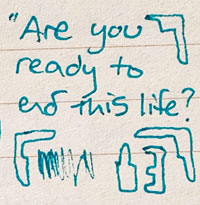
The sign Then I went with Brendan to our beds — awkwardly placed near the ceiling in the front hall. He said something about being happy and I said “Doesn’t it bother you to be constantly monitored by the government?” This was something I knew much more about in the dream than in waking life. I leaned back and a sign went on in my head. It was in funky Japanimation-style text with yellow highlights, saying “Are you ready to end this life?” At first I was shocked, afraid, fear of death coming to mind, then a wisdom came over me. “There is no death,” I thought, and relaxed. “What can it hurt?” My curiosity took over and I said yes without words. The sign faded and I woke up, fully awake at what must have been 5:30 AM.
Social Dreaming: Again we see friends and some people we don’t know in the waking world gathering to dream socially.
The environment is “a collection of memories from all the inhabitants, seemingly built anew each night”. We’re all projecting some of our own environments into the dream!
The scene becomes a railroad and several of us are playing a game of sorts there, then we face an angry dog. It’s likely one of us came up with it and several joined in. It’s interesting how in the drama of the game, panics spread through the group like in “The Slumber Party & Scary Man Prank”. We are very aware of each other’s emotions.
-
Hanging Out 2020 • 7 AM
I’m dreaming from what is probably a NREM state. I’m present in my body, aware of sounds from the physical world around me — a tree branch falling, people moving about, talking. But my focus is in the dream. This is a dream of hanging out — just enjoying myself socially with a bunch of other dreamers. I suspect that NREM dreams are probably similar. My rational mind is not trying to make sense and rationalize things. My dream self is driving.
I’m hanging out with a group of two girls and three other guys. We’re all friends, very comfortable with each other. We’re in a large white room with warm golden light and tall open windows. In one corner, the walls came in to form a rectangular platform, about half as tall as the room (as if to make space for a room on the other side). There is a rumpled pile of white towels with black smudges in the middle of the floor. Someone asks what game we should play next. I’m not entirely sure how this starts, but the towels become a rolling snowy slope and at once expands to the size of the whole room — with us shrinking in proportion to make it a large mountainside. The towel-like nature of the landscape makes unusual rolls in the hillside. I feel that even though we can no longer see the main room, the invisible rectangular walls of it define the space.
We play a game of climbing up and sliding down the snowy slopes, enjoying ourselves and laughing. Then we climb up the slope, up a short cliffside of dark rock, and onto the platform area of the room. The platform is now like a balcony overlooking the mountains. It has a white balustrade. (Okay — I have to explain that word. I was trying to think of the right word for this white iron fence-like border around the platform, and that word popped into my head. I’ve heard it before but I never knew what it was. I just looked it up and it’s the perfect word for this. Weird.)
So everyone climbed up onto the platform. They were sprawled out on the floor or sitting, physically close and touching. They seemed like boyfriends and girlfriends or close friends. I felt left out. I climbed out to the outside of the balustrade and hung onto the bars. I projected my feelings into a full-throated song about how the two girls I wanted most didn’t want me back. It came out fully formed, creative, musically interesting. I sang maybe 5-6 lines, then turned my attention back to the mountain scene, which was turning back into a room now.
Through the front wall, I saw a group of four people chasing a soccer ball, and jogged over to play with them. But they were kids — maybe aged 10 or so, and I decided I was too old for them. I heard someone singing “Stairway to Heaven”. I began singing along. Someone else was singing along, too. Probably someone from the platform. I liked my voice least of the three, but I still gave it my all. The originator of the song stopped playing and singing the song. There were a few seconds of silence. I didn’t want to stop yet, so I started it up again. The next guitar notes played — I didn’t need to rationalize this by imagining I was playing a guitar — my dream self was in control. I began to sing again. And the other voice joined in with me.
As I said earlier, my awareness was near my sleeping body the whole time. When Gwen (in the bed next to me) said “I love you, Papa”. I just responded out loud “I love you, Gwen” without skipping a beat. No resistance, no groggy wake-up. My mind was just right there.
Hanging Out: Linking this state to NREM is quite an idea. That would explain the different feel of dreams like this. It’s less physicalized and rationalized than dreams, feels more local.
-
Fiona’s Shop 2024 • 6 AM
Context: Justin has been in various rock bands since college.
I go to a college.. I’m hanging out with Justin on a bed in what feels like a hallway. I’m going into his thoughts about bands and concerts. I see images from past band experiences. Then he shows me this kind of art piece. . . . [It’s a moving panoramic art piece of an early band he was in]
After sharing in his memories and thoughts, I pull back to the bed we’re on. I notice music is playing. They’re my songs! He’s listening to songs I’ve written, but much better versions. The first was one of me playing guitar and singing. One of them is a much improved version of “Night Song” — an experimental song I made with cricket sounds.
We seem more in a bedroom now, and I’m looking through Justin’s cabinets and closets. It’s dim morning light.
Direct Sharing: This is wild. Justin and I aren’t even bothering with translating our communication to physical terms. We’re just directly sharing thoughts, images, experiences. In fact, what we’re sharing is improved versions of what we’ve created in the physical. It’s just two friends hanging out, sharing their interests.
-
Me and Taylor 2024mature content
Context: Taylor Swift was dating a football guy around this time.
A few more people appear outside the door, to my right. The cook mentions them and I turn my head and see Taylor Swift sitting next to me. I refer to her as “a girl who looks like Taylor Swift” but I’m sure it’s actually her.
I start to talk with Taylor and I’m being clever and funny. We leave the roof and walk down the hallway together. She pulls me into a bathroom and we kiss. She begins to initiate sex, and I hesitate for a moment, remembering that I’m married. Then I realize this is the dream state and go for it. It’s wet, and brief, but good.
We begin walking about the mall. Half of it is closed off and in darkness, and we decide to explore some of the closed areas. We’re about to go into one but notice a security guard standing near the entrance, facing away. He turns and sees our interest, and says he would look the other way for $210. We continue on and find another way in.
At some point Taylor’s close friend joins us as we wander the darkened corridors. I keep being funny and clever. We come to a big room with a concrete wall in front of us, but it’s about 20% transparent and we can see through it to a football game taking place on the other side. I make a subtle joke about how it would be so weird to be playing out there, with so many people looking at you. “Could you even imagine that?” (haha)
Confidence: I love that I’m being clever and funny in a social setting in the dream state. I’m rather introverted in waking life. I certainly have it in me, but prefer to be on my own. Yet I’m always happiest when I’m being open and socializing with good friends in waking life. It appears I instead do my socializing in my dream life.
Because the mall was darkened but not creepy, it seems likely it was a real physical location in the near realm. Taylor’s initiative in kissing me and so on was unexpected, so it was clearly another dreamer I was hanging out with. This is true for the security guard asking for a bribe as well.
Continuing Parties After Falling Asleep
After drinking with friends and then falling asleep, I frequently continue socializing with people in the near realm.
-
Astral Party 1999 • age 25
It’s Saturday night, after going out drinking:
I dreamed that we moved to Oberlin. We were on the second floor, as is actually the case. It was night and people were going by outside our window looking for parties. Buttercup’s sister came by and crawled up the wall to the second story window, then talked and left. Then a crazy lady on her way somewhere came by and we told her to leave. Then this mussed-hair bleached-blonde fellah came in for a while, then left, walking about a story off the ground. Then all these people started arriving. They came in through our open front door, a balcony which appeared outside the window, and another open door leading to the hallway. Soon it was packed, like an Oberlin party. Everyone was college-aged and out for fun, telling jokes and playing tricks. Many were drunk, carrying 40s. I was drunk, too. I kept mis-recognizing people, then catching my error before going up to talk to them. Truth is, I didn’t recognize any of them. I worried about my things. I once walked past this couple and heard the guy say “I’m sorry I didn’t recognize your stuff” and the girl took it sexually and started snickering for a while as I went about.
After a while people began to leave, but then a few more would come through. Half-awakening, I felt strongly as if this were a true dream, that I wanted them all to leave, that this was an astral continuation of Saturday night partiers, now drunk and asleep in the early AM. . . . Upon waking, the “Oberlin house” felt much like it was this one.
What We Do in Dreams: Here we see dreamers continuing their drunken revelries as if they hadn’t fallen asleep.
-
The Mulcher 1997 • age 22
I was drunk last night and slid in and out of sleep a few times. I remember doing astral adventures — house searches, visiting people, talking with Buttercup. I saw the outlines of her face in blue and off-step in red. Intense communication. It was hard to maintain.
Telepathic Communication: Another experience of telepathic communication in the near realm. On some occasions in the morning I feel that something has transpired between Buttercup and I during the night, that we argued or made up or went adventuring together.
I feel that this communication goes on at a subconscious level at all times. Not always telepathically but there’s a much deeper awareness of what everyone is communicating that we are consciously aware of.
Shared Experiences
I believe most nonphysical experiences are shared to some extent. This is usually the case when socializing in the near realm or astral, but usually not the case in rotes, in which unknown characters take a familiar form to convey their emotional meaning. Subjective dreams can be influenced by others nearby, whether the others are awake (astrally or physically) or dreaming themselves.
It requires both people remembering the experience upon awaking and discussing dreams with each other to confirm these, which is a rare thing.
-
Meeting Tink 1992 • age 18
I go to visit Kayla. I arrive, and her campus is a darker equivalent of SSU. She lives in Aquarius (a dorm at SSU). I meet this fairy who glows brightly through the gloom. Her real name is a one-word name that reminds me of “Patchouli”, but I call her “Tink”. We became immediate best friends. I have an utter fascination with her, and my whole visit begins to revolve around her. She can change size from small to really tiny to human size. I seemed to have the fairy power, too, as I could also change size.
At one point Kayla is showing me her room, but I’m just waiting for when she has to leave so I can go visit Tink again. Then I was searching for Tink because I had something to tell her. It was a very dim dream except for Tink. I was so enraptured by her!
Nov 9, 1992: In waking life, Kayla told me that during a guided meditation, she wandered into fantasy. She became Tinkerbell, pure white, and flew off to a far away place where I was a dull gray, sitting, lonely. She swooped down and flew in circles around me and I turned from gray to a shiny, shimmering white fairy just like her. We smiled at each other, took each other’s hands, and flew straight into the heavens.
I wish I knew the date of my dream about Tink, but I didn’t write it down. I wonder if these coincided.
Kayla and Tink: Without knowing the dates, I can’t confirm this, but it seems likely that her meditation and my dream crossed or influenced each other.
-
The Slumber Party and Scary Man Prank 1999 • age 24
It was still dark and I looked out a window. I pointed and said to Buttercup, “Look at that. . . . MAN!” Surely enough a bearded spooky face appeared out of the shadows in the window, from a black silhouette to a full face, giving the appearance of approaching. Buttercup got scared and fell to the floor in a fetal position. She seemed to be locked in her own world, shaking, and these grapefruit-sized semi-transparent black orbs were skittering all over her body. . . . Later, awake: Wow!! Buttercup dreamed of scary men out on the porch! After she fell into the fetal position with the black orbs all over her in my dream, she dreamed she was unable to move with cockroaches running all over her body. She dreamed all night of the men on the porch trying to break in and get her.
A Verified Shared Experience: This is one of the rare times where two people in a shared experience both remember it, and I was fully aware I was in the dream state. Not only that, I unintentionally scared her into a subjective dream by creating a thought form. If only I’d thought to create something beautiful. The atmosphere of fear and the darkness outside made the scary man emerging from the dark behind the window an effortless choice. Next time I’ll see if I can defy the emotional environment and conjure swirling fireflies.
-
The Flipped Ship 2025
I’m on a cruise ship at sea. I remember Buttercup and Gwen being there. . . . I then found myself in one side of a two-part room, roughly in the shape of goggles, and it shifted forward, turned, and the part I was in tipped off the front of the ship and fell, hanging by a thick cord from the other one. Then, the other went off the side, and my consciousness massively enlarged again. The two small chambers were now dangling at the end of a massive projected arm coming off the ship. My room, at the bottom, was swinging back and forth somewhat. It was thrilling. The sides of my chamber changed to just netting, and I clung on, upside down, swinging. I called out to Buttercup to look, take a picture. I took some pictures, too. The two chambers switched orientation a few times, swinging out above the sea.
I didn’t remember this dream until Buttercup told me she had a wild dream where she was in a cruise ship. She was up high at the top of the ship, looking down at the sea and palm trees, when the entire ship started rising and rotating like it was doing a loop-de-loop on a roller coaster until it was upside down, high in the air.
Linked Flight: We were both in the dream of the cruise ship, and then both felt the same movement and attributed it in different ways. I wonder if the two-part chamber was her and I in bed, with the cord as our personal connection. Both of our astral bodies must have started moving at the same time. I wonder what caused this strong sense of movement, and why we both felt it.
I awoke feeling energized, after feeling low all week.
Interacting with Other Local Dreamers
-
A Wild Night Out 2003
The city is like San Francisco and New York City. There are lots of people and shops — everything is packed in. In the background, Alfred Waits singing Fiona Apple’s “Slow Like Honey”. I can hear people’s thoughts. We had to walk through what was now someone’s apartment. After showing us through, they telepathically complained that they should put locks on the door.
Wandering Through: Here we appear to be wandering through the near realm in a big city, picking up people’s thoughts. We disturb some sleeping people and hear their complaints after they show us through.
-
Bed and Breakfast and Company 2000
Awake: Buttercup and I are staying in a bed & breakfast
Dream: I have a long and protracted realtime dream with the landlady of the B&B getting into bed with us and not leaving us alone! I eventually told her off. There was a strong Dark Tower feel but it was the actual room we were in. She was astrally visiting us!
Hello Dreamer!: I suppose there’s nothing better for meeting new dreamers than running a B&B, is there? Every night, someone new right down the hallway. I can’t fault her enthusiasm. In fact, I’d go back, just to see if I could get some more interesting memories out of it.
-
The Arizona Center 1996 • age 22
I got a job in a little food place in a mall. The work came naturally to me. Some of the more experienced and relaxed workers asked if I wanted to go somewhere with them. I did, and this friendly guy took me for a drive to this arid place in Arizona that had an organization like the Berkeley Psychic Institute. The people there were friendly and immediately accepting. Buttercup joined us shortly afterwards.
The Arizona Group: So here I am, recently relocated to the San Francisco area. I get a local job in the dream world and then some coworkers take me to this group of people hanging out in an Arizona desert. Just like socializing in the physical world.
-
The Exercise Salesman 1996 • 10 AM • age 22
I’m living with Buttercup and two others atop this building like the Co-op in Berkeley we almost lived in. This guy came by, trying to sell something. He peeked in the window and I pretended to be asleep. But then Buttercup came home and he tried to work his deal on her. She came in and embraced me. We ran around and played, ignoring him. He became dejected and started to trudge off. Finally I was ready to hear him. It was something about exercise, but he was too depressed and walked off.
I spied on him as he went to the next apartment. Still kinda down, he tried again. Someone answered the door and he convinced her to join a marching band (from some high school) who escorted her downstairs to the courtyard. He gave her some useless prizes. Buttercup, also watching, wanted the prizes. He came over and tried to convince us and I resisted. Buttercup accepted and so did some others.
Then I heard all these screechy scratchy sounds — emotions in the M-band! I could make out different ones — some happy, some depressed. I ran to go help and saw some weird party going on.
Door-to-Door Salesmen: This Co-op wasn’t far from our apartment in Berkeley. It had very dark wood and a super strange feel to it. I’m not surprised I visited in dreams.
A local dreamer comes by going door to door with a pitch about exercise. Perhaps he was continuing a job he had in the waking world.
-
Bedroom Singalong 1997 • age 22
The black guy who frequents Irene’s is sleeping next to me in my Blaine House bed — a thing I found quite strange. My bed had white sheets, the breeze was blowing, and the room was fully decorated. The guy was singing great music with me, soulful and inspired. He suggested a song, “Suzanne,” and hummed it, then called it too sappy. For some reason I thought he meant the Jackson 5’s song “ABC” and decided to do it. His girlfriend appeared in a prison beyond the brick wall next to us and began singing with us. I started singing one part and I was gonna let him take the next part, but it became the main part and he prompted me semi-sadly with the words. It was a love song and she was so loving singing it with me. I tried to redirect her affections to him but couldn’t remember his name. I told him I’d make it up to him and fix it.
Then I remember swimming in a secret world in Mario 64. It was in an underwater supermarket with lots of eels. I had to swim through 10 rings. I guess this was in my room — he was watching me play, impressed.
Unexpected Slumber Party: I’m in Bath, England at the time, so this might be a local person who reminds me of the regular at Irene’s. My Blaine House bed represents the bed I’m currently sleeping in. This is likely a projected-over experience in the near realm.
We’re like old friends having a sleepover.
-
A New Friend 1997 • age 23
I met someone and got to know him really well in one dream and had the feeling of being glad to have found friends in Atlanta so soon.
Local Friend: We’d just moved to Atlanta. Here I’m very conscious of having found a local dream friend.
-
The Annoying Kid 2025
The setting was one of the suburban houses I live in within the dream state. It was dark out but I could see. I was upstairs sleeping. This kid that Bodhi knew from the neighborhood kept coming by our house when we were sleeping and going onto our back porch, where it seemed he was trying to steal a pool float. There was also a pool noodle with a shark head or rooster head attached to the end that I think he was trying to steal. Bodhi was trying to stop him, as was I. I didn’t recognize him, and asked Bodhi who it was. He gave a name I didn’t recognize, but I knew where he lived — five houses down from us on the same street.
After some time of this, I grew angry at the interruptions and went to the house. I knocked on the door and his mother answered. I told her what was going on. I ended up inside the house. There were two other kids in there. I didn’t recognize any of them. We talked about why he was doing this. I left, hoping that would be the end of it.
Messing Around: Because it’s dark out, and I’m aware that I’m sleeping but Bodhi and I are getting interrupted by his presence, this was likely a dreaming kid coming onto our back porch in the near realm. That would be the local reality, even though in the dream state I’m at my astral home.
In the physical world, we don’t keep pool things on the back porch, so that part might have been projections or related to the astral home.
Cross-Country Road Trips
I go on a lot of cross-country road trips with friends in the near realm. These typically involve a car rationalization. The purpose is to hang out with new and old friends, to attend gatherings, celebrations, and raves, and to visit parks, take tours, and see sights.
-
Milwaukee Road Trip
I’m on the road to Milwaukee with some friends. We get to the countryside part of the trip and stop on the side of the dirt farm road for a rest.
-
Car Encased in Ice 1999 • age 24
I dreamed Buttercup and I were on a cross country trip to San Francisco. We stopped at a gas station and I was distracted for a time inside.
Cross-Country Trip: We moved from San Francisco to Atlanta a year and a half before, and we like to go back and visit in the dream state.
-
Hanging with Ween 2000 • age 25
[I have a long dream of hanging out with Dean & Gene Ween]
I left off last night traveling home from Pennsylvania (Ween lives in Philadelphia). I was thinking Minnesota was my home, then realized it was Georgia.
Travels: This is a cross-country road trip to be back home in time for morning.
-
Tail Gunner
I’m in this small plane, being taken against my will by this girl to Appleton, Wisconsin. . . . The plane hits the ground. . . . I see this old farmer guy coming. . . . I follow the farmer home, asking how much further it is to Veroquah, my destination (this is unfamiliar to me in waking life). He says it’s “only 10 miles” and he’ll find someone to give me a ride.
Viroqua, Wisconsin: Twenty years later, I looked up “Veroquah” and found it! Viroqua, Wisconsin is about halfway between SSU where I lived at the time and Appleton, only a little ways off the direct route.
-
Free the Children 1997 • age 23
Buttercup and I get distracted from the march and go to a comic store. We start grabbing rave fliers on the way out. This friendly guy starts giving me directions to a rave near Atlanta: take 75 to 6-- to 706, to exit 13/14, then to the liquor store on Walker Road. I didn’t understand his directions at first but then it became clear.
Next door was this food place and we sat outside around this big rock.
Traveling to Astral Events: I frequently find myself traveling across the US to specific locations. Here we see how it begins — people hanging out, talking about something interesting or fun to go to, just like in waking life. I tried to find these roads in GA but could only find 75 and Walker Road.
-
Hanging with Star Trek Legends 1996 • age 22
I’m speeding towards Blaine House, on the trip through Minnesota to Oberlin. A police car starts to follow me with its lights on. I ignore it and keep driving. It eventually disappears.
-
Highway 710 2010 • 4:30 AM
We were heading west on a paved road through a green natural setting. . . . Then they took the exit north on Highway 710, and I looked behind us to see if Buttercup had seen us make the turn, but I didn’t see her car (the walls of the trailer home were no obstacle).
-
Mountain Removal Mine 2011
Buttercup and I are on a cross-country trip somewhere. We get a little lost on these roads and end up at a park not too far from Atlanta.
Visiting Other Countries
The US is huge, and I usually remain local to America when in the dream state, even though I travel far and wide. In rotes, I translate everything back to familiar American terms.
So it’s surprising when I travel to another country and the architecture and people are quite different.
-
Visiting England 2025
This dream was astonishing in an entirely new way. I was with some guy friends, traveling about on a trip together. But at times, it was clearly in England. Everything was so very different from my usual American dream surroundings. We went into this big English building, and the construction, decor, the people, everything was English in a way I don’t recall seeing before in my dreams. They even had the English equivalent of weird, confusing bathrooms! . . . I noted that they didn’t have British accents, their telepathy being translated into my own style of speaking.
-
Indian Celebration 2025
I spent several hours with an Indian family. I was in their home with their friends having a celebration of some sort. What struck me about this dream was how unfamiliar everything was. The traditions, the celebration, the surroundings — it was all new to me, and I was quite enjoying myself. It felt like I was in India, or an astral version of India. I remember walking around outside at one point.
In India: Here’s another dream where I appear to be in another country. The celebration and traditions were all new to me, meaning this dream was not translated into my usual familiar forms.
Waiting for a Friend to Go to Sleep
-
Waiting for Brendan 2004 • 1:30AM
Awake: After writing with Brendan and sharing music, I go to sleep at midnight. I dream the following over the next hour:
In my dreams I go to visit him and make brief contact several times. We prepare to go out adventuring but he’s busy in his semi-dark apartment (which isn’t accurate to waking life). I make contact, then drop, then make contact, then drop. I get bored and wait in my universal dream space, the school between the worlds (the Atlanta Tower). It’s dark there. The building at the top of the elevator is like a hotel. It’s several stories tall and domed at the top, with a theater. It’s directly above the physical world. I wander into a familiar gift shop nearby. There are several racks of piano music. There are some unfamiliar songs I decide to try while I wait. There’s something by Brit Grant maybe? Also something a little cooler by someone like Sheryl Crow. The rest are unfamiliar. One isn’t even sheet music. Then I spot the pricing guide.

Sheet music prices I’m disappointed to find they’re not free. They’re under a half-circle. This has all happened before. I’m waiting for Brendan to go to sleep so we can visit in dreams.
Meeting the Waking: This is simply amazing! Here I’m trying to make dream contact with someone who hasn’t gone to sleep yet. I’m making brief contact with him but since he’s still awake the contact can’t be sustained and keeps dropping, so I’m killing time in the dream world waiting for him to go to sleep so we can meet up in our dream bodies!
Playing Games
While hanging out with other dreamers, we come up with unique games to play.
-
Hanging Out 2020 • 7 AM
I’m hanging out with a group of two girls and three other guys. We’re all friends, very comfortable with each other. . . . Someone asks what game we should play next. I’m not entirely sure how this starts, but the towels become a rolling snowy slope and at once expands to the size of the whole room — with us shrinking in proportion to make it a large mountainside. The towel-like nature of the landscape makes unusual rolls in the hillside. I feel that even though we can no longer see the main room, the invisible rectangular walls of it define the space.
We play a game of climbing up and sliding down the snowy slopes, enjoying ourselves and laughing.
-
Body Transformations 2003
I’m in a neighborhood with some friends in the near realm. It’s dim, early-morning light. It feels high in elevation. I’ve been spending time here recently, running around with friends. The mountains are light brown with few trees, like the Sierra Nevadas, but the neighborhoods are green with trees.
I decide to do a side flip on the street. From standing, I bend sideways to the left and then flip to the right and land on my feet. This is something I tried to do in waking life after the volleyball game at Kai’s wedding — people thought it was hilarious. In the dream, we all went into this house. People were wandering about, doing their own thing, and I was practicing these flips in the wide end of this hallway. Once when I flipped, my legs softly hit this ironing board and I stopped in mid-flip, just hanging there in the air. Gravity wasn’t too much of a concern. But instantly I rationalized that I had grabbed onto the ironing board with my legs and had my back on the floor. Someone was watching. I smiled, thinking this probably looked impressive. There’s a little break in my memory. . . . Then I’m standing at the other end of the hallway where there is a sink and counter, and I’m looking into the mirror. My reflection is that of a cute asian girl I’d seen earlier in the dream. Without intending to, I had taken on her shape. As I looked, I noticed that the only obvious difference was the expression — she was always bright-eyed and smiling, while I had this sort of blank expression. I thought “I’m not nearly as cute without the smile,” but I still enjoyed the thought of being in a girl’s body and how I could grab guys’ attention. I thanked the girl next to me. She didn’t have a very animated reaction. Then a break. . . . We were playing this game. I was in a room with two light gray dogs. I was to transform into a matching one, then run about and interact with them and this bone. The others were supposed to guess which one was me by my actions, and I was to try to be as doglike as possible. Before we started, I expressed a concern to the girl from the hallway — “Will I be able to return to the asian girl form afterward?” The girl said “Usually you return to your natural form.” This was telepathic. She and the others were in a different room, waiting for the game to begin. When communicating like this, I saw them above and beyond the present room I was in. So, I transformed. I was both within the dog form looking out, and watching the dog from outside. It was strange to go after the bone with my mouth, to interact with the other dogs with my mouth, to run on four short legs. I did my best to be dog-like. The others correctly picked my dog because of the way the hindquarters looked — like mine. I had to agree. It was like in cartoons when a character changes shape but keeps some of their own aspects. When I was the asian girl, I remember thinking she was taller than I remember, and I was, because I am, proving in literal form that it’s hard to let go of that which you’re proud of.
True, Social Dreaming: This is an example of true social experiences in the near-realm, in what feels like a real neighborhood. The other people in the dream are also in the same focus, well aware of the laws of dreams, playing astral shape-shifting games, communicating telepathically without rationalizations.
Twenty years later I was driving around in Oakland, and came to this neighborhood that almost perfectly matched this dream. I couldn’t find any specific landmarks but everything about it was familiar from this experience.
Others Departing as Morning Approaches
-
Keeping Tabs on the Election 2024
I remember in the early hours of the morning, 3-4 AM, that I was socially dreaming, hanging out with several other people in a living room, sitting on couches. The atmosphere was dim morning light. The people were just clearly outlined spaces of shadow. They had checked out, one by one — gone to sleep within the astral or woken up in the physical. At one point, just one couple was left.
Leaving Social Dreaming: People disappear from the near realm when they wake up physically. They may also go into a dream while remaining in place.
-
The New House 2024
I crossed the road and directly across the street was a comic shop, which I took to be a bonus. As I approached, I saw someone leaving and the lights were out. It has just closed (it was around 5-6 AM).
Closing Up for Morning: It’s not just me that heads home as morning approaches. Often time astral businesses will close around this time.
-
The Mountain Valley Gathering 2003
The groups continued to hang out for a time. Morning was coming, and people started heading to the buses to go home. I was one of the last to leave, but finally squeezed my way onto a bus.
Morning Dawns: Just as people at parties in the waking world say their goodbyes and head home as it gets late, socializing dreamers say their goodbyes and part ways as morning comes. I expect it’s more a habit from the waking world than anything. Since a lot of social dreaming seems to take place in the near-realm, gradually rising daylight is a very visible sign there, unlike other areas of the astral that contain their own constant light level.
-
Hanging with Star Trek Legends 1996 • age 22
I’m speeding towards Blaine House, on the trip through Minnesota to Oberlin. A police car starts to follow me with its lights on. I ignore it and keep driving. It eventually disappears. But then when I stop in this mall, a bunch of police cars surround me and take me in. . . . I’m put “in jail” in this hotel and dining establishment which has the police staton in it. I’m eating with Buttercup in this booth next to William Shatner (Bill), Leonard Nimoy (Leo), and Dr. McCoy (Bones). I gasped upon seeing them. Bill and Leo went to return their dishes and I began talking to Bones. He kisses me on the lips on two different occasions. It’s kinda awkward but I manage to strike up some good conversation. The others come back and we move upstairs to hang out and talk. It’s fun and friendly. They do the pass-a-story game for fun — clarifying that they don’t really write Star Trek episodes like that. They’re laughing and talking as we make up new episodes. Bill gives me a comic torn out from a newspaper. After a while, morning is coming and they leave. I bounce all around telling everyone.
Getting Up Soon: I don’t think these are the real actors from Star Trek, but whoever they are, we have a great time hanging out, talking, and making up Star Trek episodes. They leave because morning is approaching.
-
The Treehouse OBE 2024 • 5:30 AM
I went up to the next floor. Here I saw a worker or two. One I took to be the foreman. As he came in, he looked at me a moment, seemed not to believe his eyes, then moved on. He went to the other side of a ledge surrounding the spiral. . . . I followed him a little bit and got his attention. He looked at me, disbelieving. He seemed stricken, as if seeing a ghost, but I gestured that I was sleeping. I reached out and touched him on the shoulder.
More and more workers were arriving, and I greeted them. The morning light was increasing towards daylight. One worker thought I had noticed his lateness and made some smiling explanation.
Workers Arriving: While I typically head back to my bed as morning approaches, here I see workers arriving at my house in the early morning. Perhaps that’s due to the thought that in the morning they head to work. Maybe they do this astral construction work mostly during the day while their waking mind is otherwise occupied.
The foreman is surprised to see me . . . why would that be? Maybe in my half-aware OBE state I appeared semi-transparent, as I had the other night.
Socializing in the Astral
What’s the difference between socializing in the astral and near realm? The near realm reflects physical locations, and while it can appear fully formed but there’s a sort of transparency to it, a different level of perception. The astral is more vivid. It’s painted in full color, fully formed, and doesn’t reflect any physical location.
-
Free the Children 1997 • age 23
Buttercup and I get distracted from the march and go to a comic store. We start grabbing rave fliers on the way out. This friendly guy starts giving me directions to a rave near Atlanta. . . . Next door was this food place and we sat outside around this big rock. On the rock was this guy we knew from somewhere. He eventually started talking to us. He introduced this smiley girl to us and we started talking. Buttercup got really nervous and shy so I had to be more talkative. The girl said “You must be in a really bad mood.” Buttercup said we were tired out from all the directions we just heard. During the conversation with the girl, I turned inside myself again. Everything got really skewed with dark areas from behind me becoming more central to my visual field. I missed a few moments of outside activity and when I turned back out, she was back to talking with her other friends. The girl grabbed a piece of aluminum foil. I grabbed mine and got all excited because I knew a funny foil trick. She noticed me beaming at her and brought her attention back to me. I couldn’t access the trick for a few moments and she waited. I said “I know this trick with foil” and then I remembered it. I blew on it funny and it made funny sounds. There was amusement.
Reality of Social Dreaming: This is an experience with real people in the dream state. Buttercup was awake when I dreamt this, but I’ve seen how we’re always dreaming underneath our waking consciousness, so that’s actually not a barrier at all.
Hanging Out with Friends (Astral)
-
Weed Beer 2023 • 2:30 AM
I’m at a bar in a city with three friends, including Buttercup and a guy I took to be Lucas. The bar has tall ceilings, mostly concrete, and black railings. We’re the only ones in the small front area. We sit at a table and look at the drink menus. They’re large, with pictures of the drinks next to their names. I’m drawn to two tan/orange beers. The waiter comes and when it’s my turn I ask his opinion.
-
Brendan’s Party 2024 • earlier in the night
We were having a slumber party in this huge house of Brendan’s. Part of it was outdoors with big tent-like fabrics above us. We arrived in the evening. Brendan wasn’t entirely available, but we saw him from time to time. His parents were there. Buttercup was there with me. She was also wandering off and coming back. Brendan had said that he set aside some marijuana for us, if we wanted, but I forgot where and spent some time looking for it. In the end I either found it or created some, and smoked it. There was a part where we were playing a complex board game. The party was to go on throughout the next day and night.
This was a telepathic “social dreaming” true dream.
Slumber Party: Brendan’s house was the gathering place. We kept leaving into our individual dreams and adventures and then returning, or “waking up” there again.
Interesting that it was to continue throughout the day. This must refer to the fact that we’re dreaming at other levels even when awake.
-
Gathering the Kids 2025
I was hanging out and traveling with a group of friends. We were looking for a particular place. . . . Highland something — a restaurant or bar. I had an idea of where it was, so we all got on a bus and set off. On the way we passed some red and yellow buildings. It went on a long ways, crossing a wide river at one point without bothering with a bridge. I suspected this wasn’t the right way, and when we arrived, Highland wasn’t there. I checked my maps again, and this second location had also closed, and it was now open at the red and yellow houses we passed a long while ago. But there was a bar type place where we had arrived, and we went there.
Restaurant and Bar: Just like in waking life, we enjoy going to restaurants and bars in the astral with friends.
-
Between Classes 2010
I go down the stairs and around the corner. Just a little ways down the hall I see Quentin sitting against the wall with some friends. I am excited to see him, so I call out to him and sit down in front of him. He’s excited to see me at first but then quickly becomes guarded and begins talking to his friends instead. I wait a moment, and see that it’s clear he’s going to ignore me, so I disengage my excitement and lean back, a few moments from leaving. Feeling this, he turns back to me and says, as if in explanation, that Eric said that I’d changed, that I wasn’t myself — not fun or engaging. I remembered the name from playing soccer (though Quentin didn’t know that Eric) and remembered that as when my affliction started (again incorrectly — that was 2006, and the affliction started in 2003). So I started talking about how that was a long time ago and how I am much better now (am I?). As I started talking with him, I reached out and held hands with the girl sitting next to him and we were affectionately touching each others hands in the cutest way. This conversation sort of let me into the group, and we started talking about various things.
Social Dreaming: This is essential social dreaming. Though it’s not taking place in the near realm, an astral school would be a natural setting for it as well. Quentin acted as I might expect him to. That way of hanging out in a hallway, just casually sitting around, talking, was something we used to do a lot in high school.
-
Friends and Dream Awareness 1997 • age 22
Brendan and I went into the garage. I thought I had forgotten my glasses and contacts because I couldn’t see clearly. I said “Clarity now!” and my vision became clear. I was about to start flying and trying to go OB, but got distracted. Savannah came by. Brendan and I started doing cartwheels in a huge mud puddle. . . . Ruby started telling me about her friend Kari’s tragic marriage.
Visitors: When someone thinks of us, they can appear before us. Friends kept showing up to hang out, and I was drawn into their fun and stories.
-
The Buried Building 2024
The next thing I remember I’m back at the bottom of the hole. . . . I’ve brought a bunch of people with me to show them the building. They mostly stay behind me, out of my direct awareness. . . . We explore other interesting rooms.
I enter a room that’s more like living quarters. The others have gone ahead a little bit. I go into a larger, open living room with natural light, then outside to a big, beautiful scene. I’m on the bank of a river. The river is about 20 feet wide, with big rocks beneath the surface. To the right it curves away outside the exterior of the building. To the left, it descends very steeply about 30 feet from above. In the physical this would be a waterfall but here the river has just bent downwards. To my left is Ruby, smiling. Beyond her and up the bank is Buttercup, and maybe someone else. Emma is there somewhere. Beyond the river is a hill sloping up, with patches of woods and grass. At the top of the hill is a large rounded structure made of red pipes, like a playground structure but as big as a building. I remember that Buttercup had wanted to go up and explore this earlier, and she was hoping we could go now. I wondered if I could play in the river a little, in the downward slope to the left but got a warning from Buttercup that it was too dangerous, and I slightly agreed. Then someone suggested some funny prank to do when Ranier showed up (I saw this idea playing out in visual form), and I turned towards the door to see Ranier coming outside to join us. I gave him a hug.
Back to My Friends: Inside the rote, it felt like it was me and a few observers, but they didn’t participate. I wonder if going outside the building caused me to exit the rote. Perhaps this is where I came from when I entered the rote. I’m now openly communicating with my friends and family in a social dreaming setting.
-
The Detachable Room 2004
At this point, Kai came in. He wanted to do something. [He shakes the room free from the house] It was a rush! The room came to a stop and then fell apart so that there was one wall flat on the ground and another standing up precariously. We laughed.
About ten people from the school were there, laughing, amazed. . . . Angel from my soccer team walked through. He said hi, looked about, and kept walking. Probably just a brief intersection of dreams.
Social Dreaming: Kai walks in and wants to do something! Another great example of social dreaming. It’s as simple as that. Just as easily as you’d drop by a friend’s house to say hi or pick up a phone and call — in fact, it’s easier because all you have to do is think about someone and you’re right there with them.
He shakes me free from my body (my room representing my body) to go on an adventure. Angel, a player on our soccer team, wanders through.
Shared Dreams (Astral)
This section shows some dreams that were verified to be shared by those involved. It also includes some that had such an accurate representation of a person involved, behaving in unanticipated ways, that it must have been them.
-
End of Days 2012
Someone said it was the end of days. Incredibly huge tsunamis were rolling up all the coasts and continuing across the continent. Buttercup, Bodhi and I had fled Georgia to higher ground in Colorado. . . . [The tsunami arrives and we escape to a mass transport area]
I grabbed some important things, and Buttercup joined me. On the way back, she started slowing down and collapsed onto the ground with Bodhi, overtaken by sadness and despair. I tried to get her motivated to get up, but she wouldn’t, so I scooped her and Bodhi up in my arms and ran towards the last plane boarding . . . [we make it onto a plane]
We’re awake now. Without hearing a word of my dreams, Buttercup told me she dreamed about massive flooding from a tsunami, about losing Bodhi, and about yelling at some woman who objected to her publicly breast feeding. They were at one point at the top of a building surrounded by rushing flood waters!
Sharing Dreams!: This is just amazing. There is no doubt in my mind that we were sharing and influencing each others’ dreams.
-
Blinking Masks 1999 • age 25
I was searching for a mask in this open, friendly-feeling warehouse. I showed Buttercup one that was gross and funny and she didn’t like it. I couldn’t find it later and she says she hid it under some clothes in a box. Then I was looking at a whole row of science helmets on stands, and they had blinking red lights. Then the blinking stopped and and I wanted them to blink again but they wouldn’t.
Buttercup also dreamed of masks.
Shared Dream: I didn’t get many details about her dream, but this might have been a shared dream.
-
The Chamber Beneath Blaine House 2000
So I’m at Blaine House with Wadsworth. It’s daytime. We’re in the back yard. There’s no gazebo, as usual. The ground is very spongy and dug up in some places — they’d just emptied the septic tank. Wadsworth brought me to this 4-inch diameter round hole — the top of a metal pipe leading up from below and said he wanted to show me something. He pried this metal cover off and then I looked down the pipe. I could see water glimmering far below, and a white/blue tile. The picture resolved and I could see one whole end of a large swimming-pool-type chamber. I was fascinated that I could see so much through such a small hole, down a pipe. I turned to look the other way and could see the whole other side of the room, dimly lit. How?! “That’s incredible!” I thought. I asked how that could be. Next thing, we’re inside on a platform along one wall with white metal rails, looking around. We’re down there, inside the septic tank. There’s still plenty of water — they hadn’t pumped it all out. It was clear and blue and seemed pure, which surprised me. Wadsworth and I talked a little about it, then I asked how we were going to get back out and I looked up at the little hole in the ceiling and he nodded and I became really afraid of how I’d get through there. But I was distracted then by three white objects in the water below. It was a harp seal family! So cute! Amazing, I thought. How could they live down here, eating filth? Wadsworth expressed something about how it was purified down here.
Then we walked down the stairs to our right and Wadsworth jumped into the water. I was disgusted, but soon he was walking on the surface. Ice! My fascination was constant. The floor by the doors on this side of the wall was frozen and rippled. I stepped down and peered into the first door — it was a racquetball court with a floor of ice. Wadsworth led the way to the second door, which opened to a larger storeroom, mostly barren but with various machinery parts scattered about. Through the door on the far side of that room was a very large room with white walls, an off-white tile floor, and what looked like a business party in an engineering department. This was definitely Wadsworth’s! There were a few people scattered about in business slacks or skirts, holding styrofoam cups with punch, mulling about and talking. Decor was absent and there was a lot of open space, a few desks, and engineering parts scattered about. I asked Wadsworth how the room was being powered and he pointed up, saying “sparse, low-cost lighting.” There were scattered bulbs and only sections of the fluorescent ceiling lights were on. It wasn’t dim, but it wasn’t bright, either. Then through another door was a 70s-looking kitchen area with cheap silverware and dishes with greenish cupboards, more partygoers, and more assorted parts everywhere.
Wadsworth introduced me to Ruby (my sister), who had now joined us, but he called me “Brad” to some of his friends. There was a hallway beyond this room. I thought, “Who knew that there was this great underground area beneath Blaine House all this time?” I asked why he hadn’t told me about it before. I remembered the big pile of dirt in the backyard when they built the house and now attributed it to this complex. Soon I found Ruby more interesting and I went with her to the main septic tank room where we started. The floor was all ice now. We exited through another door.
Dreamer Wadsworth: I think this was Wadsworth. So much of the personality was his. His concern with saving money when it comes to the lighting and the kitchen, the engineering department party, his once interest in racquetball — pretty much everything fit him. It’s not infrequently that I find him at Blaine House, and he’s often acting as himself — an independent agent, rather than a thought form conforming to my expectations. There’s even evidence of him going in and out of lucidity. The party seems to draw him into another context, and he mistakes me for someone named Brad.
-
Hyperspace Warps 2001
Buttercup, I, and two friends were flying together over a huge beautiful park that I recognized. It had a river with tall spires of rock, huge rolling grassy hills, and an overlook. There was a busy commercial area in the center and a building with a long winding outdoor walkway. We landed and walked down it. It was packed with people. We saw a beautiful small open garden area on one side and walked into it, raising our arms and dancing about. Someone there said it was $9 apiece to be in there. I was shocked, but danced about some more, then left. The others came, too. Across the hall and down a bit there was another beautiful natural place and we went in to admire and play in the beauty. Again, $9. I left. The others stayed. They received a jellied cracker on a napkin and coffee drinks. I remained in the hall, watching people.
I returned after a bit and Buttercup smiled, and said I must be having quite the time watching people moving their coffee cups to their mouths addictively, unthinkingly, in the cafe across the hall. Truth is, I wasn’t watching that specifically, but had noticed it. Buttercup had ordered me a jellied cracker for $9 and I went to the stewardess of the garden and said, “I’m sorry, I can’t pay $9 for this, or allow my wife to do so for me.” “Fine!” she said, and asked me to scrape the jelly off the plate. I started to, but then saw how foolish it was and stopped. I left and wandered about some more.
A Shared Dream: Buttercup acts and speaks just as she really would — it is likely a shared dream with her. At this time in my life, money has been really tight for me, but less so for Buttercup. This is a scene that could very easily have happened in waking life. And what she thought I would have been thinking was completely accurate as well! I had noticed how people were replaying physical behaviors without actually eating or drinking.
Playing Games (Astral)
-
Friend or Foe 1997 • age 23
Buttercup and I were running through a rainforest tunnel cave trying to survive. It was like a video game. I kept having to shoot these mud-drenched guys in tattered clothes. Then this one enemy and I ran out of ammo and tried to be the first to reload. The enemy turned into a large Puerto Rican woman, and I challenged her to hand-to-hand combat, with Buttercup choosing the rules. We gave our guns to her. She said: “First one to score three hits wins. A hit is a hot coal blow to the forehead or a knife wound to the mouth.” We got ready and then I thought about how sick this was and said “Hey, do ya wanna just be friends?” The woman was shocked at first and took my outstretched hand into a wrestling hold, then released me and shook it. She was really nice and laughed about how nasty Buttercup’s rules were.
Craving Drama: Had I only remembered a bit of the last dream, I might have thought it just violence, but the greater context reveals that it was a game staged by those involved.
-
The Shape Shifting Game 1994 • age 20
I finish up a great project, then hang out with a friend. We play this game where I would hold out my hands, arms straight forward, then randomly change everything but my face to that of different girls at SSU, and by looking at my new hands, I’d guess “large,” “skinny,” “tall,” etc. The friend would laugh and say “Yup, go on.”
Shape-Changing Game: This is a game I likely played with another dreamer.
Playing Pretend
We sometimes play pretend in the astral, as children do. Sometimes this results in the creation (projection) of thought form scenes, characters, and objects as we get more into it.
-
Playing Batman 1996 • age 22
I had Buttercup’s car and it was loaded with stuff. This group of smart, funny kids ran by with a tent, giggling. I had to follow. There was some contest to see who could set their tent up the fastest. We tried different things and it was fun. There was a person there like Lark, and one like Brendan. We all decided to play Batman. We set up this elaborate game where we were in Gotham and I was supposed to save Buttercup. We all got caught up in the game.
Playful Dreams: I love playful dreams. We’re like a bunch of kids playing together, making up games, having light-hearted fun together.
-
Rachel’s Reunion 2010
I had gone on some cross-country trip and arrived at a ranch-style house in an endless green forest where Rachel was acting as host. It was like a gathering point for a rally, with people meeting up who hadn’t seen each other in a while. . . . Ranier runs up to me, grinning. I shout “Ranier!” and embrace him. Then Sid shows up and I give him a big hug and then 5-6 others appear. We’re all very happy and it’s clearly play time. Somehow Ranier, Sid, and the others end up in suits of shiny armor and begin having sword fights. I want one and soon I’m in one, too, holding a long silver sword. We playfully fight back and forth and then they all start galloping around the yard with fake horses, Monty Python style. Instead of riding a fake horse, I run after them, saying “Hey guys, I don’t have a horse! Wait for me!”
Text Video credit to the movie Monty Python and the Holy GrailThe next part I remember was being at the rally destination. It might have just been down the hill from the house, or maybe a whole different place. It was beautiful. We were on a forested hillside overlooking a wide river that flowed into a lake. Across the river was a short mountain ridge. Each area had an associated “kingdom”. On the side of the hill, our village of cabins and such was the earth kingdom. Down by the lake was the water kingdom, and across the river was the fire kingdom. It was set up like an adventure area with the goal of visiting each kingdom. Ranier, Sid, and the boys were there (not Brandon), and Buttercup was now there as my main companion. We had adventures, talked, went into a subdream or two, and had a grand time exploring.
References: Rallies are youth group gatherings at Unity Church. I met Rachel at one.
How Children Play: When children are having imaginary play, they do these exact things. They invent challenges and respond to them, like playing the floor is lava. It wouldn’t be fun without the danger. The scene with the boys fighting like knights was like that.
Board Games
Board games are popular in the astral — especially those with miniature characters or environments. This is because we can occasionally project ourselves into the scenes and become part of the action.
-
Volcano Survival 1998 • age 23
I was sitting in front of a board-game featuring a volcanic island. I hit two fire marbles together and a big flaming meteor descended (from the marbles or me) into the volcano. I hit the stones more rapidly together to get the volcano to erupt and it did. My concern for a group of little people on the rocks brought me down into the scene and we built defenses. It was all play — a game.
The Gods on Olympus: Consider the Greek stories of the gods on Mount Olympus, looking down and playing games with the lives of humans, sometimes going down and interacting directly with the humans as well. This is where that comes from!
In dreams we play games just like this, for fun and drama! We sit above the miniature scene, looking down from above, manipulating events, causing trouble. And then our own concern draws us into the scene, into the danger we’ve just created.
-
Brendan’s Party 2024 • earlier in the night
We were having a slumber party in this huge house of Brendan’s. . . . There was a part where we were playing a complex board game.
Projected Games
Some games are projected on top of an existing environment, like an augmented reality game.
-
Most Beautiful Rain Fairies 1998 • 2:25 AM • age 24
The following was a version of The Tower. As usual, it contained a challenge. It was a stadium with an angled walkway up the middle of the playing floor. There’s a repeating dream within the stadium in the form of Final Fantasy Tactics where I’m given a guitar that turns into a gun and I need to slay this George Clinton character. I’m unleashing water in different directions, and there are many repetitions.
-
The Circle Mall 2024
I exit into this circular mall bustling with people. I play this game that spans the whole width of the mall, where bad guys are coming in and there’s this mountainous pile of human-sized bone pods which I have to shoot. World of Warcraft trolls are part of it.
Afterwards I get involved in a game where I have to do or find various things in the mall to get points. One involves watching this dancing show, after which the announcer will come out wearing a large belt with a code or symbol on it.
Mall Games: The first game was like an AR (Augmented Reality) game. It took place in the space of the mall itself, a sort of dream layered over the mall.
Thought Form Games
-
Thought Form Games at Arcology Hill Stadium 1996 • age 22
In the arena at the top of the hill with the tower, I was playing this game with another team. This was the big show. A huge crowd had gathered to watch and had made signs to cheer me on. My opponent had carried out a trick of major proportions to win, and I was instantly defeated (I’m assuming that Drax had something to do with this). I was bitter. It seemed that I hoped to outrun something, and that’s why I lost. Was our game called “try to see the best side of everything I throw at you?” Perhaps!
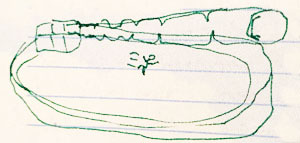
Astral matter emitter 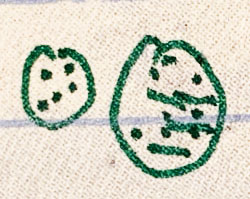
Circle symbol writing Now a device in the corner of the field began to shoot out this raw unformed astral matter across and over the field. Smaller balls of it all connected and joined into this big, floating ball. There were all these circle symbols on it that I was reading. My defeated friends and I decided to keep playing and reverse our loss. We made a bunch of hot-air balloons out of the big thought-form ball, and flew up into the baskets. Swirling around us were lanterns, and the mad hatter, and everything seemed to be alive like in musicals. We sailed past a big statue and some fruit and vegetable stands. Lots of people ended up in the balloons, including many old friends. The cloud of balloons, lanterns, and spontaneous creative forms began encircling the top of the hill and tower, then going up one side. It was not scary from this perspective.

The real thing was much cooler From twelve days later, “The Insanity Creature of the Tower”: The “games” the other night. It wasn’t against Drax, it was against the insanity creature! It recreates reality. One must be stronger than it. It is all selfish desires, weakness, and needs. That’s what the game was — to exert your reality, your fearlessness and good interpretation on every horrible thing it could throw at you.
Astral Games: Incredible! With thought-forms as a foundational reality in these dream civilizations, doesn’t it make sense that games could be devised using them? And what better than this very game! It was all so beyond anything I would think up. In short, the stadium was able to shoot out pure unformed thought-form matter into the center of the field, and we were able to coalesce it into forms with our thoughts.
This is the same stadium as in “Most Beautiful Rain Fairies”.
-
Forge Ball 1992 • age 17
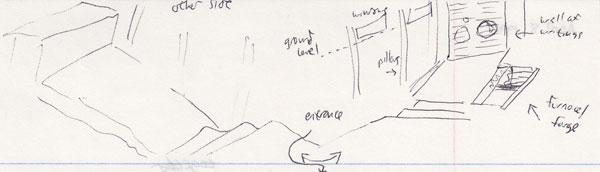
The brigand’s bunker and forge I’m a young warrior undercover with some older thieves and brigands. We enter a cavernous hall slightly underground in the forest. There is a hot furnace off to the right, and a wall of strange writings straight ahead. Some of them are kicking and bouncing these rough bubbly thick foam balls at the wall. They’re very light, like a cross between bubbles and beach-balls. Each time one hits the wall, it leaves an inexplicable, strange-looking white circle or symbols, then bounces back smaller. Soon they run out, so one guy goes into the forge and collects some bubbling metal in a blow pipe. He emerges, holds the pipe to his lips, and blows. A glowing hot bubble clump starts to emerge from the far end of the pipe.
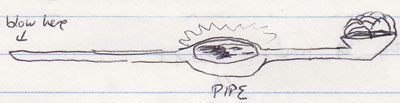
The pipe used to inflate astral matter The brigand I’ve been following takes me to the other side of the building, and does something else. Just then, I see the new extremely hot purple bubble bouncing into the room. It hits the ceiling, then comes at me and hits my face. I let out a yell, and someone runs over and tears it away, along with my two golden armor head pieces. I am unharmed. I take my armor back.
Astral Matter Forge: This is so cool — the brigands’ forge has poured energy into and melted down the astral matter. Any strong source of heat or light can work for this purpose. So here they have developed a game with it.
Social Activities in the Astral
Amateur Performances, Talent Shows, and Competitions
-
The Pirates 1997 • age 22
I was in the audience for this big play where the audience was supposed to sing along. We were going to, but the screen with the words turned off. So Buttercup started making it up and I joined in. During a pause we were asking people if it was okay what we were doing. They said it was. Before long I was in the play, playing a wandering pirate. I got some fish, dropped one, and began shouting and singing about it in this pirate-y Scottish accent. Then this other pirate and I dropped rubber snakes on the pirate captain and first mate below.
Later on, I was talking to someone in a room like my single in South Hall. He asked if he could film the next episode of his show in my room. I said yeah. There was some singing, and I was telling him about a dream I had earlier about the ocean.
Audience Participation: These amateur performances usually are open to audience participation. It’s a collective thing. If someone is moved to sing or join in, that’s usually just fine.
-
The New Musical 2025
I was watching a rehearsal / performance of a new musical. The name was well known in the dream, but I don’t recall it. The main character was named Hanibel. It had this 90s alternative vibe to it. As I watched, I sporadically sang along with Hanibel, an effusive stylish character that reminds me of the character singing the title song in Hazbin Hotel. The set was colorful but murky, as if undersea, with lots of blues and greens as a main theme. It felt somewhat piratey. After the initial scene and song, the story followed along a strange train on a track much of the time. All the characters got on and sang as we traveled. We arrived somewhere where there was a female lead character, again very 90s. The songs were excellent, the art direction was excellent, and singing along with Hanibel was so fun. I felt honored, like I was chosen to shadow that part.
After it was over, there was another rehearsal / performance where the original Hanibel stepped away and I did it on my own. I was rather nervous, at times knowing just what to do and at others making it up or getting tips from people. Though the idea of actually performing in front of an audience terrified me, I was just there for enjoyment. I told some other performers how excellent I thought the musical was.
References: Hazbin Hotel is an animated series.
Being in Musicals: I really enjoy good musicals. If it weren’t for my stage fright and poor memory, I’d probably really enjoy being in one. In the dream state I can!
-
A Reading of Foundations 2025
I was on a balcony overlooking a stage. Someone with a beard and a robe was on the stage below reading Foundations to the people seated in front of him and gathered at the balcony where I was. The book was in the form of two stacks of pages sitting on the ground, like an open, unbound book. I thought to myself how there were some somewhat embarrassing parts coming up in the dreams section. I felt I was just stopping by, checking in on my way between other dreams.
-
Welcome, Earthlinks! 1997 • age 23
I was put in a group of three to do a project of some sort. We were supposed to be acting like ET. One person from each group would get up and do a little monologue in front of a camera. One group was badass ET, beating up this guy who didn’t feel hurt by the blows. . . . I crossed my eyes, bit my lip, and smiled in a funny way. I said, “This is Exphlon broadcasting on channel 8. This channel is silence. . . . This channel is also silence. . . . ” But they weren’t recording. Then this other guy from my group wanted to perform, too. I was pleased. He was tall, with black hair. We exited and entered again. “Welcome Earthlinks!” I said, then focused in, uncrossed my eyes, and peered through the window blankly. Everyone was laughing. My group-mate spoke, then I did and it was all spontaneous and very funny. I ended with this “You are copying everything from us, earthlinks! You have pants, a shirt, Slorboz at every corner, and lights in the sky. But one thing you have forgotten! When we realized there was life on other planets, we made big free love structures to celebrate. If you want to come, dial 669-4plex73.” Then we walked away.
Tomfoolery: What do we do in dreams? The same things we’d do in waking life. Here I’m at a fun social gathering, with people putting on funny skits.
-
Rubber Dolphins 2000 • age 25
I’m a really fun special event or celebration with a great teacher. There are students from Spring Lake Park there, and I’m making jokes about Lindsey hitting on me to Brandon. . . . Buttercup and I soon arrive at the try-outs. The kind teacher seems to be running the show. We see two “dolphins” on the stage having this dialogue. Then one tears out of the costume and hijinks ensue. Buttercup and I have these red lobster-antenna crowns for our heads. We’re told there’s two lobster parts, and we have to compete. I go first and play at having trouble getting up on the stage, then do something that makes the audience laugh. Then it’s Buttercup’s turn. She puts on a black and white building costume and starts singing the Gilligan’s Island theme while horizontally sliding to the edge of the stage. Not too funny, I think, but then she (as a building) is moving down a city street of similar buildings and it starts shifting, changing to many buildings moving down many streets in a beautiful, incredible display. I’m awed. The judges declare it a tie and ask us to go again. I do some okay funny stuff, then sit down in the audience and wish this random guy a happy birthday. His name is Brandon. I make some cracks and eventually have him kiss not his date but the guy sitting next to him and he does — on the mouth! The crowd loves it and calls it the “Brandon Routine”. Then Buttercup goes and it starts out so-so then gets pretty funny but we’re running into the next time slot and these musicians in black are already setting up on the stage next to her.
Afterwards I sit with the musicians and idly play the drums with my hands while talking with a friend.
References: Lindsey and Brandon were friends in high school, which was Spring Lake Park HS.
Performing: Here we are in a higher realm with a teacher who is helping us prepare for this lighthearted comedy competition. It’s a celebration, and we’re doing amateur performances to amuse ourselves. It’s very normal in a lot of ways — how people would naturally act if they were freed of inhibitions and just . . . happy. The astral world is an emotional filter of sorts. People in a similar state of mind gather to similar places, which makes gatherings like this such a success.
-
Jay, Master of Thought Forms 2010
I’m in the audience in an auditorium, watching amateur comedy acts. It’s in a high school gymnasium, and nobody is very good. Then the last guy gets up. It’s an Indian American named Jay (or Jaya), wearing a red and black plaid shirt, sort of portly, and maybe 20 years old. He does a couple jokes, then he walks off the stage — but he is still standing there. Then multiple versions of him walk off the stage and into the audience and he’s still there. The crowd is perking up and I’m really astonished, looking around at all the Jays settling into the audience. Then a bunch of them surge back onto the stage for another joke or statement, and then scatter off and then surge back through the audience in different patterns and then disappear into the crowd. I’m just astonished and wondering how he’s done it.
Last Comic Standing?: My interest in Last Comic Standing (a comedy competition) in the waking world attracted me to a bunch of like-minded people who are interested in trying it out on their own.
Spontaneous Channeled Group Songs and Performances
This is my favorite thing in dreams. My absolute favorite.
-
The Rising Song 2009
An awesome dream. I’m in a crowd in front of an outdoor theater watching something like Last Comic Standing. One particular comic comes out, saying nothing, but moves about like a dancer on this arm of a platform projecting onto the stage. Suddenly single people scattered about from the audience burst out, yelling a syllable or tone. And then it coalesces into a song — a moving, heartfelt, dynamic song that flows up through everyone. It’s beautiful, moving, ever-changing. And then there is silence and a single woman’s voice rises out of the crowd behind me, singing a new part of the song, and when she finishes, the song rises through the crowd again. After it finishes, the crowd moves to a larger area outdoors and swells in size. I remain near the original stage because Buttercup will soon be back.
After a while, though, I begin to think she’ll look for me in the main bulk of the crowd in the new area, so I begin walking around obstacles and fences to get there. As I walk, I start to feel like singing. A song rises up through me, and I burst into song — a new song, but still dynamic and powerful. My voice is strong, bluesy, and going beyond what I’ve done before. The song comes through me, and others join in, moving into new parts, having never heard them before. This current of people walking to join the main body grows, all singing this song, and my voice the lead voice, or at least I am unaware of others letting that part of the song through. From time to time a song ends and we walk along, talking to each other, and then I’ll feel the urge to sing again and let a new verse come calling out of me. In this way we made our way to the center of the new area. I wanted to sing a song about how we’ve arrived, and one came rising out of me — out of us all. It was all so beautiful.
Beautiful: This dream has stuck with me as one of the most beautiful experiences of my life. So many times my mind has returned to this. How I wish something like this was possible in waking life. Flash mobs are the nearest thing we have to it, but they require rehearsal and practice. To just let go and let the Rising Song come through you and everybody around you is truly a beautiful thing that I wish everyone could experience. No wonder I love musicals — they are essentially this experience, except in the physical you only get to watch.
-
Breaking Free 1997 • age 22
I’m part of this big class group playing soccer in a gymnasium. The floor eventually changes to water, and everyone is on rafts. Masa is playing goalie naked. She swims over to our side, while the immature ones were all laughing and gawking. Four of us, including Joy and someone like Leslie B start singing this song of breaking the mold, of stepping out of the system. A bunch more join in. I’m not afraid of being naked anymore. We sing and decide to start living a little more, a better life. The other half of the group won’t join in and leaves without us. The ones left are all more friendly. The dream frees up and energy rises.
Breaking Free: It looks like this song was inspired by the immature reactions to nudity. A much better response than getting angry or feeling embarrassed.
-
My New Favorite Movie 2023 • 3:30 AM
It began with a walk. A friend and I were taking a walk through a neighborhood. It was dimly lit out. We were near the area where we were going to pick up our new dog — a big shaggy brown dog that was known to be really mouthy and licky, not something I actually wanted. As we walked along, I saw what I thought was a weasel jumping around across the street and a few houses away. I pointed it out to my friend. I started singing something like, “Heeey weasel, jumping jumping weasel, why don’t you come to me. . . . ” I sang a few verses, creative and silly, just singing freely what came to me. Then it began running towards us. As it got closer, I realized it was a scary-looking black, white, and brown dog that I had mistaken for a weasel. It circled around us, then began to follow us.
After walking another block, an angry man came up to us from behind. It was the dog’s owner. I turned around and explained to him that I thought it was a weasel, what with my eyesight not being as good as it was, and it jumped the fence and ran out to us. He understood. I think I had begun to sing some of it, and he joined in? At any rate, he was the first to join us.
Then we saw a party going on in one of the houses, and I felt intimidated by it — maybe because it was a poorer part of town. There were lots of people I didn’t know, people of many different cultures in there. Someone came out and said, “What? You’re not going to come in to the party?” I said I wasn’t invited, and he gestured an overly obvious invitation. So we went in, even though I didn’t know anybody there (in waking life I would be too intimidated to do this).
Now this begins of a long series of events where I face and head into uncomfortable situations; usually entering a stranger’s house, experiencing something or another with them, then relaxing, having fun, and at some point breaking into song where my friends harmonize with me and it sounds great. The people from the house join in, and at the end one or two of them joins us when we leave. Each time the group gets bigger and the next original song gets more complex, with more parts in it.
The songs were amazing — instant harmonies, like everyone knew it even though we’d never heard it before, just expressing our thoughts in words musically, and watching them weave into songs.
I’m trying to remember each encounter. . . . Each new situation was more uncomfortable than the previous. One was a family dinner with an African American family where a very scary-feeling new boyfriend had joined them. Everyone was tense around him, and he felt really dangerous to me. But I began a song to greet each person and him as well, and he definitely noticed that, and responded in a challenging way (it seemed the only way he knew how to be). But the song continued and changed, and I noticed it wasn’t always me to initiate a new part of the song now — I had enough people who had joined me that some of them initiated melodies, which I went along with. There was always a bit of spontaneous fun that preceded or was part of the beginning of the song. Afterwards, it was the scary guy who joined us. I had my reservations but didn’t stop him.
One later on was going into the house of an Indian family. All of these encounters were large groups of people, like get-togethers with lots of family or friends.
The people that joined me — each was strange in their own way, and had a story or power of some sort. Some were originally scary or intimidating characters. For example, near the end, one guy had this metal brace around his neck and his arms. He said that some information (the story itself?) was all coiled up and stored inside of him. He showed us an illustration of the bands coming off and seams appearing, which uncoiled, revealing how it was stored in him.
Then I was coming home alone with Buttercup. . . . [I casually set off a big explosion]
Wondering now if the “movie” was over, I headed back out into the neighborhood. Walking along, I came to this prison-like area surrounded by a chain link fence with guards. I think I was still with my friend from the beginning. We spoke to the guards, and four of the original group were let out. They were mad at me. For leaving them for the scene with the explosion? It felt as if some time had passed. I felt like this story deserved a better ending, so this part was now happening. We resolved the anger and went on to find more of the group from before.
We ended up climbing the walls of a fortified slum area to find one of our singing group firing huge boulders out of himself at us. They bounced off the wall we were climbing, back into the big truck he was in, then back and forth before rolling away. So they had each become hostile to me over time, and we were going out to fix it, and it was to end in a grand way.
I don’t recall the specifics, but it did come to that grand conclusion nearby, upon a set of bleachers. And as it did, I felt so moved and connected that I declared that this was my new favorite movie.
The Disarming Song: My favorite kind of dream! This one had a twist, in that I had to face and relax into an uncomfortable social situation before the song could continue. Each time I did, more people joined me.
-
The Nun in the Wall 1997 • age 22
There were about 10-12 priestesses dressed the same up front. One was speaking about the horrors of all that had happened earlier and needed to turn on soothing music. Then a group of 3 and a group of 5 started talking in absolute unison, eyes half-closed, speaking in foreign tongues and moving in between themselves as if dancing, but so oddly! This inspired some joy and forgiveness in my heart.
Channeling Weirdness: This was really neat, a real dream phenomenon. It’s like the chorus from a Greek tragedy.
Sharing Popular Rotes
Just as in the physical, we share the best or funniest story rotes with each other, and they spread across the dream world in this way.
-
The Naked Touchdown 2024
I’m watching this rote of an American Football play. [It’s about the naked touchdown]
This is hilarious. I have to tell Buttercup. I exit the rote and go to her. She’s by a small swing set in a forested area with roads. I tell her (in words) about the naked touchdown. As I do, I see the scenes again in my mind. A guy walks by who reminds me of a park ranger. He overhears and starts talking about the scene, too, saying his sister told him about it.
You Have to See This: This rote is so popular in the dream world at this time that someone walking by recognizes it.
-
Security 2007
This dream lasts hours, and is like a full-length movie in scope. I’m a student in high school and America is freaking out about some stupid incident that scared it, much like in waking life with the Cartoon Network ads in Boston (where everyone thought the ads were bombs). I get pissed at all the overreactions, so I vaguely disguise myself and take pictures of myself with a pumpkin. I print them out with “this is not a bomb” written on top and put them up around the school. The school begins to freak out. I get scared and try to hide my tracks but they’re not on to me. It becomes like martial law, and eventually I try to escape this new prison-like school and succeed.
Then, my character becomes kind of like Jim Carey playing Dr. Evil — I become secretly the head of a fake security company and bleed the school dry of money setting up ridiculous security (much of it fake). I’m dressed in a bright blue shirt, bald, with a reddish tinge to my head, acting the part of the fanatic, totally trusted by the principal, causing ever more fear in him, getting ever more money and power. I’m planning the final show, just before I awake — to pretend to have caught me, to stir up such hatred as to have the administration call for blood, then to unmask the entire situation. I decide to wake up and write it down. It’s America’s story right now.
Recent Events: Taking and printing photos, dealing with money, the long span of time — these indicate that this was a rote of a physically-based story. It’s likely this rote was being passed around in the dream world because of the similar recent events in the physical world.
Festivals and Gatherings
-
Rave On 1997 • age 23
My cross-country journey continues in this dream, in which I stop in a big forest for an outdoor rave. I’ve been doing a lot of this recently. . . . The trees are very tall and the plants have huge leaves. There’s tall grass and lush vegetation everywhere. . . . I’m so excited to be here!
I head to the bathroom, and meet someone. The talk flows free, smooth, and friendly. I’m making friends by the dozen. One guy keeps saying something I don’t understand, something about GRANT and I think back to my recent Minnesota to California trip and say, “I think I went to that one!” He says “Yeah, it’s on the way!” We decide to camp together. There’s some confusion now if he was the one I was traveling with before or not. So then I meet another guy who turns out to be an old friend. We talk a lot and I invite him to stay with us, too, but he is uncertain. We’re in a house now. Then some crazy girl I recognized came downstairs and told me to invite Brit B. and I said it’d take her two days to get from Minnesota to here (Colorado?). I remembered that Brit had been to a rave recently and got very drunk and passed out.
Raves: There are lots of gatherings of dreamers for various reasons. Raves were a big thing at this time. I went to a few in waking life and several in dreams.
-
The Buzzing Campus Eclipse 1999 • 8 AM • age 25
I’m outside on the lawn of what I’m now calling “Purdue University” (from a dream conversation I had with River). I’m hanging out with all these hippies, punks, and generally very unique and interesting people. I was staring at this guy who looked like Rand, and who had my electric blue guitar. I introduced myself and he said his name was Pirate Something Jack.
Later this girl and I are sitting on the ground and I’m leaning back against her legs. Her mother runs up all happy. She wants me to like her daughter. It was sunny daylight, and then the color of the sky got darker and someone shouted “eclipse!” Everyone got up and got into a position to see it. I ran around the building. Gravity diminished as a moon flew across the sky, barely crossing the sun’s path. Everything turned a dark orange color and then there were bees everywhere.
Gathering at Purdue: It’s unclear if this is a regular gathering at Purdue University or if it’s centered around the eclipse.
-
The Island of Fire 2000
We’re back at the forested slope. This time we’re descending with a huge group of Renaissance Festival people into a clearing in a thick forest. Everyone’s dressed up and speaking in accents. I just sort of don my costume by thought as we enter the scene. I choose to be a funny guy and I’m cracking all sorts of jokes. A friend becomes this warrior wearing a helm with detachable bull horns.
Renaissance Festival: I’m hanging out with some friends, having fun, and we decide to head out to join up with this Renaissance Festival group. People enjoy their dreamtime as they would in the waking world.
-
The Mountain Valley Gathering 2003
There was a recurring gathering and celebration in this wide flat mountain valley. There were tons of people there. Buttercup and I had gone together. There were smaller groups that met together to talk, joke, play, and get to know each other. Buttercup was in a different group than I.
At the climax of each festival, a dragon appeared, flying and breathing fire. We were anticipating it. Its name was like “Issaerc”. This was my third gathering. I felt I had defeated it the last two times. In the dream I vividly remembered it, but now I can only remember that I was able to fly and used this concoction I made to disable it.
I was going to this little grocery store with all these new friends from my group when I realized the dragon was coming and would soon be here. It was as if I were reading this from a book in my mind. I saw the pages, read “And the dragon Issaerc rose again from the swamps and set fire to the trees, and the land was caught in a blaze.”
Social Dreaming: Here we have dreamers gathering together to hang out, talk, get to know each other, and make new friends. Too bad waking life isn’t more like this. But dreams give us an opportunity to do what we wish we could when we’re awake.
-
Deadwood Blues 2010
After watching Deadwood, I dream this:
I’m walking around a small Deadwood-like town with lots of interesting fellahs. Most of them have interesting facial hair — long moustaches, goatees, sideburns, and they all sort of fit the Deadwood style but in a modern kind of way. It has a college kind of feel, too. I’d wager they’re dreamers in costume (as was I) and interested in the genre.
Deadwood Gathering: When a show or movie is big in the minds of people, it’s not uncommon to find a community of fans living out that style in the dream world.
-
College Celebration 2022 • 7-8 AM
I’m at a college that I often go to in my dreams. It’s mixed in with Oberlin. It’s dim, early-morning light. There’s a celebratory atmosphere, and I’m interested in this girl. Brendan is there, and he’s trying to get directions from her — he brings it up a few times. There’s this concert, like an open-mike night but larger scale, and the girl is part of it. When her turn comes up, there are these cars parked in front of the performance area, which is on the green between some buildings. It begins with the cars lighting up in different colors and making sounds. Then the music starts.
-
Two Dogs 2024
Buttercup and I had decided to get two dogs — a Emma and her puppy. They were light brown, medium-sized dogs with long hair. We went to this crazy place to make the final arrangements. It was a couple’s house, but it was also the king of roadside attractions, as you’ll see. When we first arrived, it was just us and the lady. . . . [We pick up the dogs and I explore around outside]
Things got crazier. More and more people were showing up. I returned to the house. There was a huge line of people filing in past the front desk between the downstairs room and the barn workshop. I did some exploring and ended up in an underground area beneath the house. To the right was an Egyptian-themed club, sparkling with rich splendor, and filled with topless black women in Egyptian costumes. I went along a hall where other such themed areas were. The rush of people was getting intense and I decided it was time to head back while I still could.
A Flood of Folks: This is interesting as it starts as just my family visiting a country lady and her husband, but then crowds start flooding in because it’s also a huge roadside attraction. It reminds me of “The Treehouse OBE” in which, as morning approaches, workers begin arriving at our house. I feel like there are different flows of people and energy as morning approaches. These flows probably change throughout the whole day.
Astral Theaters
-
Uncle John’s Puffball Mushroom Farm 2023 • 7 AM
Buttercup and the family are at a huge mall, in a movie theater watching a movie. It was the mushroom farm movie! I remember pulling out of the movie a few times to adjust some of my belongings nearby or say something to Buttercup, who was sitting next to me. . . . I kept coming out of the movie rote for various reasons and returning to find things progressed!
-
My Other Kids 2025
The building had an event space with seating. It was showing a movie . . . or maybe a band was playing? Either way, we all went to see it. I changed seats from time to time. At one point, late in the dream, I was sitting by Hazel and it finally occurred to me to ask her how life was. At another point, I was sitting alone, and found Wadsworth sitting stiffly next to me. He never looked at me, but said something about how he was here for the football game or something. This clearly wasn’t it.
In the Seats: When I go to an astral theater, pat of the time is spent watching the rote of the movie showing, and the other is socializing with other people in the seats around me. I wander about the theater sometimes, get into the movie for a while, then focus back out again.
It’s rather similar to hanging out with people in a living room in the near realm, though in those cases we go off into individual dreams instead of having one shared rote in front of us that we can enter into and exit at will.
Going on Journeys Together
Practically every night I go on a journey somewhere, often with Buttercup.
-
The Worst Way to Get to Narnia 2017
Myself and another person who had been to Narnia before were preparing to go back. We’d gathered about 10 friends in what felt like someone’s room on a college campus. The two of us were explaining how we were going to get there.
A Dream Gathering: A group of dreamers getting together to find Narnia has a pretty good chance of success.
Gathering News
This is rarely the reason for socializing in dreams these days, since news is ever-present and immediate. But sometimes, when communication breaks down or there is an important event occurring overnight, we can learn things through dreams.
-
Keeping Tabs on the Election 2024
Context: This is the night after the 2024 presidential election, when results were slowly trickling in.
I remember in the early hours of the morning, 3-4 AM, that I was socially dreaming, hanging out with several other people in a living room, sitting on couches. The atmosphere was dim morning light. The people were just clearly outlined spaces of shadow. They had checked out, one by one — gone to sleep within the astral or woken up in the physical. At one point, just one couple was left, and I got the strong impression that Trump had won the election. I accepted it as true, and went on dreaming. Hours later, when I woke, I wasn’t surprised to hear he’d won, even though I’d expected Harris to have won when I went to sleep.
Keeping Up With Events: Social dreaming was my way to keep up with events while asleep.
Who We Dream With
Roommates, Housemates, Bedmates
The people sleeping near you are best positioned to appear in and influence your dreams.
-
Uncle John’s Puffball Mushroom Farm 2023 • 7 AM
There was [a mushroom] that was shaped vaguely like an angular weasel face, mostly a light orange color. When I brought my hand close to it, it seemed to move a little in response. Buttercup and Bodhi and Gwen came near, maybe some others, and I told them to hold their hands out to it, and it reacted similarly. I decided to take a video of it and Bodhi got behind it and jumped around. . . . I remember pulling out of the movie a few times to adjust some of my belongings nearby or say something to Buttercup, who was sitting next to me . . . [we exit the movie back to the mall where I get separated from Buttercup]
I wander into a cafe and walk up to a large table where some women are. One looks like the actress Kaley Cuoco. I hear her say to me “I like you so much.” I wasn’t looking at her at the time, so I look up at her and meet her eyes and say “hmm?” but she is embarrassed and says “Oh! Nothing. . . . ” I see/feel the clear, transparent-ish shapes of Buttercup and the kids across the table as they enter the context and I’m reminded that I’m already with someone.
References: Kaley Cuoco is an actress.
Ever-Present: Buttercup is often with me in my dreams. Sometimes as an actual embodied character but more often as a nearby presence. Every time in the night when she or I shifts in bed, she’s brought back into mind.
In this dream, she’s embodied most of the time. While I’m engaged in the movie rote, she is sitting next to me. She appears with the kids in the movie. We leave the movie together and shop, and then I go on my own through the mall (Buttercup is awake at this point). She’s not there until a the cafe scene, where she and the kids appear transparently, more an idea than embodied people in the dream.
-
The Sliding House 2023
We’re in a house in a neighborhood. I think it was meant to be Buttercup’s parents’ house. It was raining, and I knew the house was about to come loose from its foundation and start sliding. It did so, and I told everyone to hang on . . . [the house slides a long way, falling apart as it goes, then stops]
The “we” was uncertain here. I felt that there were other people in the house, that it was Buttercup and the kids, felt but not seen. Maybe simply because they’re in the physical house where I’m sleeping?
The ‘We’ of Dreams: This might be one of the reasons why I feel a part of a group, a “we”, when dreaming. This dream was specifically about a house, and I felt that others were in the house, which reflects the waking reality of my family sleeping nearby.
I think we regularly hang out with other dreamers in our own homes.
Friends Known Only in the Dream World
After spending so much time socializing in the dream world, I’ve made a lot of friends. Rarely do I recall their names. Here are a few examples:
-
Instant Band 1998 • age 24
I’m hanging out with three guys who I don’t know in waking life but are friends dreamside. I started this music thing — it came almost fully formed into my head with a fantastic beat. I somehow broadcasted the song as a whole outside myself. With my attention I added new lines and rhythms to it. The music was so good I would have bought the album in a minute.
The four of us danced and skipped around this simple house with open windows and doors . . . [we have a run-in with a cop car]
My friends and I went back inside. I suggested getting a band together but I ran into many excuses — they were busy writing papers that were due soon and other such reasons.
Dream Friends: These guys were likely students, talking about papers being due.
-
Fiona’s Shop 2024 • 6 AM
I’m back in a hallway bedroom. Some of my old college friends begin to arrive, though they’re not familiar to my waking self. One reminds me of Sid. I give each a huge bear hug.
-
Heading Home 2025 • 8 AM
I walked down the hall and into another large room, this one filled with elementary school kids being taught by a teacher. As I walked through, I looked out over them, wondering if I’d recognize one. After a couple seconds I saw one I took to be Owen (who I know in waking life, though he was much younger in the dream) and I waved at him. Then I saw Huang, who I knew only from the dream side, who gave me a “hey” gesture.
-
Looking for the Ball 2025
There was an open door at the bottom of the stairs and it opened out into the parking lot of a huge soccer complex. . . . Along the way I saw a team among the cars walking to the fields. Someone called my name and waved and I waved back. It was someone I’d recently met in a group in another dream.
A Familiar Unfamiliar Face: I think this was a guy I’d played soccer with in another dream.
-
Neon Chakra Flowers 1997 • Middle of the night • age 23
All our best friends were over to help us move. Juno was there, and upstairs was Sticky (who I don’t actually know in waking life). . . . Our roommates were this girl who looked like Liza Minnelli laying face down on the couch with a silver sequin skirt, and this friendly black guy. Juno was glad to see me again. There was this girl named Sticky across the room, in the same dark w/neon glow kind of scenery and I danced around a table and proclaimed my love to her: “You, I’ll always love best, Sticky.” She was a super raver-girl with metallic makeup and a shiny silver shirt. Some parts of her shirt were glowing. She was laying on her back, head to me, legs bent, grabbing her ankles and rocking playfully. She looked somewhat like the female singer from Dee-Lite. She didn’t seem very present.
References: Dee-Lite is a band. Liza Minnelli is an actress.
Dream Friends: Sticky is a dream friend that I’m quite fond of, but who I don’t know in real life. It seems we’ve known each other a while at this point.
-
Fantastic Solstice 1997 • age 23
I was in this bookstore cafe eating with some friends, but I didn’t recognize them. The walls were filled with books and I picked up and read one called “Solstice”, thinking that 1) someone took my name, and 2) that it was The Lord of the Rings (LotR). In fact it had nothing in common at all with LotR, though I didn’t realize it at the time. I read a little at a time, and wanted to read more so badly that I started interrupting later parts of the dream to return to it. I read a little at the table, then played some Weezer songs on a 12-string guitar which belonged to this very friendly Arabic/Indian guy. He was about to leave and waited patiently for his guitar. Then he said (probably later) that the Solstice book was his and that I could have it or borrow it for a while if I wanted. He was definitely going to be a good friend. . . . [We enter into the story and have adventures]
Ranier and I took Buttercup to a muddy place to prepare for the next chapter of Solstice where there was a huge endless bug storm (neuron activity again). We got into the mud and it was up to our knees. A cat was nearby. There were floating islands of matted plants and trees, foaming steam pools, and then flying stinging red ants. Two attacked me. Just beyond was a bunch of people, including my new Arabic/Indian friend.
References: Solstice was the name of a BBS I once had.
A New Dream Friend: A casual time hanging out with some dream friends in a cafe leads to this adventure within Solstice and the new friend.
-
Bedroom Soccer 2023 • 7:30 AM
I cross the street to this place that feels like a restaurant or cafe, but there’s no food. It’s more like a gathering place. It’s a small building made out of stone-and-mortar. There was an inside area but the other half had no roof, and there were stairs to an upper area. I went in and sat down at a long table in the enclosed area. I was here for a while, and I felt like I knew a bunch of the people there. I talked with various people. At one point I asked myself, “Am I lucid? Do I know this is a dream? Of course!” Then this girl showed up and sat down across from me. I recognized her in the dream and said an excited “hello!” We talked, then I decided I wanted to fly. I invited her outside.
Dream Friends: It’s good to know I have all these dream friends. This girl reminded me of a cross between someone from my Y.O.U youth group and the dancer Comfort. But she was neither. Had I been projecting more, she could have appeared as either of those people.
-
Telekinesis 1993 • age 19
In the dream I achieve telekinesis after long hours of practice in my mind. I’m staying at this place with a friend who can do it. So I really push myself and finally I move the candle across the bathroom. It was all so real. After a while, we drive into a small town with only a few buildings. I’m spontaneous and fun and my friends are too. We talk about the new blue truck in town, and the berries it holds. We climb onto the general store, jump from the roof, and each land in the dirt parking lot with an individual flair. We get in our big white truck. The scene is incredibly familiar.
Social Dreaming: Here I’m spending time with some dream friends. We’re laughing, conversing easily, and testing our abilities to control the dream. This sort of social, playful dream is one of the best.
Adversaries in the Dream World
Luckily this list is a lot shorter. Only one comes to mind, and I don’t know any of the backstory.
-
Consciousness Research Foundation 1997 • age 22
I’m walking by myself through slushy streets and I block this car as I cross the street. It follows me up onto the grass and sidewalk and I think “Shit, it’s those Consciousness Research Foundation people.” I turn and see that it’s actually Lisa! I have a good laugh. I say hey and explain to her what I thought was going on. We walk and talk. It was a very good, very natural conversation.
Consciousness Research Foundation: Where did that come from? Years later, in 2010, I looked it up online and it’s a real organization that was founded in 1997!
Apparently I ran into these people before and it wasn’t a good experience.
Different Dream and Waking Relationships
-
The Whirlpool 1997 • age 23
The first person I saw was Breanna (from the southwest Minneapolis Y.O.U.) who looked up at me, reclining, smiling, golden. I said “Thank goodness you survived” and she seemed at that moment like a girlfriend, like a longtime girlfriend from another reality.
Breanna: Certain dreams have suggested that Breanna is a closer friend in my dreams than in waking life. In waking life I hung out with her a few times and liked her, but she lived far away so it didn’t really go anywhere.
Encountering Dazed-Out Dreamers
It can be hard to distinguish between unfocused dreamers and thought forms.
-
For Old Lollapalooza! 1996 • age 22
It somehow turned into a school function. There was a speaker, but all the students were sitting there, looking lifeless. The “football of speaking” came to me and I stood up and yelled “This is for the old Lollapalooza!” meaning the way the caves used to be. I kicked the football far away and forms of some of my old friends from high school rose from their seats cheering and gave me high-fives.
Sleepers: “Sleepers” is a word coined by Tito Monroe. It means people in the astral realm who don’t react with much attention to you or just stare vacantly. I probably could have said anything in that tone and it would have triggered a similar reaction.
They also could have been thought forms, responding the way I expected them to.
Someone Joining Our Dream
We jump into dreams and rotes together frequently from the near realm. Anytime we communicate with someone, we can enter their dream (or vice versa) through the energy bridge. We can even observe their dream without going entirely into it.
-
Picture Day 2023
When I returned to the area where I last saw the team, I saw no sign of them. This began a long search. . . . I was getting really upset and worried, imagining the news reports of the coach who had lost his team.
But then I heard Buttercup’s voice, calling out my name. I followed it back to the Vietnamese area. She was saying she’d found them. I couldn’t locate her, but I did finally find the team! They were on the outside of the corridor of shops, wearing aprons and cleaning while eating some sort of gooey snacks. I assumed the restaurant owner had said they could have some if they’d helped clean the place. I gathered them and told them it was time for pickup.
Near Realm Help: It’s possible, even likely, that Buttercup felt my anxiety and decided to help me out. It’s interesting that I heard her voice without ever seeing her. This means she might have been in the near realm, and came to observe my dream and help me out without entirely entering into it.
Our Effects on Others’ Dreams
Being that we dream socially and interact, it follows clearly that we have effects on other people’s dreams.
-
The Bombing and Revelation 2006 • 6:25 AM
[Mordred blows up Raven’s front door with a bomb]
So I visit Raven, but more lucid. She greets me warmly. Her brother stops by. She talks about burning her hand and being cured by some product made by bees. Then I broach the topic of the bomb. She jumps on me, furious, demanding to know what I know of the bombing. Her eyes are vivid and focused on me.
What Bomb?!: Since Raven was talking about a burn on her hand and bee products, which had nothing to do with my dream, I take her to be an independent dreamer. It’s unclear if the bombing is news to her, but my mentioning of it got her full attention and likely derailed her dream plot.
Convincing Others They’re Dreaming
Rarely does anyone believe me when I tell them we’re dreaming, and never has anyone grasped the full meaning of that.
-
Lucid Dream: Bruce’s Arm and the School Bus 1997 • 10:13 AM • age 23
The kid saw the shrunken bus and was surprised. Then with a huge smile, I put my hands on his shoulders and said “We’re dreaming. This is a dream!” and he had this look like he didn’t believe me and I said “Yeah, everything feels like usual, but we are!” He started walking back to his little house. I followed and inside there was this girl. I said “Look, I’m going to fly.” I lifted up and drifted immediately down into the corner. He wasn’t very impressed and threw himself in the corner and sarcastically said “Ooh, I’m flying, too.” So I got up with a greater will and did the back flip thing and it worked — I was floating there and flying about. Then he was flying, too, but he was unconscious, drifting in the air but mostly motionless. He had this plastery semi-sweet look on his face.
The Other Dreamer: The kid I talked to was a great example of a dreamer who isn’t aware that he is dreaming. At times I am able to reach him and at others he is seemingly absent from his body, possibly focused internally. It’s possible seeing me fly sent him into a subjective dream.
-
Adventures at College 1998 • age 24
Buttercup, Nika, Stan, and I were walking up to a car. I noticed I wasn’t wearing any pants, but I was too embarrassed to say anything. We all got in, and I was in the back on the right. Now that we were in the car, I admitted that I had no pants on. Everyone laughed. “Oh, that Sam.” They made plans to swing by our place so I could get pants. But when I looked down again, I was wearing pants. I said “Hey! Look! I’m wearing pants now! It’s because this is a dream!” Everyone turned around and gaped. One of them said, astonished, “It has to be!”
Unpantsed: The classic no-pants insertion, followed by the unusual “sudden appearance of pants” convinces everyone this is a dream.
My attention must have shifted to the waking world, causing me to feel I had no pants, and then when I stopped thinking about it, I returned back to my normal pantsed form.
-
Brendan’s Gathering and Summoning Pants 1999 • 5:30 AM • age 25
So then, alone and outside the front door, I had another revelation: “Of course! This is a dream!” I ran all over, leaping with energy and excitement. I told everyone, not getting much understanding. I popped into a darkened room with some people and announced it to the people within but they didn’t hear.
Lucidity: They didn’t “understand” or “hear” me. I wonder if that information is being blocked at some level of their consciousness. Or maybe they feel it’s not important?
Farces and Misunderstandings
Misunderstandings are commonplace in dreams, what with people often being in different contexts, thinking what’s happening is physical life, or unknown characters appearing as people we know.
Farces are natural occurrences in dreams.
-
Buttercup’s Defense 1997 • Nap, 4:30 PM • age 22
Buttercup was defending herself in a court case in a medieval village. At her request, it was being held on a platform in a marketplace in front of a crowd of hundreds of people. Her family and friends were there, including a whole bunch of jokesters.
There was much excitement when the prosecution arrived. The woman filing the complaint was moved out of a huge vehicle by hordes of doctors, nurses, and people dressed in white. It was absurd!
The defense’s preparations were extensive but their arguments were insane. Buttercup’s only statement in her defense was to simply sit in front of a marker board that had various things written on it, including “I am a walked-upon lizard” and “dirt-covered, they take advantage of me,” intended to invoke pity. I actually let out a laugh in shock and amazement when I saw it, then covered my mouth. Other arguments for the defense included a man in brown, who when questioned on his occupation, said he was “the friendlian,” stressing it loudly so all could hear, and giving a fake smile. There were songs and dances and rude interruptions and shouts of support from Buttercup’s friends. After a while I was so shocked that I leaned over to Buttercup and her Wadsworth and gave them a firm piece of my mind, saying how perhaps they could win an award with this absurd performance, but never the case. I said it was very funny, but a very expensive joke. I remember their shocked expressions and then I was thrown out of the marketplace.
Performance: People may come to a scene with their own individual context, seeing the events from totally different perspectives. The strong reaction I got from Buttercup’s family was likely due to this. Perhaps they were watching a lighthearted comedy routine, while I was seeing it as a court case with serious consequences. My waking self was engaged and reacting with anger, which was inappropriate in their context.
-
The Siamese Hag 1997 • age 22mature content

The edging on their hood and cape Well along came this siamese hag in a black hooded cape with green edging. One hood was stitched closed and the hag head inside was blind and comatose. The other hag head was talking to me but I wasn’t paying attention. Then I suddenly focused all my attention on her, met her eyes, and approached her directly, saying “I WANT SOMETHING FROM YOU.” She stopped suddenly, surprised at my intensity. She was thrilled and fell to the ground. She lifted her cloak and was naked beneath. She squirmed around saying “Take what you will, and my sister too!” I was repulsed and turned away. I projected my communication at her again. “No! I want to know what you see, how you see!” She said “Oh!” and picked herself up. She began to tell me great things, of which I forget.
Good-Time Girl: This is hilarious. I certainly didn’t expect this response from her!
They Become Friendly
Dreams are full of misunderstandings. People come across each other from completely different contexts and misunderstand each other’s actions. What seems like an enemy might not be.
That aside, I think in some cases the relationship actually changes at the moment of confrontation. What happens is that instead of trying to force emotional energy out of you, you provide a full stream of it with your open attention. Suddenly satisfied, the antagonists relax into a better version of themselves.
-
Field of Beasts 2000 • age 25
I’m out exploring in these fields that are divided up into squares like sod fields. They have a light dusting of white snow. Suddenly this bear runs up to me and bear-hugs me from one side and this raccoon hugs me from the other. It’s a very warm sensation. Then this host of creatures that I was previously scared of comes out of the woods and runs towards me. I run back through the fields I came from and into this building. They chase me, and are joined by a big fleshy ogre. I’m with Buttercup now and we flee down hallways. We get to the car and quickly pull out. We drive through the narrow lots and smash into another car. I think to myself “No, that’s no good. Let’s try again.”
So I’m back at the first hallway in the building and cause the hallway between myself and the oncoming group to glow with hot yellow light. Then I cause a tornado to appear in the middle. But it doesn’t stop the fleshy ogre, who runs right through it. I flee, then change my tactic. I let him catch me. He stops short, huffing, and says “I wondered if you could make me a CD.” I said I would, then left.
Fwwieend?: Well this is odd. Was this just some big misunderstanding? It all starts off with a friendly bear hug. And then the ogre just wants me to make him a CD.
Following Another Dreamer’s Plot
When we’re in a rote, we’re experiencing someone else’s story. Rotes are very common in dreams, both as a part of conversations (telling a story), and in recreation (books, movies, etc). Since the characters are usually replaced by people and places with the same emotional meaning to us, they sometimes don’t seem like someone else’s story, even though they are.
Outside of rotes, we regularly encounter independent dreamers having their own experiences, following their own plot lines, and they sometimes pull us in and change the course of our dream.
-
Submarine Self-Destruction 1990 • age 15
[I’m at a rally, talking, playing around with people]
Someone grabs me and tells me to come quickly for something. I follow him to my car. “You have to fire the missile. They’re crossing the station front!” He hands me a controller. I just nonchalantly hit “fire”. Then I get in the car to see what happens. A visor comes down, a view screen appears, and a pressure equalizer starts to work. I hear “Hold breath” on the intercom. Water rises and closes over the vehicle. I notice the missile path on the view screen and try to steer it into an enemy submarine. It’s too late. It misses and hits a ridge, but the explosion succeeds in knocking the submarine over and damaging some systems. We go to the surface and tell control that that’s all that we can do. We land and hang up our banner. Control tells us to go back down IMMEDIATELY and finish the job. We do.
[There is a big battle. We’re told to self-destruct our submarine while everyone else evacuates]
My Wadsworth is the co-pilot. We land our submarine on theirs and set the self-destruct timer. Then Wadsworth swims to the surface and I take a diving suit up to the surface, which is the floor of our basement.
References: A rally is a youth gathering at Unity Church.
The Stranger’s Will: I’m socially dreaming, when a stranger runs in and starts giving me instructions. Without thinking, I follow them and attack an enemy submarine. After the transition to the submarine I refer to them as “control”, and continue following their commands.
In waking life, I am not one to blindly follow orders. This seems like the behavior of the hypnotic waking self.
-
The. . . . Party? 1997 • age 22
There was a big party. I was with Buttercup and this guy and someone else. We ended up on the roof, watching people. . . .
The toy — a ball with counterweight I met this friendly Asian boy who was discouraged about sex, saying he’d never get laid. I sorta comforted him. He got out this toy: a ball with a long string and a weight — you’d throw the ball then whip the weight behind it in another direction for cool effects. He said he wanted us to play with it. I went down some stairs to get some distance and when I looked back up he was gone. He’d thrown himself over the edge of the roof to die. I ran to the edge and looked down. He’d landed head first on the concrete. His head was bashed in, and there was this white foamy liquid on the concrete all around it. I ran to the party and told someone to call an ambulance. Then I realized the kid was running behind me saying “Touch my head! Feel it!” I refused. He’d survived, and so he did it again and again, and each time it was like the tragedy was new. The next time, his head was a crushed up carton that leaked ice cream. I got more and more distanced from the drama.
Another Dreamer: This boy was another dreamer who became fascinated by his crushed head. His actions totally grabbed my attention and took over the plot of my dream.
-
Cliff Climbing 1997 • age 22
I ended up with a group of hard-core explorers who were teaching me guts. It was snowy and we were going up and down these near-vertical cliffs, leaping and grabbing. I loved the challenge of it. They supported and taught me. I really liked them a lot. There was a moment where we invited Buttercup along, but she couldn’t do it for long or thought it was impossible and went back to her house.
Active/Passive Dreams: Sometimes I am initiating the action in dreams, and in others (less frequently) I am being led by others, following the main action of another dream character like this.
-
Two Dogs 2024
The lady asked if I could do canning. Confused, I said no. Her husband came up the stairs (I jumped into him momentarily as he did so) and he took me into another room, like a barn workshop. Here he gave a demonstration of how to can dog food. He started with a can and then coated it with what looked like nacho cheese, and that was the secret to keeping it sealed. I zoned out as he started the description, knowing I wasn’t actually going to can my own dog food.
Canning Dog Food: Here I get pulled into a man’s canning demonstration. I’m not interested in this.
Joining Someone’s Dream
It’s possible to enter someone else’s subjective dream experience.
-
Cheetahs Love Sandwiches 1997 • age 22
I was hanging out with Buttercup and this guy. We climbed this big oak tree and threw sticks at a small abandoned house. To our amusement, they stuck upright in the roof. Then I got really scared of heights and the guy started screaming that a cheetah was stealing his lunch.
The scene instantly changed to the upper floor of a library. He couldn’t catch the cheetah, who was chewing on and slowly engulfing his sandwich. Knowing that I understood cats, I set off to catch him.
OMG Cheetah!: This other fellow totally changed the course of my dream. I was pulled by his emotion into his dream context and drawn into the action going on there. It’s possible he started out dreaming he was in the library, throwing sticks out the window. Or he could have gone into this reverie dream while in the tree.
-
The Twisting Parking Deck 1997 • nap • age 23
I was traveling with Buttercup and her friends on an upward-sloping road. . . . The road became a parking garage. . . . The scenery changed and the curves of the garage became crazy, even more curving than the picture below. . . .
The twisting route up and down through the parking deck There were video games on every level and I played some. Then we warped into a party from Buttercup’s dream; a lame, boring business man party. The guy throwing the party heard me describing it thus and looked at me angrily. The room was rocking and tilting as we moved along the track.
Joining a Dream: While looking to entertain myself on the ride, I play various video games, then jump into Buttercup’s dream to check it out. It’s not to my liking.
-
Most Beautiful Rain Fairies 1998 • 2:25 AM • age 24
The following was a version of The Tower. As usual, it contained a challenge. It was a stadium with an angled walkway up the middle of the playing floor. There’s a repeating dream within the stadium in the form of Final Fantasy Tactics where I’m given a guitar that turns into a gun and I need to slay this George Clinton character. I’m unleashing water in different directions, and there are many repetitions.

Chasing George Clinton in the stadium In the final repetition, all the children come to the opposite side of the stadium where I was and gather around me. A boy in the front looks at me sternly. His eye contact seems to have initiated a change in attitude that changes the scene to this:
It begins like another repetition but this plant-like light green creature leaps off the edge of a balcony and hits a switch which turns on a sprinkler system. The creature flies over the tops of the trees and plants itself in the middle of the stadium, which is like a greenhouse now. All these rain fairies of every color and shape leap off the plants and fly and zoom through the air. Each is a different color and light as air. I am one of them. I think I’m red or purple. The rain keeps us flying and we swirl about and dance on the breeze. Our collective will keeps the rain falling. We perch on a grove of trees. Someone asks me “Wasn’t that fun?” and I say “Yuup!” I feel pure joy and we laugh. The rain has stopped and I ask “What happens now? How do we hide?” We’re slowing down and she says just grab the plant and rest. Then I wake up.
The flying was exhilarating! It was like a wonderful ride filled with such energy and fun. This was a most beautiful life. They seemed like plant spirits which come to life in the rain. This last repetition of the challenge was definitely a true dream.
Switching Channels: This stadium at the top of the Arcology Hill is used for games and challenges. Based on the angry kids, I think I might have been projecting my strange Final Fantasy Tactics dream onto their environment, running around like a crazy person. The boy helps me tune into their channel, and I see and join in with their dream instead, which is delightful.
-
The Ghost Lady 2023 • 4:30 AM
In the near realm, Buttercup asked me to come with her to investigate this ghost she saw. I was curious and went along. We arrived at a run-down ruined city. The style of this was kind of like Adventure Time — colorful and post-apocalyptic. I remember imagining the ghost would be a small floating green orb for some reason. When we arrived, it felt like we arrived at level 1 and had to go to level 10 or something. So we started walking around. In this parking garage we saw some talking derelict cars. . . . There were some adventures along the way.
Eventually we got onto this parked bus that was mostly full of people. This was where the ghost was. Buttercup indicated the back. There was an open seat in the back row near a twitchy crazy lady. Apparently she summoned the ghost. I was excited to see it.
References: Adventure Time is a cartoon series.
A Good Trick: Here Buttercup leads me into a dream with her and brings me to this crazy lady, who essentially plays a trick on me with her pet ghost.
Being a Supporting Character
A lot of times I happen upon weird events already underway when I arrive; a bit of objective dream reality happening in the astral world around me.
-
River Diving 1992 • age 18
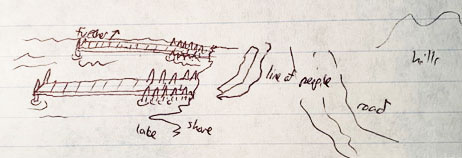
The docks and road along the river I’m driving back home with Wadsworth. We decide to stop at a familiar place along the shore of this lake. There is a big line of people leading to the near dock. What happens is about eight people get on the dock at a time, then all dive in and swim to the other dock. That’s it. No race. It’s supposed to be a lot of fun. Well, we finally get to the front of the line and go onto the dock. Everyone but me dives in. I hesitate, but finally dive in when the rest are about halfway across. Surprisingly, the fat, short, balding man who runs it blows the whistle and says to start over because we didn’t jump at the same time. I question “Why does it matter?” He says something about “togetherness,” so we all start heading back to dock one.
Weird Events: I stumble upon and join in with this lame ongoing event.
-
The Lost Hiker 1997 • age 22
I’m at these snowy slopes with friends. There’s a report that someone unstable is naked and lost, so we go out searching. I go my own way, along paths at the bottom of a cliff and across floating ice. Eventually I see Valentine, half-buried in mud. I ask if he’s the one who was lost, but it’s not him. Then this girl walks by with a downtrodden person. “Ah, she found him,” I think.
Dream Events: Events like this reveal that I’m not always the main character in my dreams, nor the most important. Other people start things which I may or may not hear about, and sometimes the mystery is solved or dispute ended without my intervention.
Doctors
Beware of doctors in dreams. They will do the most horrible stuff to you.
-
Split in Two 1996 • Early AM • age 22
I overheard talk about some big surgery of the ribs for me. Next thing I knew I was drifting out of a deeply anesthetized state to overhear a nurse say to a doctor: “Yeah we separate the body into two pieces during this surgery. We take the hips and below to a whole other place.” I blearily said “Is that so, nurse? Guess I’m not supposed to be awake to hear that,” in a humorous way, grinning at her shocked expression. They took me to a little place with huge paper towels and made this long ripping sound with them as they anesthetized me further. Then they separated me in two, saying “and this side goes left and this side never was.”
Next I saw Emma & Ruby in a waiting room and this sick dorky happy music comes on — their sign to take me to my “special meal.” As we went, I was bobbing up and down slightly, to give the illusion that I was walking. But I was suspended by rubber bands, being lifted and lowered slowly as if I was walking. We walked past a mirror set up to reflect only my top half. We walked a long way, past many people, and finally with big grins they said “And here’s your special place, all relaxed so you can lounge out like a king.” They lay me down on this stupid-looking denim beanbag with an upper torso paraplegic indentation on it. I speak through my drugged state: “This is all well and good except I have no legs. It’s really quite a show you put on. Is it okay to be awake?” They assured me it was okay to get more lucid. My voice was all gravely, so I asked Emma if they’d hooked up my vocal chords wrong. She said probably not. She said they’d checked all my fillings, and given me a whole new set of skin, because the old skin on my arms had gotten old and grey. They held up a mirror to my face. It was powder white with light brown crevices. Truly disgusting. I imagined my cool brand-name tattoo in light purple. They assured me it was very cool looking. I realized that I wasn’t a male right then and missed my bottom half. Then I woke up, laughing as I realized it was a dream.
Never Trust Doctors: Never trust doctors in dreams. First, you don’t need them because your body is a projection. Second, they will do horrible things to you. Every. Time.
-
Dr. Eye Plucker 1997 • age 22
I was getting my face surgically realigned. This doctor took out my eyeballs and held them in front of me. “These are your eyes. They are bad at seeing because (and here I thought he was going to blame my father) . . . because of your father’s anger.” He flashed pictures of me unable to express certain things to Wadsworth and then my face twisting with anger. The surgery was him putting my eyeballs back in my head.
Doctors!: See? Doctors are horrible!
Revisiting Interrupted Relationships
In physical life, relationships and jobs can end abruptly. We don’t just slowly stop going to a school or college — we graduate and then are done. But our long-term focus on those things don’t just stop. Our invested attention only slowly fades from our minds and so we find ourselves returning to those people and places in the dream state.
Break-Ups
When a relationship ends, not due to disinterest but due to circumstance, we often continue them for a time in dreams. For me, this applies most to girlfriends and friends left behind after graduating.
-
Girlfriends Past and Present 1994 • age 19
Kayla’s waiting for me in the parking lot in a yellow car. I go to the wrong parking lot, and run through the rain to see her. I was so happy that she just showed up in Marshall to see me, surprising me.
Kayla and I are running around campus. We talk about having kids and are really cuddly. We have a good time. Bridget calls and I have to be really sneaky and I feel bad. I’m trying to keep Kayla from seeing Bridget and vice versa.
Two Visitors: I had dated Bridget on and off over the last year. Then Kayla and I got back together briefly and then broken up again (it was a long-distance relationship). So here they both visit me in the near-realm on campus.
These dream visits happen frequently in long-distance relationships.
-
Thinking of You 1994 • age 19
Then Avery was there, and I starting rubbing her back. She turned around, looking much older, and smiled. She said “I love you, Sam.” I was a bit surprised. I hung around her and talked a bit, then she ran off with her friend.
Hello Again: This is half a year after Avery and I broke up. Break-ups are hard, and the couple often visits each other in dreams for a while afterwards.
These interactions are always authentic to our true feelings.
-
Visit to Kayla 1997 • age 23
I ended up somewhere I recognized as the vicinity of where Kayla hangs out in dreamland so I decided to visit. She, two friends, and her Wadsworth were sitting on chairs next to a wall in what seemed like a transport station. At first I couldn’t tell which one was her but then one became clear. She seemed emotional as if tears were nearby and she looked intensely at me for a moment before turning away and returning her focus to her father. He was very thin and very tall. He’d gone senile and was staring vacantly at times, at others losing so much of the conversation that he would yell at her for making fun of him or accusing her of talking crazy to drive him insane.
Ever-Visiting: I haven’t included the endless dreams where I visit Kayla. She was my first love, but it was a long-distance relationship, on and off for a few years in high school and at SSU before it ended painfully. The dream visits are never that great, often awkward and unsatisfying like this one. They’ve trailed off over the years. Once I got to Oberlin, I rarely thought of her, so it’s not due to any fresh waking attention. Yet in dreams, I keep visiting.
The same applied to Raven, my girlfriend at the end of high school. Those visits went better, often friendly at least. But I avoided them sometimes, too.
-
The Meeting 2000 • age 25
I’m at a familiar dream school. It is a good, quality school — unlike the Dark Tower. I have a regular class schedule and memories of many days there. Buttercup is there as well. There is a crossroads at a walkway where in the past I have gone to meet Kayla. I am heading to a class when I notice someone that looks like Kayla walking in another direction. It looks as if her face is behind a veil or plastic sheet but as I look (project?) it becomes clearly her. There is a mutual recognition and I tell her we have to run off and find a private room somewhere where we can talk, because if Buttercup saw us together she’d flip out.
So we peek into all these music practice rooms but there are people in them. Finally we find an empty one and sit down at a table. There is a row of glass display boxes there. We talk, and the topic turns to Buttercup, and a big intricate golden machine before us that represents her. As I looked on in admiration, Kayla understood my attraction to her. But then she said something about some imperfection. Now the machine is actually Buttercup, who opens the door and starts yelling at Kayla about Kayla’s own imperfections. This is a little odd . . . maybe I’m crossing scenes but I run off to Buttercup, who is out in the courtyard. She calmly explains that she knew Kayla was at that school and that we’d probably meet up sometime. I’m relieved that there’s no anger about it. She found Kayla less threatening than she thought.
Later there’s a part of the dream where there’s some trouble and Kayla sends out this psychic eye thing and that impresses Buttercup.
A Distant Friend: Kayla and I tried to remain friends after the break-up. It didn’t really pan out in waking life but in the dream world I visit her from time to time. It’s hard to know if this was really her.
-
Hyperspace Warps 2001
I ended up somehow with Kayla, at the college where we meet. We were talking and she jumped up and took my hand suddenly, and we were running down a path at night, familiar as anything, around a curve, woods on all sides, down a lane, and to this open place under the bushes. The intent was for some privacy, and she informed me as we ran that we were going to see Anne. . . . Brockovich. It turned out to be Anne from Y.O.U. and a new boyfriend. I told her of the name mix-up and we laughed.
References: Anne Brockovich is an environmental activist. Y.O.U. is a youth group I went to.
Old Girlfriends: Kayla appears in a lot of my dreams. Our dream interactions have outlasted most others from that long ago except for my family. The weird thing is that Kayla does not regularly enter my thoughts in waking life. At this point it had been about 7 years since I’d had any waking contact with her. It’s as if we continued a friendship in the dream world that had become absent in waking life.
The same is true of Raven.
Workplaces
I find it’s not unusual to visit past workplaces in dreams, especially in the months following my time there. It’s as if lingering thoughts from the routines and relationships with people there draw me back.
-
The Magua Discol 1998 • age 23
So I decide to check out how Definition 6 is doing. I’m there and it’s abustle with new people. There’s a big empty hole where my desk was. I’m talking with Quentin about people’s reactions to my leaving. I said, “So no one even said anything?” He said “No. I was here the other day and no one said a word.” The morning meeting was commencing and Meagan walked by. I said “Hey”. Everyone was lining up at the back entrance and Peter came down the middle with someone, wedding-style, to symbolize the wedding of their company with a new one. They had also decided to combine their names. I just wanted to leave so I slipped out among the others.
Outside everyone was turning around to see their new sign. In yellow and white with an edge of blue lightbulbs was “THE MAGUA DISCOL.” I let out a laugh. “Disco-L? Just put a few more nails in their coffin,” I thought as I awoke.
Checking In: After quitting my job a week earlier, I went to check in and see how they were doing.
-
The Stolen Car 1998 • age 24
I had gone to [Definition 6] again and it was all different — rich oak furniture, no monitors, and very few workers. I thought I was supposed to come in Monday and Tuesday but thought maybe I was wrong and left.
Work Habits: Habits are hard to break. I keep showing up to work. This time I think I’m still working there but am clearly at the wrong place.
-
Visiting Work Again 1998 • age 24
So I’m at Definition 6 playing lots of games while everyone else works. After a while I realize I’m not supposed to be there and I leave. I go to my car outside (outside is consistently different from the actual place) and drive away.
Habits Die Hard: It’s six weeks since I quit Definition 6 and I’m still returning there from time to time in dreams. In terms of community, it was my first since moving to Atlanta.
-
Kicked Out 1998 • age 24
I had a big dream of visiting Definition 6 where Derek was getting really vicious trying to keep me out, and I woke from the dream crying.
After going back to sleep, I returned and got someone there fired. Then they hired three children and an evil dog to kill me. The dog was the real baddy.
Tired of Me: I’ve clearly kept visiting for too long and some people at work want me out. Perhaps Derek was dreaming that someone kept breaking in.
-
Hyperspace Reunion 2000 • age 25
Context: Last night we'd seen the Definition 6 sign in a new location.
I got this call from the sales guy at Definition 6. He asked if I was going to come in. I thought, “Huh? I don’t work there,” but I doubted myself and asked what day it was. He said I should come in but since I can’t remember he’d give me control of all sales calls coming from Alabama. Slowly I regained some lucidity and said, “You know, I don’t work there. I haven’t in a long time.” He suddenly breaks down crying, sobbing, saying he liked me the best and missed me and I should come and visit. So I did, and there’s Oscar standing at the door, so happy to see me. He welcomes me in and the office is much more sterile and plain than before. The sales guy asks me if I want to play Myth with him and I say “No, I used to play those games but I don’t anymore.”
Visiting Past Workplaces: I wasn’t close with any of the sales guys there. I wonder if he mistook me for someone else.
-
Pants Don’t Fail Me Now 2010
Context: I used to work at Turner Broadcasting.
So I’m back at Turner again. I’ve been coming here in dreams regularly since I resigned. It’s dimly lit. I go to my cube and start gathering my stuff to take home. It’s a process of deciding what I most want to keep and piling it into my arms. After gathering a huge amount, I step out of my cube and my pants fall down. People are ignoring me for the most part, and there’s new people coming in to my cube and hooking up wild technology — this huge stack of black boxes with lots of black cables coming out of it everywhere. Some new decorations are appearing outside my cube. I set down all my stuff and pull my pants back up and then gather it all again and go downstairs, which I think is like a mass-transit mall.
Stopping By: I worked at Turner Broadcasting for a few years.
Visiting Past Homes and Schools
We may also return to places we used to live or go to school. In such a case, the current residents might be unknown to us.
-
Revisiting High School 2004
I’ve been thinking about Mordred lately, about how he’s doing, what he’s up to. . . . (This is 12 years after I graduated.)
I dream I’m in a grocery store and walking out with some groceries when I see him pass by with his mother. I reach out and say “Mordred?” and he sees me but keeps walking. His mother stops and she talks with me a little. I walk along with her, talking, but Mordred stays ahead. I ask what they’re doing in Georgia. Mordred’s Emma says he’s doing something in a city I don’t recognize. I eventually run ahead and talk with him, even though he’s not interested. . . . He thaws just a tiny bit but is still cold.
Then later I’m with Mordred and about 20 friends of his hanging out at this college campus. I go right up to him, having just seen him. We make light conversation. Manville comes by with some friends, but I’m more interested in talking to Mordred at this point. I end up hanging out with Quentin and Tony Tam and a bunch of others laying in a pile watching TV, barely conscious. Quentin’s a dealer of some kind.
At some point I and some others visit our high school. It’s modern but badly made, swollen at the seams. I commented about the giant plastic baby doll’s head that used to be atop it (I have no idea where that came from).
Then there’s a long segment where I’m hanging out with Avery and it seems like it lasts days but it’s full of unhappiness and fighting. Just before I wake up, I pack up my things and tell her it’s over. She says she’ll always have feelings for me. I think a moment, then walk out.
References: Mordred, Manville, Quentin, and Tony Tam are friends from high school.
Checking In On High School: My thoughts of Mordred made a connection to him in the dream state. His disinterest in talking with me at this point is likely an accurate reflection of his feelings. But that connection spirals out into other people in our high school friend group, and eventually to Avery, who I knew through connections to Mordred. The emotions there was probably also an accurate reflection of the feelings at the time.
-
Visiting Banana House 2024
I was visiting “Banana House”, which didn’t much look like Banana House. I showed up and went inside. The first person I met wondered if I was a handyman, and I said that I used to live there. There were maybe 8 people living there — young college students. Real people, not projections. The place was a wreck, as it always had been. I asked a little about the landlord, Vince McGillicutty, and one person said they hadn’t heard from him in 10 years, and that they had the same contract going on repeat. I told them some things I knew about the building. Basically I was wandering around, talking to people here and there. I started cleaning up garbage, just to be useful.
Eventually Buttercup showed up and I met her outside. . . . We went inside and I showed Buttercup around. The people were okay with our presence but were also wondering why we were there.
Visiting a Place: I’m visiting what I take to be Banana House at Oberlin College. Buttercup and I last lived there 27 years ago.
The Dream Friend — The Other
In many dreams I find I’m drawn to use the word “we” when describing what I’m doing. It feels as if I am accompanied by an unseen “friend”. It’s not clear upon waking who it is, but there’s always a sense of warm companionship.
Sometimes this “we” refers to myself and the character I’m inhabiting in a rote. At other times I’m in my dream self focus and the “we” refers to my waking self riding along with it. Sometimes it seems to be Buttercup, who I have a long-time open connection with, and who also enters my dream context whenever she shifts in bed next to me.
-
Scratching Boy George 1989 • age 14
My Wadsworth and I were at the top of a snow-covered mountain. We had a sled so we got on and started going down, steadily increasing speed . . . [we end up in a valley with a river] We saw a wooden ship floating by, so I jumped on. There might have been someone else with me, but I’m not sure. It had a flat deck and was purple, orange, and pink. There were three trap doors in it. In the front were three pipes, the captain, and a strange furnace. I had the hammer from Zelda II, and went around hitting parts of the ship with it, hoping to reveal treasure like in the game. I went to the front and put two glowing lumps that were each about three feet long into the furnace. Then the ship started sinking. We all jumped out, and soon fell down a waterfall. There were two more waterfalls, and after the first, I caught a quick-moving side stream. No one got hurt. We came to the shore by a cave-like opening with a huge metal door inside. We considered opening it, but wondered about the possibility of water coming out. I opened it, and found the world of Zork.
References: Zelda II and Zork are video games.
Ridealongs: There’s a “we” which begins as me and Wadsworth, but before long that character fades into a more vague “someone else”.
More importantly, note how my pronouns change. Whenever non-actions happen, such as perception or thinking, I use “we”. When action happens, it’s usually “I” who is doing it. Note the sentence “We saw a wooden ship floating by, so I jumped on.” It’s almost as if the other is riding along with me, while I am in charge of the actions. They are in the theater of my mind, sometimes appearing physically in the scene, sometimes not, but always there with me.
I’m 14 when I had this dream, so the phenomena of the “dream friend” seems to have always been there.
-
From Road to River 1994 • age 19
I’m bounding around a familiar neighborhood with a friend. A lady drives by and asks where a gas station is. We point to one of our gang, the only local. He/she points to a distant Amoco. Then the street changes to a river and the cars become boats. Ruby and I start to go down this river. I ask “is it safe?” It gets fast and fun and we finally reach the bottom — a deep sandy valley.
The Dream Friend: The friend seems to become my sister Ruby this time. She was with me in a similar situation when a car slowed down and asked for directions.
-
Neon Chakra Flowers 1997 • Middle of the night • age 23
I said goodbye to Kelly. I thought she was really cool and said it was nice to meet her. My friend (where did he come from?) said goodbye to her three female roommates who were in the kitchen.
The Waking Self
-
The Disc 1997 • age 23
I was shopping in a grocery store when these really interesting-looking tall aliens gave me this magic disc. There were these controls all over the top front area. I gripped on tight, pressed one button, and shot up really fast into the sky. I was traveling rapidly through space. It seemed like a colored haze at times and then came together. I went to this planet that was supposed to be Neptune. I descended and came down in this area with trees near a red pond. It was red because it was saturated with tiny red motes. I glided smoothly over the pond and saw a tribe of dark-skinned nature people nearby. There was probably a slight awakening because the dream jarred and repeated with a friend coming with me. He overturned the disc and it got lost. We swam in the red pond over to a small wooden enclosed dock where we met two people like us, but who had been trapped there for many years.
My Waking Self: After the jarring from a brief awakening, I returned to the scene with “a friend” — it’s my waking self! The rote rewound a little bit and we can see the influence of the waking self on the same scenes. First, rather than gliding over the pool, we swim across it. Second, the “dark-skinned nature people” take on the form of “people like us” — people from Earth.
The Character I’m Inhabiting
-
The Real Office 2010
We arrive at the first house. By “we” I mean this real-life Minnie and myself as inhabiter/observer.
The Friend: Sometimes the “we” that I refer to is myself and the character I’m inhabiting in a rote. I feel the main character that I relate to enough that I inhabit them to be the “friend” that I’m often with.
-
My New Favorite Movie 2023 • 3:30 AM
It began with a walk. A friend and I were taking a walk through a neighborhood. It was dimly lit out. . . . Then I was coming home alone with Buttercup. It wasn’t our actual house. I think we drove home, and I rationalized a car — it was our green Prius. . . . Wondering now if the “movie” was over, I headed back out into the neighborhood. Walking along, I came to this prison-like area surrounded by a chain link fence with guards. I think I was still with my friend from the beginning.
The Friend: Once again, I think the “friend” might be the person I’m inhabiting on and off in the rote. I think the scene with Buttercup and the explosion might have been either outside the rote or a reverie subdream within it.
Opposition and Willpower
Willpower is the sole factor determining who wins a fight or sporting event.
Fights
-
Army of Me 1996 • age 22
We marched past the castle of evil — Blaine House! I was declared captain of the left wing, but I wasn’t ready. I didn’t have my bow, but a friend let me borrow his. The enemies came from Blaine House — starting with storm troopers. I set the house and the nasties inside on fire with my will alone. The house began to burn.
Will Fire: On retrospect, it’s odd that I’m setting fire to Blaine House when I had recurring nightmares of Blaine House burning ten years earlier.
-
Excessive Defense 1997 • age 22
Context: Last night, Buttercup and I were talking about defending ourselves.
It’s a sunny day, and there’s this big graduation extravaganza in Wilder Bowl. Lots of people are here, hanging out. There’s an extra building serving food near where the gym is. I’m in line to go in. I feel like I’m in this drug state, tripping or something. This man starts grasping at my hat and tells me firmly to release it. I turn to him, meet his gaze, and return his intensity a hundredfold. I lunge at him, screaming to “Let go, you son of a bitch or I smash your fucking dumb-ass face to bits.” He was backing off fast and now took off running. I returned to the food line and all of Wilder Bowl was silent.
References: Wilder Bowl is a greenspace at Oberlin.
Willpower: You can gather a great deal of energy to yourself in the dream state. I usually end up facing consequences as a result of counterattacks like this.
But this was progress for me. After being rather introverted and occasionally bullied when I was younger, I was practicing strongly standing up for myself in the dream state.
-
Cracker Brain 1997 • 4:30AM • age 23
[Cracker Brain] came up the curtain to the edge of the second floor where I was hiding a sledge hammer. Slowly, slowly. . . . I could read its fears. Only when most afraid could it be grabbed and that’s what I did. It got really close, was ready to strike, and I grabbed it by the shirt. There was a big tug of war and my goal was to pull it from the curtains and drop it so it would die. But I gave up fighting because it was just a movie and I just didn’t care (a theme recently). It grabbed me and pulled me off the edge. The film ended and I went to Cracker Brain to find that it was a short, young Asian lady!
Giving Up the Fight: Just like the dream the night before, at one point I decided not to fight anymore. This is the best strategy. In a dream, the fight will last as long as one’s will holds out. Attention only intensifies the negativity, and brings the waking self further into the situation.
-
The Mirror People 2012
On the way past the outside of the office, I saw the obstinate man through the window. I kicked the window hard as I walked past and flicked him off. Then I felt them coming after me. One ran up on me quickly, like a werewolf on all fours, and leapt at me, but I managed to dodge the attack. . . . Then I’m walking down the street again and it’s gotten dark like night. Three of the administrators are about to attack, I know, and they’ve brought along Pete. They all fly towards me on bikes (rationalization) and we fight. After an initial struggle, they stop attacking, seemingly spent of their energy.
Creepy Enemies: The administrators were especially creepy. In each case, there’s one attack and then they’re spent.
Sports
The trouble with sports in dreams is that your acts of will always succeed unless it’s against a dreamer with an equal or greater will. You play with perfect skill and what you want to happen happens — even if it requires going into a subjective reverie to experience it.
-
From Skateboarding to Flight 1997 • age 23
We’re all stopped at this big gas station and hanging out. I decide to skateboard. Instantly I’m really good. A few kicks and I’m circling the gas station and jumping curbs no problem. I start by following one of the other guys, then I go solo. I think I could really get into this. Then Juno is following me around on a skateboard, too. I do this fancy board-flipping trick and I pull it off!
Skateboarding: Typically the skateboard would be a travel rationalization, but in this case I set out to skateboard. There’s no learning curve or coordination needed in the astral. If we’ve seen it, we can do it.
-
Gliding Soccer 2003
I was heading back to the soccer field. . . . They were interested in playing a little, so we did. I found it too easy to score — my kicks were perfectly placed and their goalie kept passing it to me.
Dream Sports: I was able to perfectly place the ball with every kick. A game of will rather than skill.
-
I Suck at Basketball 2010
I was playing basketball in a dimly-lit gymnasium. I don’t know where this came from, as I almost never play or think about basketball. I sucked. I never made a single basket, I couldn’t maintain a dribble, and half my passes were totally off.
Missed Shots: My belief that I suck at basketball translated to the dream. With the slightest effort, I could have made every shot, but I was limited by my beliefs.
I’ve found it difficult to do sport activities relating to rhythm and gravity, such as dribbling in basketball and juggling in soccer.
Traps, Tests, and Experiments
Being Tested
-
The Insanity Creature of the Tower 1996 • 3:15 AM • age 22mature content

The insanity creature The hill with the Tower is actually a pretty place, and ancient.
There was this horrible thing, like pink flesh filling a cup. It had one eye and one mouth. Its eye was wrinkled and unfocused, or focused elsewhere. This was the insanity creature, which we thought we had contained. I was so curious, and asked to take it somewhere.
There was a familiar girl with me, a friend. We were dressed in white clothing. We escorted the thing together, but I couldn’t close the cup. Once inside the Tower, the test began.
Inside, the light was dim. In the middle there was a big, black orrery (a mechanical solar system model) on a big raised dais — like Augra’s from The Dark Crystal. Everything was in a black obsidian style, reminding me of a business office in the 90’s. It was mostly empty.
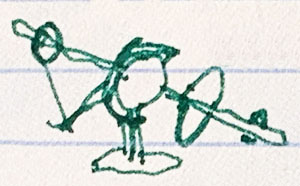
The orrery 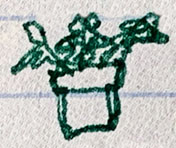
A new herb: Bolero The teacher had found a new herb, it was the opposite effect of marijuana, reversed it, he said, produced a purplish hazy effect. It was called . . . bolero? The leaves were thin with little symmetrical holes in them. The teacher was prepping me.
We walked up a set of wide steps. There was some horrible equipment belonging to the girl: a head clamp, a draining device, mirrors, and various horrible things. The insanity creature in the cup had given me two arm-length, erect penises, and put me on display, for all to see. I tried to hide them, but they were so nice, one had to be proud. It may have been done through the mirrors — I saw myself with them in the reflection. The mirrors lie — it isn’t your reflection.
She removed my glasses and I could still see fine, which proved to me that it was the spirit world. I calculated the picture instead of seeing it, seeing clear lines with light haze around them.
She lured me to her. I was so horny, I almost. . . . I wouldn’t let her go. I needed to be inside her, with both raging hard penises that the thing had given to me. I needed it so badly. That’s all I could think about. She changed and grew and shrunk, and I was forcing myself closer to her. I needed her, and she said yes but only if she could do it her way. I finally gave in and said yes. The moment I agreed, it was already over.
She had given me some intense drug, and used the draining equipment. The light was strobing. She was teasing me — she wasn’t going to let me have any; she never was.
Then Guido R and someone else came down. I pulled out of the drug madness and looked around. I recognized a sign and said it was Banana House. They smugly said “yes it is.” But it wasn’t — it was the Tower. I could control the drug-induced madness at times, but it snuck in everywhere, through those little mirrors that reflected out lies.
The strobing light and drug weirdness were to confuse me, but I stood up, walked around, and cleared my head. I turned off the strobe, almost became lucid, then woke up. That was my success. I got my dream!
I’m fighting this madness every night! See “Thought Form Games at Arcology Hill Stadium”. The games weren’t against Drax, they were against the insanity creature! It recreates reality. One must be stronger than it. It is all selfish desires, weakness, and needs.
References: I lived in Banana House at Oberlin. Guido R lived there too.
Incredible: This was one of the most incredible dream recalls I’ve ever had. So many details were there, even during the weirdest happenings and alterations of consciousness. The pure evil of the pink eye thing, the mirrors, the battle for what is real, and the challenge with the girl where I had to remain in control during the test. . . . It’s awe-inspiring.
To think, this was all a test by a teacher. The influence of the fleshy pink insanity creature, driving me towards sex. The insanity creature was a metaphor for the physical body, the source of all selfish desires. The strobe light was the distracting flash of the brighter but slower rate of physical consciousness. All of this represents the soul’s encounter with the physical creature it joins with in each incarnation. The soul’s goal being not to give in to the confusion and influence of the physical body’s selfish desires.
I was thrilled with the fact that I remembered this dream, which touches upon a deeper level of myself, the nightly work of my dream self.
-
The Interview 2016
I was in a job interview. The environment was very corporate, and I was not enthusiastic about this job. We were in a windowless conference room with fluorescent lights. Everyone was dressed up. I sat near the end of a long conference table, filled with about 16 people. I was one of three applicants for a web job. Someone there said that the other two got jobs there. I figured they had interviewed earlier, since I just got there for the interview.
It turned out there were about 300 applicants, and maybe 10-20 positions open. The interview began, and we were divided into groups of 5-6. The order of the following is uncertain:
At one point, I went underneath the floor in the building where the company was. There was a round glass pillar with open space all around. I stood on a platform. Maybe 50 feet below the platform was a floor that was a grid pattern — not really a solid floor but just the grid. The forms of dead interviewees were down there, all wearing white and red bodysuits. They were sitting there motionless, embedded in the grid. I felt like they had tried to escape under the company’s floor and not made it. It also seemed that the bodysuits were virtual reality outfits and that the grid I was seeing was a peek beneath the pattern. Surrounding the grid of the circular floor were a bunch of stores. There was something else going on down there. People — interviewees, I assumed — were swinging from hanging cables, trying to follow the commands they were given to swing about and break through security measures to attack table-sized blocks in the stores.
At this point I was getting a little more excited about the interview process. Back up on the company floor, I watched as one group of five tried to defend from an attack of some sort, using their powers. When my group’s turn came, I expected the same test, but instead our test was offensive. We needed to get from one end of a hallway, through all these defenders, to reach the interviewer. We were in position at the far end of the hallway. So what did we do? We sat around a table eating breakfast. We had plates full of food — scrambled eggs, biscuits, and more. I felt it was important to keep everyone focused on this and began a conversation, commenting on a biscuit, keeping everyone involved, and it worked. Perhaps focusing on our own little reality made the defenders disappear? At any rate, we passed the test.
At one point I was walking somewhere with one of the people in my group. I told her that I thought she’d make a great defender, that her personality was right for it, and she did well in a test of that type.
Next there was a tour of the office. It was Christmastime. There were stacks of company-branded shirts here and there, meant to be given to interviewees. This part of the office was nice, with windows, and everyone seemed focused, competent, and friendly. But I noticed something. The scene was being overlaid with Halloween. Black and orange decorations appeared. There were black cat decorations. I knew this was being done as a test, but wanted to pretend I was being fooled. I spoke loudly. “Wow, this is great! It’s Halloween, with presents, and all these Halloween shirts! What a great idea!”
I was eventually led to a dining area, with lots of decorations hanging from the ceiling. I sat across from a cool-looking guy with a tall afro, who engaged me in friendly conversation. It seemed like I had made it through the tests. I assessed my situation, and realized I sat in a room with a bunch of young people who had special powers, and nobody knew what powers anyone else had. It was like the birth of a superhero team of some kind, though I didn’t have any expectation of what we were going to do. But it was exciting to look around and wonder what everyone there was capable of doing.
Making the Team: I’m not sure what the point of the test was if we could just summon and eat breakfast instead of what was expected of us. Perhaps it was a test of independence, unique thought, and not getting emotionally involved.
-
The Gods of Art 2025 • 7 AM
I was at a school — some wild school of creativity. . . . At some point [the woman] mentioned a higher level, and I indicated that I wanted to see it. She said to tell them that I was her apprentice, named something like “Amara 2” where Amara was her title. We went up a flight of stairs to a floor that was bright and clean. There were lots of colorful blankets there, and there were a variety of strange people there, not quite human, but humanoid. One type I saw a few of had different colors of skin, one green, one brown. But for all that, they had entirely human personalities. They didn’t question my presence but welcomed me in. I walked in, talked to one or two of them. I sat on a couch and the brown-skinned one flopped down next to me. I said “Hello there!” She said hello and told me she didn’t talk to people unless they greeted her first. But she had expertly put herself in my way, haha.
They wanted to do a dream test with me. Confidently, I agreed. They put a ring of cardboard about 3 inches tall on the floor. I sat before it and flopped my head forward into it. Instantly, I was “dreaming”, but I was still there in the room with them. I sat back up and smiled at them. They were doing tests of some sort and I felt like I whizzed right through them.
Eventually we returned to the floor of flowing art below, and went outside. There was a giant vehicle there, like a car half-transformed into a giant robot. I flew up onto it. There was to be a parade. Other very interesting creative vehicles were beginning to come down the road. The vehicle I was in pulled out into the road and the parade began. It wasn’t long before I was walking again. A bunch of people in orange jumpsuits appeared about 20 feet ahead of us (under a pedestrian bridge). They were walking towards us, and I felt they were there to oppose us. What was I going to do? I felt this was still the test now. I did various dream tricks like ignoring them or just observing them intently. No conflict broke out, no emotions got involved, no fear. I was just having a great time.
Being Tested: I spend a lot of time in dreams being tested. I feel like it may be some kind of training by my higher self. At least the tests are immersive and entertaining.
Astral Experimenters
-
The Orange Light 2014 • 3:40 AM
I am living in this house with Buttercup and the kids. While there, I hear this loud grinding, buzzing sound for about 7 seconds. I hear a mental news report or people’s thoughts, talking about the destruction that took place, and I go outside to investigate. I see a girl (maybe 6-8 years old) and a seven-foot tall tree. The story unfolds to me — there was an orange light on the tree that turned on and then killed a bunch of people and destroyed a bunch of things. Instantly my thoughts turn angry against it. The orange light comes on. I know not to look at it, because once it’s on for 7 seconds, it visits nuclear death upon the ones triggering it. As I become distracted, it turns off.
Now this scene I replayed later on, and so the two are mixed, but I recall mistaking the girl for the source of the orange light. So at least the second time, probably both, I was facing the tree from up close while the girl circled around it maybe 10 feet away. I made sure to keep her out of my sight by keeping the tree between us as she walked around.
I returned to my house, terribly scared of this orange light. As I walk around inside the house, I notice that both the upstairs and downstairs bathroom windows face out towards the seven-foot tree. I have to use the bathroom, but fear to go in it. I imagine myself not being able to use the bathroom in my house in the morning or evening. I decide I can’t live that way and decide to do some experiments.
The first I don’t recall . . . perhaps testing to see if objects can set it off. In the second experiment, I test to see if animals can set it off. I feel bad about doing so, but grab the cat and set it in the window in view of the tree. Nothing happens, even when it looks that way. I remember thinking I need to protect Bodhi and Gwen from this thing. At some point something in the house makes me angry and the orange light appears over it. The orange light is circular, reminiscent of a traffic light, and superimposed over whatever I am getting angry at. I have 7 seconds to stop being angry. I manage to do so.
Then I’m setting off with a bunch of people. We’re driving to a facility to test the orange light. On the way there, something in the traffic upsets me and the orange light appears. I calm myself and it turns off. My face becomes relaxed and passive and I let my thoughts move to other things. When we arrive at the facility, we put on space suits, ready to run a series of tests or training missions in a series of tightly-sealed chambers. The tests begin: we encounter purposefully upsetting situations, and we try to relax and not let it make us angry. If it does, the orange light comes on and we have to stop being angry in time.
There are several rounds of this. In one I fail and a nuclear bomb explodes on my group — the result of which is that I feel I am almost certainly irradiated and will have health issues due to that. In another I’m doing pretty well, but we see a nuke go off in the chamber across the way, and the blast is so strong that we are also destroyed. I see the screen representation of both the chamber across the hall and ours turn red.
I become quite good at letting go of the anger.
I am back at my house again, with some people who I think are from the training sessions. I’m playing a game with the orange light and several children now. I’m no longer afraid of it. If it appears, I instantly turn my attention elsewhere and let the anger go. There is a pizza delivery, and I think the Beeb is there, too. There are several more instances of the orange light appearing, but I always overcome my emotions in a second or two. I revisit the 7 foot tree, replay that scene again, and the orange light never comes on.
There’s a long scene in a fashion store as well, with the ever-present now-minor threat of the orange light, which makes a few appearances — the longest of which is outside the front door of the store across the street on a billboard.
I have learned good self-control, but what a truly horrifying dream! It was like behavior modification with the most blunt of instruments.
References: Lewis was my high school nemesis.
Behavior Modification: This is clear behavior modification. It’s horrifying to realize (after waking up) that you’ve likely been the subject of an experiment. But I did learn emotional self control from it. Consider Monroe’s astral training rotes, which he did as challenges to advance himself. Perhaps it’s like that.
-
The Observers 2015 • 7 AM
This follows the dream “The Madness,” which I awoke from at 4 AM. In that, I was trapped in a rote that was difficult to escape from. I suspect that the following might be the same place from a higher, more detached perspective.
The second part of the night was remarkable and strange. It followed some siblings, and a whole cast of people that (I think) they didn’t know. Over and over and over again, the observers took a set of circumstances and tried to get the siblings to do something. The circumstances took a shape, like a building. Each successive scene, the building got bigger, taller, deeper, and the observers became more numerous. It may have begun as the roller rink in the earlier dream. But after each iteration it became larger and more abstract, soon hanging in space. Before long, the building was mere outlines, when viewed from outside. The observers were focusing on a girl from the siblings. But about three quarters of the way through realized it was the younger brother — the strange adept, the savant — who held what they wanted. With him, they tried flattery and appeasement. At this point, the building was large and very deep now, coming to a point at the bottom. They offered him a special train ride, but rotated the perspective so that the train was facing down. They wanted to get them deeper into the building. It worked. After a little while, near the bottom, one of the siblings asked a question about evolution. In response, they went through a thought gateway into a wide grassy field to look at and study these different animal versions of themselves — monkeys and horses, I think.
I wish I remembered more. What were they looking for?
Experimenting On Dreamers: This is so strange. A group of entities who understand the nature of the astral world is running these people (dreamers?) through a rote, trying to elicit some behavior or reaction. While I don’t know what the purpose was, what’s important is that there are goal-oriented entities who are able to manipulate the simulation’s circumstances. They didn’t seem sinister in any way and were happy to answer one of the siblings’ question at the end. It seems more like curiosity.
Were they trying to get me to the bottom of the structure in my simulation? Deeper into the madness of the basement? They sure did try hard to keep me in it.
Places Made to Prey On Dreamers
It surprises me how many times I’ve encountered places that are made to prey on dreamers. It’s not something I’ve ever read about. These places seem like they’re meant to trap dreamers within like a venus flytrap. They use a variety of tricks to accomplish this, playing on our fears and desires.
These places are made to trigger us into a “waking self fragment”, a state of shortened context in which the waking self fully believes that the dream is waking life with all its consequences. This usually results in the expression of strong emotions, which may be their purpose. We essentially act as power generators for those in the lower astral (where these places are) that have cut themselves off from the flow and seek energy from others.
Put this together with dreams where the dreamer appears to be tested or experimented on and the behavior modification of “The Orange Light”, and it paints a unsettling picture of some of the things going on in the dream world.
This isn’t just an astral phenomenon. There are people in waking life who antagonize others and feel good when they do — they are unknowingly absorbing the emotional energy their victims release. In fact, there’s a stage of childhood where children (boys, usually) get a rush of energy every time they antagonize someone. You can see it in the smile on their face afterwards. This may be a response to the separation of the dream self and its stronger flow of energy at around the age of 7. This may continue to differing degrees through the next period of their lives, from 7-14. They “rage bait” another person unless he is “cool” or “chill” — a reference to the diminishing returns of emotional energy coming off them. My son’s own strong emotional reactions encouraged more antagonizing behavior until he learned to let it roll off him. Perhaps that’s why so many men grow up to be emotionally closed and unavailable — a state of being closed off to the flow of energy.
-
The Virginity Test and Demon Battle
I’m walking along Hwy 65, and I see Raven. She sees me, too. I avoid the really treacherous crosswalk and catch up with her. We begin talking. She tells me she’s playing guitar now and writing cartoons. She shows me. Though slightly juvenile, the cartoons are an improvement. We end up at this house. Inside, we continue to talk. Suddenly she jumps on me and starts kissing me. Then it is as if a narrator appears and says “A spirit took over his body and forced him onwards. He resisted, his face turning red as a tomato, but the spirit was strong. . . . ” I wrenched free from the spirit’s clutches and held Raven back, saying “No, this is not right. This isn’t what I want.” Raven pleads “Why?” and trying to cover up my true feelings, I say “It would really complicate everything.”
Suddenly a voice booms something to the effect of “Who’s been in my house?!” The scene changes slightly. Raven is laying on this bed with this long flowing dress. There is another girl in another long flowing dress on the other side of the room. These two partially transparent shadow-men appear and say “Who’s virginity has he stolen?” They check this vial of pink liquid by each girl’s bed. One man takes off the lid and I know that if the stuff floats out into the air and glows brightly, they are still virgins. It does for both of them and the ghost-man throws me an approving grin. Then he goes into another room where lie four more girls in similar dresses with similar vials. He checks them all. All still virgins. The shadow-men disappear. I look at the girls. One of them is Kayla! I know that they are all the princesses I must choose from. Raven comes up to me and asks me to go away with her. Before I can answer, a voice booms out “No! Can you not see? You are not the one he wants!” She begins to ask “Who is the one?” Then all the girls are sitting on this big plush bed with drapes.
The Narrator’s Test: This house is clearly a malevolent dream trap, with its own narrator that tries to influence me. Its goal is to tempt people and then punish them if they give in. The voice was even using the power of suggestion to make me believe I was possessed by a spirit to get me to give in. But it didn’t work, and I passed the stupid test.
The narrator was testing me, but at the end spoke my own thoughts out loud. Though in dreams, reading another’s thoughts is trivial.
-
The Predatory Club 2003
It’s dark out. Buttercup and I and two others are going from club to club. There are a few along the street we’re on. We see a new one up ahead. The title is in big dark letter-symbols. We go in and sit at a table on the ground floor. It’s got a rustic, unfinished, but purposeful look, with a wooden floor. Upstairs is a dance floor. The menu has drinks and food. The cost is thus: the first three things for each person costs 75 cents total. The 4th thing costs 79 cents. The fifth is around $5.29. The 6th is $30. The 7th is $3,000. The 8th is $300,000. We joked with the waitress about the pricing, but I was wary. I knew this was a trap — that if you had 8 you’d end up working for them. I had three choices of drinks and food then went upstairs. While there I lost track of time and everyone I came with. I saw Jack Black and someone else famous, but they weren’t animated. I danced.. and blacked out. It felt like much later that I came back downstairs, and felt bad for leaving the others for so long. I was scared about how much I’d had, not being able to remember. It turns out it was only 5 total. Scary.
A Sinister Dream Locale: This seems like a true place in the dream world, custom-tailored to lure in and trap dreamers like a carnivorous plant. The initial deal is too good to pass up, but a distracted dreamer would easily lose track of how many things they ordered. And if something about the place caused you to black out. . . . Now of course they can’t keep you there, but they can make you very emotional about owing $300,000, and they can feed off that energy.
-
The Wild Bus Ride and Parasitic Moths 2012
In the next building, I decide to get something from the administration room. The entrance to the administrative room is a round barrel-sized hole in the floor and there’s a totally naked oiled-up lady sitting on something so that her top half is outside the hole. Undeterred, I go around her and squeeze through the hole into the administration room, which is a short room — fit only for crawling. I find what I’m looking for and squeeze back out the round opening past the oiled naked lady. I have the thought that a lot of people would probably be jealous of me pushing past her, but to me she’s just in the way.
At some point I decide to leave the camp entirely. As I go through the forest to escape, the environment gets trippy as things move and change in front of me. It’s clear to me that the woman running this place is a witch and doesn’t want me to leave. Vines and branches move to block my way. The landscape changes, lengthens before me. A field with a path becomes a dead yellow area with a dead tree whose long scratchy limbs are hard to get around. I am aware of these attempts to block my escape, but I get through them and am able to leave.
The Witch’s Den: This is very interesting. We have a very short room which needs to be descended into. And guarding it? Something sure to distract teenage boys (which this area seems to be focused around) — a naked lady. It would distract anyone with a short attention span (short context) attempting to get through. I have a strong focus in this dream, so I’m not falling for tricky stuff. Failing trickery, the dark spirit turns to more direct methods — molding the astral environment to keep me from leaving, but I was able to push through the obstacles.
-
The Mirror People 2012
[I find myself back in high school] I realized that I didn’t need to be here — I could just go home! Walk out and not come back! So I headed straight to the administrative office.
A blonde girl with a wicked look was helping someone at the counter. She was talking to this tall trailer park kid named Pete. She put his last name down as “dopey” in the form she was filling out. She was being subtly cruel and nasty to him. I got her attention and she said something nasty to me as well. I let her have it verbally. As I spoke, more of my memories came back to me — I was 38! What was I doing in high school? I was married! I had already graduated from SSU and Oberlin. She got upset and lost her shit. She had a violin case which she threw down the counter. . . . The others behind the counter were ignoring me so I focused my attention on one of them and asked how many credits it took to graduate. He blew off the question and started talking about something else. I repeated myself, raising my voice. He asked for a degree of how many years. I said four. He started trying to distract me and tried to change the subject, so I shouted the question so loud he finally cracked, and, trembling, told me the number. “And how many credits do I have?” The fellow who seemed to be in charge there was at a computer, unruffled. He drew my attention to this mesmerizing color pattern on the screen. It didn’t work. I pushed harder. He hardened and changed the subject. It became clear he was going to obstinately avoid telling me. “Well, I know I have enough credits,” I thought. I stormed out, down the hall, and out the front door of the school.
On the way past the outside of the office, I saw the obstinate man through the window. I kicked the window hard as I walked past and flicked him off. Then I felt them coming after me. One ran up on me quickly, like a werewolf on all fours, and leapt at me, but I managed to dodge the attack.
I was done with high school! I began walking down the street looking for my car. I could still feel their anger at my back. . . . [I escape from a house and withstand another attack]
I’m looking now from a perspective a few hundred feet off the ground, and see Pete’s house in the distance burning with this blazing white/pink-red fire, and I know it’s a trap. I know it’s to lure me over there to save him. . . . I am back on the road on the west side of the school, and it’s dark again. Another attack is coming — this time from five administrators. . . . I begin to lift off the ground, and the world bends away spherically. The grid flexes into different hills, and I somehow know that one neighborhood I come to is known as “The Whale”. It’s got a big bend, like a big hill, and it’s very large. I feel myself being drawn down into it, and I’m trying to pull up. It’s around here where I wake up.
Flytrap High School: This is another place meant to trap dreamers with shortened context. It’s kind of disturbing how many of these I find. The high school administration area is a place designed to distract you from answers, to aggravate you, to keep you in high school forever.
When more subtle emotional distraction attempts fail, more obvious attempts like the mesmerizing computer screen are tried. It seems it would have been easier to just lie, but perhaps that’s not permitted somehow.
But even when I escaped the high school, the administrators were trying to keep me trapped in the neighborhood by getting me to buy a house there, and failing that — fighting me. So many tricks and traps — like the fake burning houses — meant to draw me back in.
-
The Madness 2015 • 4 AM
There was a long crescent area that went around the rink, and at the far end there was a doorway to stairs going down. It was quite dark, and the people over there were mostly dressed in black outfits and costumes, but I could see glowing dust on them. The stairway heading down had that same glowing dust on the stairs. The announcer said in a half-joking voice, “I wouldn’t go down there!”
[many adventures later. . . . ]
Progressively things got more wild and crazy, the people gathering down there acting more and more drunk. It was fun. It was more an uninhibited, raucous drunk. Not blurry or clumsy. I was having a blast and laughing and being so funny. But there was an edge of madness to it all. . . . At some point I decided to leave this place. It wasn’t easy. I made several attempts, as there were replays involved. Each time, it tried to lure me back in with all kinds of distractions. Typically, I made it up a few sets of stairs from the lower rooms (seemingly always bringing others up with me), and I would find myself at the landing a step down from the main roller rink floor. Each time I approached, tons of black cratered asteroid-like magnetic balls and rectangular magnets came flying towards us. These detached from the floor, from the structure of the threshold. I knew I had to shake them off as quickly as possible as I ran through the threshold to the main floor. At that point, I’d run along the crescent, past a dark counter full of vendors providing various services and things. Sometimes I’d get sucked back into it by watching the dancers, seeing attractive girls in their costumes or innovative dancers like the guy in the weird suit and top hat, whose bottom half was hidden by a screen that showed legs dancing as his top half danced weirdly along with it. On a few of these escape attempts I saw the wait staff looking angrily at me, and I said something like “I’m sorry! I promise I won’t come back again.” I felt like I’d made a terrible mess somehow.
On one especially insane escape attempt, I wound back into the scene because this girl dressed in all black with some interesting accessories grabbed on to me. She whispered in my ear that she had finally found me, that she had been wanting to see me again since the first time, that she really liked me. She said she wanted to get it on with me. She must have had butterfly costume elements, as I said “We could make little caterpillars” and I started to feel in the mood. But then I heard a voice calmly say “Brother. Brother, it’s me”, which shook me out of it. The voice came from a big, round man sitting in a chair near the entrance to the underground rooms. He held me in a bear hug. I stepped back, realizing it was someone like Bruce H., a strong, calm, benevolent person who was on my side.
I knew I had to rescue Buttercup and Fiona from the madness. I focused myself into perfect clarity of purpose and went through the threshold and down the stairs. The madness reeled around me, more wild than ever, but I stayed separate from it. I went down 2-3 levels and finally found them in a crazy scene. The floor was scattered with huge buds of weed, and they were among a bunch of people on the ground, trying to gather up as much as possible. Neither had a shirt on, but were wearing bras. I looked at this scene with calm detachment. I got down next to Buttercup and told her she was coming upstairs with me, and then said the same to Fiona. I put an arm around each of them, and led them up the stairs. I walked them up past reeling drunken scenes of wild partying madness to the threshold. I made a run for it through the oncoming magnetic pock-marked balls and rectangles, and brought them through the opening. The kind, calm spirit that looked and felt like Bruce waited for them and took them into his arms.
To escape the building, I had to force myself through an invisible window boundary a few levels up. In one attempt, I careened towards the street head first, but I was unafraid, as that was the fear blocking the exit. I landed on my feet. Another time, I scaled down the outer windows and jumped down the final story. But then the area around the building was blocked by invisible barriers. I made it through a few boundaries that would have kept less experienced dreamers inside. Finally I was running down a street, and realized I was on an island — the final boundary. I vaguely remembered arriving at this island earlier in the night. But. . . . I got distracted.
Come On In, but Don’t Try to Leave: Here I have stumbled into a predatory dream location that doesn’t want to let me out. What tricks it used! The first one was using humor — which is an unusual thing to find in a basement. Then it used a wild, uninhibited, drunken feeling as a draw. When these positive influences failed, it turned to an aggressive physical attack using magnetic rectangles and balls, which is like nothing I’ve ever seen before. Then there’s the most straightforward and common method: distraction — the dance competition, the vendors, and when I seemed likely to escape, a sensual girl latches on to me. There was social pressure from the angry wait staff, fear of pain from dropping out the window, and there were physical-seeming boundaries — the windows, invisible barriers, and finally an ocean.
It’s interesting that as much fun as I’m having, my entire goal quickly turns to trying to escape, and trying to help others to escape as well.
-
Disney Park Madness 2025 • 3:45 AM
Context: We've been very much into theme parks as of late.
It was night, and I was lost in this huge Disney theme park. I had arrived with Buttercup and the kids, but became lost. I was in this wandering, drunken state. I was at this Star Wars show. I saw everyone getting a box of gifts, and I went to ask a steward for one. He brought me one — it was this box with random stuff in it, including a replacement shell for a remote control — nothing I found valuable. He also brought me a large box that seemed like it had been meant to be delivered to me. It was a bike pedal and something else, packed as if it were bought used. I quickly remembered (concocted) a story that I had bought this as part of a video game for Bodhi when he was really into trucks, and told the guy I must have ordered it 10 years ago because he was 14 now (this is correct as of two days ago). I asked him to return it and credit me the $15. After this, I went somewhere, got lost, and then started wandering around looking for my boxes, even though I didn’t care about them. I spoke to another steward and she didn’t know about the boxes, but offered me a souvenir drink satchel that hung around my neck. I took it, thinking it was just compensation for my troubles, but as I walked away, I realized it was meant to replace the value of the boxes. I didn’t want that deal! I went back to her to give it back but couldn’t find her again.
I wandered the park like a drunk, it seemed, without a clear plan or goal. My mind state felt like madness and short-term memory, the delirium of being very drunk. . . . After a while I realized I had lost my shirt and my phone also.
I found Buttercup and the kids in the front row of this Star Wars show. I only spoke with Buttercup, who was more clear-headed. They were about ready to go, but I told them about my lost phone. We went to a steward, who took us in an elevator up to a store where everything for sale was organized by color. We stood by the hot pink items. The steward disappeared behind a door. I was only able to wait for eight seconds before I lost patience and wandered off on my own again.
I returned to the ride where you held your hands up high to control it. I had checked this one for my phone several times, but checking it meant riding it to another area. I accidentally went through the Rapunzel show area several times. It was like a stadium with many levels. Near the entrance was a Star Wars ride (no line!) that took people to the Star Wars area, which was I think just the Star Wars show. . . . I spent much of the dream in a panicked search for my missing things. I kept finding stewards and asking them, but kept coming up empty handed. . . . I found Buttercup and Gwen again (I assumed Bodhi was there in the crowd behind them). Eventually I was reunited with my phone. I almost lost it again minutes later when I set it down to rifle through a box for a free “treasure” that I saw ahead of me in a map in my head. The treasure was garbage, as usual. I almost picked up some pirate stickers, but upon opening the package, realized they were not great.
It was getting late and we were anxious about missing our flight back home at the end of the night (this was just a day trip). . . . I think we were close to an exit when I woke up.
Disappearing Gifts: Emotionally harvested again.
The idea of giving gifts in a place with big shows and rides is a clever one. Once we switch focus to a big show or ride, the gift thought forms fade away. But in this case, it wasn’t even necessary since I was in such a delirious state.
I don’t know why I was so keen to get the garbage treasures back. Perhaps because they were gifts from a big theme park experience. My lost phone eventually became a more realistic thing to obsess over finding. But notice that once I found it, a map appeared in my head with a new free treasure, and I almost lost it again. That kind of timing shows intent.
Structurally, this place was very, very hard to escape from, a multi-level maze with endless passageways, rooms, and distractions. I kept asking for directions and being led seemingly closer to an exit, but they each led back inside. Very much a place to trap and “harvest” dreamers emotionally.
I had a very similar dream three months later. I took a day trip to Disney World, was surprised to get an “exclusive gift” and promptly lost it while watching a show. I spent a long time trying to locate it.
Others in the Astral
True Dreamers
On rare occasions, I’ve spent time with another dreamer focused in their dream self, using an intimate knowledge of the astral world.
-
Lucid: Colored Pots and Pans 2000
I joined [Marilyn Manson] on the way over. We talked deeply and honestly and it was joyous. At one point, I said “I bet you like the rush of emotion.” He began running all about through the grass and I joined him, running at turbo speed, just loving the feeling of it. Then we looked up ahead at a vast landscape of colored pots and pans stacked into towers with a path running through them up to this huge tall black pot. I suggested we go up the path and we did. Marilyn said he felt like he was coloring the pots and pans with his mind as he looked at them. As we got on the path they turned to cars, still stacked and still colored.
References: Marilyn Manson was a musician.
Another Dreamer: The fact that “Marilyn” thought that he was the one coloring the pots and pans with his mind not only is strong evidence that he was another dreamer, but that he was strongly focused in his dream self at the time, which is also supported by the deep, joyful conversation we were having and the turbo-speed running we were doing. All of this points to an awareness of the dream state and the ability to consciously control it.
Pranksters
I love running into astral pranksters. These are people in their dream self focus creating humorous situations to mess with people.
-
The Rude Waiter 1996 • age 22
I’m at a table with Uncle and another guy. We’ve asked the waiter to play a trick on Uncle. Uncle is a vegetarian and the waiter has brought him meat. Then the waiter cuts his eggs and throws a bit on the floor. Then he flicks a half-eaten shriveled sausage across the table onto his pancakes, saying “Here’s your raisin, sir.” The waiter is so animated and funny. Then he moons Uncle from outside and comes back and calls him an asshole. Then he brings his “ice cream”: a frothy mixture in a white cup, almost all foam. It’s horrible tasting and on the side are written all kinds of things such as “You are an uncivilized toad.” The waiter dances around mockingly as he reads these things to him. My God, I had to try so hard not to burst out laughing. Uncle was so flustered he didn’t know what to do!
Humor: This scene was so incredibly funny. I love running into hilarious people in the dream world.
-
Thanks a Lot, Lance 1996 • 6 AM • age 22mature content
Context: Lance was my sister's boyfriend at the time.
I arrived at Blaine House, and Ruby helped me unpack. I was staying in what used to be my parents’ room, and Lance came to see me. The rave fliers, various knick-knacks, and surprisingly, all these sex toys were on the bed. Suddenly Lance is on his back with baby clothes on and shaving cream on his face and I’m sticking my plastic-wrapped toe into his butt. He makes some funny comments about how much he loves it but he wished my toe was backward. Why? Oh, to get his g-spot, of course. I told him how scared I was that Wadsworth would come in, and voila! Wadsworth charges in the door without knocking and does a double-take on Lance. I rush to cover the sex toys with a blanket. Wadsworth loses his shit and gets crazy mean. He tries poking his fingers into my life and I get vicious mad back. Lance has reverted back to himself, wearing a dark blue sport shirt, leaning back, and smiling. Then Emma comes in raging, and demands my shoes. I throw them at her (in waking life, my arm slams the bed) and say “fine, take them.” Then I change my mind and say “No, fuck you, they’re mine, I bought them.” They both gasp and look at me with hatred. Then Buttercup wakes me up.
Lucid Pranks: Lance’s actions all seem very deliberate to me. From dropping in, to instigating that scene with the baby clothes and shaving cream, to leaning back and looking amused when Wadsworth stormed in. I have to think that really was Lance having some fun at my expense. I’ve been known to play tricks on other dreamers when I’m semi-lucid, but certainly not like that.
-
Lance’s Xmas Present 1996 • age 22mature content
It’s Xmas with Buttercup’s family, but instead of her brothers and sisters it was Lance and his new girlfriend. I was taking a nap when it started. I awoke to Buttercup dangling a Nintendo 64 over my head. She had got it for me because her parents didn’t get her one. I was too tired to fully realize how awesome that was. Buttercup got one for Paige, too. I asked why we were celebrating on Xmas eve and Buttercup said her Wadsworth blamed it on the cat. More gifts were opened and her parents fell asleep. I told Lance to show everyone his penis and he took it out and it got hard and was 1 1/2 feet thick and 2-3 feet long and filled his entire lap but his testicles were little. He was thrilled, and everyone else was shocked. Then he tucked it away. It sorta sucked, for Xmas.
Prankster: Obviously, I can’t blame Lance entirely, since it was my suggestion. But he didn’t have to make it so ridiculous.
-
The Wild Bus Ride and Parasitic Moths 2012
People on the bus begin shouting in amazement and excitement. It’s something about the bus driver. It’s hard to see at first, but I eventually get a glimpse of him. He’s facing back towards the people on the bus, smiling knowingly — he’s not looking where he’s going! The bus is heading towards the side as we approach a steep hill. There’s this moment where I feel we collectively give permission to go over the side of it, and we do. It’s a big bump and the bus tips to the side. For a moment I’m afraid it’ll tip over but it doesn’t. My perspective has shifted to a higher point of view just above the bus, and it remains there as I see the bus head towards a phone pole, then slowly adjust to avoid it at the last second, then towards the edge of the road, then back in the nick of time. Suddenly I realize the driver is outside the bus! He’s walking along the road with that big smile and I realize he is somehow directing the bus on this wild ride, going over big bumps, and almost hitting things before swerving away.
Then the bus goes off-road completely. It heads down a red clay embankment with scattered trees towards a little stream. My perspective is now above the front of the bus, so it feels more like it’s ME moving rather than the bus. I wonder if the driver dares take us across the stream, and he does, crossing back and forth across these shallow parts. Then we go over a hill and come to a wider stream. Does he dare? He does! We splash over the stream and continue.
The Playful Bus Driver: The bus driver is clearly having a good time with the bunch of us. Typically in group travel I think the destination is set, but perhaps our moment of collective permission allowed him to take us for a joyride.
-
The Ghost Lady 2023 • 4:30 AM
We got onto this parked bus that was mostly full of people. This was where the ghost was. Buttercup indicated the back. There was an open seat in the back row near a twitchy crazy lady. Apparently she summoned the ghost. I was excited to see it. I sat in the back seat. She was seated on a side-facing seat right in front of me. A few seconds after I sat down, she began to shake her hand, then extended her pinky and thumb and made a gun cocking noise “ch-ch” and then, looking at me, said “ooooh he’s awake”. She stopped summoning the ghost. So I closed my eyes. I waited a couple seconds and then opened them. She was looking right at me. I closed my eyes for a bit longer, and I heard the “ch-ch” and I opened them. She said “ooooooh he’s still awake” and stopped. Okay, I had to time this just right. I closed my eyes again, just concentrating on the dark, relaxing, waiting. I was going to give it a good long time this time. I turned my head to the right and laid it back on the seat, unconsciously matching the pressure from my pillow in waking life. 10 seconds, 20.. and then. AND THEN. I heard this “RAAR” in my ear. It sounded like someone speaking in a monster voice, like it was spoken directly into my physical ear, pressed against the pillow. This wakes me up.
I wasn’t scared, but I was surprised. It felt like someone had played a good a joke on me. I was impressed. The crazy lady and her pet ghost trick. Bravo, haha.
The Ghost Trick: This whole thing feels like a prank set-up. The lady in the astral seems to like to play tricks on people, and she gets me right in the mental state she wants before unleashing the cute ghost sound right in my ear.
-
The Madness 2015 • 4 AM
At some point I went down there. It was a series of underground rooms. The order here is all scrambled, as I seemed to relive it and go through it several times. Not long after my first time going down and meeting some people there, we were joined by “John Cleese” (actually Chevy Chase), and I was completely familiar with him — as if we’d known each other a long time. He and I and two people were waiting in chairs in the first room at the bottom of the stairs, and someone came in. John (Chevy) said something like, “I don’t know who we’re waiting for.” Someone else said “or what.” Someone else said “Or when they’re coming.” And then I said “or why” and felt it was the missing piece to the joke, and then John pulled a little silk scarf off a picture which revealed that the picture was of a man’s firm belly, almost showing his “little friend”. The person who came in was shocked and mortified. I laughed and laughed and laughed.
I went to explore the other rooms down there. They felt somewhat like rooms in a college house, with cheap furniture and a brown shag rug. The atmosphere was of one slowly becoming more and more drunk. We re-ran the gag in the front room a few more times. I wanted to shock more people with it. But Cleese wouldn’t play along after the first time or two. He changed it up each time, sometimes hindering me, sometimes throwing the whole joke out of balance with an unexpected picture, leaving everyone hanging. At one point, he ran back up the stairs and I yelled “Cleeeeeeeese!” He came back in a minute, and I said “My Emma is here! Let’s do the joke on her!” He asked where she was and I pointed her out in the next room in. He sat next to her and started making out with her. I was horrified. Then after a little bit, his lips and hers began to expand out into big flat pancakes with holes in them, at which point he got up and sang this funny song about their pancake lips . . . it invoked an image of using your lips on too many kitchen tools or something, as if that’s what happened to them. Very funny stuff.
Humorous Banter: I was having a total blast with the clever Cleese/Chase character, who was adept at breaking everyone’s expectations.
Spirit Guides
-
Guardian Spirit Leila 1992 • age 18
Awake: I’m staying at Kayla’s. She tells me of Leila, a guardian angel of hers. She tells me that Leila makes her presence known by knocking (on a theater seat, on a desk). She tells Leila to watch over me tonight. I go to sleep.
Excited dream. I feel like I’m right above my bed, looking at a computer screen. It’s cycling between detailed schematics of figures, including one that is very large. I was examining statistics and body diagrams of different life forms in red, blue, yellow, and green in great detail. I sense ten angels in all. I want to learn about the large one, sensing perhaps that it represents Kayla’s guardian angel. The images on the computer screen are coming faster and faster, flashing through brighter and brighter colors, accelerating to this incredible speed. So I dive into the large one and I see whirling colors, and I’m suddenly awakened from sleep by 3 loud knocks on the 2nd story window by my bed. There was no fear, only wonder at the knocks. I settle back to sleep.
This time I dream of a large building with circular black supports, lots of windows, and a circular glass elevator in the center. It is night and cloudy. A flame shoots up through the center glass shaft of the elevator, and I sense some disaster coming. I climb down the shaft and leave the building. I emerge in this parking lot with scattered cars. My Dad walks out from between some cars and says something to me. Then he walks off, leans forward, and takes off flying. I watch, amazed, and say “Oh, so that’s how to do it!” I lean forward, lift my feet up, and fly. I recognize myself as the 2nd one ever to fly. It’s an amazing feeling. I fly for a while. As I do, others walk out into the parking lot, and also fly. I land and am immediately woken up by another series of knocks on the same window. They are faster and more insistent this time. Again I felt no fear, only amazement.
I fall asleep again and wake up an hour or two later, so warm in this usually-cool room that I remove the covers as well as my shirt. Then I fade off back to sleep and awaken, cool again, the next morning. A truly spectacular and strange night. Thank-you, Leila.
Leila: This was simply incredible. I have never had such memorable interaction with a spirit as this. To have something happen like this without the slightest feel of strangeness or fear in the air, only wonder and awe, is certainly a sign of a good entity.
-
The Boar 2003
Context: We saw a boar on the road in Florida yesterday.
Suddenly a boar appears at the edge of the water. It’s huge, and it’s fighting two dogs, utterly enraged. I’m dressed strangely, with a cape, strange accessories, and a large golden poleaxe. . . . I lift up the poleaxe, but now the boar is running along the bank towards the others. There is someone in charge, too — a spirit guide, who looks to me with penetrating eyes to take action. I do. I run to the shore and bury the axe in the beast’s back. This is a giant boar, king of boars. It’s wounded. I give it several gashes as it runs about.
Then I am back in the lake and the boar comes to me. The spirit guide person is near, and speaks knowingly into my mind that I must kill it. I am saddened by this. I want it to go off and heal. I feel everyone in my head, and I know they know my sadness. The beast circles me and perhaps it attacks? I let fly with the axe and cut its neck, but I must hack it several times, through muscle and sinew before the blood starts flowing. The beast stands, then falls, and the water is colored with its blood. I return to the shore, seen as a hero by some, while others are sympathetic to my sadness.
Spirit Guide: Often the sign of a spirit guide or advanced soul is the penetrating eyes that can focus your attention and jolt you to lucidity. This guide seemed to know what had to be done here, even though it wasn’t what I wanted to do.
This was a rote from a distant age, but I’m unsure where it came from.
-
Daredevil Spirit Guide 1996 • age 22
I had a dream earlier all about my spirit guide. I remember one flash right now of him wearing a daredevil helmet and a funny suit. I knew we had had some past life together which was also in this dream.
-
Wormhole Caps 1999 • age 24
The masters I communicated with told me to approach the horse and focus and they would essentially send a beam of energy into the horse and it would calm itself and open its eyelid for me. It did, but I couldn’t reach.
The Masters: I wonder if this was referring to the masters I communicated with in this dream or regularly. I wasn’t aware of this at all!
Powerful Souls
-
World Religious Conference 1997 • age 22
I was transported to this big international city scene. It was a big, big event like a world conference, and I was very happy to be there. . . . There was this old man who looked like a rabbi there, and he was just all love. He had just arrived. He took the sick and troubled one by one and spoke their inner voice to them and was right and helpful each time. I watched with awe and longing to be like him. I was so filled with love and joy that I began to shake, to vibrate. The light was getting brighter around me and I could feel dimensions beginning to shift.
The Rabbi: A beautiful experience. It’s too rare that I encounter people like this in dreams.
-
Declining the Catacombs 2008
Everyone’s walking the same way down the path. Something in bold and vibrant colors accosts someone up ahead, and I figure it will do the same to me. I keep walking forward, and it does. I spring out of myself and fly quickly up off the path, above the cliff and across a bit of trees, until it can’t catch me. I spring back to myself and it’s gone. I keep walking. The vibrant thing is awaiting up ahead. It comes at me again, more forcefully. It’s asking questions. I fly out of myself. “No!” I say, not even hearing the question and list of answers. It asks again and we jump again — “No!” After each flight we slow down, then I spring out at the next question. No!.. No!.. No!.. No!.. then it’s over and I’ve sprung to a large open field.
The trophy display I’ve won some sort of honor. Something flies into my hand, like bandages but with writing. There’s something like a trophy display on the ground that looks like a bike rack. It has several of these bandages attached. I got the high score in a certain category — the 2nd to get it. I place the bandage in the appropriate spot on the rack.
Then I’m back on the path. The vibrant blur is a girl, about my age, with reddish hair, wearing some kind of World of Warcraft armor, and she’s beautiful. We talk for a while. I’m enraptured. She tells me there was some Java code built into the awards device and that it was her voiceover back at the device. We talk about the path, about the horrible ghost image of some dark woman who could grab me and not release, cold like death, frozen in time. She says she can take those away, or generate similar ones. I ask her to show me how.
Challenger, Guardian: She’s a powerful soul. She seems to be challenging everyone that comes to her on the path, but I avoid her challenge, and avoid answering her questions, which would likely draw me into some subdream or distract me from the path.
I don’t know why I jumped out every time she attempted to ask a question. Perhaps I’d encountered her before.
-
Osiris the Dancer 2010 • 3:30 AM
Soon we are joined by the dancers — girls who are dressed in Persian style, in flowing silk, several who are topless. They are doing group circle dances in the center of the room, very close to us. Most of the men have dispersed or are otherwise preoccupied, so there are only a few watching, including myself. One with long red hair catches my eye and asks me if I want to join the dance. I become shy and say no, that I wouldn’t know what to do. Then she steps back from the group, regards me with a smile, and says that she has someone special for me. She leaves and then comes back shortly with Osiris. Osiris is gorgeous, dressed in a white topless outfit that had form-fitting pants and ribbon-like fabric flowing off the arms. Her skin is slightly darker than the other dancers. She comes up to me and there is this moment of unspoken permission and then a blur.
When I come to, I’m lying in the same position, and the party is over. I look down and I’m completely covered in drawings made and colored in with wet, sticky white chalk. My jeans are like shorts, reaching just up above my knees. I fold over the edge to see the inside and the same drawings are underneath the fabric in reverse! The chalk drawings are on my chest as well — everywhere I can see. It’s all in white, except for little edges of pink and blue. The drawings on my legs appear for the most part to be a pattern of finely drawn buttocks and thighs laid across each other, and then colored in. What had happened during that blur with Osiris? I get up and go to the door. It’s my friend, who is anxiously looking for me.
Osiris the Dancer: Osiris is a powerful and beautiful soul. These powerful souls can have intense effects on people. If only I could remember what happened during the blur!
-
The Revel of Ruby En 2020 • 6 AM
I just had a peak experience.
I found myself walking through a neighborhood with sidewalks and lots of green grass. Somehow I happened upon three young women. There was nothing overly special or attractive about their appearance. We were talking, playing, joking, laughing, smiling, feeling natural. They were headed to a dance club. One of them, I learned, was Ruby En. I’d heard of her (in dreams) before, in glowing terms, from Buttercup, I believe. Like, I had to meet her, she was amazing. We arrived at the club. It was built with wood inside — wood tables and chairs, a wood structure. It was busy, but we walked up to a table.
Ruby was going to perform “stand-up”. I asked some questions about it. I wanted to try it, I said. I was joking, but the moment she went in, I swirled in behind her. If there was a stage, I didn’t see it. She burst into the main room, carrying so much energy and charisma with her, and I don’t even know what she did, but where she went, magic followed — pure revelry. Music, singing, rhythm, dancing, colors. I was IN. I only spent the smallest time observing before I was singing, full-voiced, dancing wildly. I spun back to our table at one point. A black woman in colorful clothing and makeup came over to me and began to decorate me. Pink eyeshadow on the left, green on the right. I allowed her. Ruby En spun around back to me. She gave me personal attention, met my eyes. I was in awe. My smile was absolutely full. I beamed at her. We had a personal connection. She was interested in me, and I her. She drew me out into the revel again. From what I could tell, participation was total. Everyone was in their full expression as they creatively added to the music and dancing. Everyone was drenched in color, from colorful clothing to colors on the face and skin like Holi colors. And from time to time, Ruby En would return to me, smile that endless smile, hold my hands, talk to me, connect personally, and spin me back into the revel. I had a feeling that she had that connection with everyone there.
After some time, we left, and walked outside. I had this feeling that I had to return to work before too long. I decided to wear my revel clothing and makeup. But then I remembered that Travis had given me the afternoon and then a few days off. So I happily stayed with Ruby En and her friends longer.
She started a revel at another location — in a hallway underground, that seemed for utility, but before long it was the most incredible celebration you ever saw. It’s like the moment she was ready, she’d just begin, with a full-voiced, full-energy word or song as she moved fearlessly among the people, and she’d grab their attention and quickly raise the whole energy of the place until everyone was a part of it. And as before, she’d return to me, making me feel special to her, a growing personal connection, and my desire to spin out and express myself fully would overcome me and off I’d go.
And then we were at a new place. It was backstage with this huge stage before us, and smaller ones elsewhere, and she was ready to go out onto the stage, a lead character, and she grabbed my hand and said “ready?” I wasn’t, but of course I went with her, and I didn’t know what to do but dance as the music washed through me, and she and I danced across the stage, and I realized likely no one was watching — the stages were all full, all were 100% into the revel. There were no lines to say, no specific part to play — only pure self expression, release into the shared experience.
And then a question, and an answer. We shrink down, enter a hole low to the ground, and the revel begins among rhino beetles, undiminished in any way. As we depart I see her symbol, a stage curtain, wrapped in a rope around the middle, rhino beetles dancing or dangling from above.
I had to write it down. I’m returning to bed, hoping to see Ruby En again.
References: Ruby En isn't someone I know in waking life.
Utter Brilliance and Total Expression: Ruby En is a powerful being, a bright source of connection, inspiration, expression, and pure goodness. She presents as an everyday person, but her energy and power is world-changing.
This is my idea of heaven. I would follow Ruby En anywhere. This is the pure essence of what moves me, what feeds my heart and soul. What an absolute gift to everyone around.
The question I asked at the end was about if this effect was limited to humans, and she showed me how it wasn’t limited at all.
-
Creative Genius 2018 • 4 AM
The new movies! OMG so brilliant and fluid and colorful in every way. I absolutely revel in the frenzy of the chaotic story. Episode one was an hour long but compressed. In episode two I meet this character named something like Milo Longlastname (the first name had four letters). He had big brown curly hair, thick glasses, and was wearing a black shirt. At first I thought it was a girl. But it was partially a disguise. I talk and walk with him (and his female caretaker?). I ask how long he’s been psychic. She says how did I know? I said I am the same way. We walk in front of this old bar. He goes still, twitching. I know his mind is within the bar, painting every inch with his wide colorful brushes, an explosion of creative chaos, scenes over scenes, yet with one crazy narrative. After a couple of minutes he comes back to himself and we continue walking. I myself go into his scene, see what he’s done. I say I loved his influence in Invader Zim. I awake at 4 AM twitching, molten, stunned, and amazed.
The closest thing in waking life is the animation of Cyriak. But the story itself is just as wild and trippy. It was absolute genius of exactly the kind I love.
The opening sequence of W/ Bob & Vince, created by animation genius Cyriak. References: Invader Zim and Little Big Awesome are cartoon series.
A Muse: What a wonderful creative tornado! Perhaps this guy is a muse.
-
The Gods of Art 2025 • 7 AM
I remember seeing someone’s art in a graphic novel. It starred a goofy kid with a tall rectangular head, in cartoon style, mostly drawn with black ink on white paper. His story was told in the most incredible styles, and I loved it. It was so creative I went into it, and it was moving, flowing. I felt like I was hallucinating on it. But that was part of it. I was moving through the story. I was IN his story and expressing myself within it.
I came out of the story, back to the school. I said I needed to see more. This was a level of art beyond anything I’d seen before. I was hungry, ravenous for more. I was told the artist was coming. He walked up, his head was the blocky artistic head from the story, but it became normal-colored, then smoother, more human, but not all the way. I expressed my love for his art. He spread his arms and released a stack of art on clear paper to me, and I understood he made it for me. He moved on, and I looked through the stack. In it was myself as a character in his story, drawn in his styles, but in color. I was wearing my brown fedora, and I had long blonde hair and a green shirt. I was in his story!
Creative Genius: This guy’s art style is incredible and because it’s astral, it’s interactive. The way he instantly generates stories with me in them shows his skill. It’s odd that I had long blonde hair, but I do wear a brown fedora on occasion and my favorite color is green.
Ghosts
Someone who has died and has strong attachments to the physical world will remain in the near realm, where they can be seen and interacted with under certain conditions. These are what we typically think of as “ghosts”.
When the disembodied soul moves to its natural environment in the astral/dream realm — it will appear and act just as it had when alive. Ghosts within dreams are more likely due to:
- someone having a semi-transparent appearance (for whatever reason)
- projections based on expectations of ghosts or looking for ghosts
- rotes of a ghost story
Our astral bodies are just projections. Being semi-transparent is just another waythe way the astral body can appear — anyone can appear that way if they want.
-
The Ghost Children
Dad keeps noticing that a tarp appears over some of his stuff in the basement from time to time. He keeps removing it, convinced a ghost is doing it. Later we check it out. It’s daylight. We hear flapping sounds at a certain point and see butterfly shadows around the shadows of our heads, but nothing is casting them. I try to disbelieve it — I shut my eyes, I turn off the lights, but the moving shadows remain. . . . Me and a friend are at the new place outside talking about ghosts and stuff. Did they follow us? Suddenly a glowing white ghost of a girl with long straight hair appears on the bench. I stare. My pal talks to her kinda unfriendly-like. I stop him and take over. She doesn’t have an aura of fear. I invite her to the car and she comes in. The seats are facing each other — front to back. She shows us a friend- a ghostly boy her same age. I say “you can probably only go a certain distance from this area.” I start driving, and say “Don’t be afraid, this is your first experience driving.” We cross an intersection and go to this big square building.
At first, we end up doing a mime face paint thing. The boy turns solid, skin staying white. The girl sits by me and I talk to her. No one else can see her so I try to be inconspicuous. But some people notice (weird, I noticed myself through their eyes . . . confusing). They could also completely vanish if I asked them. Things hit them, but paint wouldn’t stain or mark. I was trying to convince the girl to do the face paints, since she’s white anyway, but she wouldn’t. Some time passes, and when I return, nobody is there. I ask people about them, etc. No one knows. It’s night and I run around the building looking. No luck. I’m really disappointed.
Ghosts and Spirits: Ghosts in dreams are hard to understand. What are they? These were all strange hauntings. We can all appear any way we want in the astral. So why would some appear ghost-like? I really don’t know.
-
The Ghost Boy 1996 • age 22
I crawled out of bed and went into the next room. There were these rays of moonlight and in them appeared this this ghost-like image of a small boy. I was upset before but suddenly felt such love for this boy. He reminded me of my youth. I asked him questions and he knew all the answers and perhaps his answers sent me into other dreams. . . . But it was intense and I swore I’d believe in these spirits.
Seeing Spirits: Having just crawled out of bed, I am in the near realm. This is likely a spirit.
-
Befriending a Ghost 1997 • age 22
I was in a house that was haunted, trying to interact with ghosts. Certain parts of the ghosts would phase solid and I’d grab them or push them. Then I met a girl who was killed on December 17th or 21st, waiting eternally for Xmas. I attempted to befriend her. She started out as a dog — she had a really close bond with her dog and took its shape from time to time. Suddenly inspired, I tried to tell her I was studying this kind of thing on the earth plane. I told her about death and what happens afterwards, the pure essence, and more. Very strange dream. The girl turned into Ashley from South Hall later on.
References: South Hall was my dorm at Oberlin.
Ghost Communication?: Was this real a communication with a ghost? Seems real enough. Except why did she turn into Ashley later on? Did I start projecting?
-
Conversing with Ghosts 1997 • age 22
I went to Mudd. I was looking for ghosts, and found them. They were circular and glowing. After doing little more than floating through me for a while, I made contact. It was either through a video machine or tombstone. A movie started playing on the surface, showing the 70s, with Mudd partially built. Next to it was the extra building from last night’s dream. I was so excited to recognize it and was convinced I had been dreaming about the past.
References: Wilder and Mudd are buildings at Oberlin.
Conversing with Ghosts: Whoa.. I just looked it up and Mudd was actually built in 1974!
Disturbed Souls
Experiences in the physical can really twist up some people, who close to the flow and obsess about their negative experiences. They may think themselves into scary shapes and project frightful images of themselves. These are temporary states, and though they may go on a long time, they will one day come out of it and continue their journey of awakening and remembering.
-
The Madness 2015 • 4 AM
At one point I heard screaming from behind a staircase. Curious, I went to it, and though I somehow knew I shouldn’t, I opened up a set of three to four stairs that was actually a hidden door. A woman came out. I instantly knew her as a deeply crazy person, a person driven mad, and I regretted my decision. She had been trapped in there with no way out for a long time. Above the hidden door, I could see the bottom foot or two of what looked like a shower, with lights inside and a glass door. Inside there were 5-6 different versions of that same woman, in different states. One was pregnant. They were alternate versions of her, trapped in madness. This story was vaguely familiar to me and I wanted nothing to do with it. It was bad enough that I let her out.
Memories and Dread: My dream self knew more about this than my waking self did. It knew or was picking up the terrifying backstory about this person.
Nonhuman Spirit Beings
In the astral we may encounter nonhuman spirit beings like animals, fairies, guardian spirits, and things you’d never heard of.
Our Pets
-
How Do I Know That? 1996 • age 22
While playing in a yard with cats, Muffin came up to me, wise and radiant. She began speaking with me, and I felt so happy. I asked about Estragon, and found her. She was scraggly, fat, and ran away from me. But Muffin was so wonderful to see again.
References: Muffin was my first cat, and Estragon was my second. Both have long since passed on.
Cat Spirit: I wonder if that was really the spirit of Muffin. Since she was radiant and wise, I think it probably was. Thought-forms generally are dull and only act as you expect them to.
-
Walking Lucid in Midtown 1998 • age 24
While I was talking to Ama, I saw Cous-Cous and Smitten (our two cats) approach. They were totally loving, and I was holding them and petting them.
I left Ama and walked to the top of the hill that Tjo Street went along. The cats followed me.
My Cats!: I have no doubt that cats are adept dreamers, considering how much they sleep. Here my two cats accompany me on an out-of-body adventure.
-
Kitty Companion 2023 • 7 AM
A day or two ago, I noted that my cat Trixie was in my dreams. Then last night, I dreamed I was in “Decatur” (but it wasn’t) and there was a concrete structure that the city had just added a huge battery to. The battery was the size of a school bus standing on end. There was this crazy punk guy who had climbed up near the top of it (past the “no climbing” signs) and was licking this control panel. He was messing with it and everyone around was watching in horror. Trixie was in my jacket — this probably being a rationalization for her dream body being next to my solar plexus. She wiggled about a little as I walked. I thought that if that battery exploded, she’d probably claw me really good. So of course the battery DOES explode and smoke fills Decatur. Luckily Trixie doesn’t react and I run down some stairs and flee with everyone else, her staying there in my jacket the entire time.
There’s no physical side to her presence in my dreams. I sleep on my side with a body pillow, and she doesn’t like being in contact with anyone. The only waking possibility could be if she had meowed, which is rare. The way it happened, I think she was just joining me on my dream.
References: Trixie is my cat.
Kitty Companion: I’m surprised my cat and dog aren’t in my dreams more than they are.
-
Uncle John’s Puffball Mushroom Farm 2023 • 7 AM
So now I’m holding Finn over my shoulder and walking through the mall. The mall is playing music, and Finn starts singing along, in his strange doggie voice. I’m surprised. He sings the next part of the song, and I’m surprised he knows the words. “This is amazing,” I think, and I try to record it with my phone to show Buttercup later.
References: Finn is our dog.
Singing Finn: I was less surprised than I should have been. Truly, I don’t understand why my dog would be in my dream, singing.
Animals
-
The Turtle and the Eel 1994 • age 19
We were canoeing in the boundary waters with some friends, surrounded by a pine forest and clear water, watching the stars. The whole dream took place just after the sun went down and there were stars above in the clear sky. I saw a really big turtle surface and go down again. The turtle surfaced again in the dark water and I knew it was calling for me, so I jumped in and grabbed hold of it. My other friends jumped in behind me and swam along, following the turtle and me. As the turtle took me under the surface, it kept turning and nipping at me, but it never hurt me. It brought me to the bottom. I was breathing just fine and floating along with it. I could still see the starry sky up above. It was truly beautiful. Then the turtle took me and the others into this cave underneath the rock. Somehow it was lit up and easy to see. The turtle went back to its swimming and surfaced while me and my friends spent time in the underwater cave.
Meanwhile, some others were up above, looking down into the water, thinking us dead. Rather than show myself, I thought “If only they knew.” The others climbed out and up the rock cliff a ways. I exited the cave and went to the surface. Then I floated back down. Suddenly I wondered if I’d land on any weird sea-stuff, and I looked frantically around. A black eel-thing swam at me and attached to my leg. I poked it sharply with a stick and it partly came loose. I went to the surface and climbed onto the rocks. An orange cat bit the eel and pulled it off me. It ate half while the other half attached to its side. I tried to get it off the cat, but the cat wouldn’t let me near it.
References: The boundary waters are the lakes at the border of Minnesota and Canada.
Dream Beings: This turtle and cat seemed to be separate entities with their own missions and purposes. Yet the eel was certainly created by my fear of scary sea beasties.
-
A Great Love 1997 • age 23
There was this rocky cliff of tan stone by the ocean. It was a hard climb to the top but I managed it. At the top was an old house where the meanest redneck people lived. Memories of 8-tracks, tapes, and a mean basset hound came to me. The man there had tried to make me go away. I was returning to collect what was owed me. Somehow I wasn’t afraid. Their meanness couldn’t touch me. They owed me $100 worth of specific things and I was here at last to take it.
The first thing was this ragged old basset hound with a missing front leg. It was light tan and very wrinkly. When I first saw the dog, it didn’t take to me. It pulled back towards the house. The man came out and asked for $500 and I said we agreed on $20 before. $150 flashed in my head but I stayed at $20. He accepted, then went back inside. The dog began to huddle up to me. I wondered how many years it had left. I had asked if the dog’s leg had been gone last time I saw it and they said yes. The dog was trembling and seemed at times to be a Raggedy Ann doll of great value to me but worn out and old. We went up onto the ridge. The dog was pushing up against me and I was filled with love for it. I could feel it say “Thank you, thank you,” as it began to remember unconditional love. I held it so close and stroked it gently and it was effortless to give. I understood that its earlier meanness and resistance was because it didn’t feel loved or valuable. Now it did.
I wondered how I could take care of it. Would it have enough space to run with me and Buttercup in our trailer home? I saw in its eyes that love was what it needed, and that was enough. I went back down to the stones near the old house and met the man, his wife, and their older, immature son. The Wadsworth said “just sold the dog.” The son said “ya mean old bitch?” and looked over to the ridge. I knew then how much they had mistreated her.
The Hound: The dog seemed very much to be an independent being.
-
The Back Massage 2025
I’m in the woods, looking for more of the frogs.
I catch three. I showed someone, and they pointed out their vibrant blue dots. I learn that they’re very endangered, and Oberlin (?) has been doing a good job of bringing them back. I’m shown a rectangular hole under a tree root where these webbings of frog eggs are spread across, and I watch as some hatch and fall like bursts of rain. I want to help. One frog I’m holding communicates with me in my head saying it wants to go back where I found it. I put it back, though I have some trouble getting it there.
Animal Communication: I’d assume these frogs were thought forms, except for the fact that one is communicating with me.
Fairies
-
Meeting Tink 1992 • age 18
I go to visit Kayla. I arrive, and her campus is a darker equivalent of SSU. She lives in Aquarius (a dorm at SSU). I meet this fairy who glows brightly through the gloom. Her real name is a one-word name that reminds me of “Patchouli”, but I call her “Tink”. We became immediate best friends. I have an utter fascination with her, and my whole visit begins to revolve around her. She can change size from small to really tiny to human size. I seemed to have the fairy power, too, as I could also change size.
At one point Kayla is showing me her room, but I’m just waiting for when she has to leave so I can go visit Tink again. Then I was searching for Tink because I had something to tell her. It was a very dim dream except for Tink. I was so enraptured by her!
Nov 9, 1992: In waking life, Kayla told me that during a guided meditation, she wandered into fantasy. She became Tinkerbell, pure white, and flew off to a far away place where I was a dull gray, sitting, lonely. She swooped down and flew in circles around me and I turned from gray to a shiny, shimmering white fairy just like her. We smiled at each other, took each other’s hands, and flew straight into the heavens.
Meeting Tink: This is the first time I met Tink, whose warm light cuts through any gloom. In the years to follow, I met many who reminded me of her fairy qualities.
And yet, Tink was a form Kayla took during a guided meditation. So I can hardly call her a fairy spirit, which was what I thought at the time.
-
The Reverse Gate
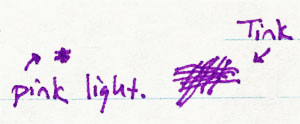
Faeries as crossed lines At one point I became aware of a multicolored light following me around on the reverse side, lending light when things were dark (my drawing was of 5-6 vertical lines crossing 5-6 horizontal lines). I called it Tink, thinking back to the dream long ago. Another was a pink light (drawing of something like an asterisk). Both lit the darkness some and provided warmth.
Fairies: I see these fairy-like creatures from time to time. I often experience them as sentient colored lights.
-
The Mischievous Fairy Girl 1997 • age 22mature content
It began at Blaine House. I was kinda living there, exploring around and always typing at the computer. I was there with Buttercup. There was also a strange blonde girl, like Julia, the library girl, and the girl from Tank. At different times she seemed like each, but different from each, too. She beckoned me to join her on the wall around the deck outside and I did. She showed me something there, in the sky or the woods or my mind. When we got off the wall, the part we had been standing on collapsed, rotted out. Strange.
Later I was working on Foundations in the woods by the sandbox. I was trying to make symbols in the stone. The blonde appeared there in fairy form, and had information for me. I had to lay on my back and look up to read it. Big holographic letters appeared slightly above me. They were black calligraphy letters on yellowish parchment. She was explaining how things worked — answering some questions I had, and expressing her love for me. She appeared as Julia for a moment to give me a soft kiss but I didn’t kiss back. I thought of this person as a strange visitor but loved Buttercup the same and continued things as usual with her.
Then I was in the library where the blonde girl really made her move. I was at a terminal working. She appeared as that library girl, constantly sending me letters above my head and conjuring sheep in the wall to get my attention. She was flirting madly, but also helpful and humorous. Weirded out by all this, I was telling a friend when I was interrupted again. She asked me to go out with her and a bunch of people including Bridget and her boyfriend. I thought “No, of course not!”
Then in the private corridor where I was working appeared a thin brown-haired girl in black leather sex gear. At first I ignored her, but then realized it was a gift from the blonde. The girl in black was scantily clad and tied to this chair, sitting in it. I went to her to tell her no, but she was talking fast and got out my thing and revealed hers — it opened up in her at a corresponding level, in her chest. She slowly took me towards her. My ability to resist faded quickly and I let her do what she would. The sensations were so strong and it felt as if I was putting more of me inside her than possible, pushing hard into the slippery wetness, I pulled her leg over my shoulder and went harder, pushing only, and then, suddenly . . . orgasm. And that woke me up.
It was as if she was some mischievous spirit, determined to get my attention, to win me over. Yet she was helpful and friendly, too. It was a unique entity, an external force in my dreams. I was never mad at her, only confused at her intentions. Was she a fairy spirit?
Astral Beings: This is a very strong character, certainly not created and animated by me. It laid traps for me, got in the way of my goals and foiled my will. It was intelligent, clever, and insistent. What I would definitely think of as a fairy spirit. It was someone who dwelled in these realms, who knew the way things worked here.
-
Like Warcraft, but a Whole World! 1997 • age 22
I turn to these “fairies” which appear as busty female mighty mouses. They’re bright pastel colors: pink and yellow and light green. Some are “super” and help the others to get up to where I am, but then more and more can fly and become “super”. Now they become typical fairies and join me against the orcs. A few got stuck in some wood and have to teleport to get free, leaving fairy dust behind. The thing about fairies — it’s hard not to get sucked into them. I almost lost the dream a few times getting sucked into fairy world or some dream featuring only them. I was hypnotized, mesmerized watching them.
Fairies: Fairies aren’t even characters in Warcraft, but here they are again. They really do have a power to take over your dream, so be very careful! They can be very mischievous, mesmerizing, distracting, and greedy for your attention.
Other Astral Beings
-
Most Beautiful Rain Fairies 1998 • 2:25 AM • age 24
This plant-like light green creature leaps off the edge of a balcony and hits a switch which turns on a sprinkler system. The creature flies over the tops of the trees and plants itself in the middle of the stadium, which is like a greenhouse now. All these rain fairies of every color and shape leap off the plants and fly and zoom through the air. Each is a different color and light as air. I am one of them. I think I’m red or purple. The rain keeps us flying and we swirl about and dance on the breeze. Our collective will keeps the rain falling. We perch on a grove of trees. Someone asks me “Wasn’t that fun?” and I say “Yuup!” I feel pure joy and we laugh. The rain has stopped and I ask “What happens now? How do we hide?” We’re slowing down and she says just grab the plant and rest. Then I wake up.
The flying was exhilarating! It was like a wonderful ride filled with such energy and fun. This was a most beautiful life. They seemed like plant spirits which come to life in the rain. This last repetition of the challenge was definitely a true dream.
Rain Fairies (Plant Spirits): What a wonderful experience. Here I get to become another form of life and experience things the way they do.
-
Uma Boga — The Tall One 1999 • age 24
I’m walking in “my neighborhood” and see a strange creature. It’s 8 feet tall, covered with black fur, and roughly human in shape. It has a small creature, possibly a baby, in its arms. I go up to it and cling to its leg. I want to know it. Its eyes are like ours, but the center lacks a pupil and is instead shaded from the top. I find her beautiful and open. Her name is Uma B-something, like Boga. I try to be her friend. She can roll her eyes back in her head and human ones appear. Before long she has clothes and her hair is less long and more like human hair. I am so fascinated. I invite her to hang out at my house. She won’t, so I walk with her. We go to a mall. She has a book of drawings. They’re really impressive — incredible depth, accuracy, and an odd style. More and more she uses her human eyes. There is a love growing between us — a free, warm flow. How could this be? I’ve just met her.
Was it earlier? We were walking through a hospital and they tried to drug her and make her more human. I fought it but she didn’t, so I stopped. It was near lunch at the mall. I told her I had to meet my girlfriend Buttercup for lunch. She was terrified. Somehow this meant betrayal to her.
What Is It: I have no idea what other sort of things could live in the astral. This was clearly a positive entity of some sort.
-
Oberlin Dreamfire and the Zombie Line 1997 • age 22
I opened the door hatch in the ceiling to a dreadful sight.
Student after student was standing in a big line, zombie-like. The orange flickering was everywhere. I knew it was too late for these people. It seemed like they were lining up for a nursery. I looked to the left and saw a small girl shining flashlights (or light from her hands) and thin beams of light from her eyes at me. It cut through the flickering orange light to fall on me and made me uneasy. She came to me and started speaking factually, unemotionally about what was taking place. She took my hand and slowly led me out of the building. Valentine, I thought, was following. I was so worried and caught up in everything that I missed most of what she said. As we got to the bottom floor I turned around and Valentine wasn’t there. I asked her where he was and her silent, stone eyes told me that he had joined the line up above. I began to beg and plead with her. She told me to stay right where I was and she would bring him. Buttercup and Paige ran up to me. Buttercup hugged and kissed me and I told Paige to wait. Eventually Valentine returned and we all ran out of the building frightfully fast. We were about to run into the next building and realized we had to stay under open sky.
“BENJI, REBECCA, ERICA, GERALD, GET AWAY FROM THE BUILDING!” I repeated the girl’s last message to me as we ran.
References: I lived in South Hall at Oberlin for a few years.
Incarnation Overseer: The girl stood watch, the only one who knew what this scene was all about. The light shining out of her hands and eyes indicated that she was a different sort of being than the other people in this scene. She recognized us as not being a part of this scene and helped us get out. Perhaps she recognized us as dreamers.
The line to the nursery makes me think this might have been a representation of the line for incarnation. The flickering lights would indicate the slower hypnotic frequency of the physical. But why the feeling of fear and dread?
Thought Form Automatons
Thought forms imbued with enough attention can last a long time, performing their prescribed duty of protecting, relaying messages, or even engaging in games.
Messengers
-
Dream Girl 1995 • age 20
When she finished the song (this part is foggy), I looked deeply into her eyes for a moment. She returned my gaze. Then this gray wolf began to chase after her. She fled to a truck and the wolf leapt up to the window and spoke to her. I approached fearlessly and the gray wolf took off in a blur, darting into the distance. I went to the window and spoke to her. She was truly beautiful. She was short, had brown eyes, and light blonde hair. I asked if she was alright, she said “yes” and told me that gray wolves were only messengers of danger. Although she seemed to want to be with me, she implied that it wouldn’t be the best thing in the eyes of the wolf, (foggy, again) but that she wouldn’t mind my company?
Messenger of Danger: This seems like something from a fable. Strong belief in protective spirits can give them power in the astral realm. She ran from the wolf at first, so she must not have known it was a messenger until it spoke to her.
-
The New Apartment 2001
In the upper right of the horseshoe was this strange video arcade. . . . The games were strange and dirty and somewhat non-digital. A voice came to me describing this gambling game. I felt almost compelled to play. There was a crude thought-form man trying to run the game. If one of his numbers beat one of mine, he got the previous coin I played. Somehow I became really mad at him and was beating him up in this watery stoney pit. He was clearly a thought form at this point — buoyant, reactive but strangely so, dazed and unintelligent-looking.
The Gambler: This thought form seemed to have the ability to speak messages into my head — to describe the gambling game, and likely to play it as well.
Guardians
-
Underworld Guardians 2001
There’s a city. It’s “San Francisco” in my mind but a smallish metro area in reality. My house in the dream lies further away beyond some woods, separated from the town by residential streets. There are great gullies and ravines below the roads, filled with trees and shrubs, so that the roads form bridges. We called the areas under them the underworld or dark lands. Beneath that was a large corporation called the Golden Rhino, a reference to a gang in a video game I’d been playing. Forces were set up against me here. I kept going down into the lower areas and kept being turned back by people. They purposefully did all they could to make me lose my way. . . .
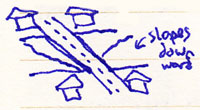
The gulleys under the road I’m at a neighbor’s house, asking questions. The sky quickly gets dark, and I end the conversation and run to my house. I mean to enter my house, but instead enter a red SUV in the driveway. A tornado comes suddenly overhead and picks up the car, whirling it about in different directions. I brace myself as it pulls the car through the woods towards the city. . . . The tornado drops me in “San Francisco,” with one of the guards watching over me. It’s a stiff, upright, floating figure with a dark reddish semi-transparent aura. . . . Finding Manville, Ruby, and Raven, I jump in a car with them and drive down a ravine under a road. Soon we find an opening in a rough rocky cliff and leave the car rolled onto its side on a ledge outside. “If I didn’t know this was a dream, imagine the distraction of this!” I thought, imagining the implications of physically reacting to this scene (surely a dream of car accident, rescue, and the financial implications of a car wreck — in short, a stupid dream, a physical expectation dream). But we leave it, walk into the inclining cave to find two rigid, distracting members of Golden Rhino, who hand us very interesting print-outs of waking-life topics. I call out their game in front of my friends. “They distract us and confuse and trick us in any way they can to keep us out, to keep us from knowing.”
The Misleaders: The guard as stiff, upright, and floating, and the characters handing out prints-outs are rigid. These defenders of the underworld are thought form guardians running on automatic. They use very tried and true techniques that would work to trigger and distract the waking self in order to derail the dream.
-
The Worst Way to Get to Narnia 2017
A security officer that felt kind of like an automaton saw me from higher up the slope and demanded that I halt. He was carrying a big gun. Instead of giving me time to come back up, he unleashed this big white and black tarp down the slope, making it more difficult for me to get up. I was pissed. This was unfair.
The next scene I recall is that I was back up at the top of the cliff and armed with a huge gun, and there were three automaton security guards pointing rocket launchers and other huge guns at me. There were people all around and there was no doubt I was going to die or be arrested.
Thought-Form Security: I got the sense that the security guards were automated thought forms by the way they acted. Perhaps they were trying to prevent me from leaving this area.
I have no idea what the tarp the security guard rolled down was — some astral phenomenon I couldn’t translate.
Negative Spirits
-
Endless Nightmare from Hell 1997 • age 23
This is one of the worst dreams I’ve ever had. . . . So through all the jail city scenes I must have been getting attached because when the demonic mass-murder guy came I was so scared and disappointed. He was an evil genius, pure evil and hate. You could escape for a few seconds but he’d always find you. The demon had all-brown eyes and was composed of meat and tumors. It seemed to always attack whoever felt the safest, though it was absent at times. He had machine guns and would spray death upon people. The bullets penetrated brick and left little hell flicker-flames where they hit the ground. I escaped once and played dead but he knew and fired at my head. In the end only the three of us could stop him. I finally snuck up on him and pounced. He said “You think you can beat me?” He froze me in the air and unleashed his deep demonic hate power. I knew I couldn’t beat that level of violence and hate. I tried to gouge his eyes out but he kept rewinding me and freezing me.
The Demon: Beating the demon with violence was out of the question. Had I full possession of my waking memories, I’d have known to beat him by expanding my consciousness or beaming love at him or simply ignoring him and focusing on something else.
The Astral Realm
Astral Regions and Boundaries
The Near Realm
The Lower Astral
Lower astral realms are darker, murkier, thicker, and more constricting. Like being underwater.
Nightmares
-
Wadsworth’s Revenge 1996 • age 22mature content
It was night, and there are all these Oberlin parties. At one, we’re off by some pine trees a little ways away from the party. Someone says “Didn’t I see your Wadsworth rubbing up against himself at the last party?” “Unlikely”, I said. Then Wadsworth walks up from the road and says hello. I’m totally shocked. He tells me about himself recently, how he’s bought some vintage . . . like “WarCat” or “HellCat” missiles and other crazy stuff. He told me that he was shamed, and was going to kill himself tomorrow. Because of the divorce, he, a respectable man, is being searched wherever he goes — his bag on the plane, his hotel room broken into and searched. So he’s going to kill himself. I tried to play it off, to say “Oh, really? That’s nice.” I think it’s really weird and am really freaked out by his appearance at my college.
I might have gone inside to tell Buttercup, but end up outside with him again, on the docks. He uses all these manipulations and tries to get me to have sex with him and even takes on the image of a naked woman that looks kinda like Buttercup. Finally I escaped him and ran back towards the party yelling “Call the police! Call the police NOW!” I ran inside. There was a moment where it was clear to me that angels were trying as hard as anything to stop or destroy him because he was the antichrist. I was yelling to everyone “Leave the house immediately! Someone has a bomb! Get far away!” Only half of the people were leaving, due to their drugged-up state. Police arrived and pursued Wadsworth. I ran and ran, seeing little groups of others running away off in the distance.
When I got far enough away, I turned and looked at the little house. I saw little lights, flames from Wadsworth’s HellCat missiles, going up into the night sky. The first one I thought was headed for Finney Chapel (then I thought it was a different college), then one for another school and for different places where I had friends. . . . I knew I was going to be alone. Then one missile went straight up, half-lit like a firework as it hit a helicopter, which then fell to the earth and exploded. Everything turned black and white as the explosion slowly filled land and sky, rocketing outward, lifting huge chunks of earth into the sky. The explosion came closer and closer, with no sign of stopping. I knew I was nowhere NEAR far enough and began to run, then turned and resigned myself to my fate.
References: Finney Chapel is a building at Oberlin.
My Dad, the Antichrist: I had a pretty rough relationship with Wadsworth in high school. But he wasn’t this bad.
Fear
-
The Seeking Lights 1998 • age 24

The spotlight It was a night realm and I was in a big office tower. There were these spotlight things out there searching for me. I was with someone who knew lots about them. You had to hide from them. If they shone in the window and lit you up, they’d follow you closely and have ultimate manipulative power over the dream. The stairwell in the office tower was glass and we had to run in short bursts to avoid the lights. We could see them moving through the thick, cloudy black sky before they beamed out at us. At the time, I was an expert on how they worked and what they did but much of that has faded.
A girl had joined us. I found her attractive. We got to a high floor and ran about hiding. I hid in a closet just as the light shone at the closet door, but the guy with me was caught in the light right outside. Since the light was still getting in a little through the edges of the closet door, he coached me on what to do, telling me to hold still and look at the darkest areas of the closet door. I did and began feeling calmer and calmer. Did the light leave? Soon I exited the closet. The guy told us all to take off all our clothes so that the light couldn’t copy us exactly. On retrospect, it was a thing which I had wanted, and, as the lights were known to absolutely manipulate the dream, made little sense as a deterrent. Soon, we all sat along the wall, naked. I turned to the girl and asked if she’d like to do it and she said, enthusiastically, “Yes!” We were about to but some force prevented us. I looked outside and it was full daylight. In fact, it had been daylight for a little bit. The room was the same, but I could see that it was now speeding over a brown-red rocky landscape with sand dunes. So the lights had gotten us. The other guy said that it was probably an illusion meant to prevent us from jumping out. I wake up.
The Dream Lights: We were in a dark astral realm where the lights in the sky may have been higher astral beings, who, by means of the low state, we interpreted and experienced through paranoid eyes and feared. When actually caught, we were rescued to a higher vibrational realm and became more happy and relaxed (since we didn’t fight it). The claim of the lights having “ultimate manipulative power” was a poison pill to cast doubt if they found us.
Astral War
-
Nuked in Atlanta
The buildings seem extruded I’m with Buttercup in the Atlanta Tower — the concrete multi-level transporter, up above the college with the auditorium. Around the college is a city. Everything is over-extended, like soft cheese extruded through a square hole. It’s the heart of Atlanta. We’re at the top of the tower when we’re nuked. The nuke hits not far off. The explosion is a perfect grey-brown sphere with a smooth exterior, reflecting white light. I jump behind the couch with Buttercup, hold her tight, tell her I love her, and think “who knew the 18th would be the end?” The blast rolls over us. It’s like a continuous painful wave of static rolling through me. It hurts in the heart. Then it’s over and I’m surprised to find myself alive. I figure the radiation poisoning will eventually kill me. I consider calling someone to say goodbye but decide instead to try to get out of there. While trying to get to the car, another nuke hits and we dive behind some furniture again. Afterwards, we decide to try to take shelter in the auditorium but they don’t want us in there. It’s too crowded or too dangerous. Finally we get to a car and drive off.
Astral War: I’ve had many dreams of being hit by nukes. Of course I survive them, but the shock of the blast can be intense. The surroundings are also never affected.
-
San Francisco Burning 1997 • age 22
I dreamed of being in San Francisco. It was night, and everything was burning. Some force was setting off chain-fire bombs and half the buildings were in high flame. I was there with Emma and maybe Buttercup and Ruby on vacation. We had a planned date to leave but I was nervous because the building next door was burning already. I went down into the city and did some risky fighting against people in black clothing with strange logos on them as they shipped bombs in boxes all over.
Darkness: The most consistent thing in dreams is the correspondence of the level of light to the mood and energy of the dream.
Lower Astral Dreams
-
The Stinging Ocean 1996 • age 21
My dreams last night were typical of those recently. I dreamed a horrible ocean dream. While in dark tidal pools, semitransparent grey arthropods would scurry around our legs. Then they became scorpions. We played some game about trying not to step on them. But they grabbed our feet and one stung to kill. Then we mixed in giant centipedes, seaweed, bugs, spiders, and lots more sea life including this dead-looking finless spotted fish which you had to try to avoid. There were also jellyfish and toothfish and jawfish. Manville turned into a big “N’gtoash Nisk” with a spiny head. I could breathe underwater. I was never injured but the deep-sea ocean life fear of the unknown was real.
Ocean Fear: Many ocean dreams are about fear of the gross weird creatures and the unknowns beneath the surface. This reminds me of the “hungry ocean” region that Monroe described. It’s surprising that I could be light-hearted enough to make up a game there.
-
Three Hells 1997 • age 22
I set out to visit the 5 hells (only got to the first 3) with a guide and a friend. The friend wanted to see the hells before the heavens. It may have been Lance. We went down a spiral wooden chute to hell #1: a classroom doing nice things but you had no choice. “We will play basketball for 5 minutes, according to standard rules, and you will look at the Washington Monument on the way out.” The second hell was a lonely haunted zombie house with axe murderers and chainsaws. Lance got really into it and got lost there. I went to hell #3: a huge post-apocalyptic war adventure.
Hells: There’s plenty more where that came from.
-
Endless Nightmare from Hell 1997 • age 23
This is one of the worst dreams I’ve ever had. I was driving through Nevada with two friends and got a ticket which required 3 days of jail time. I showed up and the woman “shortened” my sentence to 3 days. Yay. So I went in and found my own cell. The jail wasn’t guarded and the gates weren’t locked, however. There were movies to watch. I went outside and it was as big as a city. The atmosphere of the jail town was murky, dark, and heavy. There were many people there. I kept walking further and found there were no walls, no escape. In the town, everything was super color-contrasted, almost like a theme park. The color red, especially, was at once both much brighter and murkier than usual.
Then we were in some classroom. We had all brought our projects in but the TV lacked batteries. The scene turned into this play about snapping-jaw underwater worms that I disturbed or something. My friends and I were underwater and there was a huge sunken pirate ship that belonged to me. We were finding gold and treasure. At one point I pulled at a beam and it started to collapse but in slow underwater motion. The transition to the underwater scene was an easy one due to the heavy, dark feeling of the jail town.
So through all the jail city scenes I must have been getting attached because when the demonic mass-murder guy came I was so scared and disappointed. He was an evil genius, pure evil and hate. You could escape for a few seconds but he’d always find you. The demon had all-brown eyes and was composed of meat and tumors. It seemed to always attack whoever felt the safest, though it was absent at times. He had machine guns and would spray death upon people. The bullets penetrated brick and left little hell flicker-flames where they hit the ground. I escaped once and played dead but he knew and fired at my head. In the end only the three of us could stop him. I finally snuck up on him and pounced. He said “You think you can beat me?” He froze me in the air and unleashed his deep demonic hate power. I knew I couldn’t beat that level of violence and hate. I tried to gouge his eyes out but he kept rewinding me and freezing me.
This dream was a complete hell nightmare. There was some powerful “Tara” or something there, too.
Astral Hells: This is a lower astral area I fell into. The prison city wasn’t so bad, though it had a disturbing kind of light. However, the demonic mass-murder guy was terrifying.
Rampant Negativity
The goal of rude and aggressive behavior by disembodied souls is to gain energy by drawing emotions out of those around them. They require energy from another source because they are closed to the flow from the Source. These souls then gather at lower astral locations and draw those in the dream state to them.
-
The Superhero’s End 2011
It began with Emma, Alfred, and Ruby taking Buttercup and I to a fancy restaurant. We were sat among other people and decided we wanted to be a little more solitary so we moved to a different table. It took the waiters forever to take our order — I remember that I said it had been two hours. So we were getting frustrated. There was definite friction between us and the waitstaff at this point. While waiting, I had been drawing on my paper menu, and the waitress came and snatched it up, saying they needed it for other guests. This event happened again later, when I had drawn some great pictures on the back of another menu. This time as she walked away, I said “excuse me” louder and louder and got up and followed her, while she ignored me. I followed her to the kitchen and took it from her. I came up with a compromise — that I would simply make a copy of my pictures and give her back the menu. She agreed. A large copier was near us. I put the menu in and waited.
I looked out this large plate-glass window and saw that behind this restaurant was the underside of a bridge over a stream. The water was about a 1-2 feet deep, and there were maybe 80 cats just sitting out there, gathered to the shallows, but since it was so packed, some were resting several inches deep in the water. I commented on this to the waitress, and then turned back to the copier. It had copied the single-page menu into a 120-page stack where it enlarged and expanded on all the text and images in the menu. Upset, I returned to the table and plopped down the huge stack, saying “This is what the copier did.” As I sat, I saw the waitress clear the nearly-full plate of this mentally handicapped guy who could only moan in resistance, but who obviously wasn’t done eating. This happened twice.
Just when we were at the end of our patience, the food was brought out. There were a series of offensive things that happened, though I particularly remember adding to the story later on at some point to justify the violence to come — looking back and remembering new things that hadn’t happened before (and experiencing them distantly as I “remembered” them). The first was that I tried some chocolate thing but didn’t like it so I spat it out. The waiter who cleared my plate came back with powdered chocolate in a little bag — the very chocolate I had spat out, and offered it to me rudely. Then he took our centerpiece as he left. He also brought me this awful orange stew with a squeezed-out orange on top. Those two things were added later. But there was plenty originally. He was saying rude things and acting meanly. As he did, I filmed it with my iPhone. I said I was going to put up a web site showing how rude and awful they were. I had caught a LOT and he was not happy. The manager came over to interview Ruby, and asked her a few questions. The last was whether she would Twitter about this. When she said yes, he wrote her a big check to shut her up. There was a lot more as well. I suggested we not pay and just leave. Someone in our group said we should “go to the restroom” in groups of two and then leave. A group of two got up, and I did too because I was really done with it all. On the way out I yelled at the waitstaff and at the door shouted “Worst restaurant EVER!”
Outside was a big square, and I waited for the others there. I heard this crash and went in to investigate. Our table was upside down, with the rest of our party standing around it. I was so pleased! I wanted to see what happened, and the scene played out — they had lifted the entire full table of food and flipped it over, smashing everything to the ground underneath it. Yeah! I was in. Others in the restaurant were following suit, and I overturned tables and chairs and such on my way out.
The restaurant turned out to be on the bottom floor of the hotel we were staying at and at some point I decided to go back to my room. Every maid and bell boy gave me dirty looks. It was all-out war now, and more and more of the hotel was getting wrecked. It turned into this bitter cruel battle between all these various factions. Nobody could get along, and everything was getting destroyed. At one point, I told Ruby to just assume everything you had ever owned was destroyed, and if any was salvageable, that was a good surprise. When I got to my room, it was more like my room at home than a hotel room, but it looked like a tornado had gone through.
Systemic Rudeness: I wonder if this is a place made to feed off negative emotions. That ALL of the waitstaff was unapologetically rude to everyone is interesting. These could also be projected expectations of rudeness on my part, as I clearly remembered making up new scenes when remembering it later on.
Rigid Religious Places
These are usually described as being the upper end of the lower astral frequencies. The people here are strict and rigid in their religious practices, controlling and not allowing of anything new or different.
-
The Lawn and Building 2024
I’m wandering about in a small town. It feels European. I’m in a public square with cute buildings all around. There’s a weird girl playing hacky sack with a black ball of cloudy energy. She fumbles it and it flies towards me. I catch it on my foot, then flip it back towards her. It lands on the ground between us. There are two ladies at a table nearby. One shouts with humor “thank you, but she’s going to hate you for doing that.” I get the understanding that the weird girl is really rigid with her game, that she doesn’t allow interference. She’s got this dark cloud of energy around her head. I continue on my way.
I come to a large, wide, flat, uniform lawn with a brick building in the center. I’m picking up trash. I head towards the large building, looking for a trash can. The two-story building in entirely brick and square, with no windows, and only a single door. The door opens, and a man in a suit comes out and adjusts his shoes. I get a very bad feeling about the building, and feel that it is a strict religious place. Its lack of windows tells me that they’re very controlling in there, not interested in outside ideas. I head a different direction.
Creepy and Closed Up: I rarely wander into these regions, their being anithetical to my nature.
Going Underground
Many times when you go underground, whether it be downstairs, down a ladder, or down into a hole, you end up in a lower frequency area; a worse place — darker, more constricted, creepier, more cluttered. Depending on where you’re starting, it won’t always be awful, but it will usually be worse.
Tight, Cramped Areas
Higher frequencies of consciousness feel expansive, while lower ones feel constrictive. There is an interesting spatial correlate to this. Imagine that while standing in a room, you expand to nearly the size of the room. You feel constricted, your motion constrained. Now imagine you’ve shrunk to the size of a marble. Suddenly the same room feels vast, with room to move and fly about. I’ve changed my scale in this way in the dream state.
These feelings might be due to the degree of expansion into 3D physical space. Remember that the Source flows outward through the nonphysical and then into physical space at the tiniest scales. At slower frequencies of consciousness, we catch that expansion later on — we’re more expanded into 3D space than usual, and at higher frequencies, we catch it sooner, when it’s smaller, making us less expanded.
-
Bass in the Basement 1998 • age 23
The basement is compressed I was in a house with Buttercup’s family. I was on the main level, playing music on this big black TV-like thing. I had the “ultra bass” button pushed in. We went downstairs to the basement to eat in the room underneath the TV thing. It was so incredibly loud — playing a loud distorted buzz of a tune: high_-__--_-_-_high then silence, then a repeat, as if only it were playing every other measure. My senses were dull and I couldn’t think straight on the basement level. To get back upstairs to turn it off, I had to push myself along the floor. I was the size of the passageway, as if the basement were a more compressed, lower frequency world, a third of the height of the main level.
Astral Compression: Just as some dreams are expansive and freeing, some are constricting and horrible, like this. Low frequency tones were exaggerated, too. Quite different from the bells and pure tones heard on higher realms.
Basements, Sewers, Subways
-
Good and Evil Girlfriend
I was disgusted both by [Avery’s mother’s] appearance and manner, and she spoke of the witches in the basement: women who will grab out at you. Avery then went down into the basement and Bridget and I nervously followed. Unpredictable lightning lit up a smallish roughly-built place complete with garbage, doll houses, and a few small girl’s toys. I looked wide-eyed for those witch women, and long moments passed without their appearing.
Basements: Basements are often cluttered, horrible, nasty, haunted places.
-
The Sewers Beneath the Dark Tower 1997 • age 22
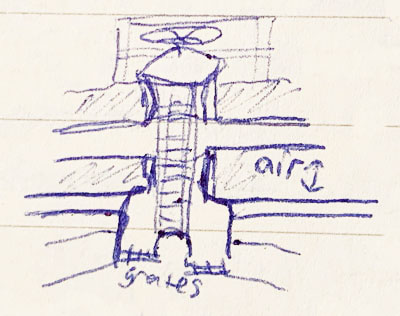
The sewers beneath the Dark Tower Brendan and I had figured out the secret way to enter the sewers at the Dark Tower. We’d been exploring them. The openings were narrow and inside were long endless tubes with warm, strange winds. There were little flames burning. I feared it wasn’t breathable air, so I kept returning to the surface for air. Below the lower air tube was a little jump-down place with a grate in the floor. After jumping in one of these we ended up in a subway system. It was scary. We knew we had to be careful because everyone who rode the subway was crazy. We immediately met some such people. Someone was talking threateningly and using slurs.
Underground: The higher frequency the astral realm, the more bright, open, and spacious it is. Conversely, it gets nasty when you go underground. The subway, then, would definitely be a place of crazy people.
-
Mountain Flying 1997 • age 22
There were dreams of subways and lots of traveling. People kept shooting guns in the subway. We decided to travel some other way after that.
Subways Again: See, they’re bad news!
-
The Haunted Ride 1996 • age 22
I’m in a haunted house ride. I think Buttercup is with me. It’s a miniature haunted house and boring at first, but then the car seems to plunge off the track through this door in the floor into this super nasty haunted house! It has all the keen effects of dreamland, fuzzy visually blurred places and mysterious shades. Mirrors up ahead on either side of the hall are reflecting hideous pictures of us back.
The Real Haunted House: The ride turns much darker and scarier once we plunge through the floor into the basement level.
-
The Red Scooter 2000 • age 25
Bat Boy I chase them down into a sunken staircase (the underworld) and into this madhouse scene with scary sleepwalker people all milling about. I rush through two pale greenish rooms to where Buttercup is. I pass multiple copies of the bad guy; this yellow-eyed purple-haired guy that looks like “bat boy” — very much like a thought form as it is mostly lifeless. I reach the exit but a wave of fear passes over me. The door leads me back inside, but I focus and press onward and make it out.
References: Bat Boy was a weird character from a tabloid.
The Underworld: Going downstairs is a typical sign of moving into the underworld, and the bat boy thought form and sleepwalkers bear this out.
-
The Madness 2015 • 4 AM
There was a long crescent area that went around the rink, and at the far end there was a doorway to stairs going down. It was quite dark, and the people over there were mostly dressed in black outfits and costumes, but I could see glowing dust on them. The stairway heading down had that same glowing dust on the stairs. The announcer said in a half-joking voice, “I wouldn’t go down there!”
At some point I went down there. It was a series of underground rooms . . . [the first was a long, humorous encounter]
I went to explore the other rooms down there. They felt somewhat like rooms in a college house, with cheap furniture and a brown shag rug. . . . Progressively things got more wild and crazy, the people gathering down there acting more and more drunk. It was fun. It was more an uninhibited, raucous drunk. Not blurry or clumsy. I was having a blast and laughing and being so funny. But there was an edge of madness to it all.
At one point I heard screaming from behind a staircase. Curious, I went to it, and though I somehow knew I shouldn’t, I opened up a set of three to four stairs that was actually a hidden door. A woman came out. I instantly knew her as a deeply crazy person, a person driven mad, and I regretted my decision. She had been trapped in there with no way out for a long time. Above the hidden door, I could see the bottom foot or two of what looked like a shower, with lights inside and a glass door. Inside there were 5-6 different versions of that same woman, in different states. One was pregnant. They were alternate versions of her, trapped in madness. This story was vaguely familiar to me and I wanted nothing to do with it. It was bad enough that I let her out.
The growing madness manifested in crazy imagery; things bending and twisting and kaleidoscoping all about, like circus funhouse mirrors.
An Unusual Basement: Going underground in dreams will typically take you to dark, cramped, horrible places. Strangely, there was a lot of humor and wild drunken energy here before I apparently went down too far and opened the hidden door to the disturbed person under the stairs.
The Higher Astral
-
Time Weaving 1996 • age 22
It was bright and sunny, on a lawn in Oberlin with some friends. I was speaking about my theory of the nature of time and events. There was a helicopter flying about in such a funny and exact way. The future’s beautiful and at peace. . . . This really felt like the future. Very bright.
Higher Frequency — The Future: The brighter, higher (frequency) astral often feels like an idealized future. This is because it’s a reality closer to the now, the moment point, the Source. It’s just a fraction of a moment closer, and that tiny change in proximity to the formless, to all-knowingness, creates a reality there at that frequency that is so much brighter and happier. It’s the future, but it’s happening at the same time and place as now. And our consciousness can accelerate forward (faster) and see it from time to time.
Sunny, Blue Skies, Oceans, Beaches, Mountains, Soaring Vistas
There’s no way to know where specifically in the mid-to-higher astral these locations are. Suffice it to say, they’re beautiful and bright.
-
Calling on the CB 1996 • age 22
There was a plane that crashed in the coastal town near the ocean. Sid and Buttercup called me on a CB radio and then came by. I said “Thank goodness, my friends are here!” I went out and joined them, frolicking in the sunshine. It was clear, vast, beautiful, sunny. It felt like Northern Exposure in some ways, with small coastal towns.
Mid-Astral: The bright sunshine and nature makes me think of a mid-astral environment.
-
Rubber Dolphins 2000 • age 25
This older friend is leading us down along this peninsula in shallow waters to this great swimming area at the end of the peninsula — an area of rolling hills of soft sand. There are a lot of people there. The waves are gently rolling.
The Laughing Seas: I hadn’t noticed before that this is a recurring dream place. This is a bright, sunny place with golden sandy beaches, bright blue skies, lots of people having a great time being clever, playing social games together, and laughing. It seems like a world of oceans and islands and there is always massive technology in the distance — ships, plants, machinery. It’s one of the happiest places ever.
-
The Incredible Country 2025
Buttercup and I were on a trip to an amazing place. The first thing I remember is coming to the flat sandy top of this mountain island. It was as if the top of the mountain were shaved off and it was all sand like a beach. From this center of this height, I walked towards the edge. The landscape below slowly revealed itself to me as I did. To the left, a brief area of tall rounded green spires. To the right of that, tall hills, and then an amazing purple-blue city structure in east asian style along a curving beach, then the sea between it and the island. . . . There was a map in my head of this place. All up and down the rest of the mountain island and mainland were marked areas, and I could see that this place was full of attractions and things to see. It all had the feeling of an unknown culture that I was eager to explore.
Incredible Vistas: This is such a beautiful, awe-inspiring place. I’m glad among my various self-imposed challenges I also take some time to enjoy the sites of the upper astral.
Astral Transit Areas — Airports and Malls
Fast travel through busy areas often takes physical form as an airport or other mass transit station connected to a vast mall (at least in my experiences).
I dream often of malls — huge indoor gathering places with stores everywhere and tons of people. They’re almost always connected to transit centers — typically taking the form of planes or buses — providing communal travel to distant locations in the dream world. My Dream Self uses these when traveling long distances from one place to another, or when returning to my body as morning approaches.
-
End of Days 2012
Incredibly huge tsunamis were rolling up all the coasts and continuing across the continent. Buttercup, Bodhi and I had fled Georgia to higher ground in Colorado. . . . We found another concrete opening that continued on — a sewer or something. We went in and. . . . I think this eventually led to a mega mall. I remember at one point looking around to see if there were any interesting stores. There were tons of people in fantasy convention costumes — super heroes and the like. There was a comic book store but it wasn’t open yet, though I could see some costumed people in there. The mission to get on a plane and escape was kicking back in. I met up with another woman looking for an exit. I pulled out my iPhone and it brought up a very easy way to get out. We took a few flights of escalators up to the top floor. We saw the exit sign above some stores. I searched around, but couldn’t see an exit. I asked someone, and they directed me to go in the back kitchen area of this restaurant. I did, and it was busy with activity. There were delicious-looking donuts here and there, and I remembered that I was there once before to exit and they had offered me a donut. I had to skirt the machinery, then ask these guys to move aside to let me through. I squeezed between a machine and the wall, took a last wistful look at the donuts, and then exited through the back door.
Outside, the sky was heavy with rain. Before me was a small parking lot. I went looking for my car, and found it.
MegaMall — There and Back: We are seeking a way to escape the destruction and head for a mall and airport. My Dream Self knows that these are astral transit areas. We get there by accessing a tunnel, but have a hard time finding the exit.
Higher and Lower Versions of the Same Place
-
Ultra Oberlin 1996 • age 22
I left the inn and started walking down Main Street towards Banana House. The land was extra curved (the tiny planet effect), and things rose rapidly over the horizon. As I got near the intersection, the sky turned bright yellow and I saw the new downtown Oberlin. It was magnificent, with movie bars and video game places and so much fun stuff to do. There were big sphinxes and bright lights and colors and it looked kinda Egyptian — a total fun land. The games and everything were really high-tech. After stopping in to different places, I continued to Banana house.
I arrive at a higher realms version of Banana House. It’s sunny, the neighborhood is more forested, peaceful, and every color is deep and suffused with gold. I remember green especially; a deep green with a reddish-gold shining through it. My room was much cleaner, had advanced technology, and new, well-made furniture. Guido R’s room was on the opposite side of the hall and he had reddish hair. I was naked, but went to his room to talk about the weed he sold me, because some of it was hair, some was moss, and some was broccoli and asparagus. I told him that he owed me $35. Then I heard Wadsworth call out. I looked outside and everything was in deep, vibrant hues like after a rainstorm, and the sky was that beautiful pre-thunderstorm color. I felt so safe and secure. But I wanted to hide from Wadsworth. I knew he’d come. I went to the hall to greet him and he was energetic and animated. He was telling jokes. I checked Buttercup’s and my room for stuff he shouldn’t see and then invited him in. He started rooting through her stuff and I said that was rude.
Ideal Oberlin: There appear to be a spectrum of different versions of each dream place, from high, sunny, spacious ones, to dark, cramped, horrible ones.
Even for being a higher version of Oberlin, there was my hilarious complaint about the weed and an unwanted visit from Wadsworth.
-
Earth One 2005
I’m at Oberlin, looking for a dorm room, and I run into Bard from SSU. His parents are walking behind him. We talk, and his parents give us some space. We go inside a building on north campus, and he says I can stay with him. We go in a closet and he tries to kiss me, but I stop him. Outside we find a ton of people laying down in the grass, in contact with each other, watching the sky. The sky is a wild sight with planets and bright lights. But every moment is a joy on Earth One. We live on Earth Two. Earth Three is constant war. I return to Earth Two, so as not to be missing for Buttercup’s birthday tomorrow (the upcoming day).
Eventually I get involved in this crazy Reno 911 adventure with a gun fight. My gun does heavy damage to floors and walls. I use a flame thrower to start this rich residence on fire. Then we return to the city. I throw my incriminating documents into the dumpster, then realize that the feds are waiting in the dumpster. Junior and I decide we’ll all go to Earth One. We find a long pole attached to the side of a building and get excited — that’s how we can cross over. We climb it and as we do, gravity shifts and reverses. After 15 feet or so, we’re seemingly climbing down toward the ground again along a pillar. We dismount onto Earth One. The joyous feeling of well-being returns. I’m not sure, but maybe this is where the sky thing happens.
Three Earths: It’s an interesting idea that there are these three versions of earth with strange ways to travel between them. It seems like these correspond to higher and lower astral realms.
Locations I Regularly Return To
-
Dreaming Context While Awake 1997 • age 22
Awake: I’m feeling warm and happy, talking, under soft lights, falling asleep, and then. . . . This is the happy realm. . . . This is the Dark Tower as I think about doing work. . . . Each place corresponds with a kind of thought. Makes sense, but I’ve experienced it now. So strange how dream context appears and takes over. It just slides in and BLAM, it’s a dream. I act a certain way only in each dream locale, with a certain sort of consciousness. A certain kind of need fuels it. I’m only ever here because of this.
Dream Locations Understood: This is huge.. each dream location corresponds with a kind of thought, a kind of consciousness, with a certain way of behaving, fueled by a certain kind of need.
The Dark Tower
In my dreams, I’m at the Dark Tower when I think about doing work.
-
The Dark Tower Is a School and Dorm 1996 • age 22
I was at SSU again, during orientation. Buttercup was with me. I was there to visit Juno. We had to stay in a dorm, and were assigned to the Dark Tower, so I think that might be SSU. Buttercup and I were allowed to sleep in the same room. She took a shower and a sizable stream of water flowed out the door and joined with one of the two streams running down each side of the spiral hallway. I tried to call Juno repeatedly and failed. One time, I encountered the rudest phone operator lady ever. She went crazy, and I chewed her out big time.
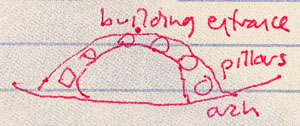
The entrance to the Dark Tower
seen from aboveThis is all very familiar. I’ve been here before and had trouble contacting my friends. Everyone there was like new college students at orientation, walking around with pamphlets and folders. The sky is always ominous and cloudy, and the light is like early morning. There are other buildings up the road. I know this place very, very well. The doors to rooms were black, and all the same and kinda run down. The DARK TOWER is the main dorm there, the main building and receiving area. Most everything in this SSU/Dark Tower isn’t working yet, but you can explore. The beginning lake part of the drive is like the curving forested roads along Lake Minnetonka.
References: SSU is the first college I went to.
The Dark Tower: This appears to be my first recorded dream of the Dark Tower. It was an orientation, and I was assigned to the Dark Tower dorm.
-
Dark Tower Description 1997 • age 22
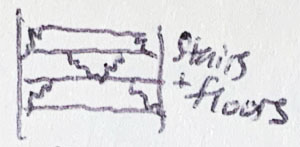
The stairways of the Dark Tower The Dark Tower is very consistent. It’s quite run-down and somewhat two-dimensional. It’s very tall with one basic hallway spiraling up to the height of the building with doors on either side. There’s always a lot of movement, people going up and down. There’s yellow on the vertical parts of steps. The rooms are filled with endless junk, like a basement bargain store, but it’s not shopping, either. Outside are vast lands, some snowy. . . . I usually see it from high above, as if flying in. . . . It’s never a scary place, just dingy and ugly, and there are lots of people, too.
-
OBE at the Dark Tower 1997 • age 22
I was doing lots of travel around the area of the Dark Tower, on route 330, route 303 and some others. Approaching the Dark Tower, the freeway seemed to rest on the treetops, and a beautiful sunset was going on as we drove. As I drove, I overlooked a forest where Ranier was. I threw grapes out the window to him. After the drive I went to see Ranier in the woods and when I arrived, the grapes I threw finally finished falling through the trees. Familiar Dark Tower buildings were nearby, perhaps even other towns or cities.
The Dark Tower is also near the big forest with hanging paths and worn, covered trails in the valleys cut away by the river. The Dark Tower is in such a valley. Within the Dark Tower were living quarters, including my Blaine House room. There was a murky green coloring to everything. There was also a huge new bookstore. Someone like Amanda worked there. . . . The traveling to the Dark Tower seems a standard part of each dream of that locale. It’s very familiar. The Dark Tower seems like a boarding house in the spirit world. The forest is kinda trashy and dark and the tower is run down. But both are huge and full of people.
-
The Sewers Beneath the Dark Tower 1997 • age 22
There’s definitely a Banana House at the Dark Tower.
[Brendan and I] were looking for Sid in room 722 in the Dark Tower. . . . I went up to the 7th floor. It was a classroom now — a big one.
The sewers beneath the Dark Tower Brendan and I had figured out the secret way to enter the sewers at the Dark Tower. We’d been exploring them. The openings were narrow and inside were long endless tubes with warm, strange winds. There were little flames burning. I feared it wasn’t breathable air, so I kept returning to the surface for air. After the second air tube was a little jump-down place where a grate was. After jumping in one of the grate spots we ended up in a subway system. It was scary. We knew we had to be careful because everyone who rode the subway was crazy. We immediately met some such people. Someone was talking threateningly and using slurs.
-
Epic of the Dark Tower 1997 • age 23
Upon thinking a moment this morning of the Dark Tower, I recalled that I was there last night, dreaming intensely.
It was so real. I am a complete person, totally living that experience while there. It’s totally real. No doubts now. I can’t remember too much yet, just that I was at a high parapet looking out over the vast landscape at the twilight sky. It’s dark above but deep red on the horizon. I’m talking with people, climbing on rocks, discovering things, exploring the dream realm. It was so full of activity and adventure, so completely real. . . . The libraries, being outside. It’s in the twilight realm. . . . There are places nearby that we go to. . . . There is always the feel of an impending storm. There’s a mountain I climb, I see things from such heights at times! . . . I hadn’t dreamed of [the Dark Tower] in a long while, and then woke up early this morning and there it was, reassuring me that I dream of it early on every night. Last night I was engaged in some really intense research and discovery, as part of a big spiritual project.
-
Dark Tower Warcraft 1997 • age 23
There’s this big game of Warcraft going on in the valley in front of the Dark Tower. It was like a bunch of guys playing with miniatures on two large islands. . . .
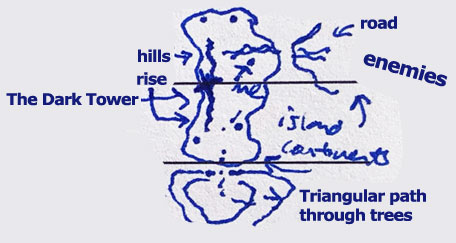
The area around the Dark Tower as a Warcraft map I know these lands so well from many other dreams. There was a dream of going south, then east, and discovering a big forest and castles. This place is really rock solid. You can see the Dark Tower on a slight hill in the distance. It seemed more stormy now, as if it had rained recently and the sun might break out from behind the clouds. The lands could be very beautiful. There is a flavor or smell to the whole place. I had a memory of doing 3D holographic modeling or something at the Dark Tower. . . . Very dim now. . . . The drive there is along the coast from the north to the middle of the map. The rolling plains were green with grass and stony patches. Where I was playing Warcraft it was gray and it was dark with scattered lights on the island across the water.
The ever-present effect of bright reds along the horizon in the East was present. Under it, shrouded in dark, were the dotted lights of an old city.
References: Warcraft is a video game.
Dark Tower Details: The stony green rolling fields were very much like those found in England.
-
The Dark Tower Tour 2000
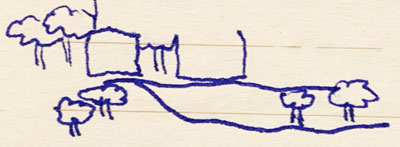
The upper and lower road to the Dark Tower The Dark Tower is a college in which the Dark Tower itself is the first, main building you see upon arrival. In front of it, the road from the west splits into upper and lower parkway roads heading east, with a mixture of trees and open spaces. There are huge square grates all over the lower road which caused big bumps when you drove over them, so I avoided them. The road was a changing patchwork of stone tiles near the end. Whoever I was with in the dream, I was swearing to them that this was the actual location of the Dark Tower. I had a name for the place, too: something like “Anabestos”. I said it had something to do with my first rally, when I fell in love at a rally? But no one was pictured with that thought. Strange. . . . There are a lot of buildings along each parkway, which I visit from time to time. I have many adventures in the Dark Tower and the next, squarish building over. It’s big but not as tall. Things aren’t as dark seeming. The buildings are of a tan-brown color, and made of brick. They are dusted with black dirt.
References: Rallies are youth group gatherings at Unity Church.
The Dark Tower: The upper and lower roads reminded me somewhat of Kenyon College in Ohio.
-
Thought Form Class 2000 • age 25
I am in a classroom, though it’s not the Dark Tower. I made a firm resolution not to return as I believe it is in the lower astral.
Moving On: I remembered one more dream at the Dark Tower in August, 2000.
The Great Hills
-
Storage at the Great Hills 2004
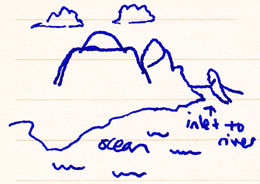
The Great Hills This is a relatively new dream place I’ve been going to in the past 5 years or so. It is bright, sunny, colorful, and happy. It’s a place I visit in deep sleep. Round-topped hills like these in dreams are very meaningful — a concentration of energy, perhaps. The Great Hills have gray wooden houses scattered about it, spiraling roads, and great views. I was excited to be finally moving here, to the rightmost hill. Our destination was like an old campground building, somewhat abandoned. There was an intention of “my family” moving there long ago — so much so that a huge storage area at the top of the right hill was somewhat filled with old belongings of Emma’s and Wadsworth’s. I was looking through it for useful things. None of it was familiar at all. It was all was several decades old, seemingly from the 70s. Buttercup was with me, but in a great rush. I stretched her patience as much as possible, but then we left. I think it was nearly time to wake up!
The Great Hills: Now that I remember this dream place, I remember going here so often. I don’t recall them often due to their occurrence earlier in the night.
I wonder if this isn’t a scrolled out view of Arcology Hill on the left, actually. Arcology Hill is always without a greater context in my mind. And the specific context of the hill on the left in this view is only that it sparkles with distant lights among the thick forest there, which is what Arcology Hill looks like.
Arcology Hill
-
The Tower on Arcology Hill 1996 • 3:33AM • age 22
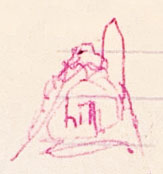
The Tower on Arcology Hill 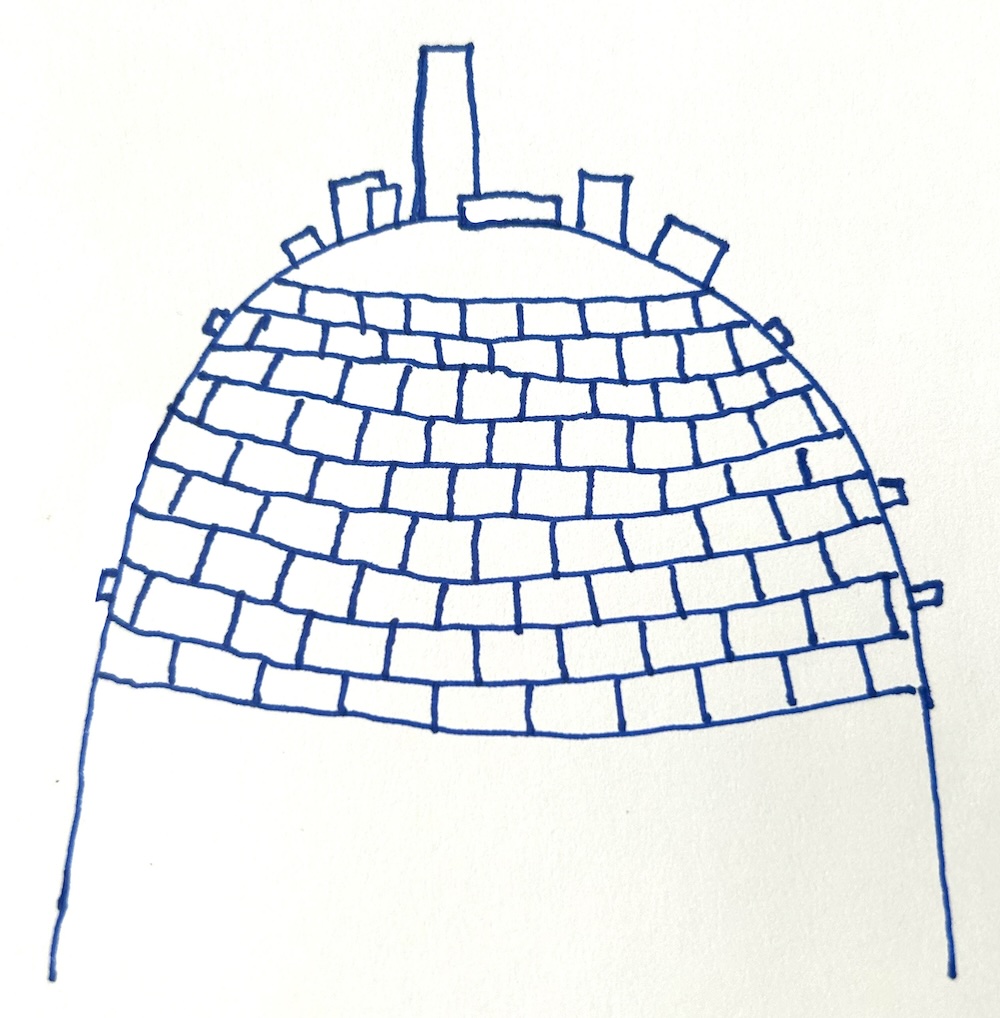
The property lines going around the sides of the hill,
and the town, tower, and stadium at the top.Some of these properties I regularly visit, and I have routes up the hill that I repeatedly take. One route takes me up/across a huge tree that gives me vertigo, which leads to a property with lush greenery and a lake.
The way each property is divided into its own space but visible as a whole from outside is like an overview of the individual screens in the original Legend of Zelda game.
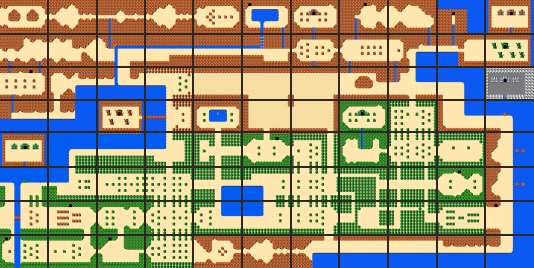
An overview of the individual screens in the original Legend of Zelda game Image from https://www.zeldadungeon.net/ Arcology Hill: This is the first time I remembered coming to Arcology Hill. I typically dream in this location around 3-4 AM every night, and I don’t remember these unless I am awakened in the middle of them. Arcology Hill is an incredibly well-defined place that I return to again and again. I am always challenged in some way in The Tower with something disturbing.
-
The Devil on Arcology Hill 1996 • age 22
As I’m napping with Buttercup, I come to remember last night’s horror, and why I didn’t want to remember it, and why I awoke in such a bad mood: Buttercup and I were on Arcology Hill, maybe a third of the way up the hill. It’s near the fern and lake area in the little valley. Our room was a bunch of crudely nailed boards up high above a natural scene, like an attic in the trees. It had steep angles and was very high up.
We had many visitors. One of the visitors was the devil. I had started accepting him around, since he was so unobtrusive, even talking to him a little. I still didn’t like him. But once, on accident, I left our perch, and left Buttercup alone with him. As I returned, I saw him leaving and I realized what I had done, and, uncertain, I even waved goodbye to him. When I found Buttercup, she was crying. He had tried to do something to her and I was filled with such a rage. My perspective rose higher after this. . . . I woke up in the worst ever mood.
Arcology Hill and the Tower: There is rarely a dream of this place without some kind of disturbing personal challenge. I wonder why I keep going back.
The Tower on Arcology Hill
The strange thing about the Tower on Arcology Hill is how many different forms it takes on the inside. At different times, the inside is a gothic masquerade, a high-tech building, a plush mansion, and more. What’s consistent is that it’s a tower shape (when seen from outside), it’s at the top of Arcology Hill, and it’s a place of facing difficult challenges.
-
Banana House Party 1996 • age 22
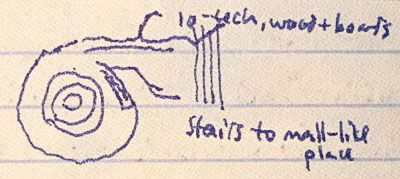
The Tower, viewed from above The Tower is very high tech, but around a corner, it’s eaten away, revealing a wooden frame. Stairs lead to this mall-like place. Nomads live in the wooden part.
Spiral Exit: I’ve noted spiral passageways in the Dark Tower and the Atlanta Tower. Note in the drawing how the exit curves down from the top edge, as if from a spiral passageway here as well.
-
Split in Two 1996 • Early AM • age 22
I feel like this is The Tower, in disguise. . . . I overheard talk about some big surgery of the ribs for me. Next thing I knew I was drifting out of a deeply anesthetized state. . . . Preceding this was Banana House as a big wooden warehouse. It used to be a restaurant, I think. Buttercup and I lived upstairs. . . . Guido and I were throwing a lot of food around, up and down the balcony. Will was there, and everyone was drinking or on drugs.
The Tower: The balconies are a very common feature of one version of the Tower. It’s plush, with red carpet and huge stairs and balconies and very rich. I had many adventures on these balconies. There is a common theme of being drugged and really out of my mind. Both the Banana House and surgery scenes both seemed to take place in the Tower.
How is this the Tower if it doesn’t look like the Tower? There’s a feel to it, a shape to it, a challenge, and it’s often at the same time of night, around 3 AM — 4 AM.
-
The Origin of the Tower 1997 • age 22
I dreamed something about the origins of Arcology Hill & The Tower. It was unpopulated, natural, covered with pine and pine needles. Some careless people were climbing on top of it. They were playing with fire and I knew the hill would go up in flames.
Underneath there was something going on, too. The interior of the hill was carved out into chambers and such, like all dream hills seem to be. The inside was changing, too.
-
The Tower — Masquerade and Betrayal 1997 • age 22
The Tower appeared as a huge gothic church with tons of balconies and wide stairways. It had lots of dark wood and red carpet. I worked on the top floor in a computer job. The theme was “making new friends — a threat to our relationship”. There was a masquerade going on. I met this guy named Christopher something: a muscled business jock. Later, Buttercup was hanging out with him. He was wearing the black carpet and she was wearing all black. They snuck into the darkness of the place where I worked (now closed) and I snuck after them to spy because it certainly didn’t look good. She caught me and yelled at me. There was a longish in-between part of me fighting some jealous internal battle. I must have lost because I was then flying around in this envelope of flame and caught her with her arms around this other guy in the game room. I got so mad and yelled at her and we began arguing. I tried it again, nicer, but I was ill at ease that time. In the end I tried to destroy the whole building. I wanted to burn it down but I think I began to disintegrate it from the top instead. The city around was big and gothic and the sky pitch black.
The Tower: The Tower has taken on the form of the masquerade many many times. It has big stairs and red carpet and a balcony and many rooms and is very rich. And of course there’s a trial to overcome.
The Atlanta Tower
-
Building the Atlanta Tower 2000
The elevator I’m in a concrete, domed school-like building. I’ve been here before many, many times. There are two elevators. I know a secret, though. It’s because I’m in Ranier’s Room. I take the elevator to floor 12, make some sideways adjustment, and then go all the way to the top. Where do I end up? The Atlanta Tower. There’s another student about to do his film project. That interfered with my latest trip so I decide to wait around. While waiting, I meet Brigit, this girl who has this huge living space with a forest of 10-foot tall pink molten muffin-top things. She has photo books of her and four friends in attention-getting outfits. There are walkways made of chairs and junk, and I slip on one on the way out. I want to help fix it.
I’m building the Atlanta Tower, or I’m a child inside it as my parents are building it. There’s a sense of it being something I don’t want Wadsworth’s help with anymore. It’s being built on many fronts at once, and they’re all unfinished. There are lots of people working, and there’s sheetrock lying about. I feel like I’m out of money. It’s huge, like a mountaintop, up by the birds, all covered in trees. Sometimes the buildings were merged into grassy hills.
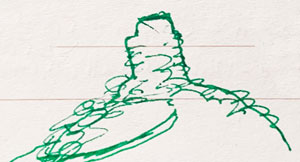
The Atlanta Tower 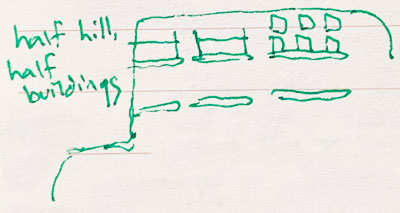
Half hill, half building At the Atlanta Tower I have free reign to go wherever I want. Upon discovering an outer porch without any railing, I become upset at a Emma character, who seems to not be actively working on it.
In the last part of the story, I’m with an attractive orange-haired girl and decide to pick up Brigit. I passed through her family’s school area earlier. Now I drive to her house. It’s similar in form to the school but wooden and shaded by trees. The left opening is a car port. Everything has a sensation of height, airiness, a feeling of uplinks/elevators to higher places.
In another elevator at the domed school, I accidentally go down instead of up. There are three sections of three buttons on the wall panel. The buttons are all dirty, broken, and scratched. I don’t want to go down at all so I quickly make the elevator go back up, then I exit.
The Atlanta Tower: This might be the earliest mention of this as “The Atlanta Tower”. Could this be the actual construction of some part of The Atlanta Tower? The college clearly already exists — probably an extension of Georgia Tech if I got the location correct in a later dream. Atlantic Station, a 138-acre commercial and housing development was being constructed at this time in the very same area, and was probably having an influence on the astral here as well.
-
Nuked in Atlanta
The buildings seem extruded I’m with Buttercup in the Atlanta Tower — the concrete multi-level transporter, up above the college with the auditorium. Around the college is a city. Everything is over-extended, like soft cheese extruded through a square hole. It’s the heart of Atlanta.
Tower Transporters: Here I refer to it as a transporter, as all these towers appear to be — a spiral through which one raises frequency.
-
Waiting for Brendan 2004 • 1:30AM
Awake: After writing with Brendan and sharing music, I go to sleep at midnight. I dream the following over the next hour:
In my dreams I go to visit him and make brief contact several times. We prepare to go out adventuring but he’s busy in his semi-dark apartment (which isn’t accurate to waking life). I make contact, then drop, then make contact, then drop. I get bored and wait in my universal dream space, the school between the worlds (the Atlanta Tower). It’s dark there. The building at the top of the elevator is like a hotel. It’s several stories tall and domed at the top, with a theater. It’s directly above the physical world. I wander into a familiar gift shop nearby.
Waiting Area: Unable to reach Brendan because he’s likely awake, I hang out in the city area near the Atlanta Tower.
-
When Everyone Stopped 2006 • 5:45 AM
I’m dreaming that Buttercup and I are on an early AM trip to do some shopping in an area a bit northwest of downtown Atlanta. . . . I knew when he arrived that the guy was going to take us somewhere, and he did. We found ourselves in a lovely little town in northwest Atlanta. The city center was busy with people shopping and eating. The sky was pale gray-blue. Colors were more intense. We traveled past the downtown area, peering in restaurants, and down a street into the neighborhood.
The Atlanta Tower: This is the city center around the Atlanta Tower — just above Atlanta, surrounding the college, auditorium and the elevator tower. I drew a little map, with a point to the north marked “work”, a point to the south marked “downtown”, and a midpoint between them, offset to the west, marked “shopping” where this dream took place. This places it in the vicinity of GA Tech, Turner Broadcasting, and Atlantic Station.
The Woods Neighborhood
-
Wadsworth’s New Daughter 2024 • 6:30 AM
I was returning through the Woods Neighborhood towards the highway — the opposite direction as usual. I was surprised to see new development there — buildings a few stories high. Businesses of small import, not open to the public. There was a new small lake there. I thought maybe some of this had replaced the house we’d once lived in. I never did pass the house in this dream. The roads are somewhat maze-like, and it’s hard to find it.
At any rate, I passed through the Woods Neighborhood area to the stores on the north side. I went to a small standalone grocery store I often go to. The front doors opened into a large hallway with the grocery store opposite. The checkout was directly ahead.
An Astral Home: This is the first time I’ve clearly remembered this dream location that has been a standard location for me for ages. It’s one of several recurring suburban astral homes that I go regularly to and consider mine.
An interesting thing is that these recurring astral locations are very stable. They are predictably themselves. Though it feels somewhat like Blaine House and Midway Woods in some ways, it’s also entirely unique. If this were a rote, it’s far more likely I’d paint over these places with well-known physical locations and people. For example, in a rote I’d be far more likely to project a known store onto the grocery store and a known person onto Wadsworth’s daughter in order to understand it. But instead I have this grocery store that’s unknown to me in the physical but always the same in the astral, and this unknown person who strikes up a conversation with me, seemingly uninterested in Wadsworth’s ploy. In essence, these locations are more real and authentic, not dressed up in my past impressions.
New Town
Other Times and Worlds
While our consciousness in the dream state is often focused on things related to our physical life, we are free to experience anything, including other times and worlds.
Traveling to Distant Worlds
-
The Disc 1997 • age 23
Context: I was reading a book with aliens in it.
Alien and magic disc I was shopping in a grocery store when these really interesting-looking tall aliens gave me this magic disc. There were these controls all over the top front area. I gripped on tight, pressed one button, and shot up really fast into the sky. I was traveling rapidly through space. It seemed like a colored haze at times and then came together. I went to this planet that was supposed to be Neptune. I descended and came down in this area with trees near a red pond. It was red because it was saturated with tiny red motes. I glided smoothly over the pond and saw a tribe of dark-skinned nature people nearby. There was probably a slight awakening because the dream jarred and repeated with a friend coming with me. He overturned the disc and it got lost. We swam in the red pond over to a small wooden enclosed dock where we met two people like us, but who had been trapped there for many years. I flew out searching for the disc and my searching made tons of buttons and such appear but not the disc. Then a dwarf/elf flew by and dropped off a disc for me and the two others but not my friend.
Odd: My focus on the science fiction book probably brought me to a like-minded community in the astral, leading me to this unique experience.
-
A Distant World 2000 • age 25
I’m in a plane-like ship traveling with friends through a cloudy nebula near the center of a galaxy where the stars were profuse. It was absolutely amazing and beautiful beyond words. I remembering thinking “I should take a picture” and scrambling for a camera, but right when I got it we were out of the nebula. Soon we were descending into a strange world. It was misty and cool and this different kind of pine tree was everywhere. The plane was piloted by a young person, and after a soft descent, we landed in this lake. The plane was pale, smooth, rounded and small — a rapidly shrinking thought form. We made for the shore.
There were pine cones everywhere and I thought “Hey — I’ll take one of these back to Earth.” I was reprimanded by some older new-ager so I played it off as a joke. The buildings were cube-shaped, seemingly made of wood and glass. They were brown, jade, and gray. We went into a low building by the lake. Inside were Ranier, Buttercup, Aurelia, and Fiona, along with others I didn’t know. We played a game of questions that was a little risqué at times. During such times the lights dimmed.
Then we met a Japanese man from Miajima and told him that after this, we’d be going to some park in Japan. Soon we headed out and there was this large hill with a winding path. We were beginning a trek. We were going to split up at this point and meet again later.
Another World: This sure seems like a different world. I’ve read many accounts of travels out of body or in the dream state to other worlds. As distance isn’t a barrier, the only impediment is having a connection to it, having a reason to go.
Distant or Future Civilizations
-
The Hole in the Sky
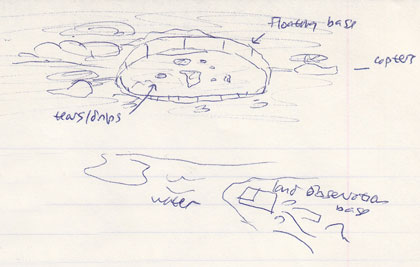
Hole in the sky with observatory below There’s this hole in the sky that has an airborne base holding it stable. The hole started as a big ring, with a really powerful whirlwind of energy coming down. But now it’s reduced to just small color-flashing globs. I decide to try to release some of the hole’s energy. Disaster. This red plasma pours out of the holes and falls into the sea. All sea life becomes comatose: living, but with lifeless eyes, just floating. The water turns black. I’m getting yelled at by some female scientist for my foolishness. The mistake will have more consequences, as well.
Otherworldly: Dreams like this tell stories so far beyond my understanding that I have to believe I’m peeking in on some other world and unable to grasp what’s happening.
-
Prisoner of Atlantis
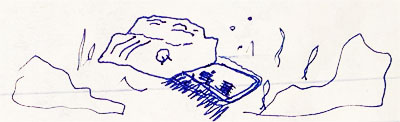
The floor of the sea, the rock slid aside 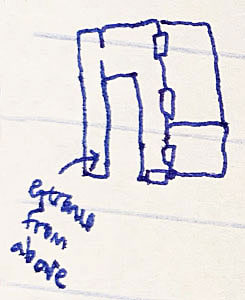
The interior of the chamber Juno and I are in scuba gear, walking on the ocean floor. We’re near this large, engraved rock. We recall stories that a person from Atlantis lives there. This rock had never been found, and the story was considered only a legend. This wasn’t our original reason to be there (or so we told the ones in the boat high above). Juno and I grabbed the huge rock and lifted, and incredibly, it slowly rose! We slid it aside. This revealed an entranceway cut out of the stone below (see map). We swam down. A woman in some kind of gear quickly poked her head and arm out of the door. I was filled with awe at the sight of her. I walked toward her and held out my hand. She took it and smiled. We followed her through a door into this room that looked like a lived-in bedroom. There was a much less watery feel in here. It was filled with a strange, slightly sparkly substance, which allowed us to walk as if on the surface. Without thinking, I took off my gear, took a deep breath, and found I could breathe. Turning back to the woman, I found her without her gear on. She looked just like Juno, except with a different quality about her. Her hair seemed lighter, as if she herself shone a bit. I was kinda attracted to her. She wore these bright and colorful fish-laden designs. I asked her many questions and she answered them all. She was an Atlantean, but was locked up in this prison by Atlas, a computer law-keeping machine. However, she wasn’t all that lonely. We were down there a long time, then took her up to the surface to show her surface life.
Underwater: There are hints of a very interesting backstory here, with a computer law-keeping machine that can imprison people from Atlantis.
-
Astral Warfare — Mind Bombs 1997 • 3 AM • age 23
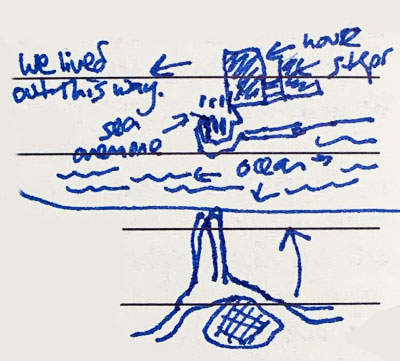
Detailed map I caught a recurring dream spot. It’s at the bottom of the hill and up a bit. I am here very often — it’s an ocean-based civilization built along the sea on rock under a massive overhang. The feeling was of both being crushed in a bit and feeling free and light.
I had this large group of partying friends, and I had gotten initiated into a beautiful native cult where I had gotten a mask, a tribal totem and symbol of inclusion, called something like the “semi-sloppily-made” something. Then there was a great dance where I couldn’t see very well, and there was such love and energy flowing from everyone. The first few were wearing blue masks. Everyone showed their own personal talents in the dance. Then some friends were there and were telling me that the government wanted me to return to school. At this point I felt like a little boy. In the rest of the dream, I was my age (23) or a little younger. I said I wouldn’t be taken away, ever, by anyone. I think I felt we were “on drugs” at this point now.
So what happened was that the government started with their mind-bombs. First they set off one that didn’t seem to work, but the next made space and colors fluctuate wildly. There would be rapid color shifts and the room would seem to spin or rock, and everything outside would seem to stretch, move, rock, and twist so that if you were to try to target them, you’d fail. I experimented with targeting a car and found the aim of my finger constantly moving downwards.
So eventually we got away but I felt like we had all just taken very hard drugs and were stumbling and slow. We had driven to a port to the North. Inside, some of the buildings were spacious, elegant, and very rich.
I had a vision of our room — me and my native love. It was green, had big windows, and silky fishnet curtains draped around all over. I so wanted to return to her. I had felt embarrassed about being so drugged up. There were lots of people living on the street. The house was on a ridge of green, and a slight valley lead up to the hill with a town I often dream of. I think the Dark Tower may be nearby.
A similar feel I was desperately trying to get home to find my love. She was thin and had green hair. There was a hexagon area with rows of red then green jellyfish anemone things, rocking back and forth in the tide. Someone had said you could slip through them without harm but I was always afraid, so I jumped over a corner of it. Coming down to the ocean, around this way was a long way home that I often went by mistake. I came down a craggy decline with broken glass on it. There were crabs on it and a walkway by the ocean.
I had such love for this girl and wanted so badly to be with her that I awoke to put my arms around Buttercup. I was a little sweaty and very hot.
It’s like this picture I have, walking down to the shore! The angles were much more steep. I have been in this dream place so many times before. Every night, I think, Every one! An oceanic civilization with a crazy government out of control? An underwater civilization? Shockwaves underwater can disrupt creature’s senses.
Ocean Civilization: In this exceedingly real, reoccurring place, the war is incredibly astral in form. No physical fighting, but “mind bombs” which distort the structure of astral matter to confuse and disable the enemy. What a vivid description. I don’t like this place. I never have.
-
Tribal Gore 1997 • age 22
I’m a young boy, adopted by a Native American tribe in their arid lands. One day my blonde, blue-eyed parents, brother, and sister return to me. A nasty fight with the tribe ensues, where I try to defend my original family while my tribe tries to slaughter them. There’s a lot of blood and my little brother and I get run through by a 7-foot fork.
Then there’s a big dramatic burial ceremony where the body is pressed into the earth in the front yard of Blaine House. The hole is 6-7 feet deep and bright red with blood. The tribe spray-paints it blue, then gets in and goes through these elaborate rites to free the soul and say goodbye to all the memories of who they were and where they lived.
Past Life Tribe: Is this a past life memory? Interestingly, I just read of a number of tribal cultures which, when a member of their tribe dies, go through elaborate rituals to scare their spirit off or hide from it by moving or changing their names.
The Nature of the Astral World
Astral Societies and Events
Astral Societies
Astral Events
-
World Religious Conference 1997 • age 22
I was transported to this big international city scene. It was a big, big event like a world conference, and I was very happy to be there. I was filled with light and energy and I started leaping high in the air speaking the voice of truth: “Knowledge without love is like skin filled with skin! It cannot operate without a heart and a complex inside!” I yelled it out to people as I leap-frogged them. I jumped straight through Emma.
Then I visited a hospital. I was in this huge underground chamber. I think most of the people there were Jewish. There was this old man who looked like a rabbi there, and he was just all love. He had just arrived. He took the sick and troubled one by one and spoke their inner voice to them and was right and helpful each time. I watched with awe and longing to be like him. I was so filled with love and joy that I began to shake, to vibrate. The light was getting brighter around me and I could feel dimensions beginning to shift.
I’m not sure what interrupted me, but things became different. The hospital became a cathedral and the rabbi became a cripple who was carried by a huge strong man. Suddenly a huge contingent of very colorfully-decorated people came flooding in. Some were very, very tall. They were the Islamic representatives.
There was some trouble above. Curious, I went up the concrete steps and passages to investigate. Outside, army and police officials were restraining a group of people. There was fire, orange and red banners, and a big amphitheater-type place, which was mostly cleared out except for military men in the first number of rows. Then I saw someone running towards the cathedral opening and I could read their thoughts: “1,000 years of blood and fire for the. . . . Christians? Death and fury to the Quakers!” I ran downstairs to warn them but got lost. Buttercup was down there! Then I woke up.
Astral Realms: This is a very clear, very true dream. Notice the huge religious gatherings, gurus and healers, ancient grudges, and the truest thing of all — the beautiful love I felt for the loving rabbi that filled me with light and vibrations.
-
When Everyone Stopped 2006 • 5:45 AM
We returned to town and sat at an outdoor table by a restaurant. There were tons of people at other tables, talking, shopping, all adding to a background crowd babble. And then it happened. Everyone finished their sentence at the same moment and STOPPED TALKING. Within moments it became dead silent. I felt this VERY strange dizzy feeling in my stomach. Others’ perplexed looks made me think they felt it, too. I fell from my chair to my knees. What was this? Was gravity changing? Had the world stopped turning? Some sort of radiation? Then I came from full REM to waking in a matter of seconds, and STILL have the feeling right now. Did something big just happen?!
Everyone Stopped: Written at the time: The dizzy feeling is very strong. Surely all these people were not thought forms which I controlled. The silence was intense — like we all had this constant background awareness of something, and then whatever it was just stopped. I half expect to check the news and see some major thing had happened — but there was nothing in the news.
Movies and Art
The astral world has its own art, movies, plays, concerts, and so on. And you can bet that they’re all far more impressive than those here.
-
Lucid Dream: Bruce’s Arm and the School Bus 1997 • 10:13 AM • age 23
This girl next to me asked if I wanted to see the new movie coming out, named “Peace,” which seemed to have two parts. I recognized it and said “Yes, yes, I sure do!” though what I recognized wasn’t something familiar to me now.
Astral Movies: Only in the mid-upper astral would people be excited by a movie called “Peace”.
-
Fiona’s Shop 2024 • 6 AM
I’m hanging out with Justin on a bed in what feels like a hallway. . . . He shows me this kind of art piece that had a special name. It was a long scene of people dancing from when one of his bands began. The view started in the center, and as I looked to the left and right, it continued in that direction like a wide panorama. It was in motion, in a little loop. People were dancing. It was artistically styled, mostly in black and white, but with some shades. There were exaggerated drawings of a few people in the back — probably the band members.
Astral Art: This art piece is amazing; something unique to the astral.
Social Movements
-
Free the Children 1997 • age 23
There was something going on that was giving freedom and rights to women, and it was a long-term thing and very successful. So I decided to start a rally for the children, to release them from the great bias and control, to free the children and the young! I started yelling out to everyone to gather and rally the children. All these children started following me in this huge march.
Continuous Dream Narrative: I was aware of great social movements going on in the astral — one to empower women, and so I started one to freeing the children. I truly believe that there are great movements astride on the astral, things that affect history through the mass dreams of individuals. I have been to several organizations and gatherings in the astral which reflect and foretell present-day issues.
Dream Classes
-
The Great Journey 1997 • age 22
I’m in the land of the Dark Tower. There’s this big classroom full of students. Three or four of us are selected from the group to go on this great journey. One student is jealous as we leave, and says “Why do you get to go?” There was all this preparation before we left.
Dark Tower Classes: The Dark Tower is a school, though not an especially good one.
-
The Whale-Chasing Machine 1997 • age 23
I’m watching humpback whales flee in terror from something. They circle in front of this wall of stone, then smash into it. They lick the algae to see if there’s a way through. Beyond the wall is a black area on the ocean floor. A cheetah is running by on the top of the wall (underwater!). A whale bumps the wall, almost hitting the cheetah, and something from the black area is knocked loose and floats to the surface. It’s a microbe or disease.
Suddenly the sea surface is a tabletop with myself and other students standing around it. The teacher says “Who do you think gets affected by this disease?” He tells us to launch these rubber bands in the air towards the table. He’s hoping they land randomly on all the models of plants and creatures around but they all land on the grass, so he redistributes them. We were talking about the effects of a whale-chasing machine and how a virus could wipe out everything.
-
Out of Body Experience — Flying on the Rooftop 1996 • age 22
[I have an incredibly clear OBE]
Oh! And after the experience, I woke up in the class, thinking this had all happened during some sort of test. I went to tell my teacher, who had a moustache and big smile and was excited to hear about it. I was so happy, I was almost in tears! Was this my soul teacher? He had a familiar feel.. Like he was watching me . . . and I was looking into his eyes (again) when I woke up.
Classroom: I awaken from this OBE into a classroom, so as real as this was, this OBE must have been a rote, translated to my actual physical environment and people I knew.
-
Distracted in Class 1997 • age 23
I was in a smallish classroom, lit by yellow lamps. Everyone seemed so much older than usual, as if it was a higher, more advanced grade. I was missing the lesson because I was talking to this girl in the back row. It was a long class, and I was engaged in numerous distractions, including drawing, eating, and talking.
Distracted: I find myself in a dream class, but unable to focus on the lesson, instead getting distracted in various ways.
-
Final Exams 1998 • age 24
I dreamed that it was final exam time in my classes. In one that might have been history, I had a big project planned. I had made baked-clay houses, land, people and horses and painted most of them. I was nervous about being in front of the class and took a Percoset to mellow. I thought back to my last exam and how at the end I’d lost my fear and smiled and really got into it. I wanted to start out like that this time.
I went to the front and the lights dimmed. A spotlight was on me and I set it up and began talking and play-acting the figures. After maybe 10 minutes I fell into this kind of trance and began telling a story with great spirit. Now, in the trance, I was expressive and the story flowed through me. The whole class was gaping, leaning forward, way into it. Soon it was very rowdy. I had them. Everett was in the audience, smiling and laughing like in elementary school. Everyone was drinking beer now, shouting out “yeah!” and having a good time. It seemed to last over an hour. Then the teacher turned on the light and class was over. He told me how horrible it was and that I had failed. I felt sad and said “But do you see the victory here? I’ve overcome my fear of speaking. I made them love my story.” It was no use. I either failed or got a D.
The final in my next class was outside and I had brought my computer as a tool but began talking and never used it. My teacher was so loving the presentation, so emotionally moved. I saw his reaction and broke down crying, relieved after the frustration from my previous final. They all loved me. I certainly got an A and felt like I had found my place.
Dream Class Finals: Who would have thought that there would be finals, or grades. That’s likely just a physical expectation that’s catered to.
-
The DeadStorm 2010
I was in a writing class with maybe 8 other students. In the first part, we had to write something. I was writing a story, though I don’t remember what it was about. I remember looking down at my writing and it was strangely scribbly. It looked like how I wrote when I was in elementary school and still getting some of my letters wrong. The teacher told us to stop writing for the next part of the class, but I just had to finish up my thought. He came around and poked me hard in the back. I stopped, but then said seriously to him “You will not poke me in the back like that again.” For the next part, he handed out these stamp kits. He had us pass our stories to someone else, and we were to take the stamps and stamp words on their story in funny or appropriate places, which sounded like fun.
Astral Classes: Another astral class. I can’t help but notice that this is like a class for kids. I’m 36 at this point. I felt like a teen in the class but my handwriting was like a little kid’s. The other students were teens.
Learning How to Create Thought Forms
-
Thought Form Class 2000 • age 25
It’s interesting to see how gradually the context of a dream can expand until a seemingly insignificant dream can become a significant dream.
I am in a classroom, though it’s not the Dark Tower. I made a firm resolution not to return as I believe it is in the lower astral. This classroom was on the ground floor. A gray light entered through windows and I felt I was just above the surface in the astral world.
My experience through dim consciousness was this: I was looking down at a miniature city, just a few buildings. My first thought? Wow, StarCraft! So suddenly all these Zerg creatures (because of their odd shapes) are fighting. Floating jellyfish are flying about and I invade the docking area of the kid next to me. I eventually run out of troops, but I find two oranges and think “ooh, these can be bombs!” I run about the other students in the room, looking for something to demolish, but when I see them all working on their projects I lose my fire and decide not to.
Starcraft 2 (Terrans invaded by Protoss) Image credit to Blizzard
Building thought form scenes
My contribution: attacking zerg Image credit to ThisIsGame.comYou know what their projects were? Creating little thought-form cities on the tables in front of them, using their thoughts. The place had every appearance of an art class — supplies everywhere, students wearing white aprons. And what I saw when running about were new, semi-formed thought-form structures in various colors — oblong shapes with a single color throughout, like playdough. One student had a mountain, house, and a newly-created thought form blob without edges or separate colors (yet).
So this was thought form class! And I was a fool student running about creating trouble, my mind fired emotionally by the competitive conflict of StarCraft (which was in my head last night because I considered deleting it). I was creating wildly, flying the troops and moving them about, but it was nonlucid emotion and memory projections powering and directing my work. What a lesson for everyone, huh?
Astral Classrooms: There are so many astral schools, of varying degrees of quality. Humanity is keen to awaken itself, bit by bit, to the world we visit every night in dreams, and this is a great example. This school is so much better than many I’ve visited. If this is the quality of school at the surface, then maybe the Dark Tower is in the underworld, as I’ve never seen this kind of focus before — well, in the other students, at least.
Learning Astral Sciences
-
Fractal Mathematics Class 1999 • age 25
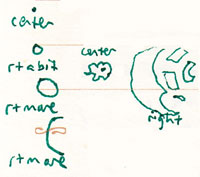
The images changes the further from the center I’m in a math class and the teacher is talking about fractals. He has a laser pointer and is shining it at the back wall. As he moves it to the right or left, it grows into a larger and larger fractal pattern, but the center of the pattern is also shifting out of sight, out of what the laser is lighting up. The result of this is that you can either see the center (but it’s very small), OR you can see details (but not the center). There is also an up/down adjustment for color (this I’m less sure of). I had the impression that THIS IS HOW VISION WORKS.
Astral Teachers: They teach such interesting things in the astral! If only I could remember more!
Taking Turns Teaching
-
Student Teachers 1997 • age 23
I’m in this class (not a Dark Tower class) and what happens is that students take turns teaching. Some I loved, others not.
-
Teaching 1998 • age 24
Last night I dreamed I was in a classroom and I went up to teach my ideas about higher planes and life after death and everyone was rapt. I was afraid of being laughed at but instead I was listened to and respected. I taught for half the class time and left, then when I returned, everyone smiled and waved at me! Today I had lots of extra energy.
Dream Classes: This is the first time I remember ever teaching dream classes.
Peculiarities of the Astral World
Peculiarities of the Astral World
Changes in Light
The amount of light we experience is a result of how open we are to the flow. Said another way, the light in our astral environment is determined by our frequency of consciousness. It’s the emotional index of our focus, and as such it typically doesn’t change without changing our focus.
To experience a different amount of light, we have to change our emotional focus, which would shift us to a different frequency, and thus a different environment would spring up around us. This makes the act of simply switching on or off a light in the near realm or astral very unreliable.
However, in dreams we can project an environment with different light levels to satisfy our expectations. This is a subjective projection that will only remain as long as we keep some attention on it.
No Sun or Shadows
As often as I’m in bright, sunny places in the astral realm, I don’t recall ever seeing the sun. The reason is that the light in dreams comes from within everything. The astral space and matter itself is the source of the light. There are also no shadows in the astral world. The exception to this (and to many laws of dreams) is that if you are looking for them, then of course you will find them. The mind’s ability to project is virtually unlimited. One could shut out the entire astral world and live completely within a memory or expectation.
Determined by the Light of Consciousness
-
The Home for Shape-Changers and Psychics 2004
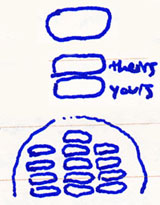
Mental screens There was one point where I was outside the home in a parking lot. It was night. The parking lot was a huge dirt and gravel area filled with cars. I began experiencing something like a hallucination — seeing through other minds. In waking life, we see through a single wide screen located in the darkish orb of our minds. But we can add another screen above ours and see through another mind screen as well. The velvety black sphere of mind can expand and expand to contain an unlimited number of screens. Someone was leading me back to the home. I asked them: “What if someone could see through every single mind? Wouldn’t that make them crazy?” and as I spoke it the black sphere of my mind expanded exponentially, opening up mind screen after mind screen until there were hundreds, each one the size of my own usual mind screen, and each letting more light into the velvet space of my mind until it was a sort of pre-dawn bluish gray. But all the viewpoints made me reel and I closed it down. “That was psychic,” I thought. In opening all those minds, I learned much about the transformations and what goes on at night. Then I’m in a truck being driven back to the home. I take turns looking at others and seeing their psychic abilities/ailments.
Mind Screens: This is amazing. In altered states, one can experience the visual field (or “mind screen”) separate from the velvety black sphere of mind. This shows that there is no limit to our mind’s capacity to connect.
The light change from that velvety black to a pre-dawn blue-gray is the ambient light of the astral realms! The light has to do with how many minds we’re open to! There’s no question that the lower in the astral we are, the more alone and disconnected we are. Our connection to the light of other minds causes that pre-dawn blue-gray light of the mid-lower astral, and the light of huge numbers of minds causes the bright sunlight in the higher astral realms. The “reeling” sensation I felt as I opened to hundreds is mentioned by those who go into frequencies too high for them to handle.
The image here is actually three. The top part shows one’s visual field. The middle shows one’s own with a second above it. The bottom part of the image shows one’s perceptions opened up to 12 others, within the expanded velvet space of the mind.
Rare Changes in Light
While each astral or near realm frequency has its own ambient light, we are free to project light or darkness over it. When this happens, we are moving into a dream projection, and as soon as we withdraw our energy from it, the ambient light will return to its natural state.
-
The Green Dragon of Sauron 2004
The camera spun around 180 degrees to a shot of a dark land with a stone monolith, lit by gray moonlight, the grasses making everything look hairy. A threatening landscape. Then back to our heroes, charging towards this dark land. They’re mounting a hill and crossing a membrane — a cave through a mountain pass. The word “membrane” just popped into my head — a nonphysical boundary which will take physical form appropriate to the situation. As they exit the cave tunnel, they enter the land of the stone monolith, but in daylight. [The heroes battle Sauron, and flee to a third room. . . . ]
They emerge into a large circular area, walled by mountains. . . . Now this new area was very sunny and bright with long green grass and healthy trees. . . . At this point a strange transformation began to come over the dream. The bright tree-filled grassy mountaintop area began a slow transformation to a room in an unfamiliar house which I later thought of as my own. This of course led to all sorts of inconsistencies in size. The first change was that there was a ceiling, a white ceiling which in the mountaintop was a layer of clouds. . . . Our surroundings had transformed completely into a room now, but at this point was like a room in a dungeon. It had cinder-block walls and was lit by torch light. I discovered a doorway and went in to investigate. [We battle the dragon. . . . ]
So then we went back to hunting in the ceiling. The light changes to natural light. The ceiling turns white. It appears like a room in a house again, rather than a room in a dungeon.
Changes of Light: Much of this dream is projected onto the rooms in my house, which at the time of the dream has bright, sunny light.
In the beginning, I’m projecting out a story based on The Lord of the Rings. I project a dark land ahead of me, but when I pass through the membrane into that room, I bring the daylight of the scene with my allies into that once-dark scene. Then when we flee, we cross another membrane into an mountain scene with full sun. The mountain scene slowly changes into the physical reality of our sunny bedroom, and then I begin to project a darker scene onto it — a dimly-lit dungeon room. After that scene plays out, the projection fades, returning me to the sunny bedroom.
We can project dark scenes in light places.
-
Haunted by Spirits 1997 • age 23
It was sunny and we were outside. A photographer was trying to take pictures of this scientist with his mother and grandmother, but every time we took a picture, day changed to night. Then someone screamed or freaked out, and the scientist, against the advice of the photographer, turned on the lights — to daylight. The picture that came out showed him absent from his actual position and instead tied up in the corner. This kept happening.
Tied Up at the Moment: So creepy. It’s rare that light changes so drastically in dreams. Usually these transitions are gradual and only go one way. But the dark does indeed match with what happened in the dark.
-
The Buzzing Campus Eclipse 1999 • 8 AM • age 25
It was sunny daylight, and then the color of the sky got darker and someone shouted “eclipse!” Everyone got up and got into a position to see it. I ran around the building. Gravity diminished as a moon flew across the sky, barely crossing the sun’s path. Everything turned a dark orange color and then there were bees everywhere.
Rare Light Change: This is a rare example of the light level changing in a dream without changing of location.
-
The Mirror People 2012
It starts out with me going to Spring Lake Park High School. The high school was pretty dimly lit. . . . I made my way to Ranier’s room, which had the lights on. . . . A couple people cleared out until it was just Manville A and myself in there. We had this friendly but awkward conversation. At times the light was off, as if someone had turned off the light switch and it was only dimly lit like the rest of the school. Manville and I talked about various things. . . . I turned my attention back to the pile of shirts Ranier had left for us, and it was bright in the room again. . . . It’s dim morning light and I see a couple go into a house along the street on the north side of the school. . . . Then I’m walking down the street again and it’s gotten dark like night. . . . Another attack is coming — this time from five administrators.
References: Ranier's room is the office my high school counselor.
Changing Light: When a room has different lighting than the ambient lighting of the dream, it suggests dream projection. The back-and-forth changes in Ranier’s room suggest going back and forth between true social dreaming and projections.
This is a predatory dream location, so the dim light and switch to full night as the attackers come is fitting.
Changes in Light Due to Jumps in Time
Our own experience doesn’t jump in time, but rotes can move across time from scene to scene, just like any story.
-
The Nun in the Wall 1997 • age 22
I was traveling with Buttercup. We decided to stay in the spare room of Brendan’s religious organization. . . . I came back later at night. . . . I left and came back in the morning. They were having one of their religious services.
Night to Morning: This dream spans time in an odd way, going from night to morning. This is also a rare change in the lighting of a dream without changing location. This is likely a rote.
-
The Home for Shape-Changers and Psychics 2004
One [medication] is in “tab” form like LSD with pictures on them. . . . I look through some of the tabs, then give him one, but I begin to have colorful LSD-like hallucinations. I basically freeze up and watch the brilliant colors melt through my mind. I reason that the tabs must have worked through simple contact.
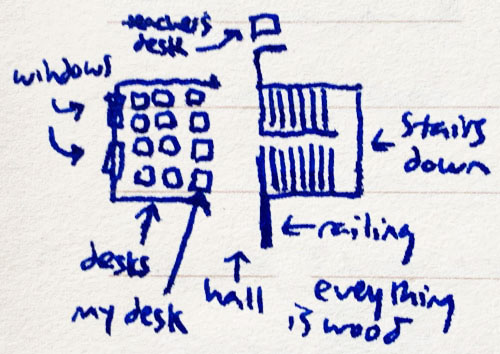
The classroom scene Then I’m in a desk in a classroom next to my red-haired friend, still color-hallucinating, when something happens. The dark nighttime scene where it’s just he and I in the room begins to cross-fade into a morning-light version of the room packed with people at their desks. I am very aware of this happening. It takes maybe 5-10 seconds. I’m talking to my friend, then say “Hey, what’s this? It’s daylight. It was just night a second ago and I have no memory of what happened between then and now!” But of course nothing happened. It just changed around me. Everyone seems alive and awake, but I can see their monster shapes as faint outlines within them. Each one is different — from furry wolves or bears to the undead to bizarre twisted monstrosities. And as I watch, everyone in the room begins to change shape. Some more quickly, some less quickly. But it’s dim daylight like just after sunrise so there’s not a lot of fear.
Lighting and People Change: The empty classroom scene at night cross-fades into a morning scene with all the desks occupied, as if we faded into the future of the same room. It’s another time shift, which this dream has lots of. This means I’m within a rote.
Reeling from Too Much Light
-
The Home for Shape-Changers and Psychics 2004
Someone was leading me back to the home. I asked them: “What if someone could see through every single mind? Wouldn’t that make them crazy?” and as I spoke it the black sphere of my mind expanded exponentially, opening up mind screen after mind screen until there were hundreds, each one the size of my own usual mind screen, and each letting more light into the velvet space of my mind until it was a sort of pre-dawn bluish gray. But all the viewpoints made me reel and I closed it down.
Reeling: When one goes higher than they are ready for in the astral, they get dizzy, lightheaded. I wonder if this is why I reel at the pre-dawn light of so many minds suddenly opened in my mind and have to close them down.
Astral Interpretations of Physical Phenomena
While projections and expectations can recreate anything perfectly in the astral, certain physical phenomena are usually off in predictable ways. There are two independent reasons that physical-only phenomena take unusual forms in the astral world:
First, the dream self focus has a weaker understanding of physical-only phenomenon (much like its lack of biological understanding), and creates its best approximation of them in the astral.
Second, and more importantly, there are limitations in the action and behavior of astral matter, which lacks the actual internal qualities of the physical elements and is instead made of a universal substance given many forms. Astral matter does not have temperature, acidity, reactivity, combustibility, or any other innate physical characteristics, leaving only our expectations to determine its behavior.
Fire (Dreamfire)
Fire does not naturally exist in the astral. Astral matter does not give off heat (or cold), does not combust, does not create smoke, or consume other matter. Unless one or more of these actions is specifically expected, looked for, or a necessary part of the story, the fire thought form doesn’t have these characteristics. It’s merely a light phenomenon, representing fire.
-
Oberlin Dreamfire and the Zombie Line 1997 • age 22
A large part of the campus was on fire. Dreamfire, of course: never flames but orange lights flickering from unseen places. . . . We took the stairwell to the 1st, 2nd, 3rd floor. . . . Then instead of floor 44 where I meant to get off was floor D. It was half a floor. I opened the door hatch in the ceiling to a dreadful sight.
Student after student was standing in a big line, zombie-like. The orange flickering was everywhere. I knew it was too late for these people. It seemed like they were lining up for a nursery.
References: I lived in South Hall at Oberlin for a few years.
Dreamfire: Dreamfire is a strange thing, and well described here. Dreamfire is usually the form fire takes in dreams. It doesn’t consume anything. It’s just flashing orange light.
-
The Rogue Faction
There was a scene with giant vehicles driving slowly through a burning city. But the flames were whitish-tan, the buildings melted around the flames like ice would.
Whitish-Tan Dreamfire: An odd color of dreamfire. Notice how it’s melting the thought forms around it, which would be the astral equivalent of “destroying” matter.
-
Bees 1997 • age 23
Then I was in the stairwell of a place I might have lived. There was a big vertical cylinder in the middle and a beehive in the center. A voice spoke into my mind “I’ve always thought the old way worked best: fire.” The cylinder started spinning, flashing in glowing rainbow dreamfire. It was beautiful. Bright flashing flames flew out and incinerated everything.
Explosions
Explosions aren’t natural in the astral. They only happen through expectations taking form, and often happen quite differently than expected.
-
Submarine Self-Destruction 1990 • age 15
[There is a big battle. We’re told to self-destruct our submarine while everyone else evacuates]
My Wadsworth is the co-pilot. We land our submarine on theirs and set the self-destruct timer. Then Wadsworth swims to the surface and I take a diving suit up to the surface, which is the floor of our basement. We climb the stairs to the main level of the house. Dad stands directly above the location of the two subs. I go into my room and hide behind the thickest walls. Mom stands in the loft. The blast comes. I see it — a slow-moving shockwave of intense heat moving towards me. I’m not protected enough. I scramble out the window for another wall of protection. I close my eyes and take the blast. When I open them again, the house is devastated.
Slow-Motion Explosion: The explosion is moving towards me so slowly I have time to reposition myself further away.
-
Wadsworth’s Revenge 1996 • age 22
One missile went straight up, half-lit like a firework as it hit a helicopter, which then fell to the earth and exploded. Everything turned black and white as the explosion slowly filled land and sky, rocketing outward, lifting huge chunks of earth into the sky. The explosion came closer and closer, with no sign of stopping. I knew I was nowhere NEAR far enough and began to run, then turned and resigned myself to my fate.
Shockwaves: Explosions frequently take the form of relatively slow-moving shockwaves.
-
Nuked in Atlanta
We’re nuked. The nuke hits not far off. The explosion is a perfect grey-brown sphere with a smooth exterior, reflecting white light. I jump behind the couch with Buttercup, hold her tight, tell her I love her, and think “who knew the 18th would be the end?” The blast rolls over us. It’s like a continuous painful wave of static rolling through me. It hurts in the heart. Then it’s over and I’m surprised to find myself alive.
Nuclear Explosion: My expectation of pain makes it come true.
-
The Buried Building 2024
I’m riding on a bike, escaping. Perhaps I’d stolen something? But I pass a tank on the road. It turns its turret around and fires at me. Focusing in on the moment, I see the explosive canister pass by my head. In slow motion it continues forward ahead of me, then explodes. The explosion is cloudy rather than fiery. A circular hole is left in the ground, and beneath it a 2-3 story drop. I watch as my body plummets to the bottom.
Tank Blast: No fire here, just an explosion of smoke leaving a deep hole in the ground.
Lightning
-
The Real Office 2010
I tell him how lucky he is to be living in such a beautiful place with so much sky, grass, trees, and open space. It’s been stormy evening light so far and now a fierce wind whips up and dark clouds approach. There’s a bright flash and he says to watch out for the lightning. The lightning happens in little bursts about a foot tall and a foot wide in different locations at the base of the house.
Little Lightning: Lightning, being a light phenomena, runs up against the “rapid changes of light” limitation in the astral. So to compensate, I dream of tiny lightnings.
Lava
Lava in dreams is a very interesting substance. It’s astral matter that remains amorphous, but also has the high-energy qualities of producing light and heat. This more energetic astral matter is more responsive to thought.
In the astral, heat doesn’t burn or starts fires (though our focused expectations can cause it to appear that way). Lava will sometimes melts physical objects, as melting is a natural way for astral matter to act.
-
Super Hero Lava Pool 1995 • age 20
I go exploring underground with GenX. We enter this immense rectangular metal room where the floor is entirely lava. There is a metal walkway around the edge and a ledge on one side. Polaris, Guido, and another hero join us as we go out on the ledge. Guido pushes Polaris in. Then he pushes in some other big guy. We feel scared and helpless. So I do the crazy thing and push Guido in. He tries to drag me in too, but isn’t able to. He disappears under the flames and I think “How can any of them survive that?” They resurface as alien skeletons as more and more superheroes file into the metal room. Eventually the ledge is filled. Some overlord guy pushes someone in from time to time. Forge goes into the lava, then Mr. Fantastic jumps in after. But he comes back up as Spider-man and escapes through Peter Parker’s corpse. Other heroes do their best to survive. Ghost rider goes in a man and comes back hideously powerful, riding this flame cycle along the ledge. Some reappear as flaming new characters. Things are getting bad when suddenly Iceman appears and freezes the lava solid. The superheroes go absolutely WILD. Everyone is saved.
References: GenX is a superhero team. Polaris, Guido, Iceman, Ghost Rider, Forge, Spider-man, and Mr. Fantastic are other Marvel super heroes. Peter Parker is Spider-man's real name.
Lava: I’ve found lava to be a powerful transformative force. Forms become very malleable in it. While some superheroes melted into it, it transformed others.
-
The Backyard Lava Pit and Dream Crossover 1997 • age 23
I had a room in Tank. I don’t recall knowing my roommates. Buttercup was there at times, though I had to really pull her. There was a lava pool in the back yard. It was squarish, with constantly moving red and yellow lava. At one point it was spitting red coals up through the ground, many of which went over to the neighbor’s house. I went over there and told a boy not to touch them. Little by little the lava spread, and then it really began to flow. It flowed down the alley leading to the neighbor’s house. It went into the back yard in thick sheets and I yelled at a man and the butler to watch out. They were most assuredly thought-forms, though, as they were almost like vacant balloons, animated only by my expectations. One just let the lava take him — just didn’t even notice. After the lava had flowed over the butler’s foot, his colors began swirling and melting into it. As the lava rose, he melted into it, becoming of the same semisolid amorphous flowing, stretching substance.
So my housemates had sealed up the lava hole and I said “No! That’s a bad idea! It’ll build up pressure and BLOW!” As I said BLOW, it did (talk about the power of suggestion). It flowed and filled the lower levels of the house and the back yard. It was really deep (6 feet in the back yard) and the top turned dark gray as if cooled. We ran out onto it. I discovered that when I took big leaping strides, the lava pushed me up into the air with big waves. We played there.
References: Tank is a co-op in Oberlin.
Lava: The lava reacted exactly to my expectations both when it burst and when I decided to start bouncing on it like a trampoline.
-
Rachel’s Reunion 2010
At one point, Buttercup and I journeyed along the hill upstream from the camp. As we went, we saw a burst of fire and black smoke from across the river. A volcano! There were flames and smoke coming from the top, then bursts of lava. I thought “Yikes — I hope none of those spurts come this way!” Of course, the volcano spat out a hot lava rock way up into the air and directly overhead. I called out to Buttercup to watch for the rock, and it landed only a few feet away. As we continued, the volcano kept spitting sprays of rocks up and over to us. I dodged them all until I became curious about what it would be like to get hit, causing one to land near me and roll down next to my arm. It was hot, but didn’t burn. Then the volcano spat out a wide sheet of fast-moving lava over the hill in front of us. It looked like tomato soup. We fled up the hill.
Lava Always Responds: My playful fear of being hit by a lava rock clearly caused it to happen. I remember looking straight up into the blue sky, waiting for the lava rocks to fall, so they were actually materializing out of nothingness up above us.
Tornadoes
These are similar to physical tornadoes except they sometimes come in great numbers, change the landscape, and/or carry me to a new location.
Vortexes are a result of flows, which is inherent to consciousness, and thus natural to astral matter. Consider that our chakras are vortexes, connecting energy across different frequencies.
-
The Insanity Creature of the Tower 1996 • 3:15 AM • age 22
In front of Blaine House, there are lots of big clear tornadoes coming from the west. I was outside, holding onto trees, but even they were being pulled up. So I went to the basement and it was small, weird, and empty of furniture. There were some other people there, too.
Tornadoes: These appear from time to time, usually more than one, sweeping the landscape.
-
Tornadoes and Electricity 1996 • age 22
I’m in some big fields in the back of a school and the tornadoes start coming. They come in waves, and there are more than 18. I hold onto a big slab of concrete with some other person. After they pass, I dodge lightning and leap electrical wires.
Whirlpools
Whirlpools are like tornadoes, in that they are a vortex that can act as a gateway to another place.
-
The Whirlpool 1997 • age 23
This dream was inspired, no doubt, from a big whirlpool I saw earlier today.
I was in this neighborhood of houses on a hill in a rocky landscape. There were big black magma-type rocks near the ocean, and a never-ending whirlpool a little ways out. My house was nearest to the ocean. There was a conversation where I expressed a desire to go through the whirlpool. Then a big wave hit and the house broke loose and started floating on the water. It floated over a rock ledge, smashed into another house, and began moving towards the whirlpool. Someone said “Hey, you got your wish. We’re heading towards the whirlpool!” As we neared it I saw how violent and ominous it seemed. Now I hoped too late to avoid it. My house, full of people, plunged down into it and my last breath of air got mixed with water as the house was sucked under. The underwater portion was impossibly long and my breath barely held but finally I washed out on a beautiful cascading waterfall that was broken by rocky landings.
Whirlpool: Whirlpools are like tornadoes in dreams. This one acts as a gateway or hyperspace corridor. I’m not sure which. It took us to a new location in the astral world.
Sudden Storms
Ocean Waves
-
Standing Waves 1998 • age 23

Standing waves on the ocean 
A standing wave with a hole in it I’m at this resort on the ocean, with forests and rivers around it. It was in a little resort town. I went to see the ocean and there were steep, uniform waves moving in.
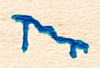
A crooked bench The next day there was a storm and the waves were strange and very tall. They were standing in rows but shifting constantly. The wind was moving them. The waves almost looked scared, like snakes wavering. I “hoped” in my head not to get hit by a wave and suddenly the wave in front of me churned and sent forth a blast of water the size of my head right at me! I sidestepped it and it blasted for a good 12 seconds. I went and told Buttercup. The whole world was shifting and rocking up and down slowly. One of the benches was crooked for compensation.
As two waves combine, I notice there is a hole in the middle of them for a moment.
Standing Waves: This is definitely a dream phenomenon. The water was very thought-reactive. The waves were so strange, standing there in rows. A tilting city, too, and it seemed to be designed to deal with the rocking and tilting!
Flowing Water
Sometimes a river in the astral is a rationalization of a nonphysical flow of energy. As such it doesn’t need to follow any rules of gravity and may flow in any orientation — even straight up!
-
The Buried Building 2024
I’m on the bank of a river. The river is about 20 feet wide, with big rocks beneath the surface. To the right it curves away outside the exterior of the building. To the left, it descends very steeply about 30 feet from above. In the physical this would be a waterfall but here the river has just bent downwards.
Water and Gravity: How flowing water reacts with gravity is a very physical thing. To the dream self, when a river comes down a slope, it just bends downward without changing its appearance in any way.
Mirrors
Astral matter does not reflect light, so mirrors don’t work as they do in the physical. If we see an image of ourself in a mirror, there are two possibilities.
First, it may be the result of projection. In this case, we would appear just as we expect to — yet the results are often surprising. Second, it may be the result of jumping out to look at ourself from an outside perspective. In this case the strange results may be due to the influences of our focus or feelings at the moment. Once, when talking to a cute girl, I unconsciously took on her form.
I’ve had several dreams where mirrors show false reflections meant to manipulate or scare me.
-
The Haunted Ride 1996 • age 22
I’m in a haunted house ride. I think Buttercup is with me. It’s a miniature haunted house and boring at first, but then the car seems to plunge off the track through this door in the floor into this super nasty haunted house! It has all the keen effects of dreamland, fuzzy visually blurred places and mysterious shades. Mirrors up ahead on either side of the hall are reflecting hideous pictures of us back.
Evil Mirrors: Here’s an instance of mirrors reflecting lies.
-
The Insanity Creature of the Tower 1996 • 3:15 AM • age 22mature content
The insanity creature in the cup had given me two arm-length, erect penises, and put me on display, for all to see. I tried to hide them, but they were so nice, one had to be proud. It may have been done through the mirrors — I saw myself with them in the reflection. The mirrors lie — it isn’t your reflection. . . . I could control the drug-induced madness at times, but it snuck in everywhere, through those little mirrors that reflected out lies.
The Mirrors Lie: The mirrors were a particularly insidious trick. They’d reflect lies. It would be you in almost every respect, but with lies built in — one or two changes, and it would be hard not to believe that what you saw was real. A powerful tool to use on nonlucid dreamers.
Eclipses
There is no sun or moon in the astral, so my dream self only has a vague idea of what an eclipse is.
-
The Buzzing Campus Eclipse 1999 • 8 AM • age 25
It was sunny daylight, and then the color of the sky got darker and someone shouted “eclipse!” Everyone got up and got into a position to see it. I ran around the building. Gravity diminished as a moon flew across the sky, barely crossing the sun’s path. Everything turned a dark orange color.
Something Like That: The moon here looks like an atmosphere form, called into being by our expectations once the person yelled “eclipse!” It was clearly an approximation of an eclipse, since the moon flew rapidly across the sky, barely crossed the sun, and the darkness came first. A failure of the collective dream selves to understand how an eclipse physically works.
Unique Astral Phenomenon
Energy Warps
Energy warps appear to be openings to higher, more energetic frequencies. They can be a point from which higher-energy matter comes from, or an area that has an empowering and expanding effect on everything.
-
Thought Form Games at Arcology Hill Stadium 1996 • age 22
Astral matter emitter
Circle symbol writing Now a device in the corner of the field began to shoot out this raw unformed astral matter across and over the field. Smaller balls of it all connected and joined into this big, floating ball. There were all these circle symbols on it that I was reading. My defeated friends and I decided to keep playing and reverse our loss. We made a bunch of hot-air balloons out of the big thought-form ball, and flew up into the baskets. Swirling around us were lanterns, and the mad hatter, and everything seemed to be alive like in musicals. We sailed past a big statue and some fruit and vegetable stands. Lots of people ended up in the balloons, including many old friends. The cloud of balloons, lanterns, and spontaneous creative forms began encircling the top of the hill and tower, then going up one side.
Pure Creation: The stadium emitted unformed astral matter and we shaped it creatively with our thoughts.
-
Hyperspace Warps 2001
I found myself at our lovely new house. I opened the back door and stepped out into this dense, thick-smelling primeval nature world. The plants and insects were huge and felt ancient. Two brightly colored butterflies flew together in front of me and locked into a mating position. Then, suddenly, a dragonfly, as big as my arm and buzzing loudly, flew in and snatched them. It was a vague notion of a dragonfly — probably a rationalization. I was saddened, but in a moment it was caught in a table-sized spider web. A third butterfly jumped from the union. “Oh, I didn’t see that one before,” I thought, “It must have been directly behind the other two.” Then others began to fall from the union. I thought they were dead at first, but they took flight as they fell. There were more and more — a brilliant cascade of color. And from this proceeded a creative frenzy, directly from the soul, the lava warp, the face of god, the gateway to the infinite. As to exact things, my memory fails me, but I was in ecstasy, playing in this field of explosive creation. . . . I’m not sure where this fits in. . . . I walked out into an open field at an elementary school setting. The details are unclear, but I had a blue super ball. I threw it, and when it landed, there were two, of different colors. A child joined me. As we played, creation came bursting from every point. Soon there were wobbly-edged coconut-sized balls that would break open and solidify, releasing some toy or treat. Kids from everywhere came running out to play. I caught one of the balls, cracked it open, only to find it filled with super balls of every size, color and texture. I gave it to a kid after grabbing handfuls of balls and began to bounce them everywhere. More came down than went up. It was blissful, ecstatic play.
The Hyperspace Warp: This is a beautiful thing that I have seen a few times. It’s like an opening to the highest plane, a powerful gateway of pure creation, of light and beauty and thought-reactive matter exploding out into reality. It’s accompanied by an ecstatic feeling because of the higher-frequency energies pouring through.
The super ball warp is similar to the hyperspace warp except that it’s boiling from the general area instead of bursting out of a single point.
-
Powered 2013 • 2:30 AM
There was a substance or drug that powered people up. It was released by accident. . . . I’m looking out the window of the bank. I see a man smash out through the window on the first floor of a building. Then he rises up to the second floor, lands, and cheers. He flew! It’s a bearded guy, looks like a biker. A manager-looking guy flies up to the second floor and lands next to the biker. Another guy is sticking to the edge of the outside of the brick building, thrilled that he can stick to the side of the building and watching what’s going on below. Everyone was discovering that they had powers.
Inside, things are getting dangerous. A man has the most concentrated bit of substance, sealed up in a little clear plastic bubble. He calls out to everyone, full of energy and emotion. “Do you see this? This is the most concentrated and dangerous part! This, they are keeping from you!” and he tears open the bubble case and holds aloft a chunk of potato, seemingly taken from someone’s dinner plate. It’s saturated with the substance of power. Ground zero for the accidental release. Someone shoots over to grab it. At some point in the chaos, a cluster of four slowly-expanding black orbs is released from it, the orbs growing slowly and flashing from black to cinders and back. I know when they burst they’re going to explode massively. They do and an entire quadrant of the glass bank building is taken up in the explosion. Another black cinder bubble cluster flies in the opposite direction towards people coming up a spiral staircase. I watch to see what happens — as the bubbles expand, they melt and fuse onto the people coming up, who now look like glassy-skinned semi-molten thought forms. In fact there’s a wild chaos to every form here. Everything is inflated 120%, as if it was a balloon, overfilled. Colors are vivid, glowing. Everything is burning with inner heat. People are so filled with it that they are spontaneously displaying amazing powers. . . . Things are getting crazy as people discover their power. Wild groups race each other . . . there’s a race to the top of the building.
Higher Energy Pouring Out: This is an amazing scene. Whatever this is, it is highly energetic, pushing out energy from higher frequencies into everyone and everything in the vicinity. The energy sustaining every thought-form (including people) is turned up, hyper-inflating everything from the inside, charging it with heat and brilliant color. Probably the best explanation is that it’s a channel or opening into a deeper, higher-energy frequency. At any rate, the flood of energy strips away some rational, waking limitations and gives people the energy and belief to do things they otherwise wouldn’t have thought they could.
Note how the high energy of one of the orbs melts and fuses the thought forms together. They lose their definition, becoming glassy (the early stages of melting). The energy of higher frequencies flows in through the interior of the lower forms. Everything is blazing with this inner energy, barely able to contain it.
Electrical Lightning Fields
-
Traveling Sparks 1996 • age 22
Buttercup and I are traveling through England. We stop in a presentation of “The Garbage Pail Kids!” in a church and I’m sitting behind this enormously tall guy. During a break, a commercial appears onstage: a car or truck in the forest is consumed by this vortex of flames and an electrical field emanating from between these trees, because it couldn’t meet the competition. Instantly I was there, curious to learn more about this strange electrical field. I was with someone, too.
The forest was dark, and the trees were tall, beautiful, and thick. I started walking and was instantly seized by some electrical field of blue lightning tendrils which lifted me up and spun me about. Then we began traveling down the trail at tremendous speeds, still spinning. I smashed through branches and growth and went higher and lower and was wholly unhurt. In fact, I was quite exhilarated by it. We went higher and I thought of how far ahead of the others we’d be. I looked below and saw the “Pelennor Fields” and a castle I wanted to explore but didn’t know how to stop moving.
Dream Phenomenon: The electrical field seems like an astral phenomenon; something that can carry you along with it.
The Pillar of Flame
I have had several dreams that feature a circular chamber with a pillar of flame in the center. When I touch it or go to it, I feel ecstatic energy or get transported into another dream. Is this a representation of the spine filled with pranic energy? Or some universal astral structure?
-
Guardian Spirit Leila 1992 • age 18
I dream of a large building with circular black supports, lots of windows, and a circular glass elevator in the center. It is night and cloudy. A flame shoots up through the center glass shaft of the elevator, and I sense some disaster coming. I climb down the shaft and leave the building. I emerge in this parking lot with scattered cars. My Dad walks out from between some cars and says something to me. Then he walks off, leans forward, and takes off flying. I watch, amazed, and say “Oh, so that’s how to do it!” I lean forward, lift my feet up, and fly. . . . It’s an amazing feeling. I fly for a while.
Elevator Shaft: The emergence of the flame signals a disaster coming, but then I end up flying.
-
Bees 1997 • age 23
I was in the stairwell of a place I might have lived. There was a big vertical cylinder in the middle and a beehive in the center. A voice spoke into my mind “I’ve always thought the old way worked best: fire.” The cylinder started spinning, flashing in glowing rainbow dreamfire. It was beautiful. Bright flashing flames flew out and incinerated everything. This is where the dream “A Great Love” started.
Ignition: Again the cylinder doesn’t start with fire, but ends up with it, and it takes me into another dream.
-
Enlightenment by Fire 1997 • age 23
I found a small mouse and picked it up. It began talking to me. It suggested I go back to the fire shaft, a place I was familiar with but hesitant about. I had four cards in my hand with different pictures of the inside. The structure was white and had a pillar with flames in the center. Around it were some wood spokes, perhaps? Anyway, I opened the heavy door to it and left the mouse outside. The entrance was at the top and I jumped down. I knew that I might end up in some other dream, and I had to try not to sink below the fire chamber. I held myself near the pillar and opened up to it and communicated with it. Upon doing so, I felt this ecstatic energy surge through me. I moved around the center with this feeling and then eventually left.
The Fire Shaft: Note my familiarity with the fire shaft and my reluctance to go. I know I might end up in a different dream. What is it?
Spinning Colors
-
The Color-Flashing Hat 1996 • age 22
I was at a performance of Tori Amos at an elementary school (Tori’s music came on to wake me up) and I was up on stage sitting next to her, trying to figure out how to play her songs. I think I learned some of it. Then I started dancing and then I got out this color-flashing hat and started flying and spinning and jumping and dancing and shooting around. So much activity that I awoke in a sweat!
Spinning Colors: This is the third dream now that I can think of with spinning colors, including the melt-out one of the many Rebeccas, and the young one of falling stars in the Blaine House backyard.
It reminds me of the rapidly-cycling every-color from dreams and psychedelic states — a color that cycles quickly between all colors and can be interpreted as any of them.
Astral Energies
-
Neon Chakra Flowers 1997 • Middle of the night • age 23
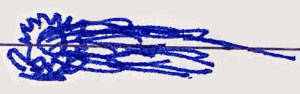
A neon chakra flower Kelly’s bedroom was dark and mystical. There were two small glowing flower devices spraying this soft, fragrant water in many tiny streams across the room. The streams were crossing in an X shape in front of the bed — one pink, one yellow. They were the weirdest things — they followed me, pushed towards me to spray me when I got close. The spray was misty and sweet smelling. . . . There was this girl named Sticky across the room, in the same dark w/neon glow kind of scenery and I danced around a table and proclaimed my love to her: “You, I’ll always love best, Sticky.” She was a super raver-girl with metallic makeup and a shiny silver shirt. Some parts of her shirt were glowing.
Chakras: I think here I was seeing energy flows and subtle astral structures. I don’t know what the spraying flowers were, but they reminded me of chakras. Seeing chakras in the astral is always a weird thing. They are so strange that they are hard to integrate into the scene. Sometimes they are seen as designs on clothing. It’s also interesting that2 when I’ve seen chakras, they’re spraying water or mist.
-
Leonard’s Piercings 2015
I dreamed I was hanging out with Leonard in the living room of Blaine House. He had gotten the top of his ears pierced in a triangle formation with little green, blue, and red gemstones. He also had the pupils of his eyes pierced with a blue gemstone in the center of each. It was dimly lit, and I was very impressed when these began to flash with light. The fact that he had pierced his eyes didn’t phase me.
Flashing Gems: I’m not sure what exactly this is. The flashing gems in his eyes feels like it might have been a rationalization of an energy communication.
Hyperspace
See larger section on Hyperspace below.
The High Wall
This seems to serve as a boundary between different places.
If you were shrunk way down and moving from one room to another in a house, this could be the wall. There are a number of possibilities.
-
Primordial Jungle Continent 1998 • age 23
I’m flying high up in the atmosphere. I can see all these dry, treeless continents and then one floating above the others with huge untouched jungle forests. There is someone with me, flying, and it appears to be Wadsworth. Everything below has a whitish glow to it. We are at what seems to be the top of a wall with no roof. On the other side are the tops of the trees of the jungle forest.
The High Wall: I’m flying here without rationalizations — no plane or car — so this isn’t a sky highway. But either there is something there or I’m rationalizing something for me to be standing on when we stop. I tend to think there’s a boundary of some sort here, since it’s treeless on one side and a jungle forest on the other.
Atmosphere Forms
If you look up in the sky in a dream, you may see atmosphere forms. Sometimes it’s people or things flying high overhead, and sometimes it’s like a movie is taking place high up in the sky with glowing figures.
-
Shaynu Grey and London Boy
Manville, Mordred, Quentin, and I were exploring a snowy landscape. We lay on our backs in the snow, looking up at stars. We see three figures fly across the sky in different directions, really high up. I know who these legendary beings are instantly. One is Shaynu Grey, one is London Boy, and the third I don’t recall.
Suddenly we’re inside a house, after a big party. Manville and I are getting along really well. I decide to beckon Shaynu. I send out a mental call. Before long she appears in front of the four of us. She is tall and reminds me of my cousin Jane. Then I ask her her name three times because I can’t understand her the first two times. She seems like she doesn’t want to be here. I treat her with lots of respect. I lend her the use of my body. Boom! She’s in it and I’m in one of the guys! Manville, I think. I ask her to watch over us, and allow us to exchange “hit points” if any one of us is hurt exploring. She grants it. She leaves and I get my body back.
The people from the party are all falling asleep now, including Mordred and Quentin. Manville and I alone are awake and try to call upon London Boy (I keep thinking it’s Leaf Boy). He seems about to appear from the starlit sky when I awaken.
Atmosphere Forms: In this case, the atmosphere forms are legendary people.
-
Atmosphere Forms 1997 • age 23
It started outside with a big group of people in Wilder Bowl at night, but it wasn’t really unconscious-darkness. We were looking up at the stars and watching atmosphere forms go by. One was the shape of a knight holding out his sword. We expected a dragon next but instead a stupid “next frame” sign appeared. There was all this sound equipment set up. Some of it was mine.
References: Wilder Bowl is a greenspace at Oberlin.
Atmosphere Forms: I think atmosphere forms are big thought forms up in the sky. They’re strange, though. In one dream they were advertisements. They go by slowly overhead, at around the level of the clouds.
Musical Tones
Mystical Places
There are a lot of strange and mystical places in the astral realms. People can gather to visit them or go on tours just like in waking life.
-
Mystical River Circles 1997 • age 22
Buttercup and I were staying in a different resort deep in nature. We were going on a big tour with lots of people to see the mystical rain and the river circles. . . . There was a wide river. We climbed a slope and looked down through some trees at the river and saw a strange pattern in the flowing water — a disturbance of some kind. Apparently some civilization from long ago had seen these and constructed some magical places, which we went to see.
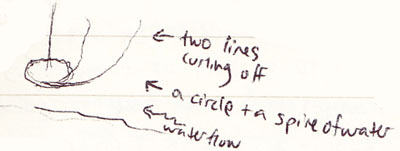
A spire of water in the river One was a circle of underbrush and plants, shrouded in dark forest. As we approached, it started to rain. The circle turned bright blue and sparks shot all over. Our guide was quite excited to see it.
-
Wormhole Caps 1999 • age 24
I dream of a greenish pool of pure water off to the side of a supermarket. It’s some quintessential gateway. The pool is surrounded by black rocks with a cliff on one side, and has pure soft sand beneath the surface of the water. Buttercup and I looked up and this tone came that shifted the sand into little hills and patterns, rising up out of the green water. We played on them. At times I wrapped myself in the sand as if it were elastic rubber sheets. The feeling was grand.
Sound Patterns in Sand: This is really interesting. Sounds are known to make patterns in sand. The device that can illustrate this is called a Chladni Plate. Each tone makes a specific pattern. Here we see that same effect in the dream world.
Other Odd Phenomena
-
You Don’t Know Skiing 1997 • age 23
I skied down. On the way, I let go of my poles and they slid downhill with me but standing on end and sort of spiraling!
-
Mina the Bat 2024
The next thing I remember is that I was outside, and there were these incredibly deep openings in the ground, striated with light yellow and light purple layers, of a psychedelic fractal design. The material of the earth seemed like a flexible dough-like substance. It looked almost biological. The openings were as wide as several houses. There was one crevasse on each side of the house. I was looking down as if floating in the air. I passed over the roof of the house as I moved from one crevasse to the other. I wonder if this could have been Satori playing out over the scene.
The Astral Earth: My only guess as to what this was is that it could have been my Satori playing out over the landscape there. Or perhaps my vision was penetrating into the ground, and the astral matter took that perceived form? It felt like it was opening up as I looked..
It seemed as if I was looking at the nature of astral matter below us. The soft, pliable nature reminded me of striated dough.
Dramatic Changes in Consciousness
Astral Drugs
I sometimes experience altered states of mind from astral drugs in the dream state. The effects are instantaneous, and not always related to my expectations. These experiences point to the possibility that there are astral substances that can have psychological effects, but I don’t know how that would work since everything is made of the same astral matter.
Any mental state we’ve experienced in physical life can be reproduced, as well as some we haven’t. Consciousness is so flexible that the memory of the effect is enough to bring it back fully, much in the same way that any style we’ve experienced can be perfectly reproduced. These altered states are a style of experience.
-
Drunk Dreaming
After an unhappy visit with Kayla, I go to a McDonalds in Moscow where people were winning food. A friend won three free hard drinks and gave me one of the winning coupons. It said ages 17+, so I decided “what the heck, just so I can say I’ve done it.” I ordered an O.I.L., which looked brown and carbonated. I asked what O.I.L. stood for. The kids working there said “oil of tequila(?)”, “animal(?) blood”, and “liquor.” They looked scared and grossed out, but I drank some anyway. It was really thick. Then time slowed down, and it became hard to walk. It was kind of fun. I was drunk. But it didn’t last.
Drunk, Asleep: I wonder if the effects were due to my expectations. If the age was 17+, then this was before I’d actually had alcohol.
-
The Insanity Creature of the Tower 1996 • 3:15 AM • age 22
A new herb: Bolero The teacher had found a new herb, it was the opposite effect of marijuana, reversed it, he said, produced a purplish hazy effect. It was called . . . bolero? The leaves were thin with little symmetrical holes in them. The teacher was prepping me.
There was a familiar girl with me, a friend. We were dressed in white clothing. . . . We walked up a set of wide steps. There was some horrible equipment belonging to the girl: a head clamp, a draining device, mirrors, and various horrible things. . . . She had given me some intense drug, and used the draining equipment. The light was strobing. . . . I could control the drug-induced madness at times, but it snuck in everywhere, through those little mirrors that reflected out lies.
The strobing light and drug weirdness were to confuse me, but I stood up, walked around, and cleared my head. I turned off the strobe, almost became lucid, then woke up. That was my success.
The Madness Drug: In my experience, astral drugs have immediate effects, as they don’t need to be metabolized. It’s likely then that once I had given in to her, the girl had given me the bolero, causing the madness and strobing light, and then drained me.
-
Wacky Salve 1996 • age 22
I’m on a mountain with a friend. He has this tube of vaseline-like gel that he tells me is some powerful drug. We taste some and immediately go wacky. Then I have to make this dangerous journey across little rope ladders to get two more packages from this guy. He warns us that we’ll die if we eat a whole one.
-
Influence and Purple Goo 2001
I’m in this big bright enclosed glass area. It feels like a rave or party on a cruise ship. I discover this Galvatron transformer in gun mode that shoots a viscous purple gel at people that makes them freeze, fall to the floor, and experience ecstatic emotions. So I go around the party squirting people, and I become quite popular.
References: Galvatron is a transformer that transforms into a purple laser canon. BP is a gas station chain.
Purple Goo: Here’s another thick, gel-like astral substance that has an immediate psychological effect on people.
-
The Home for Shape-Changers and Psychics 2004
Then I remember being in a room with a friend and the witch-lady. There’s a dark bed in it, and outside it’s the darkest night. She dumps a bucket of medications and pills onto the bed, saying there are two new pills my friend should try — like DD2T and D2DT. One is in “tab” form like LSD with pictures on them. The other is a pill. I look through some of the tabs, then give him one, but I begin to have colorful LSD-like hallucinations. I basically freeze up and watch the brilliant colors melt through my mind. I reason that the tabs must have worked through simple contact.
Then I’m in a desk in a classroom next to my red-haired friend, still color-hallucinating.
Astral Drugs: Yet again, an astral drug has a significant effect on me. I’m not expecting it to do anything, so it doesn’t appear to be a matter of expectation.
-
The Reluctant Hero 2011 • 2 AM
In THIS particular playing of the story, I kept getting in car accidents — big, head-on collisions that totally wrecked the cars involved. It happened twice while driving around town with some friends, and then again after I’d had three drinks, so I was a bit woozy. The policeman said I was in big trouble since they’d taken my license already. . . . [Much later] I stumbled forward in a stupor.
A Drunk Stupor: It seems that part of the rote is having too much to drink. Perhaps the drunken stupor is a part of the story.
-
The Dark Engine 2022
Before bed, Ruby and I were talking about ayahuasca. I was saying that while I often hear the disclaimer that “one doesn’t need psychedelics to have intense spiritual experiences”, and I believed that may be true for some, I didn’t feel like I could get anywhere close without them. Well, my dream self decided to prove me wrong. In the middle of the night, I became aware of being in a wildly altered state, a dark engine of power flowing through me. By dark I meant I felt a very dark inky brown fluid churning through my consciousness. It colored the dreams that followed.
Psychedreamic State: It’s clear our dream selves can reproduce any altered state of consciousness we’ve ever experienced, and likely many new ones.
I wonder at this inky darkness I’ve experienced on several occasions. On my last mushroom trip (which was rather weak), I felt it, saw it. Then it was a deep inky red. Why is it so murky?
-
The Gods of Art 2025 • 7 AM
I was at a school — some wild school of creativity. I felt high. But it was normal to us. . . . I was invited to the place where the artists lived. I went immediately. It was a multistory building, a little bit slummy. They didn’t care, that didn’t matter to them. . . . Eventually I came around to the front, re-entered the house, and saw a woman there. She had been in the periphery a few times as I explored, and now I focused in on her. She was tall, with a unique style of hair and dress. . . . She asked me if I wanted to try a drug called Smoop (or something). Not recognizing it, I at first declined. I didn’t know how long it lasted, what it did, if there was addictiveness, side effects, all that. But eventually I decided to try it. She poured a little bit of a clear substance on my hands, and called it an “ink”. Up to this point in the dream, I hadn’t thought of the word “ink” to describe any of this art, so I thought it strange for a drug to be an “ink”. When the clear ink hit my hands, they gave off two huge pulses, and then it was on. As psychedelic as it was before, it increased dramatically. I went deeper into the art of the place.
I walked around, met people, took a pull from a guy with a pipe like a staff. He wanted me to inhale 2 1/2 feet of smoke in one go. I tried but had no idea how to get that exact amount. He looked like a wizard.
[There’s a big parade]
And even in this part, the drug was in full effect, making everything artistically fascinating and trippy in a way I hadn’t experienced before. I awoke a little bit, in bed. My body felt completely comfortable, paralyzed, at peace. I slowly awoke, moving just a finger or two. In that nearby space, I felt like I was still on the strong hallucinogen, until I got up out of bed to write this down. AMAZING.
Astral Drugs Have Real Effects: I’ve always felt that being high on marijuana brings me much closer to the dream state. Now here I am in the dream state, feeling high. Marijuana has had a long history of enhancing the arts, both in creation and enjoyment. This is because it can bring us into a state of intensified openness, further up the stream towards the now.
This artists’ community is producing incredible art, and continuing this tradition. The “ink” drug has an instant effect on me, intensifying the artistic flow.

Location-Based Effects
It’s well known that consciousness changes as one’s frequency increases and decreases. But some changes in consciousness appear to be related to different locations very near to each other.
-
The Madness 2015 • 4 AM
There was a long crescent area that went around the rink, and at the far end there was a doorway to stairs going down. It was quite dark, and the people over there were mostly dressed in black outfits and costumes, but I could see glowing dust on them. The stairway heading down had that same glowing dust on the stairs. The announcer said in a half-joking voice, “I wouldn’t go down there!”
At some point I went down there. It was a series of underground rooms. The order here is all scrambled, as I seemed to relive it and go through it several times. . . . Progressively things got more wild and crazy, the people gathering down there acting more and more drunk. It was fun. It was more an uninhibited, raucous drunk. Not blurry or clumsy. I was having a blast and laughing and being so funny. But there was an edge of madness to it all. . . . The growing madness manifested in crazy imagery; things bending and twisting and kaleidoscoping all about, like circus funhouse mirrors. . . . I knew I had to rescue Buttercup and Fiona from the madness. I focused myself into perfect clarity of purpose and went through the threshold and down the stairs. The madness reeled around me, more wild than ever, but I stayed separate from it. I went down 2-3 levels and finally found them in a crazy scene. . . . [I rescue them, then try to escape]
This is where I woke up, as Bodhi came into the room. I woke up right away, fully awake, and upon taking him to the potty, that’s when I noticed the trippiness of my mental state.
Drug-Based and Location-Based: This is interesting. The whirling drunken madness was only in the basement rooms. On the main floor, my consciousness and the surroundings were normal.
-
Weed Beer 2023 • 2:30 AM
I’m at a bar in a city with three friends, including Buttercup and a guy I took to be Lucas. The bar has tall ceilings, mostly concrete, and black railings. We’re the only ones in the small front area. We sit at a table and look at the drink menus. They’re large, with pictures of the drinks next to their names. I’m drawn to two tan/orange beers. The waiter comes and when it’s my turn I ask his opinion. He starts talking and mentions the weed beer but he’s talking too fast and he gets self-conscious and says he said too much, that was just information for those in the back. Then he walks away and I’m not sure if he took an order for me or not.
I go into the back — to check my order? I don’t recall getting or drinking the weed beer. But as I arrive in the back, I find myself high/tripping/drunk in this wild psychedelic state. Everything has taken on this green tinge with bursts of orange and pink appearing in the upper part of my vision. I’m super focused in the now and feel like I’m melting into everything. There are a lot more people back here. I meet a woman’s eyes and she says something like “nice hat” and I felt that I could have just stood there and melted into a deep connection with her — with anyone back there, but I was heading back to my group in the front. I made some joke about how the hanging lights back here looked like Tibetan hats and how the Tibetans would be missing them, but continued walking and came back around to the front of the bar. I saw my companions in a blissed-out state, apparently also under the effect of the weed beer. Buttercup was leaning over against Lucas, who was now shirtless, and was similarly slumped to the side. . . . Something about this brings my consciousness back to my body in bed. I was lying there, thinking about what had just happened, still totally feeling like I was in this psychedelic state. I was amazed at how much of an intense, wild state of mind I could be in while dreaming.
Weed Beer: In dreams, dramatic psychedelic changes in consciousness are usually triggered by contact with a certain substance or being in a certain environment. In this case, we weren’t effected until I went into the back, and then it seemed to be affecting everyone, even those in the front.
When I refocused in the physical, I brought that psychedelic state of mind with me.
Astral Warfare
-
Astral Warfare — Mind Bombs 1997 • 3 AM • age 23
It’s an ocean-based civilization built along the sea on purple rock under a massive overhang. The feeling was of both being crushed in a bit and feeling free and light. . . . The government started with their mind-bombs. First they set off one that didn’t seem to work, but the next made space and colors fluctuate wildly. There would be rapid color shifts and the room would seem to spin or rock, and everything outside would seem to stretch, move, rock, and twist so that if you were to try to target them, you’d fail. I experimented with targeting a car and found the aim of my finger constantly moving downwards.
So eventually we got away but I felt like we had all just taken very hard drugs and were stumbling and slow.
Mind Bombs: What a horrible weapon. If this was an underwater civilization, it could have been shockwaves disrupting people’s senses.
Changes in Energy
-
Robotech Vortex 1997 • age 23
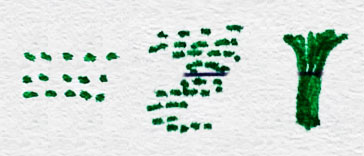
from haze to vortex I remember a view screen, perhaps, or a window in the big ship which reveals a brown haze of points. As my perspective twists and turns around it begins to look like a big spiral and then a vortex. I’m shooting down beside it at an immense speed with this great sound ringing all through me and around me like the THX sound. I felt a rush, a speeding up, and was filled with more energy afterwards. I felt more brave, alive, and playful.
The THX sound: Vortex, Sound, Energy: A change of perspective revealed the haze of dots to be a vortex, which I rush towards. The sound reminds me of the yawning mawing sound I heard in “Going Under” when I moved consciously from waking reality to dream reality.
-
Suicide and Dream Fire 1998 • 5:20 AM • age 24
Buttercup was going away for the day and I decided to kill myself. I’m standing on the street and put a gun to my head and shoot! Then I concentrate and say “5, less blood to see, 4, less blood to see, 3, 2, 1” and I look from a third person perspective and see myself standing there. There’s no blood, but I’m pale. Then I go back into my body perspective and think that Buttercup would probably have preferred to be there when I died than find me later. Since I found I was not actually dead yet, I assume death is on the way. I begin to wander.
My consciousness is changing. It gets clearer and clearer and I feel almost exactly like I’m on LSD. There’s this swirling energy in my head which lights up and clarifies the visual field wherever it’s at, leaving the places without it darker and blurrier. It would flow along the edges of things like doors and enter objects. There were multiple swirls at any given time.
Inner DreamFire: The decision to kill myself was totally out of place, but it led to some interesting experiences. The dreamfire might have been prana or some other energy coming into play and flowing into forms in the dream environment.
-
Cricket Crushing 1997 • age 23
This dream was ultra clear and in vibrant color. I was in my room at college. There were two ladies there and some crickets. I crushed one with a pool ball and then let the cats eat it. Another cricket under my desk gave off lights as I slowly squished its rear segment. The lights and energy released made me feel dizzy and strange.
Drunk on Life Force: Did I release some energy by squishing the cricket? What a strange effect! Was it a thought-form created by me and I released my energy back to myself by squishing it?
Changes in Focus
-
The Sickness 1998 • age 23
Scariest damn dream. Buttercup and I are living in a city like Atlanta. There are bad neighborhoods near us and a big park. I’m wandering in a stupor through this scary, dark, poor, crime-ridden part of town. Am I following some people or are they following me? We pass a fence leading to the park and I see Buttercup off in the distance, walking hurriedly. She is upset, frustrated, searching. I call out to her. She is obscured by a fence and trees. I climb the fence and run to her. She tells me she had lost me again on the way home, that I had wandered into a bad part of town again and it worried her sick. This had happened many times before.
As we walked through the park, she told me about some everyday things. But as we exited the park, the sickness began again. I blacked out and began to wander, possessed. I started vomiting disgusting amounts of yellow and white pus, over and over. Buttercup was so repulsed. I had the feeling that this was related to something back from my childhood. I had exact detailed printouts of all the cycles and changes my body went through. I wondered if I should go see a doctor. Buttercup thought “yes”. It was as if at those times I’d be a mental case, an invalid, a possessed unthinking dullard, and to me there was nothing worse. The nastiest nightmare.
Nightmare: This was so horrid and disturbing. Little did I know at the time that things would get so much worse with my health in the years to come.
There’s no illness in the astral. This may have been a story rote. Or it could have been Buttercup’s impression of me unfocusing from the scene and wandering or disappearing while turned inwards.
The Mental Plane
The Mental Plane
This is a new section. More could be added to it. But how to identify the “Mental Self”?
Senses in the Dream State
Vision
Seeing Through Objects
Seeing through objects is a natural part of 4D vision. Our translation of our perception into physical terms only continues so long as it’s not in the way. Simply wanting to see through or beyond something allows us to easily do so.
Unlike Immersive Perception, we feel we are looking through something from a single vantage point.
-
Jumping Through the Wall
I’m sitting up in bed, looking through the wall into the next room. Suddenly realization occurs that this isn’t really possible in waking life.
A pretty good depiction of what seeing through a wall looks like Video credit to Bravest WarriorsCasually Looking Through the Wall: Without my waking self engaged, I’m free to use nonphysical perception.
-
Highway 710 2010 • 4:30 AM
[I’m a passenger in a trailer]
They took the exit north on Highway 710, and I looked behind us to see if Buttercup had seen us make the turn, but I didn’t see her car (the walls of the trailer home were no obstacle).
Seeing Through Cars: Vehicle rationalizations are never an obstacle to seeing around you. In fact, nothing is. Simply wanting to see through walls, for example, is enough to make it happen.
-
Fiona’s Shop 2024 • 6 AM
So from there I go to visit Fiona’s new restaurant. It’s on the ground floor of a skyscraper. I wonder what’s above, then know that it’s floor after floor of apartments. I peer through the ceiling to see the hallways of doors.
Looking Through the Ceiling: I’m in my Dream Self focus, as I experience direct knowing and looking through objects without skipping a beat.
-
The New House 2024
I decided to visit the new house that we were moving to. Buttercup picked it out. I wasn’t paying much attention. When I arrived there was really loud music coming from the house next door. I looked in through the glass front wall (looked through the wall, actually) and saw 4-6 guys sitting around a table playing a game of some sort, with drinks and snacks.
Looking Inside: I frequently look through walls and objects in the astral when I want to see what’s on the other side. There’s a layer of explanation rationalization going on when remembering and writing down dreams. What I remember is looking into the house. When writing down the dream, I think they must have had a glass wall — unless I catch myself.
Remote Viewing
We need only think of someone to see them and their surroundings in our mind. With a stronger focus, we actually go to them. This is essentially a telepathic window but without the telepathy.
-
Benji Adams, Virginia Senator 2025
I learned that the government sessions went all day long for three weeks, and they had taken our phones when we first went in. I had recently been hanging out with Buttercup and the kids and I had to let them know I’d be occupied for the next three weeks. I saw them in my mind, hanging out not far away.
Seeing Distant: The idea that they “took our phones” probably made me think I couldn’t communicate with them through my mind.
Closing Your Eyes in Dreams
The astral body is simply a familiar form we project out of habit. We don’t actually use the eyes from that body to see. We simply peer through that body unobstructed. Our ability to see isn’t blocked by closing our eyes, wearing blindfolds, or being within a vehicle rationalization. Our perception is higher-dimensional, and is not blocked by any astral structure when we want to see through it.
Even so, our expectations can get involved and alter our experience.
-
Practicing Clairvoyance 1997 • age 22
There was a huge expanse of the dream where I was with Joan and Emma and other spiritually-focused people. I fully developed and recognized my ability to see with my eyes closed! I blindfolded myself and walked about seeing everything clear as day, reading from books, describing pictures, proving it again and again. I was so excited! I really did it! But it was a dream. . . . I was seeing in a different way, a view screen at another angle, where the picture formed out of the darkness. It was like looking through a short tunnel, but extra clear and sharp at times.
Astral Sight: This tunnel effect is similar to my hypnagogic clairvoyance experiences. I wonder if, expecting to be unable to see, I was seeing using a similar method — “a viewscreen at another angle”.
-
The Book of Synesthesia 1998 • age 24

The visual field behind closed eyes Buttercup and I were with some friends in this forest. Buttercup went on a run. I was sitting or lying down somewhere and closed my eyes. After a few moments of darkness, I could see again. The visual field was smaller than usual and kind of jittery around the edges — like the drawing — but as clear as usual.
Higher Body Clairvoyance: When I was able to see again, the effect wasn’t just of returning my previous vision, but more like the tunnel vision of the near realm clairvoyance I have experienced in hypnagogia. Was it another way of seeing?
The drawing I made is similar to when I can see my visual field in psychedelic states. It was monocular in this case (a single field with tighter circles in the center), rather than binocular as it appears within the body (see drawings).
-
The Chamber Beneath Blaine House 2000
Floating along, I closed my eyes. The scene dimmed and then reappeared in full light. But this, I thought, was in my head. I focused on creating a thought form and suddenly held a sprig of spruce in my hands. I then “opened my eyes,” causing a flash of dark as my inner sight moved to my outer sight (or because I expected it) and there was the sprig.
Closing Your Eyes in Dreams: I experienced a momentary darkening due to the expectation of my eyelids closing. Then, with my sight undiminished but believing my eyes closed, I “opened my eyes” which caused a similar flash or dark in order to frame the idea of the light coming back.
How Light Affects Near Realm Vision
-
A Melange of Dreams 2001
The street light support cables. Image credit to Google MapsI found myself in the near realm outside the apartment. There was a lot of interaction with neighbors, though I’ve forgotten most of it. At one point I was straightening this bent street light support cable cover. There were three — two covers were yellow, and one was white.
Upon waking I looked out the window and saw the plastic coverings on the cables. By the amber light of the street light, one appeared white and two yellow, like in the dream. But by daylight, they appear as two different shades of yellow. We must see physical light when in the near realm, unless memory is the reason I saw it this way. But if I recall, nothing else was colored in that orange light.
Near Realm Vision: This is really interesting. Either light from the physical is perceived when OB, or that the imagery was coming from my memory — even though I see this area most in the day.
Blurry Vision Expectations
Around 6th grade I developed terrible vision. I wore glasses for years, then contacts, then experienced the wonder of Lasik in my mid-20s and could see normally again.
During the period of poor natural vision, going to bed meant I removed my contacts or glasses, meaning my entrance into and out of the dream world was with blurred vision, an expectation that occasionally made its way into my dreams.
-
Frequency Fall 1997 • age 22
I went to the bathroom, complaining about my contacts. A nurse appeared and put them in vaseline after I took them out. I looked around and my vision was all fuzzy. I thought, “Well, okay, this is a dream. I can see okay if I try.” So I did and everything got clear and a little further away.
Dream Vision: Here’s a great example of expectations. Taking my contacts out, I naturally expected things to be blurry, and they were. But when I was reminded that it was a dream and that the blurriness was unnecessary, my sight became clear again.
-
Between Classes 2010
A girl that reminded me of Rhonda was there, and she had her glasses in her hand. Still in my sleeping position, I reached out my hand for them and she handed them to me. She said she needed them back soon or . . . something bad would happen. I quickly put them on and saw the world as slightly distorted through low-prescription glasses. Then I handed them back.
Vision: Here my vision is distorted by someone’s glasses. An effect of expectation, just as removing my glasses or contacts in other dreams led to blurry vision.
Requesting Clarity
As strange as it seems, we can get clear perception in the dream state or an OBE by simply asking for it. I’ve read countless instances of this, and eventually tried it myself — it worked.
-
Friends and Dream Awareness 1997 • age 22
Brendan and I went into the garage. I thought I had forgotten my glasses and contacts because I couldn’t see clearly. I said “Clarity now!” and my vision became clear.
Getting Clarity: Going to the garage from Blaine House would indicate a switch out of my body. This would put me in the etheric body near the physical, a position from which vision is sometimes unclear.
Changes in Color / Black and White
-
Wadsworth’s Revenge 1996 • age 22
I saw little lights, flames from Wadsworth’s HellCat missiles, going up into the night sky. The first one I thought was headed for Finney Chapel (then I thought it was a different college), then one for another school and for different places where I had friends. . . . I knew I was going to be alone. Then one missile went straight up, half-lit like a firework as it hit a helicopter, which then fell to the earth and exploded. Everything turned black and white as the explosion slowly filled land and sky.
References: Finney Chapel is a building at Oberlin.
Black and White: A strange effect from an explosion, as if it was so bright, it washed out all the color for a moment.
-
Everyone is Buttercup 1996 • age 22
She said something about how abnormal Buttercup was. Buttercup starts crying and I comfort her, thinking “If that’s normal. . . . ”
Then I start seeing things in green, orange, and purple. Everything is super bright with colors bleeding outside the lines and person-sized splotches in the air.
Color Bleed: I have no idea what this is or what caused it, but that specific color separation is similar to what I’ve seen on LSD.
The Effects of Spherical Sight
-
Out of Body Experience — Flying on the Rooftop 1996 • age 22
Then more people appeared, as guides, ready to take me out of my body. It was Buttercup, Kayla, and Marco (who I don’t know in waking life). Kayla, at times, appeared as her look-alike from Oberlin. I felt as big as the room, my head almost near the ceiling (perhaps I was floating)! Buttercup was out-of-body and took my hand while I was standing and lifted me. We floated up through the ceiling.
The Corner Ceiling Rationalization: This is the spherical sight rationalization, where to explain how you’re seeing the whole room, you rationalize that you must be in the corner of the room up by the ceiling. This “corner ceiling” phenomenon is a common OBE experience. In this case, I felt big since I felt like I was standing but my head was near the ceiling.
Projected Doors and Objects
Sometimes when we see a door in a room where there isn’t usually one, we are misplacing a door we are seeing with our natural spherical sight. Since we believe we can’t see behind us, we project what we see there in front of us, and these false doors always lead into fantasy.
-
Hyperspace Doorways 1988 • age 14
I dreamt about finding a new door inside our house. Going through it, I followed some strange passages around, always finding new doors. It reminded me of Zork. Then I came out, and a storm started with a lot of rain.
References: Zork is a text-based video game.
360 Degree Doors: In this case the false door leads to a maze-like fantasy area.
-
Bedroom Soccer 2023 • 7:30 AM
At this point my wake-up alarm goes off. I wake up and set it for 13 minutes, then I go right back to sleep.
The effect of this on my dream is that I’m back watching the soccer game, except the entire soccer field is now encased in the space of an invisible room — my bedroom. The green grass and hills continue beyond it, but everything on the field is bounded by this room and much reduced in size. There’s a bed along the side of the field. At first, it’s blocking the far half of the field. But as I look around, trying to figure this out, I find the bed is then to my right. Now there are two identical beds. They’re about the size of my bed — queen size, but with the pink & yellow patterned sheets of my childhood.
Multiple Beds: The way the bed changes position, then appears to be two beds, is a common effect of 360° vision. This would imply that I’m dreaming while my astral body is standing up in my bedroom, bringing the image(s) of my bed into the dream. This happens in the same way as any other physical sensation is brought into a dream.
Turning Inside
While we are capable of spherical vision in the astral, limiting our vision to only one direction is a standard physical limitation we bring with us. Opening up to a wider view can lead to strange experiences.
-
Free the Children 1997 • age 23
On the next block there were no cars, only people, and one of them was HUGE — at least 10 feet tall. I wanted to talk to him but he turned invisible. In my head, I turned around to see if I could see him and imagined I’d see a ripply spot where he was. In this imagined scene, I was in a curved spherical space where it’s darker but I still partially experience what’s outside me. When I’m inside my head, I’m not experiencing the outside. . . . [We leave and go to a comic store]
During the conversation with the girl, I turned inside myself again. Everything got really skewed with dark areas from behind me becoming more central to my visual field. I missed a few moments of outside activity and when I turned back out, she was back to talking with her other friends.
Turning Inside: I’m doing some experimentation with looking behind me without turning around. I’m essentially inverting my perception within my head to see behind me, causing strange visual effects.
Rotated Compass
Confusion resulting from spherical sight could also lead to a weird rotation of one’s internal compass, where everything feels somehow rotated. I’ve always had a good sense of direction, a feel for what direction North is. So for example, a neighborhood, rotated 90° feels very different from before.
But a more familiar explanation comes from marijuana. As context narrows, the distant context of direction is one of the first to go. If you’re the kind of person like I am that has a general sense of what’s North, then you can lose this and your compass can get confused, making everything feel markedly different.
-
Dreams Inspire Life 1996 • age 22
South Hall was rotated from it’s E-W position to a N-S position.
References: South Hall was my dorm at Oberlin.
Rotation: This probably occurred in the near realm, wherein I experienced strange effects from spherical vision.
-
Barbed Orange Lightning 1997 • age 22
Oberlin campus is all rearranged. I’m in this office/library/lounge in this building to the northwest of Wilder Bowl. . . . On further reflection, campus was perfectly arranged, but I had a messed-up compass.
References: Wilder and Mudd are buildings at Oberlin.
Internal Compass: Issues from spherical sight could explain the rotated internal compass effect.
Convex Sight (Fisheye)
When spherical vision is squeezed into our normal range of vision, it can appear convex — like looking through a fisheye lens where the center of the image is concentrated and closer up to us.
-
Kindred 2025 • 5:15 AM
Dinner is rice and yellow curry, in big bowls. The view of the table is weird. I feel like I’m toddler sized, sitting on the chair, as my eyes are even with the table top, but I can shift my gaze up and over the table, where everything is large, fish-eyed. Like the table has the same spatial component as a round-topped hill.
Table Distortion: While this shape is usually applied to large hills, it shows up here in small scale at the dinner table. I think it’s related to a concentration of energy.
Seeing Behind the Imagery
-
Pure Testosterone 2001
The complex was huge. I returned with some others to the auditorium and there were reenactments of my earlier “enlightenment”. But I called forward to the air and radiated enormous power, reducing the contents of the room to a flowing stream of light, pushing the floor down until a sphere of energy was established.
Holographic Rote Beam: I use my immense power here to reduce the scene to a glowing stream of light. This reveals the holographic nature of the rote, the flowing beam that lights the hologram.
-
Memory Rooms and Exploding Dreamstuff 1997 • 6 AM • age 23
I was at Blaine House in the silver light of dawn (like in the waking world: 6AM). The light felt like a presence — a BIG one. There was a thin layer of ice all over the ground. The back yard was flooded almost to the top of the hill, with a thin, barely visible ice layer on top. Everything was so fresh and new, like being outside on a winter morning.
Silvery Light: The winter-morning silvery light of this dream is a sign of higher levels of consciousness, more “screens” of consciousness watching. That’s why it felt like a presence — it was. It’s literally the light of a higher level of attention. It’s no surprise that I remembered that I can walk through walls.
The presence I’m referring to is the presence of a more connected consciousness. It was the heat of that consciousness melting the thought form environment, revealing the ice-like appearances — a truer, less-formed level of everything.
-
The Mountain Valley Gathering 2003
I was one of the last to leave, but finally squeezed my way onto a bus. My consciousness remained outside looking in. As the bus began to move, the dim, drab bus station changed into this vibrant, shining white maze. I don’t recall the transition but maybe it had to do with my change in perspective? Anyways we took this very square path, then up this 45 degree incline up stairs. Then it straightens, tilts sideways and . . . out a door? We arrive at our destination: Long Island.
Outside the Imagery: I think I must have stepped outside the veil of physical imagery and seen the energy side of everything. I appear to watch the bus follow different passageways and through a door to a new location, which once again is embodied in physical imagery. Very interesting.
-
The Perfect Girl 1998 • age 24
She had a good friend who was at times a shard of bright light.
Shard of Light: I am occasionally seeing through her friend’s projected imagery. We are, at our nature, conscious light.
Dark Mode
There’s a mode of perception underlying the final projected physical form we perceive. In this mode, the lighting is very dim, and we can see the black 3D shapes of people and things. There is sometimes a subtle glow corresponding to chakras and energy fields. I associate this kind of perception with the near realm, though it can occur in the astral, too.
Our perception projects the final physical form on top of this, adding lighting, texture, and a full range of colors to the exterior of everything.
-
Tuning Back In 2026
I was snoozing, going in and out of dreams. Returning to the dream, I found myself floating just above the scene I was in, except the scene was made up of dark, transparent forms with multicolored reflective hues across their surfaces, like oil on water. It was all perfectly still, the shapes in perfect detail but without the colors filled in. The scene was a parking lot with some parked cars and lots of long-limbed people. Upon returning, the people were replaced by Order robots from Borderlands 4, which also have long, thin limbs. I tried to adjust my focus to see the scene properly.
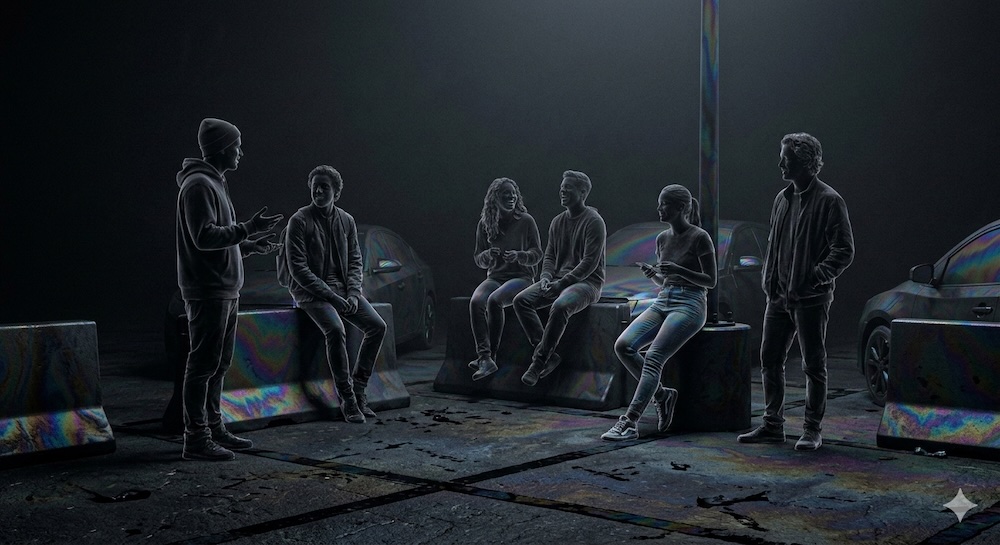
Tuning back in to the dream References: Borderlands 4 is a video game.
The Paused Rote: The rote paused as I shifted gears towards waking and back. For a moment I had trouble tuning in completely.
-
Keeping Tabs on the Election 2024
I remember in the early hours of the morning, 3-4 AM, that I was socially dreaming, hanging out with several other people in a living room, sitting on couches. The atmosphere was dim morning light. The people were just clearly outlined spaces of shadow.
Outlines: I’m seeing the shapes of the people before the color and other visual effects are projected on.
-
Neon Chakra Flowers 1997 • Middle of the night • age 23
Buttercup and I were moving up a level in Tank, to room 301. . . . As we were talking, the room was slowly changing into [the new tenant’s]. . . . The transformation was completed. Kelly’s bedroom was dark and mystical. There were two small glowing flower devices spraying this soft, fragrant water in many tiny streams across the room. . . . The new room was so much bigger and nicer than the previous one. . . . There was this girl named Sticky across the room, in the same dark w/neon glow kind of scenery and I danced around a table and proclaimed my love to her: “You, I’ll always love best, Sticky.” She was a super raver-girl with metallic makeup and a shiny silver shirt. Some parts of her shirt were glowing.
Shadow Mode: In both room transformations from one owner to another, there’s a phase where the room is dark and lit up with subtle neon glows. This is the scene without the final physical scenery painted on.
-
I Suck at Basketball 2010
Half the players were thought forms or non-lucid dreamers, sort of dark forms just moving slowly around, but not really participating. As the game went on, more and more players and/or thought forms filled the court so that it was really crowded.
I have a vague recollection that this didn’t start out as basketball, that it was a room full of people, gathered for some other purpose, and that the basketball game sort of took hold.
Dreamers: This is a situation where it’s difficult to tell if we’re dealing with unaware dreamers or thought forms. Since the room had a lot of people in it already, some were probably vaguely attracted to the game. Perhaps others were conjured to be the opposing team. It was odd how dark and shadowy some were compared to the people who were clearly more aware and awake.
Lands of Ice and Snow
While snow and ice can appear as a part of the scenery in the dream state, if the entire scene is only snow and ice it might mean that you’re seeing behind the imagery.
-
Ice Land 1997 • age 23
I was in a land made entirely of ice and water under moonlight. There were mountains of ice, and near the shore were icebergs.
Buttercup and I were staying in a tent together. We were part of a group researching all these different ocean creatures. One was this creature that stuck to you. There was a whole field of them in the water. We went out exploring and I ended up falling into the water. The others came to my rescue and dried me out. I didn’t feel cold. We saw different kinds of fish.
In the end, the land of ice turned into Oberlin. Oberlin seemed to be around the corner in a non-icy spot, and then I gradually forgot about the ice and didn’t see it again.
[This continues into a long dream of being in Oberlin]
Ice and Water: We’re likely in an astral space without much form, which I interpreted as a landscape of ice and water. In that case, we’re seeing the more basic astral structures. Or perhaps there is a scene here, but we’re not properly tuned into it.
Oberlin being “around the corner” could have been a rationalization of me focusing into the scene more, and/or projecting my familiar college imagery onto it.
-
Rolling Snowballs 2010
Buttercup and I had gone to the top of this snow-covered mountain overlooking a wide, open valley. Down in the valley was a small town, and I think this may have been Jackson Hole, which I’d been talking about with Emma and Ruby lately, but never been to. It was night, and the entire landscape was covered in snow, several feet deep. . . . A woman came by and we talked to her briefly. I think she had a baby with her. Then we noticed an asphalt path running right next to us and down the mountain. We wondered if it had been there all along. Then I looked up and saw a cable car above the trees a little ways behind us. An even easier way down! Then I heard this drumming and this music and realized there must be some kind of village behind where we were. I followed the music and came to this charming summery village at the top of the mountain.
The Snowy Mountain: Here we are in a vague white astral environment, which we take to be a snowy mountaintop. When the woman joins us, we see physical elements that weren’t there before, and she leads us into the more physical environment of the little village.
Ice-Like Surfaces
On many occasions I’ve seen what look like flat, thin, semitransparent ice-like surface. It’s often on the ground but sometimes covers the openings of buildings. I usually perceive this as a thin layer of ice or the surface of water. On the ground, it can be walked on, no matter how thin it seems. When I perceive one as a thin layer of ice, it will act like it when I try to crack through it.
This is a truer perception of the structure of the astral world, less influenced by projection. It’s the perception of a boundary of some sort, though they can be easily crossed.
-
Oberlin Dreamfire and the Zombie Line 1997 • age 22
Determined not to lose my Foundations work I ran towards South Hall, noticing that the frozen puddles actually were a thin layer of ice with no water, brickwork, or earth beneath them. An officer rode up next to me on horseback and warned me about South Hall. He was standing over an ice sheet and I was worried about him falling through for a moment.
Every doorway, window, and opening of South Hall was covered with a thin sheet of ice as well. I easily broke through them as I went inside.
References: I lived in South Hall at Oberlin for a few years.
Dream Ice: When I see these ice-like membranes, I’m seeing outside the scenery to an extent. I’m tuning out of the projected visual scene somewhat. Semi-melted thought forms appear to have an ice-like coating as the color recedes back within. Here I’m seeing the outer shape of the buildings and landscapes due to being in a slightly higher frequency.
-
The Crackety Mineral Springs 1997 • age 22
A bunch of us are traveling in this narrow river canyon on a raft. There are orange cliff walls around us and the river is 6-16 inches of crystal clear water over ripply orange sand. . . . I saw some people having fun cracking ice, so I jumped out and the river was covered in ice now. The others joined me. From time to time there were large deep openings in the river floor which led to deep caverns.
Form of.. Ice!: The ice was as clear and pristine as the water, which means that the water’s surface had to undergo only the slightest of changes to be ice, not water. It’s simply a flat plane of some sort, perhaps the boundary of an astral subrealm, easily interpreted as a water surface or ice.
-
Memory Rooms and Exploding Dreamstuff 1997 • 6 AM • age 23
I was at Blaine House in the silver light of dawn (like in the waking world: 6AM). The light felt like a presence — a BIG one. There was a thin layer of ice all over the ground. The back yard was flooded almost to the top of the hill, with a thin, barely visible ice layer on top. Everything was so fresh and new, like being outside on a winter morning.
I was meeting my best friends: Buttercup and a representation of the boys at Oberlin. We all just started hanging out, all totally being ourselves.
Around every corner and in every room of the house there was a crazy different scene or dream going on, but I stayed in the Blaine House context.
Higher Perception: The light, the ice, the feelings, and the presence here all indicate I’m united with a greater consciousness seeing Blaine House from a higher perspective. I’m peeking behind the curtain of physical forms to an extent, further towards the higher frequency, formless side of things.
Here again I notice a thin layer of ice on everything. In many accounts of those who examine the spirit world closely, they say it is made up of translucent materials, much like ice.
-
The Chamber Beneath Blaine House 2000
I’m not sure how Ruby and I got back to the surface of Blaine House, but we looked at the house and I noticed the windows were all covered with a white semitransparent skin and bulging out from the inside, as if someone were inflating a huge balloon inside the house. I said “Those must be painting tarps over the windows. They must be repainting.” Ruby didn’t think so.
Bulging Blaine House: I’ve seen several times how thought form buildings can inflate and deflate. Of course in the astral there is no air. Thought forms “inflate” with attention from within. They can even have openings like windows. A thin mostly-transparent membrane defines their outer boundaries and can occasionally be seen over the openings, as it is here.
The bulging could indicate additional thought energy on the house. Maybe just all our attention on it — Wadsworth’s, Ruby’s, and mine?
-
The Worst Way to Get to Narnia 2017
The ocean’s edge wasn’t as far down as usual in this area, and under the perfectly clear water, I saw a hyena walking along on the rocks. Under the water! I was astonished and climbed down a little further.
Surface of the Sea: I wonder what these clear surfaces are. Different layers of the astral? Here it just looks like more dry land below the “water’s” surface, as if I’m merely peering through a thin layer of light.
The Glowing Grid Underlying Forms
A few times in the dream state I’ve seen a grid structure underlying astral forms. It reminds me of the grid structure of the depth field that I’ve seen in altered states of mind.
-
Lucid: Colored Pots and Pans 2000
We turned to [the large structure] and not much was visible — just some bits sticking out of the top of the sandy/muddy hill. There was an opening barely large enough to slide in through and a flexible area that revealed lines of blue energy when pushed on.
The Grid: Pressing on the side of the building revealed these lines of blue energy, like a grid underlying astral matter. I wonder what this is.
-
The Green Dragon of Sauron 2004
The throne of bone and staff The wizard had a long black plastic-looking staff with a white band and white end. We took it. Legolas used it, and sent a purple stream into the clouds. Just before the clouds, it hit a previously invisible grid (the ceiling) and lit up a purple area. We realized that if the dragon were above it, we could see it light up in orange and yellow instead of purple. Also, the closer we were to the clouds, the larger an area we’d light up.
The Glowing Grid Structure: I wonder if this is the grid-like structure of the depth field. It revealed that the ceiling was there, even though it wasn’t visible.
-
The Interview 2016
I went underneath the floor in the building where the company was. There was a round glass pillar with open space all around. I stood on a platform. Maybe 50 feet below the platform was a floor that was a grid pattern — not really a solid floor but just the grid. The forms of dead interviewees were down there, all wearing white and red bodysuits. They were sitting there motionless, embedded in the grid. I felt like they had tried to escape under the company’s floor and not made it. It also seemed that the bodysuits were virtual reality outfits and that the grid I was seeing was a peek beneath the pattern. Surrounding the grid of the circular floor were a bunch of stores.
The Grid Floor: Whatever this grid was, the goal was to stay off it.
-
The Insanity Creature of the Tower 1996 • 3:15 AM • age 22
She removed my glasses and I could still see fine, which proved to me that it was the spirit world. I calculated the picture instead of seeing it, seeing clear lines with light haze around them.
Vision by Calculation: How interesting. At times I’ve seen all of reality as being derived from a simple mathematical formula with infinite answers, as the Source spirals out into all shapes and forms, all possibility.
Other Senses
Smells in Dreams
-
White or Rose? 1998 • age 23
Troubled, I exit and Buttercup and I go to this old garage-like mall. It’s filled with people our age. It’s a little bit friendly and fun, and a little bit scary. We’re looking around and it’s like how I remember Bob’s Produce Market, with lots of earthy smells.
References: My Emma used to take me to Bob's Produce Market when I was a baby.
Smells in Dreams: It’s not often that a smell is featured in a dream, and usually it’s because it’s being integrated from the waking world. But here is an example where it probably isn’t from the waking world, but from a memory.
-
Trail of Dreams 1999 • age 25
North of Radisson became a huge park with rolling hills and trees and the smell of tar. People were tarring new paths all over, stinking up the place.
Smells: How rare to catch smell being such a strong part of the plot of a dream. I have to wonder if there was some tar work being done in the waking world that influenced the dream, but I made no note of it at the time.
-
Hyperspace Warps 2001
I found myself at our lovely new house. I opened the back door and stepped out into this dense, thick-smelling primeval nature world. The plants and insects were huge and felt ancient
The Primeval Smell: My sense of smell has faded as I’ve gotten older, but when I was younger it was strong and called up lots of ancient-feeling memories and associations.
Precognition
-
Car Wreck Precognition? 1997 • age 23
Yesterday I couldn’t get the Bjork lyrics “all these accidents that happen” out of my head. Then I dreamed of looking for cars in a really dark car lot while Buttercup had dreams of dying in a wreck. Today Buttercup got into a car accident and while she was unhurt, the car was totaled, setting us on the search for a new one. Uncanny!
Precognition: Big events cast their shadows ahead of them, and in the dream state we can pick up on them. These are things that may seem out of the ordinary, but not worth mentioning until the event that followed.
Opening to Beauty
-
Bus to the Beach 2000
Buttercup then moves diagonal from us and the blonde girl leans over and gives her a friendly kiss on the cheek. I look from the blonde, to her little sister, to Buttercup, comparing their beauty, and each one I stare at becomes extremely beautiful, ideal. Pretty neat. It’s my first memory of looking for beauty in dreams.
Opening to Beauty: I’ve no doubt this is a very powerful dream technique. Spiritually, it is very powerful, as that focus on appreciation opens us to higher energy and awareness, greater connection and communication. It focuses us in the now.
Miscellaneous
Miscellaneous
The Source of Creativity and Inspiration
Everything flows from the inside out. The physical world is the hardened outer crust of the fluid, blazing spiritual world that creates and sustains it. The dream world and all the higher, inner worlds closer to the Source are the source of so much inspiration and brilliance in our lives.
-
Studying Hell Creatures 1996 • age 22
We’re in the ocean. At certain times when we were motionless, the waves would ripple up and throw us to the shore and these strange unseen creatures would bellow.

Similar wave creatures inspire this scene from Ponyo Fantasy Ideas: Just this year I saw a movie called “Ponyo” (released 10 years later), made by the imaginative Hayao Miyazaki. So many of his ideas come from the dream world, and this very thing was in Ponyo — creatures made of water that could rise up out of the water and manipulate things.
-
Like Warcraft, but a Whole World! 1997 • age 22
Context: I was playing Warcraft II at the time.
I’m playing Warcraft. I land in a small village surrounded by a desert, but there are distant trees all around and a cliff rising up on one side. Atop is the orc’s castle. It’s big, black, and sooty, surrounded by a forest of dead trees. There’s nothing on the ground except dried vines and leaves and barren saplings. The trees only have sparse leaves near the top . . . [the entire dream is in the Warcraft World]
Into Warcraft: Written at the time: “So much of this was like Warcraft, but expanded into a real world. Wow!”
Warcraft I, II, and III were real-time strategy (RTS) games where you looked down on a 3D landscape from a fixed perspective. I loved those games. I had this dream in 1997, experiencing what it would be like to descend into and live the game in first person. I’m sure many people had similar dreams (including the game developers), because this entire area existed in the dream world.

One of my many characters in World of Warcraft Seven years later, in 2004, Blizzard introduced this very thing — World of Warcraft, a massive online RPG in which people got to live out this very dream. When it came out, it was a huge hit, and I got deeply into it for several years.
I just noticed — it’s called WoW for short, and I followed my statement above with “Wow!”
-
Swirling Creativity 1997 • age 23
Falling Asleep: Every night I try holding my attention for as long as possible. Last night I was chanting awareness songs. I was being so brilliantly creative! Masterpieces of art and writing came to me — ideas of painting, stories, characters, stained glass, humor — it was endless, enrapturing, beautiful. The visual background was waves of hot energy swirling like seaweed in a current.
The Source of Inspiration: This is another of my favorite things — creativity and brilliance coming at the speed of thought, utterly enrapturing.
-
The Phoenix Slips
“The phoenix slips, within the dusk disclosed”
This was a quote from something read at a man’s funeral. The key question being, “What will his favorite part of the funeral be? What will he remember?”
Flashes of Brilliance: This sounds like a tiny piece of some really fantastic poetry. A rare piece of fully-remembered prose, straight out of the dream world.
-
The Elevator 2000 • age 25
This dream could have been the inspiration for Dr. Who.
I’m in the “elevator”. “Phone booth” would also describe it well, as that was about the size of it. It was made of unfinished wood, and had an apparatus like a toilet but smaller and flatter. It let light in from a slot near the top of the door. I had with me during all the following travels a small, friendly, invisible companion who was like a dwarf or cat in size. We were very close.
One of the earlier stops was arriving (via the “elevator”) in New York at night to visit Brendan and Melody and the rest again. I remember commenting, “Wow, here we are.. again!”
Later there was this scene: I was a computer programmer in this strange world. I went to Subway to work on a job for them. I needed the manager for something but couldn’t get ahold of him, so I left a phone message. Then I came back in 3 days and the manager (an old friend) wondered why the job wasn’t done. I explained. Then I’m in the elevator.
So before the elevator had just moved smoothly. This time it was dropping rapidly. Then there was a slight shudder, then nothing but slow rotation as though it had dropped completely out of the shaft and was free-falling. I was on alert. I stared into invisible cat eyes now, as on-alert as I was (I suspected later on that my dwarfish friend was responsible for the wild ride).
The elevator stopped and the quality of light was different — it was daytime with odd tints and overtones of feeling. I opened the door to a blue sky with puffy clouds in a Renaissance town of fantastic wealth and variety. Things were very different than any history of ours. Information came naturally to me, and I knew that there were very powerful groups of people. One group stuck to lavish costumes of all black. There was quite an energy in the air and a lot of people. We climbed a hill to what looked like a resting area with picnic tables all about us. My invisible guide was with me the whole time. I was going to ask this woman a question. I thought she had a lot to tell me but she would likely first ask what faction I was part of . . . and then suddenly I was back in the elevator.
This time the elevator turned wildly head over heels as it descended. As each side became the floor, it changed hue and a treasure chest appeared, each identical. I chose one and then turned around. The door was open and the elevator was stopping. I saw the change — the Renaissance scene was still there but flat-looking. It faded out to a mottled gray-brown before opening into a new scene — a dark brown sky with smoky clouds. I see a boy sitting on a car in a wheat field. I become him. I have a sack, and open it. Inside is a gun and some ammo. I see an asian man about 50 feet away, and know that he is my father. He’s looking for me. He soon sees me and is shocked. I look around me. There is a hole in the car and gasoline all over everything. I realize that the boy (me) intends to kill himself (myself). Then I awaken.
Dreams Inspire Fantasy: I have no doubt dreams are the inspiration for most fantasy and science fiction. I’m only vaguely familiar with Dr. Who, so this dream isn’t inspired by watching the show. This is likely a sort of dream phenomenon or natural rationalization of some sort of wormhole-like gateway — one that likely inspired the show!
Dr. Who traveling through time Image credit to julielilacQuantum Leap is another show I never watched but I know about — where a man goes into different situations and becomes a character in them and then tries to find his way out of their situation. This is inspired by rotes viewed in the dream state.
-
The Deep-Haunted School 2011
I’m in this college-like school. The school was bustling with living students and ghosts. I alone can see the ghosts. But I can see something else going on as well. As my eyes tune further into the spiritual frequencies, I see that the ghosts are being attacked by a deeper level of ghosts — the ghosts of ghosts. What the ghost world is to us, this world is to them. But the deep ghosts appear as horrible monstrosities in this world — inhuman beasts and terrors. The ghosts can pass through walls but not the deep ghosts. They need an open door or opening to get into a new area. In the room where I first discovered them, there were deep ghosts above the ceiling, calling forth more deep ghosts to drop through the grates. At the far end of the room was this enormous deep ghost, a kraken-like monstrosity with tentacles.
I would talk to ghosts of friends, and show their location to the living. I tried to record everything with my iPhone, with photos and videos (this has been a trend in my dreams lately) to see what this all looks like to the physical world. I was walking with the ghost of Brendan or Kai and he said he couldn’t go through this steel door. I assured him he could, and he pushed through. As soon as he did, I opened the door to go in myself. From the far end of the hall behind us appeared a stream of deep ghosts coming towards us. I rushed to close the door before they made it into the hallway.
At that point, I saw a well-practiced troupe of female ghost students marching down the hallway, eyes straight forward, chins up, very disciplined. They were from another school — a ghost school. I said “Welcome, students!” They kept on marching. I directed them to a classroom. I was taking charge of this situation, since I was the only one able to see both the ghosts and deep ghosts. The classroom was filled with a mix of living and ghost children. I explained the presence of the ghost children to the living. I began to explain what was happening in the school with the deep ghosts. The academy ghosts would snicker when I got a term wrong. At one point, a disembodied voice spoke from my left, asking a question, which I answered. Then I asked, “Who was it that just called me” which caused more snickering, and I threw them a dirty look, as I knew this was more along the lines of EVP.
Then I began to frantically write down the details of the dream in a large book illustrated with stylized ghostly drawings. Earlier I had tried to type out details on my iPhone, and then tried recording a sound memo. I wanted to remember this dream! And I did!
Deep Ghosts: This could be an amazing fantasy story. Regular students, ghosts, and deep ghosts intermingle in this dream. Being that this is an astral school, it could well be teaching dreamers and disembodied spirits (ghosts). The rules about passing through walls are interesting. Perhaps the deep ghosts are lower astral entities that are too physical. These academy ghosts seemed aware of their situation — certainly enough to be amused by the lack of knowledge of their dreamer teacher.
-
The Gods of Art 2025 • 7 AM
This dream was beyond anything I’d ever experienced; a nonstop trip through a world of intense art. No words will be able to accurately portray this, but I’ll try.
I was at a school — some wild school of creativity. I felt high. But it was normal to us. I was working on an art piece. It was a circular paper that took up my entire visual field, and I was drawing on it with blue pen. It had lots of different sections. One in particular on the left was all these wavy curling lines like water flowing or vines. It got somebody’s attention.
I remember seeing someone’s art in a graphic novel. It starred a goofy kid with a tall rectangular head, in cartoon style, mostly drawn with black ink on white paper. His story was told in the most incredible styles, and I loved it. It was so creative I went into it, and it was moving, flowing. I felt like I was hallucinating on it. But that was part of it. I was moving through the story. I was IN his story and expressing myself within it.
I came out of the story, back to the school. I said I needed to see more. This was a level of art beyond anything I’d seen before. I was hungry, ravenous for more. I was told the artist was coming. He walked up, his head was the blocky artistic head from the story, but it became normal-colored, then smoother, more human, but not all the way. I expressed my love for his art. He spread his arms and released a stack of art on clear paper to me, and I understood he made it for me. He moved on, and I looked through the stack. In it was myself as a character in his story, drawn in his styles, but in color. I was wearing my brown fedora, and I had long blonde hair and a green shirt. I was in his story! . . . I was invited to the place where the artists lived. I went immediately. It was a multistory building, a little bit slummy. They didn’t care, that didn’t matter to them. It was very alternative, creative and unique. And it often seemed black and white as if all made of ink. I walked through the building, feeling as if I was hallucinating wildly at the hallways, doors. Everything moved, spoke. There was a hallway with doors. One had some vertical lines on it, but they moved and I moved into them. Then I looked at the next door. Eventually I came around to the front, re-entered the house, and saw a woman there. She had been in the periphery a few times as I explored, and now I focused in on her. She was tall, with a unique style of hair and dress. . . . She asked me if I wanted to try a drug called Smoop (or something). Not recognizing it, I at first declined. I didn’t know how long it lasted, what it did, if there was addictiveness, side effects, all that. But eventually I decided to try it. She poured a little bit of a clear substance on my hands, and called it an “ink”. Up to this point in the dream, I hadn’t thought of the word “ink” to describe any of this art, so I thought it strange for a drug to be an “ink”. When the clear ink hit my hands, they gave off two huge pulses, and then it was on. As psychedelic as it was before, it increased dramatically. I went deeper into the art of the place.
The Power of Art: I’d been recently working on the part of Foundations about artists in the upper astral, and I now feel I was underestimating the significance and power of art. It’s not just a good painting, but a world of experience, a fluid way of interacting with the world around you in a way that leaks brilliance through every line. In these visual representations that convey worlds of information, the styles are as meaningful as the images themselves.
The World’s Attitude Towards Dream Abilities
Throughout history, there have been shifting attitudes towards the sort of magical-seeming powers we have in dream state. In the Western world we are coming out of a long era that has been hostile to it. In the last century, popular culture has come to embrace the idea of superheroes who are invulnerable, who can fly, shape-shift, or use magic. Comics and fantasy lead the way, inspired by our experiences in the dream state. And these in turn capture our imagination, our desire to go beyond our physical limitations.
-
The Home for Shape-Changers and Psychics 2004
Context: I used to work at MLT Creative with Allen, Saul, Wilson, and Vortigem.
This home was a cross between MLT Creative and a sort of retreat home. The house is of the classic haunted house style, like those in Savannah. There are several people from MLT there, including Allen. Wilson was there earlier but left. Then a bunch of people that I knew (but not in waking life) arrived. It felt like I was there several days. In the beginning it was pretty normal, though I felt there was something secretive going on. The leaders — Allen and the rest — knew a lot they weren’t saying.
The tall metal sculpture Here’s one scene: In the center of the house, there’s this open column that goes up all four stories. Someone builds this little one-story sculpture of two-colored metal at the bottom. But then this hefty magician-looking guy whirls to the top of it and pulls all these slivers of silver or gold metal from out of the air and extends the statue all the way to the ceiling, hovering over it. There are lots of people about and it’s generally thought of as someone’s eccentricity showing — like someone who hasn’t taken his medication. People gather to watch. Then two black-haired teens — a Filipino boy and girl — step up and pull out bows and arrows and fire them at the statue. The boy’s arrow hits this curve in the statue, which causes the arrow to curve around and fly straight up. The girl tries and tries to do the same but can’t get it to work. This sort of thing is clearly not allowed in the Home (where’d they get the weapons?) but everyone stares, transfixed. Then some leadership characters arrive and take care of the situation.
From time to time in the days following, people make mention of beasts and monsters, with one conversation where everyone admits what they shape-change into under the guise of “If you could transform into something, what would it be?” Now over the months there, in the evenings, I’d seen some odd things but never put it together — people being rushed off in fits, stories that didn’t seem like they could be anything more than stories. . . . But slowly it came together.
There was a large red-haired guy I thought of as a friend. He transformed into a large red wolf monster, but he wasn’t too dangerous. There was this guy I found interesting but hadn’t approached yet. He transformed into a horrible room-sized mass of purple hooks — like gonzo noses or bent pipes — in a dark black cloud. Both these two would transform unexpectedly. I surreptitiously discovered that Allen himself became a great white-furred yeti wolfman, but it was rare and highly controlled, as it was with most of the leaders. One leader was a woman who generally seemed like a witch. As I began to put it together, I realized that the younger people in the home showed more psychic abilities than shape-changing ones.
Mental screens There was one point where I was outside the home in a parking lot. It was night. The parking lot was a huge dirt and gravel area filled with cars. I began experiencing something like a hallucination — seeing through other minds. In waking life, we see through a single wide screen located in the darkish orb of our minds. But we can add another screen above ours and see through another mind screen as well. The velvety black sphere of mind can expand and expand to contain an unlimited number of screens. Someone was leading me back to the home. I asked them: “What if someone could see through every single mind? Wouldn’t that make them crazy?” and as I spoke it the black sphere of my mind expanded exponentially, opening up mind screen after mind screen until there were hundreds, each one the size of my own usual mind screen, and each letting more light into the velvet space of my mind until it was a sort of pre-dawn bluish gray. But all the viewpoints made me reel and I closed it down. “That was psychic,” I thought. In opening all those minds, I learned much about the transformations and what goes on at night. Then I’m in a truck being driven back to the home. I take turns looking at others and seeing their psychic abilities/ailments.
The final scene is just before I awoke. Things broke down. I ended up in a swamp, just outside the Home. With me were the leaders, including Allen, the witch-lady, and someone like Saul from MLT with a camera. Saul accidentally dropped a bunch of coins and two yellow disks of film into the tar-like mud but only caught one disk and didn’t see the other one fall. I nabbed it. Holding it, I was able to see more pictures of what goes on at night — a taming of the chaos of the transformations. I ended up running back indoors with them where they had a discussion of what to do. Saul noticed the missing disk and went searching for it. He had a device that could locate it — it beeped and flashed a light when he got close. I didn’t want him to discover it on me so I left it on a counter near a laptop where he did find it.
Then I remember being in a room with a friend and the witch-lady. There’s a dark bed in it, and outside it’s the darkest night. She dumps a bucket of medications and pills onto the bed, saying there are two new pills my friend should try — like DD2T and D2DT. One is in “tab” form like LSD with pictures on them. The other is a pill. I look through some of the tabs, then give him one, but I begin to have colorful LSD-like hallucinations. I basically freeze up and watch the brilliant colors melt through my mind. I reason that the tabs must have worked through simple contact.
The classroom scene Then I’m in a desk in a classroom next to my red-haired friend, still color-hallucinating, when something happens. The dark nighttime scene where it’s just he and I in the room begins to cross-fade into a morning-light version of the room packed with people at their desks. I am very aware of this happening. It takes maybe 5-10 seconds. I’m talking to my friend, then say “Hey, what’s this? It’s daylight. It was just night a second ago and I have no memory of what happened between then and now!” But of course nothing happened. It just changed around me. Everyone seems alive and awake, but I can see their monster shapes as faint outlines within them. Each one is different — from furry wolves or bears to the undead to bizarre twisted monstrosities. And as I watch, everyone in the room begins to change shape. Some more quickly, some less quickly. But it’s dim daylight like just after sunrise so there’s not a lot of fear. Some of the leaders bring in a blonde teenage boy in a big cage and I ask my friend about it. He says “He’s one of the dangerous ones.” The leaders change their minds at the top of the stairs and lead the cage back down, but just before he’s out of sight I see him transform into this furious wicked werewolf. I pretend not to have seen, because it seems we’re not supposed to know.
Now everyone is transforming, and I look down at my hands — they’re slightly blistered but the skin is sunken in. “Oh no! Not undead!” I think. “That’s the worst.” I try to will my skin back to normal but only succeed in stopping the transformation from progressing. I run over to the teacher for help and she looks me over and says: “It’s your name: Adams. Change it and you’ll be fine. Change it to Sam Eckerd.” My name — I’d never thought of that — like in The Addams Family. My skin was like Lurch’s. “But Eckerd?” I thought. “Like the drug store?”
The Home for Shapeshifters and Psychics: A place like this is practically an inevitability in the astral world. This place has probably been around a long time, reflecting older attitudes. Someone fearful, intending to do good, sees a dreamer or disembodied spirit do what any consciousness can do — change shape, fly, communicate telepathically, create something out of thin air, and so on. Not realizing that they are both in the astral world, they are horrified to find themselves in the presence of a witch, werewolf, or someone with their own particular “ailment”. There are three stages along this path — 1. Kill them, 2. Suppress them and try to make them normal, and 3. Teach them to embrace and control their abilities. This home is somewhere between stage 2 and stage 3. It’s run by shape-shifters and psychics, and while it suppresses the unsupervised use of abilities, the goal is to teach, even if it’s not entirely open.
Truly Bizarre Dreams
-
The Sponge Car
It was a dark atmosphere, and we were running from malicious people. They were trying to get in a shiny black sedan. The first time Buttercup saw it, she noticed it was spongelike. She knew if she didn’t pay attention to it, it would become more spongelike. The second time she looked at it, it was actually made of sponges, with odd corners poking out. It was yellow and green like the sponges we usually use. The malicious people got into the car and it didn’t really work.
Spongelike: What on earth is this about? Why is this car being irresistibly drawn towards spongehood?
-
The Monkin — The Little People 1995 • 3.5 hours in • age 20
We went to the bottom and I noticed a dark face in the wood. Manville told me to begin scratching at the bark of the tree to protect it. I did and rubbed off all this shreddy bark. Then Manville started scratching on his brown shirt and underneath was a blue, green, and red shirt like it. I scratched the back of my pants (jeans material) to reveal new clothes, but I continued all the way up to my head and under my hair was this long, silver-white hair. I felt it was a sign of wisdom, something special that doesn’t happen to everyone. Manville’s Emma came out and asked what we were doing, but her presence didn’t stop my transformation.
Transformation: I’m not sure what to make of the scratching off of layers of clothing and skin to reveal something beneath it. This is the only time I’ve dreamed of something like that. Maybe it was related to the etheric or astral body.
-
Dark Shadow Vehicle Lifegiver Man 1995 • age 21
We went into this dark place and there were people playing on this keyboard on this big tech array. I was unbearably attracted to it and someone said “let him play!” I rose into the air within a dark shadow. My hat turned into a bat (the mammal kind) and went to one of the consoles. This spooked one of the people there, but another calmed her. Some living metal creatures also came into being and aided my interface with the machine. I started designing these big, impossibly bulky metal planes and became frustrated, saying “but look at them, they could never fly.” One of the people there said “but they can, because you bring them to life!”
I then returned outside and began walking north with my guard again. I thought about my powers. To the left was a gang war outside a gas station. . . . I furrowed my brow, sent off my bat hat, and started calling cars to life everywhere in this parking lot and sending them after the gangs.
And His Bat Hat: What on Earth is happening in this dream?
-
Singing Baboons 1997 • age 22
I was walking around this strange land and heard “O, Do Not Forsake Me” by They Might Be Giants being sung by a beautiful voice. I looked up and saw that it was coming from a baboon in a tree. There were many more in the tree, and they all joined in, singing harmonies, as did I. We sang it through a second time and I hit the low ending. I was proud and friends complemented me.
“O Do Not Forsake Me” by They Might Be Giants: -
Psychedelic Jive Man 1997 • age 22
Buttercup, I, and this jive-talking black guy were out in nature. The story was that I was her wimpy geeky boyfriend and she was attracted to the commandeering, confident black dude. Of course, I was jealous. Then we came across this skinny black guy stuck in a pit and Buttercup went to rescue him. I thought she’d get stuck too so I went to help her. Skinny as the guy was, he got up and lifted a one-ton keg and threw it out of the pit. It landed on the jive guy and squished him all up. The result is that he became this big-headed super guy who could read everyone’s thoughts and only tell the truth. I said “Hey, that’s like me on mushrooms!” He said “Yeah, exactly what I said.”
Then Buttercup started crying and asking him to tell her why I had always lied to her. I wanted to say “No, that really isn’t true!” and I guess I/we did so by returning to past events at Oberlin, one by one, and going into them. Oh, and by the way, it suddenly turned to night.
Someone Else’s Story: This was clearly a rote, because it came with backstory and we were all playing parts. It also went really weird with the first guy getting squished and transforming. It was clearly a silly story but here I am taking it seriously and defending myself.
-
Cheetahs Love Sandwiches 1997 • age 22
I was hanging out with Buttercup and this guy. We climbed this big oak tree and threw sticks at a small abandoned house. To our amusement, they stuck upright in the roof. Then I got really scared of heights and the guy started screaming that a cheetah was stealing his lunch.
The scene instantly changed to the upper floor of a library. He couldn’t catch the cheetah, who was chewing on and slowly engulfing his sandwich. Knowing that I understood cats, I set off to catch him. The cheetah came to where I was and tried to dart past but I leapt on him and rode him. He was still chewing as he ran. However, my weight didn’t slow him down. So I rubbed his nose and steered his head into the bookcases and eventually he slowed down and stopped near Buttercup and the guy. He had finished the sandwich but was now really affectionate to us.
Super Weird: The stick-throwing game is weird enough, but the cheetah eating someone’s lunch from out of nowhere in another scene entirely? Wonderfully weird.
-
The Mulcher 1997 • age 22
I was in a department store with this big mulching machine. It was mulching some naked people, including Sophie. I was saying my goodbyes and felt kinda grossed out and guilty.
-
Brendan’s Playhouse Cats! 1997 • age 23
Here’s part of a song that was coming through Melody and Brendan’s mean cat: “Then we’ll ask him a question, and if he says ‘eight!’, then psychic talking cat sperm is sure to be great!”
-
Pure Testosterone 2001
It was night. I entered the monstrous mechanical auditorium and went to the left. Here I saw the ultimate power-up ammo for my rocket launcher. I jump to it and cry out “Revolution!” I leap up into the air with incredible power. Time slows down as I shoot a shape/symbol at each “teacher” in the place who was after me and my thoughts. I was a rampant force, unstoppable, uncatchable, always on the move. My being expanded, smeared across time, and I landed on the table in the middle.
I turned my attention to the prisoners. Ani DeFranco was somewhere among them, perfect, beautiful. She was called Ani Cross now. I climbed this tower of prisoners, each encased in a postcard-type thing, and asked where she was. One helped me. I found her and asked what I could get her to eat. Anything she asked for, I would get. She blew me off as another suitor, but I wouldn’t flag. I followed her and spoke with her again and again until she was on my side, till she knew me. I had a girlfriend now but would lose her in a moment for Ani. . . . White, diminutive aliens were among the prisoners, disguised as humans for ten years. They’d been watching me and they said that glorious things came from my head. There was a formula or small device that was central to their people. They called on it, took it into their egg-shaped ship, and flew off.
The complex was huge. I returned with some others to the auditorium and there were reenactments of my earlier “enlightenment”. But I called forward to the air and radiated enormous power, reducing the contents of the room to a flowing stream of light, pushing the floor down until a sphere of energy was established.
Then I began the changes outside. A tiger attempted to jump the wire fence. It was difficult to stop her. I wanted to, but her mate was calling her from outside. Eventually she made it and I let her go, hoping she’d be okay in the land between cities.
Hilarious!: This is like some adolescent 80s testosterone awesome fest. It’s like something Napoleon Dynamite would have come up with. Even the way I wrote it was totally in the character of the dream. AWESOME.
-
Road Sign 2026
The moment before I finally woke up, I was going down this road, and saw a diamond-shaped yellow road sign that said “Become a black person”.
Boring Memories
Not all memories are worth sharing. Some are just boring.
-
In Someone’s Else’s Story 1996 • age 22
Someone’s telling me about their experience and I start living it: I (as him) go with someone to interview this religious fellow. We go to talk to him and he’s rude and disgusting. He/I sarcastically say “Oh, how loving and compassionate. What a holy man.” He sends us upstairs to talk to someone else, who brushes us off. Then when pressured, he allows an interview and starts talking about where he and the religious guy came from, including their high school. He tells us about some play that grades 30, 60, & 880 put on that was big and national. They did something with a knight whose leg was cut off and he explained the trick they used to do it (he was contorting). A rascally dwarf type of guy there said to me “You should enjoy this, it’s humor!”
Ramblings: This fellow upstairs rambled on and on, going off on his own tangents and making little sense to me. Why would I care about all this? Why did someone share this stupid, boring rote?
Channeling
Animals Can See Spirits
-
Lucid Dream: Bruce’s Arm and the School Bus 1997 • 10:13 AM • age 23
I came upon the kittens and went right up to them. They were very startled, then cautiously curious. They ran and then one of them threw something at me! . . . This morning, the kittens seemed a little hesitant to approach, then both sniffed me profusely before relaxing.
The Kittens: We had two kittens at the time. It’s been said that animals can see astral forms — dreamers, ghosts, etc. Here we have an experience where I visit the kittens in a semi-conscious OBE and they react to me as if I were a ghost — familiar but unfamiliar. The next morning they are uncertain of me. They seemed to have some kind of astral defense as well — their ability to “throw something at me”.
Temporal Oddities
-
OBE at the Dark Tower 1997 • age 22
Approaching the Dark Tower, the freeway seemed to rest on the treetops, and a beautiful sunset was going on as we drove. As I drove, I overlooked a forest where Ranier was. I threw grapes out the window to him. After the drive I went to see Ranier in the woods and when I arrived, the grapes I threw finally finished falling through the trees.
Time Twist: I threw the grapes from the tree freeway and much later in the dream I went to the forest and saw them finish their fall, as if I had to be present for them to continue their existence. This seems really important. Does time not progress unless someone is there to witness it? Or do I have to be present for my thought forms to continue? Or did they fall again because I was thinking about them?
Dark and Light: There’s a certain quality to the satori waves that makes it possible at times for the light to seem dark and the dark to seem light. Our interpretation can shift.