The Holographic Brain
We’ve seen the holographic nature of reality in “Physics: The Holographic Model”. As individual extensions of the Source, we have that very same holographic nature. In order to interface with that nature, our brains function holographically. In fact, the whole picture of the human brain is quite simple, though it plays out in infinite different ways. This section is absolutely essential in understanding the mind and its interface through the brain.
The following is a continuing narrative on the Holographic Brain from “The Holographic Universe”.
Recording Holograms
The omnipresent light of the Source intersects with the very same light beam coming through our own focus on our experiences in the physical. The two together record our experiences in a higher-dimensional hologram — a memory.
A hologram is produced when a single laser light is split into two separate beams. The first beam is bounced off the object to be photographed, in this case an apple. Then the second beam is allowed to collide with the reflected light of the first, and the resulting interference pattern is recorded on film. (Talbot 15)HUscientific, researcher • modern • Talbot
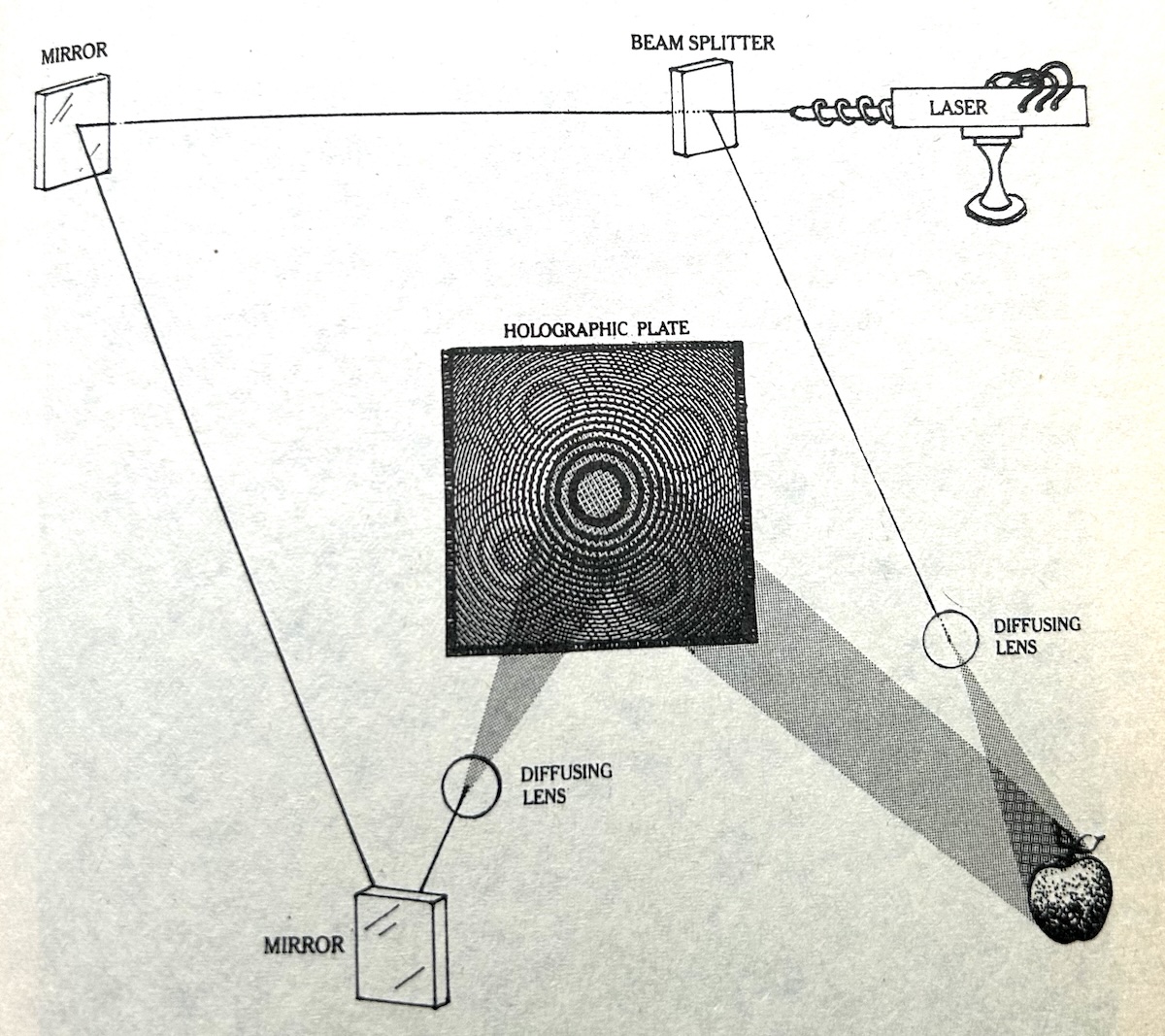
Holographic Memory Storage
What is observed by us in the physical is stored in memory nonphysically, becoming part of our library of physical experiences and forms. Consciousness dips into the physical universe for a lifetime and picks up all these forms which can be perfectly reproduced (projected) at any time.
Even with massive portions of their brains removed, [rats’] memories remain stubbornly intact. . . .
Memories were not localized at specific brain sites, but were somehow spread out or distributed throughout the brain as a whole. . . .
No one ever came out of surgery with any selective memory loss. (Talbot 13-14)
[Nonlocality] offered at last a way of understanding how memories could be distributed rather than localized in the brain. If it was possible for every portion of a piece of holographic film to contain all the information necessary to create a whole image, then it seemed equally possible for every part of the brain to contain all of the information necessary to recall a whole memory. . . .
If a holographic plate is broken into fragments, each piece can still be used to reconstruct the entire image. (Talbot 17-18)
The “whole in every part” nature of a hologram certainly seemed to explain how so much of the visual cortex could be removed without affecting the ability to perform visual tasks. (Talbot 20)
Saying that every part of a piece of holographic film contains all the information possessed by the whole is just another way of saying that the information is distributed nonlocally. (Talbot 48)HUscientific, researcher • modern • Talbot
Holograms . . . are nonspatial. Many holograms can be superimposed upon one another in one “space,” or on one plate. . . .
This explained why memories survived massive brain damage, why the brain could store infinite layers of memory, and why memories were often triggered by certain “reference beams” of associations. (Judith 330)WoLiresearcher • modern • Judith
Photographic Memory
Pollen and Tractenberg suggest that perhaps [individuals with photographic memories] have more vivid memories because they somehow have access to very large regions of their memory holograms. . . .
Again, once the brain has memorized a face and converted it into a language of wave forms, it can, in a sense, tumble this internal hologram around and examine it from any perspective it wants. (Talbot 23-24)HUscientific, researcher • modern • Talbot
Neurons Encode the Hologram
The only question that remained was what wavelike phenomenon the brain might be using to create such internal holograms. As soon as Pribram considered the question he thought of a possible answer. It was known that the electrical communications that take place between the brain’s nerve cells, or neurons, do not occur alone. Neurons possess branches like little trees, and when an electrical message reaches the end of one of these branches, it radiates outward as does the ripple in a pond. Because neurons are packed together so densely, these expanding ripples of electricity—also a wavelike phenomenon—are constantly crisscrossing one another. When Pribram remembered this he realized that they were most assuredly creating an almost endless and kaleidoscopic array of interference patterns, and these in turn might be what give the brain its holographic properties. “The hologram was there all the time in the wave-front nature of brain-cell connectivity,” observed Pribram. “We simply hadn’t had the wit to realize it.” (Talbot 20)HUscientific, researcher • modern • Talbot
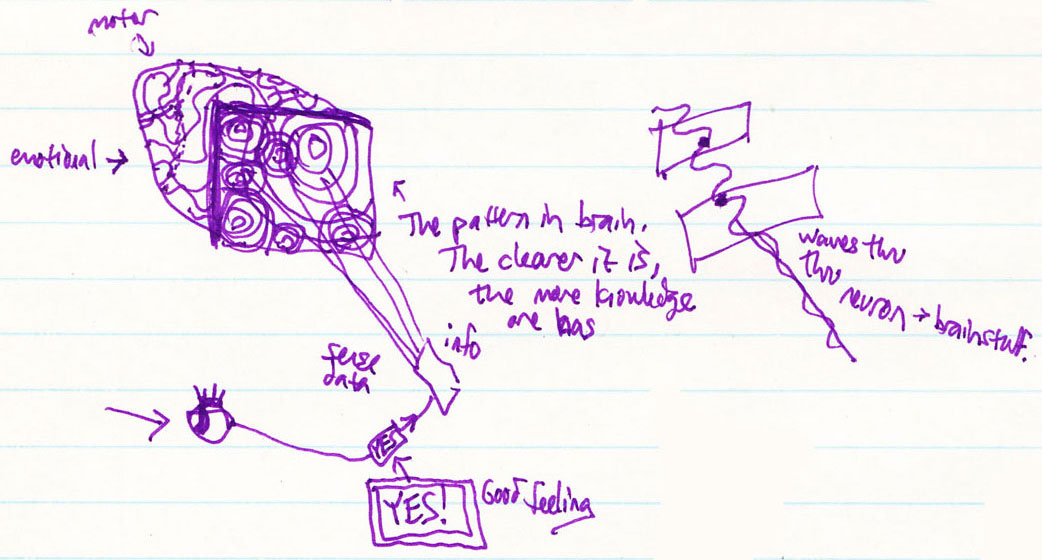
The pattern in brain. The clearer it is, the more knowledge one has.
In this state of deep remembering, I looked up at a lamp and, rather than seeing normal light, saw the light and dark waves of interference patterns.
Fourier Transforms — The Language of the Brain
Just as a television camera converts an image into electromagnetic frequencies and a television set converts those frequencies back into the original image, Fourier showed how a similar process could be achieved mathematically. The equations he developed to convert images into wave forms and back again are known as Fourier transforms. . . .
[Researchers] had uncovered evidence that the visual system worked as a kind of frequency analyzer. Since frequency is a measure of the number oscillations a wave undergoes per second, this strongly suggested that the brain might be functioning as a hologram does. . . .
Despite the popularity of this view, the DeValoises felt it was only a partial truth. To test their assumption they used Fourier’s equations to covert plaid and checkerboard patterns into simple waveforms. Then they tested to see how the brain cells in the visual cortex responded to these new wave-form images. What they found was that the brain cells responded not to the original patterns, but to the Fourier translations of the patterns. Only one conclusion could be drawn. The brain was using Fourier mathematics—the same mathematics holography employed—to convert visual images into the Fourier language of wave forms. (Talbot 27-28)HUscientific, researcher • modern • Talbot
Fourier transforms can be thought of as waves that we translate into forms. Does moving up the stream (into higher frequencies) mean moving towards the Fourier transforms?
I awoke from vivid dreaming with an image: a field of non-moving rolling waves, alternating rounded peaks and valleys. Imagine balls laid out in a grid with a sheet laid loosely over them. Each little hilltop was the top of a sphere, reflecting the whole. Like pearls reflecting the whole. This image was related to Fourier transforms — this is how it becomes holographic!
Holographic Senses
Since the brain stores and recalls wave forms, then our senses must be conveying their signals as wave forms. To achieve this, they must be acting as frequency analyzers.
Senses Are Frequency Analyzers
Helmholtz had shown that the ear was a frequency analyzer. More recent research revealed that our sense of smell seems to be based on what are called osmic frequencies. Bekesy’s work had clearly demonstrated that our skin is sensitive to frequencies of vibration, and he even produced some evidence that taste may involve frequency analysis. (Talbot 28)HUscientific, researcher • modern • Talbot
Projection of Sense Impressions
Projection is one of the basic qualities of consciousness. We project our various sense impressions of the world out holographically to their perceived positions outside of us. We assemble them into a cohesive world.
Pribram points out that when we look at a person, the image of the person is really on the surface of our retinas. Yet we do not perceive the person as being on our retinas. We perceive them as being in the “world-out-there.” . . .
Creating the illusion that things are located where they are not is the quintessential feature of a hologram. (Talbot 24-25)HUscientific, researcher • modern • Talbot
After eye operations, people who were born blind must also learn to orient themselves in a world they used to know only through the sense of touch. At first, they see the objects as if these were actually in their eyes; next they see them outside their eyes, but as if painted on a flat surface. Only gradually do they learn to perceive depth and the spatial distance between things. (Steiner 101)Tclairvoyant • Theosophy • Steiner
Storage and Retrieval Angles
By changing the angle at which the two lasers strike a piece of photographic film, it is possible to record many different images on the same surface. Any image thus recorded can be retrieved simply by illuminating the film with a laser beam possessing the same angle as the original two beams. . . .
Pieces of holographic film containing multiple images, such as those described above, also provide a way of understanding our ability to both recall and forget. . . . It has been suggested that our ability to remember is analogous to shining a laser beam on such a piece of film and calling up a particular image. Similarly, when we are unable to recall something, this may be equivalent to shining various beams on a piece of multiple-image film, but failing to find the right angle to call up the image/memory for which we are searching. (Talbot 21)HUscientific, researcher • modern • Talbot
The strength of the recording is due to the attention on the experience. All memories fade over time, but repeated attention on a memory will keep it going longer. Our memories are very fallible, and it’s likely that every time we remember something, we are storing a new memory of an old one.
Holographic Streams — Movies
When [pieces of holographic film containing multiple images] is held in a laser beam and tilted back and forth, the various images it contains appear and disappear in a glittering stream. (Talbot 21)
If each phase of an activity, say a woman blowing a soap bubble, is recorded as a series of successive images in a multiple-image hologram, each image becomes as a frame in a movie. If the hologram is a “white light” hologram—a piece of holographic film whose image can be seen by the naked eye and does not need laser light to become visible—when a viewer walks by the film and changes the angle of his or her perception, he/she will see what amounts to a three-dimensional motion picture of the woman blowing the soap bubble. (Talbot 201)HUscientific, researcher • modern • Talbot
The following is a hologram recorded in this fashion called “The Kiss 2”:
In this case, the different frames of the video are caused by the camera moving spatially around the recorded subject. In essence, a spatial angle is substituted for the dimension of time. A higher-dimensional hologram would be able to use time itself as the index of change.
It would then be within our psychological time that we can move back and forth within this hologram. Indeed, this is how we as consciousness share and explore experiences.
See Sharing Memories.
Perceiving the Holographic Structure
To the naked eye, the image on the [holographic] film looks nothing at all like the object photographed. . . . But as soon as another laser beam is shined through the film, a three-dimensional image of the original object reappears. (Talbot 15)HUscientific, researcher • modern • Talbot
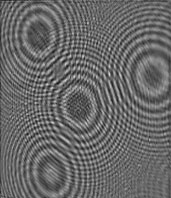
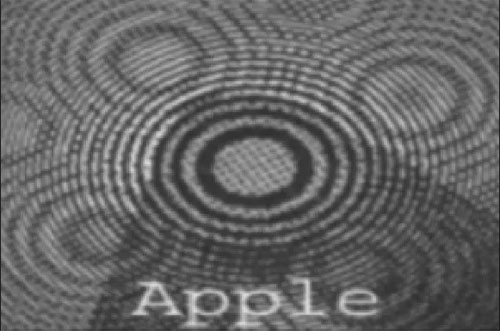
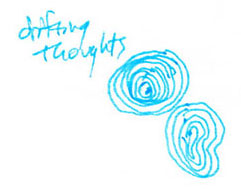
One of the most common things that I’ve seen in altered states of mind is overlapping concentric rings. I believe what I’m seeing is holographic wave interference patterns — the raw encoded holographic nature of the mind. This is what holographic plates look like without the reference beam shining on them to reveal their imagery. While we usually see the 3D holographic image, in some focuses we can also see the structure in the brain that holds the hologram.
Playing a scene via a 2D holographic plate is done by changing the angle of the beam. In our mind, our steady focus of attention lights the hologram, which we then move through in psychological time.
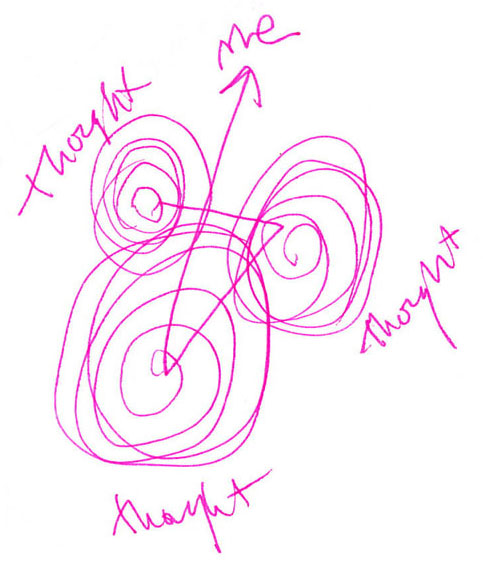
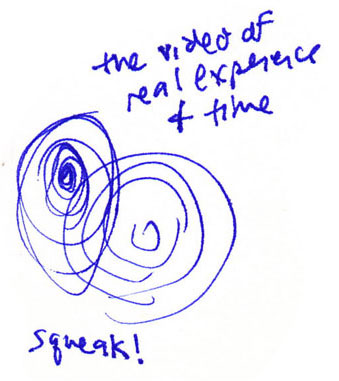
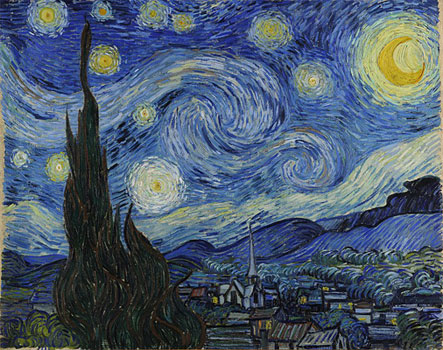
Starry Night by Van Gogh has a feel reminiscent of seeing these rings while on LSD.
The Lights Within the Rings
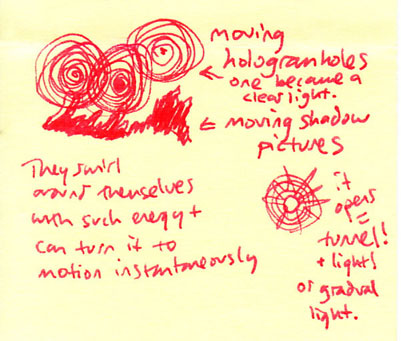
In one rare instance, I saw the holographic rings open up to reveal light through a tunnel:
Moving hologram holes. One became a clear light. Moving shadow pictures. It opens = a tunnel! A light! Or gradual light. They swirl around themselves with such energy and can turn it to motion instantaneously.
During hypnagogia:
• I see concentric hologram rings. One opens, and light comes out.
• As my thoughts drift, I see two sets of concentric hologram rings, like two separate eyes. The circles are also lights merging in the center.
The Workings of the Holographic Mind
The brain is a receiving station and interface between the physical body and the higher-dimensional mind. The mind works holographically as well, even outside the body.
Our experience can be reduced down to the intersection of two things — experiences coming from the now, and projections coming from our past.
The basic functions of the mind are pattern-matching and pattern-association functions. They’re not something biologically built — they’re far more foundational to consciousness than that. Consciousness perceives, and it retains. What it retains shines back (projects) onto what it perceives. This intersection forms our reality.
Our focus of attention shifts between various degrees of experience and projection, with pure experience at one end of the spectrum and pure projection at the other.
Our Experience Is the Meeting Point
This is absolutely KEY to this section.
Tints [of consciousness] stain reality in a given manner; so that certain effects splash out from the mind to fall upon the objective landscape. . . . The images of the mind . . . suddenly turn alive and brilliant, casting their reflections brightly out upon the objective world . . . NOTE: the projections of past experience
Objective experience is a mixture of images within the mind and objective material without. . . .
The musician’s and the artist’s worlds are doubtlessly different, for each projects outward those particular nuances of desire and interest that program perception; and though they both share the same physical universe, the differences represent those unique characteristics that make consciousness particular, specific, and personally meaningful. . . .
It is as if the private cast of consciousness works upon the objective world landscape by giving it its final, private, definite form; as if before the individual perceives objects, there is instead a field of pliable, malleable, pseudoshapes. The perceptions themselves bring these into focus and form, adding all the dimensions of actuality, depth, color, and so forth—these being projected outward upon that landscape according to each man’s particular cast of consciousness. . . .
It is a screen of twofold function. On the mental or psychological side it projects ideas and beliefs outward where, at the point of contact, these work upon or slide over the pliable but incomplete field of objectivity, giving them their final form. The outside of the screen, the brain, perceives the finished product. Here we have inner and outer images transposed one upon the other so cleverly that it is impossible to distinguish between the two. (Roberts 104-106)AJoaAPchanneled • modern • James
We project our feelings, knowledge, and associations into people, objects, and events in physical reality. We are co-creators of our subjective experience. We experience the meeting point between our internal projected reality of past experiences, fears, desires, and expectations with the perceived physical world.
We create that emotional dimension of 3D reality that we experience in dreams and after death. The higher dimensional extension we provide is based upon the emotion (frequency), and the intensity (amplitude) of the feeling behind it. For more on this, see The Astral World Is Written Through Attention.
Association
Association
Another primary way we understand the world is through associations. Concepts are linked together in various ways in the mind. If your Emma bakes apple pies regularly, the concept of apple pie may become associated with her. Focusing on one part of an association can bring up thoughts of the other.
Its Holographic Nature
The holographic idea offers a further analogy for the associative tendencies of memory. This is illustrated by yet another kind of holographic recording technique. First, the light of a single laser beam is bounced off two objects simultaneously, say an easy chair and smoking pipe. The light bounced off each object is then allowed to collide, and the resulting interference pattern is captured on film. Then, whenever the easy chair is illuminated with laser light and the light that reflects off the easy chair is passed through the film, a three-dimensional image of the pipe will appear. Conversely, whenever the same is done with the pipe, a hologram of the easy chair appears. So, if our brains function holographically, a similar process may be responsible for the way certain objects evoke specific memories from our past. (Talbot 22)HUscientific, researcher • modern • Talbot
Generalizing Associations
Similar specific associations naturally spread into general associations. Each specific association becomes evidence for the generalization.
Hate is restrictive. It narrows down your perception. It is indeed a dark glass that shadows all of your experience. . . .
If, for example, you hate a parent, then it becomes quite easy to hate any parents, for in their faces you see and project the original offender. (Roberts 174)SSchanneled • modern • Seth
This is holographically true. Hate is a projection from a past point of pain. While it has our focus, it casts its shadow out into our experience. The only thing it can see is its source, the thing hated, and the more you look through that hate, the more you find it; the more it broadens.
Feelings about a specific parent can spread to all parents, and eventually to all adults, then to all people.
Pattern Recognition: Expectations
Passive Projection: Pattern Matching
The entirety of our past experience forms a vast database that we passively compare our present experiences against. This is how we recognize things and situations. Expectations arise from these holographic projections from our past into the now.
This passive pattern-matching is on at all times in the background. It allows us to recognize people, places, objects, and situations we know from the past. It compares new situations to those in the past with the same key features in order to provide information and to give us hints as to what is going to happen. This is automatic and takes no effort or attention. If there is an emotional component to the past experience, it is given more weight. Our situational knowledge and expectations are the effect of this automatic pattern matching system.
The tendency for a past experience to find a match in the present is initially due to its similarity, amplified by a) the past emotional charge it still holds, and b) our present attention. Our past experiences with emotional charges form a more active seeking, though it still usually occurs without conscious attention (see The Fading Lights Model).
What we perceive now is selectively amplified based on what we perceived in the past.
Its Broad Scope
The holographic nature of the mind is such that it can effortlessly compare vast amounts of familiar patterns at once. For example, I was playing Pokémon Go the other day, scanning across the tiny images of 6-8 different Pokémon on the screen, looking for new Pokémon I hadn’t seen before. I realized that at a glance I was instantly comparing what I saw against the 900 Pokémon I’m familiar with in the game. It was automatic and instantaneous.
How the Past Projects
How does something without our present attention passively project into our experience?
During each experience, the light of our attention flows into and takes the form of that experience, with all its new associations. That form continues to exist mentally, radiating outwards into our new present experience. The emotional component, being the brightness (or amplitude) of the image, radiates more brightly but fades more quickly than the concept itself, which remains far longer.
The action of past experiences in this regard is described in detail in The Effect of Thoughts.
Its Holographic Nature
In a 1970 article in the British science magazine Nature, physicist Pieter van Heerden proposed that a type of holography known as recognition holography offers a way of understanding this ability [to recognize familiar things]. In recognition holography a holographic image of an object is recorded in the usual manner, save that the laser beam is bounced off a special kind of mirror known as a focusing mirror before it is allowed to strike the unexposed film. If a second object, similar but not identical to the first, is bathed in a laser light and the light is bounced off the mirror and onto the film after it has been developed, a bright point of light will appear on the film. (Talbot 22-23)HUscientific, researcher • modern • Talbot
That point of light is a light to our attention — it’s not visibly seen, but it grabs your attention. I call this the attention field. More on this to come.
The hologram of our subjective experience is built at the intersection of our present physical sensory experience and our past experience.
Pattern Recognition — Objects
When you see a small red object on the table, your mind matches it with a visual pattern you’ve experienced before, and you recognize it as a strawberry. This recognition calls up information on the pattern, including the taste and the linguistic symbol — the word “strawberry.” The relevant information may include such things as “I like strawberries” and “strawberries are safe to eat.”
We project those expected qualities into the strawberry.
Pattern Recognition Sequences — Events
We also recognize sequences — patterns across time. After seeing events play out a certain way before, seeing the same initial event generates an expectation of it turning out the same way. Just like object recognition, this is at play at all times as an attention-saving mechanism that allows us to predict what will happen next based on the past.
These expectations are also projections. We project what we expect to happen out into our experience so that we can quickly see it there when it happens.
Expectations Are Projections
You always form your own reality according to your ideas and expectations. This is the nature of consciousness in whatever reality it finds itself. (Roberts 119)
In physical life you see what you want to see. You perceive from the available field of reality certain data—data selected carefully by you in accordance with your ideas of what reality is. . . .
Your experience, in other words, follows your expectations. (Roberts 138)SSchanneled • modern • Seth
This means that consciousness is holographic in nature.
Here’s a fun little example. Listen carefully to the following clip from Disney’s Peter Pan, in which the lyrics sung are, surprisingly, “think of Batman pooping snakes”:
You heard it clearly, right? Now listen again with the actual lyrics in mind: “take the path that moonbeams make”. You heard that clearly, too, didn’t you? There’s not a single word in common between those two phrases. We projected our expectations along with the video. Clearly, projections are incredibly powerful at shaping our experience.
Our sensory experience was used to confirm our expectations.
Filling In the Unknown
Everything we have a concept for lives in a cloud of associations. All the experiences we’ve had with each type of person or thing form thoughts and expectations about it. Looking at someone or something through that cloud means we don’t actually see much of them at all — we see our past associations and expectations. We project those out onto that person or thing and feel we know something about them based on that past experience.
The world is filled with unknowns. But we transform it into a world of seeming knowns through the projection of our expectations.
Due to the holographic nature of the mind, all expectations are projections. Anywhere we find unknowns, we project likely situations into them. We don’t know the future but we make guesses, projecting known patterns out into it. We proceed under the assumption that our expectations are going to happen. What we project is mixed into what we perceive to form our final experience (see Our Experience Is The Meeting Point).
These projections can have a profound effect on our lives. The way we fill in the unknown, what we expect from the future, our degree of optimism or pessimism — this is our own contribution to our subjective reality. As we get older and have more experiences, we see less of what’s really there and more of our own projections. The world can become too known, too predictable.
All things are to man’s mortal consciousness what he thinks or believes they are. (Benner 73)ILchanneled • New Thought • Benner
There is a well-known experiment you can try right now. Each of our eyes has a small blind spot where our ocular nerve connects. The brain corrects for this blind spot by filling in what it expects to be there based on the surrounding context.
Take a look at the image below. Close your right eye, and look with your left eye at the +. From a certain distance away, the dot disappears, as the brain fills in the blank spot with expectations based on its white surroundings.

We entirely fail to see something that is actually there. We are seeing our visual expectations.
Psilocybin/LSD: When watching a bat fly through the sky above me in its strange and unpredictable patterns, I found myself actually seeing an image of where I expected the bat to go whenever it turned. As it turned, I saw a version of the bat go straight, then disappear.
I woke up physically and went to the mirror in the bathroom. For a split second when I looked at myself, I saw a dark red spot roughly between my eyebrows. A vestige of my dreaming awareness, seeing my third eye? It was lower than I imagined. I also saw a few thin black lines, as if made by trails of flying insects that had passed by.
It seemed that my vision was a liquid that flowed to cover over these images. . . . It may be covering up things we’ve come to believe as “not useful”, just as it covers over the blind spot in each eye.
Rationalization
When we are surprised by something unexpected or something we don’t understand, we try to fit it into our context in a way that makes sense. Maybe she meant this, or maybe something happened that we didn’t notice. This is known as rationalization — fitting experiences into the framework of physical life.
Buttercup is a master of this — her mind will rapidly go to great lengths to try to make sense of a statement or situation that’s confusing to her. She rapidly comes up with an explanation that makes sense, though it may not be correct. She instinctively connects something weird or unknown back into the logic of the conversation, or of recent events.
Rationalizations are a form of projection into the unknown. Our experience isn’t adding up, so we clearly missed something. We make our best guess and project that into our situation.
Rationalization is frequently at work in the physically-oriented mind when in the dream state. There things often break the typical rules of physical reality, and our mind instantly works to makes sense of them. This has a MASSIVE effect on our dream experiences, as we’ll see in The Nature of Dreams.
General to Specific Patterns
If someone tell you that you are about to meet someone, this brings about certain very general expectations. How do we react? We call on our general overall impression of other people. If it’s positive, then we will feel excited. If it’s negative, you will feel suspicious and distrustful. You react to this general “other person” unless you are able to get more details which may have significant meanings. “You are about to meet a 21-year-old girl with brown hair” brings about more specific expectations, yet they are still rather generalized through everyone you’ve known that fits that description. “You are about to meet Buttercup for lunch,” brings about a very specific expectation. Each attribute that has some meaning is cross-indexed to bring about a certain set of expectations about what is going to happen.
Projection of Generalizations
Visual Projection During Data Loss
Sense neurons gradually become silent to our attention as their input remains the same. This is called “neural adaptation”.
To get around this, we have quick little involuntary eye movements called eye saccades, which keep the receptors in our eyes refreshed. Without these quick eye movements, the photoreceptors in the eye keep reporting the same thing and our vision slowly goes dark. If you can fix your eyes unmoving on one thing, you can watch this happen.
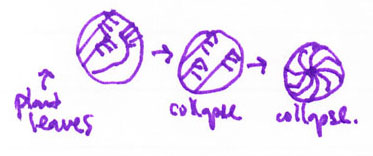
While on LSD or psilocybin, I stared fixedly at the branches of a tree to see what happens in detail as attention fades from my eyes. What happens first is that as the visual attention slowly begins to fade, the brain finds similarities in the branches and leaves in our visual field, and it essentially says: “They’re basically the same. We can see them both at once! We can see one by seeing the other.” As attention on one part of the tree fades out, the mind projects a similar part of the tree into its place (rotated to fit best). Thus my attention is seeing a smaller section of branches while projecting that section into different places. Projection takes over whenever attention fades.
The brain continues to find similar patterns in your slowly fading awareness of the branches and leaves, then slowly adjusts our visual perception so that the pattern is repeated in more and more places (starting in the easily-changed periphery). This continues, little by little reducing it into steadily simpler kaleidoscopic fractal pattern. Paradoxically, we feel that we see more, for we “see” this projection over a broad section of the tree. This is a kind of visual compensation by projection. One sees all repeated patterns at the same time, as if it’s one big object moving in unison. As the wind blows, the projected patterns sometimes move into and out of each other, rocking in and out like a kaleidoscope.
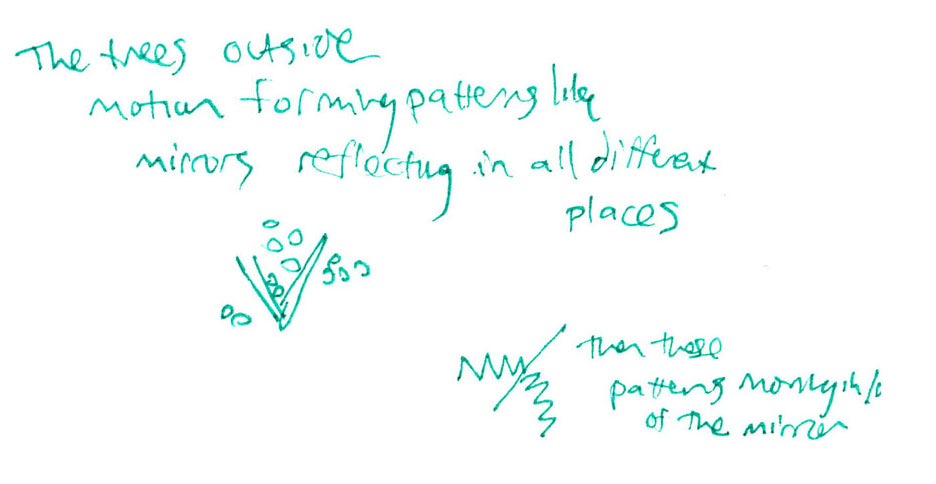
Then these patterns moving in/out of the mirror
TO DO: Take a photo of a single tree against a blue sky and edit it in stages to show how this works.
The manner in which the visual field increases during this effect is this: there is a ring in the center of the visual field of extreme acuity. Around that appears another ring, flickering faster and faster. Then it becomes solid and another ring appears. At another time, I noticed a more prominent flickering before I could see a thing.
Keep staring and smaller and smaller bits of the tree are spread further and further. The fractal pattern then rotates and collapses into darkness that remains until we flick our eyes to a new location, the saccade refreshing the visual senses.
When staring fixedly, the visual information fades and the scene begins to collapse into self-similarity.
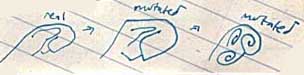
This visual generalization is due to the brain filling in data loss with projections. The brain generalizes and projects more and more based on the remaining limited data, making the lost data appear as the same experience as what remains. That limited data gets projected everywhere in the darkness of unawareness. We’re projecting into the sensory darkness.
Of course, what you’re experiencing isn’t true. Every set of branches and leaves is NOT the same as all the others. The mind is doing this projection to compensate for the steady reduction in visual information because of staring fixedly.
Without LSD or psilocybin, it’s difficult to do this experiment. Without the increased attention to clearly see your visual projections, the scene simply fades to black.
This reflects a universal rule of the mind. Projection takes over whenever attention is lacking.
In the Periphery
If you were able to clearly observe your peripheral vision when you focus in on a certain pattern, you would see that things in your peripheral were taking on that very same pattern in a similar projected generalization about your surroundings. The periphery of our vision is a low-data area, and prone to projections.
As described above, the periphery is the first area to begin relying on projections.
Generalization and Projection
What are the implications of this visual generalization? That it is the nature of the mind, wherever attention is absent, to project expected patterns so that it can understand and “see” more. We miss out on a chance at new information when our attention is elsewhere. This is precisely how expectations work: something new is essentially replaced (projected over) by our past experience of similar things. To the extent that our attention is elsewhere, we’re not actually perceiving that thing, we’re perceiving our projections.
This visual generalization works the same way as any of our expectations — projecting wherever attention is lacking to make our experience seem known — to have a feel for the world when we’re not paying attention.
Our experience of anything, including any category of people we can come up with — be it in terms of race, gender, nationality, etc — are often based on limited experiences, projected into others with little attention.
The Trouble with Expectations
Seeing Through Past Experiences
This is CENTRAL and CRUCIAL. I’ve directly experienced in many psychedelic experiences that a lack of attention that results in looking through past experiences is the central source of what blocks the Source and keeps us from experiencing the extraordinary beauty of the now.
Nothing is remembered perfectly in the Waking State, for nothing is experienced perfectly, as it really is. Rather, the previous impressions of experience and belief color every experience, every thought. (MSI 24)
Previous impressions of experience collide with current sensory data to distort or color all images. . . . This is the typical experience of the Waking State -- partial or complete loss of the experience almost immediately. The less is lost, the more is remembered. . . .
Memory is the natural state of mind. When the experiences are not lost, memory is automatic. . . .
What steals away the experience? Conditioned responses, beliefs and judgments. . . . The vast majority of sensory and mental input is filtered out before it reaches the conscious mind by the Hypothalamus and the Reticular Activating System. This . . . keeps the mind from being overwhelmed by excessive data -- but it also has the unfortunate effect of keeping . . . the boundaries of the Waking State firmly in place. (MSI 31-32)
When we perceive anything, the previous impressions we have learned to associate with similar objects resonate with our current experience to provide a name for the object. (MSI 218)
A coarse mind will tend to . . . force new experience into the old grooves. (MSI 244)
Consciousness will be colored by that desire; the objects of perception will not be seen clearly. (MSI 296)Ewisdom • modern, Hindu • Isham
Your brain is not the source of your intelligence. It is simply a data processor. It takes in data through receptors called your senses. It interprets this energy in formation according to its previous data on the subject. It tells you what it perceives, not what really is. (Walsch 343)CWG3channeled • modern • Walsch
Our actual senses in the now are so different from how we experience them as adults. We receive raw, neural signals and our bodies translate everything we experience into known, useful labels that we know how to deal with, based on our past experiences. Faster moving particles = hot. Denser molecular structure = hard. A certain visual wavelength & frequency = blue. Certain chemicals = sweet.
Marijuana: I wanted to get up close to the experience of sugar. My attention moved up the signal further and further, past the concept of sugar, past the idea of sugar, past memory associations of sugar to the actual raw realtime experience of sugar. It was a sea of cubes, like sand, which rolled against my tongue. I wondered what it was like for my cells to experience sugar, causing me to zoom in further. It was a misty whitish color, a bunch of circles with beams of light going out in two directions, and swirling and rolling both at the same time. Without all those past associations, I was able to re-experience it fully in the present moment.
In normal life, each real experience runs through our library of past experiences, associations, beliefs, and needs. We “experience” very little, perceiving much further down the stream from the original sensory perception.
ALL OF THIS is reduced and captured into the word “sweet”. We’re so deeply abstracted from real experience through our past impressions that instead of this whole exquisite experience, we now just think “sweet”.
We simplify the present by living in the past. Our attention is freed from the now at the cost of our happiness.
Benner, speaking from the perspective of the Source:
Just to the extent you hold to things that are past, do you still live in the past, and can have naught to do with Me, Who dwell in the ever-present NOW, the Eternal. (Benner 169)ILchanneled • New Thought • Benner
“Without freedom from the past, there is no freedom at all, because the mind is never new, fresh, and innocent.” — Jiddu Krishnamurti Qwisdom • various
This pattern recognition function is always on. Its purpose is to simplify the present moment by comparing it to past experiences. As you go about your day, your sensory inputs are being compared to patterns from your past and motivations from the present. This frees up our attention for other things. In terms of survival, this is amazing. You instantly recall everything you might need to know about any person, object, or situation, which frees up your attention to fulfill other needs.
However, in terms of happiness, it’s crushing, as you experience only your past projections onto the world. This blocks out most new experiences, and is the cause for the growing unhappiness as we get older. Our world progressively becomes more abstracted in this way, as instead of seeing anything truly, we see our past conceptions of things.
The older you get, the more you feel you’ve seen it all before. Looking out through the filter of memory is not really seeing. If you’ve gotten used to something, you’ve adapted to it. The sound of the air conditioning, the cold temperature, the constant bickering; if it no longer affects you like it did at first, you’ve adapted to it, tuned it out.
This is also true of distraction. The more distracted you are, the more you draw on your past experience of a thing. This week’s trip to a park is seen as essentially the same as last week’s, even though it may be an entirely new park. We assume the people around us are pretty much the same as people we already know. Although the situation before us is new, we see it as old. Our attention is instead focused on past or future issues, and the current experience isn’t relevant to that.
As long as life is lived without attention, we experience nothing new and live in a world of shadow. Without attention, life becomes boring, repetitive, and our possibilities will seem to be exhausted.
I recall an interesting experiment where people were hypnotized so that they couldn’t conceive of a past. As a result, they saw their future potential as unlimited. Without the weight of their personal history, they became more joyful, optimistic, and creative. (Ryerson and Harolde 57-58)SCchanneled • modern • Ryerson & Harolde
Whatever We Expect Disappears
Whatever we expect disappears. Expectation causes something predictable to gradually fade from our attention. Repeated stimulus that is deemed unimportant is adapted to and tuned out in our normal waking state. For example, a constant or repeated sound becomes background before long, and gets no attention. When a thing is expected, you’ve integrated it into your context and it becomes background. It essentially disappears from our attention. This is known as “habituation”.
This is evident with the senses as well. A new smell grabs our attention, but soon fades from our awareness. Once we sit down, the sensation of the chair slowly fades until we don’t feel it anymore. This is a basic neurological phenomenon known as “neural adaptation”.
Habituation can be overcome through our focus of attention. During deeper states of meditation, a repeating stimulus will be surprising each time. Expectations require memory. One disengages from their memory as they focus in the now.
The Curse of Comparison
When something is completely new to us, it probably has our full attention. Likewise, if we are fully present in the now, even something we’ve experienced many times before can feel new and we can gain fresh insights through from it. Uncompared, everything is perfect.
Marijuana: I was high, eating this cheap, nasty pizza I usually bought, and suddenly it was as good as the best pizza from my childhood. Why? Because of my deep concentration on it. You stop comparing everything to “the best you ever had” and enjoy a thing for its uniqueness, it’s realness to you, it’s presence in the now.
When comparing similar experiences, we see only differences and sameness. As in any comparison, a judgement of one being perfect makes all differences bad.
I can look back at the poor quality of the cartoons I watched in my youth. But at the time they brought me happiness, reminded me of who I am. It was me that was infusing them with value, with truth. It was me opening up totally to them, letting the light flow through my attention. But I can no longer enjoy them. I am aware of clichés, blinded by comparisons, and succumb to the limitations of my “finer taste.”
This forces us to find new things to stimulate us in different ways and leads us to expand our horizons, though the light becomes harder to find.
See Standards for Enjoyment and How the Source Speaks to Us.
How Emotionally-Charged Expectations Reinforce Themselves
Some expectations have an emotional component. If a person, thing, or event had a positive or negative effect on us, that strengthens the memory. That detail is stored along with the pattern, and recalled when we match that pattern in our environment. Emotionally-charged expectations (fears, desires) shine out more brightly onto our sensory landscape. Their emotional charge gives more weight to the projection.
Our happiness comes from opening up to the flow from the Source. Our attention comes forward into the now, and we have new experience, bringing happiness and pleasure. We’ll go into this in detail in The Flow Into Us.
• When we expect pleasure and happiness, we open up and focus in the now. This allows us to experience pleasure by opening to the the flow.
• When we expect pain and failure, we close up, try to block the experience, and thus do not experience the pleasure of the flow.
Both of these situations reinforce themselves, regardless of what actually happens.
For this same reason, when one expects to have something and doesn’t get it, it is as if it was already theirs and was suddenly lost. So there is anger, sadness, disappointment. If one expected to lose something, and it wasn’t lost, then they feel better, and their energy rises back to its pre-expectation state.
Anomaly Detection
Anomaly Detection
As long as your experience seems to match your expectations, there is no need for attention to be drawn to it. Our attention is free for other things. But what happens when a new situation only partially matches our expectations?
There is an innate holographic phenomenon which draws attention to any sensory input or occurrence which breaks expectations. This “Anomaly Detection” kicks in and holographically lights up the difference between our experience and expectation, drawing our attention to the difference. This added attention primes us for learning. Our attention is drawn to the differences and we encode new memories.
As long as our experience of a strawberry matches our concept of a strawberry, it can satisfy our hunger while our attention wanders to other things. However, if the strawberry is blue, has a weird spot, or tastes different from what you expected, then that difference grabs our attention. We look closer at it, pay more attention to it, and decide this is not a strawberry we want to eat.
Its Holographic Nature
Any feature of the object that has changed since its image was originally recorded will reflect light differently. An individual looking through the film is instantly aware of both how the object has changed and how it has remained the same. (Talbot 23)HUscientific, researcher • modern • Talbot
The Trouble with Anomaly Detection
When we go out into the world filled with energy and focused attention, anomaly detection draws our eyes to new and interesting things, new opportunities to explore. Anomaly detection fuels our curiosity.
But when we are focused on an ideal, any anomaly may render it useless to us. For example, when we are trying to conform to the “perfect conditions” which we believe are needed for success, any anomaly is a sign of failure. In these situations, anomaly detection triggers fear instead of curiosity.
I’ll cover this in detail in “Social Conditions For Happiness” below.
Projections: Specific Search
Foundations
Introduction to the Pure Essence
During an LSD experience when I was 20, I re-experienced the flow of the Source into me. I called it the “Pure Essence” of every good experience I’ve ever had, separate from the form of those experiences. I’ll share that experience in the chapters ahead. For now, understand that the Pure Essence is that flow of love and light into us. It’s the very light of attention that we shine out into the world, or on our past experiences.
The Attention Field
We all know the visual field — the screen upon which we see the world. It’s what we’re seeing with right now. But there is also an inner field of perception that relates specifically to attention — the attention field. It overlays all the sensory fields, including the visual field. In the physically-focused state of consciousness, the attention field is perceived only by our attention.
The attention field is a holographic field of inner light and darkness. When we’re fully focused in the now, the light of our attention passes clearly through it, lighting up our perception with an inner light and clarity. When we’re projecting in any way by focusing on desires, fears, or the past, the entire attention field dims and only that which matches lights up.
The attention field is most noticeable when we’re searching for something.
Active Projection: Specific Search
As described above in “Pattern Recognition: Expectations”, the whole of our past experience lies on one side of the attention field, with our present sensory experience on the other side. Together they merge into our filtered final experience. Our ability to recognize people, things, and patterns constitutes a passive ongoing projection.
When actively looking for something, our attention is phased (split) between an internal focus on a mental image (projecting it outward) and the environment we’re searching in. I call this “Specific Search”.
Specific Search is projection enhanced by attention.
We regularly use our projection ability every time we search for and find things. When looking for something, part of our mind focuses inwardly on what we are looking for. The light of our attention projects that image outward, interlacing it with our sensory perceptions, which filters out anything that doesn’t match and lights up that which does. Our attention is then attracted to whatever lights up. This light is typically not seen visually, but acts upon our attention.
All projections are holographic filters. While we focus some of the light of our attention on what we are looking for, that light disappears from our attention field, and only returns through whatever is matched.
In this way, we see the world through the filter of that which we’re looking for. Like all other primary functions of mind, this works holographically through projection.
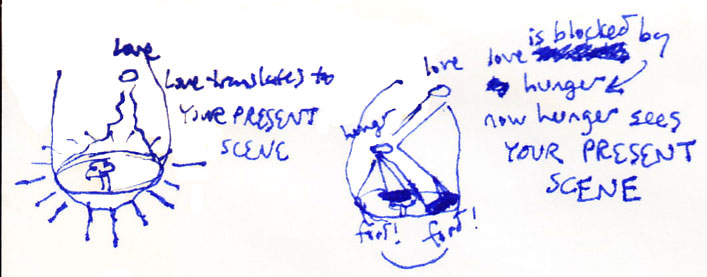
Without any filters, we perceive our current environment fully. The light of our full attention shines out upon the scene.
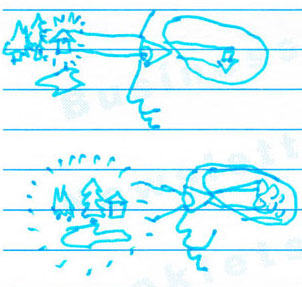
The Light of the Match
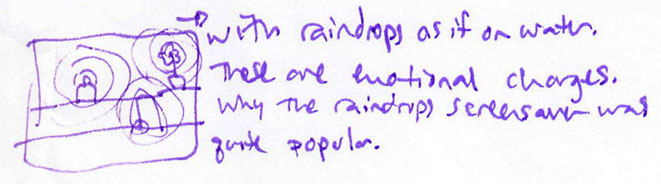
Because the light of our attention is half focused on the object we’re searching for rather than our present experience, our present experience dims in the attention field. When a Specific Search matches something in our environment, that object lights up in the attention field, which draws our attention to it. Holographically, it’s the light of attention, the Pure Essence of the mind that’s shining out through the matched object. That thing radiates (to our attention) with ripples like waves from raindrops. I’ve seen this many times in altered states. Attention is always drawn to the brightest thing and thus is drawn towards the match.

|

looking for that specific friend and find him. |

|

|
Holographically, being the same causes resonance. That resonance lets the light through into whatever we’re looking for.
This is how the the match lights up, holographically. The “rings of relevance” are the raindrop-pattern rings.
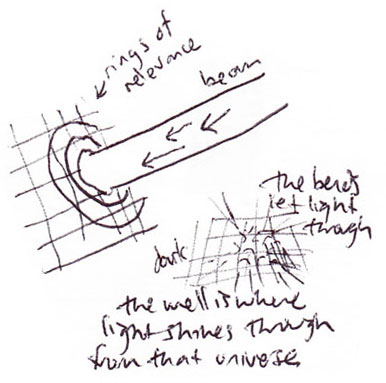
The well is where light shines through from that universe.
This effect is frequently used in animation and illustrations, often as drawn-in lines surrounding and outlining a thing.
This is why the good guys in fantasy — fairies, elf queens, and heroes are sometimes depicted as glowing with a pleasant glow. It’s the light of “who you’re looking for”.
Seeing the Light of the Match
When we find that match, the light of attention shines out of us at it. This, too, can be seen in certain altered states of consciousness. It’s used to show that someone has found something, or fixed their attention on something in art and animation. We instantly recognize and understand this when we see it.

specifically his spider sense has picked up on something.
We become more present when we see someone we like, and in so doing, our light shines out more brightly, often in a sudden flash.

shows excitement about a treat
I like to use modern examples, but the light of attention, streaming from the Source, is the core of our consciousness. Here’s a quote by Ibn Arabi from the 1200s that describes the holographic nature of Specific Search perfectly:
The Truly Real Himself is perpetually bestowing this knowing on you in the heart, except that your heart is preoccupied with knowing something other than God. . . .
But when they attain what they were seeking, suddenly the Face of God appears to them in that thing, even though they weren’t seeking that Face. SGFwisdom • Sufism • Arabi
A match in a Specific Search holographically allows light through. That light is “God’s Face” — the light of attention, coming directly through you from the Source. Removing our searching returns the fullness of the light in a continuous and non-conditional manner.
Its Holographic Nature
Specific Search Is Projection
Specific Search is projection enhanced by attention. Normally, we perceive our environment directly. But when we’re looking for something, we instead directly “perceive” the object we’re searching for and project it out into the environment, where we hope it will light up with a match.
This only works via the nonlocal aspect of holographic perception. Imagine we’re looking for a dog. Without nonlocality, we would never find it if it were in a different position, or at a different distance, or facing a different direction from where we imagined it. Finding a dog that’s standing in front of us would be nearly impossible. But holographically, the entire 3D image of a dog is projected nonlocally and it works perfectly.
When high on marijuana, I enter a state of Deep Attention, where I can see the processes of my mind happening in great detail:
I was looking for mold on my bread, and I actually SAW it there! (the bread had no actual mold)
This kind of experience shows that we’re actually projecting the image of what we’re searching for (or expecting) into our visual field. The projection from my Specific Search was strong enough to actually see it there.
The fact that Specific Search works via projection fits perfectly with holographic recognition. If you’ll recall, lighting up a similar image (a search projection) to what is recorded in the hologram (what you see around us) causes the light (that attracts your attention) to appear.
In another experience I had while high, I turned to look at someone coming towards me, hoping it was a specific person. My expectation/desire caused me to project that person’s face onto them, with the result being that my visual attention was instantly drawn to the part of the two faces that was similar (the circled part below). This was instantly followed by a jarring moment where that similarity was used as a basis for projecting the rest of the expected face over what was really there — someone else. The projected face didn’t match the rest of the face, so the two faces appeared superimposed. I then realized it wasn’t who I thought. This all happened in a moment.
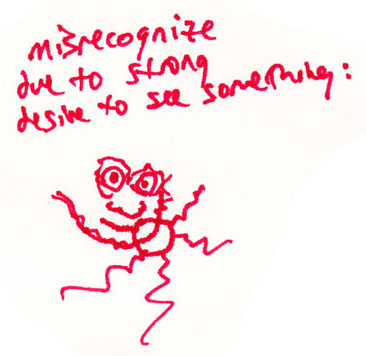
to see a specific person.
In the dream state, where there is no physical structure to tell us otherwise, we DO see what we’re expecting or searching for. If I were in the dream state in the example above, the face I was looking for would actually be continuously projected onto that person’s face and I would have misrecognized them.
Each Specific Search is essentially a holographic projector.
I’ve had countless dreams where I’m looking for something and I find it, again and again, as I look around. This is even further evidence that Specific Search is a form of projection. This is key in explaining much of our experiences in the dream state and after physical death.
In the astral frequency domain that we experience in the dream state and after death, we can access and replay any of our past experiences.
Subject: I would call it the Book of Life—a record of what you have done. . . . If I’m looking in it then it reflects what I look for. If another looks in it, then it reflects what they look for. (Cannon 47)BDLhypnosis • modern • Cannon
The term “reflects” is key here. What I’m focusing on (and thus projecting) acts as the index, and the memories themselves reflect the event back to me based on that index.
Interweaving of Projections
Projecting is done by INTERWEAVING FRAMES. We’re projecting a memory from the past, interweaving it into the present. The points of similarity in the two streams grabs our attention. Specific Search is accomplished by interweaving input from the present and projections from the past. This is done by phasing, of course.
In the scene below from Head by the Monkees, black and white rapidly switch places. The two images morph into each other when flashing quickly back and forth. The same thing happens between our experience and our projections. Our projections interweave their frames with what we actually see, and it pulls what we actually see towards the projection.
A mental projection would likely be at a higher frequency than the sensory input, meaning it would exist between the physical frames as well as holographically superimposed on top of them.
TO DO: See if you can create a video of a circle and triangle flashing rapidly back and forth. See if you perceive something in between.
Emotionally-Charged Specific Searches
Emotions always intensify experience and make bigger impacts in our memories. Thus fears and desires are the primary sponsors of Specific Search. The fears and desires don’t need to come from personal experience — they can be passed from person to person through stories.
Fears
Fear-based specific searches focus attention on what might happen to take away our happiness. The bigger and more present the threat, the more attention is directed into the fear and its search. Fears are given focus as a defense against the object of fear.
Fears serve to protect us from having future negative experiences. During and just after a negative experience (as we reflect on it), some of our energy is removed from the total flowing energy of the mind and is hardened into place around the memory as a mental structure, a focus point. This hardened point serves as a protective eye that is ever looking out for whatever hurt or scared us in the past in order to protect us from it in the present.
The Process in Detail
Alertness: When something frightening is happening, fear provides an energy surge (through adrenaline) and this increases our focus. Our attention jumps out and takes on the form of the threat, becomes it. This focused attention gives us an opportunity to avoid pain.
Resistance: We are on high alert. If we can’t avoid the danger and we’re about to be hurt, at that instant we pull back from the now; we contract, brace ourselves. The pain comes, and then it is over.
Aftermath: Because we strongly projected emotional energy into the situation, that energy has become a fixed, unchanging structure — a frozen form of that threatening situation. That trapped energy is no longer a part of the flowing total energy of our attention. It has become a fear-based Specific Search.
That frozen form has a specific purpose: protecting us by looking out for the fearful event it contains. This is the holographic basis of a Specific Search. It ever holds the image of the situation from the past and compares the current situation to it, alerting us to the extent that it finds similarities.
From the available information surrounding the fearful event, we attribute the causes or potential causes for why it happened. Those associations are linked to the fear in the energy fields of the mind.
An example: We’re walking through the woods one evening and a terrifying monster jumps out and attacks us. Unable to react in time, it slams into us, knocking us over, then it disappears into the darkness. Obviously, we’re now afraid of monsters. But what happened there in detail?
When the monster appeared, we got a jolt of energy from adrenaline. Our focus increased and we were ready to act, but it was too late — the monster was coming too fast. We brace for the expected pain. In that moment, we pull back from the now. We get hit, and the monster moves on — but we don’t. That experience leaves an image in our minds of the monster coming at us, but it’s terrifying, we don’t want to look at it. Without at all realizing what happened in our mind, we take that fear with us, and it exists to protect us from it happening again. We may have survived, healed, and become happy again, but a part of us remains, trapped, looking out for the monster by projecting it into our surroundings via our attention field. The closer our situation matches, the more triggered we are by the past event.
Our linked attributions can shift over time. Maybe we’re not just afraid of monsters, but of the forest and the dark, too. Maybe we learn that monster regulation laws have been weakened recently, and that fear becomes partially channeled into anger towards those responsible. That fear can cause a network of secondary effects.
Releasing Fear: Now imagine that a week later, we return to that forest, trying to be brave. The forest primes the monster Specific Search and it gains strength, so we are very much on edge from the fear. The monster appears again. The specific immediately intensifies and adrenaline surges. We pull back from the experience. The monster reaches up and . . . removes its mask. It’s our friend in a costume. We recover from our shock and laugh. As we laugh, we begin to relax. There was no danger, no threat. Just a joke. Still focused on the fear, we move through the fear block, releasing it. Yet we’re filled with energy from the Specific Search. We tackle our friend to the ground, tell him what we thought of his joke. We laugh. The fear dissolves.
Fears and desires are different sides of the same coin. When we fear a monster, we desire safety. When we fear being alone, we desire companionship.
The structure of the Specific Search itself is formed by pulling back from the experience, resisting it in psychological time. see What Happens Energetically under “Fear, Contraction, Pulling Back from the Now”.
Desires
Misattribution of the Pure Essence
When we mistake the Pure Essence as coming from something outside of us, we will likely become attached to that form.
When we attribute the source of the Pure Essence to a specific form or situation, we will likely form an attachment to it. This is the essential mistake we make in physical life. And it’s no surprise, because we are trained by our bodies from birth to think this way.
Our physical bodies have the ability to divert our attention away from the flow of the Pure Essence. It does this to ensure its physical needs are met. As babies, when we are hungry, we find our happiness has decreased and there is a pain. At first we don’t even recognize it as hunger. We simply cry out, wondering where our happiness has gone. When our mother feeds us, the pain blocking the essence goes away and our happiness returns. As we put together the causes and effects, we realize that our mother is essential to our happiness and become attached. Rightly so — without her and others, we would eventually die.
In this way, our physical bodies train us to fulfill its needs, and we learn the lesson that our ability to be happy comes from outside of us. Due to our social natures, this network of needs for happiness can grow in any conceivable direction. This is covered in detail below in “The Conditioning of the Soul”.
Let’s say we’re having an amazing experience. Based on this lifelong training, we naturally attribute new sources of happiness (the Pure Essence) to various external things and situations (people, possessions, social status, drugs, wealth). We can easily become attached to the form of the experience, mistaking it as the source of the happiness we felt. In truth the happiness came from being present in the moment for the experience.
So we end up becoming attached to this person, this event, this drug. We think “That’s what brings the happiness. That’s what I need more of”. So we make plans for more, waiting on happiness until we have what we’re looking for. We feel anticipation as it comes near, and we focus our attention in the now, the flow. This focus brings happiness — early! We don’t even have it yet! Then it arrives, and we find ourselves happy. We’ve proven it true. We’ve unwittingly made it true.
“Happiness, which has reason for it, is only another form of misery. Bliss is when you’re happy for no reason whatsoever. In the mere fact of existence.” -Asir
Now home alone, we’re bored, thinking of the good time we had. As we focus on it, our attention has been pulled out of the light of our present experience into the past. We begin to feel the need to find it again to be happy.
To believe that happiness comes from an external source or condition is to make it so. By expecting it there, you will find it there. But we brought our ability to be happy with us to that original happy occasion. Now we’re ever running to catch something that was ours to begin with.
Ali said: “Desire blocks access to the real.” (Muhasibi 182)EIM-Mwisdom • Islamic • Muhasibi
Attachment to any positive experience decreases the chances of having another. Fear is always involved with attachment — fear of not feeling that way again. Any and every attachment will eventually bring pain. Each need contains the fear that it will go unfulfilled. We act as if our life is being threatened when that source of happiness disappears.
Attachment is not necessary when we have positive experiences. It happens when our normal state is unsatisfying, due to having too much of our essence wrapped up in conditions. In such a case, when we have those positive experiences, we realize what’s been missing for so long and don’t want to let it go. If we can release our energy from their conditions in our everyday lives, then those positive experiences won’t seem so intensely bright in comparison. The experience will still be just as positive, but we won’t form an attachment to it.
Ignorance means that values are built upon the ephemeral -- the body, possessions, cherished beliefs -- and not on the experience of the unchanging Absolute. Since this is so, suffering becomes certain, for if our treasure is stored up where moth eats and rust decays, we will weep for our lost idols in the end, for these eventually pass away. Only the Ascendant NOTE: pure consciousness endures forever; if the Ascendant is our prime focus, if the Ascendant is our treasure, then life will be lived in purity and joy, in love, in health. (MSI 115-116)Ewisdom • modern, Hindu • Isham
From The Detailed Identification by Padmasambhava:
Not recognizing this, if you seek mind outside,
Looking for something else, how can it find itself?
It is like a fool gawking at a crowd,
Forgetting himself among them,
Not recognizing himself, looking for himself,
Mistaking others for himself.”
Sem is the mind that thinks, plots, desires, manipulates, that flares up in anger. The ordinary mind is the ceaselessly shifting and shiftless prey of external influences, habitual tendencies, and conditioning: The masters liken sem to a candle flame in an open doorway, vulnerable to all the winds of circumstance. (Rinpoche 46)TBoLDwisdom • Tibetan • Rinpoche
Now what is the essence of happiness, found alike in the passion of the sensualist and in the ecstasy of the of the saint? It is union with the object of desire, becoming one with that which promises delight. . . . Their place in evolution is shown by the object with which they seek union. The disturbing mark of a base or lofty Soul is not the search for happiness, but the nature of the object which yields happiness. (Besant 51-52)SLwisdom • Theosophy • Besant
The object of desire is the difference. Have we fooled ourselves into thinking happiness comes from some person, thing or condition? Then we have not yet discovered the Pure Essence itself, and though satisfying the condition can bring us temporary happiness, it reinforces an attachment to something that does not actually contain the Pure Essence.
Yet if we know the Pure Essence directly, we may freely seek union with temporary, limited objects of desire without attachment.
If a form has helped take you to a deep place, that’s great! Now immediately forget the form. Leave it behind, so it doesn’t get in your way.
What Happens Energetically
When we don’t want to let go of a positive experience, our energy contracts around the experience as it ends.
After a positive experience, our excitement dies down and things go back to normal. When we look back to the positive experience, we charge it up with a little bit of our attention. Perhaps our friends bring it up, and we shine attention onto it again. The more we do this, the more charged the experience gets.
Neurologically, it’s exactly the same as an aversion to negative experiences — our energy contracts in the same way, causing us to keep looking for the desire’s object to bring happiness.
What Is Trapped
What exactly is trapped in a Specific Search?
A Specific Search is a bit of our energy holding an enduring shape.
Specific searches are created by the experience of a strong change of emotions. Some of our flowing energy (a part of us) continues to hold the shape of that experience over time, which continues to project itself out into our experience on a context-sensitive basis.
Specific searches are then a span of memory brightened by our attention (our projection of the essence). Our attention can charge that memory at the time of the experience or afterward. Because that memory is charged, it pulls at our present attention. It’s a little piece of the past that continues to affect the present. We continue to think about it. It attracts our attention to the degree that it matches our current context. At times of low sensory input, memories of recent bright experiences return to the forefront and come into our thoughts.
This is essentially the basic pattern matching of our past experiences, only louder and longer-lasting due to the attention we put on the memory. This makes it more distracting than other past experiences, pulling at our attention more often.
Is a part of us trapped within specific searches? Specific searches are memories. Because emotions only occur in the present, and our emotional reaction to memories can change over time, we can conclude the memories don’t contain the actual emotions we recall — just our memory of having them (see The Frequency Spectrum of Memories). As such, that frozen energy structure is a part of our available energy but it is not itself conscious. Rather it is only projecting out its current state.
In conclusion, a Specific Search is a part of our energy holding a pattern from the past. So it both lowers our total available energy and distracts from our current attention.
In future chapters, I will describe how these structures melt down and release their energy under the effect of LSD and psilocybin, and how they lose their ability to attract our attention under the effect of marijuana. see Primal Awareness and Deep Attention.
Holographic Focuses
Holographically, light pours through the holes in the center of these contractions. A really tight focus will have a thin, limited stream of light coming through and a very open focus will allow much more light through. Each is a limiting context through which we experience the world.
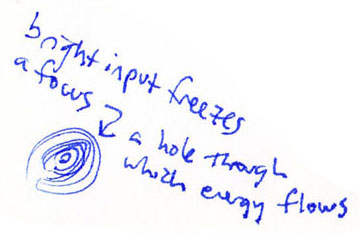
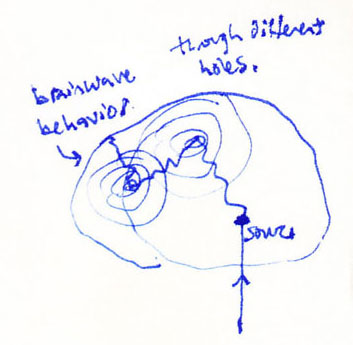
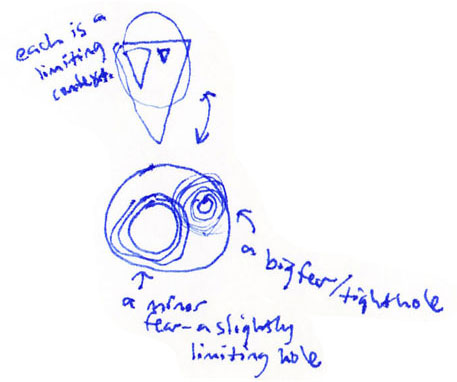
Details: The top image is a brain with spotlights from specific searches shining out. The second picture is a cross-section of the brain showing the holographic circles of each Specific Search.
The light shines through when our projected search finds a match.
These holographic rings can sometimes also be contractions of energy. Our energy contracts around a need. The stronger the need, the tighter the contraction, the more our experience is limited in searching for whatever satisfies the need.
Desires, Fears, and Expectations
Holographically, desires, fears, and expectations are the same — they all shine out to varying degrees from our past experience into our present. They all project into the attention field in the exact same way, if not to the same degree. They all filter out experience.
Desires and fears are expectations amplified by emotional charges, while expectations are often neutral. Together they form a position from which we try to safely and effectively navigate the unknown future. Expectations set the stage as our ability to understand our world and predict what is coming. Within this context, we seek after our desires while trying to avoid our fears.
Our memories shine their needs and their understanding on the main sensory “screen” of the brain, looking for significant things that we desire or fear. These specific searches contribute to the overall context of our experience.
The totality of our specific searches is a large part of our “mental state”, selectively intensified by our current context. In the absence of sensory context they can be activated by expectation or brought into being in the dream state.
For more, see Mental State.
Attracting Attention
The focal points that are lit up with residual attention in our mind act as Specific Search projectors trying to reattract our energy. They are energy trapped in conditions, trapped in the past, looking for release. Each is a viewpoint. The classic arcade game Tempest has some similar elements — the crawler around the edge being the point of view shining on the center, the scene before you.
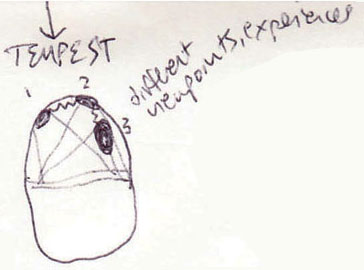
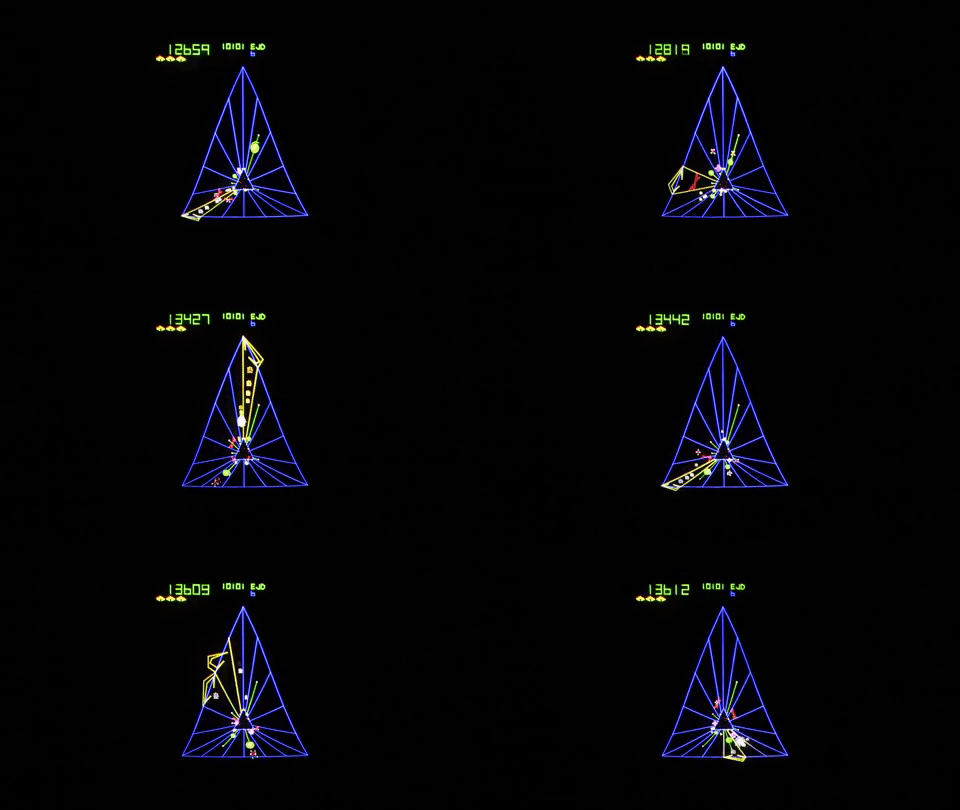
that project their search out onto the visual field.
Search Intensity and Context
The strength of any Specific Search is equal to a) its importance and b) likelihood of finding it. If you are vaguely in the mood for doughnuts and you happen upon a bakery, then the doughnut search will be powered up! Now if you don’t find doughnuts there, your suddenly-intensified search for something sweet might just be satisfied with something similar; a more general match.
Many desires and fears sleep until a certain context brings them into focus. We may not usually be scared of bears, but if we’re alone in the deep woods and hear a growl, that fear will jump to the forefront.
These energy structures fade slowly over time through the regenerating aspects of sleep, though they may also be continually reinforced by our attention or situational context.
Desperation Increases Possibilities
Desperation comes from an incredibly strong need. It increases possible Specific Search matches. When you’re looking desperately for a lost dog, and a cat walks by in your peripheral vision, you’ll turn to look, for it matches in a general way. The greater your need to find something, the more general the input needs to be to set off the recognition trigger.
The Trouble with Specific Search
It Blocks Our Light
Anytime we focus internally on something from the past, whether to find it, avoid it, or simply think about it, we are withdrawing our attention from our present experience. Our attention is the source of the light, the Pure Essence, the flow from the Source.
To the extent that we are focused on any search, sensory input is disregarded unless it matches the object of the search. While looking for one thing, you are actually missing everything else. The more we want to see something, the less we actually see in order to find it.
When we find what a Specific Search is looking for, that thing lights up in our attention. This supports the idea that it contains the light. We begin to believe that the light is only found through these things. But that light will never be as bright or complete as the light it blocked out to create the search condition.
Put another way, specific searches are in themselves conditions for happiness. We pull our attention from the natural light and beauty of life to find what we search for — the condition that will release the light back to us.
All it takes is for us to entertain a belief that we need to be or have something for it to prove you right.
The Pure Essence is always there, within us. But if we were to try looking for it, we wouldn’t find it. Our very act of searching for it would obscure it! By simply relaxing and not searching for anything, we find it again.
The great lesson is that every time you come to believe in a condition for happiness, that condition in itself prevents your happiness. The simple fact of believing it means you’re looking for something, and the effect of that is a reduction in the experience of the light that is the source of happiness. This is a holographic truth. Every desire or fear ties up a little part of ourselves in a condition, making it unavailable to light up our experience. The more conditions we believe in, the less happy we can be — even if we fulfill all those conditions.
Conditions displace happiness. Where once the light of consciousness was shining out through all things, it now seemingly lies within conditions. Our beliefs gather our happiness up and throw it out from us, and we have to chase it down to get it back.
Great needs make for very restrictive filters, whereas if our needs are few, we are carefree and happy, since little in our experience is filtered out.
Specific searches constantly pull from our attention, looking for their release conditions; the context where their energy can be released.
The ever-searching eye of Sauron in The Lord of the Rings feels so evil because it is constantly searching, searching. Since searching blocks out light, the eye is in darkness, single-mindedly obsessed with finding the ring. It represents desperation, unhappiness.

“As long as you seek for something, you will get the shadow of reality and not reality itself.” — Shunryu Suzuki Qwisdom • various
Our searching casts shadows that obscure the Pure Essence. It gets filtered out with everything else that doesn’t match.
Confirmation Bias
How Specific Searches Reinforce Themselves
Our projections (desires, fears, and expectations) affect our experience of the outside world. This filtering causes us to see only evidence for what we are looking for. Things that don’t match will be ignored and attention will be drawn only to what matches.
Each fear is projecting out from the painful situation that created it, looking for signs of that situation in your present context. We literally project what we fear into the world to see if there are matches. Obviously, this affects our experience of the world.
When we look out at the world through a fear, we are searching for the conditions that originally created it, and so we find similarities in our present environment. We make attributions based on the fear’s original context. For example, that sound could have been anything, but since we’re focused on monsters, we think it must have been a monster.
For example, the fear-based belief that the world is filled with crazy people will call attention to anyone who seems out-of-the-ordinary. You will see a far greater number of people who will scare you, reinforcing the belief. You may mistake anyone acting silly as an insane person. In addition, this fear filters out all the known people in your life.
In psychology, this is called confirmation bias. This is the well-known tendency to see and accept only information that confirms our beliefs. This is the natural holographic result of Specific Search. That which matches what you seek lights up in your attention. The rest is filtered out.
In this way, desires and fears tend to feed themselves and grow stronger. They strengthen themselves, reinforced by the only things they can see in our filtered experience.
Projection into Unknowns
Imagine we see someone that may be a threat. Fear focuses on any possible threatening behavior. If it finds something (or imagines it finds something), we may choose to avoid or escape the object of fear by leaving the situation. To the degree that sensory awareness is discontinued (leaving the scene, closing our eyes, distracting ourselves), we allows ourselves to experience only the fear’s projections, allowing it to fill in the context with what we most fear. This further strengthens them.
In fact, anything that we can’t know — what someone is thinking, what their motivation is, what they did before we saw them, what they plan to do next — are filled in by our projections. To the extent that a fear has our attention, we’re reliving it, bringing that experience with us into the now.
Unless we face the object of fear and see it truly, these beliefs will only strengthen.
For how this works in terms of thought forms, see The Influence From and Growth of Thoughts.
We Find What We Seek
If there is one massive truth about consciousness we can extract from all of this, it is the following:
We tend to find what we’re looking for — except when we’re looking for nothing. That’s when we find happiness.
Optimism and pessimism will both prove themselves out. We are one big self-fulfilling prophecy. The sooner we realize that, the happier we’ll be.
Overcoming Confirmation Bias
Confirmation bias can be overcome through critical thinking and the principles of the scientific method. It takes fresh attention on evidence to change a belief.
We can also use confirmation bias to our advantage. We can begin to focus on a positive belief that counters a negative one we hold. Confirmation bias will then cause us to find evidence for the positive.
The Conditioning of the Soul
The Descent into Conditions
The Unconditional Life
The soul knows no fear.
In our natural state, life is a joy. The world is full of light, and we are happy, curious, and full of energy. We openly and joyfully experience the world.
Rumi: “You are the unconditioned spirit trapped in conditions, the sun in eclipse.” (Chopra 283)ABTMresearcher • modern • Chopra
This sun in eclipse is a perfect metaphor for how our conditions, our past experiences and specific searches block the light of our attention in the now.
Physical Conditions for Happiness
Our soul, come to inhabit a body and experience the physical world, brings no conditions on its happiness. But the physical body is another matter.
The physical body’s need for food, water, warmth, sleep, and health trains us from birth that happiness relies upon the satisfaction of conditions. Life becomes less pleasurable and fulfilling as we get more hungry, tired, or cold. The physical body draws focus to these needs automatically as they arise. It communicates them to us through discomfort or pain, which pulls at our attention until we satisfy these conditions. The physical body conditions the soul.
As babies, we are introduced to separation, hunger, and cold. But we slowly learn what we need to do to satisfy those needs. These needs then trigger our learned specific searches to satisfy them. When our experience is dimmed from pain and discomfort, we know what to do. We seek out what we need. Once satisfied, the pain and discomfort recede, we feel pleasure, and our attention is freed up. Returning our happiness is the body’s reward for fulfilling its conditions. As long as we do so, the body allows us to be happy. This is basic behavioral training our body does.
These conditions are important for maintaining a healthy physical body, and before long we accept these as natural conditions for happiness. Life would be rather simple if we stopped there, but as social creatures, we extend that belief in conditions for happiness into more and more areas as we grow up.
Much of the early weeks of existence as a human are taken up with conscious and frustrating efforts to obtain control of this new physical body. Simultaneously, it is overwhelmed by astounding demands for nourishment—a process that was an automatic function in previous existence. Add to that a massive battery of strong and chaotic signals pouring in from sensory sources never before perceived. . . .
From this beginning emerges the primary learning system that continues throughout human life. It is the focusing of conscious awareness. Pain or pleasure, as reported by the five physical senses, turns attention to the event being experienced, and such experience is then learned and stored. Further, if the element of emotion is involved, the storage process is enhanced greatly. . . . The depth of learning is in direct relation to the intensity of the experience. (Monroe 249-250)FJOBEr • modern • Monroe
During this time, our attention is pulled repeatedly to these strange new needs. In this way, the body forces its needs on the incarnating soul, harnessing and redirecting it towards those purposes. Fear based on physical pain is introduced, as are desires based on physical pleasure.
Relationship Between the Body and Soul
The body is a “soul catcher”.
I had to pee. My mental space fills with repeating patterns, creating a webwork to influence me, the thought “I need to pee” fills the space recursively — a holographic projection, a Specific Search.
The body’s needs can block the higher experiences, like a fractal umbrella opening.
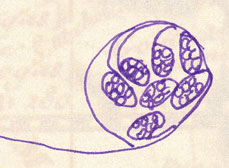
As the need releases, it fades out, allowing the mental space back to you. There is a give and take with the physical body. An agreement. “You may drive, but you must fulfill our needs.”
This is the symbiosis between the body and soul. The soul is meant to provide guidance from a higher level. The soul is the body’s navigator through probable realities, able to send out and receive information across time via those higher dimensions to avoid tragedy or seize opportunity through intuition. In return the body provides sensation and experience and a place in this beautiful world.
The body demands attention as the needs grow. When these needs are all met, the soul is freed up to experience and enjoy life.
Social Conditions for Happiness
Physical conditions are pretty straightforward, and we learn how to satisfy them early in life. But we aren’t just physical creatures — we’re social creatures as well.
We have the need for friends, for relationships, for a place in society. We’re already used to thinking in terms of conditions for happiness. As we grow, we discover what is expected of us by others, what conditions we must fulfill to be accepted by our family and friends. Now instead of being conditioned by our body, we’re being conditioned by other people. We encounter all kinds of varying beliefs about what is acceptable and what isn’t. Family, friends, and culture define a spiraling array of arbitrary and complex new conditions. Some of these beliefs are contrary to others. These conditions can be literally anything — looking and acting a certain way, believing certain things, participating in certain events and traditions, liking or disliking certain things, treating certain groups of people a certain way, associating with certain people and not others.
We learn that joy and love can only be felt and expressed under certain conditions. We learn which qualities are valued and which are not. We learn which behaviors deserve which treatments. We can’t be too loud, too weak, too wild, too different. We learn that certain conditions only apply to certain people. We see conditions all around us. We see the people who fail to satisfy these conditions rejected or punished.
Now in order to get back to that original state of happiness we came from, we need to satisfy not only the physical conditions, but all the social conditions we’ve witnessed and come to believe in.
Social conditions are specific searches as well. When one’s acceptable appearance and behavior are constrained, we must always be watching ourselves and others. Behind each condition is a fear that it won’t be satisfied. Fear, our survival instinct, gets triggered more and more by social conditions.
This social conditioning becomes the source of much of our unhappiness. These additional needs are internalized, and become ongoing problems for us; unnecessary conditions that limit us and block our happiness. In time these conditions can become ever-present and all-consuming, stripping all joy and pleasure from our life.
Social Conditions
Social conditions attempt to modify and standardize behavior. We find that we cannot be left to our natural joy without also fulfilling these conditions. When we fulfill conditions for happiness, we are considered worthy of happiness. When we fail to fulfill conditions for happiness, we are considered unworthy.
Satisfying Others’ Conditions
We grow up in a social world centered around our parents, siblings, and extended family. This gradually expands to friends, teachers, love interests, and so on. We learn what is acceptable and what isn’t from them. We learn that each person may have their own variations in what they think is acceptable. We begin to track these rules of behavior internally. How we might behave with friends might not be acceptable with our parents. So we regularly ask “what would so-and-so think?” This becomes a very important concern as we grow up.
Surrogate Selves
I was a very empathic kid. I had trouble with empathy. I’d empathize with the viewpoints of people close to me, and I’d see things through their perspectives. I’d see things through so many other people’s perspective that I began to feel that it was interfering with the development of my own independent self. In my teens, I began a huge effort to throw off the viewpoints of others in order to find my own. All these other “selves” in me I referred to as “surrogate selves”.
Surrogate selves are the people whose perspective we see ourselves from. They are perspectives which we check everything we say and do against. It is always a bad thing. Most surrogates are judgmental. They are a constant influence on our thoughts and actions. They are people we want to impress or people we are afraid of. Often it is an overly critical parent, but it can be anyone.
The effect is similar to constant surveillance. It’s a constantly intrusive perspective in your mind, one by which every experience must be checked. It makes people unhappy at a very deep level because it keeps us internally focused, out of the now.
Projecting Beliefs in Social Conditions
When we believe in a certain condition for happiness, we assume it to be universal and imagine it existing in the minds of everyone we come across. We judge everyone and act as if everyone out there is judging us by the same standards. If we judge the world harshly, it is because we see it as judging us the same way. Yet the person these beliefs affect the most is the person holding the beliefs. If we believe that being wrong is a universal condition for rejection, who do we reject most often and most harshly for being wrong but ourselves?
Whenever we judge other people, we are strengthening the belief in a rule that also applies to ourselves. We live under that weight. We know firsthand that these conditions for happiness are real! The only safe side of that belief to be on is the judging side.

When someone puts us down, know that they are themselves suffering from a belief in the same condition. The ridicule they are directing at us is also constantly directed at themselves, limiting their own behavior.
Conforming to (Agreeing With) Conditions
When we are rejected due to some condition, the most common reaction is to seek to satisfy that condition. We change our behavior, or we answer questions according to what it is the other person wants to hear. We are then accepted. By conforming, we are showing our agreement with the belief in that condition. If you let me treat you badly for failing to conform, for example, then we have an agreement on conditions. We understand that you would treat me just as badly if our situations were reversed. We both believe it’s justified.
When we satisfy a condition, the energy in that condition is released back to us. We feel excited and we allow ourselves to focus in the now (not realizing we could have done that all along!). This often functions to reinforce the condition as we think “Look! I knew this would make me happy!”. But that release is a shadow of the light available to you, and only continues so long as the condition remains fulfilled. It may temporarily allow happiness, but you remain chained to maintaining the condition.
What the conditions are doesn’t matter. It can be and often is completely arbitrary. Changing styles, opinions, ways of talking, looking, behaving, appreciation of certain things and rejection of others.
Conformity is the natural result of social conditions. Social conditions always separate, create subgroups that are perceived as lesser due to their differences. Many of those in power worship themselves due to their own success and thus anyone who acts, looks, and thinks just like them is accepted into their group. Those who conform are seen as people just like them in need of praise.
Conformity
Taken all together, the common social conditions for happiness form a broad picture of what a successful person looks like and acts like. This is the image that most conditioned people try to conform to. If you look and act successful, then you’ll be rewarded with social acceptance, job promotions, and opportunities. There is a very thin range of variation allowed within the strict confines of “successful.”
Those that succeed by conforming are unfortunate in that they are prone to happily support and encourage these conditions, as their success sets them apart from and above others. It is harder to reject a belief when it appears to benefit you.
Spreading Social Conditions
When we conform to conditions, we spread belief in the conditions. Through our behavior, we are all teaching each other what conditions we believe in. This is how beliefs in conditions for happiness are spread from person to person. It’s like a behavioral virus.
Competition
We are taught that not everyone can be worthy. In schools, only a few get awards. In games and sports, only one player or team can win. Only certain people get love and admiration. So we learn to see our peers as obstacles and seek to outwit and outdo each other.
This competition can be a part of many social conditions. In most sports, the person or team in first place gets all the attention and everyone else gets none. We look for faults in others to make ourselves look better. Instead of working together, we’d rather compete. Since appearances matter most, cheating can feel justified as a means to an ends.
Conditions We Can’t Conform To
Often, there are conditions that you cannot conform to such as age, race, gender, nationality, and sexual orientation. There are also behavioral conditions we can’t possibly conform to, such as never making mistakes, never being wrong, and never expressing ourselves. When we are rejected due to any of these conditions, we find ourselves unable to change, and if we accept the condition as valid, we may hate ourselves for being what we are.
That, or we can reject the condition itself.
Defying (Disagreeing With) Conditions
Being rejected can be the first step down a path to greater happiness.
When we are rejected due to some condition, the best response is reject the condition itself. If we see the way we’re treated as not justified, then we refuse to accept the treatment we receive. We stand proud, embrace the state of being that brought rejection from some group, and band together with others that are like us. We may even exaggerate our differences. These subcultures of misfits and outcasts include punks, goths, and alternative subcultures. We are trying to prove to the world that love and companionship can exist under conditions which some groups reject.
My girlfriend and I were walking along the road at a festival in rural north Georgia. A car drove by and someone leaned out and shouted “FREAK!” at us. We both burst out laughing. We’d accepted long ago that we were different and embraced our differences.
This defiance is also a message that spreads like a behavioral virus. Witnessing a rejection of the condition, people may begin to question their own support of that condition. In time social conditions can be reversed, though some will continue cling to their own conformity to that condition to bolster their embattled self esteem.
Ending Bigotry
This is why fighting against racism and sexism by putting down the people believing in it backfires. Under the weight of even more rejection, they cling even harder to their inherent fulfilled conditions, the right to happiness that they earned through conforming. The solution, instead, is to make them feel worthy of happiness so that they don’t need to believe that racial or gender-based conditions (for example) are what make them worthy. These are people who have been submitted to strong and repeated rejection in their lives. The racism and sexism is in fact an attempt to reacquire their own feelings of worth.
Enforcing Social Conditions
We can’t have conditions for happiness without enforcing them. Otherwise people would stop believing in those conditions and they would no longer make us superior. Anyone could be happy at any time! People don’t want to let go of anything that makes them feel superior.
Social conditions cause us to separate people into groups according to how well they conform, and thus how worthy of acceptance and happiness they are. We learn to treat each group differently in order to enforce the conditions we accept.
Enforcing Conditions in Others
In order to make a condition for happiness true, people need to enforce it. In the case of someone we “care about”, who we want to succeed within those conditions, this is done my behavior manipulation. Think of a parent teaching their children how to behave to succeed. This is usually done through reward and punishment. In the case of someone we don’t care about, it’s done simply through causing pain and rejection when they fail.
People may try to impose their fears on others in order to protect them. Often, one believes it is within reason to manipulate others to get them to fear what they should be fearing — for their own safety. But when it comes to spreading social conditioning, we are always doing others a disservice — we are protecting them from a monster we are helping to create.
Those who have worked so hard to satisfy conditions, to be worthy, do not want to allow someone who is unworthy to be happy. Especially when they themselves are worthy but not happy. They take it upon themselves to cause pain to those who should be feeling pain and encourage happiness in those who should be happy. Since conforming to social conditions isn’t actually required for happiness, people must enforce it for it to work.
Manipulating Those We Care About
Reward — Positive Reinforcement
First one needs to reward success in satisfying the condition. They say, “If you fulfill this condition, not only will I let you be happy, but I’ll be friendly, give you affection. I’ll let you be part of this group. I’ll give you gifts.”
Where the conditioning succeeds, we feel rewarded, yet manipulated. Where it fails, we feel open resentment for kindness or a reward that was withheld.
Rejection — Negative Reinforcement
Secondly, one needs to punish failure to satisfy the condition. It begins with judgment and rejection. This could be rude words and closing that person off in various ways, like removing affectionate contact.
If rejection alone doesn’t work, then one may turn to active punishment and the infliction of pain. One will take away what we love, hurt us — whatever it takes to get us to satisfy the conditions that will allow them to accept us.
Negative reinforcement leads to a relationship based on fear. Where the conditioning succeeds, we will bitterly conform to the conditions. Where it fails, we have open confrontation. In either case, we end up with a negative, controlling relationship, or no relationship at all.
Conditional Love
What this amounts to is conditional love. We are using our love and acceptance as reward and punishment so that they satisfy certain conditions. This isn’t love at all, but manipulation.
Conditional love teaches that we only deserve love and happiness under certain conditions. Conditional love is always manipulative, even if the one manipulating believes it’s in our best interest.
Justified Cruelty to Those We Don’t Care About
Social conditions say that people are justified in treating the unworthy badly. If we hurt someone as much as we believe they deserve to be hurt, then we feel right and justified. After all, unworthy people should not be allowed to be happy. We’re merely putting them in their place. It’s akin to proving certain food is dirty by throwing dirt onto it. People may inflict pain so that “bad” pleasure seems less worth it.
This is why we often see the most cruel actions coming from people who consider themselves the most good. They are merely enforcing the conditions that put them up on the pedestal. We see Superman beating the tar out of a bad guy and we cheer him on. “Yay! Kick him harder! Break his legs! He deserves it!”
Enforcing Conditions in Ourselves
We internalize conditions we agree with. We become our own watchdogs and torturers, freeing others of the burden. We learn the lesson that if we don’t feel bad on your own, others will make us feel bad. Our fear of being rejected by others causes us to constantly watch ourselves for signs of failing conditions.
More important than what we get in life is what we accept. We only accept what we think we deserve. All it takes to enforce conditions for happiness in ourselves is to focus on the condition that we’ve failed to meet. That simple focus takes us out of the moment, and filters our experience only to things that affirm that thought. That’s the holographic result of any focus on the past — finding matches in the present. We push happiness away out of fear. We alone can deny ourselves the pure unconditional love and happiness that is part of our own being, for it is available at every moment to everybody. We suffer at our own hands, until we stop focusing on it.
We accept what we feel we deserve by being present for it, to empower it with the agreement of our attention — whether what we feel we deserve is good or not.
The Trouble with Conditioning
With social conditioning, our natural goal of happiness is displaced by a goal of acceptance. Since our happiness is now determined by arbitrary social conditions, we can be easily manipulated.
More Desires, More Fears
Social conditions lead to a spiraling network of desires and fears.
Our simple desire for social acceptance and fear of rejection can be twisted by social conditions into virtually anything. No matter what form they take, the additional fears from social conditions become constant drains on our attention. as we attempt to find ways to conform to them. Simply feeling the need to compete for acceptance drains our happiness.
We Get Acceptance, Not Happiness
What happens if we succeed in conforming to someone else’s conditions? We are accepted. We should feel pride. We should feel worthy. We now feel that we deserve to be happy. However, feeling worthy of happiness is completely different from feeling happy. When that happiness doesn’t come, we begin to wonder if something is wrong with us. We did everything we were told to do and expected of us, so we should be happy. We begin to demand things of people, for they owe us. We aren’t thankful or kind. We don’t need to be. We deserve this. We’re entitled. We deserve respect.
One person cannot give happiness to another. One can give money, favors, affection, or acceptance, but it won’t ensure happiness. Being worthy isn’t being happy. When we are finally the worthy person we want to be, we find ourselves filled with an egotistical pride that makes us feel superior. Not happy.
Those who achieve success in life are often surprised that it didn’t bring happiness. When alone in the quiet, they still feel the fear associated with maintaining all the conditions for happiness. Many conclude that they just haven’t succeeded enough yet, that they don’t have enough money or success, and go out seeking more. In this false safety of satisfied conditions, they still cannot connect with the Pure Essence. Their own success is a prison they’ve built for themselves, because they still believe in these conditions. In fact, they believe in them more than most.
These conditions, reinforced by their constant striving to fulfill them, have grown to titanic sizes in their minds. They utterly eclipse the experience of the moment, driving their host onward toward greater heights of money and power that will only take them further from happiness.
These social conditions are specific searches, of course, and our focus on them allows only the shadow of the Pure Essence into our experience, no matter how well we satisfy them. To the degree that we accept social conditions for happiness, our light is eclipsed. We are not living.
Conditions Separate and Limit Us
Social conditions make it hard to see anyone else as an equal. In fact, that is their point. They cause us to draw lines that separate us from others based on how well they satisfy the conditions we accept. The separations are for the purpose of feeling superior over others. Those on the wrong side of the line are rejected, and may even be the subject of hatred and violence.
Rejection of any person, quality, or behavior creates a separation from our greater self, and adds to the things we’re not allowed to be.
Atun-Re: “What is God? God is the interlinking of yourself with the whole. It is from the whole that the inner light comes. So, if you are derogatory toward any of your brothers or sisters, then you are derogatory toward yourself, and that light grows dim, for you have disinherited a small portion of yourself. . . . The light grows dim if you do not acknowledge yourself, for you are also a part of the whole, are you not?” (Ryerson and Harolde 106-107)SCchanneled • modern • Ryerson & Harolde
This is a literal truth. Our inner light grows as we move up the stream towards greater generality, towards greater union of consciousness. The more we shut out, the less bright our light is.
Separation from God and from each other is the cause of all your dysfunction and suffering. Still, separation continues to masquerade as strength. . . .
This lie is the genesis of all wars and all the class struggles that lead to war; of all animosity between races and genders, and all the power struggles that lead to animosity. . . .
Act as if you were separate from nothing, and no one, and you will heal your world tomorrow.
This is the greatest secret of all time. . . .
Understand that it is about power with, not power over. (Walsch 43-44)CWG3channeled • modern • Walsch
Social evolution is demonstrated by movement towards unity, not separatism. (Walsch 260)CWG3channeled • modern • Walsch
Conditions Cause Fear and Insecurity
Social conditions give us reasons to suppress joy, to reject love. Fulfilled or not, they stand in the way of our happiness. Each condition is thus another reason to fear. Only by careful navigation and constant vigilance can we hope to keep all conditions satisfied. Change can upset our careful balance, and thus change causes fear.
Insecurity is the inevitable destination of social conditioning. The more conditions, and the more harsh those conditions, the more insecure we will be. Insecurity is a fear of not being accepted — of not being worthy of love.
Insecurity happens whether or not we are successful in achieving our accepted conditions. Even when we have fulfilled all our conditions, we ever fear falling from our unsteady precipice.
Conditions Lead to Deception
When trying to satisfy the conditions of another person or group, the true goal is to please them, not necessarily to satisfy the condition. We learn to present appearances as fulfilled conditions. Deception becomes a part of the toolkit of the person undergoing conditioning.
Not only that, but we will stop fulfilling or appearing to fulfill the condition if we think we can get away with it, such as when the conditioner is absent. At these times, the suppressed desires will run rampant, with all the strength built up over the period of time that it was forcibly restrained.
The purposes of conditioning and controlling are always contrary to the truth.
Denial and Excuses
When we believe in social conditions for our happiness, we may use various forms of self-deception to preserve our self-worth. We may engage in denial or manipulate our own reasoning and perceptions.
Let’s say that we believe that being the best is a condition for happiness. When defeated in a game or sport, we may make excuses or choose to believe that others cheated in order to preserve our self-worth. We allow ourselves to believe these falsehoods. Or if we think we might lose, we might cheat because winning is the only thing that matters.
A bad experience with another person can also be repressed through attribution: “it must have been a joke”, “it was an accident” or “he didn’t mean it”. That makes it acceptable, and we don’t have to change anything.
At subconscious levels we know the truth, so we keep that knowing away through distractions.
Denial is in no sense necessary. It has a tendency always to plunge one further into illusion because the denial keeps the mind fixed upon the condition and it is thereby more likely to intensify that condition. (Spalding 78)MotFE4wisdom • Spalding
We must accept what happened. We must dissipate the emotional charge from it through understanding and acceptance. In that way we can look at it passively, without intensifying it with further attention.
Fear of Being Wrong
A belief that worth comes from intelligence leads to a fear of being wrong. Someone believing this condition tries hard to appear knowledgeable. They would rather make something up than not know. Any evidence that they are wrong is a threat, and causes anger and defensiveness. Being wrong in an argument means that they are weak or lesser, and they will not apologize or back down to someone they see as lower than them. Rational arguments and evidence matters little, because rationality isn’t the goal; acceptance is. They generally look to reinforce what they believe, which is quite an easy task thanks to the filtering power of the holographic mind.
This fear also prevents people from asking questions, for then they may appear less intelligent. This limits their ability to expand their own knowledge.
If we are only concerned with the truth, then we have no fear of being wrong. If we are wrong, we are glad that we now know better and make an adjustment in what we believe.
Other conditions lead to fear of losing, fear of being weak, or guilt for things that cannot be changed.
Conditions Limit Self Expression
Social conditions are primarily responsible for our fear of expression. How and what we express becomes based on where we are and what we feel safe to express.
Fears can block expression. They are contexts that we run our desired expression through to see if it is safe. We are more careful when we are lower on energy (maladaptive), checking our potential expression through more fear filters. Fear says “someone could be listening, someone could find out.” When fear is in command, we have to feel really safe in order to express ourselves.
Fear is ANY holding back. There is no doubt about this. It withdraws energy from the interactive connection. Fear shuts off expression. “I can’t say what I really feel. . . . ” It looks for an escape, a change of subject, a reason to leave. I get distracted, go inside, turn off the channels of communication, don’t hear, don’t feel, go numb. Breathing grinds to a halt.
When on ecstasy (MDMA), I bypassed all these filters and my expression was instantaneous. I wasn’t scared by contexts that didn’t really exist. They aren’t real as long as we don’t give them attention. Without fear, I was speaking my voice naturally. I surprised myself by speaking before I’ve given myself permission to speak.
I’m so present that I’m talking naturally without consulting my filters, so filled with love that there’s nothing to hide. It’s harder to suppress a thing than to just go ahead and express it. There’s no room for fear. I talk with total freedom because why not? I’m completely open. Being here now means not once turning inside — no fear, distraction, shyness, or needs. I have no desires! Everything is perfect. I change and am motivated only by wanting to experience new things. I’m in it for fun — that is my sole, basic, commanding, primordial motivation. Curiosity and fun, seeking new experiences.
When connecting so freely and openly with someone, I’m experiencing lifetimes worth of truth and bonding in just 10 minutes.
Superiority and Inferiority
To the degree that we believe in social conditions, we end up with a superiority/inferiority complex. I observed as a teen that people who feel and act superior invariably have strong feelings of inferiority beneath it. And those who feel inferior often sooth themselves with the thought that they are better in important ways than those who reject them.
At the heart of this is one thing:
Social conditioning grants the illusion of self-worth for a reason.
No matter how worthy one feels, it can be taken away by changing circumstances, and so one has to always be on guard. Everyday happiness disappears entirely into a concern with conditions which shifts and changes from day to day.
Narcissism
Belief in social conditions can lead to narcissism at the top and bottom of the spectrum.
Those who succeed in conforming to social conditions consider themselves “worthy” of happiness. Their behavior fits the model of grandiose narcissism, often characterized as “entitled self-importance”. Their core traits are “selfishness, entitlement, lack of empathy, and devaluation of others”. (Wikipedia)
Those who fail may end up considering themselves “unworthy” of happiness. Their behavior fits the model of “vulnerable narcissism”, characterized by “negative emotionality, social avoidance, passivity and marked proneness to rage”. (Wikipedia).
The Worthy
We all want to be worthy of happiness. In truth, we all are. Entirely. Right now, this very moment.
Unfortunately, if we believe in social conditions, our worth must be strengthened by the unworthiness of others. One of the worst parts of conditions for happiness is the monsters people become when they are deemed worthy.
Worthy and Entitled
Those who have succeeded in satisfying their social conditions feel they deserve happiness. They feel entitled to it. But since satisfying conditions doesn’t bring happiness, they have to figure out how to take it. They ignore anyone who is considered less than them (as long as they aren’t threatening their worth). If they don’t get their way, they can become loud, threatening, and violent, tactics which usually have a good deal of success with those who are insecure. They require “respect” from (control over) those around them.
The focus of the worthy and entitled is almost entirely on themselves, as they’ve achieved their ideals. Their attention remains focused on the conditions and the division that they are now on the “correct” side of. So they remain ever inwardly-focused, missing out entirely on the actual happiness available in the moment.
Fairness Relative to Worth
When someone with a big ego is wronged, then his idea of justice is not an eye for an eye, it is two eyes and a leg for an eye. The comparatively worthless person who hurt him will suffer according to his worth. With conditions, it is always that way; happiness according to worth, and pain according to lack of worth. Of course, if the one receiving this outsized “justice” has a big ego, then the battle escalates rapidly.
Those who believe they are perfect see any differences from them as a failure. Anything that challenges them or their status must be dealt with strongly. These “perfect” people are the ones who do almost all of the terrible things in the world. They have no issues destroying that which is different and therefore inferior.
The Unworthy, Insecure
Those who have failed to satisfy social conditions similarly tend to be focused largely on themselves. But in this case the focus is negative, centered on figuring out how to satisfy their failed conditions.
This leads to an intensification of insecurity and its resulting feelings and behaviors.
Importantly, these all exist just below the surface in those who consider themselves worthy, but the worthy are too busy focusing on their success, so long as it lasts. When the balance tips, they will likely find themselves in the same situation.
External Authorities
When insecure, we are even more prone to accept others as the authority on how we should be treated, since we are that much more desperate for acceptance. We treat ourselves in the same manner as those we respect treat us. We cherish those who give us acceptance and seek to appease those who are angry at us.
Situation-Dependent Behavior
The different sets of limits on our behavior for different people and situations cause us to question what will be acceptable in any circumstance by any number of people there. We are constantly adjusting ourselves. We wish to keep a perfect appearance of satisfied conditions. Insecurity causes us to become fake — every word forced, every emotion an act.
We feel watched by a thousand eyes. The more we are watched, the more limited our behavior must be. We may disengage from others socially and keep to ourselves.
There are endless lists of things we shouldn’t say or do, lists of ways to behave in the presence of lists of different kinds of people, and emotions to edit and adjust so as to seem happy about it all. This leads to a fractured, situation-dependent self.
Internal Conflict
To the extent that we’ve internalized these conditions, our self is divided against itself. We condemn the unworthy parts of ourselves, get mad at ourselves, punish ourselves. With the uncertainty and confusion of dozens of viewpoints filling our minds (some of which can’t stand us), there is endless self-doubt. We question ourselves with the same intensity that others have. Our true emotions are often in conflict with what is expected of us.
Rejecting Parts of Ourselves
Some social conditions cannot be conformed to, such as those involving race, physical attributes, gender, or sexual orientation. This may lead us to reject parts of ourselves. Due to the way attention works, this self-rejection only serves to focus attention on these parts.
During our life, we wall off experiences that we wish to forget. We do this so effectively that we do not remember many of them. We begin this walling-off process early in childhood and continue it throughout our life. These walled-off pieces of our consciousness can be seen in the auric field in terms of blocks. (Brennan 69)
The wall you built up between the greater integrated you and a part of yourself . . . serves to hold back a portion of yourself that you do not want to enter into your experience of the moment. (Brennan 134)HoLclairvoyant • modern • Brennan
That energy remains trapped within, remaining out of the flow of light and attention.
Loss of Self
When insecure, we base our decisions not on our own desires and needs, but on the desires and needs of others. These conditions dominate and subjugate our own needs and desires. This creates two separate and conflicting identities; that which we actually are and that which we want to be so that we can be accepted.
Dealing With Failed Conditions
Many are left in a position of failing some conditions, but don’t feel strong enough to defy the conditions entirely. How do we cope?
Trickle-Down Cruelty
When being rejected or punished for failing a condition, our self esteem takes a hit. It’s not uncommon at this point to attempt to make ourselves feel better by gloating over others who we think are less worthy than ourselves. This doesn’t make us any happier, but it does provide a temporary burst of superiority and this redirects attention away from our own failure. Unfortunately, by doing so we are not only hurting another, but are reaffirming our belief in a condition that we don’t meet.
An example of this is the child who is a victim of physical violence at home. His Wadsworth beats him, calling him weak. He can’t lash out at the actual source of his anger — his Wadsworth is too strong and could take away everything — so he looks for another outlet. He finds a smaller, weaker kid in the playground and bullies him. In this way he can feel like the stronger one.
Projecting Failed Conditions
A more extreme response may be to disassociate the rejected parts of ourselves by projecting them into others. Then we are free to be the righteous, good self and fight against that failure. In this way we can move into the perceived positive side of the condition. We get to become the victor for a time, rather than the victim. This is also a strong affirmation of the condition we believe in.
This leads to situations we see again and again in society. Some people become extremely vocal in their attacks on perceived negative qualities. We see the moral crusaders, and in almost every case, they’re deeply haunted by those very qualities in themselves. It’s as if they are shouting a call for help: “Please someone, stop me! With enough social pressure against my own unacceptable desires, maybe I can stop myself!”
It’s practically a cliché that the anti-gay crusader is engaging in gay experiences behind closed doors. Being so oppressed by failing his own believed condition of happiness, he has to jump the fence to the side where he feels like the righteous one and does so loudly. But as ever, it’s the belief itself that he needs to rethink.
The Scattering of Attention
This process of accepting and trying to satisfy social conditions for happiness is one of the primary stories of our lives.
We are born with a unified attention, focused in the now. Our focus on physical and social conditions divides and scatters our attention more and more. Each new condition weakens us. The more attention we have wrapped up in conforming to conditions, the less we are present in the now.
Mental State
Our entirety of our state of mind at any given time can be described as our mental state.
Our mental state is best represented by all the ways our focus of attention is pulled at any given time. It’s based on how our past experiences match up with our current situational context. In other words, it’s defined by how our desires, fears, expectations, and beliefs interact with the present moment. This determines our thoughts and feelings.
An example:
You are at a wedding, and your thoughts are as follows: “I should be at work. I shouldn’t have gotten married when I did. I miss Lance. I am hungry. I hope no one asks me to dance. I hope Bodhi likes my new haircut.” To others, you will not seem present or happy.
This is your mental state. Does this sound like a happy person? No. Let’s look at why. There are a variety of different things going on here. First, there is an instance of regret: “I shouldn’t have gotten married when I did.” This is an energy drain that can’t be fixed, because it’s something you can’t change. Attention is drawn out of the moment into the regret.
Second, there are some aspects of need: “I am hungry” & “I miss Lance.” The first is a physical need, or perhaps a distraction to cope with feeling unhappy. The thoughts about Lance may have occurred by your comparing your interactions with people at the wedding with your interactions with Lance. This dulls your experience. These both filter present experience.
The statement “I should be at work” is an example of the return of a motivational conflict you had before coming to the wedding. Not enjoying yourself, you begin to regret your decision. Your presence here is contrary to that need. A focus on work takes you further out of the present experience.
“I hope Bodhi likes my new haircut” is an example of seeing importance in something beyond your control and will probably make you anxious.
“I hope no one asks me to dance” is examples of fear. They, too, comprise part of your mental state, and like the others, they take away from enjoyment of the present moment.
Motivational State and Decision Thresholds
Motivational logic is quite simple. It is like logic in circuitry. Conflicts are resolved by simply adding up all the relevant factors. For example:
• I am thirsty (+5 motivation to getting drink).
• But I’d be embarrassed getting up in class (-7 motivation to getting a drink)
• And someone’s giving a report (-3 motivation to getting a drink)
• But the doctor said I should drink more (+3 motivation)
• And now I’m REALLY thirsty (+6 motivation)
• You like to be sure of an action before you do it. Life is uncertain and you don’t want to take any chances. Your decision threshold is +5 at least.
Result: State of indecision. +4 total motivation isn’t enough to make an obvious and easy decision. When there are motivations towards doing mutually exclusive things like in the example above, then there is anxiety and a mental drain. The more conflicting motivations you have, the more unhappy you will become.
As you set your attention on this problem, you finally remembers the teacher saying “get a drink whenever you want if you’re thirsty” which adds +10 and makes it obvious and easy. Everything adds up, pushes over your decision threshold, and you go get a drink. Your confidence level is the same as the certainty of your action. In this case, an energy index of +14. Your thirst is satisfied and no longer distracts you. In addition, the inner conflict has been resolved, and the pleasure you feel at this is a result of the energy moving freely back into the system again. Your attention is freed to other things.
It is very simple and straightforward how this system works, but the factors involved can be difficult to realize and account for.
When you have lots of energy, it takes less motivation to decide to actually get up and do something. This is clear to me on LSD, when my high energy and focus in the now makes it feels like my body jumps up to follow any decision to move.
The human mind is in an ever-changing motivational state.
Desperation
Desperation is a motivation that has grown huge, and motivations, if large enough, will find a way to express themselves. The things holding back motivations become inadequate blocks. For example, you don’t believe theft is okay, but you believe your friend might be in imminent danger and you need money to get to him. If you see no other way to do it, the possibility of theft becomes feasible because it becomes much greater than the motivation not to. When desperate enough, the choice to steal will be easy. One will then look for loopholes in their belief systems to justify their actions.
Mental Load and Divided Attention
Our mental load is the amount of different conditions (desires, fears, and needs) affecting us. When we have a million things that we should be doing or a lot of behavioral rules to consider in every situation, we spend a lot of attention on seeking the conditions that will satisfy us and others. A high mental load equates to high stress.
We should seek to reduce our mental load as much as possible. This frees up our energy and leads to happiness. We are reunited with the power of our full, undivided attention, and the world looks new and filled with opportunity. Having reached the goal of being happy, our needs and motivations fade away.
Scattered and Distracted
We get stressed out anytime there are a lot of things pulling at our attention. Hard choices or conditions on our happiness scatter our attention and causes a shortage of energy.
A weak mind is a scattered mind, wandering from experience to experience, never able to hold onto any thought stream for long enough to accomplish its purpose. . . . Without transformation to one purpose, one meaning, one object, one cause, one use, life continues to be burdened by mutually contradictory thoughts, desires and actions. (MSI 207-208)
If life is divided, progress will always be sporadic and weak. (MSI 299)
If the mind is distracted, the eyes do not see, the ears do not hear. (MSI 225)Ewisdom • modern, Hindu • Isham
Being completely free from stress inside, they see only Beauty and Truth outside. (MSI 135)
The nervous system is freed from stress as consciousness expands; consciousness expands as the nervous system is freed from stress. (MSI 147)Ewisdom • modern, Hindu • Isham
Let’s take a closer look at individual moments in the division of consciousness. In the illustration below, 3/4 of our attention is on one thing while 1/4 is on another. The smaller focus gets a full moment of attention every fourth moment.
As our attention shifts, it registers moments attending to various things. For example, over a period of five minutes, our attention may be 60% on watching TV, 20% on texting, 10% overhearing a conversation in the next room, and 10% worrying about things you need to do later. A less distracted person may focus 80% of their attention on watching TV.
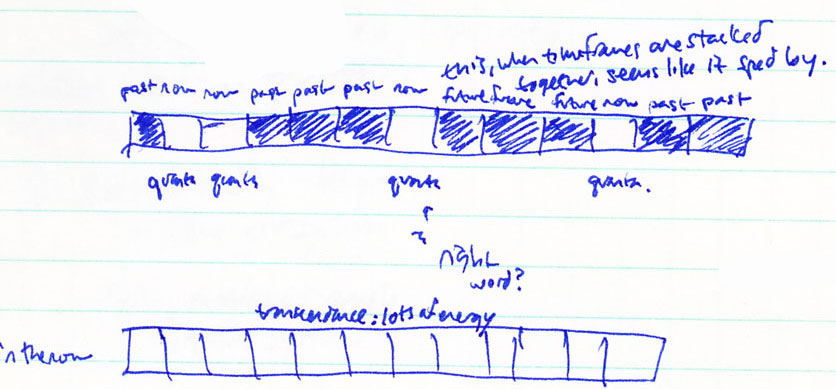
In the now. Transcendence: lots of energy.
Notice in the diagram above how focuses on the past or future are dark, representing internal focuses on the past. Focusing in the past does not bring in new light and energy from the now. Attention in the now, however, does, and an undistracted focus in the now brings transcendence.
Our emotionally charged past experiences are the cause of these distractions. They pull on our attention to varying degrees, depending on how much our current situation triggers them. Maybe our situation triggers a subtle fear, which takes 1/40 of our attention, and a slight hunger which is taking 1/30 of it. Each need is like a different projector speeding up and slowing down. Each pulling attention from and weakening our primary focus.
The specific searches of our needs and desires are literally different points of view — different angles of perception from which we see a situation. These filters/constrictions are stored at different points in the mind and project themselves into our experience.
Details: Angles change as one association recedes and another picks up
Adaptive vs Maladaptive
The number and intensity of things pulling at our attention determines our mental load. This load is essentially the background noise to our present experience, eating up our attention. We only have whatever attention is left available to us to focus in the moment.
This is a CENTRAL concept. Our available attention determines how present we are in the moment, and this in turn determines how happy we are.
This being the case, it should be clear how the endless distractions of social conditions robs us of happiness, whether we are able to conform to them or not.
Being Adaptive, in the Now
We are adaptive when our energy is free to flow into new experiences. This is our natural state, and it happens when we are not divided and distracted by fears, needs, or desires.
Adaptability is our ability to release the previous context when a new one arises. The ability to let go and accept something new. The ability to live in the now, in the moment. It appears as creativity and lightheartedness. This is determined by how much of our energy is free to move. To the degree that we are without attachments to the past, we are adaptive. With our energy freely available to us, we are present enough to overcome problems easily.
Adaptability is the difference between seeing something as funny vs stupid, beautifully unique vs flawed in comparison, interesting vs boring. The question is “do you have enough energy to flow into this new situation?”
Swirling energy adapts to any new situation — there’s never any pain. You learn to live with it, accept the loss.
When your energy is free, you adapt instantly to new situations and accept them. Any loss is filled instantly with swirling, flowing energy and it instead becomes a feeling of potential.
Being Maladaptive, in the Past
Being maladaptive means having difficulty in adapting to new situations. We become maladaptive when we have a high mental load — when we have little free mental energy because our energy is attending to desires and fears. We are tense, frustrated, drained, and don’t have the energy to deal with anything. We have little attention available in the now because it is all bound up in the past.
I’m writing after playing guitar and I haven’t fully switched over. My hand is crippled for writing, still being in the guitar position.
Neophobia — Fear of Anything New
Maladaptivity primarily appears as resistance to new situations. This is called neophobia. When one doesn’t have the energy to adapt to a new situation, fear rises because they can’t deal with it. Routine is a way of preserving stability, and so is embraced. One may stop liking new music and will go back to the music from the time when they last felt happy, when they were last present enough to feel the Pure Essence in it.
Once one has obtained acceptance through satisfaction of conditions, they’ll grip onto it. They become stagnant, and stop trying new things and taking risks. Anything new is seen as dangerous. Change can threaten and upset the delicate balance of satisfied conditions.
Neophobia is often visible in old age. Many old people cling to the old ole days and don’t take to anything very new. They become closed-minded and set in their beliefs. Their attention is so bogged down in the last that they can’t see the Pure Essence in anything new. That kind of happiness only existed in the past when they were younger and more adaptive.
Standards for Enjoyment
One may embrace their failure to enjoy most things as an indication of intelligence, discernment, experience, and stands proudly “above” the more gross or common pleasures, as only certain sources are worthy of making them happy. The unspoken assertion is “I have been through all the garbage that you presently enjoy. Soon you’ll see there’s nothing in it, too.” It’s a condescending viewpoint we so often see in those with a prideful ego.
Those who feel this way suffer a lack of enjoyment in life. Their unhappiness and distraction cause them to unconsciously cross-compare more and more, blocking the essence out of most new experiences. The very few things left that they enjoy becomes a symbol of their fine taste.
See The Curse of Comparison for how this happens.
Finding Happiness Free of Conditions
Loving Ourselves
We can be free of these conditions this very moment. It only takes a change of focus. Breathe, come forward, be present right now as you are. You’re welcome here. You’re safe. We can love and accept ourselves, unconditionally, as we are. All the happiness we could want is available to us in its fullness right now.
If we come fully into the moment right now, we are reunited with the Pure Essence — the light of our own consciousness, and find there is nothing more to desire than that. We’ve made it! It’s that simple. It’s that close to us. The things we feared didn’t keep us from it. The things we desired weren’t actually needed.
We must learn to love and accept ourselves just as we are, faults and all. The world is fine as it is. If it were perfect, it wouldn’t be nearly as good at teaching lessons. We are on a journey along with everyone else. We are all learning and growing as we go. Making mistakes is how we learn.
If we find it hard to be present in this moment, it is due to the weight of attention and emotion we’ve put into our past experiences. Those experiences are dim, fading lights in comparison to what is available to us this instant, right now. Without filters from the past, we can again see the present clearly, the Pure Essence back shining brightly out into our experience.
Overcoming Conditioning
Social conditions aren’t real. They’re made up by insecure people to put themselves up on a pedestal above others. Defying social conditions removes their power. It’s a cruel game and you don’t have to play it. Reject all the viewpoints condemning and controlling you. Be unique. Be yourself. Do your own thing, at your own pace.
Remove all the social conditions and we see clearly again. Without the past, everything we experience is without comparison. Comparisons are filters which pull our experiences away from the beautiful now. We’re literally peering through the shadows of our past experience! Those past experiences, desires, and fears are what we spend so much of our attention looking at, it’s what our experience is flowing through before it reaches us. This is the holographic and neurological reality we experience.
seek pleasure in nothing.
That thou mayest know everything,
seek to know nothing.
That thou mayest possess all things,
seek to possess nothing.
That thou mayest be everything,
seek to be nothing.
—St. John of the Cross, The Ascent of Mount Carmel (Dass 150)JoAwisdom • modern • Dass
I was high. While talking with friends, I began to feel like I was acting really strange (because of my tendency towards self-analyzing and self-editing). I felt this monster of shame rise up. I was a thing which I didn’t want anyone to see. I had to hide myself. I felt that everyone knew my shame and that I had to disappear and be forgotten. I retreated to my room. Everything appeared weird and scary and overwhelming. I felt these shadows of myself picking me apart, looking at every little piece of me and saying it wasn’t good enough, it was shameful and strange. If I was to ever go out into the world again, I must be certain to hide these things, it told me.
From a higher perspective, I was watching this happen, and I did not want it to.
I held myself and comforted myself, and as if on some strange cue, I began to see my neurons flashing before me. I was instantly pacified and a great strength began to well up inside of me.
My most terrible foe had always been a harshly critical self-awareness. Let it become aware of itself, I thought. Let it turn on itself and destroy itself. It is weak, and I am strong, I proclaimed. I felt myself come together, confident, centered, and I felt strong, the fears retreating. I called out to them, I proclaimed that my curiosity will tolerate no hiding. I tore the curtains back, feeling that as I did so, I was not afraid of knowing anything. I hunted out those hateful thoughts. As I did so, I felt a stronger vibration, a greater confidence. I felt my gut turn to fire and I laughed them all into oblivion.
We can laugh a fear to death. We can laugh at the tremendous weakness of those aspects of ourselves which seek to edit us to please others. How pathetic they are! Laughing destroys the seriousness of our fears and insecurities.
Without knowing it at the time, I had tuned to that higher frequency consciousness that was observing what was happening, and from that perspective, I saw the fears and negative voices for the weak things they were. I shone the light of attention on them and dissolved them. The feeling of a stronger vibration was that higher frequency consciousness, the unbroken focus that had been shattered by the constant distraction of the fears fueling my childhood conditions for happiness. Slower frequency perceptions will always be seen more clearly at higher frequencies of consciousness.
This was an important turning point in my life. I came out of that experience changed. That higher perspective freed me from those feelings of insecurity, and I returned to it whenever I got high from that day on.
Becoming Aware of Our Conditions
Behaviors continue until you pay attention to them to change them. Attention changes our destiny.
We need to become aware of all the conditions we believe in (unconsciously or not) before we can reject them. How many ways could you answer this question: “I would be happy if. . . .”
Figure out to what extent and in what ways you are judging people. Ask yourself if various attributes deserves love. Do unintelligent people deserve love? Do unattractive people deserve love? Were you treated badly once for being thought of this way?
Become aware of your emotional reactions and ask yourself what the belief was that caused you to feel this way. What are you afraid of? What makes you angry? When you lose at a game, how do you react?
Getting Free from Control
Whenever your primary goal is acceptance from others, then others are in control of you.
If you find yourself in an agreement, spoken or not, that trades control for something, break the agreement. The most common form of agreement is a trade of acceptance for control. We let someone else tell us how to dress, act, think, and so on, and they give us acceptance. When you tire of this external control, break the agreement. Reject their conditional acceptance and embrace your own freedom. Standing up to anyone who seeks to conform you to their conditions is an affirmation of self and life. It shows strength of character.
Being rejected by others can even lead to freedom. At the moment of being judged and rejected we can assert ourselves and reject the belief in the condition itself.
We cannot be controlled unless there is something we believe we need from someone else. The best defense against being controlled and manipulated is to find happiness within ourselves. Our happiness is the responsibility of no one but ourselves.
Psychedelics
Some psychedelics allow us to experience life fully in the now. With LSD & psilocybin, the meltdown from Primal Awareness releases the energy locked up in Specific Search structures. With marijuana, in the state of zero context specific searches cannot be triggered by contextual matches.
Making Ourselves Whole Again
Social conditions divide you against yourself.
The conditions exist due to one or more people imposing them on us. If we accept the conditions, we accept their viewpoint, and it is as if they are living within us to an extent. These conditions act as a surrogate self, watching over us from within. It’s a Specific Search sponsored by and enforced by others. We internalize it to protect ourselves. And in so doing we become divided.
A surrogate self that rejects us acts like any other belief projection. It will look in our experience to reinforce itself. Realize that we have internalized someone whose point of view is harmful to us, and reject it entirely. As our confidence grows, we release these internalized conditions and the viewpoints of people who have conditioned us.
Time spent alone without the influence of others is essential. This allows us to develop our natural self and pursue our own needs and goals. Instead of always seeing ourselves through others’ viewpoints, we start seeing others through our own viewpoint. How does this person make us feel? If we feel any manipulation there, end the relationship. Reject the influence. Only spend time with people who accept who we are.
With a stronger sense of self, we disregard both insults and compliments. Both of these, when accepted, serve to push us back into being controlled by others and believing in their conditions.
Being Yourself
Marijuana: I found myself talking without running it through my usual filters first. The words came out and surprised me.
This is the freedom of being comfortable with yourself. On marijuana, our greater focus of attention can either intensify our self-consciousness or make it disappear altogether, depending on our focus.
Returning to Unconditional Love
When someone fails to satisfy our conditions, and we feel unable to accept and love them, then we are the one who needs to change. We will never be happy attempting to change others to conform to our conditions. Learn to love without condition. Leave behind the narrow view that only certain people deserve love and happiness. Everyone deserves happiness!
Unconditional love is the most powerful force of change there is. It is a demonstration against every condition for happiness. It is a statement that love is stronger than fear.
At first the idea of acting without a system of conditional worth arouses fear. We’ve spent our lives building up a fortress of satisfied conditions for happiness, and we don’t want to give that up. Yet that fortress is built on fear. It separates us from others, makes us feel better than others. We don’t need to be. We can be happy right now, for no reason whatsoever.
We fear that to be without satisfied conditions means to be without worth. But it is the conditions themselves which stand in the way of happiness. These beliefs aren’t the pathway to happiness, they are the gates that stand between you and happiness. Let down your guard. Be happy for no reason. Be happy just to be alive on this beautiful day in this beautiful world. And if people judge us? Let them! What do we need from them if we’re already happy? Spend time with people who accept you for who you are.
Love freely, without conditions, without limits, without attachment. The more we do this, the more we show by our own example that conditions are unnecessary.