And now, at long last, we have the foundations of understanding needed to understand dreams.
TO DO: (v4) Differentiate “dreaming” from “nonphysical experience”. Rename the “dream self” the “astral self”.
TO DO: (v4) Further incorporate the idea of the primary astral body (OBEs) vs astral projections into the astral world. Also the “The Different States of Sleep” as it applies to the position of the astral body in relation to the physical.
The Purpose of Sleep
Energetic Purposes
Relaxation and Energy Field Rotation
Under the effects of marijuana, I was able to consciously explore what happens when we deeply relax our focus, as we do when falling asleep.
By relaxing our minds in Deep Attention, we enter a state of deep relaxation; a warm, peaceful state of bliss. It feels as if our minds are filled with TV static. Our brain waves synchronize.

Unfocused attention gives a sensation of warmth as the field of consciousness spreads out, touching more of the mind. Focused attention focuses the energy into a tight beam, touching a limited area of the mind, and feels cool and clear.
As we relax more deeply, we begin to feel a slow rocking or spinning sensation in a 4 second cycle. It feels as if an energy field is slowly rotating within our minds. We feel a swing of electrical poles between the left and right hemispheres.
The direction of rotation is counterclockwise from the top, clockwise from the bottom. The rotation goes from right forward to left forward to left back to right back.
There is an on and off in the energy field rotation. The off makes a hole of sensory silence for imagination or expectations to fill in. However, this covers up the really neat subtle experience there. In the off-cycle, one can imagine the swing goes all the way around instead of changing direction, and thus they feel a spinning sensation instead of a rocking one.
The rocking sensation may be related to (or the same as) the potential rocking of the Ecstasy Trance (see The Ecstasy Trance).
Its Purpose: Clearing Charges
The regeneration gained from this state is due to the energy field rotation, which washes out strongly charged memories and emotions in the same way a magnet erases data. This releases energy by reducing the energy wrapped up in past experiences.
In other words, the field rotation slightly melts the structures of specific searches, releasing some of the energy contracted around them back into the mind. It’s the very blissfulness of the state that melts these structures. Having the bliss you seek means you don’t need all the things trapped in your conditions.
One returns from this state revitalized. We are filled with energy, clarity, and peace. It regenerates the energy of attention.
My focus is back and my energy is up. Things that were overwhelming before I can now handle. I’m more relaxed and ready to be social.
In Terms of Shortened Context
These waves sweep across the mind, releasing some of the energy we gave through our attention to various beliefs, desires, fears, and other past experiences.
The energy field rotation, in reducing charged past experiences, serves to reduce our context and return the energy of attention back to us. This shortened context is a defining aspect of the hypnotic waking self in dreams, and accounts for how we easily accept and believe anything we encounter in dreams (see The Hypnotic Waking Self).
Re-Energizing Through Separation of the Bodies
The separation of the bodies is a key factor in the formation and phenomenology of dreams.
When a man falls into a deep slumber, the higher principles in their astral vehicle almost invariably withdraw from the body and hover in its immediate neighborhood. Indeed, it is the process of this withdrawal which we commonly call ‘going to sleep’. . . .
Our subject is in deep sleep, the physical body (including . . . the etheric double) lying quietly on the bed, while the ego NOTE: reincarnating self, in its astral body, floats with equal tranquillity just above it. (Leadbeater 20)Dclairvoyant • Theosophy • Leadbeater
During sleep, the energy body, also known as the etheric body . . . expands and opens in order to accumulate and store energy. The energy body can, normally, only do this in its expanded state during sleep. Once expanded, the chakras trickle power, in the form of etheric matter, into the energy body. During this recharging process the astral body separates and tunes into the astral dimension where it can create and experience dreams. ToPOBEr • modern • Bruce
The phantom body NOTE: astral body is the condenser of cosmic energy—the very energy you employ in moving about. (Muldoon 79)
When the etheric body moves slightly out of coincidence, it becomes more of a magnet to the universal energy than when in coincidence. (Muldoon 70)
[Everyone who sleeps’] astral bodies move slightly out of coincidence for the purpose of becoming charged with cosmic energy, every night. . . .
When the condenser, the astral body, is run down, the subconscious moves it out of coincidence as soon as possible, to enable it to recuperate more quickly. (Muldoon 83)
Although, as Lancelin has pointed out, there is an inflowing and outflowing of cosmic energy . . . during the waking hours, the outflow exceeds the inflow, especially in the nervous type. (Muldoon 128)PotABOBEr • Spiritualism • Muldoon
The soul seeks the rest, and so, causes the body to “fall asleep.” . . .
It will just leave the body when it seeks “refueling”; when it becomes weary of all the nontruth and false reality and imagined dangers, and when it seeks, once again, reconnection, reassurance, restfulness, and reawakening for the mind.
When the soul first embraces a body, it finds the experience extremely difficult. It is very tiring, particularly for a newly arriving soul. That is why babies sleep a lot. (Walsch 160)CWG3channeled • modern • Walsch
Sensations of Separation
If you could hold consciousness up to the last moment, in the hypnagogic state, you could feel the act of discoincidence. . . .
The astral, where the mind really is, often gets the sensation of sinking or sliding, because the sensibility is in both bodies, and the physical seems to move downward, while, as a matter of fact, the astral moves upward. . . .
There are certain sensations, which, when once he has become familiar with their significance, he will always recognize as “signs” of the loosening of the astral body. . . .
He can experience them in the hypnagogic state, when going to sleep—if he will but concentrate his attention upon himself. . . . A slight repercussion of body generally follows [a falling sensation], if conscious, because of emotion. . . .
When you experience the falling or sliding sensation, in the hypnagogic state, and become startled . . . you will find that consciousness was slowly diminishing all the time . . . almost gone—then the sliding feeling concurrent with the startled jump—and you are conscious again! . . . You will admit that, for a moment, you were not sure of being conscious. It was during that very brief moment of “unknowingness” that the subconscious Will moved the phantom NOTE: the astral body. (Muldoon 123-125)PotABOBEr • Spiritualism • Muldoon
See Stages of Separation Via Relaxation for the fully conscious experience of this separation.
Deep Sleep — Higher Separation
Sri Yukteswar: “A man identifies himself about sixteen hours daily with his physical vehicle. Then he sleeps; if he dreams, he remains in his astral body, effortlessly creating any object even as do the astral beings. If man’s sleep be deep and dreamless, for several hours he is able to transfer his consciousness . . . to the causal body NOTE: reincarnating self; such sleep is revivifying.” (Yogananda 414)AoaYwisdom • Hinduism • Yogananda
Sleep Balances Energy,
Allowing Higher Dreaming
Internal balance shifts us into higher vibrations, expanding consciousness:
As the energy polar systems within the self come into greater balance, they begin to shift into higher levels of vibration. . . .
If the body is unbalanced, most energy is used in just balancing the internal aspects of the consciousness. When the bodily energies become balanced, and use less time during the sleep state to readjust the balance or the internal energy structures, then the person is able to work in the higher energies. . . .
Regeneration takes place mostly during the sleep state. . . . The majority of souls on the earth level go into their higher energy system during this period of regeneration. . . .
They usually cannot recollect these experiences . . . because they are not understood or recorded in the earth plane. . . .
When their lower energies are balanced temporarily, they can go into the higher levels, but rarely remember them. They mainly remember the dreams that are more earth-oriented, which is a working out of emotional and mental blocks or a balancing of energies in these lower-vibratory levels.
Those individuals who function on a higher-energy level will have higher-energy dreams, which the individual would interpret as more real than the conscious state. You call this ‘lucid’ dreaming. It is more real because it is the reality levels of the higher consciousness. (McKnight 159, 161-162)CJOBEr • modern • McKnight
This goes hand in hand with the above to form a great description of the flow (Kundalini) and its affect on dreams.
Alfred MacPherson: “[The dream state] is also accessing a broader degree of recall, or mind, or memory that exists independently of the physical body. . . .
“The higher self, or superconsciousness, is like a wheel that is constantly turning. It is the causal energy. It comes into the subconscious mind through the subtle anatomies NOTE: chakras and then cycles through the physical body as the life force. Then it comes up and approaches the conscious realms. It breaks up anything that is unspiritualized or blocked in the physical body and drags it up into the dream state. Your dreams then become a series of symbols NOTE: closest physical or emotional associations of activated energy so you can retain the information consciously.” (Ryerson and Harolde 207)SCchanneled • modern • Ryerson & Harolde
I like the energy flow part, but there is a lot more to dreaming than this.
At conscious levels, our waking self directs that energy flow to habitual things or things that have recently been a focus of our attention.
Spiritual vs Typical Dreams
For a few years, I found escape from my chronic pain in the game World of Warcraft. I’d play far too many hours a day, finding that my focus in the game was an effective way of distracting myself. During those years, my dreams were a continuation of the game, taking place in what felt to be a collective World of Warcraft dream environment created by all the players playing it. My thoughts and motivations were all game-related, and I always awoke with a feeling of disgust, of wasted opportunity when I recalled those dreams. What a waste to just keep doing the same thing I was doing during the day throughout the night. There was nothing deep or revealing or true in dreams like that. Nothing that relates to me as a person or my life. I called these dreams “garbage dreams”.
A “typical dream” happens when the waking self rouses within the a wider reality of the dream world, and mistakes it for physical reality. When this happens, it brings all its mundane earthly fears, desires, and limitations along, and misses out on the limitless opportunities provided. Dreams like this involve far more projecting than seeing. They can help us work through issues and express ourselves emotionally, but they still feel like missed opportunities.
A much more satisfying dream occurs when my dream self is in charge, living its life in the dream world; socializing, having adventures, and learning with the full knowledge of its situation and how to navigate its natural world.
I have long come to recognize pure release-type dreams, which reflect the day’s tensions or long-felt inner anxieties. (Monroe 143)JOotBOBEr • modern • Monroe
Most of my dreams were obviously a more or less nonsensical mix-up, based on past happenings and memories of books I had read. They might be highly pleasurable and entertaining, but I did not feel that any importance could be attached to them. (Fox 27)
NOTE: To be contrasted with:
Dreams in which I was exploring what appeared to be a marvellous celestial world, exhibiting the most amazing extremes of beauty and ugliness, of attraction and repulsion, of hope and despair. This world was saturated with an indescribable glamour, a seemingly divine atmosphere; so that, on waking, I felt I had been nearer to God even in a dream-hell than I was in my pleasant room lit by the morning sun. (Fox 29)APrOBEr • modern • Fox
Inner Purposes
Many of the true purposes of dreams have been forgotten, even though those purposes are still being fulfilled. The conscious art of creating, understanding, and using dreams has been largely lost; and the intimate relationship between daily life, world events, and dreams almost completely ignored. The “future” of the species is being worked out in the private and mass dreams of its members. (Roberts 170)URchanneled • modern • Seth
The last line refers to Physical Reality Out Of Dreams.
Reconnection
In the dream state, we can move up the stream beyond our waking selves, the guardians of physical life, with all their fears, desires, limitations, expectations, and separation.
Dr. Peebles: When you go to sleep you are going into your own deep trance, by suspending significantly your fears of the day, your self-interest of the day, your assumptions of the day. Thereby you enter in an act of love, of intimacy between yourself and the universe, yourself and the rest of the planet Earth, yourself and other points of view. You surrender into contact, into oneness, through merging yourself with the rest of life. . . . Trance is also accomplished in daydreams, precisely the same as that of sleep, but with a little bit less surrender. This is a state of invention, problem solving, innovation, reevaluation, where one’s points of view are again suspended or laid aside or at least relaxed for a moment. . . . Because in the state of daydreams, approaching sleep, there is less and less demand by the critical mind. . . . And that is when true problem solving, invention, insight, become successful. (Pendleton 14-15)TDAchanneled • modern • Pendleton
Inner Guidance
Sleep is one of the states in which we can connect with our inner selves and receive guidance.
The higher centers of intuition are activated while physically oriented portions of consciousness remain with the body. . . .
This happens in every night’s sleep. Two areas of activity are involved, one very passive and one acutely active. In one state this portion of consciousness is passive, receiving information. In the next stage it is active as it takes part through action—the concepts given it are then vividly perceived through participation and examples. This is the most protected area of sleep. The rejuvenating characteristics enter in here, and it is during this period that the Speakers NOTE: guides act as teachers and guides. (Roberts 246)SSchanneled • modern • Seth
The active stage Seth is describing is engaging in action through memories.
Dr. Peebles: Every soul . . . is guided by Spirit. . . . Guided is to be touched with love so as to . . . experience, for example, when you wake up in the morning . . . a desire to be alive. . . . But it’s not because your body lay inert. It was because you went into another realm, and you experienced guidance, healing, if you will, from the Spirit, that made sense of your activity and gave permission and invoked desire to come alive again. That is the purpose of guidance. (Pendleton 42)TDAchanneled • modern • Pendleton
From Your Higher Self
Sleep . . . is the natural door into the subconscious. . . .
It is in sleep . . . that man enters the subconscious to make his impressions and receive his instructions. In these states the conscious and subconscious are creatively joined. (Goddard 86-87)Rmystic • New Thought • Goddard
Be very interested in what your higher self is telling you through the dream state. We continually work out problem situations through our dreams. We also receive many insights. (McKnight 135)CJOBEr • modern • McKnight
You are sometimes wiser, more creative, and far more knowledgeable when you are dreaming than when you are awake. (Roberts 5)SSchanneled • modern • Seth
From Reincarnational Selves
There are periods set and allowed for within the play NOTE: physical life itself in which each actor retires in order to refresh himself. In these he is informed through the inner senses of his other roles, and he realizes that he is far more than the self appearing in any given play.
In these periods he understands that he has his hand in the writing of the play, and he is freed from those assumptions that bind him while he is actively concerned with the drama’s activities. These periods, of course, coincide with your sleep states and dreaming conditions. (Roberts 51)
Whether or not you realize it, each of you intrudes into other systems of reality in your dream states without the full participation of your normally conscious self. . . .
When you think of the purpose of your existence, you think in terms of daily waking life, but you also work at your purpose in these other dream dimensions, and you are then in communication with other portions of your own entity NOTE: reincarnating self, at work at endeavors quite as valid as those you are about in waking life. (Roberts 38)SSchanneled • modern • Seth
Dream images work for the entity NOTE: reincarnating self as a whole and serve as a means for the various personalities to communicate. . . . In many cases, the previous personalities communicate with the present one. This is a means of acquainting the present personality with its ‘past’ and also of reminding it of its goals, without disturbing the blatant awake ego NOTE: waking self. . . .
In sleep . . . the ego is quieted. (Roberts 95-96)SD&Pchanneled • modern • Seth
In the dream state, you will be reassured, and by yourselves . . . the selves you have forgotten. . . . Those selves are, and they will speak to you and reassure you in the dream state, as they speak now when you are awake—but you do not listen. (Roberts 387)CWSchanneled • modern • Seth
There are several sections on communication with the inner self. For example, see Intuition and Direct Knowing below, Intuition, and Guidance From Within.
Communication
On the Higher Planes there is a constant meeting and exchange of help while the bodies are asleep, far beyond anything the outer self is conscious of. (King 132)IADchanneled • Theosophy • Germain
With Other People
Dreams serve as backup systems also, for example, in the important communications between various peoples or nations—and, particularly when physical communication is cut off between such groups, dreams provide the continuation of information’s flow from one part of the species to another. (Roberts 472)
Families in your society are often broken up, parents and children living quite apart in other portions of the country or in different countries entirely, so dreams that connect you with such relatives have risen to the fore, so to speak. People often keep track of changes in hometowns that they may not have visited for twenty years except in the dream state, when they familiarize themselves with the alterations that have happened, visit beloved streets and houses, or view old classmates. (Roberts 468)DEVF2channeled • modern • Seth
With Past-Life Friends
Very close friends from past lives, who are in a position to do so, often communicate with you when you are in the dream state. . . .
The strangers that you meet in your dreams are often, of course, people now alive—contemporaries—that you have also known in past lives. (Roberts 182)SSchanneled • modern • Seth
Jane recounts a “dream” she had:
Jane: “Here I stopped, dead still. The storm had come. It was pouring outside. Everything inside was strangely silent. The voices suddenly ceased. The whole room seemed to be in a state of waiting—but for what? Completely puzzled, I looked around, trying to get my bearings. And it took some doing. There was no denying the fact that a door had replaced our middle bay window. Curious, I approached and finally threw it open.
“Here I found a table and chair set of fine dark wood, and beyond, another spacious apartment. Again I paused: Where had the apartment come from? Then it seemed to me that I had known about it in some dim past and forgotten. Indeed, as I hurried down the hallway I seemed to remember other such apartments also.
“The hall opened into a large center area that was used as a clothing store. Preparations were being made for a sale. I recalled that the people here were friends of mine from that same remembered past and that I had visited them before in this same manner. The people saw me, recognized me at once and welcomed me with great joy.
“As we chatted, I was filled with warm satisfaction and wondered how I could ever have forgotten our previous visits. A delightful conversation followed. . . .
“I mentioned the other apartments and looked forward to exploring them. My friends thought it would be great fun and offered to go with me. A sense of adventure filled me. I couldn’t remember when I’d had such a good time! Then I remembered that I had to return by noon to get Rob’s lunch. Though I was very tempted to stay, I left my friends, promising to return that afternoon.” (Roberts 241-242)SD&Pchanneled • modern • Seth
Jane exits her body into the electric, anticipatory atmosphere of a false awakening in the near realm. Her 360° vision is compressed into her habitual forward vision, making the door behind her appear in front of her. Going through the door causes a break in continuity that allows her to change environments to one at the edge of her attention — that of a past life. Here she reconnects with the people she knew, in the forms she knew them in.
Learning
There are inner meeting places, then, interior “places” that serve as points of inner commerce and communication. . . . They are quite as used as any city or marketplace in the physical world. . . .
They are indeed learning centers. Many people have dreams in which they are attending classes, for example, in another kind of reality. Whether or not such dreams are “distorted,” many of them represent a valid inner experience. . . . He or she then begins to recognize the fact of involvement with many different levels and kinds of reality and activity. (Roberts 183)URchanneled • modern • Seth
Another early result of my new navigator (my total self?) was remembering the going-to-class format. This came after my usual out-of-body separation process, releasing to such guidance, and without much movement finding myself among a crowd of gray forms. “Crowd” means so many they seemed to fade into the distance. All were focused in one direction, and none seemed to notice my arrival—except one, brighter than the others. It approached me and stopped. . . .
The form rolled. (You’re back at sleeper’s class.) . . .
Sleeper’s classes—attended by countless humans during a portion of their deep sleep, during the sleeping out-of-body period. . . . How many times I had been here long before I knew it, before I knew anything about OOBEs. (Monroe 79)FJOBEr • modern • Monroe
From time to time and sometimes for many weeks and months at a time [Vicky] went regularly to classes at night when she was asleep. She could repeat word for word on awakening the lectures that had been given and describe the class demonstrations which had been made. . . .
From time to time she read accounts of some new scientific theory or discovery that was in print for the first time, which she had heard about in the “night classes” months or even years previously. . . .
The discourses given by the lecturer are in clear and orderly sequence. At times teaching aids are used or there are laboratory demonstrations. She goes to sleep and seems almost immediately to find herself on the campus or in a building or a classroom of the university. These have been the same buildings and lecture halls through the years. The architecture is simple but not like any building she has seen in waking consciousness.
The demonstrations or teaching aids are what she calls “thoughtforms.” The teacher or lecturer instantly brings into manifestation in the air in front of him, three-dimensional models which he can turn and alter at will. The models are instantly enlarged or reduced in size as the teacher desires for demonstrating some point in the lecture. When she attends lectures on the atom, schematic models are shown, also models that do not look like anything she has ever seen. These models may be in motion or may be stopped for observation. . . .
In the last few years, at my insistence, many of these lectures which Vicky attends while she is asleep have been dictated and typed, and the material remains to be evaluated. . . . The lectures are on many different subjects because Vicky can choose the subject that interests her. Often when she walks into the college at night she looks over a list of lectures that are posted and seeks out the classroom and the lecture which interests her. On other occasions, immediately she goes to sleep and finds herself sitting in a particular lecture hall clearly alert and aware and waiting for a lecture to begin.
Usually the other students in the class are not known to Vicky in waking life, though she may see the same students from month to month in the classes. Occasionally she sees people she knows in waking life at the lectures. At times a number of students gather for questions at the end of a class. On one occasion Vicky decided to see whether she could verify the presence of a friend in a night class. Would he be aware of it and would he remember anything regarding the class? The friend was living across the United States. A few cautious questions on the telephone verified that he remembered being present. He did not remember the details of the lecture as clearly as she did. (Karagulla 110-113)BtCresearcher • modern • Karagulla
When I was asleep, I was constantly communing with the Beings of Light I had seen during my near-death experience. . . . I would find myself in a room where Spirit Beings would be working on projects. . . . I could watch them as they worked. At times these spiritual voyages were like going into a classroom. . . .
I watched as they took a single cell and grew it into a living human being. It was like watching conception, birth, and growth all in a few minutes. At other times I would find myself in a classroom where I was watching the universe in reverse, shrinking from the massive place it is to something as tiny as a pea. Other times I would go to the laboratories where there appeared to be research underway that dealt with light frequencies and sound. (Brinkley 36-37)APitLNDEr • modern • Brinkley
-
The Great Journey 1997 • age 22
I’m in the land of the Dark Tower. There’s this big classroom full of students. Three or four of us are selected from the group to go on this great journey. One student is jealous as we leave, and says “Why do you get to go?” There was all this preparation before we left.
-
The Whale-Chasing Machine 1997 • age 23
I’m watching humpback whales flee in terror from something. They circle in front of this wall of stone, then smash into it. They lick the algae to see if there’s a way through. Beyond the wall is a black area on the ocean floor. A cheetah is running by on the top of the wall (underwater!). A whale bumps the wall, almost hitting the cheetah, and something from the black area is knocked loose and floats to the surface. It’s a microbe or disease.
Suddenly the sea surface is a tabletop with myself and other students standing around it. The teacher says “Who do you think gets affected by this disease?” He tells us to launch these rubber bands in the air towards the table. He’s hoping they land randomly on all the models of plants and creatures around but they all land on the grass, so he redistributes them. We were talking about the effects of a whale-chasing machine and how a virus could wipe out everything.
-
Out of Body Experience — Flying on the Rooftop 1996 • age 22
[I have an incredibly clear OBE]
Oh! And after the experience, I woke up in the class, thinking this had all happened during some sort of test. I went to tell my teacher, who had a moustache and big smile and was excited to hear about it. I was so happy, I was almost in tears! Was this my soul teacher? He had a familiar feel.. Like he was watching me . . . and I was looking into his eyes (again) when I woke up.
Classroom: I awaken from this OBE into a classroom, so as real as this was, this OBE must have been a rote, translated to my actual physical environment and people I knew.
-
Distracted in Class 1997 • age 23
I was in a smallish classroom, lit by yellow lamps. Everyone seemed so much older than usual, as if it was a higher, more advanced grade. I was missing the lesson because I was talking to this girl in the back row. It was a long class, and I was engaged in numerous distractions, including drawing, eating, and talking.
Distracted: I find myself in a dream class, but unable to focus on the lesson, instead getting distracted in various ways.
-
Final Exams 1998 • age 24
I dreamed that it was final exam time in my classes. In one that might have been history, I had a big project planned. I had made baked-clay houses, land, people and horses and painted most of them. I was nervous about being in front of the class and took a Percoset to mellow. I thought back to my last exam and how at the end I’d lost my fear and smiled and really got into it. I wanted to start out like that this time.
I went to the front and the lights dimmed. A spotlight was on me and I set it up and began talking and play-acting the figures. After maybe 10 minutes I fell into this kind of trance and began telling a story with great spirit. Now, in the trance, I was expressive and the story flowed through me. The whole class was gaping, leaning forward, way into it. Soon it was very rowdy. I had them. Everett was in the audience, smiling and laughing like in elementary school. Everyone was drinking beer now, shouting out “yeah!” and having a good time. It seemed to last over an hour. Then the teacher turned on the light and class was over. He told me how horrible it was and that I had failed. I felt sad and said “But do you see the victory here? I’ve overcome my fear of speaking. I made them love my story.” It was no use. I either failed or got a D.
The final in my next class was outside and I had brought my computer as a tool but began talking and never used it. My teacher was so loving the presentation, so emotionally moved. I saw his reaction and broke down crying, relieved after the frustration from my previous final. They all loved me. I certainly got an A and felt like I had found my place.
Dream Class Finals: Who would have thought that there would be finals, or grades. That’s likely just a physical expectation that’s catered to.
-
The DeadStorm 2010
I was in a writing class with maybe 8 other students. In the first part, we had to write something. I was writing a story, though I don’t remember what it was about. I remember looking down at my writing and it was strangely scribbly. It looked like how I wrote when I was in elementary school and still getting some of my letters wrong. The teacher told us to stop writing for the next part of the class, but I just had to finish up my thought. He came around and poked me hard in the back. I stopped, but then said seriously to him “You will not poke me in the back like that again.” For the next part, he handed out these stamp kits. He had us pass our stories to someone else, and we were to take the stamps and stamp words on their story in funny or appropriate places, which sounded like fun.
Astral Classes: Another astral class. I can’t help but notice that this is like a class for kids. I’m 36 at this point. I felt like a teen in the class but my handwriting was like a little kid’s. The other students were teens.
Higher Sense Perception Training
[Dr. Philip] said that for many years he had regularly attended “classes” when he was asleep at night. During the sleep state he found himself in what appeared to be a medical college where night after night clear and logical medical lectures were given in perfectly intelligent sequence with none of the confusion or irrelevancies that normally accompany a dream state. He spoke with individuals and professors who were present in these classes and discussed medical problems. He felt as alert and as aware as he did in waking consciousness and on waking he could remember everything that had been said. In these classes he was trained to see into the physical body and observe its condition and function. Early in this experience he discovered that he could see into the physical bodies of patients when he was wide awake and at work in his office as easily as he did in the night classes when he was asleep. (Karagulla 73)BtCresearcher • modern • Karagulla
Subject: I am attending a lecture. . . .
The lecture is being presented in mental concepts and images rather than in words. . . . He is lecturing us on the malleability of the senses and how they can be fooled. . . . You must go by your intuitive feelings because your instincts are in tune with the basic heart throb of the universe and they will guide you through. . . . For example, he is showing us different natural objects but they will be the wrong color and texture to show how the eyes can be fooled. . . . They encourage us to use our intuitive and psychic powers because it is much easier to develop them on this side. And the more you develop them here, the easier it is for them to break through when you are on the physical plane. (Cannon 179-180)BDLhypnosis • modern • Cannon
Learning How to Create Thought Forms
-
Thought Form Class 2000 • age 25
It’s interesting to see how gradually the context of a dream can expand until a seemingly insignificant dream can become a significant dream.
I am in a classroom, though it’s not the Dark Tower. I made a firm resolution not to return as I believe it is in the lower astral. This classroom was on the ground floor. A gray light entered through windows and I felt I was just above the surface in the astral world.
My experience through dim consciousness was this: I was looking down at a miniature city, just a few buildings. My first thought? Wow, StarCraft! So suddenly all these Zerg creatures (because of their odd shapes) are fighting. Floating jellyfish are flying about and I invade the docking area of the kid next to me. I eventually run out of troops, but I find two oranges and think “ooh, these can be bombs!” I run about the other students in the room, looking for something to demolish, but when I see them all working on their projects I lose my fire and decide not to.

Starcraft 2 (Terrans invaded by Protoss) Image credit to Blizzard
Building thought form scenes 
My contribution: attacking zerg Image credit to ThisIsGame.comYou know what their projects were? Creating little thought-form cities on the tables in front of them, using their thoughts. The place had every appearance of an art class — supplies everywhere, students wearing white aprons. And what I saw when running about were new, semi-formed thought-form structures in various colors — oblong shapes with a single color throughout, like playdough. One student had a mountain, house, and a newly-created thought form blob without edges or separate colors (yet).
So this was thought form class! And I was a fool student running about creating trouble, my mind fired emotionally by the competitive conflict of StarCraft (which was in my head last night because I considered deleting it). I was creating wildly, flying the troops and moving them about, but it was nonlucid emotion and memory projections powering and directing my work. What a lesson for everyone, huh?
Astral Classrooms: There are so many astral schools, of varying degrees of quality. Humanity is keen to awaken itself, bit by bit, to the world we visit every night in dreams, and this is a great example. This school is so much better than many I’ve visited. If this is the quality of school at the surface, then maybe the Dark Tower is in the underworld, as I’ve never seen this kind of focus before — well, in the other students, at least.
Learning Astral Sciences
-
Fractal Mathematics Class 1999 • age 25
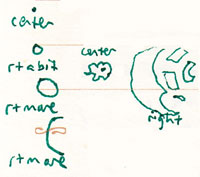
The images changes the further from the center I’m in a math class and the teacher is talking about fractals. He has a laser pointer and is shining it at the back wall. As he moves it to the right or left, it grows into a larger and larger fractal pattern, but the center of the pattern is also shifting out of sight, out of what the laser is lighting up. The result of this is that you can either see the center (but it’s very small), OR you can see details (but not the center). There is also an up/down adjustment for color (this I’m less sure of). I had the impression that THIS IS HOW VISION WORKS.
Astral Teachers: They teach such interesting things in the astral! If only I could remember more!
Taking Turns Teaching
-
Student Teachers 1997 • age 23
I’m in this class (not a Dark Tower class) and what happens is that students take turns teaching. Some I loved, others not.
-
Teaching 1998 • age 24
Last night I dreamed I was in a classroom and I went up to teach my ideas about higher planes and life after death and everyone was rapt. I was afraid of being laughed at but instead I was listened to and respected. I taught for half the class time and left, then when I returned, everyone smiled and waved at me! Today I had lots of extra energy.
Dream Classes: This is the first time I remember ever teaching dream classes.
Inspiration
Dream Inventions and Inspiration
Many concepts, advancements and practical inventions simply wait in abeyance in the world of dreams until some man accepts them as possibilities. . . . Imagination is waking man’s connection with the world of dreams. (Roberts 214)SD&Pchanneled • modern • Seth
There is no human activity to which dreams and group dreams have not contributed. . . .
Dream content was and is directed by the individual intents, purposes and interests of the dreamer. . . . The person interested most in herbs and plant life would also find that nightly dreams mirrored that daytime preoccupation, so that nightly dream excursions might find the dreamer examining strange herbs in another location than the native one. Or he might be given knowledge as to how the herbs could best be used for healing purposes. (Roberts 467-468)
There is no craft that was not first conceived of by an individual dreamer, who later transferred it to the social world of activity. (Roberts 469)DEVF2channeled • modern • Seth
Inventiveness was the result of the inspiration and communication of the dream world. Man dreamed his world and then created it. (Roberts 173)
Man’s dreams have always provided him with a sense of impetus, purpose, meaning, and given him the raw material from which to form his civilizations. The true history of the world is the history of man’s dreams, for they have been responsible in one way or another for all historic developments. (Roberts 179)DEVF1channeled • modern • Seth
Scientific Discoveries from Dreams
Many important scientific discoveries and inventions came from dreams (and many, many more from unremembered dreams). These include James Watson’s discovery of DNA (find source), Einstein’s Theory of Relativity (find source), Elias Howe’s invention of the sewing machine, and more.
TO DO: Include how CRISPR (was it?) was discovered in a dream.
“The technological world out there” was at one time the world of dreams. (Roberts 469)DEVF2channeled • modern • Seth
[Niels Bohr] dreamed that he was on a sun which consisted of burning gas. There were planets that moved swiftly around this sun attached by thin filaments. When he awoke he had the model of the atom which is substantially the same today. (Karagulla 113)BtCresearcher • modern • Karagulla
In 1869, Dmitri Mendeleyev, a professor of chemistry at Saint Petersburg, went to bed after trying unsuccessfully to conceptualize a way to categorize the chemical elements based upon their atomic weights. He later reported, “I saw in a dream a table where all the elements fell into place as required. Awakening, I immediately wrote it down on a piece of paper. Only in one place did a correction later seem necessary.” As a result of this dream, the periodic table of elements was created. (Van de Castle 35) ODMresearcher • modern • Van de Castle
The German chemist Friedrich A. Kekulé had tried for many years to find the molecular structure of benzene. He reported dreaming as he dozed in front of a crackling fire one cold night in 1865:
“Again the atoms were juggling before my eyes . . . my mind’s eye, sharpened by repeated sights of a similar kind, could now distinguish larger repeated structures of different forms and in long chains, many of them close together; everything was moving in a snake-like and twisting manner. Suddenly, what was this? One of the snakes got hold of its own tail and the whole structure was mockingly twisting in front of my eyes. As if struck by lightning, I awoke. . . .”
This dream led Kekulé to the realization that the structure of benzene is a closed carbon ring, a discovery that revolutionized modern chemistry. (Garfield 67-68)
In the field of anthropology, an astounding dream discovery was made by Hermann V. Hilprecht, professor of Assyrian at the University of Pennsylvania.
Hilprecht was working late one evening in 1893 trying to decipher the cuneiform characters on drawings of two small fragments of agate that he thought were babylonian finger rings found in temple ruins. He tentatively assigned one fragment to a particular period (that of the Cassite period, c. 1700 B.C.), but he was unable to classify the other. He went to bed about midnight, feeling uncertain about his classification, and had this dream:
A tall, thin priest of the old pre-Christian Nippur, about forty years of age and clad in a simple abba, led me to the treasure chamber of the temple, on its southeast side. He went with me into a small, low-ceiled room without windows, in which there was a large wooden chest, while scraps of agate and lapis lazuli lay scattered on the floor. Here he addressed me as follows: “The two fragments which you have published separately on pages 22 and 26, belong together, are not finger rings and their history is as follows: King Kurigalzu (Ca. 1300 B.C.) once sent to the temple of Bel, among other articles of agate and lapiz lazuli, an inscribed votive cylinder of agate. Then we priests suddenly received the command to make for the statue of the god of Ninib a pair of earrings of agate. We were in great dismay, since there was no agate as raw material at hand. In order to execute the command there was nothing for us to do but cut the votive cylinder into three parts, thus making three rings, each of which contained a portion of the original inscription. The first two rings served as earrings for the statue of the god; the two fragments which have given you so much trouble are portions of them. If you will put the two together you will have confirmation of my words. But the third ring you have not found in the course of your excavations and you will never find it.” With this the priest disappeared. . . . I woke at once and immediately told my wife the dream that I might not forget it. Next morning—Sunday—I examined the fragments once more in the light of these disclosures, and to my astonishment found all the details of the dream precisely verified in so far as the means of verification were in my hands. The original inscription on the votive cylinder reads: “To the god Ninib, son of Bel, his lord, has Kurigalzu, pontifex of Bel, presented this.
Hilprecht had been working with drawings of the fragments at the time of his dream. As soon as he was able he went to the museum in Constantinople, where the actual fragments were. They were kept in separate cases, since it was not known that they went together. Hilprecht found that they fit together perfectly. In all respects they confirmed the information in the dream. (Garfield 66-67)
While searching for a less expensive means to engrave his illustrated songs, [William Blake] dreamed that his dead younger brother, Tito, appeared to him and indicated a process of copper engraving, which he immediately verified and used. (Garfield 65)CDLDer • modern • Garfield
Creative Works from Dreams
Some inventors, writers, scientists, artists, who are used to dealing with creative material directly, are quite aware of the fact that many of their productive ideas came from the dream condition. (Roberts 176)URchanneled • modern • Seth
Whether [Stevenson] was awake or asleep, he, or what he called the “little people” of his dreams, were occupied in making stories for the market. Especially when he was pressed for money, he found that:
. . . at once the little people begin to bestir themselves in the same quest, and labour all night long, and all night long set before him truncheons of tales upon their lighted theatre. No fear of his being frightened now; the flying heart and the frozen scalp are things bygone; applause, growing applause, growing interest, growing exultation in his own cleverness (for he takes all the credit), and at last a jubilant leap to wakefulness, with the cry, “I have it, that’ll do” upon his lips.
. . . The Strange Case of Dr. Jekyll and Mr. Hyde is a famous example of the tales partially produced by Stevenson’s Brownies. (Garfield 70-71)
The English poet Samuel Taylor Coleridge (1772-1834) experienced his famous dream inspiration: one lazy summer afternoon in 1789 the young poet whiled away the hours in his thatch-roof cottage in the western countryside of England. He idly turned the pages of a history book called Purchas His Pilgrimage. His newly found opium habit nipped his innards, so he drained the nearby glass of laudanum he had ready. He yawned as he read the words “Here the Khan Kubla commanded a palace to be built. . . . ” Flipping the page, he closed his eyes, his head tipped forward. His dark curls fell across his face and moved gently with his breath as he dozed. The golden rays of the afternoon sun lit his cheek. When he awake three hours later the stately passages of “Kubla Khan” were firmly in his mind, with their “caverns measureless to man” and “sunless sea.”
In this case, the creative product occurred in its totality in the dream. Coleridge estimated that his original poem was 200 to 300 lines. He said that “all the images rose up before him as things” along with descriptions of them without any sense of effort. (Garfield 62-63)CDLDer • modern • Garfield
Sullivan composed the “Lost Chord” in a dream but was only able to remember the first few bars. In contrast, George Frederick Handel heard the last movement of his oratorio The Messiah during a dream. Richard Wagner wrote to a friend, regarding his opera Tristan und Isolde, “For once you are going to hear a dream, I dreamed all this: never could my poor head have invented such a thing purposely.” Schumann claimed he recorded a song that he heard in a dream, and in 1954, Wilson Allen recalled from a dream portions of what has become his most popular song, “This Could Be the Start of Something Big”. (Van de Castle 14)
The famous acrobat Tito Gaona. . . . : “I have sometimes dreamed my tricks at night . . . and then tried to master them from the dream.” (Van de Castle 15)
[Novelist Graham Greene] became so immersed in his dreams that the boundary line between himself and his characters became blurred. . . . “Sometimes identification with a character goes so far that one may dream his dream and not one’s own. . . . The symbols, the memories, the associations of that dream belonged so clearly to my character Querry that the next morning I could put the dream without change into the novel, where it bridged a gap in the narrative which for days I had been unable to cross. . . . When an obstacle seems insurmountable, I read the day’s work before sleep. . . . When I wake, the obstacle has nearly always been removed: the solution is there and obvious. (Van de Castle 19)ODMresearcher • modern • Van de Castle
The Source of Creativity and Inspiration
Everything flows from the inside out. The physical world is the hardened outer crust of the fluid, blazing spiritual world that creates and sustains it. The dream world and all the higher, inner worlds closer to the Source are the source of so much inspiration and brilliance in our lives.
-
Studying Hell Creatures 1996 • age 22
We’re in the ocean. At certain times when we were motionless, the waves would ripple up and throw us to the shore and these strange unseen creatures would bellow.

Similar wave creatures inspire this scene from Ponyo Fantasy Ideas: Just this year I saw a movie called “Ponyo” (released 10 years later), made by the imaginative Hayao Miyazaki. So many of his ideas come from the dream world, and this very thing was in Ponyo — creatures made of water that could rise up out of the water and manipulate things.
-
Like Warcraft, but a Whole World! 1997 • age 22
Context: I was playing Warcraft II at the time.
I’m playing Warcraft. I land in a small village surrounded by a desert, but there are distant trees all around and a cliff rising up on one side. Atop is the orc’s castle. It’s big, black, and sooty, surrounded by a forest of dead trees. There’s nothing on the ground except dried vines and leaves and barren saplings. The trees only have sparse leaves near the top . . . [the entire dream is in the Warcraft World]
Into Warcraft: Written at the time: “So much of this was like Warcraft, but expanded into a real world. Wow!”
Warcraft I, II, and III were real-time strategy (RTS) games where you looked down on a 3D landscape from a fixed perspective. I loved those games. I had this dream in 1997, experiencing what it would be like to descend into and live the game in first person. I’m sure many people had similar dreams (including the game developers), because this entire area existed in the dream world.

One of my many characters in World of Warcraft Seven years later, in 2004, Blizzard introduced this very thing — World of Warcraft, a massive online RPG in which people got to live out this very dream. When it came out, it was a huge hit, and I got deeply into it for several years.
I just noticed — it’s called WoW for short, and I followed my statement above with “Wow!”
-
Swirling Creativity 1997 • age 23
Falling Asleep: Every night I try holding my attention for as long as possible. Last night I was chanting awareness songs. I was being so brilliantly creative! Masterpieces of art and writing came to me — ideas of painting, stories, characters, stained glass, humor — it was endless, enrapturing, beautiful. The visual background was waves of hot energy swirling like seaweed in a current.
The Source of Inspiration: This is another of my favorite things — creativity and brilliance coming at the speed of thought, utterly enrapturing.
-
The Phoenix Slips
“The phoenix slips, within the dusk disclosed”
This was a quote from something read at a man’s funeral. The key question being, “What will his favorite part of the funeral be? What will he remember?”
Flashes of Brilliance: This sounds like a tiny piece of some really fantastic poetry. A rare piece of fully-remembered prose, straight out of the dream world.
-
The Elevator 2000 • age 25
This dream could have been the inspiration for Dr. Who.
I’m in the “elevator”. “Phone booth” would also describe it well, as that was about the size of it. It was made of unfinished wood, and had an apparatus like a toilet but smaller and flatter. It let light in from a slot near the top of the door. I had with me during all the following travels a small, friendly, invisible companion who was like a dwarf or cat in size. We were very close.
One of the earlier stops was arriving (via the “elevator”) in New York at night to visit Brendan and Melody and the rest again. I remember commenting, “Wow, here we are.. again!”
Later there was this scene: I was a computer programmer in this strange world. I went to Subway to work on a job for them. I needed the manager for something but couldn’t get ahold of him, so I left a phone message. Then I came back in 3 days and the manager (an old friend) wondered why the job wasn’t done. I explained. Then I’m in the elevator.
So before the elevator had just moved smoothly. This time it was dropping rapidly. Then there was a slight shudder, then nothing but slow rotation as though it had dropped completely out of the shaft and was free-falling. I was on alert. I stared into invisible cat eyes now, as on-alert as I was (I suspected later on that my dwarfish friend was responsible for the wild ride).
The elevator stopped and the quality of light was different — it was daytime with odd tints and overtones of feeling. I opened the door to a blue sky with puffy clouds in a Renaissance town of fantastic wealth and variety. Things were very different than any history of ours. Information came naturally to me, and I knew that there were very powerful groups of people. One group stuck to lavish costumes of all black. There was quite an energy in the air and a lot of people. We climbed a hill to what looked like a resting area with picnic tables all about us. My invisible guide was with me the whole time. I was going to ask this woman a question. I thought she had a lot to tell me but she would likely first ask what faction I was part of . . . and then suddenly I was back in the elevator.
This time the elevator turned wildly head over heels as it descended. As each side became the floor, it changed hue and a treasure chest appeared, each identical. I chose one and then turned around. The door was open and the elevator was stopping. I saw the change — the Renaissance scene was still there but flat-looking. It faded out to a mottled gray-brown before opening into a new scene — a dark brown sky with smoky clouds. I see a boy sitting on a car in a wheat field. I become him. I have a sack, and open it. Inside is a gun and some ammo. I see an asian man about 50 feet away, and know that he is my father. He’s looking for me. He soon sees me and is shocked. I look around me. There is a hole in the car and gasoline all over everything. I realize that the boy (me) intends to kill himself (myself). Then I awaken.
Dreams Inspire Fantasy: I have no doubt dreams are the inspiration for most fantasy and science fiction. I’m only vaguely familiar with Dr. Who, so this dream isn’t inspired by watching the show. This is likely a sort of dream phenomenon or natural rationalization of some sort of wormhole-like gateway — one that likely inspired the show!

Dr. Who traveling through time Image credit to julielilacQuantum Leap is another show I never watched but I know about — where a man goes into different situations and becomes a character in them and then tries to find his way out of their situation. This is inspired by rotes viewed in the dream state.
-
The Deep-Haunted School 2011
I’m in this college-like school. The school was bustling with living students and ghosts. I alone can see the ghosts. But I can see something else going on as well. As my eyes tune further into the spiritual frequencies, I see that the ghosts are being attacked by a deeper level of ghosts — the ghosts of ghosts. What the ghost world is to us, this world is to them. But the deep ghosts appear as horrible monstrosities in this world — inhuman beasts and terrors. The ghosts can pass through walls but not the deep ghosts. They need an open door or opening to get into a new area. In the room where I first discovered them, there were deep ghosts above the ceiling, calling forth more deep ghosts to drop through the grates. At the far end of the room was this enormous deep ghost, a kraken-like monstrosity with tentacles.
I would talk to ghosts of friends, and show their location to the living. I tried to record everything with my iPhone, with photos and videos (this has been a trend in my dreams lately) to see what this all looks like to the physical world. I was walking with the ghost of Brendan or Kai and he said he couldn’t go through this steel door. I assured him he could, and he pushed through. As soon as he did, I opened the door to go in myself. From the far end of the hall behind us appeared a stream of deep ghosts coming towards us. I rushed to close the door before they made it into the hallway.
At that point, I saw a well-practiced troupe of female ghost students marching down the hallway, eyes straight forward, chins up, very disciplined. They were from another school — a ghost school. I said “Welcome, students!” They kept on marching. I directed them to a classroom. I was taking charge of this situation, since I was the only one able to see both the ghosts and deep ghosts. The classroom was filled with a mix of living and ghost children. I explained the presence of the ghost children to the living. I began to explain what was happening in the school with the deep ghosts. The academy ghosts would snicker when I got a term wrong. At one point, a disembodied voice spoke from my left, asking a question, which I answered. Then I asked, “Who was it that just called me” which caused more snickering, and I threw them a dirty look, as I knew this was more along the lines of EVP.
Then I began to frantically write down the details of the dream in a large book illustrated with stylized ghostly drawings. Earlier I had tried to type out details on my iPhone, and then tried recording a sound memo. I wanted to remember this dream! And I did!
Deep Ghosts: This could be an amazing fantasy story. Regular students, ghosts, and deep ghosts intermingle in this dream. Being that this is an astral school, it could well be teaching dreamers and disembodied spirits (ghosts). The rules about passing through walls are interesting. Perhaps the deep ghosts are lower astral entities that are too physical. These academy ghosts seemed aware of their situation — certainly enough to be amused by the lack of knowledge of their dreamer teacher.
-
The Gods of Art 2025 • 7 AM
This dream was beyond anything I’d ever experienced; a nonstop trip through a world of intense art. No words will be able to accurately portray this, but I’ll try.
I was at a school — some wild school of creativity. I felt high. But it was normal to us. I was working on an art piece. It was a circular paper that took up my entire visual field, and I was drawing on it with blue pen. It had lots of different sections. One in particular on the left was all these wavy curling lines like water flowing or vines. It got somebody’s attention.
I remember seeing someone’s art in a graphic novel. It starred a goofy kid with a tall rectangular head, in cartoon style, mostly drawn with black ink on white paper. His story was told in the most incredible styles, and I loved it. It was so creative I went into it, and it was moving, flowing. I felt like I was hallucinating on it. But that was part of it. I was moving through the story. I was IN his story and expressing myself within it.
I came out of the story, back to the school. I said I needed to see more. This was a level of art beyond anything I’d seen before. I was hungry, ravenous for more. I was told the artist was coming. He walked up, his head was the blocky artistic head from the story, but it became normal-colored, then smoother, more human, but not all the way. I expressed my love for his art. He spread his arms and released a stack of art on clear paper to me, and I understood he made it for me. He moved on, and I looked through the stack. In it was myself as a character in his story, drawn in his styles, but in color. I was wearing my brown fedora, and I had long blonde hair and a green shirt. I was in his story! . . . I was invited to the place where the artists lived. I went immediately. It was a multistory building, a little bit slummy. They didn’t care, that didn’t matter to them. It was very alternative, creative and unique. And it often seemed black and white as if all made of ink. I walked through the building, feeling as if I was hallucinating wildly at the hallways, doors. Everything moved, spoke. There was a hallway with doors. One had some vertical lines on it, but they moved and I moved into them. Then I looked at the next door. Eventually I came around to the front, re-entered the house, and saw a woman there. She had been in the periphery a few times as I explored, and now I focused in on her. She was tall, with a unique style of hair and dress. . . . She asked me if I wanted to try a drug called Smoop (or something). Not recognizing it, I at first declined. I didn’t know how long it lasted, what it did, if there was addictiveness, side effects, all that. But eventually I decided to try it. She poured a little bit of a clear substance on my hands, and called it an “ink”. Up to this point in the dream, I hadn’t thought of the word “ink” to describe any of this art, so I thought it strange for a drug to be an “ink”. When the clear ink hit my hands, they gave off two huge pulses, and then it was on. As psychedelic as it was before, it increased dramatically. I went deeper into the art of the place.
The Power of Art: I’d been recently working on the part of Foundations about artists in the upper astral, and I now feel I was underestimating the significance and power of art. It’s not just a good painting, but a world of experience, a fluid way of interacting with the world around you in a way that leaks brilliance through every line. In these visual representations that convey worlds of information, the styles are as meaningful as the images themselves.
Rehearsal and Exploring Probabilities
This gets pretty wild. Our inner self is multiversal. It spans probable realities and communicates across them.
We engage ourselves in stories that interest us, and play the part of characters in them. In this way, we gain practice and get to experience the results of our actions.
In the very deep reaches of sleep experience . . . you are in communication with other portions of your own identity, and with the other realities in which they exist.
In this state . . . you are learning, studying, playing; you are anything but asleep. . . .
You process daily experience, project it into what you think of as the future, choose from an infinity of probable events those you will make physical, and begin the mental and psychic processes that will bring them into the world of substance.
At the same time, you make this information available to all these other portions of your identity, who dwell in entirely different realities and receive from them comparable information. You do not lose contact with your ordinary waking self. You simply do not focus upon it. . . . In the daytime you simply reverse the process. . . .
There are, therefore, channels that exist between all these streams of consciousness. (Roberts 93-94)SSchanneled • modern • Seth
Dreams are mental work and play combined, psychic and emotional rich creative dramas. They also involve you in the most productive of enterprises as you begin to play with versions of events that are being considered for physical actualization. (Roberts 463)DEVF2channeled • modern • Seth
On many occasions then you set yourself a problem—“Shall I do this or that?”—and form a dream in which you follow through the probable futures that would “result” from the courses available. . . . Each individual alive also has his and her private dreams, and these help form the accepted probability sequence of the following day, and of “time to come.” (Roberts 294-295)UR2channeled • modern • Seth
In dreams you are acquainted with probable events, from which you then choose. (Roberts 34)
In some adventures you do visit other probable realities. (Roberts 67)
The dream state, however, does operate as a rich web of communication between probable selves and probable existences. . . . The consciousness that you know can indeed now emerge into even greater realization of itself, but not by obsessively defending its old position. Instead it must recognize its power as the director of probable action, and no longer inhibit its own greater capacities. (Roberts 83)URchanneled • modern • Seth
The dreaming self is to some considerable degree aware of the probable self. . . .
This data is often wound by the dream self into a dream drama which informs the subconscious of dangers or of probable success of any given event which is being considered by the subconscious for physical actuality. (Roberts 304)SD&Pchanneled • modern • Seth
Your dream experience represents a pivotal reality, like the center of a wheel. Your physical world is one spoke. You are united with all of your other simultaneous existences through the nature of the dream state. (Roberts 441)UR2channeled • modern • Seth
According to the Aguaruna NOTE: an indigenous people of the Peruvian jungle, dreams may reveal emergent possibilities and events that are developing but have not yet occurred or become fully accomplished facts. (Lewis 6)DEresearcher • modern • Lewis
After dealing with crisis in their dreams they could deal with it better in waking life. (Garfield 97)CDLDer • modern • Garfield
Simulations
This is how the subconscious mind creates dreams: By tuning into the astral dimension during sleep, it can create any scenario it wishes. This is the subconscious mind’s way of solving problems and of communicating with the conscious mind. It creates a series of complex thought form scenarios and projects them into the mind stuff of the astral dimension, where they become solid. The conscious mind then lives through and experiences these created scenarios in the dream state. ToPOBEr • modern • Bruce
This is similar to Monroe’s simulation rotes, where the orchestrating subconscious mind mentioned here is the higher self of Monroe’s writings.
Survival and Exploration
Survival
It was early man’s dreams that allowed him to cope with physical reality. The dream world was his original learning ground. In times of drought he would dream of the location of water. In times of famine he would dream of the location of food. That is, his dreaming allowed him to clairvoyantly view the body of land. . . .
In those early times all species shared their dreams in a way that is now quite unconscious for your kind, so that in dreams man inquired of the animals also—long before he learned to follow the animal tracks, for example. . . . Man explored the planet because his dreams told him that the land was there. (Roberts 172)DEVF1channeled • modern • Seth
Genetic dreams of one kind or another continue throughout your lives, whether or not you are consciously aware of them. . . . Those dreams are most closely related to survival in physical existence, and whenever that survival seems threatened such dreams arise to consciousness whenever possible.
They are the dreams that warn of famines or of wars. (Roberts 331)DEVF2channeled • modern • Seth
Animals also dream, for example, and whole herds of starving animals will be led by their dreams to find better feeding grounds. (Roberts 441)UR2channeled • modern • Seth
One person might, because of his or her own interests, seek largely from dreams warnings of difficulty or trouble, and therefore be the family’s dream watchguard—the one who has, say, the nightmares for everyone else. That person will also serve a somewhat similar role in the waking state. . . .
Others even in the dream state operate as healers or teachers or explorers. (Roberts 469)DEVF2channeled • modern • Seth
OB Exploration
Man explored the physical world in the dreaming state long before he explored it physically. Such dreams gave him the assurance that other lands existed outside of his own, and spurred him onward into those physical expeditions in which the species has always taken a particular delight. . . .
In such a fashion man learned the location of the oceans upon the earth—or at least was given the assurance that such large bodies of water existed, along with clues as to their locations, and the placement of the stars overhead. (Roberts 467)
Group dreaming was at one time taken for granted as a natural human characteristic—in a tribe, for example, when new locations were being sought, perhaps in time of drought. The various tribal members would have dreams in which the problem was considered, each dreamer tackling whatever aspect of the problem that best suited his or her abilities and personal intents. The dreamers would travel out-of-body in various directions to see the extent of drought conditions, and to ascertain the best direction for the tribe to take in any needed migration.
Their dreams would then be shared by the tribe in the morning, or at special meetings, when each dreamer would give a rendition of the dream or dreams that seemed to be involved. In the same way, other dreamers would simply check with the dreamers of other villages or tribes. . . .
Oftentimes much of the material did not need to become conscious: It was “unconsciously” acted upon, turned directly into action. (Roberts 462-463)DEVF2channeled • modern • Seth
The Nature of Dreams
Now at last, with the greater reality explained and understood, we can understand our experiences in the dream state, and the laws under which they happen.
I want to make an important distinction. We currently think of any adventures we engage in while asleep as “dreams”. I want to distinguish this as two states. The first is being awake in the nonphysical (near realm or astral) in our astral bodies, exploring and socializing in objective environments, a state which that self considers “not dreaming”. It is from this non-dreaming state that we may go into what that self considers a “dream” — a more subjective state of fantasy or adventure that is equivalent to the physical act of playing video games, watching movies, or daydreaming.
While asleep, we go in and out of more-or-less subjective “dreams” while remaining in an objective nonphysical environment.
The Nature of Dreams
In greater terms you are just as awake when you are asleep, but the focus of your awareness is turned in other directions. (Roberts 318)UR2channeled • modern • Seth
No level of consciousness is without some kind of participation in dream states. . . . Even electrons . . . dream. Animals . . . dream, as do plants, insects, and all forms of life. (Roberts 472)DEVF2channeled • modern • Seth
The astral (dream) frequencies of consciousness are up the stream from the physical. All energy passes through the astral on the way to the physical. Thus every physical thing has an existence in the astral (and every higher domain). The activity at the astral frequencies is the dream state of everything in the physical.
The Reality of Dreams
“Reality” operates basically, however, in a way that is perceived more clearly in the dream state. Freedom from time and place, the wider kind of communication, the great mobility of consciousness—all of these experiences under dreaming conditions are characteristic of the basic nature of reality. (Roberts 461)UR2channeled • modern • Seth
These are aspects of the natural state of consciousness. This reality is more fluid, more connected. We come closer to it in the dream state.
The dream world is as organized as your own, but from the waking state you do not focus upon that inner organization. Your dream images exist. They are quite as real as a table of a chair. They are built up of particles, invisible only from the waking situation. (Roberts 451)UR2channeled • modern • Seth
Various improbable events . . . have caused me to wonder for some time whether I might be dreaming or not. . . . I decide to observe everything closely and with circumspection. . . .
A wide meadow stretches out in front of me, with wooded mountains in the distance. All this is naturalistically coloured and brightly lit. The sky is blue and blindingly bright. The top-most trees on the mountains are clearly outlined against the sky. Despite all my efforts I can find nothing which leads me to believe in the possibility of a deception. . . . The conversation I am listening to has a naturalistic timbre and volume. I can understand every word clearly. Nevertheless I have the impression that the words are seeming to emanate not from without, but from within myself, like audible thoughts. At this point it occurs to me that I am almost weightless, and am scarcely touching the ground on which I am lying.
(Moers-Messmer, 1938, Case 5) (Green and McCreery 25)LDPLDer • modern • Green & McCreery
Here we see the reality of dreams. Mixed in here are aspects of the inner reality — telepathic communication and lack of gravity. Only a strong focus from the waking self pick up on these things as being unusual, because they are natural to the dream self.
In an experience last evening in the dream state, Ruburt received fresh evidence by viewing for himself portions of two other lives—merely snatches of environment, but so dearly filled with precious belongings and loved ones, so alive with immediacy—that he was shocked to realize that the full dimensions of existence could continue so completely in such detail and depth at the same time as his present life.
It seemed that he could step from any one such existence to the other as you might walk from one room to the other, and he knew that at other levels of the psyche this was indeed possible. (Roberts 430)DEVF2channeled • modern • Seth
Multiple Sources of Perception
Different Impressions from Different Bodies
We receive sensations from each of our various bodies. We are a receiving station for all kinds of physical, etheric, astral, and mental events, communications, and sensations. These are all being integrated and assembled into our final experience, depending on our degree of focus on any specific frequency.
In the trance-like state of sleep, we take off our blinders to all the nonphysical channels of communication and perception. We will primarily tune into one channel, but the rest of these, then, can become influences on our dreams. That tuning can change moment to moment, and different channels and sensations can blend into one dream experience. Consciousness does its best to assemble these various perceptions into a coherent narrative (see The Assembler).
Leadbeater gives us the clearest understanding of how this works:
All these varieties of finer matter exist . . . in man also. . . . When sufficiently evolved he is able to express himself on all these different levels of nature. . . . It is through these various vehicles that he is able to receive impressions from the world to which they correspond. (Leadbeater 10-11)MV&Iclairvoyant • Theosophy • Leadbeater
The factors which may be concerned in the production of dreams are:
1. The ego NOTE: reincarnating self, who may be in any state of consciousness from almost utter insensibility to perfect command of his faculties, and as he approximates to the latter condition, enters more and more fully into possession of certain powers transcending any that most of us possess in our ordinary waking state.
2. The astral body, ever palpitating with the wild surging of emotion and desire.
3. The etheric part of the brain, with a ceaseless procession of disconnected pictures sweeping through it.
4. The lower physical brain, with its infantile semi-consciousness and its habit of expressing every stimulus in pictorial form. . . .
The recollection on waking, which is a sort of syntheses of all the different activities which have been going on, should generally be somewhat confused. (Leadbeater 45-46)
The first experiment tried was with an average man of small education . . . whose astral form . . . was externally little more than a shapeless wreath of mist. . . .
The consciousness of the body on the bed was dull and heavy, both as regards the grosser and the etheric parts of the frame. . . . The sprinkling of two or three drops of water on the face called up in the brain (though somewhat tardily) a picture of a heavy shower of rain; while the etheric part of the brain was as usual a passive channel for an endless stream of disconnected thoughts, it rarely responded to any of the vibrations they produced, and even when it did it seemed somewhat sluggish in its action. The ego floating above was in an undeveloped and semi-unconscious condition, but the astral envelope, though shapeless and ill-defined, showed considerable activity.
The floating astral can at any time be acted upon, with an ease that can scarcely be imagined, by the conscious thought of another person; and in this case the experiment was made withdrawing it to some little distance from the physical body on the bed, with the result, however, that as soon as it was more than a few yards away, considerable uneasiness was manifested in both the vehicles. . . . Any further withdrawal would have caused the man to awake, probably in a state of great terror.
A certain scene was chosen—a view of the most magnificent character from the summit of a mountain in the tropics—and a vivid picture of it was projected by the operator into the dreamy consciousness of the ego, which assimilated and examined it, though in a dull, apathetic, and unappreciative kind of way. . . . The man was awakened . . . to see whether he recollected it as a dream. His mind, however, was an absolute blank on the subject, and except for some vague yearnings of the most animal description, he had brought back no memory whatever from the state of sleep.
It was suggested that possibly the constant stream of thought-forms from outside, which flowed through his brain, might constitute an obstacle by so distracting it as to make it unreceptive to influences from its higher principles; so after the man had again fallen asleep, a magnetic shell was formed around his body to prevent the entrance of this stream, and the experiment was tried again.
When thus deprived of its ordinary pabulum NOTE: bland intellectual fare, his brain began very slowly and dreamily to evolve out of itself scenes of the man’s past life; but when he was again aroused, the result was precisely the same. (Leadbeater 56-58)
The next subject was a person of much higher type—a man of good moral life, educated and intellectual, with broad philanthropic ideas and exalted ambitions. In his case the denser body responded instantaneously to the water test by a very respectable picture of a tremendous thunder-storm, and that in turn, reacting on the etheric part of the brain, called up by association a whole series of vividly-represented scenes. When this disturbance was over, the usual stream of thoughts began to flow through, but it was observable that a far greater proportion of them awoke a response in this brain—also that the responsive vibrations were much stronger, and that in each case a train of associations was started which sometimes excluded the stream from the outside for quite a considerable time.
NOTE: Without the distraction of the random stream from outside, the dream most likely had a more coherent story.
The astral vehicle in this subject was far more definite in its ovoid outline, and the body of denser astral matter within it was a very fair reproduction of his physical form; and while desire was decidedly less active, the ego itself possessed a much higher grade of consciousness.
The astral body in this case could be drawn away to a distance of several miles from the physical without apparently producing the slightest sense of disquiet in either of them.
When the tropical landscape was submitted to this ego, he at once seized upon it with the greatest appreciation, admiring and dwelling upon its beauties in the most enthusiastic manner. After letting him admire it for awhile the man was aroused, but the result was somewhat disappointing. He knew that he had had a beautiful dream, but was quite unable to recall any details. . . .
With him, as with the other man, the experiment was then repeated with the addition of a magnetic shell thrown round the body, and in this case, as in the other, the brain at once began to evolve pictures of its own. The ego received the landscape with even greater enthusiasm than at first, recognizing it at once as the view he had seen before, and surveying it point by point with quite ecstatic admiration of its many beauties.
But while he was thus engaged in contemplation of it, the etheric brain down below was amusing itself by recalling pictures of his school-life, the most prominent being a scene on a winter day, when the ground was covered with snow, and he and a number of his playmates were snowballing one another in the school playground.
When the man was aroused as usual, the effect was exceedingly curious. He had a most vivid remembrance of standing upon the summit of a mountain, admiring a magnificent view, and he even had the main features of the scenery quite clearly in his mind; but instead of the gorgeous tropical verdure which lent such richness to the real prospect, he saw the surrounding country entirely covered with a mantle of snow! And it seemed to him that even while he was drinking in with deep delight the loveliness of the panorama spread out before him, he suddenly found himself, by one of the rapid transitions so frequent in dreams, snowballing with boyhood’s long-forgotten companions in the old school-yard, of which he had not thought for years. (Leadbeater 59-61)Dclairvoyant • Theosophy • Leadbeater
While dreaming, you really are in the astral plane. . . .
In a dream . . . your mind is thus a receiving station for the vibratory waves . . . carrying with them thoughts, sounds, influences, music, voices, and what not, of two worlds; and it is through the reception of these impressions that many dreams are instigated. . . .
When you are asleep, your vibration-reception-ability is greater than when you are physically awake. . . .
The astral body has well been termed the “dream body”, for it is in that body that we dream. (Muldoon 155-156)PotABOBEr • Spiritualism • Muldoon
The more we rise toward the rarefied higher ether the less we can depend on our memory. If the concentration of the will is not kept up sufficiently another source of error intervenes. The consciousness abandons its astral body. This latter, endowed with a certain sensitivity of consciousness, gauges impressions on its own plane, whilst the conscious spirit brings back impressions from another dimension. The result is a mixture, more or less coherent. (Yram 43)PAPOBEr • Yram
In deep slumber the higher principles in their astral vehicle almost invariably withdraw from the body, and hover in its immediate neighborhood, practically almost as much asleep as the latter. In some cases, however, this astral vehicle is less lethargic, and floats dreamily about on the various astral currents, occasionally recognizing other people in a similar condition, and meeting with experiences of all sorts, pleasant and unpleasant. (Leadbeater 21)APclairvoyant • Theosophy • Leadbeater
Impressions from Different Selves
While each body defines an individual self that can provide input into the dream, so can probable selves and other incarnations, connected to us at the level of the reincarnating self.
Rob: I’d just finished having two dreams at once. . . .
Seth: To the entity NOTE: reincarnating self, your own consciousness could be likened to one stream of consciousness. . . .
You are rarely able to “bring in” any “other-self” material and hold it while retaining your own sense of identity. Such material may at times bleed or intrude into your own thought, where it blends and is not recognized. . . . It adds to the overall atmosphere of your being. Without understanding or training, you would have to “lose” your own consciousness in order to perceive the “other-consciousness.” . . .
You could not, practically speaking, experience such other-consciousness unless you learned to stand somewhat aside. . . . But even if you did, the very experience of other-consciousness itself would supersede your living space. You would need another self, able to hold both lines of consciousness at once, lost in neither but maintaining footing in each. This would be a very difficult achievement in a normal life in any sustained fashion. . . .
At certain levels the brain can handle simultaneous material. . . . This does not mean the development of dual personality, by the way. It means the further expansion of the concept of identity. . . .
That identity would contain the you that you have always known, and in no way threaten it. . . . You would just have another expansion of consciousness, another self-who-is-aware-of-being. . . .
Selves are born out of selves to operate in various levels of activity. . . .
Language and your verbal thought patterns make [simultaneous dream] translations highly difficult. . . .
One experience was a dream of your own. . . . The other “dream” experienced simultaneously was, instead, your muddled interpretation of vital experienced reality on the part of another portion of yourself, in another reality entirely. (Roberts 123-126)
In the sleep state you are in a connective area, where bleed-throughs occur. (Roberts 181)URchanneled • modern • Seth
The Day’s Influence
Subjects were deprived of exposure to certain color stimuli by wearing colored goggles during every waking moment for five to eight days. . . . The goggle-colored objects appeared almost entirely during the early parts of the night and all but disappeared after the third REM period. This pattern is typical of most dream studies; recent impressions are manifested most commonly at the beginning of the night. . . . Subjects who lived in a red-dominated world in their waking lives also lived in a red-dominated world in their dreaming lives, at least during the early part of the night. (Van de Castle 253)ODMresearcher • modern • Van de Castle
This is an important observation — the day’s effects slowly wear off as one continues to dream. For me, by 3-4 AM, about 4 hours into sleep, I’m deep in the dream world.
The Dream State
Marijuana
Marijuana and Connecting with Dreams
The state of mind when high is the mind you have when dreaming. It’s the exact same, except in dreams the outside experience is FLUID as opposed to locked down in the physical world, which doesn’t respond to our thoughts and expectations. Being high is like lucid dreaming in the physical world. After smoking enough, everything feels like it is in a dream or a memory from a dream.
High, I was dreaming everything — I was experiencing everything from a dream perspective (only the disagreement of my physical senses prevented it from simply being a dream). I can dream what I’m doing right now. I mean at this very moment, typing at the computer, I can switch this into a dream context and I’m still typing like I was a moment ago but it is a dream instead. It’s a different way of experiencing.
I’m acting out the behavioral patterns of good dreams. It seems like that’s why I’m doing what I’m doing. The dream reasons are more real than my waking reasons. We exit the door.. to go get the mail? Or to return to the Dark Tower? This is all so much like dreams because the attribution is shifted to the deeper reasons of my dream self.
Dreaming comes from a different train of attribution — that of the dream self.
When high, I can watch my attention trying to follow a dream-pattern and mismatch physical reality because my eyes are still open. This brings me back out of the dawning dream.
With marijuana, I consciously follow into dreams, watching how it works, and come back with all kinds of answers.
While concentrating fully on the taste of delicious food, my dreams flashed back to me. I remembered dreaming of the Dark Tower, or I was newly dreaming of the Dark Tower. When attention moved away from eating and to remembering more dreams, I lost the connection. The dreaming state may be built upon positive body sensations.
Always Dreaming
We are always dreaming, even when awake. It’s a current underlying our waking experience. Usually the brightness of the physical world overpowers it, but when we get lost in thought, we find ourselves closer to the dream world. When high or asleep are we aware enough on subtler levels to feel them clearly.
My inner dream world’s brightness is almost matching the waking world’s brightness. I feel that reality, which is almost more real.
I’m dreaming right now underneath everything else. Attention follows the loudest input stream, which is usually the body.
Sometimes when I’m working on Foundations, I feel dreams on the periphery of my awareness. We are dreaming underneath our conscious awareness at all times and only become aware of it when in altered states, asleep, or anytime our waking mind has quieted down enough to see it.
I’m awake and already dreaming! While working on Foundations, I recognized dream places, including the Larson’s house.
I can feel my dreams getting closer when I focus on questions regarding the nature of the universe. I can sense my dream self talking, feel it moving, flying, and warping around while I am awake. It’s moving to different parts of the dreaming. I’m inspired and it’s inspired, too!
I realised that we have dreams continuously, both in sleep and in a waking state. We never cease to have dreams, though we are not aware of this. . . .
It is not at all necessary to be asleep in order to observe dreams. Dreams never stop. We do not notice them in a waking state, amidst the continuous flow of visual, auditory and other sensations, for the same reason for which we do not see stars in the light of the sun. (Ouspensky 263)ANMUpsychedelic • Theosophy • Ouspensky
You are dreaming when you think you are awake. . . . You are involved on other levels of consciousness beside the one that you know. (Roberts 365)CWSchanneled • modern • Seth
At night you tune in to dreaming reality simply by closing out so-called waking reality, but the same kind of dream experience continues beneath your focus in waking life. (Roberts 460)UR2channeled • modern • Seth
Tuning Into Our Dreams Through the Now
Go rapidly into dreams! Forget the day by continually refocusing to the present. Do this and you’re ALREADY dreaming!
Now-now-now-now-dream vs. hoooooooooooold ooooooooooon. The dream is much closer to the now.
We connect with the higher frequency dreaming reality by coming closer to the now. We need to get out of the thoughts recorded at physical frequencies, free our attention, and relax into the state where we can see and connect with dreams. Marijuana takes us to this state because very little context is pulling us away from the now.
Being near dreams is being in a happy state. It’s nearer and higher up.
The dream state is closer to the now. Its light is nearer to the perceiver — it doesn’t travel as far out from the Source as physical perception. It appears as a wider field of perception above the physical body’s visual field.
Translating Nonphysical Experiences
The Divisions of Consciousness
Consciousness at each frequency forms a pool and a unique self that specializes in that frequency. The most well known are the waking self that is reading this, an expert in physical life in a human body.
There are also various states of consciousness in waking life, upon which you do not focus, and of which you are usually quite unaware. Each state knows its own conditions and is familiar with a different kind of reality. . . .
“You” close off from your experience these other stages of consciousness in which other portions of your entire identity are intimately involved. These other stages of consciousness create their own realities as you create your own. . . . If you probe into these realms you will be forced to perceive them with the root assumptions of your own system, translating feelings of warmth and comfort, for example, into images of warm shelters or buildings, or feelings of fear into images of demons. . . .
The dream [is] an attempt to translate the deeper experience into recognizable forms. . . .
Dreams [exist] in more than one reality, with effects that dissect various stages of consciousness that are real, in your terms, to both the living and the dead and in which both the living and the dead may participate NOTE: the astral realm.
(Roberts 248-249)SSchanneled • modern • SethSee The MetaDreamer, Dream Self, and Waking Self.
Moving Into Dream States
First, of course, with various degrees of spontaneity, there is the inward turn of consciousness away from physical data, from worries and concerns of the day. Then there is an undifferentiated level between wakefulness and sleep where you act as a receiver—passive but open, in which telepathic and clairvoyant messages come to you quite easily. NOTE: scanning channels
Your consciousness can seem to float. There are varying physical sensations, sometimes of growing large, sometimes of falling. NOTE: body separation Both sensations are characteristic of moments in which you almost catch yourself, almost become aware of this undifferentiated area, and then translate some of its experiences into physical terms. The sensation of largeness, for example, is a physical interpretation of the psychic expansion. The feeling of falling is an interpretation of a sudden return of consciousness to the body.
This period can last for only a few moments, for half an hour, or can be returned to. It is a cushioning, supportive, and expansive stage of consciousness. . . . Following this period there is an active state, that can occur, of pseudodreaming, where the mind busies itself with physical concerns that have managed to cling through the first two stages NOTE: the NREM stage.
If these are too vigorous, the individual may awaken. This is a vivid, intense, but usually brief stage. Another undifferentiated layer follows, this time marked quite definitely by voices, conversations, or images, as consciousness tunes in more firmly to other communications. NOTE: scanning channels at another level Several of these may compete for the individual’s attention. At this point the body is fairly quiet. The individual will follow one or another of these inner stimuli to a deeper level of consciousness, and form into light dreams the communications he is receiving. NOTE: social dreaming
Somewhere during this time he will go into a deeply protected area of sleep, where he is at the threshold to other layers of reality and probabilities. At this point his experiences will be out of all context to time as you know it. He may experience years though only minutes have passed. He will then return toward physical reality in an area marked as REM sleep by your scientists, where physically oriented dream productions will be created, putting the knowledge he has gained into use.
The cycle would then be repeated. Almost the same kinds of fluctuations and stages occur even when you are waking, however, though you are even less aware of them because then the egotistical NOTE: waking self acts quite purposefully to blanket out these other areas of experience.
The precise stages are present beneath waking awareness, however, and with the same chemical, electromagnetic, and hormonal fluctuations NOTE: you are always dreaming. You simply are not aware of what your consciousness is doing. You cannot yourselves keep track of it for five full moments of your time. The dimensions of it can only be sensed by those determined enough to take the time and effort required to journey through their own subjective realities. Yet intuitively each individual knows that a part of his experience escapes from him all the time. When you suddenly cannot remember a name that you should know, you have in essence the same kind of feeling of which you are always subconsciously aware. (Roberts 249-251)SSchanneled • modern • Seth
The stages of falling asleep are described in detail in The Boundary of Dreams. For more on the stages of sleep, see The Stages of Sleep.
Higher Learning in Physical Terms
According to Seth, REM is our playground to apply the learning we gained from our connection to this deeper state. It is through these dreams that our waking self understands and remembers the higher learning.
Two areas of activity are involved, one very passive and one acutely active. In one state this portion of consciousness is passive, receiving information. In the next stage it is active as it takes part through action - the concepts given it are then vividly perceived through participation and examples NOTE: rotes. This is the most protected area of sleep. The rejuvenating characteristics enter in here, and it is during this period that the Speakers NOTE: guide act as teachers and guides.
This information is, then, often interpreted on return by other layers of the self such as the body consciousness and subconscious, where it is formed into dreams that will have meaning to these areas of the self and where general teaching, for example, may be translated into practical advice involving a particular matter. (Roberts 246)
In the most protected areas of sleep you are dealing with experience that is pure feeling or knowing, and disconnected from both words or images. As mentioned, these experiences are translated into dreams later, necessitating a return to areas of consciousness more familiar with physical data. . . .
The unconscious and subconscious areas, however, are aware of much more of this information than the ego NOTE: waking self, for it receives only the minute residue of dream material as a rule. (Roberts 252)
At certain depths of sleep, however, the soul’s perception operates relatively unhampered. . . . You drink, so to speak, from the pure well of perception. You communicate with the depths of your own being, and the source of your creativity. These experiences, not being translated physically, do not remain in the morning. You do not remember them as dreams. Dreams, however, may later the same evening be formed from the information gained during what I will call the “depth experience.” . . .
During it, energy is generated that makes the dream state itself possible. (Roberts 81)SSchanneled • modern • Seth
The Nonphysical Aspect of Physical Experiences
It is true that dreams allow the physically oriented self to digest current experience, but it is also true that the experience is then returned to its initial components. It breaks apart, so to speak. Portions of it are retained as “past” physical sense data, but the whole experience returns to its initial direct state.
It exists then, “eternally,” separated from the physical clothing that you need in order to understand it. (Roberts 81-82)SSchanneled • modern • Seth
In this way our experiences become “portable” to any consciousness. When sharing an experience (as a memory rote), it can be experienced in its original physical forms, OR it can be experienced in its higher aspect, and dressed up in the receiver’s closest-matching physical forms.
Translating Nonphysical Experiences
Dreaming is the result of projecting physical forms and rules onto nonphysical experiences.
You dream when you are out of your body, even as you dream inside it. You may therefore form dream stories about your own out-of-body travel, while your physical image rests soundly in bed. . . . If you remember such an episode at all it may well seem very confusing, for you will have superimposed your own world view where it does not belong. (Roberts 423)UR2channeled • modern • Seth
The Physical Body Consciousness
This strange, dim [body] consciousness has many remarkable peculiarities. Its action seems to be to a great extent automatic, and the results NOTE: while dreaming are usually incoherent, senseless, and hopelessly confused. It seems unable to apprehend an idea except in the form of a scene in which it is itself an actor, and therefore all stimuli, whether from within or without, are forthwith translated into perceptual images. It is incapable of grasping abstract ideas or memories as such; they immediately become imaginary percepts. If, for example, the idea of glory could be suggested to that consciousness, it could take shape only as a vision of some glorious being appearing before the dreamer. (Leadbeater 22)Dclairvoyant • Theosophy • Leadbeater
Our Library of Physical Experiences
Our projection of known physical forms is an automatic translation to terms the physically-oriented waking self can easily understand. This projection uses our current life context (weighted by attention) to fill in the physical forms that work best to convey the intended meaning. It uses our “Library of Physical Experience”.
This is similar to the process by which we simplify things in the physical by looking at them through our past experience. It takes less attention to see new experiences as the recurrence of similar past experiences, freeing up our attention and allowing us to react in our habitual way. In the physical, this is not experienced in terms of our perceived environment, while in the astral it is.
Now all consciousness, including your own, is highly mobile. While you focus your attention primarily in your own world, certain portions of your consciousness are always straying. When you are sleeping, then, your consciousness often ventures into other realities, usually in a wandering fashion without tuning itself in to any precise frequencies. Beneath many seemingly chaotic dreams there are often valid experiences in which your consciousness “lights” in another reality, without being attuned to it with the necessary precision that would allow for clear perception. The information cannot be sifted or used effectively and is translated into dream images, as your consciousness returns toward your own home station. Therefore, it has been difficult to achieve any kind of clear picture of such other realities. . . .
Unless your consciousness is tuned in with exquisite precision you will not be able to perceive clearly. You will instead pick up at best the ghost images, probabilities, and private data that are not officially recognized as part of the main reality’s official structure of events. (Roberts 332)
There are layers of actuality in which your psyche is also highly involved, and these may or may not appear to have anything to do with the world that you know.
When you travel into such realms you usually do so from the dream state, still carrying your private symbols NOTE: past experience with you. Even here, these are automatically translated into experience. This is not your own codified system NOTE: physical world, however. You may journey through such a reality, perceiving it opaquely, layering it over with your own perceived symbols, and taking those for the “real” environment. In these terms the real environment will be that which was generally perceived by the natural inhabitants of the system. . . .
In certain terms you are a part of any reality that you experience—but you may have difficulty in the interpretation of events. (Roberts 323)UR2channeled • modern • Seth
The “stuff” of the environment will have its origin in the mind of the projectionist, being symbolic of his idea. . . . A Speaker or Speakers NOTE: guides will appear in whatever guise will be most acceptable to the projectionist. (Roberts 281)SSchanneled • modern • Seth
When you examine the state of dreams, however, you do it as a rule from the framework of waking reality. . . .
Your subjective life NOTE: dream life is now interpreted through the specialized state of consciousness that you call the waking one, in which you recognize as real only experience that falls within certain space and time coordinates. (Roberts 219-220)DEVF1channeled • modern • Seth
The images of dream-life arise because life spreads its carpet over the true inner activity. . . . The ego NOTE: the higher self and the astral body are livingly active when we dream; when their activity comes into contact with the etheric body . . . then dreams arise. But in dreams we make use of life’s physical memories in the etheric body, thus rendering visible the activity of the ego and of the astral body, which would otherwise remain invisible. (Steiner 113)
Dreams are the least part of his experiences while asleep. Everything else, however, remains unconscious. Only the dreams surge up into consciousness. Yet it could be said that the dreams, be they ever so interesting, ever so manifold, ever so rich in many-hued colours, represent something that restricts the human being completely to his own self. (Steiner 50)LBDclairvoyant • Theosophy • Steiner
A series of vivid pictures appears in my mind; I can’t tell if it’s originating from within me or somehow outside of me. . . . “You are in a higher vibratory region, a thought-responsive environment. Your perceptions of your surroundings are created by your mind. Your mind is interpreting the environment according to the reference points and forms it can relate to.” (Buhlman 27)ABtBOBEr • modern • Buhlman
The following is a description of the tunnel after death:
Case 4:
S: I think something is . . . pulling me into my proper level of travel and trying to relax me, too. . . . I’m hearing sounds. . . . An . . . echo . . . of music . . . musical tingling . . . wind chimes . . . vibrating with my movements . . . so relaxing . . . and I have a memory of scent and taste, too.
Dr. N: Does this mean our physical senses stay with us after death?
S: Yes, the memory of them. (Newton 21-22)JoShypnosis • modern • Newton
It restricts us in its rationalizations, in its need to take recognizable physical forms and conform to physical laws.
I don’t think dreams take physical form at the etheric level, because astral rationalizations go on to affect the dream.
The Closest Match
When we project our own physical imagery onto an experience, we are not seeing it truly. In such cases, the events and situations can be new but the places and characters are not.
The examples below from Monroe are in terms of OBEs, but the exact same process happens in dreams.
One problem is.. the mind’s identification of persons, places, and things which up to that moment have been unknown and unperceived previously. . . .
When an unknown or apparently impossible situation, place, person, or thing is encountered, the mind comes up with some kind of answer rather than no answer whatsoever.
The answer takes the form of rationalization. . . . Or more commonly, a search is made of past memories and experiences to produce proper identification. It compares the situation under which the object or action is perceived with past personal experience. If there is nothing to coincide exactly with the observed data, the mind invariably reports the most similar memory and states, “This is the object or action you are seeing.” It is only after critical analysis that some semblance of what actually was perceived comes to light. (Monroe 185)JOotBOBEr • modern • Monroe
This is key. The heart of communication is an attempt to convey meaning. A relatively unimportant character in a story may appear like the closest-resembling person you know. But if the meaning of the character is important — if the character is the experiencer’s mother, then your own mother would be substituted. This changes the appearance of the story, but preserves the essential meaning.
The following took place during an OBE:
There are many good illustrations of this phenomenon. One of the best is the visit to Mr. Bahnson’s house in the morning. The mind, having no reference in its memory of the object being placed in the back of the car (Van DeGraff generator), identified properly its approximate size, the round wheellike protuberance on a post, and the base platform, and reported erroneously that it was a child’s automobile. The mind properly reported the boy and the baseball, because this was a part of its memory-bank data. (Monroe 185-186)JOotBOBEr • modern • Monroe
It’s as if the waking self can view the dream only through past experiences. But there’s a memory stream of the real events that happened, too, because I can sometimes reveal these rationalizations through careful recall of the dream. Sometimes I remember what happened immediately preceding the rationalization, and sometimes I note my own expectation preceding something happening or appearing. The waking self skips over these details in its understanding, having “fixed” the story to make more sense.
The following is from an OB precognition experience:
Of equal interest was the experience of the airplane crash. . . . Here was a whole series of events filled with much sensory data, filtered by the mind’s past associations. Added to this was the rapid superimposure of information, so that the sequence of events in time added to the confusion. The impression of taking a trip by airplane was quite accurate. However, the mind “forgot” that there was a bus trip to the airport first. Consequently, in reporting the loading of the bus, the impression was that this was the airplane. In boarding the bus, the mind perceived the driver waiting beside the door. In an attempt to identify the man, the memory was searched and the most similar person in past experience was selected as the person encountered. . . .
Then, the flying low and slow over streets was a perfect description of the event itself—the bus traveling the turnpike to the airport—except that the mind was still fixed on the idea of flying in an airplane. (Monroe 186)JOotBOBEr • modern • Monroe
The more incongruities there are with physical reality, the more the mind has to rationalize events. Sometimes it backtracks to find its mistake, but rationalization is easier.
Monroe visits a person’s house in the physical while OBE:
[The mind] ran into a problem on the motion of Mrs. Bahnson in handing out the morning mail. This was reported as “dealing cards,” but the mind was faced with the incongruity of playing with large white cards (letters) at a table filled with dishes. The idea of “card playing” was the least impossible similar event in the memory association, so that was the unit retained. (Monroe 186)JOotBOBEr • modern • Monroe
It seems that once the mind is set on one interpretation, it seems easier to stick with it, even in the presence of incongruities. It’s easier to rationalize than change the interpretation.
It is curious that these effects are in operation in OBEs, which usually carries with it the full critical faculties of the waking self.
A mind which is telepathically affected can project its sensory delusion on some real figure which bears a general resemblance to the agent. (Gurney, Myers and Podmore 63)PotL2researcher • Society for Psychical Research • Gurney, Myers, & Podmore
See How We Understand Others’ Memories for how this applies to memory rotes.
Past Timeframes
Some dreams are set in a past timeframe. When this happens, the settings, characters, and objects are drawn from the self we were at that time.
See also Earlier Self Perspectives.
-
Bedroom Cleanup 2024
I set [the rolls of colored wrapping paper] down on my childhood bed from my room in Blaine House. . . . This was the bed with the pink and yellow cover from my early childhood.
At this point I began to clean up garbage from the bed — bits of wrapping paper scraps and plastic. To the side of them was the plastic molding for a model kit — the kind used for model airplanes and such. I checked it and almost all of the pieces were taken out.
7-Year-Old Timeframe: The time when I had this bed covering was about the same time I was briefly into doing models. I got some as gifts, and built them, but they weren’t my favorite thing.
-
Caught Cheating 2025 • earlier still
Much earlier in the night, I was hanging out in a mall in Minnesota. Word had gotten out that I had been cheating on Raven. . . . There was a bunch of people from my high school chasing me, kicking me, shouting at me.
Girlfriend In Context: In the timeframe of dream — being in high school in Minnesota — the girlfriend I’m cheating on translates to Raven, my girlfriend at the time.
-
Stealing the Password 2025 • 3:45 AM
The characters and context from this dream are all from about 20-25 years ago, when I was working at Definition 6. The first thing I remember is a sort of stand-off with my boss. . . . He’s trying to subtly antagonize me into revealing if my server is at home or elsewhere by suggesting that I “go home, to the garage” to turn off the accounts, as if they’re hosted from a computer at my house. His ploy works at revealing that I have a server, though, as I say that I can do it from here. In my mind I see the server, which is being hosted offsite (as it was 25 years ago), and I see my home computers, which are from that era, too.
I arrive home in our present living room and close all the blinds — they are slat blinds like we used to have in the house we lived in then, not the folding blinds we currently have. We didn’t live in Hibernia house 25 years ago, but returning “home” meant coming back to the near realm where I’m sleeping.
Set In the Past: The timeframe that I worked that job is partially brought with me. The layout of Hibernia House (my current house) in the near realm was accurate, but the blinds took their appearance from that older time period.
Physical Recreations Require Source Material
I was supplied with my drink and Charles with his, and the taste to me was exactly what I had expected it to be. I was told that, had I never tasted whisky in the world, I would not have been able to appreciate the taste of it at the astral level, though I should undoubtedly have tasted in the astral liquid what I presumed to be the taste of whisky. (Richelieu 49)ASJOBEr • modern (Theosophy) • Richelieu
Should we want to experience something from the physical which we’ve never experienced before, we could only experience our guess as to what it is like based on similar things.
Forgetting What We Can’t Translate
You (the Watcher NOTE: higher self) can perceive a great deal. You (consciousness NOTE: the waking self) can only remember a little. The more you become accustomed to non-verbal awareness, the more you will be able to remember. . . .
Let’s pretend that you are a television set with 36 channels. Your Watcher is an expert at all of them. . . . It likes to jump around. Your conscious mind is only good at Channels 1 and 2. Everything else comes in as static or scrambled images. So your OOBE might be going along fine while you are on Channels 1 and 2 but black out -- or become dreamlike -- when your Watcher hits the remote and jumps to its favorite channel. ASOBEr • modern • Goodin
The MetaDreamer, Dream Self, and Waking Self
There are many focuses of self; different but connected centers around which our experience and memory gather. Each focus becomes a specialist in its own area. They are all us, but result in somewhat distinct selves. Several of these focuses are involved in the dream state.
The MetaDreamer focus of consciousness is a broad focus that specializes in preserving the dream state. It acts as a conductor, handling different sources of input and directing them into specific focuses of consciousness.
The waking self and dream self are also focuses of consciousness. The waking self is a specialist in physical life, and the dream self is a specialist in astral life (dream life). Each knows the rules of its environment in great detail, but usually has little knowledge of the other.
The MetaDreamer decides where we direct the input from the physical — to our waking self or dream self. To continue dreaming, waking influences are forced into the dream context by keeping focus on the dream. This preserves the dreaming state.
The following experiences are wonderful examples of these different focuses:
-
Escaping from Dogs 2001 • 4 AM
I was awoken from dreams by this loud alarm-like sound being made by the freezer, and can’t resist writing down what I remember.
I was a character, not quite me, running over rocks along a beautiful river in a summery area with mountains on either side. I was being chased by dogs. The dogs were 100% thought forms, rubbery and cheating gravity as they came after me. I had created them earlier just as an experiment. Could they catch me? But the more I watched them, the more I could believe them, and a sense of urgency prevailed.
I ran into this large open cave with river water pooling in it. While it was a perfectly real cave, looking back I know with certainty that it was the Dream Station. This has been my new recurring dream place for quite some time, though it is more of a feeling and a shape than one specific place. To hide from the dogs, I considered jumping down into the water to grab two giant turtles and swim with them, or I could go into this black area. But I realized doing this would significantly “change things”. The Dream Station connects to the underworld (or the physical world), I believe. There is a straight vertical shaft between it and a more dark and solid place, and it may be related to my 4 AM underworld journeys. The time was almost exactly 4 AM when I awoke.
So it was at this point in the dream that I hear the alarm from the physical side. Suddenly I am no longer in the action, but outside the cave discussing the sound with a friend. I am now the storyteller, aware of both worlds, wondering if it’s a car alarm, or if it’s coming from the neighbor’s apartment. I even remembered that it had happened earlier in the night and stopped. So I decided to wait it out and push back to the dream side. I thought about how to attribute the sound in the dream. “Ah, I’ll attribute it to a search ray, operated by the dog-keeper to find me.” It worked — I was back in the character of the dream. But this was scary. I tried to bury myself in the soft, light sand, but the queen had found me.
I awoke to fix the fridge now since it wasn’t stopping.
The Dream Station is the concrete-like building in last year’s “Building The Atlanta Tower” dream. It’s related to the Smooth Caves, too.
Amazing, this storyteller, knowing two worlds and more, and this blind actor that believes everything it says.
The Dream Self, Waking Self, and Fragments: Let’s look at this in detail:
In my dream self focus, I set up the scene with the dogs. This scene is a rote. As seen elsewhere, my dream self considers this scene a “dream”. I project myself into it. This projection is into a character in the dream. It isn’t quite me. It doesn’t have my memory. It’s a waking self fragment. Created without context, it begins to get emotional, thinking the dogs chasing it are physically real. But the beeping pulls my attention out of the character back into my more real dream self focus with its broader, wider context. It has its own body. It’s been here all along but I was focused in the projection, like a person on a couch playing a video game. Now from the dream self focus I shift focus to the physical, to my full waking consciousness, to determine what the beeping could be. At that focus, reunited with my waking context, I make a decision to wait and hope it stops beeping on its own again. I pass that decision back to my dream self focus, where I uniquely know how to deal with the sound. I consciously redirect the sound into the dream scene along with a context-appropriate explanation of what is causing it. Now that the sound is dealt with, my attention can jump back into the character in the dream scene. I can get back to playing what is essentially my custom-built video game, where I’m playing the part of the character who is once again being chased by dogs.
This is amazing. In the dream self focus, we are the conductor of dreams. We orchestrate our dream experiences from a broader context. We are aware of when we are “dreaming” or not. We are intimately aware of the workings of the astral world. In that focus we set up scenes and situations for fun, and project ourselves into them to experience.
What we project is a self fragment; a receptive, uncritical, trusting copy of ourselves that will fully accept and believe the situation it finds itself in. The self fragment has no history, but it’s still us. Given any situation, we react as we naturally would. We don’t understand (or even question) how we got here. A self fragment is us, just as a person with amnesia still has their personality, expectations, desires, and fears. We lack only the wisdom available from a larger, broader context — including, importantly, the wisdom to know that in the larger view, we created this adventure for ourselves.
The self fragment is the embodiment of “suspension of disbelief”. It’s how we can understand stories.
Running from the dogs triggered my waking self emotionally, and it awoke into the dream with no memory of how it got there (shortened context). Typically at this point the self fragment pulls in physical life context and begins to apply physical rules & limitations. It responds as if what’s happening has physical life consequences.
At the dream self focus, I knowingly created the thought forms of dogs on a whim, to see if they could catch my character in the story. It may seem insensitive to the poor trusting self fragment who began to believe he was in danger! But I achieved my goal — drama! Why do we read books? Why do we watch movies? Drama, conflict, adventure.
Notice how the dream scene itself is a rote from the perspective of the dream self! I exit the scene to make the decision about the alarm sound, and then when that’s dealt with, I reinhabit the character — MYSELF — running from the dogs in the dream. Also consider how I describe this character as “not quite me” when referring to the self fragment. That’s the perspective from the dream self focus. It’s a limited version of me running through a rote. It has to be or it wouldn’t believe in and engage with the simulation.
Once my full waking self decided it was safe to return to sleep, I shifted focus to my dream self, where I do something my waking self knows nothing about. I knew I had to integrate the sound into the story rote so I could return to it. This worked and my attention returned to the scared fragment self within the rote, now even more scared by my dream attribution of the sound as a search ray.
Our full waking self is our focus in daily waking life and in lucid dreaming.
The MetaDreamer, then, simply describes the ability to focus back and forth from the dream self focus to the waking self focus.
I frequently go into little imaginative reveries in dreams, usually to add drama and excitement at times when I’m less engaged externally. See the section “Reveries” for examples of this. I’ll do it several times within the same dream adventure.
-
The Bombing and Revelation 2006 • 6:25 AM

A cartoonish bomb I’m hanging out with Mordred up the street from Raven’s house. He blows up their front door and the surrounding area with a bomb. The bomb was like a symbol of a bomb in my mind. I’m in a really dazed and unthinking mental state. I talk it over with Mordred, and tell him I’m going to talk to Raven, but think of course I won’t reveal who’s behind it.
So I visit Raven, but more lucid. She greets me warmly. Her brother stops by. She talks about burning her hand and being cured by some product made by bees. Then I broach the topic of the bomb. She jumps on me, furious, demanding to know what I know of the bombing. Her eyes are vivid and focused on me. I start to explain how I was walking along, “Observing and listening to two people, but in this dream state”. I begin to question myself, thinking “Why didn’t I tell you before?” and “Why didn’t I stop this?” and “Why did Mordred do it?” and “Why am I keeping his identity secret?” I realize it’s because I didn’t believe it was real, but the intensity of emotion in Raven tells another story. As I question whether it WAS real or not, I shift into another level of dreaming — this one more logical and near my body. I feel centered in my bedroom and think “Ah, yes of course, because it wasn’t real. She would have told me in email or on Solstice.” I feel relieved but wonder what that was all about. it was 6:25 AM. I decided to remember this dream and went back to dreaming other things.
Rousing the Waking Self: My dream self is aware that it was passively dreaming, possibly inside a rote. I wasn’t emotionally invested because I knew I was in a “dream state”, which is like watching a TV show. My dream self knows that a bomb wouldn’t have any real consequences in the astral or in this dream rote.
But Raven’s intensity rouses my amnesiac waking self, who asks the questions that I would ask if this had physically happened. This leads to the waking self deducing that I stood by while a friend was put in danger, which disturbs me so much that I step out of the dream, refocusing into the near realm to determine if I was physically dreaming.
When we die, we enter a widened context just like this, one which sees our physical life as a dream we’ve just awoken from.
The MetaDreamer
There is a broader focus of self that’s aware of both the waking world and the dream state. It is a calm, knowledgeable perspective that can make decisions based on this knowledge. It can attribute waking world stimulus into dreams in order to continue dreaming. It’s aware of the waking world time and date so that it can plan activities in the dream world. This is a focus I call the MetaDreamer.
The MetaDreamer focus is more than just the waking self and the dream self — it knows more than the waking self. Here the two can be seen from a higher perspective. This focus of consciousness is most apparent in the sleep states where we’re near the body. It recognizes the sensations of astral body separation and responds to them.
I’m snoozing this morning. Maybe 5-10 minutes into falling asleep again, a part of me recognizes the full-body tingle state as being about to go deeper into dreams and wakes me up instead because we have a flight coming up. What’s interesting about this is I’m not aware in my waking state of this tingling state as a sign of going deeper into sleep. I just learned that today. So there’s a part of me that’s aware of those deeper stages of falling asleep and also of my waking needs.
This shows an expanded realm of knowledge and memory my waking self doesn’t have access to. It’s knowledge about my physical body and its variations in consciousness, but it’s outside the range of my waking self. The dream self doesn’t understand everything about waking life (see Lack of Biological Understanding), just as the waking self doesn’t know much that the dream self does. At the MetaDreamer focus, I know both and more.
TO DO: ..OR is the MetaDreamer simply the ability to focus back and forth from the dream self focus to the waking self focus? Is it the dream self focus that knows how to route sensations? Time and date are all very physical things. Perhaps there is no specific MetaDreamer state — it could just be communication between the dream self and waking self. But first — reinvestigate the NREM state. I think this may just be the dream self’s “natural” non-dreaming state. Remember, whatever this focus is, it can manipulate waking self fragments within dreams (or maybe the dream self is doing that).
Is the MetaDreamer the subconscious? The “subconscious” is a bit of a weak term since it means “anything we know but not conscious of”, and what we’re conscious of changes.
This is related to the Near Realm and the dream staging area. see A Dream Staging Area.
Aware of Both Realities
The MetaDreamer focus is a step outside both the dream state and waking state, able to shift between both. We can refocus to the physical momentarily to identify physical world stimulus, making the call as to whether it’s important enough to wake up for or otherwise weaving it into the dream to essentially silence it.
This applies to near-realm stimulus as well. If we sense something there, we can shift out focus into the near realm to deal with it.
In the MetaDreamer focus, we have access to knowledge about the waking world, the date, the body’s position, and the bedroom environment. This goes even beyond what the waking self knows, in that it can access subconscious knowledge of the waking self, such as the stages of astral body separation and the current time up to the very second.
-
Strangely Part-Lucid 1998 • age 24
I was dreaming in a strangely lucid way. When I went to sleep, I immediately saw the darkness before my eyes as a 3D space, with occasional risings of bright light. I was more conscious and aware. I was aware of Buttercup’s every shift and body movement, and my attention went momentarily to the waking side, then consciously returned to the dream. For hours I had this higher awareness. At the end I was able to draw out of the dream instantly, and wake up without any sleepiness.
The MetaDreamer: Here I was able to transfer easily into and out of the MetaDreamer focus, easily transferring my attention back and forth between the waking world and dreams.
-
The Proselytizers 2023
From within a dream, I heard talking in my bedroom. I considered returning to my dream but someone was talking about Jesus. So I roused myself and got out of bed. My wife and kids were arranged on the bed, in sitting positions, while a man stood at the foot of the bed, talking about Jesus. Two younger women stood behind him and off to the side. Enraged at people trying to convert my family, I went on the attack. I told them that of all the major religions, Christianity was the worst, that their sacred book had the least spiritual knowledge, and how dare they come here and preach to my family. The younger women were taken aback.
The Place of Decision: I was not going to let religious zealots preach to my family, so I awoke in the near realm to deal with them.
Then, just like my first OBE, I slowly started to become more conscious and I was aware of having multiple consciousness. My awareness increased until I was fully conscious, but this time my conscious self was an observer. I was allowed to watch with astral vision, but I wasn’t in control. Another part of me was running the show, doing some very serious work, and knew all the tools of the trade. What I saw was astounding.
I was gliding slowly up from below, until I saw what looked like a human brain. I could sense the body it belonged to. Somehow, I knew it was my own body. The brain looked like about one hundred small spheres of light, grouped in the shape of a human brain. Each sphere had a different brightness. I noticed that four particular spheres were shining brighter than the rest, and I knew they had been cut off from the other spheres. Using my mind tools, I worked for about 10 minutes adjusting neural pathways, “rewiring,” and manipulating energy. Then I recharged the four spheres with energy. Next, I programmed the brain so that it would use different neurological connections and make automatic adjustments! I was a psychic healer in my sleep!
Satisfied with my work, I left. I approached a second brain and followed the same process. I rewired, transferred energy, then programmed the brain to aid in the healing process. After I was finished with the second brain, I worked on a third and then a fourth. . . .
NOTE: He proceeds to do healing work on several other people.
As I approached a sixth brain, the observing part of my psyche began to gain more control. As this happened, I was poured like a liquid into my body. As I came to, I was in complete awe. I looked at my clock and saw it was 2:00am. I went over the experience several times in my mind so I would not forget. Then I drifted off toward sleep.
At once, I saw another brain. Then my subconscious realized that “I” was consciously tagging along again. It quickly went back to my body and I woke up again. I dozed off again and this time I was out cold. My subconscious didn’t take me along this time. The next memory I have is of dreaming sometime later in the night. OBEHWOBEr • modern • Peterson
This fits well with the idea of trying to keep the waking self asleep so it doesn’t interfere with the dream experience.
The Barrier Between Selves
There is a void of consciousness between frequency domains that causes us to develop different, but related, selves in each domain.
-
Spoken Messages 2024
In previous nights, when I heard the recorded message and focused towards the physical, what I was doing a moment ago in the dream seemed distant, on the other side of a barrier.
Across the Border: The MetaDreamer can switch our attention across the borders between selves. It’s like tuning a radio. From any one frequency, the others feel distant and unreal. If we can tune them out so that they don’t exist to us, how real can they be? The only constant is consciousness — the one listening.
Directing Our Focus
Checking In on the Physical
-
Half a Conversation 2024 • 5:30 AM
At one point, while falling deeper asleep, my attention caught on some noise or movement on the waking side. I felt like I was this hairy horned monster, descending down this spiral staircase back to check up on the physical body. I felt like we have this “watcher” focus where the dream self keeps an eye on the physical world.
Checking In: There’s a “dream staging area” which is essentially a shaft down to the near realm where the body is sleeping. Returning to the physical, I’m sometimes aware of going down this shaft to get back to my room.
While one is in the free [astral] state . . . he will be shot back within cord-activity range at intervals, and at once the physical body will begin to respire in a stronger manner. It is plain that the subconscious has an eye on the condition of the physical body. (Muldoon 131)PotABOBEr • Spiritualism • Muldoon
Muldoon’s conception of the subconscious is similar to mine — a much deeper intelligence, which takes in more information and is aware of far more than the waking conscious is. It’s similar to my idea of the “MetaDreamer”, which keeps an eye on both the dream scenario and the physical body.
Deciding to Wake Up or Not
At the MetaDreamer focus we can communicate with the waking self to decide what’s worth waking up for.
-
The Whales of Maui 1994 • age 19
Context: I was in Maui at the time.
I was dreaming intensely happy dreams concerning humpback whales. I had completely forgotten that I was in Maui and thought the sound of the waves were sudden strong gusts of wind. This frightened me, so I awoke.
Dangerous Winds: My context had shortened enough in the dream state that I didn’t remember the new place that my physical body was sleeping. The sound of the waves I had been hearing all day was unfamiliar in the dream state. It was too new to be available at that level yet, not yet engrained deep enough as a possibility.
Because I lacked that context, the next most likely possibility was that it was strong wind gusts, indicating a storm. I decided to wake up to make a decision about how bad the storm was, but waking up expanded my context enough that I could remember that it was just the sound of the waves.
Purposely Attributing Waking Influences
When we are asleep and get sensory input from the physical, we shift our focus towards the physical to make a determination about what is causing it and whether or not to wake up. If we need to wake up, we do. If not, the sensory input is fed into the dream context by refocusing on the dream. This preserves the dreaming state and allows us to ignore that particular sensory input.
-
Spoken Messages 2024
My lucid dreaming audio messages played as expected last night. I only remember one. The message was being spoken by a character in the dream!
Same Old Song: I think this was likely due to the fact that I was getting used to hearing the messages. The MetaDreamer focus, finding them unremarkable now, chose to preserve my focus in the dream by redirecting them into the dream context.
-
The Standard Lightning 1998 • age 23
In the waking world, there was lightning flashing outside.
In my dream my mind was trying to create a “standard lightning” to fit them all in the same mold so they’d have less effect on my dreams. It was trying to desensitize myself to a repetitive stimulus. It didn’t work and the lightning and thunder eventually woke me up.
Extinguishing Stimulus: At the MetaDreamer focus I was trying to reduce physical distractions to my dreams.
-
Escaping from Dogs 2001 • 4 AM
I was a character, not quite me, running over rocks along a beautiful river in a summery area with mountains on either side. I was being chased by dogs. The dogs were 100% thought forms, rubbery and cheating gravity as they came after me. I had created them earlier just as an experiment. Could they catch me? But the more I watched them, the more I could believe them, and a sense of urgency prevailed. . . . So it was at this point in the dream that I hear the alarm from the physical side. Suddenly I am no longer in the action, but outside the cave discussing the sound with a friend. I am now the storyteller, aware of both worlds, wondering if it’s a car alarm, or if it’s coming from the neighbor’s apartment. I even remembered that it had happened earlier in the night and stopped. So I decided to wait it out and push back to the dream side. I thought about how to attribute the sound in the dream. “Ah, I’ll attribute it to a search ray, operated by the dog-keeper to find me.” It worked — I was back in the character of the dream.
Weaving Sounds into the Dream: The MetaDreamer refocuses to the Waking Self to make judgements about the meaning of sounds coming from the waking world, then upon deciding it’s not important, decides how to weave them back into the plot of the dream so as to minimize their ability to interrupt the dream. Once attributed to something relevant to the dream, that sound no longer would draw me out of the dream.
-
Brendan’s Gathering and Summoning Pants 1999 • 5:30 AM • age 25
Earlier in the night I shifted and my hand brushed Buttercup’s face and I apologized to AMY in my dream.
Waking Affects Dreams: My attributing the brushing of her face in bed to Brit in the dream preserves my focus on the dream.
Awareness of Exact Time of Night
While asleep, a part of us has an awareness of physical time down to the very second. For a long time when I was in high school, I’d wake up moments before my alarm clock went off.
-
Time’s Up 1996 • age 21
I say “Fuck it. Here comes the noise.” Then immediately I hear the BEEP BEEP of my alarm. I knew the moment it was going to hit. When I decide to get up, all the sleep flushes from my body in a tingling wave and I’m wide awake.
Dream Awareness: This is an example of how much the dream self is aware of. Here, that knowledge was used in the dream conversation!
Planning Underworld Trips
I’ve discovered that when I am exploring the underworld in the dream state, I always consider the time in the waking world. I try to time it so that I’m back at the surface by the time I wake up. This a part of almost every underworld dream, though I have no idea why. It could simply be the mistaken idea that I need to return to my body to wake up. Or does the dream self need my waking self’s guidance (its longer context) to get back? Is there a negative impact on the day that follows?
-
The Underworld and Lava Flow Map 2000 • 4:15 AM • age 25
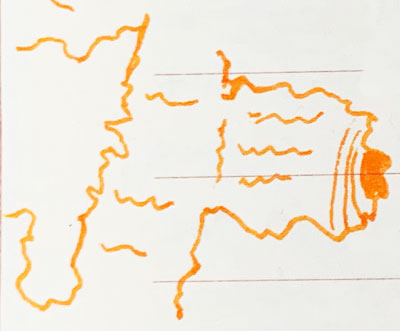
The lagoon and entrance to the underworld There I was, floating high above this lagoon surrounded by rocks and yellow sand. It was filled with shallow, stagnant water. On one side there was an entrance to what I knew was the underground water system, a deep hole that went down into blackness. This was a different pool than the one I usually go in, and though I was tempted, I decided not to explore, as the tide was getting higher (I knew it was 4:15 AM, later than I’d usually go, which meant I’d get back too late) and I didn’t have someone with me to navigate the curving passageways to air pockets. I could drown!
Planning Underworld Trips: Written at the time: “My thought when considering the underworld was that I’m usually back by 6:20–7:00 AM, and leaving at 4:15 AM wouldn’t give me enough time to get back. To consider I keep timetables and schedule events in my dreams according to waking times is incredible!”
Is there some kind of energy tide? It’s odd that my dream self, native to the astral world, would consider drowning to be an obstacle in its larger plan-making.
-
Something Wild In Dreams 2000 • age 25
While we waited, we talked. They asked how far it was and I said it took about 3 hours to get to the puzzle chamber where I had once gotten, but had lost my light and been unable to solve all 3 puzzles. They were large chambers, reminiscent of underground video game dreams. But my friends balked at the time, especially as we had spent 15 minutes waiting for the witch woman’s gift. Soon after that she reappeared, still green and monstrous but far less dead-looking and afraid. She presented me a hard hat with four flashlights containing full batteries! Thrilled, I strapped the hat on and continued, but I think the others had left.
Planning to Be Back in Time
This feeling of needing to be back in time to wake up also applies in a general fashion to any dreams that involve travel. Even after all this study of the dream state, I still have the impression that I have to get my things and return home, when I could just simply wake up mid-adventure.
-
The Nightly Schedule
I ran into Marco B and he wanted to show me something at this music store called “Kirk”, but Buttercup and I ran out of time and had to start getting back home. It was 5:50 AM. We ran through streets until we found a familiar subway stop. I expected something like a plane flight after the subway to get home.
Awareness of the Time: This shows an awareness of the time of night, and a realization that my time in the dream world is running short. Buttercup and I mistakenly believe we need to get back to our bodies in time for the alarm, and make the typical rationalized journey back — fast travel (subway) to faster travel (airplane). Perhaps the subway is an opening to traveling the greater astral currents back.
-
The Tree Clearing 2024
Buttercup and I are driving to work. I feel like it’s a good 15-minute drive. I’m mad, thinking about the trees. About 10 minutes in (it seems), I realize I should get pictures of the tree rings before they’re cleared away. I separate off from the main car in my own car and do a U-turn in the road. . . . As I drive, I wish I’d turned around earlier because it’s a long drive back to the house and I’m going to be late for work.
Heading Back for Work: It’s morning and we’re traveling back “for work”, which is accurate, since it’s a work day for us. This is the first time I remember having a feel for how long the journey back was — 15 minutes in this case.
-
My Other Kids 2025
Hazel and her friends had decided to relocate to someone’s house further up the mountains. . . . I ended up in a car with some of them on the way up to the mountains. As we arrived, I realized morning was coming. I asked the way back to Atlanta, and realized it was back the way we’d come, and that I shouldn’t have made this last trip. I wondered how I’d get back.
-
Heading Home 2025 • 8 AM
My alarm was coming soon, so I was getting ready to come home. I was at my junior high school, and so I went over to get my things from the elementary school next door.
-
Disney Park Madness 2025 • 3:45 AM
3-4 AM is the hour of MADNESS!
It was night, and I was lost in this huge Disney theme park. . . . [I run around in a delirium, searching for things]
It was getting late and we were anxious about missing our flight back home at the end of the night (this was just a day trip). The place was very, very hard to escape from, a multi-level maze with endless passageways, rooms, and distractions.
The Flight Back: This one is strange, because it’s 3:45 AM. I usually sleep until 7:30 or 8:00 AM, so there was actually plenty of time left. These 3-4 AM dreams are something different, and I wonder if it’s another level that I go to. Perhaps I needed to return to where I was previously by 4 AM.
Knowing When to Wake Up
This subconscious knowledge of the exact time of night can be called upon to wake ourselves up at a specific time.
-
Pictures of Dreams 1997 • age 22
I needed to get up for breakfast at 8 AM without an alarm. In the dream state I was looking at pictures, reminders from other dreams, and each picture had a little sound bit recorded with it too. The last was a picture of Buttercup saying “huh-huh”. It repeated over and over and the sound seemed to be coming from waking life, in the room. It repeated until I was fully awake and aware, just in time for breakfast.
Sub-Waking Sounds: This internal alert to wake up came through the context of the dream.
-
When Everyone Stopped 2006 • 5:45 AM
I’m dreaming that Buttercup and I are on an early AM trip to do some shopping in an area a bit northwest of downtown Atlanta. It dawns on me that it’s before work, a weird time to shop, but realize we have several hours (somehow knowing the right time of night).
Time Awareness: Here again I’m aware of the time of night, and the upcoming work day. Dreams like “Bedroom Soccer” reveal that I often know I’m dreaming, even if I don’t do anything special with this knowledge.
Awareness of the Upcoming Day and Plans
-
Gliding Soccer 2003
So it’s Thanksgiving morning and in the dream I knew it. I was heading back to the soccer field. . . . So when we saw a huge group over the hill, we went to them (we glided over) and started a larger game. My thinking was, “It’s Thanksgiving morning, so we don’t have a game today, but I can play for about an hour, and hopefully still have time to finish setting up my new computer before we have to go over for Thanksgiving.” Now everything about this thought was true in the waking world, except that as it’s my second day off, I assumed it was Sunday. So I played a little soccer, but with all the gliding, it almost immediately rationalized into hockey. I played a few minutes, then woke up with plenty of time to get done what I need!
Awareness of Time and Date: In the dream I’m aware that the upcoming day is Thanksgiving. I also knew exactly when to wake myself up.
-
Earth One 2005
Outside we find a ton of people laying down in the grass, in contact with each other, watching the sky. The sky is a wild sight with planets and bright lights. But every moment is a joy on Earth One. We live on Earth Two. Earth Three is constant war. I return to Earth Two, so as not to be missing for Buttercup’s birthday tomorrow (the upcoming day).
Incoming Birthday: Here I know I need to get back to Earth Two for Buttercup’s upcoming birthday.
Aware of the Physical Body’s Position
-
Careful Freak Out
I dreamed that there was a horrible caterpillar thing on my leg and violently shook my leg, but while my reaction was sudden and so violent as to wake me up, I noticed that I carefully twisted the angle of my leg when I shook it so as not to kick Buttercup who was sleeping right next to me.
Levels of Physical Awareness: There was a part of me aware of the fact that I was in bed dreaming and that there would be a physical consequence to my proposed action. In that split second, it caused me to alter the direction of my violent leg shake!
-
Dreams Inspire Life 1996 • age 22
Much pleasantness! I dreamt of South Hall, with lots of crazy fun, like we have before classes start. Friends and I were climbing on furniture, giving away stickers, being loud, creating art, and playing together. At first, Brad H was the only familiar person there. The action spanned the lobby, the RC’s room, my room, and the bathroom. While playing in the lobby, I saw Buttercup on the couch and was overjoyed! In waking life I turned, wrapped myself around her, and squeezed her. Back in the dream we continued to play.
References: South Hall was my dorm at Oberlin.
Cuddling in Bed: I felt so happy to see her in the dream that I shifted my attention to the waking side briefly to snuggle up against her, then refocused in the dream.
-
Guided in Dreams 1996 • 5:05 AM • age 22
Buttercup and I communicate so subtly when sleeping. I sensed fear in her and gave her rhythmic squeeze pulses to remind her it was a dream, to remind her of the physical.
Comforting Her: My intention was to pull her out of the dream enough to realize she doesn’t need to be afraid.
TO DO: Now go back to the top of “MetaDreamer” and answer the question there. Is this a separate thing?
The Dream Self
The dream self is a focus of consciousness that’s a specialist in the astral frequencies of consciousness (the dream world). It’s aware that it’s dreaming, and aware of the various laws of dreams. It has its own continuous memories and a deep knowledge of how to navigate the astral plane that our waking self focus doesn’t.
It grew up in the astral world at the same time as our waking self grew up in the physical world. It had to learn how to operate there just as we had to learn how to walk and talk. These selves (and higher ones) were far more connected in our first 7 years of life before the barrier between them began to strengthen.
In childhood and in the dream state, each personality is aware to some extent of the true freedom that belongs to its own inner consciousness. . . .
Many of these freedoms are quite natural to you in the dream state, and you form dream environments often to exercise such potentials. (Roberts 22-23)SSchanneled • modern • Seth
Aware of the Waking Self
While mostly engaged in its own adventures, the dream self shows a casual awareness of the waking self at times.
-
Befriending a Ghost 1997 • age 22
I was in a house that was haunted, trying to interact with ghosts. Certain parts of the ghosts would phase solid and I’d grab them or push them. Then I met a girl who was killed on December 17th or 21st, waiting eternally for Xmas. I attempted to befriend her. . . . Suddenly inspired, I tried to tell her I was studying this kind of thing on the earth plane. I told her about death and what happens afterwards, the pure essence, and more.
Cross-Plane Awareness: My dream self knows the difference between the astral plane and the physical plane, and I’m casually aware of what I’m studying in the waking world. Feeling “suddenly inspired” is that memory connection between the dream focus and waking focus.
This is a very physically-oriented dream. Ghosts are a physical-world phenomenon (seeing astral bodies from across the border), as is the thought of them as being insubstantial. So my dream self is in a rote of a ghost story from the physical, but knows that the experience isn’t physical and that I have a separate life on the physical plane.
-
College Celebration 2022 • 7-8 AM
I’m at a college that I often go to in my dreams. It’s mixed in with Oberlin. It’s dim, early-morning light. There’s a celebratory atmosphere, and I’m interested in this girl. . . . I find the girl and talk to her after the concert. She’s on her way somewhere and has to go. She isn’t very interested in me, and I grow bored in my pursuit. At one point I was composing some message to her on a tablet computer, made up of a bunch of sub-messages. One of them is funny — it says ”something something my wife” (referring to Buttercup). I put it in there, but then hesitate. Oh yeah, I think, I shouldn’t mention my wife from the waking world to the girl I’m pursuing in the dream world. So I remove it. My dream self is clearly aware of my waking self and the agreement we have that I am free to pursue romantic connections in the dream world. When my waking self is in charge and unaware that I’m dreaming, I always put a stop to it.
The Romantic Agreement: After passing up all these romantic opportunities in dreams due to my waking self having a girlfriend/wife, I decided I need not deprive myself of those kinds of experiences in dreams. Romantic connection is one of my greatest delights. So I decided to be okay with that. Of course that could only happen if I was aware I was dreaming at some level. And I find that I usually am.
My dream self is aware of my waking self, but has its own life and doesn’t always think about it.
-
The Deep-Haunted School 2011
I’m in this college-like school. The school was bustling with living students and ghosts. I alone can see the ghosts. But I can see something else going on as well. As my eyes tune further into the spiritual frequencies, I see that the ghosts are being attacked by a deeper level of ghosts — the ghosts of ghosts. . . . I tried to record everything with my iPhone, with photos and videos (this has been a trend in my dreams lately) to see what this all looks like to the physical world. . . . [I have more interactions with ghosts and deep ghosts]
Then I began to frantically write down the details of the dream in a large book illustrated with stylized ghostly drawings. Earlier I had tried to type out details on my iPhone, and then tried recording a sound memo. I wanted to remember this dream! And I did!
The Dream Self: Let’s consider this. . . . I’m in a dream of a ghost-haunted school with living and ghost students and monstrous “deep ghosts”. It’s so unusual, even for a dream, that I wanted to record it to see what it looked like in the physical world! All of this I accept as real, but not the physical world. This is an accurate view from the dream self focus. My waking self is not engaged or I’d likely feel terrified. Yet I’m using waking self techniques to record this, thinking it’ll be available when I wake up.
Later I tried to write down details both on paper and via my iPhone. This may have been a false awakening of the waking self, or a continuation of the dream self’s efforts. There are only two states where I’d write down a dream while dreaming. The first is from the waking self (or fragment) believing it’s already awake. The second is from the dream self, unaware that these recordings can’t be accessed in the physical.
Mixed Focus
At times it’s difficult to tell if we’re focused in the dream self or waking self. We sometimes seem to be drawing from both simultaneously.
-
The Worst Way to Get to Narnia 2017
Myself and another person who had been to Narnia before were preparing to go back. We’d gathered about 10 friends in what felt like someone’s room on a college campus. The two of us were explaining how we were going to get there. I said “We don’t know what the gateway will be. I use the term gateway, but you could say portal or door. I would love to get pictures, but I’m not sure if your phones would work there. In fact, the gateway could be through water, so decide whether or not you want to risk it.”
Running Tours: Fascinating! This seems to be my waking self, using its knowledge of gateways, and fully believing we’re going to find one (we do). I’m accessing my dream self’s memory of the surrounding areas, but at the same time believing we’re in a physical place where phones operate and can break when submerged.
-
The Underworld and Lava Flow Map 2000 • 4:15 AM • age 25
There I was, floating high above this lagoon surrounded by rocks and yellow sand. It was filled with shallow, stagnant water. On one side there was an entrance to what I knew was the underground water system, a deep hole that went down into blackness. This was a different pool than the one I usually go in, and though I was tempted, I decided not to explore, as the tide was getting higher and I didn’t have someone with me to navigate the curving passageways to air pockets. I could drown!
Astral World, Physical Rules: I considered entering the underwater catacombs — something I would never do in waking life — but didn’t have someone to help guide me to air pockets so I don’t drown. This shows that I’m in some cross focus between the dream self and waking self. I’m very versed with astral phenomenon, but also believe to some degree that physical laws matter. Are these just little ingrained physical concerns bubbling up into the dream self focus?
Informing the Waking Self
When my waking self connects with my dream self, the dream self can impart some of its astral knowledge to help me through a situation. It’s as if I draw back from one focus enough so that I can see and consult with both.
-
The Sliding House 2023
When I turned around, the driveway had become an asphalt cliff face going up several stories. There was a strange wooden elevator in it, and I used it to ascend, but it was broken at the top. I tried to figure out where to place my hands and feet to get out and over the cliff top, and was having little luck when I realized I could just think “up and over” and I’d fly right over it, so I did.
Just Fly: I was stuck too hard in my waking consciousness here, having a hard time. My dream self imparted a bit of knowledge to help me get past my imagined physical limitations.
-
Bedroom Soccer 2023 • 7:30 AM
There are a couple people like waiters managing the place. I go up the first set of stone stairs. They’re collecting the baby snakes that they keep finding. This comes from an earlier dream, or a dream from a different night. These baby snakes are a wide variety of snakes, including a white one I called “needle snakes” because they had regular needle-like protrusions coming off their sides, almost like legs. I got distracted by these snakes, which were all over the landing area. I thought about bringing one (not a needle snake!) along with me, putting it in my pocket. This resulted in something like a back and forth between my waking self and dream self. The waking self had this (odd) desire, but then my dream self told me I wouldn’t be able to bring it with me . . . to the waking world? Was that my intention?
A Cross-Self Dialog: The desire comes from the waking self, but the dream self, knowing better, informs me that it won’t work. This is an interesting point of dialog between the selves. Both thoughts seem to come from “me” quite naturally, but they come from different focuses. Like “I want this! ..Oh yeah dream rules.”
Consulting with the Waking Self
In dreams I can easily shift focus to the waking self to consult with it. In this way the dream self can access its knowledge and memory of waking life.
-
Atlanta, Nuked 2024
I was informed that a nuclear bomb had hit and destroyed Atlanta. We were in the northern suburbs, out beyond the radius of destruction. The roads into the city were blocked off. There were groups of militant people, dressed in black. There were also a lot of white-faced clones. I found my way into one of the groups. At one point I inquired who had launched the nuke, and was told it was Japan. At that time my waking self gave it a lot of thought, wondering why. It was like a short-term shift of focus towards the waking side.
Working Together: This is interesting. I shift my focus to my dream self to my waking self to interface with its knowledge of world affairs to try to understand the situation.
-
Me and Taylor 2024mature content
I start to talk with Taylor and I’m being clever and funny. We leave the roof and walk down the hallway together. She pulls me into a bathroom and we kiss. She begins to initiate sex, and I hesitate for a moment, remembering that I’m married. Then I realize this is the dream state and go for it. It’s wet, and brief, but good.
Permission Granted: I check in with my waking self, remember I’m married, but realize at some level that I’m dreaming and that it’s okay to proceed.
-
Not Dreaming 2024 • 4:10 AM
Last night was my first success at my iPhone playing a lucid dreaming alert at a certain time. At 4:10 AM it played the second alert. My attention jumped to the physical, and I thought “Oh, it worked! But it’s the second message (the wake-up one). Too bad I’m not dreaming.” I went back to sleep. I felt I was thinking, perhaps, rather than dreaming.
-
The Fulcrum 2025 • 6:50 AM
I realized that [Wilson’s house] rested on a delicately balanced “fulcrum”. A long floor board ran the length of the building under both apartments, with a fulcrum in the center . . . [adventures continue]
Here I use a word in the dream state — “fulcrum” — that I almost never use in waking life. I was using that word when talking to people about the issue. It was definitely my dream self saying it, as it navigated the building’s hyperspace without surprise. I recall a moment of recognizing this balancing, rocking effect in the dream, and shifting focus towards the physical to get the answer.
The Fulcrum: Here I shift to the waking self to get the right term for this physical effect.
-
The Funny Show 2026 • 5:30 AM
I made up some lie about why I was there. The lies then piled on top of each other, and got ridiculous. At some point I was singing this duet with a girl that we were making up on the spot. It turned out really good and as the liar I promised to record my part of it. But after a short consultation with my waking self, I realized that I wouldn’t actually do that. The scene was over, and I felt bad lying about the song, so I went back to tell her, in case she went through the effort of recording her side.
Checking In: I meant to record my part of it, but after so many failed recordings in the past, my waking self said it wouldn’t work in the dream state. Oddly, I didn’t go on to apply that fact to her being able to record it.
-
The Old Forest 2026 • 5:30 AM
I was in my run-down castle-like home in the old forest with the giant trees and no underbrush. I was talking mentally with someone who wasn’t present, and they mentioned that the huge trees around it could fall (a sore spot with me since people are cutting down trees left and right because “what if they fall on my house?”). The voice said there were five sister trees right next to the house, each 8 feet across. I had just flown a circuit around the house and said “there are two that are 12 feet across.” I was proud of these giants, but they were old. The forest was old, in a state of slow decay.
Cross-Focus Talk: I think this may be a conversation between my dream self and waking self. I’ve never noticed a communication before where I didn’t know who I was talking with. My dream self is in this old forest scene, and it’s possible my waking self brought up a sore spot that the scene triggered in it.
Limited Access to Waking Memories
If you have little memory of your dream locations when you are awake, then remember that you have little memory of your waking locations when you are in the dream situation. (Roberts 10)SD&Pchanneled • modern • Seth
Non-lucid dreamers suffer from a state-specific form of amnesia, so that while awake they remember their dreams only with difficulty, and while asleep they recall their waking lives through a carnival mirror, darkly and distortedly, or not at all. (LaBerge 3)LDLDer, researcher • modern • LaBerge
Aware of Its Natural versus Dreaming State
The dream self has its own ideas of what it considers dreaming.
The dream self considers its social activities in the astral and near realm as “not dreaming”. It contrasts that with rotes, reveries, and subjective states that involve projection and rationalizations, which it considers “dreaming”. It’s aware of which state it’s in and the distinction.
When the waking self pops into the dream state to inquire if it is dreaming, the answer from the dream self is always “of course”. It is responding in the physical self’s context that this is not a physical experience. That said, the dream self still has its own distinctions.
-
Flying in the Aviary 1996 • Middle of Night • age 22
It’s a glorious bright land and I’m flying through the air! [I have adventures at the Aviary]
I’m flying, then FLASH — I’m visiting and pestering Kayla. She has a date for something but it doesn’t bother me. I try to do backflips but it’s hard. This feels more “real” and so I felt I couldn’t fly here. Kayla and her date get on a bus and I join them. As the bus starts to move, she complains to a girlfriend of hers who’s having sex. Since she’s annoyed, I say “Hey, let’s go to sleep! Do you fly? I’ll take you to this place!” I settle down to sleep on the bus, but instead of going to the Aviary, I drift awake in the physical.
Dream Transitions: In the dream self focus, I consider the more real social dream with Kayla to be “awake”. I know I can get back to the Aviary by “going to sleep”. I’m confident I can take her with me, and I probably could.
Instead, I woke up in the physical world.
-
The Bombing and Revelation 2006 • 6:25 AM
I’m hanging out with Mordred up the street from Raven’s house. He blows up their front door and the surrounding area with a bomb. . . . I’m in a really dazed and unthinking mental state. I talk it over with Mordred, and tell him I’m going to talk to Raven, but think of course I won’t reveal who’s behind it.
So I visit Raven, but more lucid. She greets me warmly. Her brother stops by. She talks about burning her hand and being cured by some product made by bees. Then I broach the topic of the bomb. She jumps on me, furious, demanding to know what I know of the bombing. Her eyes are vivid and focused on me. I start to explain how I was walking along, “Observing and listening to two people, but in this dream state”.
I Was Dreaming: The dream self is making a clear distinction between when it is dreaming and not. What is likely a rote about a friend bombing a girlfriend’s house is considered a “dream state” to the dream self, who now is socially engaging with Raven in the astral, something it no longer considers “dreaming”.
-
Bedroom Soccer 2023 • 7:30 AM
This game seems silly, and I feel tired. I walk over to the bed on the far side of the room and get in. . . . I stay and snooze.
Then I remember leaving the soccer field and going down a road. . . . [I park the car and go into a cafe] I went in and sat down at a long table in the enclosed area. I was here for a while, and I felt like I knew a bunch of the people there. I talked with various people. At one point I asked myself, “Am I lucid? Do I know this is a dream? Of course!” Then this girl showed up and sat down across from me. I recognized her in the dream and said an excited “hello!” We talked, then I decided I wanted to fly.
What Is Lucidity?: After watching Bodhi play soccer, I laid down on a bed and fell asleep. Perhaps that’s the transition that causes the dream self to call the next part a “dream”.
When question of if I’m dreaming occurs to me, the obvious answer is YES. It seems like such a silly question at the time. I’m well aware that I’m dreaming and it’s not a big deal. There’s no change in the light or sudden burst of energy or anything. I’m just dreaming again, like I always do. The only result of the question is the habitual desire to do some flying.
-
The Slumber Party and Scary Man Prank 1999 • age 24
I knew this wasn’t a dream all night.
It was night. There was a group of us in the front room of a house. . . . It was like a slumber party, except everyone started out sleeping and slowly woke up. . . . At first there was fear in the room. Only Buttercup and I had awakened. Someone gave a warning but I knew it was just fear. I must have been talking about thought forms, because some of the nonlucid sleepers had expressed doubts about the reality of them. Since I KNEW they were real, I decided to play around with them and practice making some thought forms.
The Dream Self as Itself: This is the reality behind dreams — a social, out-of-body gathering of friends in the astral. My dream self considers this not dreaming. To it, the stories we share, the little reveries, the subjective spaces we go into — those are the dreams. And that’s true, from that perspective. The house we were in was not painted over with rationalizations or projections from my waking self. I knew all about dream reality, about thought forms, but my waking self wasn’t fully engaged, or I’d be extremely excited. I’m just calm, in this familiar space I go to every night.
Now contrast this with “Bedroom Soccer” above in which I’m projecting a full outdoor landscape around me. It’s taking the shape of my room, and I’m projecting my childhood bed over my real bed. Even as I walk away, a car rationalizes around me and the hallway I’m walking down is a road with houses all around. My dream self considers this obviously a dream. It’s astral but very much influenced by my projections. I’m “dreaming” — in other words, I’m projecting my environment.
-
Gwen’s Birthday 2024 • 7:15 AM (1:45 later)
Buttercup, Bodhi, Gwen, and I were on a trip in Emma & Alfred’s RV, which was the size of a large house inside. . . . At some point it was Gwen’s birthday party, which took place on the top floor of the RV. . . . The top floor had gradually transformed into a huge Toys R Us, which was just the bottom floor of an even larger mall. . . . I walked over to someone standing in an entrance line. I said something like “This Toys R Us used to be the top floor of an RV!” She looked at me like I might be crazy. I continued, “It’s because this is a dream.” She just stared at me. I said “Hi, I’m Benji, father of the birthday girl.”
Everyday Awareness: My dream self is aware of when it’s dreaming, and aware that things that seem physically odd can be explained by this fact. This does start out like social dreaming, however. I see three options: 1) It might have become a “dream” when the scene changed to Toys R Us, 2) It might have all been within a rote, or 3) My dream self was referring to “dream” in the waking sense (this not being physical).
Additionally, note that my context is long enough to remember that this store is the upstairs of an RV. If my context were shorter, I would have forgotten that.
-
Dream Aware 1997 • age 22
Buttercup and I were staying in the Dark Tower. It was really vivid and cool. . . . There was some game or something there, too. I was quite aware that this was some altered state and I told others about “my dream”.
The Dream Self: It’s not uncommon for my dream self to refer to previous experiences as dreams. I suspect it may think of rotes as dreams.
-
Friends and Dream Awareness 1997 • age 22
I dreamed that Buttercup was off visiting some lame old guy. When she returned, there were love notes written on her glasses case: “Do you flirt with Benji like you do with me?” and so on. I was in a jealous fit and said “Well this is a dream anyways.” I left this bigger version of our room through the window and came back in through the window above. I was now in Blaine House and I was saying “It’s a dream, right? I’m in a dream.” I had a hell of a time putting on underwear, pants, and shoes.
Then Brendan and I went into the garage. I thought I had forgotten my glasses and contacts because I couldn’t see clearly. I said “Clarity now!” and my vision became clear. I was about to start flying and trying to go OB, but got distracted. Savannah came by. Brendan and I started doing cartwheels in a huge mud puddle. Then I saw a stump that had turned into artwork. Ruby started telling me about her friend Kari’s tragic marriage. After all these distractions I forgot I was dreaming. So close.
Buttercup’s and my room was mixed with Wadsworth and Emma’s room, with the green rug and big open space.
Lucidity and Distraction: After getting emotionally drawn into jealousy, I get tired of it and take a step back to my dream self, who knows that it’s a dream. I then do some interesting navigation out and back in through windows, likely as a technique to end the “dream” I didn’t like. I end up at Blaine House but I’m unsure if I’m still dreaming. I begin socially dreaming with a bunch of friends, which is typically a situation my dream self considers “not dreaming”. The idea that I’m dreaming leads to the usual desire to fly, but I’m distracted by my friends.
This is my typical dream self awareness — I don’t think I was particularly close to waking self lucidity here.
Going to Sleep in a Dream
At times when we’re hanging out in the near realm with friends, we can “go to sleep” within that state to experience “dreams”. The near-realm state is a more physical focus. We “wake up” from these dreams back into this near realm focus. Sometimes this appears as a false awakening.
This can also occur from within an astral environment, or from within an ongoing dream.
At other times, we may feel tired or bored and just lay down for a nap within a dream. This is often just a short rest, until another dream character wakes us up, or we wake up on our own.
-
Adventures in Northtown Mall 2001
It seemed as if at first there was a class because Meagan was sitting next to me. I asked her out and she said no. She was dating this jock Peter, who I hated, so I made up some rude lies about him. She was shocked and went to chew him out. Meanwhile, I curled up on the floor to fall asleep. Was I about to pass into another dream? It was all dark and still and I felt sleepy. But before long I felt a kick, and then another. It was Peter, waking me up. He asked “What was that all about?” I didn’t know what to say to him, so I apologized.
Nap Time: I must have felt tired, as I lay down for a nap. But the plot I had set in motion continued, with Peter returning to wake me up.
-
Rolling Snowballs 2010
Buttercup and I had gone to the top of this snow-covered mountain overlooking a wide, open valley. . . . Everything was as if bathed in dim moonlight, and it was hard to discern slopes and edges. After getting a little panicky about being too close to the edge, we decided we’d have to stay the night up there. I wasn’t afraid of the cold, however, and I burrowed a little hole in the snow. I tried to get Buttercup to join me but she didn’t. My little burrow was cozy and I think reflected the shape of the comforter and blankets around me.
After drifting in and our of sleep here, a woman came by and we talked to her briefly.
Asleep, Dreaming of Sleeping: It’s not unusual at times to dream of going to sleep. In this case, as my attention was on going to sleep, I think my awareness moved towards the physical a bit, as my burrowed hole was the shape of the blankets around me.
-
Bedroom Soccer 2023 • 7:30 AM
This game seems silly, and I feel tired. I walk over to the bed on the far side of the room and get in. There’s another little girl napping in there, and I crawl in to the center of the bed. For a moment I wonder if this is something I shouldn’t do — getting into a bed when there’s a little girl sleeping there.. but I stay and snooze.
Then I remember leaving the soccer field and going down a road.
Time for a Nap: Perhaps the appearance of my bed and my recent wake-up was the reason, but I felt tired and wanted a little nap. Maybe this serves as a transition from NREM “hanging out” situations to fully immersive dreams. In this case, it washed away the bedroom overlay and I was on my way again, without the limitations of the room shape.
-
Dr. Hoddeson 2025
After snoozing the alarm, I found myself in a doctor’s office. It belonged to Dr. Hoddeson, my ENT. I was sitting on the hospital bed trying to figure out why I was there, but I was sooo tired. . . . [Dr. Hoddeson] then walked around the room, doing various things. I was so tired. I gathered up the sheets like in my real bed, laid down, and closed my eyes. I could hear him talking to a nurse about some new medication to try. After a bit he woke me up to drink as much from this bottle of red liquid as I could take, and so I sat up and had a sip.
Sleepy in Dreams: I sometimes have waves of being tired in dreams. This is an especially strong one. I’m resting my eyes in the dream — not dreaming, but rather listening to the doctor going about his business.
-
Stealing the Password 2025 • 3:45 AM
The first thing I remember is a sort of stand-off with my boss. . . . He’s trying to subtly antagonize me into revealing if my server is at home or elsewhere by suggesting that I “go home, to the garage” to turn off the accounts, as if they’re hosted from a computer at my house. . . . I arrive home in our present living room and close all the blinds. . . . It’s mostly dark (as it actually is) but there is some dim light. My goal is to go in, change the password, and secure the computer. But I fall into a short dream. . . . Waking up, I find most of the blinds are OPEN, and I wonder if my boss’s guys are outside, somehow messing with the blinds to observe me. I close all the blinds again, one by one. I fall into another dream. . . . [It’s a dream about Christmas]
Just then I hear three loud BANGs. I’m suddenly back in my current darkish living room where I was dreaming, and the three front-facing BLINDS ARE UP.
Near Realm Dreaming: Twice after returning to my home in the near realm I fall back into dreams, then reawaken in the near realm.
-
The Reverse Gate
Myself and two others were painting on a blackboard. I had the idea to run at it and go through it like a gateway. I asked someone to try. When they approached it I shut my eyes. When I opened them the person was gone. The second person did it, then me. I had been thinking that it would open a reverse world and it did. . . . We spent much of our time on the reverse side, as it felt like new. . . . There were periods of darkness when it was quiet and I was “asleep” in bed in the dream — an awareness in the astral level of the waking world.
Periodic Sleep: We regularly return to the near realm, a focus closer to our physical body.
Pulling Out of Dreams
Since the dream self is aware when it’s dreaming, it can make the decision to leave an unpleasant dream and return to its previous focus in the astral or near realm.
-
Lucidly Ending a Bad Dream 1997 • age 23
This dream happened while we were sleeping in the car while parked at a Texaco, me leaning back and Buttercup laying across me. The dream, somehow, took that very shape, like the buildings were modeled after us.
It started with Buttercup and I getting really high. Then she said she wanted to go out alone and I couldn’t believe it. She was wearing a low-cut nightgown top and lots of necklaces. Phil started talking to her cleavage and drooling so I hit him with a towel. He was really upset and I wondered how justified I was.
Then I recall fog, darkness, then a JUMP! Buttercup and I are in a car teetering over a cliff, but she is able to back the car away from the edge. She is injured in the back so I carry her, floating part of the way, to safety. I ask what happened and I see the story of this guy holding her by the jewelry out the window of a building and my rescue attempt which got me beat up. We leave the building. It’s dark as anything outside and this guy starts following us. I tell him off but he continues.
Then darkness and JUMP! I’m pulling consciously out of the dream. My desire for happy experiences with Buttercup is behind it. I “open my eyes” and it’s so dark in the car but there’s Buttercup in full color and light laying across me (my eyes are physically closed). She turns to meet my eyes and I pour love out to her and say “Sorry, I love you” and she expresses the same to me — a very nice moment, and very clear. Almost lucid. I felt the dream pulling me back at one point but willed myself to remain in this happier space.
A Greater Self-Awareness: This dream illustrated a greater self-awareness. In my dream self focus, I realized I was responsible for taking part in the horrible dreams I just had with Buttercup and when I saw her in the near realm, we both knew the unreality of what had just happened in the dreams and chose to replace the negative feelings with our true feelings of love. Thus a false dream gave way to a true experience.
-
Finding Bodhi 2025 • earlier
I dreamed that Bodhi was lost, that I lost him in a crowd after his last soccer game. At the point my memory starts, he had been missing for a week. . . . I went to the area where I had last seen him and began calling for him in loud, desperate tones. After a few minutes I heard his “Papa” in response. I followed it and came to a building. A door opened, and Wilson and two people I didn’t recognize walked out, purposely ignoring me, walking past. I looked in the door and there was Bodhi, sitting on the concrete floor. I ran in and hugged him tight.
After a moment of hugging, I pulled entirely back from the dream and woke up briefly. It was with a feeling like “that’s enough of that”. I remained in bed, thinking about the dream and other things, then eventually fell back asleep.
That’s Enough: My dream self ended that dream quickly after finding Bodhi. He might have actually been responding from the near realm, after hearing my calls for him.
Controlling the Plot
When the dream self creates a dream, it can control its plot.
-
The Buried Building 2024
The next thing I remember I’m back at the bottom of the hole. . . . I’ve brought a bunch of people with me to show them the building. They mostly stay behind me, out of my direct awareness. . . . In one room, there is a door slightly ajar, and I imagine that inside is a crazy man with wolf ears, patches of fur, claws and dark eyes. I see him now, fully imagined, and the wall is like a panel of glass. The doorway is just around the corner, so I go in. The wolfman is inactive. The walls are covered with shelves containing jars and things. I’m aware at this point that I’m editing the story. I narrate that “at this point, something small happens, but it’s the most important moment of his life”. I zoom in and time slows as the wolfman picks up one of the jars to look at it, and a tiny spider climbs down onto his hand and bites him. The bite makes him indestructible. That scene finished, I mentally unleash the wolfman and I (as the character I’m inhabiting) do battle with it. I end up outside the room, with the door cracked, giving the wolfman a neck massage. He calms down and joins us. We explore other interesting rooms.
Changing the Rote: When I return to the buried building, it’s with an audience. I don’t see who they are because I never focus on them. Instead I’m reliving the original rote but changing it, sometimes consciously, sometimes not. I was aware that my desire for drama created the wolfman and I was consciously narrating the part about the spider bite.
-
The Underworld and Lava Flow Map 2000 • 4:15 AM • age 25
So instead I ventured out into a foot-deep blue channel closer to the ocean. I thought about how I’d planned the Jurassic Park 2 dream I was having before. A black lava flow map of the island used in the first movie appeared before me, and I retraced in my mind where on the island all the events took place. I thought, “Yeah, that was a good, thrilling movie.”
Dream Planning: Here I find myself recalling how I had planned an earlier dream based on Jurassic Park, which was a thrilling dream. I’d purposely thrown myself into a dramatic, exciting conflict for the fun of it.
-
The DeadStorm 2010
I was in a writing class with maybe 8 other students. In the first part, we had to write something. I was writing a story, though I don’t remember what it was about. I remember looking down at my writing and it was strangely scribbly. It looked like how I wrote when I was in elementary school and still getting some of my letters wrong. The teacher told us to stop writing for the next part of the class, but I just had to finish up my thought. He came around and poked me hard in the back. I stopped, but then said seriously to him “You will not poke me in the back like that again.” For the next part, he handed out these stamp kits. He had us pass our stories to someone else, and we were to take the stamps and stamp words on their story in funny or appropriate places, which sounded like fun.
It’s likely the next part was the story I was writing during class. This is a version of “The DeadStorm”, an event in a fantasy novel I hope to finish one day.
I was in a medieval village, with lots of people everywhere. It felt sort of like a Renaissance Festival but everyone was in costume and it went on as far as the eye could see. There was a storm overhead. I was in a black tent building selling swords and various things. I floated out and peered up at the storm. “Wouldn’t that be cool if there was a black path of the storm coming right overhead, like a dark road?” I thought, and looked up to see it become so. “Darker,” I thought, and it darkened. “Darker still,” I thought. Then I turned to one of the villagers and cast words into his mind, which he spoke, “What dark and foreboding sign is this in the clouds?” Then with glee, I asked myself, “So what comes down this frightening dark path in the sky? Demon horsemen. The undead.” I looked up, and there were the hoofs of horsemen showing through the dark clouds in the sky, galloping overhead. “Hmm.. I wish I could see them better.” I drifted into the black tent building and thought, “Let’s try this.. footsteps on the roof!” and as I looked up, skeletal footprints pressed down on the cloth fabric of the roof as the walkers on the Dead Storm passed more closely overhead. The medieval villagers were deliciously scared. I was delighted. “One should burst through!” I thought. So one did; a skeleton tore through the fabric, landed, and with a wave of his hand, pulled the soul from a villager. The villager crumpled before him, leaving the golden sparkling circle of his soul slowly fading out.
I floated outside again and looked up. I decided to try to make the cloud riders more visible. “Let’s try this,” I thought, and the dark cloud path became wispy and transparent and the riders became visible, but it didn’t really work without the dark cloud path. It wasn’t as scary, so I brought it back. But them descending from the path worked really well. So I called one down out here where a ton of villagers were standing, practically evenly spaced along the road. A demon man came down from the sky this time and landed in the road near me. “He’s going to take the souls of everyone around him!” I dictated, and since I was standing near him, I thrust my hands out and released a wave of force, propelling me backwards and up the hill just in time to avoid his death spell, which killed all the people in a 30 foot circle around him.
I awoke at this point, and it was the most gentle awakening. Still interested in the dream, and still possessing the exact same consciousness that was directing the dream, I continued it in my waking mind. “Now it is time to take my vengeance against you, demon.” I thought, and I took the form of a powerful angel with curly flowing blond hair. I held a long shining blade in my hands.
The imagery here was as bright and memorable as the rest of the dream. It was taking place in the exact same mental place and generated by the exact same part of the mind. Continuing:
I felt a moment of fear and since I didn’t want to be touched by him, I summoned an array of daggers and blades of light to surround and circle me, then lifted into the air and dove for the demon man. In a flash he was gone. I rose to the level of the dark cloud path and lifted my hand and shone a beam of intense light down the cloud path, dissolving it and breaking it up. I did the same in the other direction. Being that I was awake, I moved my hands physically a little as I was doing this, in the fun of the moment.
The Dream Self: I begin in my dream self focus, in a writing class. As I begin to write the story, I enter an immersive subdream in which I’m actively creating and living through the story from the inside. I’m creating drama for the story, but everything is my creation — there’s no need for fear or rationalizations (I float about at will). I’m all-powerful here.
I feel no difference in consciousness after I awaken slightly and continue creating the plot with what is clearly my waking self. How could that be?
In the dream self focus, we set up dramatic situations as “dreams” for fun. In this case, I’m fully myself within the rote, not a fragment self. When our context is broad enough, the waking self can direct the dream.
Its Continuity
There is as much continuity to the dream self as the waking self. Each focus also provides access to a corresponding body of knowledge that the other is usually not aware of.
-
Colorado Volcanoes National Park 2024 • 5:30 AM
Buttercup and I are on our way to Volcano National Park in Colorado. We’ve been there once before. It’s a drive around this mountainous area that includes a volcano and a glowing lake of lava. Emma and Alfred are with us, but not really active. As before, we’re approaching from the south side. Last time we visited, we went counterclockwise. I tell them we’re taking the clockwise route this time.
A Second Visit: We’ve been here before, and my dream self remembers the route we took last time.
In sleep and dream states you are involved in the same dimension of existence in which you will have your after-death experiences. You do not remember the most important part of these nightly adventures and so those you do recall seem bizarre and chaotic. . . .
Your dreaming self [has] an equally large body of memory. As there is continuity to your daily life, so there is continuity in your sleeping life. . . .
Your waking physical self is the dreamer, as far as your dreaming self is concerned: You are the dreamer it sends on its way. Your daily experiences are the dreams that it dreams, so when you look at your dreaming self and consider it, you do so with a highly prejudiced eye, taking for granted that your “reality” is real, and its reality is illusion.
Its reality is far more native to your being, however. . . .
When you dream you are flying, you often are. . . . Many of your experiences, therefore, are precisely those that you will meet after death. . . .
In physical life there is a lag between the conception of an idea and its physical construction. In dream reality, this is not so. . . .
In the sleeping state, you have memory of everyone you have ever met in your dreams, though you may or may not have met some of these people in your daytime existence. In the sleeping state you may have constant experience through the years with close associates who may live in another portion of the world entirely, and be strangers to you in the waking state.
As your daily endeavors have meaning and purpose, so do your dream adventures, and in these you attain various goals of your own. These you will continue in the after-death experience. The vitality, force, life, and creativity behind your physical existence is generated in this other dimension. In other words, you are in many ways a fleshy projection of your dreaming self!
In the dream state you learn, among other things, how to construct your own physical reality day by day, just as after death you learn how to construct your next physical lifetime.
In dreams you solve the problems. In the daytime you are consciously aware of the methods of problem solving that you learned in sleep. In dreams you set your goals, as after death you set the goals for another incarnation. (Roberts 135-137)SSchanneled • modern • Seth
Seth: “Your waking physical self is the dreamer, as far as your dreaming self is concerned: You are the dreamer it sends on its way.”
Oftentimes, dreaming, you are not aware of your waking self; but waking, you are not often aware of your dreaming self. (Roberts 385)CWSchanneled • modern • Seth
Its Own Memories
The dream self has its own memories, separate from the waking self’s memories. Memory is what forms the continuity of any self.
-
Lucid Dream: Bruce’s Arm and the School Bus 1997 • 10:13 AM • age 23
This girl next to me asked if I wanted to see the new movie coming out, named “Peace,” which seemed to have two parts. I recognized it and said “Yes, yes, I sure do!” though what I recognized wasn’t something familiar to me now.
Movies: Here I recognize the name of a dream movie that doesn’t exist in the waking world.
-
When Everyone Stopped 2006 • 5:45 AM
MY quest is to stop by a comics store (or two — I see a second one when we arrive).
I peruse the comics, which are all strange. . . . Then I check for Magic and other cards. I saw a familiar (in dreams only) light blue and purple series I wasn’t too interested in, and then another box. It’s not Magic but another game I like from dreams with big beautiful pictures.
References: Magic The Gathering is a collectible card game.
Card Game: I recognize a collectible card game I’ve seen in other dreams, one unknown to my waking self. I spend a lot of time in comic shops in my dreams at this time.
-
Pictures of Dreams 1997 • age 22
I was looking at pictures, reminders from other dreams, and each picture had a little sound bit recorded with it too.
Pictures of Dreams: If only I could access this with my waking self! I’d love to see photographs and hear sound bites from dreams.
-
The Dark Tower Is a School and Dorm 1996 • age 22
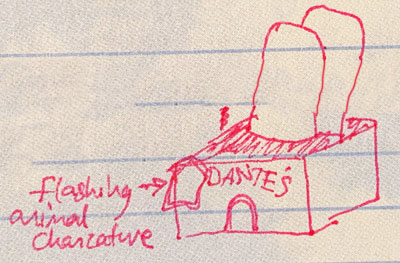
Newspaper ad for Dante’s I was at SSU again, during orientation. Buttercup was with me. I was there to visit Juno. We had to stay in a dorm, and were assigned to the Dark Tower, so I think that might be SSU. . . . At one point, I see a place called “Dante’s” in a newspaper ad. It had an image, and the hills/dome behind on top of it reminded me of The Tower on Arcology Hill.
Aware of Other Dream Locations: Here I am at the Dark Tower, looking at a newspaper ad and thinking an image in it reminds me of another popular 4 AM dream location of mine: the Tower on Arcology Hill.
-
Hook’s Fairy Hunt 1996 • age 22
I’m Peter Pan. There’s a huge bald bad guy, twice the height of Hook. He is collecting fairies, but Tink can make fairies non-physical by touching them, after which they stretch and escape. . . . This was intended to add to my already huge collection of Peter Pan story ideas, which, upon waking, I discover I don’t recall at all.
-
Driving Miss 59 1997 • age 22
I was at Westwood Elementary, all bundled up against the cold. It’s daytime, with snow and ice on the ground. There’s an awkward celebration for this woman with short red hair who just turned 59. I decide to drive her home. I look around but can’t find my car. “I’m sorry. I just realized I haven’t driven here for a long time,” I say.
No Cars Necessary: In the physical world, I would need a car to get to Westwood, so I expected to have one. But then a wider memory that included my dreams informed me that I haven’t used one to travel here in a long while.
-
The Autistic Dreamer 2011
He says, “You need to get a handle on yourself”, or something like that. He says “You spend too much time with the spice.” I say “I’ve been dreaming about the spice!” (I don’t remember those dreams, though.)
Memories My Dream Self Has: Here, my dream self remembers from its past things that my waking self doesn’t remember.
-
Bedroom Soccer 2023 • 7:30 AM
At this point, I need to park my car, so I make a U-turn and into a parking spot at the side of the street. Someone pulls in behind me. It’s a middle-aged woman with short red hair. She recognizes me and greets me, and asks if here for another.. something. I don’t recognize her, and say I was here for a soccer game. Then I notice her uniform and the building across the street and remember her. She works at this.. maybe like a physical therapy or medical place I go to sometimes.
Recognized: Here someone I don’t initially recognize sees and recognizes me from other dreams, and then it dawns on me who she is.
Dream Continuity Across Nights
The continuity of the dream self includes places it regularly visits, people it knows in the astral, cross-country trips, long-running story lines, and much more.
I find I frequent some dream locations for a while, before moving on to others. Some I return to from time to time for many years. Some I’ve been going to for decades. And then mixed in with these are new locations I’ve never seen before.
This also applies to groups of friends that I stay with for days or weeks at a time.
-
Rave On 1997 • age 23
My cross-country journey continues in this dream, in which I stop in a big forest for an outdoor rave. I’ve been doing a lot of this recently. This time the area I come to has some military-looking people. The trees are very tall and the plants have huge leaves. There’s tall grass and lush vegetation everywhere. I was driving an SUV. I try to get a spot in the corner. I’m so excited to be here!
I head to the bathroom, and meet someone. The talk flows free, smooth, and friendly. I’m making friends by the dozen. One guy keeps saying something I don’t understand, something about GRANT and I think back to my recent Minnesota to California trip and say, “I think I went to that one!” He says “Yeah, it’s on the way!” We decide to camp together. There’s some confusion now if he was the one I was traveling with before or not. So then I meet another guy who turns out to be an old friend. We talk a lot and I invite him to stay with us, too, but he is uncertain. We’re in a house now. Then some crazy girl I recognized came downstairs and told me to invite Brit B. and I said it’d take her two days to get from Minnesota to here (Colorado?). I remembered that Brit had been to a rave recently and got very drunk and passed out.
Cross-Country Raves: I’ve been traveling across the country attending dream raves!
Within the dream self focus, I remember the continuity between nightly experiences: what happened yesterday, a week ago, friends that I don’t know in waking life, and how to get to different locations in the astral realm.
-
Rejoining the Team 1996 • age 22
Nov 26th: I was wearing my soccer uniform, looking for the Blaine team to join them. But it was already the semifinals in the tourney. Eventually, Coach Broadwise came to me and laid it down. He said I could’ve been a captain if I’d stuck with it. It’s too late now and my indecision cost me. I was thinking he must be a spirit guide.
Dec 10th: I’m in Blaine House, after talking to Coach Broadwise and rejoining the team. I had to make it to 3 games and then I could be in the tourney. The next game was March 1st. He said I could wear any old jersey I had, as long as it was blue. He seemed pleased. And so I rejoined the soccer team in my dreams last night.
Joining Up: I have a continuation of a soccer dream from two weeks earlier. I’m in college at this point, and I never intended to play soccer beyond high school.
-
Kicked Out 1998 • age 24
I had a big dream of visiting Definition 6 where Derek was getting really vicious trying to keep me out, and I woke from the dream crying.
After going back to sleep, I returned and got someone there fired. Then they hired three children and an evil dog to kill me. The dog was the real baddy.
Returning Visits: This is the fourth dream I’ve recorded of visiting Definition 6 after I stopped working there two months earlier. I’ve progressed from continuing to work, to just hanging out, to finally wearing out my welcome.
-
European Wife
I return to a European country with mountains and a coast where I married this girl in another dream. We meet again, the first people to come together when the two whole crowds meet. I like her, but don’t want to stay married. I didn’t even know we were married before the trip.
Visiting Her: It could be that I married her in a previous dream. It could be a rote with backstory, though we usually fully accept the backstory as the context of a rote, so I think the first case is most likely.
-
The Armageddon Clock 1988 • age 14
I went to call Emma. When she got there, Manville went missing. I suggested we check the place we found them in a different dream. She went there and found Lewis or Quentin. Then we found Manville in the street further ahead and picked him up.
Dream Continuity: Here I remembered being aware of what had happened in other dreams, and brought that knowledge to bear in this one.
-
The Arizona Center 1996 • age 22
I got a job in a little food place in a mall. . . . This friendly guy took me for a drive to this arid place in Arizona that had an organization like the Berkeley Psychic Institute. The people there were friendly and immediately accepting. Buttercup joined us shortly afterwards.
There was a scene with a car driving over a small cliff. People were hanging out below, in an aloe plantation.
Similarities: This was just like the July 1st dream two weeks earlier! A big spiritual group in an semiarid place was accepting me as a part of the group.
-
Graduation Weirdness 1997 • age 23
June 8, 1997: I was at Blaine House and it was packed! There were the goth girls and a boyfriend, Ruby and her friends, Brendan and Melody, and more. . . . The house was now twice as high — four stories, and the most shocking change was the removal of the courtyard wall. The house seemed so different without it!
June 30, 1997: Everyone was returning to Blaine House. Brendan arrived with breasts! Twice I tried questioning him on it and he got so far as “This friend of mine ate soooo many brownies!” I was moving out of there. It was sunny and it seemed like the garage and above portions had become a four-story dorm and library, like the better dream schools. I was moving out, though, because I was graduating.
Blaine House’s New Size: Blaine House became four stories in “Blaine House Reconstruction” just a few weeks earlier, and it’s remained that new size!
-
Bees 1997 • age 23
July 16, 1997: So I’m working at this shitty grocery store. It’s a big mess and I can’t find anything I need so every customer is taking forever. . . . Suddenly Buttercup pokes her head out of our trailer home and shouts that there are tornadoes nearby. I get really excited.
July 19, 1997: I was in a grocery store, and the bees kept appearing everywhere. I tried many ways to kill them, but some always remained. There was a scene with a big display and I sprayed this liquid all over it, but one escaped. . . . I wondered how I could take care of [the dog]. Would it have enough space to run with me and Buttercup in our trailer home? I saw in its eyes that love was what it needed, and that was enough.
The Grocery Store and Trailer Home: More continuity — three days earlier I dreamed of working in a grocery store. Now I’m fighting bees in a grocery store. In the dream that follows, I reference Buttercup’s and my trailer house again. Both dreams seem to be in an impoverished area.
-
Die, You, Die! 1998 • age 24
July 4: I was inside Wilder at Oberlin and some official lady was trying to track me down and capture me, but I considered her more of a nuisance. I went into a darkened room with Melody and Brendan and hid in the adjoining room behind some clothes in the closet. She stormed into the room after me and searched, even where I was, but missed me. Then she found me and there was a big wrestling match, but I slipped away and the chase continued.
July 5: A continuation of yesterday’s plot! The same mean crusty lady is chasing me around Oberlin, saying “You’re the worst non-Native American student of your class. The worst!” and I caught her on the Native American thing, “Listen to you — skewing information to make me out to be bad!” Graduation was coming and she must have been getting to me as it was very dark — a heavy black cloud covered graduation just 30 feet up. I didn’t want to be there. Strange! Who is this persistent lady?
Nov 23: Buttercup picked up the campus paper and held it up in front of my face. “Mushrooms!” seemed to be the title and the headlines were about some old mean lady trying to regain control of campus, with a picture of a stern old matriarch on the steps of a building.
Continuity: This shows plot continuity over two nights; a plot I’m definitely not interested in or motivated to have. I wonder if it’s a case of mistaken identity. This is about a year after I graduated.
Months later I’m back at Oberlin and she’s being reported on in the campus paper!
-
Art Class, Day 5 1999 • 5 AM • age 25
Then I’m in art class, superimposed over the basement of Blaine House. It has the concrete floor, but it’s much neater. This is day 5 of art class, the last day. Day 1 was the first teacher. Day 2, 3, and 4 was a second teacher, and today was the third and final teacher. Every day I had run out of the class thanks to some insult or rude comment from the teacher One day I fled to my room in a fancy posh hotel. These five classes took place on five consecutive nights of dreaming!
-
Powered 2013 • 2:30 AM
We are driving along the shore of this big lake in California. There’s a housing development there that’s been abandoned because the lake is moving inland and expanding. This is something I visited in another dream yesterday or earlier tonight. The lake has moved further in since the last dream.
-
Return to Colorado Volcanoes National Park 2025
I was on a week-long astral vacation visiting national parks in the West. Last night, we had made it back to Volcano National Park, one of my favorites. I was with a group of 4-5 people, including Ruby. . . . A little bit later, after stopping at a park building, we were on this bus tour of the park, touring the grassy plains at the base of the volcano. It took us through some ruins, which I didn’t know the park had, and I found them fascinating. Some of the buildings were multiple stories tall. The bus tour took us around, past a place where I had played in some beautiful clear pools on a previous visit. Ruby recognized it as well, and I realized we must have been here together before. I was itching to get off the bus and go explore these areas in person. . . . We returned to the national park building, to something like a gift shop. I told the others we should head up the mountain at some point where we could see the lava and I showed them a picture of it with my mind.
A Week-Long Trip: I’m in the middle of traveling with Ruby and some others on a week-long tour of astral national parks. I visited Colorado Volcanoes National Park almost exactly a year ago, and that was my second trip there. This time I’m touring some different areas at the base of the volcano, and Ruby and I both recall the clear pools from an earlier trip.
-
College Celebration 2022 • 7-8 AM
I’m at a college that I often go to in my dreams. It’s mixed in with Oberlin.
A Truer Location: This is a college that my waking self is unfamiliar with, but my dream self goes to regularly. “It’s mixed in with Oberlin”, I say. That familiarity by the dream self means it doesn’t need to be completely overlaid with Oberlin for me to understand it. Likewise, it’s not an unfamiliar college in a rote that needs the form of Oberlin for me to understand it.
I see the face of a decorative clock on an upright piano that has just been opened. It is literally a face, with a lovely expression on it. I see closer and closer views of it. It rather resembles a Buddha’s face, white, constructed of seamed metal. Then I see it drawn on my note pad, and I say, “I’d usually wake up at that part.” The dream continues. (Garfield 150)CDLDer • modern • Garfield
Note the suggestion of a great dream-life knowledge of the dreamer, like my timing of descents into the underworld
Regular Times of Night to Visit Certain Areas
At around 3:00–4:30 AM (3–5 hours after falling asleep) I have a deep level of sleep in which I go to the same place every night, though the place changes over time. At times this was the Dark Tower, the Tower and Arcology Hill, and the catacombs.
-
The Tower on Arcology Hill 4 1996 • 4 AM • age 22
August 3, 3:33 AM: I just caught an early-night dream place that eluded me forever. It was a tall rounded hill with something like a tower arcology on top. There are towering heights and steep angles and hugeness. It’s a long climb up, like our Yosemite hike. There was a huge tree on the side of the hill. I got vertigo while climbing on it. After the tree is a lake. I’m frequently about three quarters of the way up the hill. There’s a stream and lush vegetation. There are houses and buildings all over the hillsides, separated by lots of fences and property lines. Each property is a different section, and I travel from one to the next. . . . I remember being here so many times!
August 4, 4:23 AM: A great search for something, a yearning. I’m pretty sure the same place as yesterday, less fear in it. . . . My will appears as many subtle manipulations. I have a job, working for someone.
August 5, 4:13 AM: Buttercup and I had just made it to the bottom of the hill. It had been a long journey, and far from this reality.
August 6, 4:00 AM: Back to the hill. I remember some voice telling about this team from. . . . Italy? Brazil? Yellow-yellow-red-white, and how America stifled it..? Anyway, the team was playing a game of whatever in Berkeley’s stadium on campus. We had been walking on a busy city road asking people for change, maybe? It felt like the city atop the hill by The Tower. That’s where I was when I woke up earlier this morning. All this was just a subset of a larger plot.
Back to Arcology Hill: Notice how I’m returning every night to the same place at the same time of night.
Its Knowledge
-
Lucid: Colored Pots and Pans 2000
As we got on the path [the pots] turned to cars, still stacked and still colored. One car blocked the road. Was it occupied? As I had the thought, a vague white silhouette could be seen in the driver’s seat. Recognizing the thought form, I said “no” and smiled to myself.
Unemotional Clarity: In this scene, I catch the thought form forming in response to my wondering if the car was occupied or not. This is the dream self focus. I’m not fooled by what I see. I know I’m in the astral, and I’m catching the details with an awareness of the laws of the astral world.
Now if I’d been afraid someone was in the car or if I’d hoped someone was in the car, I’d likely have missed my hand in creating it. The waking self’s desires and fears get the waking self involved in the dream, where I then would mistake it for real, physical life.
Perhaps when fears and desires take over, the dream self continues to dream at its level while we go into a shallow emotional-level fantasy that is what we remember upon waking. We are always dreaming, even while awake.
-
Time Weaving 1996 • age 22
It was bright and sunny, on a lawn in Oberlin with some friends. I was speaking about my theory of the nature of time and events. . . . Here’s my theory: Events are woven together by many people and also by a positive and negative timestream. I was explaining that at a certain level, the weaving could be unraveled and reconstructed as a different event. And this goes on at all points in time.
Dream Mind: My dream self does its own experiments and has its own theories. This theory is unfamiliar to my waking self.
-
Escaping from Dogs 2001 • 4 AM
I ran into this large open cave with river water pooling in it. While it was a perfectly real cave, looking back I know with certainty that it was the Dream Station. This has been my new recurring dream place for quite some time, though it is more of a feeling and a shape than one specific place. To hide from the dogs, I considered jumping down into the water to grab two giant turtles and swim with them, or I could go into this black area. But I realized doing this would significantly “change things”. The Dream Station connects to the underworld (or the physical world), I believe. There is a straight vertical shaft between it and a more dark and solid place, and it may be related to my 4 AM underworld journeys. The time was almost exactly 4 AM when I awoke.
Its Knowing: I don’t know how this would change things, but my dream self knew.
-
Enlightenment by Fire 1997 • age 23
[The mouse] suggested I go back to the fire shaft, a place I was familiar with but hesitant about. I had four cards in my hand with different pictures of the inside. The structure was white and had a pillar with flames in the center. Around it were some wood spokes, perhaps? Anyway, I opened the heavy door to it and left the mouse outside. The entrance was at the top and I jumped down. I knew that I might end up in some other dream, and I had to try not to sink below the fire chamber.
Advice of the Dream Self: Here my dream self knows that following this path could lead to a different dream and I know what I must do to avoid that.
-
Dream Aware 1997 • age 22
Buttercup and I were staying in the Dark Tower. It was really vivid and cool. We were staying with these two immature boys. Someone was pressuring us to do something cool and one of the boys thought we should jump out the window onto this tin-roofed shed below. I said that was stupid but Buttercup jumped. She half missed the shed, smashed her head, and was silent. Somehow I knew she’d be alright but I ran down to see anyways.
Unconcerned: My dream self knew she was okay, since you can’t be injured or die in dreams. If my waking self had been engaged, I’d be freaking out and crying after witnessing such a thing, sure that she was dead.
This sleeping self of yours is far more knowledgeable than the waking self. (Roberts 94)SSchanneled • modern • Seth
Consciously Creating Doors
-
Lucid: Colored Pots and Pans 2000
We had to face something in the large structure first.
We turned to it and not much was visible — just some bits sticking out of the top of the sandy/muddy hill. There was an opening barely large enough to slide in through and a flexible area that revealed lines of blue energy when pushed on. I said “no, no” and gathered their attention. I knew I could easily get to the bottom of this through dream law. I mentally pried open the ground and created a big opening for everyone. The ground was pliable and the opening started small and was stretched open. We entered. . . . Then we went into another room and I taught them how to open doors in walls. “Begin by sticking a pin-like extension of your mind into the wall.” Two of them were lined up with me, trying it. The appearance was like sticking a pin into clay. “Then, when it’s in, expand it, stretch it open into whatever shape you like — circle, square, patterned frame, etc.”
Opening Astral Doors: Wow! My dream self came up with a way to open astral doors that overcomes object permanence. This technique is completely new to my waking self.
-
The Reverse Gate
Myself and two others were painting on a blackboard. I had the idea to run at it and go through it like a gateway. I asked someone to try. When they approached it I shut my eyes. When I opened them the person was gone. The second person did it, then me. I had been thinking that it would open a reverse world and it did. It was like a mirror image. The things on my right were still on my right and the same for my left. The opening between became cut out in the shape of a door. We spent much of our time on the reverse side, as it felt like new. I thought about ways to tell which side you were on — printed letters, money — would it come through reversed? But I never tried. There were many stories about the other two, as they learned new things. . . . I imagined a dark purple blazing zero on the palm of my hand and pressed it on another point in the blackboard to open up a new gate. This one opened to a pure fantasy area of sweeping landscapes and flight and beauty.
Gateway to a Reversed World: I’ve experienced this before with a mirror. I wonder why I expected a blackboard to lead to a reverse world.
Stuck in Time
I’m starting to believe that my waking self split from my dream self around the age of kindergarten, 5-6 years old. At this age, consciousness becomes more physically focused, and we’re able to hold a focus longer. Meanwhile, the dream self preserves its belief in dream magic and grows in its understanding of the astral world.
To the dream self, Blaine House is always its home, no matter where I’ve moved to since or how long I live there. Changes to the house and my room after this time period don’t make it into my dream version of Blaine House.
Its lack of biological understanding and difficulty with technical tasks fits the mind state of a kindergartener. I’ve found I have a kindergarten-level writing ability.
-
Bedroom Soccer 2023 • 7:30 AM
At this point my wake-up alarm goes off. I wake up and set it for 13 minutes, then I go right back to sleep.
The effect of this on my dream is that I’m back watching the soccer game, except the entire soccer field is now encased in the space of an invisible room — my bedroom. The green grass and hills continue beyond it, but everything on the field is bounded by this room and much reduced in size. There’s a bed along the side of the field. At first, it’s blocking the far half of the field. But as I look around, trying to figure this out, I find the bed is then to my right. Now there are two identical beds. They’re about the size of my bed — queen size, but with the pink & yellow patterned sheets of my childhood.
My bed covers when I was little (at the house before Blaine House). Stuck In Time: The bed covering — this is the bedsheet I had as a smaller child. It was eventually replaced with a lion blanket, and my bed replaced with a waterbed, due to allergies. But to my dream self, “my bed” will always be the bed and the covers I had before that.
-
World Religious Conference 1997 • age 22
So Buttercup and I arrived at Blaine House and either it seemed smaller or I seemed bigger than before. I was thinking “Okay! At last here I am at Blaine House where I always dream!”
Growing Up: I show up at Blaine House adult size — unusual to my dream self.
Lack of Biological Understanding
Our dream self’s home is the dream world, the astral world. This focus of consciousness knows much more than my waking self about the dream world, but doesn’t have a good understanding of biological physical life. It knows the general aspects of biological life but often gets the specifics very wrong.
-
Thought Form Games at Arcology Hill Stadium 1996 • age 22
I also ran around being a cat. . . . I found a tiny cat in a small hole in the steps. It was there with three white cats; a mother, a young cat, and a newborn, none of which would open their eyes. To clean the young ones, the mother ate them and then coughed them up.
Eating Kittens: This is great! Knowing only that a cat uses her mouth on her kittens to clean them, the dream self mistakes the mother cat as eating her kittens, and then, because they’re still there afterwards, coughing them back up. It’s a misunderstanding of a physical thing that the dream self (myself as a child) observed, and is being played back in the dream in the fashion of the misunderstanding.
Pregnancy
-
Male Pregnancy
I am, of all things, pregnant. A big, muscular bulge rises from my stomach. It doesn’t at all seem odd to me and I forget the difference between boys and girls. I feel this glowing joy from my belly — a radiating happiness and proudness. I’m excited to have this child, and incredibly happy.
Pregnancy!: I remember this dream well to this day. The warm feeling of being pregnant was wonderful. It was a delight.
References to the baby are extremely common and occur in approximately one third of all dreams after the fifth month. The actual delivery is not very often mentioned and the baby is frequently born as if by magic, or sometimes the woman’s mother obligingly has it for her. Once born, the baby usually possesses unusual physical characteristics such as weighing 5 ounces or else tipping the scales at 35 pounds, or can walk and talk at birth. (Van de Castle 392)ODMresearcher • modern • Van de Castle
Birth
-
Wormhole Caps 1999 • age 24

The horse’s eye After a time, I saw up on the shore a confusing sight that resolved into a horse giving birth out of its eye, with all the gory reality that would entail. As the foal came out, the horse’s eye came off as if it was a half ping-pong ball. Everyone was too grossed out to put it back on, but I grabbed the slippery, wet eye and approached the horse. The masters I communicated with told me to approach the horse and focus and they would essentially send a beam of energy into the horse and it would calm itself and open its eyelid for me. It did, but I couldn’t reach.
Eye Birth: In the Middle Ages, some believed that certain animals conceived and/or gave birth through the ear or mouth. This is like something a small child (or my dream self) might come up with. Further evidence that my dream self is a child is that I can’t reach the horse’s eye, meaning that I’m child-sized.
Note, too, that the eye is not an orb but shaped like a half ping-pong ball. The dream self doesn’t understand physical anatomy very well either.
-
Creative Genius 2018 • 4 AM
I can’t stay long as I have a flight to Russia in the morning. But I have this dog who is pregnant and will give birth soon. Since I can’t have it doing that on the plane, I decide to stay with it. It gives birth to two full-sized dogs that are totally stiff. The second one has a giant anchor coming out of its back, which makes me laugh.
Abnormal Birth: Nope, that’s not how it works either.
Babies and Growing Up
-
Baby Turtle Monster? 1997 • age 23
I saw a turtle get born and it grew up really weird and transformed. Two eyeball halves became one, and it started looking like a ball of mud.
Babies: The dream self really doesn’t understand babies and growing up.
-
End of Days 2012
Buttercup said it was past Bodhi’s bedtime, and I took him from her to let him sleep on me for a little while. For the most part he was a bundle of blankets, but when I looked in, I saw that he was scrawny but had a full beard, which I thought of as awesome rather than unusual.
Baby’s Beard: That’s an honest reaction.
Bathroom Functions
The need to pee can really hijack a dream. I’ve seen it happen many times, and of course the dream can never resolve the need, nor do we in the dream self focus really understand how.
-
The Detachable Room 2004
I’m trying to pee in a urinal in a bathroom crowded with people and various things (when I wake up, I find I really have to pee). Anyways, I get it wrong — I take off my jeans and dunk them in the urinal water, which is already yellow. Oh no.. I realize my mistake. I’m slightly embarrassed and head back to my room, leaving the other people in the bathroom. There I find a sink and put the pants in the water to clean. . . . [I take some time cleaning up, then:] At this point, Kai came in. He wanted to do something. I said “Hold on, I have to pee.”
-
The Mirror People 2012
I quickly went down the hall to the men’s room, realizing as I arrived that this was the place I liked the least here. I go in and there are urinals marked from A-Z in a row around the room — but they were more bowls on short walls with no privacy, and there were all kinds of people in there. The toilets were even worse in terms of privacy. I tried but couldn’t go.
The Damn High School Bathrooms: This is one of the worst dream places ever. It’s a large sprawling bathroom with lots of disgusting open toilets and urinals, offering no privacy at all, and always with plenty of people around. I spend an anguished time there, and always fail to make it happen. I think that’s a good thing.
Eating
-
Kitty Nose Crackers 2003
People were inserting rectangular packages of crackers into cats’ noses. The cats were Muffin and a similar cat that I felt was mine. The crackers would go right in there, into the nostril, then be sucked in and disappear. I figured at first this was how cats ate, but for a moment wondered how the whole package of crackers made it through the narrow nose area. Well, nonetheless they did. I figured the cat would get sick from the plastic so I kept telling them to stop. I took all the cracker packages, crumpled them up, and threw them away.
References: Muffin was my first cat. We got her when I was about 8.
Eating Fail: Here’s a failure to understand how eating in the waking world works. My waking mind almost engaged, but then just accepted it. The cats’ nostril would just expand to the size of the package of crackers as people pushed them in and then return to normal size.
Sex
-
The Mischievous Fairy Girl 1997 • age 22mature content
The girl in black was scantily clad and tied to this chair, sitting in it. I went to her to tell her no, but she was talking fast and got out my thing and revealed hers — it opened up in her at a corresponding level, in her chest. She slowly took me towards her. My ability to resist faded quickly and I let her do what she would.
Lining Up Parts: So this fairy had the idea to give me this sexy girl as a gift, and while she generally had an idea of how sex works, didn’t quite have the physical understanding of it.
-
The Train Ride 2024
The next part I remember, I was on this big train car with lots of benches like stadium seats. I was on my back, with Avery, naked, on top of me. I began to touch and feel her body. I reached down below. It was very wet, but my hand was not far down enough — in the belly area. Still, I enjoyed the touching a bit.
Something Like That: My dream self had sort of the right idea, but the location was off.
I was then in a bedroom. There was a ginger haired (sic) woman that looked like she was getting ready to go to work. I went towards her and pushed her onto the bed. Immediately, she had this look of contentment on her face; a look of peace and happiness. As she lay there, the top of her suit opened and I pushed up her top and bra. I was a bit shocked to find that she had a vagina in her right breast. Then her skirt disappeared and we both became naked. JoATOBEr • modern • Moon
The oddities that happen in Moon’s OB sexual encounters remind me of the lack of understanding of sex that the dream self has. He’s most likely interacting with thought-forms.
Death
The dream self doesn’t understand physical death because death doesn’t exist in the astral. The astral body can’t be harmed or killed — it’s merely a thought form projection. Even when we expect our own death, we find we remain, unharmed.
As to fighting enemy thought forms in the dream state, as long as our attention is on a thought form, it will continue to have life. The only way to be rid of a fear-based thought form is to turn our thoughts to something else. Deprived of our attention, it will melt away and disappear.
-
Suicide and Dream Fire 1998 • 5:20 AM • age 24
Buttercup was going away for the day and I decided to kill myself. I’m standing on the street and put a gun to my head and shoot! Then I concentrate and say “5, less blood to see, 4, less blood to see, 3, 2, 1” and I look from a third person perspective and see myself standing there. There’s no blood, but I’m pale. Then I go back into my body perspective and think that Buttercup would probably have preferred to be there when I died than find me later. Since I found I was not actually dead yet, I assume death is on the way. I begin to wander.
My consciousness is changing. It gets clearer and clearer and I feel almost exactly like I’m on LSD. There’s this swirling energy in my head which lights up and clarifies the visual field wherever it’s at, leaving the places without it darker and blurrier. It would flow along the edges of things like doors and enter objects. There were multiple swirls at any given time.
At one point I felt the wound with my hand and my flesh seemed to be intact but there was a little indent the size of a BB in the skull near my right eyebrow, along with a dull pain.
Death: A person’s dream body can never be hurt or killed. The expectation of a bullet hole caused my astral body to take on a slight indentation where it happened, and nothing more.
I think the feeling that I was about to die freed up my attention into the now, causing the dreamfire effect.
-
The Orange Light 2014 • 3:40 AM
There are several rounds of this [testing]. In one I fail and a nuclear bomb explodes on my group — the result of which is that I feel I am almost certainly irradiated and will have health issues due to that. In another I’m doing pretty well, but we see a nuke go off in the chamber across the way, and the blast is so strong that we are also destroyed. I see the screen representation of both the chamber across the hall and ours turn red.
I am back at my house again, with some people who I think are from the training sessions.
Casually Dying: There’s no death in the astral. In a rote, it just becomes a point at which you stop and retry, like a video game.
Difficulty with Technical Tasks
This appears to be a phenomena in the dream self focus.
The kind of continuous focus that is required for technical tasks is developed in the waking focus of consciousness. It’s needed to survive and thrive in the physical world.
The dream consciousness has less need of this, living more closely to the now. Survival is ensured, and creation is instantaneous, so there’s no need to develop a capacity for technical tasks.
-
Terrible Service 1996 • age 22
I sort of got a job at the Feve. I don’t know if the owner knew and they didn’t train me too well. It took over an hour to get my first customer’s order right and I couldn’t understand what she wanted or the price or how to make it. I kept losing the paper I was writing on. I felt so bad and it sucked.
Technical Tasks: Want to drive yourself batty? Try to do multi-step technical tasks in the dream state. It won’t go well.
-
I Ate Your Sandwich 1997 • age 22
Context: I worked at Irene's at the time.
I dreamed I was called in to work at Irene’s again and it was the Feve and I got everything wrong. I was trying to make a Pepsi-Root Beer but kept messing it up: adding too much water or eating someone’s food. My consciousness only stepped in to help once every thirty seconds. The rest was me acting without a greater plan, according to habit.
References: Irene's is a cafe in Oberlin. The Feve is a related cafe in town.
Technical Difficulties: Our focus is ever-changing in dreams. The waking self often enters the dream state in a low-context state of mind, a state like being high on marijuana. Holding focus on a long or technical task is often very difficult.
This dream was a perfect example. While attempting to carry out preparation and delivery of food, I kept losing my place and forgetting what I was doing. This waking self consciousness, after awakening in a dream, finds itself in a strange situation and tries to make the best of things according to the clues left to it. It often guesses wrong and, for example, I eat the sandwich I was meant to deliver.
-
Self-Kidney Removal 1997 • age 22
I was in a class on the second floor and this guy was teaching us some weird stuff. There was a part where we’re supposed to remove our own kidney and I thought “That can’t be real, it must be metaphorical.” But I wasn’t sure. I kept reading the instructions over and over but couldn’t maintain the entire thing at once and was continuously confused. Then we went to another room (I did the first step fine) and were given a complex set of instructions. I kept forgetting, watching others, and copying them. Others were doing horribly as well, getting it all wrong. At times I would stop and go into a subdream about something mildly related, then come back.
Complex Procedures: It is nearly impossible to do complex procedures when dreaming. You have to be really focused to pull this off. It seems the other dreamers were having the same problems as me. This is related to short-term memory resetting again and again from being in the low-context dream state.
-
Grocery Sam 1997 • age 23
So I’m working at this shitty grocery store. It’s a big mess and I can’t find anything I need so every customer is taking forever. Then this girl pays in coins and I have the worst time counting them. Then when I turn my back, someone takes them and all these people start messing with me and stealing stuff.
Counting Coins: Even something as seemingly simple as counting coins can be an insurmountable technical task in dreams. The short-term memory of the dream self is too short to keep track of where you are.
-
The Wild Bus Ride and Parasitic Moths 2012
When we get back outside, the person guiding the group has this big sack of gifts for us. She pulls out the first thing — a soccer ball! I get the most excited, and she says “I think this one goes to Sam,” and she hands it to me. I start trying to juggle it, but I’m doing poorly and I feel a bit embarrassed. Then a couple other kids want to play and we pass it around but I’m not making very good passes. I try juggling again, but do badly.
Juggling Fail: Juggling a soccer ball involves coordination with properly-working gravity. As usual, such things are unlikely to work well in dreams.
Reading
It’s nearly impossible to read something in dreams because consciousness’s natural form of communication isn’t linear — it comes at once as meaning or experiences. What sometimes ends up happening upon reading a word is that entire words begin to come out of one letter.
Take, for example, a written page. The page represents an intended communication in physical terms. When trying to read this in the astral, we begin in the habitual way — focusing on letters, attempting to absorb the communication word by word. But as the meaning begins to reach us, it wants to come quickly as a whole, in its natural form.
As the meaning begins to come, we slip bit by bit to the more natural state, and the meaning begins to come to us. In physical terms, more than one letter begins to come through a single letter. Take that very sentence: More than one letter can come through a single letter. At rising degrees of reception, the sentence, while being fully understood, could appear as “Mr thn on ltr cn cm truh a snge lt”, then shortened further as “M t on ln sgr,” then even just “M” where the entire sentence streams through a single letter. No information is lost — your “eye” or focal point just moves less across the page while the letters continue to stream to you.
As another example, if while reading the phrase “more than one letter”, we were to look back at the word “more” after reading “than one”, we might see “letter than one”, as the next word appears where the eye moves to. Again, this is a step between the habit of physical reading and the full communication represented by the page coming to us at once merely by glancing at the page.
-
Lucid Dream: Bruce’s Arm and the School Bus 1997 • 10:13 AM • age 23
I was wary of getting into a magazine because I knew it would distract me out of lucidity, but I thought it a good experiment to see what happens. I tried to read and kept going over words, wondering what they meant. Then I thought of how letters are supposed to change in dreams and wondered why I could see them alright. In an attempt to get the meaning, I concentrated really hard on one entry in the classifieds. As I focused on the second half of the word, the first became more blurry and when I returned to it, it said something different. Ah, I thought. Almost getting the meaning changed the words when my expectations blended with the other letters.
Reading: I could read fine, and the words wouldn’t change as long as they were just making sounds in my head and not conveying meaning.
Once I began to interface with the meaning, the position of the letters and words stopped mattering. Having read and understood the first and second half of the word, when my eyes went back to the first half of the word, the next word came through there. Without our waking habit of scanning across the page, the entire intended meaning will come to us as we stare at one position.
-
Barcelona Dreams 2000 • age 25
There was a bit where I was reading the headline of a fax and was criticizing the design, but of course the words were changing. It’s as if information comes directly at you out of the page starting at one letter — entire sentences will stream into your mind through the single changing letter. But as you scan across the page, only a little comes out of each letter and the whole page seems to change as you read it.
-
Semi-Lucid OBE: Webbed Windows 1998 • age 24
I was reading something in my mind — some kind of instructions. The meaning seemed to come through faster than the words could convey and thus the words seemed to shift as I read them. Later I tested my dream state by looking for something to read. I opened a book and it was all blurry and I hastily concluded that this proved my dreaming state.
Reading in Dreams: Reading can be a good test of being in the dreaming state.
-
Bus to the Beach 2000
I write everything in this notebook but find it almost impossible to read whenever I look back. So I try to write very neatly, but it’s hard to control what I write.
Reading and Writing: After a dream where I am able to read normally, I find I am unable to write normally or read anything that I write. My thoughts don’t work well being strung out in words in the dream state.
I flew up to a street sign. . . . I could not read the words. I could see letters or symbols but nothing more. (Taylor 65)STOBEr • modern • Taylor
Reading is very difficult matter. The print seems clear enough until one tries to read it; then the letters become blurred, or run together, or fade away, or change to others.
Each line, or in some cases each word, must be held by an effort of the will until its meaning has been grasped; then it is released—on which it becomes blotted out or changed—and the next held in its turn and so on. (Fox 46)APrOBEr • modern • Fox
Books and newspaper are lying on the counter. I grab one up, leaf through it and read. I want to learn a sentence off by heart and read it several times through. The first half of the sentence does make sense; it is talking about the use of memos in business. The second half of the sentence is complete nonsense, even though the individual words are comprehensible in themselves. I particularly look for some newly coined words but cannot find any. On repetition the sentence seems to become continually longer although the content remains similar, and I cannot retain it in my mind. It strikes me that I am fairly tired and a strange indifference disposes me to do nothing more. The light is continually weakening, and in its place arise all sorts of fantastic images.
(Moers-Messmer, Case 11) (Green and McCreery 26)LDPLDer • modern • Green & McCreery
Beings of the higher Hierarchies cannot read our books. . . .
The spiritual Beings begin to read only when human beings on the earth read books — that is to say, when what is contained in the books comes to life in the thoughts of men. (Steiner 146)LBDclairvoyant • Theosophy • Steiner
Nonphysical communication is much more direct. Entire ideas and experiences are expressed at once, without any need for stringing words together linearly.
Reading Normally
On rare occasions, you can read the way we physically do. Typically this is possible when the writing is just the title or name of something, rather than a larger body of information.
-
Finding Bodhi 2025 • earlier
I was in Bodhi’s room. There was a thick envelope from his school. It was unopened, but seemed important. I opened it and the pages were all stuck together with blue painter’s tape. I scanned across it, picking up that a study of word content had revealed evidence of cruelty. Huh? I didn’t know what that was about.
Reading by Scanning: I think the reason I could read this is that I was scanning it, not paying attention to individual words — though some actual words stood out, like “cruelty”.
It could also have been a rote of some sort.
-
The Magua Discol 1998 • age 23
Outside everyone was turning around to see their new sign. In yellow and white with an edge of blue lightbulbs was “THE MAGUA DISCOL.” I let out a laugh. “Disco-L? Just put a few more nails in their coffin,” I thought as I awoke.
Reading: At the time I found it strange that I could clearly see the letters and read it without it changing. Now I realize it’s because it doesn’t mean anything. If it meant something it would have started changing.
-
Reading Dreamside 2000 • age 25
I was looking at a map of an island. It said in clear letters “THOMAS” next to it. I wondered, “Is that St. Thomas?” and looked to the left to find a much smaller “ST” out there.
Reading: As “Thomas” was the only bit of information here, I was able to read it. I probably projected the “St.” due to my looking for it.
-
Ween’s Bio 2000 • age 25
There’s a scene where I’m reading a bio for Ween that uses their song lyrics. And I can read! I could see the whole page, the layout of the words, and the individual words. I was reading, scanning my focus across the page, but it was like it was being spoken into my mind. It was describing some court case involving this slightly older guy who did something bad down at the river and Ween was there fishing and saw it.
Reading: Interesting. I wonder why this can sometimes work.
When I read in the waking world, I hear the words being spoken in my head. So that part is the same.
-
Adventures in Northtown Mall 2001
spit out a gift for me that was a list of song names and a CD called “Smeg-something“. Buttercup and I tried to figure it out. It turned out to be a New Year’s gift from Raven, who was disappointed that my attention had now turned to Buttercup. I had a hard time reading it, sinking into a single word often, and getting more information through that word. But I could see the list of song names clearly. The problem was that my imagination was going wild reading every single word. Maybe each word was reflecting all the words that I’ve ever seen surrounding it.
Reading: I believe I could read the song names because that was the whole of the information — just the name. Sinking into a reverie on each word is likely connecting to further information about it.
Writing
Communication in the inner realms is direct, through telepathy or rotes. As such, writing isn’t needed or used. This is only carried over into the dream state from the physical, due to expectations and rationalizations.
-
The DeadStorm 2010
I was writing a story, though I don’t remember what it was about. I remember looking down at my writing and it was strangely scribbly. It looked like how I wrote when I was in elementary school and still getting some of my letters wrong.
Elementary Writing: My writing skills were at an elementary level. Perhaps they remain in the state they were at when the dream focus and waking focus began to diverge, somewhere around kindergarten. At that point the dream self lost contact with the waking self’s advancements in writing and understanding.
When we teach children in preschool and kindergarten, are we teaching them at the dream self focus? Is that why they’re limited in the complexity they can learn?
At the end of a dream I am writing my dream with a pencil across the pillow. It is something about Western philosophy. I force myself to sit up and see whether the writing is clear. I find it is only a series of dots and dashes. I then force myself actually awake to write. (Garfield 170)CDLDer • modern • Garfield
Getting Dressed
The dream self has no need to know how to dress a physical body, so this simple task (to us) can prove challenging.
-
Friends and Dream Awareness 1997 • age 22
I was now in Blaine House and I was saying “It’s a dream, right? I’m in a dream.” I had a hell of a time putting on underwear, pants, and shoes.
Our Personality in Dreams
I want to underscore that though there are breaks in the continuity of memory and thus knowledge we have in these different focuses, we are still very much ourselves in the dream self focus.
-
Hypnagogic Visions 1996 • age 22
I have been practicing seeing with my eyes closed, but I often forget when I wake up. I’ve been in dream classes, in training. I’m realizing that the dream self is me. I’m learning to recognize the shifts of consciousness.
Humor and Wit
I have the same sense of humor in my dream self focus.
-
The Back Massage 2025
My dream self is a humorist who likes to break people’s expectations.
I’m in a truck. I’m standing in the back, and “Pierce Brosnan” is behind me, though it’s actually Ezra Danson. It’s a comedy setup. . . . It’s known that Pierce likes giving unrequested back massages, and I don’t like them. This is the same setup as an episode of Seinfeld.
So the scene begins. Pierce starts rubbing my back. I get this big grimace on my face. He sees it, and says, “Where’s your smile?” So I begin to drive him crazy with weirdness. I’m only half-focusing on him and breaking all his conversational expectations. I randomly bring up something about his wife Kim. It’s hilarious, and it really gets his goat. . . . Speaking of humorously breaking expectations: Later on I’m talking with this girl I like at a dorm. I pick up a thought that it’s her birthday. “It’s your birthday??” I say . . . then I run away. She follows of course to find out why. She’s wondering if I’m going to get a gift or something. It turns into hide and seek in the hallways upstairs.
Comedy: Breaking expectations is one of my favorite forms of humor.
-
The Game Sphere 2025 • 5 AM
I play this one [game], leaping, flying, spiraling through action and adventure. In my mind I’m beginning to desire certain franchises to join in… and I’m excited that in the next layer it’s something more my style. I find myself in a world where all the characters are stylized Santas — in different colored suits — some military style or American style, all vastly creative and humorous. I’m the normal familiar Santa in a red suit. All have big beards, but of different shades and colors. The scenery is dry with sand dunes.
Every Kind of Santa: I love that this is “more my style”, even with my dream self. I mean, that self really is me, just in a different circumstance. I’m also reminded of the burly bearded men in the location “Space Station Benji” (see the location in dreams-intro.php).
-
The Nubicus 2015 • 8 AM
My car had transformed into a four-wheeled kid’s tricycle to fit through [the metal poles]. It had a molded plastic bucket seat and four wheels. I was still in it, and the two people in the back seat were now walking on either side of me. It rolled to a stop and a few people gathered around. Perhaps made shy by the attention, I said “and it also becomes a Nubicus”, and I flipped it up over my body like an incomplete shell. Curious, people peered inside, and with humor, I swatted at them like a cat.
Creativity and Humor: My sense of humor is the same as my waking self. The word “Nubicus” came to me instantly and it sounded funny so I went with it, then playfully imitated a cat.
-
The Farce 1999 • age 24
Oh, hilarity! Buttercup woke me up because I was snort-laughing like mad.
I was a character in a fantastic farce of a tale. The rules were crazy, the actors fluid with them. There was a council meeting at this particular part. We decided to spray ourselves with this big bottle of water as we spoke to avoid temptation. This gray water bottle (probably a fading thought form) was going to be a woman’s headband. There were people who were “traps” of various sorts, who sometimes decided to misfire and not go off. Earlier I was a dead fish — with the features all on one side. So silly. Everybody was being so clever. I’ve been laughing a lot in dreams recently.
We were all on a huge ocean liner passing inches from an island. Someone turned the gravity off on the ship and we floated out. We represented some kind of fluoride toothpaste. We tried to turn the gravity back on when the floating beans were right over Anthony Kiedis’ head (he was in a documentary we’d just seen).
We had been on the island recently.. Chandler was on some quest about girls or onion rings that was going to bring him to the rim of the volcano (and the rest of us had a reason for going up there, too). Madness! I loved it!
Hilarious Dreams: The details fail to convey the hilarity. But I wish I had more dreams like this, whose major emotional component is humor, shenanigans, and laughter.
-
The Comedy Club 2008 • 3:30 AM
After watching and laughing at Last Comic Standing, I have this dream..
It’s like a comedy club mixed with a school, filled with very funny people my age, and there’s such laughter, such joy in it. I consider it the best day ever. I’ve left my usual dream grounds to be there. It’s after classes, and we’re all hanging out having this wild imaginative play time. There are groups from dance classes there. I have this pure and amazing water spirit I keep calling on. It’s in a rectangle. I spin and float in the air when communing with it. It’s a sacred and personally-beloved spirit. It inspires me.
Humor: Humor and friends always attend my most happy dreams, as it does the most happy times in my waking life. There’s just nothing better than when I have this easy rapport and deep personal connection with my friends. The humor and cleverness just flows out of me. These are the happiest of dreams, the best of times.
-
The Funny Show 2026 • 5:30 AM
I ended up meeting the guys behind the show. They were all young, around 20. I felt totally at ease with them. The goal was humor and I was all in. We were talking, laughing, every line we said was funny. After this near-thing of writing a song together, I wanted to be part of this crew. I told them that if they ever needed an old guy for one of their sketches, if putting all that sticky beard glue on their faces was just too much, to call on me. . . . Hanging out with the Funny Show guys was a riot of creativity and humor.
True Dreaming
These are true experiences of the dream self, with less or no interference from the waking self, whether by it requiring rationalizations, applying physical limitations, or thinking it’s waking life. The dream self focus likely doesn’t consider these “dreams”.
-
Declining the Catacombs 2008
It’s bright and sunny, and the colors are vibrant. I’m walking along this reddish orange dirt path. There are rolling hills of bright green grass on the right side. On the left is a rising rocky cliff. It feels like World of Warcraft. I come to a cave opening that is interesting to me. It looks like carved ruins. I crawl in through a square opening into a dimly lit room. Ah, I remember this. Room after room, interesting shapes, many paths, long sections. But it’s dim, and feels claustrophobic. I know it very well. I’ve spent months in there, through many dreams. But I don’t want to go back in. I crawl back out to the sunny path.

Entrance to the catacombs A tall fellow on the path sees me. He asks me about it. I said “I used to go in the catacombs all the time.” Catacombs! The word sort of occurs to me right then. He said he did once, too. I continue on.
Somewhere along here I break down crying, sobbing deeply. I can’t now recall why. Was it about my poor health? The catacombs? Someone is with me, a friend. I feel refreshed afterwards, and keep walking.
Everyone’s walking the same way down the path. Something in bold and vibrant colors accosts someone up ahead, and I figure it will do the same to me. I keep walking forward, and it does. I spring out of myself and fly quickly up off the path, above the cliff and across a bit of trees, until it can’t catch me. I spring back to myself and it’s gone. I keep walking. The vibrant thing is awaiting up ahead. It comes at me again, more forcefully. It’s asking questions. I fly out of myself. “No!” I say, not even hearing the question and list of answers. It asks again and we jump again — “No!” After each flight we slow down, then I spring out at the next question. No!.. No!.. No!.. No!.. then it’s over and I’ve sprung to a large open field.

The trophy display I’ve won some sort of honor. Something flies into my hand, like bandages but with writing. There’s something like a trophy display on the ground that looks like a bike rack. It has several of these bandages attached. I got the high score in a certain category — the 2nd to get it. I place the bandage in the appropriate spot on the rack.
Then I’m back on the path. The vibrant blur is a girl, about my age, with reddish hair, wearing some kind of World of Warcraft armor, and she’s beautiful. We talk for a while. I’m enraptured. She tells me there was some Java code built into the awards device and that it was her voiceover back at the device. We talk about the path, about the horrible ghost image of some dark woman who could grab me and not release, cold like death, frozen in time. She says she can take those away, or generate similar ones. I ask her to show me how. There are so many more details.
A Higher Path: This is a true dream. My waking self isn’t interfering at all. Even so, it’s taken physical form and the forms use my recent experiences — the vibrant spirit is wearing some kind of World of Warcraft armor, which I was playing at the time.
-
The Observers 2015 • 7 AM
This follows the dream “The Madness,” which I awoke from at 4 AM. In that, I was trapped in a rote that was difficult to escape from. I suspect that the following might be the same place from a higher, more detached perspective.
The second part of the night was remarkable and strange. It followed some siblings, and a whole cast of people that (I think) they didn’t know. Over and over and over again, the observers took a set of circumstances and tried to get the siblings to do something. The circumstances took a shape, like a building. Each successive scene, the building got bigger, taller, deeper, and the observers became more numerous. It may have begun as the roller rink in the earlier dream. But after each iteration it became larger and more abstract, soon hanging in space. Before long, the building was mere outlines, when viewed from outside. The observers were focusing on a girl from the siblings. But about three quarters of the way through realized it was the younger brother — the strange adept, the savant — who held what they wanted. With him, they tried flattery and appeasement. At this point, the building was large and very deep now, coming to a point at the bottom. They offered him a special train ride, but rotated the perspective so that the train was facing down. They wanted to get them deeper into the building. It worked. After a little while, near the bottom, one of the siblings asked a question about evolution. In response, they went through a thought gateway into a wide grassy field to look at and study these different animal versions of themselves — monkeys and horses, I think.
I wish I remembered more. What were they looking for?
Purely an Observer: I experience this entire dream without rationalizations. I do not inhabit any of the characters or get pulled into the plot. I can see the entire context, what is going on from the outside, from a perspective probably similar to that of the astral entities manipulating the situation. This is a true dream — I am seeing something happening in its true form.
Acting Without Waking Limitations
This is the typical state of the dream self when not “dreaming” and limited by the waking self’s involvement in the dream.
-
Hyperspace Warps 2001
Buttercup, I, and two friends were flying together over a huge beautiful park that I recognized. It had a river with tall spires of rock, huge rolling grassy hills, and an overlook. There was a busy commercial area in the center and a building with a long winding outdoor walkway. We landed and walked down it.
Natural Flight: This is a more true dream. I am flying without rationalization — there is no plane or vehicle being created to make sense of it — I merely fly.
-
Hanging Out 2020 • 7 AM
I heard someone singing “Stairway to Heaven”. I began singing along. Someone else was singing along, too. . . . I liked my voice least of the three, but I still gave it my all. The originator of the song stopped playing and singing the song. There were a few seconds of silence. I didn’t want to stop yet, so I started it up again. The next guitar notes played — I didn’t need to rationalize this by imagining I was playing a guitar — my dream self was in control. I began to sing again. And the other voice joined in with me.
Experience Without Rationalization: The music came without the need for my rationalizing a source. This is an experience in the near realm, which typically doesn’t require rationalizations.
-
The Destructive Plane 1996 • age 22
I got out of the plane and swore I’d push the huge aircraft back up the hill. I actually did!
No Waking Interference: I simply act on my desire to push the airplane thought form up the hill. Without waking interference (projection of physical limitations), there’s nothing to prevent me from doing this.
-
Jungle Exploration 2003
I went out onto the dock of the lake. Some young kayakers in a long black and gold kayak came by and I helped guide their kayak in. They looked slightly tribal. Then, in third person I’m watching myself stand on the wooden bridge with the paddle and two tribal youths walk by with a kayak and call to me: “Hey, paddle boy!” So I help them into the water. I’m floating all over at this point, outstretching my reach, unconstrained by physical limitations.
Stretching Outside Expectations: In my dream self focus, I’m not limited by physical constraints. Were my waking mind to step in, it would rationalize what was happening with some bizarre conjurations that it would instantly accept without question.
Above the Drama
Negative emotions are an astral response to experiences in physical reality, and are taken with us into the astral frequencies. They belong to the waking self and are brought into the dream state by the waking self. When the emotions are calmed, our dream self can be the focus of consciousness.
-
The Decay of Blaine House 1998 • age 24
While trying to call someone I saw a huge airplane flying low in the back yard, flying so strangely that it must have been a thought-form! It almost stopped in the middle of the field, then continued towards the edge of the woods, where it wouldn’t clear. Then it turned around and drifted across the field into a ditch. I ran to get rubber rafts to save them, and tried to get Ruby to help, but she wasn’t interested.
Nah: Ruby isn’t interested in joining my dream drama to rescue the fake victims of the thought form plane.
-
The Animal Shelter Gateway 1998 • age 24
I was distracted by a blue snake in a small cage with an unsecured lid. I tried to block the exits around the lid with boxes but it got out. . . . I expected to get bit and of course I was then bit. [I returned to my room] and said into her ear “Buttercup! I just got bit by a poisonous snake!” and she calmly said “No you didn’t. You’ll be fine.” Then I calmed down and woke up.
Hard Pass: Her calm reaction tells me she’s used to deflecting this kind of dream drama.
-
The Mountain Carnival 2023 • 9 AM
The kids run up to a herd of goats, and I’m looking for the group but not finding them. So I’m yelling for the kids to come with me, and I get a little panicked, as I don’t want to miss the bike ride back to the plane. There was another flight later that our whole family was going to catch. . . . The carnival is closing up.
After more searching, I find the road the bikes were on and follow it a little ways to a weird car-type thing with a few people in it. I tell them the situation and they say the only way to get to the airplane is with a vehicle. I ask if they can give us a ride, but they don’t want to. We ask another and no luck. We head back to the carnival, and now it’s just Buttercup and me. She also seems unconcerned, and rightly so. This is all a big misunderstanding on my part — a rationalization mess.
The Knowing Wife: Once again, Buttercup is not going to be drawn into my dream dramas. In her dream self focus, she is calmly unconcerned.
-
The Tree Clearing 2024
I considered suing them. Then I thought how awkward it would be suing our actual waking neighbors, seeing them in my mind. But then I realized those were waking-life neighbors, and these neighbors weren’t them. I never actually saw anyone living in that back yard house.
“I’m going to sue them.” I say to Buttercup. “No, you’re not,” she says with finality. I’m put off by her tone. “I am.” I say.
Over the Drama: It’s funny how many times my waking self has gotten wrapped up in some dream drama and Buttercup has (often patiently) dissuaded me of the reality of the situation. She doesn’t often get drawn into my drama.
-
Sounding the Chord 2023 • 3:30 AM
I dreamed that everyone I knew came to see me. I was in a mall-type place, and took them from place to place, including an adult musical game-show of sorts with amazing music that had called me in. I was enjoying it with no shame but knew they would be concerned. As I finished with the entertainment, they brought me to a large room where everyone would fit. It was filled with lots of incense. “Too much”, one of them said. “Put these out, and these.” But to me it was fine, a great blend of smells. The place had a Buddhist theme. But it was also like an event place, with servants standing on hand. It was a large open area, with tables set across the center in an arc. Nothing was flat or straight. Everyone took places at the tables while I walked about. I entertained myself with small delights, waiting for them to speak. They had come together out of concern for me. But I was unapologetic, and I spoke to the fears behind their concerns. I was being true to myself, unconstrained by fears.
At some point I moved to a room a little higher up. It was like a viewing room for the main room. It was also filled with people in rows of seats rising above me. On the surrounding wall were little mirrored words and phrases, stacked deep over each other. I wiped some away, then apologized, knowing the work that went into them. Focusing on the larger messages below, I read some and not others, and maybe added my own. There were Buddhists in the rows above me who called out in delight. I said something that reminded one of them of an important word or phrase from a video game they loved and they called out in recognition. I smiled.
I was going to let go and trust and see what happened. Then, I climbed higher in the building, up the outside and onto a little roof high up, above the front door. The house itself was a pale white, almost transparent. The environment outside the building was a foggy golden tangle of vague roots, a protection of sorts. I was going to do something. I imagined myself becoming a target for doing it. I sat down, closed my eyes, then I began.
I made a sound, and the sound was a single tone. I tilted back my head and this added sub frequencies to the sound. It sounded rougher, with an internal rhythm to it. It was a powerful sound. And then I expanded the range upward, and quickly added another tone and another until there was maybe 7. Each had its own unique internal rhythm and sub frequency, and all together it was a chord of magnificent beauty and power.
A Judgmental Intervention: I experience this rote from a higher, emotionally detached place, a place of wisdom. I could easily imagine myself reacting really badly if this happened in waking life. But from this higher perspective, I was calm, and spoke truth.
-
New Perspective 2026
Yesterday in Foundations I was going through the “Sadness” section and read the dream “Dating Around” from 1997. In it, Buttercup wanted to date other people and I cried and cried. Now, deep in the night last night, I dreamed Buttercup was interviewing this young black guy with spiky hair, to see if he was a good dating option. He was behind a desk, and Buttercup was asking him questions. I was there, in a chair next to Buttercup, and I raised an eyebrow to him and said something to the effect of “It’s going to be really hard for you, man. It’s like we’re married.”
Confidence: I think this is the dream self perspective on our relationship. Even if Buttercup does start hanging out with him in the dream state, the undeniable fact is that she and I are almost always together in dreams, and he’d be hanging out with me as much as her.
The Full Waking Self
Physical Life, Lucid Dreams, and OBEs
The full waking self is the person we are in the physical world; the one reading these words. The full waking self has access to its memory of experiences in the physical world, its knowledge of the physical and social laws it lives within, its physical relationships, goals, desires, fears, and so on.
The full waking self is also our focus when we experience an OBE or lucid dream. It is ourselves as a physical creature having the thrilling experience of exploring a new world.
See the sections Lucid Dreaming and Lucidity and the Astral Body.
Communicating with the Dream Self
When high, my waking self is in a shortened context, which frees up more of my attention. With that increase in attention, I can see so much more. What is typically my subconscious awareness becomes conscious. A connection is made between these focuses and information flows to my waking self. What this feels like is that I feel my greater subconscious self observing my waking life, and its observations are fascinating and new to my waking self.
The dream self is a part of that subconscious.
Right now dream me and waking me are talking. I know it ALL! I get carried away, have wonderful realizations but get too into the current one and forget the previous one. I have to release and forget the last one to let the next one come. I only remember the ones I’ve seen many times and become quite familiar with. When I’m really high, then the memories I make are as fragile as those in dreams. I often feel as if I’m in a dream, or remember what is happening from an ongoing dream. “I’m coming through, trying to tell you as much as possible!” I was trying hard to write things that my waking self would understand, to communicate to a lower frequency me. Sometimes there aren’t enough links to waking life to remember them. My dream self knows exactly how dreams work. He’s got this whole other mind. But they’re both me and they talk a lot. Kids are always dreaming.
It takes creativity to communicate depth, to bring form to formless knowing. This is done through metaphors that mean something to our physical minds — something familiar from our physical lives. I’m using the works of artists to build brilliant metaphors. I play ever-changing new music on the guitar in this stage.
The more we study mysticism, science, psychedelics, spirituality, and experience imaginative stories (fantasy and science fiction), the more connections we are building to the subconscious, and the more these things will be used as connecting points to remember and be enlightened through.
When awake, we experience forms and project meaning onto them. When asleep, we experience meanings and project forms onto them.
To the dream self, our physical world may be hard to understand. To the waking self, our nonphysical may be hard to understand. Both are natives of their own environment.
Our higher selves think differently. To them the waking world is a dream.
My brilliant depths are trying to communicate.
I know all in dreams. I’m close to them now, when high.
I remember my dream wisdom when I dream while high (and awake).
See also How the Source Speaks to Us for more on communicating with our higher self.
Its Narrow Physical Focus
I distinctly experienced a partial eclipse of personality, a descent from a higher to a lower plane of being during the interval separating the dream state from wakefulness and could clearly mark a narrowing down of the self, as if forced to shrink from a state of wide expansion to one of close confinement. (Krishna 243)LWKmeditator • Hinduism • Krishna
The Hypnotic Waking Self
The “hypnotic waking self” is the waking self under the influence of a shortened context span. Our contextual span shortens and lengthens throughout the various sleep cycles.
As contextual span shortens, our waking self transitions into an accepting hypnotic state. It observes the experiences of the dream self, touching it up with physical rationalizations, and occasionally communicating with it.
Feeling “dreamy” means that everything is quickly accepted. You go into it and there’s no judging it. The questioning part of the mind relaxes.
Shortened Context
The way the body puts the waking mind to rest is similar to the dopamine flood that brings us closer to zero context on marijuana. This frees us from past fears and future desires in order to rest, and helps keep the waking mind from jumping in. When the waking mind rouses for short periods in the dream state, it’s under this short-term memory effect.
This short-term memory reminds me of the movie Memento in some ways. Finding ourselves suddenly in a strange situation, we do our best to figure out what’s going on and how we got here.
While awake, the subject deliberately memorized the value of pi to sixteen decimal places, and then attempted to recall this figure in a lucid dream, with results he describes as follows:
I recalled my experiment objective of reciting pi in a dream to test the extent of conscious recall, and did so. I recited it mentally; I did not speak in the dream, but consciously thought the numbers. However, as I reached the seventh decimal place, and was forced to exert greater effort to recall the numbers, I failed and rounded the number off at the seventh place, and stopped there.
(Marcot, 1987)
It is interesting to note that the number of digits that this subject was apparently able to recall was roughly equal to a typical span that may be held by an average waking subject in short-term or immediate memory. (Green and McCreery 44)LDPLDer • modern • Green & McCreery
Here the difficulty likely is remembering one’s place in the string of numbers.
Said to myself “This is a dream” repeatedly. . . .
I tried to work out how many times 5 went into 200 to test my powers of calculation in the dream. I think I correctly remembered that 5 times 4 made 20 and then I planned to multiply 5 or 4 (I think I wasn’t sure which) by the number of 20s in 200, but I think I wasn’t really able to complete the operation to my satisfaction.
(Subject C) (Green and McCreery 46)LDPLDer • modern • Green & McCreery
This is the short-term memory state of dreaming. They can handle part of the calculation, but then holding that in short-term memory while making the second calculation proves too difficult.
See Deep Attention.
Totally Accepting
The keystone of this state is total acceptance of everything, questioning nothing. Something odd or unusual often fails to get our attention at all. The shortened context means there’s almost no past experience to compare the current experience against.
Accepts or Rationalizes All
If the waking self does notice something odd or unusual (and it might take some time to figure out just what it is), it can be rationalized through projections that change the scene or explanations that make sense of it. The waking self fragment is adept at this. Its semi-hypnotic state means that even if the rationalization or explanation isn’t very realistic to our full waking self, it will often find it acceptable and go with it.
-
The Naked Touchdown 2024
I’m watching this rote of an American Football play. My perspective is from above. It’s a running play where everyone is crowded into the middle. From this mob, a single black man springs out and jumps over the line for a touchdown. The odd thing is he’s all brown, head to toe. My mind is trying to figure out why this is weird. “Oh! He’s not wearing his jersey!” I realize. I reasoned that someone must have pulled it off as he was running through the crowd of players. But that doesn’t explain it entirely. Something is still off . . . and then it comes to me: he’s entirely naked! I rewatch the scene and this time I see it for what it is. As the scene continues, the announcers slowly catch on.
Something Is Amiss: This sports rote is clearly something only my waking self would understand. But notice how long it takes me to understand what’s going on. At first, I just notice that something is odd, and then it takes me two different realizations before I understand what I’m looking at. When I think it’s just his jersey missing, I rationalize an explanation for it. When I notice he’s entirely naked, then it’s just too wild to rationalize away. Instead, it’s hilarious.
-
A Fish Through Glass 1996 • age 21
I found this mystic weirdness shop with couches and mattresses all over the floor and fish tanks lining the walls, and we all sat down and started to talk. But I was watching the fish and one slipped through the glass and started swimming through the room. I wondered if we were breathing water or thick air or what. But then I discovered it was a trick played by what used to be the shop owner.
Dreaming Mind: When I saw the fish swimming through the air, I didn’t for a moment think I was dreaming. A more realistic explanation, it seemed at the time, was that we were breathing water or that the air was really thick here. Then it was explained away as a trick.
See Rationalizations - Waking Self Projections.
Easily Fooled
Because we don’t question what’s going on, we can be easily fooled by others.

It can be rather comical. The waking self with short-term memory is very much like the characters in Looney Tunes cartoons that Bugs Bunny (essentially the lucid dreamer) regularly fools with simple costumes and by setting expectations. These cartoons are a great example of the varying levels of consciousness in the dream state.
-
The Tower Ride 1996 • Early AM • age 22
I was working as the ticket-taker for this ride that, if not on the top of The Tower on Arcology Hill, was nearby. It was $4 and I was taking over for a friend. Everyone had these excuses for not having to pay and were sneaking by and soon there was a mad rush. I became hard-ass and started kicking people off the cars if they didn’t have tickets.
Believing It All: When you’re not lucid, it’s easy to believe everything you’re told. The people in line learned that I wasn’t too lucid and used it to their advantage.
-
The Reluctant Hero 2011 • 2 AM
The policeman said I was in big trouble since they’d taken my license already. He wondered what they were going to do with me. I pretended that I was blind, hoping to distract him from the fact that I was drunk, and my friends played along. It worked somehow. He didn’t haul me away and the story could continue.
Pretending to Be Blind: The police officer was easy to fool with this ploy, missing the fact that driving blind is worse than driving drunk.
Responding With Full Attention
One effect of shortened context is freeing up our full attention into the now. The shorter the context, the more past concerns are left behind. So when something has our attention, it has our full attention.
-
Windsurfing 1997 • age 23
The scene changed before long and it was my whole family at a sunny ocean beach. We windsurfed and it was fun! I fell in at one point and there were sharp jagged shells on the sea floor. I convinced this guy I had cut off half my foot and he went crazy and called people to stop the massive blood spill in the water. There really wasn’t one.
Hook, Line and Sinker: It can be difficult to get another dreamer’s attention — to pull them into your context and communicate with them. But if you’re successful, like I am here, they may turn the entirety of their focus to you and what you told them. This poor fellow fell for my ruse and then ran off, embellishing on it so that the blood was flowing in amounts comparable to an oil spill!
Quickly Forgets — Easily Distracted
-
The. . . . Party? 1997 • age 22
When I looked back up [the kid] was gone. He’d thrown himself over the edge of the roof to die. I ran to the edge and looked down. He’d landed head first on the concrete. His head was bashed in, and there was this white foamy liquid on the concrete all around it. I ran to the party and told someone to call an ambulance. Then I realized the kid was running behind me saying “Touch my head! Feel it!” I refused. He’d survived, and so he did it again and again, and each time it was like the tragedy was new.
Short Term Memory: I was in a shortened context here. When it happened the second time, I’d already forgotten the first time. Again and again the site of his jump triggered my fear and I thought him dead, though each time he was fine, albeit a bit leaky.
-
Tail Gunner
I follow the farmer home, asking how much further it is to Veroquah, my destination (never heard of this place). He says it’s “only 10 miles” and he’ll find someone to give me a ride. Then he gets distracted and starts showing off his electronics collection.
Distractions: The farmer’s distracted and unexpected behavior means he is likely a dreamer.
-
Free the Children 1997 • age 23
So I decided to start a rally for the children, to release them from the great bias and control, to free the children and the young! I started yelling out to everyone to gather and rally the children. All these children started following me in this huge march. . . . On the next block there were no cars, only people, and one of them was HUGE — at least 10 feet tall. I wanted to talk to him but he turned invisible. . . . [I get wrapped up in trying to see him]
Buttercup and I get distracted from the march and go to a comic store. We start grabbing rave fliers on the way out.
Distraction: A simple distraction can totally change the plot of the dream as we forget what we were doing before.
-
Angsty Xmas 1996 • age 21
Ruby drove us out one side of the circular driveway and we were going to go back in the other, but she missed it. I was kinda surprised by her lack of driving control, and she turned and missed it again. Then we were talking and she missed it again and she turned down this steep tractor road in a cornfield. I was going nuts and told her to get out and let me drive. . . . We went to Dairy Queen. . . . I tried to order a banana split. “Can I have a banana split?” The older semi-foreign man said “A cookie?” and got me a cookie. “No, not a cookie, a banana split.” The old man looked up at the menu display, heated a cookie in the microwave and gave it to me. “No, not a cookie.” The person behind me told me to explain what a banana split was to the man, so I did. He got the manager, who looked it up in her files and said that they had no bananas.
Unfocused Dreamers: This dream is filled with unfocused dreamers. Notice how Ruby dazed out while driving and gets caught in a pattern. Later, the Dairy Queen man isn’t really paying attention to me, hearing instead what he expected or wanted to hear.
-
Bad Service 1997 • age 23
I’m in this big department store and finally get really fed up at the bad service. . . . I start a riot, and we all commence to trash the store.
I must have lost the train of thought because I find a drawer I want to buy. There are cashiers working, so I go to pay for it. I buy it and go outside. A guy walks by with 3 Garfield statues and says “Did you see the free Garfield stuff?” I go back inside, find two fierce stylized Garfield statues, and take them. I find I have written plans for the riot and decide to destroy them because I don’t want to be caught. In one version of the dream I burn them. In another, I throw them away in “another store” (which is the same store after a blank-out of forgetting).
Distractions: The store remains through the various plot lines and versions of the dream, as the one constant. Distractions cause breaks in the continuity of my dreaming mind. These small interruptions wash out memories of the previous part of the dream, and I find myself in a store and go from there.
-
Dating Around 1997 • age 22
Buttercup and I were grocery shopping (we needed to go shopping in waking life) and we were at the check-out counter but forgot some things. So I ran to get them and got horribly lost and distracted.
Distractions: It’s so easy to get distracted when in shortened context dream state.
-
The Superhero’s End 2011
At one point, someone had a great idea to make peace. Everybody got two things that had been lost or buried in the wreckage, and their job was to match them with their owner. It changed everyone’s focus to finding and helping people. I had this bedraggled little dog and a book. Each came with a description written on a crinkly pink paper. I walked around looking for the owner, made a circuit of the room, but had no luck. There were several pets — including a purple guinea pig. But this peace didn’t last and fighting broke out again, as bad as ever.
A New Focus on Peace: It was a brilliant attempt and worked to distract everyone for a while, giving them a new focus. Typically this could work but there must have been too many people still in fight mode.
According to Muldoon, this state of shortened context applies to the projected astral body as well:
Suppose [one] were projected under the suggestion “food” . . . and that he was journeying to the bakery. Now on the way, suppose he should pass the bank . . . where he was in the habit of going very often. . . . This suggestion might dominate the one he was following and he would try to enter the bank instead of continuing to the bakery. (Muldoon 191)PotABOBEr • Spiritualism • Muldoon
The shorter contextual span of the dream state is why it’s so easy to get distracted when on the way from one thing to another. The appearance of the bank in the example above is a context-sensitive habit trigger, and because of our shortened context, overtakes the rapidly-fading desire to get food.
Habitual Behavior
-
The House War 2011
There’s this wooded valley somewhere in the east US, with a river running through it, and a little town at the intersection of two roads. . . . I’m driving along the road towards the little town and get an invite from Avery to hang out. I think, sure, why not, and now we’re traveling together in the car. Part of hanging out is returning to the time when we were together to a degree and so we hold hands. She’s telling me about this particularly awful boyfriend she had who messed with her head and beat her. . . . Eventually we’re walking around the town center, and then I decide it’s time to get back, so she begins to lead me back, but then takes me down these unfamiliar roads to this ramshackle house. . . . She leads me down a dirt driveway strewn with toys and various things, and then up this side stairway to an entrance. We go in and it’s this messy, worn, nasty place with dim light. She reveals that this is the home of that awful guy!
She goes down this stairway into this darker basement area, and there he is. She very quickly falls into her old role as his girlfriend, and he’s being cruel to her.
Similar Situation, Similar Behavior: Avery and I fall into a weak version of our old relationship. The intention was for her to take me back, but as she’s focused on her awful boyfriend, she takes me to his place instead, probably unintentionally. When she sees him, she falls into the victim role. Without attention, we travel down familiar paths.
I wonder if talking about it pulled me into a rote of the memory. . . .
-
The Treehouse OBE 2024 • 5:30 AM
My recorded “your body is sleeping” message triggered this.
I found myself at my computer downstairs — a habitual place to be. I’ve been there before when I heard the message. I got up and started walking around. I walked into the living room.
My Usual Place: I found myself dreaming while my astral body was at my computer downstairs, where I spend a lot of my waking time. This behavior is described in detail by Muldoon — see “Following Desires & Habits”.
But I wonder — my astral body would be my dream self, so why would it be following habitual waking self behavior? Perhaps my dream focus is in a further projection in the astral, in the manner of passing through gateways, while I left that me at the desk as the “foot in the door” — a habitual first projection point.
-
Blaine House Alert 2024
I’m at Blaine House. It’s night. I’m at a desk against the back wall in the basement — likely my astral body is at my desk downstairs in my current house, and it’s superimposed into Blaine House.
In Two Locations: My astral body has moved to its habitual position at my desk downstairs, and superimposed it into my dream of being at Blaine House.
The Power of Suggestion
Much like someone in the hypnotic state, a waking self fragment will respond easily to suggestion.
-
The Fields of War 1996 • age 22
It’s a big war, and I’m going all about, clubbing and stabbing. The enemy is ugly and orc-like. A really big Indian fellow from our side is collecting all the discarded weapons in a pile, probably to fix later. Someone told me I had to pierce him with a spear to make him leave, so I did. But he was on my side and I don’t know why I did.
Suggestion: I respond easily to suggestion, even if part of me knows it doesn’t make sense.
-
You’re All Sheep! 1996 • age 22

We all become sheep I’m visiting Manville A. He’s not home but I’m trading cards in his house with Milhouse. We went right in because he said we could. We thought some of the cards were illustrated by Manville, but no. We were in the yard when Manville came home. He compared us to sheep, and we all turned into sheep. A hundred other people arrived and turned into sheep. There was shearing and wool pulling. I wondered humorously how that’d translate back to real terms. Would we all be bald when we changed back?
References: Milhouse is a nerdy character from The Simpsons.
Power of Suggestion: Manville compared us to sheep, and voilà! We were sheep! The plot then continued like that.
-
Semi-Lucid OBE: Webbed Windows 1998 • age 24
She had some of my pages of notes and photos from earlier and started reading them. I didn’t want her to and went to see what they said. There was some writing about time, then some doubt about being able to get lucid or OB. I felt myself upon reading it that I was losing a grip and fading out. I was disappointed that Emma didn’t finish her drawing.
Doubt: Interesting that as I read about my doubt in being able to get lucid, I lost my lucidity. Suggestion is very powerful in the dreaming mind.
See also Believing Mistaken Memories about Us.
Deep Attention and the Dream State
The state of the hypnotic waking self is very much the Deep Attention state that I enter into when using marijuana. The only difference being that on marijuana, my waking self is engaged to varying degrees by activity in the physical world. When not engaged physically (and when sleeping), I slip into my dream self.
See Deep Attention.
My experiments have led me to believe that out-of-body consciousness is very focused and directed. This single-mindedness makes it easier to induce the experience, and usually stays with me during the experience. This focus also makes it easier to remember details of an experience. It can also be a hinderance (sic), because it’s tempting to divert your full attention to some small distraction during the experience, rather than doing something that you had planned. OBEHWOBEr • modern • Peterson
Emotions with Full Attention
In the dream state emotions can run wild, taking hold of us so completely that we give them full expression. They flow through us like an unstoppable torrent.
In the dream state, we are in a state of shortened context. The result is that our attention is freed up more fully into the now. All of our energy is available to move into an emotion, and when it does, we feel it fully. It’s not that we’re always emotional in the astral. It’s just that when we are, we’re fully in it to an extent we rarely allow in the waking world. Children live in this fuller attention state. That’s why their emotions are so big.
The dream world is the astral world, known by some as the realm of emotion. Emotions are an awareness of the astral frequencies, where we feel changes in the flow as a result of our focus. But don’t think of it as a realm of pure emotion. It’s better understood as everything but the physical. In the astral, we still feel the familiar emotions of physical life. Going inward further, at mental/causal frequencies, emotion resolves into a unending state of flow perceived from the physical perspective as unconditional love.
Wherever our focus shifts to the waking self, we bring that physical life baggage closer to us where it can be emotionally triggered. In that focus we believe what’s happening is waking reality, with all the consequences that it brings.
All our emotions, moods and impressions are possible because we are embedded in a universal field called the astral, whose condition is feeling. . . .
Within the universal field, every person has an individual emotional field, sometimes called the aura or the astral body. (Karagulla and Kunz 47-48)C&HEFclairvoyant • modern • Karagulla & Kunz
Usually, my emotions are normal during OBEs. Even my sense of humor isn’t lost during my OBEs. However, I had the following experience during which I was very emotional. I even became hysterical, for no apparent reason. OBEHWOBEr • modern • Peterson
Intense Emotions
A common result of rousing the waking self (switching to the waking self focus) is that we often find ourselves in a situation that would have huge consequences in our waking lives. We don’t recall how we got there, but we feel we’ve really screwed up.
The emotions are intense because of the dreaming focus in the now. They’re amplified by the full weight of our attention.
During an OBE, emotions seem to be greatly intensified, almost as if I become the emotion itself. (Taylor 87)STOBEr • modern • Taylor
Love
-
Dream Girl 1995 • age 20
When I finally turned around, I saw one of the most beautiful girls I have ever seen. She was sitting on a barrel stool playing guitar and singing a wonderful, beautiful song. When she finished the song (this part is foggy), I looked deeply into her eyes for a moment. She returned my gaze. . . . [I] spoke to her. I approached fearlessly and the gray wolf took off in a blur, darting into the distance. I went to the window and spoke to her. She was truly beautiful. She was short, had brown eyes, and light blonde hair. . . . I followed her to her house, and found her performing in her backyard on a big stage to a large crowd. I watched in awe, then began to dance as her acoustic music turns to rock like Babes In Toyland. (Foggy) Afterwards, I joined her and her band members in a shallow stream in the forest writing songs and jamming. They’re surprised by me, pleased by my musical talent. The area is beautiful. We spent time together, too. Oh, it felt incredible!
References: Babes In Toyland is a rock band.
In Love: I dream again of a perfect dream girl. She’s got the same life glow and spirit as Tink, though in a different form. It’s the Pure Essence shining through.
Fear or Panic
-
The Severed Thumb 1999 • age 25
I held my severed left thumb in my hand. . . . I think, “How does not having a thumb affect my life?” I ponder the implications. “I can still write, as my right-hand thumb is fine. . . . Oh no! I can’t play piano!” Then I panic. I shout and run about calling for doctors and asking people to call a doctor or hospital. Soon I’ve gathered a crowd, including one doctor.
Waking Perspective: I’m just fine with this severed thumb until I run it across my waking perspective, and then I freak out when I realize the physical implications. Once again this affects the course of the dream.
-
Lost in Time 1999 • age 25
In Ranier’s room I was told it was something like December 6, 2001 (two years later). I found that the last thing I could remember was the last few days of November, 1999, (the actual date). I felt I must be losing my mind, having a psychotic break. Then things went dark and I saw red flashing lights in my head. I thought “There are those lights! I must have been abducted by aliens for the last two years!” I was really scared.
Looking for a Cause: Instead of doubting the date I was told, I believed it and became afraid for my sanity. When the lights appeared from my lucid dreaming device, they acted as the answer to the question “how did I lose 2 years?”
-
The Mountain Carnival 2023 • 9 AM
We’re in a full plane, flying over the mountains. . . . It’s a bike tour now. After a short ride, we arrive at a roughly-built mountain carnival, with goats, sheep, farm animals, food vendors, small buildings, and fences. It feels sort of thrown together. We enter on foot with the group.
The kids are still with me and they’re focused on the carnival now. We go in a little ways with the group, but then we get separated from them. We walk about the carnival. The kids run up to a herd of goats, and I’m looking for the group but not finding them. So I’m yelling for the kids to come with me, and I get a little panicked, as I don’t want to miss the bike ride back to the plane. There was another flight later that our whole family was going to catch. I begin to ask around. I ask this teenage girl. She doesn’t respond, then gets in her car and leaves. I wait a minute to see if she’s gone to find help but she doesn’t come back. Nobody I talk to really has much of a reaction. The carnival is closing up.
Waking Self Panic: Once again, my focus moves towards my waking self, and it takes the scene (as is, without question of course) as waking life. Based on the fact that I lost track of the group, I fear I’m going to be left behind when they leave to come home. This fear entirely sidetracks the dream and takes over the plot. I spend the rest of the dream trying to find the group.
In this [projected] condition, especially if it be mistaken for the waking state, one falls an easy prey to wild and unreasonable fear. (Muldoon 35)
[Oliver] Fox notes . . . he is nearly always invisible to [people], though his presence may at times be felt. . . . This is always unfortunate, for when such is the case the entity is shocked and frightened, and this state produces a corresponding shock within himself, the result of which is to draw him back into his physical body immediately. (Muldoon 36)PotABOBEr • Spiritualism • Muldoon
The other person’s psychic fear flash itself impacts Fox, sending him back into his body.
Anger
I am not often angry in my dreams, but when I am, it is without limits. I do things I would never consider in waking life — I smash people into walls, kick in their faces, and throw cars. In part, I am aware that there is no effect on them except that they know my strength and fury (thought forms cannot feel pain or suffer injury). At these times, I am impervious to fear, and the dream enemy usually gets the hint and leaves.
-
Angsty Xmas 1996 • age 21
Dusk set in. . . . I was upset at all the wasted time and was bashing branches against old dead trees. Aunt Abbey immediately came to my side and told me to stop it and be careful, expecting me to obey. That made me so mad, I yelled at her and dragged her by her leg to a fence and bashed her bitching body against it while she continued to complain. Then I threw her off an incline.
Astral Rage: I wonder if this is a good way for the mind to release frustrations. What we emotionally aren’t able to do in waking life, we can do in dreams. But it’s also possible we’re strengthening these tendencies. The target doesn’t reflect any waking feelings — I’ve always liked Aunt Abbey.
Note, too, how the environment gets darker in the scene transition just before this happens. I’ve moved to a lower frequency version of this area.
-
Berserker Rage 1996 • age 22
Bad dreams continue. Last night I dreamed I was in a violent frenzy killing off the undead coming after these two princesses at Blaine House. I was big and unstoppable and unafraid and cutting here and there. Amidst the frenzy, I cut off the legs of the two princesses. Then it became real. They tried to talk with me about it. I was sorry and wished it hadn’t happened. Then they tried to get between Buttercup and I. . . . Horrible. And after dreams like that I always start the day off on the wrong foot. Ugh.
Bad Dreams: Here I’m overcome with berserker rage and lose control. The one nice aspect of giving into rage is feeling strong, unafraid, and having a single unified purpose, which is foreign to my usual divided, self-analyzing state.
Bad dreams can happen when we shift to the waking focus, believe we’re in the waking world, and expect we have to suffer the consequences of actions we would never do in waking life.
-
The Great Journey 1997 • age 22
I’m in the land of the Dark Tower. There’s this big classroom full of students. Three or four of us are selected from the group to go on this great journey. . . . This was a great honor, a great beginning. . . . Buttercup and I park at a parking lot. We’re a block away doing something, but I keep checking on our car. There are all these people near it and perhaps it’s due to my fear expectations and focus, but they start going through our stuff in the car, eating our food, drinking our drinks. I run over there and roar angrily. I hold up each item and declare its price and demand repayment. They keep scurrying from car to car. I overturn one car and then flip over another. While doing so, they pile into the last car and escape.
So I guess I must be following them because I see them in a campground and begin to terrorize them there. Soon I’m behind the wheel of their car, smashing it into trees and driving it off a steep incline. I think police come now. Off to a great start!
Overreacting Again: Not only am I likely responsible for the people taking our stuff (by looking for it), but for the massive over-reaction afterwards.
-
White or Rose? 1998 • age 23
[We’re in a lodge] Buttercup checks out, then two others, then it’s my turn. I have to show three IDs. I hold them out to the dark-haired woman and wait, going into a bit of a daze. I didn’t notice that I had got in the way of her cleaning up. I’m sure it seemed rude. I became more lucid and apologized but she wouldn’t accept it. I explained that I didn’t mean to get in the way and she wouldn’t believe it. She was mad and blowing me off and I got really angry and jumped up onto the counter screaming what a very rude person she was being and everyone around was slightly shocked by my outburst of rage. As I was turning to walk out, this young, immature-looking kid from my dream-side youth group turns to me and says to a friend, “Look! He did it again!” As if my behavior was often like this and had really been getting to him. . . . Further back, there’s some movement and Buttercup tells me that the rude girl up front wasn’t very liked and the people there heard my story and were going to get her fired.
Take No Shit: My take-no-shit attitude in the dream state sometimes goes too far. I’m glad I have this strength of will, but maybe I use it too much? This kid certainly thinks so.
-
Trail of Dreams 1999 • age 25
This woman (who was part of the project but also spraying a hose) got mad and stormed over. Buttercup started telling her how they were ruining the environment. Buttercup started crying. The woman put on a fake smile and said even meaner stuff. The woman walked away and I, furious, followed her. In front of a cameraman, I said “You talk with smiles and pretend kindness but underneath you are saying FUCK YOU.” These last I said in a guttural tone. “You should work for the government, able to smile while saying horrible lies. . . . ” I went on and on and the woman fled, crying. I then awoke.
Wild Emotions: When I’m seized by anger in the dream state, I often go too far. But believe it or not, learning to express my anger is a positive thing for me at this time, as I’d spent so much time suppressing and internalizing it.
-
Art Class, Day 5 1999 • 5 AM • age 25
This is day 5 of art class, the last day. Day 1 was the first teacher. Day 2, 3, and 4 was a second teacher, and today was the third and final teacher. Every day I had run out of the class thanks to some insult or rude comment from the teacher. . . . We were playing with play dough colors. Buttercup mixed blue and yellow for green, and then added yellow and white and were mixing the two into a very cool interplay of yellow and green with an effulgence of even whiteness that was far more like mixing light than play dough. . . . I wanted to make green, too, so I was watching and waiting for her to be done. The teacher said “Why don’t you mix the remaining two colors, red and blue?” and I said “I wanted to do my own.” The teacher sneers “Come on, this isn’t THIRD GRADE,” and my friend looks at me like “oh, no” and I storm out and up the stairs and go to my room, but then decide instead to hide out in the bathroom where they’re less likely to find me.
A Hard Time in Art Class: It’s odd — usually during this time period I would have reacted with rage but I reacted more like a child this time. I may have been dreaming from a child’s perspective.
-
Influence and Purple Goo 2001
Earlier on, I dreamed of being near the hill with the Tower. It’s dark, and I was living in a house in a caul de sac with Brendan, Luke, Kai, and Brandon’s friend Gary. I drive home from somewhere and as I do, I see Luke, Kai, and Gary outside their house “shooting” at me. It’s more like flashes of light, though. Harmless. But I get mad and get a wild idea to get revenge. I drive as fast as I can into the front door and smash through it. The car begins floating and I slam it forward into Kai and Gary multiple times. Suddenly feeling bad, I spare Luke, then start apologizing. I start to panic about hospital costs but then it dawns on me that it’s a dream, and I think “What a way to teach them to respect me — no financial burdens. They’re scared but don’t die.” What an awful thought! They wander back in and I hug them and apologize.
Overreacting, a Bit: Here I am losing my cool based simply on the seeming intention of my friends shooting at me. Those flashes of light were most likely communications.
-
The House War 2011
[An abusive guy and his family is continually taking things from my luggage]
Finally I’ve had enough, and decide to kill the nasty boys. I go to each in turn and rip their heads off. Their bodies melt away leaving just a balloon-like head that falls to the floor. I chase the mother out, take the baby, and boil it in water, then put it down the garbage disposal, to Emma’s horror.
Fed Up: Wow, I was really pissed! How horrible!
Sadness
There’s no sadness quite like dream sadness. Emotions in the dream state are so intense due to the singular focus of being near zero context. You’re fully in it.
-
Imprisoned 1996 • Middle of Night • age 22
I dreamed of being in a nasty movie, but it was real to me. There was such hatred and cruelty. People were being killed left and right. Mobs were killing people’s family members. I fled and was able to escape, but then I came back to see how it ended. I was shot and shot others in return. I was taken away by police, and sentenced to 26 months in jail, just when I was going to see Buttercup again, finish college, and see all my friends. I was devastated, crushed, crying in my sleep. . . . And then I woke up to such freedom and happiness!
Imprisonment: Dreams of imprisonment are the worst. I go through the trauma of thinking that I’ll be put in jail for a long time and the huge effect that would have on my life.
-
Dating Around 1997 • age 22
We’re all living in new one-story houses in the burbs. It’s night. Buttercup and I are together in one house. Brendan, Ranier, River, Brandon, and Wendy are in another, and Paige, Nika, and Stan are nearby. Buttercup tells me she wants to date other people. I feel disbelief, then cry torrents of tears. . . . Then she left for her date. I cried and cried.
Ultimate Sadness: I feel it as if it was 100% real, the end of everything we had together.
-
Tapestry of Tears 1997 • age 23
I’m on the couch in the living room (but it’s like gramma’s living room). I’m facing the back cushion, with my face is pressed up against it. I’m talking with Buttercup, when I notice my tapestry is hung sloppily behind the couch and not behind the entertainment center where I left it. I am overcome with emotion. I get up, tear it down, and run to the bedroom, crying. I put my head in the pillows, curl up, and just cry.
Emotions: Why did I cry because of the misplacement of the tapestry?
-
Adventures at College 1998 • age 24
I looked up at Buttercup’s guilty face and started crying deep sobs. She started crying, too, and came over and hugged me. We held each other for a time. Our emotions released, we walked together as friends towards campus.
Getting Past It: An emotional torrent is expressed and released.
-
Hyperspace Reunion 2000 • age 25
I got this call from the sales guy at Definition 6 (last night we’d seen their sign). He asked if I was going to come in. I thought, “Huh? I don’t work there,” but I doubted myself and asked what day it was. He said I should come in but since I can’t remember he’d give me control of all sales calls coming from Alabama. Slowly I regained some lucidity and said, “You know, I don’t work there. I haven’t in a long time.” He suddenly breaks down crying, sobbing, saying he liked me the best and missed me and I should come and visit.
Astral Emotions: Strange. I barely knew any of the sales guys I worked with.
-
End of Days 2012
Someone said it was the end of days. Incredibly huge tsunamis were rolling up all the coasts. . . . I grabbed some important things, and Buttercup joined me. On the way back, she started slowing down and collapsed onto the ground with Bodhi, overtaken by sadness and despair. I tried to get her motivated to get up, but she wouldn’t, so I scooped her and Bodhi up in my arms and ran towards the last plane boarding. Her sadness got to me and I began to cry. We arrived just as they were accepting the final passengers. There I was, holding my wife in my arms, baby in hers. I pleaded with them, and they let us in.
Whipped by Emotions: Buttercup and I are overtaken with sadness, without any apparent trigger, just due to the weight of trying to escape these life-changing disasters.
Amazement
-
Needle Tech 1997 • age 23
I ran to attack but realized I was in a devil costume and so was my good friend who was with me. And the two next to us were us — twins! I was beyond fascinated, so much so that my focus began wavering in and out — dulling and sharpening. We sat down to talk and I got to know the duplicate girl. At times I was dumbly nodding, and at other times I added clever humor to the conversation. In and out.
Astral Emotion: It’s interesting to catch the effect of emotions on the astral body. Here I was opening and closing in big swings due to the fascination I felt.
-
Nightly Dream Dates 1998 • age 23
Spinning within me Buttercup and I were now two luminescent men with grayish golden hair. We had a small piece of mountain land with soft grass and a small, muddy-bottomed lake. The land was for running her horses. Earlier, there was a thunderstorm while we were at a larger horse-running land.
I felt strong emotion, accompanied by this cool spinning sensation within me, like strands of golden light. The spinning made me feel excited and unstable. I knew I had to report this and ran back to . . . somewhere and woke up.
Spinning Sensations: This spinning sensation is a feeling of getting too emotional or excited, and it can cause us to lose our focus.
Emotions Obscure Experience
Negative emotions are encountered and learned in the physical. As such, emotions often cause us to focus on the physical self where they originate. This often leads us to project things into our environment, which obscures true experiences.
Our focus on something that caused strong emotions in us in the past takes us out of the present, out of what is happening now.
[Spiritual senses] are veiled and obscured in us, primarily by the passions of the nafs NOTE: psyche, ego. (Elahi 5)PoPwisdom • Iranian • Elahi
Overcoming Strong Emotions
In Locale II NOTE: the astral realm, reality is composed of deepest desires and most frantic fears. Thought is action, and no hiding layers of conditioning or inhibition shield the inner you from others. . . .
The raw emotion so carefully repressed in our physical civilization is unleashed in full force. To say that it is overwhelming at first is a massive understatement. . . .
My first visits to Locale II brought out all the repressed emotional patterns I even remotely considered I had—plus many I didn’t know existed. They so dominated my actions that I returned completely abashed and embarrassed at their enormity and my inability to control them. Fear was the dominant theme—fear of the unknown, of strange beings (non-physical), of “death,” of God, of rule-breaking, of discovery, and of pain, to name only a few. Such fears were stronger than the sexual drive for union, which, as noted elsewhere, was in itself a tremendous obstacle. (Monroe 77-78)
In the earlier penetration into the Second State NOTE: out of body experience, thought and action are dominated almost entirely by the unconscious, subjective mind NOTE: habitual thought patterns. Attempts at rational understanding seem buried in an avalanche of emotional reaction. . . . Basic fears which you believed to be erased are the first to come forth. These are followed or joined by the equally strong drive for sexual union. . . . Together, these present two solid strikes against continued development of the Second State. . . .
Slowly, the conscious mind begins to act upon this apparently unorganized, illogical mass, to bring order and objective perception into it. (Monroe 181)
At this stage, you may be filled with strong desires which can be almost overwhelming. . . . These desires, appearing unannounced and unexpectedly, are subjective and emotional, and can easily submerge the deductive reasoning position you have built up so carefully. . . . Recognize them as a deep, integral part of you that cannot be “thought” away. . . .
The trick is to keep the conscious, reasoning you in a dominant position. It isn’t easy. (Monroe 223)JOotBOBEr • modern • Monroe
Monroe is describing his habitual thoughts and feelings as the “unconscious, subjective mind”. Through repetition in our attention, they habitual patterns grow strong and overwhelm our conscious mind while experiencing OBEs. In contrast, his “conscious mind” is his attention in the now, which, when freed from emotional patterns from the past, can observe things calmly and rationally. Maybe that corresponds to a mental self focus.
When our full waking self perspective ventures forth in OBEs and lucid dreams, it is always an adventure of discovery. In my experience it’s the rousing of a Waking Self Fragment that causes us to get emotional (explained below in “The MetaDreamer, dream self, and waking self”). Things go best when I remain in the dream self focus where emotions don’t get triggered.
Other Effects of Shortened Context
-
Teen Witch 1997 • age 23
After falling asleep while watching the 80s film Teen Witch, I woke up on the couch not knowing myself. I felt like I was still in the 80s. I couldn’t remember what I looked like, and felt that looking in the mirror would remind me who I was. I felt lost. All but my greater context was missing.
It’s like this with gateways and rotes. Don’t forget where you came from or you lose lucidity — your waking context.
Context and Discontinuity: When we lose our context, we lose our meaning and motivations. It comes from a temporarily shortened memory.
-
The Severed Thumb 1999 • age 25
I was in a sandy square in a small Western town. I held my severed left thumb in my hand. . . . A police officer who had also been attracted to the scene walked up beside me, intrigued, and for some reason he looked at my thumb and the blood was blue! So he called me an alien. Laughing, I stopped and looked into a building. The inside was dark, and filled with horribly funny-looking aliens (like from Mars Attacks but more bloated) and machines from the 50s. I winked and nodded toward the room, hoping the officer would see and freak out. That distraction allowed my thumb to naturally return to normal. Noticing this, I circled back to the doctor and held up my flawless healed thumb before him, smiled smugly, and galloped off.

The creepy martians from Mars Attacks Distraction: Upon being distracted, my astral body takes on its usual form again, and my thumb is just like it’s always been.
The easily-distracted nature of the waking self causes us to release thought forms quickly from our previous focus.
See How Context Determines Meaning.
Context and Stability
I have lucid dreams where I possess more or less waking consciousness, where the dream environment is fairly stable (although differing from reality somewhat). But I also have lucid dreams where I possess somewhat less of my waking faculty and find there to be much less stability and more elements of fantasy involved. OBEvLD-DWOBEr • modern • Walker
Perhaps the stability of the dream is related to the length of memory. Perhaps a 5-second span of the story is a close fit with one memory, but a longer span of the story would better match a different memory. The longer the span of memory, the more “stable” its imagery will be. At some point that span of memory includes the waking self’s memory.
“Waking consciousness” would then refer to a contextual span similar to that of waking life.
Expanding Context
As the waking self’s context expands, it remembers more and more of the dream, back through gateways and rotes, and then into its waking memories. From this wider view, it has a truer context on the dream experiences.
-
The Mirror People 2012
It starts out with me going to Spring Lake Park High School. . . . I realized that some time earlier (another dream), I had managed to apply to return to SSU because Emma and I called and got assurance that I had enough credits to graduate. That being true, I realized that I didn’t need to be here — I could just go home! Walk out and not come back! So I headed straight to the administrative office.
A blonde girl with a wicked look was helping someone at the counter. She was talking to this tall trailer park kid named Pete. She put his last name down as “dopey” in the form she was filling out. She was being subtly cruel and nasty to him. I got her attention and she said something nasty to me as well. I let her have it verbally. As I spoke, more of my memories came back to me — I was 38! What was I doing in high school? I was married! I had already graduated from SSU and Oberlin.
References: Ranier's room is the office my high school counselor.
Dawning Awareness: One’s contextual span is a spectrum rather than on or off, and it can change moment to moment. Generally I don’t question anything when I end up in a dream of high school, but my context began to awaken here — not enough to realize that it was a dream, but enough to let me know I could leave; at first, with the permission of the administration (which they did not grant) and later I realized enough to where I could leave without their permission.
The Waking Self Fragment
Just as in waking life, our past experiences are specific searches that scan across what we’re experiencing in the dream state. Upon recognizing a charged situation, a match is made which pulls focus to the waking self. When this happens, the waking self essentially “wakes up” within the dream. It awakens without context, and believes whatever it’s experiencing is physically real. The very thing that awoke it causes it to have a strong emotional reaction to what’s going on.
I also call this a “waking self fragment”.
Even without memory of how we got here, this fragment is still ourselves, with our personality, expectations, fears, and desires. Its emotional investment keeps the waking self in charge and prevents my focus from returning to the dream self. The dream is kept in a very physical framework, and I act as I would in the physical world.
The part of ourselves (our attention) keeping that memory alive (and searching for the danger or desire) appears on the scene to assess the situation. It doesn’t know how it got there, but it’s ready. This is what it’s been looking for.
In fact, it’s the person we were at the time of the emotional experience that is called forward into the dream experience that just triggered it. These are those little bits of us, of our attention, that were frozen into the form of those original experiences. THIS IS KEY. Where is their context? They were cut off at the time of the experience. That’s why they don’t know what’s going on.
Remember — myself as a 12-year-old is a 100% valid version of me. A whole consciousness with its own perspective. I’ve changed a lot since then but that “me” still exists, with its perspective, and, as Seth says, it’s capable of fresh experience and development in different directions, such as its impression of Buttercup in “Teen Witch”.
This in part is how experiences in the dream state help us deal with emotionally charged experiences. They give us chances to find what we’re searching for (our fears and desires) and to practice responding to them. The locked-away parts of us get to come out and play.
The waking self fragment exists in a state of shortened context, similar to that experienced by the full waking self when high on marijuana. In this case, the effect is provided by the shortened context of the dream state. This effects its state of mind, as I describe below.
While Seth is talking about an incarnation here, it applies to the Waking Self Fragment as well:
Consider your present self as an actor in a play. . . . The scene is set in the twentieth century. You create the props, the settings, the themes; in fact you write, produce, and act in the entire production - you and every other individual who takes part.
You are so focused in your roles, however; so intrigued by the reality that you have created, so entranced by the problems, challenges, hopes, and sorrows of your particular roles that you have forgotten they are of your own creation. (Roberts 46)
The meaning of the play is within you, therefore. It is only the conscious portion of you that acts so well, and that is focused so securely within the props of the production. (Roberts 51)SSchanneled • modern • Seth
The Waking Self Breaks Continuity
When the waking self is triggered and comes forward into the dream, it does so as a waking self fragment. This change of focus displaces the dream self and breaks its continuity, as the waking self fragment takes over and sidetracks the dream.
-
Underworld Guardians 2001
Finding Manville, Ruby, and Raven, I jump in a car with them and drive down a ravine under a road. Soon we find an opening in a rough rocky cliff and leave the car rolled onto its side on a ledge outside. “If I didn’t know this was a dream, imagine the distraction of this!” I thought, imagining the implications of physically reacting to this scene (surely a dream of car accident, rescue, and the financial implications of a car wreck — in short, a stupid dream, a physical expectation dream). But we leave it, walk into the inclining cave to find two rigid, distracting members of Golden Rhino, who hand us very interesting print-outs of waking-life topics. I call out their game in front of my friends. “They distract us and confuse and trick us in any way they can to keep us out, to keep us from knowing.”
The Dream Self and Emotional Distractions: Written at the time: “It seems my strength against them is my ability to stay focused instead of getting distracted by anything set before me. I keep my focus on the overall goal.”
This is entirely due to not getting emotionally involved. When my waking self is triggered and takes over the focus, I get emotionally involved. That self would then appear suddenly in the dream, with no memory of how it got there, reacting as if this was really happening in waking life. The dream goes off the rails.
Without that interruption, I maintain continuity. I remember my goal. I’m not distracted by the tornado or the tipped-over car or the print-outs. I’m focused in my dream self and I know I’m dreaming.
-
A Nighttime Walk 2010 • 1:30 AM
Buttercup and I had decided to go to Blue Ridge. On the way, I drove through a red light. I was afraid I’d get a ticket so I looked behind us and saw this car with a little structure on top that I thought might be a police siren. There were four people inside which I could see clearly. They weren’t police, but I made sure to stop at the next intersection at the bottom of a hill. Once the car stopped, the rationalization was no longer needed, so it disappeared and we were on foot again. We walked across the crosswalk to the right. It dawned on us that we had a long ways to go on foot. Buttercup said “Wait, so we’re going to walk to Blue Ridge tonight? That’s going to take like 18 hours.” I shook my head, wondering what we were thinking. We decided to abandon the trip.
A Strange Situation: This is a great illustration of how the waking self can sidetrack an adventure.
Concern about the traffic lights shifted my focus to the waking self, who decided that to follow traffic rules, I should stop the car at the next intersection. When I did, the car rationalization disappeared, since it was no longer needed. We’re walking now. At this point, we remember the goal of going to Blue Ridge, but forget the astral method (fast travel) we were using to get there since that’s not a possibility in the physical world. Buttercup’s waking self realizes that it’ll take forever to get there on foot. So we abandon the trip.
Breaking Continuity In Memories
Our dream self will sometimes drop a waking self fragment into a memory to see how it handles it, as a test or practice run. In the big picture, the goal is to get ourselves to engage less emotionally, which allows us to see things clearly. We retain our broader context when we become less “sticky” with the attachments and aversions we developed in waking life.
-
Escaping from Dogs 2001 • 4 AM
I was a character, not quite me, running over rocks along a beautiful river in a summery area with mountains on either side. I was being chased by dogs. The dogs were 100% thought forms, rubbery and cheating gravity as they came after me. I had created them earlier just as an experiment. Could they catch me? But the more I watched them, the more I could believe them, and a sense of urgency prevailed. . . . It was at this point in the dream that I hear the alarm from the physical side. Suddenly I am no longer in the action, but outside the cave discussing the sound with a friend. I am now the storyteller, aware of both worlds, wondering if it’s a car alarm, or if it’s coming from the neighbor’s apartment. I even remembered that it had happened earlier in the night and stopped. So I decided to wait it out and push back to the dream side. I thought about how to attribute the sound in the dream. “Ah, I’ll attribute it to a search ray, operated by the dog-keeper to find me.” It worked — I was back in the character of the dream. But this was scary. I tried to bury myself in the soft, light sand.
Believing It: In the dream self focus, I had created this subdream rote, putting myself into a scene with dogs chasing me. But then that self began to believe it was real. This requires a break in context. A longer memory would reveal that I had created these dogs to see if they could catch me. But due to the break in continuity caused by my fear, I forget that I was responsible for creating this and that it’s not physically real. I believe I’m really in danger.
I can jump back out of the rote and reconnect with my greater context, then jump back in and I’m disconnected from it again — yet there’s always some connection. I can always choose from a higher level to pull out of the rote. Think of a rote as a bubble. When we jump in, we are just within the context of that bubble. When we jump out, we reunite with the greater context outside. Our physical lives are bubbles. The bubble is a context barrier. While we are within a rote, we disconnect from the greater continuity and absorb the context (backstory) of the rote.
The bubble of our consciousness trails out behind us in the normal waking state, with its long life context. This includes all of our memory — all the things from the past that affect and influence us. When high, our context resets again and again. That trail of continuity behind us breaks, breaks again with every change of focus, shortens our context to just right now.
These tests were nonverbal and were apparently conducted by a nonphysical, presumably my INSPEC friend NOTE: his reincarnating self. We would meet shortly after I left the physical state, and I would be asked if I were ready. With complete trust, I would agree. Immediately there would be a loud click, and I would find myself fully immersed in the experience. Gone and forgotten was the fact that it was not “real,” and I would live it totally. At a crucial point where a significant decision had to be made, I would make it. Then there would come another loud click and I was back with the INSPEC. If I had performed satisfactorily, that particular test would not be repeated. If I had not done so, I would have to go back and try again until I did. . . .
This new version seemed much the same, except that there was no supervising INSPEC that I could determine. . . . It would have been easy to dismiss them as simply vivid dreams if they had not been preceded by INSPEC-structured modality. Moreover, I had not had ordinary dreams or nightmares for years. (Monroe 106-107)UJOBEr • modern • Monroe
There are several key components of this.
First, upon entering the memory rote, there was no memory of the lead-up to the experience. Second, that it seemed totally real, just like a vivid dream. This is the Waking Self Fragment. It comes into the memory without any context.
See Simulations.
Believing This Is Physical Life
Believing that the dream experience is physical life is the most common wrench thrown into our dreams. The dream self can be happily socializing and living through people’s stories, when the waking self is alerted by something and takes focus. It mistakes what’s happening for events in physical, waking life. Typically this results in freaking out in one way or another and a total departure from the dream self’s storyline.
Beliefs are primary. Our reality bends to them. If we believe something strongly enough, no amount of evidence to the contrary will reach us. Our beliefs form a context through which everything else is seen. Our experiences in the dream state show this clearly. Once our waking self takes hold, its belief that physical life is the only reality will warp the dream experience to maintain that belief.
Our spiritual development consists of freeing ourselves from attachments and strong beliefs in our waking life. This allows us to perceive true, unaltered experiences in the dream state.
-
Isobel’s Head 2002
I had three objects with me. Two were long like swords (but I forget what exactly) and the third was a round fuzzy thing like my stuffed owl J’buzhibu. I gathered together some dried leaves I had, set the fuzzy thing upon them, and prepared to set it on fire.
Then there’s an interruption from the waking side — my guess is that it was Isobel, our dog, because when I returned to the dream moments later it is no longer a fuzzy thing but Isobel’s head! I set about putting my lighter to it, but the thought of the loss of my dog, of burning her head, of Buttercup’s sadness, all this overcame me and I became sad and tried desperately to remember how she had died. It was so sad that I woke up.
Tragedy: The waking interruption pulls attention to my waking self. When I return to the dream, it’s there watching as I continue the earlier dream action. Thinking this is physical life, I respond with strong emotion.
-
The Wedding 1997 • age 22
There I was, dropped into a scene right before my wedding. My waking self had woken up here and this was not how I wanted it to be. There were hundreds of people in this big Christian church with pink as the color theme. I read the list of events and it had a bunch of disagreeable religious topics, including a talk on “the power of evil”. I decided to wear sweat pants and a t-shirt to express my feelings on it all. . . . I was thinking how odd and outdated the institution of marriage is. I was intentionally screwing things up. When it came time to read the lines I read the wrong things and thought it was hilarious. Buttercup/Raven thought what I was doing sucked but I had to go through with it. This kind of wedding meant nothing to me.
Mistaken for Waking Reality: Memory rotes turn into fantasy as we exert our will in the rote and change the story.
In this case, my waking mind wakes up in another’s memory rote, mistakes it for physical life, and gets all out of sorts, finding itself in the sort of wedding I would never want.
The States of Consciousness
The Different Focuses of Consciousness
From these different focuses of consciousness, we can see distinct types of dreaming experiences.
We must consider the behavior of the primary astral body — the one more or less anchored to the physical body. Throughout the night, it moves in and out of the physical body. Though we project ourselves into the nonphysical astral frequencies (astral projection), the primary astral body always remains in the near realm, often near or within the physical body.
There appear to be six possible states:
6) True Astral Experiences: In the dream self focus, we are having true experiences in the astral. We have access to all our memories and knowledge stored at this focus (frequency). We have intimate knowledge of the astral world, and we don’t blink at flying, shape-changing, or moving in and out of gateways and memories. Consciousness is focused in the astral body, which has moved away from the physical body. The waking self is asleep, along with its believed physical limitations. There is no need for rationalizations. The dream self considers this “not dreaming”.
5) Rationalized Astral Experiences (Astral Dreaming): We are in the dream self focus, but the waking self is watching from its hypnotic state — passively, sleepily aware of what the dream self is experiencing — enough to project physical rationalizations into the scene. Consciousness is in the astral body, which is near the physical body (within cord-activity range). The dream self occasionally gets engaged in memory rotes or reveries. This state is analogous to daydreaming, watching a movie, or playing a video game. The dream self considers this type of experience “dreaming”.
4) Waking Self Fragment: We are focused in a Waking Self Fragment, triggered to wakefulness within the dream by something desirable, scary, or unusual. Emotion has caused the astral body to rejoin the physical body, giving the waking self control of the action. We are in a shortened context, not knowing how we got there, but believing this is the physical world. Our expectations, fears, and desires appear as thought forms and sidetrack the plot. We try to behave appropriately by the social rules of waking life, and the dream is rationalized as much as possible into physical terms and physical rules.
3) Lucid Dreaming: We are in the dream state with our full-context waking self. We are aware that we are dreaming and can break waking world rules within the dream. Our surroundings are projections of rich and vibrant physical imagery that is a mix of astral reality and subjective projections. The astral body is separated from but near the physical (within cord-activity range). However, we are only the waking self and lack the knowledge and context of the dream self.
2) Out of Body Experience: Our full-context waking self is focused entirely in the astral body, which can go any distance from the physical body. We are experiencing the near realm and/or astral world without projecting physical imagery. However, some experiences are still rationalized, such as the corner ceiling phenomenon. Physical habits like object permanence still need to be overcome. Like lucid dreaming, we only have the knowledge of the astral world that our waking self has.
1) Awake in the Physical: Our full-context waking self is fully awake in the physical world. The dream self, while still active, is not part of our experience. Its experiences seem distant and unreal, rarely reaching our consciousness, except in moments of rest, when we daydream. The astral body is entirely within the physical body.
We accept things without question in states 4-6. Which of course we should! What happens is real — it’s just not physical. Why would we care if something is physical in the dream self focus? Everything in its home focus is nonphysical. We are correct to accept what we see in the astral as real. From the emotional/psychological standpoint of the dream self focus, it 100% is!
It’s only when, from the waking self focus, we mistake the astral experience for physical experiences that something can seem wrong or incorrect. This can then awaken the waking self to lucidity.
Our normal waking consciousness is the level at which we emotionally engage. The physical world is where we learned all the non-ecstatic emotions, after all. Keeping things out of the waking self’s awareness keeps them from emotionally affecting us. That’s why communication can be overwhelming when high. We emotionally engage with far more than we usually see.
That’s also why lucid dreams are so amazing to our waking selves — we have full emotional engagement with the activity of the dreams. Flying brings pure delight. The power of creating and changing our environment is thrilling. We feel the pure excitement of being in another world!
To the dream self focus, this is all normal and not especially remarkable.
Waking Influences on Dreams
The Influence of the Waking Self
The waking mind is the focus of our mind that contains memories of physical reality and all its physical laws, rules, and limitations. While it remains asleep, we operate from the dream self focus. The dream self’s natural domain is the astral world, and isn’t limited by physical limitations.
The Assembler
Consciousness is an assembler. It joins multiple streams of input into a single coherent picture. We translate a pattern of lights and colors in our eyes into a three-dimensional scene with objects in it, at different locations relative to us. We hear sounds, smell things, feel sensations, and attribute them into the picture as coming from certain objects around us. Consciousness assembles all these disparate streams of information into one continuous picture of our surroundings. It’s so natural, we never even think about it.
Now consider our mind when dreaming. In addition to the inputs coming from our physical senses, we are receiving inputs from the higher senses of our etheric and astral bodies. At the MetaDreamer focus, we are translating these into physical terms for the waking mind, and we are assembling all this input as best we can into one coherent narrative.
This process can be best seen when it fails to work as intended. Visual agnosia is a condition where one is able to visually perceive separate aspects of a thing without being able to identify it as a whole. This is a failure of the “assembly”.
The following is an example of visual agnosia:
“What is this?” I asked, holding up a glove. . . .
“A continuous surface,” he announced at last, “infolded on itself. It appears to have”—he hesitated—“five outpouchings, if this is the word. . . . A container of some sort?”
“Yes,” I said, “and what would it contain?”
“. . . There are many possibilities. It could be a change-purse, for example, for coins of five sizes.”
. . . He saw nothing as familiar. (Sacks 14-15)MwMhWresearcher • modern • Sacks
Contributions from the Waking Self
The waking self arouses itself and contributes notes to the dream self based on what it’s seeing. This happens at many points during dreams. The waking mind notices something, grabs focus, and then may either settle back down or hold onto the focus.
-
Sri Maharishi 1998 • age 24
I was the student of Maharishi. I loved him dearly. We lived in India. He had been my teacher for a long, long time. . . . He was 120 years old. I was 100. When I realized this, I worried that I hadn’t finished Foundations, but Maharishi was still going strong at 120.
Ripples in the Waking Mind: Moments in the dream trigger little shifts into waking context. Here being 100 years old triggers my fear of not finishing Foundations. But I put it to rest thinking I could live to 120 and return focus to the dream.
-
Teacher on Concentric Isle, East Timor 1999 • age 25
A beautiful true dream! I am flying high over the ocean, near the clouds with my teacher: a tall, lanky black man with an African look. We are traveling to East Timor, an island called something like “Concentric Isle” but also like “geometric” and “symmetric”. It’s a long thin oval of forests, mountains, and beach of fantastic beauty. I wonder what East Timor actually is and a map flashes up in my head, showing that it’s an island and a portion of the mainland.
We arrive at my teacher’s house by the sea. It’s warm and incredibly beautiful. Inside in an anteroom there is a pool of water. He walks across the surface of it and tells me that I can, too. I do so without thinking. Then I try again but the more I think the deeper I sink. I get frustrated with myself. Then we decide to explore. I know we will spend the night outside the house somewhere. He says not to bring shoes or anything else. “Fine, that’ll be fun”, I think. Then I think — “Oh, I’ll need my contact lens stuff.” He tells me I don’t need it but get it if I must. I get/conjure it from my backpack. Leaving, he steps on a nail and it sinks into his heel all the way. At the same moment I step on a burr and get stung by a bug in my heel. He asks me to help get the nail out but he easily and painlessly pulls it out, as I do with my burr.
The Teacher: Interestingly, while traveling to East Timor with the teacher, no airplane rationalization is conjured to explain the fast travel through the sky. We’re just flying through the sky, two dreamers. Perhaps the teacher has a calming and focusing influence.
The thought that we’re going to spend the night away triggers my waking self thought “always remember your contact lens stuff.” Once I have it, my waking self settles back down.
The theme of this dream is being in the astral without engaging the waking mind, which messes with our experience.
Our waking consciousness can obscure our true dreaming experiences. Its projections and rationalizations can distract from and take over the stories of our dreams. If it thinks the dream is physical reality, it can entirely take over the dream with it’s physically-oriented fears, desires, and behaviors.
Worrying About Money
The eternal waking consideration of how much something costs comes up all too frequently in dreams.
-
Hyperspace Warps 2001
We saw a beautiful small open garden area on one side and walked into it, raising our arms and dancing about. Someone there said it was $9 apiece to be in there. I was shocked, but danced about some more, then left. The others came, too. Across the hall and down a bit there was another beautiful natural place and we went in to admire and play in the beauty. Again, $9. I left. The others stayed. They received a jellied cracker on a napkin and coffee drinks. I remained in the hall, watching people. . . . Buttercup had ordered me a jellied cracker for $9 and I went to the stewardess of the garden and said, “I’m sorry, I can’t pay $9 for this, or allow my wife to do so for me.”
Entrance Fees: The entrance fee irritated my waking self. Had I realized this wasn’t the physical world, I could have conjured up any amount of money at will.
-
Too Much House 2026
Returning to my new home after not seeing it for a few weeks, I found the builders had actually mostly finished it! It had seemed an eternal construction project in which little progress was ever made. But now, it was almost done! The main focus in the dream was the basement level, which we had requested be made to give it a little more space. We descended into it to find room after room, fully furnished. We hadn’t asked them to do this, and I wondered at the cost, but it was rather nice. . . . Some of it was very posh, which I didn’t like. There was a room with people in white suits walking around with slices of pizza on platters. I found the servant’s kitchen they were coming from, which was huge and filled with things. Two cooks were in there. There was a larger kitchen for us attached. . . . It was way too much! I wondered at not only the cost to build but the cost to simply live there and pay taxes.
Mansion: I do not care for shows of wealth. This all triggers my waking worries about cost, which is of course of no concern in the astral.
Imposing Physical Limitations
The waking self applies the social rules, habitual behaviors, and physical limitations of the our waking life to our experiences in the astral world, thus limiting our actions.
-
Teacher on Concentric Isle, East Timor 1999 • age 25
We arrive at my teacher’s house by the sea. It’s warm and incredibly beautiful. Inside in an anteroom there is a pool of water. He walks across the surface of it and tells me that I can, too. I do so without thinking. Then I try again but the more I think the deeper I sink. I get frustrated with myself.
Walking on Water: The lesson is to do what you want without engaging the limitations (rules and expectations) of physical reality.
-
A Nighttime Walk 2010 • 1:30 AM
Buttercup and I had decided to go to Blue Ridge. On the way, I drove through a red light. I was afraid I’d get a ticket so I looked behind us and saw this car with a little structure on top that I thought might be a police siren. There were four people inside which I could see clearly. They weren’t police, but I made sure to stop at the next intersection at the bottom of a hill. Once the car stopped, the rationalization was no longer needed, so it disappeared and we were on foot again. We walked across the crosswalk to the right. It dawned on us that we had a long ways to go on foot. Buttercup said “Wait, so we’re going to walk to Blue Ridge tonight? That’s going to take like 18 hours.” I shook my head, wondering what we were thinking. We decided to abandon the trip.
The Waking Self’s Limits: Once the rationalized car disappeared, we found ourselves naturally continuing on our journey on foot — the same way we had no doubt set out. Our waking minds stepped in and saw the situation from the physical world perspective, and convinced us we’d never be able to make it before the night was out.
-
Erupting Kilauea 2010
I’m walking with Justin down a long narrow road that’s in the middle of a lake. Justin’s holding Laura. I say, “Hey, let’s cross back over into the US (from Canada) for a second. Do you have your passport on you?” We get to the border station. There’s nobody there, just a walled-off area with some doors. I step through the first door into a brightly painted red/orange room with a door at the far end. Justin steps mostly in but keeps his foot in the door, and says that he doesn’t think he has his passport. So we back out and return to the road across the lake.
References: Laura is Justin's baby girl.
Passports?: We could have just gone if my waking self hadn’t intervened brought in the rules of the waking world.
[The astral phantom] NOTE: astral body is independent of the floor; he does not make contact with the floor at all. Yet he can walk upon it! . . .
Through force of habit thus learned in the physical . . . he is sustained.
I was projected in the astral body and walked down the street. I was about to cross to the other side, but stopped to see if a car might be coming! . . . Force of habit! . . .
Similarly, one will dodge other persons, at times. . . . On the other hand, one will at times pass right through earthly people—never think of colliding with them. (Muldoon 289-290)PotABOBEr • Spiritualism • Muldoon
Emotions Intensify Physical Focus
When our waking selves are triggered emotionally in a dream, that waking self becomes the focus and brings with it into the dream all the rules and limitations of physical life.
-
Picture Day 2023
When I returned to the area where I last saw the team, I saw no sign of them. This began a long search as I went up the road along the school fields for a while, then crossed the street into a big park with lots of fields they could have gone to. . . . Bodhi and I walked for several blocks through it, but we didn’t see them. A block past, I was getting really upset and worried, imagining the news reports of the coach who had lost his team.
But then I heard Buttercup’s voice, calling out my name. I followed it back to the Vietnamese area. She was saying she’d found them. I couldn’t locate her, but I did finally find the team! They were on the outside of the corridor of shops, wearing aprons and cleaning while eating some sort of gooey snacks. I assumed the restaurant owner had said they could have some if they’d helped clean the place. I gathered them and told them it was time for pickup. It was getting dark and they needed to be back at the drop-off point. However, they all quickly ran off, to my consternation. Bodhi and I followed, but they were soon out of my view. A little ways ahead, we saw a train stop and decided we’d get to the drop-off point quicker if we took the train, which seemed to be heading that way. . . . The ride was taking too long and I was feeling anxious for it to be over so I could get back to finding the team.
Emotional Focus: When I lose track of the team in the dream, my waking self pulls focus. I know the waking world consequences of this; I imagine the news reports about losing the team. I keep my focus on finding the team throughout the entire long dream. That emotional focus, once activated, remains.
Emotion will usually . . . make the astral body more subject to gravity. (Muldoon 95)PotABOBEr • Spiritualism • Muldoon
Sexual Desire
When taking a nap, I often pass through a very distracting “world of sexy thoughts” on my way into deeper relaxation before I can fall asleep.
Jane: “Between the first episode and the second, I was fully alert, awake in my astral body, but still connected with the physical one. In this state I experienced what I can only call ecstasy, involving the entire body. While the feeling was not localized, it certainly felt strongly sexual in nature, and when I left my body, there was a moment when this continued very intensely. . . .
“Creative, psychic and sexual energy are only various aspects of the same force. . . . The sexual feelings accompany many dream projections and are entirely absent in others. Their presence at all, however, may easily give rise to . . . sexual hallucinations that should be but are not always recognized as such.” (Roberts 357)SD&Pchanneled • modern • Seth
Every time I tried to think of going farther than ten feet from the physical body, the sex idea stopped me. The new technique was that instead of fighting the idea of sex, or ignoring it, or denying its existence, I thought, yes, the idea of sex is a very good one and we (I) must do something about it. I will in just a little while, but first, I want to go somewhere else. (Monroe 192)JOotBOBEr • modern • Monroe
I realize I am dreaming.
Suddenly I am feeling extremely sexual. I know that I have to seek sexual satisfaction before I can do anything else. I am fully lucid, floating on my back in an amorphous sky. . . . I . . . come to an incredible orgasm. . . . The power of all the feelings that surge through me is intensified beyond real life and beyond all belief. . . . The immensity of the sexual feelings are so great that I awaken. (Kelzer 253)tSatSLDer • modern • Kelzer
Hormonal Influences
[Dr. Melody Finley] reported on a case in 1921 where dream content was clearly affected by endocrine therapy. . . . [Finley’s patient] was given an extract of whole pituitary gland each morning. After about ten days of treatment, her nighttime activities underwent a dramatic change. As soon as her head touched the pillow, she began to experience extremely pleasant dreams. The dreams generally took the form of a journey and were perceived in very bright color. The sun was shining, a familiar, dingy railroad station was now clean and bright, the fields of grain were deep yellow, and the sky was clear blue as the train moved along. The characters in her dreams were smiling or laughing. . . .
The pituitary extract was discontinued after three weeks and the patient was placed on an extract of suprarenal (the whole adrenal gland). After a few days of the new treatment, the character of the dreams changed. They were harder to recall, less vivid, without colors, and, without exception, unpleasant. Toward the end of the course of treatment, she would awake several times each night with a sense of horror, and muscles so tense they would ache for several minutes. The only emotions she experienced in her dreams were fear and anger. She dreamed of having violent quarrels and awaiting terrible news. . . . The patient’s daytime mood was actually more cheerful under the adrenal substance because of her increased energy level. (Van de Castle 224)
Before ovulation, more male characters were present, and they were viewed as very interesting and appealing, while other women receded into the background or were cast into somewhat competitive roles in relation to the dreamer. After ovulation, women seemed to feel an affiliative connection with other women, but an attitude of hostility towards men was detectable. (Van de Castle, XIX)ODMresearcher • modern • Van de Castle
Bodily Needs
I have many dreams where the plot is diverted by the need to go to the bathroom. I go in search of a place and . . . let me just say that the dream world is not well equipped in this regard. While finding a bathroom usually isn’t difficult, you can pretty much assume it’s going to be too public and not well designed for the purpose at hand.
The dream self has no real need to understand such things.
Rationalizations — Waking Self Projections
The Nature of Rationalizations
A rationalization is a picture or scene that is projected over the original experience.
In the dream state, we exist in a world of physical locations and forms, but without the limitations of physical laws. Thought and focus of attention are the cause of everything we experience. The dream self has always lived here and knows the workings of the astral well. While the waking self rests, the dream self is able to use this knowledge and adventure freely. Meanwhile, the waking self dreamily watches the dream self’s experiences. To the waking self, the ability to fly and alter our surroundings with our thoughts ranges from amazing to terrifying. These things can wake up the slumbering waking self, which pulls focus, thinks it’s awakened in physical life, and often gets emotional. At this point, it takes over the plot. The same thing happens when it sees something it’s looking for or scared of.
A rationalization is an instantaneous projection caused by the waking mind essentially saying “That’s not possible. I must be. . . .”
Rationalizations come from the dreamy waking self in an attempt to “explain” unusual nonphysical situations. It thinks it’s watching a movie about physical life, and automatically making corrections to make sense physically. This allows it to remain calm and quiet, preventing it from interfering with the dream state. The rationalizations are projected into our surroundings and instantly take form. We think in terms of “must be”. We’re traveling very fast, so we “must be” in a car. A car instantly appears around us and the waking self is satisfied.
The more awake the waking self is within the dream state, the more our dreams will conform to physical rules, that being the only possibility the waking self knows.
Rationalizations are only necessary when we have lost the thread of consciousness from physical life. When we transition the full waking self into a lucid dream state or OBE, then our context spans both the physical and astral realities. We know we’re not awake, and that we’re not in the physical world, and that explains any unusual experiences.
In this lucid state, we can accurately attribute physical sounds and sensations to the physical side. There is no need to try to fit them into the dream experience, because it’s not the only option.
When an unknown or apparently impossible situation, place, person, or thing is encountered, the mind comes up with some kind of answer rather than no answer whatsoever.
The answer takes the form of rationalization. (Monroe 185)
A dream of riding or flying in an airplane has a similar connotation. The mind, refusing to accept the possibility of flying without mechanical help due to memory experience, conjures up an airplane to rationalize the event. Again, when consciousness and full awareness are brought into play, the “airplane” disappears. (Monroe 187-188)JOotBOBEr • modern • Monroe
Even then in many dreams you still tend to translate experience into hallucinatory physical terms. Most of the dreams that you recall are of this nature. (Roberts 81)
While you are awake ordinarily you block [other existences] out. In the dream state you are much more aware of them, although there is a final process in dreaming that often masks intense psychological and psychic experience, and unfortunately what you usually recall is this final dream version.
In this final version the basic experience is converted as nearly as possible into physical terms. It is therefore distorted. This final touch-up process is . . . much more nearly a conscious process than you realize. . . .
If you do not want to remember a particular dream, you yourself censor the memory on levels quite close to consciousness. . . .
Here the basic experience is hastily dressed up as much as possible in physical clothes. This is not because you want to understand the experience, but because you refuse to accept it as basically nonphysical. All dreams are not of this nature. Some dreams themselves do take place in psychic or mental areas connected with your daily activities, in which case no dressing-up process is necessary. (Roberts 93)SSchanneled • modern • Seth
Contributions from the Waking Self
Jane (Ruburt): “I decided to take a nap. . . .
“I lay there, aware of a growing disquiet. Suddenly I realized that I was hearing voices, but they seemed to come from inside my head. They grew steadily louder and louder. I was certain that I was still awake. The voices rose. I felt as if a radio was turned on full volume in my head, but with stations scrambled—for I could make no sense out of what was said. Instead, I seemed to hear fragments of conversations. Really frightened, I shook my head and looked about the room.
“Everything was normal. The morning was still dark and dismal, the gray light of outdoors visible through the blinds. But the voices were definitely booming now. Desperately I tried to find their source. Then I realized that a transistor radio was blaring from the bedside table. I turned it off. It didn’t occur to me that in reality, we had no such radio in the house. To my complete bewilderment, the voice continued. Then I “remembered” that there was another radio in Rob’s studio. Surely the voices were coming from there!” (Roberts 240-241)
The basic action of the first dream involved [Ruburt’s] reception of several voices. Though he does not remember this, they spoke words of encouragement. . . . Initially they were crystal-clear and without distortion. There were four in all—all male. They belonged to personalities no longer within the physical system, but who were closely allied with Ruburt in past lives. The fourth voice was mine. This was an attempt to build Ruburt’s confidence—to show how clear reception can be if his abilities are fully utilized.
The above portions therefore were actually not dreams but experiences happening while he was dissociated. . . . When he heard the voices, instead of becoming confident, he fell into a dream state. He did not want to accept the responsibility that he felt his abilities put upon him, and so in the dream, he looked for an outside source for the voices and dreamed the radio sequences. In the dream, however, the voices continue [after he switched the radio off]. (Roberts 243-244)SD&Pchanneled • modern • Seth
Seth reveals a key thing here. Jane hears the voices, but goes into a dream state because she “did not want to accept the responsibility that he felt his abilities put upon him”. In other words, she had a fear response.
Afraid, she pulled back from the now into her waking self focus where all experiences are translated into physically-reasonable terms — a “dream state”. She retains her expanded perception, but it comes through distorted and rationalized into physical terms.
In this focus, everything is rationalized by her waking self, which only believes in the physical world. To Jane’s waking self, the most likely cause of the voices is that they are coming from a radio. There must be one nearby. This forms the expectation of one, which she instantly projects into the environment in a reasonable place. Now her waking self can safely explore the situation.
Rationalizations happen when the waking self contributes to the dream. We recede to slower frequencies where the waking self lives, and everything is assembled into a physically-believable picture. We’re not flying, we’re in a plane. We’re not hearing telepathic messages, we’re hearing a radio. This transforms the unbounded experiences we are capable of into the safe (if sometimes strange) appearance of physical life.
Jane: “I lay down on the bed to support my body, closed my eyes and used all my will-power to eject myself out. Almost at once, and I must admit, much to my astonishment, I succeeded. There was a wrench, almost painful, a click at the back of my neck and I found myself flying through a window at seemingly incredible speed. . . . NOTE: She does a bit of exploring. . . .
“At the moment I panicked, I was suddenly pulled backward through the air faster than I’d come, if that was possible. This frightened me more than the forward flight. This time, there was a strange, very loud noise, like the magnified twang of a rubber band or cable that seemed to be reeling me back in. I actually hit my physical body with a shock, my physical head and neck banging up and down on the pillow, so that my shoulders and neck were stiff for a week.”
Seth: The actual physical window was behind his head. He felt impelled to have a window in front of him in order to get out of the physical house, and the window through which he went was a fabrication of his own. . . . He did not have the confidence, you see, to see himself passing through the physical walls, as he did in fact. . . .
As you become more accustomed to the experience, the waking self will recall more and more and not become frightened. When you panicked this time, from the waking condition, the experience ended. If the waking self had not been taken along in this particular manner, the journey could have continued. (Roberts 318-319)SD&Pchanneled • modern • Seth
Bringing the waking consciousness along with the experience of the dream self is like bringing a cat on a car ride. It will not enjoy the experience if it becomes uncomfortable and its terror may cause you to turn around and go back home. However, if you can keep it pacified or asleep, then you are free to enjoy your trip.
As long as our focus remains in the frequency range of the waking self, we will find ourselves in a believable approximation of a physical environment.
Objective Rationalizations
Rationalizations, like any projections, create thought forms. These are objective, though temporary, creations.
-
Lucid Dream: Bruce’s Arm and the School Bus 1997 • 10:13 AM • age 23
There was traffic and school buses. I picked up a big bus, and was floating along with it. . . . Then I walked up another hill, forgetting about the bus.

The school bus, melted & shrunk I met this kid and we started talking. While we did, the bus I had picked up had shrunk to the size of a large plank of wood. It was just one color of gold/yellow now, and each indentation was much less defined, as if melting, shrinking. Somebody had grabbed it and was running over the hill with it under his arm.
Let Me Borrow That: The bus appeared in the dream because I heard one from the waking world. This shows that thought forms (including rationalizations) are objectively real to others in the astral.
Subjective Projections
While there is evidence that rationalizations can create objective objects, there is also evidence that it can be a subjective projection.
Imagine two people listening to a speaker. Each may be mistaking the speaker for a different person. Each person doesn’t see the other’s projection — only their own. Likewise there may be two people in the same astral environment, but seeing it as a completely different physical environment, but having the same emotional meaning for them.
-
The Island of Fire 2000
There’s a massive fire on the top of the cliffs, threatening to spread downwards. There are lava flows and fireballs as we leave. . . . There’s a break in memory and we’re back at the forested slope. This time we’re descending with a huge group of Renaissance Festival people into a clearing in a thick forest. . . . Mistaking this as the island from earlier, I remember the danger we were in. I look up to a cliff above us and see a trail of lava coming down. Soon the gully at the bottom is filled with lava. . . . My attention is unavoidably drawn to the lava below as I wonder if we’ve lost anybody. I find myself hovering above it. There is a little thought-form Gollum down there sinking slowly a bit and jumping periodically, saying “Oww!” like a broken record. A friend, Buttercup I think, is also there, walking on the lava and sinking a little with each step. I explain how it’s impossible to walk on lava like that because you’d burn up. The lava turns out to be red and glowing and pliable but not hot. I see a row of the renaissance people including a queen in pink and a prince sitting on a wooden ornamental bench ON the lava.
Thought Form Lava: The lava here is very clearly projected by my expectations when I remember it from the previous scene and looked up to the cliff. It seems to have appeared under all the other characters in the scene. But it seems that it only appeared that way to me. Nobody else was acting as if they were standing upon lava.
-
Erupting Kilauea 2010
Over here it’s beautiful — the lake is surrounded by green, tree-covered hills, and there are lots of people around. It’s a tourist destination. As we begin walking, something catches my eye — a great plume of smoke from the top of two hills. There are rapid waves of smoke coming up off the hill to my right, and up ahead, a huge plume of dark, billowing smoke is erupting. I run over there and sit down near lots of other people, as it’s a great view. I look to the top of the larger volcano and see this wooden structure that looks like troll buildings in World of Warcraft. I’m thinking about trolls when the ground begins to shake and rumble and a huge explosion happens. Bright blue-green lava explodes out of the top of both volcanos. Blue-green is the color of trolls.
References: World of Warcraft is a video game and trolls are one of the races in it.
Influencing the Lava: Dream lava is extremely thought-reactive stuff. Even so, I’m surprised my thoughts about trolls would turn the entire eruption blue-green. There were all these other people there. Did my thoughts change it foreveryone? Unlikely.
Adjusting Rationalizations
-
The Nubicus 2015 • 8 AM
We ended up driving around in my car and talking about whatever came to mind. I drove the car into a parking lot. At the end of the parking lot, there was a path leading along the beach, but it was blocked by those metal posts to prevent vehicles from going through. Without even considering what was happening, I slowed down and then slowly proceeded forward onto the path. My car had transformed into a four-wheeled kid’s tricycle to fit through. It had a molded plastic bucket seat and four wheels. I was still in it, and the two people in the back seat were now walking on either side of me. It rolled to a stop and a few people gathered around. Perhaps made shy by the attention, I said “and it also becomes a Nubicus”, and I flipped it up over my body like an incomplete shell. Curious, people peered inside, and with humor, I swatted at them like a cat.
A Better Rationalization: The thought form rationalization changes to fit the situation. No longer able to fit between the posts, the car shrinks down to a tricycle to fit. Meanwhile, my companions continue on foot.
Usually when done with a travel rationalization, we leave it behind and it melts out of sight as our attention turns towards the destination. But here with people around me, I’m left with the shrinking rationalization and awkwardly pick it up and wear it.
-
The Mountain Carnival 2023 • 9 AM
We’re in a full plane, flying over the mountains. The pilot takes us in very low to show us some trails and tell us about landscape features. I’m a bit shocked as he takes us in among the trees. “This is dangerous,” I think. “I wish he’d just take us there.” Obviously the plane is a group travel rationalization. At one point I look out as we pass 12 feet from a tree without impact. I look at the wing and it’s made of wood boards with a wood covering at the front painted red. “Wow, it’s a wood plane,” I think (the credulous dreamer). Eventually the landscape catches my attention instead. We pass into a snowy valley, and the snow is standing in towers of gravity-defying swirls. “This really is beautiful. I want to come back and hike this,” I think. As we exit the snowy valley, the plane must have descended, as I find we’re all riding in a group on bikes (new rationalization). It’s a bike tour now. After a short ride, we arrive at a roughly-built mountain carnival, with goats, sheep, farm animals, food vendors, small buildings, and fences. It feels sort of thrown together. We enter on foot with the group.
Fear of Plane Crashes: In most group travel at faster speeds, the group travels just above the landscape. The plane rationalization that results very often triggers the waking self into fear of crashing. As the destination nears, the group descends towards the ground, potentially intensifying the fear of a crash. Luckily, in this case, I’m distracted by the interesting landscape. When I focus back, we’re at ground level, and the rationalization changes to us riding on bikes.
This is likely the source of many people’s fear of flying.
-
Nightly Vacations 2024
[Buttercup and I] set out on our way to the next location. We set off separately, on motorcycles. When she caught up to me, the motorcycles locked in position next to each other, then became a car.
A Better Fit: Once we’re traveling together, side by side, a car makes more sense.
Discarding Rationalizations
When rationalizations are no longer needed, we stop paying attention to them. Deprived of attention, they melt away just like any other thought form.
-
Mountaintop Flying 1996 • age 22
It began as a ride at the fair. I was in a little roller coaster car on this track on the side of a mountain. At one point the car flew up at the peak and jumped this rock. I realized then that gravity didn’t matter so much. I jumped the next peak and began to fly.
Separation Rationalization: I was rationalizing my astral body movement at first, but then realized I didn’t need to. The waking self stepped aside and the dream self took over. I no longer needed to rationalize the sensations as having a physical source.
-
Highways in the Sky 1999 • age 25

Highways in the sky I dreamed of driving on highways up in the sky. The highway had many lanes, and we seemed surrounded by an ocean of dark rainclouds. Exits dropped steeply down into the darkness below. One of these deposited me, now car-free, into a dark space.
Rationalizations No Longer Needed: When the need for the rationalization ends, so does the thought form that was created.
-
Gliding Soccer 2003
I was heading back to the soccer field. I rationalized my speed by imagining I was driving, but when I got to the field, I didn’t get out of the car, I just slowed down.
Car Addition: I never get in or out of a car rationalization. It appears after I begin moving and disappears when I arrive. It’s added onto the real scene by the waking mind.
-
A Nighttime Walk 2010 • 1:30 AM
I made sure to stop at the next intersection at the bottom of a hill. Once the car stopped, the rationalization was no longer needed, so it disappeared and we were on foot again. We walked across the crosswalk to the right.
No More Car: Stopping the car at the intersection caused us to release the car rationalization, since typically the only time you would stop traveling in a dream would be when you are at your destination.
-
The Train Ride 2024
The train moved slowly forward, very near some trees. . . . I noticed the train moving between tightly packed trees and roots, not even sticking to the track, and there wasn’t even a train now! Buttercup and I were slowly sliding forward, side by side, over these tree roots, between trees, and then into a very familiar place — a narrow stream of dark water with two tall walls of dark stone bricks on either side. I’ve been here many times before.
What Train?: The train didn’t seem like a rationalization originally. There were several cars. But as it started moving, I could see out through the roof and floor, and eventually it disappeared entirely, and it was just Buttercup and I moving slowly along.
-
Colorado Volcanoes National Park 2024 • 5:30 AM
I got the route wrong and led everyone into this rocky hot zone alongside the lava lake. I thought we were going to die but I gunned it up a steep slope and Buttercup, Alfred, and I ended up shooting up — no longer in a car — just high enough to grab the rails that had replaced the road here as it passed over a gulch. Buttercup and I caught the rail by one hand. Straining, we hauled up our luggage and got ourselves up onto the rail. I had particular trouble with my iPhone. Then we pulled Alfred up as well. Adventure! About 10 feet ahead of us the rails ended in rocky ground, where the route continued. . . . We drove on and made it to the highest point on the road.
A Dramatic Scene: When we’re traveling, the four of us are in a car. But as we’re launched up into the air, the car rationalization disappears and we have a dramatic scene of barely grabbing the rail and hauling ourselves up. Once we make it back to solid ground, the journey continues, naturally, in a car.
When Rationalizations Cause New Problems
Rationalizations, while solving one incongruity, can themselves cause new problems. Take fast travel rationalizations. These introduce a bulky metal vehicle moving at fast speeds into the scene. These have their own rules of motion, and may not fit when navigating narrow spaces that the body alone easily fits through.
This is the cause of all plane crash dreams. A plane is a reasonable rationalization when we’re flying higher up. However, most ascents and descents are gradual. When we’re descending to a destination with obstacles — say a forest or city — the plane rationalization may trigger waking fears of crashing, and the resulting expectation causes it to happen.
Problems caused by rationalizations can sometimes cause our attention to split off into a fantasy subdream. It’s possible that the dream self may continue its adventures while we deal with the drama and consequences of thinking we’re in the physical.
-
End of Days 2012
The line was extremely long and slow, and made its way through the airport. I don’t recall getting on a plane, but I do recall sitting down in seats arranged in rows in the airport, and then we took off. . . . I decided to check on the plane’s status. I switched to third-person perspective only to find us flying low over a freeway. Someone asked the captain why we were flying so low and I heard the captain saying there was a problem of some kind. The plane passed under a bridge and then slowly started to land on the freeway. It went well, except we heard warnings that up ahead there was an obstacle of some kind. Soon I saw it — a toll booth blocking the right side of the freeway. The plane hit it, sheering off and destroying the right side of the plane. The left side shook and listed . . . [the crash continues]
Plane Rationalization Consequences: The group of us departed together, and the plane was rationalized after we departed. However, in the astral, there’s no reason to travel high up in the sky, so when I took a look outside, I saw the rationalized plane flying right over the freeway. A bus might have been a better rationalization! The size of the plane means bridges and toll booths become a problem, and my fear takes over and leads to the crash scene.
-
The Seaweed Bridge 1996 • age 22
The sky is sunny. Buttercup and I are in a car, road tripping through pine woods and such and the road gets really crazy. It turns for a while into big, white boulders and we’re going 80mph and skimming over the surface of them. Then there are these long parts driving on the river, on a road-like trail of seaweed. We’re still going 60mph and skim over the top of the water long distances before sinking down.
Sinking Car: Here we have a nice conflict of expectations. I’m astrally traveling fast enough that my mind conjures up a car to rationalize it. The car rationalization worked for a while, though it was a bit flimsy as we were going over the boulders. Once we crossed onto the river, I needed something else to explain how we were still going, so my mind conjures up a trail of seaweed. But this time it was too unlikely and my waking mind says “Driving a car across seaweed? Shouldn’t I be sinking?” The expectation of sinking into the river takes over, interrupting the journey we were on.
Explanation Rationalizations
Not all rationalizations produce a thought form counterpart. Sometimes we rationalize to understand a situation. We think “I must have . . . ” or “it must be . . . ” to make sense of the situation. Explanation rationalizations are done by the waking self, either trying to figure out how it ended up in a situation within the dream, or during dream recall later on. Those explanatory thoughts become mixed in with the actual memories of our astral experiences, even as we’re remembering and writing down the dream.
This happens often with scene transitions, too. I rationalize that I must have gone somewhere or done something to get where I suddenly find myself. I don’t have an actual memory of that, but it connects two points and I sometimes add it into the story of the dream.
Consider the confusion when trying to understand a dream in which you remember the same thing happening two different ways. Was one of these what “really” happened while the other was a daydream or fantasy? Understanding memory rotes helps to make sense of this kind of dream.
A remembered dream is a product of several things, but often it is your conscious interpretation of events that initially may have been quite different from your memory of them. . . . There are many kinds or varieties of dreams, some more and some less faithful to your memories of them—but as you remember a dream you automatically snatch certain portions of subjective events away from others, and try to “frame” these in space and time in ways that will make sense to your usual orientation. . . .
When you are alive, corporally speaking, what you think of as dreaming becomes subordinate to what you refer to as your conscious waking life. You always examine your dreams then from an “alien” standpoint. . . . The dreaming condition is consequently experienced in distorted form. (Roberts 175-176)URchanneled • modern • Seth
Remembering dreams is subject to “your conscious interpretation of events”.
Following are explanation rationalizations by the waking self from within the dreaming context. Note the common phrases used: “must have”, “I assumed”, or “I reasoned”.
Sometimes we create memories as part of explanation rationalizations. See Searching Memories Is Usually Creative.
-
Like Warcraft, but a Whole World! 1997 • age 22
I also had a little dream of being in the bedroom here with Buttercup, doing normal stuff, and I find the card I put in the mail yesterday. I think “Oh, no, I must have bought two!”
Reality of Dreams: I’m dreaming, but I can’t tell. I try to make sense of seeing the card again when it should be in the mail.
-
Mina the Bat 2024
I find someone out there who’d caught this huge bat-like creature. Its head was as big as ours, but bony, extended in a way reminiscent of a cow. I wondered at how he’d caught it, and saw a picture of him with his arms extended, and it just flew to him. . . . Then I was walking back to the house, holding it. I was holding it at an angle so that its head was higher than mine, focused on its face, and we were communicating — perhaps this was actually a telepathic window. I don’t remember picking it up, and the telepathic windows are usually higher up like this. How much of our dream recollection is “I must have” because of these unusual non-physical effects?
Explaining Telepathic Windows: My original thought upon remembering this scene is that “I must have taken it from the man and was holding it up” even though I didn’t have a specific memory of that. That was simply an explanation rationalization. What makes more sense is that there wasn’t actually a transition there and I just began to communicate telepathically with it, which is of course the natural method of communication in dreams.
All memories of actually speaking words are added to the scene by the waking self.
-
Body Transformations 2003
I decide to do a side flip on the street. From standing, I bend sideways to the left and then flip to the right and land on my feet. This is something I tried to do in waking life after the volleyball game at Kai’s wedding — people thought it was hilarious. In the dream, we all went into this house. People were wandering about, doing their own thing, and I was practicing these flips in the wide end of this hallway. Once when I flipped, my legs softly hit this ironing board and I stopped in mid-flip, just hanging there in the air. Gravity wasn’t too much of a concern. But instantly I rationalized that I had grabbed onto the ironing board with my legs and had my back on the floor. Someone was watching. I smiled, thinking this probably looked impressive.
Impressive Leg Strength: Gravity is a habit easily overcome in dreams. When the waking mind is asleep, or awake and lucid, we can fly. Here, when the flip is interrupted, I hang in the air. Instantly, the waking mind jumps in to alter the scene to make physical sense of this. It comes up with the only conceivable explanation for this according to physical laws.
This flipping was a memory suggestion from my waking self, so it was driving here, and thus needed the rationalization that I grabbed the ironing board with my legs. My dream self wouldn’t need to rationalize this.
-
Neon Chakra Flowers 1997 • Middle of the night • age 23
I could see fine (I assumed I had contacts) but wanted my glasses.
I Must Have Had Contacts In: I’m presented with a fact and rationalize an explanation for it.
-
Rubber Dolphins 2000 • age 25
This big dolphin rises up out of the water behind it. I’m totally enraptured for a moment, before I notice how fake and rubbery it looks, and how it doesn’t interact with the water. A thought form! I notice it’s connected to the boat by a mechanical arm (though I don’t see this).
Must Be: Here I rationalize the appearance of this fake-looking dolphin by “noticing” an explanation for its existence.
Memory Rationalizations
Some explanation rationalizations can come in the form of memories. Looking for a memory can be the same as creating one.
-
TV Road 1997 • age 23
Raven is my girlfriend as this begins. We were on our way to a youth group event. We’re driving around this dark neighborhood. . . . We come across a video billboard (it’s simply a large TV in the mall). I get enthralled watching this hilarious Popeye sketch in The Best of Saturday Night Live. Raven gets mad waiting for me and I decide to just forget the trip. I look back at the TV, which has this woman in a hot tub, and I travel into the scene. This is rationalized by me “remembering” that I traveled there by bus.
References: Popeye is an old cartoon/movie.
Rationalizing Gateway Travel: Not realizing that I used a screen gateway, I explain my presence in the studio by recalling my recent experience of traveling in a bus and thinking that must be how I got there.
-
Home Near the Tower 1999 • 3 AM • age 25
I’m driving home with Buttercup and it’s evening. The roads are all very steep, as much up and down as right and left. I’m driving crazy, very uncontrolled, almost getting in accidents, then looking for turn-offs to hide in if we are pursued. At one point I take as a point of reference a small egg-shaped car and zip through a bunch of red lights faster than a car should be able to go. Then, terrified, I ask Buttercup “What’s wrong with me? Am I on drugs?” She says “Yes”. I seem to think back and remember that I was taking some sort of stimulant I had thought wasn’t a big deal.
The Stimulant: Wild alterations in consciousness are a common occurrence on Arcology Hill. The drug, in this case, is likely just an explanation rationalization (with accompanying created memory).
As a Prelucid State
Another way of thinking of this is that we are in a pre-lucid state. We only need to rationalize when our context is long enough to notice that something is not quite right. We’ve shifted focus toward the waking self. We could realize this is a dream and become lucid, but the incongruity is resolved by our rationalizations.
A particularly interesting type of pre-lucid dream is that in which the resistance expresses itself, not merely by suggesting to the dreamer ways of accounting for his perceptions, but also by modifying the imagery of the dream as soon as the dreamer becomes critical of it, as in the following example reported by the physicist Ernst Mach: (Green and McCreery 17)
At a time when I was much occupied with problems about space I dreamed that I was walking in a wood. Suddenly I noticed that the displacement of the trees was insufficient in terms of perspective, and deduced from this that I was dreaming. Immediately the deficiencies in the displacements were made good. Then again, in another dream, I saw in my laboratory a glass beaker filled with water, in which a candle was steadily burning. “Where does it get the oxygen? There is oxygen absorbed in the water. But where do the gases which result from combustion come away?” Now bubbles began to rise from the flame, and my mind was set at rest.
(Ernst Mach, quoted in Tholey and Utecht, 1987, p. 91) (Green and McCreery 17)
It occurred to me that a house directly in front of me seemed to be upside down, upon which I was convinced that I must be dreaming. But then I noticed that I had spectacles on, and it immediately crossed my mind that they might be inverting spectacles. In order to test this, I took off the spectacles, whereupon I saw that the house ahead of me was now standing upright. This led me to suppose incorrectly that I was really in a waking state.
(Tholey and Utecht, 1987, p. 88) (Green and McCreery 16-17)
The difficulty which lucid dreamers often experience in reproducing the effect of a light being switched on may be disguised by a switch or bulb being absent or appearing to be defective. (Green and McCreery 29)
Backwards Rationalizations or Memories
Wildest of all, our waking self can contribute entire scenes into the past history of the dream state to rationalize what caused something. This is more than just a false memory — we feel as if the rationalized scene is what happened instead of what really happened.
While this doesn’t happen often, it shows that the waking self’s memory of the dream can be edited after the fact.
-
The Sound 2024
I was dreaming I was in the bathroom. There was a sudden loud clack from someone awake in the physical bathroom, and I dreamed my hand flicked and whatever I was holding hit the counter to make that sound — in exact time with the sound.
Rewriting the Past: At the moment I heard the sound, I projected a rationalization of it including the moments leading up to it seamlessly into my dream experience. This required backwards attribution. The flick of my hand was projected backwards as an event preceding the sound to cause it, but was just as much part of the dream as the sound itself. It was assembled into the final experience. We can project rationalizations into the past and it’s not disruptive to the flow of the dream.
There is a well-known dream, much quoted but never fully understood, which is described by Maury in his book Sleep and Dreams. . . .
Maury: “I appear before the Revolutionary Tribunal. . . . I argue with them; at last, after many events which I remember only vaguely, I am judged, condemned to death, taken in a cart, amidst an enormous crowd, to the square of the Revolution; I ascend the scaffold; the executioner binds me to the fatal board, he pushes it, the knife falls; I feel my head being severed from the body; I awake seized by the most violent terror, and I feel on my neck the rod of my bed which had become suddenly detached and had fallen on my neck as would the knife of the guillotine. This happened in one instant, as my mother confirmed to me, and yet it was this external sensation that was taken by me for the starting point of the dream with a whole series of successive incidents.” (Ouspensky 257)ANMUpsychedelic • Theosophy • Ouspensky
I see two possibilities here:
First is Maury’s own — that the entire dream happened in an instant. My own experience in “The Sound” above confirms that a rationalization can overwrite the history of a dream. Additionally, our subjective psychological time does not need to intersect with physical time; I’ve had hours worth of dreams in ten minutes. However, the length of the preceding dream seems excessive for a rationalization, which only needs to be sufficient to satisfy a dreamily slumbering waking mind.
Second is that the blow to his neck may have called forth a past life memory by association, which he took to be a dream that just happened. This seems the most likely answer in my mind.
[Richers] tells the story of a man who was awakened by the firing of a shot, which yet came in as the conclusion of a long dream, in which he had become a soldier, had deserted and suffered terrible hardship, had been captured, tried, condemned, and finally shot—the whole long drama being lived through in the moment of being awakened by the sound of the shot. (Leadbeater 36)Dclairvoyant • Theosophy • Leadbeater
This is another great example. Was he already dreaming of being a soldier? Did this whole dream occur instantaneously upon hearing the shot? Did the shot trigger a past-life memory?
A seventeen-year-old girl dreamed that a man broke through her bedroom window and shot her on the left side of her head. She woke up with a severe migraine headache on the left side. Another woman dreamed she was taking a walk when a storm broke out. A bolt of lightning struck her head and turned her around several times before she fell down. She also woke with a migraine headache. (Van de Castle 368)ODMresearcher • modern • Van de Castle
Both of these attribute what is typically a steadily-increasing pain to a single momentary cause, though migraines sometimes do come on quickly. These could be examples of backwards rationalization. First there is pain, then a cause is rationalized and the imagined scene is projected backwards.
Rationalizing Astral Experiences
Rationalizing Astral Phenomena
In the dream state, the things we most often rationalize are astral phenomena. The nonphysical astral world operates on a different set of laws and has its own unique phenomenon. Our waking self sleepily rationalizes these so that they make more sense in a physical context. This happens automatically through simple observation of the dream experiences by the waking self. This lets the waking self continue its state of calm semi-sleep, allowing the dream self to maintain focus.
If we’re traveling fast over land, we conjure a car around us. If we’re talking to someone who’s not present, we conjure up a phone or video screen. These rationalizations are a layer superimposed onto the dream environment by the waking self.
Fast Travel — Cars and Bikes
Fast travel is probably the number one thing rationalized in dreams. For solo or small group ground travel, a car or bike is a common rationalization.
There’s never any getting into the cars or starting them up — the travel begins immediately and then the cars appear around us. Likewise, when we reach the destination, there’s never a need to turn off the car or open the doors and step out. We simply slow down and the rationalization disappears.
-
The Old Forest 2026 • 5:30 AM
I was leaving this [old forest] area in a rationalized car on the winding road out. Just after exiting the old forest into a small town, I turned around to see a tree tip and fall. . . . Then I saw a fire blazing. . . . There was a police officer I knew, and he was in a building nearby. I looked towards him intently through a window and caught his eye. I was still in the car, but it wasn’t moving now. I held his attention and signaled “fire” by holding up one hand and wiggling my fingers, then pointing to the old forest. Then I held my arm up and tilted it at the elbow, signaling “fallen tree”. He got the message and flew out of the building, creating a police car around him as he flew towards the forest. I floated up out of my car, then joined him in the car as he went to investigate.
Watching Rationalizations: I’m closer to true dreaming here, so I see the travel rationalizations forming almost as an afterthought. We don’t get into the cars — the travel begins immediately and then the cars appear around us.
The dream self experiences the scene further up the stream, before the physical rationalizations come into being. I see the true action and then the rationalizations coming into being.
In addition, the policeman doesn’t bother with leaving the building by a door, nor do I bother with leaving my car through the door. We float right up and through the forms as if they weren’t there.
-
Teacher on Concentric Isle, East Timor 1999 • age 25
The next thing I remember I am with this woman driving from a man’s house where she lives or visits. We come to the end of the drive and slow down way too fast for a car. The car sideswipes the wall and crashes horribly. Of course, we’re just fine, since we were speed-traveling and had simply slowed down. The car is elsewhere, fading from memory and relevance, and we go inside.
Car Rationalization: My fear expectation that the car is going to crash causes it to do so, but we’re already outside it. In this case I’m able to observe the crash fantasy and not get caught up in the drama of it.
-
The Mirror People 2012
I’m walking down the street again and it’s gotten dark like night. Three of the administrators are about to attack, I know, and they’ve brought along Pete. They all fly towards me on bikes (rationalization) and we fight.
Flying Bikes: Though they were flying towards me, the bike rationalization fits because they were coming in just above the street.
Note that we rationalize other people’s fast travel as well.
-
Emma’s Crash 1997 • age 23
I was part of a huge pack of kids wandering across big snow-covered fields. I see Emma on a snowmobile off in the distance coming towards us. She’s jumping the ditches that separate the sod fields. I began to fear Emma crashing, and thus at the nearest ditch the snowmobile crashes into the near side. Her body flies out and goes bouncing back and forth several times before landing and disappearing under the ice. I go running out onto the ice. I reach under, grab her hand and pull her out to safety. . . . She had come to pick me up for something.
Snowmobile: Emma’s speed of approach suggests that she was fast-traveling towards me, and because we were on snowy fields, I rationalized her on a snowmobile.
-
Bedroom Soccer 2023 • 7:30 AM
Then I remember leaving the soccer field and going down a road. This is in the direction of the hallway outside my bedroom door. I go down the street perpendicular to the soccer field two blocks, looking at the houses and trees, then turn right. At this point, I need to park my car, so I make a U-turn and into a parking spot at the side of the street.
Not Another Car: I left the soccer field on foot, and didn’t feel I had a car until I turned. At that point, I felt I needed to park it. Notice there’s never any memory of getting into or out of the car. It serves its purpose as a rationalization once a certain speed is reached and those details aren’t often needed.
-
The Stolen Car 1998 • age 24
We left the area and went for the car. It was at a college. We saw the car, but the license plate said “Collection.” Someone changed it! And they were driving off in it! So we jumped into the car, Buttercup driving, and chased it. Eventually I became the driver. It wasn’t until later that I realized this folly and said “The car that I’m looking for is THIS one” and pointed straight down. I felt so silly and a little embarrassed.
Oops!: So I think someone’s stealing my car and I get into my car to chase them. I just conjured up another car without thinking and later realized my foolishness. The waking self fully believes its first thought, mistaking the first car I come across as the car I’m looking for, even though the license plate is different.
-
The Mountain Carnival 2023 • 9 AM
It began in a town, and Buttercup and the kids and I are on vacation. The kids wanted to go somewhere so I went with them. My more specific memory begins when we’re driving around in a self-driving car (this is new!). It’s a black SUV. I’m calling out commands like “Stan, turn around” and “Stan, pull over” and the car follows.
Self-Driving Car: This is a new one! In this case it’s just me and the kids, so I’m the driver by default. I notice the rationalized car responding to my desires and rationalize this mentally as it being a self-driving car responding to voice commands.
Group Travel — Buses
Larger group ground travel is usually rationalized with a bus if on the ground, or a plane if higher up.
-
The Mountain Valley Gathering 2003
The groups continued to hang out for a time. Morning was coming, and people started heading to the buses to go home. I was one of the last to leave, but finally squeezed my way onto a bus.
Buses Home: As morning approaches, people gather in buses to head back home.
-
Highway 710 2010 • 4:30 AM
I was walking along a path and came to some RVs. One had some writing and graffiti on it. I determined that the owners had decided to let hikers use their bathroom, but it had proven to be a terrible idea and they had rescinded their offer. I went in to talk with them, to get the story. Before long we were traveling along inside the RV, with one of the women at the wheel and the other one talking to me and showing me papers. We were heading west on a paved road through a green natural setting.
A Persistent Vehicle: While most people rationalize a vehicle just when traveling, these two women were living in an RV. I went inside to talk to them, and I found us moving along the roads before too long, so it appears that this is a persistent home and vehicle for them.
Flight — Planes and Sky Highways
Flight in the astral is simply traveling up off the ground. To the waking self, a plane is the most common rationalization. The size of the plane varies proportionate to the size of the group traveling.
However, if the initial rationalization is a car but the travel route goes up into the air, then a further rationalization of a highway in the sky might be used.
These sky highways have many lanes and the exits are steep ramps leading down to destinations. I’ve seen them several times, making me think that they could be a rationalization of persistent astral currents that people travel on between locations.
-
Tail Gunner
I’m in this small plane, being taken against my will by this girl to Appleton, Wisconsin (where Kayla lives). She’s flying low, almost into these tall corn fields. We’re arguing. I’m hanging onto the tail, firing at her, and she’s firing back. I jump forward after two hits and grab the controls. She threatens to crash the plane. I smack the steering control upwards, and the plane hits the ground and slides for a distance. The plane wreckage is now no more than a flattened cardboard box.
High Astral Speed: This elaborate plane scene is a rationalization of high-speed travel, caused by someone coming to get me and bring me to Kayla. This is further supported by the fact that the plane wreckage — a thought form created by the plane rationalization — quickly decayed into what looked like a cardboard box.
-
A Distant World 2000 • age 25
I’m in a plane-like ship traveling with friends through a cloudy nebula near the center of a galaxy where the stars were profuse. It was absolutely amazing and beautiful beyond words. I remembering thinking “I should take a picture” and scrambling for a camera, but right when I got it we were out of the nebula. Soon we were descending into a strange world. It was misty and cool and this different kind of pine tree was everywhere. The plane was piloted by a young person, and after a soft descent, we landed in this lake. The plane was pale, smooth, rounded and small — a rapidly shrinking thought form. We made for the shore.
Fast Travel Thought Form: A space ship may have been more appropriate, but the more familiar airplane became the rationalization.
-
Highways in the Sky 1999 • age 25
Highways in the sky I dreamed of driving on highways up in the sky. The highway had many lanes, and we seemed surrounded by an ocean of dark rainclouds. Exits dropped steeply down into the darkness below. One of these deposited me, now car-free, into a dark space. I sunk through the floor which was the roof of a bright room that connected to previous dream scenery.
Rationalizing Fast Travel: The car rationalization simply disappears as I reach my destination.
-
Bus to the Beach 2000
We’re on a big tour in this foreign city. The people are on buses, split into groups. . . .
Descent from above Then we’re driving down this extremely high, steep road towards this white sand beach and beautiful water. We descend on a path not quite meeting the road we saw below and it started getting faster. For a moment I prepared for impact, but we gradually straightened and landed on the shore. The whole time I assumed there must have been a second road but there wasn’t.
Descending into a Scene: Again we see the descent from the sky highways down a steep incline into a dream location. A bus is a common rationalization of fast astral travel when traveling with so many people.
Smooth Travel — Skating, Surfing, Skiing
In the dream state, there is no need to walk. We travel at walking speed only because it is physically familiar. We may rationalize taking steps, but when the waking self begin to doze, we glide. If the waking self notices this, then it may rationalize it as being on skates, skiing, or surfing.
Smooth travel rationalizations usually happen at walking or jogging speed.
-
Field of Beasts 2000 • age 25
I’m skiing — the sensation of movement and flight rationalized. There’s a half-pipe and people are trying to go down one side and up and out the other.
I’m Skiing Again: I find myself once again rationalizing myself skiing to explain my smooth, fast movement along the ground.
-
Gliding Soccer 2003
When we saw a huge group over the hill, we went to them (we glided over) and started a larger game. . . . So I played a little soccer, but with all the gliding, it almost immediately rationalized into hockey.
-
Windsurfing 1997 • age 23
I was at the Blaine Soccer Complex and it was raining. I had been given a windsurfing board and was having a great time with it. I was a natural, shooting around and slipping and jumping. I left it for a minute to pursue something soccer-related but went back to it soon. First I got the wrong one, then found mine buried in the mud. The scene changed before long and it was my whole family at a sunny ocean beach. We windsurfed and it was fun!
Windsurfing: There is no water at the soccer fields, which means the windsurfing board was conjured up to explain my smooth traveling motion. Since the thought form was my rationalization, it began to shrink away when I went back to play soccer. Perhaps that’s why I had trouble finding it, and possibly conjured a new one from the mud.
The fantasy of windsurfing eventually took over and the scene changed to a beach to match it better.
-
Gwen’s Birthday 2024 • 7:15 AM (1:45 later)
I go over to a group of dirty workmen sitting in folding chairs. I sit among them, but my sitting doesn’t prevent me from moving about and talking to them, so I rationalize I must be in a wheelchair.
Wheelchair: This is a new one. Since I move about smoothly while remaining in a sitting position, I must be in a wheelchair.
Telepathy — Phones, Speakers, Voice Messages
Common rationalizations of hearing telepathic communications are receiving a phone call or video call, hearing someone’s voice through speakers, or listening to voice messages.
-
The Neighborhood Construction Ship 2001
I’m at Blaine House with Ruby and it’s bustling with people. I look out the kitchen window to see this immense airship made of metal girders carrying enormous amounts of building supplies. It stretches from right overhead to beyond the distant horizon. “What? How?” I asked, astonished. The phone rings and I pick up. A person answers my questions, explaining that it’s space folding (a reference to a method of travel from Robotech). It seems to have enough material to build an entire city.
References: Robotech is an animated sci-fi series.
Telephone Rationalization: The phone is a rationalization of the mental communication that comes in answer to my questions.
-
Calling on the CB 1996 • age 22
Sid and Buttercup called me on a CB radio and then came by. I said “Thank goodness, my friends are here!” I went out and joined them, frolicking in the sunshine.
CB Radio: I got a telepathic call from my friends, and rationalized it as coming from a CB radio.
-
Barbed Orange Lightning 1997 • age 22
There’s a big explosion outside Finney with hazy orange light and barbed orange lightning. I want to run over and investigate. Buttercup gets a phone call, and tells me to go ahead. In the area of the explosion I see injured people and investigators. I sneak around looking for info. This scared wounded girl holds my hand and then needs a hug. Then she starts kissing me, so I leave.
References: Finney is a building at Oberlin.
A Telepathic Call: Someone telepathically contacts Buttercup after the explosion, which is rationalized as a phone call.
-
Thought-Form Plants 1993 • age 19
I’m in the new age book store, listening to this speaker/singer over the main speakers. It seems to be a lesson of some sort. I’m holding a leaf. I plant it and it begins to grow really fast. Then the tape ends with the speaker saying some angry words. Then there is an audible hum. Suddenly all the plants turn into clear tubes and melt into a red gooey substance. Freaky.
Near-Realm Voices: In the near realm, one can hear voices from any number of sources — usually other dreamers. In this case my mind conjures a loudspeaker to rationalize it.
-
The Orange Sun 1998 • age 23
Then the message machine started playing a message from River, barely audible. I messed with the volume a little and it only barely helped. He was inviting us to something and complimenting us. Was this a mental communication?
Message Machine: A rationalization of a telepathic communication.
I awaken in bed and look around myself. It is already light, I find myself in a room in which I lived as a child twenty years ago, but I do not realise this. But something else strikes me instead; I hear voices and sounds, which seem to be coming from all directions. I think that this is sure to be an after-effect of sleep, and that I now have the opportunity to write down word by word what the voices are saying. All at once I find a pencil in my hand and see a notepad lying on the bed in front of me. This makes me suspicious. I think: If I did not pick up a pencil, then it should not be in my hand, and if it is there, there must be something wrong with me. The most plausible explanation would be to regard it as a dream, if I had not just woken up. So, I think, now for the first time I am really awake. Only the voices, which I still hear, worry me. For it occurs to me that hallucinations in a waking state are a sure sign of mental disturbance. I get up and begin to search. When I open the door of the bedside table, I see inside it the parts of a radio piled up: tubes, transformers, and coils; in addition to a loudspeaker funnel there is a small glowing light-bulb. I pull a connection out of the accumulator, upon which the tubes go out, but the light-bulb goes on burning. At the same moment the voices and sounds also vanish. NOTE: Expectation kicking in But immediately afterwards they start again, at first softly, then becoming continually louder, and music joins in. Now I give up the struggle and think: I hope that no one will notice that I am out of my mind—and I continue to dream.
(Moers-Messmer, 1938; our italics) (Green and McCreery 68)LDPLDer • modern • Green & McCreery
Telepathy — Letters, Notes
These are telepathic messages rationalized as written letters and notes. At this time in my life, writing letters and notes to friends was rather common.
-
Dream of Avery 1994 • age 19
I’m in this abandoned house in the woods. Some friends are there — Bard, Dom, and others. For some reason I didn’t have any pants. Avery suddenly shows up. Someone else runs to hug her and she gives them a weak hug. Then I step up to her and we embrace strongly. She kisses my cheek, then my nose. I kiss her chin, then we just decide to forget this denial thing and we kiss passionately on the lips. Then I read a letter she gave me. It listed everything she’s done with this one other guy since we broke up, which was just kissing and hugging. Then there’s her list of what we had. I look it over and it’s pretty complete. Soon Avery and I are on the floor, kissing, entwined. Then after a few minutes I begin reading another letter from her, saying how happy she was that we were getting back together.
She was about to go somewhere in her car, and I called to her from the balcony. “Avery, I really didn’t intend, I didn’t mean for us to. . . . ” I held out the letter and she turned and ran towards her car.
Communication by Letters: Her telepathic communications come to me rationalized as written letters. How odd that she didn’t simply speak to me. It’s not like the communication was coming from a distant or unknown source.
-
The Whales of Maui 1994 • age 19
Me, Brandon, and Bridget are in the back seat of Vortigem H’s car, in that order. He’s driving us somewhere. We pick up Jay and he starts moving in on Bridget big time. She’s supposedly with Brandon. Brandon gets mildly upset, and Jay keeps pushing, till she’s sitting on his lap, facing him. Brandon and I talk through notes. Finally Bridget gets fed up and comes over to Brandon and me, throwing nasty looks at Jay.
Passing Telepathic Notes: Here I am communicating telepathically with Brandon, but I rationalize our private conversation as passing notes.
Rotes — Movies, Video Games, Books
Rotes communicate fully immersive experiences — either memories or stories. They are often rationalized as movies, TV shows, video games, or books.
-
The Flying Car 1992 • age 18
I’m driving in a car along highway 65. There are 3 small green lights on the dashboard. One lights up as I reach 20, 40, and 60. Once two are lit, I knowingly hit this lever and the car jolts off the ground and starts flying, doing incredible circles and dives. My passenger is astounded. Rightly so. I take the car on a few flights. When I take off with 3 green lights (60 MPH), the car goes very, very fast while in flight. It’s a real rush, but not surprising to me, nor odd. Later on I show this amazing flight to people in my dorm in the form of a video game I wrote. I am proud. They are in awe.
Transitions: My experience of the flying car could be a rote. It doesn’t appear much like a travel rationalization. Then when I share the rote, I rationalize it as a video game.
-
Conversing with Ghosts 1997 • age 22
I was looking for ghosts, and found them. They were circular and glowing. After doing little more than floating through me for a while, I made contact. It was either through a video machine or tombstone. A movie started playing on the surface, showing the 70s, with Mudd partially built. Next to it was the extra building from last night’s dream.
References: Mudd is the library at Oberlin.
Rationalization of Rotes: I rationalized the telepathic communication rotes from the ghost by conjuring a “video machine” (or tombstone) to explain it.
-
The Book of Synesthesia 1998 • age 24
I pulled the shirt down from my eyes and ran to Buttercup, who was more like Emma now. I explained the whole thing to her and as I did so produced a book explaining my experiences. The book was big and in full color, with pictures and explanations of what I’d experienced.
A Rationalized Rote!: My explanation of everything to them produced a book — probably a rationalization of a rote containing my experiences. In fact, the book contained more than I’d remembered from the dream.
-
The Home for Shape-Changers and Psychics 2004
I ended up in a swamp, just outside the Home. With me were the leaders, including Allen, the witch-lady, and someone like Saul from MLT with a camera. Saul accidentally dropped a bunch of coins and two yellow disks of film into the tar-like mud but only caught one disk and didn’t see the other one fall. I nabbed it. Holding it, I was able to see more pictures of what goes on at night — a taming of the chaos of the transformations.
Dropped Rote?: Saul drops a disk of “film”, which I can read with my mind. In the previous scene, I discover the ability to look into other people’s minds. Have I just begun to rationalize that ability in this scene?
Monroe describes people in the astral who are thinking while open as being “leaky”, meaning their thoughts are able to be seen by others. Perhaps this was a visualization of that.
-
Bedroom Cleanup 2024
I was a coach and had a bunch of soccer videos made by my players. . . . They appeared like rolls of colored wrapping paper.
Wrapping Paper: Their rotes are brightly colored and rolled up. This is an unusual rationalization that captures their “rolled up” nature. Monroe sometimes describes entering rotes as “unrolling” them.
The Beings came at me one at a time. As each one approached, a box the size of a videotape came from its chest and zoomed right at my face. . . .
A moment before impact, the box opened to reveal what appeared to be a tiny television picture of a world event that was yet to happen. As I watched, I felt myself drawn right into the picture, where I was able to live the event. (Brinkley 37)SBtLNDEr • modern • Brinkley
Direct Knowing — Web Sites, Books
Direct knowing is available to us in higher frequencies. In physical terms this doesn’t make sense, so we rationalize that we’re reading or viewing the information from a specific source like a book or web site.
-
The Real Office 2010
We begin talking about the real characters The Office is based on. We were looking at pictures of them, as if on an iPad in front of us. I only remember that we’re walking down the sidewalk, then standing and looking at a web site with pictures and text about them.
References: The Office is a TV series.
iPad Rationalization: The simple act of wondering something brings about the information I seek. It comes in a familiar form — web sites on an iPad. I don’t recall specifically seeing an iPad, but the information was before me, in my head, at about the size an iPad would be. Interestingly, this is a rationalization of simple knowing. I wanted to know more about something, and it just came to me, as simply as looking something up on the web.
-
The Wild Bus Ride and Parasitic Moths 2012
I need to know what [the insects] are, as they might be the source of my sinus pain if they’re living in there! I grab a tissue and then grab an insect with it. It’s nearly escaping so I decide a dead one will do if I don’t mangle it too much. I mash it against the floor and it turns this dark maroon, as if it had burst a pocket of maroon blood. I start looking for a something that could tell me what kind of bug it is. I find a big fold-out National Geographic map about parasites, and see what this is right away on it. They’re parasitic moth larvae!
You Want Information?: Another information source readily at hand!
Spherical Sight
We naturally have 360° spherical sight in the astral. Our narrow band of forward vision is a physical expectation we take with us into the dream state. When our natural spherical vision peeks through, the waking mind rationalizes it in a number of ways by changing our apparent position or folding the 360° vision back into a limited 120° visual field.
I am standing at the foot of a staircase, talking with someone, when I have the peculiar sensation that someone else is behind me. Bending backward (rather than turning around), I see that it is our Chinese housekeeper, Hsiu-Ming. Leaning forward again, I continue to talk. (Garfield 141)PtELDer • modern • Garfield
It’s fascinating the lengths we go through to rationalize things. Spherical sight is so unlikely to our waking self that bending over backwards makes more sense.
See The Corner Ceiling Rationalization.
Astral Viewing Rooms
Astral viewing rooms are nonphysical places in the astral used for studying events, reviewing past lives, and for selecting our next lives.
-
The Game Sphere 2025 • 5 AM
There is a boxy arcade game with a screen in front, and all else is a light purple diffuse light. I stepped into this game sphere. . . . I meant to just try it out, to take a peek. BUT. Once I was in there, it was an immersive wraparound fully real experience, and there was constant motion — flying around, falling, great leaps.
Arcade Machine: Since these are game rotes, an 80s-style arcade machine makes perfect sense as a representation.
The Astral World
-
Into the Mystic 2025 • 3:45 AM
[I’m social dreaming, hanging out with friends]
At one point, I become aware of this diffuse dim white light, like dissolved sugar, and I shift sideways between two moments into a higher frequency. In this new space, there’s a yellow brick road with people on it. It curves, rolling over small hills. There are unique, well-defined people standing stationary on the yellow brick road. They’re facing towards the destination down the road but not really moving. Everyone is so real, each a fully-defined character. There’s this calmness, steadiness. But I want to get to the haze light, the sugar light. I spring forward into the air, moving past them. A young woman wakes up to this and focuses on me: you can jump here?! My jumping is the answer. I make jumps forward, past people on the road. It’s not far to the first big rise. There are fewer people ahead, and then a drop-off into this dark, undefined area off to the right side. I feel a large open space there. The pale diffuse sugar light is there, coming in waves. It comes out of nowhere in bursts, waves, flowing past me. A hyperspace structure is in the center of this void, spinning about and changing shape, with arcs of cartoon yellow shapes coming off it, looking overall like a brownish structure of sand in a complex cube-like shape, spinning rapidly — the tesseract. But I’m more interested in the waves of diffuse sugar light coming out from the center. Questions are answered. There is time here, I realize, measured by the different frequencies of the waves — the larger waves and the lesser ones reflecting off of them in different patterns. These are the different “states” that determine time, I think to myself. I realize my jumping in here off the edge is my own move to a different state. I absorb the subtle waves of light for a little while before stepping back out of the void onto the road.
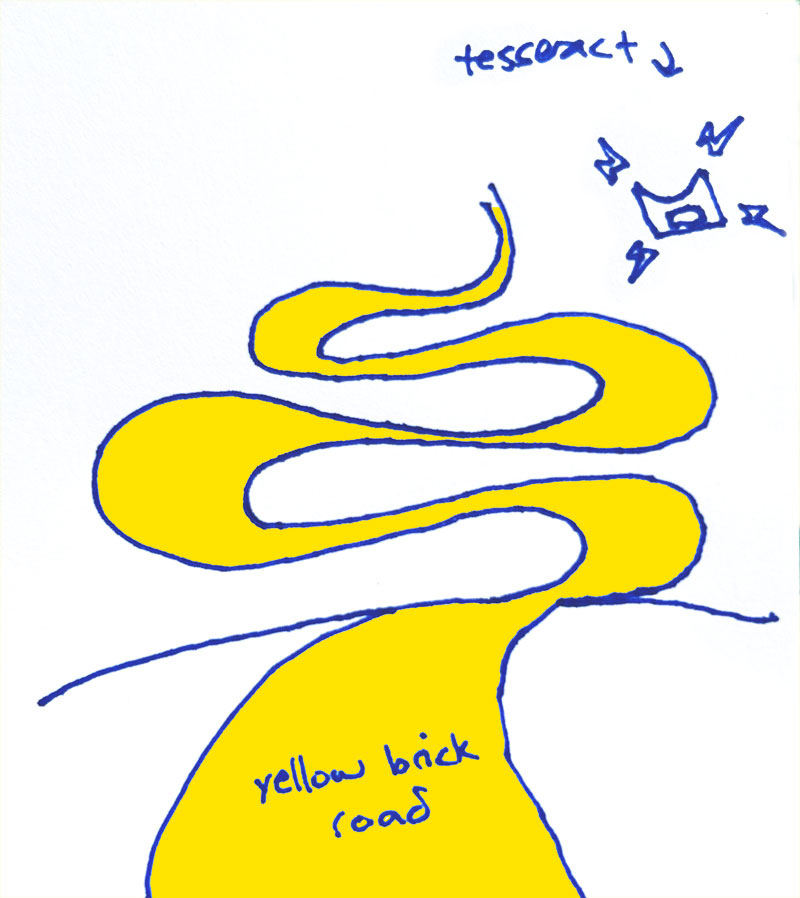
I’m heading back on the yellow-brick road, just floating belly-down this time. Again, it’s not far; 30 feet in the sparse area with the tree near the edge, 30 more feet through the more crowded area. I’m remembering to gather my things from the last dream — wallet, keys, costumes that I need to return. I had borrowed the costumes from the store using… what was it called, I wondered, borrowing clothes temporarily? The only other awake person on the road is listening to my thoughts, and offers “layaways” as the answer. I responded “nah, but it’s like that. . . . ” I’m getting distracted and then realize I don’t need any of this — I throw up my hands and let my things fall away. I begin moving again. Down the road, back to the dream. And I’m back in the dream? Or waking up. My body is filled with energy and good feelings, charged up with the dim sugar light. I had struggled to fall asleep, but now I was in the perfect state. I sat there thinking about the dream, trying to remember it, catching a corner of it, almost losing it, before getting a hold, remembering, then waking up to write it down.
I felt quite large in this dream, filling the space more than usual.
I got the sense that at higher levels we speak self-fulfilling prophecies. We create something (speak it with our attention) — a sound-form-idea — that is an end result that exists outside physical time as a cause for its own creation within physical time.
Yellow Brick Road: This dream was at 3:45, when my dreams are at their most intense and deep. The fact that I effortlessly “shift sideways between two moments into a higher frequency” shows that I’m dealing with a higher, more knowledgeable level of myself.
The gold of the yellow brick road is the color of the inner light. It’s a ribbon of light, bending back and forth as it enters thicker matter, creating frequency domains and voids (see Wave Motion In Slower Frequency Domains). The yellow brick road, the people on it, the grass and trees on the side are all physical forms painted on it. The Wizard of Oz is built on a spiritual reality, as are all great works.
There are lots of echoes of Monroe in here. The fact that I had to jump to make forward progress on the yellow brick road was like his need to “skip” to get places in the stream. I wrote at the time “It was like building up force against the flow by holding stationary for a few moments, then releasing, being weightless, and moving forward.”
The rolling yellow brick road on the way to the void and tesseract was sort of like an overview of the astral realms — very populated nearby, and less so going out. Each hilly loop defined a different arc of road ahead of me or “ring” of sorts to my perception. Monroe described the astral planes as rings. The bending back and forth created the Tiny World Effect (see The Tiny World Effect). The fact that I felt quite large might have been my presence scaled outward into this astral overview.
The yellow brick road didn’t lead to the tesseract — that was in the void off to the side. It was the void’s sugar light energy that drew me into this viewpoint. That was my actual destination. From this higher-frequency viewpoint I saw the astral as the yellow brick road that I was currently on.
Walking on Water
-
The Blue Crab 2025
I go out to a boat floating on the ocean, not far from the shore. I’m just walking on the water, rationalizing floating docks as I go.
Floating Docks: Ice is also a common rationalization for walking on water.
Energetic Interactions
Energy can be projected outward from the astral body, typically from the chakras. It can take form based on its intention. Energetic interactions are often rationalized as someone “throwing” something at you or to you.
-
Walking Lucid in Midtown 1998 • age 24
While first setting out on Tjo Street, Buttercup came skipping down the way and it was like this bouquet of flowers came from her and shot into my arms. Then she gave me a big hug and kiss and then retreated away (she’s awake and at work right now).
Verification: During the very half hour of that dream, Buttercup wrote me an email! Thus her appearance!
Buttercup’s Love: Buttercup’s positive thoughts of me while she was at work connected with me in this dream. I’ve seen similar bursts of something shoot out from people in the near realm, and it’s a sort of communication. This one turned into flowers, either through some visual similarity or a representation of her feelings toward me.
-
Lucid Dream: Bruce’s Arm and the School Bus 1997 • 10:13 AM • age 23
I came upon the kittens and went right up to them. They were very startled, then cautiously curious. They ran and then one of them threw something at me!
Kitten Attack!: An energetic attack from one of the kittens!
-
My New Favorite Movie 2023 • 3:30 AM
We ended up climbing the walls of a fortified slum area to find one of our singing group firing huge boulders out of himself at us. They bounced off the wall we were climbing, back into the big truck he was in, then back and forth before rolling away.
Energetic Attacks: This energetic attack takes the form of huge boulders.
-
The Most Beautiful Story (A Remake) 2023 • 2:30 AM
I’m “driving” around with a camera, filming. I’m about 20 feet in the air, flying, but I don’t realize it in the dream. I get in the way of some cops. They want to stop me but I’m filming, and they give chase, throwing things up at me, but I keep driving away.
Energetic Fear Responses
In the astral, our emotions can cause energetic responses that can be seen.
-
The Slumber Party and Scary Man Prank 1999 • age 24
It was still dark and I looked out a window. I pointed and said to Buttercup, “Look at that. . . . MAN!” Surely enough a bearded spooky face appeared out of the shadows in the window, from a black silhouette to a full face, giving the appearance of approaching. Buttercup got scared and fell to the floor in a fetal position. She seemed to be locked in her own world, shaking, and these grapefruit-sized semi-transparent black orbs were skittering all over her body. . . . Later, awake: Wow!! Buttercup dreamed of scary men out on the porch! After she fell into the fetal position with the black orbs all over her in my dream, she dreamed she was unable to move with cockroaches running all over her body.
Skittering Orbs: Buttercup became scared by something and fell into a fetal position. The energetic response to the fear was black orbs scurrying all over her body. Within her own dream, she rationalized them as cockroaches.
-
The Stinging Ocean 1996 • age 21
My dreams last night were typical of those recently. I dreamed a horrible ocean dream. While in dark tidal pools, semitransparent grey arthropods would scurry around our legs. Then they became scorpions. . . . I was never injured but the deep-sea ocean life fear of the unknown was real.
Scurrying Fear Orbs: My fear of unknown ocean creatures caused the same energetic reaction, and I rationalized it as arthropods scurrying around my legs.
The Astral Cord
The astral cord connects the astral body to the physical body. It’s always there, though it is often edited out of the dream experience or rationalized as something else.
I was groggy. I noticed that I seemed to have a computer printout in my hand, and I felt the need to take this printout with me and show it to LD. . . . I took the end of my computer printout, and I walked into the dining room. I didn’t want my computer printout to tear, so I walked very carefully, and I turned to see how my printout would unfold itself. The other end was sitting on the floor next to my bed--apart from my body.
I walked backwards and I watched it unfold and grow longer with each additional page being unfolded from the main pile. Upon looking back into my room I saw the printout, but not any astral cord, so I realized that the printout that was unfolding WAS my astral cord [in disguise]! That’s why there seemed no end to it! It only took the appearance of a printout! OBEHWOBEr • modern • Peterson
In Why We Survive . . . by Mr. Hunt. . . .
“She (the dreamer) found herself, on one occasion—of course in the dream—upon the roof of a building, and for some reason or other was particularly interested in a cord which she took to be, quite prosaically, a clothesline looped over the roof.
“Curiosity led her to follow-up this line as it went over the edge of the roof and into a bedroom window. It led her to a bed in which lay her own sleeping body, and immediately upon the recognition of this she found herself awake and in her own body once more.” (Muldoon 313)PotABOBEr • Spiritualism • Muldoon
The Aura and Aura Pictures
The aura is the overall energy expression of the flow through the astral body based on its moment-to-moment focus. The aura can be seen in the astral, though it is usually edited out of our physicalized and rationalized version of the dream.
-
Osiris the Dancer 2010 • 3:30 AM
Osiris is gorgeous, dressed in a white topless outfit that had form-fitting pants and ribbon-like fabric flowing off the arms. Her skin is slightly darker than the other dancers. She comes up to me and there is this moment of unspoken permission and then a blur.
When I come to, I’m lying in the same position, and the party is over. I look down and I’m completely covered in drawings made and colored in with wet, sticky white chalk. My jeans are like shorts, reaching just up above my knees. I fold over the edge to see the inside and the same drawings are underneath the fabric in reverse! The chalk drawings are on my chest as well — everywhere I can see. It’s all in white, except for little edges of pink and blue. The drawings on my legs appear for the most part to be a pattern of finely drawn buttocks and thighs laid across each other, and then colored in. What had happened during that blur with Osiris?
Rationalized Aura: Were the chalk drawings my aura? Why was it all lit up and visible after the experience with Osiris? I remember the chalk being wet and sticky as if freshly applied, like body paints.
-
Kindred 2025 • 5:15 AM
The man walks out in this amazing costume that reminds me of an aura. It’s bluish overall, with a slightly inhuman face with large dark eyes. The entire costume is changing shape and shades. It’s as if it’s made entirely of 2-3 inch long filaments of mostly blue light standing out from him, blowing in its own internal wind. The filaments are tightly packed, almost like fur, but flowing. The character is the Sandman, and it is the most impressive costume I’ve ever seen. He tells me how they’ve tried to make all these inventions work over the years but none has taken off. I say THIS WILL.
Blue Aura: This is most certainly his aura, and he’s able to change its appearance somewhat. Or else I might just be seeing the flow of energy as it changes around him. The large, dark eyes have been described by some as concentrations of energy.
Chakras
The chakras are the electromagnetic “organs” of the astral body, metabolizing the Flow from the Source into light of different frequencies. These are usually covered up by our projections of physical forms, but sometimes they peek through.
At some point I stopped whatever I had been doing and tried to meditate with the intent to see my chakras. I sat down (with my eyes open, looking at myself) and began concentrating on trying to see the spectrum of my chakras. Initially, nothing happened. But after a few moments, very faint colors appeared at the various centers. Then I shut my eyes, and my sight clicked in with my eyes closed. I was wearing what I thought was a blue gown with golden flowers etched into it, or hanging from it. There were very complex etchings throughout the whole robe. There was one big flower that was distinctly noticeable, the stem coming out from my waist (which I had originally thought was a belt) and lying on the floor between my legs. When I saw all this I thought, “What’s this robe? I wanted to see my chakras!” Then it dawned on me that these were my chakras. Then I lost consciousness and went off into other adventures.
As I sit here and write, I wonder if that robe was some type of representation of my Etheric body, displaying the more active chakras as flowers, and the complex etchings being the nadis. APCOBEr, LDer • modern • DeGracia
The night of the day after my front midline channel opened and the energy squeezed through my solar plexus and crept beyond my navel during meditation, I dreamt that I put on a leotard that had a front panel set into it made of beautiful pale-blue open lace. (Garfield 182)PtELDer • modern • Garfield
Internal Energy Circulation
The flow of internal energy sensations are interpreted and integrated in much the same way as physical sensations.
The “meaning” of my dreams . . . is lying over a base of physical sensation. (Garfield 181)
The varied shapes of our dreams tell us of the location and the blockage or movement of the basic life energy dwelling and circulating within us. (Garfield 202)
The current tingles and buzzes as it moves from place to place in my system—now in my genitals stirring passion, now in my legs making me feel airborne, now in my cheeks creating whirlpools and breezes, now in my brain stirring eddies of lightheaded ecstasy, now on the surface of my skin like a drizzle of rain, tingling alive in every pore, now plunging down my front to make me feel, in my dreams, as though I am plummeting to earth. . . .
When the current is very strong and the peak passes down my throat . . . a mass of energy sometimes “sticks” in the depression in the base of the throat. Like a great, whirling lump, the mass of energy wedges there, unable to break through, giving me a sensation of difficulty in breathing or a sense of some matter caught in my throat. . . .
Most often now the current originates from the soles of my feet. . . . Rumbling out, hot and bubbly, it starts its upward journey. It is like my dreams of dancing on hot mud, of walking on pulsating sands, of twirling on my toes; it is like all my dreams of dancing. (Garfield 178-179)
I dream that I am dancing, twirling, leaping, ballerina-style, and awaken to find that the “bubbling springs” in the soles of my feet are whirling wildly. (Garfield 181)
Shortly before the pathway through my crown opened, I dreamt of a stream of water dripping on the top of my head; after the pathway opened, and the whole area was sore for days, my dream characters were hit on the head with rocks and hammers, leaving them as sore as I felt. (Garfield 181)
As I circulated the energy upward and downward during the day, I dreamt at night of roller coasters, escalators, steep hills, ski slopes, deep-grooved tracks, sharp curves on roadways, flights of stairways up and down. (Garfield 182)
This moving energy produces sound-feelings as well — different kinds of vibrations that we feel and hear. It’s the vibration of our very energy bodies as energy from the flow flows through us.
Sounds and feelings take on specific shapes. . . .
In “The Great Steering Wheel” dream, when I felt the wind and the sun in my face, it seemed perfectly natural. What could be more reasonable than the sound of wind as one flies through the air? . . . I did not question hearing the rush of water passing my ears as I dived deep into a pool of water in a dream to pick up a special pebble from the bottom. And when I flew along the seashore and heard the roar of the ocean, it, too, seemed to make sense. . . .
Yet, bit by bit. . . . I came to the realization that the sounds and sensations of wind and water in my dreams are pictures of the sound-feeling that comes from within myself. It was not the wind or the water that produced the sound-feeling, nor was it a memory-image of wind and water. It was, quite literally, myself. I was producing a shimmery sound-feeling that my dreaming mind formed into pictures of wind and water! . . .
Other dream pictures were related to the sound-feel. The roar of a passing train in a dream, the powerful purr of a bus-train that approached, the buzz of a swarm of bees, the rumble of voices in a crowd, a burst of clapping hands. . . . I began noticing fast-moving beats in the background of lucid dreams. I heard pulsations or drumbeats. . . .
Sometimes the pulsation shapes itself into rhythmic verse as well as music. (Garfield 153-154)
I was being kissed on every portion of my body at once, the all-over tingling sensation it produced led me to the awareness that I was dreaming. (Garfield 155)
I found myself being overrun by a horde of mice. . . . The tickle of hundreds of tiny feet on my bare skin explained the prickly sensation I was experiencing. (Garfield 155)
I justify the sound I hear myself making by images of wind, water, motors, insects, animals, and people that buzz, purr, roar, hum, chant, and whir. I justify the vibration that I feel myself making by objects, animals, and people that pet, kiss, and tickle me. (Garfield 156)PtELDer • modern • Garfield
The form it takes is whatever is most natural and appropriate to your context.
See The Energy Backdrops of Dreams for a visual correlate of this.
The Star Field / The Sphere
This is an awareness of the mind as a spherical field of star-like points of light that surrounds our central point of consciousness. Each star is a miniature scene representing a place or person we know — Besant and Leadbeater’s “mental image”. Our focus on a particular scene expands it out around us as a dream or rote.

Each star is as bright as the attention we’ve poured into it in the past, each very slowly fading, but calling out for more attention.
See The Mental Image and The Influence From and Growth of Thoughts, and Attention Increases Size above.
This is equivalent to the sphere described in The Sphere and Beam Model.
-
The Star Field
I have a vague recollection of returning to an index — a star field from which I chose my dreams.
The Star Field Index: This is interesting. The fact that I call it a star field fits perfectly with the idea of all these points of light in my brain being tiny rotes, focuses of context that I can expand into dreams.
-
Pulled by Desire 1996 • age 22
I have been watching closely, yet it is fleeting still. I have no memory of dreams, but I remember thinking “yes, I see it working”. At times there is a desire, then everything turns to dots and I feel pulled somewhere where my desire is easier to attain.
Pulled by Desire: This may be related to the star field. It looks like I’m exploring how desire pulls me to different locations.
-
Guided in Dreams 1996 • 5:05 AM • age 22
It expands outward Straightforward, easy-to-understand dreams tonight. I’ve been following desires, floating around through downtown San Francisco. I really am traveling around. I love this! Everything is being shown and explained to me. . . . Motivations move us forward. Belief in a goal increases our motivation. Focusing on a destination creates movement towards it. . . . A little later: I’m keeping consciousness in sight from my dreaming. It follows thoughts. When you think, it swirls and turns and expands out, emitting more of itself.
The Star Field: Motivations and desires pull us into scenes. The star field contains all the options. We expand a star, a scene, a rote that we’re drawn towards.
-
The Tower on Arcology Hill 1996 • 3:33AM • age 22
Crazy dreams woke me up. I just caught an early-night dream place that eluded me forever. It was a tall rounded hill with something like a tower arcology on top. There are towering heights and steep angles and hugeness. It’s a long climb up, like our Yosemite hike. There was a huge tree on the side of the hill. I got vertigo while climbing on it. After the tree is a lake. I’m frequently about three quarters of the way up the hill. There’s a stream and lush vegetation. There are houses and buildings all over the hillsides, separated by lots of fences and property lines. Each property is a different section, and I travel from one to the next. The smooth caves where I visit Kayla are here, on this hill.There are huge buildings and steel structures. I remember being here so many times!

This is great, with the trees and lights peeking out. 
This shows the many property lines better. Arcology Hill — The Sphere?: Here I discover that every night in the early hours of deep sleep, I go to Arcology Hill. The hill is divided into small properties, each a potential adventure zone, though the overall goal is to get to the top.
Could Arcology Hill be the sphere of my mind seen from outside? In the sphere, every direction is a different topic of focus, a different star in the star field. The way the hill is divided into countless small properties might be a physical correlate to my mind sphere. See Our Focus Within the Sphere.

The round-topped hill could be a physicalization of the mind sphere within my head.
I’ve seen the image below, representing the mind sphere, with hallways or passages to different dreams. This is the mind sphere from the inside, looking out to each of the different properties represented on the hill above.
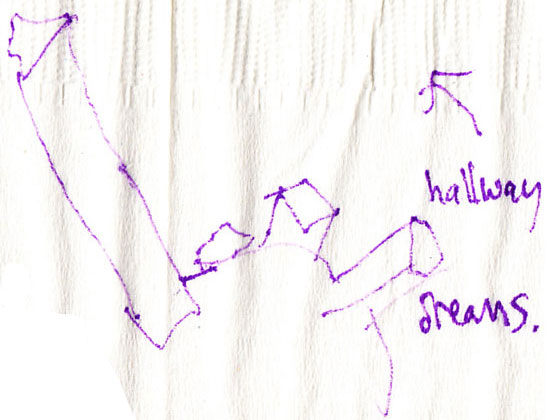
This is reflected in popular imagining of science fiction brain-scanning helmets.


imagined as a helmet.
See also Nonphysical Movement - The Star Field.
Rationalizing Astral Body Separation
Astral body separation can be considered both an astral and physical phenomena, as it’s the point where the two come together (and separate).
Buzzing, Tingling, Vibrating
A buzzing vibration is a very common sound heard during astral body separation. The sound is often rationalized in my experience as a swarm of bees. Dealing with the bees usually takes over the plot of the dream.
-
The Space Probes 1996 • age 22
I’m running over pebbles and water. I’m about to get to this lake with the intent of flying over it and I suddenly hear this swirling buzzing noise of some intensity. Thinking I stumbled across a beehive, I startle and wake up. I was probably about to go OB. . . . Later: I’m in a sunshiny beachy area and my family’s around but I’m avoiding them. I experience big jumps down (100 foot drop into water) and cool sensations.
OBE Sounds: Notice that as I’m about to fly, the swirling, buzzing noise appears. The feelings of motion during the separation of the astral body is often rationalized as flying in the dream state, and attempts to fly may trigger astral body separation.
The falling sensations come from the astral body falling back into the physical.
-
Bees 1997 • age 23
There was this big nasty segment about bees. I was in a grocery store, and the bees kept appearing everywhere. I tried many ways to kill them, but some always remained. There was a scene with a big display and I sprayed this liquid all over it, but one escaped. This guy thought the bees were powerful and followed them around. One surviving bee could always produce a queen.
Then I was in the stairwell of a place I might have lived. There was a big vertical cylinder in the middle and a beehive in the center. A voice spoke into my mind “I’ve always thought the old way worked best: fire.” The cylinder started spinning, flashing in glowing rainbow dreamfire. It was beautiful. Bright flashing flames flew out and incinerated everything.
Bees: I was feeling the body separation vibrations and rationalizing the sound as bees. Of course I could never kill them all. The vibration would continue regardless of my actions on the thought forms I conjured to explain them.
The next scene was a transition to my body in what I believe to be the “column of fire” metaphor to represent my spine and the energies flowing through it.
-
The Buzzing Campus Eclipse 1999 • 8 AM • age 25
It was sunny daylight, and then the color of the sky got darker and someone shouted “eclipse!” Everyone got up and got into a position to see it. I ran around the building. Gravity diminished as a moon flew across the sky, barely crossing the sun’s path. Everything turned a dark orange color and then there were bees everywhere. Buzzing! I knew that they liked the color red. I got stung on the hand and was bleeding. I ran into the school and went underground through all these elevators, futuristic rooms, and huge elegant chambers. I was trying to find a way back to the surface while avoiding the bees!
Out of Body Bees: All at once there is a change of light, low gravity, and the buzzing. The low gravity feeling could be a sensation of my astral body coming loose. But the bees frighten me and I retreat into a building (my body?), before eventually trying to find my way out again.
How strange! What is happening with this “eclipse” that sends me nearly into an OBE?
-
The House War 2011
We take a road on the near ridge up to an abandoned building. . . . It was filled with bees! There were some transient-seeming people living there, too. Somehow we lured the bees out of the building and down the road. Then it was only orange wasps that were left.
Bees and Wasps: Notice how I can’t escape the sound by leading the bees away — when I return, it’s re-rationalized as wasps.
Patricia Garfield describes her experience of “lucid dreaming”, which is largely the experience of astral body separation during the dream state. Before lucidity begins, the sensations are rationalized in the dream state.
The typical lucid dream NOTE: astral body separation begins with an initial change of consciousness. An intense body movement in air or water . . . is followed by a different state of mind. . . . A sensation of coolness often accompanies or precedes the lightheaded feeling. . . . Next. . . . I am likely to have a vivid sensation of rising in the air. This lifting up is sometimes simultaneous with a whirring sound and a vibration feeling that travels through my dream body. . . . The lifting sensation or active flying builds to a crescendo. (Garfield 76)
1) Changes in sensation. . . .
- The feeling of wind blowing in your face or a cool draft.
- A tingling of your skin. This often involves the image of a light rain or drizzle.
- A sound or vibration, like a combined buzzing-tingling or a buzzing light.
- A patch, crack, or hole of light that appears—sometimes as a window.
- The sense that a dream story is beginning again (. . . rather like waking deja vu)
- An intense staring or focusing of your eyes (what I call “fixedness”)
- Rhythmic movements such as dancing, spinning, swimming, or pelvic thrusting.
- A shift in consciousness within the dream—a sense that you are “going to sleep,” “waking up,” “going into a trance,” feeling “lightheaded,” or feeling “tired.”
- Suspension in the air—such as flying, floating, or levitating. (Garfield xxxii-xxxiii)
Lucid dreams have contained imagery of my walking through sprinkles of snow, or being in cool night air, or feeling a fresh, cool breeze, and so on. . . . At other times the sensation of coolness is justified by images of my diving into deep pools of water. (Garfield 77)
More and more I became aware that I was dreaming. . . . I felt the excitement of an inner world expanding. (Garfield 68)
Astral Body Separation
Several experts in lucid dreaming and OBEs have had experiences in the dream state where the physical body is represented by their house. Much as I dislike this kind of representative metaphor, my mind appears to use it as well. In several dreams, it seems exiting my room or house marks an important transition.
The dream self, finding itself already in a body in the dream state, is aware at some level when it is still within the physical body. What best represents the thing a body lives within in physical terms? The house (or bedroom) where we live. With one’s house representing the physical body, exiting the house is equivalent to exiting the body.
My dream self, which separated from my waking self around the age of 7, uses the house I lived in at the time — Blaine House — as its physical body metaphor.
-
OBE at the Dark Tower 1997 • age 22
I was doing lots of travel around the area of the Dark Tower. . . . In my Blaine House room [within the Dark Tower], I had an OBE in which I found out how to fly: jump and hold onto the “rising” part. I flew up through the wall and roof, and ended up on the deck outside my room in Blaine House. I looked around. Below me on the entrance side it was all the same as Blaine House, and there were flashing Xmas lights down there. The moon was in the sky above and the forest was on the other side, reminiscent of other Dark Tower lands & forest. It seemed that above my room, instead of the roof, was a part of the Dark Tower’s library. . . . [I talk with several people]
Later I was on the ground floor trying to fly back to my body many levels up and I noticed the silver cord. I touched it and it was warm. I followed it back to my body.
Exiting the Tower: I have a dorm room in the Dark Tower, and it’s my room from Blaine House. From within that room, I exit through the wall and ceiling (exit the body) in what I think of as an OBE, arriving outside Blaine House.
-
Bedroom Window Gateway 1997 • age 23
A common experience was jumping out the window of my childhood bedroom in Blaine House to another world far, far below. And now, Buttercup and I were up high, among the trees, where my room is. Maybe the roof had become transparent. At any rate, Buttercup wanted to go somewhere out of the rain, and there was a dry place in the world down there, in the caves by the water — that’s where we had to jump. But it was a mile down this time. I had done it countless times before but now I hesitated.
The Bedroom Window: My childhood bedroom in Blaine House was on the second floor. I had a window above my bed, and outside the window were trees, their treetops just over my bedroom.
With Blaine House representing my body, exiting through that window meant leaving it, and I must have done so in tiny ball form for the two-story drop to feel like a mile. Likewise, the world down there was tiny in size.
-
Semi-Lucid OBE: Webbed Windows 1998 • age 24
I came to in the living room of THIS apartment. . . . I looked out through the set of three windows. The clouds were really interesting (though the sky’s clear in the waking world). I wanted to go outside. . . . At times it seemed that the yard of Blaine House was down below. . . . I willed myself to the room’s entranceway. My body took a few steps and tipped to the right onto the sofa. There was a weird in/out sensation and then I got up again and walked through the entranceway into the kitchen.
I went downstairs to the pool table room of Blaine House, now all rearranged.
Exiting to Blaine House: The upstairs apartment we were living in was a somewhat new home for us. I’m semi-lucid, in the near realm version of our apartment. I can see the yard of Blaine House outside rather than the apartment’s yard. When I left the apartment, I felt an odd sensation (exiting the body) and exited down the stairs to the interior of Blaine House. This appears to be the body-as-house metaphor where I exit my body as I exit the house, and appear in Blaine House, my astral home base.
-
The Detachable Room 2004
I’m at Blaine House, which I identify as an Oberlin college dormitory somewhat. . . . Isobel, sleeping next to me in bed, stirs, and I awake momentarily. . . . At this point, Kai came in. He wanted to do something. . . . He went around the room unhooking the power cables to Blaine House. I don’t recall if I saw this, or simply knew this. My room was where the fancy dining room was — on the second floor corner in the back. The whole house was similarly divided into small dormitory-like rooms. . . . Kai ran over to me and started jumping around. The entire room started rocking and shaking. . . . All at once the room slid out of the house. It fell to the ground, slid across the grass in the back yard, and finally down a hill. It was a rush! The room came to a stop and then fell apart so that there was one wall flat on the ground and another standing up precariously. We laughed.
References: Isobel was our dog.
Sliding Out: The body-as-house metaphor appears again! The rocking back and forth is something I’ve seen when getting nonphysical assistance in getting out of the body. Kai knows what he’s doing. The way I slide out and drift to a lower spot is similar to the exit I had in “Passion & Liftoff” — one in which I rationalized I was in a plane drifting down and crashing.
The dream begins at Oberlin in a dorm. My brief awakening from Isobel stirring brings on an awareness of my physical body (represented by Blaine House). This mixes the two locations in my mind. When the room slides out, I exit the body to the exterior of Blaine House — my metaphor for being outside the body.
-
The Destruction of Blaine House 2023
Buttercup and I were on the porch off the master bedroom [of Blaine House], looking out across the fields. I looked down and I saw that there was this 30’ x 40’ hole in the ground, and through it I could see lava bubbling — bright red and yellow. Then I noticed that the house was tipping slightly towards it. I went in to the bedroom and the house tipped back to its original position. I went back out to the porch and the house tipped towards the fields and lava. At this point I began to panic. We needed to tell someone!
The next thing I remember is that we were in town. . . . [I call for help]
Then I’m back at the house. . . . At some point, I had a higher view of the house.
Rock Your Body: With Blaine House acting as my physical body, here I am just outside the house on the porch, and as I move about within the house, it rocks back and forth — a common method of astral body separation. Often upon separation there is a scene change, and I find myself in a town. Returning to Blaine House, I’m now outside of it.
-
The Office Tower Party 2025 • 6 AM
Some people directed me toward the center of the building, where this floor and the two floors below it were part of the party. Entering this area, I found a series of rooms built around a staircase, where one could circle through the rooms before descending to the next floor. . . . I went back into the game again, and as I played, I made this huge leap to a new area. However, this leap was also reflected in the office building, and I found myself on the outside stairs on the 2nd level. Oops! I needed to find my way back to the party. So I went back inside and found my way to the center area again. . . . Then I heard Buttercup calling to me in my mind. She was here with Gwen! They had wanted me to show them around, and I had forgotten. I went back to the building entrance I had just come from and saw them there. I hoped they hadn’t been waiting long, and she responded that they hadn’t. There on the wide front steps I saw a donkey. . . . So Buttercup, Gwen, me and the donkey went inside and I began showing them around, starting on the 2nd floor and moving up.
Dreaming Within the Body: It’s said there’s a spiral current up the spine, and here there was a spiral path around the central “spine” of the building. My feeling of the astral body moving from my leaping ended up with me outside the building. It appears the house-as-body metaphor can apply to any building.
Here I begin at the top of the building, possibly in my sixth chakra area, and descend to other chakra “floors” of the building. Size is not an issue, since consciousness can scale to any size.
If this is true, I’m giving my wife and daughter a tour of the dreamscape inside of my body. Note that of my lower five chakras, my second (feeling, empathy) is probably the most open. Fittingly, that’s where I exited and re-entered the building from the jump and also where we re-entered together.
Patricia Garfield’s lucidity is often related to the release and movement of her astral body, and a sensation of coolness that results. In these examples, she dreams visual metaphors of the astral body exiting the physical.
Some of my lucid dreams are preceded by ordinary dreams with explicit imagery of being pregnant or giving birth. . . .
Emerging from a hole, then, whether it is the birth canal of a woman, or a space cut into a screen, seems to be part of my personal imagery for “birthing” a lucid dream. . . .
More often, my movement in these dreams has been upward—through a hole in the roof or forward and up, as through the screen. . . . Sometimes . . . the movement is upwards and later downward. (Garfield 143-145)
The pretty green grasslike plantings on either side of the path all look alike, until, at a certain spot, they appear wavy.
This is a clue to the presence of a special opening. . . .
This special spot where the wavy green grass covers a hole in the earth is where it is possible to go through to the “other side.” Zal and I kneel and scoop the earth away with our hands. . . .
When we have uncovered the opening, Zal and I each squeeze through this hole in the earth. Hovering in the air on the other side, we seal the hole from underneath with our hands. On this side, all is white and snowy (the coolness). (Garfield 145-146)
I am on a ship. . . . I go outside, yet somehow I am underground and see a staircase. Ascending it, I exit through a hole in the earth. There, people across the water on a dock point to falling snow (the coolness). . . . Will I be able to reopen the hole in the earth? . . . Feeling the edges of it with my fingertips, I push. A kind of trapdoor swings open and I go through it, down the steps and back to the ship. (Garfield 144-145)
I seem to be in a house that resembles the one that we now live in, although not exactly like it. . . .
I have an overwhelming desire to go outside. Hsiu-Ming and I move towards a screened-in porch. . . . Outside the screened porch I can see that it is night and dark. I want very much to get out but there seems to be no door.
Hsiu Ming . . . cuts an opening in the screen with one of her fingernails. . . . I squeeze my body through the space in the mesh.
A blast of cool night air strikes me (the coolness). Bending my knees, I push off from the ground and into the air, still fully aware that I am dreaming. (Garfield 141-142)
Squeezing through a narrow space . . . seems to suggest a movement from one state of being to another. Occultists would say that it represents the separation of the astral body from the physical body. . . . Many of my lucid dreams involve such imagery. (Garfield 143)PtELDer • modern • Garfield
In the next example, the exit of the astral body is so quick, no slow process of exiting the body appears in the dream, and she goes directly to experiencing the movement and coolness:
A girl friend and I are catapulted from a swing at its forward arc. We zoom into the air and are then caught up and blown along by a great gust of wind. . . .
The wind is blowing swift and cold (the coolness). . . . It carries us . . . above snowy fields. (Garfield 206)PtELDer • modern • Garfield
Astral Body Movement
Astral body movement can be part of the astral body separation, or movement afterwards.
-
Mountaintop Flying 1996 • age 22
It began as a ride at the fair. I was in a little roller coaster car on this track on the side of a mountain. At one point the car flew up at the peak and jumped this rock. I realized then that gravity didn’t matter so much. I jumped the next peak and began to fly. I was flying fast through this jagged mountain range with steep angles. When I landed I had this total physical body rush. It was so grand. Then I heard a voice say “No one deserves to fly right now more than you, Benji.” The rocks I was on broke off the mountainside and I had the hugest free fall into the river below. The river was a glowing blue color, as if it was evening and very cold. I awoke when I hit the water. So crazy cool!
Flying: My first rationalization of the sensations was of being on a roller coaster at the fair. Then I switched to direct flying.
Flying is usually the rationalization of the movement of the astral body, including its separation from the physical body — something we do several times every night. This was one of those cases. The return was sudden and the impact woke me up, which can happen with sudden returns.
-
Passion and Liftoff 2000mature content
I went to this odd, out-of-place room. Inside was a friend and two gorgeous naked girls laying on these pillows, facing away. I was overtaken with this strong sexual passion and made some verbal attempts at seduction. What it was is that I was outpicturing to one of them scenes of how nice it would be. So then I was floating above myself, embodying the imagery, with her vaguely above me. We began doing it, but she became less and less important. As I moved, I felt these golden waves going up and down my floating body from my feet to my head. It was ecstatic, orgasmic but sustainable.
Then without warning I’m in a plane on takeoff. It rises slowly and another plane passes over it. My perspective on my plane was as the plane — around and above it. My plane can’t get enough lift and comes to the inner corner of the walls of this ruin. It crashes in an explosion, throwing me rapidly forward, and I awake.
What was all that about? It seems I raised my energy, drifted out of body, then rationalized the plane to account for the lift-off sensations. The plane rationalization began slightly after take-off, slightly above the ground where I was in the scene before it. It probably “crashed” when I reached the corner of my bedroom.
Lift-Off: So this is a clear rationalization of the motion I feel as I move higher out of my body. Upon separating, I seem to drift down into the corner of the room, with the resulting crash rationalization frightening me back into my body.
Note that the girl floating above me is also rationalized as a plane!
Usually the sensations promoted by astral body activities bring about “aviation-type” dreams. (Muldoon 85)PotABOBEr • Spiritualism • Muldoon
I am quite certain that [“flying” and “falling” dreams] are but memories of some degree of Second State NOTE: out of body experience. I have often become aware of experiencing the flying dream during sleep, only to discover that I was actually floating out in the Second Body NOTE: astral body as I brought consciousness to the incident. This involuntary action happens most frequently without any conscious effort. . . .
Falling dreams were also repeatedly examined in my early experiments. It is a common “feeling” in quick reintegration of the Second Body with the physical. (Monroe 187-188)JOotBOBEr • modern • Monroe
Rationalizing Physical Sensations
While in the dream state, we’re in a thought form body that we take to be our physical body. So it doesn’t make sense for us to be receiving sensory impressions from yet another body in a different location and environment (our beds).
When we experience a subtle, unknown physical stimulus during sleep — not enough to really get our attention — then the sensation flows directly into the dream and we attribute what it is from the dream context.
When a brighter, louder, or more persistent physical stimulus happens, we may briefly switch to the MetaDreamer focus to determine if there is reason to wake up or not. The MetaDreamer focus identifies the cause of the stimulus, or at least determines if it’s worth waking up for.
When the cause of the physical stimulus is identified and waking up is not needed, it may be integrated into to the dream. This is a “waking insertion”. This has the benefit of being the attribution point for further interruptions from that same source, preventing the need to switch back to the MetaDreamer focus again.
In these ways, physical sensations are integrated into the dream. This preserves the dreaming state.
See “Purposely Attributing Waking Influences” for how this is decided and done at the MetaDreamer focus of consciousness.
Dream Reattribution
Dream reattribution happens with subtle stimuli whose source isn’t identified. The sensation flows directly into the dream to be rationalized (attributed to something) based on the context of the dream.
The form of the rationalization is determined by a combination of the immediate context of the dream and the longer context of the person’s life.
See also How Context Determines Meaning.
This pattern of individual differences can be noted more clearly in those instances where the experimenter used himself repeatedly as the subject under study. Maury, for example, frequently reported calamitous incidents in response to the sensory stimuli to which he was exposed. Hervey Saint-Denys, on the other hand, seemed frequently to come up with images of beautiful and desirous women, regardless of whether auditory, olfactory, or taste stimuli were involved. And Cubberly’s dream imagery was often suggestive of concerns with social status or position. (Van de Castle 219)ODMresearcher • modern • Van de Castle
This shows that the kind of rationalizations we use is what is natural to our expectations. This is based largely on how we see the world — our overall state of desires and fears. Is the unexpected something to be feared? Or is it most likely some new delightful stimulus? This is indicative of our primary orientation in life.
[Dr. Gregory] applied a bottle of hot water to his feet while in bed and dreamed that he was making a journey over almost unbearably hot ground on his way to the top of Mount Etna. The same stimulus induced dreams in other nineteenth-century authors of being led by Satan over the burning marl of hell; having one’s feet held to a fire by a bandit; being a bear learning to dance by standing on hot iron plates; and scorching one’s feet while escaping from a burning house. (Van de Castle 208)ODMresearcher • modern • Van de Castle
Physical Touch
When considering the cause of physical sensations, “stimulus from another body” isn’t considered a possibility in physical terms. These sensations are then reattributed to our astral body, which we mistake for our physical body.
Tactile stimuli were more frequently incorporated into dreams than either light or sound. (LaBerge 165)LDLDer, researcher • modern • LaBerge
Klein (1930) described the influence of discrete physical stimuli on the “imaginal associations” or dreams of hypnotized subjects. Characteristically of Klein’s results, one subject who was pinched on the hand invariably dreamed of a black rat, whereas another subject whose hand was touched with cotton dreamed: “A cow licked my hand.” (Moss 9)HIoDhypnosis • modern • Moss
When I happened to press my hand with my knee and the hand became numb, I dreamt that a dog was biting my hand. (Ouspensky 246)ANMUpsychedelic • Theosophy • Ouspensky
A woman who awoke because of a painful sensation in her nose, caused by its resting too long on her hand, dreamed there was a peculiar epidemic going on which attacked and destroyed the bridges of its victims’ noses. She was greatly affected in her dream by the agony she endured of seeing so many noseless persons, and her distress woke her. (Van de Castle 211)
A. J. Cubberly attached a small piece of gummed paper, two centimeters square, to some part of his body and recorded whatever dreams these “tensions” might produce. When a “tensor” was placed upon the sole of one foot, he dreamed of people dancing rather clumsily, like rustics dancing in a barn; one woman in the center of the group was notably awkward, “as if there were lameness in one foot or the other.” When a tensor was placed on the right large toe, he dreamed of climbing stairs in a building to reach a certain office, which he entered on tiptoe so as not to be discovered. (Van de Castle 218)
The water spray was associated with dreams in which there was a sudden rainfall or a roof beginning to leak. (Van de Castle 258)
Cold water had been sprayed on a subject’s uncovered back. . . . They woke him thirty seconds later. In the first part of his dream, there was a complex description of acting in a play. The dreamer then described walking behind the leading lady, who collapsed: “I ran over to her and felt water dripping on my back and head. The roof was leaking. I was very puzzled why she fell down and decided some plaster must have fallen on her. I looked up and there was a hole in the roof.” (Van de Castle 259)
Another investigator administered painless shocks to the wrist. . . . One subject, for example, reported he was trying to ignore someone who was tugging at his sleeve. (Van de Castle 259)ODMresearcher • modern • Van de Castle
Internal Physical Sensations
Van de Castle writes of dreamers with migraine headaches dreaming of being shot in the head and struck by a bolt of lightning.
A patient with painful itching skin dreamed he was stroking his dog, who enjoyed the sensations so much that the dreamer began to use his nails and intensified his efforts until he became almost breathless. He woke to find his skin lacerated and bleeding. (Van de Castle 211)
The dreamer felt the bullets pierce his heart and saw blood flow out. Other dream events then occurred, and at its conclusion the dreamer felt as if a bomb exploded. The dreamer had experienced an arterial infarct (heart blockage) during this dream. (Van de Castle 367)ODMresearcher • modern • Van de Castle
See also Internal Energy Circulation.
Our Sleeping Environment
The first and most characteristic dream, which I had very often, was one in which I saw a quagmire or bog of a peculiar character. . . . Often this quagmire or bog . . . appeared before me on the ground or even on the floor of my room, without any association with the plot of the dream. I did my utmost to avoid this mud, not to step into it, even not to touch it. But I invariably got into it, and it began to suck me in and generally sucked my legs in up to the knees. I made every conceivable effort to get out of this mud or mire, and sometimes I succeeded, but then I usually awoke. . . .
The whole content of this dream was created by the sensation of my legs being entangled in the blanket or sheets, so that I could neither move nor turn them. If I succeeded in turning over, I escaped from this mud, but then I invariably woke up, because I made a violent movement. (Ouspensky 245-246)ANMUpsychedelic • Theosophy • Ouspensky
G. F. Meier described a dream of being hanged; he awoke to realize that he had fastened his nightshirt too tightly around his neck. In another dream, he was being overpowered by men who stretched him out on the ground and drove a stake into the earth between his big toe and the toe next to it. Meier woke up to find a straw sticking between these same toes. (Van de Castle 208)
“A friend of mine happening to sleep in damp sheets, dreamed that he was dragged through a stream.” — Tito Macnish, The Philosophy of Sleep (Van de Castle 208-209)ODMresearcher • modern • Van de Castle
Sounds
-
On a Motorcycle 2000 • age 25
We’re flying in a physical plane and I dream:
Buttercup and I are on a motorcycle (this is how I had attributed the loud roar and bumpiness of the plane). She was trying to convince me of the value of this intricate pattern on tissue paper but I thought it was just tissue paper and threw it off the back of our motorcycle. Suddenly I realized it had love notes written on it between her and I! Instantly I regretted the rash move and jumped off to get it. This other motorcyclist picked it up and I tried to chase them (on a motorcycle again) but got on the wrong ramp and then jumped the motorcycle way up in the air. The vertigo and fear of the anticipated crash caused me to awaken.
Motocycles: I attributed the loud roar and bumps of the plane to being on a motorcycle together. When I jumped off and the sound continued, I rationalized another motorcycle to make sense of it. Then I created another one for myself to give chase.
“Another friend dreamed that he was stroking a kitten which in consequence purred most lustily. On awakening, he found that the working of the heavy machinery of a neighboring mill was slightly shaking his bed, and making the joints produce a sound like the purring of a cat.” — Tito Macnish, The Philosophy of Sleep (Van de Castle 209)
[Maury] dreamed about the ringing of an alarm bell signaling that a revolution had broken out when a pair of tweezers was held near his ear and struck with a pair of scissors. (Van de Castle 213)ODMresearcher • modern • Van de Castle
In [Lester Dennett’s] own dream he heard a lamb bleating rhythmically, which then coalesced perfectly in cadence with his telephone ringing as he awoke. (Whinnery 240)JoNDE-JWhresearcher • modern • Whinnery
Smells
In response to a burning match held close to his nose, [Maury] dreamed that he was on a ship at sea and the magazine of the ship blew up. (Van de Castle 213)ODMresearcher • modern • Van de Castle
Lights
Lights don’t typically make an impact on us since our eyes are closed. However, there are some exceptions.
The flashing light evoked dreams of seeing lightning or shooting stars. (Van de Castle 257-258)ODMresearcher • modern • Van de Castle
Super Nova Dreamer
I was using the Super Nova Dreamer from the Lucidity Institute — a mask you wear when you sleep that detects REM cycles, and then flashes red lights that get incorporated into your dreams. With training, one learns to recognize the lights as a signal that you’re dreaming, leading to lucidity.
-
Blinking Masks 1999 • age 25
I was searching for a mask in this open, friendly-feeling warehouse. I showed Buttercup one that was gross and funny and she didn’t like it. I couldn’t find it later and she says she hid it under some clothes in a box. Then I was looking at a whole row of science helmets on stands, and they had blinking red lights. Then the blinking stopped and and I wanted them to blink again but they wouldn’t.
Super Nova Dreamer: I didn’t recognize the signal, but the lights were incorporated into the dream.
-
LASIK Beams 1999 • age 25
The Super Nova Dreamer showed up as the red light from LASIK laser eye surgery which prompted a whole dream on the subject. No surprise, as I’m going in for a LASIK follow-up today.
Super Nova Dreamer: Depending on the context, the flashing red lights could end up being just about anything. Here it alters the plot of the dream.
-
Lost in Time 1999 • age 25
Twice earlier in the night I nearly awoke to the Nova Dreamer lights. The first time they appeared pink with light gray lines, like the light had cling-wrap on it. The second time they appeared as a red-orange kaleidoscope of shapes. . . .
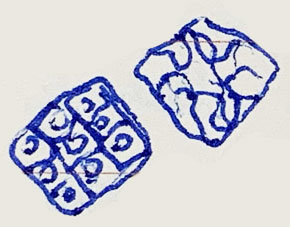
Appearance of the NovaDreamer lights 
NovaDreamer kaleidoscope I dreamed I was in my college dorm (somewhat related to Oberlin). . . . In Ranier’s room I was told it was something like December 6, 2001 (two years later). I found that the last thing I could remember was the last few days of November, 1999, (the actual date). I felt I must be losing my mind, having a psychotic break. Then things went dark and I saw red flashing lights in my head. I thought “There are those lights! I must have been abducted by aliens for the last two years!” I was really scared.
Super Nova Dreamer: Written at the time: The lights first come through the context of the dream. Then, if I refocus, the dream dims out nearly to black and I just see the kaleidoscope pattern of red lights.
Neural Phenomena
Satori
-
The Destruction of Blaine House 2023
The next part I remember is that Buttercup and I were on the porch off the master bedroom, looking out across the fields. I looked down and I saw that there was this 30’ x 40’ hole in the ground, and through it I could see lava bubbling — bright red and yellow (this could very well have been caused by a satori pool). Then I noticed that the house was tipping slightly towards it. I went in to the bedroom and the house tipped back to its original position. I went back out to the porch and the house tipped towards the fields & lava. At this point I began to panic. We needed to tell someone!
The entire story could have just all been the result of a Satori pool being integrated into the dream as a lava pool.
Satori Pool to Lava Pool: I’ve seen a few times where what seems like a satori pool is overlaid on the dream scene, and it becomes integrated into the dream in some form.
Neurons
As everything you see is created within your head (no light enters the brain), it’s no surprise that neurons themselves can be influences upon the scenery of dreams. I’ve seen them other times in altered states of mind, and they come through the rationalization field in many different forms.
-
The Fireworks Vines 1999 • age 25
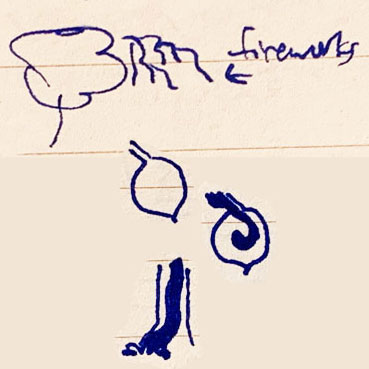
Fireworks vines, tree leaf, leaf with vine curls I’m sitting in a most beautiful garden. It’s well-pruned with pathways, flowers, and square-cut bushes forming walls. My friends were with me (including Phoebe from Friends). I looked up at the sky and saw what looked like the remains of fireworks but they weren’t moving and weren’t fading. They were a light orange color and seemed to emanate a dim orange light that was hard to make out against the bright blue sky. Fascinated, I went to one of them and found a narrow orange tree trunk, less alive than it could be, and the firework trails were branches that ended in orange leaves, like aspen. I also saw at the base of each tree a vine sprouting in vibrant green and climbing the tree, splitting as the branches did and ending with a curl in each single leaf. It meant new life and I was totally charmed with it. I think I was seeing neurons and some energy of life within!
The following appear to be brain cells or the ends of neurons, which I have seen several times behind the visual field in psychedelic states.
Sometimes, just before falling asleep, I would see through my closed eyelids a number of small misty-blue or mauve vibrating circles . . . somewhat resembling a mass of frog’s eggs, and only just on the borderline of visibility. (Fox 19)
In my out-of-the-body experiences I have noted on several occasions, beneath the golden glow suffusing the room, this barely visible, vibrating curtain of circular cells. . . . I believe it is always present at the back of things, if one concentrates upon it, though it will often remain unnoticed because of the more arresting nature of other phenomena. But in my projection experiences these vibrating circles remain empty. It was only in my early childhood that impish faces or friendly ink-pots appeared in them. (Fox 20)
Now in this amber-tinted shining haze, there appeared countless colored forms of men and beasts, representing man’s upward evolution through different stages of civilization. These forms faded away; the pathway lost its golden tint and became a mass of vibrating circles or globules (like frog’s eggs), a purplish-blue in color. These in their turn, changed to “peacock’s eyes”; and then suddenly there came a culminating vision of gigantic peacock, whose outspread tail filled the heavens. (Fox 90-91)APrOBEr • modern • Fox

I see a large cluster of grapes in my field of vision. . . . They are all perfectly round, somewhat small, and uniform in size and shape. Suddenly, every grape on the cluster, in perfect unison . . . shifts its position slightly, and each grape is outlined with a brilliant ring of white light. . . . I realize I am dreaming. . . . Now, all the rings of light, perfectly circular around each grape, move again as one, in perfect unison . . . as each takes on a slight hexagon shape of light which appears just inside each circumference. . . . Now, as if by the twist of a brilliant giant kaleidoscope, the entire cluster spreads out and expands with a brilliant white flash, creating thousands of identically illuminated grapes that spread gloriously to the left and right as far as I can see across my entire field of vision. (Kelzer 115-116)tSatSLDer • modern • Kelzer
The hexagon is somehow a fundamental part of vision — I have seen vision as perceived through hexagons in psychedelic experiences.
For rationalization of neural phenomena with psychedelics, see The Rationalization Field.
Waking Insertions
Waking insertions are a kind of dream reattribution where the very thing experienced from the waking side appears in the dream state. This happens when we’ve identified (or already know) what a certain stimulus from the physical side is, and the thought of it brings it into our dream. This happens because the mind is an assembler of experience into a rational, continuous whole.
Substitutions Due to Brief Interruptions
In these brief interruptions, something from the waking world becomes the object of my attention. When I return to the dream, the previous object of my attention in the dream is replaced by it.
-
Isobel’s Head 2002
I had finished the adventure game (a realtime first person game with others, of course) in the treasure chest and was now back out on the desert sands. I had three objects with me. Two were long like swords (but I forget what exactly) and the third was a round fuzzy thing like my stuffed owl J’buzhibu. I gathered together some dried leaves I had, set the fuzzy thing upon them, and prepared to set it on fire.
Then there’s an interruption from the waking side — my guess is that it was Isobel, our dog, because when I returned to the dream moments later it is no longer a fuzzy thing but Isobel’s head! I set about putting my lighter to it, but the thought of the loss of my dog, of burning her head, of Buttercup’s sadness, all this overcame me and I became sad and tried desperately to remember how she had died. It was so sad that I woke up.
Waking Insertions: Sounds, sensations, lights, and anything else coming from the waking world while dreaming can find its way into a dream. The stimulus needs to be integrated into the dream in order to prevent it from interrupting the dream. However, as we see here, it doesn’t always work out, and the insertion itself can prove to be so shocking as to jar one out of the dream.
-
The Detachable Room 2004
I’m trying to pee in a urinal in a bathroom crowded with people and various things. Anyways, I get it wrong — I take off my jeans and dunk them in the urinal water, which is already yellow. Oh no.. I realize my mistake. I’m slightly embarrassed and head back to my room, leaving the other people in the bathroom. There I find a sink and put the pants in the water to clean.
Isobel, sleeping next to me in bed, stirs, and I awake momentarily. When I return to the dream, it’s Isobel I’m washing in the sink. “I need to get the urine off,” I think. It’s not actually Isobel, but a squirming Cavalier puppy who wants to get out of the sink. While washing the yellow off her back legs and backside, I wonder if I’m mistaking the golden cavalier spots for stains. At any rate, I wash off all the stains. Notice how it was the lower part of the pants that was stained, and when the dog replaced them as my object of focus, it was the lower end of the dog that was stained. When I was done washing, the dog was smaller and whiter than Isobel, obviously a shrunken thought form.
References: Isobel was our dog.
Waking Substitutions: This is another great waking substitution, just as in “Isobel’s Head”, with the same subject! In this substitution, she is also made into the subject at hand — she replaces my pants as the object in my hands, with her bottom end as the stained end. Being that the dog form shrinks and fades pretty quickly shows that the need for that attribution to remain in the dream also fades pretty quickly.
What We’re Wearing
A classic waking influence is the insertion of what you’re wearing to bed into the dream. This happens because of a brief switchover to the waking focus, in which you’re temporarily aware of your physical body, including sensations on your bare skin, before refocusing in the dream.
If you’re wearing something uncomfortable, the sensation may cause it to be inserted into the dream, where you may try to take it off only to find another is there to take its place.
-
When Everyone Stopped 2006 • 5:45 AM
On the way up I realized I was only wearing boxers! I rationalized that I must have left my shirt and shorts somewhere. It was really junky down there, so it wasn’t hard for me to start finding clothes everywhere. . . . A friendly fellah came downstairs to help and now Buttercup was with me (another insertion from waking life, perhaps).
Waking Insertions, Rationalizations, and Projections: Pulling our (lack of) clothing into the dream often awakens the waking self in the dream, who doesn’t want to be in public in its underwear. Buttercup, next to me in bed, is also pulled into the dream. It’s likely she or I shifted in bed just before this scene.
-
Deadwood Blues 2010
I’m wandering about, going from bar to bar, and end up in this one at a table with three other guys who we all found mutually amusing. I was talking kind of softly as if I had something in my mouth (I was sleeping with a blue mouth guard in my mouth to prevent me from grinding my teeth, and this appeared in my dream). We were talking and making each other laugh but I found it annoying that there was something in my mouth, so I turned and spit it out, and a blue glob flew out into the shadows of the wooden floor. But I assumed that must not have been all of it, because there was still some in there, so I reached in and grabbed out another big gob of it and threw it onto the floor. And yet, there was still more in my mouth. So handful after handful, I pulled gobs of blue goo out of my mouth and threw it on the floor until it became clear that I just had to deal with having something in my mouth and went back to the conversation trying to speak around the obstruction.
Waking Thought Form: My awareness of the mouth guard at this point in the dream (probably because of so much talking) caused me to recreate it in the dream world. While I believed that removing it from my mouth in the dream would work, it made no difference to the sensation of it in the physical world, so it continuously remained in my mouth.
-
Triple Braced 2018
I was sleeping with a soft neck brace on.
In my dream, there was a scene where I was going to speak in front of a bunch of people. I realized I was wearing the brace, and took it off. Then I realized I was wearing another one, so I took that off too. Then I felt that there was a third, so I took it off and started wondering about why and how I could be wearing three neck braces.
The sensation continues!
It’s Still There!: The sensation of my neck brace made it appear in my dream. But no matter how many times I took it off in my dream, the sensation of it continued.
Thunderstorms
-
Thunderstorms and the Shape of Dreams 1996 • age 22
Then, at Blaine House, a HUGE thunderstorm was coming. The radio said power was out where it had been. We could hear the thunder even though the storm was far in the distance. I was rushing about, preparing — shutting windows and screens and such, helping young Ruby do the same in her room. I could walk around without worry in Blaine House. Wadsworth was there, but it was not a problem. I actually didn’t mind him being there. The clouds were black and huge and coming fast but above us it was blue. The storm hit pretty intensely and I woke up to find a REAL thunderstorm going on!
Storm Integration: Here the lightning and thunder of a real thunderstorm bring one into my dream.
Sounds and Voices
-
Lucid Dream: Bruce’s Arm and the School Bus 1997 • 10:13 AM • age 23
So I’m flying again. I look down at the street and it’s shimmering, like grass in the wind, moving in swirling sheets of points of light. I don’t think I’ve seen anything shimmer quite like that. There was traffic and school buses. I picked up a big bus, and was floating along with it. I scared some kids in other buses by pretending I was going to throw the bus at them. I heard all the kids scream but of course I wasn’t going to — just kidding around. Then I walked up another hill, forgetting about the bus.
The school bus, melted & shrunk I met this kid and we started talking. While we did, the bus I had picked up had shrunk to the size of a large plank of wood. It was just one color of gold/yellow now, and each indentation was much less defined, as if melting, shrinking. Somebody had grabbed it and was running over the hill with it under his arm. I said I heard a bus from the waking side, a rumbling engine-y feeling. I asked the kid if he could hear it and he thought it was the vehicles on the road in the dream. I said “No, it’s coming from the other side, from my body side.” I then had dual awareness for a few moments; half there, half here, but in the same space. That’s when I felt my head and jaw vibrating.
Thought Form Rationalization: I started flying outside and saw the shimmering in the street. There was no traffic at this time. Then suddenly there was all kinds of traffic, not moving, just sitting there with their engines on like they were in a traffic jam. It was either a rationalization of a bus or truck outside in waking life or a rationalization of the head and jaw vibrations. As I turned my attention to the conversation, the bus thought form began melting.
-
Weaving Dream and Physical Conversations 1996 • age 22
Buttercup awoke me and her voice broke into a conversation in the dream I was having at the same audio level.
Conversation Source: The telepathic dream conversation is already being translated into physical terms as talking out loud. From here, someone speaking from the physical side mixes right in.
Smells
It was summertime and the odors from a recently unpacked barrel of “strong old American cheese” pervaded his sleeping quarters. In addition, he became aware of rats gnawing in an old wall behind the bedstead. When he finally got to sleep, the dreamer found himself in some barbarous country, charged with a political offense, and doomed to be incarcerated in a large cheese. He then became aware of an army of rats attacking the monstrous cheese which was his prison. Just as they gained entrance and began to “fix themselves in numbers upon my naked body,” the dreamer awoke with throbbing temples and a sense of nausea from the extremely strong odor of cheese. (The Journal of Psychological Medicine) (Van de Castle 210)ODMresearcher • modern • Van de Castle
Light
-
Under the Earth: Guardians 1996 • age 22
Buttercup, I, and a friend are now running through the tunnel on the other side. As we continue, it steadily brightens and ahead of us we see the mall across from Rainbow Foods. There’s fresh snow on the ground outside. . . . I wake up to the year’s first snow.
The Brightness of Snow: The increased brightness of the morning light off the snow likely influenced the dream to include snow on the ground.
Max Simon, the French author of The World of Dreams, preferred to sleep in a room without curtains because in his early morning dreams he then frequently found himself in buildings “bathed in floods of dazzling light, while everything seemed animated and joyous.” (Van de Castle 215)ODMresearcher • modern • Van de Castle
Fulfilling the Sensation
There’s another interesting type of rationalization I’ve encountered when it comes to steady pressure as a physical stimulus. This most often comes from the sensation of our bed, blankets, or pillow. In these cases, I have in several instances made sense of it in the dream by putting my dream body in a position that would result in that sensation.
-
So I Have a Rat 2023
Buttercup, who does not like rats, was dreaming that she was holding a rat in her hand, much in the way one holds a burrito. It was her first memory of the dream, so she doesn’t know how she got it. The rat was alive, but not struggling. She was presented with the conundrum of what to do when you find yourself with a rat in your hand. She was so flummoxed that she “woke up” in our bed. She was still dreaming, however.
She stretched her arm out and grabbed something on the night stand. It was a rat! So once again, she had a rat in her hand.
So I Still Have a Rat: This is fascinating! The rat thought form in her hand continues through the false awakening. Her stretching and grabbing something from the night table was a way to explain the sensation of the rat still being there.
She is fulfilling the sensation of the thought form in her hand from her dream just before the false awakening!
Bed, Blankets, Pillows, Sleeping Partners
-
Tapestry of Tears 1997 • age 23
Nap dream: I’m on the couch in the living room (but it’s like gramma’s living room). I’m facing the back cushion, with my face is pressed up against it. I’m talking with Buttercup, when I notice my tapestry is hung sloppily behind the couch and not behind the entertainment center where I left it. I am overcome with emotion. I get up, tear it down, and run to the bedroom, crying. I put my head in the pillows, curl up, and just cry. My crying wakes me up. Was I really crying? It seemed to come from reality on just the other side. When I awoke my face was pressed up against Buttercup’s back.
Rationalizations: My face being pressed up against the couch is my first rationalization of my face being pressed up against Buttercup’s back. Then I get up and run to my bed, and press my face against the pillow in just the same way to continue to rationalize the physical sensation.
-
Between Classes 2010
This conversation sort of let me into the group, and we started talking about various things. I laid my head down on Quentin’s knees and basically got into the position I actually was in bed, with Quentin’s knees as the pillow.
Fulfilling the Stimulus: The pressure of my pillow was stimulating my neck, and to make sense of it, I laid my head on Quentin’s knees in the dream. Sensation and potential distraction explained away!
-
The Ghost Lady 2023 • 4:30 AM
I closed my eyes again, just concentrating on the dark, relaxing, waiting. I was going to give it a good long time this time. I turned my head to the right and laid it back on the seat, unconsciously matching the pressure from my pillow in waking life.
Matching the Pillow: As I relax with my eyes closed in the dream, I come closer to the physical realm, because that’s where this state is familiar. I must become aware of the pressure of my pillow and lean my head against the seat in such a way as to “fulfill the sensation”.
-
Rolling Snowballs 2010
After getting a little panicky about being too close to the edge, we decided we’d have to stay the night up there. I wasn’t afraid of the cold, however, and I burrowed a little hole in the snow. I tried to get Buttercup to join me but she didn’t. My little burrow was cozy and I think reflected the shape of the comforter and blankets around me.
Waking Shape: The shape of the burrow I dug seemed to take the form of the blankets wrapped around me. This seemed to be a different part of the dream, where I was partially aware of the waking world, maybe thinking more than dreaming. Some time passed here where my focus was not fully with my dream body.
Other Influences on Dreams
Physical Short Circuits
We experience “physical short circuits” in the dream state when we have a desperate desire to perform a physical activity such as running or shouting, but instead of routing that action to the astral body, we’re attempting to perform it using the physical body. Since the physical body is in sleep paralysis, it doesn’t respond, and the action fails.
Being Unable to Run Fast
-
The Red Scooter 2000 • age 25
Someone comes up to us and I have this sudden fear that he’ll ride off with Buttercup on the red scooter — so of course he does. I chase them, but I’m very slow. I concentrate really hard on running fast and the colors get deeper and darker. I become aware I’m dreaming, aware that I can break the seeming rules of reality around me, but still the red scooter pulls out of sight.
Faster, Faster!: The classic inability to run fast, which I completely overcome moments later by lucidly teleporting to them.
Being Unable to Talk or Yell
This happens when, for whatever reason, we end up trying to speak with our physical voice in our sleeping body. Being mostly paralyzed, this doesn’t work and we hear our attempts failing.
-
Deflating Tank 1997 • age 23
Very angry, I yelled that I hadn’t done it, but had merely laughed and laughed when it occurred. I was trying to yell louder and louder but my voice remained a whisper. At least it was an insistent one.
-
Adventures in Northtown Mall 2001
Walking to the center of the mall, I saw Raven walking the other way. She said a meek hello and continued on. I turned around and followed her into a book store. I tried to speak but my voice was all raspy, so I left.
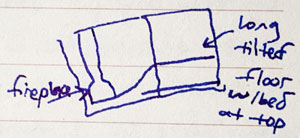
Raven’s tilted house I returned to the center of the mall and thought about her. I appeared in this twilight neighborhood near a tilted, window-covered house without any decorations in it (I was likely just seeing through the walls). It was Raven’s house. I saw her inside and she eventually saw me and came out. We walked and talked. Then I saw this distant light in the sky, darting about unnaturally and I said “UFO!” I repeated it over and over because it felt as if my mouth was full of crackers and I couldn’t say it. Weird! Twice in one night!
Cracker-Mouth: Here I find I’m unable to talk at two separate times in the dream. The first time I was just trying to talk. The second time, I’m trying to shout, which is the more classic instance when one tries to use their physical voice and it fails to work.
Lucid Dreaming
“NonLucid” Dreams
The Nonlucid State
Lucid dreaming is usually described as being aware that we are dreaming. This refers specifically to the waking self being aware that it is dreaming. Thus being “nonlucid” refers to the waking self being unaware of this fact.
Being nonlucid typically refers to the waking self in its hypnotic, unquestioning state. This corresponds to state 5) Rationalized Astral Experiences. It could also describe state 4) Waking Self Fragment in which the waking self is fully engaged but unaware that it’s dreaming. In both cases, the waking self accepts the situation it’s presented with. Why? Because seeing is believing. The situation passes all the tests — we can see it, hear it, feel it, and interact with it.
The only thing missing in this state is our ability to compare the current scene against the whole of our physical experience. We have to go from accepting everything, to seeing something as unusual, to then seeing it as impossible. We have to do so without our rationalizations fixing or otherwise making sense of the incongruities. This requires holding our focus on the physical long enough. The shortened context of the hypnotic waking self makes this very difficult.
The hypnotic state allows the dream self free action without being constrained and questioned by the waking self.
Rarely does it dawn on the dreamer that things in the dream could be other than they are. (Sparrow 13)LDDCLLDer • modern • Sparrow
In a dream, one accepts as natural the most absurd occurrences through lack of lucidity; in a conscious projection, critical judgement is always operative. (Vieira 72)PotCOBEr • modern • Vieira
Lucidity — The Full Waking Self
Lucid Dreaming
My discovery that my dream self is always aware that it’s dreaming was a bit of a shock to me (see my dream “Bedroom Soccer”). This underscores the difference between the waking self focus and dream self focus. This means that lucid dreaming is something that only applies to the waking self.
Lucidity is being focused in the full-context waking self within the dream state.
What differentiates the waking self’s lucid (state 3) from nonlucid states (states 4-5) is our contextual span. In state 4, the waking self has awakened without any context, and in state 5 it is in the shortened context of a hypnotic state.
From these nonlucid states, lucidity comes as a slow dawning of awareness as more attention moves through the waking self focus, extending its context to a point where it links up with the full continuity and context of the waking self in a moment of realization — “this is a dream!”
Meanwhile, the dream self is always aware of when it’s “dreaming” and when it’s not. If we know we’re dreaming and that’s not especially exciting news, we’re likely dreaming in the dream self focus (state 5).
In the waking state the conscious mind must focus rather exclusively upon that one particular point of concentration that you call reality, simply so that it can direct your activities properly in temporal life. It is quite equipped, however, also to direct you to some extent in other levels of reality when it is not needed for specific survival duties. (Roberts 170-171)URchanneled • modern • Seth
Altogether [Frederik van Eeden] recorded 500 dreams, of which 352 were lucid. . . . He said that he had almost complete recall of his waking life during [his lucid dreams]. (Garfield 155)CDLDer • modern • Garfield
Walking down the hall, I could feel the cold hardness of the stones beneath my feet and hear the echo of my steps. . . .
I was in full possession of my waking faculties while dreaming and soundly asleep: I could think as clearly as ever, freely remember details of my waking life, and act deliberately upon conscious reflection. Yet none of this diminished the vividness of my dream. (LaBerge 1)LDLDer, researcher • modern • LaBerge
-
Lucid Dream: Bruce’s Arm and the School Bus 1997 • 10:13 AM • age 23
Yes! Yes! Yes! I did it! Lucid Dream!! YES!!! Oh it was so amazing!
I went to bed at 2:30 AM, got up around 9 AM to drive Buttercup to work, and then went back to sleep around 9:15 AM. I tried holding my inner eyes open from 9:15-9:30 AM but to no avail. So I just went to sleep, lights out. The window was open with lots of singing birds. Temperature very comfy.
It began with me getting food in a cafeteria. Bruce (Buttercup’s Wadsworth) was lying on the table with the food, and I was cutting up his arm with a big steak knife to put on my plate. Then I realized what I was doing and looked up because I knew the body I was cutting didn’t mind. I saw another copy of Bruce standing there. He was looking at me strangely, casting his gaze back and forth from the version of him on the table to me. The Bruce on the table began to get lighter and lighter and float up into the air. I turned to the standing Bruce and said “You’re Bruce H.” and he said “Yes, I am”. Then I indicated the floating body and said “Then this isn’t your body,” and he said it wasn’t. At that moment I REALIZED I WAS DREAMING and began running about, leaping from table to desk to chair!
I came upon the kittens and went right up to them. They were very startled, then cautiously curious. They ran and then one of them threw something at me! And then I was flying. Of course, it’s always the first thing I try. My memory is a little flighty. Then I was in this house. The colors were so vibrant and my sense of touch was as real as real! I couldn’t believe it! I grabbed this fuzzy cleaning thing and it was so very soft. I made a note of remembering it.
I was standing on a table in a brightly colored green-floored TV room in Blaine house. I went outside and the house was this brightly lit, strangely proportioned building with bright colors. I was on a hill and tried flying. Here are some secrets: you tend to drift downward unless you turn belly up. It seems your belly pulls you forward. So I’m flying again. I look down at the street and it’s shimmering, like grass in the wind, moving in swirling sheets of points of light. I don’t think I’ve seen anything shimmer quite like that. There was traffic and school buses. I picked up a big bus, and was floating along with it. I scared some kids in other buses by pretending I was going to throw the bus at them. I heard all the kids scream but of course I wasn’t going to — just kidding around. Then I walked up another hill, forgetting about the bus.
The school bus, melted & shrunk I met this kid and we started talking. While we did, the bus I had picked up had shrunk to the size of a large plank of wood. It was just one color of gold/yellow now, and each indentation was much less defined, as if melting, shrinking. Somebody had grabbed it and was running over the hill with it under his arm. I said I heard a bus from the waking side, a rumbling engine-y feeling. I asked the kid if he could hear it and he thought it was the vehicles on the road in the dream. I said “No, it’s coming from the other side, from my body side.” I then had dual awareness for a few moments; half there, half here, but in the same space. That’s when I felt my head and jaw vibrating. I refocused into the dream. The kid saw the shrunken bus and was surprised. Then with a huge smile, I put my hands on his shoulders and said “We’re dreaming. This is a dream!” and he had this look like he didn’t believe me and I said “Yeah, everything feels like usual, but we are!” He started walking back to his little house. I followed and inside there was this girl. I said “Look, I’m going to fly.” I lifted up and drifted immediately down into the corner. He wasn’t very impressed and threw himself in the corner and sarcastically said “Ooh, I’m flying, too.” So I got up with a greater will and did the back flip thing and it worked — I was floating there and flying about. Then he was flying, too, but he was unconscious, drifting in the air but mostly motionless. He had this plastery semi-sweet look on his face.
Then a crowd of people about my age came in. One of them had a stack of magazines, copies of an artistic/fun one like Creative Loafing. I was made a little uncomfortable by all the people and decided to keep my dream realization to myself for a little longer. I was wary of getting into a magazine because I knew it would distract me out of lucidity, but I thought it a good experiment to see what happens. I tried to read and kept going over words, wondering what they meant. Then I thought of how letters are supposed to change in dreams and wondered why I could see them alright. In an attempt to get the meaning, I concentrated really hard on one entry in the classifieds. As I focused on the second half of the word, the first became more blurry and when I returned to it, it said something different. Ah, I thought. Almost getting the meaning changed the words when my expectations blended with the other letters.
Then I turned to another page. This girl next to me asked if I wanted to see the new movie coming out, named “Peace,” which seemed to have two parts. I recognized it and said “Yes, yes, I sure do!” though what I recognized wasn’t something familiar to me now. Then I saw a picture in the magazine of them building the set. “Like Labyrinth 3!” someone said. It had a red, circular structure edged by glowing lines. It had pillars, and two huge guys in Star Wars masks were assembling it. I was getting too into the picture and thought I should wake up so as not to forget. And I did! I woke up with a slight sweat at around 10:13.
I awoke a few times during the lucid dream to discover a vibration shaking my head and jaw and had then forced myself back into the dream. I was sleeping on my right side.
I’m so charged with energy that it’s hard to sit here and write. I’m so refreshed! I want new things to conquer! I don’t want to go back to sleep. . . . This morning, the kittens seemed a little hesitant to approach, then both sniffed me profusely before relaxing.
While lucid, it seemed like there were glowing diamonds in my head.
Lucid at Last: This dream was so perfect! I tried to convince someone I was dreaming, tried to read, flew, lucidly experienced rationalizations and thought-forms, went back and forth consciously between the waking and dream worlds, and things felt as physically real as they do when awake! There are many aspects of OBE here, too (more on that in a later section).
I think of lucidity as being the full-context waking self. But consider that I recognized the movie “Peace” that only exists in the astral. So my dream self focus was also engaged. Is my focus shifting back and forth? Or broad enough to encompass both?
-
Lucid Dreaming and Sex 1994 • age 19mature content
I finally start hanging out with Alison, Jen, Rand, and the rest. We talk about sex. Alison says she’d like to know what it’s like, asks me to show her. I think “Ah, no. I’m going to wait”. Then I think, “But wait, this is only a dream, so I can do it!” So I agree and we start at it, jumping right in, and everyone’s watching. Finally we decide to get some privacy, and go outside for a walk. I say, a little apprehensive, “This . . . is a dream isn’t it?” She shrugs and smiles. I say, “Then how can I do this?” I hold up my hands and part them and at the same time the leaves in a willow branch ahead move aside for me. She nods and smiles, and I think “Hey! I’m lucid dreaming!”
We get out into the main road and I tilt gravity so we can both ski down the gravel. We do, and I realize I hadn’t showed her any other sexual positions, so we go to the side and I show her woman-on-top. A farmer drives by and doesn’t even look. Then a crazy farmer enters his field and we get scared and start heading back. She says his head looks like a hamburger and suddenly it really is! We laugh and go back to the building. We enter the perfect room for sex, but there’s a big dog there. I close my eyes and call it from outside. It goes to the door, growls, and runs off. Alison goes “How did you do that?” I smile and shrug. We continue having sex there, then go upstairs to see Bard, Rand, Peter, and some others. They’re in PJs, with wet hair, ready for their movie sleepover party. We join them.
Lucidity, Dream Magic, and Freedom: I don’t typically wonder if I’m dreaming unless it matters to what I’m doing, as it does in this case. That can then remind me of magical-seeming things I can do in the dream. I take this to be lucid dreaming, simply because I know I’m dreaming, but I’m not in the full presence of my waking self. Rather, this is social dreaming, which is the true experience of the dream self. My initial response to Alison’s request comes from my waking self attitude, but then the knowledge that I’m dreaming comes and I realize I can say yes. My awareness wavers back and forth but mostly remains in the dream self focus, as I keep doing magical-seeming things and thinking nothing of them.
My waking self would consider this dreaming, but my dream self wouldn’t. When my dream self determines that I’m dreaming from the waking perspective, I think little of it.
Lucid Awareness of the Physical
In typical non-lucid dream experiences, sounds and sensations from the body that we determine are not to be important enough to wake up for are rationalized into the dream experience.
However, when lucid or OB, the full waking self is engaged. This is a level of awareness that contains both realities and thus can accurately attribute sensations to either. In this state, the sounds and sensations from the body are understood as coming from the physical.
-
Lucid Dream: Bruce’s Arm and the School Bus 1997 • 10:13 AM • age 23
I met this kid and we started talking. . . . I said I heard a bus from the waking side, a rumbling engine-y feeling. I asked the kid if he could hear it and he thought it was the vehicles on the road in the dream. I said “No, it’s coming from the other side, from my body side.” I then had dual awareness for a few moments; half there, half here, but in the same space. That’s when I felt my head and jaw vibrating.
The MetaDreamer: I’m lucid in this dream, and I’m aware of the sound of a bus coming from the physical world. Earlier I had integrated the bus into the dream. But as I continue to hear it, I discuss it openly with another dreamer, knowing it’s coming from the physical world.
An interesting illustration of the possibilities of stimulus incorporation in lucid dreams is provided by a dream recorded by Hervey de Saint-Denys (1867), in which the striking of a clock was not only incorporated into his lucid dream but recognized as an external stimulus from which he deduced that he was lying asleep in Paris, where he was living near a noisy clock, and also inferred (apparently correctly) what the time was and how long he had left for sleeping. (Green and McCreery 167)LDPLDer • modern • Green & McCreery
I am fully aware that I am dreaming. . . . I am still aware of my physical body, however, as it lies in my bed. (Kelzer 146-147)
I become aware that I am dreaming. . . .
I am in a small jail cell. . . . I consciously and deliberately levitate my body up into the air and then roll over a couple of times.
Now I hear my son, Erik, walking into the bedroom in his usual manner. I hear the shuffle of his feet on the carpet and feel the waterbed shake as he plops onto the far side of the bed next to Charlene. I hear them speaking and soon Charlene tells him to go back to his own bed, which he does reluctantly. I continue to focus on my lucidity in the dream state. I keep full concentration on my body floating in the air and feel quite pleased with myself. (Kelzer 37)tSatSLDer • modern • Kelzer
Consciously Waking Oneself Up
-
Lucid Dream: Bruce’s Arm and the School Bus 1997 • 10:13 AM • age 23
A crowd of people about my age came in. One of them had a stack of magazines. . . . I was wary of getting into a magazine because I knew it would distract me out of lucidity, but I thought it a good experiment to see what happens. . . . I saw a picture in the magazine of them building the set, “Like Labyrinth 3!” someone said. It had a red, circular structure edged by glowing lines. It had pillars, and two huge guys in Star Wars masks were assembling it. I was getting too into the picture and thought I should wake up so as not to forget. And I did!
Waking Up: The full-context waking self has the ability to wake itself up from the dream, similar to the MetaDreamer focus.
Subject E: “The first development beyond lucid dreaming was the discovery of how to wake myself out of a dream. The method, which I discovered quite by chance in an ordinary dream while hiding from pursuers, consists in covering my eyes with my hands and withdrawing my thoughts from the dream. There would follow a prolonged and most unpleasant sensation as though trying to get back into my body, which I could sense but not move.” (Green and McCreery 97-98)LDPLDer • modern • Green & McCreery
Becoming Lucid
Precursors to Lucidity
Garfield’s lucidity usually coincides with the separation of her astral body. A sensation of lightheadedness often precedes this, along with other sensations of astral body separation, such as sensations of movement and feeling vibrations.
When I am about to become conscious in a dream I get a strange feeling in my head. Suddenly, within the dream, I will “feel tired” and may even lie down to sleep. Or I will have the impression that I have been asleep and have just awakened. In some dreams I feel I am in a trance. Spinning around and around in a dream, like dancing, also produces the peculiar feeling—a lightheaded exhilaration—that is the frequent precursor of conscious dreaming. (Garfield 49)PtELDer • modern • Garfield
Degrees of Lucidity
Lucidity is an ever-varying spectrum. It grows and lessens over time, depending on where our focus is and how emotionally engaged we’re getting. We can be lucid one moment and then lose it as we get pulled into a scene.
I found that though I might know I was dreaming, there were degrees of realization, and the vividness or perfection of the experience was proportionate to the extent of the consciousness manifesting in the dream. To get the best results, I had to know all about the past life of my earthly self, just as one does in waking life, to realize my body was asleep in bed, and to appreciate the extended powers of my command in this seemingly disembodied state. (Fox 34-35)APrOBEr • modern • Fox
Appreciation comes when the waking self, limited by physical rules, experiences being freed from those limitations.
At a table near mine is a lady who would be very attractive—only, she has four eyes. Here are some illustrations of these degrees of activity of the critical faculty:
1. In the dream it is practically dormant, but on waking I have the feeling that there was something peculiar about this lady. Suddenly I get it—“Why of course, she had four eyes!” NOTE: Barely noticing.
2. In the dream I exhibit mild surprise and say “How curious, that girl has four eyes! It spoils her.” But only in the same way that I might remark, “What a pity she has broken her nose! I wonder how she did it.” NOTE: Noticing, but not accounting for.
3. The critical faculty is more awake and the four eyes are regarded as abnormal; but the phenomenon is not fully appreciated. I exclaim, “Good Lord!” and then reassure myself by adding, “There must be a freak show or a circus in the town.” Thus I hover on the brink of realization, but do not quite get there. NOTE: Accounting for through an explanation rationalization.
4. My critical faculty is now fully awake and refuses to be satisfied by this explanation. I continue my train of though, “But there never was such a freak! An adult woman with four eyes—it’s impossible, I am dreaming.” NOTE: Dreaming is a possibility (Fox 35-36)APrOBEr • modern • Fox
Each successive step towards lucidity comes from a broadening of context. As context broadens, possibility becomes more limited by what we’ve experienced before in life.
There is also the possibility of rationalization: One set of eyes appears instead as an extra set of glasses with eyes painted on them.
The Pre-Lucid State
In the pre-lucid state, the waking self has awakened a little more, and wonders if it might be dreaming. We then typically do some tests to determine if we are dreaming or not.
Only in dreams do we wonder if this is a dream. Yet that rarely triggers an awareness that we’re dreaming.
If a lucid dream is a dream in which you are aware that you are dreaming, a prelucid dream is one in which you suspect that you are dreaming without fully realizing that you are doing so. . . .
Prelucid dreams . . . can defy all detailed inspection to test their reality. . . .
You may conclude, on the basis of examining your dream, that it is reality. If you do so, the dream continues in an ordinary manner. If, on the other hand, you determine that your experience is indeed a dream, you can proceed into a lucid dream experience. (Garfield 149-150)CDLDer • modern • Garfield
It’s the same short-circuit of attention that comes from attribution to known causes. Just as in waking life, if everything we experience is seen through previous impressions, it won’t reach our attention — the experience instead flows into and strengthens that past impression. It prevents awareness in both the waking self and the dream self.
A type of dream which is . . . closely related to a lucid dream, is that in which the dreamer suspects that he or she may be dreaming and thinks about this question, or undertakes various tests, to try to decide the true situation. . . .
Even after the most careful consideration of the situation in which he find himself, the pre-lucid dreamer may none the less come to the conclusion that he is really awake. (Green and McCreery 14-15)
By a small river I am walking along a narrow path. I do not know the country, the place is strange to me. A woman is coming towards me and a large object like a hat box falls from her grasp into the water and floats. The woman climbs down the river bank, steps onto the water surface, makes a few steps and fetches the object. This astonishes me and I leave the path so as to go down to the river and look at the water. I have forgotten whether there were ripples, the colour is green and rather dull, the top layers are transparent. I step on it and walk over to the other bank. At each step I sink in slightly: it seems like walking on sand. Looking around me, I suddenly find the whole river covered with people who are walking across from the banks. The first surprise soon passes, I come to accept the facts as they are. But when I see a bridge at some distance, my unwearying intellectual curiosity stirs again. I begin to ponder: “It cannot be ice; it is too soft for that and besides the air is too warm. Perhaps it is a new invention. But if so, why should bridges be built?” Suddenly I have a flash of enlightenment: “Could it not once again be a question of a dream?” At first I feel a disinclination to accept this idea, but slowly convince myself that no other possible explanation remains to me.
(Moers-Messmer, 1938, Case 18) (Green and McCreery 14-15)
-
Testing Dream Reality 1996 • age 22
But then I thought further and did some experiments: It was cold outside and I actually felt it. I was tired, and I had to go to the bathroom — not dreamlike things. . . . But somehow I realized it was a dream and gave Ruby a big hug because I hadn’t seen her in so long.
Dream or Real?: While in the dream state, tests of reality often fail to discern the that it’s anything other than the physical world.
-
Kissing Melody 1997 • age 22
I’m with Buttercup at a party and come back early. Brendan and Melody had just finished “doing it” in our room and Brendan went downstairs to bed. Melody was still in my bed. We talked friendly-like, then she said “Aren’t you going to keep me warm?” So I leaned over against her but then there was kissing. Melody’s twin and Bessa, both roommates of Melody in this dream, walked by outside, saw us, and were horrified. Suddenly I realized what was happening. Melody soon left and I was desperately preparing for Buttercup’s return. Was this real? Was it a dream? I was convinced that some of it had to be a dream, but I felt I was lying to myself. I found Buttercup and had a happy reunion but my mind wouldn’t let me enjoy it. Guilt was eating me up.
I wandered out to the north of Radisson and saw Melody in the back of a bus. Buttercup was nice to Melody and I watched, detached. Then Buttercup and I returned to our room and she threw me down kissing me but I prevented myself from enjoying it. . . . Buttercup’s sister, living downstairs, came to tell on me and I got even more into trying to figure out what was real and what wasn’t. I awoke and realized it was a dream.
Love and Guilt: There are times when I find myself in an amorous situation with someone that’s not my wife/girlfriend in a dream. If my waking self is aware and thinks this is physically happening, then I recognize this as cheating, which turns the dream into a story of guilt and regret like this one.
On the other hand, if I’m aware that it’s a dream, I can just enjoy it, knowing it’s not something that will affect my waking life. I’ve given myself permission to engage in amorous encounters in the dream state.
-
World Religious Conference 1997 • age 22
So Buttercup and I arrived at Blaine House and either it seemed smaller or I seemed bigger than before. I was thinking “Okay! At last here I am at Blaine House where I always dream!” I decided to look around to try and remember what the meaning of each room was. I got the impression that Blaine House was now mine. . . . A stack of four ghostly, glowing, semi-transparent books appeared on the floor and I stared at it, thinking “Whoa! Now I’ve seen a ghost for real, for the first time ever!”
Whoosh: I remember that Blaine House is where I always dream. My waking self is lightly engaged here, and it thinks this is all real. Even being in the place “where I always dream” isn’t enough to raise the question of whether this is currently a dream. A minute later, I think I’ve actually seen a real ghost for the first time.
Short-Term Lucidity
When I first became lucid in dreams the consciousness was of such brief duration that it seemed unimportant. . . . These brief flashes and mild forms of lucidity gave me no clue to how special the state of dream consciousness could become. I used them mostly to wake myself. (Garfield 83-84)PtELDer • modern • Garfield
During the beginning stages of lucid dreaming the experience rarely lasts for more than a few moments. The dreamer usually awakens immediately, or is quickly reabsorbed into the normal dream-state. (Sparrow 33)LDDCLLDer • modern • Sparrow
Causes of Lucidity
Lucidity by Weirdness
-
Crying at a Different Level 1996 • age 22
I’m cleaning, sweeping the floor. While sweeping around my three guitars (my electric, an acoustic, and an acoustic from Buttercup), I accidentally knocked over two of them and the necks broke. I knew they couldn’t be repaired and emotion welled up. I thought “might as well cry” and I did, but I heard it from another level (one closer to waking but still dreaming). This woke my consciousness. I realized I was dreaming and got over it.
Lucidity out of Weird Experiences: The strangeness of hearing the crying coming from another level of dreaming, or even from my waking body was enough to make me realize that I was dreaming, and knowing that allowed me to let go of the sadness.
-
Lucid Dream: Bruce’s Arm and the School Bus 1997 • 10:13 AM • age 23
It began with me getting food in a cafeteria. Bruce (Buttercup’s Wadsworth) was lying on the table with the food, and I was cutting up his arm with a big steak knife to put on my plate. Then I realized what I was doing and looked up because I knew the body I was cutting didn’t mind. I saw another copy of Bruce standing there. He was looking at me strangely, casting his gaze back and forth from the version of him on the table to me. The Bruce on the table began to get lighter and lighter and float up into the air. I turned to the standing Bruce and said “You’re Bruce H.” and he said “Yes, I am”. Then I indicated the floating body and said “Then this isn’t your body,” and he said it wasn’t. At that moment I REALIZED I WAS DREAMING and began running about, leaping from table to desk to chair!
Lucidity via the Bizarre: The scene is far too strange for my rational mind to miss. I’m sawing into Bruce’s arm with a steak knife and an identical copy of him is watching me do so. What the hell was I doing? I don’t even eat steak.
The Bruce standing up seemed like the real Bruce. He sure responded like himself.
I walk by a bowl on the shelf with a plant growing in it. I see with horror some small moldy snake-lizardlike animals crawling in the earth. “I’ll have to discard the whole thing later,” I think. I feel a wave of disappointment at the vague thought. “I haven’t dreamed anything like that in a long time.” Then I look out a nearby window and see my daughter, who has sneaked outside, running over to a boy. Now she begins to change form, bubbling and turning into a large similar snakelike object herself—like a huge ball formed of, or covered with, snakes, but with her own head. This is even worse (to dream about). Suddenly, I am struck with the full realization that I AM DREAMING altogether. I become very excited. (Garfield 152-153)CDLDer • modern • Garfield
Notice the casual thought “I haven’t dreamed anything like that in a long time.” It’s from the dream self, which has that long memory of its experiences in dreams. It knows its dreaming, and just keeps on dreaming.
Jane: “Next, I found myself running out in the back yard, through the rain. I dropped my cigarettes on the wet ground, picked them up, and discovered to my astonishment that they weren’t wet at all. At the same time I found another pack in my pocket. This really stopped me. I was so certain I only had one pack. As I stood there trying to figure this out, a newsboy came across the lawn and called out, ‘Hi.’
“I looked up, really confused this time. He definitely was not our present newspaper boy, but the one who had delivered papers to us in another town, several years earlier. He couldn’t possibly be the same age and delivering papers in Elmira! Besides, we got only the evening paper, and it was still morning.
“For the first time I wondered: Could this be some kind of dream?” (Roberts 242)SD&Pchanneled • modern • Seth
To test out whether I am dreaming or not, I gently rub together the thumb and the fingers of my right hand. A delicate, refined energy quickly flows from my fingertips and rushes all through my upper body. The feeling is so unique that now I realize that I am dreaming. (Kelzer 22)
Soon the bed and I are flying together around the room. . . . Suddenly, I realize I am dreaming. . . . I begin to sing, “Beautiful dreamer, wake unto me, Starlight and dewdrops are waiting for thee.” . . . As I sing, I hear the gentle tinkling of a music box . . . in perfect accompaniment. (Kelzer 141)tSatSLDer • modern • Kelzer
I dreamed that I was standing on the pavement outside my home. The sun was rising behind the Roman wall, and the waters of Bletchingden Bay were sparkling in the morning light. . . .
I was about to enter the house when, on glancing casually at these stones, my attention became riveted by a passing strange phenomenon, so extraordinary, that I could not believe my eyes—they had seemingly all changed their position in the night. . . . Then the solution flashed upon me: though this glorious summer morning seemed as real as real could be, I was dreaming! (Fox 32-33)APrOBEr • modern • Fox
Lucidity by Stress
The dream self is aware of when it is dreaming, and if our waking self becomes too panicked, it is able to communicate that we are dreaming, and potentially pull us out of the dream and wake us up if needed.
Brief lucid dreams commonly arise from an emotionally stressful situation. A nightmare in which you are terrified becomes lucid at the point you say to yourself, “This is only a dream; I don’t need to be afraid. I can wake up.” This realization usually terminates the dream. Dreamers commonly experience this rudimentary level of lucid dreaming, usually without recognizing it as such. (Garfield 151)CDLDer • modern • Garfield
The statement “only a dream” is a communication to our Waking Self Fragment, who is convinced it’s awake in the physical. Its relief comes from knowing that it can’t be physically harmed, and that its carefully-constructed waking life won’t be affected by what’s happening.
I am a pregnant mother in a hospital, about to deliver. . . . The sensations are so intense that I realize I am dreaming. (Garfield 144)PtELDer • modern • Garfield
Helped to Lucidity
The dreamer had forced herself through a gray and slimy mass. It was unpleasant but she felt it was necessary if she was to advance further. In a brightly lit place in the midst of the slime, the dreamer recognized Mr. Spock from the television series Star Trek. Mr. Spock told the dreamer that she shouldn’t worry about what happened because she was dreaming. The dreamer didn’t believe him and asked about the gray, slimy mass through which she had just passed. He replied that the dreamer had just passed through her own brain or mind. The dreamer was skeptical. Mr. Spock told her that he would jump up and remain suspended in midair to prove to her that they were part of a dream. When he successfully remained suspended, the dreamer finally became convinced. (Van de Castle 450)ODMresearcher • modern • Van de Castle
She said to me, “Do you know you’re dreaming?” I replied, “By gosh, I am, aren’t I?” . . . I awoke in the physical body, in bed. I was conscious, but unable to move; I could not utter a sound, could not move my eyelids. This condition prevailed for about three minutes, and all the time my entire body kept twitching, especially the limbs. (Muldoon 42)PotABOBEr • Spiritualism • Muldoon
The sleep paralysis.
Unbroken Lucidity
Another technique is to simply never lose lucidity in the first place.
I remained lucid from the time I went to bed until now, and the act of awakening was virtually dispensed with. (Vieira 119)PotCOBEr • modern • Vieira
The Yogis of the dream state strive to never let go of consciousness; the lucid dreamers usually struggle to become conscious during the dream. (Garfield 147-148)CDLDer • modern • Garfield
Then I found, to my delight, that some dreams were starting lucid. There was no particular image that shifted me from an ordinary dream state to a lucid one. They simply began lucid. (Garfield 120)PtELDer • modern • Garfield
The Onset and Effects of Lucidity
Sensations of Lucidity Onset
The onset of lucidity . . . is sometimes felt very distinctly, like bursting out of the clouds in an airplane flight and feeling dazzled by the clear sunlight. Or sometimes is occurs so slowly and gradually as to be almost imperceptible to the dreamer. (Kelzer xxii)tSatSLDer • modern • Kelzer
-
Adventures at College 1998 • age 24
From time to time I’d experiment with the lucidity — feelings of lightness and rushes of energy, occasional floating and flying.
Changes in Consciousness
Suddenly, I realize I am dreaming, and I feel a great surge of energy shoot through my whole body and settle in my forehead. . . . I stand ready to meet the wildebeest’s attack and feel tremendous energy bristling out of my arms. . . . At the very last moment, just as I expect to feel their impact, the wildebeest and the naked aborigine come to an abrupt halt, directly in front of me. For several minutes, I confront the wildebeest, powerfully, looking straight into one of its bloodshot eyes, as it nervously paws the earth. . . . I feel totally balanced and poised, mentally clear, and very satisfied. Slowly the dream fades out. (Kelzer 3-4)
I become aware that I am dreaming. I begin to feel a very pleasant, light-headed sensation. (Kelzer 16-17)
I am standing somewhere inside a small dark room and I see two square window frames in front of me. . . . I see a bright light streaming in from the outside. . . . Suddenly, I realize I am dreaming and I feel a powerful jolt of energy shoot through my body. I rise up off the floor and enter the light, flying head-first through one of the open window frames.
Instantly, I enter a whole new scene. (Kelzer 118)
Suddenly I become aware that I am dreaming. I see a huge, all-pervasive flash of light that illuminates my entire field of vision. . . . I feel my whole consciousness elevated rapidly to that familiar feeling of the lucid dream. (Kelzer 149)tSatSLDer • modern • Kelzer
Vividness — The Light of Attention
The vividness of lucid dreaming is due to the emotional engagement (and thus attention) that comes from the waking self. When lucid, we are aware there are no physical consequences of our dream activities and fear evaporates. When nonlucid, physical fears and limitations in all their varied forms remains present.
Jane: “For the first time I wondered: Could this be some kind of dream? A rush of disappointment flooded through me. If I was dreaming then the apartments would disappear when I awakened. I would never get to explore them! I looked at the yard again. It was our yard. The environment was brilliantly clear. And then, out of nowhere it seemed, a sense of freedom and exhilaration flashed—I could explore the apartments if I wanted to! I was out of my body. My body was in bed.
“With that realization, my senses became super-alert. The yard and everything within my vision was significant, alive, super-real—seemingly more real than at any other moment of my life. . . . Surely, it was past the half-hour I had given myself. . . . I decided to return to my body at once.
“With no transition at all, I sprang up to a sitting position in bed. Immediately, I checked the clock. . . . Only half an hour of physical time had passed. (Roberts 242-243)SD&Pchanneled • modern • Seth
Her first realization that she was dreaming made her feel disappointed. The increase in alertness and clarity didn’t appear until she became excited about dreaming. At that point she becomes more present, her attention focused in the now.
Then the solution flashed upon me: though this glorious summer morning seemed as real as real could be, I was dreaming!
With the realization of this fact, the quality of the dream changed in a manner very difficult to convey. . . . Instantly the vividness of life increased a hundredfold. Never had sea and sky and trees shone with such glamorous beauty; even the commonplace houses seemed alive and mystically beautiful. Never had I felt so absolutely well, so clear-brained, so divinely powerful, so inexpressibly free! The sensation was exquisite beyond words. (Fox 33)APrOBEr • modern • Fox
For Rapport, the emergence of lucidity “instantly” transformed his dream into “an incommunicably beautiful vision.” For Faraday, “immediately the light became almost supernaturally intense . . . space seemed expanded and deeper, just as it does under psychedelic drugs.” (LaBerge 118)LDLDer, researcher • modern • LaBerge
Tactile and auditory sensations in conscious dreams are more beautiful—silk feels even more lustrous, musical tones are even more exquisite. (Garfield 153)PtELDer • modern • Garfield
-
Lucid Dream: Bruce’s Arm and the School Bus 1997 • 10:13 AM • age 23
I REALIZED I WAS DREAMING. . . . I was in this house. The colors were so vibrant and my sense of touch was as real as real! I couldn’t believe it! I grabbed this fuzzy cleaning thing and it was so very soft. I made a note of remembering it. . . . I was standing on a table in a brightly colored green-floored TV room in Blaine house. I went outside and the house was this brightly lit, strangely proportioned building with bright colors. . . . So I’m flying again. I look down at the street and it’s shimmering, like grass in the wind, moving in swirling sheets of points of light. I don’t think I’ve seen anything shimmer quite like that. . . . While lucid, it seemed like there were glowing diamonds in my head.
Shimmering and Vivid Colors: The shimmering I’ve read about in the mid-to-upper astral frequencies; stronger focuses of attention. Directly before that, I left Blaine House (my body metaphor) and went outside. I could be OB at this point.
Concerning dreams in which you feel certain you are normally awake: When these dreams are unusually vivid, then the ego NOTE: the physical self is aware and participating, but generally it is not using its critical faculties. . . . You can become critically alert NOTE: lucid, but when you do so, you realize that you are not in your normal waking condition.
In awake-seeming dreams you are indeed awake, but within a different psychological framework, indeed, within a different framework of reality. You are operating at a high level of awareness, and using the inner senses. These enable you to perceive an added depth of dimension which is responsible for the vividness and sense of exhilaration that often occurs within the kind of dream. The next step, of course, is to allow the ego to awaken its critical faculties while within this state. You are then able to realize that while you are indeed awake as you seem, you are awake while the body is asleep. . . .
Only then can you fully begin to manipulate the conditions that exist and communicate this knowledge that you receive to the ego. (Roberts 337)SD&Pchanneled • modern • Seth
This matches my understanding of states 4) Waking Self Fragment and 3) Lucid Dreaming. In lucid dreaming, the waking self has its critical faculties because it has its full waking context (memories).
Dreamscape Changes on Lucidity
As soon as I become lucid, I feel a flow of tingling energy rising up into my head and settling in my forehead. The dream images shift suddenly and now I see an amazingly beautiful evergreen tree in front of me. (Kelzer 18-19)tSatSLDer • modern • Kelzer
We are lost. . . . “But that can’t be! In a place where we have been living for decades! It must therefore be a dream!”
No sooner have I come this realisation than both the surroundings and my wife disappear. I however am standing in a room quite near a boy of about 12 years old.
(Lischka, 1979, pp. 80-81) (Green and McCreery 23-24)LDPLDer • modern • Green & McCreery
Losing Lucidity — Going into a Dream
Lucidity can be thought of as a broader context — one that includes both the dream state and the waking state. To maintain that broader context, we need to keep it in memory. Remember that the dream state is a state of shortened context. This means that forgetting that we’re in the dream state is easier than it may at first seem. All it takes is one good distraction.
Due to Strong Emotion
The primary cause of losing lucidity is getting emotional. Emotions pull focus quickly into what’s going on, which shortens context to state 4) Waking Self Fragment. Too much of our focus is pulled into the action and we forget the broader context that we’re in the dream state. An emotional focus supersedes the greater perspective required for rational thought, just as it does in waking life. By going into the now, we lose the broader context.
We can be pulled out of the dream self focus (state 5-6) just as easily and in just the same way, though in this case it’s accompanied by a shift to the waking self focus, because it’s the waking self that’s emotional (even in the dream state).
One danger of emotional involvement is that the lucid dreamer’s consciousness may be reabsorbed by the dream, and as the lucid dreamer becomes emotionally absorbed, he reidentifies with the dream role. (LaBerge 119)LDLDer, researcher • modern • LaBerge
If you do things in a lucid dream that seem too physically dangerous to you or you lose yourself in the emotion, lucidity will be lost. (Garfield 158)CDLDer • modern • Garfield
If I allowed my emotions to get the better of my mental control the dream would come to an abrupt end. I would enter a restaurant and order a meal, only to wake after savoring the first few mouthfuls. (Fox 43)APrOBEr • modern • Fox
Now I hear a loud knocking on the front door and my wife, Charlene, goes to answer it. As she opens the door, I see a man standing there with the hairy, dark face of a beast. . . . He . . . speaks with a deep, rumbling, gravelly voice, garbling and mumbling his message in a very guttural yet urgent way. . . . His voice becomes so loud and distracting to me that I begin to lose my lucid awareness as I listen to him. . . . Suddenly I awaken. (Kelzer 22)tSatSLDer • modern • Kelzer
Suddenly, I become aware that a man is in bed with us, lashing out in attack. . . . NOTE: They wrestle. For seconds at a time I am losing and I forget that I am dreaming. At these moments, the fight is as though it were a real and desperate one with my life at stake. . . .
Finally, at one moment where the awareness of dreaming is strong and the idea that I can do anything in a dream holds, I find that I am clutching a table knife. . . . I plunge the knife into the man’s now-bared buttocks. . . . Then he is gone. (Garfield 75)PtELDer • modern • Garfield
-
Adventures at College 1998 • age 24
As we departed in the car, Buttercup was standing in the street, waving and beaming love at me and blowing kisses. I felt elated by her love but then noticed that there was a hispanic fellow clinging onto the back corner of the car who was waving back at her, thinking Buttercup was throwing all this love at him. He drops off the car, runs over to her, and puts his arm around her. He starts talking to her. I think “Uh-oh, this is trouble. Since this is a dream, I should be able to lift out of here.” My body is heavy at first but I turn and look and my interest propels me into the air. I’m more curious than anything to see what such a misunderstanding will develop into. I’m now watching at about rooftop level. The guy seems to be totally in control. Buttercup’s just following his lead. A few hispanic friends join up and they set up a picture with this big fancy camera-contraption across the street. I keep wondering if they’ll see me but they don’t. They go up the walkway and into a house.
I wait a few moments and then follow. I kick the door in and there they all are in bed, lying disheveled under the blankets, dressed and half asleep. Buttercup is half off the bed. I grab her hand angrily and pull her out of there. We storm down the block. [we argue]
Emotional Takeover: I’m lucid as we’re driving away, but the potential for infidelity hooks me emotionally and I lose lucidity, now taking this for physical life. The jealousy and emotions that follow this scene are from the waking self focus. It’s an odd reaction since Buttercup and I have never had a possessive relationship.
Lucidity only comes into play when the waking self is already engaged. The dream self always knows when its dreaming.
The Astral Body’s Response
Astral projections of the unconscious type is of such a nature that it will promote sensations! These sensations cause emotions in the mind, or dreams. And the emotion in the dream will cause the finer body to interiorize NOTE: return to the physical body. (Muldoon 85)PotABOBEr • Spiritualism • Muldoon
Due to Sexual Activity
Most subjects found it difficult to engage in sexual activity, or even to have mildly erotic encounters, without loss of lucidity, a fact which they tended to ascribe to its interfering with the emotional detachment which they regarded as necessary for the maintenance of insight. . . . Other lucid dreamers, such as Subject A, have found it possible to engage in amorous activities but have found it impossible not to awake before the culmination of the experience. (Green and McCreery 100)LDPLDer • modern • Green & McCreery
In an even more recent lucid dream, “Naked Babies,” 9/15/73, I succeeded in experiencing an orgasm, suggesting that it is possible to learn to have strong emotional experiences in a lucid dream if one is accustomed to the state of dream consciousness. (Garfield 169)CDLDer • modern • Garfield
Due to Too Much Interest
I would visit a theatre, but could never stay in the dream more than a few minutes after the curtain had risen, because my growing interest in the play broke down my mental control of the experience. I would encounter a fascinating lady and even talk to her for a little while, but the mere though of a possible embrace was fatal. . . . The motto for the projectionist should be: “I may look, but I must not get too interested—let alone touch!” (Fox 44)APrOBEr • modern • Fox
Lucid dreamers have to be objective observers for the most part, otherwise they risk becoming reabsorbed into the dream scenario and losing conscious awareness. OBEvLD-DWOBEr • modern • Walker
-
Lucid Dream: Bruce’s Arm and the School Bus 1997 • 10:13 AM • age 23
I REALIZED I WAS DREAMING. . . . A crowd of people about my age came in. One of them had a stack of magazines, copies of an artistic/fun one like Creative Loafing. I was made a little uncomfortable by all the people and decided to keep my dream realization to myself for a little longer. I was wary of getting into a magazine because I knew it would distract me out of lucidity, but I thought it a good experiment to see what happens. I tried to read and kept going over words, wondering what they meant. . . . Then I turned to another page. This girl next to me asked if I wanted to see the new movie coming out, named “Peace,” which seemed to have two parts. I recognized it and said “Yes, yes, I sure do!” though what I recognized wasn’t something familiar to me now. I saw a picture in the magazine of them building the set. “Like Labyrinth 3!” someone said. It had a red, circular structure edged by glowing lines. It had pillars, and two huge guys in Star Wars masks were assembling it. I was getting too into the picture and thought I should wake up so as not to forget. And I did!
Aware of the Danger: I’m not only lucid, but aware that getting too into something might cause me to lose lucidity.
Sensations of Lucidity Loss
I feel myself being pulled out of the lucid state and falling back into ordinary dream consciousness. I feel the delicate balance of the energies shifting. . . .
I somehow “fell” back into the state of normal dreaming, and I was clearly aware of this falling sensation as it occurred. (Kelzer 34)
I now feel myself losing my balance as I start to fall from the lucid state. (Kelzer 141)tSatSLDer • modern • Kelzer
This seems to indicate that one is falling back into the physical body. This corresponds with Garfield’s description of lucidity as coinciding with astral body separation.
Changes on Loss of Lucidity
The light and clarity of lucidity fade along with our attention as we get reabsorbed into the dream adventures. We fall back into established emotional patterns. My own losses of lucidity usually don’t cause any changes aside from the loss of context.
The lucidity begins to fade and then the dreamscape also fades as I fall back into a sound sleep. (Kelzer 37)tSatSLDer • modern • Kelzer
On repetition the sentence seems to become continually longer although the content remains similar, and I cannot retain it in my mind. It strikes me that I am fairly tired and a strange indifference disposes me to do nothing more. The light is continually weakening, and in its place arise all sorts of fantastic images.
(Moers-Messmer, Case 11) (Green and McCreery 26)LDPLDer • modern • Green & McCreery
Lucidity and the Astral Body
Transitions and Correspondence
The astral body separates from the physical regularly while we sleep, accompanied by various vibrations and sensations of movement that feel like flying. When focused exclusively in the dream state, we integrate and rationalize these experience from that context. However, our focus can shift back and forth through the night between our physical body, our projected astral body, and the various dream states. This grants us an awareness of the larger context and can lead to lucidity. Lucid dreaming and awareness from within the projected astral body are often related for this reason.
Separation into Lucid Dreams: WILDs
When separating directly into the astral, one finds themselves somewhere in the dream world, rather than exploring the near realm where their physical body is. These experiences are known as “Wake-Initiated Lucid Dreams” or WILDs. The process of bringing over the waking consciousness during the relaxation phase is the same, and thus they start out the same as OBEs. Notice how the separation of the astral body is a part of these experiences.
As your relaxation deepens, you will feel your body get heavier. . . . You may feel a wave of relaxation sweep over your body. You may also feel your skin tingle or you may feel waves like little chills moving through your body. . . . Finally, all of a sudden, it feels like your body is slipping backwards, or that you are falling, or that your body is slipping forward, or that your body is floating gently downwards. . . . When this happens, YOU ARE LEAVING YOUR BODY. . . .
It is also very likely that. . . . YOU WILL BLACKOUT, but only for a split instant. . . . You will regain your awareness after this momentary blackout and YOU WILL BE ASTRAL PROJECTING. You will be somewhere in the dream world, fully lucid. APCOBEr, LDer • modern • DeGracia
I tried to fall in trance by relaxing, using a step by step method initially inducing heaviness of body and limbs, thereafter listening to my blood pulsating in the bloodvessels (sic), then by feeling warmth and following all these steps by distracting my awareness from the body towards inner space. I began to hear a rushing. Then the rushing vanished and I saw very colourful mosaics attracting my attention. After a while the mosaics disappeared and it became dark and silent and very peaceful. Then I heard the laughing and screaming of many children, initially the sounds were faint as if far away; then they seemed to be approaching. When they seemed to be very close I had the impression of dissociating from my physical body. In lying position I drifted through a short tunnel, which I could not see, but of which I had a space feeling. When the tunnel was passed, all of a sudden I stood on a meadow. There was full daylight and I saw a swimming pool just in front of me. [The] meadow and swimming pool were crowded. VOBEaMOBEr • modern • Ballabene
OB Periods During Sleep
Acharya: When you go to sleep, you, the ego NOTE: the reincarnating self slip (sic) out of your physical body at the moment when it loses consciousness; you are clothed in your astral body and living in the astral world, under astral plane conditions. (Richelieu 17)
Acharya: During his lifetime a man has the opportunity of living under astral plane conditions every time his body is asleep, but in actual fact it is only the man whose standing in evolution is above the average who takes full advantage of these opportunities. The young soul, or unevolved ego, certainly gets out of his body during sleep—he cannot help doing so—but his intelligence (mental or mind body) is not sufficiently developed to furnish him with the amount of knowledge necessary before he can use all his faculties to their highest extent. Therefore he usually hangs about near his sleeping body, waiting for the call to re-enter it. (Richelieu 17-18)ASJOBEr • modern (Theosophy) • Richelieu
Projections occur of course in the sleep state constantly, whether or not they are remembered. They are recalled when there is some reason to do so, some merit or obvious achievement involved, as in societies where it is considered highly advantageous to use dreams and projections. (Roberts 317)SSchanneled • modern • Seth
The Astral Body and Dream Activity
Our projections influence dreams, and our dream activity may in turn influence our projected astral body.
Almost all of your dream experiences do involve projection of one kind or another. (Roberts 338)SD&Pchanneled • modern • Seth
One may dream and the astral body will project and enact the dream in its true locale; or one may dream the same dream, and the astral body will enact the dream close to the physical body. . . . One may dream of events which are happening at some distant place, without ever being projected there, just as a clairvoyant may. (Muldoon 302)
The astral body does not even respond to some dreams. (Muldoon 302)
A dreamer, in a clairvoyant dream, can see scenes and events which are occurring elsewhere on the earth plane. . . . One can see events and scenes, in his dreams, which are taking place upon higher planes, and believe that he has projected into these planes, when he actually has not done so. (Muldoon 305)PotABOBEr • Spiritualism • Muldoon
Clairvoyance comes from phasing some of our attention to a different place. In the cases Muldoon describes, a percentage of the astral body is at the location being perceived, even if the greater part remains behind.
Focus and Astral Body Response
If the subconscious Will becomes possessed of the idea to move the body (coinciding bodies) and the physical counterpart is incapacitated, the subconscious Will moves the astral body independent of the physical. (Muldoon 65)
The stress of the mind will do one of three things when it becomes strong. It will awaken the subject; it will cause him to somnambulate NOTE: sleepwalk physically, or it will project the astral body. (Muldoon 239)
Physical somnambulism NOTE: sleepwalking and astral projection cannot occur simultaneously in the same subject. (Muldoon 304)PotABOBEr • Spiritualism • Muldoon
Intended motion while asleep means that the astral body moves rather than the physical (except while sleepwalking).
The phantom NOTE: astral body obeys the dominating impression which it receives from the mind when it is projected! . . .
If, however, a partially conscious projection results, the phantom will perform the action and the subject will dream—a dream more or less similar to the action. (Muldoon 179-180)PotABOBEr • Spiritualism • Muldoon
We follow whatever our focus is, whether it be a new focus through attention or a habitual focus through inattention.
Movement of the Astral Body Due to Dreams
In the dream state, we are within our primary astral body within the physical body. In the dream state, we project ourselves into the nonphysical astral world and into a new astral body. The primary astral body in the near realm may simultaneously move about in the physical near realm in response to these dream experiences.
The initial projection into the astral happens in the same way that we enter subdreams and memories. With subdreams (gateways and reveries), we project ourselves from one astral focus (location) to another, and in memory rotes, we project ourselves into the memory. Each time, we find ourselves within a new body, having left the last body (mostly) behind us.
Meanwhile, the primary astral body in the physical near realm follows along to varying degrees. When we refocus towards the physical, we find ourselves in our primary astral body in the near realm, often near our sleeping body, but sometimes in an unexpected location.
It’s the difference between the primary astral body which is anchored to the physical body and its projections into the astral.
Just as there is somnambulism (commonly called sleep-walking) of the physical being, there are also persons who, while asleep, walk about in the astral body. . . . It is a state of unconscious projection. . . .
At scattered intervals, throughout astral somnambulism, the dormant, conscious mind may become active for an infinitesimally short time, or partially conscious for a longer or shorter time. When the intermittent flashes of “awareness” occur, they register muddled and haphazard scenes, sounds, etc. (Muldoon 57)
Unless consciousness be present from the very beginning of a projection, it will first begin to manifest itself in the form of a dream. It seldom comes suddenly, but slowly, when the phantom is projected—a dream always preceding it, and it works itself out of the dream. If the dream corresponds to the action of the phantom, consciousness is more likely to appear.(Muldoon 153)
The physical sleepwalker can act out the dream which is in his mind—so can the astral somnambulist NOTE: sleepwalker. . . .
If the somnambulist encounters a person, he will either pay no attention to him, or at once that person will become a part of the dream-if the subject is partially conscious. . . . Should the projector in a dream encounter other individuals—either earthly or in spirit—they likewise at once become characters in the dream. (Muldoon 190)PotABOBEr • Spiritualism • Muldoon
The dream becomes a mix of both realities. We’re in the realm of projections and overlays.
I dreamed that I was talking to someone about astral projection. After the conversation ended, and I was back inside my bedroom, I said to myself (still in a dream state), “That’s an excellent idea; I think I’ll project.”
So in the dream, I stood up and went outside. I walked to the place just behind (east of) my house and I woke up there out of my body! I realized my condition, and I was surprised, but I stayed in perfect control of my emotions. OBEHWOBEr • modern • Peterson
I would prevent myself from drinking for some time . . . and at the same time aggravate the desire by thinking of drinking, gazing at a glass of water, putting it almost to my mouth, and then refusing to drink it.
Before retiring, I would force myself to swallow an eighth of a teaspoonful of salt. . . .
The first projection—by means of this method—in which I became conscious was a dream projection. I dreamed that I was walking along a dusty road. It was a sweltering hot day. I was thirsty, but could find no place to get a drink. . . .
Finally I reached a farm-house. There was a windmill! I hurried as fast as I could to the tank below—but it was dry. . . .
I began to climb up the ladder of the windmill. Just as I reached the top the wheel began to turn rapidly and, catching my clothing, threw me outward through the air. I was glad (in my dream) that I was flying through the air, for I could see that I was speeding toward a river near my home, and that I should probably get a drink there. Soon I was by the river and on my knees drinking. It was at this moment that I became nearly conscious, and I found myself in the astral body on the bank of a river—which is less then 100 yards from my home—at a spot where I often sit when fishing. (Muldoon 192-193)PotABOBEr • Spiritualism • Muldoon
I had been reading of an Indian massacre. The leader of the band of Indians was named “Little Priest”. After going to sleep I began to dream. . . .
I suddenly saw Indians poking their heads through the trees and underbrush. . . . I raised my gun and began to fire at them. . . . It was one continual bang—bang—bang! . . . As “Little Priest” approached me, I dropped the gun and began to cringe back. But the bang—bang—bang! continued. It was growing more distinct! I was forgetting about the Indian chief. I was conscious!
It was a windy night, and the screen-door, outside, was slamming back and forth in the wind—bang—bang—bang. I found, when conscious, that I was projected in the astral, and standing near my shotgun, behind the door of the kitchen. But that was not all! There stood an Indian (spirit) and he said, “You call Little Priest?” . . .
Had I been within cord-activity range, when this banging and fearful Indian fighting commenced, an interiorization would have resulted, because of the emotion. You can readily see how consciousness is faintly functioning in dreams. (Muldoon 154-155)PotABOBEr • Spiritualism • Muldoon
This is a complex and fascinating one. The dream continued the waking context of the book Muldoon was reading. From this context, the slam of the screen door was rationalized into shooting a gun. The astral body, based on this rationalization, moved to the proximity of a gun in the physical. Eventually the continuation of the banging sound caused him to switch focus towards the physical to determine what it was. At that point he became conscious in his projected body. His focus on Little Priest in the dream caused him to appear in the near realm.
We might also consider the possibility that the first slam of the door conjured the back story of walking through the wilderness and seeing “Indians” (see Backwards Rationalizations or Memories).
As I remember the dream, the room was about twelve feet square, and I stood on the floor in the center of the room, looking up through the hole in the centre of the ceiling. That was the only opening through which I could escape. . . .
I wondered if I could not fly through the hole. . . .
I began to rise into the air, but as I was passing through the hole I became caught fast in it. . . . At this point I began to awaken. . . .
I found myself projected! . . . The position of the body (astral) corresponded with the position it held in the dream. I was just half-way through the ceiling of the room, when I became conscious. (Muldoon 154)PotABOBEr • Spiritualism • Muldoon
I desired a drink of water. . . . I did not stir from bed. . . .
Eventually I was lost in sleep. When I regained consciousness, I was in the projected astral body. It was a result of a dream—a very insignificant dream. I was dreaming that I stood beside the water-tap above the sink in the kitchen, and that I could not turn it on so that I could get a drink. . . .
There was a difference between the dream and what actually took place. In the dream I thought that the faucet was shut off so tightly that I could not turn it, but in clear consciousness I knew it was because my hands would not make direct contact with the material. (Muldoon 177)PotABOBEr • Spiritualism • Muldoon
Muldoon’s thirst causes him to get up in his astral body and go to the sink. He finds that his astral body is unable to make contact with the physical sink. This is rationalized in the corresponding dream in physical terms. His mind makes the best interpretation using a physical rule set. “It must be because it was turned off too tightly.” This explanation needs to overlook the fact that his hand isn’t actually making contact with the handle, but that’s easy because not being able to touch the handle is physically impossible.
This raises a new question. If the astral body is wandering about on the physical plane, following habitual patterns and only sometimes related to what we’re doing in the dream state, then what “body” are we in when dreaming?
Habitually Returning to Places
We keep returning to old workplaces, old houses, and old relationship in the dream state even after we’ve moved on.
The astral body, when exteriorized and unconscious, will be found to meander about in the subject’s familiar haunts very much of the time—going through activities which have become habitual. (Muldoon 182)
If you could watch an unconscious projector during the course of the projection, you would often see that the phantom NOTE: astral body was following the routine which the subject was accustomed to follow during the day. (Muldoon 174)PotABOBEr • Spiritualism • Muldoon
Another powerful (broken habit) factor which has a very strong activating effect upon the subconscious Will is that of sleeping in a strange place; that is, in a place where one is not in the habit of sleeping. You probably have no idea how inclined the subconscious mind is to move the body back to the place where it is accustomed to lie while sleeping. . . .
In any projection, the astral body will always “project” with much more ease to a familiar place than to a strange place. (Muldoon 181-182)
I went one day to visit my aunt in a neighbouring village. That night I slept there and, before going to sleep, seemed very restless, wishing that I were at home. . . .
I finally dozed off to sleep and, shortly, I was dreaming that I was flying about with wings, in the air of my room at home, just over the bed where I had always slept. Consciousness came to me in the astral body, and I found myself hovering horizontally over the bed, at home. . . .
Here is another experience. . . . I did not see my physical body lying upon the bed NOTE: at home, when projected and conscious. . . .
“Where is my body?” I wondered. “I want to find it!” But scarcely had I thought of finding my physical body than I was back in the room—at my aunt’s—where it was. You can get some idea, from this, just how slowly the conscious mind functions, in comparison with the rapidity of the subconscious. Before I had time to (consciously) remember that I had been sleeping at my aunt’s home, I was back in my physical body! (Muldoon 182)
In several instances, I have found myself dreaming while my astral body was at the desk where I spend much of my time. During these moments of greater awareness, the desk was briefly incorporated into the dream.
See Habitual Behavior for these experiences.
Switching Focus — Dreams vs Astral Body
Remember that the dream self knows when it is awake vs dreaming. It can be floating around, socializing in its astral element, before drifting off into the dream state where everything is embodied in physical form and rationalized into following physical laws.
You could turn an ordinary dream into an OBE. You could wake yourself up and say, “Wait a minute. I know this is a dream. I’m wide awake now.” From there you could either keep dreaming and have a “Lucid dream,” or wake yourself out of the dream and have an out-of-body experience. Both are fun.
(1) I have dreamed I was out-of-body, and have woken up KNOWING it was only a dream.
(2) I have had OBEs where I have fallen asleep while out-of-body, then started dreaming, then woken up out-of-body again.
(3) I have also have (sic) lucid dreams, then I made the conscious transition to an out-of-body state where I watched my lucid dream scenery dissolve. OBEHWOBEr • modern • Peterson
The astral body, wherever it is, frequently settles down into the dream state. It may sleep in place or sleepwalk and move about in correspondence with the dream actions.
Transitioning from the dream state to an OBE means the physical translation disappears. OBEs always include the full waking self, which doesn’t require the automatic physical translations that take place while it’s within the physical body.
Form one NOTE: the astral body will spring out of an ordinary dream state. In spontaneous projections, you may become conscious in form one, project, return to the ordinary dream state and from there project again several times. (Roberts 320)SD&Pchanneled • modern • Seth
Once you start astral projecting you will find that you will astral project from within your dreams.
You will be in a dream, and in the dream you will get the idea to astral project. This is a different phenomena from becoming lucid during a dream that we have already discussed. When you become lucid during a dream, you will still be in the same dream, only now you will be lucid. When you astral project from a dream you will LEAVE the dream you were in and enter a projection. Often, when you wake up from the projection you will be back in the dream that you had left and you will NOT realize that you are dreaming. This is a weird situation to be in, but it has happened to me many times. APCOBEr, LDer • modern • DeGracia
Consciousness on astral plane (sic) can be unstable. . . . If consciousness is unstable on astral plane (sic), your awareness may shift from astral to dream state and go back to astral state (sic) again. It’s like you would turn a switch in your head. When I had experienced this several times, I was amazed to realize, that my astral body existed furtheron (sic), unconscious and independent from my awareness, maintaining its activities. EEABOBEr • modern • Ballabene
I began to dream that I was back at my secondary school. I was walking down the corridor, into the reception and then into the dining hall. It was here that I became cognisant of dreaming; I had regained consciousness. I ran a bit forward whilst I tried to decide what to do next.
I noticed how different this was from OOBing. In both cases, you can become conscious, but when dreaming, you know that you and your physical are one, and in the same place. When OOBing, you feel separate from your physical body. JoATOBEr • modern • Moon
It’s possible that “dreaming” in terms of automatically translating everything to physical terms only happens when focused within the physical body.
Rarely does an astral projector ever experience projections which are completely conscious from beginning to end. . . .
Most tales of conscious astral projection begin after the astral body has left the physical. (Muldoon 231-232)
As a rule, when consciousness does intervene, it makes its début after the body has already separated, and is walking about, totally unaware of the fact up to the time of awakening. (Muldoon 54)PotABOBEr • Spiritualism • Muldoon
Also, strange as this sounds, you can have an OOBE while you are having an OOBE! That is, you can leave your body while you are projecting! APCOBEr, LDer • modern • DeGracia
We appear wherever our attention is. When we phase attention between two locations, we appear in both. When entering a memory or gateway, we project ourselves into it, leaving a trace of ourselves behind to return to later — a foot in the door so to speak.
This may also be referring to the initial projection from the OB primary astral body via astral projection into the astral world.
From Lucidity to OBE
When you become aware in a dream . . . you should already be in a communal dream pool. If you want to try changing this to a real time projection, try and become aware of your physical body. If you can sense it, you may be able to return to a time location near it. This is difficult, though, and may end the experience completely, i.e., forcing a return to the waking state.
I suggest you enjoy the [lucid dream] for what it is. Communal dream pools are very colourful places and usually lots of fun. You will see all kinds of weird and wonderful things there and have all kinds of adventures. ToPOBEr • modern • Bruce
You might have to regain awareness by awakening in a dream. A lucid dream can be an entry point to OOBEs. . . . Skilled astral projectors are usually also skilled dreamers. ASOBEr • modern • Goodin
The Vibration
Experiences of the vibrational state are rationalized while dreaming, but when lucid we may recognize that it’s a sign of astral body separation.
As I watched the crab, it jumped five feet straight up in the air. . . . Again the crab jumped and I realized that I had to be dreaming. . . . Immediately, I felt a strange tingling sensation in my body and realized that I’d entered the vibrational state while dreaming. Out of habit I focused my complete attention on the idea of floating up and out of my physical body. Within seconds, I could feel myself lift from my body. (Buhlman 183)ABtBOBEr • modern • Buhlman
I was involved in some form of quiz. . . . This was all part of a dream and then I felt the vibrations. There was no sinking feeling which was characteristic of all my other OOBs. . . . I imagined there was something spinning, nothing in particular, just a swirling black hole that pulled me free of my body.
I remember being in this school hall with lots of kids sat down on benches in rows. A teacher first called out one kids (sic) name, and then Stephen Hall. People were looking at me thinking it was me and I became embarrassed. I pressed my head back against the window pane and the (sic) started to feel the sinking feeling I always have when I am about to project. This startled me a little but I managed to calm myself down. Three dots appeared in my line of vision and I figured I would concentrate on those to make sure no stray thoughts entered my head and stopped the vibrations. The dots looked like this:
o o
They began to spin counter-clockwise and the more I stared into and through them, the deeper I felt myself go. Then the vibrations kicked in and I began to feel my astral body separate. JoATOBEr • modern • Moon
Sensations of Flying
Separation and movement of the astral body often cause sensations of flying, which may be integrated into the dream.
Flying dreams often precede lucid dreams. In fact, lucid dreamers have many more flying dreams than the ordinary dreamer. . . .
Flying dreams seem to indicate to van Eeden that lucid dreams are coming:
When I have been flying in my dreams for two or three nights, then I know that a lucid dream is at hand. And the lucid dream itself is often initiated and accompanied all the time by the sensation of flying.
. . . Two out of four recent lucid dreams of mine were preceded by nonlucid flying dreams that occurred during the same night. . . .
Tara Arnold-Forster: “I found that it was just as easy to fly downstairs as to walk. . . . At first I only flew down one particular flight of steps, and always downwards; but very soon I began to fly more actively. . . . When once I realized that I could always escape by flight, the sense of the something unknown, to be escaped from, became a thing of the past.”(Garfield 160-161)CDLDer • modern • Garfield
Experiences
Patricia Garfield’s sensations of motion and coolness are from the separation and movement of the astral body. She either integrates these sensations into her continuing dreams, or becomes lucid. Garfield’s lucidity sometimes triggers astral body separation and sometimes the separation triggers lucidity. She often becomes aware from within her astral body in the vicinity of her sleeping physical body. Note that the rationalizations only happen when the sensations precede lucidity.
These are also good examples of how our mind makes sense out of all the sensations reaching it. (see The Assembler.)
NOTE: A normal dream, then. . . . Suddenly we all seem to be caught up in a swift current of water that comes rushing into the corridor. The water fills the space rapidly and we are whisked down the hall, people and fish and water swirling on all sides around us. The current is strange because it is so clear. I can hardly see it, yet I know it is there. Spinning around, we are swept faster and faster. . . .
The scene shifts and now I am lying in bed with Zal on my left (as I actually am). It’s dark, as though I had just awakened in the middle of the night, yet I know that I am dreaming. I feel very peculiar—as though I am in a trance. I decide to test whether I can move out of my body. . . . Immediately I feel “myself” rising from the bed, lifting straight up from my body as though I am floating on my back in a swimming pool. . . . The sensations are strikingly real. . . . I hear and feel the blood throbbing loudly in my ears. Accompanying it is a sound-feel, a kind of whirring-vibration that continues so long as I am “out.” Then I seem to float back down into my physical body and the whirring-tingling ceases.
I look around the darkened room. Seeing a window with light sky behind it, I say to myself, “Well, look out of it!” The window itself seems to move from spot to spot on the wall. . . . When the window is still, I can see that outside of it there is a city skyline. (Garfield 73-74)PtELDer • modern • Garfield
It begins as a dream, rationalizing the astral body separation. She then shifts focus to her floating astral body.
The moving window is the result of what Bruce terms “The Alice in Wonderland Effect” — a result of spherical nonphysical vision. It leads to dream fantasies (see Fantasy Doors).
With a sense of revelation, I know that I am dreaming. The scene floods with more intense color. I watch in wonder. Suddenly one of the tiny bluebirds alights on the forefinger of my left hand. . . . “Oh you pretty. . . . ” I start to say “kitty”. . . . I begin wondering what to do with this precious lucid state, but now I feel overcome by a wave of exhaustion. My ears begin the familiar ringing, my head feels floaty and dizzy. I must rest.
I lie down on the ground on my right side and close my eyes. NOTE: This is ‘fulfilling the sensation’, as she was sleeping on her right side at the time The whirring-buzzing sound grows louder, drowning out everything. This time it does not stay centered in the head, but moves around my body and travels to my bottom. Like a point of buzzing light, it traces a pattern around and around the cheeks of my buttocks. . . . I see a crack of bright light in the sky. . . . I watch the light.
Through the swirling in my head and the feel of the delicious buzzing, I struggle to decide what to experience. . . .
Unexpectedly, there is a sharp movement, as though of the earth beneath me (it is Zal shifting in our bed). The dream snaps to ordinary. The whirring stops. I am no longer me, lying lucid in a dream wondering what to do. Instead, I see a small boy who lies on his right side in a crib. His mother, a large, plump woman, has just startled him awake by opening the door. (Garfield 81)PtELDer • modern • Garfield
Lucidity comes within the dream, triggering the beginning of astral body separation. She goes to sleep within the dream to switch focus to her astral body, but her husband’s movement distracts her back into a dream.
I feel myself floating a couple of feet above my sleeping body. . . . “Go back!” I tell myself. Immediately, I feel the astral body lower and click back into alignment with the physical. . . .
Again I will myself to rise. Again I float upward. Suddenly I am caught up, as though in a great gust of wind, and feel myself hurtled away into space . . . NOTE: the current I have so many weird adventures that my mind cannot hold them—blurred memories of fleeting scenes and colors merge together. Then I seem to become unconscious briefly. Next I fall, for a moment, into ordinary dreaming . . . NOTE: she has a bland dream
Now I am in the air, flying. Once again, I become clearly conscious of the fact that my body is asleep and I am dreaming. As I fly, my body floods with sexual passion. . . . I reach a decision to hold off orgasm for a short while; I continue to fly around the large, warehouselike room. (Garfield 113-115)PtELDer • modern • Garfield
Awareness begins in the floating astral body before falling into dreams. Then she returns back to her astral body. Note the large warehouse-like room in this and the following dream. This is due to the shrinking of her astral body making her bedroom seem bigger. This feeling is integrated into the dream.
I am wandering around a huge space, rather like a warehouse. There are many extraordinarily beautiful things for sale. . . .
Suddenly I have a strange feeling that something is happening in the next room. With a sense of urgency, I hurry around a corner. . . . Reaching the doorway I see that the room is a spacious one with windows on all sides that stand open; bright sunlight streams in. Long sheer curtains billow up in the breeze that enters the open windows. . . . I recognize that I am dreaming. . . .
The breeze blows against my body and face (coolness). I begin to feel slightly dizzy (the lightheadedness) and I rise up into the air. Now my body is a-tremble with the “sound-feel.” It is a tactile-noise, or an audible-touch—both at once. A whirring-tingling rumbles in my every cell. (Garfield 151-152)PtELDer • modern • Garfield
She’s dreaming within her astral body. As she reaches the next room, she exits her body, and rationalizes the sensations from the dream.
See Astral Body Movement for more of Garfield’s rationalized separation experiences.
Suddenly I snapped to full consciousness observing that I was now floating above my bed. I must have been in a semi-dream state when I left my body. (Taylor 36)STOBEr • modern • Taylor
In my dream I was crossing a large room, in which several people were gathered, when I saw a pure white dove fly down obliquely and alight on my forehead. Immediately I found myself in a state of conscious projection, and profited by the occasion to go and visit some friends. . . .
Without being confused, my vision was, however, somewhat passive. However light it might be, there was a sort of veil over my dream. But, as soon as the dove had touched me, the transformation was instantaneous. As if under a magic spell I suddenly became as clear-headed as in the best moment of my physical life. . . . I was fully conscious of all the work I had done with regard to astral projection, of the presence of my sleeping body, and of the exteriorization NOTE: projection of my double NOTE: astral body, at the same time as I was working out how best to use my momentary powers. (Yram 113)PAPOBEr • Yram
My Experiences
Our astral body separates from the physical nightly while we sleep. It doesn’t need to go far to accomplish its task of regenerating energy. If it is in the regenerative position just above the astral body, then one is still within cord-activity range, where strong emotions will pull it back to the body.
Our astral body sometimes moves out of that range in response to our dreams, acting as a sleepwalking physical body might. Our focus of consciousness may move back and forth between the dream state, the astral body, and the physical body, as it picks up sensations from each. When switching focus between bodies, there is a dual-sensation feeling — an in/out, larger/smaller, rising/falling sensation. During the transition, we’re feeling both at once.
My OBE-like experiences have either been mixed with the dream state of rotes. Blaine House appears in several of them.
-
OBE at the Dark Tower 1997 • age 22
Within the Dark Tower were living quarters, including my Blaine House room. . . . In my Blaine House room, I had an OBE in which I found out how to fly: jump and hold onto the “rising” part. I flew up through the wall and roof, and ended up on the deck outside my room in Blaine House. I looked around. Below me on the entrance side it was all the same as Blaine House, and there were flashing Xmas lights down there. The moon was in the sky above and the forest was on the other side, reminiscent of other Dark Tower lands & forest. It seemed that above my room, instead of the roof, was a part of the Dark Tower’s library.
Circular impressions I noticed that my astral body had circular impressions here and there along my skin. Perhaps these were nadis? Also, it was shimmering as if wet with sweat. I was talking to the Amanda-like library person and asked her if she noticed anything strange or different about me. She said “You look beautiful!”
I talked to some people I took to be physical, wondering if they’d remember my OB communication. I wondered if I was talking to their superconscious mind or not.
Later I was on the ground floor trying to fly back to my body many levels up and I noticed the silver cord. I touched it and it was warm. I followed it back to my body and examined it more: it got thicker within 10 feet, from thread size to computer power cable size.
Because I was knocking over books in the library as I flew, I must have been at least half dreaming this, but the flying was fully real and I was really lucid! I returned to my body because it had been a while, taking a second to reconnect. The doctor came, thinking it was a miracle I had lived, and Buttercup was there and I told her “I did it! I was fully out of body!” I felt such joy and I wanted to write down my discoveries. Buttercup was pissed but I started to write, then thought “I’m still dreaming”. So I woke up for real and started writing here.
Dream to OBE and Back: This OBE from within a dream is a mix of my dream awareness and awareness from within my astral body.
This begins as a dream experience, with me rationalizing my fast travel as driving a car above the treetops. With Blaine House being my physical body metaphor, going to my Blaine House room meant focusing in my physical body. I then flew out of my room (left my body) and had adventures outside of it, all while being colored in with the dream scenery. Even though it absorbed the context of the Dark Tower, I was lucid and no longer rationalizing my flying. My awareness of the appearance of my astral body and the astral cord are direct perceptions of the astral body.
I return to my body and go directly into a dream where a doctor and girlfriend and worried about my OBE.
-
From Skateboarding to Flight 1997 • age 23
The dream continues down this lane to the forested front of Blaine House. I’m flying now, and the little hills at the far side of the forest path in the front woods are incredibly exaggerated. Instead of slight three-foot slopes they were mountainous. It seems that slopes and hills are always super exaggerated when flying. This is part of the low gravity feeling I feel.
I’m with a large group of friends (as usual). I think our friendship is based on something music-related. Anyways, my purpose now is separation and flight. I lay down and close my eyes. I relax and let go and I fall into this incredible movement — I’m rocking and twisting, like breaking out of a cocoon. Then I feel myself shoot up into the treetops. My eyes remain closed but my spacial sense is working keenly — that’s how I can tell where I am. I float and fly about and whirl but don’t open my eyes because I’m afraid I might fall. Then I’m sitting up in my dream body and my friends all say it was real, they saw me lift off the ground and move forward.
Separation and Flying Dreams: This begins with social dreaming in the near realm. I move to the area outside Blaine House (my physical body representation), and I shrink down to bodiless size while flying around the forest path. The context then returns to social dreaming. I decide to leave my body. I lay down to match my position in bed, then appear to achieve separation (though I’m already outside my body, according to the Blaine House representation). I fly about and then return to my dream body and the social dream.
-
Lucid Dream: Bruce’s Arm and the School Bus 1997 • 10:13 AM • age 23
I REALIZED I WAS DREAMING and began running about, leaping from table to desk to chair!
I came upon the kittens and went right up to them. They were very startled, then cautiously curious. They ran and then one of them threw something at me! And then I was flying. Of course, it’s always the first thing I try. My memory is a little flighty. Then I was in this house. The colors were so vibrant and my sense of touch was as real as real! I couldn’t believe it! I grabbed this fuzzy cleaning thing and it was so very soft. I made a note of remembering it.
I was standing on a table in a brightly colored green-floored TV room in Blaine house. . . . [I fly about and meet a kid]
I said I heard a bus from the waking side, a rumbling engine-y feeling. I asked the kid if he could hear it and he thought it was the vehicles on the road in the dream. I said “No, it’s coming from the other side, from my body side.” I then had dual awareness for a few moments; half there, half here, but in the same space. That’s when I felt my head and jaw vibrating. . . . I awoke a few times during the lucid dream to discover a vibration shaking my head and jaw and had then forced myself back into the dream.
Lucid Dreams and OBE: I begin in the dream state and become lucid. Shortly after, I am in the physical world, in my own house in my astral body. I see the bright colors, feel the sensations of touching physical objects, and encounter the kittens. Then it goes back into a lucid dream for a while. At one point I’m in a position of dual awareness of the dream and my physical body, where I feel my head and jaw vibrating. This is the vibrational state of the astral body separating. After a bit more lucid dreaming, I wake myself up.
-
Nightly Dream Dates 1998 • age 23
Buttercup and I were in a lodge, at a rally. We would meet out of our bodies in the hall near a radiator and go on a date each night. A little exchange with my dream self and waking self let me know that most people dream from within their bodies in bed, and that we had left ours. Buttercup and I were semitransparent and glowed brightly.
References: Rallies are youth group gatherings put on by Unity Church.
Dream Wisdom: I’m in a rote of an OB meet-up — note that it has backstory. But the exchange with my dream self is my own, and validates my feeling that some dreams are in the body, and some are out of it.
-
Semi-Lucid OBE: Webbed Windows 1998 • age 24
I came to in the living room of THIS apartment. I had been downstairs taking pictures and writing notes on the nature of time and the mind. I was reading something in my mind — some kind of instructions. The meaning seemed to come through faster than the words could convey and thus the words seemed to shift as I read them. Later I tested my dream state by looking for something to read. I opened a book and it was all blurry and I hastily concluded that this proved my dreaming state.
I looked out through the set of three windows. The clouds were really interesting (though the sky’s clear in the waking world). I wanted to go outside, but each window I opened revealed a screen covered with spiders and webs. Ugh! I couldn’t go through that. At times it seemed that the yard of Blaine House was down below. I knew I had just gone to sleep and was OB or dreaming. I remembered something I had recently read in a book, and thought “So I shouldn’t be able to leave this room without shifting bodies.” I willed myself to the room’s entranceway. My body took a few steps and tipped to the right onto the sofa. There was a weird in/out sensation and then I got up again and walked through the entranceway into the kitchen.
I went downstairs to the pool table room of Blaine House.
Semi-Lucid OBE: I’m walking around semi-lucid in our apartment on 5th Street. The desk where I spend a lot of time is near the set of three windows — this is likely where my astral body moved to while I slept. I experiment to see if I’m in the dream state and determine that I am, though my context doesn’t extend to my full waking self, or I would have been a lot more excited.
Being that the exterior of Blaine House is outside, this room appears to be taking on the role of my Blaine House bedroom, a common representation of my physical body.
Here I remember reading that you need to move from the etheric to the astral body to leave your house, as the etheric body can only go a short distance from the body. I mistakenly apply this to the room I’m in, but this does lead to a dizzying “in/out sensation” at the entranceway. This sensation is familiar — it sometimes feels like simultaneously getting larger and smaller.
After this I walk through the kitchen to the stairs, and end up going down the stairs to the main floor of Blaine House. I’m still dreaming within my body.
-
Walking Lucid in Midtown 1998 • age 24
I came to at the intersection of 3rd and Tjo Street. It felt like I was tipsy. My vision was slightly dim, but pretty good. I noted a blue/green car with license plate 590 GBJ — the letters were something like that. I was totally aware that I was dreaming, and OB in my neighborhood. I made a mental note of the car and license plate so I could find it later.
While first setting out on Tjo Street, Buttercup came skipping down the way and it was like this bouquet of flowers came from her and shot into my arms. Then she gave me a big hug and kiss and then retreated away (she’s awake and at work right now).
I continued down Tjo Street for a while. I was stumbling at times, winding and weaving and it seemed that my vision could easily go out and a fantasy-dream would start up and take its place, but I held on strong. I was walking, not gliding. I came to a street sign and I reached out to touch it. It felt solid and real.
Continuing down Tjo Street, I eventually came by a nursing home complex. I went inside and this old woman stopped suddenly and said “I feel a presence.” I started speaking to her. She was frightened at first but my voice was soft and soothing. I told her my name and asked hers but she didn’t respond at first. Then I pushed on and she said something like “Anga” or “Ema” or “Ama” and I repeated it and she clarified it and it started with an “A.” I told her I’d come by in about 1/2 hour in person.

Appearance of the clouds While I was talking to Ama, I saw Cous-Cous and Smitten (our two cats) approach. They were totally loving, and I was holding them and petting them.
I left Ama and walked to the top of the hill that Tjo Street went along. The cats followed me. There was a little dirt & gravel bare spot or parking lot. I decided to turn around and go back to see if the blue/green car was still there before I woke up. I ran swiftly back down Tjo with big steps. As the speed increased, so did this tingling feeling that was in the back & top of my head and my scalp. Soon it felt that a hand was holding my head steady as I bounded down that slope. I looked up at the clouds to match that, too. They were swirly and billowing, and I thought “that’s not normal or likely,” and the alarm came on.
Verification: During the very half hour of that dream, Buttercup wrote me an email! Thus her appearance!
Out of Body or Lucid?: I went for a walk immediately after I woke up to confirm the details. Did this all correspond to the physical world? Mostly no. It turns out the sky was totally clear. While I knew 3rd street was close to my apartment, I couldn’t find Tjo Street, a nursing home, or a blue/green car where I had seen them. This entire experience was like an OBE that I was lightly dreaming onto. It was mostly the physical world, but with projections added to it. It was undeniably one of the most lucid experiences I’ve ever head. It felt as physical and real as waking life.
During the very half hour when I had experienced the flowers coming to me from Buttercup, she’d written me an email. This telepathic contact was given representative physical form in the dream, meaning I was understanding true things but translated to physical forms.
-
Rocket Feet 2024 • earlier
While asleep, I heard one of my recorded messages! “Your body is asleep” was the trigger. I made an effort to exit my body, and in my imagination I floated out of it, through the wall, and down to the street, but I ended up appearing in a different yard. Here, I was in a semitransparent body.
Maybe?: This certainly seems like an OBE, especially the odd detail of appearing in a different yard upon exiting the house. The audio message must have awakened my waking self, which immediately began the OBE attempt. I don’t recall having any bright or vivid consciousness during this. However, this was remembered after a longer period of dreaming “The Treehouse” dream.
-
The Treehouse OBE 2024 • 5:30 AM
My recorded “your body is sleeping” message triggered this.
I found myself at my computer downstairs — a habitual place to be. I’ve been there before when I heard the message. I got up and started walking around. I walked into the living room. It was different, very empty. Did I want to see it? I was hesitant. I was living alone here. There was a big TV where there is one now, and another to the right. There was no couch. It was lit with morning light, though it’s still dark out physically. I walked through where the couch was in waking life, wondering if I’d feel any resistance, but there was none. More confident, I continued. It gets hazy. In the dining room (?) there was a table with some boxes. I decided to experiment. I hit a gray box with my hand and it made a little sound, then it tumbled to the floor. It seemed to forget to make a sound when it hit the floor, though.
And then one of the corners I turned connected to the Treehouse. I hesitated a moment, thinking it was in construction, but then with giddy excitement I decided to have a look around anyways. I was OB — it was fine. This time there was a spiral ramp leading up to the first floor. . . . [I explore the Treehouse]
More and more workers were arriving, and I greeted them. The morning light was increasing towards daylight.
Near Realm Exploration: The recorded message awakens me in my astral body at my computer downstairs, where I spend most of my waking time. I explore a partially empty version of my house. Eventually I turn a corner to see the Treehouse that was created in yesterday’s dream, but it’s entirely different inside, and its in my current back yard rather than Blaine House’s back yard.
I would think the treehouse to be more astral, but the dim early morning light in the dream state grows brighter as physical morning dawns.
-
Gwen’s Birthday 2024 • 7:15 AM (1:45 later)
Someone announced “Now all the fairies who are ready to fly, come to the center!” I thought, “I’m a fairy!” and I joined them. They were all happy-looking women. I noticed that many had these pinwheel-like wings on their backs. I stood in the midst of them and the announcer said, “Now start your wings!” I knew I didn’t have wings like that, but I started lifting up off the ground, accompanied by a vibrating sound. I knew this was related to astral body separation, and I began to fly around the mall.
Vibratory Take-Off: Since I knew what the vibration sound was, I didn’t rationalize it.
Going into a Dream While OB
Dreaming While OB
Since we are often in our slightly projected astral body while asleep, it is no surprise that this is a state from which we often dream. While dreaming, we can also go into a “reverie subdream” — a dream within a dream — which sometimes involves lying down to go to sleep (see Reveries).
You dream when you are out of your body, even as you dream inside it. You may therefore form dream stories about your own out-of-body travel, while your physical image rests soundly in bed. . . . If you remember such an episode at all it may well seem very confusing, for you will have superimposed your own world view where it does not belong. (Roberts 423)UR2channeled • modern • Seth
Going into Dream Fantasies
In the following, Peterson attempts to get out of his body through visualizations. However, his astral body doesn’t go along with the visualizations.
The Fantasy trap can be quite persistent and annoying, as you can see from the following example: . . .
I tried to pull myself up to the ceiling, and tried to send my consciousness to the ceiling by imagining the point of view of looking down at my body. I got a brief “clairvoyant” image of my body down on the bed, but I didn’t actually travel up there. . . . I tried for a while longer to get free, but once again I lapsed into semi-consciousness. After a long time of dreamlike short scenes, I finally snapped out of it again, and I was still out of my body but stuck to it.
I thought, “I’m really out of my body!” Then I said, “Wow! I’m really projecting. I’m even speaking aloud while out of my body!” Then the humor of what I just said, and the fact that I was talking to myself, caught up with me and I chuckled aloud.
I wanted to get away NOTE: out of his body so strongly that I started to use my mind to pretend to go to places. In essence, I started to fantasize. It was very much like the normal dream state.
In the first fantasy I walked out into the living room. JP, CA, Mom, and Dad were there, talking. I walked out and sat down. I said something like, “You can see me!”, then they said, “Of course we can see you.” Then I thought, “This can’t be right; I’m projecting.”
Just then I came out of it and came to realize I had been fantasizing. I was still stuck to my body in the same position.
I tried again to use my mind to get away and slipped into another fantasy. In this fantasy I walked up to my bedroom door, opened it and went through. I walked to the nearest window and tried to walk through it. But it seemed very solid. So I very quickly went to the back door, ignoring everything else. I opened the door and walked outside. I went to the nearest clearing and jumped up into the air in a Superman pose. Then I fell flat on my face! It seemed so very physical that I began to doubt I was projecting. I thought, “Well, now I’ve made a complete fool of myself. I must be physical.” I started walking toward the house again but I never got there. It was then I came to realize that I had been fantasizing again.
While in this [OB] state, I was falling into darkness, where I felt the energy all around me pulsating. . . . Seconds later I landed into a dream. TVOSOBEr • modern • Warner
Travel Fantasies
Dream travel is, according to Green, “A somewhat unreliable process, with a high probability that the subject will lose his state of lucidity or wake up before the termination of the journey is reached.” (Garfield 170)CDLDer • modern • Garfield
Instantaneous Travel Fantasy
It is generally accepted that if you can visualize a destination you can project yourself there instantly, at the speed of thought.
I have found this to be highly unreliable.
I find this instantaneous method usually projects you straight into a subjective location created by the visualization of your target. You may appear to be at your destination but you will usually find many discrepancies between the real location and where you are. . . .
By using your visualization powers to travel with, you will not actually travel. You will create a subjective copy of a destination and enter it. ToPOBEr • modern • Bruce
Most of the OBE books say that you can travel in the blink of an eye, just by thinking about the person or place you want to visit. Therefore, I would think about a place I wanted to visit, and I would visualize that place, and imagine I was there.
I learned this form of idle imagination can easily turn into an unproductive OBE-daydream. Instead of being transported, the visualization takes on a life of its own and my consciousness slips into a dream-fantasy state. The fantasy is entirely subjective, as far as I can tell, and can be as wild as any ordinary dream. But once the fantasy is over and my consciousness returns to normal, I know I’ve been dreaming.
When I return to full consciousness, I may still be out of my body. Waking up out-of-body (and comparing the former dream to the now-OBE state) convinces me that the OBE was real (objective) and that the fantasy was not real (subjective).
I thought, “Almost every book I have on astral projection says that you can travel to a person instantly by thinking about them. I’m going to try it again.” So I closed my eyes and visualized LD perfectly in every detail. I just sat there and visualized and nothing happened. . . . I thought, “This is getting me nowhere.” I started to think about LD, hoping this would work better than visualizing her. Still no results.
A few times I could “think” myself to another location, but these had unpredictable results:
I closed my [astral] eyes and started thinking about LD. I opened them again and nothing had changed. I decided to try to visualize LD instead. I closed my eyes, and visualized LD. “LD,” I mentally called. I opened my eyes and looked around. I was not in the same place! I didn’t see LD either. I had no idea where I was. I was so overwhelmed by the change of scenery without any physical sensations, that I lost all consciousness.
I launched myself straight up in the air. I thought about LD and in a split-second, it seemed as if my consciousness blurred and instead of flying, I was transported somewhere at a blinding speed. That confused me, and I thought for a second, “No! I want to fly there.” I felt LD’s presence for a second, but my confusion sent me back to my body again instantly.
Long Distance Travel Fantasies
I have found it more reliable to follow the surface for short to medium distance projection of up to a few hundred miles. Even this can be difficult as it is easy to fall into the Alice effect while travelling. All you have to do is break concentration once and you will slip into a dream pool. Strict mental control must be maintained at all times when travelling in real time. ToPOBEr • modern • Bruce
Fantasy Doors
Projecting Doors Through Spherical Vision Effects
A limited field of vision is one of the physical habits we bring with us into the astral. When experiencing our natural spherical vision in physical terms, interesting objects behind, above, or below us are shifted into our habitual limited range of view in front of us.
Going through this door results in going into the astral — in Bruce’s terms, the “Alice in Wonderland Effect”.
You project your astral body and look around your room. Everything appears normal, but suddenly, you notice the door is on the wrong wall? While looking around, you have seen this door with your rear vision, confusing your natural left, right, brain perspective. The brain can’t assimilate this because your frontal perspective, and the position of the furniture, pictures, windows etc, are normal; but the view behind you is reversed. This tricks the subconscious mind into creating a door where it thinks it should be. . . . Once it has been created, it will not be uncreated, as that would be unacceptable to your conscious mind. . . .
When you turn to where the door really should be, you will, usually, find the door there as normal. Now you may have two, or more, doors where there should only be one. If you go through the real door, you will find the rest of the house as it should be, hopefully. But, if you go through a false door, the mind knows its false and won’t accept it opening to a normal part of your house that it knows can’t possibly be there. So, if you open this door you will find something else. It is usually a corridor or passage, you don’t have, leading off into other parts of the house you don’t have either. . . .
From then on, if you go through this door, you are in Wonderland.
What you are doing, in effect, is entering the astral dimension via uncontrolled creation, through this [created] door. . . . Once the subconscious mind starts creating like this it continues to do so at a geometric rate. It has to, for the conscious mind to assimilate the abnormal situation it is in. ToPOBEr • modern • Bruce
Going Through Fantasy Doors
I noticed that there was a doorway in my bedroom wall, one that was not there physically. So I went through the door and began to explore.
The doorway lead into a castle and I was very surprised by this. I remember thinking to myself that rooms have all these hidden directions in them in the astral plane. It was a huge and elegantly decorated place and the decor looked fairly modern.
I looked into John’s closet. There was now a window right in the middle of his closet. In the window was a pink rainbow swirling mist that enchanted me enough to want to dive right into it. I thought to myself, “Well, I’ve only gotten this far by pushin’ on ahead!” And so I plunged into this glimmering, enchanting window. I really don’t recall well what happened to me after this point. APOBEOBEr, LDer • modern • DeGracia
I dreamt that while living in my house, I discovered the door to a room I had never before seen or known about. . . . The room was old, yet fine and grand. (Roads xiii)IaTROBEr, LDer • modern • Roads
When I entered that fantastic shop, which had no physical counterpart to my knowledge, the experience became definitely astral in nature. (Fox 115)APrOBEr • modern • Fox
Fox sees passing through a fantasy door as leaving the near realm and going into the astral.
Determining the Astral from the Near Realm
If you fall prey to the fantasy trap, there are certain clues that you are no longer in the proper NOTE: OBE state: Fantasy-objects (such as doors and windows) might seem solid, fantasy-people might see you, and your fantasy-body might not be able to fly. OBEHWOBEr • modern • Peterson
Comparing Lucid Dreams and OBEs
Similarities
In both lucid dreaming and OBEs, it is the full-context waking consciousness that is active.
Astral Body Separation Phenomena
OBEs and lucid dreams both involve the separation of the astral body.
One important reason for connecting WILDs NOTE: Wake-Induced Lucid Dream and OBEs is that they share phenomenological features. . . .
62 percent of participants experienced at least one of the phenomena on the questionnaire. These were: paralysis, weight on chest, vibrations, buzzing (or other noises), and floating or sinking. ONELDLDer • modern • Levitan
Fully Awake upon Returning
When waking up from both lucid dreaming and OBEs, one returns to the body without a perceptible change of consciousness.
Coming out of an OOBE is NOT like waking up from sleep. Usually when we wake up from sleep we pass through a hypnopomic period . . . feeling dreamy and comfortable and many times do not want to get out of bed right away. Coming out of a projection is much different from this. The transition is completely abrupt and you will find yourself wide awake lying on your bed. As I said, you may even feel “light and tingly” when you return here to the physical, or in rare cases you may feel tired. APCOBEr, LDer • modern • DeGracia
The more vivid the lucid dream the easier it is to remember. And the fact that dreams often increase in brilliance at lucidity onset makes them much easier to remember. Also conscious awareness seems to break the amnesia barrier (for me anyway), such that there is almost no noticeable transition or gap in consciousness from dreaming to waking. Awakening from a non-lucid dream on the other hand is often associated with a period of disorientation and confusion, which hampers recall. OBEvLD-DWOBEr • modern • Walker
Differences
Comparing OBEs and Regular Dreams
The imagery and activities of an OBE are usually much less bizarre and more coherent than those of an ordinary dream, and most often the scenery is something from the normal environment rather than the peculiar settings of dreams. Third, OBEers are often adamant that their experience was nothing like a dream. (Blackmore 121)BtBresearcher • modern • Blackmore
There is a vast difference between ordinary dreams and projections. . . .
Projections involve many more aspects of the whole self and are a mark that the personality is progressing in important ways. The inner senses are allowed their greatest freedom in projection states, and the self retains experience that it would not otherwise. When this knowledge becomes a part of the ordinary waking consciousness, then you have taken a gigantic step forward. (Roberts 346)SD&Pchanneled • modern • Seth
Differences in Clarity
Roads is in a fully conscious guided experience of the astral world, and his wife Treenie joins him from the dream state. While experiencing the same things, there is a difference in clarity.
“This isn’t a dream. This is a metaphysical reality that is happening in a wide-awake state of consciousness.”
“It may well be for you, but for me it lacks real clarity. I get moments when everything goes vague.” (Roads 12)
“Did you see the race of ethereal Beings? . . . You got the inner dialogue and insight with it?”
“Yes, but it was sketchy. My intuition tells me that this whole experience is basically for you, and that I’m here as a support—for a while.” . . .
I feel a smile in her thoughts. “This is your reality, I’m only here in a dream state. It all gets a bit vague now and then.” (Roads 16)IaTROBEr, LDer • modern • Roads
Comparing OBEs and Lucid Dreams
Comparison of Lucid Dreams and OBE
- LD: 50%-70% incidence in general population.
OBE: 14%-25% incidence in general population. - LD: Dreamer can consciously program the dream.
OBE: OBEer is a passive, objective observer. - LD: Consciousness often vivid, with mystical qualities in experienced subjects.
OBE: Consciousness more ordinary, like being awake, even in experienced subjects. - LD: REM dream type with occasional alpha.
OBE: No typical REM findings on EEG.
A typical [lucid dream] lasted between two and five minutes, occurred at about 6.30 A.M., about 24 minutes into a REM period and towards the end of a 22-second REM burst. . . . The nights on which lucid dreams occurred did not show a different sleep pattern from other nights, although they did tend to follow days of above average stimulation. (Blackmore 118)BtBresearcher • modern • Blackmore
Bedroom Exploration
In a lucid dream, typically one does not dream about being in one’s bedroom, as is common in the out-of-body state. OBEHWOBEr • modern • Peterson
Sex
Many Lucid Dreams contain sexual content. . . . During LDs, sexuality is convincingly real. In other words, it feels the same as real sex.
OBEs, however, rarely have sexual content. When OBEers report having “astral sex,” the experience is not anything like physical sex. It’s more like an ecstatic mind-trip, a transfer of energy, or a euphoria, but it doesn’t feel like physical sex. OBEvLDOBEr • modern • Peterson
Reality
After a lucid dream, the subject accepts the “unreality” of the lucid dream after awakening. After an OBE, the subject usually asserts emphatically that the experience was “real.”
I’ve had lucid dreams in which I had complete control, then dispelled the dream only to wake up in an out-of-body state. When this happens I’ve noticed that the scenery in a lucid dream seems artificial, unlike OBE scenery. It’s even possible to change the scenery with your mind NOTE: in a lucid dream. OBEHWOBEr • modern • Peterson
Peterson is saying OBEs are more real in a physical sense.
Seeing Truly vs Projecting
Quieting Our Own Projections
I have found my worst enemy during OBEs to be my own uncontrolled imagination. I have learned that whatever I imagine—devils, demons, or pink elephants—will be created instantly. I have found that it is important to keep my thoughts clear and uncluttered.
In addition, it is important not to prejudge or guess what is going to happen, because I might be the one creating it! It is important to keep dreamlike manifestations from contaminating my OBEs. But controlled use of the imagination during an OBE can be quite amazing and down right fun! (Taylor 57)STOBEr • modern • Taylor
Generally speaking, if you are fairly content about physical reality, you are in a better position to study these inner environments.
If you see evil all about you in physical life, and if it seems to outweight the good, then you are not ready. You should not embark upon an exploration of these nightly adventures if you are depressed, for at this time your own psychic state is predisposed toward depressing experiences, whether awake or asleep. . . .
You should be as flexible mentally, psychologically, and spiritually as possible, open to new ideas, creative, and not overly dependent upon organizations or dogma. . . .
This is to be an active exploration and endeavor, not a passive withdrawal, and certainly not a cowardly retreat. . . .
Your experience, in other words, follows your expectations. Now the same applies to after-death experience and to the dream experience, and to any out-of-body encounters. If you are obsessed with the idea of evil, then you will meet evil conditions. If you believe in devils, then you will encounter these. (Roberts 138-139)SSchanneled • modern • Seth
Seeing Outside the Imagery
-
Pure Testosterone 2001
The complex was huge. I returned with some others to the auditorium and there were reenactments of my earlier “enlightenment”. But I called forward to the air and radiated enormous power, reducing the contents of the room to a flowing stream of light, pushing the floor down until a sphere of energy was established.
Holographic Rote Beam: I use my immense power here to reduce the scene to a glowing stream of light. This reveals the holographic nature of the rote, the flowing beam that lights the hologram.
-
Memory Rooms and Exploding Dreamstuff 1997 • 6 AM • age 23
I was at Blaine House in the silver light of dawn (like in the waking world: 6AM). The light felt like a presence — a BIG one. There was a thin layer of ice all over the ground. The back yard was flooded almost to the top of the hill, with a thin, barely visible ice layer on top. Everything was so fresh and new, like being outside on a winter morning.
Silvery Light: The winter-morning silvery light of this dream is a sign of higher levels of consciousness, more “screens” of consciousness watching. That’s why it felt like a presence — it was. It’s literally the light of a higher level of attention. It’s no surprise that I remembered that I can walk through walls.
The presence I’m referring to is the presence of a more connected consciousness. It was the heat of that consciousness melting the thought form environment, revealing the ice-like appearances — a truer, less-formed level of everything.
-
The Mountain Valley Gathering 2003
I was one of the last to leave, but finally squeezed my way onto a bus. My consciousness remained outside looking in. As the bus began to move, the dim, drab bus station changed into this vibrant, shining white maze. I don’t recall the transition but maybe it had to do with my change in perspective? Anyways we took this very square path, then up this 45 degree incline up stairs. Then it straightens, tilts sideways and . . . out a door? We arrive at our destination: Long Island.
Outside the Imagery: I think I must have stepped outside the veil of physical imagery and seen the energy side of everything. I appear to watch the bus follow different passageways and through a door to a new location, which once again is embodied in physical imagery. Very interesting.
-
The Perfect Girl 1998 • age 24
She had a good friend who was at times a shard of bright light.
Shard of Light: I am occasionally seeing through her friend’s projected imagery. We are, at our nature, conscious light.
Dark Mode
There’s a mode of perception underlying the final projected physical form we perceive. In this mode, the lighting is very dim, and we can see the black 3D shapes of people and things. There is sometimes a subtle glow corresponding to chakras and energy fields. I associate this kind of perception with the near realm, though it can occur in the astral, too.
Our perception projects the final physical form on top of this, adding lighting, texture, and a full range of colors to the exterior of everything.
-
Tuning Back In 2026
I was snoozing, going in and out of dreams. Returning to the dream, I found myself floating just above the scene I was in, except the scene was made up of dark, transparent forms with multicolored reflective hues across their surfaces, like oil on water. It was all perfectly still, the shapes in perfect detail but without the colors filled in. The scene was a parking lot with some parked cars and lots of long-limbed people. Upon returning, the people were replaced by Order robots from Borderlands 4, which also have long, thin limbs. I tried to adjust my focus to see the scene properly.
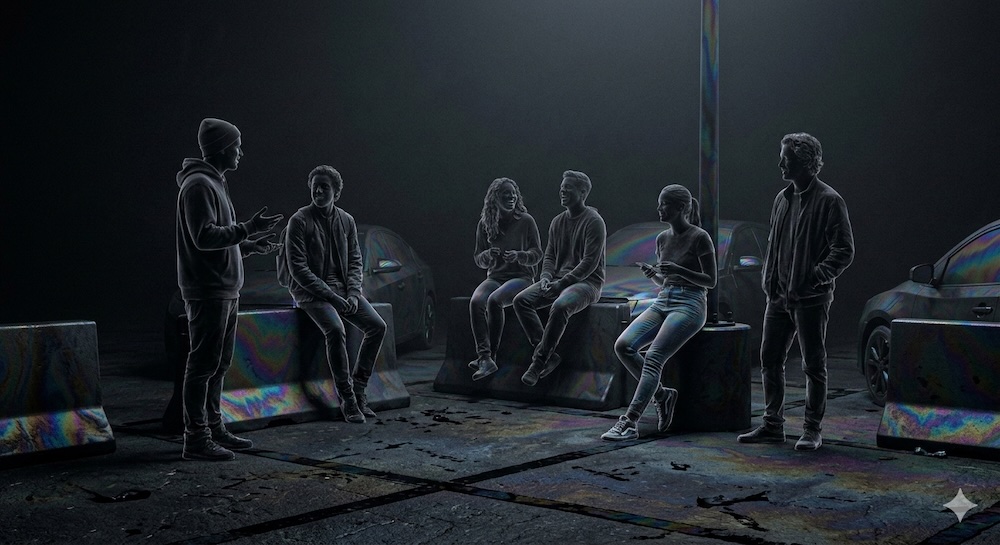
Tuning back in to the dream References: Borderlands 4 is a video game.
The Paused Rote: The rote paused as I shifted gears towards waking and back. For a moment I had trouble tuning in completely.
-
Keeping Tabs on the Election 2024
I remember in the early hours of the morning, 3-4 AM, that I was socially dreaming, hanging out with several other people in a living room, sitting on couches. The atmosphere was dim morning light. The people were just clearly outlined spaces of shadow.
Outlines: I’m seeing the shapes of the people before the color and other visual effects are projected on.
-
Neon Chakra Flowers 1997 • Middle of the night • age 23
Buttercup and I were moving up a level in Tank, to room 301. . . . As we were talking, the room was slowly changing into [the new tenant’s]. . . . The transformation was completed. Kelly’s bedroom was dark and mystical. There were two small glowing flower devices spraying this soft, fragrant water in many tiny streams across the room. . . . The new room was so much bigger and nicer than the previous one. . . . There was this girl named Sticky across the room, in the same dark w/neon glow kind of scenery and I danced around a table and proclaimed my love to her: “You, I’ll always love best, Sticky.” She was a super raver-girl with metallic makeup and a shiny silver shirt. Some parts of her shirt were glowing.
Shadow Mode: In both room transformations from one owner to another, there’s a phase where the room is dark and lit up with subtle neon glows. This is the scene without the final physical scenery painted on.
-
I Suck at Basketball 2010
Half the players were thought forms or non-lucid dreamers, sort of dark forms just moving slowly around, but not really participating. As the game went on, more and more players and/or thought forms filled the court so that it was really crowded.
I have a vague recollection that this didn’t start out as basketball, that it was a room full of people, gathered for some other purpose, and that the basketball game sort of took hold.
Dreamers: This is a situation where it’s difficult to tell if we’re dealing with unaware dreamers or thought forms. Since the room had a lot of people in it already, some were probably vaguely attracted to the game. Perhaps others were conjured to be the opposing team. It was odd how dark and shadowy some were compared to the people who were clearly more aware and awake.
Lands of Ice and Snow
While snow and ice can appear as a part of the scenery in the dream state, if the entire scene is only snow and ice it might mean that you’re seeing behind the imagery.
-
Ice Land 1997 • age 23
I was in a land made entirely of ice and water under moonlight. There were mountains of ice, and near the shore were icebergs.
Buttercup and I were staying in a tent together. We were part of a group researching all these different ocean creatures. One was this creature that stuck to you. There was a whole field of them in the water. We went out exploring and I ended up falling into the water. The others came to my rescue and dried me out. I didn’t feel cold. We saw different kinds of fish.
In the end, the land of ice turned into Oberlin. Oberlin seemed to be around the corner in a non-icy spot, and then I gradually forgot about the ice and didn’t see it again.
[This continues into a long dream of being in Oberlin]
Ice and Water: We’re likely in an astral space without much form, which I interpreted as a landscape of ice and water. In that case, we’re seeing the more basic astral structures. Or perhaps there is a scene here, but we’re not properly tuned into it.
Oberlin being “around the corner” could have been a rationalization of me focusing into the scene more, and/or projecting my familiar college imagery onto it.
-
Rolling Snowballs 2010
Buttercup and I had gone to the top of this snow-covered mountain overlooking a wide, open valley. Down in the valley was a small town, and I think this may have been Jackson Hole, which I’d been talking about with Emma and Ruby lately, but never been to. It was night, and the entire landscape was covered in snow, several feet deep. . . . A woman came by and we talked to her briefly. I think she had a baby with her. Then we noticed an asphalt path running right next to us and down the mountain. We wondered if it had been there all along. Then I looked up and saw a cable car above the trees a little ways behind us. An even easier way down! Then I heard this drumming and this music and realized there must be some kind of village behind where we were. I followed the music and came to this charming summery village at the top of the mountain.
The Snowy Mountain: Here we are in a vague white astral environment, which we take to be a snowy mountaintop. When the woman joins us, we see physical elements that weren’t there before, and she leads us into the more physical environment of the little village.
Ice-Like Surfaces
On many occasions I’ve seen what look like flat, thin, semitransparent ice-like surface. It’s often on the ground but sometimes covers the openings of buildings. I usually perceive this as a thin layer of ice or the surface of water. On the ground, it can be walked on, no matter how thin it seems. When I perceive one as a thin layer of ice, it will act like it when I try to crack through it.
This is a truer perception of the structure of the astral world, less influenced by projection. It’s the perception of a boundary of some sort, though they can be easily crossed.
-
Oberlin Dreamfire and the Zombie Line 1997 • age 22
Determined not to lose my Foundations work I ran towards South Hall, noticing that the frozen puddles actually were a thin layer of ice with no water, brickwork, or earth beneath them. An officer rode up next to me on horseback and warned me about South Hall. He was standing over an ice sheet and I was worried about him falling through for a moment.
Every doorway, window, and opening of South Hall was covered with a thin sheet of ice as well. I easily broke through them as I went inside.
References: I lived in South Hall at Oberlin for a few years.
Dream Ice: When I see these ice-like membranes, I’m seeing outside the scenery to an extent. I’m tuning out of the projected visual scene somewhat. Semi-melted thought forms appear to have an ice-like coating as the color recedes back within. Here I’m seeing the outer shape of the buildings and landscapes due to being in a slightly higher frequency.
-
The Crackety Mineral Springs 1997 • age 22
A bunch of us are traveling in this narrow river canyon on a raft. There are orange cliff walls around us and the river is 6-16 inches of crystal clear water over ripply orange sand. . . . I saw some people having fun cracking ice, so I jumped out and the river was covered in ice now. The others joined me. From time to time there were large deep openings in the river floor which led to deep caverns.
Form of.. Ice!: The ice was as clear and pristine as the water, which means that the water’s surface had to undergo only the slightest of changes to be ice, not water. It’s simply a flat plane of some sort, perhaps the boundary of an astral subrealm, easily interpreted as a water surface or ice.
-
Memory Rooms and Exploding Dreamstuff 1997 • 6 AM • age 23
I was at Blaine House in the silver light of dawn (like in the waking world: 6AM). The light felt like a presence — a BIG one. There was a thin layer of ice all over the ground. The back yard was flooded almost to the top of the hill, with a thin, barely visible ice layer on top. Everything was so fresh and new, like being outside on a winter morning.
I was meeting my best friends: Buttercup and a representation of the boys at Oberlin. We all just started hanging out, all totally being ourselves.
Around every corner and in every room of the house there was a crazy different scene or dream going on, but I stayed in the Blaine House context.
Higher Perception: The light, the ice, the feelings, and the presence here all indicate I’m united with a greater consciousness seeing Blaine House from a higher perspective. I’m peeking behind the curtain of physical forms to an extent, further towards the higher frequency, formless side of things.
Here again I notice a thin layer of ice on everything. In many accounts of those who examine the spirit world closely, they say it is made up of translucent materials, much like ice.
-
The Chamber Beneath Blaine House 2000
I’m not sure how Ruby and I got back to the surface of Blaine House, but we looked at the house and I noticed the windows were all covered with a white semitransparent skin and bulging out from the inside, as if someone were inflating a huge balloon inside the house. I said “Those must be painting tarps over the windows. They must be repainting.” Ruby didn’t think so.
Bulging Blaine House: I’ve seen several times how thought form buildings can inflate and deflate. Of course in the astral there is no air. Thought forms “inflate” with attention from within. They can even have openings like windows. A thin mostly-transparent membrane defines their outer boundaries and can occasionally be seen over the openings, as it is here.
The bulging could indicate additional thought energy on the house. Maybe just all our attention on it — Wadsworth’s, Ruby’s, and mine?
-
The Worst Way to Get to Narnia 2017
The ocean’s edge wasn’t as far down as usual in this area, and under the perfectly clear water, I saw a hyena walking along on the rocks. Under the water! I was astonished and climbed down a little further.
Surface of the Sea: I wonder what these clear surfaces are. Different layers of the astral? Here it just looks like more dry land below the “water’s” surface, as if I’m merely peering through a thin layer of light.
The Glowing Grid Underlying Forms
A few times in the dream state I’ve seen a grid structure underlying astral forms. It reminds me of the grid structure of the depth field that I’ve seen in altered states of mind.
-
Lucid: Colored Pots and Pans 2000
We turned to [the large structure] and not much was visible — just some bits sticking out of the top of the sandy/muddy hill. There was an opening barely large enough to slide in through and a flexible area that revealed lines of blue energy when pushed on.
The Grid: Pressing on the side of the building revealed these lines of blue energy, like a grid underlying astral matter. I wonder what this is.
-
The Green Dragon of Sauron 2004
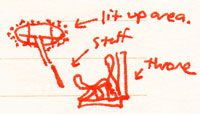
The throne of bone and staff The wizard had a long black plastic-looking staff with a white band and white end. We took it. Legolas used it, and sent a purple stream into the clouds. Just before the clouds, it hit a previously invisible grid (the ceiling) and lit up a purple area. We realized that if the dragon were above it, we could see it light up in orange and yellow instead of purple. Also, the closer we were to the clouds, the larger an area we’d light up.
The Glowing Grid Structure: I wonder if this is the grid-like structure of the depth field. It revealed that the ceiling was there, even though it wasn’t visible.
-
The Interview 2016
I went underneath the floor in the building where the company was. There was a round glass pillar with open space all around. I stood on a platform. Maybe 50 feet below the platform was a floor that was a grid pattern — not really a solid floor but just the grid. The forms of dead interviewees were down there, all wearing white and red bodysuits. They were sitting there motionless, embedded in the grid. I felt like they had tried to escape under the company’s floor and not made it. It also seemed that the bodysuits were virtual reality outfits and that the grid I was seeing was a peek beneath the pattern. Surrounding the grid of the circular floor were a bunch of stores.
The Grid Floor: Whatever this grid was, the goal was to stay off it.
-
The Insanity Creature of the Tower 1996 • 3:15 AM • age 22
She removed my glasses and I could still see fine, which proved to me that it was the spirit world. I calculated the picture instead of seeing it, seeing clear lines with light haze around them.
Vision by Calculation: How interesting. At times I’ve seen all of reality as being derived from a simple mathematical formula with infinite answers, as the Source spirals out into all shapes and forms, all possibility.
Increasing Clarity of Perception
When dreaming we are actually in a different world. . . . However, as long as our spiritual organs are undeveloped, we can form only a muddled idea of this world. Until then it exists for us only as much as the sensible world would exist for a being with only the most primitive, rudimentary eyes. This is why we usually see only images and reflections of daily life in this second world. . . . Our soul paints the pictures of its daytime perceptions into the stuff of which the dream world is made. (Steiner 153)
The content of our dreams also changes. Whereas our dreams formerly contained only echoes of our daily lives, and transformed impressions of our surroundings or our own bodily condition, the images we now see arise out of a world unknown to us before. (Steiner 151)HTKHWclairvoyant • modern • Steiner
Though the condition in which the astral body is to be found during sleep changes largely as evolution takes place, that of the ego NOTE: reincarnating self inhabiting it changes still more. Where the former is in the stage of the floating wreath of mist, the ego is practically almost as much asleep as the body lying below him; he is blind to the sights and deaf to the voices of his own higher plane, and even if some idea belonging to it should by chance reach him, since he has no control over his mechanism, he will be quite unable to impress it upon his physical brain so that it may be remembered upon waking. If a man in this primitive condition recollects anything at all of what happens to him during sleep, it will almost invariably be the result of purely physical impressions made upon the brain either from within or from without—any experience which his real ego may have had being forgotten. (Leadbeater 29-30)Dclairvoyant • Theosophy • Leadbeater
Dark Tower Classes: The Dark Tower is a school, though not an especially good one.