The Boundary of Dreams
TO DO: (v4) Differentiate “dreaming” from “nonphysical experience”. Rename the “dream self” the “astral self”.
Relaxation and Hypnagogia
Hypnagogia is the state of falling asleep.
In the hypnagogic state, we descend through the noise of our most recent focuses of attention. Our mind flashes quickly between thoughts and images, following trails of association. As the brightness of those thoughts slowly fades, we slowly move into a more fluid state closer to the now. We begin to see the subtle waves of Satori converging towards the center of our mind. As Satori builds into a stable pool of light, we may begin to see “hot spots” which are the brightest part of images shining through the veil separating our physical consciousness from the dream state. And then we find ourselves moving through the Satori Pool, crossing the veil, into the vividly real world of dreams.
Observing Hypnagogia: The Inner Eyes
An important part of any conscious exploration into our minds in meditation or when we’re falling asleep is opening our inner eyes. We naturally disengage focus from our sight when we close our eyes. But if we want to see what’s going on when our eyes are closed, we have to re-engage focus on our sight. Simply shift your focus back to the darkness of the visual field behind your closed eyes so that you’re looking at it in the same way you look at the world around you with your eyes open. It feels like holding your attention forward. From here, you can consciously watch what happens as your mind begins to relax and descend through hypnagogia into dreams.
When looking with my “inner eyes”, my physical eyes are looking forward as if they were open. When I’m not, they take the typical position of rolling upwards. The position must correlate to a visual focus.
Keeping the inner eyes open feels like holding up a heavy weight. At some point, the muscles just can’t continue, and you want to just sink into sleep. It’s like trying to flex and keep flexed a weak muscle. But it also feels that with practice they’ll become stronger and you’ll be able to keep that focus longer.
I sometimes feel that this practice helps draw the waking self along into dreams, helping with lucid dreaming and increases dream recall.
Deep breathing is necessary to keep conscious focus as you relax into the dream state.
-
Hypnagogia: The Inner Eyes 1997 • age 23
Last night, falling asleep, I noticed my inner eyes — those which you can open and close without opening your eyelids. It was so hard to keep them open — doing so made me lightheaded and then they would slowly pull closed, like when I’m completely tired and can’t keep my eyelids open. Now I understand that lightheaded feeling when lucidity sets on. These are the eyes that see newly, that can accept new, novel experiences without trying to rationalize them. This is the focus of the waking self, being drawn across the boundary to dreams.
Stages of Relaxation
-
Falling into Dreams 2002
I was up till 3 AM. Upon going to bed, my breathing began short and deep and each breath lengthened into the long, deep breathing of sleep. Here’s what I noticed:
* Stage 1: Continuation of Activity: Whatever you were most engaged in before bed continues to be the topic of thought. In this case, it was working on the Personality Forge.
* Stage 2: Fears: Fears of every kind enter my mind as I try to relax; intruders in the house, fire breaking out, and entire fantasies associated with each.
* Stage 3: Desires: Sexual desires and fantasies. The threshold to move the body becomes higher. Getting up the energy to shift position is about the best you can do — small movements are very difficult.
* Stage 4: Led Into Dreams: Very interesting thoughts. Desires to run into exciting scenes leads one’s attention into dreams.
References: The Personality Forge is my chatbot web site.
-
Distracted from Lucidity 1997 • age 22
Falling Asleep: My attempt to hold my focus was more difficult last night. Very quickly images of girly comic book characters flooded in and grabbed my interest, so I lost my focus.
Barriers to Memory: This is my focus being distracted by what I call the “sexy thoughts” stage of falling asleep.
-
Meditation: Satori Waves 1998 • age 23
Morning meditation: This helps: every thought you have, say “let go of that.” Then after a while say “let go of letting go.”
After the initial chaos in the mind settles down, Satori begins.
Getting to Satori: When relaxing into sleep or meditating, your mind has to descend through your charged thoughts. The task is to avoid giving them fresh attention, so that you can quiet your mind enough to reach the point where you begin to see the waves of Satori.
See “Satori” below for more.
Scanning Channels as We Fall Asleep
As we relax into sleep, our concerns with daily things slowly fades, and as our mind quiets, we start to become open to picking up the thoughts of others. These appear as rapidly-changing thoughts and scenery.
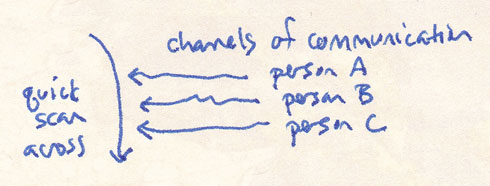
I closed my eyes and am watching the imagery. The channels change quickly, as I see fast and changing scenery. Each communication is on a channel. The images slow and we take longer looks into channels that interest us, then we pick a channel to listen to.
It’s like in the 80s, how we “channel surfed”, flipping through TV channels, looking for something interesting. But we do it telepathically as we relax into sleep, and our minds slow down their wild thinking.
But perhaps a better analogy would be when you’re in a crowded restaurant and there are conversations going on all around you at the same time. You can listen to any so long as you tune your attention to it.
This is what Leadbeater spoke of when clairvoyantly observing someone falling asleep (quoted above):
The denser body responded instantaneously to the water test by a very respectable picture of a tremendous thunder-storm, and that in turn, reacting on the etheric part of the brain, called up by association a whole series of vividly-represented scenes. When this disturbance was over, the usual stream of thoughts began to flow through, but it was observable that a far greater proportion of them awoke a response in this brain—also that the responsive vibrations were much stronger, and that in each case a train of associations was started which sometimes excluded the stream from the outside for quite a considerable time. (Leadbeater 59-61)Dclairvoyant • Theosophy • Leadbeater
Reports from the hypnagogic state . . . generally seemed emotionally flat. . . . The imagery seemed more like a succession of snapshots than a movie. (Van de Castle 266)ODMresearcher • modern • Van de Castle
See also “The Open Thought Stream” in communication.php and “The Influence of Undirected Thoughts and Emotions” in communication.php.
Roving Thoughts and Rapid-Fire Dreamlets
As we relax, we are dropping down through our own recent focuses of attention, starting from the brightest and descending down into less bright focuses. So long as we can pass through them without them grabbing fresh attention, we continue to pass downwards towards deeper relaxation and higher frequencies of consciousness (see the “The Fading Lights Model” in attention.php).
As we drop through our louder, brighter thoughts, we reach a place where we can pick up the thoughts of others. These two things — dropping through our own recent focuses and then scanning of outside channels — form the basis of our initial rapid-fire dreams.
Following are some thoughts and rapid-fire short dreams that appeared during conscious hypnagogia sessions. One is rapidly replaced by the next. They’re hard to remember even in a short session.
The fun of playing video games at Gasoline Alley, Liza Minnelli’s flirtatiousness, the boat on the sea in the movie Cocoon, a kindergartner in the rain, being out of body, a memory I created when told of a boy on Ritalin.
A layer of me is pulled off, inhibitions release, and I begin dreaming: A close-up of a Buddhist’s ear, a little girl opening a can at SSU and it’s me inside. She looks in and it’s all fish-eye. I awaken.
They come so fast and so seemingly random:
• Laughing with Sid about holding his hand, putting my arm around him.
• Singing a new song I just made up: “Asshooooole!” Na Na Nana Na Na Na. Full sound and all instruments amidst a music video.
• An inspired conversation
• Looking at a woman’s hair, which turned into a big spider plant with fuzzy fronds.
• I was back in the most action-packed plot of an animated movie, shooting forward through tunnels on a raft! The movie had green and black and glowing colors like The Secret of Nimh. [Return to a short sleep] Again, incredible rushing speed and movement! Huge fast streams, falling 2,000 feet, grabbing rocks along the way.
• “Com-er-ser-al”. Thinking about Japanese accents.
Then I drift to sexy thoughts and visions about my girlfriend. Then high school gym class where people have an evil plot. Then more sexy visions. “You can’t see my eyes” being said in a bug voice. Then this full music video love song visual adventure.
-
Video Game Regurgitation 1997 • age 23
Falling Asleep: There was an endless string of one-second video game clips, most with perspective changing — sliding left or right. Gradually the endless chaos began to organize into a whole. Remembering The Tibetan Book of Living and Dying, I decided to try to hold my attention on something. As I did, the pieces assembled into a consistent storyline of this multi-piece robot-thing, like a mosaic of clip-art images, like a picture built from things cut out of a magazine. The story continued, and I became lost in it. At first it would jump every 5 seconds but it became stable for longer periods the longer I focused on it.
Earlier on, PaRappa would have had the loudest, brightest pulses, but since it was 4 hours earlier, they faded in lieu of the more recent game stimulus.
Hypnagogic Reorganization: As consciousness descends into silence, it passes all the recently seen images on the way. The collage of video game images — I thought it might have been a rehash, a reorganization and output of each second of game play in order from most exciting one-second interval to least. In quietness, most of it all came out, but reorganized by the brightness of attention I put on it.
Hypnagogic Experiences
-
Hypnagogic Horns 1997 • age 23
Hemi-Sync Evening Meditation: Dreams almost appeared once or twice. There was a short appearance of a point of light, a feeling of spinning, and the sound of a two-toned horn throughout. Other than that, frustrating.
Hypnagogic Sounds: Hemi-Sync is a audio technology developed by Tito Monroe that uses binaural beats to align one’s brainwaves and aid in meditation.
Bodily Relaxation
Meditation, Sept 24: Saw Satori quite clearly as yellow fuzzy circles moving inwards very clearly, almost lucidly. Breathing out releases muscle tightness. Tight lines become fluid blurs.
The clear outlines of the body we have when we’re awake melt into a less defined mass as we relax our focus on the physical.
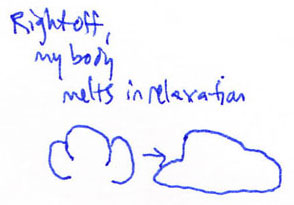
Eventually the sensation of the body’s shape fades out completely as we return to our natural point-in-space consciousness.
Hypnagogic Visions
-
Hypnagogic Visions 1996 • age 22
First attempt. . . . Release, release, don’t try. If you try to see, then you flex up an image. Relax, breathe, release. I felt REM coming and going. I found myself in Mario Land, because I was playing it today. I was seeing fantastic new boards, new integrations, new characters, the land bobbing up and down, and a high speed circling platform. I saw colors blazing, splitting into 3 layers. I felt hot and saw Mario fire wheels, too.
As I drift deeper, Mario World varies more and more and crosses into nearby styles. It becomes 3D and integrates more things into it. An egg bounces rapidly between 4 different panels, the viewpoint rapidly following the egg.
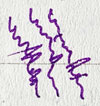
Colors splitting into 3 layers 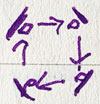
Rapid egg bounces Hypnagogic Experiences: This is one of the first hypnagogic recollections, and I realize that focus freezes the flow, stops the progression into release and deeper states. As the relaxation progresses, more and more is drawn into the chosen focal point — Mario World.
-
Hypnagogia: Brilliant Visions 1997 • age 23
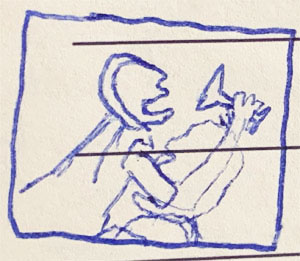
Image of drinking another’s mind Falling asleep: As I was going to sleep, my visions were so bright and beautiful that I saw them quite clearly. They were appearing in such a wide variety of artistic styles — some that I hadn’t seen or used in a long time. I was so in love seeing them again. Even as a part of me was playing with the styles, another part was giving them life and action — not always pleasantly. One I remember is a guy about to drink from a wine glass. He had reached his hand into the mouth and through the head/brain/mind of another to drink what was scooped from inside. This one had taken a few different forms before it landed on the one I attempted to draw. It was all a mind-blowingly beautiful display.
Speed of Thought: Visions appear and change at the speed of thought. There is no delay. As we think a thing, it is there. If we want to change it, it changes as the desire occurs to us.
-
Vision Experiment 2025
I’ve been intending to use my morning snoozes as a chance to become lucid or step OB. This morning, I held my focus as I returned to sleep, and saw I was standing in front of a lake, surrounded by mountains. It was beautiful, but the scene went in and out of focus, mountains blurring into uniform white light (the morning sun was shining).
Lakeside: In the morning, it’s ridiculously easy to get here, provided you can hold your focus and not fall back asleep where all the fun and adventure is.
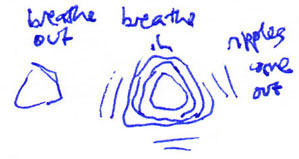
When breathing out, I see a steady triangle. When I breathe in, ripples come out from it, and I feel like I’m shooting forward, zooming through corridors, a vast motion. Then I drift to thoughts with images attached.
Holographic Rings
See “The Lights Within the Rings” in holographic-mind.php and “Holographic Focuses” in holographic-mind.php.
Seeing Aura Static
See “The Flash of Fear” in attention.php.
Seeing Neurons
See “Neurons” in fields-of-perception.php.
Hypnagogic / Hypnopompic Clairvoyance
I sometimes experience clairvoyance while falling asleep but more often when waking up. The typical experience is this:
I am laying in bed between waking and sleep and seem to have my eyes open, looking at the ceiling or the room around me. Then, I wake up a little more and open my eyes, realizing that my eyes weren’t open at all before. And yet I was seeing!
The sight at these times is a little bit like tunnel vision — the image is a smaller circle in the center of my visual field, fading to black around the edges. I don’t have a chance to look around much, but tend to be looking at one spot until I wake.
-
Hypnagogic Visions 1996 • age 22
I have been practicing seeing with my eyes closed, but I often forget when I wake up. I’ve been in dream classes, in training. I’m realizing that the dream self is me. I’m learning to recognize the shifts of consciousness. . . . First attempt. . . . Release, release, don’t try. If I try to see, then I project an image. Relax, breathe, release. I felt REM coming and going.
Hypnagogic Clairvoyance: It’s tricky keeping attention focused during the hypnagogic stage. But it can be done.
-
The Haunted Ride 1996 • age 22
Several times this morning, while sleeping in, I found myself looking out at the room around me, in a kind of tunnel vision, not entirely focused. Then I’d get very excited and wonder if my eyes were open. They weren’t!
Astral Sight: The lack of visual clarity in this one may have been an expectation, since at this time I wore contacts and an unfocused view is usually what I see upon waking up.
-
The Lava Trail 1996 • age 22
These last few nights before I wake up, I’ve noticed I’m looking at the blinds and around the room with my eyes closed. It’s 70% accurate and tunnel-vision.
-
Inaccurate Clairvoyance 1996 • age 22
Why are my visions, my seeing without using my eyes, always so inaccurate? The picture comes in clearly and with a surprise I realize what I’m doing. . . . But there was a picture and frame on the wall we never had, or Buttercup’s in the wrong place. Am I seeing? Or projecting?
Projection?: It’s said the near-realm is very much like the physical world but with small changes here and there. Is that what I’m seeing? Or is it a projection? It comes straight into the visual part of my mind.
-
Hypnagogic Clairvoyance 1997 • age 22
Dream sight experiment this morning. I kept seeing unreal cartoony scenes. Then I got the room.
There is one special type of hypnogogic (sic) image I would like to mention. . . . You will be lying there relaxing and going into trance, and all of a sudden, you are staring at the room you are in clear as day. It’s as if you are seeing your room through your closed eyelids! . . . Use it as a clue to the fact that you are close to being able to leave your body. APCOBEr, LDer • modern • DeGracia
Lying on the sofa in the afternoon with my eyes closed, I suddenly found that I could see the pattern on the sofa-back. This told me that I was in the Trance Condition. I then left my body, by willing myself out of it, and experienced an extremely sudden transition to a beautiful unknown stretch of country. (Fox 66)APrOBEr • modern • Fox
Case No. 657—Tony Zaino
“A couple of times, when my wife works the mill night-shift, my children had to awaken me. I see her, or my children, well in advance of their touching me. but this is the thing—my wife, and my children, tell me that my eyelids are closed tight.” (Crookall 59)CBAPresearcher • modern • Crookall
My eyes were closed; but presently, with my astral sight, I could see the room quite plainly and my wife sitting sewing by the fire. I also felt a numbness creeping up my legs and the old disinclination, or inability to move. . . . I just willed to leave my body and then found myself standing on the lamplit pavement outside the house. (Fox 67-68)APrOBEr • modern • Fox
Akin to distant-point vision is what might be called immediate-environment vision, in which the dreamer sees occurrences which are actually happening in his immediate environment, and even in the room wherein he sleeps. Such dreams usually occur in the daytime during a midday nap; not infrequently just an instant before the dreamer awakens. (Muldoon 304)PotABOBEr • Spiritualism • Muldoon
Time Dilation
My fully conscious 5 minute nap felt like 30 minutes of sleep.
I used to work a job that was 10 hours a day, four days a week. During lunch breaks, I’d take a 10-minute nap during which I had what felt like an hour’s worth of dreams.
Satori and the Entrance into Dreams
Satori
While falling asleep or meditating, after a few minutes I can see rising waves of light in the darkness behind my eyes. It’s barely visible at first, and generally moves in waves from the periphery of my visual field toward the center. At first there are two waves — one for each brain hemisphere, and they are not in sync. They rise and fall in different cycles, and come to different focal points, not always in the center. But slowly they come into sync and move together towards the center.
This continues over and over. Initially, the lightness that gathers in the center fades, but as time goes on, the waves of subtle light begin to leave a small, gradually brightening pool of light in the center. Once this pool is established, each consecutive wave slightly increases the size of this pool of light. Once it gets big enough, images and dreams appear within in.
I call this “Satori”, a reference to the screen saver of that name that had a similar movement (see below). It’s the Japanese term for awakening, related to the Zen Buddhism experience of enlightenment.
The video below shows the motion, except that in reality it becomes one single wave of light coming in towards the center at a time, equal in size to the dark wave behind it. It’s dimmer, more subtle than this. Also ignore the many “eyes”.

Satori’s purpose appears to be to synchronize the hemispheres and wash out the charges of areas of the brain that are currently lit up with attention so that it can relax. This allows it to move into the synchronized brain states — alpha, beta, theta, and delta, which are required for the deep and regenerative relaxation of sleep.
Satori, in terms of tunneling, is tunneling backwards, pulling back from the day’s engagements, moving away from the physical focus.
-
Hypnagogic Lucidity 1997 • age 22
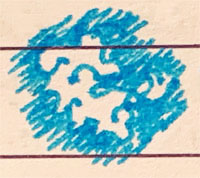
Petri dish or neurons I did really well holding onto consciousness last night. I kept waking my consciousness as I sunk deeper and deeper. I was determined. I got great visuals: black satori and then sparkling fields of transparent purple and black. Then dreams kicked in. At the very beginning I was controlling them. There was a painting of fish. Then there was this black and white biological design, like neurons or something in a petri dish.
-
Purple Veils 1997 • age 22
Falling asleep, I saw very vivid images as I tried to remain lucid. Shimmering purple veils rapidly transformed into dreams. Hard to keep control of the rapidly changing topics.
-
Breathing and Dream Consciousness 1997 • age 22
The dark sparkle-field is really beautiful. After a while the deep purplish black waves of the satori seem white.
Dark and Light: There’s a certain quality to the satori waves that makes it possible at times for the light to seem dark and the dark to seem light. Our interpretation can shift.
-
Satori Pools Melt Through to Visions 2010
I was watching the edges of the dark wave of the satori as it overtook the lighter waves and saw that it was like black ink in water at the edges flowing into the lighter waves. It was like liquid darkness in this inky chaos pattern, very fluid in nature. And of course when I focused on it, it froze, and stopped moving altogether.
Liquid Light: The appearance of the light of Satori is very unusual. It’s like the aurora borealis at times, this shifting, moving light that has an overall flow, but sticks in places until it irons them out through repeated cycles. The erratic patterns it moves over begin to flow more and more smoothly, and the sticky places that prevent it from being a smooth circle gradually wash out. Here I see close up that both the light and dark have a liquid property, and that the dark is a wave as well, not just a blank canvas that the light plays over. The dark is an inky liquid that washes over the dim aurora light waves. Fascinating.
Focus Freezes Satori
Since focus freezes the flow (see “Focus Freezes the Flow” in flow-into-us.php), focus also freezes the movement of Satori. Satori waves only move in a state of disengaged attention.
Getting stuck in a thought freezes the motion of Satori in place, preventing progression into deeper states.
When we focus, the energy in our mind comes to the center of the brain’s hemispheres. When we relax, it splits to the right and left edges. Relaxation lets us fall deeper into hypnagogia, and then refocus pauses it, allowing us to look at the phenomenology of the mind. This is also a good exercise for gaining lucidity in dreams. It forms a habit of refocusing in after each period of further relaxation.
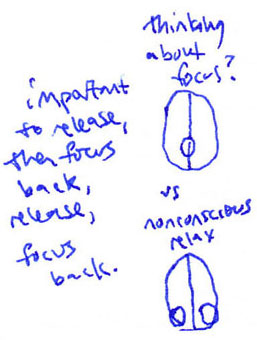
Important to release, then focus back, release, focus back.
-
Focusing Satori 1997 • age 22
Any sort of conscious focus on anything causes it to slow down and freeze.
Phasing Focus: Satori slows down first because attention phases, moving gradually more and more into a focus.
-
Rapid Satori 2010
[I wake up and return to sleep]
My focus interrupted [the Satori waves] pretty quickly. The first effect was that it went from one pulse to two that went to the center of each hemisphere (simply the effect of switching to binocular perception). The waves then slowed down and eventually stopped moving altogether, resulting in two stationary blobs of dim light. Before this, dream visions were coming rapidly, but now I couldn’t get through into the visions at all.
Then I began to relax again, removing my focus from the satori. It began to slowly move again, in the manner I’ve often described: the slow gathering from the exteriors to the center.
Fear causes a strong, sudden focus. It will immediately stop the flow and thus the Satori waves.
Fear froze me up — instantly stopped the regeneration. Fear clicked off the Satori Pool like a light, then it eased back on.
Direction of the Satori
When Satori begins and you are still unfocused, each hemisphere of the brain may have a differently timed cycle and/or they might peel off to the top or bottom. The rate of movement, however, is always the same.
Could my perceptions of different directions of satori be of the same satori from different points of view within the brain?
-
Satori Watching 1997 • age 23
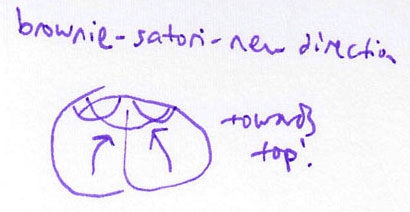
Sometimes, when first beginning to relax, there are separate waves on the left and right, going one after the other. This time they were peeling off to the top. After some time, they align and converge in the middle, as one.
Eating a brownie caused a change in the direction of satori. Its direction is apparently related to the where my focus is within the brain. It could be due to the change in my direction of focus as I point it to an input stream (taste) coming in from a different direction. Or, if my attention moves to the taste region, that could be the point from which I perceive the Satori.
Satori in Three Dimensions
Most often I think of Satori waves as moving across the flat visual field before me. But the brain isn’t flat, it’s a 3D structure.
If you sit in the sunshine with your eyes closed, but focusing visually, you may see something like the image on the left. I’ve seen it frequently. It’s the overlay of the left and right visual input in your brain. It’s a 3D space, where the dark center is higher resolution because it is further away, having branched to more neural endpoints.
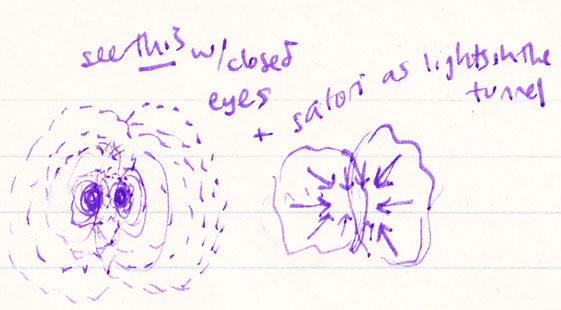
The Satori, seen as moving through this 3D space, is moving down the tunnel of branching neurons, like a light traveling up the base of a tree and out to all the branches.
See “Extending Space” below.
The Satori Pool
Satori waves gradually converge in the center of the visual field. As each fluctuation comes together in the middle, it forms a subtle pool of light there that gradually expands and brightens.
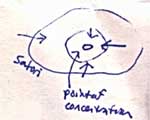
The Satori Pool grows into an opening through which we can move into the full sensory world of the dream state. It becomes like the opening of an eye, a gateway.
I like the metaphor of “the veil”. The veil is used in Sufism and Islam to describe the barrier between the physical and spiritual. There are many veils — each is the boundary of a frequency domain. Beyond the veil, dream reality awaits in its full, bright-as-life clarity. But from the waking side, it appear only dimly, obscured by the veil. The light of Satori builds up as we relax our mind more and more into a flow state, coming closer to the now, and the light that collects before us creates an opening in the veil that we can move through into the reality of dreams.
-
Meditation: Satori Waves 1998 • age 23
After the initial chaos in the mind settles down, Satori begins. It’s a sort of visual Aum, a repeating wave that evens out the charges, smooths everything. The Satori pool begins to build and brighten. At times there was something like an aurora brightening and softening, causing waves of coolness in my body. . . .

Lightning discharges from Satori As the Satori pool got wider, its periphery triggered little lightning flashes. Then the pool built up over them. These little flashes seemed to be discharged into the pool and evened out.
The Satori Pool: How interesting that the Satori Pool itself seems to be discharging parts of the brain as it expands and opens the gateway to dreams.
-
Satori Pools Melt Through to Visions 2010
As the waves built up in the middle, they formed a slowly growing circle of dim light in the visual field before my inner eye, a gooey spot that, once I pushed through, revealed full visions. The first vision was that the two dimensional plane that the satori was playing on was a wall and the pooled light was a hole in the wall beyond which was a scene of a sunny Mediterranean village.
At another time I saw a pair of eyes forming beyond the pool of satori light. It occurred to me that this would usually be scary but I had the awareness that everything here was made of me, and thus there was no fear.
There’s a bright field in the middle with concentric circle-ripples. Then the edges become clear, making it take the overall shape of an eye. Soon I’m in a dream. I reach out to grab a disc sled from this woman and my shoulder twitches, which stirs me back to the swirling strange lights. I ask for help getting out of my body and there’s my girlfriend on top of me kissing me. I rub my astral foot up and down against hers and feel it as if it were real. Then I awaken to write.
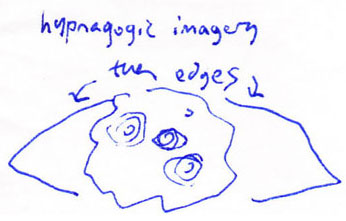
A Satori Pool that’s grown bright enough opens into a dream.
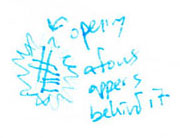
I saw undulations for a brief period. These undulations looked like someone had dropped a rock in the water, except they went backwards, from the periphery to the center. The undulations occurred in the darkness behind my closed eyes. . . .
The undulations faded and I was watching the darkness behind my closed eyes. I perceived a circular swirling motion between my eyes and this motion became like an expanding hole. In the hole I saw a woman’s face. APCOBEr, LDer • modern • DeGracia
Hot Spots (Through the Veil)
Sometimes we just pass through the Satori Pool and arrive in dreams. At other times, we begin to see the oncoming dreams as “hot spots” before we pass through.
Hot spots are little spots of light that develop behind the satori. They light up as the satori passes over them. They are all-color, a rapidly-cycling color that can be interpreted as any color.
Bits of full dream scenes shine forth from beyond the veil as these hot spots, and as we pass through the veil, full dreaming comes on.
-
Breathing and Dream Consciousness 1997 • age 22
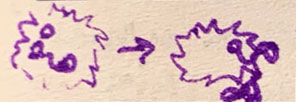
Glowing, pulsing neurons I saw such hot-spots! They were like glowing, pulsing neurons. What you’d imagine was based on the shapes and patterns of those pulsing colors. These colors are odd in that they can be shifted to any color scheme or depth pattern. From this a montage of dream imagery came forth.
-
Hypnagogia: Neurons Behind the Veil 1997 • age 23
There’s a point where all colors are equal, where the gradients and color schemes are applied and created by you. It’s a field of potential. They are just the first parts of the image seen, or maybe the image forms around the hot spots. Dreams are right beyond the veil.
The All-Color
There’s an “all-color” in hypnagogia & psychedelia, a color that is a rapid cycling of all colors. It has the sparkling quality of starlight. It can appear as any color you want it to be.



It reminds me of the psychedelic style used in the 60s-70s where the colors shift rapidly, and the picture is highly contrasted. When seeing this in the movie Head while high, I hardly realized it wasn’t normal. I accepted it like I accept a dream.
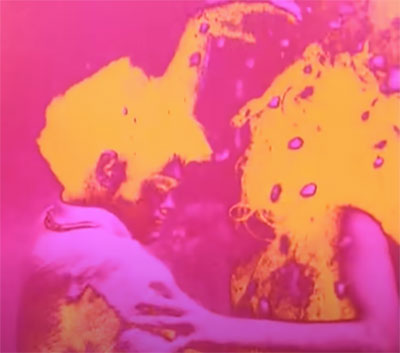
When you see infinity in a thing, it’s that very all-color that you see.
You all think you’re different: blue, red, yellow — oh so different!
I’ve seen Hot Spots resolve into dreams in several ways:
Bright Spots in Visions
While the Satori continues, little hot spots begin to appear in the visual field. With a slight shift in focus, these spots turn out to be a common color-theme or brightness in a dream-picture that shows through the veil before dream-visions appear.
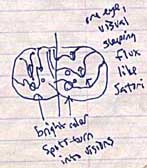
Bright color spots turn into visions
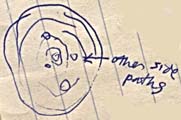
For example, once I saw a series of hot spots across the Satori Pool and as I watched, they resolved into the brightest points of a roman soldier’s armor, as part of a vivid, full-color moving scene. The soldier was on horseback, marching with an army along a green ridge. In this case, the hot spots were the first things clearly seen as the vision was coming into view. I saw the hot spots clearly for a little bit before the vision appeared quickly in full. And at that point, I’m in a fully visual dream.



Another scene of hot spots based on the shining armor of Roman soldiers:
I am falling asleep. Golden dots, sparks and tiny stars appear and disappear before my eyes. These sparks and stars gradually merge into a golden net with diagonal meshes which moves slowly and regularly in rhythm with the beating of my heart, which I feel quite distinctly. The next moment the golden net is transformed into rows of brass helmets belonging to Roman soldiers marching along the street below. (Ouspensky 252)ANMUpsychedelic • Theosophy • Ouspensky
Memories — Entering Scenes
Hot spots can also be focal points in the mind sphere. As we look closer or gain interest in one, we tunnel towards it on the beam of our attention, and they enlarge out around us — we find ourselves in a scene. These glowing focal points may be memories or even communications.
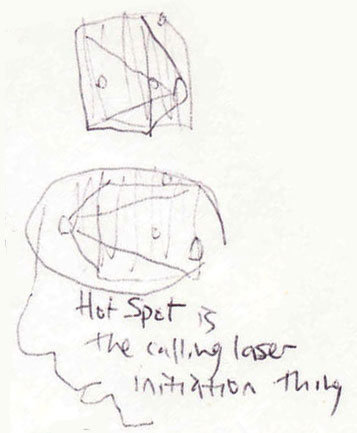
I lay there until I became aware of a small scene forming between my eyes. As I stared at the picture, it grew larger and larger until I was standing in it. I was near what looked like a neighborhood street corner. (Taylor 28)
I was dreaming that I was walking through my house when I woke up in the dream (became lucid). I was instantly back in my body in the paralysis, except in my third eye there was a picture. I focused on the picture, and it grew larger. Then I was in the picture. . . . I floated through the front doors into a huge dining hall. (Taylor 41-42)STOBEr • modern • Taylor
The Energy Backdrops of Dreams
The Dream Screen
The Satori Pool not only remains open through the night, but it grows and expands, the waves changing in form an intensity. It forms a beautiful, dynamic backdrop to the dream state that I call the Dream Screen.
Progressive Stages of the Satori Pool
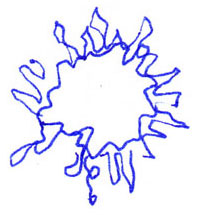
swirling streamers
While the Satori Pool is often my primary focus, just out of focus from it are holographic and cellular structures:
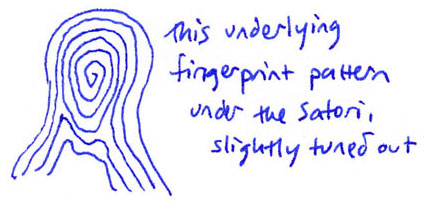
slightly tuned out.
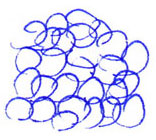
of the Satori Pool.
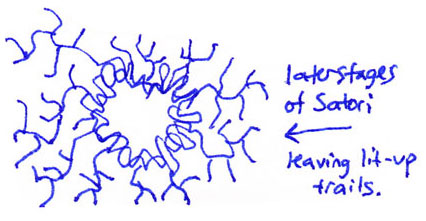
There are some similarities between the deep satori and the following animation, especially the trails extending off it. The shape at the center, however, is a simple circle or oval.

Dreams came rapidly at this point, and it was hard to tell where they came from and how. Rapid-fire short dreams — hard to remember even in a short trance. The rapid-fire dreams were like descending rapidly through the chaos of the day (see “Roving Thoughts and Rapid-Fire Dreamlets” above).
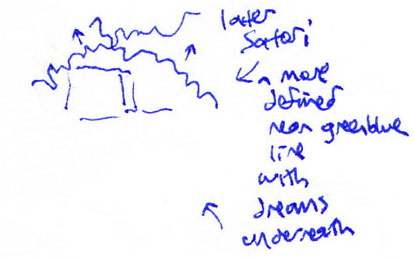
The Dream Screen
-
Infinitely Cycling Imagery 2025 • 3-4 AM
I was hanging out with three friends at the side of a lake. . . . The background of this experience (on the more physical side I think), was this rapidly-cycling background of beautiful, vividly colorful landscape scenes. While they were cycling incredibly fast, my attention caught on certain images for a fraction of a second to see them. On top of the cycling were these waves of light going from one side of the visual field to the other, criss-crossing in different directions. It was like an advanced Satori.
This rapidly-cycling field had no memory dimension to it. It existed in zero-context. It could only cycle this fast when I had no attachments to anything. When I locked on to an image, the cycling slowed or stopped. I felt like it was a field of infinite possibility, in which all things existed. This was early in the night, likely in a deep phase of sleep.
The Dream Screen: The whole of our past experience is available at once. In terms of physical time it flashes before us rapidly. This cycling happens at faster and faster frequencies until it is instantaneous. These faster frequencies are up the stream, closer to the Source. They occur because of a lack of attachment. Our attachment stops the flow on a particular image or idea. It allows us to closely examine something, but it’s also what drags us out of the now in physical life. The higher realms are described as twinkling rainbow cascades of color — all colors cycling.
Now back to dreams. We have the reality of what’s happening in the astral, and it’s upon this rapidly-cycling background. We select from the images the most familiar and sensible given the circumstances, and apply those images to experience the scene in physical terms. Our expectation of object permanence means we only have to select them once per scene, and they remain until they are forgotten. This is the screen upon which we dream. An infinite-possibility energy field from which we select what we want to represent the deeper nonphysical realities we are experiencing.
-
Morning Satori Pool 2023 • 7 AM
My alarm woke me up and I’m falling back asleep. As my waking self is going back under, I see this wide satori pool of every-color light, flickering, providing a background of every color and every brightness for my dream imagery to appear upon, and it quickly does. After a night of dreaming, the pool is well-established and allows a near-instant return to dreaming imagery.
Established Satori Pool: Once the Satori pool is established during the Satori experience, it remains there as a universal medium for image projection until you wake up.
-
The Dream Field 2025 • 3 AM
From vividly dreaming, I open my eyes. My entire visual field is filled with this pattern of “cells” of concentric, looping, or back and forth lines. The centermost one looks like a fingerprint. It’s most visible upon the white pillowcase in front of me, less so on the darker blankets around it, but still there. It’s constantly changing, like the common scribbly animation style that’s never still but always shifting between a few scribbled frames. The lines themselves can become thicker and darker, or thinner and smoother, or crystallize into panels with various tones.
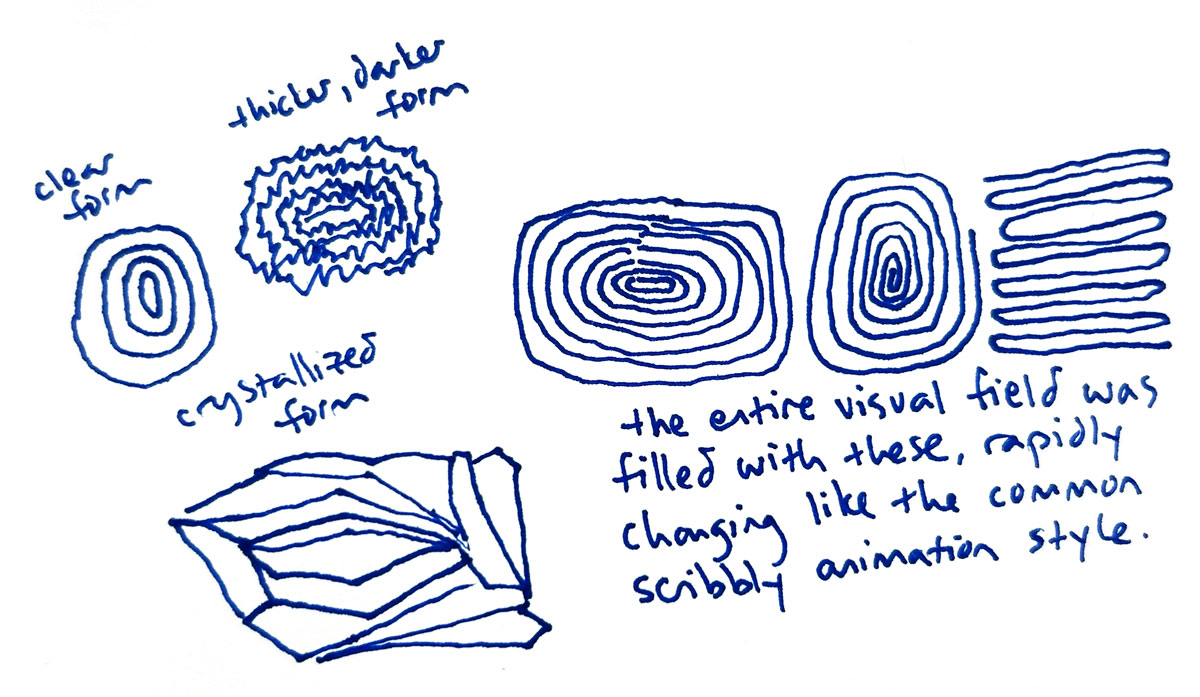
The “boiling line” animation style comes from the dream field Video credit to Micah BuzanThis provides a field of patterns we interpret into dream experiences, forms we project upon to form the images of dreams.
The Pattern On Which We Dream: This is the screen of energetic potential upon which physical forms appear.
-
Horrible Visions 2025
I was falling asleep and inexplicably seeing vivid horrible visions behind my closed eyes. I was sick with norovirus but was starting to improve, so I don’t know why this was happening. It was so unusual, I watched with some grim fascination. At one point I opened my eyes, and Buttercup was asleep, facing me. I saw a gridwork of semitransparent squares overlaying my vision, each with a sort of creepy hazy moving wrinkled pattern in it, such that when I looked at Buttercup’s face, it appeared deeply wrinkled and shaded in a creepy way. It was as if this little pattern would apply itself to make whatever I looked at appear horrible.
Creepy: Here the dream field was applying its effect on physical forms, both those coming from memory and those perceived physically.
See “The All-Color” above.
Shifting Through the Dream Screen
I was in bed, dreaming, when something pulled my consciousness towards wakefulness. I partially emerged from dreaming, pulling the lower part of my awareness back through a shimmering screen of pink and blue. From there I saw the screen and became aware on the waking side, like peering out from under a blanket. The dreaming was on the other side of that shimmering barrier — I just had to release my attention from the waking side and return through it to dreams. But I fully awoke instead.
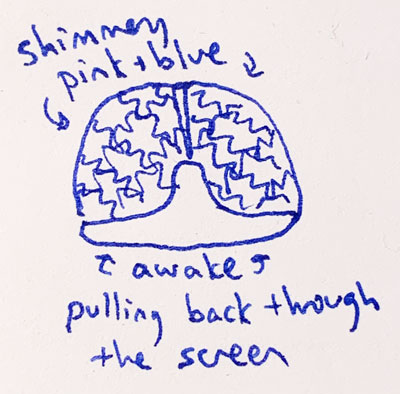
Awake — pulling back through the screen.
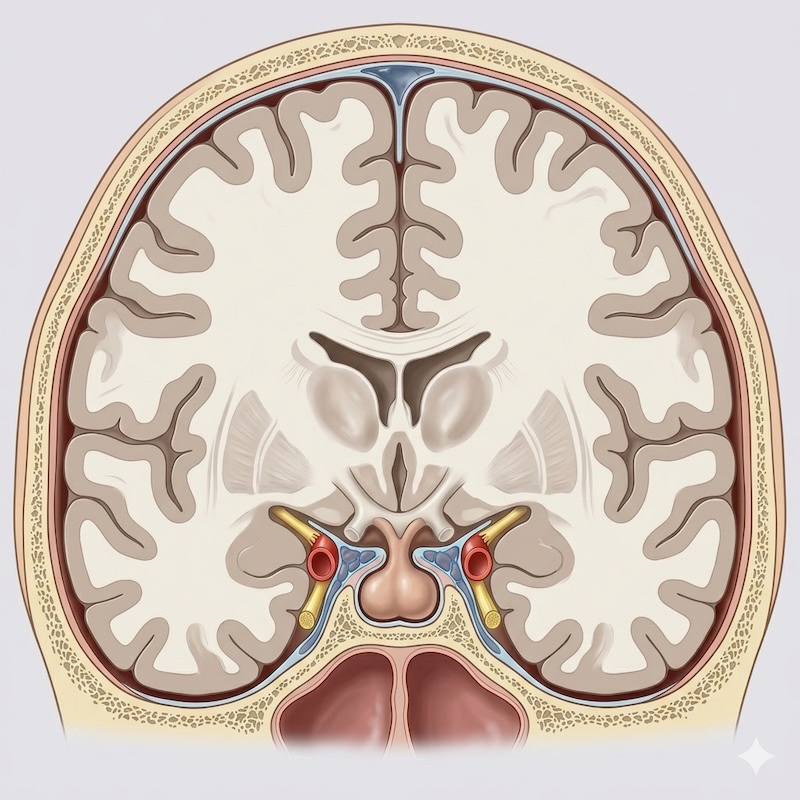
near the pituitary gland.
The “Dream Screen” is the nightly evolution of the Satori Pool that we move through on the way into dreams. Consider how it changes in “Progressive Stages of Satori” above. Its changing appearance likely reflects our energy fields and focus.
The shape above is interesting — the large areas on the upper right and left are the right and left hemispheres of the brain, where the visual field appears to be. The curious rise in the lower center would be the position of various brain-related structures such as the pituitary gland an optic chiasm.
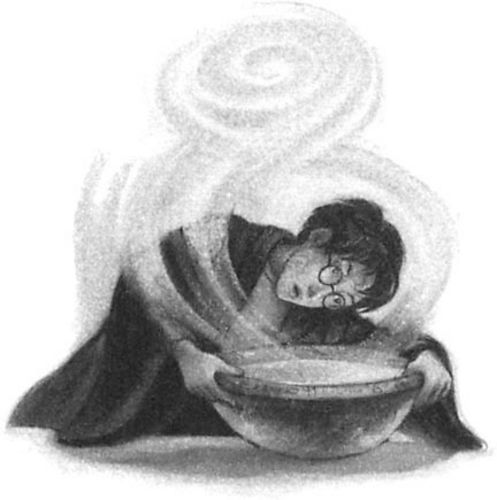
This Dream Screen reminds me a great deal of the “pensieve” from the Harry Potter books — a bowl that contains liquid memory. By submerging your face into the liquid, you find yourself in another time and place, experiencing the memories of others. The surface of the liquid is very much like this screen. In the experience above, I pulled my focus back across the screen to the physical, and, upon finding no trouble in the physical, could return forward through the Dream Screen.
Fast Satori
-
Rapid Satori 2010
Immediately upon waking up and going back to sleep, I found that my satori was this fast-moving single pulse of dim light moving from the periphery to the center of my visual field. The rate of the light waves was maybe 1-2 per second.
Seeing Fast Satori: In the beginning, the Satori waves take about 4 seconds to move from the perimeter to the center. After the Satori creates the pool that we use to cross over into dreams, it continues on to this state, increasing its frequency to this fast-moving, tight ball of light 1-2 times per second, continually washing out and regenerating the neurons and the mind throughout the night. It seemed that, upon going back to sleep, I picked right up where it left off until I started focusing on it.
It would make sense if this continuous washing-out of attention is responsible for the shortened context of the waking self in dreams.
Satori Pool Visions
The Satori itself can act as a backdrop for visions to form out of, rather than going through the Satori Pool itself.
-
Breathing and Dream Consciousness 1997 • age 22
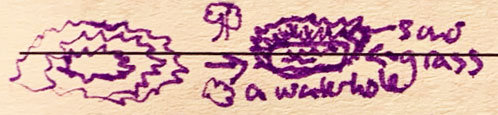
Water hole based on Satori pattern The initial dream images were based on the satori pattern, which took the form of a water hole with trees around it. Alice from Wonderland ran out of the water hole. I tried to interact with her but I didn’t feel like I was actually there.
Satori: The satori pool, like any other stimuli, may become a part of the dream.
The Cascade
Marijuana
The cascade, being a result of our ever-changing orientation to the Source, is one input stream that is integrated into dreams.
The cascade is described in “Within the Tunnels” in flow-into-us.php.
The patterns cascading down from the Source as we look up the tunnel towards it are transformed into dreams and visions of every kind. The cascade creates these beautiful spiraling waterfalls of light. They spiral about as we change our focus relative to the Source. We steer into a band (focus on it) and it expand out around us, becoming dreams and visions.
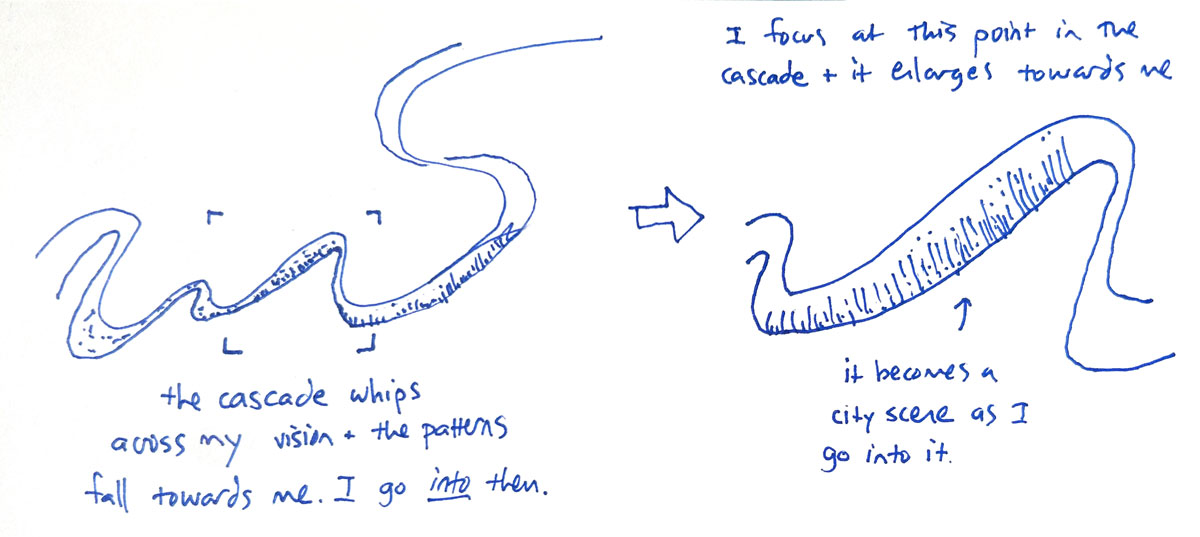
It’s the patterns within the bands that fascinate us. They form like stretching taffy or melted cheese.

of the strands formed by melted cheese

These cascades form the substance (though not the final shape) of our visions.
As is often the case, our subconsciousness awareness of the cascade has made its way into popular culture. The cascade is represented as the matrix behind the apparent physical universe in The Matrix. In the movie, one can see and engage in physical scenes by focusing intently on these patterns.
The difference is that the cascade is falling toward us and is made up of waveforms rather than characters.
Sources of Stimulation
My fuel for the cascade from the Source was visual, but now I’m eating a mint chocolate smoothie and I’m focusing on that input stream, and dreaming off the cascade coming from THAT sensory data.
The loud crunching of my granola became the fuel for my thoughts and visions. When I suddenly stopped eating, that particular dream had to stop, too.
Energy Patterns
Marijuana
The energy wave patterns of your mind continue to influence your dreams even after the original transition to physical imagery. They are expertly integrated into the scenes you are experiencing, adding color and texture.
Just as our physically-oriented consciousness assembles sight, hearing, touch, and more into one consistent whole, our dream selves assemble various nonphysical energy streams into our final experience.
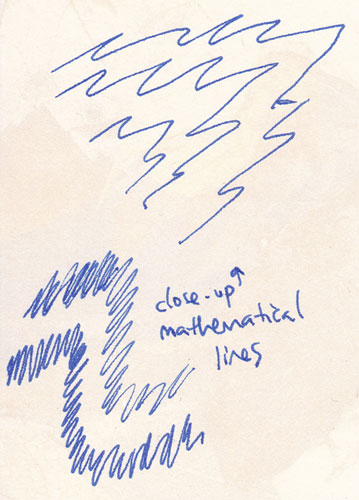
This first appeared as a visual close-up of patterns of dirt in the foreground of a city scene. Then, as I focused in on the pattern in the dirt, they resolved into waves made of tightly-oscillated light blue lines, like EEG readings. These appeared on the black of my mind screen. I was now seeing the original source material for the previous dream vision. The city scene was my understanding projected onto it, the way I saw it in physical terms. Importantly, the imagery is not arbitrary at all — each kind of wave pattern represents something very specific.
That wave pattern is a mathematical truth of some kind.
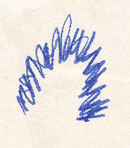
The slow tilt of my head forward and back generates wave forms, another screen our visions can be played upon. The position of my body is an energy backdrop to my dreams and visions. I can focus on that input, look that way in the brain where body sensations come in. I can dream on those sensations.
This means those sensations, in terms of lights, in terms of raw neural patterns, help form the visual basis of my dreams. They are integrated into the dream experience.
The Wave Forms Behind Forms
The visual scene before me broke down until I could see the wave forms behind it. They were waves made up of colored lines squiggled back and forth rapidly.
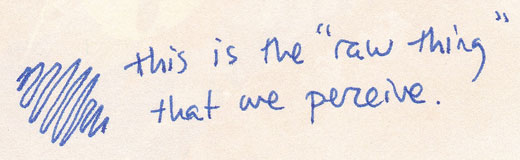
This ball-like shape takes form as part of a scene. A ball. A lamp. A box. . . .
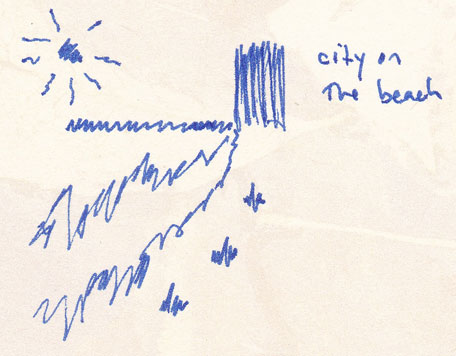
Each part of the scene has a meaning. Imagine the squiggly lines are words, each telling you something, each underlying a part of the scene before you. Somewhat like the picture below.

The Texture of Wave Forms
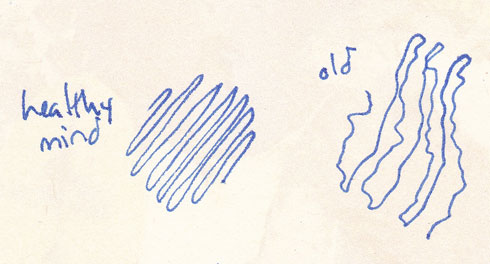

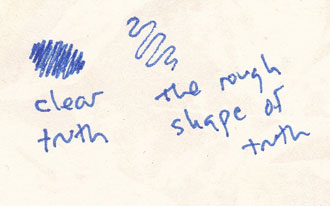
The texture of the wave forms affects the dream. The pattern reflects the movement of the mind, the speed and freedom with which it flows. When free and unstuck, it writes in high detail, a deep truth in high resolution. Attention fills it in, clarifies it. The scene becomes more real, less easy to project other things onto.
When the tiny lines making up an image are spaced out from lack of attention due to myriad background distractions, then the whole picture has a sort of shaggy, unfinished quality to it. It’s a vague pattern, a rough shape, because we take a quick, distracted look at it.
In Terms of Projection
This is analogous to peering through our own sphere of projections at what lies beyond. Seeing from fears, desires, and other expectations, we see shapes but alter them into what we expect. Seeing with undivided attention, we see the true astral dreamscape and people around us.
Imagine a globe around us, a screen which can be anywhere from transparent to opaque. We see through it, and we project onto it. When we’re projecting onto it, we’re not seeing through it. What we project may be based on a vague sense of what’s actually there, or it may shut out what’s beyond it entirely. This is what Monroe describes as being “open” or “closed”. This is described in numerous places. People can be shut tight in their own sphere of projection.
In Terms of Phasing
This is ALSO analogous to weaving two different streams together, moment by moment. What is — what I expect — what is — what I expect. This is phasing.
This phasing can vary from 100% seeing 0% projecting to 25% seeing, 75% projecting, to 0% seeing, 100% projecting. It can change moment to moment. Experiences can trigger you to open or close more.
See “Attention Moves By Phasing” in attention.php.
Rousing the Waking Mind
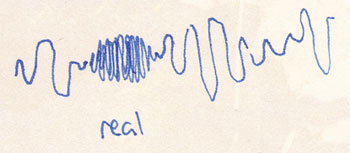
Our waking mind gets pulled into the true dream scenario when the signal is strong enough, clear enough, that it can see it clearly. It shifts away from projection, “wakes” from its fantasies. “Oh wait, I see what this actually is!” It feels like it just left a daydream into a real scene and it gets engaged without wondering how it got there.
Otherwise, it might just remain engaged in fantasies because there’s so much space to imagine into.
Moving Out of Body
Extending Space
I had an experience of space extending forward from my forehead while meditating with my forehead resting on a table. The result is that I felt like I was rising up out of my physical body.
The satori, first. Inner eyes wide open. Images and scenery come. Satori returns and I experience space expanding in front of me, like a stack of white blocks appearing between my head and the table it’s resting on. When the waves return, I am rising and lowering and the stack is getting taller, pushing me upwards.
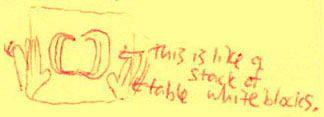
Another hypnagogic experience:
Visions of looking down on the desk from a higher perspective, seeing the catalog, my pen, in this exact lighting, very clear, as if:
Satori usually appears to be on a flat field. But a few times, satori appeared to take on depth, a tunnel extending straight forward from my forehead:
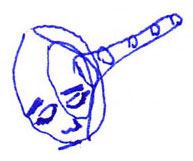
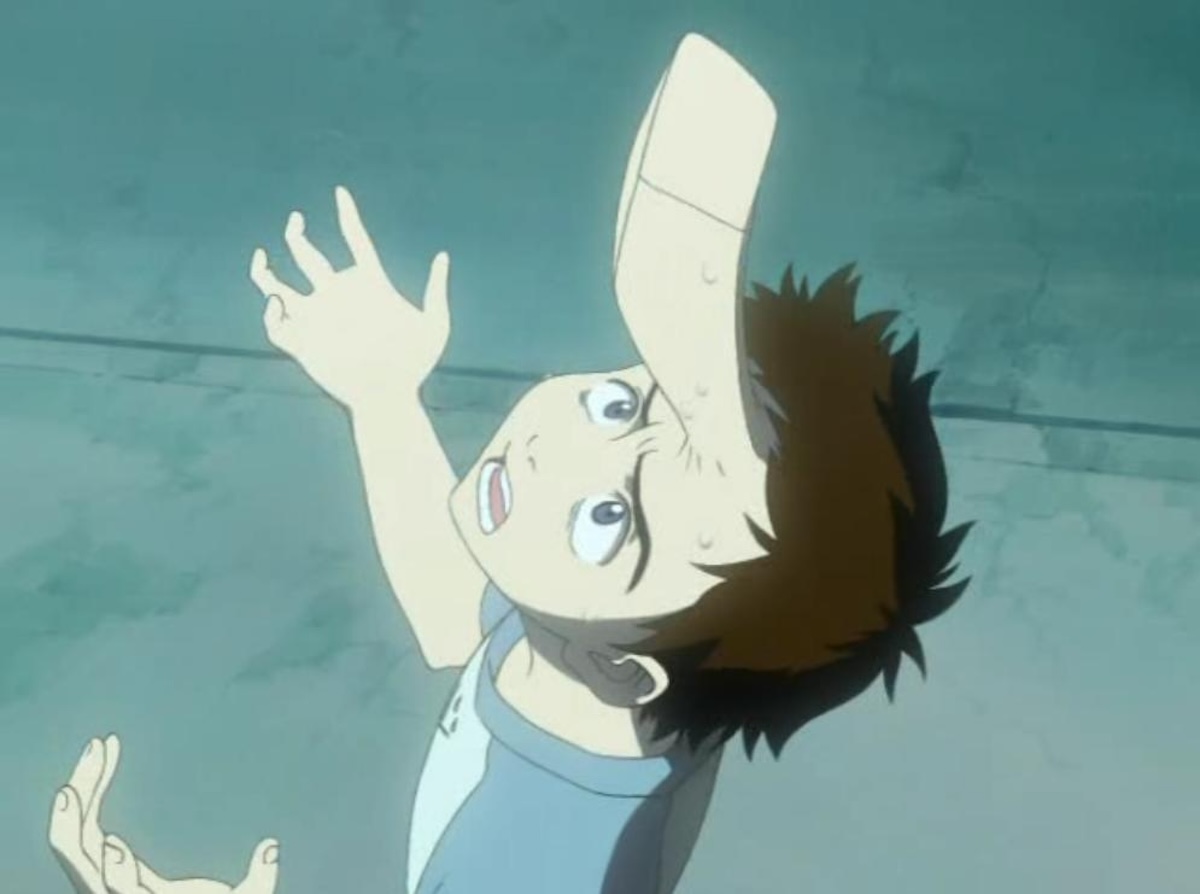
in the excellent anime FLCL (Fooly Cooly)
You peer out of the third eye into another dimension by concentrating your attention fully and drawing your body sensations into your mind.
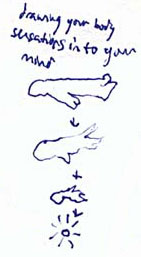
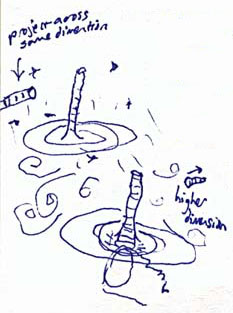
Details: beneath the tunnel at the bottom
is the head and brain of someone lying down.
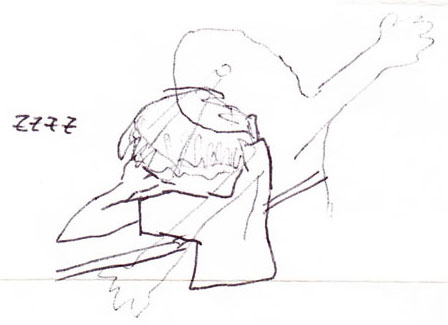
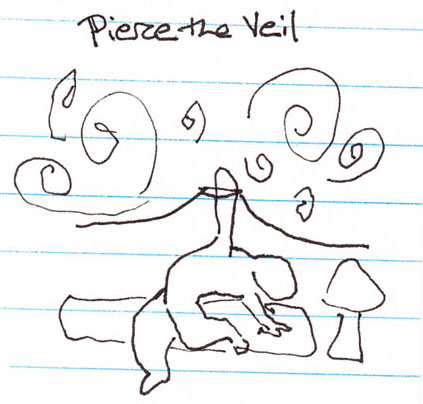
The edges of my head are fuzzy. I feel like I’m in a big wide bed and I am this little point of light rising out of it. I was thinking intently about something, then I felt myself SINKING and then felt a big jerk on my solar plexus, like it separated and pulled up for a second.
It’s known that one can astral project out of any chakra. In the experience above, I appear to be exiting through my third chakra. Taken with the next image, the arm I drew may be imagined as the tunnel extending from my solar plexus.
Separation from the Body
I awoke. It was 5:20 AM — a perfect time for lucid dream experiments! I practiced MILD and then went through the counting: “1, this is a dream, 2 this is. . . . ” I was conscious when the paralysis began coming on but I kept being disturbed by jolts and strange physical sensations. When I got past them, this intense active energy filled me. I felt like something was about to happen. I kept pulling back, feeling that if I didn’t, I’d float away or expand to infinity. I even felt a sleep twitch and a straightening of my spine.
References: MILD (mnemonic induction of lucid dreams) refers to a lucid dreaming technique.
Lucid Descent: These experiences are very much like the sensations that precede OBEs. The sleep paralysis happens just before the separation of the astral body.
As I fell asleep, I felt a weird sensation of being pulled out, like spacetime stretching, turning me inside out and trying to hurtle me forwards. It was pulling from my adrenal area near my belly and heart. It felt like perspectives changing, like the whole world was getting bigger or smaller in comparison to me.
Separation Sensations: These are sensations from the etheric/astral separation, something I rarely experience consciously.
I had discussed with Ruby the idea of “asking for help” in getting OB before bed, but had always thought it strange. Who were you asking? What if some local ghost answered? But we thought it was likely the higher self. So I tried holding onto my awareness as I was falling asleep. After a while, during which my consciousness rose and fell, I felt my astral body move! I was lying on my side, and it was a brief falling sensation, about 6” to a foot behind me. As I thought about it, I understood the lack of body sense people describe in the astral body. Either the astral body was moving out backwards and I was feeling the falling sensation from the astral body’s perspective, or the astral body was moving out forwards and I was feeling the falling away sensation from my physical body’s perspective — there was no way to know.
It Moved!: There is dual perception at this point, from both the physical body and the astral body.
So asking for help worked! I’ve read about that from several sources. I don’t usually ask for help in life. I learned there’s usually a price. So I have that issue to overcome.
The Deep Sound
There’s a sound associated with going deep into dreams and out of body. It’s like a deep AAAAAAAA, like the deep, resonant voices of monks. It sounds like a great doorway is opening before you. As is often the case, dreams are so real that it often doesn’t occur to you that you’re dreaming.
Falling asleep last night, heard a rumbling maw in the distance and thought “is that the body exiting sound? . . . nah” Damn! It was like a deep, primal, opening of something huge, a deep deep rumble, a maw.
I was woken by Buttercup snoozing the alarm or something and then laid down facing away from her. I then got it in my head to turn over and wrap around her, and I felt the urge to but it was too late! I felt myself being pulled inwards and this mawing deep slow voice sound, like my voice, but slowed down to a deep “auuuuu,” like this sound:
The sound was startling and slightly disturbing. It was not physical — it came from a strange internal source, not through my ears. The pulling inward sensation was a pulling from the body sensation. Then there was an almost popping sound, like a transportation or change was occurring. When it was complete I lost all body sensation and then completely blacked out for 1-2 timeless seconds — a lot longer than I had imagined it would be.
After the 1-2 second blackout, I was back, in this dim space where I felt very small. I said in my head “Shit, I’m dreaming!” and then struggled to come back, with the singular motivation of rolling over in bed behind it. I didn’t even remember this until 5 minutes after I woke up for good (after another short dream).
Body Separation Experience: The way this came about was in the style of an OBE. A Lucid Dream begins as a dream, while an OBE begins while being consciously awake and watching the transition across.
TO DO: Find the tape recording of the DEEP SOUND!
The Boundary of Dreams
This entire section is KEY in understanding dreams.
Crossing into Dream Context
Marijuana brings us very near to the dream state. From here, I can see my dream context moving in and taking over the attribution of physical sensations.
Dreams and reality morph keenly into each other. Rustling paper in the physical world is interpreted as voices from the dream world. Dreams relate my guitar playing to The Tower (a recurring dream location). I’m slowly sliding into my dream contexts. They’re re-attributing my physical experiences. I’m seeing similarities up the stream: “This is like a pinball game, like The Tower now, now like yesterday in waking life.” It’s hard to say which one is more real. I’m experiencing the now in widely varying terms.
I’m dreaming using the same sensory data that my physical self is perceiving. I can feel the dream context impinging on the physical — faint traces of dreams, FEELINGS from the dream side, HINTS of other worlds. Its own context appearing around what I see with my eyes.
My attention is being drawn across to another frequency, another context (another world of meaning) that interprets and translates physical input. That context can completely reinterpret everything and relate it to itself, much in the way that any thought does. “How do these sensations relate to my story?”
Consciousness weaves perceptions into its context.
My wife and I were talking about her new technical job at work and she began to fall asleep. I sat down on the bed, and she said: “It would be nicer if you came into the comput . . . the phone book and snuggle with me.” I laughed and she realized what she said and explained to me that in her head, the phone list was the closest thing to the word “blanket” in the work context because “a blanket is something you pull over you, like pages of a phone book.”
Which context is more real? When falling asleep, physical body sensations fade and dream context becomes more and more real, until we find ourselves following that context instead. We tune into it. We project ourselves into whatever reality we are most focused in and so at that point we move about fully in a dreamscape.
I interpreted the sound of keys in the waking world as the sound of a dog’s chain collar in the dream. Once the dream context becomes more real than the waking one, waking sensations are attributed to the dream.
James, living in the astral, discusses the experience of being near to but outside the stage of physical reality:
Each barest whisper or muffled cry . . . appears also elsewhere, translated into a different medium.
It is as if one actor’s spoken line were simultaneously transposed into a musical note in some vast ever-continuing composition; into one original line or color or shape that was part of some massive, spectacular painting always in process. (Roberts 133-134)AJoaAPchanneled • modern • James
The signal is real, but what it means, what it is translated to and the terms in which it is understood, can be literally anything.
Main Source of Attribution Comes from Dreams
The transition from waking context to dream context is fascinating. It’s a switch over of attribution due to a change of context, and that’s IT. That’s ALL it takes. One moment the metallic sound is most likely the wind chimes outside your room, and the next, it’s the sounds of weapons clanging in battle.
This is absolutely essential to understand. Our physical sensations can be bent into any shape or form that will make sense based on our context — even a context we’re not yet aware of. Their actual form barely matters at all.
-
Dreaming Context While Awake 1997 • age 22
So strange how dream context appears and takes over. It just slides in and BLAM, it’s a dream.
-
Hallucinations While Driving 1997 • age 23
I was driving on a cross-country road trip, late at night, and I was exhausted. I was experiencing hallucinations while driving as sleep pulled at me. Oncoming car lights became the sparks in people’s eyes. It takes one commonality to change an entire scene — that was all it took to switch contexts. It happens in meaning, in the depth field first. Colors are easily reestablished. A concrete patch in the rough shape of an animal becomes a deer in the road. Colors are easy to change. Dreams creep in from the periphery. Unseen context changes rapidly.
Reattribution: Hallucinations from dreams and psychedelics occur in exactly the same way. Meaning adjusts the depth field and colors reestablish themselves. The only difference is when we have physical sensory input coming in, the new context has something to fight against. To work, it needs to integrate that input. For example, to stay in a dream, we need to attribute physical sounds and lights to something in the dream.
-
Driving Hallucinations 1992 • early AM • age 17
I had gone to Spirit Mountain to ski for New Years eve. I skied until midnight, and then headed home. It was a three-hour drive back. It was between 3-4 AM when I neared the three-hour mark, and my dreams were beginning to impinge on my experience. The alternating light and dark patches on the road from the street lights seemed now to be the alteration of steeper and flatter parts of the slopes ahead of me. The signs I passed on the side of the road were skiers in my periphery. It wasn’t subtle — I was actually seeing this. Luckily I made it home alright.
Same Impressions, New Meanings: After spending hours on the slopes, my dreams were returning to that same context, bending my driving experience back into a skiing experience. The context changed, and with it the interpretation of my physical sense impressions.
-
Hyperspace Warps 2001
Earlier on, I half awoke in bed, 100% convinced that I was downstairs sleeping on the couch, and wondering how I got there. It took over a minute to realize I was in bed — that there was no TV where the TV should be. But for that whole minute I was dreamily looking at my bedroom, maintaining that it was the living room downstairs even though it looked nothing like it.
Overpowering Belief: This is key. Here I am presented with a very familiar scene, but the intensity of my belief that it’s another scene makes what’s before my eyes almost irrelevant. My belief that I’m downstairs in the living room is so powerful that it overrides the clear evidence in front of me. In the dream state, belief is primary. Sensations from the physical (or any other source) is bent to support that.
The Dreaming Mind Perceiving Physical Reality
These give me the feeling of the mind being in strange and unfamiliar contortions. In the dream state, it changes its shape and frequency, resulting in it being in positions from which normal physical stimuli are perceived in very different ways.
It’s like when I travel through strange maze-like catacombs or passages to get to different places. I can end up sideways or upside-down to the previous perspective, but the new perspective seems normal.
-
Spirit Guide 1996 • age 21
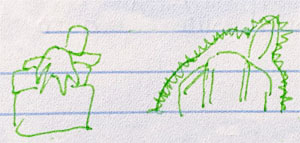
My desk as a spirit guide I had the weirdest experience early on in the night. I sat up in bed or looked up astrally and saw the desk as a Native American spirit guide leaning over me with a dark and crackly aura around him. It was a long, strange moment, but really really neat!
Spirit Transformations: The presence of the spirit guide was the astral reality, and when I combined this with the input from my physical eyes, my consciousness did its best to fit the two together. The result was as if he was appearing through the form of these objects.
Further up the stream, in higher frequencies, everything is more malleable. Through changes in context, a circle can appear as a square. Or objects on a desk can appear as a Native American spirit guide.
-
Dream Hallucinations 1999 • age 24
Man with rice-picking hat 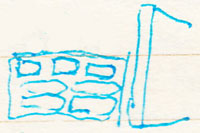
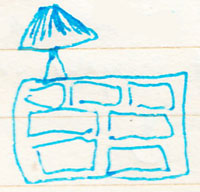
An arm raised up high Several times during the early morning I opened my physical eyes while dreaming and the surroundings were right out of the dream, mapped over the physical bedroom. For example, this man was standing there. Looks like a dresser and a lamp, no? Well it was very clearly a man with a rice-picking hat, and next to it, on another occasion, the closet door was an arm raised up high. That became the most likely interpretation of that sense data and gradually it faded to the reality of being parts of our bedroom. How far can the context of a situation stretch its appearance? There’s probablyno limit.
Dream Hallucinations: Here are some more great examples. See how amazingly far context can stretch the raw sensory data? It almost doesn’t matter at all what you’re looking at. It’s almost entirely secondary to context and expectation. The mind only needs to make minor adjustments to account for it. “It’s still a man,” says the mind, “he just appears to have a rice-picking hat on.”
-
Astral Party 1999 • age 25
A car drove by in the physical world and it sounded as if filtered through an effect that made it sound like “zhaowm”, pulsing in and out in a definite manner around 2 pulses per second. The sound was as if slightly muffled, as if from behind a barrier or a veil. Wondering, “Is that really a car?” I awoke more and sat up. Buttercup went to the kitchen for water and the light in the door crack thinned and widened to the same rhythm, as if my entire consciousness were wavering back and forth at the same speed as the sound flux. Before long it settled.
Dream Flux: I’m not sure what this is but it’s very interesting. It must be the cycling of the mind’s slow brain wave such as theta or delta affecting my audio and visual input. It’s a frequency I was tuned to in the dream state — one which modified my physical perceptions.
-
Brendan’s Gathering and Summoning Pants 1999 • 5:30 AM • age 25
I’ve been paying attention while falling asleep and “under the veil” to the sound of passing cars. They sound muffled, distorted, and their passing seems to last longer. They last longer because I’m listening with more attention and thus time is more extended in that state.
Sound from the Dream State: For more, see my experiences with marijuana in “The Experiential Fluctuation of Time”.
-
LASIK Beams 1999 • age 25
I often awake to the Super Nova Dreamer, which appears as incredible shifting kaleidoscope patterns of red and white and yellow as I shift from sleeping to waking.
The Interpretation Field: The Super Nova Dreamer is a lucid dreaming device that flashes red lights before your eyes when you are in REM sleep.
The flashing light reaches consciousness in the dream state in such a way that causes the simple red light to appear as kaleidoscopic imagery of varying nearby colors.
-
Lost in Time 1999 • age 25
Twice earlier in the night I nearly awoke to the Nova Dreamer lights. The first time they appeared pink with light gray lines, like the light had cling-wrap on it. The second time they appeared as a red-orange kaleidoscope of shapes.
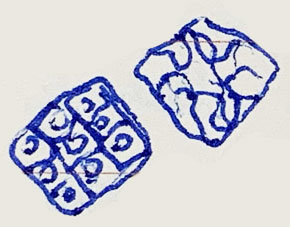
Appearance of the NovaDreamer lights 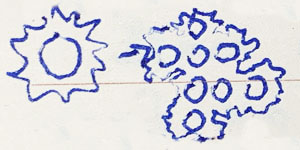
NovaDreamer kaleidoscope References: The Nova Dreamer is a lucid dreaming device that flashes red lights during REM sleep.
Nova Lights: Note that there is only one flashing red light in front of each eye. Perhaps the multiplication of the lights in due to my perceiving a wider cross-section of visual neurons — the single red light appearing 9 times.
-
A Melange of Dreams 2001
Recently, a huge thunderclap broke into my dream as an explosion of numbers, letters, and symbols (%!*#) that filled up the visual field. Last night thunder came again and again, each seeming to be a book that I read in its entirety in a flash of light.
Breaking Into Dreams: It takes a lot to break into deep sleep, but loud thunder will do the trick. It’s interesting how distorted it sounds when it does, and how it will come through so many layers of the mind, being transformed into information and then into something else entirely within the context of the dream.
In the early days of the internet, power surges from lightning could cause the modem to produce a short stream of random numbers, letters, and other characters on the screen. I wonder if the first instance took this form because of that.
-
Sensation Shaping 2023
As I was in bed, close to sleep, I was noticing how easy it was to imagine a sound into the real, full experience of the sound. There had been a beeping somewhere in the house, and I was able to imaginatively reshape the white noise of the air purifier into that exact sound, as loud and real as the original. I tried it with a few different ambient sounds I heard, and it worked.
Imagining Sounds: In this low-context state near sleep, we’re able to take any arbitrary stimulus and shape it into what we want or expect it to be.
-
The Strange Face 2024
I had just barely woken up and was laying in bed for a minute, trying to remember my dreams. My sleepy mind saw something on the bookshelf, and I took it to be a face. It was a weird face, stylized, with some dark smudges on it. I couldn’t figure out what it was in the dark morning light until I pushed myself a little more awake, and saw what it really was.

This is my mental conception
of what I was looking at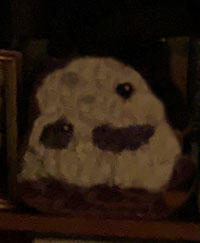
This is what I was seeing visually 
This is what it actually was Stuck In the Wrong Idea: An image was entering my eyes. My first conception of it of a face emphasized the parts that looked like a face, and attributed other parts to black smudges and background. It remained looking like a weird face for as long as I let it. It was only upon focusing more into the physical world that I picked up the details that revealed its actual (adorable) shape.
-
Dedication to Expectation 1999 • age 24
In a nifty dreaming mind occurrence, I awoke slightly in the middle of the night and turned toward Buttercup, expecting to see her face. I did and found it had these tribal patterns on it. It was so strange that it startled me slightly. A few moments later I realized I was staring not at her face but at the patterned blanket over her head. My expectation of seeing her face and the visual input of the pattern on the blanket had merged into one. The tribal feel came from where it was difficult to translate a correct feature out of that segment of the pattern. This shows the dreaming mind’s dedication to experiencing what it expects to experience.
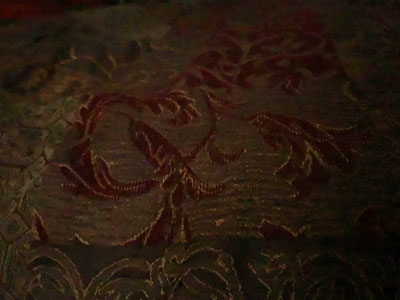
My beautiful wife (the pattern of our blanket) Visual Hallucinations: This also sheds light on the way visual hallucinations work. Given any scene, the mind can so expect to see something that it can construct that expectation out of the scene. It may have to see it as being at a certain angle, in a certain style, or so on, but the mind’s great creativity will make it so.
Our perceived reality is, at any given moment, the meeting point between our projections and perceptions.
-
The Bookshelf Monster 2025 • 7:30 AM
While snoozing, I opened my eyes for a moment. Before me was this creepy monster! I looked at it without any kind of emotional reaction, and watched as the internal reality of it changed into the bookshelf. I studied how the light and dark contrast areas became the eye and the tooth-filled mouth off to the side.
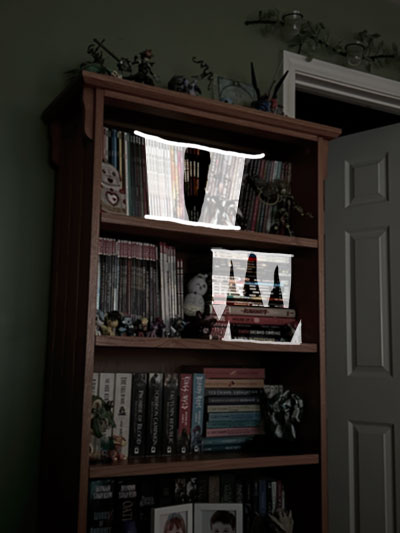
The bookshelf monster, as observed 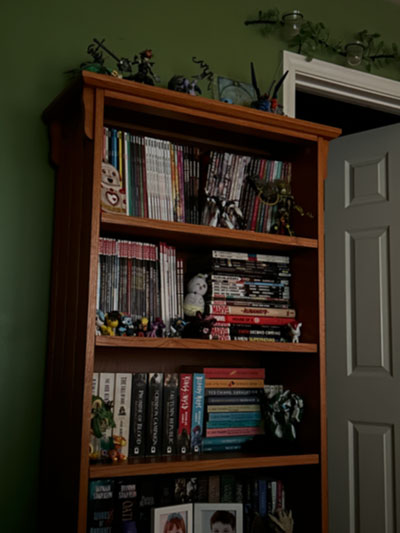
The bookshelf from waking consciousness -
The Lizard Clock 1999 • age 24

The orange lizard I was dreaming that two lizards were coming down the wall. I must have opened my eyes at this point, and saw another one coming down the wall in the dark — a black one with a bright orange head. I began to panic, then awoke, and found myself staring at the red digital clock across the room. What a total transformation! The interpretation field accepts sensory impressions as a basis for what it creates, stretching it as much as necessary to fit the context.
Perception Within Context: It’s amazing how visual information can be warped by context and expectation into being anything in the world — from a digital clock to the head of a lizard. I’ve also had experiences like this many times with psychedelics.
The “interpretation field” is where sensory input is transformed to fit into a particular context. This includes the context of an expectation, desire, or fear.
Reality Across Contexts
The hat on the table, while possessing all of the necessary paraphernalia of reality for that scene, might also, however, serve as a different kind of reference point for one of the other programs simultaneously occurring. In that reality, say program two, the entire configuration of hat and table may be meaningless, while still being interpreted in an entirely different way from a quite different perspective. There in program two the table might be a flat natural plain, and the hat an oddly shaped structure upon it—a natural rather than a manufactured one. . . . Any of the objects shown in the program you are watching, then, may be used as a different kind of reference point in another reality, in which those objects appear as something else. (Roberts 358)UR2channeled • modern • Seth
As you’ve seen, I’ve have had many experiences like this. When something (an object, person, sensation) appears in our context, it is interpreted within that context.
Ruburt found himself in an out-of-body state, looking at a jacket. It had four rectangular pockets. It was giant-sized. As he looked at it the front flap was open. In the dream he flew through this flap literally into another dimension, where the point of the flap was a hill upon which he landed. From that second perspective, the pockets of the jacket in the first perspective became the windows of a building that existed in a still-further, third dimension beyond the hill. . . .
He knew . . . that if the shades were pulled in the windows in Perspective Three, then the jacket-pocket flaps would appear to be closed in Perspective One. He also realized he had been directing the erection of the building in Perspective Three by making the jacket (in Perspective One). . . .
Ruburt was validly involved in the erection of that building, and he did indeed travel through various dimensions in which the objects in one represented something entirely different in another. . . . Any given object in one dimension has its own reality in another. (Roberts 362)UR2channeled • modern • Seth
What Seth calls “dimension” here I call “context”.
From a smaller scale, the objects on my desk could be interpreted as mountains and buildings. This results from a strong belief in our present context — one so strong that the possibility of an incongruous object does not occur to us — it must become something that fits our context. This happens instantly, without thought; it’s a natural translation into our context. This means each center of thought is a self-fulfilling prophecy, adjusting anything that doesn’t fit.
See also “Double Context” below and “Overlays” below.
The Dream State
What We Do in the Dream State
What do we do in dreams? The same things we do in waking life, without any of the work and responsibilities. It’s a time of socializing, exploring, adventuring, playing games, and experiencing stories.
Socialize
Just like in waking life, we are social creatures, and spend time hanging out with friends, family, neighbors, and anyone we run across. This is a large part of our dreaming experience. See the main section “Social Dreaming” below.
Pursuing Interests
-
Under the Earth: Guardians 1996 • age 22
After looking through some book stores, Buttercup and I are back at Oxford 2. I go to get some Guardians cards. There’s a deal where I can trade in a book or two for their value and I do. I end up with about 16 packs.
References: Guardians is a collectible card game. Oxford 2 is a comic book store.
Comic Shops: A regular dream activity for me all my life has been visiting comic book shops. I don’t do it often in person anymore, but I still dream of it. I’ve always loved fantasy, and I’d go for comic books, graphic novels, cards, etc. That interest frequently shows up in my dreams. Comic book shops in dreams are FULL of gateways to other worlds.
-
Ultra Oberlin 1996 • age 22
I was at Oberlin. I went to a party in the snack bar because I heard people were naked there a lot. This black girl was flashing herself and people were picking each other up. There was this blonde girl I liked and we kissed and cuddled. I was putting white face-paint on her and she told me I didn’t have to, kinda losing interest. There was also a scene in a store room with lots of toys. I remember flirting with Sophie momentarily, and someone who reminded me of Summer from SSU. The latter and myself were talking and kissing. I was trying to convince her she could go far in music.
I’m a Lover: My most beloved thing is bonding and closeness with the opposite sex. This shows up frequently in dreams and is part of my happiest, most satisfying dreams.
-
Make Love Later 1997 • age 22
Earlier in the night, I had a dream where I was traveling all about, and I came across a girl who loved me. She was cute, petite, kinda like Jen, and we were hanging out. She casually asked if I wanted to make love later and I thought “Yeah, that’d be really nice.”
After this was a dream of Raven and me, as we were in the prime of our relationship. We had just met up again. She asked me if I wanted to make love later and I thought “Yeah”, but then I remembered I had a different girlfriend, but couldn’t remember who. I thought it was Anne (my 6th grade girlfriend for a day) and found it difficult to tell Raven but finally did. But “Anne” was referring to Buttercup (I thought they seemed similar in this realm). It was all just purely the good feelings of all these relationships. A wonderful place to be.
Pursuing Intimacy: My favorite activity in dreams again is my most fulfilling activity in real life — the pursuit of love and intimacy!
-
The Best Video Game Ever 1997 • age 22
I’m in a toy store with this boy, looking for WarCraft 2 Expansions. Instead, I find Zelda for Nintendo 64, so I pop it in and start playing.
Video Game Stores: I spend a lot of time in video game stores and playing video games in the dream state as well.
-
Giving Flying Lessons 2016 • 8 AM
There were a series of adventures, little episodes, and at the end of each, we picked up a new character.
The ghost followed us to our car and got into the front seat. I took a closer look, and it was Alice (from Alice in Wonderland). She was mostly solid-looking but glowing. Okay, so she must be the latest character, I thought. I accepted her as part of the group. She had sat in the front seat, so I found a spot in the extremely wide back seat among all the others.
Video Game Desires: The idea of collecting characters comes from collecting characters in Smash Squad, which I was really into at the time. It’s a waking self desire, and my dreams partially take that shape.
Vacation
What would you do if you had the freedom to do anything? One idea: go on vacation!
-
Nightly Vacations 2024
Buttercup and I were on vacation, going from place to place, spending nights at Airbnb rooms. This is very much like something we’d do in waking life. We set out on our way to the next location. . . . We found it, and went inside. It was a big house with lots of rooms. After talking to the person ahead of us, the owner enthusiastically welcomed us. She said to Buttercup, “Look how cute you are!” and Buttercup didn’t respond at all. She told us where our room was. . . . I remember seeing at one point a detailed overview map of this area. It was a cute little city. There was a main road which kept curving to the right along this river.
It’s wild — we just vacation in the astral every night. Exploring, socializing, seeing things, having adventures.
Holiday Road: Without the responsibilities of physical life, we are free to do anything we enjoy in the dream state.
Astral National Parks
Buttercup and I love visiting National Parks, and I find myself attracted to similar beautiful lands in the astral. It’s so much easier to get to them and the parks are so much more impressive in the astral world!
-
Colorado Volcanoes National Park 2024 • 5:30 AM
Buttercup and I are on our way to Volcano National Park in Colorado. We’ve been there once before. It’s a drive around this mountainous area that includes a volcano and a glowing lake of lava. Emma and Alfred are with us, but not really active. As before, we’re approaching from the south side. Last time we visited, we went counterclockwise. I tell them we’re taking the clockwise route this time. I can see the route perfectly on a map in my head. . . . Rather than roads, these were more like routes . . . suggestions of roads. Due to their being poorly marked and defined, several times during the dream, we made wrong turns and end up in hot, deadly volcanic regions. We drove around the glowing lava lake, then came around this rise, high up. As we turned the corner, we saw the huge energy collection panels that were attached to the National Park lodge near the peak. The route continued across these panels. . . . We drove on and made it to the highest point on the road, which revealed a busy National Park lodge complex, with food, a gift shop, rides, lots of people, and amazing views of the top of the volcano. The lodge was made up of all these connected buildings built around the volcano. The volcano was continuously erupting hot smoke and debris like a blast furnace from an opening that was maybe three feet across. The lodge had windows right beside it, allowing for an amazing view. A ranger said it was the second most powerful volcano. . . . Inside the building, I found the start of a mine cart ride. I followed it around to the “other side” where it led, to the side where I thought Buttercup was. But I didn’t find her. I stopped to get some water and got a ticket that could be used to fill up on gas before leaving. I think someone gave me some food, too. I left this section of the building and just outside someone was handing out treats from a tray with a variety of sweet things. I grabbed a dark chocolate bear claw. . . . I made it eventually to the exit area in a lower part of the building. The exit area had cars and gas pumps and that’s where I found Buttercup and the kids! I gave someone my white ticket to fill up gas, and away we went. This side of the volcano was more forested.
-
Return to Colorado Volcanoes National Park 2025
I was on a week-long astral vacation visiting national parks in the West. Last night, we had made it back to Volcano National Park, one of my favorites. I was with a group of 4-5 people, including Ruby.
-
Erupting Kilauea 2010

The lodge on the lake (this picture of Cilantro On The Lake in Canada is almost it exactly) Image credit to Google MapsOver here it’s beautiful — the lake is surrounded by green, tree-covered hills, and there are lots of people around. It’s a tourist destination. As we begin walking, something catches my eye — a great plume of smoke from the top of two hills. There are rapid waves of smoke coming up off the hill to my right, and up ahead, a huge plume of dark, billowing smoke is erupting. I run to get a better view. I scramble to come up with the name of this volcano, and Kilauea springs to mind so I stick with it. I now think I’m in Maui. I get out my iPad to record video of the eruption. The larger volcano emits a big white cloud in a vague shape that keeps its exact form and lifts up and travels across the sky. Then the volcano is silent. Before long, a little spout I didn’t see by the side of the lake road lets out a pillar of smoke, then stops. . . . Then there’s a small underground rumble and a small eruption from under the lake, bubbling smoke and air up to the surface. Up ahead, where the road joins up with a big open area, there’s a bar and store for the tourists. I run over there and sit down near lots of other people, as it’s a great view.
Volcano Watching: I love places like this in the physical world. In the dream world, they are regular places I visit. This is a different volcanic park in the astral, with a restaurant and shop was made for the visitors.
Yellowstone-Like Areas
Yellowstone National Park is one of my favorite national parks, and find my way to similar lands in the astral. Anything related to geysers, fumaroles, hot pools, volcanos, or lava grabs my interest.
-
The Lava Trail 1996 • age 22
I was looking at a very long picture on the wall. It showed this trail of glowing rocks, suggesting an unseen river of lava. The rocks looked like glowing salt crystals with red and yellow lights in the center of them. I was fascinated and went into the picture. I was walking along the path among the rocks. At the trailhead was an exposed portion of an underground river. The water was hot and I couldn’t see into the crevice from which it came and went.
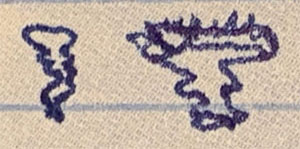
Flat-topped spires, eroded below After visiting the lava trail, I went back to the suburbs and there were these thin-trunked, flat-topped spires along the sidewalk. I was jumping along the top of them and they were remarkably sturdy. These, too, gave the sense of lava or a liquid having swept through and eaten away about 4-15 feet of land around them, leaving behind the crystals and spires.
-
The Hot Lands 1996 • age 22
I’m on a nature tour with Brendan and others. We’re walking on planks, and there are geyser spurts around. “The only geysers out this way,” said the old man. I caught water spurts in my hand. I got close to a hot pool and Brendan was scared.
Higher lands are more peaceful, happy, and tranquil than the lava fields. Higher lands have less people and society.
-
The Island of Fire 2000
Soon the boys and I leave, driving along the foresty road. We stop at the side of the road and descend this steep slope to a barren rocky plain that sputters from weird holes. We block the sputtering holes, throw stuff into them, and play about with rocks. Then as we drive off, big rocks start to shoot out of one of the holes, barely missing people. I feel bad for starting such a thing. As we drive away, I realize it’s the Tahiti-like island. There’s a massive fire on the top of the cliffs, threatening to spread downwards. There are lava flows and fireballs as we leave.
Experience Stories
One of the most common things people do in the dream state is participate in stories. The stories are people’s memories, in the form of rotes — fully immersive wrap-around realities in which we can become the characters and even change the outcome of the story. People can create fictional rotes as well.
In waking life, we watch movies and shows, read books, and (even closer to this experience) play immersive video games.
-
Taking the Shot 2013
I was walking through these dim hallways with Brendan. It was awkward getting around. There were these big plants hanging from above with dark flower-like parts, but more primordial. We were looking at them, pulling on them.
Then I’m hanging out casually in this house/bar place with lots of people I know. It’s kind of like a college party but it’s part of a retail establishment. I’m lounging on the floor talking to some people. Someone hurries over and says that we’re being robbed. The thief is collecting the money and so I put my wallet out on the floor in front of me. There’s a lot of cash in there, and the guy takes some of it but leaves the rest. A few minutes later the robber comes back, looking for more valuables to take. Seems he’s only got $35 so far. There are these big silver decorative coins behind one of the chairs, and he scoops them up.
I’m heading downstairs. I go up to a friend that looks like Gene, a shop-owner in a clothing store, and I interrupt his conversation with two people, tell him, “We’re being robbed. He only has $35 and is looking for more”. The shop-owner is worried, and we start talking about where we’re going to get more money. We’re heading up the stairs and I say “Or we could call the police.” And we look at each other, realize it could turn ugly if we do, and safer for everyone to have him on his way with a bit more cash. But we’re considering it. As we reach the top of the spiral stairs, we see a police officer there. There are several more, fully armed, bunkered down at the front desk. The first officer I see says, “Put this on,” and he hands me a flak jacket. As I’m putting my arms through the arm holes, either he says or I imagine he’s saying “Take off your backpack. TAKE OFF YOUR BACKPACK!” which amuses me terribly because my arms are totally involved in putting on the jacket. Then he hands me a rifle/shotgun, and does the same with the shop owner.
This area is open to the outside on both sides, and I step out to survey the side of the building, gun held up. Someone comes out the side, arms up, waving that I’m not looking for him. Then more and more people spill out. They’re well-dressed, and it seems to be a massive wedding party. I’m scanning the people for the robber and finally I see him, and he’s got his arm around a well-dressed lady. The crowd slows down as they realize the situation, and there’s basically a line of people caught near the robber and his hostage about 30 yards away. The robber is wearing this light gray shirt. The police don’t realize what he looks like. He’s wearing ammo belts and has a big gun. He shouts out something threatening to us about the hostage. “The hell you do,” I thought. I could feel all the police officers around me freeze in fear, but I wasn’t about to let this situation go that way. I pulled the trigger. A shot rang out in the silence and the man was punched back off his feet. A direct hit in the chest. The police officers ran to him and I walked calmly out. About ten feet from him I came to a stop. One officer asked if I wanted to “push the button”. I assumed he meant at the electric chair or something, and I shook my head. I flipped my gun in the air and drove the point into the ground, then started walking calmly back towards the lounge bar, doing a little dance to myself. Nice job, self.
The best part of this dream was how totally calm and laser-focused I was throughout it all. I just did what was right, what I had to do to end it. There was no doubt, no hesitation. And when it was over, no worries. That was truly awesome. An extremely rare and enjoyable experience for someone with my level of empathy.
Enjoying Being Someone Else: What dreams come down to, what all of life comes down to, is enjoying the experience of being a part of a million stories. That’s all this dream is. I enjoy it so much because I get to be someone that’s unlike my usual waking self — unshakable, confident, calm in chaos.
-
The Funny Show 2026 • 5:30 AM
I’d seen a couple commercials for “The Funny Show”, but wasn’t entirely convinced. The commercial had Big Bird from Sesame Street in it. I finally decided to give it a try:
There was a part where I had to pass through a ballet studio in a mall. As I did, a gigantic bird foot in a ballet shoe punched down through the ceiling in front of me. Then the other foot crashed through in a different spot. This was the big bird part. I thought that was rather good — blowing the Big Bird expectation out of proportion.
[I engage in another sketch and then meet the show’s creators]
References: Sesame Street is a kids' TV show.
Shows: There are movies and shows in the astral, too! These are created as rotes that can be watched or lived through as one of the characters.
-
The Switcheroo 2026 • 3 AM
I’m at an unfamiliar college campus, visiting this on and off casual love interest . . . [there’s a long dream about my relationships and being tricked into getting someone pregnant and raising the child]
“In the next part,” said the announcer, “we’d see. . . . ” A bunch of scenes flashed before me, of chaos raising the kid, of me as Eddie Murphy bumbling around with a huge hat stuck over my eyes, flashes of tons of scenes of what was coming in the next segment. I realized I was apparently black. As it went on, I thought that it was revealing too much. I saw a quick upcoming scene where she came to take the child away and I fought to prevent it.
Story Rotes: This is a fictional multi-part rote created by someone in the astral, complete with an advertisement for the next part of the story.
Playing Games
This refers to in-person games with others in the astral or near realm. See “Playing Games” below and “Playing Games (Astral)” below under “Social Dreaming”.
Creating Drama
We can create drama when we’re looking for some excitement, either to challenge ourselves or just for fun — just as children do during imagination play.
-
Half a Conversation 2024 • 5:30 AM
I was in bed with the lights on in my childhood room in Blaine House. It was dark outside, and Buttercup was there with me. She was having a conversation with someone, talking about me in glowing terms. . . . I only heard her half of the conversation, with pauses between where someone else was talking. . . . In the meantime, I was just thinking to myself, about her conversation and about other things. . . . I thought that I was doing pretty well, felt pretty strong, and was ready for a challenge.
So I left the room into the hallway, with the thought “there will be an intruder in the house.” And I saw him!
Creating a Dream: Here I am hanging out in my bedroom in the near realm. I’m thinking, watching Buttercup dream, and then decide to create my own drama with a frightening dream of my own. I enter the dream by leaving the room to go into the hallway.
The challenge that I set for myself was no joke — a terrifying situation. It’s like I’m trying to get myself to learn ways of dealing with situations without falling victim to fear.
Overcoming fear is one of the central themes of physical life.
Reliving Scenes
When our dream experience reminds us of a notable scene from a recent experience, book, movie, or game, that association can cause the dream to bend onto that track and take the form of that experience. We then relive that scene in a new way as our dream experience takes its shape.
From Memories
-
The Green Dragon of Sauron 2004
At this point a strange transformation began to come over the dream. The bright tree-filled grassy mountaintop area began a slow transformation to a room in an unfamiliar house which I later thought of as my own. This of course led to all sorts of inconsistencies in size. The first change was that there was a ceiling, a white ceiling which in the mountaintop was a layer of clouds. The dragon was above it, and would swoop down through it from time to time to attack. . . . The wizard had a long black plastic-looking staff with a white band and white end. We took it. Legolas used it, and sent a purple stream into the clouds. Just before the clouds, it hit a previously invisible grid (the ceiling) and lit up a purple area. We realized that if the dragon were above it, we could see it light up in orange and yellow instead of purple. Also, the closer we were to the clouds, the larger an area we’d light up. . . . And then it disappeared and we got really nervous. Our surroundings had transformed completely into a room now, but at this point was like a room in a dungeon. . . . So I turned around and saw a silhouette of the dragon head descend slowly from above the door frame! A perfectly chilling scene. . . . Now here’s what I realized afterwards — the dragon battle had some VERY similar elements to the last REAL battle I had, which was a water fight with Kai. I was under the porch, while he was above. I had a hose and from time to time could see where he was and I would spray up through the boards to get him. The most frightening part was when I couldn’t tell where he was anymore and he had snuck around the side and doused me!
This dream borrowed its shape from that experience!
Inspired by Life: It appears that the idea of an attacking an enemy above from below was similar enough to the water fight I had just had to draw that experience into the dream and transform the scene and plot to something more like it, because that’s right when the transformation to a room in a house began. The staff and the lit-up area was very similar to a hose and water-splash area. So was the chilling scene where I lost Kai and was ambushed.
So what does this say? This was purely a fantasy dream to begin with, and when it got close to events that had emotional impact (engaging challenge and fun) in waking life, it partially changed course and form to follow that path.
From Movies
-
The New Apartment 2001
I was at the table with Buttercup and Alexandra and other friends. . . . Then I returned to the table to find that the people had changed to my extended family and Raven’s extended family. A scene played out similar to one from The Slums of Beverly Hills, which I’d seen last night, but with these characters, where Raven’s family was asking me questions but Wadsworth and Emma kept answering and saying that they had paid for the apartment and took all responsibility for it. I got up and stormed off.
A Scene from a Movie: The scene from The Slums of Beverly Hills that appeared in this dream hit me close to home, which is why it came up in this dream, why I didn’t question its appearance, and why I reacted strongly to it. It exchanged a few actors to be more fitting, but used the scene at hand to play itself out. I guess this is what it would be like in waking life if every little daydream actually happened. Since it was like a daydream or subdream, Wadsworth and Emma, who weren’t previously in the dream, disappeared as soon as the scene played itself out.
From Video Games
It is not at all uncommon for the context in my dreams to be a video game I have been recently playing. In a video game, we enter a world with different rules where only certain actions are available to us. It is easy for a dream experience to continue under these limitations, in the same manner that it is easy to dream within the normal limitations of physical life — such as the idea that one is unable to walk through walls or fly.
Working Through Issues
We create drama in dreams that reflects our issues in physical life. In this way we engage with and prepare for how to deal with difficult situations by living through them.
-
The Tree Clearing 2024
We’re living in this house with trees around it. Beyond our back yard is a house where our neighbors live. It’s a rectangular plot of land, and beyond it is a forest. I know I’ve been here a few times before. The trees along the neighbor’s house have begun to look scraggly and dead. Every time I go out there, there are fewer of them. Then, as I watch, a towering beautiful tree is cut in half and falls. I don’t see anyone doing this. I tell Buttercup to look as it happens. The back yard is almost entirely treeless at this point. I note that one log in the back yard has a thin ring cut out around it, which is a way to kill a tree. I see similar rings on others.
I considered suing them. Then I thought how awkward it would be suing our actual waking neighbors, seeing them in my mind. But then I realized those were waking-life neighbors, and these neighbors weren’t them. I never actually saw anyone living in that back yard house. . . . Finally, back to our actual (dream) house, I take pictures of the ring around the log, only it’s branch-sized now (shrinking thought form).
Losing Trees: Our city has been steadily cutting down huge, beautiful trees because, though they look perfectly healthy, they’re “diseased” and may fall some day. It makes me really angry. The day before this dream, they took out several more, so the problem was freshly in my mind.
Never once in this dream did I see a neighbor in the back house. The huge tree that I watched come down came down without any cause — nobody was there. So I’m living out this drama in my dream. I’m projecting this all.
And the logs I saw earlier were branches when I returned — shrinking thought forms as my attention turned to work — another sign that they were my own creation.
Recurring Anxiety Dreams
-
The Recurring Burning House
I dreamed of my house burning down and the frantic search to save the comics and stories I’d written, and then maybe my family. This was a frequently recurring dream in my childhood.
Anxiety: I’m not sure why this dream troubled me so often as a kid. The cause may have been an attempted arson of our new house when Wadsworth was building it. Another time, there was a small fire over a couple acres in the woods next to my house. It never reached more than a foot high. But neither of these events ever troubled me when awake. Yet a fear of fire unwittingly made it a reality in my dreams. The dream ceased when I made copies of all my drawings and stories and comics and gave them to a friend for safekeeping.
-
New Fuel for the Burning House Dream 1996 • age 22
I was dreaming of a burning roller coaster. I intended to get my important things out of my room and save them before the fire came. Heh. Same old same old.
Recurring Dream: Now many years after I gave a friend a copy of creative work, I have done much more work and this dream appears again. Time to make back-ups again.
-
The Destructive Plane 1996 • age 22
I was wearing my soccer uniform, looking for the Blaine team to join them but it was already the semifinals in the tourney. Eventually, Coach Broadwise came to me and laid it down. He said I could’ve been a captain if I’d stuck with it. It was too late now and my indecision cost me. I was thinking he must be a spirit guide.
References: Coach Broadwise was my soccer coach.
Soccer Unreadiness: These dreams are usually the same, with variations. Sometimes I show up late and I can’t play, sometimes I’m missing my uniform or shoes or shin guards, and sometimes I’m not allowed on the team.
These dreams happened during a long period where I wasn’t playing soccer, after playing for 11 years as a youth. It’s odd that this sort of dream came up so much. I barely even thought about soccer after I went to college.
Exploring Upcoming Events
-
Visiting San Francisco 1997 • age 22
I was crossing a bridge to get to San Francisco. I was traveling alone, without Buttercup. Once there, I went to a movie.
Visiting Our New Home: After graduation, Buttercup and I moved to Berkeley, near San Francisco. This dream probably took place on our week long cross-country road trip to get there.
-
Friend of the Dalai Lama 1998 • age 23
I was a friend of the Dalai Lama!
I was spending time at a few ashrams, or just one which I returned to. I spoke with yogis. I lacked the cultural traditions (bowing and such) but they didn’t mind.
There was a big outdoor festival. . . . Then it was almost time for the Dalai Lama to speak at the Emory graduation. Two vaguely familiar old guys came up to me and gave me two free tickets to see him. I was very grateful. I arrived in the big school auditorium, and sat by the Dalai Lama in the back. I stupidly asked if he was nervous. Everyone was dressed very strangely. I had a big hat, and was dressed in a slightly far-eastern style with a western hippie flare. The Dalai Lama was doing something with a paper bag mask. As he went up to speak, Buttercup woke me up.
The Dalai Lama’s Visit: The Dalai Lama was coming to Atlanta to speak at the Emory University graduation ceremony in 9 days. We had tickets to see him. It looks like I was exploring that upcoming event, and maybe he was too.
-
Three Brave Knights 2000
I was with Sid and Ranier, who I’ll probably see later today. We were wandering about this town.
Pre-Gathering: We often connect with people in the dream state when they’re on our minds. One sure way to establish a mutual connection is to have upcoming plans to see each other.
I used to do this when writing letters back and forth with people (before the internet). Typically there were months between letters, and over and over the night before a letter arrived, I dreamed of the person sending it. It happened so often, I’d wake up knowing that a letter from them would arrive that day, and was always right.
-
Double Trixie 2023
I dreamed this long dream of driving around with Maggie, Henry, and Bodhi. A dog appeared that we had to rescue and bring back to the car, and my cat Trixie was there, too. At one point, my Dream Self made some adjustment to the dream that it thought quite normal but I was surprised to see that it caused TWO Trixies to appear. I wish I could remember what it was.
In waking life the next day, on the drive to soccer practice, I mentioned my dream to Maggie, and she asked if I noticed that their dog was with us in the back seat. I hadn’t — I had no idea they ever brought him along!
A Change From the Routine: I always drove us to soccer, but the car wasn’t going to be available the next day so it was unusual that Maggie was going to take us. I apparently was thinking about that while asleep and it inspired a dream, which I daresay revealed a true element about what was coming the next day. Perhaps this was due to a telepathic communication from Maggie about her intention to bring her dog, or maybe I peered ahead and saw this inconsequential detail.
Upon returning to read this dream three years later, I note that we now have a dog which is the same size and has the same black and white coloring as Trixie. Maybe one of the Trixies was our new dog Boomi?
-
Picture Day 2023
This was a crazy long and intense dream. The first thing I remember is leaving this big school building to go meet the soccer team for picture day. I found them across the field by the street. They were supposed to be wearing their dark blue jerseys and half were but a bunch were wearing light blue and a few were wearing white. I looked down at myself and I was wearing light blue. Damn!
I told them to wait by the corner up ahead while I went home and got my dark blue jersey. Bodhi came with me.
Tomorrow’s Events: Again, this is a dream inspired by a break in tomorrow’s routine. I needed to remember that the next day was picture day, which meant we had to wear our uniforms to practice. The fact that I was trying to keep that in mind brought it up in my dream.
Dream Research
Being as interested in the nature of dreaming as I am, this falls into the category of pursuing interests for me. When I become lucid in the dream state, I engage in experimentation with myself and my environment.
-
Charting Probable Worlds 2024
After drinking and dancing in waking life, I spent the first part of the night dreaming that I was working on charting influences on society. The influences resulted in a darker or clearer flow of water. I remember adding and removing Christianity, and then specific Christian beliefs, like the belief in the Christian God. After some experimentation, I ended up with a rather clear flow, much better than when I began.
Belief Systems: I wish I remembered more of the details, but the flow of water represented the flow from the Source.
-
Semi-Lucid OBE: Webbed Windows 1998 • age 24
I came to in the living room of THIS apartment. I had been downstairs taking pictures and writing notes on the nature of time and the mind. I was reading something in my mind — some kind of instructions. The meaning seemed to come through faster than the words could convey and thus the words seemed to shift as I read them. Later I tested my dream state by looking for something to read. I opened a book and it was all blurry and I hastily concluded that this proved my dreaming state. . . . I went downstairs to the pool table room of Blaine House, now all rearranged. Wadsworth and Emma were there. Wadsworth couldn’t see me but Emma could and was thrilled. We mind-talked but not too successfully. She could see me as a light haze. I told her to draw what she saw and I put a piece of paper by her because she wasn’t getting it. She went to the couch and I danced about.
Doing Research: Here I’m walking around my apartment, out of body and partially dreaming, casually doing what comes naturally to me — writing down notes about my observations on time and the dream state. I’m testing things, doing research, trying to learn as much as possible.
-
The Book of Synesthesia 1998 • age 24
I explained the whole thing to her and as I did so produced a book explaining my experiences. The book was big and in full color, with pictures and explanations of what I’d experienced:
Colored dots form anything 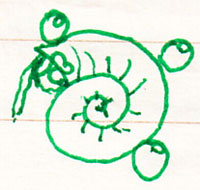
The sound of a snail reveals its form Different colored dots can form any sound, sight, or experience. The sound of a snail reveals its full form. By hearing you see what caused the sound.
Synesthesia: Oddly, what I read in the book was not part of what I was trying to communicate to Buttercup/Emma. Perhaps the book contained the full knowledge of my dream self.
-
My New Favorite Movie 2023 • 3:30 AM
I was coming home alone with Buttercup. It wasn’t our actual house. I think we drove home, and I rationalized a car — it was our green Prius. We got out, and I saw and remembered that I had this thing set up in the driveway — a super dangerous experimental contraption where I had basically thrown together all this explosive, energetic stuff with the goal of just seeing what would happen. From the outside, it looked like a white garbage bag full of stuff. On a whim, the same kind that had guided the whole dream, I decided to set it off. I turned it on, then I immediately realized I needed to get Buttercup to safety. I shouted to her to go inside the house, and she rushed in. I led her upstairs and down a hallway to the far corner of the house.
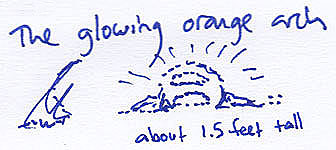
The glowing orange arch We got to the bedroom and the explosion went off with a great flash of light. I was surprised to notice a golden orange light continuing from the area of the experiment. We looked out the window and saw a glowing shape — a circle with an orange arch across the center, made of hardened, chalk-like material. We watched it glow with a strange light, and I knew it was some powerful portal. Then it collapsed into dust and the light was gone. The explosion had utterly wrecked the car I’d parked next to it. It was kicked back about 16 feet, with the entire outer frame of it knocked askew, and it was all deeply corroded and melted. I laughed and said I should have moved the car first.
Curiosity: This is a strange tangent in this dream. I have no idea what the resultant orange arch is. It was certainly unexpected.
-
Many Minds Sharing One Dream 1994 • age 19
Falling asleep, I held in mind the desire to dream about the oneness, to feel and experience it, and to awake 4 hours after falling asleep. It worked — I awoke suddenly on my own nearly four hours after falling asleep, just as I had wanted! . . . I felt as if I were many minds sharing the same dream. . . . Scientists, earlier and later in the night, studying what we felt, where we were. We were doing experiments, asking questions, yet I can’t recall the answers. The first moment I peeked my eyes open this morning I saw incredibly bright light, as if the natural light had been intensified. I felt charged up, and I flipped and flopped in bed as if I was experiencing some sort of orgasmic ripples.
Shared Dreams: Sometimes when dreaming or high I become keenly aware that there are a lot of “us.” I say “us” because they seem like kindred spirits, enjoying the same dream or experience, somehow connected to me or part of a greater personality.
Overcoming Fears
Our dream self tests our waking self, putting it in different situations, training it to overcome fears.
-
Let’s Get Nuked 2025
My family was in this house in a familiar big astral city. It had big picture windows all around — likely a rationalization of looking through the walls. We were looking out, and there was a huge explosion off in the distance, out of sight. Nukes, again. We could tell where it hit by where the wave of wind and debris came from, burning and disintegrating (to an extent) everything in its path. We huddled together on the couch, scared. Where would the next one hit? We looked around out the windows.
But then I grew tired of this. I decided that the next one was going to hit right here. I looked out the window behind us. I saw the missile coming directly towards us. It smashed through the window and landed on the floor directly in front of us. It was metal, about a foot and a half long. For a moment, it didn’t explode. Part of me thought “whew, we’re lucky!” but a different part said, “No. It explodes.”
Everything turned white, and then it faded… we were still sitting there, huddled together, nothing changed. “See?” I said. “We’re fine.”
I went on to a different dream.
Extinguishing Fears: Here I find myself in a situation that has always caused existential dread. I could have tried to survive it, cowering behind the couch, but I was tired of being afraid. I forced the issue, faced the fear dead on and survived it.
-
Kindred 2025 • 5:15 AM
The woman says a Christian prayer before eating. When she’s done, I say a mocking prayer. There is shock around the table. I feel blazing energy from within. I calmly explain the truth of what I know in regards to what she said in the prayer. On one hand this seems so rude, me challenging their conceptions of God. But I continue, and though they are shocked, they listen. I speak in their terms, using the term “God”. I am walking around the house with her now, listening, correcting her misconceptions. She listens, responds, in a strange state like in shock. I don’t know if she’s letting it in, hearing me, but this goes on for a little while.
Challenging Beliefs: What’s significant about this is that I’m talking about my beliefs, which I keep entirely to myself in waking life. It was like breaking through a wall, and led to the powerful scene that followed.
Moving Beyond the Body
In the very first stage of sleep, the astral body separates from the physical body into the near realm, viewing the astral version of the physical world from its own higher frequency. This is the staging ground for all of our nonphysical experiences and dreams.
The Near Realm
Many times throughout the night, our focus shifts to the primary astral body within the near realm. The astral body may be within the physical body, just outside of it, or freely moving about. Experiences in or near the body include near-realm conversations, in which we converse telepathically with people near us in the physical world. At these times, we hear clear voices but the people aren’t visualized.
When the astral body is separated from the physical, we socialize with other dreamers in the near realm. It’s the state of hanging out with other dreamers in a room, going in and out of dreams, communicating, playing games, telling stories. The stories and games are considered “dreams” (See “Social Dreaming” below).
This is also the state where we end up in a false awakening, and write down or tell others about the dream we just had (see “False Awakenings and The Near-Realm” in into-dreams.php).
The near realm is, I believe, the home focus of the MetaDreamer, which is a focus encompassing dreams and waking life. This focus is aware of the time, day (if significant), body’s position, and sensory impressions from the physical world. It’s also aware of dreams from a higher perspective, orchestrating plans through the night, allowing the mind to transition between focuses.
This may be part of the NREM stages 2-3, which is far less visual and physically-oriented dream state. Sometimes thinking or dreaming is reported in this state. The other day I was snoozing, in NREM, and I was, in fact, just thinking.
See “The Stages of Sleep” in into-dreams.php.
A Dream Staging Area
I have experienced on many occasions what appears to be a dream staging area. I feel like I’m in an undefined cave-like space in a hazy darkness. This cave exits to a fully visualized place in the astral, and remains to an extent out of sight while I go about my adventures. I’m more aware of it in the earlier hours of the night.
I’ve also experienced this expansion of space in hypnagogia (see “Extending Space” above), and I once experienced the cave-like shape under hypnosis; the flat black screen of my visual field expanded outwards from me into a open 3D space (still black) in the rough shape of a cave.
It’s in this state that I sometimes feel the shape of the area I’m in but it’s not filled out with physical forms. It’s like the lines and boundaries are made of a mostly-transparent smooth material that’s like concrete or ice. When REM dreams begin, a visual environment can be overlaid on these spaces.
-
The Smooth Caves 1994 • age 20
Context: Kayla and I had broken up for good a few months ago. I was now seeing Sophie.
The night before last, I visited Kayla in this big cave of smooth grey stone, in a large mountain range of such stone. It was night and dark, and lit by torches. At first she walked away, then gave me a little attention. Then she talked with some droid while leaving me sitting in a sunken dais, ignored.
Last night I returned to the same exact place. I was back to visit her again. We actually conversed more this time and I got the impression that things were being sorted through, forgiven, and I vaguely recall a few moments of acceptance and love. At other times, she became Sophie. This wasn’t even surprising. I went further into the caves this time and remember a big automated machinery complex.
Barely Imagined: This is an attempt at communication without bothering with all the scenery. These smooth cave systems seem to exist outside of any specific location, outside of context. It’s more of a formless place than I’m used to in dreams.
Further in the caves I wander into the astral.
-
The Whirlpool 1997 • age 23
I got a strong sense that I was in a class. It was more a sort of knowing, without being physically vivid and real. I felt my body was nearby but in a whole different space. The class was a well-oiled machine, and from this I sprang into a dream.
Deep Sleep: It seems like I go from a state of deeper sleep to one at a more physical and emotional level.
-
Memory Rooms and Exploding Dreamstuff 1997 • 6 AM • age 23
I was at Blaine House in the silver light of dawn. The light felt like a presence — a BIG one.
Around every corner and in every room of the house there was a crazy different scene or dream going on, but I stayed in the Blaine House context.
Dream Hub: In this case Blaine House appears to be a dream hub of sorts.
-
The Elevator 2000 • age 25
This dream could have been the inspiration for Dr. Who.
I’m in the “elevator”. “Phone booth” would also describe it well, as that was about the size of it. It was made of unfinished wood, and had an apparatus like a toilet but smaller and flatter. It let light in from a slot near the top of the door. I had with me during all the following travels a small, friendly, invisible companion who was like a dwarf or cat in size. We were very close.
One of the earlier stops was arriving (via the “elevator”) in New York at night to visit Brendan and Melody and the rest again. I remember commenting, “Wow, here we are.. again!”
Later there was this scene: I was a computer programmer in this strange world. I went to Subway to work on a job for them. I needed the manager for something but couldn’t get ahold of him, so I left a phone message. Then I came back in 3 days and the manager (an old friend) wondered why the job wasn’t done. I explained. Then I’m in the elevator.
So before the elevator had just moved smoothly. This time it was dropping rapidly. Then there was a slight shudder, then nothing but slow rotation as though it had dropped completely out of the shaft and was free-falling. I was on alert. I stared into invisible cat eyes now, as on-alert as I was (I suspected later on that my dwarfish friend was responsible for the wild ride).
The elevator stopped and the quality of light was different — it was daytime with odd tints and overtones of feeling. I opened the door to a blue sky with puffy clouds in a Renaissance town of fantastic wealth and variety. Things were very different than any history of ours. Information came naturally to me, and I knew that there were very powerful groups of people. One group stuck to lavish costumes of all black. There was quite an energy in the air and a lot of people. We climbed a hill to what looked like a resting area with picnic tables all about us. My invisible guide was with me the whole time. I was going to ask this woman a question. I thought she had a lot to tell me but she would likely first ask what faction I was part of . . . and then suddenly I was back in the elevator.
This time the elevator turned wildly head over heels as it descended. As each side became the floor, it changed hue and a treasure chest appeared, each identical. I chose one and then turned around. The door was open and the elevator was stopping. I saw the change — the Renaissance scene was still there but flat-looking. It faded out to a mottled gray-brown before opening into a new scene — a dark brown sky with smoky clouds. I see a boy sitting on a car in a wheat field. I become him. I have a sack, and open it. Inside is a gun and some ammo. I see an asian man about 50 feet away, and know that he is my father. He’s looking for me. He soon sees me and is shocked. I look around me. There is a hole in the car and gasoline all over everything. I realize that the boy (me) intends to kill himself (myself). Then I awaken.
The Elevator Gateway: The door seemed to open to both rotes and locations. It’s apparent by who I was in each. I was myself when visiting Brendan and Melody (location). In the next I was a programmer in a strange world (rote). The Renaissance town could have been either — I received information but was myself. That was the only one where I clearly remember opening the door. The wheat fields was a rote, as I inhabited a boy.
So what was the elevator? A rationalization of the movements of the astral body as it rocked and became partially separated from the physical body? I was pulled from the scenes against their natural rhythm, mid-stride, so it appeared to be an external influence. Was the short dwarf-cat companion pulling the strings?
The Elevator to the Astral
The elevator to the near realm most often takes the form of a tall round shaft with a rounded cave at the top. It goes from the near realm to a real college and town in the astral. Exploring and talking with people here can lead to various dreams.

reminds me of tunneling through astral frequencies in
the dream staging area.
-
Building the Atlanta Tower 2000
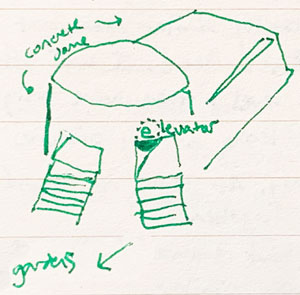
The elevator I’m in a concrete, domed school-like building. I’ve been here before many, many times. There are two elevators. I know a secret, though. . . . I take the elevator to floor 12, make some sideways adjustment, and then go all the way to the top. Where do I end up? The Atlanta Tower. . . . Everything has a sensation of height, airiness, a feeling of uplinks/elevators to higher places.
The Dream Station: I refer to this concrete, domed building elsewhere as the Dream Station. It’s a base station for an elevator to locations in the higher astral (or at least the astral tower on my crown chakra).
-
Escaping from Dogs 2001 • 4 AM
I ran into this large open cave with river water pooling in it. While it was a perfectly real cave, looking back I know with certainty that it was the Dream Station. This has been my new recurring dream place for quite some time, though it is more of a feeling and a shape than one specific place. To hide from the dogs, I considered jumping down into the water to grab two giant turtles and swim with them, or I could go into this black area. But I realized doing this would significantly “change things”. The Dream Station connects to the underworld (or the physical world), I believe. There is a straight vertical shaft between it and a more dark and solid place, and it may be related to my 4 AM underworld journeys. The time was almost exactly 4 AM when I awoke. . . . The Dream Station is the concrete-like building in September 29th’s “Building The Atlanta Tower” dream. It’s related to the Smooth Caves, too.
The Dream Station: The elevator from the Dream Station ends at a domed auditorium in the college around The Atlanta Tower. It’s interesting that it’s an auditorium — a place where different scenes are shown and acted out — where one can exit into dreams.
-
Storage at the Great Hills 2004
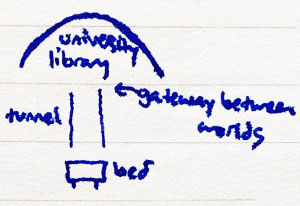
The university and cave system directly above my bed These hills in dreams are very meaningful.. a dimensional barrier, perhaps, like the university and cave system directly above me when sleeping.
Above My Bed: The university and cave system I’m referring to is the Atlanta Tower. This tunnel upwards is a frequency/location transition, much like the tunnel at death.
-
Waiting for Brendan 2004 • 1:30AM
Awake: After writing with Brendan and sharing music, I go to sleep at midnight. I dream the following over the next hour:
In my dreams I go to visit him and make brief contact several times. We prepare to go out adventuring but he’s busy in his semi-dark apartment (which isn’t accurate to waking life). I make contact, then drop, then make contact, then drop. I get bored and wait in my universal dream space, the school between the worlds (the Atlanta Tower). It’s dark there. The building at the top of the elevator is like a hotel. It’s several stories tall and domed at the top, with a theater. It’s directly above the physical world. . . . [I wander about there, looking in stores]
I’m waiting for Brendan to go to sleep so we can visit in dreams.
Waiting in the Staging Area: I consider this “between the worlds”. It’s a launching point for dreams and travels. It has a feel to it, and I feel it beyond the forms. It’s connected to the Atlanta Tower in this case.
I don’t recall taking the elevator here, as I do sometimes. I just go directly there.
The Research Station
There is one version of the staging area that appears to be linked to my reincarnating self, where I sometimes interact with other versions of myself. It appears my physical metaphor for this is a space research station and classroom like Starfleet Academy from Star Trek. However, everyone there is big, burly, bearded versions of me. I call this place Space Station Benji. It’s able to connect to any dream experience through a rounded opening, as if the dream experience were taking place in one of Star Trek’s holodecks. This comes rather near the truth of things, in fact.
-
Army of Me 1996 • age 22
We were in something like a space station. . . . And Captain Kirk/Picard was there! He was trying not to act like he was in a movie, but being funny about it. The space station was half in space, half where SSU’s main education building is. There was some kind of medieval war. We were attacked and beaten but not beaten completely. . . . Then we had people come to aid us — the black-bearded folk, Benji and his kind, peaceful people. I realized I didn’t tell Benji my name (it was Benji, of course), and went back and did so. It was a whole army of myself as different people lined up along the hill in the back yard of Blaine House. We marched past the castle of evil — Blaine House! I was declared captain of the left wing, but I wasn’t ready. I didn’t have my bow, but a friend let me borrow his. The enemies came from Blaine House.
Space Station Benji: From looking at different dreams, Space Station Benji appears to be the home of my reincarnating self — thus all the other Benjis there. It has a kind of unseen presence in my dreams, hidden in a pocket just behind the physical scenes, and able to connect to any of them.
From there, a self with a perspective that includes my dream self and waking self orchestrates things. This is my higher self, my subconscious. This self that perceives and navigates across focuses, while the dream self is similar to the waking self in its specialization at a specific frequency of consciousness.
-
The Pyramids Mystery 1995 • age 21
I played some key part in the discovery of a piece of a machine which ended up fitting together with other pieces that had been found in the pyramids. They formed a kind of tape-player which annoyingly played this weird radio song. A kid in the next room started singing along.
After waking up briefly, things were a little different. I was a youth in Starfleet Academy getting beat up by the older kids who took the pyramid tape recorder. My older self ran by and beat them up, but that wasn’t too effective.
References: Starfleet Academy is where recruits are trained in Star Trek
Into the Staging Area: When I returned to sleep, I returned instead to the staging area — Space Station Benji. The plot is connected but different, instead taking the form of the space station. Another version of me comes to my rescue.
-
The Great Journey 1997 • age 22
I’m in the land of the Dark Tower. There’s this big classroom full of students. Three or four of us are selected from the group to go on this great journey. . . . There was all this preparation before we left. I was to get into a plane and traverse the world, stopping in key points along the way. There were a few optional stops. This was a great honor, a great beginning. . . . I’m traveling all light and hi-tech. I think there’s a space station involved in this and many dreams from which these adventures are orchestrated.
Space Station: This may be a place where dreams are orchestrated, a classroom or laboratory from which things are researched.
Returning to the Near Realm
-
World Religious Conference 1997 • age 22
I saw someone running towards the cathedral opening and I could read their thoughts: “1,000 years of blood and fire for the. . . . Christians? Death and fury to the Quakers!” I ran downstairs to warn them but got lost. Buttercup was down there! Then I woke up.
A Warning: I went downstairs to warn the people in the dream and instead ran into Buttercup, meaning I might have mistakenly returned to the near realm.
-
A Hitchhiker from the Hospital 2010 • 1:30 AM
I found Buttercup and then ran to the elevator to take it down. Down where? Back to our bedroom where we were sleeping, of course! . . . I end up asleep in my bed, hallucinating wildly.
The Elevator: Very interesting! I’ve often been aware of taking an elevator or traveling a shaft up from my bedroom to various astral locations, most notably the auditorium at the Atlanta Tower. Here, I take an elevator down to escape from this scary hospital into my bedroom.
-
Finding Gwen 2025
There were vendors of food and various things. It had sort of an indoor carnival vibe. . . . Wandering on, I eventually started wondering where Gwen was. I’m not sure on retrospect she’d ever been there, but I was sure I’d lost her in the dream. I became quite panicked, calling her name loudly as I went around. But then I heard her voice calmly say “Papa” from outside the dream. I heard it from a different space and moved my focus there. It was a semi-dark, empty, spherical-seeming space, with nothing to be seen, and no sign of the dream I was just in. It was a stepping-state to the waking state, and from there I left the unpleasant dream behind.
Making Contact: When Gwen felt my fear about not finding her and spoke my name from outside the dream, it led me out of the dream into a space closer to her — probably the near realm.
The Corridor to the Near Realm
Of course all it takes to return to the near realm is to focus there. But we’re often in a dream in which our waking self has engaged to some degree and everything has taken physical form. When in this state, we return to the near realm in a physical way, by running through an empty space or a darkened, undefined corridor back to our bedroom and sleeping body.
-
The Animal Shelter Gateway 1998 • age 24
Awake: After watching a short news report on a hurricane animal shelter, I slept. In the early morning after awakening with Buttercup, I slid back into sleep:
My visual field was white. I emerged from the white into the animal shelter. I was in a hall with cages. I comforted “our” cats (which weren’t ours), and generally intended peace to the skittish animals. I was distracted by a blue snake in a small cage with an unsecured lid. I tried to block the exits around the lid with boxes but it got out. I used a snake-handling stick (also from recent TV) to nab it but once I did, I freaked out and let it go. I expected to get bit and of course I was then bit. I ran through the place I came from INTO THE BEDROOM and excitedly tried to get Buttercup’s attention to tell her I was bit. She was zoning out and not responding (she was actually awake at this time, standing by the mirror). I had to ring the phone and when she picked it up I knocked it out of her hand and said into her ear “Buttercup! I just got bit by a poisonous snake!” and she calmly said “No you didn’t. You’ll be fine.” Then I calmed down and woke up.
Home Gateway: Is this what the stable gateway back to your body looks like? A purely white space? Or was it white because of the morning light and it’s just a blank space? It’s interesting that I could just run back through it from the scene I was in.
-
Nightly Dream Dates 1998 • age 23
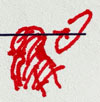
Spinning within me I felt strong emotion, accompanied by this cool spinning sensation within me, like strands of golden light. The spinning made me feel excited and unstable. I knew I had to report this and ran back to . . . somewhere and woke up.
Heading Back: I’m likely in my dream self or MetaDreamer focus, because my reaction to these sensations is to quickly return to my body and wake up.
-
Field of Beasts 2000 • age 25
I’m out exploring in these fields that are divided up into squares like sod fields. They have a light dusting of white snow. Suddenly this bear runs up to me and bear-hugs me from one side and this raccoon hugs me from the other. It’s a very warm sensation. Then this host of creatures that I was previously scared of comes out of the woods and runs towards me. I run back through the fields I came from and into this building. They chase me, and are joined by a big fleshy ogre. I’m with Buttercup now and we flee down hallways.
Back Home: Scared of these adorable forest creatures, I run back “through the fields where I came from and into this building.” Here I run into Buttercup, who joins the escape. I’ve just returned from the dream to the bedroom!
-
Stealing the Password 2025 • 3:45 AM
The first thing I remember is a sort of stand-off with my boss. . . . He’s trying to subtly antagonize me into revealing if my server is at home or elsewhere by suggesting that I “go home, to the garage” to turn off the accounts, as if they’re hosted from a computer at my house. . . . I arrive home in our present living room and close all the blinds. . . . It’s mostly dark (as it actually is) but there is some dim light. My goal is to go in, change the password, and secure the computer.
Back to the Near Realm: From the work dream I feel I need to return home, and end up downstairs in the near realm. It’s interesting that I can leave the dream purposely to return home in the near realm (where I likely was when I started this dream). But I bring the plot along with me this time.
Watching Someone Dream
-
Half a Conversation 2024 • 5:30 AM
I was in bed with the lights on in my childhood room in Blaine House. It was dark outside, and Buttercup was there with me. She was having a conversation with someone, talking about me in glowing terms, about how I made unique clothing sometimes, how sometimes it didn’t work out but how it was really interesting at other times. (This does not reflect anything in waking life.) I only heard her half of the conversation, with pauses between where someone else was talking. Her eyes were closed, and I considered her “sleeping”, even though she was moving around the bedroom. She was sitting on the floor at the foot of the bed, then crawled into bed, still talking and pausing, and at one point put her head up to the cat, who began licking her mouth. In the meantime, I was just thinking to myself, about her conversation and about other things. It was nice to overhear her talking about me to someone else with admiration.
Near Realm Dreaming: This is significant. We’re both physically in bed at Hibernia House. We’re both also in bed in the near realm. I’m lightly dreaming that it’s my bedroom in Blaine House. But I’m still aware of Buttercup, who appears in that context. She’s fully engaged in her own dream where she’s talking to someone about me, but her astral body is acting it out in the near realm. She’s essentially astrally sleep-walking.
Her astral body behavior exactly reflects the behavior of teens hanging out in their room while talking on the phone.
Dreaming from the Near Realm
Many of our dreams begin from the near realm, in which we essentially go into a fantasy based on something we experienced there. They’re like daydreams that become real. At other times, we just settle down to rest in the near realm and have unrelated dreams.
-
The Slumber Party and Scary Man Prank 1999 • age 24
I decided to play around with them and practice making some thought forms. It was still dark and I looked out a window. I pointed and said to Buttercup, “Look at that. . . . MAN!” Surely enough a bearded spooky face appeared out of the shadows in the window, from a black silhouette to a full face, giving the appearance of approaching. Buttercup got scared and fell to the floor in a fetal position. She seemed to be locked in her own world, shaking, and these grapefruit-sized semi-transparent black orbs were skittering all over her body. I told her to stop creating thought forms like that, that they weren’t real.
Later, awake: Wow!! Buttercup dreamed of scary men out on the porch! After she fell into the fetal position with the black orbs all over her in my dream, she dreamed she was unable to move with cockroaches running all over her body. She dreamed all night of the men on the porch trying to break in and get her. That’s the last I saw of her all night, too!
Into a Fear Dream: My prank has the unintentional effect of scaring Buttercup into a subjective fear dream about scary men on the porch. The astral response of her falling to the floor in fetal position and being unable to move is also brought into her dream, with the skittering black fear orbs being rationalized into cockroaches. She remains in this dream a long time. From the social dreaming scene, she is present in her astral body but unaware of us, emotionally focused within the dream.
-
The Blue Crab 2025
I go out to a boat floating on the ocean, not far from the shore. There are 6-7 people holding onto the back of the boat, stretched out in the water. Buttercup is at the far end. I step onto the back of the boat, then get down in the water next to her. . . . After a few minutes, Buttercup swims off. I follow after her, but get distracted looking at shells. . . . I’m fascinated by a blue crab there. It crawls off.
I return to our house and try to tell Buttercup what I found, but she’s preoccupied. . . . I dump out my pockets. . . . I’m briefly interrupted in my sleep by Buttercup’s scream downstairs and a thudding sound as she attempts to crush a roach running around. Knowing she can handle it, I return to the dream. . . . As I dump out my pockets, suddenly there is the blue crab, full size. It scurries around, and Buttercup wakes up from her reverie. She grabs it with some tongs, but in so doing breaks through the shell. . . . The crab guts now have a long train of baby crabs starting to move within. . . . I get them and the eggs into the bucket, but the bucket is hardly big enough, and they start to crawl out and escape. Now there are baby crabs running all over the house, and I’m trying to step on them but keep missing.
Into a Dream: I go to the near realm to show Buttercup the shells I found. Her scream interrupts my dream, and in a moment I figure out what’s going on and return to the dream. The blue crab from earlier becomes the closest analog for the roach, and I spiral off into a dream about crab guts and baby crabs.
-
Stealing the Password 2025 • 3:45 AM
I arrive home in our present living room and close all the blinds — they are slat blinds like we used to have in the house we lived in then, not the folding blinds we currently have. We didn’t live in Hibernia house 25 years ago, but returning “home” meant coming back to the near realm where I’m sleeping. It’s mostly dark (as it actually is) but there is some dim light. My goal is to go in, change the password, and secure the computer. But I fall into a short dream. . . . Waking up, I find most of the blinds are OPEN, and I wonder if my boss’s guys are outside, somehow messing with the blinds to observe me. I close all the blinds again, one by one. I fall into another dream. . . . [I dream about Christmas]
Just then I hear three loud BANGs. I’m suddenly back in my current darkish living room where I was dreaming, and the three front-facing BLINDS ARE UP. Someone had just opened them from outside on the front porch. Someone was out there NOW. I was certain that my boss from Definition 6 has sent someone. I’m terrified. Without thinking, I open the front door and SHOUT AS LOUD AS I CAN. As I’m shouting, a person I don’t know moves into sight right in front of me. I see his face clearly but don’t recognize him.
I’m awoken by Buttercup, as I actually shouted in my sleep.
Creepy Blinds: What is this creepy business with the blinds? I felt my privacy was being invaded! According to various accounts, banging sounds are a common sound in the near realm.
See also “Due to Near Realm Perceptions” below. In those examples, perceptions of the near realm and the dream merge together.
Partially Dreaming
Rather than going entirely into a subjective dream, we can partially dream on top of the current scene. The other characters are real people, making their own choices, but interpreted through the lens of the partial dream.
Imagine kids playing pretend, or lovers role-playing.
-
The Slumber Party and Scary Man Prank 1999 • age 24
Context: Friends is a TV show.
It was night. There was a group of us in the front room of a house. . . . I was having a love affair with Rachel from Friends, who I knew was Buttercup. I was pleased that there weren’t actually any relationship problems like on the show. It was altruistic, true, cuddly, and warm.
There was an experience I called “receiving a fax”. . . . It was usually a sign that someone was in great emotion, calling to me. . . . The second time it happened I caught myself thinking it was from “Rachel”, but then saw that I had placed that hope over the actual message.
Let’s Pretend: Rachel was the love interest in the TV show Friends. We were really into the show at this time. So in the dream state, I was hanging out with Buttercup and partially dreaming that she was Rachel, though I knew it was Buttercup the whole time. I could compare our relationship to the one on the show, while still enjoying the fantasy.
Near Realm Differences
-
The Treehouse OBE 2024 • 5:30 AM
My recorded “your body is sleeping” message triggered this.
I found myself at my computer downstairs — a habitual place to be. I’ve been there before when I heard the message. I got up and started walking around. I walked into the living room. It was different, very empty. Did I want to see it? I was hesitant. I was living alone here. There was a big TV where there is one now, and another to the right. There was no couch. It was lit with morning light, though it’s still dark out physically. I walked through where the couch was in waking life, wondering if I’d feel any resistance, but there was none. More confident, I continued. It gets hazy. In the dining room (?) there was a table with some boxes. I decided to experiment. I hit a gray box with my hand and it made a little sound, then it tumbled to the floor. It seemed to forget to make a sound when it hit the floor, though.
Missing Furniture: I was hesitant to explore, noting that “I was living alone here”. I wonder what that meant. Was this my own version of the Hibernia House near realm? Why wasn’t my family here? I did see them once I went to the Treehouse, likely at a more astral frequency.
The box fails to make a sound upon hitting the floor. It’s all projections and expectations, though. Perhaps I was distracted at that moment.
Near Realm Hallucinations
-
A Hitchhiker from the Hospital 2010 • 1:30 AM
I found Buttercup and then ran to the elevator to take it down. Down where? Back to our bedroom where we were sleeping, of course!
There were a couple technicians in the elevator. The doors were closing and I had this sudden fear — what if someone suddenly burst in?! And of course, somebody does! It’s this really big version of Doctor Dorian from Scrubs, the most non-threatening doctor there is. But he’s about 7 feet tall, has wild salt and pepper hair, and is maniacal and scary. He rushes at me and we fight as the elevator goes down to the bottom.
I end up asleep in my bed, hallucinating wildly. I’m asleep, and it’s in a bedroom that I feel is my own, but it’s not. It’s smaller, has a hallway in a different place, no windows where we have them, and no bathroom. It’s a teenager’s bedroom, but I accept it as ours, and think I’m lying in my own bed. Dr. Dorian is now this spirit in the room. I know I’m dreaming now, that I’m hallucinating. I’m feeling tingles move across part of my face. I’m hearing sounds I know aren’t there. But I’m also hearing sounds that I know are there, like the tap of Isobel’s foot as she shifts her position — but it’s coming from the wrong place — 180 degrees shifted from where I know she is. I know Buttercup is beside me in bed. In reality my head is propped up 6 inches on a stack of pillows but here I feel like I’m lying flat. On this backdrop, I have endless hallucinations. Dorian keeps spooking me. I imagine getting out of bed to write the dream, and then seeing him jump out from the hallway, and then I hear a real blood-curdling scream. I know it’s a hallucination but I wonder if Buttercup can hear it from her dream, and I try to keep calm. I open my eyes a little (the backdrop is the other bedroom) and see Dorian’s face spiral out for a moment in front of me and think, “Ah, I just saw it in my aura! I’ve read about that”. Then the dog jumps up on the bed, crawls over my feet and settles down. Then she lifts up my feet and starts fluffing them like pillows. I wake up enough to say “Buttercup! Buttercup, Hey! Isobel is lifting up and fluffing my feet!” and then Buttercup says “Yeah, she does that sometimes.” And then it occurred to me that as real as that felt, that must also have been a hallucination. I was stunned at the reality of it all. I could see the teenager’s room around me much of the time here, just sitting there, “sleeping”. It was as dark as night, but I could see dim black and white outlines around everything. I imagined another scenario where I was getting up to write this all down and Dorian jumped out and another wicked scream rang out through the night.
Finally I decided this was worth writing down, and I really opened my eyes. There was barely a transition. Only now did I realize that where I was hadn’t been my actual room.
References: Scrubs is a TV show. Isobel is our dog.
Hallucinations in the Near Realm: This is a fascinating experience. As I return from the dream back to my body, I’m taking aspects of the dream state with me into the near realm.
Dr. Dorian was clearly a nasty thought form I’d created, and it was only jumping out and doing things when I expected it to, which was when I became afraid that it would. I was not expecting the screams, though. I was very aware of my physical body, feeling tingling sensations move over it. Isobel’s actual tik-tak sounds came from the wrong place physically, but Buttercup was still next to me in the right position and the position of the bed against the wall and in relation to the rest of the room was correct. It was kind of like a false near realm since it wasn’t my room at all. It mixed hallucinations with real physical sounds and sensations perfectly in the exact vicinity of my bed. There was no change of consciousness when I finally opened my physical eyes.
-
Semi-Lucid OBE: Webbed Windows 1998 • age 24
I looked out through the set of three windows. The clouds were really interesting (though the sky’s clear in the waking world). I wanted to go outside, but each window I opened revealed a screen covered with spiders and webs. Ugh! I couldn’t go through that.
Lucidity and Projection: The spider webs may have been my interpretation of the screens on the windows, followed by the projection of the spiders. If you’re in the near realm, everything is locked into physical reality, but we add our own projections.
Making Physical Sounds
-
Half a Conversation 2024 • 5:30 AM
So I left the room into the hallway, with the thought “there will be an intruder in the house.” And I saw him! I let out a long shout, and I did it in such a way as to project it out physically, as it was no ordinary shout. It sounded really weird from the dream side, and I think I must have succeeded in making a sound on the waking side because my attention jumped to my current physical bedroom, and Buttercup turning away from me and rolling over.
Shouting Into the Physical: I intentionally shouted in such a way that I would physically make a sound, and it worked.
-
Stealing the Password 2025 • 3:45 AM
I’m terrified. Without thinking, I open the front door and SHOUT AS LOUD AS I CAN. As I’m shouting, a person I don’t know moves into sight right in front of me. I see his face clearly but don’t recognize him.
I’m awoken by Buttercup, as I actually shouted in my sleep.
Sonic Attack: My goal in shouting is to scare an attacker away. When I do this kind of shouting, it feels weird, like I’m shouting between dimensions, and the result is that I make sound physically. This often results in Buttercup waking me up and the end of the dream, so it does succeed in that way.
I’m usually in the near realm near my bedroom when my shouts actually make sound physically. Perhaps I have to be within cord-activity range, where the signal can travel through the etheric body.
Hearing Your Physical Emotional Reaction
As we’ve seen, preceding our own speech is the thought we are about to speak about. This thought can be heard telepathically by others before we even begin to speak. We ourselves “hear” the physical expression of that thought as words in our head. When we speak, we are simply putting physical expression to that internal voice. The internal voice is the same, whether we give it voice or not.
Emotions work the same way. When we feel something strongly, we internally “hear” the physical expression of it — even as we’re expressing it. In the near realm we hear this expression out loud, and it feels like it’s coming from a different place, one closer to the physical. From this state, that physical sound our body made is very clearly “not us”.
-
A Hitchhiker from the Hospital 2010 • 1:30 AM
I end up asleep in my bed, hallucinating wildly. . . . Dr. Dorian is now this spirit in the room. . . . I imagine getting out of bed to write the dream, and then seeing him jump out from the hallway, and then I hear a real blood-curdling scream. I know it’s a hallucination but I wonder if Buttercup can hear it from her dream, and I try to keep calm. . . . I imagined another scenario where I was getting up to write this all down and Dorian jumped out and another wicked scream rang out through the night.
References: Scrubs is a TV show.
The Screams: These screams came unexpectedly and I heard them coming from outside myself. But I believe they were my “internal voice” expressing my own instantaneous physical reactions to being frightened. When we are frightened by something jumping out, we don’t think about screaming, we just do. We give instant expression to that internal scream. In the near realm, it sounds like it’s coming from a different place, because it is — the “internal voice” of the physical body.
Crying
There’s something about crying in dreams that’s unusual. Crying is a uniquely physical way of expressing sadness. I believe in this state we hear the physical body’s “inner voice” crying. That’s why the sound of it seems to come outside ourselves, from a place closer to the physical body.
-
Weaving Dream and Physical Conversations 1996 • age 22
I was fighting viciously with Wadsworth & Emma (I called them and left messages last night). At one point I was crying loudly and half woke up and thought I might be crying out loud but I wasn’t.
Hearing Yourself Crying: I may have shifted to the MetaDreamer focus, and heard my crying in the near realm state.
-
Crying at a Different Level 1996 • age 22
I’m cleaning, sweeping the floor. While sweeping around my three guitars (my electric, an acoustic, and an acoustic from Buttercup), I accidentally knocked over two of them and the necks broke. I knew they couldn’t be repaired and emotion welled up. I thought “might as well cry” and I did, but I heard it from another level (one closer to waking but still dreaming). This woke my consciousness. I realized I was dreaming.
Voices: So either I was physically crying and heard it from the dream or, more likely, heard my inner voice crying in the near realm, where I heard it as though it was coming from another level. While sadness is emotional, the act of crying is a physical thing, so crying happens at a level closer to the physical.
-
Tapestry of Tears 1997 • age 23
I notice my tapestry is hung sloppily behind the couch and not behind the entertainment center where I left it. I am overcome with emotion. I get up, tear [the tapestry] down, and run to the bedroom, crying. I put my head in the pillows, curl up, and just cry. My crying wakes me up. Was I really crying? It seemed to come from reality on just the other side.
Really Crying?: My crying seems to be coming from a different place, on the other side of a barrier.
I’m reacting like a young child to this broken expectation. I wonder if young children automatically allow their bodies to express emotions in this way, by going with the body’s suggested natural response.
Social Dreaming
Our nonphysical experiences can be very social, taking place in the more fluid but objective nonphysical reality of the near realm and the astral. These nonphysical social gatherings are a relatively unknown but important part of our nightly experiences — one from which we communicate and dream.
These experiences are the realm of the dream self. They’re more real and true experiences, often lacking the physical rationalization that is a part of many dreams. It corresponds to state 6) Astral Experiences (True Dreaming).
From this focus we can “go to sleep” to dream, and “wake up” from dreams back into the astral or near realm. Some dreams are rotes communicated from others.
-
The Slumber Party and Scary Man Prank 1999 • age 24
Throughout the night people went in and out of activity, reflecting their sleep cycles — napping here, more awake there, forming different subgroups to hang out in the slumber-party atmosphere of the house. Throughout the night we traveled to different dimensions, experiencing our own adventures. Some of us were more limited in what they thought they could do and others not. We often met back up around a dinner table or on the blankets and pillows on the floor. . . . I was having a love affair with Rachel from Friends, who I knew was Buttercup. I was pleased that there weren’t actually any relationship problems like on the show. It was altruistic, true, cuddly, and warm.
At first there was fear in the room. Only Buttercup and I had awakened. . . . It was still dark and I looked out a window. I pointed and said to Buttercup, “Look at that. . . . MAN!” Surely enough a bearded spooky face appeared out of the shadows in the window, from a black silhouette to a full face, giving the appearance of approaching. Buttercup got scared and fell to the floor in a fetal position. She seemed to be locked in her own world, shaking, and these grapefruit-sized semi-transparent black orbs were skittering all over her body. . . . Later, awake: Wow!! Buttercup dreamed of scary men out on the porch! After she fell into the fetal position with the black orbs all over her in my dream, she dreamed she was unable to move with cockroaches running all over her body.
Objective and Subjective: Within our gathering of dreamers, we each shift throughout the night between socializing and engaging in our own private or shared dreams. My partially subjective dream of a love affair with Rachel from Friends painted that idea over the objective reality of Buttercup being there.
The creation of the thought form man outside had a huge effect on Buttercup’s dream, causing long-term subjective fear dreams. The objective nature of her panic reaction (collapsing into fetal position with black fear orbs scurrying over her) caused her to feel unable to move while cockroaches were running all over her in her subjective dream.
This shows that social dreaming takes place in an objective reality painted over to varying degrees by subjective colorings. I didn’t just dream of Buttercup responding to the scary man, she really did react that way, and remembered the resulting dreams when she woke up.
Not only may he visit distant scenes of surpassing beauty, but he may meet and exchange ideas with friends, either living or departed, who happen to be equally awake on the astral plane. He may be fortunate enough to encounter those who know far more than he does, and may receive warning or instruction from them, he may, on the other hand, be privileged to help and comfort some who know less than himself. He may come into contact with non-human entities of various kinds—with nature-spirits, artificial elementals NOTE: thought forms, or even, though very rarely, with Devas NOTE: nature spirits. (Leadbeater 31)Dclairvoyant • Theosophy • Leadbeater
You also have quite a legitimate relationship with people that you do not know as you go about your daily concerns. And you perform work of which you are unaware. . . .
You are involved [in] many activities: helping people who have died, in your terms; speaking to others who are quite alive, in the dream state; learning to understand and manipulate subjective realities. . . .
You have begun to become aware of some of your own reincarnational existences [in dreams]. . . . You should also become aware of other personalities who work with you when your normally conscious ego is quieted. (Roberts 377-378)
You do indeed meet, many of you, in the dream state, at other levels of actuality. You exchange ideas. You help each other. You have, in those terms, an interior family. (Roberts 419)CWSchanneled • modern • Seth
Even today the ESP dream studies conducted at Maimonides stand as some of the best empirical evidence that, in our dreams at least, we are able to communicate with one another in ways that cannot presently be explained. (Talbot 61)HUscientific, researcher • modern • Talbot
See “Intentional Influences” in communication.php for details.
Last night, in dreamtime, you journeyed with me to visit my children. What a pleasant reunion we had. I wondered today, if dream memories carried over into their awakening? (Starnes 52-53)LFSchanneled • modern • James
See also “Communication” in nature-of-dreams.php.
Socializing in the Near Realm
Imagine you’re hanging out in the living room with a bunch of friends or family. Some of you are conversing, some are playing games. Others are deeply involved in their phones. We do the same thing when asleep. We gather together socially in our astral bodies. Some interact telepathically with each other while others go into dreams (their games or phones). They’re still nearby and somewhat easy to communicate with, but only partially aware of the room since they’re somewhat closed, engaged in their dreams. Your conversations, emotions, and activities in the living room might reach them in their dreams.
This takes place in the astral or near realm, sometimes in a less visually defined space, and sometimes in a fully immersive shared dream space (which may either be the astral realm or full scenery projected over the near realm).
After getting high with a group of friends in Banana House, I realized that we were all sitting in the same room, awake, but dreaming different dreams. When we communicate, our dreams begin to synchronize.
At night, the same thing happens. We’re all asleep and dreaming here in Banana House. Perhaps we’re hanging out in the hallway, or in the living room. I’m dreaming a happy dream while Brendan is dreaming a dark dream. When dreaming, we project different things onto the people and places around us.
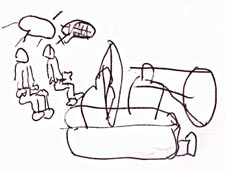
Hanging Out with Friends
In my dream self focus, I identify some experiences as “dreaming” and some as “not dreaming”. Socializing in the near realm is considered “not dreaming”. It feels more real, with less involvement from the waking self. It lacks rationalizations. Social dreaming is a state from which we can go into a dream, and to which we return when we wake up from that dream.
The following experiences illustrate this socializing in great detail.
-
Lucid Dreaming and Sex 1994 • age 19mature content
I’m driving through the country with Alison and a few others. We’re going to a movie/sleepover party at Rand’s or Bard’s. Eventually we end up in this little town, which is all part of the same building. . . . I finally start hanging out with Alison, Jen, Rand, and the rest. We talk about sex. Alison says she’d like to know what it’s like, asks me to show her. I think “Ah, no. I’m going to wait”. Then I think, “But wait, this is only a dream, so I can do it!” So I agree and we start at it, jumping right in, and everyone’s watching. Finally we decide to get some privacy, and go outside for a walk. I say, a little apprehensive, “This . . . is a dream isn’t it?” She shrugs and smiles. I say, “Then how can I do this?” I hold up my hands and part them and at the same time the leaves in a willow branch ahead move aside for me. She nods and smiles, and I think “Hey! I’m lucid dreaming!”
We get out into the main road and I tilt gravity so we can both ski down the gravel. We do, and I realize I hadn’t showed her any other sexual positions, so we go to the side and I show her woman-on-top. A farmer drives by and doesn’t even look. Then a crazy farmer enters his field and we get scared and start heading back. She says his head looks like a hamburger and suddenly it really is! We laugh and go back to the building. We enter the perfect room for sex, but there’s a big dog there. I close my eyes and call it from outside. It goes to the door, growls, and runs off. Alison goes “How did you do that?” I smile and shrug. We continue having sex there, then go upstairs to see Bard, Rand, Peter, and some others. They’re in PJs, with wet hair, ready for their movie sleepover party. We join them.
Dream Sleepover Party: I frequently dream of these gatherings of dreamers, sometimes friends in the real world (as in this case), and sometimes not. People get together and have parties, gatherings in the night. People meet, talk, go on adventures, come back. It a whole different side of life we’re mostly unaware of.
-
Discussing the Dream We Just Shared 1994 • age 19mature content
Context: I'm staying at Juno and Jay's apartment. Jay is Juno's boyfriend.
[Juno, Jay, and I] are living in this big house. Juno and I end up deciding to have sex. So we go upstairs to this room. Then, oddly, something subconscious comes up telling her she’s obligated to me. She gets ready, but I smile and dance around instead, telling her she doesn’t have to do anything. The obligation passes and we do it, although I think my dream skipped over the whole scene. Afterwards we go downstairs, both with this happy-fuzzy glow that I think is too obvious. Later we go upstairs again and I stop her on the way. “Did we really just have sex?” I say. She nods. We continue upstairs and it hits me. “We didn’t even use protection! You’re on the pill, aren’t you?” she shakes her head. I start thinking about pregnancy, having to get tested again, telling Jay. We go downstairs and she crawls in bed with him and I get in another bed across the room. She sits up, looks at Jay, and says “I fucked Sam.” I get the feeling that he suspected it, but his full reaction is lost in a sudden switch to something different. Still dreaming, Juno and I start talking about this dream, and realize we both had the same dream.
Shared Dreams: The original dream with Juno was social dreaming in the near realm. I likely passed into a waking self dream fantasy as I began to think of the physical consequences of pregnancy and discovery. But then I pull back out of it and Juno and I discuss the social dreaming “dream” we had just shared.
-
Killed at the Show 1995 • age 21
I watching a show with a bunch of people including Brendan, Kayla, and her boy. Afterwards, I said “hi” to Kayla and cuddled up against her. Then I went off exploring, and she came with because she liked me. We ended up in this big ocean chamber.
Watching a Show: After watching a show together, Kayla joins me in my exploration dream.
-
Lance’s Xmas Present 1996 • age 22
It’s Xmas with Buttercup’s family, but instead of her brothers and sisters it was Lance and his new girlfriend. I was taking a nap when it started. I awoke to Buttercup dangling a Nintendo 64 over my head. She had got it for me because her parents didn’t get her one. I was too tired to fully realize how awesome that was. Buttercup got one for Paige, too. I asked why we were celebrating on Xmas eve and Buttercup said her Wadsworth blamed it on the cat. More gifts were opened and her parents fell asleep.
Christmas Approaches: It’s December 19th and I’m at Buttercup’s home in Atlanta for my first Christmas with her family. We’re hanging out in her living room in the near realm. With myself and Buttercup’s parents going in and out of sleep, this is a clear social dreaming situation. She did, in fact, get me a Nintendo 64 for Christmas that year.
-
Dreams Inspire Life 1996 • age 22
Much pleasantness! I dreamt of South Hall, with lots of crazy fun, like we have before classes start. Friends and I were climbing on furniture, giving away stickers, being loud, creating art, and playing together. At first, Brad H was the only familiar person there. The action spanned the lobby, the RC’s room, my room, and the bathroom. While playing in the lobby, I saw Buttercup on the couch and was overjoyed! In waking life I turned, wrapped myself around her, and squeezed her. Back in the dream we continued to play.
Returning to College: At the time of this dream, Buttercup and I were living in Berkeley, California. It was summer between years of college, and we were excited to return. We weren’t the only ones! Here we met up with others excited to return and hung out in South Hall where we had both lived.
-
The Slumber Party and Scary Man Prank 1999 • age 24
I knew this wasn’t a dream all night.
It was night. There was a group of us in the front room of a house. Ranier and River came to the door and knocked but I didn’t answer. Then I got up (it was still dark), and did my morning routine. After that, I saw them waiting outside in their car. They knocked again and came in. It was like a slumber party, except everyone started out sleeping and slowly woke up.
I was having a love affair with Rachel from Friends, who I knew was Buttercup. I was pleased that there weren’t actually any relationship problems like on the show. It was altruistic, true, cuddly, and warm.
At first there was fear in the room. Only Buttercup and I had awakened. Someone gave a warning but I knew it was just fear. I must have been talking about thought forms, because some of the nonlucid sleepers had expressed doubts about the reality of them. Since I KNEW they were real, I decided to play around with them and practice making some thought forms. It was still dark and I looked out a window. I pointed and said to Buttercup, “Look at that. . . . MAN!” Surely enough a bearded spooky face appeared out of the shadows in the window, from a black silhouette to a full face, giving the appearance of approaching. Buttercup got scared and fell to the floor in a fetal position. She seemed to be locked in her own world, shaking, and these grapefruit-sized semi-transparent black orbs were skittering all over her body. I told her to stop creating thought forms like that, that they weren’t real.
Throughout the night people went in and out of activity, reflecting their sleep cycles — napping here, more awake there, forming different subgroups to hang out in the slumber-party atmosphere of the house. Throughout the night we traveled to different dimensions, experiencing our own adventures. Some of us were more limited in what they thought they could do and others not. We often met back up around a dinner table or on the blankets and pillows on the floor. It was lit up later by a general light coming from wherever we were physically sleeping. I was fully connected with my dream self (like every night) and REMEMBERED IT.
I didn’t know everyone there. There was one guy with thin, brushed-back hair who was all kissy and mouthy and grabby at me. Annoyed, I just kept pushing him away.
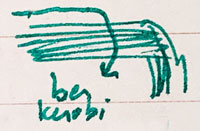
Receiving a rote or “fax” 
Sam Kenobi views a hologram in Star Wars There was an experience I called “receiving a fax” where my perception blurred with sudden streaks of lights and colors, as if I was looking through a waterfall. It was usually a sign that someone was in great emotion, calling to me. When this happened, I had to leap into it before the edge. If I did so, I’d see Sam Kenobi in a little room telling me the message. The second time it happened I caught myself thinking it was from “Rachel”, but then saw that I had placed that hope over the actual message, which was that I was supposed to be at a job interview in the waking world. This wasn’t actually true — it came from someone else at the table.
When someone was scared of something, there were no attempts to hide emotion — they immediately tried to gain control of the situation by yelling or whatever. Near the end, a girl at a table next to us freaked out when some of us were playing around by throwing water at each other. I looked at her and threw water at someone again, not afraid. She stood and yelled again that she’d beat us all up. Then I awoke from the alarm.
Later, awake: Wow!! Buttercup dreamed of scary men out on the porch! After she fell into the fetal position with the black orbs all over her in my dream, she dreamed she was unable to move with cockroaches running all over her body. She dreamed all night of the men on the porch trying to break in and get her. That’s the last I saw of her all night, too! I feel bad for scaring her — I inadvertently caused her a scary night of dreams. But WOW — an independently verified shared dream caused by lucid thought-form creation!
Social Dreaming: This dream is so important because it illustrates a very common situation in our nonphysical activities. There is a sort of social gathering, a gathering of people in the near realm, very much like a slumber party. This can be anything from a couple sleeping in bed together to large groups of friends, family, neighbors, and/or strangers gathering together. This can happen routinely or randomly, forming relationships that often do but may not always reflect relationships with people in the waking world. From here we move through levels of astral wakefulness and dreaming, our astral bodies ranging from motionless sleep-like states, to sleepwalking states, to awake-seeming states. In the first, we are in our own private dream world, and the the latter, we are “awake” nonphysically, in a social, communicative state.
During this time, people have bizarre, unpredictable influences on each other across their dreams; my dream of affection for Rachel finding a receptive target in my girlfriend Buttercup; the affectionate guy’s dream of love finding a poor match in me; our playful water fight finding an unwilling participant in the yelling girl, who was probably having a dream about something horrible; just as Buttercup, surrounded by friends, privately dreamed of fending off a break-in by scary men on the porch.
-
Brendan’s Gathering and Summoning Pants 1999 • 5:30 AM • age 25
The dream was a celebration and gathering of our friends, hosted by Brendan and Melody at their place. It was fancy but reminiscent of dorm rooms. It appeared to be a collection of memories from all the inhabitants, seemingly built anew each night. We had lots of adventures and hanging out and interacting. At one point I could see my old room from Banana House, but it was actually a small narrow house across from and below us.
Then later on the scene became a railroad and we had to listen for trains coming from different directions (created in part by fears and expectations). The moment a panic took someone in the group, it spreads like wildfire to all of us and the danger seemed to increase greatly even though the trains didn’t appear more often.
Our sights were set on a goal — a government building with a vicious dog that could easily be calmed down by any act of will against it. I stopped it with some forks, and another kid stopped it with a spray can.
(not sure where this next part was in the continuity of Brendan & Melody’s gathering)
So then, alone and outside the front door, I had another revelation: “Of course! This is a dream!” I ran all over, leaping with energy and excitement. I told everyone, not getting much understanding. I popped into a darkened room with some people and announced it to the people within but they didn’t hear.
One guy had a trick he was showing off — he made different coats flip up out of his pants when he tugged on his present coat with his elbows. His belief in his abilities made them work. I inspected the process. The jackets began as little grayish balls in the back of his pants by his belt, and expanded into fully formed jackets that flipped up onto his back and across his arms in a fully realistic-looking display of what by physical standards was an impossible act. I thought I could out-do him and, standing there in my underwear, I said “But can you just make something . . . from nothing?” and I hid my lower half outside the door frame and concentrated on making pants. I could feel the thought form whip up around my legs, enclosing them, but my surprise at the feeling of it broke my concentration and I looked down to see them receding. I tried again and didn’t bother to check this time and soon was pantsed. It’s the power of belief, pure and true, the kind passed down through the ages.
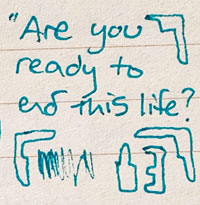
The sign Then I went with Brendan to our beds — awkwardly placed near the ceiling in the front hall. He said something about being happy and I said “Doesn’t it bother you to be constantly monitored by the government?” This was something I knew much more about in the dream than in waking life. I leaned back and a sign went on in my head. It was in funky Japanimation-style text with yellow highlights, saying “Are you ready to end this life?” At first I was shocked, afraid, fear of death coming to mind, then a wisdom came over me. “There is no death,” I thought, and relaxed. “What can it hurt?” My curiosity took over and I said yes without words. The sign faded and I woke up, fully awake at what must have been 5:30 AM.
Social Dreaming: Again we see friends and some people we don’t know in the waking world gathering to dream socially.
The environment is “a collection of memories from all the inhabitants, seemingly built anew each night”. We’re all projecting some of our own environments into the dream!
The scene becomes a railroad and several of us are playing a game of sorts there, then we face an angry dog. It’s likely one of us came up with it and several joined in. It’s interesting how in the drama of the game, panics spread through the group like in “The Slumber Party & Scary Man Prank”. We are very aware of each other’s emotions.
-
Hanging Out 2020 • 7 AM
I’m dreaming from what is probably a NREM state. I’m present in my body, aware of sounds from the physical world around me — a tree branch falling, people moving about, talking. But my focus is in the dream. This is a dream of hanging out — just enjoying myself socially with a bunch of other dreamers. I suspect that NREM dreams are probably similar. My rational mind is not trying to make sense and rationalize things. My dream self is driving.
I’m hanging out with a group of two girls and three other guys. We’re all friends, very comfortable with each other. We’re in a large white room with warm golden light and tall open windows. In one corner, the walls came in to form a rectangular platform, about half as tall as the room (as if to make space for a room on the other side). There is a rumpled pile of white towels with black smudges in the middle of the floor. Someone asks what game we should play next. I’m not entirely sure how this starts, but the towels become a rolling snowy slope and at once expands to the size of the whole room — with us shrinking in proportion to make it a large mountainside. The towel-like nature of the landscape makes unusual rolls in the hillside. I feel that even though we can no longer see the main room, the invisible rectangular walls of it define the space.
We play a game of climbing up and sliding down the snowy slopes, enjoying ourselves and laughing. Then we climb up the slope, up a short cliffside of dark rock, and onto the platform area of the room. The platform is now like a balcony overlooking the mountains. It has a white balustrade. (Okay — I have to explain that word. I was trying to think of the right word for this white iron fence-like border around the platform, and that word popped into my head. I’ve heard it before but I never knew what it was. I just looked it up and it’s the perfect word for this. Weird.)
So everyone climbed up onto the platform. They were sprawled out on the floor or sitting, physically close and touching. They seemed like boyfriends and girlfriends or close friends. I felt left out. I climbed out to the outside of the balustrade and hung onto the bars. I projected my feelings into a full-throated song about how the two girls I wanted most didn’t want me back. It came out fully formed, creative, musically interesting. I sang maybe 5-6 lines, then turned my attention back to the mountain scene, which was turning back into a room now.
Through the front wall, I saw a group of four people chasing a soccer ball, and jogged over to play with them. But they were kids — maybe aged 10 or so, and I decided I was too old for them. I heard someone singing “Stairway to Heaven”. I began singing along. Someone else was singing along, too. Probably someone from the platform. I liked my voice least of the three, but I still gave it my all. The originator of the song stopped playing and singing the song. There were a few seconds of silence. I didn’t want to stop yet, so I started it up again. The next guitar notes played — I didn’t need to rationalize this by imagining I was playing a guitar — my dream self was in control. I began to sing again. And the other voice joined in with me.
As I said earlier, my awareness was near my sleeping body the whole time. When Gwen (in the bed next to me) said “I love you, Papa”. I just responded out loud “I love you, Gwen” without skipping a beat. No resistance, no groggy wake-up. My mind was just right there.
Hanging Out: Linking this state to NREM is quite an idea. That would explain the different feel of dreams like this. It’s less physicalized and rationalized than dreams, feels more local.
-
Fiona’s Shop 2024 • 6 AM
Context: Justin has been in various rock bands since college.
I go to a college.. I’m hanging out with Justin on a bed in what feels like a hallway. I’m going into his thoughts about bands and concerts. I see images from past band experiences. Then he shows me this kind of art piece. . . . [It’s a moving panoramic art piece of an early band he was in]
After sharing in his memories and thoughts, I pull back to the bed we’re on. I notice music is playing. They’re my songs! He’s listening to songs I’ve written, but much better versions. The first was one of me playing guitar and singing. One of them is a much improved version of “Night Song” — an experimental song I made with cricket sounds.
We seem more in a bedroom now, and I’m looking through Justin’s cabinets and closets. It’s dim morning light.
Direct Sharing: This is wild. Justin and I aren’t even bothering with translating our communication to physical terms. We’re just directly sharing thoughts, images, experiences. In fact, what we’re sharing is improved versions of what we’ve created in the physical. It’s just two friends hanging out, sharing their interests.
-
Me and Taylor 2024mature content
Context: Taylor Swift was dating a football guy around this time.
A few more people appear outside the door, to my right. The cook mentions them and I turn my head and see Taylor Swift sitting next to me. I refer to her as “a girl who looks like Taylor Swift” but I’m sure it’s actually her.
I start to talk with Taylor and I’m being clever and funny. We leave the roof and walk down the hallway together. She pulls me into a bathroom and we kiss. She begins to initiate sex, and I hesitate for a moment, remembering that I’m married. Then I realize this is the dream state and go for it. It’s wet, and brief, but good.
We begin walking about the mall. Half of it is closed off and in darkness, and we decide to explore some of the closed areas. We’re about to go into one but notice a security guard standing near the entrance, facing away. He turns and sees our interest, and says he would look the other way for $210. We continue on and find another way in.
At some point Taylor’s close friend joins us as we wander the darkened corridors. I keep being funny and clever. We come to a big room with a concrete wall in front of us, but it’s about 20% transparent and we can see through it to a football game taking place on the other side. I make a subtle joke about how it would be so weird to be playing out there, with so many people looking at you. “Could you even imagine that?” (haha)
Confidence: I love that I’m being clever and funny in a social setting in the dream state. I’m rather introverted in waking life. I certainly have it in me, but prefer to be on my own. Yet I’m always happiest when I’m being open and socializing with good friends in waking life. It appears I instead do my socializing in my dream life.
Because the mall was darkened but not creepy, it seems likely it was a real physical location in the near realm. Taylor’s initiative in kissing me and so on was unexpected, so it was clearly another dreamer I was hanging out with. This is true for the security guard asking for a bribe as well.
Continuing Parties After Falling Asleep
After drinking with friends and then falling asleep, I frequently continue socializing with people in the near realm.
-
Astral Party 1999 • age 25
It’s Saturday night, after going out drinking:
I dreamed that we moved to Oberlin. We were on the second floor, as is actually the case. It was night and people were going by outside our window looking for parties. Buttercup’s sister came by and crawled up the wall to the second story window, then talked and left. Then a crazy lady on her way somewhere came by and we told her to leave. Then this mussed-hair bleached-blonde fellah came in for a while, then left, walking about a story off the ground. Then all these people started arriving. They came in through our open front door, a balcony which appeared outside the window, and another open door leading to the hallway. Soon it was packed, like an Oberlin party. Everyone was college-aged and out for fun, telling jokes and playing tricks. Many were drunk, carrying 40s. I was drunk, too. I kept mis-recognizing people, then catching my error before going up to talk to them. Truth is, I didn’t recognize any of them. I worried about my things. I once walked past this couple and heard the guy say “I’m sorry I didn’t recognize your stuff” and the girl took it sexually and started snickering for a while as I went about.
After a while people began to leave, but then a few more would come through. Half-awakening, I felt strongly as if this were a true dream, that I wanted them all to leave, that this was an astral continuation of Saturday night partiers, now drunk and asleep in the early AM. . . . Upon waking, the “Oberlin house” felt much like it was this one.
What We Do in Dreams: Here we see dreamers continuing their drunken revelries as if they hadn’t fallen asleep.
-
The Mulcher 1997 • age 22
I was drunk last night and slid in and out of sleep a few times. I remember doing astral adventures — house searches, visiting people, talking with Buttercup. I saw the outlines of her face in blue and off-step in red. Intense communication. It was hard to maintain.
Telepathic Communication: Another experience of telepathic communication in the near realm. On some occasions in the morning I feel that something has transpired between Buttercup and I during the night, that we argued or made up or went adventuring together.
I feel that this communication goes on at a subconscious level at all times. Not always telepathically but there’s a much deeper awareness of what everyone is communicating that we are consciously aware of.
Shared Experiences
I believe most nonphysical experiences are shared to some extent. This is usually the case when socializing in the near realm or astral, but usually not the case in rotes, in which unknown characters take a familiar form to convey their emotional meaning. Subjective dreams can be influenced by others nearby, whether the others are awake (astrally or physically) or dreaming themselves.
It requires both people remembering the experience upon awaking and discussing dreams with each other to confirm these, which is a rare thing.
-
Meeting Tink 1992 • age 18
I go to visit Kayla. I arrive, and her campus is a darker equivalent of SSU. She lives in Aquarius (a dorm at SSU). I meet this fairy who glows brightly through the gloom. Her real name is a one-word name that reminds me of “Patchouli”, but I call her “Tink”. We became immediate best friends. I have an utter fascination with her, and my whole visit begins to revolve around her. She can change size from small to really tiny to human size. I seemed to have the fairy power, too, as I could also change size.
At one point Kayla is showing me her room, but I’m just waiting for when she has to leave so I can go visit Tink again. Then I was searching for Tink because I had something to tell her. It was a very dim dream except for Tink. I was so enraptured by her!
Nov 9, 1992: In waking life, Kayla told me that during a guided meditation, she wandered into fantasy. She became Tinkerbell, pure white, and flew off to a far away place where I was a dull gray, sitting, lonely. She swooped down and flew in circles around me and I turned from gray to a shiny, shimmering white fairy just like her. We smiled at each other, took each other’s hands, and flew straight into the heavens.
I wish I knew the date of my dream about Tink, but I didn’t write it down. I wonder if these coincided.
Kayla and Tink: Without knowing the dates, I can’t confirm this, but it seems likely that her meditation and my dream crossed or influenced each other.
-
The Slumber Party and Scary Man Prank 1999 • age 24
It was still dark and I looked out a window. I pointed and said to Buttercup, “Look at that. . . . MAN!” Surely enough a bearded spooky face appeared out of the shadows in the window, from a black silhouette to a full face, giving the appearance of approaching. Buttercup got scared and fell to the floor in a fetal position. She seemed to be locked in her own world, shaking, and these grapefruit-sized semi-transparent black orbs were skittering all over her body. . . . Later, awake: Wow!! Buttercup dreamed of scary men out on the porch! After she fell into the fetal position with the black orbs all over her in my dream, she dreamed she was unable to move with cockroaches running all over her body. She dreamed all night of the men on the porch trying to break in and get her.
A Verified Shared Experience: This is one of the rare times where two people in a shared experience both remember it, and I was fully aware I was in the dream state. Not only that, I unintentionally scared her into a subjective dream by creating a thought form. If only I’d thought to create something beautiful. The atmosphere of fear and the darkness outside made the scary man emerging from the dark behind the window an effortless choice. Next time I’ll see if I can defy the emotional environment and conjure swirling fireflies.
-
The Flipped Ship 2025
I’m on a cruise ship at sea. I remember Buttercup and Gwen being there. . . . I then found myself in one side of a two-part room, roughly in the shape of goggles, and it shifted forward, turned, and the part I was in tipped off the front of the ship and fell, hanging by a thick cord from the other one. Then, the other went off the side, and my consciousness massively enlarged again. The two small chambers were now dangling at the end of a massive projected arm coming off the ship. My room, at the bottom, was swinging back and forth somewhat. It was thrilling. The sides of my chamber changed to just netting, and I clung on, upside down, swinging. I called out to Buttercup to look, take a picture. I took some pictures, too. The two chambers switched orientation a few times, swinging out above the sea.
I didn’t remember this dream until Buttercup told me she had a wild dream where she was in a cruise ship. She was up high at the top of the ship, looking down at the sea and palm trees, when the entire ship started rising and rotating like it was doing a loop-de-loop on a roller coaster until it was upside down, high in the air.
Linked Flight: We were both in the dream of the cruise ship, and then both felt the same movement and attributed it in different ways. I wonder if the two-part chamber was her and I in bed, with the cord as our personal connection. Both of our astral bodies must have started moving at the same time. I wonder what caused this strong sense of movement, and why we both felt it.
I awoke feeling energized, after feeling low all week.
I dreamed I met Elkington on the Common as arranged, but Slade was not present. We both knew we were dreaming and commented on Slade’s absence. . . . The next day when I saw Elkington, I said nothing at first of my experience, but asked him if he had dreamed. “Yes,” he replied, “I met you on the Common all right and knew I was dreaming, but old Slade didn’t turn up.” . . . On interviewing Slade, we learned that he had not dreamed at all. (Fox 47)APrOBEr • modern • Fox
“A Danish gentleman sought to improve his position by going to the city of Mexico. Some months after he left, I dreamed that I saw him sitting in my father’s office, and immediately ran up to him, exclaiming, ‘I’m so glad you’ve come back.’ He put his hand up, as if to repulse me gently, and said gravely, ‘You must not come near me. I am dying in Mexico of the sore throat, and I have come to tell your father.’ . . . Three weeks after, I overheard a gentleman say to [my father], ‘Well, doctor, have you heard about your friend H——?’ My father having replied in the negative, the gentleman continued, ‘I was told he died at Mexico, three weeks ago, of sore throat.’”
- Lita Jarratt (Gurney, Myers and Podmore )PotL1researcher • Society for Psychical Research • Gurney, Myers, & Podmore
This one is significant! This is clearly the dream self of the dying man, a) knowing that his body is in Mexico dying, but b) not knowing enough to realize sickness can’t be spread in dreams.
In addition, it is a shared experience. The man is not there for Lita, but both meet in the dream location of a third person — her father.
“The other night my husband and I dreamt at the same hour, the same dream—a subject which neither of us had been thinking of for months. It was a dream of wandering about our first home, and in it looking at the same spot.”
- Jane E. Fielding (Gurney, Myers and Podmore 315)PotL1researcher • Society for Psychical Research • Gurney, Myers, & Podmore
“When I was a young child . . . my mother took me into her room to sleep. She awoke in the middle of the night, or early morning, out of a dream in which it had appeared to her that the servant was attempting to murder her with a knife. I had awakened at the same time, and was sobbing in my crib by her bedside. Upon her inquiring what was amiss with me, I replied that I had dreamt that John was murdering her with a knife.”
- A. A. Watts (Gurney, Myers and Podmore 380)
“I went up in the afternoon to my room, locked the door and fell asleep upon my bed, having undressed myself and merely covered myself with the sheet, it being a warm day. After a while, I was startled out of sleep by dreaming in a very lively way that a gentleman, whom I had never seen before, was stooping over me. He was dressed in a dark gray tweed suit; he wore on his little finger a cornelian ring, and a small cameo pin which was a veiled figure. I observed that one of his eyes drooped a little. There were a number of Zulus standing behind him. When he bent down towards me he put out his hand and said, “Poor thing, you seem tired.’
“The impression was so vivid that I jumped off the bed to see whether the door could have come open, but I found that it was locked as I had left it. . . . In the middle of August we moved to Folkestone. . . . As I was going down the Military Hill leading from the camp to Sandgate, I met the gentleman whom I had seen in my dream, wearing the same clothes. He stopped, and looked at me, and said, ‘I think we must have met before.’ I said, ‘Yes’; then introduced myself, and told him of my dream. . . . He had dreamt of seeing me lying down in a white gown.”
- M. R. Wedgwood (Gurney, Myers and Podmore 593-594)PotL2researcher • Society for Psychical Research • Gurney, Myers, & Podmore
“I fell asleep, and it was then that the idea of my grandmother’s illness or death (I am uncertain which) first came to me. . . . Every particular of the room which I saw was strongly impressed upon me; that the old lady was breathing very heavily; and, strangest of all, my mother, who was and is in Australia, seemed in the room. She, as I thought, turned to me, saying, ‘I fear, Duncan, she is dying!’ How long it was before I wakened I cannot say; but every fact was strangely distinct, for I seem to remember even the ticking of the clock. The gas being quite bright when I awoke, I rose to extinguish it, and quite accidentally noticed the time.
“On receiving the intimation of her death . . . the time, I noticed after my surprise had passed away, was between 4 and 5 a.m. . . . The time I had noticed was 5:30.”
- John D. Best (Gurney, Myers and Podmore 411)PotL2researcher • Society for Psychical Research • Gurney, Myers, & Podmore
Two people asleep in different parts of the world appear and interact at a third location.
Examples of “collective” dreams, in which a large number of people sleeping in the same location all experienced a similar dream were mentioned by Manaceine. One of those involved a group of several hundred soldiers who slept in a “haunted” abbey because quarters were scarce. They awoke screaming and fled the building in terror, complaining that a large dog with long black hair had jumped upon their chests and disappeared through an opening. They refused to sleep there the following night unless the officers stood watch in the building. Although the officers obliged, “about one o’clock, in all the rooms at the same time, the cries of the previous nightmare repeated, and again the soldiers rushed out to escape the suffocating embrace of the big black dog.” These dreams vanished after they left that location. (Van de Castle 101)ODMresearcher • modern • Van de Castle
I succeeded in projecting myself into her room. . . .
I . . . went over to her dresser, put my hand upon her hair-brush, walked over to her and put my hand upon her shoulder, stood there for a few moments, then went back and placed my hand upon the hairbrush, then back to her again, etc.—repeating this about a dozen times. . . .
The next day I inquired if she had seen me in her room. “No,” was the reply, “but I dreamed that you were there. . . .
“I dreamed that you were trying to brush my hair . . . and that you kept running back and forth, trying to find the comb, and that I kept telling you it was on the dresser.” (Muldoon 242-243)PotABOBEr • Spiritualism • Muldoon
Notice how Muldoon’s friend weaves a story around his strange actions, in an effort to make sense of them.
Interacting with Other Local Dreamers
-
A Wild Night Out 2003
The city is like San Francisco and New York City. There are lots of people and shops — everything is packed in. In the background, Alfred Waits singing Fiona Apple’s “Slow Like Honey”. I can hear people’s thoughts. We had to walk through what was now someone’s apartment. After showing us through, they telepathically complained that they should put locks on the door.
Wandering Through: Here we appear to be wandering through the near realm in a big city, picking up people’s thoughts. We disturb some sleeping people and hear their complaints after they show us through.
-
Bed and Breakfast and Company 2000
Awake: Buttercup and I are staying in a bed & breakfast
Dream: I have a long and protracted realtime dream with the landlady of the B&B getting into bed with us and not leaving us alone! I eventually told her off. There was a strong Dark Tower feel but it was the actual room we were in. She was astrally visiting us!
Hello Dreamer!: I suppose there’s nothing better for meeting new dreamers than running a B&B, is there? Every night, someone new right down the hallway. I can’t fault her enthusiasm. In fact, I’d go back, just to see if I could get some more interesting memories out of it.
-
The Arizona Center 1996 • age 22
I got a job in a little food place in a mall. The work came naturally to me. Some of the more experienced and relaxed workers asked if I wanted to go somewhere with them. I did, and this friendly guy took me for a drive to this arid place in Arizona that had an organization like the Berkeley Psychic Institute. The people there were friendly and immediately accepting. Buttercup joined us shortly afterwards.
The Arizona Group: So here I am, recently relocated to the San Francisco area. I get a local job in the dream world and then some coworkers take me to this group of people hanging out in an Arizona desert. Just like socializing in the physical world.
-
The Exercise Salesman 1996 • 10 AM • age 22
I’m living with Buttercup and two others atop this building like the Co-op in Berkeley we almost lived in. This guy came by, trying to sell something. He peeked in the window and I pretended to be asleep. But then Buttercup came home and he tried to work his deal on her. She came in and embraced me. We ran around and played, ignoring him. He became dejected and started to trudge off. Finally I was ready to hear him. It was something about exercise, but he was too depressed and walked off.
I spied on him as he went to the next apartment. Still kinda down, he tried again. Someone answered the door and he convinced her to join a marching band (from some high school) who escorted her downstairs to the courtyard. He gave her some useless prizes. Buttercup, also watching, wanted the prizes. He came over and tried to convince us and I resisted. Buttercup accepted and so did some others.
Then I heard all these screechy scratchy sounds — emotions in the M-band! I could make out different ones — some happy, some depressed. I ran to go help and saw some weird party going on.
Door-to-Door Salesmen: This Co-op wasn’t far from our apartment in Berkeley. It had very dark wood and a super strange feel to it. I’m not surprised I visited in dreams.
A local dreamer comes by going door to door with a pitch about exercise. Perhaps he was continuing a job he had in the waking world.
-
Bedroom Singalong 1997 • age 22
The black guy who frequents Irene’s is sleeping next to me in my Blaine House bed — a thing I found quite strange. My bed had white sheets, the breeze was blowing, and the room was fully decorated. The guy was singing great music with me, soulful and inspired. He suggested a song, “Suzanne,” and hummed it, then called it too sappy. For some reason I thought he meant the Jackson 5’s song “ABC” and decided to do it. His girlfriend appeared in a prison beyond the brick wall next to us and began singing with us. I started singing one part and I was gonna let him take the next part, but it became the main part and he prompted me semi-sadly with the words. It was a love song and she was so loving singing it with me. I tried to redirect her affections to him but couldn’t remember his name. I told him I’d make it up to him and fix it.
Then I remember swimming in a secret world in Mario 64. It was in an underwater supermarket with lots of eels. I had to swim through 10 rings. I guess this was in my room — he was watching me play, impressed.
Unexpected Slumber Party: I’m in Bath, England at the time, so this might be a local person who reminds me of the regular at Irene’s. My Blaine House bed represents the bed I’m currently sleeping in. This is likely a projected-over experience in the near realm.
We’re like old friends having a sleepover.
-
A New Friend 1997 • age 23
I met someone and got to know him really well in one dream and had the feeling of being glad to have found friends in Atlanta so soon.
Local Friend: We’d just moved to Atlanta. Here I’m very conscious of having found a local dream friend.
-
The Annoying Kid 2025
The setting was one of the suburban houses I live in within the dream state. It was dark out but I could see. I was upstairs sleeping. This kid that Bodhi knew from the neighborhood kept coming by our house when we were sleeping and going onto our back porch, where it seemed he was trying to steal a pool float. There was also a pool noodle with a shark head or rooster head attached to the end that I think he was trying to steal. Bodhi was trying to stop him, as was I. I didn’t recognize him, and asked Bodhi who it was. He gave a name I didn’t recognize, but I knew where he lived — five houses down from us on the same street.
After some time of this, I grew angry at the interruptions and went to the house. I knocked on the door and his mother answered. I told her what was going on. I ended up inside the house. There were two other kids in there. I didn’t recognize any of them. We talked about why he was doing this. I left, hoping that would be the end of it.
Messing Around: Because it’s dark out, and I’m aware that I’m sleeping but Bodhi and I are getting interrupted by his presence, this was likely a dreaming kid coming onto our back porch in the near realm. That would be the local reality, even though in the dream state I’m at my astral home.
In the physical world, we don’t keep pool things on the back porch, so that part might have been projections or related to the astral home.
Playing Games
While hanging out with other dreamers, we come up with unique games to play.
-
Hanging Out 2020 • 7 AM
I’m hanging out with a group of two girls and three other guys. We’re all friends, very comfortable with each other. . . . Someone asks what game we should play next. I’m not entirely sure how this starts, but the towels become a rolling snowy slope and at once expands to the size of the whole room — with us shrinking in proportion to make it a large mountainside. The towel-like nature of the landscape makes unusual rolls in the hillside. I feel that even though we can no longer see the main room, the invisible rectangular walls of it define the space.
We play a game of climbing up and sliding down the snowy slopes, enjoying ourselves and laughing.
-
Body Transformations 2003
I’m in a neighborhood with some friends in the near realm. It’s dim, early-morning light. It feels high in elevation. I’ve been spending time here recently, running around with friends. The mountains are light brown with few trees, like the Sierra Nevadas, but the neighborhoods are green with trees.
I decide to do a side flip on the street. From standing, I bend sideways to the left and then flip to the right and land on my feet. This is something I tried to do in waking life after the volleyball game at Kai’s wedding — people thought it was hilarious. In the dream, we all went into this house. People were wandering about, doing their own thing, and I was practicing these flips in the wide end of this hallway. Once when I flipped, my legs softly hit this ironing board and I stopped in mid-flip, just hanging there in the air. Gravity wasn’t too much of a concern. But instantly I rationalized that I had grabbed onto the ironing board with my legs and had my back on the floor. Someone was watching. I smiled, thinking this probably looked impressive. There’s a little break in my memory. . . . Then I’m standing at the other end of the hallway where there is a sink and counter, and I’m looking into the mirror. My reflection is that of a cute asian girl I’d seen earlier in the dream. Without intending to, I had taken on her shape. As I looked, I noticed that the only obvious difference was the expression — she was always bright-eyed and smiling, while I had this sort of blank expression. I thought “I’m not nearly as cute without the smile,” but I still enjoyed the thought of being in a girl’s body and how I could grab guys’ attention. I thanked the girl next to me. She didn’t have a very animated reaction. Then a break. . . . We were playing this game. I was in a room with two light gray dogs. I was to transform into a matching one, then run about and interact with them and this bone. The others were supposed to guess which one was me by my actions, and I was to try to be as doglike as possible. Before we started, I expressed a concern to the girl from the hallway — “Will I be able to return to the asian girl form afterward?” The girl said “Usually you return to your natural form.” This was telepathic. She and the others were in a different room, waiting for the game to begin. When communicating like this, I saw them above and beyond the present room I was in. So, I transformed. I was both within the dog form looking out, and watching the dog from outside. It was strange to go after the bone with my mouth, to interact with the other dogs with my mouth, to run on four short legs. I did my best to be dog-like. The others correctly picked my dog because of the way the hindquarters looked — like mine. I had to agree. It was like in cartoons when a character changes shape but keeps some of their own aspects. When I was the asian girl, I remember thinking she was taller than I remember, and I was, because I am, proving in literal form that it’s hard to let go of that which you’re proud of.
True, Social Dreaming: This is an example of true social experiences in the near-realm, in what feels like a real neighborhood. The other people in the dream are also in the same focus, well aware of the laws of dreams, playing astral shape-shifting games, communicating telepathically without rationalizations.
Twenty years later I was driving around in Oakland, and came to this neighborhood that almost perfectly matched this dream. I couldn’t find any specific landmarks but everything about it was familiar from this experience.
Cross-Country Road Trips
I go on a lot of cross-country road trips with friends in the near realm. These typically involve a car rationalization. The purpose is to hang out with new and old friends, to attend gatherings, celebrations, and raves, and to visit parks, take tours, and see sights.
-
Milwaukee Road Trip
I’m on the road to Milwaukee with some friends. We get to the countryside part of the trip and stop on the side of the dirt farm road for a rest.
-
Car Encased in Ice 1999 • age 24
I dreamed Buttercup and I were on a cross country trip to San Francisco. We stopped at a gas station and I was distracted for a time inside.
Cross-Country Trip: We moved from San Francisco to Atlanta a year and a half before, and we like to go back and visit in the dream state.
-
Hanging with Ween 2000 • age 25
[I have a long dream of hanging out with Dean & Gene Ween]
I left off last night traveling home from Pennsylvania (Ween lives in Philadelphia). I was thinking Minnesota was my home, then realized it was Georgia.
Travels: This is a cross-country road trip to be back home in time for morning.
-
Tail Gunner
I’m in this small plane, being taken against my will by this girl to Appleton, Wisconsin. . . . The plane hits the ground. . . . I see this old farmer guy coming. . . . I follow the farmer home, asking how much further it is to Veroquah, my destination (this is unfamiliar to me in waking life). He says it’s “only 10 miles” and he’ll find someone to give me a ride.
Viroqua, Wisconsin: Twenty years later, I looked up “Veroquah” and found it! Viroqua, Wisconsin is about halfway between SSU where I lived at the time and Appleton, only a little ways off the direct route.
-
Free the Children 1997 • age 23
Buttercup and I get distracted from the march and go to a comic store. We start grabbing rave fliers on the way out. This friendly guy starts giving me directions to a rave near Atlanta: take 75 to 6-- to 706, to exit 13/14, then to the liquor store on Walker Road. I didn’t understand his directions at first but then it became clear.
Next door was this food place and we sat outside around this big rock.
Traveling to Astral Events: I frequently find myself traveling across the US to specific locations. Here we see how it begins — people hanging out, talking about something interesting or fun to go to, just like in waking life. I tried to find these roads in GA but could only find 75 and Walker Road.
-
Hanging with Star Trek Legends 1996 • age 22
I’m speeding towards Blaine House, on the trip through Minnesota to Oberlin. A police car starts to follow me with its lights on. I ignore it and keep driving. It eventually disappears.
-
Highway 710 2010 • 4:30 AM
We were heading west on a paved road through a green natural setting. . . . Then they took the exit north on Highway 710, and I looked behind us to see if Buttercup had seen us make the turn, but I didn’t see her car (the walls of the trailer home were no obstacle).
-
Mountain Removal Mine 2011
Buttercup and I are on a cross-country trip somewhere. We get a little lost on these roads and end up at a park not too far from Atlanta.
Visiting Other Countries
The US is huge, and I usually remain local to America when in the dream state, even though I travel far and wide. In rotes, I translate everything back to familiar American terms.
So it’s surprising when I travel to another country and the architecture and people are quite different.
-
Visiting England 2025
This dream was astonishing in an entirely new way. I was with some guy friends, traveling about on a trip together. But at times, it was clearly in England. Everything was so very different from my usual American dream surroundings. We went into this big English building, and the construction, decor, the people, everything was English in a way I don’t recall seeing before in my dreams. They even had the English equivalent of weird, confusing bathrooms! . . . I noted that they didn’t have British accents, their telepathy being translated into my own style of speaking.
-
Indian Celebration 2025
I spent several hours with an Indian family. I was in their home with their friends having a celebration of some sort. What struck me about this dream was how unfamiliar everything was. The traditions, the celebration, the surroundings — it was all new to me, and I was quite enjoying myself. It felt like I was in India, or an astral version of India. I remember walking around outside at one point.
In India: Here’s another dream where I appear to be in another country. The celebration and traditions were all new to me, meaning this dream was not translated into my usual familiar forms.
Waiting for a Friend to Go to Sleep
-
Waiting for Brendan 2004 • 1:30AM
Awake: After writing with Brendan and sharing music, I go to sleep at midnight. I dream the following over the next hour:
In my dreams I go to visit him and make brief contact several times. We prepare to go out adventuring but he’s busy in his semi-dark apartment (which isn’t accurate to waking life). I make contact, then drop, then make contact, then drop. I get bored and wait in my universal dream space, the school between the worlds (the Atlanta Tower). It’s dark there. The building at the top of the elevator is like a hotel. It’s several stories tall and domed at the top, with a theater. It’s directly above the physical world. I wander into a familiar gift shop nearby. There are several racks of piano music. There are some unfamiliar songs I decide to try while I wait. There’s something by Brit Grant maybe? Also something a little cooler by someone like Sheryl Crow. The rest are unfamiliar. One isn’t even sheet music. Then I spot the pricing guide.

Sheet music prices I’m disappointed to find they’re not free. They’re under a half-circle. This has all happened before. I’m waiting for Brendan to go to sleep so we can visit in dreams.
Meeting the Waking: This is simply amazing! Here I’m trying to make dream contact with someone who hasn’t gone to sleep yet. I’m making brief contact with him but since he’s still awake the contact can’t be sustained and keeps dropping, so I’m killing time in the dream world waiting for him to go to sleep so we can meet up in our dream bodies!
Others Departing as Morning Approaches
-
Keeping Tabs on the Election 2024
I remember in the early hours of the morning, 3-4 AM, that I was socially dreaming, hanging out with several other people in a living room, sitting on couches. The atmosphere was dim morning light. The people were just clearly outlined spaces of shadow. They had checked out, one by one — gone to sleep within the astral or woken up in the physical. At one point, just one couple was left.
Leaving Social Dreaming: People disappear from the near realm when they wake up physically. They may also go into a dream while remaining in place.
-
The New House 2024
I crossed the road and directly across the street was a comic shop, which I took to be a bonus. As I approached, I saw someone leaving and the lights were out. It has just closed (it was around 5-6 AM).
Closing Up for Morning: It’s not just me that heads home as morning approaches. Often time astral businesses will close around this time.
-
The Mountain Valley Gathering 2003
The groups continued to hang out for a time. Morning was coming, and people started heading to the buses to go home. I was one of the last to leave, but finally squeezed my way onto a bus.
Morning Dawns: Just as people at parties in the waking world say their goodbyes and head home as it gets late, socializing dreamers say their goodbyes and part ways as morning comes. I expect it’s more a habit from the waking world than anything. Since a lot of social dreaming seems to take place in the near-realm, gradually rising daylight is a very visible sign there, unlike other areas of the astral that contain their own constant light level.
-
Hanging with Star Trek Legends 1996 • age 22
I’m speeding towards Blaine House, on the trip through Minnesota to Oberlin. A police car starts to follow me with its lights on. I ignore it and keep driving. It eventually disappears. But then when I stop in this mall, a bunch of police cars surround me and take me in. . . . I’m put “in jail” in this hotel and dining establishment which has the police staton in it. I’m eating with Buttercup in this booth next to William Shatner (Bill), Leonard Nimoy (Leo), and Dr. McCoy (Bones). I gasped upon seeing them. Bill and Leo went to return their dishes and I began talking to Bones. He kisses me on the lips on two different occasions. It’s kinda awkward but I manage to strike up some good conversation. The others come back and we move upstairs to hang out and talk. It’s fun and friendly. They do the pass-a-story game for fun — clarifying that they don’t really write Star Trek episodes like that. They’re laughing and talking as we make up new episodes. Bill gives me a comic torn out from a newspaper. After a while, morning is coming and they leave. I bounce all around telling everyone.
Getting Up Soon: I don’t think these are the real actors from Star Trek, but whoever they are, we have a great time hanging out, talking, and making up Star Trek episodes. They leave because morning is approaching.
-
The Treehouse OBE 2024 • 5:30 AM
I went up to the next floor. Here I saw a worker or two. One I took to be the foreman. As he came in, he looked at me a moment, seemed not to believe his eyes, then moved on. He went to the other side of a ledge surrounding the spiral. . . . I followed him a little bit and got his attention. He looked at me, disbelieving. He seemed stricken, as if seeing a ghost, but I gestured that I was sleeping. I reached out and touched him on the shoulder.
More and more workers were arriving, and I greeted them. The morning light was increasing towards daylight. One worker thought I had noticed his lateness and made some smiling explanation.
Workers Arriving: While I typically head back to my bed as morning approaches, here I see workers arriving at my house in the early morning. Perhaps that’s due to the thought that in the morning they head to work. Maybe they do this astral construction work mostly during the day while their waking mind is otherwise occupied.
The foreman is surprised to see me . . . why would that be? Maybe in my half-aware OBE state I appeared semi-transparent, as I had the other night.
Socializing in the Astral
What’s the difference between socializing in the astral and near realm? The near realm reflects physical locations, and while it can appear fully formed but there’s a sort of transparency to it, a different level of perception. The astral is more vivid. It’s painted in full color, fully formed, and doesn’t reflect any physical location.
-
Free the Children 1997 • age 23
Buttercup and I get distracted from the march and go to a comic store. We start grabbing rave fliers on the way out. This friendly guy starts giving me directions to a rave near Atlanta. . . . Next door was this food place and we sat outside around this big rock. On the rock was this guy we knew from somewhere. He eventually started talking to us. He introduced this smiley girl to us and we started talking. Buttercup got really nervous and shy so I had to be more talkative. The girl said “You must be in a really bad mood.” Buttercup said we were tired out from all the directions we just heard. During the conversation with the girl, I turned inside myself again. Everything got really skewed with dark areas from behind me becoming more central to my visual field. I missed a few moments of outside activity and when I turned back out, she was back to talking with her other friends. The girl grabbed a piece of aluminum foil. I grabbed mine and got all excited because I knew a funny foil trick. She noticed me beaming at her and brought her attention back to me. I couldn’t access the trick for a few moments and she waited. I said “I know this trick with foil” and then I remembered it. I blew on it funny and it made funny sounds. There was amusement.
Reality of Social Dreaming: This is an experience with real people in the dream state. Buttercup was awake when I dreamt this, but I’ve seen how we’re always dreaming underneath our waking consciousness, so that’s actually not a barrier at all.
Hanging Out with Friends (Astral)
-
Weed Beer 2023 • 2:30 AM
I’m at a bar in a city with three friends, including Buttercup and a guy I took to be Lucas. The bar has tall ceilings, mostly concrete, and black railings. We’re the only ones in the small front area. We sit at a table and look at the drink menus. They’re large, with pictures of the drinks next to their names. I’m drawn to two tan/orange beers. The waiter comes and when it’s my turn I ask his opinion.
-
Brendan’s Party 2024 • earlier in the night
We were having a slumber party in this huge house of Brendan’s. Part of it was outdoors with big tent-like fabrics above us. We arrived in the evening. Brendan wasn’t entirely available, but we saw him from time to time. His parents were there. Buttercup was there with me. She was also wandering off and coming back. Brendan had said that he set aside some marijuana for us, if we wanted, but I forgot where and spent some time looking for it. In the end I either found it or created some, and smoked it. There was a part where we were playing a complex board game. The party was to go on throughout the next day and night.
This was a telepathic “social dreaming” true dream.
Slumber Party: Brendan’s house was the gathering place. We kept leaving into our individual dreams and adventures and then returning, or “waking up” there again.
Interesting that it was to continue throughout the day. This must refer to the fact that we’re dreaming at other levels even when awake.
-
Gathering the Kids 2025
I was hanging out and traveling with a group of friends. We were looking for a particular place. . . . Highland something — a restaurant or bar. I had an idea of where it was, so we all got on a bus and set off. On the way we passed some red and yellow buildings. It went on a long ways, crossing a wide river at one point without bothering with a bridge. I suspected this wasn’t the right way, and when we arrived, Highland wasn’t there. I checked my maps again, and this second location had also closed, and it was now open at the red and yellow houses we passed a long while ago. But there was a bar type place where we had arrived, and we went there.
Restaurant and Bar: Just like in waking life, we enjoy going to restaurants and bars in the astral with friends.
-
Between Classes 2010
I go down the stairs and around the corner. Just a little ways down the hall I see Quentin sitting against the wall with some friends. I am excited to see him, so I call out to him and sit down in front of him. He’s excited to see me at first but then quickly becomes guarded and begins talking to his friends instead. I wait a moment, and see that it’s clear he’s going to ignore me, so I disengage my excitement and lean back, a few moments from leaving. Feeling this, he turns back to me and says, as if in explanation, that Eric said that I’d changed, that I wasn’t myself — not fun or engaging. I remembered the name from playing soccer (though Quentin didn’t know that Eric) and remembered that as when my affliction started (again incorrectly — that was 2006, and the affliction started in 2003). So I started talking about how that was a long time ago and how I am much better now (am I?). As I started talking with him, I reached out and held hands with the girl sitting next to him and we were affectionately touching each others hands in the cutest way. This conversation sort of let me into the group, and we started talking about various things.
Social Dreaming: This is essential social dreaming. Though it’s not taking place in the near realm, an astral school would be a natural setting for it as well. Quentin acted as I might expect him to. That way of hanging out in a hallway, just casually sitting around, talking, was something we used to do a lot in high school.
-
Friends and Dream Awareness 1997 • age 22
Brendan and I went into the garage. I thought I had forgotten my glasses and contacts because I couldn’t see clearly. I said “Clarity now!” and my vision became clear. I was about to start flying and trying to go OB, but got distracted. Savannah came by. Brendan and I started doing cartwheels in a huge mud puddle. . . . Ruby started telling me about her friend Kari’s tragic marriage.
Visitors: When someone thinks of us, they can appear before us. Friends kept showing up to hang out, and I was drawn into their fun and stories.
-
The Buried Building 2024
The next thing I remember I’m back at the bottom of the hole. . . . I’ve brought a bunch of people with me to show them the building. They mostly stay behind me, out of my direct awareness. . . . We explore other interesting rooms.
I enter a room that’s more like living quarters. The others have gone ahead a little bit. I go into a larger, open living room with natural light, then outside to a big, beautiful scene. I’m on the bank of a river. The river is about 20 feet wide, with big rocks beneath the surface. To the right it curves away outside the exterior of the building. To the left, it descends very steeply about 30 feet from above. In the physical this would be a waterfall but here the river has just bent downwards. To my left is Ruby, smiling. Beyond her and up the bank is Buttercup, and maybe someone else. Emma is there somewhere. Beyond the river is a hill sloping up, with patches of woods and grass. At the top of the hill is a large rounded structure made of red pipes, like a playground structure but as big as a building. I remember that Buttercup had wanted to go up and explore this earlier, and she was hoping we could go now. I wondered if I could play in the river a little, in the downward slope to the left but got a warning from Buttercup that it was too dangerous, and I slightly agreed. Then someone suggested some funny prank to do when Ranier showed up (I saw this idea playing out in visual form), and I turned towards the door to see Ranier coming outside to join us. I gave him a hug.
Back to My Friends: Inside the rote, it felt like it was me and a few observers, but they didn’t participate. I wonder if going outside the building caused me to exit the rote. Perhaps this is where I came from when I entered the rote. I’m now openly communicating with my friends and family in a social dreaming setting.
-
The Detachable Room 2004
At this point, Kai came in. He wanted to do something. [He shakes the room free from the house] It was a rush! The room came to a stop and then fell apart so that there was one wall flat on the ground and another standing up precariously. We laughed.
About ten people from the school were there, laughing, amazed. . . . Angel from my soccer team walked through. He said hi, looked about, and kept walking. Probably just a brief intersection of dreams.
Social Dreaming: Kai walks in and wants to do something! Another great example of social dreaming. It’s as simple as that. Just as easily as you’d drop by a friend’s house to say hi or pick up a phone and call — in fact, it’s easier because all you have to do is think about someone and you’re right there with them.
He shakes me free from my body (my room representing my body) to go on an adventure. Angel, a player on our soccer team, wanders through.
Shared Dreams (Astral)
This section shows some dreams that were verified to be shared by those involved. It also includes some that had such an accurate representation of a person involved, behaving in unanticipated ways, that it must have been them.
-
End of Days 2012
Someone said it was the end of days. Incredibly huge tsunamis were rolling up all the coasts and continuing across the continent. Buttercup, Bodhi and I had fled Georgia to higher ground in Colorado. . . . [The tsunami arrives and we escape to a mass transport area]
I grabbed some important things, and Buttercup joined me. On the way back, she started slowing down and collapsed onto the ground with Bodhi, overtaken by sadness and despair. I tried to get her motivated to get up, but she wouldn’t, so I scooped her and Bodhi up in my arms and ran towards the last plane boarding . . . [we make it onto a plane]
We’re awake now. Without hearing a word of my dreams, Buttercup told me she dreamed about massive flooding from a tsunami, about losing Bodhi, and about yelling at some woman who objected to her publicly breast feeding. They were at one point at the top of a building surrounded by rushing flood waters!
Sharing Dreams!: This is just amazing. There is no doubt in my mind that we were sharing and influencing each others’ dreams.
-
Blinking Masks 1999 • age 25
I was searching for a mask in this open, friendly-feeling warehouse. I showed Buttercup one that was gross and funny and she didn’t like it. I couldn’t find it later and she says she hid it under some clothes in a box. Then I was looking at a whole row of science helmets on stands, and they had blinking red lights. Then the blinking stopped and and I wanted them to blink again but they wouldn’t.
Buttercup also dreamed of masks.
Shared Dream: I didn’t get many details about her dream, but this might have been a shared dream.
-
The Chamber Beneath Blaine House 2000
So I’m at Blaine House with Wadsworth. It’s daytime. We’re in the back yard. There’s no gazebo, as usual. The ground is very spongy and dug up in some places — they’d just emptied the septic tank. Wadsworth brought me to this 4-inch diameter round hole — the top of a metal pipe leading up from below and said he wanted to show me something. He pried this metal cover off and then I looked down the pipe. I could see water glimmering far below, and a white/blue tile. The picture resolved and I could see one whole end of a large swimming-pool-type chamber. I was fascinated that I could see so much through such a small hole, down a pipe. I turned to look the other way and could see the whole other side of the room, dimly lit. How?! “That’s incredible!” I thought. I asked how that could be. Next thing, we’re inside on a platform along one wall with white metal rails, looking around. We’re down there, inside the septic tank. There’s still plenty of water — they hadn’t pumped it all out. It was clear and blue and seemed pure, which surprised me. Wadsworth and I talked a little about it, then I asked how we were going to get back out and I looked up at the little hole in the ceiling and he nodded and I became really afraid of how I’d get through there. But I was distracted then by three white objects in the water below. It was a harp seal family! So cute! Amazing, I thought. How could they live down here, eating filth? Wadsworth expressed something about how it was purified down here.
Then we walked down the stairs to our right and Wadsworth jumped into the water. I was disgusted, but soon he was walking on the surface. Ice! My fascination was constant. The floor by the doors on this side of the wall was frozen and rippled. I stepped down and peered into the first door — it was a racquetball court with a floor of ice. Wadsworth led the way to the second door, which opened to a larger storeroom, mostly barren but with various machinery parts scattered about. Through the door on the far side of that room was a very large room with white walls, an off-white tile floor, and what looked like a business party in an engineering department. This was definitely Wadsworth’s! There were a few people scattered about in business slacks or skirts, holding styrofoam cups with punch, mulling about and talking. Decor was absent and there was a lot of open space, a few desks, and engineering parts scattered about. I asked Wadsworth how the room was being powered and he pointed up, saying “sparse, low-cost lighting.” There were scattered bulbs and only sections of the fluorescent ceiling lights were on. It wasn’t dim, but it wasn’t bright, either. Then through another door was a 70s-looking kitchen area with cheap silverware and dishes with greenish cupboards, more partygoers, and more assorted parts everywhere.
Wadsworth introduced me to Ruby (my sister), who had now joined us, but he called me “Brad” to some of his friends. There was a hallway beyond this room. I thought, “Who knew that there was this great underground area beneath Blaine House all this time?” I asked why he hadn’t told me about it before. I remembered the big pile of dirt in the backyard when they built the house and now attributed it to this complex. Soon I found Ruby more interesting and I went with her to the main septic tank room where we started. The floor was all ice now. We exited through another door.
Dreamer Wadsworth: I think this was Wadsworth. So much of the personality was his. His concern with saving money when it comes to the lighting and the kitchen, the engineering department party, his once interest in racquetball — pretty much everything fit him. It’s not infrequently that I find him at Blaine House, and he’s often acting as himself — an independent agent, rather than a thought form conforming to my expectations. There’s even evidence of him going in and out of lucidity. The party seems to draw him into another context, and he mistakes me for someone named Brad.
-
Hyperspace Warps 2001
Buttercup, I, and two friends were flying together over a huge beautiful park that I recognized. It had a river with tall spires of rock, huge rolling grassy hills, and an overlook. There was a busy commercial area in the center and a building with a long winding outdoor walkway. We landed and walked down it. It was packed with people. We saw a beautiful small open garden area on one side and walked into it, raising our arms and dancing about. Someone there said it was $9 apiece to be in there. I was shocked, but danced about some more, then left. The others came, too. Across the hall and down a bit there was another beautiful natural place and we went in to admire and play in the beauty. Again, $9. I left. The others stayed. They received a jellied cracker on a napkin and coffee drinks. I remained in the hall, watching people.
I returned after a bit and Buttercup smiled, and said I must be having quite the time watching people moving their coffee cups to their mouths addictively, unthinkingly, in the cafe across the hall. Truth is, I wasn’t watching that specifically, but had noticed it. Buttercup had ordered me a jellied cracker for $9 and I went to the stewardess of the garden and said, “I’m sorry, I can’t pay $9 for this, or allow my wife to do so for me.” “Fine!” she said, and asked me to scrape the jelly off the plate. I started to, but then saw how foolish it was and stopped. I left and wandered about some more.
A Shared Dream: Buttercup acts and speaks just as she really would — it is likely a shared dream with her. At this time in my life, money has been really tight for me, but less so for Buttercup. This is a scene that could very easily have happened in waking life. And what she thought I would have been thinking was completely accurate as well! I had noticed how people were replaying physical behaviors without actually eating or drinking.
“I dreamed that for some reason or other I had poisoned a woman, and the same night Mrs. Toy had a very vivid dream, in which she thought I was going to be tried for having committed a murder.”
- Edmund Toy (Gurney, Myers and Podmore 314)
[Mr. Merrifield] had a most distressing dream in which his death was foretold to him as about to happen within 24 hours. . . . He then told the whole story to his wife.
She immediately said . . . “I had dreamed most vividly that I was a widow, and the pillow was actually wet with tears. I never had such a vivid dream before, and it has troubled me ever since.” (Gurney, Myers and Podmore 316)
“The dream you ask me to narrate took place in 1856. . . . I had a vivid impression that I was dying, and awoke with a start to hear my husband sobbing so painfully that I aroused him to ask what was the matter, upon which he said the he had dreamt that I was just on the point of dying.”
- Mrs. Willmore (Gurney, Myers and Podmore 316)PotL1researcher • Society for Psychical Research • Gurney, Myers, & Podmore
Playing Games (Astral)
-
Friend or Foe 1997 • age 23
Buttercup and I were running through a rainforest tunnel cave trying to survive. It was like a video game. I kept having to shoot these mud-drenched guys in tattered clothes. Then this one enemy and I ran out of ammo and tried to be the first to reload. The enemy turned into a large Puerto Rican woman, and I challenged her to hand-to-hand combat, with Buttercup choosing the rules. We gave our guns to her. She said: “First one to score three hits wins. A hit is a hot coal blow to the forehead or a knife wound to the mouth.” We got ready and then I thought about how sick this was and said “Hey, do ya wanna just be friends?” The woman was shocked at first and took my outstretched hand into a wrestling hold, then released me and shook it. She was really nice and laughed about how nasty Buttercup’s rules were.
Craving Drama: Had I only remembered a bit of the last dream, I might have thought it just violence, but the greater context reveals that it was a game staged by those involved.
-
The Shape Shifting Game 1994 • age 20
I finish up a great project, then hang out with a friend. We play this game where I would hold out my hands, arms straight forward, then randomly change everything but my face to that of different girls at SSU, and by looking at my new hands, I’d guess “large,” “skinny,” “tall,” etc. The friend would laugh and say “Yup, go on.”
Shape-Changing Game: This is a game I likely played with another dreamer.
Playing Pretend
We sometimes play pretend in the astral, as children do. Sometimes this results in the creation (projection) of thought form scenes, characters, and objects as we get more into it.
-
Playing Batman 1996 • age 22
I had Buttercup’s car and it was loaded with stuff. This group of smart, funny kids ran by with a tent, giggling. I had to follow. There was some contest to see who could set their tent up the fastest. We tried different things and it was fun. There was a person there like Lark, and one like Brendan. We all decided to play Batman. We set up this elaborate game where we were in Gotham and I was supposed to save Buttercup. We all got caught up in the game.
Playful Dreams: I love playful dreams. We’re like a bunch of kids playing together, making up games, having light-hearted fun together.
-
Rachel’s Reunion 2010
I had gone on some cross-country trip and arrived at a ranch-style house in an endless green forest where Rachel was acting as host. It was like a gathering point for a rally, with people meeting up who hadn’t seen each other in a while. . . . Ranier runs up to me, grinning. I shout “Ranier!” and embrace him. Then Sid shows up and I give him a big hug and then 5-6 others appear. We’re all very happy and it’s clearly play time. Somehow Ranier, Sid, and the others end up in suits of shiny armor and begin having sword fights. I want one and soon I’m in one, too, holding a long silver sword. We playfully fight back and forth and then they all start galloping around the yard with fake horses, Monty Python style. Instead of riding a fake horse, I run after them, saying “Hey guys, I don’t have a horse! Wait for me!”
Text Video credit to the movie Monty Python and the Holy GrailThe next part I remember was being at the rally destination. It might have just been down the hill from the house, or maybe a whole different place. It was beautiful. We were on a forested hillside overlooking a wide river that flowed into a lake. Across the river was a short mountain ridge. Each area had an associated “kingdom”. On the side of the hill, our village of cabins and such was the earth kingdom. Down by the lake was the water kingdom, and across the river was the fire kingdom. It was set up like an adventure area with the goal of visiting each kingdom. Ranier, Sid, and the boys were there (not Brandon), and Buttercup was now there as my main companion. We had adventures, talked, went into a subdream or two, and had a grand time exploring.
References: Rallies are youth group gatherings at Unity Church. I met Rachel at one.
How Children Play: When children are having imaginary play, they do these exact things. They invent challenges and respond to them, like playing the floor is lava. It wouldn’t be fun without the danger. The scene with the boys fighting like knights was like that.
Board Games
Board games are popular in the astral — especially those with miniature characters or environments. This is because we can occasionally project ourselves into the scenes and become part of the action.
-
Volcano Survival 1998 • age 23
I was sitting in front of a board-game featuring a volcanic island. I hit two fire marbles together and a big flaming meteor descended (from the marbles or me) into the volcano. I hit the stones more rapidly together to get the volcano to erupt and it did. My concern for a group of little people on the rocks brought me down into the scene and we built defenses. It was all play — a game.
The Gods on Olympus: Consider the Greek stories of the gods on Mount Olympus, looking down and playing games with the lives of humans, sometimes going down and interacting directly with the humans as well. This is where that comes from!
In dreams we play games just like this, for fun and drama! We sit above the miniature scene, looking down from above, manipulating events, causing trouble. And then our own concern draws us into the scene, into the danger we’ve just created.
-
Brendan’s Party 2024 • earlier in the night
We were having a slumber party in this huge house of Brendan’s. . . . There was a part where we were playing a complex board game.
Projected Games
Some games are projected on top of an existing environment, like an augmented reality game.
-
Most Beautiful Rain Fairies 1998 • 2:25 AM • age 24
The following was a version of The Tower. As usual, it contained a challenge. It was a stadium with an angled walkway up the middle of the playing floor. There’s a repeating dream within the stadium in the form of Final Fantasy Tactics where I’m given a guitar that turns into a gun and I need to slay this George Clinton character. I’m unleashing water in different directions, and there are many repetitions.
-
The Circle Mall 2024
I exit into this circular mall bustling with people. I play this game that spans the whole width of the mall, where bad guys are coming in and there’s this mountainous pile of human-sized bone pods which I have to shoot. World of Warcraft trolls are part of it.
Afterwards I get involved in a game where I have to do or find various things in the mall to get points. One involves watching this dancing show, after which the announcer will come out wearing a large belt with a code or symbol on it.
Mall Games: The first game was like an AR (Augmented Reality) game. It took place in the space of the mall itself, a sort of dream layered over the mall.
Thought Form Games
-
Thought Form Games at Arcology Hill Stadium 1996 • age 22
In the arena at the top of the hill with the tower, I was playing this game with another team. This was the big show. A huge crowd had gathered to watch and had made signs to cheer me on. My opponent had carried out a trick of major proportions to win, and I was instantly defeated (I’m assuming that Drax had something to do with this). I was bitter. It seemed that I hoped to outrun something, and that’s why I lost. Was our game called “try to see the best side of everything I throw at you?” Perhaps!
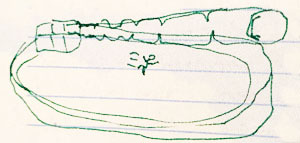
Astral matter emitter 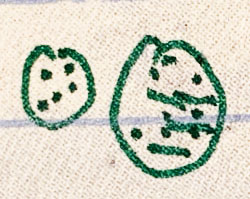
Circle symbol writing Now a device in the corner of the field began to shoot out this raw unformed astral matter across and over the field. Smaller balls of it all connected and joined into this big, floating ball. There were all these circle symbols on it that I was reading. My defeated friends and I decided to keep playing and reverse our loss. We made a bunch of hot-air balloons out of the big thought-form ball, and flew up into the baskets. Swirling around us were lanterns, and the mad hatter, and everything seemed to be alive like in musicals. We sailed past a big statue and some fruit and vegetable stands. Lots of people ended up in the balloons, including many old friends. The cloud of balloons, lanterns, and spontaneous creative forms began encircling the top of the hill and tower, then going up one side. It was not scary from this perspective.

The real thing was much cooler From twelve days later, “The Insanity Creature of the Tower”: The “games” the other night. It wasn’t against Drax, it was against the insanity creature! It recreates reality. One must be stronger than it. It is all selfish desires, weakness, and needs. That’s what the game was — to exert your reality, your fearlessness and good interpretation on every horrible thing it could throw at you.
Astral Games: Incredible! With thought-forms as a foundational reality in these dream civilizations, doesn’t it make sense that games could be devised using them? And what better than this very game! It was all so beyond anything I would think up. In short, the stadium was able to shoot out pure unformed thought-form matter into the center of the field, and we were able to coalesce it into forms with our thoughts.
This is the same stadium as in “Most Beautiful Rain Fairies”.
-
Forge Ball 1992 • age 17
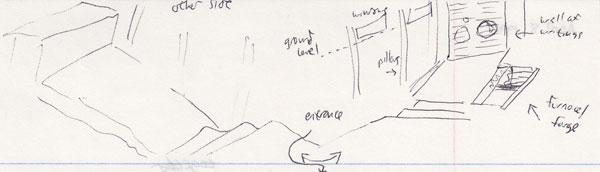
The brigand’s bunker and forge I’m a young warrior undercover with some older thieves and brigands. We enter a cavernous hall slightly underground in the forest. There is a hot furnace off to the right, and a wall of strange writings straight ahead. Some of them are kicking and bouncing these rough bubbly thick foam balls at the wall. They’re very light, like a cross between bubbles and beach-balls. Each time one hits the wall, it leaves an inexplicable, strange-looking white circle or symbols, then bounces back smaller. Soon they run out, so one guy goes into the forge and collects some bubbling metal in a blow pipe. He emerges, holds the pipe to his lips, and blows. A glowing hot bubble clump starts to emerge from the far end of the pipe.
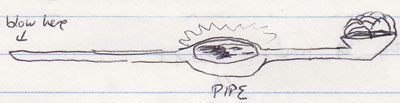
The pipe used to inflate astral matter The brigand I’ve been following takes me to the other side of the building, and does something else. Just then, I see the new extremely hot purple bubble bouncing into the room. It hits the ceiling, then comes at me and hits my face. I let out a yell, and someone runs over and tears it away, along with my two golden armor head pieces. I am unharmed. I take my armor back.
Astral Matter Forge: This is so cool — the brigands’ forge has poured energy into and melted down the astral matter. Any strong source of heat or light can work for this purpose. So here they have developed a game with it.
Social Activities in the Astral
Amateur Performances, Talent Shows, and Competitions
-
The Pirates 1997 • age 22
I was in the audience for this big play where the audience was supposed to sing along. We were going to, but the screen with the words turned off. So Buttercup started making it up and I joined in. During a pause we were asking people if it was okay what we were doing. They said it was. Before long I was in the play, playing a wandering pirate. I got some fish, dropped one, and began shouting and singing about it in this pirate-y Scottish accent. Then this other pirate and I dropped rubber snakes on the pirate captain and first mate below.
Later on, I was talking to someone in a room like my single in South Hall. He asked if he could film the next episode of his show in my room. I said yeah. There was some singing, and I was telling him about a dream I had earlier about the ocean.
Audience Participation: These amateur performances usually are open to audience participation. It’s a collective thing. If someone is moved to sing or join in, that’s usually just fine.
-
The New Musical 2025
I was watching a rehearsal / performance of a new musical. The name was well known in the dream, but I don’t recall it. The main character was named Hanibel. It had this 90s alternative vibe to it. As I watched, I sporadically sang along with Hanibel, an effusive stylish character that reminds me of the character singing the title song in Hazbin Hotel. The set was colorful but murky, as if undersea, with lots of blues and greens as a main theme. It felt somewhat piratey. After the initial scene and song, the story followed along a strange train on a track much of the time. All the characters got on and sang as we traveled. We arrived somewhere where there was a female lead character, again very 90s. The songs were excellent, the art direction was excellent, and singing along with Hanibel was so fun. I felt honored, like I was chosen to shadow that part.
After it was over, there was another rehearsal / performance where the original Hanibel stepped away and I did it on my own. I was rather nervous, at times knowing just what to do and at others making it up or getting tips from people. Though the idea of actually performing in front of an audience terrified me, I was just there for enjoyment. I told some other performers how excellent I thought the musical was.
References: Hazbin Hotel is an animated series.
Being in Musicals: I really enjoy good musicals. If it weren’t for my stage fright and poor memory, I’d probably really enjoy being in one. In the dream state I can!
-
A Reading of Foundations 2025
I was on a balcony overlooking a stage. Someone with a beard and a robe was on the stage below reading Foundations to the people seated in front of him and gathered at the balcony where I was. The book was in the form of two stacks of pages sitting on the ground, like an open, unbound book. I thought to myself how there were some somewhat embarrassing parts coming up in the dreams section. I felt I was just stopping by, checking in on my way between other dreams.
-
Welcome, Earthlinks! 1997 • age 23
I was put in a group of three to do a project of some sort. We were supposed to be acting like ET. One person from each group would get up and do a little monologue in front of a camera. One group was badass ET, beating up this guy who didn’t feel hurt by the blows. . . . I crossed my eyes, bit my lip, and smiled in a funny way. I said, “This is Exphlon broadcasting on channel 8. This channel is silence. . . . This channel is also silence. . . . ” But they weren’t recording. Then this other guy from my group wanted to perform, too. I was pleased. He was tall, with black hair. We exited and entered again. “Welcome Earthlinks!” I said, then focused in, uncrossed my eyes, and peered through the window blankly. Everyone was laughing. My group-mate spoke, then I did and it was all spontaneous and very funny. I ended with this “You are copying everything from us, earthlinks! You have pants, a shirt, Slorboz at every corner, and lights in the sky. But one thing you have forgotten! When we realized there was life on other planets, we made big free love structures to celebrate. If you want to come, dial 669-4plex73.” Then we walked away.
Tomfoolery: What do we do in dreams? The same things we’d do in waking life. Here I’m at a fun social gathering, with people putting on funny skits.
-
Rubber Dolphins 2000 • age 25
I’m a really fun special event or celebration with a great teacher. There are students from Spring Lake Park there, and I’m making jokes about Lindsey hitting on me to Brandon. . . . Buttercup and I soon arrive at the try-outs. The kind teacher seems to be running the show. We see two “dolphins” on the stage having this dialogue. Then one tears out of the costume and hijinks ensue. Buttercup and I have these red lobster-antenna crowns for our heads. We’re told there’s two lobster parts, and we have to compete. I go first and play at having trouble getting up on the stage, then do something that makes the audience laugh. Then it’s Buttercup’s turn. She puts on a black and white building costume and starts singing the Gilligan’s Island theme while horizontally sliding to the edge of the stage. Not too funny, I think, but then she (as a building) is moving down a city street of similar buildings and it starts shifting, changing to many buildings moving down many streets in a beautiful, incredible display. I’m awed. The judges declare it a tie and ask us to go again. I do some okay funny stuff, then sit down in the audience and wish this random guy a happy birthday. His name is Brandon. I make some cracks and eventually have him kiss not his date but the guy sitting next to him and he does — on the mouth! The crowd loves it and calls it the “Brandon Routine”. Then Buttercup goes and it starts out so-so then gets pretty funny but we’re running into the next time slot and these musicians in black are already setting up on the stage next to her.
Afterwards I sit with the musicians and idly play the drums with my hands while talking with a friend.
References: Lindsey and Brandon were friends in high school, which was Spring Lake Park HS.
Performing: Here we are in a higher realm with a teacher who is helping us prepare for this lighthearted comedy competition. It’s a celebration, and we’re doing amateur performances to amuse ourselves. It’s very normal in a lot of ways — how people would naturally act if they were freed of inhibitions and just . . . happy. The astral world is an emotional filter of sorts. People in a similar state of mind gather to similar places, which makes gatherings like this such a success.
-
Jay, Master of Thought Forms 2010
I’m in the audience in an auditorium, watching amateur comedy acts. It’s in a high school gymnasium, and nobody is very good. Then the last guy gets up. It’s an Indian American named Jay (or Jaya), wearing a red and black plaid shirt, sort of portly, and maybe 20 years old. He does a couple jokes, then he walks off the stage — but he is still standing there. Then multiple versions of him walk off the stage and into the audience and he’s still there. The crowd is perking up and I’m really astonished, looking around at all the Jays settling into the audience. Then a bunch of them surge back onto the stage for another joke or statement, and then scatter off and then surge back through the audience in different patterns and then disappear into the crowd. I’m just astonished and wondering how he’s done it.
Last Comic Standing?: My interest in Last Comic Standing (a comedy competition) in the waking world attracted me to a bunch of like-minded people who are interested in trying it out on their own.
Spontaneous Channeled Group Songs and Performances
This is my favorite thing in dreams. My absolute favorite.
-
The Rising Song 2009
An awesome dream. I’m in a crowd in front of an outdoor theater watching something like Last Comic Standing. One particular comic comes out, saying nothing, but moves about like a dancer on this arm of a platform projecting onto the stage. Suddenly single people scattered about from the audience burst out, yelling a syllable or tone. And then it coalesces into a song — a moving, heartfelt, dynamic song that flows up through everyone. It’s beautiful, moving, ever-changing. And then there is silence and a single woman’s voice rises out of the crowd behind me, singing a new part of the song, and when she finishes, the song rises through the crowd again. After it finishes, the crowd moves to a larger area outdoors and swells in size. I remain near the original stage because Buttercup will soon be back.
After a while, though, I begin to think she’ll look for me in the main bulk of the crowd in the new area, so I begin walking around obstacles and fences to get there. As I walk, I start to feel like singing. A song rises up through me, and I burst into song — a new song, but still dynamic and powerful. My voice is strong, bluesy, and going beyond what I’ve done before. The song comes through me, and others join in, moving into new parts, having never heard them before. This current of people walking to join the main body grows, all singing this song, and my voice the lead voice, or at least I am unaware of others letting that part of the song through. From time to time a song ends and we walk along, talking to each other, and then I’ll feel the urge to sing again and let a new verse come calling out of me. In this way we made our way to the center of the new area. I wanted to sing a song about how we’ve arrived, and one came rising out of me — out of us all. It was all so beautiful.
Beautiful: This dream has stuck with me as one of the most beautiful experiences of my life. So many times my mind has returned to this. How I wish something like this was possible in waking life. Flash mobs are the nearest thing we have to it, but they require rehearsal and practice. To just let go and let the Rising Song come through you and everybody around you is truly a beautiful thing that I wish everyone could experience. No wonder I love musicals — they are essentially this experience, except in the physical you only get to watch.
-
Breaking Free 1997 • age 22
I’m part of this big class group playing soccer in a gymnasium. The floor eventually changes to water, and everyone is on rafts. Masa is playing goalie naked. She swims over to our side, while the immature ones were all laughing and gawking. Four of us, including Joy and someone like Leslie B start singing this song of breaking the mold, of stepping out of the system. A bunch more join in. I’m not afraid of being naked anymore. We sing and decide to start living a little more, a better life. The other half of the group won’t join in and leaves without us. The ones left are all more friendly. The dream frees up and energy rises.
Breaking Free: It looks like this song was inspired by the immature reactions to nudity. A much better response than getting angry or feeling embarrassed.
-
My New Favorite Movie 2023 • 3:30 AM
It began with a walk. A friend and I were taking a walk through a neighborhood. It was dimly lit out. We were near the area where we were going to pick up our new dog — a big shaggy brown dog that was known to be really mouthy and licky, not something I actually wanted. As we walked along, I saw what I thought was a weasel jumping around across the street and a few houses away. I pointed it out to my friend. I started singing something like, “Heeey weasel, jumping jumping weasel, why don’t you come to me. . . . ” I sang a few verses, creative and silly, just singing freely what came to me. Then it began running towards us. As it got closer, I realized it was a scary-looking black, white, and brown dog that I had mistaken for a weasel. It circled around us, then began to follow us.
After walking another block, an angry man came up to us from behind. It was the dog’s owner. I turned around and explained to him that I thought it was a weasel, what with my eyesight not being as good as it was, and it jumped the fence and ran out to us. He understood. I think I had begun to sing some of it, and he joined in? At any rate, he was the first to join us.
Then we saw a party going on in one of the houses, and I felt intimidated by it — maybe because it was a poorer part of town. There were lots of people I didn’t know, people of many different cultures in there. Someone came out and said, “What? You’re not going to come in to the party?” I said I wasn’t invited, and he gestured an overly obvious invitation. So we went in, even though I didn’t know anybody there (in waking life I would be too intimidated to do this).
Now this begins of a long series of events where I face and head into uncomfortable situations; usually entering a stranger’s house, experiencing something or another with them, then relaxing, having fun, and at some point breaking into song where my friends harmonize with me and it sounds great. The people from the house join in, and at the end one or two of them joins us when we leave. Each time the group gets bigger and the next original song gets more complex, with more parts in it.
The songs were amazing — instant harmonies, like everyone knew it even though we’d never heard it before, just expressing our thoughts in words musically, and watching them weave into songs.
I’m trying to remember each encounter. . . . Each new situation was more uncomfortable than the previous. One was a family dinner with an African American family where a very scary-feeling new boyfriend had joined them. Everyone was tense around him, and he felt really dangerous to me. But I began a song to greet each person and him as well, and he definitely noticed that, and responded in a challenging way (it seemed the only way he knew how to be). But the song continued and changed, and I noticed it wasn’t always me to initiate a new part of the song now — I had enough people who had joined me that some of them initiated melodies, which I went along with. There was always a bit of spontaneous fun that preceded or was part of the beginning of the song. Afterwards, it was the scary guy who joined us. I had my reservations but didn’t stop him.
One later on was going into the house of an Indian family. All of these encounters were large groups of people, like get-togethers with lots of family or friends.
The people that joined me — each was strange in their own way, and had a story or power of some sort. Some were originally scary or intimidating characters. For example, near the end, one guy had this metal brace around his neck and his arms. He said that some information (the story itself?) was all coiled up and stored inside of him. He showed us an illustration of the bands coming off and seams appearing, which uncoiled, revealing how it was stored in him.
Then I was coming home alone with Buttercup. . . . [I casually set off a big explosion]
Wondering now if the “movie” was over, I headed back out into the neighborhood. Walking along, I came to this prison-like area surrounded by a chain link fence with guards. I think I was still with my friend from the beginning. We spoke to the guards, and four of the original group were let out. They were mad at me. For leaving them for the scene with the explosion? It felt as if some time had passed. I felt like this story deserved a better ending, so this part was now happening. We resolved the anger and went on to find more of the group from before.
We ended up climbing the walls of a fortified slum area to find one of our singing group firing huge boulders out of himself at us. They bounced off the wall we were climbing, back into the big truck he was in, then back and forth before rolling away. So they had each become hostile to me over time, and we were going out to fix it, and it was to end in a grand way.
I don’t recall the specifics, but it did come to that grand conclusion nearby, upon a set of bleachers. And as it did, I felt so moved and connected that I declared that this was my new favorite movie.
The Disarming Song: My favorite kind of dream! This one had a twist, in that I had to face and relax into an uncomfortable social situation before the song could continue. Each time I did, more people joined me.
-
The Nun in the Wall 1997 • age 22
There were about 10-12 priestesses dressed the same up front. One was speaking about the horrors of all that had happened earlier and needed to turn on soothing music. Then a group of 3 and a group of 5 started talking in absolute unison, eyes half-closed, speaking in foreign tongues and moving in between themselves as if dancing, but so oddly! This inspired some joy and forgiveness in my heart.
Channeling Weirdness: This was really neat, a real dream phenomenon. It’s like the chorus from a Greek tragedy.
Sharing Popular Rotes
Just as in the physical, we share the best or funniest story rotes with each other, and they spread across the dream world in this way.
-
The Naked Touchdown 2024
I’m watching this rote of an American Football play. [It’s about the naked touchdown]
This is hilarious. I have to tell Buttercup. I exit the rote and go to her. She’s by a small swing set in a forested area with roads. I tell her (in words) about the naked touchdown. As I do, I see the scenes again in my mind. A guy walks by who reminds me of a park ranger. He overhears and starts talking about the scene, too, saying his sister told him about it.
You Have to See This: This rote is so popular in the dream world at this time that someone walking by recognizes it.
-
Security 2007
This dream lasts hours, and is like a full-length movie in scope. I’m a student in high school and America is freaking out about some stupid incident that scared it, much like in waking life with the Cartoon Network ads in Boston (where everyone thought the ads were bombs). I get pissed at all the overreactions, so I vaguely disguise myself and take pictures of myself with a pumpkin. I print them out with “this is not a bomb” written on top and put them up around the school. The school begins to freak out. I get scared and try to hide my tracks but they’re not on to me. It becomes like martial law, and eventually I try to escape this new prison-like school and succeed.
Then, my character becomes kind of like Jim Carey playing Dr. Evil — I become secretly the head of a fake security company and bleed the school dry of money setting up ridiculous security (much of it fake). I’m dressed in a bright blue shirt, bald, with a reddish tinge to my head, acting the part of the fanatic, totally trusted by the principal, causing ever more fear in him, getting ever more money and power. I’m planning the final show, just before I awake — to pretend to have caught me, to stir up such hatred as to have the administration call for blood, then to unmask the entire situation. I decide to wake up and write it down. It’s America’s story right now.
Recent Events: Taking and printing photos, dealing with money, the long span of time — these indicate that this was a rote of a physically-based story. It’s likely this rote was being passed around in the dream world because of the similar recent events in the physical world.
Festivals and Gatherings
-
Rave On 1997 • age 23
My cross-country journey continues in this dream, in which I stop in a big forest for an outdoor rave. I’ve been doing a lot of this recently. . . . The trees are very tall and the plants have huge leaves. There’s tall grass and lush vegetation everywhere. . . . I’m so excited to be here!
I head to the bathroom, and meet someone. The talk flows free, smooth, and friendly. I’m making friends by the dozen. One guy keeps saying something I don’t understand, something about GRANT and I think back to my recent Minnesota to California trip and say, “I think I went to that one!” He says “Yeah, it’s on the way!” We decide to camp together. There’s some confusion now if he was the one I was traveling with before or not. So then I meet another guy who turns out to be an old friend. We talk a lot and I invite him to stay with us, too, but he is uncertain. We’re in a house now. Then some crazy girl I recognized came downstairs and told me to invite Brit B. and I said it’d take her two days to get from Minnesota to here (Colorado?). I remembered that Brit had been to a rave recently and got very drunk and passed out.
Raves: There are lots of gatherings of dreamers for various reasons. Raves were a big thing at this time. I went to a few in waking life and several in dreams.
-
The Buzzing Campus Eclipse 1999 • 8 AM • age 25
I’m outside on the lawn of what I’m now calling “Purdue University” (from a dream conversation I had with River). I’m hanging out with all these hippies, punks, and generally very unique and interesting people. I was staring at this guy who looked like Rand, and who had my electric blue guitar. I introduced myself and he said his name was Pirate Something Jack.
Later this girl and I are sitting on the ground and I’m leaning back against her legs. Her mother runs up all happy. She wants me to like her daughter. It was sunny daylight, and then the color of the sky got darker and someone shouted “eclipse!” Everyone got up and got into a position to see it. I ran around the building. Gravity diminished as a moon flew across the sky, barely crossing the sun’s path. Everything turned a dark orange color and then there were bees everywhere.
Gathering at Purdue: It’s unclear if this is a regular gathering at Purdue University or if it’s centered around the eclipse.
-
The Island of Fire 2000
We’re back at the forested slope. This time we’re descending with a huge group of Renaissance Festival people into a clearing in a thick forest. Everyone’s dressed up and speaking in accents. I just sort of don my costume by thought as we enter the scene. I choose to be a funny guy and I’m cracking all sorts of jokes. A friend becomes this warrior wearing a helm with detachable bull horns.
Renaissance Festival: I’m hanging out with some friends, having fun, and we decide to head out to join up with this Renaissance Festival group. People enjoy their dreamtime as they would in the waking world.
-
The Mountain Valley Gathering 2003
There was a recurring gathering and celebration in this wide flat mountain valley. There were tons of people there. Buttercup and I had gone together. There were smaller groups that met together to talk, joke, play, and get to know each other. Buttercup was in a different group than I.
At the climax of each festival, a dragon appeared, flying and breathing fire. We were anticipating it. Its name was like “Issaerc”. This was my third gathering. I felt I had defeated it the last two times. In the dream I vividly remembered it, but now I can only remember that I was able to fly and used this concoction I made to disable it.
I was going to this little grocery store with all these new friends from my group when I realized the dragon was coming and would soon be here. It was as if I were reading this from a book in my mind. I saw the pages, read “And the dragon Issaerc rose again from the swamps and set fire to the trees, and the land was caught in a blaze.”
Social Dreaming: Here we have dreamers gathering together to hang out, talk, get to know each other, and make new friends. Too bad waking life isn’t more like this. But dreams give us an opportunity to do what we wish we could when we’re awake.
-
Deadwood Blues 2010
After watching Deadwood, I dream this:
I’m walking around a small Deadwood-like town with lots of interesting fellahs. Most of them have interesting facial hair — long moustaches, goatees, sideburns, and they all sort of fit the Deadwood style but in a modern kind of way. It has a college kind of feel, too. I’d wager they’re dreamers in costume (as was I) and interested in the genre.
Deadwood Gathering: When a show or movie is big in the minds of people, it’s not uncommon to find a community of fans living out that style in the dream world.
-
College Celebration 2022 • 7-8 AM
I’m at a college that I often go to in my dreams. It’s mixed in with Oberlin. It’s dim, early-morning light. There’s a celebratory atmosphere, and I’m interested in this girl. Brendan is there, and he’s trying to get directions from her — he brings it up a few times. There’s this concert, like an open-mike night but larger scale, and the girl is part of it. When her turn comes up, there are these cars parked in front of the performance area, which is on the green between some buildings. It begins with the cars lighting up in different colors and making sounds. Then the music starts.
-
Two Dogs 2024
Buttercup and I had decided to get two dogs — a Emma and her puppy. They were light brown, medium-sized dogs with long hair. We went to this crazy place to make the final arrangements. It was a couple’s house, but it was also the king of roadside attractions, as you’ll see. When we first arrived, it was just us and the lady. . . . [We pick up the dogs and I explore around outside]
Things got crazier. More and more people were showing up. I returned to the house. There was a huge line of people filing in past the front desk between the downstairs room and the barn workshop. I did some exploring and ended up in an underground area beneath the house. To the right was an Egyptian-themed club, sparkling with rich splendor, and filled with topless black women in Egyptian costumes. I went along a hall where other such themed areas were. The rush of people was getting intense and I decided it was time to head back while I still could.
A Flood of Folks: This is interesting as it starts as just my family visiting a country lady and her husband, but then crowds start flooding in because it’s also a huge roadside attraction. It reminds me of “The Treehouse OBE” in which, as morning approaches, workers begin arriving at our house. I feel like there are different flows of people and energy as morning approaches. These flows probably change throughout the whole day.
Some time later I’ve “woken up” in a place in America. It is a sort of “dreamers’ convention” — gathering of vivid dreamers. At one point I’m sitting on a bed. Have two toothbrushes. Wonder if this is a dream. Easily pass them through one another and realize that it is.
(Subject N.C.) (Green and McCreery 20)LDPLDer • modern • Green & McCreery
See also “Learning” in nature-of-dreams.php.
Astral Theaters
-
Uncle John’s Puffball Mushroom Farm 2023 • 7 AM
Buttercup and the family are at a huge mall, in a movie theater watching a movie. It was the mushroom farm movie! I remember pulling out of the movie a few times to adjust some of my belongings nearby or say something to Buttercup, who was sitting next to me. . . . I kept coming out of the movie rote for various reasons and returning to find things progressed!
-
My Other Kids 2025
The building had an event space with seating. It was showing a movie . . . or maybe a band was playing? Either way, we all went to see it. I changed seats from time to time. At one point, late in the dream, I was sitting by Hazel and it finally occurred to me to ask her how life was. At another point, I was sitting alone, and found Wadsworth sitting stiffly next to me. He never looked at me, but said something about how he was here for the football game or something. This clearly wasn’t it.
In the Seats: When I go to an astral theater, pat of the time is spent watching the rote of the movie showing, and the other is socializing with other people in the seats around me. I wander about the theater sometimes, get into the movie for a while, then focus back out again.
It’s rather similar to hanging out with people in a living room in the near realm, though in those cases we go off into individual dreams instead of having one shared rote in front of us that we can enter into and exit at will.
Going on Journeys Together
Practically every night I go on a journey somewhere, often with Buttercup.
-
The Worst Way to Get to Narnia 2017
Myself and another person who had been to Narnia before were preparing to go back. We’d gathered about 10 friends in what felt like someone’s room on a college campus. The two of us were explaining how we were going to get there.
A Dream Gathering: A group of dreamers getting together to find Narnia has a pretty good chance of success.
Gathering News
This is rarely the reason for socializing in dreams these days, since news is ever-present and immediate. But sometimes, when communication breaks down or there is an important event occurring overnight, we can learn things through dreams.
-
Keeping Tabs on the Election 2024
Context: This is the night after the 2024 presidential election, when results were slowly trickling in.
I remember in the early hours of the morning, 3-4 AM, that I was socially dreaming, hanging out with several other people in a living room, sitting on couches. The atmosphere was dim morning light. The people were just clearly outlined spaces of shadow. They had checked out, one by one — gone to sleep within the astral or woken up in the physical. At one point, just one couple was left, and I got the strong impression that Trump had won the election. I accepted it as true, and went on dreaming. Hours later, when I woke, I wasn’t surprised to hear he’d won, even though I’d expected Harris to have won when I went to sleep.
Keeping Up With Events: Social dreaming was my way to keep up with events while asleep.
Social Movements
-
Free the Children 1997 • age 23
There was something going on that was giving freedom and rights to women, and it was a long-term thing and very successful. So I decided to start a rally for the children, to release them from the great bias and control, to free the children and the young! I started yelling out to everyone to gather and rally the children. All these children started following me in this huge march.
Continuous Dream Narrative: I was aware of great social movements going on in the astral — one to empower women, and so I started one to freeing the children. I truly believe that there are great movements astride on the astral, things that affect history through the mass dreams of individuals. I have been to several organizations and gatherings in the astral which reflect and foretell present-day issues.
Who We Dream With
Roommates, Housemates, Bedmates
The people sleeping near you are best positioned to appear in and influence your dreams.
-
Uncle John’s Puffball Mushroom Farm 2023 • 7 AM
There was [a mushroom] that was shaped vaguely like an angular weasel face, mostly a light orange color. When I brought my hand close to it, it seemed to move a little in response. Buttercup and Bodhi and Gwen came near, maybe some others, and I told them to hold their hands out to it, and it reacted similarly. I decided to take a video of it and Bodhi got behind it and jumped around. . . . I remember pulling out of the movie a few times to adjust some of my belongings nearby or say something to Buttercup, who was sitting next to me . . . [we exit the movie back to the mall where I get separated from Buttercup]
I wander into a cafe and walk up to a large table where some women are. One looks like the actress Kaley Cuoco. I hear her say to me “I like you so much.” I wasn’t looking at her at the time, so I look up at her and meet her eyes and say “hmm?” but she is embarrassed and says “Oh! Nothing. . . . ” I see/feel the clear, transparent-ish shapes of Buttercup and the kids across the table as they enter the context and I’m reminded that I’m already with someone.
References: Kaley Cuoco is an actress.
Ever-Present: Buttercup is often with me in my dreams. Sometimes as an actual embodied character but more often as a nearby presence. Every time in the night when she or I shifts in bed, she’s brought back into mind.
In this dream, she’s embodied most of the time. While I’m engaged in the movie rote, she is sitting next to me. She appears with the kids in the movie. We leave the movie together and shop, and then I go on my own through the mall (Buttercup is awake at this point). She’s not there until a the cafe scene, where she and the kids appear transparently, more an idea than embodied people in the dream.
-
The Sliding House 2023
We’re in a house in a neighborhood. I think it was meant to be Buttercup’s parents’ house. It was raining, and I knew the house was about to come loose from its foundation and start sliding. It did so, and I told everyone to hang on . . . [the house slides a long way, falling apart as it goes, then stops]
The “we” was uncertain here. I felt that there were other people in the house, that it was Buttercup and the kids, felt but not seen. Maybe simply because they’re in the physical house where I’m sleeping?
The ‘We’ of Dreams: This might be one of the reasons why I feel a part of a group, a “we”, when dreaming. This dream was specifically about a house, and I felt that others were in the house, which reflects the waking reality of my family sleeping nearby.
I think we regularly hang out with other dreamers in our own homes.
Running with Groups for Periods of Time
Part of the continuity in dreams is socializing with the same group of people for a few weeks or months. Often these are people we’ve met in dreams.
-
White or Rose? 1998 • age 23
I got really angry and jumped up onto the counter screaming what a very rude person she was being and everyone around was slightly shocked by my outburst of rage. As I was turning to walk out, this young, immature-looking kid from my dream-side youth group turns to me and says to a friend, “Look! He did it again!” As if my behavior was often like this and had really been getting to him.
My Dream-Side Youth Group: I refer to “my dream-side youth group” here, which I can’t currently recall anything about. But it’s clear that there’s a group I’m a part of in the dream world.
-
The Island of Fire 2000
I’m upstairs in a house with Deaner, who’s showing me pictures in his photo album. I spend some time on a Tahiti-like island, which was probably a rote or subdream based on a photo, and return to find Deaner (who looks different) waiting for me. I am trying hard to be entertaining and only sometimes succeeding, but there is friendly chemistry. Their place is out in the country, an old bachelor-type place filled with junk. They describe their house as “apartments” and their friends are always around. [we hang out]
They disappear upstairs and I’m left alone. . . . I call them on a white downstairs phone and talk to them but spill white wax all over my shoes. Then Deaner comes down and we laugh. Soon the boys and I leave, driving along the foresty road.
References: Deaner is from the band Ween.
Dream Friends: For several months in 2000, I had dreams of hanging out with Deaner and Gener of the band Ween. These were fun, social, personable dreams. It’s possible they were about the actual people, but more likely it was two people who reminded me of them, who I took to be them.
-
Body Transformations 2003
I’m in a neighborhood with some friends in the near realm. It’s dim, early-morning light. It feels high in elevation. I’ve been spending time here recently, running around with friends. The mountains are light brown with few trees, like the Sierra Nevadas, but the neighborhoods are green with trees.
My Newest Friends: I remember hanging out with these people in dreams regularly over a period of a few months. In dreams, we are nomads. Without the need for a home in the astral, we join up with groups for a while, make friends, and then move on to other adventures, meeting new (or old) friends and following whatever attracts our interest.
-
Me and Taylor 2024
A few more people appear outside the door, to my right. The cook mentions them and I turn my head and see Taylor Swift sitting next to me. I refer to her as “a girl who looks like Taylor Swift” but I’m sure it’s actually her.
Taylor Swift Again: It was just two months earlier that I remembered hanging out with Taylor Swift (or someone I took to be her) in the dream state. And now she shows up here when I’m socializing.
Friends Known Only in the Dream World
After spending so much time socializing in the dream world, I’ve made a lot of friends. Rarely do I recall their names. Here are a few examples:
-
Instant Band 1998 • age 24
I’m hanging out with three guys who I don’t know in waking life but are friends dreamside. I started this music thing — it came almost fully formed into my head with a fantastic beat. I somehow broadcasted the song as a whole outside myself. With my attention I added new lines and rhythms to it. The music was so good I would have bought the album in a minute.
The four of us danced and skipped around this simple house with open windows and doors . . . [we have a run-in with a cop car]
My friends and I went back inside. I suggested getting a band together but I ran into many excuses — they were busy writing papers that were due soon and other such reasons.
Dream Friends: These guys were likely students, talking about papers being due.
-
Fiona’s Shop 2024 • 6 AM
I’m back in a hallway bedroom. Some of my old college friends begin to arrive, though they’re not familiar to my waking self. One reminds me of Sid. I give each a huge bear hug.
-
Heading Home 2025 • 8 AM
I walked down the hall and into another large room, this one filled with elementary school kids being taught by a teacher. As I walked through, I looked out over them, wondering if I’d recognize one. After a couple seconds I saw one I took to be Owen (who I know in waking life, though he was much younger in the dream) and I waved at him. Then I saw Huang, who I knew only from the dream side, who gave me a “hey” gesture.
-
Looking for the Ball 2025
There was an open door at the bottom of the stairs and it opened out into the parking lot of a huge soccer complex. . . . Along the way I saw a team among the cars walking to the fields. Someone called my name and waved and I waved back. It was someone I’d recently met in a group in another dream.
A Familiar Unfamiliar Face: I think this was a guy I’d played soccer with in another dream.
-
Neon Chakra Flowers 1997 • Middle of the night • age 23
All our best friends were over to help us move. Juno was there, and upstairs was Sticky (who I don’t actually know in waking life). . . . Our roommates were this girl who looked like Liza Minnelli laying face down on the couch with a silver sequin skirt, and this friendly black guy. Juno was glad to see me again. There was this girl named Sticky across the room, in the same dark w/neon glow kind of scenery and I danced around a table and proclaimed my love to her: “You, I’ll always love best, Sticky.” She was a super raver-girl with metallic makeup and a shiny silver shirt. Some parts of her shirt were glowing. She was laying on her back, head to me, legs bent, grabbing her ankles and rocking playfully. She looked somewhat like the female singer from Dee-Lite. She didn’t seem very present.
References: Dee-Lite is a band. Liza Minnelli is an actress.
Dream Friends: Sticky is a dream friend that I’m quite fond of, but who I don’t know in real life. It seems we’ve known each other a while at this point.
-
Fantastic Solstice 1997 • age 23
I was in this bookstore cafe eating with some friends, but I didn’t recognize them. The walls were filled with books and I picked up and read one called “Solstice”, thinking that 1) someone took my name, and 2) that it was The Lord of the Rings (LotR). In fact it had nothing in common at all with LotR, though I didn’t realize it at the time. I read a little at a time, and wanted to read more so badly that I started interrupting later parts of the dream to return to it. I read a little at the table, then played some Weezer songs on a 12-string guitar which belonged to this very friendly Arabic/Indian guy. He was about to leave and waited patiently for his guitar. Then he said (probably later) that the Solstice book was his and that I could have it or borrow it for a while if I wanted. He was definitely going to be a good friend. . . . [We enter into the story and have adventures]
Ranier and I took Buttercup to a muddy place to prepare for the next chapter of Solstice where there was a huge endless bug storm (neuron activity again). We got into the mud and it was up to our knees. A cat was nearby. There were floating islands of matted plants and trees, foaming steam pools, and then flying stinging red ants. Two attacked me. Just beyond was a bunch of people, including my new Arabic/Indian friend.
References: Solstice was the name of a BBS I once had.
A New Dream Friend: A casual time hanging out with some dream friends in a cafe leads to this adventure within Solstice and the new friend.
-
Bedroom Soccer 2023 • 7:30 AM
I cross the street to this place that feels like a restaurant or cafe, but there’s no food. It’s more like a gathering place. It’s a small building made out of stone-and-mortar. There was an inside area but the other half had no roof, and there were stairs to an upper area. I went in and sat down at a long table in the enclosed area. I was here for a while, and I felt like I knew a bunch of the people there. I talked with various people. At one point I asked myself, “Am I lucid? Do I know this is a dream? Of course!” Then this girl showed up and sat down across from me. I recognized her in the dream and said an excited “hello!” We talked, then I decided I wanted to fly. I invited her outside.
Dream Friends: It’s good to know I have all these dream friends. This girl reminded me of a cross between someone from my Y.O.U youth group and the dancer Comfort. But she was neither. Had I been projecting more, she could have appeared as either of those people.
-
Telekinesis 1993 • age 19
In the dream I achieve telekinesis after long hours of practice in my mind. I’m staying at this place with a friend who can do it. So I really push myself and finally I move the candle across the bathroom. It was all so real. After a while, we drive into a small town with only a few buildings. I’m spontaneous and fun and my friends are too. We talk about the new blue truck in town, and the berries it holds. We climb onto the general store, jump from the roof, and each land in the dirt parking lot with an individual flair. We get in our big white truck. The scene is incredibly familiar.
Social Dreaming: Here I’m spending time with some dream friends. We’re laughing, conversing easily, and testing our abilities to control the dream. This sort of social, playful dream is one of the best.
Adversaries in the Dream World
Luckily this list is a lot shorter. Only one comes to mind, and I don’t know any of the backstory.
-
Consciousness Research Foundation 1997 • age 22
I’m walking by myself through slushy streets and I block this car as I cross the street. It follows me up onto the grass and sidewalk and I think “Shit, it’s those Consciousness Research Foundation people.” I turn and see that it’s actually Lisa! I have a good laugh. I say hey and explain to her what I thought was going on. We walk and talk. It was a very good, very natural conversation.
Consciousness Research Foundation: Where did that come from? Years later, in 2010, I looked it up online and it’s a real organization that was founded in 1997!
Apparently I ran into these people before and it wasn’t a good experience.
Different Dream and Waking Relationships
-
The Whirlpool 1997 • age 23
The first person I saw was Breanna (from the southwest Minneapolis Y.O.U.) who looked up at me, reclining, smiling, golden. I said “Thank goodness you survived” and she seemed at that moment like a girlfriend, like a longtime girlfriend from another reality.
Breanna: Certain dreams have suggested that Breanna is a closer friend in my dreams than in waking life. In waking life I hung out with her a few times and liked her, but she lived far away so it didn’t really go anywhere.
Someone Joining Our Dream
We jump into dreams and rotes together frequently from the near realm. Anytime we communicate with someone, we can enter their dream (or vice versa) through the energy bridge. We can even observe their dream without going entirely into it.
-
Picture Day 2023
When I returned to the area where I last saw the team, I saw no sign of them. This began a long search. . . . I was getting really upset and worried, imagining the news reports of the coach who had lost his team.
But then I heard Buttercup’s voice, calling out my name. I followed it back to the Vietnamese area. She was saying she’d found them. I couldn’t locate her, but I did finally find the team! They were on the outside of the corridor of shops, wearing aprons and cleaning while eating some sort of gooey snacks. I assumed the restaurant owner had said they could have some if they’d helped clean the place. I gathered them and told them it was time for pickup.
Near Realm Help: It’s possible, even likely, that Buttercup felt my anxiety and decided to help me out. It’s interesting that I heard her voice without ever seeing her. This means she might have been in the near realm, and came to observe my dream and help me out without entirely entering into it.
Our Effects on Others’ Dreams
Being that we dream socially and interact, it follows clearly that we have effects on other people’s dreams.
-
The Bombing and Revelation 2006 • 6:25 AM
[Mordred blows up Raven’s front door with a bomb]
So I visit Raven, but more lucid. She greets me warmly. Her brother stops by. She talks about burning her hand and being cured by some product made by bees. Then I broach the topic of the bomb. She jumps on me, furious, demanding to know what I know of the bombing. Her eyes are vivid and focused on me.
What Bomb?!: Since Raven was talking about a burn on her hand and bee products, which had nothing to do with my dream, I take her to be an independent dreamer. It’s unclear if the bombing is news to her, but my mentioning of it got her full attention and likely derailed her dream plot.
See also “Shared Experiences” above and “Shared Dreams (Astral)” above.
Convincing Others They’re Dreaming
Rarely does anyone believe me when I tell them we’re dreaming, and never has anyone grasped the full meaning of that.
-
Lucid Dream: Bruce’s Arm and the School Bus 1997 • 10:13 AM • age 23
The kid saw the shrunken bus and was surprised. Then with a huge smile, I put my hands on his shoulders and said “We’re dreaming. This is a dream!” and he had this look like he didn’t believe me and I said “Yeah, everything feels like usual, but we are!” He started walking back to his little house. I followed and inside there was this girl. I said “Look, I’m going to fly.” I lifted up and drifted immediately down into the corner. He wasn’t very impressed and threw himself in the corner and sarcastically said “Ooh, I’m flying, too.” So I got up with a greater will and did the back flip thing and it worked — I was floating there and flying about. Then he was flying, too, but he was unconscious, drifting in the air but mostly motionless. He had this plastery semi-sweet look on his face.
The Other Dreamer: The kid I talked to was a great example of a dreamer who isn’t aware that he is dreaming. At times I am able to reach him and at others he is seemingly absent from his body, possibly focused internally. It’s possible seeing me fly sent him into a subjective dream.
-
Adventures at College 1998 • age 24
Buttercup, Nika, Stan, and I were walking up to a car. I noticed I wasn’t wearing any pants, but I was too embarrassed to say anything. We all got in, and I was in the back on the right. Now that we were in the car, I admitted that I had no pants on. Everyone laughed. “Oh, that Sam.” They made plans to swing by our place so I could get pants. But when I looked down again, I was wearing pants. I said “Hey! Look! I’m wearing pants now! It’s because this is a dream!” Everyone turned around and gaped. One of them said, astonished, “It has to be!”
Unpantsed: The classic no-pants insertion, followed by the unusual “sudden appearance of pants” convinces everyone this is a dream.
My attention must have shifted to the waking world, causing me to feel I had no pants, and then when I stopped thinking about it, I returned back to my normal pantsed form.
-
Brendan’s Gathering and Summoning Pants 1999 • 5:30 AM • age 25
So then, alone and outside the front door, I had another revelation: “Of course! This is a dream!” I ran all over, leaping with energy and excitement. I told everyone, not getting much understanding. I popped into a darkened room with some people and announced it to the people within but they didn’t hear.
Lucidity: They didn’t “understand” or “hear” me. I wonder if that information is being blocked at some level of their consciousness. Or maybe they feel it’s not important?
“I am on a high hill above a lake, searching for Indian artifacts. It seems that I am being told about the culture which existed in the area during primitive times. . . .
“At this point Alta walks by. I ask ‘Do you know that we are dreaming?’ She laughs. So I point out the three stone objects on the ground. In their midst items of silverware begin spontaneously to appear—first a fork, then a cup. I look at her face. She is puzzled, seemingly on the verge of ‘waking up.’ I take the items away and other objects appear. We begin to laugh as the process speeds up. We are inundated with beautiful silver objects. Then I awaken.” (Sparrow 8)
Suddenly I realize that we are dreaming. . . . I look down on the girl and say, “We’re dreaming!” She scoffs at this and refuses to believe me. I tell her that I will prove it to her by temporarily withdrawing from the dream. As I do this, I hear her gasp in surprise, so I return. She is elated when she realizes that she has nothing to fear. (Sparrow 20)LDDCLLDer • modern • Sparrow
Sometimes I will be SLY with the person and not let on that I know I am astral projecting. I will approach the person and interact with them in a matter of fact way, without any indication that I know I am projecting. Whatever is going on, I will just go along with it. Then, out of the blue I will say something to the effect, “Hey, wake up, we are in the dream world; This is all a dream.” Often, in such circumstances, the person looks at me as if I am joking or I am a nut. And then, I will float up about five feet off the ground and say, “Ha! Can you do this in the physical world?”. When I do this, I often elicit a reaction of surprise from the person I am talking to. They no longer think I am joking! . . . However, depending on the circumstances, they will either fall back into their catatonic stupor, or I will bring them into some kind of adventure or another. APCOBEr, LDer • modern • DeGracia
Farces and Misunderstandings
Misunderstandings are commonplace in dreams, what with people often being in different contexts, thinking what’s happening is physical life, or unknown characters appearing as people we know.
Farces are natural occurrences in dreams.
-
Buttercup’s Defense 1997 • Nap, 4:30 PM • age 22
Buttercup was defending herself in a court case in a medieval village. At her request, it was being held on a platform in a marketplace in front of a crowd of hundreds of people. Her family and friends were there, including a whole bunch of jokesters.
There was much excitement when the prosecution arrived. The woman filing the complaint was moved out of a huge vehicle by hordes of doctors, nurses, and people dressed in white. It was absurd!
The defense’s preparations were extensive but their arguments were insane. Buttercup’s only statement in her defense was to simply sit in front of a marker board that had various things written on it, including “I am a walked-upon lizard” and “dirt-covered, they take advantage of me,” intended to invoke pity. I actually let out a laugh in shock and amazement when I saw it, then covered my mouth. Other arguments for the defense included a man in brown, who when questioned on his occupation, said he was “the friendlian,” stressing it loudly so all could hear, and giving a fake smile. There were songs and dances and rude interruptions and shouts of support from Buttercup’s friends. After a while I was so shocked that I leaned over to Buttercup and her Wadsworth and gave them a firm piece of my mind, saying how perhaps they could win an award with this absurd performance, but never the case. I said it was very funny, but a very expensive joke. I remember their shocked expressions and then I was thrown out of the marketplace.
Performance: People may come to a scene with their own individual context, seeing the events from totally different perspectives. The strong reaction I got from Buttercup’s family was likely due to this. Perhaps they were watching a lighthearted comedy routine, while I was seeing it as a court case with serious consequences. My waking self was engaged and reacting with anger, which was inappropriate in their context.
-
The Siamese Hag 1997 • age 22mature content

The edging on their hood and cape Well along came this siamese hag in a black hooded cape with green edging. One hood was stitched closed and the hag head inside was blind and comatose. The other hag head was talking to me but I wasn’t paying attention. Then I suddenly focused all my attention on her, met her eyes, and approached her directly, saying “I WANT SOMETHING FROM YOU.” She stopped suddenly, surprised at my intensity. She was thrilled and fell to the ground. She lifted her cloak and was naked beneath. She squirmed around saying “Take what you will, and my sister too!” I was repulsed and turned away. I projected my communication at her again. “No! I want to know what you see, how you see!” She said “Oh!” and picked herself up. She began to tell me great things, of which I forget.
Good-Time Girl: This is hilarious. I certainly didn’t expect this response from her!
Following Another Dreamer’s Plot
When we’re in a rote, we’re experiencing someone else’s story. Rotes are very common in dreams, both as a part of conversations (telling a story), and in recreation (books, movies, etc). Since the characters are usually replaced by people and places with the same emotional meaning to us, they sometimes don’t seem like someone else’s story, even though they are.
Outside of rotes, we regularly encounter independent dreamers having their own experiences, following their own plot lines, and they sometimes pull us in and change the course of our dream.
-
Submarine Self-Destruction 1990 • age 15
[I’m at a rally, talking, playing around with people]
Someone grabs me and tells me to come quickly for something. I follow him to my car. “You have to fire the missile. They’re crossing the station front!” He hands me a controller. I just nonchalantly hit “fire”. Then I get in the car to see what happens. A visor comes down, a view screen appears, and a pressure equalizer starts to work. I hear “Hold breath” on the intercom. Water rises and closes over the vehicle. I notice the missile path on the view screen and try to steer it into an enemy submarine. It’s too late. It misses and hits a ridge, but the explosion succeeds in knocking the submarine over and damaging some systems. We go to the surface and tell control that that’s all that we can do. We land and hang up our banner. Control tells us to go back down IMMEDIATELY and finish the job. We do.
[There is a big battle. We’re told to self-destruct our submarine while everyone else evacuates]
My Wadsworth is the co-pilot. We land our submarine on theirs and set the self-destruct timer. Then Wadsworth swims to the surface and I take a diving suit up to the surface, which is the floor of our basement.
References: A rally is a youth gathering at Unity Church.
The Stranger’s Will: I’m socially dreaming, when a stranger runs in and starts giving me instructions. Without thinking, I follow them and attack an enemy submarine. After the transition to the submarine I refer to them as “control”, and continue following their commands.
In waking life, I am not one to blindly follow orders. This seems like the behavior of the hypnotic waking self.
-
The. . . . Party? 1997 • age 22
There was a big party. I was with Buttercup and this guy and someone else. We ended up on the roof, watching people. . . .
The toy — a ball with counterweight I met this friendly Asian boy who was discouraged about sex, saying he’d never get laid. I sorta comforted him. He got out this toy: a ball with a long string and a weight — you’d throw the ball then whip the weight behind it in another direction for cool effects. He said he wanted us to play with it. I went down some stairs to get some distance and when I looked back up he was gone. He’d thrown himself over the edge of the roof to die. I ran to the edge and looked down. He’d landed head first on the concrete. His head was bashed in, and there was this white foamy liquid on the concrete all around it. I ran to the party and told someone to call an ambulance. Then I realized the kid was running behind me saying “Touch my head! Feel it!” I refused. He’d survived, and so he did it again and again, and each time it was like the tragedy was new. The next time, his head was a crushed up carton that leaked ice cream. I got more and more distanced from the drama.
Another Dreamer: This boy was another dreamer who became fascinated by his crushed head. His actions totally grabbed my attention and took over the plot of my dream.
-
Cliff Climbing 1997 • age 22
I ended up with a group of hard-core explorers who were teaching me guts. It was snowy and we were going up and down these near-vertical cliffs, leaping and grabbing. I loved the challenge of it. They supported and taught me. I really liked them a lot. There was a moment where we invited Buttercup along, but she couldn’t do it for long or thought it was impossible and went back to her house.
Active/Passive Dreams: Sometimes I am initiating the action in dreams, and in others (less frequently) I am being led by others, following the main action of another dream character like this.
-
Two Dogs 2024
The lady asked if I could do canning. Confused, I said no. Her husband came up the stairs (I jumped into him momentarily as he did so) and he took me into another room, like a barn workshop. Here he gave a demonstration of how to can dog food. He started with a can and then coated it with what looked like nacho cheese, and that was the secret to keeping it sealed. I zoned out as he started the description, knowing I wasn’t actually going to can my own dog food.
Canning Dog Food: Here I get pulled into a man’s canning demonstration. I’m not interested in this.
Joining Someone’s Dream
It’s possible to enter someone else’s subjective dream experience.
-
Cheetahs Love Sandwiches 1997 • age 22
I was hanging out with Buttercup and this guy. We climbed this big oak tree and threw sticks at a small abandoned house. To our amusement, they stuck upright in the roof. Then I got really scared of heights and the guy started screaming that a cheetah was stealing his lunch.
The scene instantly changed to the upper floor of a library. He couldn’t catch the cheetah, who was chewing on and slowly engulfing his sandwich. Knowing that I understood cats, I set off to catch him.
OMG Cheetah!: This other fellow totally changed the course of my dream. I was pulled by his emotion into his dream context and drawn into the action going on there. It’s possible he started out dreaming he was in the library, throwing sticks out the window. Or he could have gone into this reverie dream while in the tree.
-
The Twisting Parking Deck 1997 • nap • age 23
I was traveling with Buttercup and her friends on an upward-sloping road. . . . The road became a parking garage. . . . The scenery changed and the curves of the garage became crazy, even more curving than the picture below. . . .
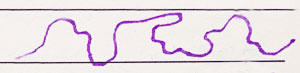
The twisting route up and down through the parking deck There were video games on every level and I played some. Then we warped into a party from Buttercup’s dream; a lame, boring business man party. The guy throwing the party heard me describing it thus and looked at me angrily. The room was rocking and tilting as we moved along the track.
Joining a Dream: While looking to entertain myself on the ride, I play various video games, then jump into Buttercup’s dream to check it out. It’s not to my liking.
-
Most Beautiful Rain Fairies 1998 • 2:25 AM • age 24
The following was a version of The Tower. As usual, it contained a challenge. It was a stadium with an angled walkway up the middle of the playing floor. There’s a repeating dream within the stadium in the form of Final Fantasy Tactics where I’m given a guitar that turns into a gun and I need to slay this George Clinton character. I’m unleashing water in different directions, and there are many repetitions.

Chasing George Clinton in the stadium In the final repetition, all the children come to the opposite side of the stadium where I was and gather around me. A boy in the front looks at me sternly. His eye contact seems to have initiated a change in attitude that changes the scene to this:
It begins like another repetition but this plant-like light green creature leaps off the edge of a balcony and hits a switch which turns on a sprinkler system. The creature flies over the tops of the trees and plants itself in the middle of the stadium, which is like a greenhouse now. All these rain fairies of every color and shape leap off the plants and fly and zoom through the air. Each is a different color and light as air. I am one of them. I think I’m red or purple. The rain keeps us flying and we swirl about and dance on the breeze. Our collective will keeps the rain falling. We perch on a grove of trees. Someone asks me “Wasn’t that fun?” and I say “Yuup!” I feel pure joy and we laugh. The rain has stopped and I ask “What happens now? How do we hide?” We’re slowing down and she says just grab the plant and rest. Then I wake up.
The flying was exhilarating! It was like a wonderful ride filled with such energy and fun. This was a most beautiful life. They seemed like plant spirits which come to life in the rain. This last repetition of the challenge was definitely a true dream.
Switching Channels: This stadium at the top of the Arcology Hill is used for games and challenges. Based on the angry kids, I think I might have been projecting my strange Final Fantasy Tactics dream onto their environment, running around like a crazy person. The boy helps me tune into their channel, and I see and join in with their dream instead, which is delightful.
-
The Ghost Lady 2023 • 4:30 AM
In the near realm, Buttercup asked me to come with her to investigate this ghost she saw. I was curious and went along. We arrived at a run-down ruined city. The style of this was kind of like Adventure Time — colorful and post-apocalyptic. I remember imagining the ghost would be a small floating green orb for some reason. When we arrived, it felt like we arrived at level 1 and had to go to level 10 or something. So we started walking around. In this parking garage we saw some talking derelict cars. . . . There were some adventures along the way.
Eventually we got onto this parked bus that was mostly full of people. This was where the ghost was. Buttercup indicated the back. There was an open seat in the back row near a twitchy crazy lady. Apparently she summoned the ghost. I was excited to see it.
References: Adventure Time is a cartoon series.
A Good Trick: Here Buttercup leads me into a dream with her and brings me to this crazy lady, who essentially plays a trick on me with her pet ghost.
I turn around to see that Treenie is standing nearby.
I gasp. “What are you doing here?”
“Trying to decide if I am in your dream, or if you are in mine.” (Roads 8)IaTROBEr, LDer • modern • Roads
Being a Supporting Character
A lot of times I happen upon weird events already underway when I arrive; a bit of objective dream reality happening in the astral world around me.
-
River Diving 1992 • age 18
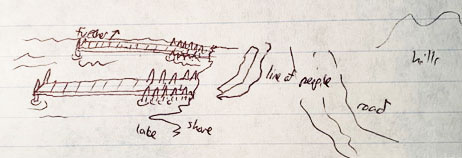
The docks and road along the river I’m driving back home with Wadsworth. We decide to stop at a familiar place along the shore of this lake. There is a big line of people leading to the near dock. What happens is about eight people get on the dock at a time, then all dive in and swim to the other dock. That’s it. No race. It’s supposed to be a lot of fun. Well, we finally get to the front of the line and go onto the dock. Everyone but me dives in. I hesitate, but finally dive in when the rest are about halfway across. Surprisingly, the fat, short, balding man who runs it blows the whistle and says to start over because we didn’t jump at the same time. I question “Why does it matter?” He says something about “togetherness,” so we all start heading back to dock one.
Weird Events: I stumble upon and join in with this lame ongoing event.
-
The Lost Hiker 1997 • age 22
I’m at these snowy slopes with friends. There’s a report that someone unstable is naked and lost, so we go out searching. I go my own way, along paths at the bottom of a cliff and across floating ice. Eventually I see Valentine, half-buried in mud. I ask if he’s the one who was lost, but it’s not him. Then this girl walks by with a downtrodden person. “Ah, she found him,” I think.
Dream Events: Events like this reveal that I’m not always the main character in my dreams, nor the most important. Other people start things which I may or may not hear about, and sometimes the mystery is solved or dispute ended without my intervention.
Doctors
Beware of doctors in dreams. They will do the most horrible stuff to you.
-
Split in Two 1996 • Early AM • age 22
I overheard talk about some big surgery of the ribs for me. Next thing I knew I was drifting out of a deeply anesthetized state to overhear a nurse say to a doctor: “Yeah we separate the body into two pieces during this surgery. We take the hips and below to a whole other place.” I blearily said “Is that so, nurse? Guess I’m not supposed to be awake to hear that,” in a humorous way, grinning at her shocked expression. They took me to a little place with huge paper towels and made this long ripping sound with them as they anesthetized me further. Then they separated me in two, saying “and this side goes left and this side never was.”
Next I saw Emma & Ruby in a waiting room and this sick dorky happy music comes on — their sign to take me to my “special meal.” As we went, I was bobbing up and down slightly, to give the illusion that I was walking. But I was suspended by rubber bands, being lifted and lowered slowly as if I was walking. We walked past a mirror set up to reflect only my top half. We walked a long way, past many people, and finally with big grins they said “And here’s your special place, all relaxed so you can lounge out like a king.” They lay me down on this stupid-looking denim beanbag with an upper torso paraplegic indentation on it. I speak through my drugged state: “This is all well and good except I have no legs. It’s really quite a show you put on. Is it okay to be awake?” They assured me it was okay to get more lucid. My voice was all gravely, so I asked Emma if they’d hooked up my vocal chords wrong. She said probably not. She said they’d checked all my fillings, and given me a whole new set of skin, because the old skin on my arms had gotten old and grey. They held up a mirror to my face. It was powder white with light brown crevices. Truly disgusting. I imagined my cool brand-name tattoo in light purple. They assured me it was very cool looking. I realized that I wasn’t a male right then and missed my bottom half. Then I woke up, laughing as I realized it was a dream.
Never Trust Doctors: Never trust doctors in dreams. First, you don’t need them because your body is a projection. Second, they will do horrible things to you. Every. Time.
-
Dr. Eye Plucker 1997 • age 22
I was getting my face surgically realigned. This doctor took out my eyeballs and held them in front of me. “These are your eyes. They are bad at seeing because (and here I thought he was going to blame my father) . . . because of your father’s anger.” He flashed pictures of me unable to express certain things to Wadsworth and then my face twisting with anger. The surgery was him putting my eyeballs back in my head.
Doctors!: See? Doctors are horrible!
Revisiting Interrupted Relationships
In physical life, relationships and jobs can end abruptly. We don’t just slowly stop going to a school or college — we graduate and then are done. But our long-term focus on those things don’t just stop. Our invested attention only slowly fades from our minds and so we find ourselves returning to those people and places in the dream state.
Break-Ups
When a relationship ends, not due to disinterest but due to circumstance, we often continue them for a time in dreams. For me, this applies most to girlfriends and friends left behind after graduating.
-
Girlfriends Past and Present 1994 • age 19
Kayla’s waiting for me in the parking lot in a yellow car. I go to the wrong parking lot, and run through the rain to see her. I was so happy that she just showed up in Marshall to see me, surprising me.
Kayla and I are running around campus. We talk about having kids and are really cuddly. We have a good time. Bridget calls and I have to be really sneaky and I feel bad. I’m trying to keep Kayla from seeing Bridget and vice versa.
Two Visitors: I had dated Bridget on and off over the last year. Then Kayla and I got back together briefly and then broken up again (it was a long-distance relationship). So here they both visit me in the near-realm on campus.
These dream visits happen frequently in long-distance relationships.
-
Thinking of You 1994 • age 19
Then Avery was there, and I starting rubbing her back. She turned around, looking much older, and smiled. She said “I love you, Sam.” I was a bit surprised. I hung around her and talked a bit, then she ran off with her friend.
Hello Again: This is half a year after Avery and I broke up. Break-ups are hard, and the couple often visits each other in dreams for a while afterwards.
These interactions are always authentic to our true feelings.
-
Visit to Kayla 1997 • age 23
I ended up somewhere I recognized as the vicinity of where Kayla hangs out in dreamland so I decided to visit. She, two friends, and her Wadsworth were sitting on chairs next to a wall in what seemed like a transport station. At first I couldn’t tell which one was her but then one became clear. She seemed emotional as if tears were nearby and she looked intensely at me for a moment before turning away and returning her focus to her father. He was very thin and very tall. He’d gone senile and was staring vacantly at times, at others losing so much of the conversation that he would yell at her for making fun of him or accusing her of talking crazy to drive him insane.
Ever-Visiting: I haven’t included the endless dreams where I visit Kayla. She was my first love, but it was a long-distance relationship, on and off for a few years in high school and at SSU before it ended painfully. The dream visits are never that great, often awkward and unsatisfying like this one. They’ve trailed off over the years. Once I got to Oberlin, I rarely thought of her, so it’s not due to any fresh waking attention. Yet in dreams, I keep visiting.
The same applied to Raven, my girlfriend at the end of high school. Those visits went better, often friendly at least. But I avoided them sometimes, too.
-
The Meeting 2000 • age 25
I’m at a familiar dream school. It is a good, quality school — unlike the Dark Tower. I have a regular class schedule and memories of many days there. Buttercup is there as well. There is a crossroads at a walkway where in the past I have gone to meet Kayla. I am heading to a class when I notice someone that looks like Kayla walking in another direction. It looks as if her face is behind a veil or plastic sheet but as I look (project?) it becomes clearly her. There is a mutual recognition and I tell her we have to run off and find a private room somewhere where we can talk, because if Buttercup saw us together she’d flip out.
So we peek into all these music practice rooms but there are people in them. Finally we find an empty one and sit down at a table. There is a row of glass display boxes there. We talk, and the topic turns to Buttercup, and a big intricate golden machine before us that represents her. As I looked on in admiration, Kayla understood my attraction to her. But then she said something about some imperfection. Now the machine is actually Buttercup, who opens the door and starts yelling at Kayla about Kayla’s own imperfections. This is a little odd . . . maybe I’m crossing scenes but I run off to Buttercup, who is out in the courtyard. She calmly explains that she knew Kayla was at that school and that we’d probably meet up sometime. I’m relieved that there’s no anger about it. She found Kayla less threatening than she thought.
Later there’s a part of the dream where there’s some trouble and Kayla sends out this psychic eye thing and that impresses Buttercup.
A Distant Friend: Kayla and I tried to remain friends after the break-up. It didn’t really pan out in waking life but in the dream world I visit her from time to time. It’s hard to know if this was really her.
-
Hyperspace Warps 2001
I ended up somehow with Kayla, at the college where we meet. We were talking and she jumped up and took my hand suddenly, and we were running down a path at night, familiar as anything, around a curve, woods on all sides, down a lane, and to this open place under the bushes. The intent was for some privacy, and she informed me as we ran that we were going to see Anne. . . . Brockovich. It turned out to be Anne from Y.O.U. and a new boyfriend. I told her of the name mix-up and we laughed.
References: Anne Brockovich is an environmental activist. Y.O.U. is a youth group I went to.
Old Girlfriends: Kayla appears in a lot of my dreams. Our dream interactions have outlasted most others from that long ago except for my family. The weird thing is that Kayla does not regularly enter my thoughts in waking life. At this point it had been about 7 years since I’d had any waking contact with her. It’s as if we continued a friendship in the dream world that had become absent in waking life.
The same is true of Raven.
Workplaces
I find it’s not unusual to visit past workplaces in dreams, especially in the months following my time there. It’s as if lingering thoughts from the routines and relationships with people there draw me back.
-
The Magua Discol 1998 • age 23
So I decide to check out how Definition 6 is doing. I’m there and it’s abustle with new people. There’s a big empty hole where my desk was. I’m talking with Quentin about people’s reactions to my leaving. I said, “So no one even said anything?” He said “No. I was here the other day and no one said a word.” The morning meeting was commencing and Meagan walked by. I said “Hey”. Everyone was lining up at the back entrance and Peter came down the middle with someone, wedding-style, to symbolize the wedding of their company with a new one. They had also decided to combine their names. I just wanted to leave so I slipped out among the others.
Outside everyone was turning around to see their new sign. In yellow and white with an edge of blue lightbulbs was “THE MAGUA DISCOL.” I let out a laugh. “Disco-L? Just put a few more nails in their coffin,” I thought as I awoke.
Checking In: After quitting my job a week earlier, I went to check in and see how they were doing.
-
The Stolen Car 1998 • age 24
I had gone to [Definition 6] again and it was all different — rich oak furniture, no monitors, and very few workers. I thought I was supposed to come in Monday and Tuesday but thought maybe I was wrong and left.
Work Habits: Habits are hard to break. I keep showing up to work. This time I think I’m still working there but am clearly at the wrong place.
-
Visiting Work Again 1998 • age 24
So I’m at Definition 6 playing lots of games while everyone else works. After a while I realize I’m not supposed to be there and I leave. I go to my car outside (outside is consistently different from the actual place) and drive away.
Habits Die Hard: It’s six weeks since I quit Definition 6 and I’m still returning there from time to time in dreams. In terms of community, it was my first since moving to Atlanta.
-
Kicked Out 1998 • age 24
I had a big dream of visiting Definition 6 where Derek was getting really vicious trying to keep me out, and I woke from the dream crying.
After going back to sleep, I returned and got someone there fired. Then they hired three children and an evil dog to kill me. The dog was the real baddy.
Tired of Me: I’ve clearly kept visiting for too long and some people at work want me out. Perhaps Derek was dreaming that someone kept breaking in.
-
Hyperspace Reunion 2000 • age 25
Context: Last night we'd seen the Definition 6 sign in a new location.
I got this call from the sales guy at Definition 6. He asked if I was going to come in. I thought, “Huh? I don’t work there,” but I doubted myself and asked what day it was. He said I should come in but since I can’t remember he’d give me control of all sales calls coming from Alabama. Slowly I regained some lucidity and said, “You know, I don’t work there. I haven’t in a long time.” He suddenly breaks down crying, sobbing, saying he liked me the best and missed me and I should come and visit. So I did, and there’s Oscar standing at the door, so happy to see me. He welcomes me in and the office is much more sterile and plain than before. The sales guy asks me if I want to play Myth with him and I say “No, I used to play those games but I don’t anymore.”
Visiting Past Workplaces: I wasn’t close with any of the sales guys there. I wonder if he mistook me for someone else.
-
Pants Don’t Fail Me Now 2010
Context: I used to work at Turner Broadcasting.
So I’m back at Turner again. I’ve been coming here in dreams regularly since I resigned. It’s dimly lit. I go to my cube and start gathering my stuff to take home. It’s a process of deciding what I most want to keep and piling it into my arms. After gathering a huge amount, I step out of my cube and my pants fall down. People are ignoring me for the most part, and there’s new people coming in to my cube and hooking up wild technology — this huge stack of black boxes with lots of black cables coming out of it everywhere. Some new decorations are appearing outside my cube. I set down all my stuff and pull my pants back up and then gather it all again and go downstairs, which I think is like a mass-transit mall.
Stopping By: I worked at Turner Broadcasting for a few years.
Visiting Past Homes and Schools
We may also return to places we used to live or go to school. In such a case, the current residents might be unknown to us.
-
Revisiting High School 2004
I’ve been thinking about Mordred lately, about how he’s doing, what he’s up to. . . . (This is 12 years after I graduated.)
I dream I’m in a grocery store and walking out with some groceries when I see him pass by with his mother. I reach out and say “Mordred?” and he sees me but keeps walking. His mother stops and she talks with me a little. I walk along with her, talking, but Mordred stays ahead. I ask what they’re doing in Georgia. Mordred’s Emma says he’s doing something in a city I don’t recognize. I eventually run ahead and talk with him, even though he’s not interested. . . . He thaws just a tiny bit but is still cold.
Then later I’m with Mordred and about 20 friends of his hanging out at this college campus. I go right up to him, having just seen him. We make light conversation. Manville comes by with some friends, but I’m more interested in talking to Mordred at this point. I end up hanging out with Quentin and Tony Tam and a bunch of others laying in a pile watching TV, barely conscious. Quentin’s a dealer of some kind.
At some point I and some others visit our high school. It’s modern but badly made, swollen at the seams. I commented about the giant plastic baby doll’s head that used to be atop it (I have no idea where that came from).
Then there’s a long segment where I’m hanging out with Avery and it seems like it lasts days but it’s full of unhappiness and fighting. Just before I wake up, I pack up my things and tell her it’s over. She says she’ll always have feelings for me. I think a moment, then walk out.
References: Mordred, Manville, Quentin, and Tony Tam are friends from high school.
Checking In On High School: My thoughts of Mordred made a connection to him in the dream state. His disinterest in talking with me at this point is likely an accurate reflection of his feelings. But that connection spirals out into other people in our high school friend group, and eventually to Avery, who I knew through connections to Mordred. The emotions there was probably also an accurate reflection of the feelings at the time.
-
Visiting Banana House 2024
I was visiting “Banana House”, which didn’t much look like Banana House. I showed up and went inside. The first person I met wondered if I was a handyman, and I said that I used to live there. There were maybe 8 people living there — young college students. Real people, not projections. The place was a wreck, as it always had been. I asked a little about the landlord, Vince McGillicutty, and one person said they hadn’t heard from him in 10 years, and that they had the same contract going on repeat. I told them some things I knew about the building. Basically I was wandering around, talking to people here and there. I started cleaning up garbage, just to be useful.
Eventually Buttercup showed up and I met her outside. . . . We went inside and I showed Buttercup around. The people were okay with our presence but were also wondering why we were there.
Visiting a Place: I’m visiting what I take to be Banana House at Oberlin College. Buttercup and I last lived there 27 years ago.
The Dream Friend — The Other
In many dreams I find I’m drawn to use the word “we” when describing what I’m doing. It feels as if I am accompanied by an unseen “friend”. It’s not clear upon waking who it is, but there’s always a sense of warm companionship.
Sometimes this “we” refers to myself and the character I’m inhabiting in a rote. At other times I’m in my dream self focus and the “we” refers to my waking self riding along with it. Sometimes it seems to be Buttercup, who I have a long-time open connection with, and who also enters my dream context whenever she shifts in bed next to me.
-
Scratching Boy George 1989 • age 14
My Wadsworth and I were at the top of a snow-covered mountain. We had a sled so we got on and started going down, steadily increasing speed . . . [we end up in a valley with a river] We saw a wooden ship floating by, so I jumped on. There might have been someone else with me, but I’m not sure. It had a flat deck and was purple, orange, and pink. There were three trap doors in it. In the front were three pipes, the captain, and a strange furnace. I had the hammer from Zelda II, and went around hitting parts of the ship with it, hoping to reveal treasure like in the game. I went to the front and put two glowing lumps that were each about three feet long into the furnace. Then the ship started sinking. We all jumped out, and soon fell down a waterfall. There were two more waterfalls, and after the first, I caught a quick-moving side stream. No one got hurt. We came to the shore by a cave-like opening with a huge metal door inside. We considered opening it, but wondered about the possibility of water coming out. I opened it, and found the world of Zork.
References: Zelda II and Zork are video games.
Ridealongs: There’s a “we” which begins as me and Wadsworth, but before long that character fades into a more vague “someone else”.
More importantly, note how my pronouns change. Whenever non-actions happen, such as perception or thinking, I use “we”. When action happens, it’s usually “I” who is doing it. Note the sentence “We saw a wooden ship floating by, so I jumped on.” It’s almost as if the other is riding along with me, while I am in charge of the actions. They are in the theater of my mind, sometimes appearing physically in the scene, sometimes not, but always there with me.
I’m 14 when I had this dream, so the phenomena of the “dream friend” seems to have always been there.
-
From Road to River 1994 • age 19
I’m bounding around a familiar neighborhood with a friend. A lady drives by and asks where a gas station is. We point to one of our gang, the only local. He/she points to a distant Amoco. Then the street changes to a river and the cars become boats. Ruby and I start to go down this river. I ask “is it safe?” It gets fast and fun and we finally reach the bottom — a deep sandy valley.
The Dream Friend: The friend seems to become my sister Ruby this time. She was with me in a similar situation when a car slowed down and asked for directions.
-
Neon Chakra Flowers 1997 • Middle of the night • age 23
I said goodbye to Kelly. I thought she was really cool and said it was nice to meet her. My friend (where did he come from?) said goodbye to her three female roommates who were in the kitchen.
The Waking Self
-
The Disc 1997 • age 23
I was shopping in a grocery store when these really interesting-looking tall aliens gave me this magic disc. There were these controls all over the top front area. I gripped on tight, pressed one button, and shot up really fast into the sky. I was traveling rapidly through space. It seemed like a colored haze at times and then came together. I went to this planet that was supposed to be Neptune. I descended and came down in this area with trees near a red pond. It was red because it was saturated with tiny red motes. I glided smoothly over the pond and saw a tribe of dark-skinned nature people nearby. There was probably a slight awakening because the dream jarred and repeated with a friend coming with me. He overturned the disc and it got lost. We swam in the red pond over to a small wooden enclosed dock where we met two people like us, but who had been trapped there for many years.
My Waking Self: After the jarring from a brief awakening, I returned to the scene with “a friend” — it’s my waking self! The rote rewound a little bit and we can see the influence of the waking self on the same scenes. First, rather than gliding over the pool, we swim across it. Second, the “dark-skinned nature people” take on the form of “people like us” — people from Earth.
The Character I’m Inhabiting
-
The Real Office 2010
We arrive at the first house. By “we” I mean this real-life Minnie and myself as inhabiter/observer.
The Friend: Sometimes the “we” that I refer to is myself and the character I’m inhabiting in a rote. I feel the main character that I relate to enough that I inhabit them to be the “friend” that I’m often with.
-
My New Favorite Movie 2023 • 3:30 AM
It began with a walk. A friend and I were taking a walk through a neighborhood. It was dimly lit out. . . . Then I was coming home alone with Buttercup. It wasn’t our actual house. I think we drove home, and I rationalized a car — it was our green Prius. . . . Wondering now if the “movie” was over, I headed back out into the neighborhood. Walking along, I came to this prison-like area surrounded by a chain link fence with guards. I think I was still with my friend from the beginning.
The Friend: Once again, I think the “friend” might be the person I’m inhabiting on and off in the rote. I think the scene with Buttercup and the explosion might have been either outside the rote or a reverie subdream within it.
For more examples, see “Character Inhabitation” in attention.php.
Opposition and Willpower
Willpower is the sole factor determining who wins a fight or sporting event.
Fights
-
Army of Me 1996 • age 22
We marched past the castle of evil — Blaine House! I was declared captain of the left wing, but I wasn’t ready. I didn’t have my bow, but a friend let me borrow his. The enemies came from Blaine House — starting with storm troopers. I set the house and the nasties inside on fire with my will alone. The house began to burn.
Will Fire: On retrospect, it’s odd that I’m setting fire to Blaine House when I had recurring nightmares of Blaine House burning ten years earlier.
-
Excessive Defense 1997 • age 22
Context: Last night, Buttercup and I were talking about defending ourselves.
It’s a sunny day, and there’s this big graduation extravaganza in Wilder Bowl. Lots of people are here, hanging out. There’s an extra building serving food near where the gym is. I’m in line to go in. I feel like I’m in this drug state, tripping or something. This man starts grasping at my hat and tells me firmly to release it. I turn to him, meet his gaze, and return his intensity a hundredfold. I lunge at him, screaming to “Let go, you son of a bitch or I smash your fucking dumb-ass face to bits.” He was backing off fast and now took off running. I returned to the food line and all of Wilder Bowl was silent.
References: Wilder Bowl is a greenspace at Oberlin.
Willpower: You can gather a great deal of energy to yourself in the dream state. I usually end up facing consequences as a result of counterattacks like this.
But this was progress for me. After being rather introverted and occasionally bullied when I was younger, I was practicing strongly standing up for myself in the dream state.
-
Cracker Brain 1997 • 4:30AM • age 23
[Cracker Brain] came up the curtain to the edge of the second floor where I was hiding a sledge hammer. Slowly, slowly. . . . I could read its fears. Only when most afraid could it be grabbed and that’s what I did. It got really close, was ready to strike, and I grabbed it by the shirt. There was a big tug of war and my goal was to pull it from the curtains and drop it so it would die. But I gave up fighting because it was just a movie and I just didn’t care (a theme recently). It grabbed me and pulled me off the edge. The film ended and I went to Cracker Brain to find that it was a short, young Asian lady!
Giving Up the Fight: Just like the dream the night before, at one point I decided not to fight anymore. This is the best strategy. In a dream, the fight will last as long as one’s will holds out. Attention only intensifies the negativity, and brings the waking self further into the situation.
-
The Mirror People 2012
On the way past the outside of the office, I saw the obstinate man through the window. I kicked the window hard as I walked past and flicked him off. Then I felt them coming after me. One ran up on me quickly, like a werewolf on all fours, and leapt at me, but I managed to dodge the attack. . . . Then I’m walking down the street again and it’s gotten dark like night. Three of the administrators are about to attack, I know, and they’ve brought along Pete. They all fly towards me on bikes (rationalization) and we fight. After an initial struggle, they stop attacking, seemingly spent of their energy.
Creepy Enemies: The administrators were especially creepy. In each case, there’s one attack and then they’re spent.
Sports
The trouble with sports in dreams is that your acts of will always succeed unless it’s against a dreamer with an equal or greater will. You play with perfect skill and what you want to happen happens — even if it requires going into a subjective reverie to experience it.
-
From Skateboarding to Flight 1997 • age 23
We’re all stopped at this big gas station and hanging out. I decide to skateboard. Instantly I’m really good. A few kicks and I’m circling the gas station and jumping curbs no problem. I start by following one of the other guys, then I go solo. I think I could really get into this. Then Juno is following me around on a skateboard, too. I do this fancy board-flipping trick and I pull it off!
Skateboarding: Typically the skateboard would be a travel rationalization, but in this case I set out to skateboard. There’s no learning curve or coordination needed in the astral. If we’ve seen it, we can do it.
-
Gliding Soccer 2003
I was heading back to the soccer field. . . . They were interested in playing a little, so we did. I found it too easy to score — my kicks were perfectly placed and their goalie kept passing it to me.
Dream Sports: I was able to perfectly place the ball with every kick. A game of will rather than skill.
-
I Suck at Basketball 2010
I was playing basketball in a dimly-lit gymnasium. I don’t know where this came from, as I almost never play or think about basketball. I sucked. I never made a single basket, I couldn’t maintain a dribble, and half my passes were totally off.
Missed Shots: My belief that I suck at basketball translated to the dream. With the slightest effort, I could have made every shot, but I was limited by my beliefs.
I’ve found it difficult to do sport activities relating to rhythm and gravity, such as dribbling in basketball and juggling in soccer.
Traps, Tests, and Experiments
Being Tested
-
The Insanity Creature of the Tower 1996 • 3:15 AM • age 22mature content

The insanity creature The hill with the Tower is actually a pretty place, and ancient.
There was this horrible thing, like pink flesh filling a cup. It had one eye and one mouth. Its eye was wrinkled and unfocused, or focused elsewhere. This was the insanity creature, which we thought we had contained. I was so curious, and asked to take it somewhere.
There was a familiar girl with me, a friend. We were dressed in white clothing. We escorted the thing together, but I couldn’t close the cup. Once inside the Tower, the test began.
Inside, the light was dim. In the middle there was a big, black orrery (a mechanical solar system model) on a big raised dais — like Augra’s from The Dark Crystal. Everything was in a black obsidian style, reminding me of a business office in the 90’s. It was mostly empty.
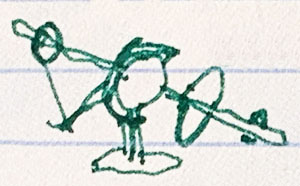
The orrery 
A new herb: Bolero The teacher had found a new herb, it was the opposite effect of marijuana, reversed it, he said, produced a purplish hazy effect. It was called . . . bolero? The leaves were thin with little symmetrical holes in them. The teacher was prepping me.
We walked up a set of wide steps. There was some horrible equipment belonging to the girl: a head clamp, a draining device, mirrors, and various horrible things. The insanity creature in the cup had given me two arm-length, erect penises, and put me on display, for all to see. I tried to hide them, but they were so nice, one had to be proud. It may have been done through the mirrors — I saw myself with them in the reflection. The mirrors lie — it isn’t your reflection.
She removed my glasses and I could still see fine, which proved to me that it was the spirit world. I calculated the picture instead of seeing it, seeing clear lines with light haze around them.
She lured me to her. I was so horny, I almost. . . . I wouldn’t let her go. I needed to be inside her, with both raging hard penises that the thing had given to me. I needed it so badly. That’s all I could think about. She changed and grew and shrunk, and I was forcing myself closer to her. I needed her, and she said yes but only if she could do it her way. I finally gave in and said yes. The moment I agreed, it was already over.
She had given me some intense drug, and used the draining equipment. The light was strobing. She was teasing me — she wasn’t going to let me have any; she never was.
Then Guido R and someone else came down. I pulled out of the drug madness and looked around. I recognized a sign and said it was Banana House. They smugly said “yes it is.” But it wasn’t — it was the Tower. I could control the drug-induced madness at times, but it snuck in everywhere, through those little mirrors that reflected out lies.
The strobing light and drug weirdness were to confuse me, but I stood up, walked around, and cleared my head. I turned off the strobe, almost became lucid, then woke up. That was my success. I got my dream!
I’m fighting this madness every night! See “Thought Form Games at Arcology Hill Stadium”. The games weren’t against Drax, they were against the insanity creature! It recreates reality. One must be stronger than it. It is all selfish desires, weakness, and needs.
References: I lived in Banana House at Oberlin. Guido R lived there too.
Incredible: This was one of the most incredible dream recalls I’ve ever had. So many details were there, even during the weirdest happenings and alterations of consciousness. The pure evil of the pink eye thing, the mirrors, the battle for what is real, and the challenge with the girl where I had to remain in control during the test. . . . It’s awe-inspiring.
To think, this was all a test by a teacher. The influence of the fleshy pink insanity creature, driving me towards sex. The insanity creature was a metaphor for the physical body, the source of all selfish desires. The strobe light was the distracting flash of the brighter but slower rate of physical consciousness. All of this represents the soul’s encounter with the physical creature it joins with in each incarnation. The soul’s goal being not to give in to the confusion and influence of the physical body’s selfish desires.
I was thrilled with the fact that I remembered this dream, which touches upon a deeper level of myself, the nightly work of my dream self.
-
The Interview 2016
I was in a job interview. The environment was very corporate, and I was not enthusiastic about this job. We were in a windowless conference room with fluorescent lights. Everyone was dressed up. I sat near the end of a long conference table, filled with about 16 people. I was one of three applicants for a web job. Someone there said that the other two got jobs there. I figured they had interviewed earlier, since I just got there for the interview.
It turned out there were about 300 applicants, and maybe 10-20 positions open. The interview began, and we were divided into groups of 5-6. The order of the following is uncertain:
At one point, I went underneath the floor in the building where the company was. There was a round glass pillar with open space all around. I stood on a platform. Maybe 50 feet below the platform was a floor that was a grid pattern — not really a solid floor but just the grid. The forms of dead interviewees were down there, all wearing white and red bodysuits. They were sitting there motionless, embedded in the grid. I felt like they had tried to escape under the company’s floor and not made it. It also seemed that the bodysuits were virtual reality outfits and that the grid I was seeing was a peek beneath the pattern. Surrounding the grid of the circular floor were a bunch of stores. There was something else going on down there. People — interviewees, I assumed — were swinging from hanging cables, trying to follow the commands they were given to swing about and break through security measures to attack table-sized blocks in the stores.
At this point I was getting a little more excited about the interview process. Back up on the company floor, I watched as one group of five tried to defend from an attack of some sort, using their powers. When my group’s turn came, I expected the same test, but instead our test was offensive. We needed to get from one end of a hallway, through all these defenders, to reach the interviewer. We were in position at the far end of the hallway. So what did we do? We sat around a table eating breakfast. We had plates full of food — scrambled eggs, biscuits, and more. I felt it was important to keep everyone focused on this and began a conversation, commenting on a biscuit, keeping everyone involved, and it worked. Perhaps focusing on our own little reality made the defenders disappear? At any rate, we passed the test.
At one point I was walking somewhere with one of the people in my group. I told her that I thought she’d make a great defender, that her personality was right for it, and she did well in a test of that type.
Next there was a tour of the office. It was Christmastime. There were stacks of company-branded shirts here and there, meant to be given to interviewees. This part of the office was nice, with windows, and everyone seemed focused, competent, and friendly. But I noticed something. The scene was being overlaid with Halloween. Black and orange decorations appeared. There were black cat decorations. I knew this was being done as a test, but wanted to pretend I was being fooled. I spoke loudly. “Wow, this is great! It’s Halloween, with presents, and all these Halloween shirts! What a great idea!”
I was eventually led to a dining area, with lots of decorations hanging from the ceiling. I sat across from a cool-looking guy with a tall afro, who engaged me in friendly conversation. It seemed like I had made it through the tests. I assessed my situation, and realized I sat in a room with a bunch of young people who had special powers, and nobody knew what powers anyone else had. It was like the birth of a superhero team of some kind, though I didn’t have any expectation of what we were going to do. But it was exciting to look around and wonder what everyone there was capable of doing.
Making the Team: I’m not sure what the point of the test was if we could just summon and eat breakfast instead of what was expected of us. Perhaps it was a test of independence, unique thought, and not getting emotionally involved.
-
The Gods of Art 2025 • 7 AM
I was at a school — some wild school of creativity. . . . At some point [the woman] mentioned a higher level, and I indicated that I wanted to see it. She said to tell them that I was her apprentice, named something like “Amara 2” where Amara was her title. We went up a flight of stairs to a floor that was bright and clean. There were lots of colorful blankets there, and there were a variety of strange people there, not quite human, but humanoid. One type I saw a few of had different colors of skin, one green, one brown. But for all that, they had entirely human personalities. They didn’t question my presence but welcomed me in. I walked in, talked to one or two of them. I sat on a couch and the brown-skinned one flopped down next to me. I said “Hello there!” She said hello and told me she didn’t talk to people unless they greeted her first. But she had expertly put herself in my way, haha.
They wanted to do a dream test with me. Confidently, I agreed. They put a ring of cardboard about 3 inches tall on the floor. I sat before it and flopped my head forward into it. Instantly, I was “dreaming”, but I was still there in the room with them. I sat back up and smiled at them. They were doing tests of some sort and I felt like I whizzed right through them.
Eventually we returned to the floor of flowing art below, and went outside. There was a giant vehicle there, like a car half-transformed into a giant robot. I flew up onto it. There was to be a parade. Other very interesting creative vehicles were beginning to come down the road. The vehicle I was in pulled out into the road and the parade began. It wasn’t long before I was walking again. A bunch of people in orange jumpsuits appeared about 20 feet ahead of us (under a pedestrian bridge). They were walking towards us, and I felt they were there to oppose us. What was I going to do? I felt this was still the test now. I did various dream tricks like ignoring them or just observing them intently. No conflict broke out, no emotions got involved, no fear. I was just having a great time.
Being Tested: I spend a lot of time in dreams being tested. I feel like it may be some kind of training by my higher self. At least the tests are immersive and entertaining.
Astral Experimenters
-
The Orange Light 2014 • 3:40 AM
I am living in this house with Buttercup and the kids. While there, I hear this loud grinding, buzzing sound for about 7 seconds. I hear a mental news report or people’s thoughts, talking about the destruction that took place, and I go outside to investigate. I see a girl (maybe 6-8 years old) and a seven-foot tall tree. The story unfolds to me — there was an orange light on the tree that turned on and then killed a bunch of people and destroyed a bunch of things. Instantly my thoughts turn angry against it. The orange light comes on. I know not to look at it, because once it’s on for 7 seconds, it visits nuclear death upon the ones triggering it. As I become distracted, it turns off.
Now this scene I replayed later on, and so the two are mixed, but I recall mistaking the girl for the source of the orange light. So at least the second time, probably both, I was facing the tree from up close while the girl circled around it maybe 10 feet away. I made sure to keep her out of my sight by keeping the tree between us as she walked around.
I returned to my house, terribly scared of this orange light. As I walk around inside the house, I notice that both the upstairs and downstairs bathroom windows face out towards the seven-foot tree. I have to use the bathroom, but fear to go in it. I imagine myself not being able to use the bathroom in my house in the morning or evening. I decide I can’t live that way and decide to do some experiments.
The first I don’t recall . . . perhaps testing to see if objects can set it off. In the second experiment, I test to see if animals can set it off. I feel bad about doing so, but grab the cat and set it in the window in view of the tree. Nothing happens, even when it looks that way. I remember thinking I need to protect Bodhi and Gwen from this thing. At some point something in the house makes me angry and the orange light appears over it. The orange light is circular, reminiscent of a traffic light, and superimposed over whatever I am getting angry at. I have 7 seconds to stop being angry. I manage to do so.
Then I’m setting off with a bunch of people. We’re driving to a facility to test the orange light. On the way there, something in the traffic upsets me and the orange light appears. I calm myself and it turns off. My face becomes relaxed and passive and I let my thoughts move to other things. When we arrive at the facility, we put on space suits, ready to run a series of tests or training missions in a series of tightly-sealed chambers. The tests begin: we encounter purposefully upsetting situations, and we try to relax and not let it make us angry. If it does, the orange light comes on and we have to stop being angry in time.
There are several rounds of this. In one I fail and a nuclear bomb explodes on my group — the result of which is that I feel I am almost certainly irradiated and will have health issues due to that. In another I’m doing pretty well, but we see a nuke go off in the chamber across the way, and the blast is so strong that we are also destroyed. I see the screen representation of both the chamber across the hall and ours turn red.
I become quite good at letting go of the anger.
I am back at my house again, with some people who I think are from the training sessions. I’m playing a game with the orange light and several children now. I’m no longer afraid of it. If it appears, I instantly turn my attention elsewhere and let the anger go. There is a pizza delivery, and I think the Beeb is there, too. There are several more instances of the orange light appearing, but I always overcome my emotions in a second or two. I revisit the 7 foot tree, replay that scene again, and the orange light never comes on.
There’s a long scene in a fashion store as well, with the ever-present now-minor threat of the orange light, which makes a few appearances — the longest of which is outside the front door of the store across the street on a billboard.
I have learned good self-control, but what a truly horrifying dream! It was like behavior modification with the most blunt of instruments.
References: Lewis was my high school nemesis.
Behavior Modification: This is clear behavior modification. It’s horrifying to realize (after waking up) that you’ve likely been the subject of an experiment. But I did learn emotional self control from it. Consider Monroe’s astral training rotes, which he did as challenges to advance himself. Perhaps it’s like that.
-
The Observers 2015 • 7 AM
This follows the dream “The Madness,” which I awoke from at 4 AM. In that, I was trapped in a rote that was difficult to escape from. I suspect that the following might be the same place from a higher, more detached perspective.
The second part of the night was remarkable and strange. It followed some siblings, and a whole cast of people that (I think) they didn’t know. Over and over and over again, the observers took a set of circumstances and tried to get the siblings to do something. The circumstances took a shape, like a building. Each successive scene, the building got bigger, taller, deeper, and the observers became more numerous. It may have begun as the roller rink in the earlier dream. But after each iteration it became larger and more abstract, soon hanging in space. Before long, the building was mere outlines, when viewed from outside. The observers were focusing on a girl from the siblings. But about three quarters of the way through realized it was the younger brother — the strange adept, the savant — who held what they wanted. With him, they tried flattery and appeasement. At this point, the building was large and very deep now, coming to a point at the bottom. They offered him a special train ride, but rotated the perspective so that the train was facing down. They wanted to get them deeper into the building. It worked. After a little while, near the bottom, one of the siblings asked a question about evolution. In response, they went through a thought gateway into a wide grassy field to look at and study these different animal versions of themselves — monkeys and horses, I think.
I wish I remembered more. What were they looking for?
Experimenting On Dreamers: This is so strange. A group of entities who understand the nature of the astral world is running these people (dreamers?) through a rote, trying to elicit some behavior or reaction. While I don’t know what the purpose was, what’s important is that there are goal-oriented entities who are able to manipulate the simulation’s circumstances. They didn’t seem sinister in any way and were happy to answer one of the siblings’ question at the end. It seems more like curiosity.
Were they trying to get me to the bottom of the structure in my simulation? Deeper into the madness of the basement? They sure did try hard to keep me in it.
Places Made to Prey On Dreamers
It surprises me how many times I’ve encountered places that are made to prey on dreamers. It’s not something I’ve ever read about. These places seem like they’re meant to trap dreamers within like a venus flytrap. They use a variety of tricks to accomplish this, playing on our fears and desires.
These places are made to trigger us into a “waking self fragment”, a state of shortened context in which the waking self fully believes that the dream is waking life with all its consequences. This usually results in the expression of strong emotions, which may be their purpose. We essentially act as power generators for those in the lower astral (where these places are) that have cut themselves off from the flow and seek energy from others.
Put this together with dreams where the dreamer appears to be tested or experimented on and the behavior modification of “The Orange Light”, and it paints a unsettling picture of some of the things going on in the dream world.
This isn’t just an astral phenomenon. There are people in waking life who antagonize others and feel good when they do — they are unknowingly absorbing the emotional energy their victims release. In fact, there’s a stage of childhood where children (boys, usually) get a rush of energy every time they antagonize someone. You can see it in the smile on their face afterwards. This may be a response to the separation of the dream self and its stronger flow of energy at around the age of 7. This may continue to differing degrees through the next period of their lives, from 7-14. They “rage bait” another person unless he is “cool” or “chill” — a reference to the diminishing returns of emotional energy coming off them. My son’s own strong emotional reactions encouraged more antagonizing behavior until he learned to let it roll off him. Perhaps that’s why so many men grow up to be emotionally closed and unavailable — a state of being closed off to the flow of energy.
See “Antagonizing for Energy” in planes-of-consciousness.php.
-
The Virginity Test and Demon Battle
I’m walking along Hwy 65, and I see Raven. She sees me, too. I avoid the really treacherous crosswalk and catch up with her. We begin talking. She tells me she’s playing guitar now and writing cartoons. She shows me. Though slightly juvenile, the cartoons are an improvement. We end up at this house. Inside, we continue to talk. Suddenly she jumps on me and starts kissing me. Then it is as if a narrator appears and says “A spirit took over his body and forced him onwards. He resisted, his face turning red as a tomato, but the spirit was strong. . . . ” I wrenched free from the spirit’s clutches and held Raven back, saying “No, this is not right. This isn’t what I want.” Raven pleads “Why?” and trying to cover up my true feelings, I say “It would really complicate everything.”
Suddenly a voice booms something to the effect of “Who’s been in my house?!” The scene changes slightly. Raven is laying on this bed with this long flowing dress. There is another girl in another long flowing dress on the other side of the room. These two partially transparent shadow-men appear and say “Who’s virginity has he stolen?” They check this vial of pink liquid by each girl’s bed. One man takes off the lid and I know that if the stuff floats out into the air and glows brightly, they are still virgins. It does for both of them and the ghost-man throws me an approving grin. Then he goes into another room where lie four more girls in similar dresses with similar vials. He checks them all. All still virgins. The shadow-men disappear. I look at the girls. One of them is Kayla! I know that they are all the princesses I must choose from. Raven comes up to me and asks me to go away with her. Before I can answer, a voice booms out “No! Can you not see? You are not the one he wants!” She begins to ask “Who is the one?” Then all the girls are sitting on this big plush bed with drapes.
The Narrator’s Test: This house is clearly a malevolent dream trap, with its own narrator that tries to influence me. Its goal is to tempt people and then punish them if they give in. The voice was even using the power of suggestion to make me believe I was possessed by a spirit to get me to give in. But it didn’t work, and I passed the stupid test.
The narrator was testing me, but at the end spoke my own thoughts out loud. Though in dreams, reading another’s thoughts is trivial.
-
The Predatory Club 2003
It’s dark out. Buttercup and I and two others are going from club to club. There are a few along the street we’re on. We see a new one up ahead. The title is in big dark letter-symbols. We go in and sit at a table on the ground floor. It’s got a rustic, unfinished, but purposeful look, with a wooden floor. Upstairs is a dance floor. The menu has drinks and food. The cost is thus: the first three things for each person costs 75 cents total. The 4th thing costs 79 cents. The fifth is around $5.29. The 6th is $30. The 7th is $3,000. The 8th is $300,000. We joked with the waitress about the pricing, but I was wary. I knew this was a trap — that if you had 8 you’d end up working for them. I had three choices of drinks and food then went upstairs. While there I lost track of time and everyone I came with. I saw Jack Black and someone else famous, but they weren’t animated. I danced.. and blacked out. It felt like much later that I came back downstairs, and felt bad for leaving the others for so long. I was scared about how much I’d had, not being able to remember. It turns out it was only 5 total. Scary.
A Sinister Dream Locale: This seems like a true place in the dream world, custom-tailored to lure in and trap dreamers like a carnivorous plant. The initial deal is too good to pass up, but a distracted dreamer would easily lose track of how many things they ordered. And if something about the place caused you to black out. . . . Now of course they can’t keep you there, but they can make you very emotional about owing $300,000, and they can feed off that energy.
-
The Wild Bus Ride and Parasitic Moths 2012
In the next building, I decide to get something from the administration room. The entrance to the administrative room is a round barrel-sized hole in the floor and there’s a totally naked oiled-up lady sitting on something so that her top half is outside the hole. Undeterred, I go around her and squeeze through the hole into the administration room, which is a short room — fit only for crawling. I find what I’m looking for and squeeze back out the round opening past the oiled naked lady. I have the thought that a lot of people would probably be jealous of me pushing past her, but to me she’s just in the way.
At some point I decide to leave the camp entirely. As I go through the forest to escape, the environment gets trippy as things move and change in front of me. It’s clear to me that the woman running this place is a witch and doesn’t want me to leave. Vines and branches move to block my way. The landscape changes, lengthens before me. A field with a path becomes a dead yellow area with a dead tree whose long scratchy limbs are hard to get around. I am aware of these attempts to block my escape, but I get through them and am able to leave.
The Witch’s Den: This is very interesting. We have a very short room which needs to be descended into. And guarding it? Something sure to distract teenage boys (which this area seems to be focused around) — a naked lady. It would distract anyone with a short attention span (short context) attempting to get through. I have a strong focus in this dream, so I’m not falling for tricky stuff. Failing trickery, the dark spirit turns to more direct methods — molding the astral environment to keep me from leaving, but I was able to push through the obstacles.
-
The Mirror People 2012
[I find myself back in high school] I realized that I didn’t need to be here — I could just go home! Walk out and not come back! So I headed straight to the administrative office.
A blonde girl with a wicked look was helping someone at the counter. She was talking to this tall trailer park kid named Pete. She put his last name down as “dopey” in the form she was filling out. She was being subtly cruel and nasty to him. I got her attention and she said something nasty to me as well. I let her have it verbally. As I spoke, more of my memories came back to me — I was 38! What was I doing in high school? I was married! I had already graduated from SSU and Oberlin. She got upset and lost her shit. She had a violin case which she threw down the counter. . . . The others behind the counter were ignoring me so I focused my attention on one of them and asked how many credits it took to graduate. He blew off the question and started talking about something else. I repeated myself, raising my voice. He asked for a degree of how many years. I said four. He started trying to distract me and tried to change the subject, so I shouted the question so loud he finally cracked, and, trembling, told me the number. “And how many credits do I have?” The fellow who seemed to be in charge there was at a computer, unruffled. He drew my attention to this mesmerizing color pattern on the screen. It didn’t work. I pushed harder. He hardened and changed the subject. It became clear he was going to obstinately avoid telling me. “Well, I know I have enough credits,” I thought. I stormed out, down the hall, and out the front door of the school.
On the way past the outside of the office, I saw the obstinate man through the window. I kicked the window hard as I walked past and flicked him off. Then I felt them coming after me. One ran up on me quickly, like a werewolf on all fours, and leapt at me, but I managed to dodge the attack.
I was done with high school! I began walking down the street looking for my car. I could still feel their anger at my back. . . . [I escape from a house and withstand another attack]
I’m looking now from a perspective a few hundred feet off the ground, and see Pete’s house in the distance burning with this blazing white/pink-red fire, and I know it’s a trap. I know it’s to lure me over there to save him. . . . I am back on the road on the west side of the school, and it’s dark again. Another attack is coming — this time from five administrators. . . . I begin to lift off the ground, and the world bends away spherically. The grid flexes into different hills, and I somehow know that one neighborhood I come to is known as “The Whale”. It’s got a big bend, like a big hill, and it’s very large. I feel myself being drawn down into it, and I’m trying to pull up. It’s around here where I wake up.
Flytrap High School: This is another place meant to trap dreamers with shortened context. It’s kind of disturbing how many of these I find. The high school administration area is a place designed to distract you from answers, to aggravate you, to keep you in high school forever.
When more subtle emotional distraction attempts fail, more obvious attempts like the mesmerizing computer screen are tried. It seems it would have been easier to just lie, but perhaps that’s not permitted somehow.
But even when I escaped the high school, the administrators were trying to keep me trapped in the neighborhood by getting me to buy a house there, and failing that — fighting me. So many tricks and traps — like the fake burning houses — meant to draw me back in.
-
The Madness 2015 • 4 AM
There was a long crescent area that went around the rink, and at the far end there was a doorway to stairs going down. It was quite dark, and the people over there were mostly dressed in black outfits and costumes, but I could see glowing dust on them. The stairway heading down had that same glowing dust on the stairs. The announcer said in a half-joking voice, “I wouldn’t go down there!”
[many adventures later. . . . ]
Progressively things got more wild and crazy, the people gathering down there acting more and more drunk. It was fun. It was more an uninhibited, raucous drunk. Not blurry or clumsy. I was having a blast and laughing and being so funny. But there was an edge of madness to it all. . . . At some point I decided to leave this place. It wasn’t easy. I made several attempts, as there were replays involved. Each time, it tried to lure me back in with all kinds of distractions. Typically, I made it up a few sets of stairs from the lower rooms (seemingly always bringing others up with me), and I would find myself at the landing a step down from the main roller rink floor. Each time I approached, tons of black cratered asteroid-like magnetic balls and rectangular magnets came flying towards us. These detached from the floor, from the structure of the threshold. I knew I had to shake them off as quickly as possible as I ran through the threshold to the main floor. At that point, I’d run along the crescent, past a dark counter full of vendors providing various services and things. Sometimes I’d get sucked back into it by watching the dancers, seeing attractive girls in their costumes or innovative dancers like the guy in the weird suit and top hat, whose bottom half was hidden by a screen that showed legs dancing as his top half danced weirdly along with it. On a few of these escape attempts I saw the wait staff looking angrily at me, and I said something like “I’m sorry! I promise I won’t come back again.” I felt like I’d made a terrible mess somehow.
On one especially insane escape attempt, I wound back into the scene because this girl dressed in all black with some interesting accessories grabbed on to me. She whispered in my ear that she had finally found me, that she had been wanting to see me again since the first time, that she really liked me. She said she wanted to get it on with me. She must have had butterfly costume elements, as I said “We could make little caterpillars” and I started to feel in the mood. But then I heard a voice calmly say “Brother. Brother, it’s me”, which shook me out of it. The voice came from a big, round man sitting in a chair near the entrance to the underground rooms. He held me in a bear hug. I stepped back, realizing it was someone like Bruce H., a strong, calm, benevolent person who was on my side.
I knew I had to rescue Buttercup and Fiona from the madness. I focused myself into perfect clarity of purpose and went through the threshold and down the stairs. The madness reeled around me, more wild than ever, but I stayed separate from it. I went down 2-3 levels and finally found them in a crazy scene. The floor was scattered with huge buds of weed, and they were among a bunch of people on the ground, trying to gather up as much as possible. Neither had a shirt on, but were wearing bras. I looked at this scene with calm detachment. I got down next to Buttercup and told her she was coming upstairs with me, and then said the same to Fiona. I put an arm around each of them, and led them up the stairs. I walked them up past reeling drunken scenes of wild partying madness to the threshold. I made a run for it through the oncoming magnetic pock-marked balls and rectangles, and brought them through the opening. The kind, calm spirit that looked and felt like Bruce waited for them and took them into his arms.
To escape the building, I had to force myself through an invisible window boundary a few levels up. In one attempt, I careened towards the street head first, but I was unafraid, as that was the fear blocking the exit. I landed on my feet. Another time, I scaled down the outer windows and jumped down the final story. But then the area around the building was blocked by invisible barriers. I made it through a few boundaries that would have kept less experienced dreamers inside. Finally I was running down a street, and realized I was on an island — the final boundary. I vaguely remembered arriving at this island earlier in the night. But. . . . I got distracted.
Come On In, but Don’t Try to Leave: Here I have stumbled into a predatory dream location that doesn’t want to let me out. What tricks it used! The first one was using humor — which is an unusual thing to find in a basement. Then it used a wild, uninhibited, drunken feeling as a draw. When these positive influences failed, it turned to an aggressive physical attack using magnetic rectangles and balls, which is like nothing I’ve ever seen before. Then there’s the most straightforward and common method: distraction — the dance competition, the vendors, and when I seemed likely to escape, a sensual girl latches on to me. There was social pressure from the angry wait staff, fear of pain from dropping out the window, and there were physical-seeming boundaries — the windows, invisible barriers, and finally an ocean.
It’s interesting that as much fun as I’m having, my entire goal quickly turns to trying to escape, and trying to help others to escape as well.
-
Disney Park Madness 2025 • 3:45 AM
Context: We've been very much into theme parks as of late.
It was night, and I was lost in this huge Disney theme park. I had arrived with Buttercup and the kids, but became lost. I was in this wandering, drunken state. I was at this Star Wars show. I saw everyone getting a box of gifts, and I went to ask a steward for one. He brought me one — it was this box with random stuff in it, including a replacement shell for a remote control — nothing I found valuable. He also brought me a large box that seemed like it had been meant to be delivered to me. It was a bike pedal and something else, packed as if it were bought used. I quickly remembered (concocted) a story that I had bought this as part of a video game for Bodhi when he was really into trucks, and told the guy I must have ordered it 10 years ago because he was 14 now (this is correct as of two days ago). I asked him to return it and credit me the $15. After this, I went somewhere, got lost, and then started wandering around looking for my boxes, even though I didn’t care about them. I spoke to another steward and she didn’t know about the boxes, but offered me a souvenir drink satchel that hung around my neck. I took it, thinking it was just compensation for my troubles, but as I walked away, I realized it was meant to replace the value of the boxes. I didn’t want that deal! I went back to her to give it back but couldn’t find her again.
I wandered the park like a drunk, it seemed, without a clear plan or goal. My mind state felt like madness and short-term memory, the delirium of being very drunk. . . . After a while I realized I had lost my shirt and my phone also.
I found Buttercup and the kids in the front row of this Star Wars show. I only spoke with Buttercup, who was more clear-headed. They were about ready to go, but I told them about my lost phone. We went to a steward, who took us in an elevator up to a store where everything for sale was organized by color. We stood by the hot pink items. The steward disappeared behind a door. I was only able to wait for eight seconds before I lost patience and wandered off on my own again.
I returned to the ride where you held your hands up high to control it. I had checked this one for my phone several times, but checking it meant riding it to another area. I accidentally went through the Rapunzel show area several times. It was like a stadium with many levels. Near the entrance was a Star Wars ride (no line!) that took people to the Star Wars area, which was I think just the Star Wars show. . . . I spent much of the dream in a panicked search for my missing things. I kept finding stewards and asking them, but kept coming up empty handed. . . . I found Buttercup and Gwen again (I assumed Bodhi was there in the crowd behind them). Eventually I was reunited with my phone. I almost lost it again minutes later when I set it down to rifle through a box for a free “treasure” that I saw ahead of me in a map in my head. The treasure was garbage, as usual. I almost picked up some pirate stickers, but upon opening the package, realized they were not great.
It was getting late and we were anxious about missing our flight back home at the end of the night (this was just a day trip). . . . I think we were close to an exit when I woke up.
Disappearing Gifts: Emotionally harvested again.
The idea of giving gifts in a place with big shows and rides is a clever one. Once we switch focus to a big show or ride, the gift thought forms fade away. But in this case, it wasn’t even necessary since I was in such a delirious state.
I don’t know why I was so keen to get the garbage treasures back. Perhaps because they were gifts from a big theme park experience. My lost phone eventually became a more realistic thing to obsess over finding. But notice that once I found it, a map appeared in my head with a new free treasure, and I almost lost it again. That kind of timing shows intent.
Structurally, this place was very, very hard to escape from, a multi-level maze with endless passageways, rooms, and distractions. I kept asking for directions and being led seemingly closer to an exit, but they each led back inside. Very much a place to trap and “harvest” dreamers emotionally.
I had a very similar dream three months later. I took a day trip to Disney World, was surprised to get an “exclusive gift” and promptly lost it while watching a show. I spent a long time trying to locate it.
Others in the Astral
True Dreamers
On rare occasions, I’ve spent time with another dreamer focused in their dream self, using an intimate knowledge of the astral world.
-
Lucid: Colored Pots and Pans 2000
I joined [Marilyn Manson] on the way over. We talked deeply and honestly and it was joyous. At one point, I said “I bet you like the rush of emotion.” He began running all about through the grass and I joined him, running at turbo speed, just loving the feeling of it. Then we looked up ahead at a vast landscape of colored pots and pans stacked into towers with a path running through them up to this huge tall black pot. I suggested we go up the path and we did. Marilyn said he felt like he was coloring the pots and pans with his mind as he looked at them. As we got on the path they turned to cars, still stacked and still colored.
References: Marilyn Manson was a musician.
Another Dreamer: The fact that “Marilyn” thought that he was the one coloring the pots and pans with his mind not only is strong evidence that he was another dreamer, but that he was strongly focused in his dream self at the time, which is also supported by the deep, joyful conversation we were having and the turbo-speed running we were doing. All of this points to an awareness of the dream state and the ability to consciously control it.
Pranksters
I love running into astral pranksters. These are people in their dream self focus creating humorous situations to mess with people.
-
The Rude Waiter 1996 • age 22
I’m at a table with Uncle and another guy. We’ve asked the waiter to play a trick on Uncle. Uncle is a vegetarian and the waiter has brought him meat. Then the waiter cuts his eggs and throws a bit on the floor. Then he flicks a half-eaten shriveled sausage across the table onto his pancakes, saying “Here’s your raisin, sir.” The waiter is so animated and funny. Then he moons Uncle from outside and comes back and calls him an asshole. Then he brings his “ice cream”: a frothy mixture in a white cup, almost all foam. It’s horrible tasting and on the side are written all kinds of things such as “You are an uncivilized toad.” The waiter dances around mockingly as he reads these things to him. My God, I had to try so hard not to burst out laughing. Uncle was so flustered he didn’t know what to do!
Humor: This scene was so incredibly funny. I love running into hilarious people in the dream world.
-
Thanks a Lot, Lance 1996 • 6 AM • age 22mature content
Context: Lance was my sister's boyfriend at the time.
I arrived at Blaine House, and Ruby helped me unpack. I was staying in what used to be my parents’ room, and Lance came to see me. The rave fliers, various knick-knacks, and surprisingly, all these sex toys were on the bed. Suddenly Lance is on his back with baby clothes on and shaving cream on his face and I’m sticking my plastic-wrapped toe into his butt. He makes some funny comments about how much he loves it but he wished my toe was backward. Why? Oh, to get his g-spot, of course. I told him how scared I was that Wadsworth would come in, and voila! Wadsworth charges in the door without knocking and does a double-take on Lance. I rush to cover the sex toys with a blanket. Wadsworth loses his shit and gets crazy mean. He tries poking his fingers into my life and I get vicious mad back. Lance has reverted back to himself, wearing a dark blue sport shirt, leaning back, and smiling. Then Emma comes in raging, and demands my shoes. I throw them at her (in waking life, my arm slams the bed) and say “fine, take them.” Then I change my mind and say “No, fuck you, they’re mine, I bought them.” They both gasp and look at me with hatred. Then Buttercup wakes me up.
Lucid Pranks: Lance’s actions all seem very deliberate to me. From dropping in, to instigating that scene with the baby clothes and shaving cream, to leaning back and looking amused when Wadsworth stormed in. I have to think that really was Lance having some fun at my expense. I’ve been known to play tricks on other dreamers when I’m semi-lucid, but certainly not like that.
-
Lance’s Xmas Present 1996 • age 22mature content
It’s Xmas with Buttercup’s family, but instead of her brothers and sisters it was Lance and his new girlfriend. I was taking a nap when it started. I awoke to Buttercup dangling a Nintendo 64 over my head. She had got it for me because her parents didn’t get her one. I was too tired to fully realize how awesome that was. Buttercup got one for Paige, too. I asked why we were celebrating on Xmas eve and Buttercup said her Wadsworth blamed it on the cat. More gifts were opened and her parents fell asleep. I told Lance to show everyone his penis and he took it out and it got hard and was 1 1/2 feet thick and 2-3 feet long and filled his entire lap but his testicles were little. He was thrilled, and everyone else was shocked. Then he tucked it away. It sorta sucked, for Xmas.
Prankster: Obviously, I can’t blame Lance entirely, since it was my suggestion. But he didn’t have to make it so ridiculous.
-
The Wild Bus Ride and Parasitic Moths 2012
People on the bus begin shouting in amazement and excitement. It’s something about the bus driver. It’s hard to see at first, but I eventually get a glimpse of him. He’s facing back towards the people on the bus, smiling knowingly — he’s not looking where he’s going! The bus is heading towards the side as we approach a steep hill. There’s this moment where I feel we collectively give permission to go over the side of it, and we do. It’s a big bump and the bus tips to the side. For a moment I’m afraid it’ll tip over but it doesn’t. My perspective has shifted to a higher point of view just above the bus, and it remains there as I see the bus head towards a phone pole, then slowly adjust to avoid it at the last second, then towards the edge of the road, then back in the nick of time. Suddenly I realize the driver is outside the bus! He’s walking along the road with that big smile and I realize he is somehow directing the bus on this wild ride, going over big bumps, and almost hitting things before swerving away.
Then the bus goes off-road completely. It heads down a red clay embankment with scattered trees towards a little stream. My perspective is now above the front of the bus, so it feels more like it’s ME moving rather than the bus. I wonder if the driver dares take us across the stream, and he does, crossing back and forth across these shallow parts. Then we go over a hill and come to a wider stream. Does he dare? He does! We splash over the stream and continue.
The Playful Bus Driver: The bus driver is clearly having a good time with the bunch of us. Typically in group travel I think the destination is set, but perhaps our moment of collective permission allowed him to take us for a joyride.
-
The Ghost Lady 2023 • 4:30 AM
We got onto this parked bus that was mostly full of people. This was where the ghost was. Buttercup indicated the back. There was an open seat in the back row near a twitchy crazy lady. Apparently she summoned the ghost. I was excited to see it. I sat in the back seat. She was seated on a side-facing seat right in front of me. A few seconds after I sat down, she began to shake her hand, then extended her pinky and thumb and made a gun cocking noise “ch-ch” and then, looking at me, said “ooooh he’s awake”. She stopped summoning the ghost. So I closed my eyes. I waited a couple seconds and then opened them. She was looking right at me. I closed my eyes for a bit longer, and I heard the “ch-ch” and I opened them. She said “ooooooh he’s still awake” and stopped. Okay, I had to time this just right. I closed my eyes again, just concentrating on the dark, relaxing, waiting. I was going to give it a good long time this time. I turned my head to the right and laid it back on the seat, unconsciously matching the pressure from my pillow in waking life. 10 seconds, 20.. and then. AND THEN. I heard this “RAAR” in my ear. It sounded like someone speaking in a monster voice, like it was spoken directly into my physical ear, pressed against the pillow. This wakes me up.
I wasn’t scared, but I was surprised. It felt like someone had played a good a joke on me. I was impressed. The crazy lady and her pet ghost trick. Bravo, haha.
The Ghost Trick: This whole thing feels like a prank set-up. The lady in the astral seems to like to play tricks on people, and she gets me right in the mental state she wants before unleashing the cute ghost sound right in my ear.
-
The Madness 2015 • 4 AM
At some point I went down there. It was a series of underground rooms. The order here is all scrambled, as I seemed to relive it and go through it several times. Not long after my first time going down and meeting some people there, we were joined by “John Cleese” (actually Chevy Chase), and I was completely familiar with him — as if we’d known each other a long time. He and I and two people were waiting in chairs in the first room at the bottom of the stairs, and someone came in. John (Chevy) said something like, “I don’t know who we’re waiting for.” Someone else said “or what.” Someone else said “Or when they’re coming.” And then I said “or why” and felt it was the missing piece to the joke, and then John pulled a little silk scarf off a picture which revealed that the picture was of a man’s firm belly, almost showing his “little friend”. The person who came in was shocked and mortified. I laughed and laughed and laughed.
I went to explore the other rooms down there. They felt somewhat like rooms in a college house, with cheap furniture and a brown shag rug. The atmosphere was of one slowly becoming more and more drunk. We re-ran the gag in the front room a few more times. I wanted to shock more people with it. But Cleese wouldn’t play along after the first time or two. He changed it up each time, sometimes hindering me, sometimes throwing the whole joke out of balance with an unexpected picture, leaving everyone hanging. At one point, he ran back up the stairs and I yelled “Cleeeeeeeese!” He came back in a minute, and I said “My Emma is here! Let’s do the joke on her!” He asked where she was and I pointed her out in the next room in. He sat next to her and started making out with her. I was horrified. Then after a little bit, his lips and hers began to expand out into big flat pancakes with holes in them, at which point he got up and sang this funny song about their pancake lips . . . it invoked an image of using your lips on too many kitchen tools or something, as if that’s what happened to them. Very funny stuff.
Humorous Banter: I was having a total blast with the clever Cleese/Chase character, who was adept at breaking everyone’s expectations.
Spirit Guides
-
Guardian Spirit Leila 1992 • age 18
Awake: I’m staying at Kayla’s. She tells me of Leila, a guardian angel of hers. She tells me that Leila makes her presence known by knocking (on a theater seat, on a desk). She tells Leila to watch over me tonight. I go to sleep.
Excited dream. I feel like I’m right above my bed, looking at a computer screen. It’s cycling between detailed schematics of figures, including one that is very large. I was examining statistics and body diagrams of different life forms in red, blue, yellow, and green in great detail. I sense ten angels in all. I want to learn about the large one, sensing perhaps that it represents Kayla’s guardian angel. The images on the computer screen are coming faster and faster, flashing through brighter and brighter colors, accelerating to this incredible speed. So I dive into the large one and I see whirling colors, and I’m suddenly awakened from sleep by 3 loud knocks on the 2nd story window by my bed. There was no fear, only wonder at the knocks. I settle back to sleep.
This time I dream of a large building with circular black supports, lots of windows, and a circular glass elevator in the center. It is night and cloudy. A flame shoots up through the center glass shaft of the elevator, and I sense some disaster coming. I climb down the shaft and leave the building. I emerge in this parking lot with scattered cars. My Dad walks out from between some cars and says something to me. Then he walks off, leans forward, and takes off flying. I watch, amazed, and say “Oh, so that’s how to do it!” I lean forward, lift my feet up, and fly. I recognize myself as the 2nd one ever to fly. It’s an amazing feeling. I fly for a while. As I do, others walk out into the parking lot, and also fly. I land and am immediately woken up by another series of knocks on the same window. They are faster and more insistent this time. Again I felt no fear, only amazement.
I fall asleep again and wake up an hour or two later, so warm in this usually-cool room that I remove the covers as well as my shirt. Then I fade off back to sleep and awaken, cool again, the next morning. A truly spectacular and strange night. Thank-you, Leila.
Leila: This was simply incredible. I have never had such memorable interaction with a spirit as this. To have something happen like this without the slightest feel of strangeness or fear in the air, only wonder and awe, is certainly a sign of a good entity.
-
The Boar 2003
Context: We saw a boar on the road in Florida yesterday.
Suddenly a boar appears at the edge of the water. It’s huge, and it’s fighting two dogs, utterly enraged. I’m dressed strangely, with a cape, strange accessories, and a large golden poleaxe. . . . I lift up the poleaxe, but now the boar is running along the bank towards the others. There is someone in charge, too — a spirit guide, who looks to me with penetrating eyes to take action. I do. I run to the shore and bury the axe in the beast’s back. This is a giant boar, king of boars. It’s wounded. I give it several gashes as it runs about.
Then I am back in the lake and the boar comes to me. The spirit guide person is near, and speaks knowingly into my mind that I must kill it. I am saddened by this. I want it to go off and heal. I feel everyone in my head, and I know they know my sadness. The beast circles me and perhaps it attacks? I let fly with the axe and cut its neck, but I must hack it several times, through muscle and sinew before the blood starts flowing. The beast stands, then falls, and the water is colored with its blood. I return to the shore, seen as a hero by some, while others are sympathetic to my sadness.
Spirit Guide: Often the sign of a spirit guide or advanced soul is the penetrating eyes that can focus your attention and jolt you to lucidity. This guide seemed to know what had to be done here, even though it wasn’t what I wanted to do.
This was a rote from a distant age, but I’m unsure where it came from.
-
Daredevil Spirit Guide 1996 • age 22
I had a dream earlier all about my spirit guide. I remember one flash right now of him wearing a daredevil helmet and a funny suit. I knew we had had some past life together which was also in this dream.
-
Wormhole Caps 1999 • age 24
The masters I communicated with told me to approach the horse and focus and they would essentially send a beam of energy into the horse and it would calm itself and open its eyelid for me. It did, but I couldn’t reach.
The Masters: I wonder if this was referring to the masters I communicated with in this dream or regularly. I wasn’t aware of this at all!
Powerful Souls
-
World Religious Conference 1997 • age 22
I was transported to this big international city scene. It was a big, big event like a world conference, and I was very happy to be there. . . . There was this old man who looked like a rabbi there, and he was just all love. He had just arrived. He took the sick and troubled one by one and spoke their inner voice to them and was right and helpful each time. I watched with awe and longing to be like him. I was so filled with love and joy that I began to shake, to vibrate. The light was getting brighter around me and I could feel dimensions beginning to shift.
The Rabbi: A beautiful experience. It’s too rare that I encounter people like this in dreams.
-
Declining the Catacombs 2008
Everyone’s walking the same way down the path. Something in bold and vibrant colors accosts someone up ahead, and I figure it will do the same to me. I keep walking forward, and it does. I spring out of myself and fly quickly up off the path, above the cliff and across a bit of trees, until it can’t catch me. I spring back to myself and it’s gone. I keep walking. The vibrant thing is awaiting up ahead. It comes at me again, more forcefully. It’s asking questions. I fly out of myself. “No!” I say, not even hearing the question and list of answers. It asks again and we jump again — “No!” After each flight we slow down, then I spring out at the next question. No!.. No!.. No!.. No!.. then it’s over and I’ve sprung to a large open field.
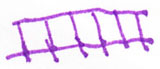
The trophy display I’ve won some sort of honor. Something flies into my hand, like bandages but with writing. There’s something like a trophy display on the ground that looks like a bike rack. It has several of these bandages attached. I got the high score in a certain category — the 2nd to get it. I place the bandage in the appropriate spot on the rack.
Then I’m back on the path. The vibrant blur is a girl, about my age, with reddish hair, wearing some kind of World of Warcraft armor, and she’s beautiful. We talk for a while. I’m enraptured. She tells me there was some Java code built into the awards device and that it was her voiceover back at the device. We talk about the path, about the horrible ghost image of some dark woman who could grab me and not release, cold like death, frozen in time. She says she can take those away, or generate similar ones. I ask her to show me how.
Challenger, Guardian: She’s a powerful soul. She seems to be challenging everyone that comes to her on the path, but I avoid her challenge, and avoid answering her questions, which would likely draw me into some subdream or distract me from the path.
I don’t know why I jumped out every time she attempted to ask a question. Perhaps I’d encountered her before.
-
Osiris the Dancer 2010 • 3:30 AM
Soon we are joined by the dancers — girls who are dressed in Persian style, in flowing silk, several who are topless. They are doing group circle dances in the center of the room, very close to us. Most of the men have dispersed or are otherwise preoccupied, so there are only a few watching, including myself. One with long red hair catches my eye and asks me if I want to join the dance. I become shy and say no, that I wouldn’t know what to do. Then she steps back from the group, regards me with a smile, and says that she has someone special for me. She leaves and then comes back shortly with Osiris. Osiris is gorgeous, dressed in a white topless outfit that had form-fitting pants and ribbon-like fabric flowing off the arms. Her skin is slightly darker than the other dancers. She comes up to me and there is this moment of unspoken permission and then a blur.
When I come to, I’m lying in the same position, and the party is over. I look down and I’m completely covered in drawings made and colored in with wet, sticky white chalk. My jeans are like shorts, reaching just up above my knees. I fold over the edge to see the inside and the same drawings are underneath the fabric in reverse! The chalk drawings are on my chest as well — everywhere I can see. It’s all in white, except for little edges of pink and blue. The drawings on my legs appear for the most part to be a pattern of finely drawn buttocks and thighs laid across each other, and then colored in. What had happened during that blur with Osiris? I get up and go to the door. It’s my friend, who is anxiously looking for me.
Osiris the Dancer: Osiris is a powerful and beautiful soul. These powerful souls can have intense effects on people. If only I could remember what happened during the blur!
-
The Revel of Ruby En 2020 • 6 AM
I just had a peak experience.
I found myself walking through a neighborhood with sidewalks and lots of green grass. Somehow I happened upon three young women. There was nothing overly special or attractive about their appearance. We were talking, playing, joking, laughing, smiling, feeling natural. They were headed to a dance club. One of them, I learned, was Ruby En. I’d heard of her (in dreams) before, in glowing terms, from Buttercup, I believe. Like, I had to meet her, she was amazing. We arrived at the club. It was built with wood inside — wood tables and chairs, a wood structure. It was busy, but we walked up to a table.
Ruby was going to perform “stand-up”. I asked some questions about it. I wanted to try it, I said. I was joking, but the moment she went in, I swirled in behind her. If there was a stage, I didn’t see it. She burst into the main room, carrying so much energy and charisma with her, and I don’t even know what she did, but where she went, magic followed — pure revelry. Music, singing, rhythm, dancing, colors. I was IN. I only spent the smallest time observing before I was singing, full-voiced, dancing wildly. I spun back to our table at one point. A black woman in colorful clothing and makeup came over to me and began to decorate me. Pink eyeshadow on the left, green on the right. I allowed her. Ruby En spun around back to me. She gave me personal attention, met my eyes. I was in awe. My smile was absolutely full. I beamed at her. We had a personal connection. She was interested in me, and I her. She drew me out into the revel again. From what I could tell, participation was total. Everyone was in their full expression as they creatively added to the music and dancing. Everyone was drenched in color, from colorful clothing to colors on the face and skin like Holi colors. And from time to time, Ruby En would return to me, smile that endless smile, hold my hands, talk to me, connect personally, and spin me back into the revel. I had a feeling that she had that connection with everyone there.
After some time, we left, and walked outside. I had this feeling that I had to return to work before too long. I decided to wear my revel clothing and makeup. But then I remembered that Travis had given me the afternoon and then a few days off. So I happily stayed with Ruby En and her friends longer.
She started a revel at another location — in a hallway underground, that seemed for utility, but before long it was the most incredible celebration you ever saw. It’s like the moment she was ready, she’d just begin, with a full-voiced, full-energy word or song as she moved fearlessly among the people, and she’d grab their attention and quickly raise the whole energy of the place until everyone was a part of it. And as before, she’d return to me, making me feel special to her, a growing personal connection, and my desire to spin out and express myself fully would overcome me and off I’d go.
And then we were at a new place. It was backstage with this huge stage before us, and smaller ones elsewhere, and she was ready to go out onto the stage, a lead character, and she grabbed my hand and said “ready?” I wasn’t, but of course I went with her, and I didn’t know what to do but dance as the music washed through me, and she and I danced across the stage, and I realized likely no one was watching — the stages were all full, all were 100% into the revel. There were no lines to say, no specific part to play — only pure self expression, release into the shared experience.
And then a question, and an answer. We shrink down, enter a hole low to the ground, and the revel begins among rhino beetles, undiminished in any way. As we depart I see her symbol, a stage curtain, wrapped in a rope around the middle, rhino beetles dancing or dangling from above.
I had to write it down. I’m returning to bed, hoping to see Ruby En again.
References: Ruby En isn't someone I know in waking life.
Utter Brilliance and Total Expression: Ruby En is a powerful being, a bright source of connection, inspiration, expression, and pure goodness. She presents as an everyday person, but her energy and power is world-changing.
This is my idea of heaven. I would follow Ruby En anywhere. This is the pure essence of what moves me, what feeds my heart and soul. What an absolute gift to everyone around.
The question I asked at the end was about if this effect was limited to humans, and she showed me how it wasn’t limited at all.
-
Creative Genius 2018 • 4 AM
The new movies! OMG so brilliant and fluid and colorful in every way. I absolutely revel in the frenzy of the chaotic story. Episode one was an hour long but compressed. In episode two I meet this character named something like Milo Longlastname (the first name had four letters). He had big brown curly hair, thick glasses, and was wearing a black shirt. At first I thought it was a girl. But it was partially a disguise. I talk and walk with him (and his female caretaker?). I ask how long he’s been psychic. She says how did I know? I said I am the same way. We walk in front of this old bar. He goes still, twitching. I know his mind is within the bar, painting every inch with his wide colorful brushes, an explosion of creative chaos, scenes over scenes, yet with one crazy narrative. After a couple of minutes he comes back to himself and we continue walking. I myself go into his scene, see what he’s done. I say I loved his influence in Invader Zim. I awake at 4 AM twitching, molten, stunned, and amazed.
The closest thing in waking life is the animation of Cyriak. But the story itself is just as wild and trippy. It was absolute genius of exactly the kind I love.
The opening sequence of W/ Bob & Vince, created by animation genius Cyriak. References: Invader Zim and Little Big Awesome are cartoon series.
A Muse: What a wonderful creative tornado! Perhaps this guy is a muse.
-
The Gods of Art 2025 • 7 AM
I remember seeing someone’s art in a graphic novel. It starred a goofy kid with a tall rectangular head, in cartoon style, mostly drawn with black ink on white paper. His story was told in the most incredible styles, and I loved it. It was so creative I went into it, and it was moving, flowing. I felt like I was hallucinating on it. But that was part of it. I was moving through the story. I was IN his story and expressing myself within it.
I came out of the story, back to the school. I said I needed to see more. This was a level of art beyond anything I’d seen before. I was hungry, ravenous for more. I was told the artist was coming. He walked up, his head was the blocky artistic head from the story, but it became normal-colored, then smoother, more human, but not all the way. I expressed my love for his art. He spread his arms and released a stack of art on clear paper to me, and I understood he made it for me. He moved on, and I looked through the stack. In it was myself as a character in his story, drawn in his styles, but in color. I was wearing my brown fedora, and I had long blonde hair and a green shirt. I was in his story!
Creative Genius: This guy’s art style is incredible and because it’s astral, it’s interactive. The way he instantly generates stories with me in them shows his skill. It’s odd that I had long blonde hair, but I do wear a brown fedora on occasion and my favorite color is green.
Disturbed Souls
Experiences in the physical can really twist up some people, who close to the flow and obsess about their negative experiences. They may think themselves into scary shapes and project frightful images of themselves. These are temporary states, and though they may go on a long time, they will one day come out of it and continue their journey of awakening and remembering.
-
The Madness 2015 • 4 AM
At one point I heard screaming from behind a staircase. Curious, I went to it, and though I somehow knew I shouldn’t, I opened up a set of three to four stairs that was actually a hidden door. A woman came out. I instantly knew her as a deeply crazy person, a person driven mad, and I regretted my decision. She had been trapped in there with no way out for a long time. Above the hidden door, I could see the bottom foot or two of what looked like a shower, with lights inside and a glass door. Inside there were 5-6 different versions of that same woman, in different states. One was pregnant. They were alternate versions of her, trapped in madness. This story was vaguely familiar to me and I wanted nothing to do with it. It was bad enough that I let her out.
Memories and Dread: My dream self knew more about this than my waking self did. It knew or was picking up the terrifying backstory about this person.
Nonhuman Spirit Beings
In the astral we may encounter nonhuman spirit beings like animals, fairies, guardian spirits, and things you’d never heard of.
Our Pets
-
How Do I Know That? 1996 • age 22
While playing in a yard with cats, Muffin came up to me, wise and radiant. She began speaking with me, and I felt so happy. I asked about Estragon, and found her. She was scraggly, fat, and ran away from me. But Muffin was so wonderful to see again.
References: Muffin was my first cat, and Estragon was my second. Both have long since passed on.
Cat Spirit: I wonder if that was really the spirit of Muffin. Since she was radiant and wise, I think it probably was. Thought-forms generally are dull and only act as you expect them to.
-
Walking Lucid in Midtown 1998 • age 24
While I was talking to Ama, I saw Cous-Cous and Smitten (our two cats) approach. They were totally loving, and I was holding them and petting them.
I left Ama and walked to the top of the hill that Tjo Street went along. The cats followed me.
My Cats!: I have no doubt that cats are adept dreamers, considering how much they sleep. Here my two cats accompany me on an out-of-body adventure.
-
Kitty Companion 2023 • 7 AM
A day or two ago, I noted that my cat Trixie was in my dreams. Then last night, I dreamed I was in “Decatur” (but it wasn’t) and there was a concrete structure that the city had just added a huge battery to. The battery was the size of a school bus standing on end. There was this crazy punk guy who had climbed up near the top of it (past the “no climbing” signs) and was licking this control panel. He was messing with it and everyone around was watching in horror. Trixie was in my jacket — this probably being a rationalization for her dream body being next to my solar plexus. She wiggled about a little as I walked. I thought that if that battery exploded, she’d probably claw me really good. So of course the battery DOES explode and smoke fills Decatur. Luckily Trixie doesn’t react and I run down some stairs and flee with everyone else, her staying there in my jacket the entire time.
There’s no physical side to her presence in my dreams. I sleep on my side with a body pillow, and she doesn’t like being in contact with anyone. The only waking possibility could be if she had meowed, which is rare. The way it happened, I think she was just joining me on my dream.
References: Trixie is my cat.
Kitty Companion: I’m surprised my cat and dog aren’t in my dreams more than they are.
-
Uncle John’s Puffball Mushroom Farm 2023 • 7 AM
So now I’m holding Finn over my shoulder and walking through the mall. The mall is playing music, and Finn starts singing along, in his strange doggie voice. I’m surprised. He sings the next part of the song, and I’m surprised he knows the words. “This is amazing,” I think, and I try to record it with my phone to show Buttercup later.
References: Finn is our dog.
Singing Finn: I was less surprised than I should have been. Truly, I don’t understand why my dog would be in my dream, singing.
Animals
-
The Turtle and the Eel 1994 • age 19
We were canoeing in the boundary waters with some friends, surrounded by a pine forest and clear water, watching the stars. The whole dream took place just after the sun went down and there were stars above in the clear sky. I saw a really big turtle surface and go down again. The turtle surfaced again in the dark water and I knew it was calling for me, so I jumped in and grabbed hold of it. My other friends jumped in behind me and swam along, following the turtle and me. As the turtle took me under the surface, it kept turning and nipping at me, but it never hurt me. It brought me to the bottom. I was breathing just fine and floating along with it. I could still see the starry sky up above. It was truly beautiful. Then the turtle took me and the others into this cave underneath the rock. Somehow it was lit up and easy to see. The turtle went back to its swimming and surfaced while me and my friends spent time in the underwater cave.
Meanwhile, some others were up above, looking down into the water, thinking us dead. Rather than show myself, I thought “If only they knew.” The others climbed out and up the rock cliff a ways. I exited the cave and went to the surface. Then I floated back down. Suddenly I wondered if I’d land on any weird sea-stuff, and I looked frantically around. A black eel-thing swam at me and attached to my leg. I poked it sharply with a stick and it partly came loose. I went to the surface and climbed onto the rocks. An orange cat bit the eel and pulled it off me. It ate half while the other half attached to its side. I tried to get it off the cat, but the cat wouldn’t let me near it.
References: The boundary waters are the lakes at the border of Minnesota and Canada.
Dream Beings: This turtle and cat seemed to be separate entities with their own missions and purposes. Yet the eel was certainly created by my fear of scary sea beasties.
-
A Great Love 1997 • age 23
There was this rocky cliff of tan stone by the ocean. It was a hard climb to the top but I managed it. At the top was an old house where the meanest redneck people lived. Memories of 8-tracks, tapes, and a mean basset hound came to me. The man there had tried to make me go away. I was returning to collect what was owed me. Somehow I wasn’t afraid. Their meanness couldn’t touch me. They owed me $100 worth of specific things and I was here at last to take it.
The first thing was this ragged old basset hound with a missing front leg. It was light tan and very wrinkly. When I first saw the dog, it didn’t take to me. It pulled back towards the house. The man came out and asked for $500 and I said we agreed on $20 before. $150 flashed in my head but I stayed at $20. He accepted, then went back inside. The dog began to huddle up to me. I wondered how many years it had left. I had asked if the dog’s leg had been gone last time I saw it and they said yes. The dog was trembling and seemed at times to be a Raggedy Ann doll of great value to me but worn out and old. We went up onto the ridge. The dog was pushing up against me and I was filled with love for it. I could feel it say “Thank you, thank you,” as it began to remember unconditional love. I held it so close and stroked it gently and it was effortless to give. I understood that its earlier meanness and resistance was because it didn’t feel loved or valuable. Now it did.
I wondered how I could take care of it. Would it have enough space to run with me and Buttercup in our trailer home? I saw in its eyes that love was what it needed, and that was enough. I went back down to the stones near the old house and met the man, his wife, and their older, immature son. The Wadsworth said “just sold the dog.” The son said “ya mean old bitch?” and looked over to the ridge. I knew then how much they had mistreated her.
The Hound: The dog seemed very much to be an independent being.
-
The Back Massage 2025
I’m in the woods, looking for more of the frogs.
I catch three. I showed someone, and they pointed out their vibrant blue dots. I learn that they’re very endangered, and Oberlin (?) has been doing a good job of bringing them back. I’m shown a rectangular hole under a tree root where these webbings of frog eggs are spread across, and I watch as some hatch and fall like bursts of rain. I want to help. One frog I’m holding communicates with me in my head saying it wants to go back where I found it. I put it back, though I have some trouble getting it there.
Animal Communication: I’d assume these frogs were thought forms, except for the fact that one is communicating with me.
Other Astral Beings
-
Most Beautiful Rain Fairies 1998 • 2:25 AM • age 24
This plant-like light green creature leaps off the edge of a balcony and hits a switch which turns on a sprinkler system. The creature flies over the tops of the trees and plants itself in the middle of the stadium, which is like a greenhouse now. All these rain fairies of every color and shape leap off the plants and fly and zoom through the air. Each is a different color and light as air. I am one of them. I think I’m red or purple. The rain keeps us flying and we swirl about and dance on the breeze. Our collective will keeps the rain falling. We perch on a grove of trees. Someone asks me “Wasn’t that fun?” and I say “Yuup!” I feel pure joy and we laugh. The rain has stopped and I ask “What happens now? How do we hide?” We’re slowing down and she says just grab the plant and rest. Then I wake up.
The flying was exhilarating! It was like a wonderful ride filled with such energy and fun. This was a most beautiful life. They seemed like plant spirits which come to life in the rain. This last repetition of the challenge was definitely a true dream.
Rain Fairies (Plant Spirits): What a wonderful experience. Here I get to become another form of life and experience things the way they do.
-
Uma Boga — The Tall One 1999 • age 24
I’m walking in “my neighborhood” and see a strange creature. It’s 8 feet tall, covered with black fur, and roughly human in shape. It has a small creature, possibly a baby, in its arms. I go up to it and cling to its leg. I want to know it. Its eyes are like ours, but the center lacks a pupil and is instead shaded from the top. I find her beautiful and open. Her name is Uma B-something, like Boga. I try to be her friend. She can roll her eyes back in her head and human ones appear. Before long she has clothes and her hair is less long and more like human hair. I am so fascinated. I invite her to hang out at my house. She won’t, so I walk with her. We go to a mall. She has a book of drawings. They’re really impressive — incredible depth, accuracy, and an odd style. More and more she uses her human eyes. There is a love growing between us — a free, warm flow. How could this be? I’ve just met her.
Was it earlier? We were walking through a hospital and they tried to drug her and make her more human. I fought it but she didn’t, so I stopped. It was near lunch at the mall. I told her I had to meet my girlfriend Buttercup for lunch. She was terrified. Somehow this meant betrayal to her.
What Is It: I have no idea what other sort of things could live in the astral. This was clearly a positive entity of some sort.
-
Oberlin Dreamfire and the Zombie Line 1997 • age 22
I opened the door hatch in the ceiling to a dreadful sight.
Student after student was standing in a big line, zombie-like. The orange flickering was everywhere. I knew it was too late for these people. It seemed like they were lining up for a nursery. I looked to the left and saw a small girl shining flashlights (or light from her hands) and thin beams of light from her eyes at me. It cut through the flickering orange light to fall on me and made me uneasy. She came to me and started speaking factually, unemotionally about what was taking place. She took my hand and slowly led me out of the building. Valentine, I thought, was following. I was so worried and caught up in everything that I missed most of what she said. As we got to the bottom floor I turned around and Valentine wasn’t there. I asked her where he was and her silent, stone eyes told me that he had joined the line up above. I began to beg and plead with her. She told me to stay right where I was and she would bring him. Buttercup and Paige ran up to me. Buttercup hugged and kissed me and I told Paige to wait. Eventually Valentine returned and we all ran out of the building frightfully fast. We were about to run into the next building and realized we had to stay under open sky.
“BENJI, REBECCA, ERICA, GERALD, GET AWAY FROM THE BUILDING!” I repeated the girl’s last message to me as we ran.
References: I lived in South Hall at Oberlin for a few years.
Incarnation Overseer: The girl stood watch, the only one who knew what this scene was all about. The light shining out of her hands and eyes indicated that she was a different sort of being than the other people in this scene. She recognized us as not being a part of this scene and helped us get out. Perhaps she recognized us as dreamers.
The line to the nursery makes me think this might have been a representation of the line for incarnation. The flickering lights would indicate the slower hypnotic frequency of the physical. But why the feeling of fear and dread?
Thought Form Automatons
Thought forms imbued with enough attention can last a long time, performing their prescribed duty of protecting, relaying messages, or even engaging in games.
See “Thought Forms as Gods, Ghosts, and Protective Spirits” in thoughts.php.
Messengers
-
Dream Girl 1995 • age 20
When she finished the song (this part is foggy), I looked deeply into her eyes for a moment. She returned my gaze. Then this gray wolf began to chase after her. She fled to a truck and the wolf leapt up to the window and spoke to her. I approached fearlessly and the gray wolf took off in a blur, darting into the distance. I went to the window and spoke to her. She was truly beautiful. She was short, had brown eyes, and light blonde hair. I asked if she was alright, she said “yes” and told me that gray wolves were only messengers of danger. Although she seemed to want to be with me, she implied that it wouldn’t be the best thing in the eyes of the wolf, (foggy, again) but that she wouldn’t mind my company?
Messenger of Danger: This seems like something from a fable. Strong belief in protective spirits can give them power in the astral realm. She ran from the wolf at first, so she must not have known it was a messenger until it spoke to her.
-
The New Apartment 2001
In the upper right of the horseshoe was this strange video arcade. . . . The games were strange and dirty and somewhat non-digital. A voice came to me describing this gambling game. I felt almost compelled to play. There was a crude thought-form man trying to run the game. If one of his numbers beat one of mine, he got the previous coin I played. Somehow I became really mad at him and was beating him up in this watery stoney pit. He was clearly a thought form at this point — buoyant, reactive but strangely so, dazed and unintelligent-looking.
The Gambler: This thought form seemed to have the ability to speak messages into my head — to describe the gambling game, and likely to play it as well.
Guardians
-
Underworld Guardians 2001
There’s a city. It’s “San Francisco” in my mind but a smallish metro area in reality. My house in the dream lies further away beyond some woods, separated from the town by residential streets. There are great gullies and ravines below the roads, filled with trees and shrubs, so that the roads form bridges. We called the areas under them the underworld or dark lands. Beneath that was a large corporation called the Golden Rhino, a reference to a gang in a video game I’d been playing. Forces were set up against me here. I kept going down into the lower areas and kept being turned back by people. They purposefully did all they could to make me lose my way. . . .
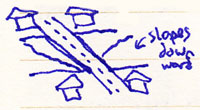
The gulleys under the road I’m at a neighbor’s house, asking questions. The sky quickly gets dark, and I end the conversation and run to my house. I mean to enter my house, but instead enter a red SUV in the driveway. A tornado comes suddenly overhead and picks up the car, whirling it about in different directions. I brace myself as it pulls the car through the woods towards the city. . . . The tornado drops me in “San Francisco,” with one of the guards watching over me. It’s a stiff, upright, floating figure with a dark reddish semi-transparent aura. . . . Finding Manville, Ruby, and Raven, I jump in a car with them and drive down a ravine under a road. Soon we find an opening in a rough rocky cliff and leave the car rolled onto its side on a ledge outside. “If I didn’t know this was a dream, imagine the distraction of this!” I thought, imagining the implications of physically reacting to this scene (surely a dream of car accident, rescue, and the financial implications of a car wreck — in short, a stupid dream, a physical expectation dream). But we leave it, walk into the inclining cave to find two rigid, distracting members of Golden Rhino, who hand us very interesting print-outs of waking-life topics. I call out their game in front of my friends. “They distract us and confuse and trick us in any way they can to keep us out, to keep us from knowing.”
The Misleaders: The guard as stiff, upright, and floating, and the characters handing out prints-outs are rigid. These defenders of the underworld are thought form guardians running on automatic. They use very tried and true techniques that would work to trigger and distract the waking self in order to derail the dream.
-
The Worst Way to Get to Narnia 2017
A security officer that felt kind of like an automaton saw me from higher up the slope and demanded that I halt. He was carrying a big gun. Instead of giving me time to come back up, he unleashed this big white and black tarp down the slope, making it more difficult for me to get up. I was pissed. This was unfair.
The next scene I recall is that I was back up at the top of the cliff and armed with a huge gun, and there were three automaton security guards pointing rocket launchers and other huge guns at me. There were people all around and there was no doubt I was going to die or be arrested.
Thought-Form Security: I got the sense that the security guards were automated thought forms by the way they acted. Perhaps they were trying to prevent me from leaving this area.
I have no idea what the tarp the security guard rolled down was — some astral phenomenon I couldn’t translate.
Gateways, Memories, and Subdreams
Gateways
A gateway is a passage from one setting to another through a picture, book, movie, or anything else which draws us in. In some cases, we are entering a rote (story experience). In others we’re just entering into a new setting.
We go through gateways when what’s on the other side seems more interesting or fun than where we are. We do this simply by focusing our attention on the gateway, and (mostly) forgetting where we are and what we were just doing. As our focus grows, we move into the new scene. Going through a gateway can be considered entering a subdream.
These transitions are done through phasing (see “Phasing and Tuning Consciousness” in movement.php). Attention shifts from our present location to the gateway, leaving a tiny part of ourselves (our phased attention) behind us like a foot in the door. We can travel from gateway to gateway in this way. When we exit a gateway, we return to the scene we came from. There are no limits to how deep we can go; we can go from gateway to rote to rote to gateway to rote, all without returning back the way we came.
Should our attention be drawn too entirely into the new scene, we may literally lose our place in the previous settings such that we lose the thread and forget where we came from. We can still return there later, but not the way we came.
I’ve returned through several rote gateways, but I don’t recall returning through location gateways.
Location Gateways
Location gateways take you to a new location context.
Pictures
Picture gateways includes posters, pictures, cards, and maps; things representative of a place rather than a story.
-
The Lava Trail 1996 • age 22
I was looking at a very long picture on the wall. It showed this trail of glowing rocks, suggesting an unseen river of lava. The rocks looked like glowing salt crystals with red and yellow lights in the center of them. I was fascinated and went into the picture. I was walking along the path among the rocks.
Picture Gateway: My fascination with the picture of the lava trails caused me to go into the picture gateway.
-
Under the Earth: Guardians 1996 • age 22
I go to get some Guardians cards. . . . I end up with about 16 packs. . . . Then we’re at the ocean. I’m sitting on the warm sand, opening some packs. The cards are cool beyond description, all ones I’ve never seen before, fun and powerful. . . .
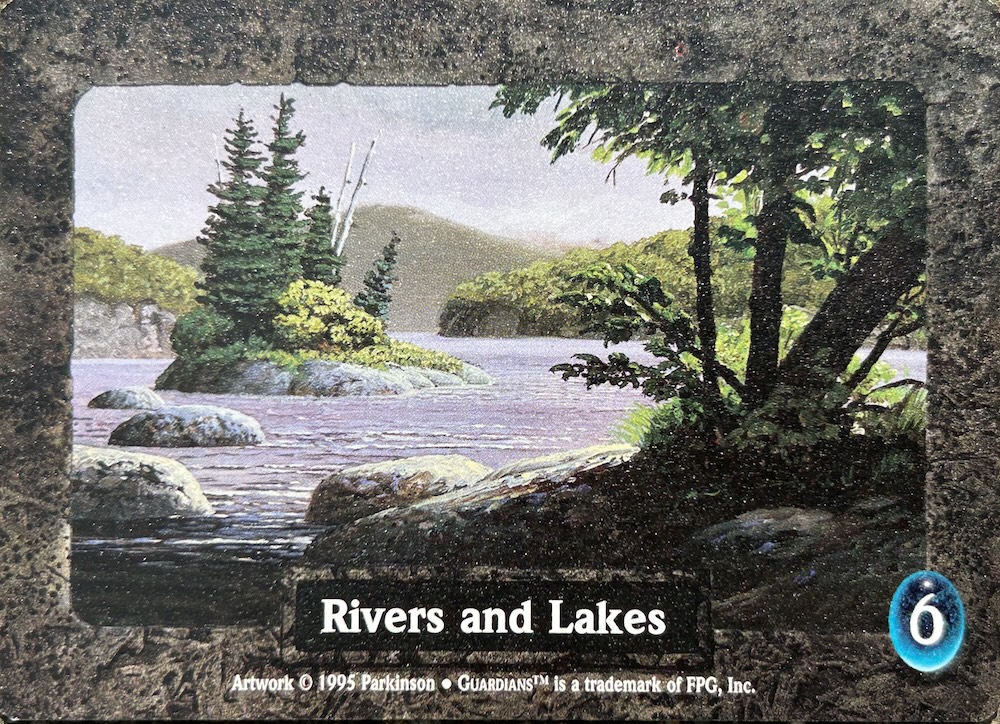
A land card from Guardians 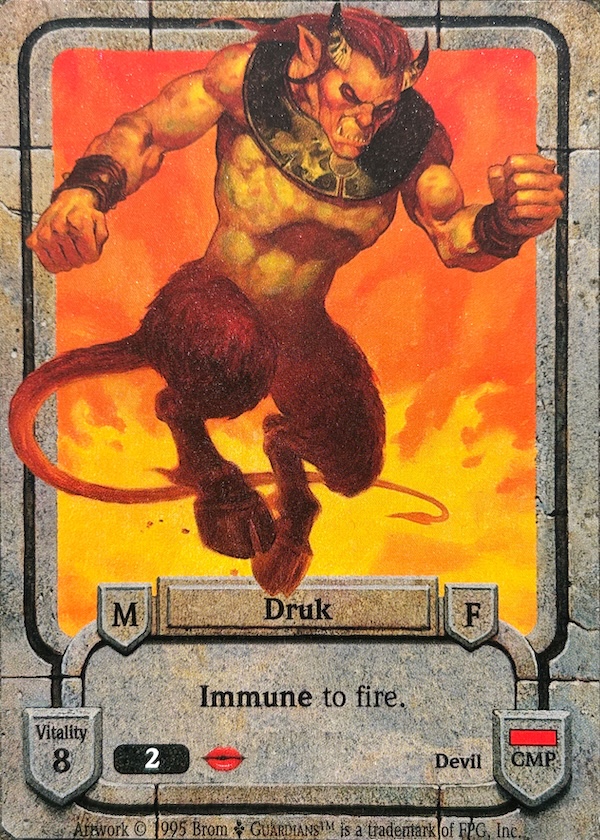
A demon card from Guardians 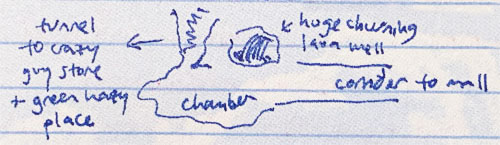
The lava chamber and passages out After getting some great demon cards, I appear underground in this corridor with Buttercup and some others. It’s lit by this immense lava flow in the room just beyond us. The lava flow is going crazy, flowing rapidly through the room. The sound is deafening and everything has a deep, flashing red tint.
References: Guardians is a collectible card game.
Card Gateways: The cards might be how I got to the ocean, but I definitely went to the underground lava chamber through the picture on a demon card. The ocean may have transformed into the lava flow.
-
Map Gateway 1997 • age 22
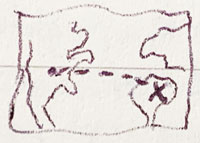
Map that acted as a gateway I look at a US map. I see that some pyramids and a sphinx are near San Francisco and I mark down that I want to visit them. . . . Maybe we had arrived in San Fran, but wherever we were we were searching this area of hilltops for a home.
Oh! Upon further reflection, I think it was the US map with pyramids and such that brought me to San Fran.
Map Gateways: Maps are great gateways. Making plans for a vacation? Focus on the destination on a map, dive down into it, and there you are.
-
Enlightenment by Fire 1997 • age 23
I found a small mouse and picked it up. It began talking to me. It suggested I go back to the fire shaft, a place I was familiar with but hesitant about. I had four cards in my hand with different pictures of the inside. The structure was white and had a pillar with flames in the center. Around it were some wood spokes, perhaps? Anyway, I opened the heavy door to it and left the mouse outside.
Gateway Cards: I’m holding cards that I can use as a gateway to the fire pillar. It’s likely I was viewing memories of the fire pillar which I translated into cards in my hands. I could have skipped the card step and just gone there through my memories.
-
The Dark Tower Tour 2000
I had left my companions behind in the lower rooms, and there were only children in this room. They encouraged me to escape something by entering a tiny picture on the wall but I was having trouble using the gateway. At times it would begin to enlarge around me but then I’d pull back.
The Picture Gateway: The children’s suggestion of escape through a picture reveals their knowledge of dream gateways. Were they dreamers as well? How interesting to see me engage then pull back when trying to use the gateway.
C.S. Lewis uses this kind of dream gateway in The Voyage of the Dawn Treader.
The painting gateway — the zooming in is all that is required (the movie gets it wrong after this scene). Video credit to the movie The Chronicles of Narnia: The Voyage of the Dawn Treader
This same effect can happen from an OBE perspective, as Peterson discovers:
I went to go through the wall into the lounge, where there was more light, as it was pretty dark in my room. Suddenly I was in a strange world. “Where the hell am I” I thought. There was very dim light and there was a damp fog all around me. There was a large building in front of me with an old fashioned thatched roof. To the side of me was an old rail fence made of massive, rough hewn timbers. I leaned against the fence and thought about it all. I looked past the house and saw the reflection of water. There was a lake on the other side of the house. . . .
Then it hit me, why this scene was so familiar to me, I was in a picture! I have a large picture hanging on the wall in my room, in the exact position where I had tried to pass through the wall. This picture has an old house with a thatched roof and a rough hewn fence around it. There is a lake behind it and it is early dawn, when the sun is just starting to illuminate things. There was no doubt about it, I was in my picture.
I’d had enough of this, it was too dim to enjoy the projection, or to do anything. I focussed (sic) on my physical body, which I could still feel. I concentrated on moving my mouth and eyes and this soon brought me back to my physical body. . . .
Within a couple of minutes I was back out of my body again. “This is great,” I thought! I hovered above my body and looked about the room. There in the gloom was the picture on the wall, the one I had entered by accident. I went towards it again, just to see if it would happen again. As I got closer it got bigger and bigger and I seemed to shrink into it. As I got right up to it, instead of passing through it, I seemed to move into it and there I was again in this dimly lit, damp world with the old house and the fence. Everything felt real about it, the fence felt like wood and even the air smelled different, it had a farm like, swampish smell about it. ToPOBEr • modern • Bruce
Miniatures
Moving into the size context of miniatures is a different sort of gateway. We end up not in another place, but at a different scale. This can occur through focusing on action figures, models, toys, and board games. See “Changes in Scale and Perspective” below for examples.
Mirrors
Light does not reflect in the astral. When we encounter a mirror, our expectations might project a reflection there. We can cross through it into a reverse version of where we just were. This takes us into a fantasy world.
Rote Gateways
We enter into rotes (recorded story experiences) to experience them. This makes them a type of gateway.
Books
Rotes can take the form of books. We can enter the book as a whole, or in the case of comic books, graphic novels, and illustrated books — we can enter through a specific picture gateway.
Libraries and comic book stores are places filled with gateways in the dream world. And, in a way, the physical world as well.
-
The First Gateway
Enter building. In shopping center. Look for Transformers 16. Brought $1. Find & buy. Read. What’s inside vividly happens!

Transformers comic book Comic Book Rote Gateway: My first experience of a gateway was in my earliest written dream at age 9-10, where I go into the action in the Transformers comic book.
-
Elfquest Endtimes 1997 • age 22
While looking through [boxes of comics], I found an Elfquest book Buttercup had given me. In the story, the elves are much older. Cutter and Skywise are looking through the hedge and a thousand swan ships are becoming visible in the ocean beyond. It’s all the tribes gathering. The sky is brownish red and heavy and some horrible thing is happening. Cutter demands that only the young survive and all the adults begin to throw themselves to the sea.

Cutter and Skywise from Elfquest Image credit to Wendy & Richard PiniReferences: Cutter and Skywise are characters in the Elfquest series.
Book Rote Gateway: The Elfquest book acted as a gateway to a story rote. This is one that I’m watching rather than participating in. I wonder if that’s more often the case with books.
-
Elfquest What If 1997 • age 22
I was reading Elfquest, and when I asked “What if the Wolfriders hadn’t turned this one way and met the others?” The answer was “Someone else would have,” and I jumped into the action — a frozen tundra. The wolfriders went the other way.
References: Elfquest is a graphic novel series which features the Wolfriders.
Gateway to a Rote: Here’s a great gateway caused by curiosity. A quality of rotes is that you can make different decisions and take different paths.
-
Fantastic Solstice 1997 • age 23
The walls were filled with books and I picked up and read one called “Solstice”, thinking that 1) someone took my name, and 2) that it was The Lord of the Rings (LotR). In fact it had nothing in common at all with LotR, though I didn’t realize it at the time. I read a little at a time, and wanted to read more so badly that I started interrupting later parts of the dream to return to it. I read a little at the table. . . . Every other page was a big splash picture that, of course, I went into. It seemed to start with a part called “The Dragon Pits”. It seemed we were going to go deep into them for a treasure, but it ended up being a tower. We were seeking something like the “true jade” that was only ever used to make book pages. All around us near the opening were merchants selling rainbow-colored crystal idols. I was the hero in the story and there was a mentor with me.
References: Solstice was the name of a BBS I once had.
Rote with Backstory: The book contains a series of picture gateways. As I enter the story, it comes with information — background story and direction. I also become the hero of the story. Since these are qualities of rotes, then the book must be a rote where the pictures are gateways to certain parts of the story.
-
The Book of Dreams 1997 • age 23
I was studying this big book of dreams, finely illustrated. . . . I think I went into the cover picture as I descended slowly (I thought I was sky diving) onto a beautiful snowy mountaintop. I was with someone, and we were going to ski or something.
Gateway Transition: As I descended into the picture, I descended into the scene. This shows a gradual transition between contexts.
-
The Superhero’s End 2011
It became so bad, this tiny world so infested with superheroes that couldn’t get along that a group of them/us decided to go back in time to the Golden Age of superheroes and nip it in the bud. A group of the most nasty, destructive superheroes were gathered together. One was pure black and could dissolve objects into nothingness. There was Venom, insane with rage, and several others.
I don’t recall if there was any transition into the past, or if it looked any different, but we set about going to comic book stores and just destroying everything that had to do with superheroes, to the horror of the people working there. My own destructive powers were meager. At one point I saw a kid reading a comic book at the counter. I looked over and it had this classic super-powerful superhero fighting against and destroying our group. The kid wanted to buy the comic, so I said “If you let me have it, then that superhero will actually come here to fight them. Either read about it, or it can actually happen.” The kid handed me the comic and I began paging through it. It became a gateway, and that superhero in green started attacking and destroying the dark heroes that were sent back in time. In a moment of panic, I realized that included me, and I escaped down a long hallway in the back of a shop.
References: Venom is a nasty evil spider-man villain.
Gateway to Doom: Here my Dream Self shows a strong understanding of gateways. When I went through the comic book gateway, I seem to have entered a nearly exact copy of the originating world, but with the addition of the superhero in green fighting us.
Video Media
Memory or story rotes may take the form of video media, including movies, videos, TV, and video games. The box for a movie or video game can also act as a picture gateway into the rote.
-
TV Road 1997 • age 23
We come across a video billboard (it’s simply a large TV in the mall). I get enthralled watching this hilarious Popeye sketch in The Best of Saturday Night Live. Raven gets mad waiting for me and I decide to just forget the trip. I look back at the TV, which has this woman in a hot tub, and I travel into the scene. This is rationalized by me “remembering” that I traveled there by bus.
So I’m in the room with the hot tub. . . . There’s a cat in the middle of the tub half drowning and half repeatedly scratching like a robot. The woman is pretending she’ll take off her bikini top to tease the viewers. The joke is that whenever I try to get to her, there’s the cat’s paw in the way.
References: Popeye is an old cartoon/movie.
TV Gateway: Here I travel through a TV (which is also video billboard in a second context). Oddly, I arrive at the set of the show they’re filming.
-
Kissing Melody 1997 • age 22
Then Buttercup and I returned to our room and she threw me down kissing me but I prevented myself from enjoying it. Soon I tried to escape into an advanced Quake game Brendan left on my computer (with his monitor). It was horrible — I was deep in the catacombs fighting against this huge nasty monster. Finally I put an end to it, didn’t care if I won (new mindset!) and got back to the dream.
Gateways into Fantasy: Here is another great example of going into a gateway, and then returning through it. The reason this time was that I was trying to escape my guilty feelings. In dreams going into a gateway can be an escape just like reading a book or playing a video game in waking life is.
-
The Best Video Game Ever 1997 • age 22
I’m in a toy store with this boy, looking for WarCraft 2 Expansions. Instead, I find Zelda for Nintendo 64, so I pop it in and start playing. There’s a number of selection screens asking to select view, asking if you like the Co-op Bookstore or not, and other options. Finally it started. It showed a sloppily-rendered world overview, and you scrolled down into the city you wanted. At this point, it became real.
We went to a big castle.
References: The Co-Op Bookstore is the bookstore at Oberlin.
Video Game Gateway: The act of playing a video game involves going into it, becoming the character. This happens through imagination in waking life, but without the constraint of physical reality locking us into our bodies, it happens literally in dreams. Our language reflects this, too. We “get into” a book or a game. That choice of language comes from our nightly experiences of dream gateways.
There has also been over my lifetime an evolution of video games from 2D areas to immersive 3D worlds, bringing them closer to what we experience naturally in dreams.
-
Tribal Gore 1997 • age 22

A Star Trek VHS tape There is very often a journey to Blaine House in my dreams — driving past the soccer fields and stopping at convenience stores and the mall on the way, all of which I did last night.
At one point, I must have been in a movie store because I fell into this Star Trek movie. The setting was very much like a space station. It was a lot more intense than the actual movie. There were more weapons, including wave guns that disrupted you and knocked you over. Strangely, I saw the holographic spirits of the dead from the last dream. There were shapeshifters and androids and lots of intense action.
Memory Impinging on Fantasy Rote: Going to video rental stores became a regular thing during my later years at Blaine House. The Star Trek scene was most likely me unwittingly using a movie box as a gateway. Imagine me standing in front of a video box, just staring, lost in a dream about it. The strangely sober and real story of the tribe from the earlier dream stuck with me and these “ghosts” returned through my memory, which I interpreted within the context of the new Star Trek story.
I consider this a video rote because it’s actually a video tape I’m focusing on, meaning it’s a story rote, even though I enter it through the cover.
-
Hazel’s Wedding 2009
I’m sitting against a wall. Hazel and her husband are across the way. He feels bad and indicates that he’s sending me a text with his phone. I wait and wait and then it arrives on my phone. It’s a movie of Hazel and him biking fast on these narrow cliff paths in another country, by the sea. It’s dry and there are people around. Soon I am with them in the scene and I thrill at the ride.
Modern Gateways: This is my first time catching a rote in the form of a video text (though there have been more since)! His video text acted as the gateway to the rote. I went into it and experienced it with them, or possibly as one of them.
Of course the phone and the video text are rationalizations of Hazel’s husband directly sending me a rote.
Web Sites
The web is the latest form that rotes can come in.
-
The Real Office 2010
We begin talking about the real characters The Office is based on. We were looking at pictures of them, as if on an iPad in front of us. I only remember that we’re walking down the sidewalk, then standing and looking at a web site with pictures and text about them. . . . Then there’s a transition to the girl who Minnie is based on, though she was blonde and looked totally different. This becomes a story about her — she’s the main character. I inhabit her at most times but am sometimes outside watching.
References: The Office is a TV series.
Web Gateway: We were standing there on the street looking at Minnie’s picture and information when I went into her story. The web site is the gateway to the rote. In this case, the text seemed to draw me in — the story.
See also “Rote Gateways” above.
Without Rationalization
-
The Observers 2015 • 7 AM
One of the siblings asked a question about evolution. In response, they went through a thought gateway into a wide grassy field to look at and study these different animal versions of themselves — monkeys and horses, I think.
A Thought Gateway: The dreaming siblings open up a gateway to another place to answer a question one of them has. This is unlike most gateways in that it is intentional, and without any kind of physical rationalization.
Importantly, I’m an outside observer here, watching the dreamers from outside their dream structure. Perhaps from this perspective I don’t see their projections and rationalizations.
Subdreams
A subdream is a dream within a dream, whether through a gateway, rote, or just zoning out or falling asleep within a dream. When you stop and think in dreams, you will usually go into a subdream.
Imagine you’re walking down a hallway and you see an interesting poster. You stare at it, and it becomes a gateway. You enter it into a subdream. As you finish that dream, you reappear in the hallway by the poster where you left off and continue along your way.
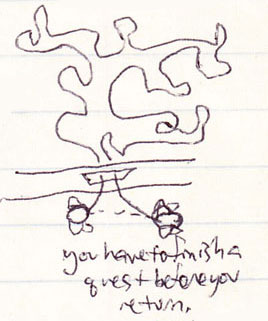
Reveries
Just like in waking life, things can get boring while traveling or waiting for something in dreams. We can become lost in thought and daydream, or occupy ourselves with our phones where we can communicate, play games, read stories, or watch videos. At these times we can call up some entertainment or invent some drama. When we do this, we go into a reverie subdream.
The only difference is that in dreams the transition is complete — we become fully present in our distractions for a time. Then we return to the scene we were in previously.
These reveries are not necessarily private. In a few situations I remember someone watching one of mine, or joining in one.
Full Reveries
Full reveries happen in a little internal world, usually unrelated to our current context.
-
Bedroom Singalong 1997 • age 22
The black guy who frequents Irene’s is sleeping next to me in my Blaine House bed — a thing I found quite strange. My bed had white sheets, the breeze was blowing, and the room was fully decorated. The guy was singing great music with me, soulful and inspired. . . . Then I remember swimming in a secret world in Mario 64. It was in an underwater supermarket with lots of eels. I had to swim through 10 rings. I guess this was in my room — he was watching me play, impressed.
References: Irene's is a cafe in Oberlin where I worked.
Video Game Break: It looks like my reverie subdream of playing a video game is visible to this guy, as he’s impressed by my skills. This is likely due to our ongoing connection. In an earlier part of the dream, I could see his girlfriend appearing in a telepathic window.
-
Consciousness Research Foundation 1997 • age 22
I was staying in some residential area. There were cool, different houses with lots of greenery. There was some trip with a bus to this movie and Buttercup and I decided to go. We got in the bus and the driver woman started this big collection process. It was $15 for Buttercup, because it was her birthday (it wasn’t actually) and because it included a lunch bag and drink. It was $36 for the rest of us. I wanted to see if the bus driver would accept less, so I waited until the end to talk to her.
While waiting, I was playing live-action Marathon with Lance L and some others. They knew the board well and eventually kicked my ass. The setting was some darkened business offices, shifted to morning light blues and purples. Lance was playing out some crazy story as he played. One weapon he had was a baby head that spewed oatmeal.
I returned to the bus driver, who asked if I paid. I said no, then talked her down to $6.50. Then we’re driving around, seeing sights.
References: Marathon is a video game.
Subdream While Waiting: In the original writing of this dream, I wondered what I did while waiting for the bus driver to collect money from everyone else. Then, immediately after, I wrote “There was some inbetween dream . . . ” describing the Marathon game. The scene change was so unrelated that while I knew it had just happened, I couldn’t place it. But it’s clear now that while waiting, I went into a reverie subdream.
-
Counselor Travolta
He tells me to take the pills and lay down and close my eyes and tell him what I see. I close my eyes and the images that arise are bright and filled with glowy white light. There’s a car driving all over this pretty field, repeatedly running over Meg Leonard who was riding a bike.
Reverie Subdream: What an odd vision! I have no issues with Meg Leonard or John Travolta whatsoever, and what seems to be a higher realm has a twisted aspect to it.
-
Sexy Alissa Milano 1997 • age 23
This took place on the beach. I just was standing there having this fantasy and it got more and more real and I went into this other world, like a little sphere around me.
Reverie Subdream: We can just up and go into a fantasy without any corresponding external stimuli. We can just be standing there and zone out into another dream.
-
Taciter 2025 • 8 AM
I’m reading a black and white line-drawn comic about some animal gods coming out of hibernation to train someone. One goes to an old man named Taciter to complain that another isn’t doing their job.
I seemed to also be driving a black SUV back from the place where I had been dreaming. It was as if I was at a traffic light and reading the comic while waiting to continue. As I drive, I miss my left turn and do a u-turn to get back on track.
Road Trip Entertainment: These cross-country road trips can take some time.
-
A Hitchhiker from the Hospital 2010 • 1:30 AM
I’m in a patient’s room in a hospital, on something like the 12th floor. I’m standing at the side of a table. Off to the side in an adjoining room, sitting at a table is Wadsworth. I’m talking to him openly about my health. I just started using Tramadol again a couple days ago after weening off it several months ago. He was telling me some stupid made-up horror stories about it that I was debunking. In the meantime, I had closed my eyes and, while the conversation continued in the hospital room, I was in my kitchen scrounging at the bottom of the countertops on the floor looking for lost pills to refill my bottle. There were just insane amounts of pills down there of every kind with only a few tramadol here and there. Eventually full bottles of things began to appear among the pills all over the floor, and then it was mostly bottles. At one point, I felt a sharp pain on my finger and realized I had pricked my finger on one bottle that had come with a syringe attached to it. That caused me to come back out of the scene and back to the doctor’s office. I’d been continuing the conversation the whole time.
Double Context: How interesting that I can close my eyes and have this subdream with a location change while continuing a conversation in another location. A likely scenario is that Wadsworth had said something about becoming a junkie scrounging for pills and I was imagining it.
-
The White Snapdragon 2023 • 6 AM
As I continued to examine it, I saw that it looked like a snapdragon flower as big as my head. . . . I put one hand inside it like a puppet. This was a mistake — it came alive and bit my wrist, leaving a little spore of some kind lodged there. I hoped I had not reinfected myself with it, whatever it was.
The dream then turned into a plant-based zombie story. People were coming after me, people with plant-mutated bodies, trying to bite me. The people were overgrown with unfortunate additions to their bodies of all colors. I ran, hid, fought.
Off Into Fantasy: The fear of the spore infecting me turns an interesting and true examination of my etheric body into a fear-based fantasy story.
Reverie Projections
Reveries don’t always take us into an entirely different scene. Sometimes they are little bouts of imagination projected out into our current context.
-
Two Dogs 2024
Buttercup and I had decided to get two dogs — a Emma and her puppy. They were light brown, medium-sized dogs with long hair. We went to this crazy place to make the final arrangements. It was a couple’s house, but it was also the king of roadside attractions, as you’ll see. When we first arrived, it was just us and the lady. She was a pretty ordinary looking country lady. She invited us in and we walked down some stairs. She was getting us some stuff for the dogs. She went into another room. The kids were with us now, excited about the dogs. I began to hear a hissing sound. I got the feeling it was a snake but didn’t see one. The mama dog was interested in something under the couch. After not being able to see what it was, I think I looked THROUGH the couch and saw the snake — it was a black, yellow, and red striped one that I thought might be dangerous. I called out to the lady. It bit the dog on the paw, but the dog didn’t react. I reasoned that maybe the snake just bit the dog’s long hair. This whole scene with the snake may have been a rationalization reverie.
Anyways, the lady returned with some various-sized bottles of milk and other supplies which she gave us.
Snake Attack Reverie: I imagine a snake to make sense of the hissing, and have a little reverie subdream about it. What I imagine happens in my head only, and doesn’t affect the dog or the plot of the dream at all. I then rationalize the lack of effect of the bite on the dog.
It’s exactly the same sort of reveries of imagination we go into while awake, except in the astral we see it happening before us, and we can get completely sidetracked by it.
-
Two Dogs 2024
The grassy fields continued for a few acres before ending in trees. People were scattered about there, and the atmosphere was excited and expectant. Something fell from the sky, and one group of people ran over to get it. I wondered if it was a satellite. It was blue, mechanical, and about the size of a soccer ball. After this I think I went into a fantasy where a much larger satellite fell.
Falling Objects: After seeing a small object fall from the sky, I naturally began to imagine (and experience) what a larger one would look like. This is the second reverie I had in this dream, in addition to zoning out earlier when watching a boring demonstration.
-
Colorado Volcanoes National Park 2024 • 5:30 AM
The volcano was continuously erupting hot smoke and debris like a blast furnace from an opening that was maybe three feet across. The lodge had windows right beside it, allowing for an amazing view. A ranger said it was the second most powerful volcano.
As I watched the impressive eruption, I imagined (and thus saw) chunks of black rock raining down from above. At first they were small sprays of gravel but then larger black rocks came down. They came down inside the building, ignoring the ceiling. I dodged about to avoid them. Some came down on this stairway and I imagined (and thus saw) them rolling down the stairway in such a way that it was like a video game challenge. I went up the stairway dodging the very real (to me) volcanic rocks.
Done with my little fantasy game, I looked around for the others but couldn’t find them.
Imagined Drama: One’s imagination can always spice things up. Here I introduce danger and turn my environment into a live-action video game. I’m becoming more aware of when I’m doing this, and not taking it for objective reality, but enjoying it for a time. The result of this awareness is that I don’t get emotionally involved with fear, which would derail the larger adventure I’m on.
-
Colorado Volcanoes National Park 2024 • 5:30 AM
I ended up driving up the wrong path on my own where I saw three wolves. Cool! But I quickly backtracked before they noticed me. I soon ended up on another wrong path where some wolves saw me and came after me. I hid in these big white bones, going out of my body to watch them attack me. The wolves were weird — they were floating; thought forms created for drama. I tricked them or something then returned to the drive.
Some Light Adventure: This was a low-level imagination reverie. The wolves I created were coming after me, but I wasn’t trying too hard to make it seem real.
-
Passion and Liftoff 2000mature content
I went to this odd, out-of-place room. Inside was a friend and two gorgeous naked girls laying on these pillows, facing away. I was overtaken with this strong sexual passion and made some verbal attempts at seduction. What it was is that I was outpicturing to one of them scenes of how nice it would be. So then I was floating above myself, embodying the imagery, with her vaguely above me. We began doing it, but she became less and less important. As I moved, I felt these golden waves going up and down my floating body from my feet to my head. It was ecstatic, orgasmic but sustainable.
Into a Communication: I begin by attempting to communicate by telepathic imagery. But my attention on the imagery pulls me into it, and I find myself floating above myself. Imagine a cartoon thought bubble with the imagery, and then imagine me embodying the self up in the thought bubble. It expanding out around me as I go into it.
As I’m actually alone in this projection, the girl fades out as I focus on my own sensations.
-
Hyperspace Reunion 2000 • age 25
I meandered through his apartment alone, then turned a corner to hear people down the hall. I went down the hall and greeted a large family who I took to be Oscar’s wife’s or girlfriend’s family. They had three baby seals (last night I imagined how Isobel would look like a seal if she only had front legs). The baby seals were cute but I had this real thought form fantasy of a huge mother seal coming to protect them.
References: Isobel was our new puppy.
-
Mountain Removal Mine 2011
I come to a place where a trickle comes out of a medium-sized hole in the earth. A story comes into my head of how some kids throw explosives into it and it kills fish that come out, which they catch. There’s an amusing imagination scene of a kid trying to grab a sunfish and the sunfish keeps trying to jump past him but getting slapped down. Eventually, it makes it past him and into the lake.
Reverie Inside a Rote: Where did the story rote about the fish come from? Was it associated with the hole in the ground? Once in the rote, it appears I imagine up a funny scene (reverie) related to it.
Our ability to creatively engage is unhindered by where we are or what we’re doing. We have the same creative capacity inside a rote as outside it.
Being Given Anesthesia in a Dream
-
My Daughter, Me 2009 • 2 AM
I’m in a sparse bed in a dimly lit hospital with some unknown Native American woman. It’s time for me to give birth. The doctor explains that the Native American woman will be unrelated to the child. Then they put me under. I go into a dream, where I find myself in the same place and position. I move slowly, aware that they’re operating on me and that this is a dream. My abdomen feels sore and I’m careful with it. I wonder if the baby’s genetics are all mine. Then I decide to pass the time by playing with cards, and the scene changes to a sidewalk in a neighborhood in summer. I’m still in the same position. I organize the cards a bit, then I feel myself come back to the hospital room.
Anesthesia Subdreams: This is a good example of a subdream. Was it truly caused by the doctor putting me under or just the suggestion of the doctor wanting to put me under? Either way, I clearly remembered coming from the hospital scene and then returning to the hospital scene when the subdream was over.
How interesting that my body remained in the same position in the subdream, while my surroundings completely changed.
Unknown Gateways
Sometimes the specific gateway is forgotten, and we just remember entering a subdream, and possibly also returning from it.
-
Super Hero Lava Pool 1995 • age 20
We play football and volleyball. (foggy) Then I go exploring underground with GenX. We enter this immense rectangular metal room where the floor is entirely lava . . . [there’s a whole story with superheroes and lava]
The guy who wrote the story writes to Marvel and says “There. Now stop writing your crap.” I go out above and find Sid and the others still playing volleyball.
References: GenX is a Marvel superhero team.
Gateways to Rotes: The gateway here wasn’t clear, but evident in that I left the volleyball game to experience the superhero story and afterwards I returned to the volleyball game. It appeared to be someone’s story rote. If you don’t remember the exact gateway, sometimes you can catch it by watching yourself return to a dream after a subdream.
-
Mountain Removal Mine 2011
We decide to stay in this hotel. . . . The older sister suggests some sort of sensual get-together. I’m busy with something and don’t get involved. . . . At some point (maybe this is what I was involved with in the room), I was in a World of Warcraft raid, substituting as DPS, but it was in a place I’d never been before. It was an intricate city in the desert style of Uldum. I could run down this tube, where gravity would hold me to the sides, and then follow the edge out into a new area, where there would be tons of mobs and more intricate city scenes. I caught up to the group and started to join in a boss fight, but found myself unprepared and weak, which is what I would be at the current level of my characters.
References: Uldum is a region in World of Warcraft. DPS is a damage role. Mobs refer to bad guys.
Warcraft Subdream: I’m in the hotel room, playing World of Warcraft. The game is a subdream inside the main dream. I was able to hear the request of the older sister from within the subdream. It’s like the game in waking life — you step into another world for a time, but are still aware of the world outside of it.
Memory Rotes
Memory rotes are a hugely important part of dreaming. Engaging with them makes up a significant portion of our dream time.
See “Sharing Memories” in communication.php.
Scene Transformations and Transitions
Imagine, if you will, that someone is distractedly watching your waking life. They’re watching your whole experience, not differentiating between the sources of that experience. If someone were watching me, for example, they’d see me get out of bed, do my morning routine. But my attention would barely be on that. Instead, I’d be focused on thinking about that scene at the party in the book I read the night before. They’d see me reliving it, and imagining telling my wife about it. Downstairs, while eating breakfast, I go to a website on my phone and watch a video about a festival in India. In my mind’s eye, I appear to be there in the action. Now I put my dishes away, talk with the kids, then play a video game where I’m a gun-bearing warrior in a wasteland. This watcher is unfamiliar with physical life and doesn’t understand the transitions. I’m just appearing suddenly in different places, as different people, doing wildly different things. Now I ride a bike to work through forest and city scenes. I see someone at work who tells me a story about their trip to Glacier National Park. They show me pictures and videos. I feel like I’m there. I recount an experience I had while there, reliving it mentally. Now I’m writing code on a computer, flashing back and forth between screens of code and the resulting web pages. I return home, and while having lunch I read a chapter from a graphic novel in which a group of people is exploring different dimensions. My waking self knows these transitions well and connects them to their different sources — videos, stories, books, games. But to the watcher, my inner experience changes wildly from time to time without explanation.
This is how we perceive dreams. Catching and understanding the transitions are key to understanding them.
There are several reasons for the scene to change, including passing through gateways, going into (or coming out of) a reverie or rote, sending or receiving communications, travelling, or simply thinking about something new. Scenes can also change outside of these circumstances. They can change in place (transformations) or change to an entirely different scene (transitions).
The astral world is incredibly responsive to our thoughts, and takes the form of our thoughts almost instantly. This responsiveness is at odds with our physical belief in object permanence. Without that belief, when our attention turns from something, it would instantly cease to exist for us, and what our attention turns to would snap into existence before us.
Typically, scene transitions and transformations require a break in the continuity of our perception to overcome the expectation of object permanence. This break in perception can be due to an object in the way, such as a wall or door, closing our eyes, turning or spinning around, turning a corner, passing through a doorway, or simply leaving and then returning. Of course nothing actually impedes our perception, but these are all physically familiar triggers that allow for a change of scene.
The shortened context of being closer to the now in the dream state helps this to happen. We have to be able to forget what the scene was a moment earlier. Otherwise our memory would span the gap and our expectations would cause the scenery to remain the same.
We can be anywhere instantly if we desire to and know how. It’s only physical habits that hold us back.
Different dream places fade in as I change my focus from thought to thought.
Object Permanence
Things remain the same in dreams because we expect them to. This is the expectation of object permanence we learned by living within a physical body. For our environment to change, we need to either travel in a physical way to someplace new, or we can interrupt our perception of the scene around us, allowing a new one (or a changed one) to take its place.
Breaking Continuity
Breaks in continuity (usually visual), allow the scene to change, bypassing our belief in object permanence.
Brief Waking Interruptions
Dreams are clothed with forms that are familiar to us, forms that we understand and which convey meaning to us. These forms can be shaken off due to a momentary awaking or shifting in bed. Upon returning to the dream, it may have taken on different forms. It’s the same dream, but with a different appearance.
When the story continues (rather than restarting), the different forms might be because for the current part of the story, different scenery and characters might fit better.
While the scenery and characters may change, the same plot continues. The plot is the essence of the story.
-
The Pyramids Mystery 1995 • age 21
I played some key part in the discovery of a piece of a machine which ended up fitting together with other pieces that had been found in the pyramids. They formed a kind of tape-player which annoyingly played this weird radio song. A kid in the next room started singing along.
After waking up briefly, things were a little different. I was a youngin’ in Starfleet Academy getting beat up by the older kids who took the pyramid tape recorder. My older self ran by and beat them up, but that wasn’t too effective.
References: Starfleet Academy is where recruits are trained in Star Trek
-
Welcome, Earthlinks! 1997 • age 23
I was put in a group of three to do a project of some sort. We were supposed to be acting like ET. One person from each group would get up and do a little monologue in front of a camera. . . . I slightly awoke in the physical but I really wanted to perform so I fell back asleep and went back to the dream.
Of course the scene was different. The whole class and camera were inside a stationary car and we were outside on the sidewalk. [We continue with our performances]
Awakening Scene Change: Here a brief awakening from the dream leads to a scene change when I return, though the characters and plot continue on unaffected. Interestingly, the classroom appears to have shrunk to the size of a car.
-
Primordial Jungle Continent 1998 • age 23
At the bottom I found myself among a group of friends. There had been some velociraptor attacks and we knew if we all held on to each other, we’d act as one large entity and overcome them. We held on when two attacked and the theory held true.
Then later on I’m on Cloud Drive near the Schmelzers’ house and two wolves come from the woods. A friend had said he feared the wolves. . . . Hey this is just a remake of the last scene! I must have awoken and then returned to the same scene with a different context!
References: Blaine House is on Cloud Drive and the Schmelzers were a neighbor.
-
Tuning Back In 2026
The scene was a parking lot with some parked cars and lots of long-limbed people. Upon returning, the people were replaced by Order robots from Borderlands 4, which also have long, thin limbs.
References: Borderlands 4 is a video game.
Like Robots: The brief interruption caused the long-limbed people from the dream to be replaced by similarly-framed Order robots.
-
The Navajo Highway 2023 • 2 AM
I dream I’m a Navajo being chased by a huge group of people. I run down this hill, around towering mesas and then into a valley where I hide behind a river’s edge. As they approach, I get into the river. Some older women come right up to the water’s edge and I go under a ledge with barely any breathing room, my face up against the rock and water. I think they’re also Native Americans but dressed in traditional American clothing. I tell the two women I plan to build the Navajo Highway here, a route that will benefit all tribes, and they agree not to reveal me.
Then I’m in a house and Emma is upstairs. It’s still night. I don’t want her to see me (the Navajo Highway thing). So I press my face up against the bottom of the stairs so she doesn’t see me (difficulty breathing again).
Two Dreams, One Reality: There’s a shared reality behind these two dreams — hiding from a woman/women, from a perspective below them, and having difficulty breathing due to having a small breathing space where I’m hiding.
Closing Our Eyes, Turning Around, or Spinning
Closing our eyes, turning around, or spinning allows the scene to change by creating a visual discontinuity that gets around our belief in object permanence. These are well-known techniques used in lucid dreams and OBEs to change locations.
-
The Neighborhood Construction Ship 2001
I’m at Blaine House with Ruby and it’s bustling with people. I look out the kitchen window to see this immense airship made of metal girders carrying enormous amounts of building supplies. It stretches from right overhead to beyond the distant horizon. “What? How?” I asked, astonished. The phone rings and I pick up. A person answers my questions, explaining that it’s space folding (a reference to a method of travel from Robotech). It seems to have enough material to build an entire city. I go outside and see that at the far edge of our property there is ALREADY a wooden wall of structures rising up into the sky, blocking the view. I can’t believe it and run to tell Ruby. Then as I turn back, the back yard is filled with wooden frames for housing complexes. They crowd in. I am flabbergasted at the speed of the development but think “at least we won’t be lonely anymore”. Then there’s talk of road access and after turning away and back, a path appears along the edge of the woods to the road.
References: Robotech is an animated sci-fi series.
Scene Changes: It’s easy for scenes to make big changes when we’re not looking, and as it seems that this one intends to show rapid progress and development, it does so when I’m not looking. Each time I turn away and then look again, it’s progressed a great deal.
-
The Blaine Treehouse 2024
I was at Blaine House. I had seen plans for building a new house in the back yard. However, I had not realized that all the trees NOT drawn were to be taken down. So when I saw that they had cut down a third of the trees back there, I was furious. I yelled at them and chased them off. This project was over, cancelled. . . . I looked at Blaine House. It was in the original position, but it was a single story house. The basement level was unfinished, as it was when I was growing up. The walls were unpainted sheet rock. The floors concrete. It was scattered with debris. One of the builder’s cars was parked inside.
When I turned around to look at the back yard, the new house was partially built.
Don’t Look!: Going into the basement allowed the thought form construction outside to continue, and I came back out to find the first floor built.
-
Too Much House 2026
I zoomed out at one point to see the house again, the new wooden fence around it, and the new gate. For a moment I saw the dilapidated old garage, thinking they should have taken it down, but then “refreshed my vision” by looking around and then back, and it was gone.
Seeing the Past: At first I was seeing my memory projection, and the old garage was there. I must have realized this as I looked away and back to refresh the scene, revealing that it was now gone.
-
The Superhero’s End 2011
[We were trying to change the past to erase the existence of super heroes]
There was a tremendous shockwave and everything faded to black for a few moments.
Then I left the stall and came back out into what was once the comic shop. Now it was a youth dancing school. Everyone was in costumes, but they weren’t superheroes. I inquired and they were the “Libra Dancing Group” — everyone there was a Libra. Outside the building, back in the square, I saw that it was a small part of a larger city, and what I was seeing was this time period without the influence of superheroes. Someone was showing me around. Before long we saw a huge march of people in light purple jumpsuits. They were the “masturbators” or “non-masturbators” or something, and I cringed, thinking that this definitely wasn’t an improvement. I saw that the conflict had poured out in different, bizarre, and unexpected ways, and realized that the superhero phenomenon was just the form of the basic conflict.
Another Transformation: The blackness broke the continuity, allowing all the specific forms to change. The costumed superheroes were replaced by costumed dancers. The underlying story of conflict remained but in a totally different form. It wasn’t the same kind of outright fighting but it was twisted in a way that often leads to it.
There’s a larger lesson in this dream. A dream can change its forms while its essential story continues. Our efforts to remove the form of the conflict (superheroes) did just that — removed the form. The story of conflict continued in a different form.
-
Bodhi’s Dream: Spinning Away 2023 • 8 AM
Bodhi just told me his dreams. . . . At some point I decided to take him to “Ohio Beach”. He jumped onto me, clinging tight, while I spun around and around until we were at Ohio Beach, which was a beach on the ocean. He was afraid to go in so I threw him in, and then I jumped in afterwards. Before his eyes appeared a map of the regions of the ocean. The first one was sharks and eels, then jellyfish, then pointy crabs, then various other horrors. He deduced that we were in the “sharks and eels” section and shouted that he wanted to leave. I said I’d take him to “Florida Beach” and so he jumped on me and I spun around until we were there instead. Here he was distracted by some cute mouse-rabbits on a root going out into the water. They jumped in the water and began to swim. A short ways away, I was standing in the water with a swirl of fish around me. Bodhi asked me to grab some fish, and so I grabbed a handful, and held them out in front of me for him to see. He wanted to get out of the ocean altogether, so he jumped on me again and I spun us to a new location on land, where we’re driving down a road towards a farm. We see Gwen, who joins us.
Spinning: Now this is interesting. Spinning to change dream locations is a well-known technique, but I’ve never been aware of myself doing that. Now here I am in Bodhi’s dream, spinning us repeatedly to new locations.
Interesting, too, how I spin us into a new scene where we’re instantly using a car rationalization for fast travel.
Several subjects have found that covering or closing their eyes in the lucid dream, and thinking of the change of scene which they would like to see on reopening them, has had the effect of producing the desired scene, or at least something approximating to it. (Green and McCreery 97)
A lucid dreamer decided that he would prefer to be in a glass-house at Kew Gardens, rather than travelling on the London Underground, as he seemed to be doing at the time. The result of his concentrating on this idea was that the roof of the carriage began to look dome-like and semitransparent, and his fellow passengers began to sprout twigs and leaves. Cases such as this suggest that what lucid dreams find it difficult to produce is not just discontinuities related to the level of brightness, but sudden and total discontinuities of any kind. . . . One might say that lucid dream imagery seems to “prefer” to proceed by evolution rather than revolution. (Green and McCreery 112-113)LDPLDer • modern • Green & McCreery
Saint-Denys discovered that placing his hands over his eyes in a dream could blot out the existing setting and enable him to fix his attention on whatever new objects or events he wished to evoke. (Van de Castle 97)ODMresearcher • modern • Van de Castle
I turned and looked at his door and it was closed. I did my new trick and looked away, then looked back, and it was open. APCOBEr, LDer • modern • DeGracia
I turn around to have a last look at the city. . . . The city has vanished! . . . Even the landscape of hills has vanished. An undulating plain of short, pale green, fine-bladed grass stretches out before me. . . .
I can see the water sparkling far below me at the bottom of the hill. . . .
Turning back, I gaze once more at the vacated city site. . . . A pair of vast silver Gates has appeared, hundreds of feet wide and as many high. (Roads 90)IaTROBEr, LDer • modern • Roads
This same behavior is in effect in “Destruction vs Object Permanence” below.
Passing Through a Barrier
Passing through a barrier creates a break in continuity that lets the scene change. This can include walls, floors, the ceiling, the ground, and the surface of water.
-
Submarine Self-Destruction 1990 • age 15
[There is a big battle. We’re told to self-destruct our submarine while everyone else evacuates]
My Wadsworth is the co-pilot. We land our submarine on theirs and set the self-destruct timer. Then Wadsworth swims to the surface and I take a diving suit up to the surface, which is the floor of our basement.
Earth Becomes Sea: We swim up and the surface is the floor of Blaine House. Water surfaces seem to sometimes act as scene transitions.
-
The Worst Way to Get to Narnia 2017
I decided to jump down the 75 foot drop into the ocean. I hit the surface and went under. I swam and swam and came up . . . in Narnia! It was colorful and strange, like an alien landscape.
-
Fiona’s Shop 2024 • 6 AM
There’s a new version of a well-known game, and I go through the wall of the room into it. I’m at the shore of a lake. Behind me is the wall and the pathway back to the room. I go out into the greenish water along some logs.
Through the Wall: The wall breaks the continuity of my perception, allowing the scene change. Interestingly, the wall is still behind me in the new scene.
I clearly knew that I could get into this game by passing through the wall.
-
The Destructive Plane 1996 • age 22
We’re on a full-sized airplane in the gym. . . . I started driving it but didn’t know how. We were now taxiing around the gym. I was trying to figure out how to stop but I couldn’t and we broke through a wall. There were cheers, so I figured it was okay to destroy the set. I kept the plane going and more and more of the wall came down.
Outside was a higher realm, near wheat fields and lava flows. There was a big hill and green trees and redwoods. Oh! It was near the new campgrounds! I taxied the plane down a road. I saw lots of trees and a few buildings I could demolish, but was hesitant. “What’s the budget of this movie?”
Walls Between Worlds: This is a very unique scene change, in that it’s accomplished by crashing through the walls of a school auditorium.
When Exiting a House
It often happens that when one exits their house in an OBE or in the dream state, they transition to a new location. Sometimes this new location is visible through the window before exiting.
There are three reasons I can think of for this. The first is that the break in continuity when passing through a wall or opening a door allows a change of scene. The second is that one may be passing out of the range of the etheric body, which acts as our anchor to the near realm. The third is that one’s house is often a metaphor for one’s physical body, and upon passing out of it one enters a new environment.
See also “Astral Body Separation” in nature-of-dreams.php.
In order to function, in real time, close to the physical dimension; [the astral body] must contain etheric matter. ToPOBEr • modern • Bruce
Left my body and passed out of the house. Sudden transition to a strange town or city. Night, and the streets crowded. Moved about unseen by the people. (Fox 88)
Left my body and passed out of the house. Sudden transition to an oriental city. Bright day. Crowds of natives, who looked like Indians, and some Europeans. (Fox 89)APrOBEr • modern • Fox
Through the window [of his bedroom] I saw that I was quite a few stories off the ground, and there was an unfamiliar city off in the distance. I decided to fly about and explore.
When I got on the roof over my bedroom, I looked out across the street (which does not exist on the physical plane). There was a row of very quaint houses of a typically American design. APCOBEr, LDer • modern • DeGracia
The following is from a lucid dream:
On pulling up the blind, we made the amazing discovery that the row of houses opposite had vanished and in their place were bare fields. . . . I opened the window and climbed out on to the sill. I then jumped, and floated gently down into the street. When my feet touched the pavement, I awoke. . . .
As a matter of fact, I was very nervous about jumping; for the atmosphere inside our bedroom seemed so absolutely real, that it nearly made me accept the manifest absurdity of things outside. (Fox 69)APrOBEr • modern • Fox
The first lucid dream I remember having was when I was only 7 years of age.
First, I had an ordinary dream of which I don’t remember much. By the end of this I was together with a schoolfellow in my playing room, when I suddenly realised that I was dreaming.
I therefore said to my friend: “Hey, wait a minute – we’re dreaming!” He seemed to ignore what I had just said. . . .
I didn’t become angry. Instead a sensation of wonder and a feeling of possessing superior knowledge overwhelmed me. Then I went to the windows, which were covered by drapes, and shouted out loud: “So you don’t believe me! Well, then look for yourself!” And while saying this I pulled down the curtains.
Outside was a scenery quite different from that of the “real” world: a small village in the most beautiful colours, and covered with tinsel. All the buildings seemed to be glowing. I could see a church and also hear the sound of church bells.
It was a very beautiful sight and the mood of the situation felt so nice, so I didn’t hesitate to jump out of the window and into the village. (Green and McCreery 126-127)LDPLDer • modern • Green & McCreery
(Subject O.D.)
I saw through a window up over the sink that it was raining outside, and I could feel that pleasant fresh feeling that one feels on warm and sunny rainy days. I was really surprised that it rained on the astral plane and that it felt so similar to what it’s like on the physical plane. I really wanted to go outside and feel the rain for myself. I tried to pass through the wall to get outside but I couldn’t. I tried to go forward and backward, but just couldn’t pass through the wall. The window was open, but there was a screen blocking my way. I tried to open the screen but couldn’t, so I decided to tear the window out. I smashed through it but the hole was too small to crawl through, so I tore away the wall around the window. But the hole was still too small to pass through! So I tore down the whole kitchen wall! I figured, hell, it was just somebody’s thought-form anyway, and they could reconstruct it easy enough! Now the hole was big enough to climb through and I jumped through it. But I wasn’t outside! Instead, I was in a strange and unfamiliar hallway. I turned around and the kitchen with the hole in the wall was gone! There was just a door there now. APOBEOBEr, LDer • modern • DeGracia
Even when the thought form barrier is removed, passing outside the house causes a transition to a different location. This has happened to me, but I can see the unusual location outside the windows, such as the Blaine House courtyard outside the windows of my apartment in Atlanta or outside my room in the Dark Tower.
Turning a Corner
-
Frequency Fall 1997 • age 22
It was “Oberlin” though it didn’t look a thing like it. It was unkempt under an foul overcast sky. We went walking around ponds and up and down hills. We walked around the side of the pool building and it became the side of Blaine House. Then I went inside. Maybe the dream retains a continuity but the source changes the context.
Transition: This one is such a subtle transition. I go from the pool building to Blaine House simply by walking around the side of a building.
Closing and Opening a Door
-
Bus to the Beach 2000
I head to the secret room at the end of the hall. I open the door, and it’s old and empty inside. I look around the corner and there’s an older boy and a younger boy in a snowsuit. I turn around to tell someone and when I look back they’re gone. I close the door and open it and the room is filled with snowsuits and hats and gloves and there’s a boy there. I ask his name and he says something like “Liv Schelyer”. . . . The older brother is Aza. Then I meet Div, a green kid. I say “You’re getting very green” and he turns his color back to black and green. Then I meet one more younger brother who is a ghost. The scene changes every time I close and open the door or leave and come back.
Opening and Closing the Door: An interesting experiment. Every time I close the door, it breaks the continuity, so that opening it again allows the scene to be different. There appears to be an independent continuity to the strange brothers inside.
-
The Elevator 2000 • age 25
The elevator stopped and the quality of light was different — it was daytime with odd tints and overtones of feeling. I opened the door to a blue sky with puffy clouds in a Renaissance town of fantastic wealth and variety. Things were very different than any history of ours. . . . [I have some adventures there] Suddenly I was back in the elevator.
This time the elevator turned wildly head over heels as it descended. As each side became the floor, it changed hue and a treasure chest appeared, each identical. I chose one and then turned around. The door was open and the elevator was stopping. I saw the change — the Renaissance scene was still there but flat-looking. It faded out to a mottled gray-brown before opening into a new scene — a dark brown sky with smoky clouds. I see a boy sitting on a car in a wheat field. I become him.
Watching Scenery Change: What a thing to catch! I saw the scenery actually change! The Renaissance scene went flat and faded out and then opened into a new scene with a new character which I inhabited. That would make it a rote, though. Hmm..
Leaving and Coming Back
-
The New Apartment 2001
I was at the table with Buttercup and Alexandra and other friends. . . . [I go to get different food]
Then I returned to the table to find that the people had changed to my extended family and Raven’s extended family. A scene played out similar to one from The Slums of Beverly Hills, which I’d seen last night, but with these characters, where Raven’s family was asking me questions but Wadsworth and Emma kept answering and saying that they had paid for the apartment and took all responsibility for it. I got up and stormed off.
After This Short Break: This was a scene from The Slums of Beverly Hills using my parents and Raven’s parents as characters. They weren’t there before the scene, and disappeared afterwards.
-
The Destruction of Blaine House 2023
I spent a while playing this soccer-like game with the kids. We were in the woods on the other side of the driveway at Blaine House. . . . Then I’m back at the house and things have gotten much worse. It’s tilting at 45 degrees and sunk about 10’ into a hot mud-flow. The fields out back are reformed into a low valley made of earth and stone through which a slow lava flow is moving. For a moment, I suggest this is a really amazing place to be, with a view of an active lava flow in our back yard. No one could stop us from exploring it like they would if it was a national park. What a view!
At some point, I had a higher view of the house. The woods, where I’d been so recently playing with the kids, had been mostly demolished by several excavators and bulldozers. It was mostly raw earth now. The mud flow went on and on out into the fields.
Terraformed: With the lava and mud flow being the main event happening at Blaine House, when I leave and return, the surrounding area has taken on more of a form natural to that kind of landscape.
The excavators and bulldozers are strange. In the years since I left Blaine House, that forest WAS in fact destroyed by excavators and bulldozers to build more houses there. That destruction is not something I’d ever thought of before, but here I see it in a dream.
Hallways, Tunnels, and Bridges
A hallway, tunnel, or bridge allows us to exit one scene and enter another. By their nature, the old scene is left behind us, and a new one can expand into being ahead of us.
Bridges are more natural physical rationalizations when traveling at faster speeds.
-
Under the Earth: Guardians 1996 • age 22
I become nervous about the lava and decide to see where the tunnel to the left goes. I run down it and there is a green haze. Further on it ends in a gate at this store’s basement.
The store’s owner is surprised and afraid at the sight of me. I explain where I came from but he doesn’t believe me. He comes with me to the gate and begins trying to trick me. His employees are running about trying to shut the gate on me but I run back into the tunnel anyways with some friends who are brave enough to help.
Buttercup, I, and a friend are now running through the tunnel on the other side. As we continue, it steadily brightens and ahead of us we see the mall across from Rainbow Foods.
Hyperspace Corridors: The tunnels lead to entirely different, surprising environments.
-
Trail of Dreams 1999 • age 25
I was in a strange dark world. . . . I helped my friends up, then I proceeded down the narrow square passage on my hands and knees. There were several exits. Around a corner the light was different and brighter, like midday under a cloudy sky, and the carpet was green instead of brown. I was now excitedly galloping on all fours. I turned another left into this dilapidated room in the attic of a small house in a small town. I took it to be my college dorm room. (Did you notice the hyperspace tunnel? Wow!) A whole bunch of friends arrived bit by bit. All I remember of the conversation was how most were telling me how sucky my place was.
Hyperspace Corridor: Here we see a hyperspace passageway leading to different areas, complete with different ambient light (a sure sign of a different environment), and different surroundings.
-
End of Days 2012
Buttercup, Bodhi and I had fled Georgia to higher ground in Colorado. . . . Buttercup and I joined up with this guy looking for shelter. I didn’t trust him. We found a short concrete passage that two people were using as a bathroom. Then we found another concrete opening that continued on — a sewer or something. We went in and. . . . I think this eventually led to a mega mall. I remember at one point looking around to see if there were any interesting stores.
Traveling Through Tunnels: Tunnels are a common way to transition areas. You might come out in an entirely different place, which cannot be logically connected to where you were. Here’s a good example — going from a mountaintop through a short tunnel to a mega mall.
-
Visiting San Francisco 1997 • age 22
I was crossing a bridge to get to San Francisco. I was traveling alone, without Buttercup. Once there, I went to a movie. . . . As I walked back toward the bridge, I was followed and harassed by a group of young hoodlums (age 7-13). I tried to reason with them and not fight but they were all hate. All these police swarmed in and I ran. . . . I got to the bridge and crossed but it brought me to this whole other place — a beach with palm trees. It was warm and Buttercup was with me. We ran to see Brendan and Melody who were up ahead, waving. I followed a few seconds later and found that Buttercup had thrown Brendan in the river because he accidentally got into this position which corresponded to a judo move she knew. We all laughed.
Bridge Crossing: Instead of traveling across the whole country, the bridge brought me directly to San Francisco. Returning to it and crossing again, I ended up somewhere else entirely. Interestingly, the mood is very different. I go from being pursued and harassed to a happy scene with good friends.
Scene Transformations
Scene Transformations refer to instances where the scene retains much of its original character and appearance, but changes in various ways.
For example, an explosion changing a scene while you’re watching is too large of a change to happen while you’re watching. Object permanence is battling with your expectations. But close your eyes a moment and when you open them, your expectations will have changed the scenery around you to charred wreckage.
While Retaining the Same Shape
What we are often experiencing in the astral is an objective reality that we are painting over with familiar physical imagery. Depending on what fits best, we paint that scenery onto the scene to make it physically familiar and understandable to our waking self.
When context or the story changes, a different type of scenery might make more sense and replace the previous scene. Or our thoughts might simply wander to a different topic which paints a different scene onto our surroundings.
-
From Road to River 1994 • age 19
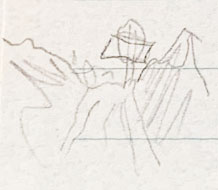
The road turns into this river A lady drives by and asks where a gas station is. We point to one of our gang, the only local. He/she points to a distant Amoco. Then the street changes to a river and the cars become boats. Ruby and I start to go down this river. I ask “is it safe?” It gets fast and fun and we finally reach the bottom — a deep sandy valley.
References: Amoco is a gas station.
Transformation: The reality is that there is a corridor of some sort with people moving on it. As we can see, it could be easily painted as cars on a road or boats on a river while preserving that same underlying reality.
-
The New Apartment 2001
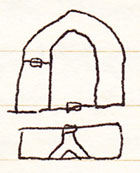
The continuous shape It began as the new apartment Buttercup and I moved to in a sunny, happy small city that I described as being near Oberlin. It had a very old-school rich feel with dark wood and high ceilings. There was a large central area with a surrounding horseshoe shape. The large central area was used every morning as a public breakfast area. . . .
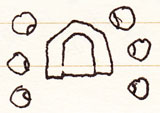
The shape with towers By the time I left the first room, the rounded outside area had become a walkway of stone surrounded on the outside not by walls but by grass and trees and it had six stone towers around it. Two were just opening their doors and I remarked, “Look, new rooms I didn’t know we had.” I saw they were selling film (or something like that).
Now the next transformations I don’t exactly recall, but while the shape remained, the center area was now water and the outside was walled and had rocks and greenery like a zoo. In the upper right of the horseshoe was this strange video arcade.
A Constant Shape: Written at the time: “Amazing and curious how a shape seems the most real thing and remains constant through so many different scenes. Almost as if it’s the shape of an amphitheater or astral viewing room upon which this is all being projected.”
-
Rolling Snowballs 2010
I followed the music and came to this charming summery village at the top of the mountain. There was a sunken area made of stone tiles with raised walls around it. People were drumming on huge drums on the far wall. Lots of people were watching, and some had brought their own large drums. It was a show of some sort. To the right, nearer the village, was a cluster of buildings with shops and tourist-type stuff, and a new performance was beginning there. It was a bunch of Japanese people dressed in these elaborate transformer costumes. They had truck parts, and at one point a few of them got down on their bellies and “transformed” to truck mode. It was very impressive.
But something about the layout of this sunken tile area reminded me of Starcraft 2, which I’m currently playing, and my perspective rose up to the 3/4 view like in the game and before long the scene was entirely a Starcraft 2 game. The sunken tile area was exactly the layout of some of the multiplayer maps, and soon I’m playing Zerg and training units.
References: StarCraft is a video game with a top-down perspective. Zerg are an alien species in that game.
Scene and Context Transformation: Did the sunken stone tile area simply remind me of Starcraft, or was Starcraft somehow suggesting its shape when I first arrived? I wish I remembered the transition more clearly, but the Starcraft version of the scene eventually took over completely. I didn’t appear to be on top of a mountain or near the tourist village, and none of the drummers or actors were anywhere around.
-
Protecting the Book 1997 • age 22
I went out the back and down the line of houses, which turned into a crenelated white bridge with a lake on one side and a cliff on the other. The cliff side had paths where the river had dipped way down. I explored this area for a time and then I met Brandon. It was great to see and speak with him. We started going back towards Buttercup’s house. . . . As we got deeper into the river trench, it was turning into Mario Land. He started finding stars and hidden places. I was curious, but didn’t watch.
Scene Transformation: First, while walking down the neighborhood street, the road turned into a crenelated white bridge over a lake and cliff.
Then the scene at the bottom of the cliff became Mario Land. I wish I had written more about how the transformation took place. But I clearly didn’t want this to become a video game dream and left.
-
The Interview 2016
Next there was a tour of the office. It was Christmastime. There were stacks of company-branded shirts here and there, meant to be given to interviewees. . . . But I noticed something. The scene was being overlaid with Halloween. Black and orange decorations appeared. There were black cat decorations. I knew this was being done as a test, but wanted to pretend I was being fooled. I spoke loudly. “Wow, this is great! It’s Halloween, with presents, and all these Halloween shirts! What a great idea!”
Holiday Switcheroo: This appears as a gradual change from Christmas decor to Halloween.
-
Neon Chakra Flowers 1997 • Middle of the night • age 23
Buttercup and I were moving up a level in Tank, to room 301. That was the top floor. All our best friends were over to help us move. . . . At first the new tenant of our old room seemed really weird, sitting against a wall, watching us move, but I stayed downstairs and talked with her. Her name was Kelly. As we were talking, the room was slowly changing into hers.
Creating Your Room: Kelly was moving into our old room, and it seems like Kelly was projecting her room around her into the new space.
This is how all these scene transformations take place — through our own changing projections. Our own projections are the first things we see. If we’re not projecting, we can see projections made by others. In this case, as I’ve moved out of this room, I’ve withdrawn my own projection and can see her projection shaping the room. I’m not sure it’s possible to know if other people are seeing my projections or their own without asking.
-
Memory Rooms and Exploding Dreamstuff 1997 • 6 AM • age 23
The light in the bathroom was on. I took off my clothes and got in the tub, furiously washing off the dirt and marshmallow. Buttercup, initially using the sink, came into the tub with me and laughed, accusing me of setting this all up, but I humorously dismissed it. While washing, my hand glanced against her butt underwater and she gave me this “nice try” look. Then it was a bed we were in, like a motel bedroom (transform!) and I remembered that we were going to end up together and reflected with pleased amusement on where we were now and how I could have new experiences at that point in our relationship!
Scene Change: Buttercup and I in the bathtub and it became a bed in a bedroom. Two people together in a thing was the essential shape of things. Perhaps I was momentarily awakened and the bed I was in became the new form of the dream.
When Moving to Higher or Lower Realms
-
Frequency Fall 1997 • age 22
Buttercup was with me. There was a great power nearby. Our thoughts, though innocent and fine, didn’t please it, and it cast this spell that lowered the frequency. I felt this mental nonphysical vibration which lowered my frequency. There was a pulsing and flashing and I felt both like I was shrinking and growing. It was a sort of reality scrolling. I think I could’ve followed the growing or shrinking sensation. In the end I felt smaller. We went outside to see how things had changed.
We found ourselves in this office by a swimming pool. It was a much more evil place than before. We’d stepped down in quality to an insane world where no one really communicated or listened to each other. Everyone was 90% projecting, closed in a tight sphere. I felt thin and weak and compressed by cold vacuous emptiness. . . . We were looking forward to seeing a hand statue we’d heard about but it wasn’t there. Instead we were greeted by this territorial guy who said we weren’t allowed to go outside. . . . He left and we decided to go outside anyways. It was “Oberlin” though it didn’t look a thing like it. It was unkempt under an foul overcast sky.
Dream Vibrations: This one is fascinating. The evil mind was the cause of this transition into a lower frequency realm. The perspective scroll, of shrinking and growing is like the focusing of a lens into different frequencies. Feeling smaller means I ended up in a lower frequency, which presses in harder on us. Our energy doesn’t go out from us as far. We are more separate.
This fits perfectly with the idea of people being closed in a tight sphere of their own thoughts, not communicating. This makes for an insane world.
-
There Be Whales Here! 1997 • age 23
I’d just seen two HUGE humpback whales leap way out of the water in a heart shape. I’m climbing down this slippery wet rocky hill of black stones. They leaped again as I started coming down. But the astral reality of going down took effect as the blue sky grayed and the whales next appeared with hideous disconnected green jaws with a few huge stained teeth sticking out.
Astral Layers: This is a great example of moving through astral frequencies. Most times, the transition is by walking down stairs or entering a sewer, or going through some sort of gateway, but here it was without any particular boundary. As I descended the hill, I moved lower down into the darker, creepier areas of the astral realm, and the scenery smoothly changed from bright and happy to an eerie lantern-in-the-fog version of the same thing. When I view the same ocean from even higher up, it’s even more beautiful.
-
Earth One 2005
Every moment is a joy on Earth One. We live on Earth Two. Earth Three is constant war. . . . Junior and I decide we’ll all go to Earth One. We find a long pole attached to the side of a building and get excited — that’s how we can cross over. We climb it and as we do, gravity shifts and reverses. After 15 feet or so, we’re seemingly climbing down toward the ground again along a pillar. We dismount onto Earth One. The joyous feeling of well-being returns.
References: Junior is a character on the TV show Reno 911.
Pole to Pillar: This is about the weirdest transition I’ve ever seen. By climbing upwards, we’ve ascended to a higher astral realm, which is evident by the happy feelings there. But why is it upside-down from the perspective we came from?
Note how the pole we’re ascending becomes a pillar we’re descending on Earth One — a transformation while retaining the same shape.
When Changing Floors
-
Gwen’s Birthday 2024 • 7:15 AM (1:45 later)
Buttercup, Bodhi, Gwen, and I were on a trip in Emma & Alfred’s RV, which was the size of a large house inside. . . . At some point it was Gwen’s birthday party, which took place on the top floor of the RV. . . . The top floor had gradually transformed into a huge Toys R Us, which was just the bottom floor of an even larger mall. . . . When I turned back to the rest of the store, it was more like a central plaza in a mall, and the shelves of toys were gone.
Ascending to Larger Floors: This begins in a large RV. Each time I go up a floor, I end up in a larger space. First, the upstairs floor of the RV expands into an entire Toys R Us, and that, in turn, is beneath an even larger mall.
It’s a general rule I’ve noticed that upon ascending levels, things become more spacious (because we become smaller), and as we descend, things become more tight and constricted. But in this scene there aren’t any of the emotional changes associated with moving to higher realms.
Towers — Vertically Repeated Rooms
A hyperspace tower is a room repeatedly stacked upon itself. As you go up, each one is smaller in size than the one below it. Each higher level may be the same room in a slightly higher frequency domain, meaning that it is closer to the now and has less expansion into space.
Chinese tower architecture seems to be a representation of this. An example of this is the Sun Pagoda.
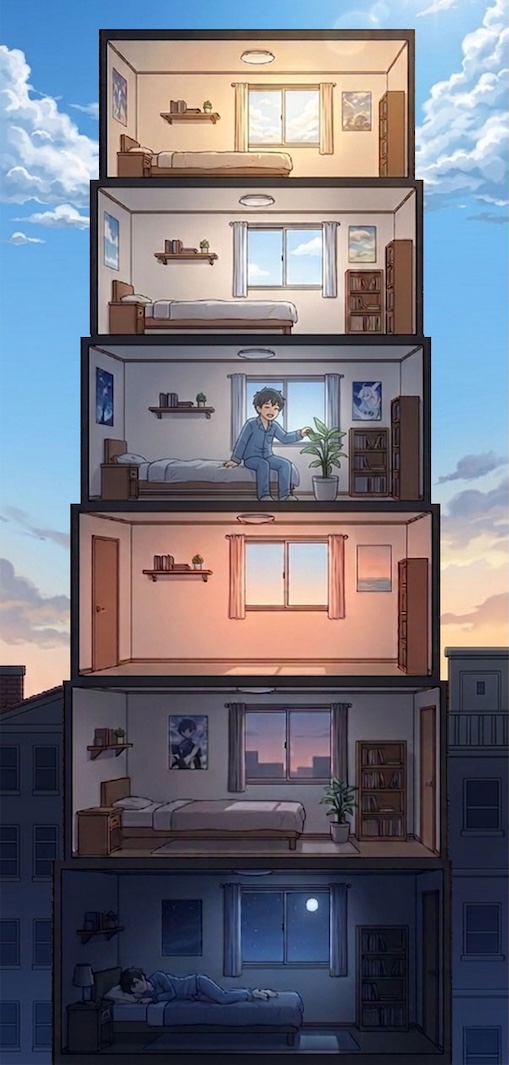
but smaller and brighter each time
under this license
-
The Inflatable Water Park 1999 • age 25
I noticed the current was having trouble inflating so many water park rides at once, so I decided to focus on one. I unplugged the others and remaining one started growing really big. It grew into a huge courtyard with a castle, axe-throwing knights, children with LOTS of colored balloons (little thought-form bubbles), huge water park rides, games, and lots of people.
The hoses I’ve seen connected to thought form buildings — they conduct a current of energy/attention to the thought form to maintain its form or increase its size!
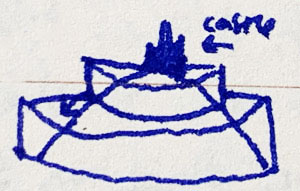
The castle on a hill with courtyards There was one point where . . . the children escaped from the courtyard with a ton of balloons and went down this hill into a larger courtyard. It became almost like a layer cake with the castle at the top, having larger and larger courtyards below it. It was on a hill (a bulge of astral attention).
Repeating Layers: The water park inflates to a courtyard around a castle, and then begins to repeat, with progressively larger courtyards appearing below the first. The castle at the top appears to become smaller. It becomes a hyperspace tower, getting smaller and smaller as you ascend.
-
The Dark Tower Tour 2000
Inside one of these two buildings, I had found my way to an unoccupied room with bunk beds and white comforters. There was an opening in the ceiling along the outside wall. I pulled myself up into a room that was almost exactly the same, but smaller. Then I went up again to an even smaller similar room. I had left my companions behind in the lower rooms, and there were only children in this room.
Hyperspace Tower Rooms: While in altered states, I’ve seen that towers in dreams can be the same room repeated vertically over and over, each slightly smaller than the one below. In fact, I saw the genesis of the Dark Tower this way! And here I am in a building near the Dark Tower, climbing up through this very kind of repeating tower room! There’s something to this!
The Tower is a long stretch of possibility. The Dark Tower is this room right here in Banana House stacked upon itself over and over again. It’s repeated patterns.
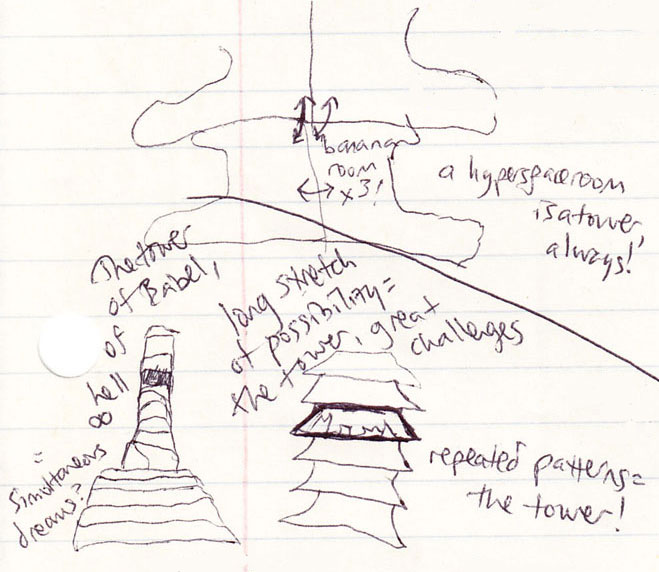
The Tower of Babel, of hell = simultaneous dreams? Repeated patterns = the tower!
Now, if you are on a lower subplane, how to you get out of it? One trick I learned is the following: fly through the ceiling of wherever you are at. When you do this, you will go through the ceiling and come up through the floor of the same room you just left! But actually, it will not be the exact same room; it will be the room but on a higher subplane. Do this a few times until you see light outside and do not feel the heavy, eerie feeling anymore. You will then be on a higher subplane. This does not always work, but it does work sometimes, so it’s worth giving it a try.
I flopped out of my body and rolled onto the floor. My vision was blinking but I quickly realized where I was at and thought, “Shit! I gotta get outta here!” I saw I was on the lowest astral plane. I felt that dark, heavy uncomfortable feeling. Everything was in grays and browns. And worst of all, there were ghoulies all over my bedroom! They were broken and twisted bodies, moving about in their lethargic fashion. At least I didn’t get frightened this time. I stayed level headed. My first thought was to wake myself up, but then I thought, “no, I’ll just go to a higher plane.” So I flew upwards through the ceiling, passed through the ceiling and came up through my floor. I did this a second time. Now there was sun shinning through my window and the ghoulies were gone, and everything was in normal colors. I was quite pleased with myself.
I flew through the ceiling, this time going outside the house. It was sunny and beautiful outside.
Gradual Transformations
-
The Joined Trees 2024
Now we’re inside the tree passage. Wilson is there, and a few others, including my Aunt Abbey. The passage is slowly transforming, though. Wilson says “Look, there’s a door here.” and I turn and there’s a huge door in the center of the passage facing the house. I can see the house through it. It definitely wasn’t there before. I open it and it seems like the owners had built an access into this tree passage. But as I look around the tree passage some more, it’s transforming more and more into the inside of a camper. There’s a table, and a tiny kitchen, and soon there’s no trace of it ever being a passageway inside of trees. But that idea is still in my head. I exit the camper and see the giant trees growing over and around it. The camper has wheels, and so I figure the trees must not be attached to the ground. Can the whole camper with the huge trees on it be pulled down the highway?
I’m messing around outside the camper and it begins to roll backwards down a slight hill. It doesn’t go far before it stops suddenly, but the sudden stop affects Abbey, who is not even inside it anymore, but further down the hill (she might be “inside” the tree passage, but from outside the much smaller camper, she appears outside). She’s knocked off her feet and lands flat on her back. I yell “Abbey!” I’m thinking how old she is and how bad that would be for her, but it must occur to me that this isn’t physical because I don’t pursue that line of thought. She gets up.
A Merging of Two Scenes: Now instead of an overlay on the near realm, The tree passageway starts taking the form of a camper! These two ideas merge together into a strange scene. I wonder where the idea of a camper came from — it wasn’t from me. Perhaps Abbey was in a camper when she joined my dream. I then try to make sense of this tree-camper in physical terms.
When the camper begins to roll and then stops suddenly, Abbey, who is still connected to the camper, takes a tumble, as the camper is her reference point.
Expanding Around Us
New scenes can expand from small points until they surround us and become our new environment. This is usually perceived in physical terms as approaching the new scene. But when in an enclosed environment like a house, this makes less sense than the scene before us simply expanding out around us.
This is equivalent to a thought form expanding or our descending into a rote.
-
The Inflatable Water Park 1999 • age 25
I hooked up a whole bunch at once and they all began to slowly inflate. I was inflating a water park right there in Blaine House! They were spreading out across the kitchen, pool room, and dining room. At a certain point, I noticed the current was having trouble inflating so many water park rides at once, so I decided to focus on one. I unplugged the others and remaining one started growing really big. It grew into a huge courtyard with a castle, axe-throwing knights, children with LOTS of colored balloons (little thought-form bubbles), huge water park rides, games, and lots of people.
The castle on a hill with courtyards There was one point where I was pursued by a head-lopping knight and another scene where the children escaped from the courtyard with a ton of balloons and went down this hill into a larger courtyard. It became almost like a layer cake with the castle at the top, having larger and larger courtyards below it. It was on a hill (a bulge of astral attention).
Transition: This transition is strange. These thought forms are being inflated within Blaine House but then Blaine House is no longer a part of the scene when they get big enough. It’s like an entirely new scene is growing up around me. Instead of a ceiling above, it becomes sky.
It’s almost as if a rote is rising up around me.
Following Rationalizations
These scene transformations follow a rationalization, giving that rationalization a more natural setting.
It may seem odd that while we can rationalize fast movement to calm the waking mind, the dramatic change of scenes that can follow aren’t enough to wake it up. It makes sense as low-context focus following. When the rationalization (say, a surfboard) becomes my primary focus, the scene changing to match it (a beach) only reinforces the rationalization. This is because once I’ve focused on the surfboard, the previous scene barely registers and is quickly forgotten.
-
Windsurfing 1997 • age 23
I was at the Blaine Soccer Complex and it was raining. I had been given a windsurfing board and was having a great time with it. I was a natural, shooting around and slipping and jumping. I left it for a minute to pursue something soccer-related but went back to it soon. First I got the wrong one, then found mine buried in the mud. The scene changed before long and it was my whole family at a sunny ocean beach. We windsurfed and it was fun!
A Better Fit: Once my focus switched from soccer to windsurfing, the scene changed to a more appropriate one given that focus — a beach scene. It’s unusual to see a change of weather coming with it, from rainy to sunny. But that did fit the playful mood that the dream had taken on.
-
Breaking Free 1997 • age 22
I’m part of this big class group playing soccer in a gymnasium. The floor eventually changes to water, and everyone is on rafts.
Transformations: The change to water probably was a rationalization of smooth floating movement. Without our need to take steps, we naturally glide, and when I noticed that, the movement made more sense as gliding across the water on rafts.
-
Hazel’s Wedding 2009
I’m the only groomsman at Hazel’s wedding. There are no bridesmaids either. Just me. It’s in southwest Minnesota. I’m following them around for the ceremony. They get in position, with me next to her beefy bearded husband. Everything’s rocking a little and I stumble. The husband turns around and yells at me, “Why did you push me?” I see us on a boat — the cause of the rocking.
Rationalization: I’m not sure what the rocking was, but both Hazel’s husband and I felt it, and I rationalized it as a boat, which it clearly wasn’t because as soon as it wasn’t needed anymore, the scene returned to being the building it was before.
Accompanying Character Transformations
The following dreams show the true flexibility of the mind, and reveal how easily and entirely the characters and surroundings can change while the essential story continues.
This is the “Roaming Context” I speak of from marijuana experiences. The story continues while the forms shift from one context to the next to the next. Dreams like this imply a shorter context than usual, a “higher mind”, closer to the formless. For more, see “How Context Determines Meaning” in pure-essence.php.
-
Riding in Jimmy the Whale
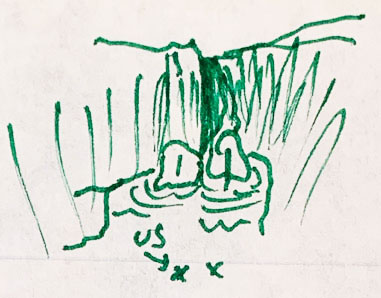
Elephants in the river gorge I’m in the wilderness with a guide. A pack of large elephants stampedes over us, then slows down. We follow them into a narrow gorge with a river. The gorge continues to narrow, and then the scene changes dramatically. Now the walls of the gorge are on all sides, but it’s the inside of a whale, and all the elephants are people. My guide friend tells me: “This is how the elephants travel this part of the river.” I get nervous. It’s really gross inside, like the inside of a throat. . . . Movement slows, and people are shifting. The guide explains that the whale stopped because he hit his head on some rock at the bottom. Suddenly a chant rises up: “Go Jimmy! Go Jimmy! Go Jimmy!” This kid with a boom box stands up. Rocking music sounds, and the whale starts moving really fast. I sense happiness from it. Then I hang on really tight as we jump out of the water. Suddenly we’re on a city street. Everyone else falls out. Only I hang on and go for a great ride as the whale jumps and flips through the street. Finally it’s over. I’m really happy. I ask the name of the guide — it’s “Jay”. The whale I seem to know as a personal friend. Strange, huh?
Transformations: Elephants change into people, and a wet, narrow gorge turns into the inside of a whale. To the guide this is just how it works here. We exit the water and the whale onto a city street.
-
Lord of the Rings 1997 • age 22
I was Gandalf. There was to be a battle at the main fortress, but we received a message to fight first at this other place and so we went. There was a walled path and I kept peeking my head out and dodging arrows. There were a number of orc clans there, each with different symbols. We had a lot of different species on our side, including elves and various strange creatures, but we were far outnumbered. We retreated to our castle, which was Blaine House and my room.

The Other World bird I rode upon that red Other World bird and at the same time I was a kid playing with toys. They stormed the castle and I escaped on my bird. They sent a similar bird after me and I finally escaped in the mall. Then I was just me, flying about, flapping my wings, maintaining myself just above the ground. I was working on flying when Cannonball’s brother came to capture me. I became Cannonball and I finally blasted to get away.
Changing Context, Changing Characters: As I transitioned to my room in the house I grew up on, the characters transitioned into toys I played with at the time. You can see the source experience — me playing with the red Other World bird, and at the same time I’m flying upon it (note than Gandalf once flew upon a bird like that). The form of the characters was shaped by the ever-shifting context of the dream.
It continued when I escaped to the mall. For a moment, the context returned to my waking life and I become myself practicing flying. But then the context turned into that of Marvel comics, likely because the mall is where comics shops are. A flying character I like? Well, it has to be Cannonball, of course.
-
The Whirlpool 1997 • age 23
Someone said “Hey, you got your wish. We’re heading towards the whirlpool!” As we neared it I saw how violent and ominous it seemed. Now I hoped too late to avoid it. My house, full of people, plunged down into it and my last breath of air got mixed with water as the house was sucked under. The underwater portion was impossibly long and my breath barely held but finally I washed out on a beautiful cascading waterfall that was broken by rocky landings.
After realizing that I was okay, I searched for other survivors. They all appeared now as cassettes, videos, and books. I tried to play them. Some worked right away, some worked after a bang or two, and others didn’t at all. I divided them into piles based on whether they worked or not, one pile becoming very loud with all its music and sound. Had everyone been transformed in this new area? I spent a while searching, then decided to go to the next area up.
Equivalence: My friends were transformed to recorded media on the other side of the whirlpool, which acts as a gateway. Could that mean they were all just thought-form creations of mine, and this was revealing that fact? Was I expecting several things that were sources of information, and they could have as easily been people as recorded media? How odd that they were playing music and sound as I found them!
-
Playing the Girl 1997 • age 23
They came after me and I ran. I knew this had to happen. They chased me into a barn and were beating me up but I felt no pain. My will pushed through and I shouted, explaining everything, and eventually I was in control of the plot and the group again.
It was I think at this point the dark barn turned into the space station. The plot continued as a story with aliens. The “others” in this dream were the gang of kids in the previous one. I jumped from one body to another.
Scene Change: The scene changes and it’s an entirely different place. The characters have changed form, too, but the same story continues.
Changes in Scale and Perspective
In the astral, scale is easily changed. You can zoom in or zoom out to any degree relative to your surroundings. When you enter a rote, you shrink down into it, then expand back out of it when you exit. This changing of scale can be accomplished at any time.
Our “location” at any given time is due to what we’ve expanded out around us with our attention, whether it is a subjective memory or objective place.
This natural scaling of perspective is why toddlers will sometimes try to sit in doll-sized chairs. In the astral, we’d naturally scale to fit.
-
Throwing Tiny Rocks 1987 • age 13
A little bit later, the hockey game stops, and some paramedics come out and put me on a stretcher. They put two strange white boxes in the middle of the rink and put a little display next to me. I ask what’s happening. The coach says that it’s a celebration of some sort for me. Little white figures start moving around on the display. Then it kind of changes from a display to real life. I’m trapped in this big building with lots of windows. I’m throwing rocks at the city I’m overlooking and breaking glass things. I hit a big building frame, and it falls towards us and knocks us over.
Changing Size and Perspective: I focus in on the moving figures in the display and that brings me down to their size. I don’t know why I’m trapped in a building at this point, but it’s likely the two white boxes become the city buildings I’m overlooking and throwing rocks at.
-
Volcano Survival 1998 • age 23
I was sitting in front of a board-game featuring a volcanic island. I hit two fire marbles together and a big flaming meteor descended (from the marbles or me) into the volcano. I hit the stones more rapidly together to get the volcano to erupt and it did. My concern for a group of little people on the rocks brought me down into the scene and we built defenses. It was all play — a game.
Gateways In: Becoming concerned with the little board-game people sucked me into their world where I helped them to defend themselves from the eruption I caused.
-
The Whale-Chasing Machine 1997 • age 23
I’m watching humpback whales flee in terror from something. They circle in front of this wall of stone, then smash into it. They lick the algae to see if there’s a way through. Beyond the wall is a black area on the ocean floor. A cheetah is running by on the top of the wall (underwater!). A whale bumps the wall, almost hitting the cheetah, and something from the black area is knocked loose and floats to the surface. It’s a microbe or disease.
Suddenly the sea surface is a tabletop with myself and other students standing around it.
Zooming Out: After the demonstration within the model, we zoom back out to ourselves sitting around the table looking down at it.
-
A Miscalculation of Scale
Miniature tanks (they’d fit in the palm of your hand) are coming from the ditch towards the house. Their cannons do hardly any damage. People in our house are shooting arrows at them. It’s a pointless battle. I go out and start stomping them. Tiny ships are coming overland too. I’m crushing them all. There’s this one ultra-kill weapon on the top of the slope. It fires a large blast towards the house, and I have trouble ripping it apart.
Then I match scale with the approaching army. I’m being chased in the field (which is a desert now) by a bunch of soldiers.
Perspective and Size Changes: The attackers are miniature, but after stomping them for a while, I get fully engaged and shrink down to match their scale.
-
Fantastic Solstice 1997 • age 23
We entered the tower. I had to find the secret door and say specific words so it would open. I tried the whole first floor, disbelieving that words could do it. This map of a side view of the tower appeared in my head and it indicated the third floor. The tower was like a thick, substantial Space Needle. While looking at the map, I watched us as little characters speed up one side of the tower and down the other.
Now the map view became real, and from that perspective, we were giants standing before the tower. The tower started looking scraggly. As giants we peeled back layers of the tower like skins. This revealed a blue skin, then a white skin, then a rotten, bug-infested wooden interior. The tower fell over. I didn’t want to touch it but this was a test and I had to stand it up. I did this and sizes suddenly began to return to normal.
References: The Space Needle is a tower in Seattle.
Perspective Zoom!: This is a great example of how easily scale can change. At first I’m searching within the tower, but once I’m looking at the map of it, I see the whole tower in front of me. It was easy to walk into the perspective from the map and find myself as big as as the tower, standing next to it.
-
Friend of the Dalai Lama 1998 • age 23

Spherical people There was a big outdoor festival. There was a scene with someone stealing balloons. I flew up high to this balloon cloud and played with 4-6 perfectly spherical people. What a strange thing! I felt I was up in space with them but I was only as high as the bleachers. Weird!
Size Changes Accompanying Flying: I wonder if the feeling that I was soaring way up into the sky but only got as high as the bleachers was due to a change in my size. If I was tiny, it would feel like vast motion but I wouldn’t get very far.
-
The Flipped Ship 2025
I’m on a cruise ship at sea. I remember Buttercup and Gwen being there. At one point I was swimming deep underneath the ship, my consciousness massively enlarged to include the ship and the sea beneath. I found some mud-covered treasure of some sort that I wanted to take with me, and, knowing it wouldn’t pass customs, tried to throw it up onto the ship. It worked on the third try, when I threw it up with my massive arms up onto both sides of the ship. The mud-balls landed midship and I went up to get them.
I had to return to normal size and pass through the ship’s customs to get back onboard, which took a minute. . . . I then found myself in one side of a two-part room, roughly in the shape of goggles, and it shifted forward, turned, and the part I was in tipped off the front of the ship and fell, hanging by a thick cord from the other one. Then, the other went off the side, and my consciousness massively enlarged again. The two small chambers were now dangling at the end of a massive projected arm coming off the ship. My room, at the bottom, was swinging back and forth somewhat. It was thrilling. . . . The two chambers switched orientation a few times, swinging out above the sea.
Giant-Sized: My changes in scale were a result of zooming out to get a fuller view. To explore the ocean floor, a wide view is beneficial, so my consciousness expanded. It contracted to normal size once I returned to the ship. Then it again expanded when I swinging out high above the sea. Note how I’m both massively expanded, watching myself from outside, but also focused within my swinging body, feeling the thrilling motion.
The dreams “Hanging Out with Friends” and “The Green Dragon of Sauron” in “Overlays” below are also great examples of changes in scale.
Merging Scenes
Any time our overall attention shifts to something new or we receive a communication from someone, we may end up with multiple scenes around us. Our waking mind often assembles these scenes into something that makes sense within physical space. A lot of strange dream environments are a result of this spatial rationalization. Different scenes appear and we try to place them within our current physical environment.
Merging In Communications
When we receive a rote or telepathic communication with imagery, we sometimes merge that imagery in with our current environment as a spatial rationalization. This happens when we split our focus more evenly between the environment and communication.
-
Indraheen 2024
I was sitting at a table with several other people in what seemed like an outdoor cafe. The table had breakfast food on it, and we were listening to someone talk about and show us something interesting in a tan/golden pool of water. The pool was likely within a rote and didn’t fit in the scene, really, so I mentally placed it to the side of the table.
Merging Images: The person talking was sharing an image of the golden pool of water, and I got confused and tried to fit it spatially into the environment around me.
-
The Old Forest 2026 • 5:30 AM
I was in my run-down castle-like home in the old forest with the giant trees and no underbrush. I was talking mentally with someone who wasn’t present, and they mentioned that the huge trees around it could fall. . . . Now I was leaving this area in a rationalized car on the winding road out. Just after exiting the old forest into a small town, I turned around to see a tree tip and fall, crushing the flat solitary wall of a ruin that was the same style as my house. Was it my house? No, this was by the edge of the forest. But then I saw a fire blazing up and to the right of it. . . . Was my house maybe there after all, but not visible? I couldn’t make sense of the scene. . . . [I tell a police officer]
[The police officer] had trouble finding any fire.
Scenes from Behind: I turn around and see a tree fall — a fear brought up earlier by an unknown communicator. Maybe this was a further visual communication from them. Then the image of the blazing fire appears “up and to the right” of the ruin. It’s not integrated into the scene, and appears without explanation. Does it also come from the unknown communicator?
-
The Crumbling Resort 2011
Buttercup and I are staying in a resort in an area like Lake Tahoe. She sets up this adventure of sorts involving a cave and then parachuting off this cliff over the sea. It’s part of a flash mob thing. I’m amazed she would do something so daring. Then, back in our room, I hear this guy yelling really loud. I look out the window. Down below there’s this cave with a river and everyone’s dressed like pirates. This is an attempt to get more people to join the parachuting.
Without meaning to, I merged the resort and the cliff parachuting scene, resulting in the resort appearing to be on the cliff’s edge. Seeing this, I wondered “shouldn’t it fall over backwards down the cliff face?” And then it does.
Resort Plus Cliff: These two scenes — the resort and the cliff parachuting are not spatially related at first. When I receive an open call from the pirate gathering, I “look out the window”, and see his scene at the bottom of a cliff. My mind stitches the two scenes together spatially, placing the resort at the top of the cliff. Upon seeing this, I form an expectation which then naturally takes place.
For moving into someone else’s environment through communication, see “The Energy Bridge” in communication.php.
Interaction Between Scenes
When two disparate scenes begin to come together, the objects in one become different objects in the other. This is like the beginning of double context, or the first stage of two scenes merging into one.
-
Hyperspace Reunion 2000 • age 25
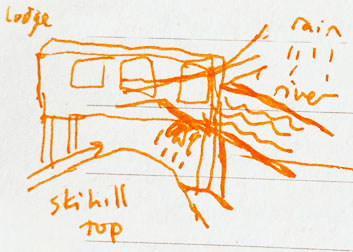
Juxtaposed scenes — the top of a mountain and the lodge I next remember being at the top of the ski hill, a recent regular spot in dreams. I’m there with Buttercup, some friends, and Isobel. We were at the top, but there was another scene in the air above the top of the ski hill. In that second scene, there was a wooden lodge at the ground level of another mountain. In the upper scene it was summer, and raining hard. There was a river there, above us, spilling water over the edges of its scene into our scene as a mix of water and snow. It was a composite scene, a crossing between worlds. The astral matter from one crosses to the other, but with the correct (appropriate) transformation — rain to snow. Wow!
References: Isobel was our new puppy.
Crossing Contexts: These two disparate scenes are very loosely connected. Only the flow of water connects them, and as it passes from one to the other, it takes on a form more appropriate to that context. This is a general rule of objects and people appearing within different contexts.
I wonder if this was a boundary between planes. In all of Swedenborg’s descriptions of the spiritual worlds, there are gradual changes in landscape between them, but in these less lucid dreams, I can find some jarring positioning of different scenes.
Double Context
Not only can a dream change its context while staying on the same track, but it can have multiple contexts at the same time.
Double context can continue as long as our attention is split between the two contexts, but typically it happens as part of a gradual change of scene, starting with one point of correspondence, then adding another and another until the new scene is dominant. During the transition, things are seen in both contexts at the same time.
Double context is a strange thing. It’s simply accepted. It may be the case that two different layers of self are experiencing the same objective thing, but projecting different forms onto it. These layers could be the dream self and waking self, our dream self observing from different contexts, our waking self at different ages, or even contributions from a past life self.
-
TV Road 1997 • age 23
Raven is my girlfriend as this begins. We were on our way to a youth group event. We’re driving around this dark neighborhood AND . . . simultaneously we’re fast-traveling through a mall. The powered-off TVs are houses and the car is a thought form. We come across a video billboard (it’s simply a large TV in the mall). I get enthralled watching this hilarious Popeye sketch in The Best of Saturday Night Live. Raven gets mad waiting for me and I decide to just forget the trip. I look back at the TV, which has this woman in a hot tub, and I travel into the scene. This is rationalized by me “remembering” that I traveled there by bus.
So I’m in the room with the hot tub and I take it to be the youth group event we’d been traveling to. There’s a cat in the middle of the tub half drowning and half repeatedly scratching like a robot. The woman is pretending she’ll take off her bikini top to tease the viewers. The joke is that whenever I try to get to her, there’s the cat’s paw in the way. Then the filming is over. [I attempt to interact with her] Now the tub is a bed, and the girl is shifting between Megan and Avery.
Awake: A single image can become anything via shifts in context. It can begin as random hypnagogic patterns or even solid objects. A shift in context, in how you see it, can completely alter it. Rice becomes sumo wrestlers. Your car becomes a village of people. Believe me, it can be anything, even action from a static image. The new scene is transformed through and effected by the original at all times.
Two Contexts: In this dream I’m repeatedly experiencing double context. Everything I see is something specific from each context. I’m in a mall and believe I’m in a neighborhood.
It even continues after I pass through the TV/billboard, where I arrive at a movie set but believe I’ve arrived at the youth group retreat. The woman there begins in a hot tub but it changes to a bed, and then she shifts back and forth between two entirely different people.
What you believe is so much more powerful than what you experience. While high or in the dream state, if you expect me to hand you a baby, and I hand you a microwave, you’d somehow find a way to see it as a baby — maybe a strange baby — but a baby nonetheless. The sensory input matters far less than the belief.
-
Art Class, Day 5 1999 • 5 AM • age 25
Buttercup and I were walking along this street with no curb, only a steep gully on both sides. We both thought it seemed dangerous. I was leading and every time a car came we had to step off the road into the gully and then watch it pass before continuing. There was a brick building to the side. I had an odd feeling this was the hill by the gas meters at Blaine House. We then had to climb over this large rock and dirt boulder but people had made a path over it so it was easy. On the other side was a very large college courtyard with green grass, scattered trees, and students all over. The wall might have been the tall white trapezoid by the garage at Blaine House! Anyways, there’s a continuity break. . . . Then I’m in art class, superimposed over the basement of Blaine House. It has the concrete floor, but it’s much neater.
Dual Location: It’s odd how this scene is both a street near a busy college and Blaine House. The two are nothing at all alike and yet somehow in my description I find points where the two correspond. The idea that it’s Blaine House lays over the previous scene somewhat, and the break in continuity switches the scenery completely over to Blaine House, while at the same time being the school I was approaching.
-
Thought Form Games at Arcology Hill Stadium 1996 • age 22
I made it to the top of the hill, near the gate for the arena’s fans. I met some selfish rich lady that was also a cat. She wanted me to pay for something for her, but I let some other poor sucker do it. At one point she dug her claws into my hands.
I also ran around being a cat. There were lots of stone steps and hallways. I found a tiny cat in a small hole in the steps. It was there with three white cats; a mother, a young cat, and a newborn, none of which would open their eyes. To clean the young ones, the mother ate them and then coughed them up. I thought these cats were tricks devised by Drax, the Merlin of the dream.
We’re Cats AND People: What a strange thing, to run into a cat that is also a rich lady (an aristocat?). I didn’t think this was weird. After that I ran around being a cat as well, and ran into other cats that were just cats.
-
The Mistake 1997 • age 23
Then I crashed the plane or we jumped out. We fell rapidly to the ocean. We swam to shore and I found a boat. I began to paddle it with the girl in the back. Vortigem H was floating toward us across the waves, above the water and then he was in the boat. Here I told him about the plane crash, but I remembered it as huge taut ropes across the bay which we were walking on and I just lost my balance. So we have a layered memory there. It’s stacked and seems parallel or equivalent from a different perspective.
Double Context: The true dream event is that I was flying the girl home and then landed in the sea. The first imagined context (rationalization) was that I was flying in a plane and crashed it. When retelling the story, the essence of it was the same — I was up high and fell — but this time it was walking on the taut ropes and lost my balance.
Overlays
Due to Near Realm Perceptions
While in the dream state, our astral body sometimes moves about the physical, going to habitual places. It occasionally becomes aware there, even in the midst of an entirely different dream experience. When that happens, its perception of its near realm environment will merge with the scenery of the dream. In my experience, this most often happens in terms of changing the spatial aspect and scale of the dream experience to match the physical one.
But isn’t our astral body there in the dream? As strange as it may seem, we can form multiple astral bodies. Consider how we may pass through a gateway, fall into a reverie, or enter a rote. We can project a body into the new scene we’re in, and when we pass through the next gateway, we generate a body within that scene as well.
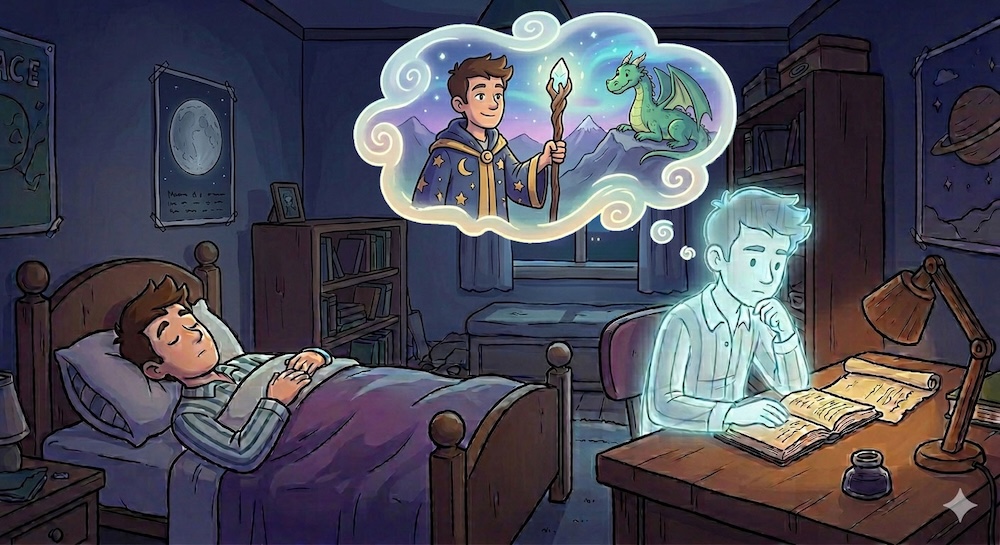
The movement of the astral body in the near realm while we dream is described in detail in “Movement of the Astral Body Due to Dreams” in nature-of-dreams.php.
Starting From the Near Realm
Overlays are fascinating. When our focus begins in the near realm, the astral scene can be attached to various entry or exit points in the physical location.
This is what makes the classic storybook “Where the Wild Things Are” famous. In four images, Max’s bedroom transforms (and expands) into a dream world.

-
Hanging Out 2020 • 7 AM
I’m hanging out with a group of two girls and three other guys. We’re all friends, very comfortable with each other. We’re in a large white room with warm golden light and tall open windows. In one corner, the walls came in to form a rectangular platform, about half as tall as the room (as if to make space for a room on the other side). There is a rumpled pile of white towels with black smudges in the middle of the floor. Someone asks what game we should play next. I’m not entirely sure how this starts, but the towels become a rolling snowy slope and at once expands to the size of the whole room — with us shrinking in proportion to make it a large mountainside. The towel-like nature of the landscape makes unusual rolls in the hillside. I feel that even though we can no longer see the main room, the invisible rectangular walls of it define the space.
We play a game of climbing up and sliding down the snowy slopes, enjoying ourselves and laughing. Then we climb up the slope, up a short cliffside of dark rock, and onto the platform area of the room. The platform is now like a balcony overlooking the mountains. It has a white balustrade.
This is similar to going into a dream while in an OBE, but this doesn’t require a fully lucid OBE. see “Going into a Dream While OB” in nature-of-dreams.php.
Starting from the Astral
If we’re already within the dream when the near realm perception begins, the dream environment often has to undergo some wild changes to make sense of the two different perceptual streams. The existing dream surroundings take on the shape limitations of the physical room our astral body is in, sometimes with connecting hallways to nearby rooms. This sometimes requires changes in scale.
In this case, we’re starting from the dream, and merging it into physical constraints.
-
Astral Party 1999 • age 25
I dreamed that we moved to Oberlin. We were on the second floor, as is actually the case. It was night and people were going by outside our window looking for parties. Buttercup’s sister came by and crawled up the wall to the second story window, then talked and left. Then a crazy lady on her way somewhere came by and we told her to leave. Then this mussed-hair bleached-blonde fellah came in for a while, then left, walking about a story off the ground. Then all these people started arriving. They came in through our open front door, a balcony which appeared outside the window, and another open door leading to the hallway. Soon it was packed, like an Oberlin party. . . . Upon waking, the “Oberlin house” felt much like it was this one.
An Oberlin Overlay: My dream of moving to Oberlin is revealed as taking place in the near-realm version of our 2nd story apartment. Notice how people deal with our second-story apartment. One guys leaves and continues walking a story off the ground. Fiona comes to visit and climbs up the wall to our window. Others walked up to a non-existent balcony on our second-story window.
-
The Green Dragon of Sauron 2004
I was living through a grander and brighter retelling of The Return of the King. . . . [Our heroes] are mounting a hill and crossing a membrane — a cave through a mountain pass. . . . [Aragorn, Gimli, and Legolas] turn, ride to the right, and flee through a different membrane into a new area — a sudden wall of mountains rises up with a cave tunnel leading into another area. . . . They emerge into a large circular area, walled by mountains. There are openings between the membrane walls of different areas, here represented by short cave tunnels . . . [we begin to battle a green dragon]
At this point a strange transformation began to come over the dream. The bright tree-filled grassy mountaintop area began a slow transformation to a room in an unfamiliar house which I later thought of as my own. This of course led to all sorts of inconsistencies in size. The first change was that there was a ceiling, a white ceiling which in the mountaintop was a layer of clouds. The dragon was above it, and would swoop down through it from time to time to attack. I was fully inhabiting Aragorn now. We stayed near the throne of bone. There was a couple of barrels full of swords and other things. Legolas had been shooting arrows at the dragon to no avail. . . . Legolas used [the staff], and sent a purple stream into the clouds. Just before the clouds, it hit a previously invisible grid (the ceiling) and lit up a purple area. We realized that if the dragon were above it, we could see it light up in orange and yellow instead of purple. Also, the closer we were to the clouds, the larger an area we’d light up. I took some swords, which were solid unadorned metal, like this pewter sword I have which is about 2 inches long. The hilt was continuous with the blade. Now Legolas would scan the clouds/ceiling with the staff and when we saw the orange/yellow of the dragon, I’d hurtle a sword, spinning, into the ceiling. It always pierced and stuck. Now some size issues: we were slowly becoming the size of the giant throne. When the mountaintop finished becoming a room, we were the size of people in a room. From that perspective, the dragon was now a weasel-sized thing above the ceiling.
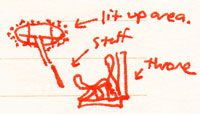
The throne of bone and staff So after a time I had hit the dragon with two two-inch pewter swords. And then it disappeared and we got really nervous. Our surroundings had transformed completely into a room now, but at this point was like a room in a dungeon. It had cinder-block walls and was lit by torch light. . . . So then we went back to hunting in the ceiling. The light changes to natural light. The ceiling turns white. It appears like a room in a house again, rather than a room in a dungeon.
Overlaid on the Physical: We begin with the shape of rooms, except it’s outdoors. Instead of walls, each room is surrounded by tall mountains, and the doors are caves in the mountains leading to the next open area (room).
As we become settled in a specific area, we see three transformations — first from the mountaintop to a room in my house, then quickly to a dungeon room, then back to my house. The first is the biggest and most revealing, as it has an enormous size and context change. The clouds became the ceiling, the mountains became the walls, and we gradually grew in size. The dragon remained the same size, making it the size of a weasel relative to us, and the swords also remained the same relative size to the dragon, making them take on the size and shape of the closest thing in my mind — the 2 inch pewter sword I kept on my desk as a kid.
The change to the dungeon scene included a rare change in lighting, as it was lit by torches and not daylight. Once this scene was over, it returned to the room in my house as before. After killing the dragon, I need an escape route, so I run out of the doorway of the bedroom to the office down the hall from the bedroom, grab a camera, and then I follow the hallway back to my bedroom, where the final scene plays out.
This whole thing was set in my bedroom, with changing set decorations and size perspective. The “membranes” were the walls of the room.
The initial scene change from the mountains to the room is the kind of slow environmental transition that happens in “Double Context”.
-
The Destruction of Blaine House 2023
I spent a while playing this soccer-like game with the kids. We were in the woods on the other side of the driveway at Blaine House. It was fast-paced and the ball was smaller than a soccer ball. The trees and plants acted as barriers — like we were playing it across different rooms with openings between them.
Outside Inside: Here’s a casual example of the structure of the house laid out on an outside forest scene. Likely we were playing a game with a ball in our near-realm house while my Dream Self imagined itself in the woods outside Blaine House. The two realities merged and the woods overlaid the boundaries of the rooms in our house.
-
Bedroom Soccer 2023 • 7:30 AM
I’m at Bodhi’s soccer game, sitting on the sidelines, watching. Each team has 7-11 players on the field. I look around and it’s a big green area, with some rolling hills and trees. . . . At this point my wake-up alarm goes off. I wake up and set it for 13 minutes, then I go right back to sleep.
The effect of this on my dream is that I’m back watching the soccer game, except the entire soccer field is now encased in the space of an invisible room — my bedroom. The green grass and hills continue beyond it, but everything on the field is bounded by this room and much reduced in size. There’s a bed along the side of the field. At first, it’s blocking the far half of the field. But as I look around, trying to figure this out, I find the bed is then to my right. Now there are two identical beds. They’re about the size of my bed — queen size, but with the pink & yellow patterned sheets of my childhood.
There’s not enough room for the full soccer game. It’s Bodhi and another kid in blue playing against two much younger kids in pink. Their uniforms seem more like fuzzy onesies. Bodhi slams a goal home, and I watch him take the ball to the center line and start it up again, scoring easily against the younger kids. I wonder what the score is, and I look at my phone. It’s 12-13. That didn’t seem right, considering the teams. I wonder where the other players went and see them standing along the sidelines at or outside the boundaries of the room, talking amongst themselves, uninterested in the game. . . . This game seems silly, and I feel tired. I walk over to the bed on the far side of the room and get in. There’s another little girl napping in there, and I crawl in to the center of the bed. For a moment I wonder if this is something I shouldn’t do — getting into a bed when there’s a little girl sleeping there.. but I stay and snooze.
Then I remember leaving the soccer field and going down a road. This is in the direction of the hallway outside my bedroom door.
Bedroom Soccer: This is fascinating. The interruption merges the shape of my bedroom with the scenery in the dream. The soccer field shrinks down, becoming crowded with beds in it. Only a few players remain, the others moving to the periphery. This raises many questions.
How could my waking up and pulling my room into the scene affect these soccer players? Unless most of them were thought form projections. Maybe there only ever were four kids playing soccer. That seems the most likely.
The room was oddly both room-sized AND field-sized.. when I saw them standing around the edges of the field, it was more the field-sized view.
But an argument for my bed appearing to other people is that a little girl from the scene had crawled into it. I didn’t recognize her, and Gwen had left the bed already. Though I certainly could have imagined her there.
-
Bedroom Cleanup 2024
I was walking across a grassy field with a guy that looked like Manville Goldblum. I was a coach and had a bunch of soccer videos made by my players, though I didn’t see them. Actually, I think they appeared like rolls of colored wrapping paper. I set them down on my childhood bed from my room in Blaine House. It was up against the wall. So once again a field of grass had become bounded in space by my childhood bedroom in Blaine House. I feel like the bed appeared because I wanted a place to set down the videos. The bed was invisible at first, made of the depth field but looking like the grass behind it, shaped spatially into the form of a bed. As I focused on it, it took on the proper colors, and the scene of the field faded into my bedroom. Again, this was the bed with the pink and yellow cover from my early childhood.
References: Manville Goldblum is an actor.
Grassy Field Overlay: Once again, just like in “Bedroom Soccer”, a grassy field becomes bounded spatially by my early childhood bedroom in Blaine House.
-
Indoor Soccer and Sexy Games 2024
I arrive late for a soccer game. I get onto the field, playing offense. . . . The game goes on a little longer, both teams crowded into their goal box, us on permanent offense, them on permanent defense. The field now has invisible pillars in it. The game is crowded into a room-sized part of the field. It’s like “Bedroom Soccer” in that the field’s space is constrained by the size of a room with pillars in it. At any rate, I asked and the final score was 2-2. The team dispersed beyond the invisible bounds of the room field and across the grass to our cars.
Incoming Overlay: This shows the gradual imposition of an overlay on a scene. I must have been slowly becoming conscious of the near-realm room I was in (though I can’t explain the pillars — maybe the bed posts?).
-
The Joined Trees 2024
I’m in the back yard of this house. There are a few huge trees right behind the house. They’re massive, gray, and old, with several dead branches near the ground. . . . I walk up to the trunk. Another huge tree is right next to it, their bases having grown together. I see a gnarled opening between them. I don’t think I could fit through, but I look inside anyways and am amazed to see a long, narrow passageway going through what must be a dozen tree trunks joined together. I’m walking along inside the passageway now, and it’s maybe 30 feet long. This is amazing! . . . I leave the tree and find that the back yard has become a room in a house. As I look around the room, I can see the original connected trees to my left, and then to make sense of the long corridor within, a continuous row of trees beyond it and then growing into and merging with the wall in front of me so that the wall was covered in smooth bark that rolled over the crown molding and curved into the ceiling.
I run to get Buttercup and Gwen. They come. . . . Scale is strange here, because we’re all a size that makes sense if this is a room, but we’re much too large for the backyard scene on top of it.
Overlaid Upon Leaving: This time the room overlay happens upon exiting the tree corridor. I wonder if I had moved in the near realm to the hallway when I dreamed of being in the tree passageway, and upon exiting the tree passageway, I went back to my room in the near realm, thus causing the overlay of scenes.
This, then, leads to the issues of scale, as in “The Green Dragon of Sauron”.
-
Blaine House Alert 2024
I’m at Blaine House. It’s night. I’m at a desk against the back wall in the basement — likely my astral body is at my desk downstairs in my current house, and it’s superimposed into Blaine House.
The Floor Is Lava: While awake, I spend a lot of time at my desk downstairs. Now asleep, my astral body has moved to its habitual position at that desk. While sitting there, I’m dreaming I’m at Blaine House in the basement. My awareness of the desk brings it into the Blaine House scene.
Astral Overlays
This kind of overlay can happen in the astral as well.
-
Badgerdoo — The Future of Video Games 1996 • age 22
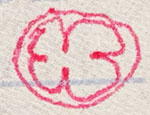
Game drug CRAZY! The Cloerma of Badgerdoo (or something like it) was the name of this game. It had full VR headgear, and players would walk around in real rooms while the game projected onto the surfaces. There were these large colored drug wafers that you’d take before playing. You’d break it in half and share with another player. The first four worlds were fun. Then there was an intro Aliens (the movie) world and a full Aliens world, both of which were really intense. Only the fifth and last world required the drugs, I think.
Ranier and Sid decided to play while I watched from outside the VR. They were at the level of the fairy-type beings who were suffering from a sickness. They had no pupils and their skin was stained black around their eyes. Worst of all, they went into these fits. It was supposedly scarier than Aliens. You couldn’t play in your room because the sickness would infest all your ultraviolet/neon colors and mess them up, and wreck some of your paper. . . . Then it would ruin everything and spread. I let them play and they walked to my room because that’s where all the supplies were (according to the game’s projected environment). Sid tried going in first but I kicked him out, yet somehow they made it in. I was mad that my room was contaminated. They didn’t seem too scared, only curious. I wished I knew what was going on in the game. This may have been in the Dark Tower. I think it was.
Drugs and Games: This one is really unique. I’m watching from outside as other people engage in what is essentially a subdream caused by a different context being painted over the current environment. Now this is what we do — this is how we understand nonphysical environments in our own terms — by projecting familiar forms onto it. But in this case, there is the additional layer of the game, which is taking over the initial interpretation of the astral environment.
My ultimate gaming idea is similar to this — you put on a headset that paints things over the real environment around you, so that while you’re interacting with fairies and dragons and such, the setting is the real world around you. That’s what kind of game this was — a layer over the current reality — something that comes quite naturally in the dream world! This game then adds mind-altering drugs into it, making one hell of a game experience.
Scene Transitions — Changing Locations
In scene transitions, the entire scene is changed, rather than parts of it. Common causes include:
- Entering or exiting gateways, memories, or subdreams
- Telepathic transport
- Any break in visual continuity (see above)
Memory rotes and subdreams always bring about entirely different scenes. Gateways are the scene, in miniature form, before we move into them.
Another cause is telepathic transport. When someone opens up a communication to us, we may travel across that energy bridge to them and appear in their environment (see “Telepathic Transport” in communication.php).
If you don’t like the dream pool you are in, or are in a real time OOBE and want to enter a dream pool, here are a couple of ways to do it: . . .
- Spin around until you become disoriented.
- Visualize a place you would like to be. (Instantaneous travel). This will usually move you to a dream pool similar to your visualized target destination.
- Fly straight up, as fast as you can. If this fails to shift your reality location, at least you will experience space flight.
- Fly away fast, close to the surface, until you find a place you like. The blurring of speed will cause a reality shift.
- Walk into a mirror, picture or painting.
Spinning and fast travel result in a break in visual continuity, which allows the scenery to change. Visualization may work, but may take you into a subjective fantasy. And the last option is going through a gateway.
Sudden Scene Changes
Scenes may appear to suddenly change around us, but this typically means that we’ve missed the transition.
I am walking uphill. . . . I know intuitively that I am going to encounter some Vietnamese soldiers soon. . . . The small band of soldiers . . . is all women. . . . I feel especially attracted to one woman and she is also strongly attracted to me. . . .
I pick her up in my arms. . . . I am most willing to be with her.
Suddenly, the scene changes. . . . I am standing now on . . . a back country road near my home town. . . . The area is quiet, peaceful, and deserted at the moment. . . . Suddenly the road is jammed with vehicles and traffic has stopped completely. A long line of cars is waiting on the road, bumper to bumper, and my van is one of them. I enter my van and sit for a while. . . .
Now I notice that the line of traffic is moving again and my van is moving right along with it . . . without a driver! . . . I discover my psychologist friend Karl riding in the passenger’s seat and we chat with excitement. . . .
The scene changes again. Still lucid, I am now sitting around a table right along the Colusa highway. . . . The table is covered with many platters of delicious food. Karl and three student hitchhikers are with me having a very exciting discussion about psychology. Two of the students are young Oriental women. [One] young Oriental woman . . . picks up a large platter of luscious, juicy, sliced pineapple. Holding it up to me in a very playful and vivacious manner, she smiles broadly and says, “Would you like to have a piece?” Quickly I respond with a very suggestive tone in my voice: “Oh, I would love to have a piece from you.” (Kelzer 72-74)tSatSLDer • modern • Kelzer
Note the easy transformation of the dashboard with road beyond to a table with highway beyond, and how the woman and Karl remain, even though the scene changes.
Crossings
A crossing is a more rare kind of transition to encounter. Rivers and roads are common rationalizations of these crossings. Unlike other gateways which are more like doors, crossings are more like long boundaries between dream locations.
Sometimes what appears to be on the other side of the crossing isn’t actually there once you cross over. The projected appearance is more a continuation of the location on your side.
One of the most well known is the river that many people cross over at death. Many in NDEs come near the river only to turn back. In Greek mythology, it is known as the River Styx. It’s a common physical form given to a very real boundary that, once crossed, usually cannot be returned across except through a new incarnation.
-
Trail of Dreams 1999 • age 25
So I got on the horse and tried to ride it down the street, but was having trouble controlling it. Soon I got the hang of it and we rode down to Radisson Road. Traffic was crazy. We bolted across and were nearly hit.
On the far side, things were different (a crossing). A couple wanted me to play a game with their son down the hill by the little stream. “We” went down there (myself and nobody), but found a large tripod blocking the way and so we walked on. Eventually “we” became Buttercup and I and the area north of Radisson became a huge park with rolling hills and trees and the smell of tar.
References: In physical life, the area north of Radisson was more neighborhoods.
Road Crossing: Crossing a busy road brings us into a different area — different from what appeared to be across the street from the other side.
Spatial Rationalizations — Hyperspace
When disparate astral locations appear together at the same time, our physical consciousness might make sense of them through “spatial rationalization”. We may place one scene within another, or connect them through doors, hallways, or around corners. This rationalization may require that one physical space be layered over another, but this is no obstacle to consciousness, which moves through attention.
In this way, spatial rationalization can create environments that are hyperspatial in nature. For example, we could enter a small house and find an ocean beach awaiting us. We could go into a building from the parking lot, then back out a door next to it to find ourselves in a mountain valley.
-
Hyperspace Reunion 2000 • age 25
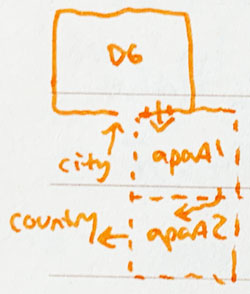
Hyperspace doors He said I should go into Oscar’s apartment and see something. His apartment was attached by hyperspace to the building next to the front door. There was a doorway leading to his apartment from inside the building, and his apartment stretched into what was, from outside, simply the front walkway. I meandered through his apartment alone, then turned a corner to hear people down the hall. I went down the hall and greeted a large family who I took to be Oscar’s wife’s or girlfriend’s family. . . . I find out that the large family I ran into were Oscar’s neighbors. Eventually I returned to them. Out their front door was a countryside scene, sunny and green. They had a deck that was also a bridge 15 feet up passing by trees.
Hyperspace Doors: This gives a good look at hyperspace gateways. In the dream world, space doesn’t need to conform to the limitations of three dimensions that we expect. It’s possible to turn a corner again and again and again and find something different there each time. I entered the front door of the building from a cityscape. Once inside, the suggestion to visit Oscar’s apartment opened up a door to it on the same wall. What could be a simpler way to pass from here to there? From the front door, that would entail taking two right turns, back through the front wall. But instead of ending up back outside the building in the cityscape as you would in 3D space, the hyperspace of the dreamworld lets us walk into a whole new room. And outside the room next to that? I exit out another door into the country scene outside Oscar’s apartment.
-
The Chamber Beneath Blaine House 2000
Soon I found Ruby more interesting and I went with her to the main septic tank room where we started. The floor was all ice now. We exited through another door.
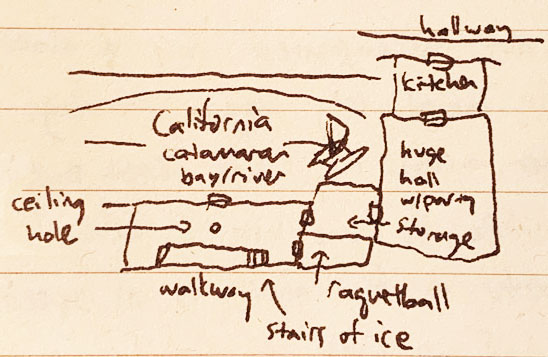
The chamber beneath Blaine House An evening landscape opened up before us, a half-moon bay of shallow, reddish water that I imagined must have been the real cess pool. It had a sandy beach. A catamaran that I “recognized” as Wadsworth’s spare one was by the water on the beach. The wall we had just passed through was a cliff viewed from this side, and a cliff-house was in the distance to our right at the top of the cliff. The sky was dark and undefined, as was the area past the reddish bay.
Hyperspace Door: Another hyperspace door! And this one is brilliant, because it reveals a lot! We go from an underground chamber during the day at Blaine House through a room to the bottom of a cliffside at a beach in the evening. The means these gateways can change the lighting, the scene looking back, and the entire look of the barrier — from wall to cliffside. As to the lighting, even while it was evening for a short time, it soon became daylight again as we came to California. The overall feel didn’t change that much. Over the course of the dream, I went from fascination to exhilaration to overwhelming joy to fascination again. Also notice how this initial California scene was not only dark but somewhat undefined or blurry, which is something I’ve seen a few other times when initially coming into a new scene.
-
Too Much House 2026
Returning to my new home after not seeing it for a few weeks, I found the builders had actually mostly finished it! . . . The main focus in the dream was the basement level, which we had requested be made to give it a little more space. We descended into it to find room after room, fully furnished. . . . There was a room with people in white suits walking around with slices of pizza on platters. I found the servant’s kitchen they were coming from, which was huge and filled with things. Two cooks were in there. There was a larger kitchen for us attached. It eventually connected to a bustling Best Buy. Outside the Best Buy was a paved pathway in a forested area like a well-kept college town.
Hyperspace Exit: Going from room to room in the basement of my house eventually leads to a Best Buy, outside of which is a forested area unrelated to the neighborhood I started out in.
Larger Inside Than Outside
One appearance of hyperspace in dreams is entering a small building or room to find that it is much larger inside. The door could be considered a gateway but typically the inside is still bounded by walls — at least, you feel it must be bounded by walls since it’s inside a building (explanation rationalization).
Consciousness exists in a higher dimension, and is not bounded by 3-dimensional space. That said, it may appear to be out of physical habit.
-
The Man Who Owned the Sun 1994 • age 20
I decide to investigate this building. I ask who can teleport, and look at Illyana, but Superman says he can. I ask him to teleport inside, and he takes us in but it’s more of an invisible fast-flying. We are aware that the sun lies somewhere inside this incredibly huge building. The first level held a huge room of laundry machines and people working, but they weren’t unhappy. We were told that the leader of the complex was evil. We proceeded to level two where we found a lot of grunt workers. Then to level three, which was a business district. Suddenly it was Manville, Mordred, and someone else with me instead of Superman. We went to level four and it was housing. We were now so high up that the building swayed in the wind, and it looked as if we were looking down from a plane. Manville opened a door and we were pulled outside. Manville fell down onto the roof of a lower level, but I grabbed the door and was able to swing back around and back inside. Manville was stuck so we had to leave him. We knew that level five was the sun, moon, stars, and clouds.
References: Illyana is a superhero that can teleport. Manville and Mordred are friends from high school.
Bigger Inside: This is an interesting combination of Hyperspace (where the interior is larger than the exterior), and the Tower Effect, culminating in a level, apparently inside the building, that contains the sun and moon, stars and clouds.
-
Home Near the Tower 1999 • 3 AM • age 25
Before long we were home. It had a back yard like Blaine House. The house was very ritzy and plush, mostly with gray-blues and blacks. Some parts of the inside were infinite, so you could sink into it and have visions, watch TV, or play video games. It’s very hard to describe. Space was very plastic. 3 feet could easily become 3 miles, and a room could expand to the size of a football field yet still remain within the house and retain its position relative to everything else.
The activities could be so bizarre. At times the work seemed to be tunneling into new space in an expanded room — developing it!
An Infinite Room: This almost sounds like a rote viewing room. Space inside a rote is completely different from outside it.
And I love the idea of tunneling into new space to expand and develop it. This would be understood in terms of hyperspace.
Some of this could also be due to changes in scale — see “Changes in Scale and Perspective” in into-dreams.php.
Hyperspace Hubs
A few times, I’ve encountered places that were hyperspace hubs; a hallway with doors that each led to a different location. This appears something beyond the way we spatially rationalize locations as they gain our attention.
-
OBE at the Dark Tower 1997 • age 22
Within the Dark Tower were living quarters, including my Blaine House room. . . . In my Blaine House room, I had an OBE in which I found out how to fly: jump and hold onto the “rising” part. I flew up through the wall and roof, and ended up on the deck outside my room in Blaine House. I looked around. Below me on the entrance side it was all the same as Blaine House, and there were flashing Xmas lights down there. The moon was in the sky above and the forest was on the other side, reminiscent of other Dark Tower lands & forest. It seemed that above my room, instead of the roof, was a part of the Dark Tower’s library.
Hyperspace Boarding House: I describe the Dark Tower here as a sort of boarding house. My room at Blaine House appears to be a room in the Dark Tower, so perhaps all the rooms are through hyperspace doorways. The outside of my window was all Blaine House, which would support that, but then I knew there was a library above my room — part of the Dark Tower.
Or.. perhaps this is just the form the idea of “my bedroom” takes, and that form flows into what’s outside the window as well.
-
The Sewers Beneath the Dark Tower 1997 • age 22
There’s definitely a Banana House at the Dark Tower. . . . We were looking for Sid in room 722 in the Dark Tower. We went up and up. . . . We got near and I rang what used to be my door and then what used to be Brendan’s door.
Rooms: Interesting how rooms from different places I’ve lived in are in the Dark Tower — Blaine House, Banana House, and probably many others. It’s the representation of “your room”.
-
The Fulcrum 2025 • 6:50 AM
I was helping Wilson move. He lived in an old two-story Victorian building that was divided into several apartments. Each floor had 4 apartments on it, in a square arrangement. The Victorian building was a sort of hyperspace hub between each apartment. For example, to get to Wilson’s room and help him move, I walked down a hallway that was also an outside driveway to a lone concrete structure. His “apartment” was therefore an independent house. It had upper branches of trees on the far side of it, as if the land fell away behind. This fit its position on the second floor of the old building. . . . The light inside Wilson’s house and in the Victorian building was dim morning light.
A Hyperspace Hub: It’s interesting that there wasn’t a distinct transition like you get with a door or turning a corner, but a scene overlay as the hall also became a driveway.
These four distinct places thus become closely linked through this one building. They are all neighbors while living in different places.
The Shepherd: “‘Where’ does not apply to this reality. We are not transversing space as you know it, but in truth we are unfolding through frames of reality.” (Roads 150)
“We are in a different continuum, but we have not traveled any place to do this.” . . .
The farther we walk down the corridor, the longer it seems to become. (Roads 153-154)
I wander down the corridor. . . . In either direction there is nothing but the long, wide, seemingly endless corridor, and the doors. . . . Not all the doors are the same. Some are very formal, yet colorful, while others appear in various styles, ranging from high and wide to short and narrow. (Roads 167)
“How is it possible for such a long corridor to be in such a small craft? . . .”
“This craft follows the continuum principle. Within this craft, all space is available in an infinite continuum. . . . It appears that this corridor is endless. In actuality it is not, but in the reality we have created, it is. A continuum is where a finite state, or space, becomes infinite. . . . In a similar way, Earth life appears to be finite, but in a Greater Reality it is infinite.”
“These doors seem to go on and on forever. Whatever is behind them?” I ask.
“They are the home environments of the travelers on this craft. The same continuum principle applies to each of them. . . . The rooms are a finite size that fits within this craft, while a simultaneous infinity also holds true. . . . A small craft has the potential of a large planet.” (Roads 172-173)IaTROBEr, LDer • modern • Roads
Labyrinthine Passages
The Catacombs
I’ve been down in the catacombs hundreds, maybe thousands of times. My dream self knows their intricate twisting passages and intersections intimately. I can navigate the hundreds of labyrinthine rooms and corridors for hours without getting lost, and I feel that the various paths I took would lead me to one of a number of different places in the dream world. But it is dim, dungeon-like, and at times claustrophobic.
-
Mazes and Scorpions 1996 • age 22
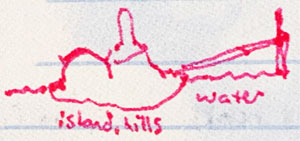
A smaller tower? Near the tower? The mazes! I’ve been here many times. It’s a deeper spiritual place, where angles are steeper, and there’s a hill with a tower reminiscent of The Tower, but much smaller. On top of the left hill is a crazy maze of dark, murky stone. I’ve been there many times before and had such fun exploring and trying to find out its secrets. On the top level are three rooms where the brickwork allows you to see inside. Getting to one of them is easy, one is medium, and one is very hard. There are many tunnels below, and possibly a river. One place is an upraised circular platform whose stonework floor has one loose stone which you can remove and that’s how you go onward — into that hole. . . . There were two young fellows that had found their way to the back wall corridor and I asked them to show me how they got there and they said they would but I never saw them again. I sense that these are passages to other dream locations.
The Maze: Here I find a maze on a hill near the Tower (or a tower). This is the kind of maze-like passages and secret doors of the Catacombs, and even here I suspected that these passages led to different dream locations.
-
Something Wild In Dreams 2000 • age 25
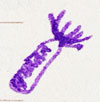
My pitiful weapon I remember exploring deeply for long periods through endless underground caves, going deeper and deeper with smaller or larger groups of friends, equipped with flashlights, laser pointers for stopping spiders and scorpions, and perhaps a gun or other weapon. This time we had a large group including Brendan. There was a single small flashlight but we were only 15 minutes in when we discovered no one had brought anything more. A good supply of flashlights and batteries was always required. I had an absurd little weapon: a finger-sized device that stuck out inch-long green and red brushes and turned. This we used only to dispatch a scorpion in a tiny sand-covered room before the power ran out. We next had to descend into a room through a narrow opening where a crazy witch-woman was screaming. I wish we’d had the gun or something at this point.
Somehow we made it into her chamber and it was lit and she was gone; she’d gone to get something for us — a gift. While we waited, we talked. They asked how far it was and I said it took about 3 hours to get to the puzzle chamber where I had once gotten, but had lost my light and been unable to solve all 3 puzzles. They were large chambers, reminiscent of underground video game dreams. But my friends balked at the time, especially as we had spent 15 minutes waiting for the witch woman’s gift. Soon after that she reappeared, still green and monstrous but far less dead-looking and afraid. She presented me a hard hat with four flashlights containing full batteries! Thrilled, I strapped the hat on and continued, but I think the others had left.
The catacombs seem a lucidity challenge — a struggle against distraction. And what lay at the bottom?
The Catacombs: Here I am, again exploring the underworld catacombs, and knowing them very, very well. I had a natural ability when I was younger for things like this, knowing where every passage went in underground dungeons in Choose-Your-Own-Adventure books, Fighting Fantasy books, and dungeon video games. But before long I began to avoid games that took place all underground. I just didn’t like it.
-
Three Brave Knights 2000
I was with Sid and Ranier, who I’ll probably see later today. We were wandering about this town. It was daytime and overcast. We were going to go adventuring underground, in the underworld! It had this D&D feel to it. There was a place in the square where a door led underground. We started out and made it underground.
We returned above ground again. I suggested we go back down but first go to the shops for snacks, weapons, and armor. We went to the snack shop first.
To the Catacombs: These trips to the Catacombs and the underworld are often very carefully planned. Here we are getting supplies, but then getting distracted along the way.
-
Declining the Catacombs 2008
It’s bright and sunny, and the colors are vibrant. I’m walking along this reddish orange dirt path. There are rolling hills of bright green grass on the right side. On the left is a rising rocky cliff. It feels like World of Warcraft. I come to a cave opening that is interesting to me. It looks like carved ruins. I crawl in through a square opening into a dimly lit room. Ah, I remember this. Room after room, interesting shapes, many paths, long sections. But it’s dim, and feels claustrophobic. I know it very well. I’ve spent months in there, through many dreams. But I don’t want to go back in. I crawl back out to the sunny path.
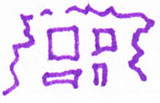
Entrance to the catacombs A tall fellow on the path sees me. He asks me about it. I said “I used to go in the catacombs all the time.” Catacombs! The word sort of occurs to me right then. He said he did once, too. I continue on.
Somewhere along here I break down crying, sobbing deeply. I can’t now recall why. Was it about my poor health? The catacombs? Someone is with me, a friend. I feel refreshed afterwards, and keep walking.
The Catacombs: Even now, thinking about the Catacombs gives me a shiver. So much time spent in a place like that. . . . Why?
Vehicles on Maze-Like Paths
One thing I’ve experienced a few times is traveling with others on a vehicle which seems to run along a track or fixed route through strange maze-like paths. These twisting passageways always take us to entirely different places. It’s similar to traveling through the winding paths of the catacombs. In both cases we travel through unadorned gray structures that seem like they are made of stone or concrete.
I believe this reflects the inner passageways of the astral world. I wonder if this is a rationalization of riding on astral currents.
-
The Twisting Parking Deck 1997 • nap • age 23
I was traveling with Buttercup and her friends on an upward-sloping road. I got out of the car for something, then had a Transformers adventure. I returned to the car afterwards and was glad it wasn’t towed. Buttercup and her friends were still with me. I drove it higher up and the road became a parking garage. I was looking for a place to park, a place to live, and something related to the Transformers adventure. The scenery changed and the curves of the garage became crazy, even more curving than the picture below. Soon we were sliding over the curves on a colored blanket instead of a car. The curves sometimes had a sparkling depth. At other times they were ridged with blue, yellow, and red to hold the blankets on.
The twisting route up and down through the parking garage 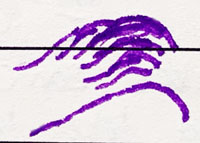
The edge of the colored blanket There were video games on every level and I played some. Then we warped into a party from Buttercup’s dream; a lame, boring business man party. The guy throwing the party heard me describing it thus and looked at me angrily. The room was rocking and tilting as we moved along the track.
References: Transformers is a comic book, TV, and movie series.
Going on a Blanket Ride: These inner passageways are a dream phenomenon of some kind. In this one I dispense with the car rationalization at some point and find we’re on something like a blanket traveling slowly over crazy curves, which is probably a much more true experience. What this is, I don’t know, but it comes with (or I have) plenty of distracting video game rotes.
Even when we enter Buttercup’s dream party, we still appear to be on the track since the room was rocking and tilting.
These remind me of Disney rides, going slowly along a curving course, seeing different points of interest and scenes as you go.
-
Visiting Work Again 1998 • age 24
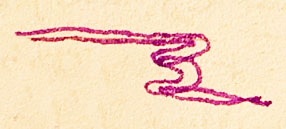
The vortex-like ramp I’m in the big red van again. I went to the mall and descended a strange vortex-like ramp to the parking lot. I went inside.
Vortex Down: The van is a physical rationalizations and road and ramp are the closest physical correlates. It seems that I’m riding on astral currents to the mall/transit station. When dealing with currents, a vortex would be a very natural “exit” formation.
-
The Mountain Valley Gathering 2003
I was one of the last to leave, but finally squeezed my way onto a bus. My consciousness remained outside looking in. As the bus began to move, the dim, drab bus station changed into this vibrant, shining white maze. I don’t recall the transition but maybe it had to do with my change in perspective? Anyways we took this very square path, then up this 45 degree incline up stairs. Then it straightens, tilts sideways and . . . out a door? We arrive at our destination: Long Island.
-
Picture Day 2023
It was getting dark and [the soccer team] needed to be back at the drop-off point. However, they all quickly ran off, to my consternation. Bodhi and I followed, but they were soon out of my view. A little ways ahead, we saw a train stop and decided we’d get to the drop-off point quicker if we took the train, which seemed to be heading that way.
We got in a small two-person train car. As it started moving, it seemed to be enclosed in a structure like a large parking garage. I noticed the tracks were more like a roller coaster, and indeed, it turned out to be a low-key, slow-moving roller coaster. In fact it was more like a ride, taking us through different rooms, some which seemed abandoned, out of use. It spiraled slowly upwards and into more rooms and then out along a busy street in the middle of a full city that was not where we came from.
Everything looked painted, airbrushed — very realistic and detailed but not quite real. The ride was taking too long and I was feeling anxious for it to be over so I could get back to finding the team. Bodhi and I decided to get off the train car and look for the way back. I tried to discern which direction we could go by trying to see the 100% real-looking scenery past the airbrushed scenery. And while I got glimpses of it in the distance, it seemed to shift back and forth and I couldn’t be sure what direction to go. I went into a little restaurant and asked someone how to get out. He said I just had to stay on the ride until it was finished. I asked someone else, and got a similar answer.
The Train to Downtown: The train takes us not down the street, but into a large parking garage that wasn’t there when we got on. It takes many twists and turns through various rooms and then spirals up to end up in an entirely different place in a different visual style.
Natural, Without Rationalizations
-
The Space Probes 1996 • age 22
I’m in space. It’s all hazy and there’s a sun off in one direction. I see a huge gray Star Trek ship go by overhead and recognize it as a long-forgotten probe. It sucks up the haze and leaves a trail of thick black smoke behind it. I know it should be destroyed, because the work it’s doing is not necessary anymore. I imagine throwing things or shooting rockets at it. The sky is clear now and the haze begins further off, looking like thunderclouds. Another probe goes by and I run in the same direction as it. I’m running over pebbles and water. I’m about to get to this lake with the intent of flying over it.
Natural Transition: Here my focus forms the reality, and physical forms follow along afterwards. There is no rationalization or feedback from my waking self that this doesn’t make sense. This along with my direct knowledge of the probes shows that I’m dreaming at a higher frequency, at a more real level.
Thought Forms
Thought Forms
The Nature of Astral Matter
The Elasticity of Astral Matter
In these experiments, I tested the elasticity through interactions with my astral body’s hands. If we expect it to be elastic, it will be, but then it will return to its original form.
-
Ghosts and Astral Matter 1996 • age 21
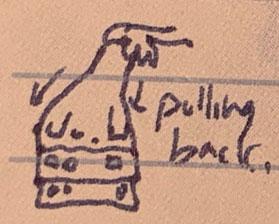
The stereo stretched as I pulled During a scene of emotional conflict, the next room began glowing an eerie green, and a large ghostly stack of stereo components appeared. I walked up to it and pulled at the top. Its features melted away as it stretched out, but when I let go it snapped back to its original form. It was some kind of elastic spirit substance.
-
The Underworld and Lava Flow Map 2000 • 4:15 AM • age 25
I ventured out into a foot-deep blue channel closer to the ocean. I thought about how I’d planned the Jurassic Park 2 dream I was having before. A black lava flow map of the island used in the first movie appeared before me, and I retraced in my mind where on the island all the events took place. I thought, “Yeah, that was a good, thrilling movie.”
The lava flow map wasn’t just imagined, THERE IT WAS in front of me. I picked it up and started to knead it and it became more pliable. Then I put it in some kind of rectangular pan and kneaded it some more. I could push my fingers deep into it and moosh it around. It didn’t smear or stick or tear or anything — it stretched. When removing my fingers the imprints slowly popped back out to form a smooth surface again. It remained black this entire time. One of my finger holes held its form as I concentrated on it, then as I became surprised that only one would hold its form, it then started to pop out. So then I turned to the original map (oops! there it is again!) and thought “Oh no, I’ve left it alone too long — it’s probably hardened.” I started kneading this one, too, and its resistance became less and less and I stretched it out longer and thinner bit by bit. Then I laid it over a shopping cart (?!) and turned back to the original map.
Playing with Thought Forms: Play reveals so much. Here we see the hard lava rock map thought form becoming more pliable and flexible from my kneading. This is likely happening simply because that’s what I’m expecting it to do. I was able to hold the finger hole in place only so long as I concentrated on it. Left alone, thought forms return to their original form and texture.
Only the Exterior Hardens
-
The Underworld and Lava Flow Map 2000 • 4:15 AM • age 25
I could see through the pan that [the lava flow map] had separated into layers. The bottom three quarters was an ivory color with brownish layer variations, then it transitioned to black at the top, which was hard and crumbly now. I picked it up from the pan and started kneading it and as I did so rock crumbles came off. Soon, as I worked with it, it seemed to become more uniformly malleable (and black throughout again).
Nature of Spiritual Matter: Written at the time: “When I looked into the interior of the thought form, I saw that the quality of the astral matter was a dull ivory. This is not surprising as I was near an underworld opening, and the region had an atmosphere of danger and adventure due to the dinosaurs.”
It is only the exterior of thought forms that take on color, hardness, and texture. Since the interior isn’t immediately visible, there is no need for it to take on these appearances. The interior retains the natural coloring and luminosity of the matter of the plane it’s on.
Liquid Interior
Thought forms appear to have a white liquid interior. At times, when they are suddenly pierced or crushed, this liquid comes out. This is not a projection; if we expected to see red blood, we would. But the natural state of thought forms is that only the exterior hardens into the expected shape, color, and texture. The interior retains the natural ivory-to-white color and flowing liquid nature of unformed astral matter.
This was likely subconsciously referenced in the movie Aliens, when Bishop, an android (very realistic but not “real”, like a thought form) is cut and white liquid flows out (see his hand below):
-
Stinky Williams 1996 • age 21
Then this big nasty guy came in and said he needed me as a vortex. So I shot at him and he shot back at me but missed. Finally I shot him and it was as if he was a sack with liquid leaking out. I chased him down and finished the job, forcing all the goo out. Afterward, he looked like a squished white spider. Later I was questioned on the matter.
The Stuff Dreams Are Made Of: The big nasty guy was a thought form, as it began to shrink away and lose color after I was done interacting with it.
-
White Goo 1997 • age 22
It seems like I go to the doctor a lot in dreams because I keep getting body reports. This time I learned of a reservoir of white sticky ooze in my hand. I tried to scrape it out but could only reach it with my tongue and had to lick it out and it was a thick and sticky white goo. Ugh! Then I had to lick gallons of it from my mouth and splat it out on the ground.
White Goo: I have really remembered this clearly to this day — it was so gross. It seems like some kind of internal though-form substance that I’ve seen before a few times.
-
The. . . . Party? 1997 • age 22
We ended up on the roof, watching people. . . .
The toy — a ball with counterweight Then I met this friendly Asian boy who was discouraged about sex, saying he’d never get laid. I sorta comforted him. He got out this toy: a ball with a long string and a weight — you’d throw the ball then whip the weight behind it in another direction for cool effects. He said he wanted us to play with it. I went down some stairs to get some distance and when I looked back up he was gone. He’d thrown himself over the edge of the roof to die. I ran to the edge and looked down. He’d landed head first on the concrete. His head was bashed in, and there was this white foamy liquid on the concrete all around it. I ran to the party and told someone to call an ambulance. Then I realized the kid was running behind me saying “Touch my head! Feel it!” I refused. He’d survived, and so he did it again and again, and each time it was like the tragedy was new. The next time, his head was a crushed up carton that leaked ice cream. I got more and more distanced from the drama.
Touch My Head!: I’ve seen many times when an astral body or thought form gets “hurt” or “killed”, this white liquid comes out. The second time I rationalized the white liquid as ice cream and his head became an ice cream carton.
The Hidden Cord
As we’ve seen, the astral body has an occasionally-visible but nonetheless essential astral cord connecting it to the physical body. Here are some instances where I see a cord connected to a thought form, one essential to its staying “inflated”.
A nonphysical cord (vortex, tunnel) connects every thought form to those feeding it with attention. This higher-dimensional connection does not need to appear as part of the 3-dimensional projection. The fact that it is not seen is simply a reflection of our not expecting it to be there. But sometimes when we relax, the deeper reality peeks through and the cord drifts into physical dimensions.
-
Deflating Tank 1997 • age 23
Then (did I supposedly “dream” this?) I saw visions of an invisible force shoving some people on a fence and yelling slurs. Then it shoved someone walking by, and went to a power line and yanked the cord out. The power line was how Tank was plugged in and the immediate result was that it rapidly began to shrink. It shrank until a conglomeration of featureless blue person-sized rooms was all that remained. My tent had deflated around us and was now in a sort of pool around our feet. The people in the deflated Tank poked their angry heads out and I just laughed and laughed.
References: Tank is the name of a co-op I lived in in college.
Inhabited Building Thought Form: I believe the cord was the source of the Tank thought-form. Without it, it deflated as if it was starved of its sustaining attention.
-
The Inflatable Water Park 1999 • age 25
I opened the box. Inside was a glowing green bean and two plastic canisters. There was a current coming from the canisters and I started hooking up these little models of water park rides to hoses that connected to them. I hooked up a whole bunch at once and they all began to slowly inflate. I was inflating a water park right there in Blaine House! They were spreading out across the kitchen, pool room, and dining room. At a certain point, I noticed the current was having trouble inflating so many water park rides at once, so I decided to focus on one. I unplugged the others and remaining one started growing really big. It grew into a huge courtyard with a castle, axe-throwing knights, children with LOTS of colored balloons (little thought-form bubbles), huge water park rides, games, and lots of people.
The hoses I’ve seen connected to thought form buildings — they conduct a current of energy/attention to the thought form to maintain its form or increase its size!
The Cords Inflating Thought Forms: Here we see very clearly that these cords are the method by which thought forms are filled and given form.
-
The Mirror People 2012
It’s dim morning light and I see a couple go into a house along the street on the north side of the school. It’s got a glass front door. I see one of the administrators showing off the house. I rush in behind them and say “you cannot buy this house!” There are all these little white VCRs (maybe 12 of them on the floor plugged in along one wall, and some are black) being offered as part of the house. “These are surveillance devices!” I shout and I start collecting them to destroy outside. The couple is shocked at this revelation.
Furniture Cords: What I take to be white VCRs are likely thought forms caught in the act of coming into being, probably on their way to becoming furniture! In the last house I was in, it began unfurnished and when I left and returned, it was fully furnished.
Buildings: Compound Thought Forms
There seems to be some unique rules about properties, their buildings, and the rooms inside each building. Each constitutes its own space within a larger space. There is a flow through a cord into a property, and from that to each building, and from each building to each room, and finally from each room to each furnishing within.
The analogy of grapes on a vine works well. Also, the analogy of being inflated through that cord remains a solid one.
Separating a Room from a House
-
Deflating Tank 1997 • age 23
So Buttercup and I are living in an apartment in Tank. We have our kittens and everything is nice. We’re sitting, hanging out on the left side path, reading, playing with kittens, and talking with Tavin. Somebody catches us breaking the left sidewalk rule: “You can’t hang out there.” They imprison us in the dark underground garage. The prison term is for 10 weeks. I shout and argue and Buttercup says the kittens will die because they won’t be fed. I am fuming, and write a letter on this yellow-screened computer saying how random and stupid it all was. Finally we decided to hell with ‘em and we followed a car out of the garage. We went back to our room in Tank, but it was now a tent along a row of other tents behind the main building.
References: Tank is the name of a co-op I lived in in college.
Ejected From the House: Our room was separated from the other rooms in Tank upon our return, apparently a result of the group no longer wanting us.
-
The Detachable Room 2004
I’m at Blaine House, which I identify as an Oberlin college dormitory somewhat. . . . At this point, Kai came in. He wanted to do something. I said “Hold on, I have to pee.” He went around the room unhooking the power cables to Blaine House. I don’t recall if I saw this, or simply knew this. My room was where the fancy dining room was — on the second floor corner in the back. The whole house was similarly divided into small dormitory-like rooms. Now as I was peeing, Kai ran over to me and started jumping around. The entire room started rocking and shaking and I, laughing, fought to keep from peeing on the floor and my clothes and such, failing because the urinal wasn’t there anymore. So the shaking and rocking continued, then all at once the room slid out of the house, fell to the ground, and slid across the grass in the back yard, and finally down a hill. It was a rush! The room came to a stop and then fell apart so that there was one wall flat on the ground and another standing up precariously. We laughed. . . . About ten people from the school were there, laughing, amazed. . . . I returned to the house and my room, which had mostly regenerated, and people set the room loose again, sliding down the hill. . . . Then they did it with the next room over.
Buildings and Rooms: It appears that each room within a building is connected via a cord (or cords) to the larger structure. In “Deflating Tank” some rooms were also removed from the building, though in that case I didn’t see how it was done.
-
The Crumbling Resort 2011
I wondered “shouldn’t [the resort] fall over backwards down the cliff face?” And then it does. I thought about all the stuff everybody had lost in the collapse, and then decided to go back inside. I somehow got to our room, and it was intact. I wondered if this was a huge trick of sorts. Then the room shifted and started to move along this rail along the back side of the resort, along this frame that spanned the entire back of it. Then it turned and started moving upwards along another rail to its original position on the 2nd or 3rd floor. There, a man was waiting with these big spikes to fasten the room into the rail where it belonged. I watched as little dents in the rail opened up as he pushed the spikes into place. It was weird, though, as the room seemed to be backwards, or somehow facing another direction.
Indestructible Rooms: Another instance of the independent nature of rooms. Once again, destruction of the building doesn’t follow through to destruction of the rooms. And this rail system on the back of the resort to put the rooms all back into place . . . it was like seeing a physical analogy of the structure behind the structure, complete with spike fasteners and a guy working on it.
Boundaries: Limits on Thought Forms
-
The Backyard Lava Pit and Dream Crossover 1997 • age 23
There was a lava pool in the back yard. It was squarish, with constantly moving red and yellow lava. At one point it was spitting red coals up through the ground, many of which went over to the neighbor’s house. . . . It flowed down the alley leading to the neighbor’s house. It went into the back yard in thick sheets. . . . I realized the whole house was buried in lava. . . . I saw the result of the lava from the front street. It had filled in a perfect rectangle of our house’s property. Now I’m thinking — such potential, such thought-reactive stuff, and a brick of stone is what we make?
Implicit Boundaries: This shows that there are boundaries around houses and properties, just as there are boundaries around rooms. It’s like a personal space that can’t be expanded past. Oddly, it did spit red coals into the neighbor’s yard at one point.
-
Deflating Tank 1997 • age 23
[Tank] rapidly began to shrink. It shrank until a conglomeration of featureless blue person-sized rooms was all that remained. My tent had deflated around us and was now in a sort of pool around our feet. The people in the deflated Tank poked their angry heads out and I just laughed and laughed. . . . They came to me with pillows and Sid immediately hit me with one.
References: Tank is the name of a co-op I lived in in college.
One’s Personal Space: The Tank thought-form and its rooms deflated, up to the limits of the bodies of those inside, which prevented the rooms from shrinking further. We are the source of our own bodies (usually), so unplugging Tank didn’t affect them.
Pillows are very thought-form-like things, too. Could they have been the deflated rooms once the people left them?
Passing Through Astral Matter
-
Memory Rooms and Exploding Dreamstuff 1997 • 6 AM • age 23
We went by the garage and I remembered that I could walk through walls! So I was jumping all around saying “Ya wanna see? Ya wanna see?” and they didn’t believe me, saying “Yeah, right.” They kept talking amongst themselves. I tried to push my hand through the stucco but it was solid. I said my standard excuse “I hate when it’s . . . crunchy?” and then kept trying. Then I closed my eyes and meditated for a second. I opened my eyes and stepped through the wall. It was like a giant marshmallow exploded as I stepped through (What the hell?) and the white goo covered Wadsworth and his cars inside the garage. It got on us, too, as well as some black dirt. Clearly this was an objective dream effect from stepping through the wall — it did not come from my expectations.
Inside the garage, Wadsworth was sitting on top of his latest and greatest car in the standard meditation position, praying to power and technology, his personal gods. There were four other cars around him, too. He didn’t flinch from the marshmallow stuff. So I left through the garage door and went back around to Buttercup and the guys, who were also splattered.
Marshmallow Dreamstuff: What a cool experiment! Instead of passing straight through the wall, I somehow detonated the astral matter by moving into it. Again we see astral matter in its native white form. It makes up all the stuff of dreaming.
-
World Religious Conference 1997 • age 22
Everything was normal enough (did I mention that it never has furniture?) until I went into my parent’s room. The bed and the green chair were still there, and the closets were full.
A stack of four ghostly, glowing, semi-transparent books appeared on the floor and I stared at it, thinking “Whoa! Now I’ve seen a ghost for real, for the first time ever!” The books represented Emma, or was from Emma. I touched one and could feel it slightly and then I slammed my hand through it and heard her yelp with surprise. Then slowly I separated the books and started reading through them. Then I felt they were probably private and so I stopped. Soon afterwards, Emma appeared in the same shimmering semitransparent form.
Astral Substance: The books obeyed all the laws of astral substance. They were at first hard to move through due to my physical expectations, but I was then able to slam my hand through it fully. Then I return to interacting with them as normal books.
How solid is dream ‘furniture’?
I tried pushing my hand into various objects such as a tabletop. Although there might be a delay before anything happened I usually found that my hand would penetrate the table after a second or so. . . . I pushed the tips of my fingers onto the glass and after a delay of about a second my fingers started to go through. It was as if the glass made way for them so that all times my hand was a perfect fit in the hole it was making in the glass. The resistance to penetration was characteristic of what engineers call a ‘push’ fit, neither sliding nor requiring great force but offering steady resistance or ‘drag’. (Worsley)DRLDer • modern • Worsley
Flying on, I come to a wall covered with graffiti. I place my hands upon the wall and push gently: my hands go directly through it. I can feel the wall’s grainy texture. The letters written on it show clearly through my hands as they pass to the other side. . . .
In front of me is a glass window covered by iron grillework. I have an urge to feel what it will feel like to go through glass and iron. Again I place my hands in front of me and push. This time I feel a great resistance. Some substance like taut plastic film presses back against my hands and face. I am having trouble breathing, as though a sheet of light plastic were being pressed against my face. . . . I push even harder. Suddenly, I burst through and find myself outside the building again. (Garfield 115)PtELDer • modern • Garfield
Telekinesis: Moving Thought Forms
Thought forms respond to thought, no matter the distance. So telekinesis in the dream state is extremely easy.
-
Telekinesis 1993 • age 19
In the dream I achieve telekinesis after long hours of practice in my mind. I’m staying at this place with a friend who can do it. So I really push myself and finally I move the candle across the bathroom. It was all so real.
Psychic Dream: The dream world is the natural home of psychic abilities like telekinesis. Here is an unusual case where I am not aware that it’s a dream at all, but the environment responds to my will.
-
Telekinetic 1999 • age 24
I had developed the ability to use telekinesis and was using it everywhere. It started at Blaine House before school. I sent out the line of force to an object, then used its own energy to lift it in the air. Ruby saw it. My life had changed. It was so exciting, I couldn’t stop doing it!
Telekinesis: Telekinesis is more impressive if you think it’s happening in the physical world.
-
Telekinetic 2025
Bodhi was halfway down the stairs, “Mama, can you open my window?” I’m at the bottom of the stairs, looking up. I use telekinesis to open his window. Bodhi turns around at the sound, then looks down at us, shocked. “My window just opened!” I smiled and said that I did it.
This was a scene from a long series of dreams wherein I realized I could use telekinesis to move things at a distance. Thinking it was waking life, I was having a lot of fun with it, showing it off to people. There was a party scene earlier where I used it a lot.
Telekinesis Again: Note how I keep rediscovering this over the years. My waking self fragments don’t retain memory of their adventures in the dream state across dreams (see “The Waking Self Fragment” in nature-of-dreams.php).
Thought Form Bodies
Just like everything in the astral, our bodies are thought forms. We are in fact a single point of consciousness, but our astral body forms around us in its familiar form whenever we expect it to be there.
Discerning People and Thought Forms
Everything in the astral is a thought form, including our own astral bodies. We unconsciously create thought forms through our thoughts and expectations. These can and often do take the form of people and animals. They are usually controlled entirely by the expectations of whoever is focusing on them.
It’s possible to create a thought form of a person, and due to the inherent attention on them, that person can communicate through that thought form, possibly even inhabiting it to join the scene with us (see “Contact and Recognition” in communication.php).
We could also be projecting our own subjective projection onto an objective person with some similarity of feeling or appearance (mistaken identity). This happens during the viewing of many rote experiences, but can happen outside of them as well.
So how can we tell if the person we’re talking to is actually that person? A waking self fragment doesn’t entertain any other possibility — it thinks the dream experience is physical life. This requires a higher level of awareness — that of the dream self or the full, lucid waking self.
This section illustrates some ways to tell. In my experience this is most often done in retrospect, when remembering the dream. The best way is by being aware of our own thoughts and expectations preceding their appearance and while interacting with them.
Appearance
Uninhabited thought forms will generally have a rubbery or glassy look. There is no sparkle in the eyes. Sometimes they will seem slightly overinflated.
-
The Red Scooter 2000 • age 25
Then someone comes up to us and I have this sudden fear that he’ll ride off with Buttercup on the red scooter — so of course he does. . . .
Bat Boy I chase them down into a sunken staircase (the underworld) and into this madhouse scene with scary sleepwalker people all milling about. I rush through two pale greenish rooms to where Buttercup is. I pass multiple copies of the bad guy; this yellow-eyed purple-haired guy that looks like “bat boy” — very much like a thought form as it is mostly lifeless. I reach the exit but a wave of fear passes over me. The door leads me back inside, but I focus and press onward and make it out.
References: Bat Boy was a weird character from a tabloid.
Madhouse Creatures: The underground madhouse area is filled with unresponsive dreamers. The antagonist is my own thought form, and looking closely I can see the tell-tale sign of the lifeless, plastic face.
-
Rubber Dolphins 2000 • age 25
Beyond it is a huge greenish building shifting back and forth in the water, which I think is very odd. But as it moves past the end of the peninsula, I realize it’s a boat. This big dolphin rises up out of the water behind it. I’m totally enraptured for a moment, before I notice how fake and rubbery it looks, and how it doesn’t interact with the water. A thought form! I notice it’s connected to the boat by a mechanical arm (though I don’t see this). It speaks to us. Then a set of three of these rubber dolphins comes, just as fake-looking and attached together. They change form to be these puppets of sea-goddesses, and they “speak” to us, moving in front of the boat.
Thought Form Dolphins: Here the fake-looking rubbery appearance and inaccurate interaction with the water gave it away.
Behavioral Clues
Behavior is often a big indicator. An “uninhabited” thought form will:
- Do exactly what you expect, when you expect it
- Do a repetitive action, and nothing else
- Remain unanimated
- Break physical norms by drifting, melting, etc
-
The Island of Fire 2000
I struggle to climb up and encounter a dull, bug-eyed person calling for help in a weird way — like an inside joke I wasn’t in on. It was a total thought form serving only one purpose.
My attention is unavoidably drawn to the lava below as I wonder if we’ve lost anybody. I find myself hovering above it. There is a little thought-form Gollum down there sinking slowly a bit and jumping periodically, saying “Oww!” like a broken record.
Thought Form People: (written at the time) Thought forms of people have lifeless, dry, unintelligent eyes and usually have one thing to depict, one message to give, one purpose, and they fulfill it but don’t stand up to careful scrutiny. You can freshly feed them with your expectations but don’t expect anything novel or surprising from them.
It’s likely Gollum was the same bug-eyed thought form on the slope.
-
A Hitchhiker from the Hospital 2010 • 1:30 AM
I ran for the door. I had the thought that it would be dramatic if the woman just outside were about to lock me in when I got out and sure enough she turned and started to lock the door right as I burst out. I turned and just about snatched the weird orb-like sunglasses off her face just to spite her, but didn’t because I was aware on some level that she was a thought form.
Walking down the hallway, now, I saw that all the people working there had these sunglasses and thought there must be some kind of harmful light somewhere about. I saw a machine emit a bright blue laser-like flash at one point. This part isn’t clear but I think I went to try to rescue Buttercup. I grabbed a pair of the sunglasses from the faces of two hospital technicians. They barely reacted. I even mentally dared one to turn around, watching closely for a reaction, but she just kept walking without missing a beat.
Biddable Zombies: The hospital technicians here are likely thought forms, as they fulfill my expectations, like trying to lock the door, and not reacting when I took their sunglasses. The question is, when I mentally dared her to turn around, I wanted her to, did I expect her to?
-
The Mountain Valley Gathering 2003
I’m back in Long Island walking along these city sidewalks. The buildings aren’t very tall here. A bum approaches me and makes a joke. I ask him if I’m headed the right way. He asks where I’m headed and I say “Midtown” (Manhattan) and he says “You sure are!” Then he disengages, which surprises me because I thought he’d follow me asking for money (so he’s not a thought form). I go faster and faster on the road, then find myself on a bike (rationalization) and driving along exits, over bridges towards Manhattan. I wake up.
Real and Unreal: The bum behaved independently and unexpectedly: he’s real. The bike appears, summoned by my waking mind to help explain how I’m moving as fast as I am: not real.
-
The Predatory Club 2003
I saw Jack Black and someone else famous, but they weren’t animated.
Thought Form Characters: Here are some famous figures to distract you, conjured up out of astral matter.
-
Buttercup’s Thought-Form Puppies 1998 • age 24
Buttercup dreamed of a string of identical puppies, some larger than others, and they all lacked any expression. At one point she dropped one and its leg bent under its body in a grotesque balloon-like way and it had no reaction. She spent the rest of the dream looking for a veterinarian.
Thought-Forms: People and animals can either be real or thought-forms, so it is interesting to note the difference in behavior between the two. These puppies were more like stuffed animals than living things. They didn’t show much of a spark of life besides moving a little and walking about.
People Represented by Objects
In most of these cases, I can’t begin to explain why this happens.
In some cases, this may be a matter of misattribution. Say I’m looking at a pair of pants and I get a telepathic message from my sister. I may think that the pants must somehow be my sister. See “Mistaking the Source of Communication”.
-
The Meeting 2000 • age 25
[Kayla and I] sit down at a table. There is a row of glass display boxes there. We talk, and the topic turns to Buttercup, and a big intricate golden machine before us that represents her. As I looked on in admiration, Kayla understood my attraction to her. But then she said something about some imperfection. Now the machine is actually Buttercup, who opens the door and starts yelling at Kayla about Kayla’s own imperfections.
The Intricate Machine: How odd that Buttercup was represented by an intricate golden machine. The drawing I made suggests some sort of clockwork brass instrument, which fits with the musical practice room scene.
In this case, the representation turns into the real Buttercup when she gets emotionally triggered.
-
World Religious Conference 1997 • age 22
A stack of four ghostly, glowing, semi-transparent books appeared on the floor. . . . The books represented Emma, or was from Emma. I touched one and could feel it slightly and then I slammed my hand through it and heard her yelp with surprise. . . . Soon afterwards, Emma appeared in the same shimmering semitransparent form.
Emma as Books: How strange that sometimes people can be represented as objects like this. I’m not sure what to make of it. But the books seem clearly linked to her by her yelp when I slammed my hand down through them.
Transformations to Objects
-
Enlightenment by Fire 1997 • age 23
I found a small mouse and picked it up. It began talking to me. It suggested I go back to the fire shaft, a place I was familiar with but hesitant about. . . . [I go to the fire pillar then return]
The mouse wanted to be returned to its home. I brought it home but when I left it, it was a bent paperclip, not a mouse.
Mouse to Paperclip?: How odd that a mouse that could communicate with me would become a bent paperclip when I brought it home. I’m at a loss as to how or why that transformation took place.
-
The Whirlpool 1997 • age 23
Someone said “Hey, you got your wish. We’re heading towards the whirlpool!” As we neared it I saw how violent and ominous it seemed. Now I hoped too late to avoid it. My house, full of people, plunged down into it and my last breath of air got mixed with water as the house was sucked under. The underwater portion was impossibly long and my breath barely held but finally I washed out on a beautiful cascading waterfall that was broken by rocky landings.
After realizing that I was okay, I searched for other survivors. They all appeared now as cassettes, videos, and books. I tried to play them. Some worked right away, some worked after a bang or two, and others didn’t at all. I divided them into piles based on whether they worked or not, one pile becoming very loud with all its music and sound. Had everyone been transformed in this new area?
People to Objects: I wonder. . . . If the people didn’t come through the gateway with me but were still communicating with me, perhaps these new forms were a rationalization of their continuing communication without their actual presence. They did all change into forms of communication, after all.
-
Inner Children 1999 • age 24
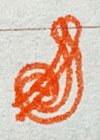
The symbol the little girl turned into Three of us are in a smallish bedroom. There was some mystery we were trying to figure out. We’re taking turns letting an inner child manifest in us, but not in so many words. For example, with me, a surprised little boy appeared and said “How many of us are there?!” I say “We just go on and on.” The little girl before him turned into a pattern on the wall when she was done.
-
The Royal Line 1997 • age 23
I was a friend of the princess of the royal line of Prokovia. I wanted her to step down from power. . . . At one point, the princess was two black labs.
-
Deflating Tank 1997 • age 23
So Buttercup and I are living in an apartment in Tank. We have our kittens and everything is nice. We’re sitting, hanging out on the left side path, reading, playing with kittens, and talking with Tavin. . . . Buttercup was falling asleep in her sleeping bag . . . [there is a big conflict]
Their anger/life was gone and I felt the story was over. Buttercup was in a sort of cocoon that looked like a stone screw-head. I had the impression that it was safe for her again. All the emotional charges had dissipated. Then I awoke.
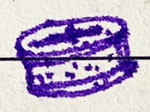
Buttercup’s cocoon References: Tank is the name of a co-op I lived in in college.
Cocooning?: So this is interesting.. Buttercup goes from being involved in the story to going to sleep “in a sleeping bag” (gradually losing shape). I then see her later in a strange-looking “cocoon”. I wonder if she turned inside and went into her own subjective dreaming early on, and this is what it looked like from the outside.
Shape Shifting
We can easily change our projected form, simply by wanting to, or imagining ourselves in a new form. Sometimes this is done unconsciously, such as when we focus on (become) someone.
-
River Diving 1992 • age 18
I notice some really large rocks right below the surface scattered around where I dove in. I complain intensely to the man, and he gets upset and calls on the water-cleaning girl. She comes and he chews her out, then tells her to take them out. Then he sends everyone home. She grudgingly does the work. Then she gets out of the water and shape-changes into somebody else. I see it and am amazed.
-
The Home for Shape-Changers and Psychics 2004
There was a large red-haired guy I thought of as a friend. He transformed into a large red wolf monster, but he wasn’t too dangerous. There was this guy I found interesting but hadn’t approached yet. He transformed into a horrible room-sized mass of purple hooks — like gonzo noses or bent pipes — in a dark black cloud. Both these two would transform unexpectedly. . . . Now everyone is transforming, and I look down at my hands — they’re slightly blistered but the skin is sunken in. “Oh no! Not undead!” I think. “That’s the worst.” I try to will my skin back to normal but only succeed in stopping the transformation from progressing. I run over to the teacher for help and she looks me over and says: “It’s your name: Adams. Change it and you’ll be fine. Change it to Sam Eckerd.” My name — I’d never thought of that — like in The Addams Family. My skin was like Lurch’s. “But Eckerd?” I thought. “Like the drug store?”
References: The Addams Family is a TV show and movie franchise.
Shapeshifters: Wow . . . a shape shifter that uncontrollably turned into a room-sized mass of purple hooks and pipes in a dark black cloud . . . that’s horrifying.
And what a surprising insight from the teacher, in regards to my own transformation.
-
Befriending a Ghost 1997 • age 22
I was in a house that was haunted, trying to interact with ghosts. Certain parts of the ghosts would phase solid and I’d grab them or push them. Then I met a girl who was killed on December 17th or 21st, waiting eternally for Xmas. I attempted to befriend her. She started out as a dog — she had a really close bond with her dog and took its shape from time to time.
Shape-Shifting Ghost: I had this dream right after returning from England, where Buttercup and I went on a number of ghost tours, so ghosts were on my mind.
Her focus on her dog caused her to sometimes take its shape.
-
My Daughter, Me 2009 • 2 AM
I notice stitches on my daughter. Was she operated on? Things shift. My daughter is a kitten, a puppy, the stitches are weeping.
Changing Form: Being that I am telepathically communicating with the baby, it follows that it’s not a thought form. But then it changes into a puppy and then a kitten. The meaning is the same — they’re all babies. Perhaps there was an interruption in the dream?
A Tell-Tale Sign — What You’re Proud Of
The trick to shape shifting is to get so completely into the new shape that you leave behind all aspects of your old shape, especially things you are proud of. If you’re proud of your height, your strength, your sexy curves, your unique hairstyle, your tattoo, your clothes — whatever you find it hard to let go of — that thing will show up in the new shape. The same thing goes for things you are ashamed of — you’ll bring with you whatever has your attention.
I’ve seen this in a cartoon or video game when I was a kid — a shapeshifter who always retains a quality from their original shape. More recent examples are Nimona, Beast Boy, and Jake the Dog, which all retain their original color when shape-shifting.
-
Body Transformations 2003
We were playing this game. I was in a room with two light gray dogs. I was to transform into a matching one, then run about and interact with them and this bone. The others were supposed to guess which one was me by my actions, and I was to try to be as doglike as possible. Before we started, I expressed a concern to the girl from the hallway — “Will I be able to return to the asian girl form afterward?” The girl said “Usually you return to your natural form.” This was telepathic. She and the others were in a different room, waiting for the game to begin. When communicating like this, I saw them above and beyond the present room I was in. So, I transformed. I was both within the dog form looking out, and watching the dog from outside. It was strange to go after the bone with my mouth, to interact with the other dogs with my mouth, to run on four short legs. I did my best to be dog-like. The others correctly picked my dog because of the way the hindquarters looked — like mine. I had to agree. It was like in cartoons when a character changes shape but keeps some of their own aspects. When I was the asian girl, I remember thinking she was taller than I remember, and I was, because I am, proving in literal form that it’s hard to let go of that which you’re proud of.
Shape-Shifting for Beginners: When dealing with really different shapes like the dogs here, just getting it right is a challenge — the body shape, four-legged running, the behaviors. What a great astral game these people came up with!
Unconscious Shape Shifting to the Person of Focus
While in altered states of consciousness I’ve seen how one entrains to another person’s frequency to communicate with them, how one becomes them, takes their shape, and that’s not just a metaphor. We sometimes astrally take the shape of a person affection, interest, or inspiration, even for a minute or two, without realizing it. Imagine how this adds to the confusion in the astral world!
In rotes, we simply inhabit the characters we’re drawn to.
-
Everyone is Buttercup 1996 • age 22
I dream of [Buttercup], myself, and some friends going to this psychology courthouse. . . . As I watch his nasty Emma talk, she morphs into Buttercup. I watch carefully and she switches back, then does it again. It was a brilliant morph, convincing as anything. She said something about how abnormal Buttercup was. Buttercup starts crying and I comfort her, thinking “If that’s normal. . . .”
Becoming the Focus: It’s clear that the mother takes Buttercup’s form as she concentrates on her. This reveals a higher truth. As we focus on someone or something, we take on its form. When we express how much we like or dislike it, we embrace or reject ourselves in that form.
-
Body Transformations 2003
Then I’m standing at the other end of the hallway where there is a sink and counter, and I’m looking into the mirror. My reflection is that of a cute asian girl I’d seen earlier in the dream. Without intending to, I had taken on her shape. As I looked, I noticed that the only obvious difference was the expression — she was always bright-eyed and smiling, while I had this sort of blank expression. I thought “I’m not nearly as cute without the smile,” but I still enjoyed the thought of being in a girl’s body and how I could grab guys’ attention.
Returning to Your Normal Form
-
The Shape Shifting Game 1994 • age 20
It all starts in art class. I finish up a great project, then hang out with a friend. We play this game where I would hold out my hands, arms straight forward, then randomly change everything but my face to that of different girls at SSU, and by looking at my new hands, I’d guess “large,” “skinny,” “tall,” etc. The friend would laugh and say “Yup, go on.”
Then this art teacher bursts in, furious, looking for me. I’m facing the far wall and have the body of a heavy-set black girl. The teacher looks around and leaves. I try to change back, but CAN’T! I go to the bathroom and decide to stay with this form, hiding my new breasts with my jacket and hiding my hips with sweats. I leave? And come back? And discover I’m male again, so I look in the mirror and I’m back to being me.
References: SSU was the first college I went to.
Lucidity and Dream Magic: It’s not every day you decide to play a game involving switching your body to that of other people. So, I must be focused in my dream self. Why did I have trouble changing back? Maybe I became attached to the girl’s body because it shielded me from the attacking art teachers. Or maybe I just thought “wouldn’t that suck if I couldn’t turn back?”
-
Body Transformations 2003
Before we started, I expressed a concern to the girl from the hallway — “Will I be able to return to the asian girl form afterward?” The girl said “Usually you return to your natural form.”
Returning to Your Natural Shape: As the other dreamer explains, when going from one form to another, one usually returns to your natural, usual form rather than the previous form. I imagine it’s difficult to go back to the previous form unless the previous form is present or it’s been well imprinted on you.
The Etheric Body
-
The White Snapdragon 2023 • 6 AM
At some point I felt what seemed like a booger in my nose. I grabbed it with my fingertips, and felt something long and huge come sliding out from all over inside my head. I was horrified to see that I had pulled out this long, ghost-white multi-armed tube-like thing that was bigger than my head. At first, it was a long stalk that split into a bunch of other stalks, which also split. After hiding it from Buttercup and the kids (who kept barging into the bathroom), I got a chance to take a closer look at it. The arms of it were tubes, as if it had grown into every.. nerve or vessel or opening within my head. As I continued to examine it, I saw that it looked like a snapdragon flower as big as my head. The face of it was grimacing, with what looked like large clenched teeth, and I reflected that that’s how I felt often, and this thing must have been the source of my decades-long head pain. As I touched it, I noticed how, just like a snapdragon, it flipped back and forth between an open form and a closed form, corresponding to two positions of over-flexed muscles in my head. . . . At one point I encountered another white snapdragon, but this one didn’t have the appearance of grimacing like mine, further underscoring the problematic state of mine.
Etheric Body Pain: In this eerie scene, I pull something huge and elaborate from within my head out of my nose. My guess is this is my etheric body, the physical body’s energy structure.
As some background, I’d been suffering from TMJ disorder, teeth clenching, and head pain for many years. This energy structure reflected that in the way it looked and the way it snapped to over-flexed positions.
-
The Eels Within 2024
This part of a dream from last week keeps sticking with me. It starts with me pulling something snotty out of my nose, but it’s several feet long and when it lands on the ground, I see it’s a clear gelatinous eel-like creature with some small orange and blue markings on it. I pulled two more out of my nose and earlier I had pulled one out and put it in a fish tank. It didn’t seem related to the overall plot of the dream.
Eels?: I don’t know what this is. Some part of my etheric body? It may have sharpened into the shape of an eel with distinctive markings because that’s what it most looked like.
The Astral Body
Our own astral bodies are thought forms. Our essential nature is a single point of conscious light. It unconsciously projects the shape of your physical body at times.
-
OBE at the Dark Tower 1997 • age 22
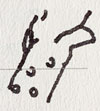
Circular impressions I noticed that my astral body had circular impressions here and there along my skin. Perhaps these were nadis? Also, it was shimmering as if wet with sweat. I was talking to the Amanda-like library person and asked her if she noticed anything strange or different about me. She said “You look beautiful!” . . .
The Astral Body: This is a rare, unrationalized look at my astral body.
-
The Reluctant Hero 2011 • 2 AM
Then — shwack! The elevator moved sideways and speared us through with a hundred spears. I felt the tightness of the spears impaling me. After a few moments, they receded and we’re spilled out onto the 4th floor.
Speared Through: It’s okay — no harm done!
-
The Severed Thumb 1999 • age 25
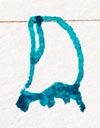
My “severed thumb” I was in a sandy square in a small Western town. I held my severed left thumb in my hand — or more likely, something in my hand had melted into a small thumb-sized object that I took to be my severed thumb. It appeared to be severed at the top knuckle. There was no blood, just the end of a thumb, severed like cut clay, and of course there was no pain. . . . About here I had a revelation. I popped the thumb-end back on my thumb-nub and it attached. I was kind of alone at this point, off to the side of the others. The blood was gone again but the thumb end fell off when I bent it.
Severed Thumb?: This was certainly a melted thought form that I took to be a severed thumb. I don’t think it’s possible to sever a part of the astral body. One can easily deform their astral body to make it look like they’d lost a thumb if they expected and believed that. Interestingly, this outside astral matter also doesn’t seem to want to join to my astral body.
Creating Thought Forms
The laws involved in the creation of thought forms are exactly those described in “The Workings of the Holographic Mind” in holographic-mind.php, most specifically “Pattern Recognition: Expectations” in holographic-mind.php and “Projections: Specific Search” in holographic-mind.php. The very same projections we use mentally in the physical world create our world in the nonphysical.
There are interesting similarities between high-energy astral matter and molten metal — both become fluid, malleable, and bright. From this state they can solidify into a form. The analogy of water and ice is helpful. Higher-dimensional astral matter (water) instantly flows into and “freezes” as a three-dimensional form (ice) created by the focus of attention. When attention is withdrawn, it slowly drains back where it came from, giving the appearance of melting ice. The rate at which it melts or drains is due to the inherent “heat” of the realm (water) where that matter exists, and our own focus of attention can be seen as a temporary “cooling” force. Higher frequencies have a higher “heat” which melts thought forms faster.
This melting can also be seen as receding into the past. Our attention on something now brings it forward into the present before us. Similarly, melting can be seen as receding into the distance (shrinking), while attention brings it close to us (growing). Since physical time is part of physical space, these are connected.
The creation and sustaining of thought forms reflects the way the Source creates and sustains all of reality. Our attention, flowing from the Source, provides an intermediary flow into a mental image that enlarges it and brings it forward.
The transience of all created forms is due to the transience of our attention. Eventually we will all melt back into oneness like the thought forms we create. Enlightenment is inevitable.
The nature of thought and thought forms is discussed in detail in “How Thoughts Take Form” in thoughts.php. See also “Focus and Proximity” in planes-of-consciousness.php.
In the dream state and in certain other levels of reality, ideas and their symbols are immediately experienced. There is no time lag, then, between a feeling and its “exteriorized” condition NOTE: the thought form produced. It is automatically experienced in whatever form is familiar and natural to the one who holds it. (Roberts 322)UR2channeled • modern • Seth
Note that Seth refers to thought forms in different ways throughout his years of channeling; thought forms, constructions, projections, symbols, and hallucinations.
Conscious Creation
Its Holographic Nature
Since it is possible to create any reality in the spirit world, it is not unusual that some souls wish to spend their off periods in the houses where they lived on Earth. . . .
These souls may want to mentally construct an exact duplication of familiar settings around where they used to live, such as the surrounding countryside, parks and streets, and any structures which remind them of their old hometowns. They only have to conjure up these places from memory and use directed energy beams for the images to appear. . . . Once in place, they will disintegrate only when the soul loses interest. (Newton 295)DoShypnosis • modern • Newton
They create thought forms using “directed energy beams”. This reveals the holographic nature of thought form creation. Our focus directs the beam of our attention, which projects and thus creates our environment out of the same matter of which our astral body is made. In this way we create holographic thought forms that are as solid as we are.
Creation in the Astral
My dream self knows how to consciously create thought forms and can do so easily.
If my waking self is awake when consciously creating a thought form, I have to overcome my belief in object permanence. This can be done by closing my eyes, or doing the creation out of sight.
-
Dream Magic 1996 • age 21
I learned DREAM MAGIC last night! . . . A bunch of people were hanging out together in the backyard of Blaine House. Sam S, dressed in drag, conjured a grape in his hand. I went crazy at this proof of magic. I leapt about and asked him to show me how to do it. He did. My hand was wet and as I concentrated, the moisture seemed to condense inward into a grape! Then Sam conjured rubber balls and then I did. I asked him if he could make light and sparkles. He did, and then I did and I was so delighted.
Creating Thought Forms: In dreams we can be conjurers. This is where the idea of magic comes from. Here I quickly grasp the art of creating thought form objects and lights. What delight to be able to create things with your mind! The condensation of some sort of liquid in the creation of thought forms is a great detail.
-
Brendan’s Gathering and Summoning Pants 1999 • 5:30 AM • age 25
One guy had a trick he was showing off — he made different coats flip up out of his pants when he tugged on his present coat with his elbows. His belief in his abilities made them work. I inspected the process. The jackets began as little grayish balls in the back of his pants by his belt, and expanded into fully formed jackets that flipped up onto his back and across his arms in a fully realistic-looking display of what by physical standards was an impossible act. I thought I could out-do him and, standing there in my underwear, I said “But can you just make something . . . from nothing?” and I hid my lower half outside the door frame and concentrated on making pants. I could feel the thought form whip up around my legs, enclosing them, but my surprise at the feeling of it broke my concentration and I looked down to see them receding. I tried again and didn’t bother to check this time and soon was pantsed.
Controlling Thought Forms: Two wonderful examples! First, the jacket trick. I’m so glad I had the presence of mind to investigate how it worked. The thought forms of the jackets would recede into little balls when they didn’t need to be seen, and expand out into the entire jacket when they did. Each one was the idea of a jacket, each an individual thought, even when not being stretched out into full form.
-
The Summoner 2001
I’m with Manville in a supermarket, but it’s not really Manville. I am desperately trying to win friends to my cause. “This is a dream,” I say. “If I can make things appear, will you believe me?” He seems doubtful but agrees. I hold out my hand. A stripe of yellow with brown splotches appears, then a banana takes shape. First it’s short and pickle-like, then it elongates. Then Manville challenges me to create his kitchen. “It has to be something I can picture,” I say, “but maybe I can read it from your mind. In fact, I know I’m capable, I’ve just never done it before. Let’s try.” I hold my palm up by his head and close my eyes, focusing on projecting into an open area of the grocery store. The images are unclear, dark. For a moment he sees something familiar. Then it shifts, switches. I give up on it.
Forming a Banana: I’m confident that I can create a banana, but an image from someone else’s mind was too much for me. I’m surprised I even got it to work a little.
-
Thought Form Class 2000 • age 25
My experience through dim consciousness was this: I was looking down at a miniature city, just a few buildings. My first thought? Wow, StarCraft! So suddenly all these Zerg creatures (because of their odd shapes) are fighting. Floating jellyfish are flying about and I invade the docking area of the kid next to me. I eventually run out of troops, but I find two oranges and think “ooh, these can be bombs!” I run about the other students in the room, looking for something to demolish, but when I see them all working on their projects I lose my fire and decide not to.

Starcraft 2 (Terrans invaded by Protoss) Image credit to Blizzard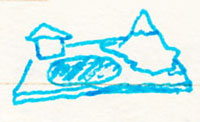
Building thought form scenes 
My contribution: attacking zerg Image credit to ThisIsGame.comYou know what their projects were? Creating little thought-form cities on the tables in front of them, using their thoughts. The place had every appearance of an art class — supplies everywhere, students wearing white aprons. And what I saw when running about were new, semi-formed thought-form structures in various colors — oblong shapes with a single color throughout, like playdough. One student had a mountain, house, and a newly-created thought form blob without edges or separate colors (yet).
References: StarCraft is a video game with a top-down perspective. Zerg are an alien species in that game.
Nonlucid Creation: The lesson here is purposeful thought form creation. When the waking self is involved in the dream, creation of thought forms happens without thinking. Every expectation, every fear and desire comes into being instantly. So creating them is not the challenge — consciously creating them is. I may have been wildly creating creatures and armies and cities, but it was all unconscious projections straight out of the StarCraft universe. I was outdone by any student who created a simple tiny house with clear purpose and the knowledge of what he was doing. I was just running around like a hyperactive kid, replaying experiences.
-
The Chamber Beneath Blaine House 2000
Floating along, I closed my eyes. The scene dimmed and then reappeared in full light. But this, I thought, was in my head. I focused on creating a thought form and suddenly held a sprig of spruce in my hands. I then “opened my eyes,” causing a flash of dark as my inner sight moved to my outer sight (or because I expected it) and there was the sprig. I was so overwhelmed I was moved to tears. I’d done it! I’d created a thought form and brought it to reality! I could feel it solidly in my hands.
Consciously Creating: Here I consciously create a thought form. Of course, I didn’t realize I was dreaming and I thought I had physically created something with my mind in the waking world. Silly me. The fact that I was “floating along” and seeing with my eyes closed didn’t clue me in.
-
The Slumber Party and Scary Man Prank 1999 • age 24
At first there was fear in the room. Only Buttercup and I had awakened. Someone gave a warning but I knew it was just fear. I must have been talking about thought forms, because some of the nonlucid sleepers had expressed doubts about the reality of them. Since I KNEW they were real, I decided to play around with them and practice making some thought forms. It was still dark and I looked out a window. I pointed and said to Buttercup, “Look at that. . . . MAN!” Surely enough a bearded spooky face appeared out of the shadows in the window, from a black silhouette to a full face, giving the appearance of approaching. Buttercup got scared and fell to the floor in a fetal position.
Thought Form Creation: Thought forms are effortlessly created by the mind to fulfill expectations. That’s why it was so easy to take in the feeling of fear in the dark room and conjure up a scary man outside. It would have taken considerably more strength/effort/focus to create something happy and positive in such an environment.
Had I not been aware that I was dreaming and been afraid of a scary man appearing, the very same thought form would have been created, and it would have scared me. But since I was aware and created it deliberately, I was not surprised or scared by it at all. In fact it was really well done! It would have scared anyone!
-
Jay, Master of Thought Forms 2010
The last guy gets up. It’s an Indian American named Jay (or Jaya), wearing a red and black plaid shirt, sort of portly, and maybe 20 years old. He does a couple jokes, then he walks off the stage — but he is still standing there. Then multiple versions of him walk off the stage and into the audience and he’s still there. The crowd is perking up and I’m really astonished, looking around at all the Jays settling into the audience. Then a bunch of them surge back onto the stage for another joke or statement, and then scatter off and then surge back through the audience in different patterns and then disappear into the crowd. I’m just astonished and wondering how he’s done it.
Multiples: Jay is a master of creating multiples of himself, showing that this is a controllable dream phenomena. It’s thought form generation, but with an impressive level of control.
-
The Home for Shape-Changers and Psychics 2004
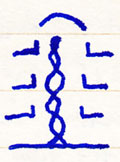
The tall metal sculpture In the center of the house, there’s this open column that goes up all four stories. Someone builds this little one-story sculpture of two-colored metal at the bottom. But then this hefty magician-looking guy whirls to the top of it and pulls all these slivers of silver or gold metal from out of the air and extends the statue all the way to the ceiling, hovering over it.
Aware of Their Powers: These people are aware of at least some of their astral abilities.
-
The House War 2011
As a last resort, the nasty family calls on some wizards and mythical creatures to fight us, and we call on a glowing pink scorpion and an earth wizard. We eventually win the battle and chase them all away.
Thought-Form Battle: A last-ditch effort to beat us fails when we create stronger thought forms.
-
Into the Mystic 2025 • 3:45 AM
I’m hanging out with a bunch of friends in a cozy, well-decorated living room. We had stopped at a thrift store earlier and all picked out a bunch of strange and interesting outfits to try later. Now, back at the house, we were lounging about and talking. I remembered the outfits and stepped into a private side room to try them on. The outfits were around a corner, a bend in space. The one I grabbed first was a shirt, but as I put it on it joined with my beard so that it looked like a big white beard shirt.
Behind a Bend: This dream was at 3:45, when my dreams are at their most intense and deep.
Note that I haven’t brought the clothes from the thrift store with me when I go to try them on. They’re stored in my memory. I casually reach “around a corner, a bend in space” to get them. This is a little effect to route around the expectation of object permanence. I expect them to be around the corner, and they are.
Dreaming that I was walking along a road—straight and I think walled on one side—and realized I was dreaming. I knew this was a thing I had been trying to do and thought, “Now I can make something happen.” I thought I would like to have an apple. I saw a patch on the road ahead and thought, “By the time I reach that it will be an apple.” Before reaching it, I found I had another apple in my hand. (Garfield 167)CDLDer • modern • Garfield
A higher, more direct desire was fulfilled — the holding of the apple was the future of the seeing of the apple.
Don DeGracia tries to envision his hands while OB, unknowingly creating them as thought forms.
Then I faded out of the lockmold NOTE: focus and was back in the void again.
I tried my newly discovered hand trick again. This time I got strange results. I saw my hand appear, kind of ghost like and transparent, then disappear as I withdrew my immediate attention from trying to feel/move it. I re-concentrated on feeling it. Now I was looking at my palm, thumb and about 1/2 of one finger. This kind of grossed me out cause it looked like melted wax or something where the rest of my hand should have been. Then I watched my other fingers “grow” or materialize, first as stumps, then they formed into my fingers. APCOBEr, LDer • modern • DeGracia
My thoughts attracted and inspired some extraphysical NOTE: nonphysical consciousness who were practicing the creation of morphothosenes NOTE: thought forms and somehow could capture my thoughts there on the street. . . .
The group of about eight . . . were playing with forms that they created instantaneously. . . .
One of them grabbed me as if by the collar and he emitted his thoughts, with mannerisms typical of a French artist, emphatically proclaiming to the other observers: “Look! This one here does not have documents! He doesn’t exist! He came from very far away. He is clandestine! There is nothing I can do but call the Inspector.”
At the same instant, another one appeared in front of me and two others behind me. They were transformed into policemen holding and pointing huge, extravagant machine guns. . . .
I knew I had nothing to fear and that it would be better to play along, participating in the farce. . . .
A fifth extraphysical consciousness dressed himself as a higher ranked policeman, came toward the others and stated:
“Hold it there! I am the inspector! I am in possession of this citizen’s documents and have come on his behalf. Free him!”
From inside his huge coat, he started pulling out, one by one, an extensive collection of documents of all types, shapes, and forms—constituting an enormous pile. As he continued to take documents out of his coat, more would appear from the seemingly bottomless pocket.
The spectators were delighted by the scene. . . .
Moments later, another extraphysical pedestrian caught their attention and became the center of their momentary interest. (Vieira 32-33)PotCOBEr • modern • Vieira
Unconscious Creation
Our environment in the dream state is the result of the existing objective environment mixed with or painted over by our own unconscious projections. These projections create thought forms.
Whatever we focus attention on is brought into our experience in the dream state. The higher law assumes that whatever we focus on is what we want to experience.
Our changing focus may be caused by desires, fears, imagination, expectations — anything that moves the attention to something that’s not present.
Expectations Create
Our expectations create our thought form environment through passive projection of our past experience into the now. See “Pattern Recognition: Expectations” in holographic-mind.php for a detailed explanation of how this works.
-
The Animal Shelter Gateway 1998 • age 24
I was distracted by a blue snake in a small cage with an unsecured lid. I tried to block the exits around the lid with boxes but it got out. I used a snake-handling stick (also from recent TV) to nab it but once I did, I freaked out and let it go. I expected to get bit and of course I was then bit.
Expectations: I expected the snake to get out and it did. I expected to get bit and I did. This snake responded to my every suggestion. Even working actively to prevent something in the dream state helps to ensure that it happens anyways.
-
Instant Band 1998 • age 24
I heard a cop car say over their loudspeaker “4-3-2-1 Please cease your activities.” We got a little scared and went to the brown cop car in the driveway next door. In it were 4 guys and one invited us to come play our music at the party tomorrow at 8. He said it was in the yellow house over there, and pointed. I saw (projected?) Banana House past a square yellow house. I said ”Banana House?” He looked kinda confused. I didn’t recall the time or date and asked them as they were leaving. It was hard to pick up but I mostly got it.
Expectation Projection: When he points to a yellow house, I can’t help but imagine up Banana House, which appears behind it. When I mention Banana House, he obviously doesn’t know what I’m talking about.
Expectations vs Reality
-
The Tree Clearing 2024
Before long Buttercup is with me in the car again, and she pulls us over, sooner than I expected. We’re apparently at our house, and I stand there, staring. It’s the view out the back of our house, but the field is flooded. When did this happen? My eyes follow the water out to the right. The lake is huge, continuing far in that direction. It’s a lake I know. There are islands and huge machinery parts in the distance, and when I turn back to my original view, there’s no neighbor’s house, no field, just the lake. Gradually my expectation of seeing our back yard was replaced by reality — this wasn’t our house at all. This was. . . . Janice Lake (something like that).
This is Home?: I’m presented with a scene that’s not my back yard, but I’m expecting to see my back yard. At first I see mostly my back yard — the field, the house, the dead trees — but with the addition of water. It isn’t until I look over to the right, following the water out into the lake scene, and then look back, that my projection of the back yard disappears and I see what’s actually in front of me.
This is incredibly important. This shows the extent to which expectation can overwrite our actual surroundings. In this case, I projected the backyard scene directly ahead of me, with the real scene bleeding in around the edges.
The following is from an OBE:
Jane: “I was still walking very slowly, with my astral eyes slitted to cut down the focus of distractions. I closed them to deepen my trance and reached out for the bathroom doorknob. I felt it hard and round, perfectly normal in my astral hand. Then I paused in uncertainty; something didn’t seem right. What had I done wrong now? I opened my astral eyes fully and stared down at my hand. It circled a ‘knob’ of air. For just a moment I felt the hardness, the bulk of that knob. Then only air was there. Obviously, I’d hallucinated the doorknob. The door was still several feet away.” (Roberts 356)SD&Pchanneled • modern • Seth
Broken Expectations
Expectations typically create, but not always. Sometimes you can be wrong, since dreams are a mix of objective and subjective.
-
A Titanic Disaster
I’m piloting the Titanic across this lake. I let a friend drive. She has to get it on this rail so that it can go under this bridge. She fails. I grab the wheel and take over. No lights come on under the bridge, and I yell “We’re all gonna die!” over and over. . . . But by some crazy luck, we make it through and I beach it near some underground passage.
Lucky Break: Titanic? That’s some heavy foreshadowing.
I fully expected to crash and yet, we didn’t. Expectations create, but they’re not the only thing at work in the dream state. Our expectations don’t override those of others or any shared objective dream reality.
-
The Man Who Owned the Sun 1994 • age 20
We asked to speak to the head guy “Phiel” or something weird. After a wait he appeared and spoke to us. We learned that he owned the sun, moon, and sky, and was slowly taking all the earth’s energy. He would someday have no need for the earth and destroy it. . . . After talking, we left the building. Mordred and I met up again outside. Then Manville showed up, blackened, bloodied, holding part of a broken bottle in his hands. He snarled. “I got him. I got the bastard.” (meaning Phiel). We were shocked. We were going to be diplomatic.
A Shocking Twist: Manville sure did have his own intentions! This is either another example of independent entities making their own decisions, or I am experiencing a story rote.
-
Snakes 1996 • age 22
I wanted to stop and tighten my laces but I passed a rattlesnake at the side of the road, then two more. We got to a place without any snakes and I stopped. We continued on into a more foresty place. I jumped in a river that was supposed to be filled with piranhas. I was scared but there were none. After a while we set out again and there were snakes in the path ahead to avoid. The snakes all had their heads up. . . . I freaked out and slid down the slope past hundreds more snakes before leaping into a tree.
Lacking Piranhas: This is a dream infested with multiplying snakes. I jump into a river and was expecting piranhas, feeling scared about it, but there weren’t any. Expectations don’t always come to pass.
Fears Create
Sometimes seeing a single frightening thing will cause countless more to appear as you look for them (searching creates) or as they recur in our thoughts (the flash bounce model). Sometimes a situation or environment triggers a related fear (association expectation). Sometimes a potential fear just occurs to us (wondering creates).
My fears are often expressed without much emotion as a “what if” or “wouldn’t that be bad if” and then of course it happens. A classic fear-based scenario is wondering “what if someone sees me” when we’re doing something crazy in the dream state.
-
Emma’s Crash 1997 • age 23
I see Emma on a snowmobile off in the distance coming towards us. She’s jumping the ditches that separate the sod fields. I began to fear Emma crashing, and thus at the nearest ditch the snowmobile crashes into the near side. Her body flies out and goes bouncing back and forth several times before landing and disappearing under the ice.
Fears Create: Growing up, there were sod fields with ditches behind Blaine House. The snow would often obscure the ditches and sometimes people would crash their snowmobiles into them — thus my fear and the resulting events. At the point of my fear expectation, I entered a subjective dream projection where the crash took place.
-
The Turtle and the Eel 1994 • age 19
I exited the [underwater] cave and went to the surface. Then I floated back down. Suddenly I wondered if I’d land on any weird sea-stuff, and I looked frantically around. A black eel-thing swam at me and attached to my leg. I poked it sharply with a stick and it partly came loose. I went to the surface and climbed onto the rocks. An orange cat bit the eel and pulled it off me. It ate half while the other half attached to its side. I tried to get it off the cat, but the cat wouldn’t let me near it.
Fear Expectations: My fear of unseen sea creatures created the eel thought form. The orange cat might have been a guardian spirit of some sort, protecting me from it.
-
The Seaweed Bridge 1996 • age 22
We’re still going 60mph and skim over the top of the water long distances before sinking down. I’m worried about my journal getting wet and it immediately splits into a wet half and a dry half. I put the dry half in a plastic bag and then call for help.
Suggestion: The fear suggestion of my journal getting wet caused it to happen.
-
Protecting the Book 1997 • age 22
I was visiting Buttercup’s parents’ house, which was a large fancy building surrounded by a kind of moat. . . . Wilson and Elizabeth arrived and I was carrying some important book. We had to cross this plank to get across the moat. I was afraid I’d drop the book and so Buttercup’s Emma took it. She set it on the edge of the plank where it fell in halfway and got wet. Everyone started complaining and blaming me and so I swam it across and it got a little more wet.
Expectations: The danger of the moat became an irresistible draw and the fear of getting the book wet caused it to happen, even when handled by someone else.
-
The Great Journey 1997 • age 22
Buttercup and I park at a parking lot. We’re a block away doing something, but I keep checking on our car. There are all these people near it and perhaps it’s due to my fear expectations and focus, but they start going through our stuff in the car, eating our food, drinking our drinks.
Fear, Suggestion, and Inhabitation: A possibility is that when I fear other people doing something, I imagine them doing it. So in a way, I am becoming them and doing the bad thing using their body, through unwitting inhabitation. Then I return to myself and get angry and exact revenge on the now-uninhabited thought forms I just created.
-
Thanks a Lot, Lance 1996 • 6 AM • age 22
Suddenly Lance is on his back with baby clothes on and shaving cream on his face. . . . I told him how scared I was that Wadsworth would come in, and voila! Wadsworth charges in the door without knocking and does a double-take on Lance. I rush to cover the sex toys with a blanket. Wadsworth loses his shit and gets crazy mean.
Fear Creates: One of the most reliable laws of dreams is that whatever we focus our attention on will happen. This includes fears. No matter how unlikely it is to happen in physical life, that fear is precisely what will happen once it has our attention.
-
Hyperspace Reunion 2000 • age 25
Before long I decided to return to Definition 6 and found that I was naked. I quickly tried to get dressed again in [Oscar’s] front apartment and of course was having trouble with it. And then of course Oscar came in. Murphy’s Law is a thought form expectation rule from dreams applied to waking life.
Murphy’s Law: Murphy’s Law, that “anything that can go wrong, will go wrong” is the waking world’s recognition of the law of expectation in dreams paired with pessimism. Everything we fear going wrong in a dream will go wrong. Get on a negative streak, and you’ll be bringing about Murphy’s Law.
In the waking world, Murphy’s Law works through confirmation bias.
-
Kitty Companion 2023 • 7 AM
Last night, I dreamed I was in “Decatur” (but it wasn’t) and there was a concrete structure that the city had just added a huge battery to. The battery was the size of a school bus standing on end. There was this crazy punk guy who had climbed up near the top of it (past the “no climbing” signs) and was licking this control panel. He was messing with it and everyone around was watching in horror. Trixie was in my jacket — this probably being a rationalization for her dream body being next to my solar plexus. She wiggled about a little as I walked. I thought that if that battery exploded, she’d probably claw me really good. So of course the battery DOES explode and smoke fills Decatur.
References: Trixie is my cat.
Desires Create
-
Graduation Hijinks 1997 • age 22
Context: My family is visiting Oberlin for graduation.
It’s graduation and everyone’s parents are here. I’m spraying people with a super soaker. Tony T’s Wadsworth gets the super soaker and gets wildly excited. He hoses down his wife, Tony, Ruby, Wadsworth, and me and we all patiently wait for him to stop. Then Wadsworth and I leave and I say “Wouldn’t it be funny if we had a pie to throw at him?” Lo and behold: Around the corner in the main room is an apple pie! Wadsworth starts scooping some into his hand and I say “No! That’s someone’s mail!” He keeps it up and I take the tags so I can report him. He chases me down to get them but I manage to keep one. Then I see four girls crying in the mailroom looking for pie and drag Wadsworth in to apologize. The girls are surprised and astonished by it all.
Creations: The pie appeared because of my suggestion, of course. But when Wadsworth started digging into it, I imagined that the pie was a special delivery for someone. This led to the crying girls appearing in the next scene. All together, kind of a dirty trick, though I don’t think that was my intention going in.
-
There Be Whales Here! 1997 • age 23
I’d just seen two HUGE humpback whales leap way out of the water in a heart shape. I’m climbing down this slippery wet rocky hill of black stones. They leaped again as I started coming down. . . . I now had a camera and would hold it up when I anticipated another leap. Of course I was never wrong.
Here They Come!: What a lucky coincidence! It’s almost as if my desire was causing them to leap.
-
Teacher on Concentric Isle, East Timor 1999 • age 25
Then we decide to explore. I know we will spend the night outside the house somewhere. He says not to bring shoes or anything else. “Fine, that’ll be fun”, I think. Then I think — “Oh, I’ll need my contact lens stuff.” He tells me I don’t need it but get it if I must. I get/conjure it from my backpack.
Waking Needs: My waking mind engages enough to remember the requirement of bringing my contact lens stuff on any overnight trip. Luckily I’m able to unwittingly conjure what I need out of my backpack, so I can continue with the lessons.
Searching Creates
When we’re looking for something, whether in physical life or dream life, we focus part of our attention on what we’re looking for. This holographically projects that image outward, which lights up matches in our attention. See “Projections: Specific Search” in holographic-mind.php for a detailed explanation of how this works.
In a dream, if that projection is strong enough, it takes form as a thought form. So when we search for something in a dream, we’re likely to find it.
Searching frequently creates multiple copies of whatever is being looked for. Sometimes this is due to what we find not being exactly right, so we continue the search. At other times it seems almost to be an unintentional recurrence of the search, perhaps based on the pull of attention back to the thrill we felt in finding what we were looking for (the flash-bounce model).
-
Banana House Tour Guide 2025
I remember being a tour guide for a group of people, walking through the attic of banana house. It was unfinished, and the particular room I was in was one to two feet deep with packed sawdust. . . . Someone might have come through, looking for a cat. . . . At any rate, looking down into the sawdust, I saw a cat face. I reached down and pulled a cat out of the sawdust. It began to walk away. I saw another cat face, and wondered how many cats were up here. I pulled it out, then saw another. Classic projection scenario.
-
Dream Magic 1996 • age 21
In dreams recently, once I start finding money, I keep finding more and more.
You Find What You Look For: Perhaps I’m walking along and I see a dollar on the ground. I pick it up and start looking to see if there’s any more. Soon I am finding money all over the place. I am creating this money by looking for it — my specific search projection causing it to take form, transforming grass or garbage into money or simply creating it out of nothing.
-
Mazes and Scorpions 1996 • age 22
Context: I had seen a wild scorpion earlier.
I dream of scorpions! The majority of this dream was my Blaine House room with the waterbed and closet. Someone had infested my room with scorpions! It started with just one, then there were more and more. I squashed the first one, then started cutting the others in half with a scissors which made some freak out and go crazy. There was a huge king and queen scorpion in my bed and thousands of little baby ones all over it. I was scared of them, but someone else was helping me to snip them up and throw them away.
Endless Scorpions: The shock of seeing a wild scorpion in waking life made it a topic in my dreams. It started with just one, but then my fear projected many more into existence.
-
Emma’s Crash 1997 • age 23
I go running out onto the ice. I reach under, grab [Emma’s] hand and pull her out to safety. Then I helped her gather her stuff: shoes and knick knacks. Of course I was projecting them all into existence by looking for them. The ground was not littered with things when I began.
-
Neon Chakra Flowers 1997 • Middle of the night • age 23
I could see fine (I assumed I had contacts) but wanted my glasses, which I had lost while we were talking. I spent a some of my attention looking for them for a while, finding countless pairs that were all wrong.
Vision: The familiar vision scenario plays out here. I’m not wearing glasses, but I can see, so it must be that I’m wearing contacts. But then I look for my glasses and find them everywhere I look through projection. Though I wonder why they weren’t the right glasses. . . .
-
When Everyone Stopped 2006 • 5:45 AM
Then on the way up I realized I was only wearing boxers! I rationalized that I must have left my shirt and shorts somewhere. It was really junky down there, so it wasn’t hard for me to start finding clothes everywhere. I found my exact swim shorts on the stairs, but knew I wasn’t wearing those — so they must have been the store owner’s. Then I saw three more pairs like it. Downstairs and around the corner were button-up shirts, and a few seemed familiar. Then I saw my green boxers and was really confused. A friendly fellah came downstairs to help and now Buttercup was with me (another insertion from waking life, perhaps) and we quizzed him, “Is this shirt yours? I have one exactly like it.”
Finding Clothes Everywhere: The old looking-for-something dream effect. We project what we’re looking for as thought forms everywhere we look.
After discovering I’m only wearing my boxers, my waking self projects clothing all over the place by the act of searching for it. Strangely, the clothing I project isn’t the clothing I’m looking for. Maybe I’m not focusing strongly enough, or the objects I’m focusing on are more similar to other pieces of clothing I have. When I keep finding my swim shorts, it seems I keep finding them because I have them more freshly in my mind.
-
The Wild Bus Ride and Parasitic Moths 2012
As I’m waiting for instructions, I look down and see a severed toe on the floor. I almost ignore it, but decide to point it out to one of the older kids running the game. He seems concerned, or nervous, and hurries us out. As we leave I see two more severed toes.
Severed Toes: The first one was most likely a melted thought form. The second two probably appeared because I started looking for them.
-
The Sliding House 2023
We had come to this house with bags packed, so there were some important things of ours to recover. What about Gwen’s Lila? I looked down in the debris at my feet, pushed something aside with my foot, and found her there. Whew!
References: Lila is Gwen's special stuffy.
Looking for Lila: Luckily I get it right the first time and the search didn’t derail the dream’s plot.
But Not Always
Searching usually creates, but not always. If distracted, or the desire isn’t strong enough, the search won’t be enough to create the thought form being sought.
A desperate or emotional search will usually create. Expectations almost always create — they’re expectations in the first place because our experience has shown a clear, dependable pattern.
-
Picture Day 2023
When I returned to the area where I last saw the team, I saw no sign of them. This began a long search as I went up the road along the school fields for a while, then crossed the street into a big park with lots of fields they could have gone to, and then continued on to what seemed like a Vietnamese part of town. I thought it unlikely that they’d gone here, so I turned around and re-searched the parks — no luck. So I returned to the Vietnamese part of town, which was a tight corridor packed with little shops on either side. No sign of them. Bodhi and I walked for several blocks through it, but we didn’t see them. A block past, I was getting really upset and worried, imagining the news reports of the coach who had lost his team.
Searching Without Success: Searching for something doesn’t always mean you find it. Most times when this works, it’s clothing or money or some lost object. But when you’re dealing with independent people, they may just have wandered off. Additionally, the emotional need behind the search has an impact on whether you project a thought form or not.
-
Looking for the Ball 2025
I was in a house, possibly Manville A’s house. A gray soccer ball rolled down the stairs and I went down to get it. I didn’t really want to. There was an open door at the bottom of the stairs and it opened out into the parking lot of a huge soccer complex. I walked out there and looked around a little. No luck. I came back to the stairs and went into the messy bedroom next to them. I found a couple gray soccer balls in there, but they were too small, and broke apart as I touched them. I left the room and returned to the parking lot.
I noticed there was a path it could have rolled that would have taken it a block’s distance down a road through the parking lot. I decided I should probably go check. I was not particularly engaged in this task. . . . I got to the parking section at the end of the lane. There was a big silvery metal grate there with spaces large enough climb through. A couple balls had collected at the edge of it. Only one ball was gray and it was too small, a size 3 maybe, and I was looking for a size 5.
Weak Replicas: Looking for something doesn’t always make it appear. My lack of enthusiasm meant my attention was only creating small versions of the ball, versions that crumbled apart when I touched them.
-
Disney Park Madness 2025 • 3:45 AM
It was night, and I was lost in this huge Disney theme park. I had arrived with Buttercup and the kids, but became lost. I was in this wandering, drunken state. I was at this Star Wars show. I saw everyone getting a box of gifts, and I went to ask a steward for one. He brought me one — it was this box with random stuff in it, including a replacement shell for a remote control — nothing I found valuable. . . . After this, I went somewhere, got lost, and then started wandering around looking for my boxes, even though I didn’t care about them. . . . After a while I realized I had lost my shirt and my phone also. . . . I returned to the ride where you held your hands up high to control it. I had checked this one for my phone several times, but checking it meant riding it to another area. . . . I spent much of the dream in a panicked search for my missing things. I kept finding stewards and asking them, but kept coming up empty handed. . . . Eventually I was reunited with my phone.
Searching for Junk: Here I am searching for some junky souvenirs I didn’t really care about and not finding them. This could have been due to my drunken state, or simply due to the fact that I didn’t really care about them. Later when I lost my phone, it was important enough to find/recreate.
Wondering Creates
When we ask “what if” in a dream, this causes a projection of the imagined scenario. The idea occurs to us, and we look for it (project it), which makes it happen. This can be inspired by fear, desire, or curiosity.
I’ve included fear-based wondering in the section “Fears Create” above.
-
Elfquest What If 1997 • age 22
I was reading Elfquest, and when I asked “What if the Wolfriders hadn’t turned this one way and met the others?” The answer was “Someone else would have,” and I jumped into the action — a frozen tundra. The wolfriders went the other way.
References: Elfquest is a graphic novel series which features the Wolfriders.
What If..?: Here I explore a different possibility if the Wolfriders had taken a different path.
-
The Green Dragon of Sauron 2004
Legolas shot arrows into some orcs as they exited the cave. At the thought of shooting arrows into whoever came out, I wondered “what if a friend is coming through?” Then we heard a familiar voice. Legolas went in. In my mind the story was filled out — a merchant friend or forest elf had used the chaos to escape the army and was running for us. But then the tunnel erupted in flame. We realized it was a green dragon. Legolas made it out but we never heard from the “friend” again. . . . We came to a bizarre twisted throne made of bone, painted in reds and blues. I must have imagined it belonged to a wizard because then there was one — an obvious thought form that just sat there, glassy-eyed, and only spoke when I expected it to, providing nothing new or unexpected.
References: Legolas is from Lord of the Rings.
Imagination and Thought Forms: My wondering creates a subdream in which the imagined scene plays out.
The glassy-eyed wizard seems to appear simply due my association with the throne of bone.
-
The Totoro-Gerbil Genetic Tank 1997 • age 22
The Totoro-gerbil genetic tank is a house-sized biosphere with rocks and ledges and water with Totoro-like gerbils of all sizes from bean-size to cat size. Some other researchers and myself were sitting on the rocks, moving some little ones around and I thought “Wouldn’t that SUCK if we fell over and crushed them?!” Well, guess what? We fell over and squashed bunches of them.

Totoros from the movie My Neighbor Totoro References: Totoro is a big fuzzy creature from My Neighbor Totoro.
Power of Suggestion: Our experience follows our focus.
Group Creation
-
The Blaine Treehouse 2024
I was at Blaine House. I had seen plans for building a new house in the back yard. . . . [Blaine House] was in the original position, but it was a single story house. The basement level was unfinished, as it was when I was growing up. The walls were unpainted sheet rock. The floors concrete. It was scattered with debris. One of the builder’s cars was parked inside.
When I turned around to look at the back yard, the new house was partially built. I could see the first floor of it and the circular walkway. The builders were back. . . . The treehouse was built enough that Buttercup and I decided to look inside. It was made of dark wood and shaped roughly like a C battery with a circular walkway around the center. There was an area for cars to park about where the little hill with the trees was. From there, there was a door to a small entryway with stairs going up. Up the stairs was the first floor. We went up again to the middle floor. The way up left you pressed into this weird wicker chair which you had to climb out of. That sucked, I thought. We’d have to fix that. There was a kitchen here. It was surrounded by windows. We counted 14 that would open. A walkway circled the building outside. As we explored the house, it was becoming finished, defined, decorated with art and knick-knacks. We went up to the third floor. It was taller than the last two, looking out at the leafy treetops. Above that was the rooftop, which was like a little meadow, with naturally growing plants and a little pond. This was above the treetops, and I could see out in all directions. . . .
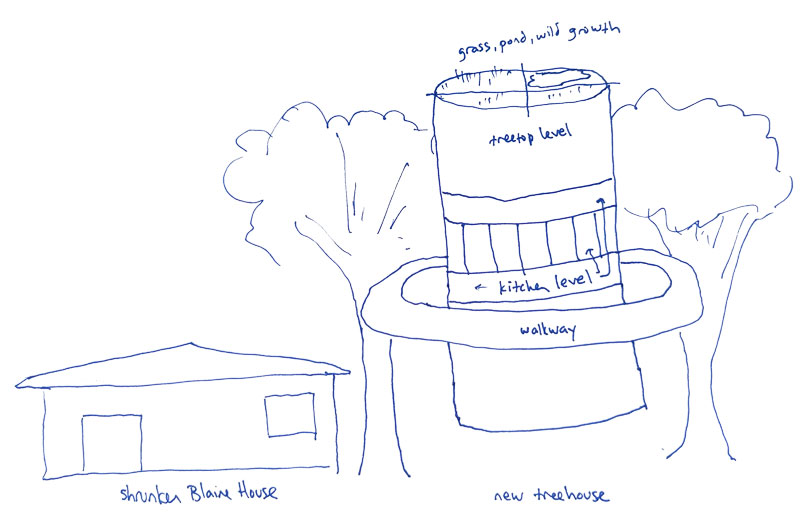
The completed treehouse We returned to the kitchen level. The builders were back, along with a man I took to be Bear, the guy who ran Big Bear Construction and did our porch project a while back. The women builders were back. This place was truly extraordinary. . . . Then I talked with Bear and explained our protectiveness about trees. As we spoke, the entire group moved out of the house through one of the walls and down to the ground. I looked at a tree between the treehouse and Blaine House. It was hard to understand what I was seeing. Was it twisted and splintered? Then the pattern came into focus. The tree had this glowing pattern on it. The light all around seemed to dim to twilight as I looked. The pattern glowed beautifully as if lit from within. As our group pulled away together, I saw the front of the treehouse. The treehouse was surrounded by six big, beautiful trees, each with a glowing symbol on its trunk. The yard had glowing art features in it. It was truly beautiful.
Rapid Construction: This is the first time I’ve seen a group working to create a thought form. While it had all the trappings of physical construction, I never saw any work being done. In fact, the first part came into existence while I was in Blaine House’s basement. The rest of the treehouse was created as we were inside it, exploring it. Its full and final form was only seen upon exiting it and looking from the outside.
-
The Treehouse OBE 2024 • 5:30 AM
And then one of the corners I turned connected to the Treehouse. I hesitated a moment, thinking it was in construction, but then with giddy excitement I decided to have a look around anyways. . . . This time there was a spiral ramp leading up to the first floor. The floor was white with black speckles that stood up a little making it feel gritty. This led to a circular tiled room, but the floor wasn’t flat — it continued the spiral to the center then sloped down again. That just wouldn’t do, I thought. It’d be great for kids, grandkids maybe, who wanted to play with matchbox cars. But no furniture would fit there. This landing seemed pretty small compared to the shape of the Treehouse. Sometime around here, Bodhi and Gwen joined me, running around.
I believe the spiral ramp continued, and I went up to the next floor. Here I saw a worker or two. One I took to be the foreman. As he came in, he looked at me a moment, seemed not to believe his eyes, then moved on. . . . I stood and watched as someone constructed a . . . stairway or shower in front of me. It was dark wood, with lots of vertical beams. As I watched, he carefully lowered a horizontal beam into place at the foot of it.
Continuing Construction: This time I get to the Treehouse by walking around in Hibernia House (my current house). The treehouse is entirely different inside, with a spiral design. Although it was finished yesterday, it’s under construction again. This time I see physical-style construction work taking place.
How Thought Forms Come Into Being
When we focus attention on a three-dimensional image from our past, we project it outwards from us. Our attention creates an invisible cord to a where that image will appear in the astral space around us, and the pressure from the flow through our attention instantly inflates it, perfectly reproducing it. The omnipresent astral substance (elemental essence) instantly flows into that form. Our continuing attention sustains it, and when attention (and thus the cord) is withdrawn, the substance slowly drains back to where it came from.
See “Thought Forms” in thoughts.php for a deeper understanding of thought forms.
Inflating and Expanding
Just as forgotten thought forms melt and deflate, new ones inflate. Almost always, it happens so quickly, we only see the perfectly-recreated final form.
But sometimes I catch thought forms midway through their creation. My attention freezes them in place until I withdraw it, at which point they finish coming into being. They freeze due to our expectation of object permanence. At that point, we may mistake them for something else, and our attention might redirect them into that new shape.
-
The Summoner 2001
I’m with Manville in a supermarket, but it’s not really Manville. I am desperately trying to win friends to my cause. “This is a dream,” I say. “If I can make things appear, will you believe me?” He seems doubtful but agrees. I hold out my hand. A stripe of yellow with brown splotches appears, then a banana takes shape. First it’s short and pickle-like, then it elongates.
Expanding Into Being: It’s interesting how the banana takes shape. It’s not often I’ve seen a thought form come into being like that.
-
The Inflatable Water Park 1999 • age 25
The castle on a hill with courtyards I opened the box. Inside was a glowing green bean and two plastic canisters. There was a current coming from the canisters and I started hooking up these little models of water park rides to hoses that connected to them. I hooked up a whole bunch at once and they all began to slowly inflate. I was inflating a water park right there in Blaine House! They were spreading out across the kitchen, pool room, and dining room. At a certain point, I noticed the current was having trouble inflating so many water park rides at once, so I decided to focus on one. I unplugged the others and remaining one started growing really big. It grew into a huge courtyard with a castle, axe-throwing knights, children with LOTS of colored balloons (little thought-form bubbles), huge water park rides, games, and lots of people.
Thought Forms: Did I inflate everything in that scene, including the children, balloons, and courtyards? They weren’t evident in the little models I saw before.
Or was it more like a rote, that expanded directly into my current environment without taking it entirely over?
-
Powered 2013 • 2:30 AM
A man has the most concentrated bit of substance, sealed up in a little clear plastic bubble. He calls out to everyone, full of energy and emotion. “Do you see this? This is the most concentrated and dangerous part! This, they are keeping from you!” and he tears open the bubble case and holds aloft a chunk of potato, seemingly taken from someone’s dinner plate. It’s saturated with the substance of power. . . . In fact there’s a wild chaos to every form here. Everything is inflated 120%, as if it was a balloon, overfilled. Colors are vivid, glowing. Everything is burning with inner heat. People are so filled with it that they are spontaneously displaying amazing powers.
Overinflating: The effect of the high-energy psychoactive substance is to overinflate everything. Typically large amounts of attention leads only to a very clear, well-defined thought form.
Caught While Expanding
Our belief in object permanence means that when our attention falls on a thought form that is in the process of expanding into its final form, it stops expanding, and only continues when we look away.
-
When Everyone Stopped 2006 • 5:45 AM
The store had these elaborate statues in one corner — I thought one was a sculpture I made in high school but it turned out to be different. They all had a clear contoured glassy outer coating around them — thought forms caught in the action of forming. Each was about 1.5–2 feet long and .5–1 feet tall. They were various shapes — like a combination of a monster/dragon head and a space ship. Later when I came back to them, they had grown into odd “gaming machines.” Each had a 70s style base unit, and a rod coming up suspending a large ship/space station thing.
Blooming Thought Forms: It looks like I wandered into these thought forms as they were on their way to becoming video game machines. As usual, my gaze locked them into their form, and then they continued coming into being when my attention was elsewhere.
-
The Mirror People 2012
It’s dim morning light and I see a couple go into a house along the street on the north side of the school. It’s got a glass front door. I see one of the administrators showing off the house. I rush in behind them and say “you cannot buy this house!” There are all these little white VCRs (maybe 12 of them on the floor plugged in along one wall, and some are black) being offered as part of the house. “These are surveillance devices!” I shout and I start collecting them to destroy outside.
Incoming Houses: I catch the furniture in the process of coming into existence. Their cords are visible, and they started out as simple rectangular shapes in white, which I mistake for VCRs.
-
Lucid: Colored Pots and Pans 2000
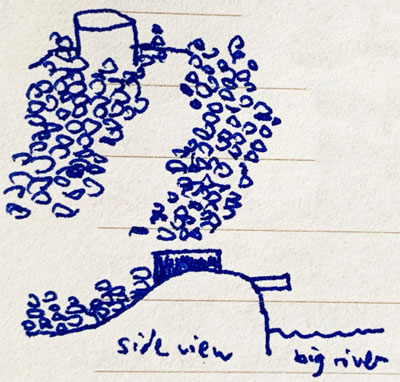
The walkway among colored pots and pans & side view Then we looked up ahead at a vast landscape of colored pots and pans stacked into towers with a path running through them up to this huge tall black pot. I suggested we go up the path and we did. Marilyn said he felt like he was coloring the pots and pans with his mind as he looked at them. As we got on the path they turned to cars, still stacked and still colored. One car blocked the road.
Pots to Cars: It’s possible the pots and pans were just thought forms caught by our attention on their way to becoming cars, and when released by distraction, they finally finished forming.
Materialization out of a Cloudy Shape
A strong focus will instantly create a perfectly detailed thought form. When created with a weaker focus, we may be able to see a thought form come more gradually into being. We may see them grow from small, vague, white, semitransparent, soft-edged things to fully-defined forms with colors.
-
The Ghost Ship
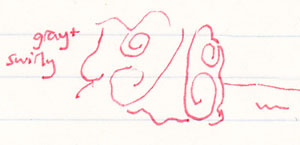
The ghost ship emerging I look out over the water and see this crazy ship-like cloud right over the water. I run inside and tell everyone. When I run back out, it’s fully formed and present — a ghost ship called the Titanic, gliding across the water silently. Did I just see the construction of a thought-form?
Thought Formation: This is a rare sighting of a thought-form coming into being. Most likely it was being called into being by someone else, or it would have been fully formed by the time I had seen it.
-
Lucid: Colored Pots and Pans 2000
One car blocked the road. Was it occupied? As I had the thought, a vague white silhouette could be seen in the driver’s seat. Recognizing the thought form, I said “no” and smiled to myself.
The Driver Thought Form: I was lucid enough to catch the thought form person forming in answer to my question.
-
Art Class, Day 5 1999 • 5 AM • age 25
It’s night now and I’m sitting in the upstairs bathroom. I get this creepy thought about three bad things coming to visit and I think that someone’s going to dangle something outside the window. I don’t want to turn and look, but I do. Something materializes as if fading in from behind thick darkness. I’m a little spooked but know someone’s playing a game and go to pound the window to scare them back but there’s no glass and my arms flail outside the window. I back up, then look around the corner and see a vague white figure on the deck with a fishing pole moving this stuffed white hippopotamus. These are all thought forms I made of course. I grab a plunger and swing it at the dangling hippo. I smack it and make this groan of disgust. Buttercup hears this and awakens me!
Thought Forms: The object was created by my fear that it would be there. I wonder where the idea of three bad things coming to visit came from.
-
Bad Service 1997 • age 23
One by one all the customers let him know what a mean bastard he is. Then I take my turn. With each customer he starts listening and then gets all mad and stops listening. I wanted someone to throw something at him, and someone throws a clear sleeping bag at him (a thought form!).
Vague Intention: The sleeping bag was my own thought form, not fully formed, from my desire for someone to throw “something” at the mean guy.
Shadowy Forms
Shadowy forms appear to be a beginning stage of thought forms — a weak thought, not specific enough to finalize the form. In other words, “someone is there” without any specific idea of who.
-
The Royal Line 1997 • age 23
The gods were bumbling around and broke a hole in the city’s inner wall, which would allow anyone in. We had the idea to stake out the opening and see who would come through; who the princess’s enemies were. I remember someone sneaking through, but it was more of a thought than real, like a darker thing of a slightly different style. It didn’t fit.
Mismatched: Typically you can discern people and thought forms from their behavior, but sometimes their appearance gives them away. Watching for someone to sneak through the hole will surely lead to a thought form person doing so, and it appears in a style that doesn’t match.
-
The Slumber Party and Scary Man Prank 1999 • age 24
I decided to play around with them and practice making some thought forms. It was still dark and I looked out a window. I pointed and said to Buttercup, “Look at that. . . . MAN!” Surely enough a bearded spooky face appeared out of the shadows in the window, from a black silhouette to a full face, giving the appearance of approaching.
Focusing In: The thought form person comes into focus before my eyes, starting as a shadowy figure before coming fully into focus as a person.
-
The Summoner 2001
Manville challenges me to create his kitchen. “It has to be something I can picture,” I say, “but maybe I can read it from your mind. In fact, I know I’m capable, I’ve just never done it before. Let’s try.” I hold my palm up by his head and close my eyes, focusing on projecting into an open area of the grocery store. The images are unclear, dark. For a moment he sees something familiar. Then it shifts, switches. I give up on it.
Shadowy Beginnings: Unable to get a lock on what I’m creating, I only manage to create a dark, unclear form before losing it.
Transforming Thought Forms
Conscious Transformation
-
Ghosts and Astral Matter 1996 • age 21
During a scene of emotional conflict, the next room began glowing an eerie green, and a large ghostly stack of stereo components appeared. I walked up to it and pulled at the top. Its features melted away as it stretched out, but when I let go it snapped back to its original form. It was some kind of elastic spirit substance. I brought some of the substance outside and changed it to something else with my mind. Then I threw it up into the air and willed it to change to rain and it did. Then I changed it to small dogs and a donkey.
Transforming Astral Matter: Astral matter responds instantly to thought to create new thought forms.
I remember once seeing myself in a large empty room without windows. Besides myself there was in the room only a small black kitten. “I am dreaming.” I say to myself. “How can I know whether I am really asleep or not? Suppose I try this way. Let this black kitten be transformed into a large white dog. . . . I say this to myself and immediately the black kitten becomes transformed into a large white dog. At the same time the opposite wall disappears, disclosing a mountain landscape with a river like a ribbon receding into the distance.
“This is curious,” I say to myself; “I did not order this landscape. Where did it come from?” Some faint recollection begins to stir in me, a recollection of having seen this landscape somewhere and of its being somehow connected with the white dog. (Ouspensky 249)ANMUpsychedelic • Theosophy • Ouspensky
Now I look at the lady standing beside the mirror and I think to myself, “I don’t want her to be here; I want Linda to be here.” And with that thought, the woman becomes Linda. (Kelzer 245)tSatSLDer • modern • Kelzer
It’s easier to project different details onto something than to turn it into something else entirely.
Replacement Rather Than Transformation
In the following examples, rather than transforming, one thing disappears to make way for something new.
I become aware that I am dreaming. . . .
I decide to practice directing the actual content of the dream. I focus on a tree in the dream scene, and I mentally command it to turn into a house. Slowly, the tree dematerializes and disappears and a small white house appears in its place. (Kelzer 16-17)
I become lucid. . . .
I mentally command the tree to turn into a . . . (pause) . . . rabbit! . . . Instantly the tree vanishes and I see only a blank, brown screen in my field of vision. I feel disappointed and . . . keep visualizing a rabbit. Soon I see the white outline of a rabbit on the brown screen. First I see it from a side view and then from its backside, as it begins to hop about with movements similar to an animated cartoon.
Suddenly, the scene changes again. (Kelzer 18-19)tSatSLDer • modern • Kelzer
Unconscious Transformation
These are due to changes in context, preference, or expectations.
Changing Form
-
The Green Dragon of Sauron 2004
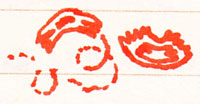
The dragon’s first appearance The dragon flew over the mountain ridge/membrane and was this swirling, looping shape in the sky. I stared at it, mesmerized. Then details fade, but the dragon dove down and attacked with flame and claw as we darted across this new area.
The Dragon: If you look at the picture, the dragon at first looks very little like a dragon. It’s almost like a kite, or wings, floating and spinning on the wind. How odd..
-
Reshaping a Guinea Pig 1997 • age 22
Me and my sister were given guinea pigs. I don’t like guinea pigs so mine gradually transformed into a gerbil.
Transformations: This time the transformation was based on my preference.
Attention Increases Size
One of the fundamental laws of consciousness is that attention makes something bigger.
In dreams this manifests as the proximity of someone or something to you, just as in the physical world, the closer you are to something, the bigger it is. In dreams, the more our attention is on something, the bigger it appears to us. As you begin to think of something, it starts out pin-prick small (far away) and expands (gets closer). Watching something expand from your attention is the equivalent of getting closer to it.
Physical reality requires the extra step of moving the physical body. Our attention draws us to move ourselves physically toward something, and doing so makes it appear bigger.
-
Liquid Reality 1998 • age 24
I was doing some experiments with sight in dreams. There was a scene with an ironing board and as I focused on it, it expanded, as if attention magnified it in size. I experimented with different things in the visual field and attention flowed into things and expanded them like liquid reality, in the same way that proximity expands things in the waking world but without the fixedness of form.
-
The Wild Bus Ride and Parasitic Moths 2012
I am in the downstairs basement level of a house. The first thing I remember here is that there’s a big booger blocking my left nostril, so I pick it. It comes out, followed by all these green dusty things which fall to the floor. I look down and they’re little insects, squirming and moving about! The horror! As I watch, they quickly grow from tiny motes to a half-inch long. They’re crawling about and increasing in number every time I look away and then back. They look kind of like little green scorpions. . . . The scorpion look was only for the first few I examined closely. The rest were long, segmented things with lots of legs and feelers. They were green and semi-transparent when small, then they turn jet black as they get bigger, then brown as they reach the size of 2-3 feet long and four inches tall. The largest ones looked more like shed skins, as they had lost definition, like a melted thought-form.
Insect Growth: I unwittingly inflate these tiny insects with my horrified attention until there is an infestation of nasty bugs. Notice how they go from transparent and barely formed to black and leggy as they enlarge under my focus.
Multiple People’s Influence
Multiple people can influence a thought form, either consciously or unconsciously.
-
The Severed Thumb 1999 • age 25
My “severed thumb” I was in a sandy square in a small Western town. I held my severed left thumb in my hand — or more likely, something in my hand had melted into a small thumb-sized object that I took to be my severed thumb. It appeared to be severed at the top knuckle. There was no blood, just the end of a thumb, severed like cut clay, and of course there was no pain. So I’m curious, and then I think, “How does not having a thumb affect my life?” I ponder the implications. “I can still write, as my right-hand thumb is fine. . . . Oh no! I can’t play piano!” Then I panic. I shout and run about calling for doctors and asking people to call a doctor or hospital. Soon I’ve gathered a crowd, including one doctor. As my friends looked at my “severed thumb,” the cut part now began to sport a thick bloody gash, looking more real.
About here I had a revelation. I popped the thumb-end back on my thumb-nub and it attached. I was kind of alone at this point, off to the side of the others. The blood was gone again but the thumb end fell off when I bent it. The doctor saw it after I stuck it on and the moment he did, reddish pinkish “blood” that was thick like jelly appeared around the severed area. Did his expectations directly affect my thought form? So he wanted to sew it up and I ran away saying “Ha! You want to stick your needles in me and sew it up? I don’t think so!”
Then a police officer who had also been attracted to the scene walked up beside me, intrigued, and for some reason he looked at my thumb and the blood was blue! So he called me an alien.
Multiple Influences on a Thought Form: Here’s an interesting example of the expectations of multiple people changing a single thought form. On my own, I took it for a severed thumb but without any blood or injury. But as I explained it to others and they looked at it, it took on a wound and blood. The doctor’s expectations added even more blood, and the police man’s weird expectations made the blood blue. Thought forms are communal property. One person’s thought form can be transformed or reanimated by someone else’s expectations.
-
Uncle John’s Puffball Mushroom Farm 2023 • 7 AM
He pointed and said “look!” and I followed his eyes to this huge puffball mushroom a little ways off. It was the size of a large beachball. When I got to it, I could see a boulder-sized one in the distance.
Amazed, I ran to it, but oddly, when I got there, it was replaced by several large but different types of mushroom, like tan, orange, and white layered shelf mushrooms, but several feet tall and wide and more shaped like wedges. None were as big as the boulder-sized one I’d seen here. They were along a sunken path next to a wood building. There was one that was shaped vaguely like an angular weasel face, mostly a light orange color. When I brought my hand close to it, it seemed to move a little in response. Buttercup and Bodhi and Gwen came near, maybe some others, and I told them to hold their hands out to it, and it reacted similarly. I decided to take a video of it and Bodhi got behind it and jumped around. I asked him to stop.
We walked away after a few minutes, and there were a swarm of flies ahead of us, and then we saw some reddish raccoons walking about. Some were young. Some walked on their hind legs like a human. Now that I think of it, they were the same colors as the shelf mushrooms we were just looking at. One walked up to Bodhi, and he picked it up. These were probably red pandas, his favorite animals.
Mushroom Red Pandas: I get excited and go to see the boulder-sized puffball mushroom. It’s likely I excitedly called the family over with me, as they arrived with me. Oddly, I end up seeing a bunch of quite different kinds of mushrooms instead, with the boulder-sized one no where to be seen. I was looking at each, thinking “Is this the one I saw? No.. Is this?”
What likely happened here is that Bodhi, registering my excitement at seeing something cool in the woods, thought that maybe it was red pandas, his favorite animal. These new mushrooms look like are red pandas caught by my attention in the act of coming into being. They end up halfway between mushrooms and red pandas, and the weasel-shaped mushroom I approach responds to our presence slightly, as if its nose was twitching.
As I remove my attention from them and walk away, they are freed up to take form entirely from Bodhi’s desires, and we find ourselves amidst a group of what I take to be reddish raccoons in the dream, but which are clearly meant to be red pandas, which Bodhi greets fondly. Amazing!
-
The Home for Shape-Changers and Psychics 2004
The tall metal sculpture In the center of the house, there’s this open column that goes up all four stories. Someone builds this little one-story sculpture of two-colored metal at the bottom. But then this hefty magician-looking guy whirls to the top of it and pulls all these slivers of silver or gold metal from out of the air and extends the statue all the way to the ceiling, hovering over it.
Creating Together: Here we see two people contributing to this thought form sculpture.
Releasing Thought Forms
One can consciously try to get rid of a thought form, though this is usually counterproductive, since attention is what thought forms require to exist.
Destroying Thought Forms
Thought forms are built by attention, so attempting to destroy one will generally only strengthen it. However, if it is our own creation, our intentions may eventually come to pass when we remove our attention from the form, then return it, expecting to see it transformed into a version that appears destroyed.
Destruction vs Object Permanence
All thought forms are made of the same astral substance. It can look like anything, but doesn’t have the inner physical properties of wood, glass, stone, and so on. Trying to make it respond as if it were these materials is difficult. While thought forms respond to our expectations, our focus on them preserves their present form. Sometimes it takes a break in our focus to allow the desired transformation.
-
Burning Thought Forms 1999 • age 25
Buttercup bought a house in Atlanta and we had to burn down the one next door because it carried some disease. Buttercup and Ruby and Emma and I all got hoses and surrounded the house. We kept lighting it on fire but the flames would go out when we looked away or stopped paying attention. A phenomenal effort got the front of the house burning but before too long, of course, it went out. The effect of the fire was that the front had tilted inwards, shrunken, and become “sweaty,” much like if you were heat-melting plastic or cheese. The wood, windows, stone, siding, etc, were all being treated as equal substances. Thus, a thought form.
I was between the houses protecting ours from spreading fire. I needn’t have worried. As I learned in the lava dream “The Backyard Lava Pit”, housing blocks are inviolate from each other. So then some distraction occurred and we came back to the next-door house (which we’d been trying to burn) to find it in charred ruins. It finally responded to our expectations when our attention wasn’t holding it in form through our physical “continuity of form” expectation. We then went in and kicked the boards down and so on.
Very Interesting!
Thought Forms and Expectations: Fire doesn’t exist in the astral. The flame, when appearing on the house, was a thought-form image we added onto it. It didn’t actually burn it. The intent of our flaming thought-form was to destroy the house, so while our attention made it melt somewhat, it also worked to hold the structure in place to a large extent. Finally it took a strong distraction to allow the house to become the charred ruin we originally wanted to see.
-
Submarine Self-Destruction 1990 • age 15
The blast comes. I see it — a slow-moving shockwave of intense heat moving towards me. I’m not protected enough. I scramble out the window for another wall of protection. I close my eyes and take the blast. When I open them again, the house is devastated. The deck wall is shredded, blown out two feet off the deck, showing nails. Most of what’s in the house is either turned to dust or knocked over and slightly charred. Every opening — windows, arches — is melted down to a small molten opening. The walls around the pool room are all blasted outwards. The spot where Wadsworth stood had a small black circle that also appeared on the ceiling. Was he totally disintegrated, or did he move? I have moments of fear, but we find him outside. He’d gone out behind the wall I was standing near.
Transformation Behind Closed Eyes: The destruction of the house would likely not have happened if I had kept watching, but closing my eyes gave the thought form of Blaine House a chance to change to my new expectation of it.
Most interesting to me is that the window and arch openings are all melted into smaller openings — as if the walls melted down over them. Melting is astral matter’s natural way of being “destroyed”.
I dreamt that I stood at a table before a window. On the table were different objects. I was perfectly well aware that I was dreaming and I considered what sorts of experiments I could make. I began by trying to break glass, by beating it with a stone. I put a small tablet of glass on two stones and struck it with another stone. Yet it would not break. Then I took a fine claret-glass from the table and struck it with my fist, with all my might, at the same time reflecting how dangerous it would be to do this in waking life; yet the glass remained whole. But lo! when I looked at it again after some time, it was broken.
It broke all right, but a little too late, like an actor who misses his cue. (Van Eeden)aSoDLDer, OBEr • Van Eeden
Structures Breaking Apart
-
End of Days 2012
Someone asked the captain why we were flying so low and I heard the captain saying there was a problem of some kind. The plane passed under a bridge and then slowly started to land on the freeway. It went well, except we heard warnings that up ahead there was an obstacle of some kind. Soon I saw it — a toll booth blocking the right side of the freeway. The plane hit it, sheering off and destroying the right side of the plane. The left side shook and listed. As it started to careen up into the air, I turned to Buttercup. Time slowed down as I looked in her eyes and said “Buttercup, I love you”. The left side broke off into sections and our set of two seats stayed upright as it flew through the air. They landed and separated, remaining upright and sliding along the road. I unlatched my seatbelt and just stepped out of the seat at a trot, then slowed down and stopped. I shouted for Buttercup to do the same. She did. A car coming from behind in the lane we were in almost hit us but we stepped aside in time.
The Plane Crash: The crash is fascinating. Since the plane itself is a travel rationalization, that thought form makes the best attempt at a realistic crash while obeying the law of dreams; that being that each person traveling is an independent unit and in actuality is just slowing down and landing on the ground. So the plane breaks apart into sections of connected people, such as Buttercup and I. We land and our seats separate, staying upright the whole time, and as we slide, then we just unbuckle and trot slowly to a stop, the plane rationalization and all its parts no longer needed.
-
Tornado Obliteration 2018
I had been traveling through the suburbs in a bus. There were reports of tornados, and we drove past some torn-up forests near our house in Atlanta.
I ended up at Manville A’s house in Minnesota with a bunch of other kids. The wind picked up suddenly outside and I asked Manville what was outside each of the walls — another room? Was it underground? Or an exterior room? It took a moment for him to understand my question but we located an internal wall. I pulled couches around us. The wind picked up and increased tremendously, shaking the room. We moved over a little and clung to the pool table in the center of the room. The room started breaking apart as the sound increased and suddenly it was a whirlwind of debris. It was over quickly. When the dust cleared, the room and everything in it except the pool table were atomized into small brownish clumps, like dryer lint. I looked out into the yard and forest around us. Manville and I stood up and walked to where a wall was, and stepped right out down the 2 foot drop into the yard.
A room, obliterated?!
Shredded Thought Form?: This is a very unusual way for a thought form to go. It was very much like what a real tornado would do, aside from the extreme level of atomization. I’ve never seen a thought form be so thoroughly rendered into debris as if it was physical. Still, the appearance of clumps of dryer lint was not correct. And what’s stranger is that we were inside it at the time!
-
The Sliding House 2023
We’re in a house in a neighborhood. I think it was meant to be Buttercup’s parents’ house. It was raining, and I knew the house was about to come loose from its foundation and start sliding. It did so, and I told everyone to hang on. It slid down the small slope into the street, then started moving down the slope of the street. As it slid, bits of it began to break off. It continued down the street and onto a larger street, picking up speed, then onto a freeway, all downhill, breaking apart more and more, leaving debris and belongings behind each time a part of the house broke off. Soon it was just a single bedraggled room. It finally slowed down and came to a halt. We stepped out.
The Shredding House: When released from attention, thought forms melt, shrink, and drift. But when they are breaking apart for other reasons and remain in our attention, they can take on a more physical form of breaking. This is interesting because the house is “one idea”, not a conglomeration of thousands of ideas of wood and walls and furniture. Maybe the debris is made up of altogether new thought forms.
I’m pretty sure the house was on its way to becoming a car, now that we were on the freeway. It had broken apart until it was a single small room, about the right size for a car, and contained (the feeling of) all of us. The wall was missing in places that allowed us to see out the front and side. Had I forgotten the previous scene, I’m sure it would have finished the transformation.
An Act of Will
We may will thought forms to disappear. This engages the higher self, who is able to prevent us from projecting imagery.
The following is in terms of OBEs. Seth refers to thought forms in this context as “hallucinations”:
You may “awaken” in your house, for example. If so, check your rooms against their normal arrangement. Anything that does not normally belong there may be an (sic) hallucination NOTE: thought form, part of the usual dreaming process. If you will such images to disappear, they will, leaving you within the basic unhallucinated environment. If you rationalize any such elements or accept them uncritically, you may fall back into normal dreaming. . . .
Keep this up with any other such images that you meet. . . . You can accept such images and play around with them or watch them to see what develops, but only if you realize they are hallucinations. (Roberts 366)SD&Pchanneled • modern • Seth
The shapes of lesser importance created in a haphazard way, without any definite consistency, dissolve fairly easily under the influence of will. We must never be too trustful of appearances. If they belong to groups it may be that we are not so strong as the people who have created them and may be ill-used by them. It is better not to take any notice of such forces.
Under the influence of thought certain shapes dissolve and leave not a trace. . . . Others have far more resistance, and we are obliged to have a kind of struggle with them before they will go. In certain cases I noticed that a liquid residue was left behind, a thick, blackish kind of amorphous protoplasm. Sometimes it was a residue symbolic of broken glass. . . .
In the majority of cases thought-forms are less vibrant, less active than beings in evolution. Their magnetism is far less powerful. During these studies I one day had occasion to dissolve the astral form of a dog. Only the head remained, and I saw a child come towards me and tell me that it was really a dog. The intense nature of the life which animated this head made me understand my mistake at once. (Yram 154-155)PAPOBEr • Yram
It’s interesting that Yram could dissolve the astral form of an independent creature. Perhaps he is only influencing his perception of its form.
Removing Attention
Since attention is what creates and sustains thought forms, removing our attention is the fastest way to make them disappear.
Of course we must remember that we’re not the only consciousness out there. This technique is effective at releasing our own thought forms, but those with the attention of many people will remain, even without our attention. In such a case we can always focus ourselves elsewhere.
Now at any of these various stages of consciousness, other phenomena may also be perceived—thought-forms for example, energy manifestations, projections from the personal subconsciousness, and projections from the collective unconscious. . . .
Often they are incipient forms given activity by the personality who encounters them. The nature of their activity, therefore, will be projected outward from the personality onto the relatively passive materialization. The person encountering these has only to turn his attention away to “deactivate” the phenomenon. . . .
It has some energy of its own, but needs additional energy from a perceiver for any interrelationship to take place. If such a materialization appears threatening, than simply wish it peace and withdraw your attention from it. It draws its main activating energy from your focusing, and according to the intensity and nature of your focus. (Roberts 281)SSchanneled • modern • Seth
‘Does the first [picture] fade, once the artist has withdrawn his attention from the canvas?’ I asked. ‘No,’ replied my friend, ‘it remains just as you see it now, so long as anyone is looking at it. You see, once a picture is created in astral matter, that picture remains static for anyone to see, so long as a single thought is concentrated on it. When all thought is withdrawn from it, then it gradually disintegrates into the main astral atmosphere and is lost for ever, or until a new thought creates it again as a new picture.’(Richelieu 92-93)ASJOBEr • modern (Theosophy) • Richelieu
When I move to the temple my lovely cottage will dissolve back into the ethers. . . . It was manifested out of the etheric substance, and when no longer needed it simply disappears. (Starnes 95)LFSchanneled • modern • James
How Thought Forms Disappear
Melting or Shrinking
As a thought form loses the attention that sustains its existence, it begins to shrink and melt like ice in the sun. Sharp edges become rounded as the entire object slowly shrinks, loses definition, and colors fade to white/clear. However, unlike ice there is no liquid left over when it is gone. Its substance simply recedes back where it came from.
-
Lucid Dream: Bruce’s Arm and the School Bus 1997 • 10:13 AM • age 23
There was traffic and school buses. I picked up a big bus, and was floating along with it. I kinda scared some kids in other buses by pretending I was going to throw the bus at them. I heard all the kids scream but of course I wasn’t going to — just kidding around. Then I walked up another hill, forgetting about the bus.

The school bus, melted & shrunk I met this kid and we started talking. While we did, the bus I had picked up had shrunk to the size of a large plank of wood. It was just one color of gold/yellow now, and each indentation was much less defined, as if melting, shrinking.
The Shrinking Bus: This a great example of how a thought form melts away when attention is removed from it by its creator.
-
The House War 2011
Finally I’ve had enough, and decide to kill the nasty boys. I go to each in turn and rip their heads off. Their bodies melt away leaving just a balloon-like head that falls to the floor.
Separated Thought-Form Head: The head is apparently the source of the thought form. I wouldn’t have thought it possible to tear someone’s head off.
-
The Superhero’s End 2011
I came up with a compromise — that I would simply make a copy of my pictures and give her back the menu. She agreed. A large copier was near us. I put the menu in and waited.
I looked out this large plate-glass window and saw that behind this restaurant was the underside of a bridge over a stream. The water was about a 1-2 feet deep, and there were maybe 80 cats just sitting out there, gathered to the shallows, but since it was so packed, some were resting several inches deep in the water. I commented on this to the waitress, and then turned back to the copier. It had copied the single-page menu into a 120-page stack where it enlarged and expanded on all the text and images in the menu. Upset, I returned to the table and plopped down the huge stack, saying “This is what the copier did.”
Expandomatic Copier: It’s possible that the copier, which likely appeared due to my expectation, had shrunk to the size of a stack of papers while I was looking away, my attention on the cats instead. When I looked back, expecting to see the copies, I took the shrunken copier to be a stack of copies.
-
The Tree Clearing 2024
The trees along the neighbor’s house have begun to look scraggly and dead. Every time I go out there, there are fewer of them. . . . I note that one log in the back yard has a thin ring cut out around it, which is a way to kill a tree. I see similar rings on others. . . . Then Buttercup and I are driving to work. . . . Finally, back to our actual (dream) house, I take pictures of the ring around the log, only it’s branch-sized now (shrinking thought form).
Shrinking Logs: As I turned my attention away from the downed trees to go to work, they began to melt and shrink. But not much, as I still remained focused on the tree loss. When I returned, they were branch-sized.
-
The Blue Crab 2025
I forego the shells and note this really interesting shimmering dark rock ledge. I pry off a few bits of the dark rock and stick them in my pocket.
I return to our house and try to tell Buttercup what I found, but she’s preoccupied. I take the rock bits out of my pocket and find they’re smaller. I think they must have broken up in my pocket but of course they are shrunken thought forms.
This same melting phenomena happens with any conscious creation done in the astral dimension. If you create for example, a sword, it will appear in your hand just as you imagine it, briefly, and then melt away. . . . If you concentrate on it you can hold it in shape, but as soon as your concentration wavers so does the creation.
I tried to move to another realm in the dream pool. I looked at my hand. . . . It was white and pale and unreal looking, it began to melt quickly, like white ice under a blowtorch. My fingers were soon stumps and then my hand melted and my arm began to follow. I tried remaking it. It grew back as I concentrated on visualizing what it should look like, but started to melt again as soon as I stopped concentrating. ToPOBEr • modern • Bruce
Melting from Heat
Heat in the astral is an interesting thing. The higher you are in frequency, the warmer it is, and the more fluid reality is. The environment is more responsive to thought. Thought forms melt more quickly, as if there is an ambient heat that affects forms. At even higher levels, forms flash quickly into being and then melt rapidly away. Attention only solidifies them when fully focusing on them.
People describe the higher astral as pleasantly warm, and the lower as cold. But since we have no physical body there, this is a translation to our sense of temperature. And yet, like astral proximity, astral “heat” has a readily visible effect on our surroundings.
-
Wadsworth’s Evil House 1996 • age 22
I became a fireman last night. We got a call and the other fireman showed me where the truck was. We arrived at the house that called and it belonged to Wadsworth! He said the house was very hot, and showed us these strange dim green flames in the sink and ceiling of the bathroom whenever he turned off the light. We eventually found that there was a small potbelly heater on the second floor that was on full blast no matter what. We went to the basement next. The ground was dirt, crusted like the hot pools in Yellowstone. In the center was a little fire well flexing about. There was a strange cream cheese substance in all the pipes and one pipe spat some out from time to time. I went to Wadsworth and gave him 4 choices: 1) call some psychics and healers to heal the house and send away the spirits, 2) call a heating man, 3) call a plumber, and 4) move out RIGHT NOW. I spent the night there. Ruby was there too. At one point, I stood up in bed and demanded that all spirits leave this place.
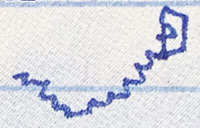
The stairs sagged down in the middle Upon “waking” there I realized my room was horribly tilted and this liquified cream cheese was trickling out of the bathroom towards my room. I ran to the basement and the stairs going up were melted into a V-shape instead of the usual 45 degrees. I realized the middle of the house was sinking rapidly into an expanding steaming hole. So I gathered a few important things and took them out. I discerned the safe places to stand and found my way to safety (thanks to my swamp stomping skills) but Ruby fell right in and disappeared completely. I rescued her once. Outside, I could see the whole house sinking, and soon it had sunk completely under, leaving just a mud pit surrounded by forest. A big crane rescued her Ruby out of the mud again. Weird!
A Melting House!: This is extraordinary. We see all these hot spots in the house — the green flames, the blasting potbelly stove, the Yellowstone fire well. The white cream cheese substance flowing through the pipes is liquid astral matter as the house itself melts from the heat.
Now often when I see a thought form melting, it’s simply shrinking like an ice cube without any liquid left behind. But at times I’ve seen a liquid center or a wet, white substance on the surface. Incredible!
-
The Backyard Lava Pit and Dream Crossover 1997 • age 23
[The lava] flowed down the alley leading to the neighbor’s house. It went into the back yard in thick sheets and I yelled at a man and the butler to watch out. They were most assuredly thought-forms, though, as they were almost like vacant balloons, animated only by my expectations. One just let the lava take him — just didn’t even notice. After the lava had flowed over the butler’s foot, his colors began swirling and melting into it. As the lava rose, he melted into it, becoming of the same semisolid amorphous flowing, stretching substance.
Melting, Joining Thought Form People: All thought forms are the same astral material in different forms. So when the butler and the man thought forms touched the hot lava, they melted right into it.
Melting into higher-energy substance like this would be an ecstatic experience. This is essentially what happens when we enter higher frequency domains.
-
Powered 2013 • 2:30 AM
He tears open the bubble case and holds aloft a chunk of potato, seemingly taken from someone’s dinner plate. It’s saturated with the substance of power. . . . At some point in the chaos, a cluster of four slowly-expanding black orbs is released from it, the orbs growing slowly and flashing from black to cinders and back. I know when they burst they’re going to explode massively. They do and an entire quadrant of the glass bank building is taken up in the explosion. Another black cinder bubble cluster flies in the opposite direction towards people coming up a spiral staircase. I watch to see what happens — as the bubbles expand, they melt and fuse onto the people coming up, who now look like glassy-skinned semi-molten thought forms.
Fusing and Melting Thought-Forms: The high-energy orbs expand, fusing with and melting the thought forms coming up the staircase.
-
The Rogue Faction
There was a scene with giant vehicles driving slowly through a burning city. But the flames were whitish-tan, the buildings melted around the flames like ice would.
Melting Buildings: Here we see an odd kind of dreamfire around melting buildings. Note that dreamfire isn’t typically hot — it’s just a light phenomenon.
Melting is the typical way that thought forms disappear. Usually this happens from lack of attention or a vague expectation of destruction. Being that I was not an active player in this movie, I was not the origin of these thought forms, and they melted even while I watched.
Melting and Reforming
Thought forms slowly melt away when attention is withdrawn from them. However, if attention is returned during the melting process, they will stop melting. Sometimes they reform into something new — a smaller object with a similar shape that fits the dream context.
-
The Wild Bus Ride and Parasitic Moths 2012
When we get back outside, the person guiding the group has this big sack of gifts for us. She pulls out the first thing — a soccer ball! I get the most excited, and she says “I think this one goes to Sam,” and she hands it to me. . . . We begin walking along this wooden walkway the way we came in. I find an egg on the ground, and then a spotted egg (the melted soccer ball!). Both lit up as I looked at them, the way things in video games light up to show they’re interactive when you mouse over them. They still carry a dim light as I hold them up, one in each hand. The bully is next to me, asking if he can hold one, and I say no. Normally I’d gladly share, but not with him. I look at the spotted egg again and it looks strange. The colors of the spots have faded to just outlines now, and as I look I can see deeper into it — about an inch. Underneath each spot is a round, darker circle, and as I look closely, they focus into quarters (coins). Neato! The bully is really jealous now. The outer layer has become hazy and transparent and I start collecting the quarters off what is now the outside. But lo and behold, under each quarter it’s clear and I’m seeing a wavy image of . . . a naked lady! It’s like a three dimensional image within a clear faceted orb which distorts in different ways as you turn it. I quickly slip it into my pocket for later. What a prize!
Exquisitely Detailed Melting and Reforming: This is a fantastic example. The spotted egg I find is the melted soccer ball thought form. The color and outlines were the first to fade. Since the exterior colors had faded to transparent, I can see that the black hexagons’ colors have retracted inwards towards the center of the ball. My focusing on these spots stops the melting and imbues them with new detail, and they form into what they sort of look like at this point — quarters. Now that I’m focusing only on the interior, the outer layer disappears in a transparent haze. After plucking off the newly-formed quarters, I can see through to the very center. Now why a naked lady appeared inside I don’t know. Was someone else projecting into the thought-form?
-
From Road to River 1994 • age 19
The street changes to a river and the cars become boats. Ruby and I start to go down this river. I ask “is it safe?” It gets fast and fun and we finally reach the bottom — a deep sandy valley. We stick the boat in a guitar case.
Melting: Vehicles are often rationalizations created during fast travel. It’s likely the boat thought-form had began to shrink when we stopped and it wasn’t needed anymore. This is how I mistook the shrunken boat for a guitar when I turned my attention back to it, and it fit in a guitar case.
-
Car Encased in Ice 1999 • age 24
I dreamed Buttercup and I were on a cross country trip to San Francisco. We stopped at a gas station and I was distracted for a time inside. When I came back out, the Neon (our car) was all covered with a thick coat of transparent ice (hint hint: thought form)! Trying to crack it off, this girl broke the windows and the plot was altered to trying to get replacements. Oddly, when I went back to the car after making some phone calls or talking to people, the car had turned into a van with a funky one-piece front window.
Melting Thought-Form: Here we see the melting of a thought-form mistaken for a thick sheet of ice! Released from attention, the car thought form begins to melt. It loses its hard edges and the colors recede inward, making the exterior look like it’s covered in thick transparent ice. Once I take it to be a layer of ice, it begins to act like it. And thus the plot of the dream is altered by the very nature of astral matter itself.
Melting thought forms reforming with an apparent outer layer of ice is a common occurrence. This shows that one of the first changes is the exterior colors receding inwards. Coloring is also the last thing to appear when a thought form is created.
Deflating
-
Deflating Tank 1997 • age 23
I saw visions of an invisible force shoving some people on a fence and yelling slurs. Then it shoved someone walking by, and went to a power line and yanked the cord out. The power line was how Tank was plugged in and the immediate result was that it rapidly began to shrink. It shrank until a conglomeration of featureless blue person-sized rooms was all that remained. My tent had deflated around us and was now in a sort of pool around our feet.
References: Tank is the name of a co-op I lived in in college.
Deflating Tank: A thought form with people inside can’t “melt” exactly — it would crush the inhabitants. Deflating makes more sense, especially in the context of it being sustained by pressure through a cord.
-
The Chamber Beneath Blaine House 2000
I focused on creating a thought form and suddenly held a sprig of spruce in my hands. . . . I was so overwhelmed I was moved to tears. I’d done it! I’d created a thought form and brought it to reality! I could feel it solidly in my hands. Ruby/Buttercup tried to take it away, unimpressed, but I refused to let go. Feeling awed, I thought Wadsworth must have been a master thought form creator to have created all this. Then I noticed the sprig becoming jelly-like and limp. I was concerned for a moment but then forgot about it.
Limp Jelly: Being that this thought form is in my hand, I have the rare opportunity to note its changing texture. Losing its sturdiness, it becomes limp.
Decaying
It’s uncommon, but sometimes I find though forms deprived of attention decaying, rotting, or crumbling apart.
-
Bad Service 1997 • age 23
I find a drawer I want to buy. There are cashiers working, so I go to pay for it. I buy it and go outside. A guy walks by with 3 Garfield statues and says “Did you see the free Garfield stuff?” I go back inside, find two fierce stylized Garfield statues, and take them. . . . [I get distracted] I get back to my car but find that the drawer is rotted and the Garfields are shrunken and falling apart like trash.
-
Looking for the Ball 2025
A gray soccer ball rolled down the stairs and I went down to get it. I didn’t really want to. . . . [I] went into the messy bedroom next to them. I found a couple gray soccer balls in there, but they were too small, and broke apart as I touched them.
Drifting
A thought form released from our attention is also released from our expectations, including the expectation of gravity. Thus I’ve sometimes seen released thought forms drifting about like balloons.
-
The Tower on Arcology Hill 1996 • 3:33AM • age 22
I catch Buttercup making out with Hiro and I’m horrified. Remembering that Hiro likes three-ways, I join in kissing them both. After a moment, Hiro detaches and floats away. A thought form!
Thought Forms: Hiro was a thought-form based on my fears. You can tell because when I stopped paying attention to him, he just up and drifted away through the air. Was Buttercup real in this dream? Hard to know.
-
Lucid Dream: Bruce’s Arm and the School Bus 1997 • 10:13 AM • age 23
It began with me getting food in a cafeteria. Bruce (Buttercup’s Wadsworth) was lying on the table with the food, and I was cutting up his arm with a big steak knife to put on my plate. Then I realized what I was doing and looked up because I knew the body I was cutting didn’t mind. I saw another copy of Bruce standing there. He was looking at me strangely, casting his gaze back and forth from the version of him on the table to me. The Bruce on the table began to get lighter and lighter and float up into the air. I turned to the standing Bruce and said “You’re Bruce H.” and he said “Yes, I am”. Then I indicated the floating body and said “Then this isn’t your body,” and he said it wasn’t.
Cohesion and Inner Motion
When we dissolve a thought-form, the first thing we notice is a slowing down in the whirling movement of its atoms. The shape loses definition and seems to go out of focus. The dimensions change, the image grows smaller and loses cohesion, and finally disappears. (Yram 155)PAPOBEr • Yram
Peculiarities of the Astral World
This section touches on my experiences of the astral from the dream state including unique astral phenomena and physical things that translate strangely in the astral. This is where physical expectations run up against astral reality. The astral does not work the same way, even though we are expecting it to.
The planes of consciousness are covered in detail from an OBE and between-life point of view in the entirety of “The Planes of Consciousness” in planes-of-consciousness.php.
Changes in Light
The amount of light we experience is a result of how open we are to the flow. Said another way, the light in our astral environment is determined by our frequency of consciousness. It’s the emotional index of our focus, and as such it typically doesn’t change without changing our focus.
To experience a different amount of light, we have to change our emotional focus, which would shift us to a different frequency, and thus a different environment would spring up around us. This makes the act of simply switching on or off a light in the near realm or astral very unreliable.
However, in dreams we can project an environment with different light levels to satisfy our expectations. This is a subjective projection that will only remain as long as we keep some attention on it.
Rare Changes in Light
While each astral or near realm frequency has its own ambient light, we are free to project light or darkness over it. When this happens, we are moving into a dream projection, and as soon as we withdraw our energy from it, the ambient light will return to its natural state.
-
The Green Dragon of Sauron 2004
The camera spun around 180 degrees to a shot of a dark land with a stone monolith, lit by gray moonlight, the grasses making everything look hairy. A threatening landscape. Then back to our heroes, charging towards this dark land. They’re mounting a hill and crossing a membrane — a cave through a mountain pass. The word “membrane” just popped into my head — a nonphysical boundary which will take physical form appropriate to the situation. As they exit the cave tunnel, they enter the land of the stone monolith, but in daylight. [The heroes battle Sauron, and flee to a third room. . . . ]
They emerge into a large circular area, walled by mountains. . . . Now this new area was very sunny and bright with long green grass and healthy trees. . . . At this point a strange transformation began to come over the dream. The bright tree-filled grassy mountaintop area began a slow transformation to a room in an unfamiliar house which I later thought of as my own. This of course led to all sorts of inconsistencies in size. The first change was that there was a ceiling, a white ceiling which in the mountaintop was a layer of clouds. . . . Our surroundings had transformed completely into a room now, but at this point was like a room in a dungeon. It had cinder-block walls and was lit by torch light. I discovered a doorway and went in to investigate. [We battle the dragon. . . . ]
So then we went back to hunting in the ceiling. The light changes to natural light. The ceiling turns white. It appears like a room in a house again, rather than a room in a dungeon.
Changes of Light: Much of this dream is projected onto the rooms in my house, which at the time of the dream has bright, sunny light.
In the beginning, I’m projecting out a story based on The Lord of the Rings. I project a dark land ahead of me, but when I pass through the membrane into that room, I bring the daylight of the scene with my allies into that once-dark scene. Then when we flee, we cross another membrane into an mountain scene with full sun. The mountain scene slowly changes into the physical reality of our sunny bedroom, and then I begin to project a darker scene onto it — a dimly-lit dungeon room. After that scene plays out, the projection fades, returning me to the sunny bedroom.
We can project dark scenes in light places.
-
Haunted by Spirits 1997 • age 23
It was sunny and we were outside. A photographer was trying to take pictures of this scientist with his mother and grandmother, but every time we took a picture, day changed to night. Then someone screamed or freaked out, and the scientist, against the advice of the photographer, turned on the lights — to daylight. The picture that came out showed him absent from his actual position and instead tied up in the corner. This kept happening.
Tied Up at the Moment: So creepy. It’s rare that light changes so drastically in dreams. Usually these transitions are gradual and only go one way. But the dark does indeed match with what happened in the dark.
-
The Buzzing Campus Eclipse 1999 • 8 AM • age 25
It was sunny daylight, and then the color of the sky got darker and someone shouted “eclipse!” Everyone got up and got into a position to see it. I ran around the building. Gravity diminished as a moon flew across the sky, barely crossing the sun’s path. Everything turned a dark orange color and then there were bees everywhere.
Rare Light Change: This is a rare example of the light level changing in a dream without changing of location.
-
The Mirror People 2012
It starts out with me going to Spring Lake Park High School. The high school was pretty dimly lit. . . . I made my way to Ranier’s room, which had the lights on. . . . A couple people cleared out until it was just Manville A and myself in there. We had this friendly but awkward conversation. At times the light was off, as if someone had turned off the light switch and it was only dimly lit like the rest of the school. Manville and I talked about various things. . . . I turned my attention back to the pile of shirts Ranier had left for us, and it was bright in the room again. . . . It’s dim morning light and I see a couple go into a house along the street on the north side of the school. . . . Then I’m walking down the street again and it’s gotten dark like night. . . . Another attack is coming — this time from five administrators.
References: Ranier's room is the office my high school counselor.
Changing Light: When a room has different lighting than the ambient lighting of the dream, it suggests dream projection. The back-and-forth changes in Ranier’s room suggest going back and forth between true social dreaming and projections.
This is a predatory dream location, so the dim light and switch to full night as the attackers come is fitting.
Turning on Lights
A common experience when in the near realm is to attempt to turn on the lights. This typically fails. The light level is inherent in the frequency of consciousness we must be focused in to be in any given environment.
One common limitation on control of the perceptual environment reported by lucid dreamers consists in being unable to control the general level of illumination. (Green and McCreery 99)
Appear to wake up in bed normally. Try to turn on bedside light but it won’t work. Feeling very groggy. Get up and try to turn on main light. That won’t work either. Then go through to kitchen to try to turn on that light. Same story. Think that maybe metered electricity has run out and think of going to look in cupboard with torch, but also start to suspect that this is a dream. Surroundings dark (but lighter than they would be if lights were really off).
(Subject N.C.) (Green and McCreery 110)
In an experiment carried out by Dr Ridley Hearne eight habitual lucid dreamers were asked to make deliberate experiments with light switches while in a lucid dream. . . . The one subject who succeeded at the task found that she could only do so by covering her eyes in the dream, which abolished her previous imagery.(Green and McCreery 110)
I switched it on and off several times and looked up at the light, which was a naked bulb. It kept sparking and flickering – I could see the filament light up and glow orangy-red. I thought, “typical of this place, nothing works properly”. (Green and McCreery 111)
I went to the bedroom light switch and turned it on. To my surprise, a light came on behind me in a room to the side, but not in the bedroom. Then I tried the kitchen light switch. Nothing happened. (Hearne, 1981) (Green and McCreery 111)
Moss reports various methods which he believes facilitate successful performance of the task, such as finding an angle of view which includes both the light switch and the light source in close proximity to each other in the visual field. (Green and McCreery 111-112)LDPLDer • modern • Green & McCreery
Some of these failures to change are due to an effect like the object permanence expectation. One might call it a “light permanence” expectation. In one example, only a light behind the dreamer came on. In another, covering one’s eyes interrupts the continuity, thus allowing the change to occur.
I switched the light on. I heard the click and felt the switch depress, but couldn’t discern any other change in the room. It certainly didn’t flood with light. I pressed the light switch once more and again, noticed no difference other than the movement of the switch. Each time, I looked toward the ceiling where the light bulb is. JoATOBEr • modern • Moon
I have noticed a similar delay between operating a dream light switch and the light coming on. . . .
I have found that if I regard dream lights as naturally slow to change, like the dawn, they will often come on, even from complete darkness and grow steadily brighter over a few seconds. (Worsley)DRLDer • modern • Worsley
Changes in Light Due to Jumps in Time
Our own experience doesn’t jump in time, but rotes can move across time from scene to scene, just like any story.
-
The Nun in the Wall 1997 • age 22
I was traveling with Buttercup. We decided to stay in the spare room of Brendan’s religious organization. . . . I came back later at night. . . . I left and came back in the morning. They were having one of their religious services.
Night to Morning: This dream spans time in an odd way, going from night to morning. This is also a rare change in the lighting of a dream without changing location. This is likely a rote.
-
The Home for Shape-Changers and Psychics 2004
One [medication] is in “tab” form like LSD with pictures on them. . . . I look through some of the tabs, then give him one, but I begin to have colorful LSD-like hallucinations. I basically freeze up and watch the brilliant colors melt through my mind. I reason that the tabs must have worked through simple contact.
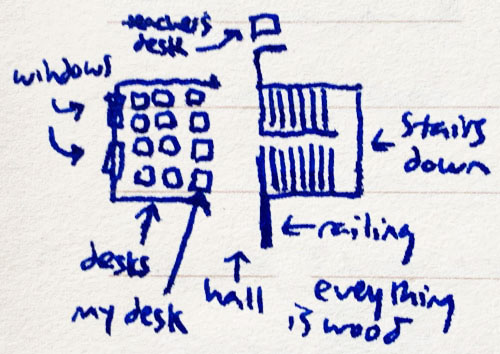
The classroom scene Then I’m in a desk in a classroom next to my red-haired friend, still color-hallucinating, when something happens. The dark nighttime scene where it’s just he and I in the room begins to cross-fade into a morning-light version of the room packed with people at their desks. I am very aware of this happening. It takes maybe 5-10 seconds. I’m talking to my friend, then say “Hey, what’s this? It’s daylight. It was just night a second ago and I have no memory of what happened between then and now!” But of course nothing happened. It just changed around me. Everyone seems alive and awake, but I can see their monster shapes as faint outlines within them. Each one is different — from furry wolves or bears to the undead to bizarre twisted monstrosities. And as I watch, everyone in the room begins to change shape. Some more quickly, some less quickly. But it’s dim daylight like just after sunrise so there’s not a lot of fear.
Lighting and People Change: The empty classroom scene at night cross-fades into a morning scene with all the desks occupied, as if we faded into the future of the same room. It’s another time shift, which this dream has lots of. This means I’m within a rote.
Astral Interpretations of Physical Phenomena
While projections and expectations can recreate anything perfectly in the astral, certain physical phenomena are usually off in predictable ways. There are two independent reasons that physical-only phenomena take unusual forms in the astral world:
First, the dream self focus has a weaker understanding of physical-only phenomenon (much like its lack of biological understanding), and creates its best approximation of them in the astral.
Second, and more importantly, there are limitations in the action and behavior of astral matter, which lacks the actual internal qualities of the physical elements and is instead made of a universal substance given many forms. Astral matter does not have temperature, acidity, reactivity, combustibility, or any other innate physical characteristics, leaving only our expectations to determine its behavior.
Fire (Dreamfire)
Fire does not naturally exist in the astral. Astral matter does not give off heat (or cold), does not combust, does not create smoke, or consume other matter. Unless one or more of these actions is specifically expected, looked for, or a necessary part of the story, the fire thought form doesn’t have these characteristics. It’s merely a light phenomenon, representing fire.
-
Oberlin Dreamfire and the Zombie Line 1997 • age 22
A large part of the campus was on fire. Dreamfire, of course: never flames but orange lights flickering from unseen places. . . . We took the stairwell to the 1st, 2nd, 3rd floor. . . . Then instead of floor 44 where I meant to get off was floor D. It was half a floor. I opened the door hatch in the ceiling to a dreadful sight.
Student after student was standing in a big line, zombie-like. The orange flickering was everywhere. I knew it was too late for these people. It seemed like they were lining up for a nursery.
References: I lived in South Hall at Oberlin for a few years.
Dreamfire: Dreamfire is a strange thing, and well described here. Dreamfire is usually the form fire takes in dreams. It doesn’t consume anything. It’s just flashing orange light.
-
The Rogue Faction
There was a scene with giant vehicles driving slowly through a burning city. But the flames were whitish-tan, the buildings melted around the flames like ice would.
Whitish-Tan Dreamfire: An odd color of dreamfire. Notice how it’s melting the thought forms around it, which would be the astral equivalent of “destroying” matter.
-
Bees 1997 • age 23
Then I was in the stairwell of a place I might have lived. There was a big vertical cylinder in the middle and a beehive in the center. A voice spoke into my mind “I’ve always thought the old way worked best: fire.” The cylinder started spinning, flashing in glowing rainbow dreamfire. It was beautiful. Bright flashing flames flew out and incinerated everything.
Explosions
Explosions aren’t natural in the astral. They only happen through expectations taking form, and often happen quite differently than expected.
-
Submarine Self-Destruction 1990 • age 15
[There is a big battle. We’re told to self-destruct our submarine while everyone else evacuates]
My Wadsworth is the co-pilot. We land our submarine on theirs and set the self-destruct timer. Then Wadsworth swims to the surface and I take a diving suit up to the surface, which is the floor of our basement. We climb the stairs to the main level of the house. Dad stands directly above the location of the two subs. I go into my room and hide behind the thickest walls. Mom stands in the loft. The blast comes. I see it — a slow-moving shockwave of intense heat moving towards me. I’m not protected enough. I scramble out the window for another wall of protection. I close my eyes and take the blast. When I open them again, the house is devastated.
Slow-Motion Explosion: The explosion is moving towards me so slowly I have time to reposition myself further away.
-
Wadsworth’s Revenge 1996 • age 22
One missile went straight up, half-lit like a firework as it hit a helicopter, which then fell to the earth and exploded. Everything turned black and white as the explosion slowly filled land and sky, rocketing outward, lifting huge chunks of earth into the sky. The explosion came closer and closer, with no sign of stopping. I knew I was nowhere NEAR far enough and began to run, then turned and resigned myself to my fate.
Shockwaves: Explosions frequently take the form of relatively slow-moving shockwaves.
-
Nuked in Atlanta
We’re nuked. The nuke hits not far off. The explosion is a perfect grey-brown sphere with a smooth exterior, reflecting white light. I jump behind the couch with Buttercup, hold her tight, tell her I love her, and think “who knew the 18th would be the end?” The blast rolls over us. It’s like a continuous painful wave of static rolling through me. It hurts in the heart. Then it’s over and I’m surprised to find myself alive.
Nuclear Explosion: My expectation of pain makes it come true.
-
The Buried Building 2024
I’m riding on a bike, escaping. Perhaps I’d stolen something? But I pass a tank on the road. It turns its turret around and fires at me. Focusing in on the moment, I see the explosive canister pass by my head. In slow motion it continues forward ahead of me, then explodes. The explosion is cloudy rather than fiery. A circular hole is left in the ground, and beneath it a 2-3 story drop. I watch as my body plummets to the bottom.
Tank Blast: No fire here, just an explosion of smoke leaving a deep hole in the ground.
Lightning
-
The Real Office 2010
I tell him how lucky he is to be living in such a beautiful place with so much sky, grass, trees, and open space. It’s been stormy evening light so far and now a fierce wind whips up and dark clouds approach. There’s a bright flash and he says to watch out for the lightning. The lightning happens in little bursts about a foot tall and a foot wide in different locations at the base of the house.
Little Lightning: Lightning, being a light phenomena, runs up against the “rapid changes of light” limitation in the astral. So to compensate, I dream of tiny lightnings.
Lava
Lava in dreams is a very interesting substance. It’s astral matter that remains amorphous, but also has the high-energy qualities of producing light and heat. This more energetic astral matter is more responsive to thought.
In the astral, heat doesn’t burn or starts fires (though our focused expectations can cause it to appear that way). Lava will sometimes melts physical objects, as melting is a natural way for astral matter to act.
-
Super Hero Lava Pool 1995 • age 20
I go exploring underground with GenX. We enter this immense rectangular metal room where the floor is entirely lava. There is a metal walkway around the edge and a ledge on one side. Polaris, Guido, and another hero join us as we go out on the ledge. Guido pushes Polaris in. Then he pushes in some other big guy. We feel scared and helpless. So I do the crazy thing and push Guido in. He tries to drag me in too, but isn’t able to. He disappears under the flames and I think “How can any of them survive that?” They resurface as alien skeletons as more and more superheroes file into the metal room. Eventually the ledge is filled. Some overlord guy pushes someone in from time to time. Forge goes into the lava, then Mr. Fantastic jumps in after. But he comes back up as Spider-man and escapes through Peter Parker’s corpse. Other heroes do their best to survive. Ghost rider goes in a man and comes back hideously powerful, riding this flame cycle along the ledge. Some reappear as flaming new characters. Things are getting bad when suddenly Iceman appears and freezes the lava solid. The superheroes go absolutely WILD. Everyone is saved.
References: GenX is a superhero team. Polaris, Guido, Iceman, Ghost Rider, Forge, Spider-man, and Mr. Fantastic are other Marvel super heroes. Peter Parker is Spider-man's real name.
Lava: I’ve found lava to be a powerful transformative force. Forms become very malleable in it. While some superheroes melted into it, it transformed others.
-
The Backyard Lava Pit and Dream Crossover 1997 • age 23
I had a room in Tank. I don’t recall knowing my roommates. Buttercup was there at times, though I had to really pull her. There was a lava pool in the back yard. It was squarish, with constantly moving red and yellow lava. At one point it was spitting red coals up through the ground, many of which went over to the neighbor’s house. I went over there and told a boy not to touch them. Little by little the lava spread, and then it really began to flow. It flowed down the alley leading to the neighbor’s house. It went into the back yard in thick sheets and I yelled at a man and the butler to watch out. They were most assuredly thought-forms, though, as they were almost like vacant balloons, animated only by my expectations. One just let the lava take him — just didn’t even notice. After the lava had flowed over the butler’s foot, his colors began swirling and melting into it. As the lava rose, he melted into it, becoming of the same semisolid amorphous flowing, stretching substance.
So my housemates had sealed up the lava hole and I said “No! That’s a bad idea! It’ll build up pressure and BLOW!” As I said BLOW, it did (talk about the power of suggestion). It flowed and filled the lower levels of the house and the back yard. It was really deep (6 feet in the back yard) and the top turned dark gray as if cooled. We ran out onto it. I discovered that when I took big leaping strides, the lava pushed me up into the air with big waves. We played there.
References: Tank is a co-op in Oberlin.
Lava: The lava reacted exactly to my expectations both when it burst and when I decided to start bouncing on it like a trampoline.
-
Rachel’s Reunion 2010
At one point, Buttercup and I journeyed along the hill upstream from the camp. As we went, we saw a burst of fire and black smoke from across the river. A volcano! There were flames and smoke coming from the top, then bursts of lava. I thought “Yikes — I hope none of those spurts come this way!” Of course, the volcano spat out a hot lava rock way up into the air and directly overhead. I called out to Buttercup to watch for the rock, and it landed only a few feet away. As we continued, the volcano kept spitting sprays of rocks up and over to us. I dodged them all until I became curious about what it would be like to get hit, causing one to land near me and roll down next to my arm. It was hot, but didn’t burn. Then the volcano spat out a wide sheet of fast-moving lava over the hill in front of us. It looked like tomato soup. We fled up the hill.
Lava Always Responds: My playful fear of being hit by a lava rock clearly caused it to happen. I remember looking straight up into the blue sky, waiting for the lava rocks to fall, so they were actually materializing out of nothingness up above us.
Tornadoes
These are similar to physical tornadoes except they sometimes come in great numbers, change the landscape, and/or carry me to a new location.
Vortexes are a result of flows, which is inherent to consciousness, and thus natural to astral matter. Consider that our chakras are vortexes, connecting energy across different frequencies.
-
The Insanity Creature of the Tower 1996 • 3:15 AM • age 22
In front of Blaine House, there are lots of big clear tornadoes coming from the west. I was outside, holding onto trees, but even they were being pulled up. So I went to the basement and it was small, weird, and empty of furniture. There were some other people there, too.
Tornadoes: These appear from time to time, usually more than one, sweeping the landscape.
-
Tornadoes and Electricity 1996 • age 22
I’m in some big fields in the back of a school and the tornadoes start coming. They come in waves, and there are more than 18. I hold onto a big slab of concrete with some other person. After they pass, I dodge lightning and leap electrical wires.
Whirlpools
Whirlpools are like tornadoes, in that they are a vortex that can act as a gateway to another place.
-
The Whirlpool 1997 • age 23
This dream was inspired, no doubt, from a big whirlpool I saw earlier today.
I was in this neighborhood of houses on a hill in a rocky landscape. There were big black magma-type rocks near the ocean, and a never-ending whirlpool a little ways out. My house was nearest to the ocean. There was a conversation where I expressed a desire to go through the whirlpool. Then a big wave hit and the house broke loose and started floating on the water. It floated over a rock ledge, smashed into another house, and began moving towards the whirlpool. Someone said “Hey, you got your wish. We’re heading towards the whirlpool!” As we neared it I saw how violent and ominous it seemed. Now I hoped too late to avoid it. My house, full of people, plunged down into it and my last breath of air got mixed with water as the house was sucked under. The underwater portion was impossibly long and my breath barely held but finally I washed out on a beautiful cascading waterfall that was broken by rocky landings.
Whirlpool: Whirlpools are like tornadoes in dreams. This one acts as a gateway or hyperspace corridor. I’m not sure which. It took us to a new location in the astral world.
Ocean Waves
-
Standing Waves 1998 • age 23

Standing waves on the ocean 
A standing wave with a hole in it I’m at this resort on the ocean, with forests and rivers around it. It was in a little resort town. I went to see the ocean and there were steep, uniform waves moving in.
A crooked bench The next day there was a storm and the waves were strange and very tall. They were standing in rows but shifting constantly. The wind was moving them. The waves almost looked scared, like snakes wavering. I “hoped” in my head not to get hit by a wave and suddenly the wave in front of me churned and sent forth a blast of water the size of my head right at me! I sidestepped it and it blasted for a good 12 seconds. I went and told Buttercup. The whole world was shifting and rocking up and down slowly. One of the benches was crooked for compensation.
As two waves combine, I notice there is a hole in the middle of them for a moment.
Standing Waves: This is definitely a dream phenomenon. The water was very thought-reactive. The waves were so strange, standing there in rows. A tilting city, too, and it seemed to be designed to deal with the rocking and tilting!
Flowing Water
Sometimes a river in the astral is a rationalization of a nonphysical flow of energy. As such it doesn’t need to follow any rules of gravity and may flow in any orientation — even straight up!
-
The Buried Building 2024
I’m on the bank of a river. The river is about 20 feet wide, with big rocks beneath the surface. To the right it curves away outside the exterior of the building. To the left, it descends very steeply about 30 feet from above. In the physical this would be a waterfall but here the river has just bent downwards.
Water and Gravity: How flowing water reacts with gravity is a very physical thing. To the dream self, when a river comes down a slope, it just bends downward without changing its appearance in any way.
Mirrors
Astral matter does not reflect light, so mirrors don’t work as they do in the physical. If we see an image of ourself in a mirror, there are two possibilities.
First, it may be the result of projection. In this case, we would appear just as we expect to — yet the results are often surprising. Second, it may be the result of jumping out to look at ourself from an outside perspective. In this case the strange results may be due to the influences of our focus or feelings at the moment. Once, when talking to a cute girl, I unconsciously took on her form.
I’ve had several dreams where mirrors show false reflections meant to manipulate or scare me.
-
The Haunted Ride 1996 • age 22
I’m in a haunted house ride. I think Buttercup is with me. It’s a miniature haunted house and boring at first, but then the car seems to plunge off the track through this door in the floor into this super nasty haunted house! It has all the keen effects of dreamland, fuzzy visually blurred places and mysterious shades. Mirrors up ahead on either side of the hall are reflecting hideous pictures of us back.
Evil Mirrors: Here’s an instance of mirrors reflecting lies.
-
The Insanity Creature of the Tower 1996 • 3:15 AM • age 22mature content
The insanity creature in the cup had given me two arm-length, erect penises, and put me on display, for all to see. I tried to hide them, but they were so nice, one had to be proud. It may have been done through the mirrors — I saw myself with them in the reflection. The mirrors lie — it isn’t your reflection. . . . I could control the drug-induced madness at times, but it snuck in everywhere, through those little mirrors that reflected out lies.
The Mirrors Lie: The mirrors were a particularly insidious trick. They’d reflect lies. It would be you in almost every respect, but with lies built in — one or two changes, and it would be hard not to believe that what you saw was real. A powerful tool to use on nonlucid dreamers.
NOTE: While OB I floated over to the mirror on the back of the bedroom door and noticed I had no reflection. (Taylor 52)STOBEr • modern • Taylor
Being OB (as opposed to lucid dreaming), his expectations didn’t take form by projecting out into the environment. Therefore he sees the truth of the mirror — no reflection.
Also, this is where the myth that vampires have no reflections comes from!
I had also seen my reflection in a mirror. The thing that I noticed straight away was that I had these huge teeth that all poked out of my mouth and onto my bottom lip — a bit like a television character called Dwayne Dibbly. I looked like some clown or goof! I was a bit bothered about looking so stupid but figured it was a handy disguise in case anyone should see me and recognise me in their house.
I remember that I had been breathing heavily. Seeing my reflection, I could see why — I looked like a mad man. It was me, but I had this fierce expression on my face and my eyes were wide and glaring. I rushed upstairs before anything bad happened. JoATOBEr • modern • Moon
In the dream I am part of an audience. I see men high in a balcony of the huge auditorium throwing small pellets into balloons, which burst and release a drug into the atmosphere. The lights go out. I close my eyes and can feel the effect already. “Oh, yes,” I say knowingly. I float up in the air into the balcony level and, hovering in the air, observe myself in a mirror. . . . My face appears in a series of bizarre forms. In one of the reflections, my face is covered with a network of scars. In another, I appear wild, with long flowing hair, a bikini top, and a native skirt. Waves of passion flow through my lower body as I move and my eyes are wild and staring. (Garfield 196)CDLDer • modern • Garfield
I looked around wondering if there was a mirror. Inspecting the shelves against the cave wall, I saw a mirror about 10 feet up on the cave wall! (No real surprise, huh?) I flew up to it and looked at myself. What I saw looked like a horror story version of myself. It was me, but my skin was all white and flaked, my eyes were completely white and chalky looking, and my eye sockets were deep as if my face was just a skull. I thought to myself, “Oh my!”. But I wasn’t unusually startled. This is not the first time I had seen weird images of myself in astral mirrors. I continued staring at the image and it then transformed into a normal image of myself. I thought that was interesting. I turned and looked around the cave, then turned back to the mirror. I saw the same thing; first the horror image, which then transformed to the normal image. APCOBEr, LDer • modern • DeGracia
It’s trivial in the astral to jump to an outside perspective to look at yourself. When looking in the mirror, Garcia could have been looking at himself in this way. He saw what his astral form had shifted to upon relaxing of his focus on it, and then gradually projected what he knew he looked like physically over that.
I saw this mirror on the wall and decided to float over to it. . . . I saw myself. . . . Looking at my eyes this time I saw a doubled pupil but the rest of the eyes seemed normal and just like the physical world.
I saw a mirror in front of me, so I decided to look at my reflection. This time my face looked a little older and my eyes were pools of blue water with bubbles floating upward.
I cruised over to the mirror once again. . . . I saw little old me, only thing that was different is that my pupils in my eyes were at the sides of the eye. TVOSOBEr • modern • Warner
Seeing the Third Eye in Mirrors
I am at the edge of a roof, looking into a mirror. At first I cannot see any reflection; startled, I say, “That means I’m dead.” Then, smiling to myself, I correct the conclusion, “No, that means I’m dreaming.” Now the image begins to take shape in the mirror as I watch, and I examine it carefully. The skin seems to be coming in rumply, oldish, scarredlike. I say to myself, “Oh, don’t do that,” and it clears as I look. The color of my ordinary eyes is, I observe, this time a deep blue. On my forehead, between my brows, is a mark that I know is a kind of rudimentary third eye. (Garfield 208)PtELDer • modern • Garfield
Here you can see how expectations influence what happens. At first, she sees truly — there is no reflection in the mirror. Then as her expectation intensifies, the image takes shape. And when the shape isn’t what she expects to see, it’s corrected.
I am dressed to go out . . . checking my appearance in the mirror before leaving. As I do so, I notice, just below my hairline, almost hidden by the hair, a third eye. I wonder what it is for. Testing its vision, I decide it is not too good for seeing. (Garfield 207)
I am in a bedroom looking into a mirror in the early morning. I am surprised to observe how large and dark the pupil of my left eye looks. . . . I realize with a start that I have three eyes. They are straight across, with the third one directly between the others. . . .
I look into the mirror again and the reflection shows a man, with two eyes, a broad face, and curly hair. . . . Then the image shifts once more to myself with three eyes. . . . Again the image shifts and now, instead of a middle eye, in its place between my brows is a round spot. At first uncolored, the dot grows white and begins to pulsate. At that, my whole body starts to throb. I feel the familiar surge of passion. (Garfield 209)PtELDer • modern • Garfield
Eclipses
There is no sun or moon in the astral, so my dream self only has a vague idea of what an eclipse is.
-
The Buzzing Campus Eclipse 1999 • 8 AM • age 25
It was sunny daylight, and then the color of the sky got darker and someone shouted “eclipse!” Everyone got up and got into a position to see it. I ran around the building. Gravity diminished as a moon flew across the sky, barely crossing the sun’s path. Everything turned a dark orange color.
Something Like That: The moon here looks like an atmosphere form, called into being by our expectations once the person yelled “eclipse!” It was clearly an approximation of an eclipse, since the moon flew rapidly across the sky, barely crossed the sun, and the darkness came first. A failure of the collective dream selves to understand how an eclipse physically works.
Unique Astral Phenomenon
Energy Warps
Energy warps appear to be openings to higher, more energetic frequencies. They can be a point from which higher-energy matter comes from, or an area that has an empowering and expanding effect on everything.
-
Thought Form Games at Arcology Hill Stadium 1996 • age 22
Astral matter emitter
Circle symbol writing Now a device in the corner of the field began to shoot out this raw unformed astral matter across and over the field. Smaller balls of it all connected and joined into this big, floating ball. There were all these circle symbols on it that I was reading. My defeated friends and I decided to keep playing and reverse our loss. We made a bunch of hot-air balloons out of the big thought-form ball, and flew up into the baskets. Swirling around us were lanterns, and the mad hatter, and everything seemed to be alive like in musicals. We sailed past a big statue and some fruit and vegetable stands. Lots of people ended up in the balloons, including many old friends. The cloud of balloons, lanterns, and spontaneous creative forms began encircling the top of the hill and tower, then going up one side.
Pure Creation: The stadium emitted unformed astral matter and we shaped it creatively with our thoughts.
-
Hyperspace Warps 2001
I found myself at our lovely new house. I opened the back door and stepped out into this dense, thick-smelling primeval nature world. The plants and insects were huge and felt ancient. Two brightly colored butterflies flew together in front of me and locked into a mating position. Then, suddenly, a dragonfly, as big as my arm and buzzing loudly, flew in and snatched them. It was a vague notion of a dragonfly — probably a rationalization. I was saddened, but in a moment it was caught in a table-sized spider web. A third butterfly jumped from the union. “Oh, I didn’t see that one before,” I thought, “It must have been directly behind the other two.” Then others began to fall from the union. I thought they were dead at first, but they took flight as they fell. There were more and more — a brilliant cascade of color. And from this proceeded a creative frenzy, directly from the soul, the lava warp, the face of god, the gateway to the infinite. As to exact things, my memory fails me, but I was in ecstasy, playing in this field of explosive creation. . . . I’m not sure where this fits in. . . . I walked out into an open field at an elementary school setting. The details are unclear, but I had a blue super ball. I threw it, and when it landed, there were two, of different colors. A child joined me. As we played, creation came bursting from every point. Soon there were wobbly-edged coconut-sized balls that would break open and solidify, releasing some toy or treat. Kids from everywhere came running out to play. I caught one of the balls, cracked it open, only to find it filled with super balls of every size, color and texture. I gave it to a kid after grabbing handfuls of balls and began to bounce them everywhere. More came down than went up. It was blissful, ecstatic play.
The Hyperspace Warp: This is a beautiful thing that I have seen a few times. It’s like an opening to the highest plane, a powerful gateway of pure creation, of light and beauty and thought-reactive matter exploding out into reality. It’s accompanied by an ecstatic feeling because of the higher-frequency energies pouring through.
The super ball warp is similar to the hyperspace warp except that it’s boiling from the general area instead of bursting out of a single point.
-
Powered 2013 • 2:30 AM
There was a substance or drug that powered people up. It was released by accident. . . . I’m looking out the window of the bank. I see a man smash out through the window on the first floor of a building. Then he rises up to the second floor, lands, and cheers. He flew! It’s a bearded guy, looks like a biker. A manager-looking guy flies up to the second floor and lands next to the biker. Another guy is sticking to the edge of the outside of the brick building, thrilled that he can stick to the side of the building and watching what’s going on below. Everyone was discovering that they had powers.
Inside, things are getting dangerous. A man has the most concentrated bit of substance, sealed up in a little clear plastic bubble. He calls out to everyone, full of energy and emotion. “Do you see this? This is the most concentrated and dangerous part! This, they are keeping from you!” and he tears open the bubble case and holds aloft a chunk of potato, seemingly taken from someone’s dinner plate. It’s saturated with the substance of power. Ground zero for the accidental release. Someone shoots over to grab it. At some point in the chaos, a cluster of four slowly-expanding black orbs is released from it, the orbs growing slowly and flashing from black to cinders and back. I know when they burst they’re going to explode massively. They do and an entire quadrant of the glass bank building is taken up in the explosion. Another black cinder bubble cluster flies in the opposite direction towards people coming up a spiral staircase. I watch to see what happens — as the bubbles expand, they melt and fuse onto the people coming up, who now look like glassy-skinned semi-molten thought forms. In fact there’s a wild chaos to every form here. Everything is inflated 120%, as if it was a balloon, overfilled. Colors are vivid, glowing. Everything is burning with inner heat. People are so filled with it that they are spontaneously displaying amazing powers. . . . Things are getting crazy as people discover their power. Wild groups race each other . . . there’s a race to the top of the building.
Higher Energy Pouring Out: This is an amazing scene. Whatever this is, it is highly energetic, pushing out energy from higher frequencies into everyone and everything in the vicinity. The energy sustaining every thought-form (including people) is turned up, hyper-inflating everything from the inside, charging it with heat and brilliant color. Probably the best explanation is that it’s a channel or opening into a deeper, higher-energy frequency. At any rate, the flood of energy strips away some rational, waking limitations and gives people the energy and belief to do things they otherwise wouldn’t have thought they could.
Note how the high energy of one of the orbs melts and fuses the thought forms together. They lose their definition, becoming glassy (the early stages of melting). The energy of higher frequencies flows in through the interior of the lower forms. Everything is blazing with this inner energy, barely able to contain it.
The Pillar of Flame
I have had several dreams that feature a circular chamber with a pillar of flame in the center. When I touch it or go to it, I feel ecstatic energy or get transported into another dream. Is this a representation of the spine filled with pranic energy? Or some universal astral structure?
-
Guardian Spirit Leila 1992 • age 18
I dream of a large building with circular black supports, lots of windows, and a circular glass elevator in the center. It is night and cloudy. A flame shoots up through the center glass shaft of the elevator, and I sense some disaster coming. I climb down the shaft and leave the building. I emerge in this parking lot with scattered cars. My Dad walks out from between some cars and says something to me. Then he walks off, leans forward, and takes off flying. I watch, amazed, and say “Oh, so that’s how to do it!” I lean forward, lift my feet up, and fly. . . . It’s an amazing feeling. I fly for a while.
Elevator Shaft: The emergence of the flame signals a disaster coming, but then I end up flying.
-
Bees 1997 • age 23
I was in the stairwell of a place I might have lived. There was a big vertical cylinder in the middle and a beehive in the center. A voice spoke into my mind “I’ve always thought the old way worked best: fire.” The cylinder started spinning, flashing in glowing rainbow dreamfire. It was beautiful. Bright flashing flames flew out and incinerated everything. This is where the dream “A Great Love” started.
Ignition: Again the cylinder doesn’t start with fire, but ends up with it, and it takes me into another dream.
-
Enlightenment by Fire 1997 • age 23
I found a small mouse and picked it up. It began talking to me. It suggested I go back to the fire shaft, a place I was familiar with but hesitant about. I had four cards in my hand with different pictures of the inside. The structure was white and had a pillar with flames in the center. Around it were some wood spokes, perhaps? Anyway, I opened the heavy door to it and left the mouse outside. The entrance was at the top and I jumped down. I knew that I might end up in some other dream, and I had to try not to sink below the fire chamber. I held myself near the pillar and opened up to it and communicated with it. Upon doing so, I felt this ecstatic energy surge through me. I moved around the center with this feeling and then eventually left.
The Fire Shaft: Note my familiarity with the fire shaft and my reluctance to go. I know I might end up in a different dream. What is it?
Electrical Lightning Fields
-
Traveling Sparks 1996 • age 22
Buttercup and I are traveling through England. We stop in a presentation of “The Garbage Pail Kids!” in a church and I’m sitting behind this enormously tall guy. During a break, a commercial appears onstage: a car or truck in the forest is consumed by this vortex of flames and an electrical field emanating from between these trees, because it couldn’t meet the competition. Instantly I was there, curious to learn more about this strange electrical field. I was with someone, too.
The forest was dark, and the trees were tall, beautiful, and thick. I started walking and was instantly seized by some electrical field of blue lightning tendrils which lifted me up and spun me about. Then we began traveling down the trail at tremendous speeds, still spinning. I smashed through branches and growth and went higher and lower and was wholly unhurt. In fact, I was quite exhilarated by it. We went higher and I thought of how far ahead of the others we’d be. I looked below and saw the “Pelennor Fields” and a castle I wanted to explore but didn’t know how to stop moving.
Dream Phenomenon: The electrical field seems like an astral phenomenon; something that can carry you along with it.
Astral Energies
-
Neon Chakra Flowers 1997 • Middle of the night • age 23
A neon chakra flower Kelly’s bedroom was dark and mystical. There were two small glowing flower devices spraying this soft, fragrant water in many tiny streams across the room. The streams were crossing in an X shape in front of the bed — one pink, one yellow. They were the weirdest things — they followed me, pushed towards me to spray me when I got close. The spray was misty and sweet smelling. . . . There was this girl named Sticky across the room, in the same dark w/neon glow kind of scenery and I danced around a table and proclaimed my love to her: “You, I’ll always love best, Sticky.” She was a super raver-girl with metallic makeup and a shiny silver shirt. Some parts of her shirt were glowing.
Chakras: I think here I was seeing energy flows and subtle astral structures. I don’t know what the spraying flowers were, but they reminded me of chakras. Seeing chakras in the astral is always a weird thing. They are so strange that they are hard to integrate into the scene. Sometimes they are seen as designs on clothing. It’s also interesting that2 when I’ve seen chakras, they’re spraying water or mist.
-
Leonard’s Piercings 2015
I dreamed I was hanging out with Leonard in the living room of Blaine House. He had gotten the top of his ears pierced in a triangle formation with little green, blue, and red gemstones. He also had the pupils of his eyes pierced with a blue gemstone in the center of each. It was dimly lit, and I was very impressed when these began to flash with light. The fact that he had pierced his eyes didn’t phase me.
Flashing Gems: I’m not sure what exactly this is. The flashing gems in his eyes feels like it might have been a rationalization of an energy communication.
Atmosphere Forms
If you look up in the sky in a dream, you may see atmosphere forms. Sometimes it’s people or things flying high overhead, and sometimes it’s like a movie is taking place high up in the sky with glowing figures.
-
Shaynu Grey and London Boy
Manville, Mordred, Quentin, and I were exploring a snowy landscape. We lay on our backs in the snow, looking up at stars. We see three figures fly across the sky in different directions, really high up. I know who these legendary beings are instantly. One is Shaynu Grey, one is London Boy, and the third I don’t recall.
Suddenly we’re inside a house, after a big party. Manville and I are getting along really well. I decide to beckon Shaynu. I send out a mental call. Before long she appears in front of the four of us. She is tall and reminds me of my cousin Jane. Then I ask her her name three times because I can’t understand her the first two times. She seems like she doesn’t want to be here. I treat her with lots of respect. I lend her the use of my body. Boom! She’s in it and I’m in one of the guys! Manville, I think. I ask her to watch over us, and allow us to exchange “hit points” if any one of us is hurt exploring. She grants it. She leaves and I get my body back.
The people from the party are all falling asleep now, including Mordred and Quentin. Manville and I alone are awake and try to call upon London Boy (I keep thinking it’s Leaf Boy). He seems about to appear from the starlit sky when I awaken.
Atmosphere Forms: In this case, the atmosphere forms are legendary people.
-
Atmosphere Forms 1997 • age 23
It started outside with a big group of people in Wilder Bowl at night, but it wasn’t really unconscious-darkness. We were looking up at the stars and watching atmosphere forms go by. One was the shape of a knight holding out his sword. We expected a dragon next but instead a stupid “next frame” sign appeared. There was all this sound equipment set up. Some of it was mine.
References: Wilder Bowl is a greenspace at Oberlin.
Atmosphere Forms: I think atmosphere forms are big thought forms up in the sky. They’re strange, though. In one dream they were advertisements. They go by slowly overhead, at around the level of the clouds.
Mystical Places
There are a lot of strange and mystical places in the astral realms. People can gather to visit them or go on tours just like in waking life.
-
Mystical River Circles 1997 • age 22
Buttercup and I were staying in a different resort deep in nature. We were going on a big tour with lots of people to see the mystical rain and the river circles. . . . There was a wide river. We climbed a slope and looked down through some trees at the river and saw a strange pattern in the flowing water — a disturbance of some kind. Apparently some civilization from long ago had seen these and constructed some magical places, which we went to see.
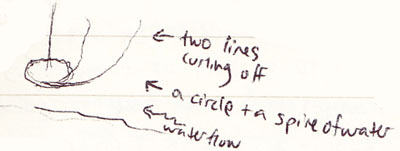
A spire of water in the river One was a circle of underbrush and plants, shrouded in dark forest. As we approached, it started to rain. The circle turned bright blue and sparks shot all over. Our guide was quite excited to see it.
-
Wormhole Caps 1999 • age 24
I dream of a greenish pool of pure water off to the side of a supermarket. It’s some quintessential gateway. The pool is surrounded by black rocks with a cliff on one side, and has pure soft sand beneath the surface of the water. Buttercup and I looked up and this tone came that shifted the sand into little hills and patterns, rising up out of the green water. We played on them. At times I wrapped myself in the sand as if it were elastic rubber sheets. The feeling was grand.
Sound Patterns in Sand: This is really interesting. Sounds are known to make patterns in sand. The device that can illustrate this is called a Chladni Plate. Each tone makes a specific pattern. Here we see that same effect in the dream world.
Other Odd Phenomena
-
You Don’t Know Skiing 1997 • age 23
I skied down. On the way, I let go of my poles and they slid downhill with me but standing on end and sort of spiraling!
-
Mina the Bat 2024
The next thing I remember is that I was outside, and there were these incredibly deep openings in the ground, striated with light yellow and light purple layers, of a psychedelic fractal design. The material of the earth seemed like a flexible dough-like substance. It looked almost biological. The openings were as wide as several houses. There was one crevasse on each side of the house. I was looking down as if floating in the air. I passed over the roof of the house as I moved from one crevasse to the other. I wonder if this could have been Satori playing out over the scene.
The Astral Earth: My only guess as to what this was is that it could have been my Satori playing out over the landscape there. Or perhaps my vision was penetrating into the ground, and the astral matter took that perceived form? It felt like it was opening up as I looked..
It seemed as if I was looking at the nature of astral matter below us. The soft, pliable nature reminded me of striated dough.
Hills and Spatial Distortion
-
Mario World Landscape Distortion 1997 • age 23
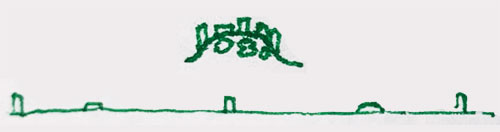
The gravity well gathers up buildings around it I’m in this huge landscape and it’s this advanced Mario game. There are big blue mountains that can squish up and hide under other mountains. One very specific effect I saw was that there was one mountain that was under this village. When there it was like a village all packed in on a hill. But then it would spread out farther and farther as it flattened until there was a great distance between each structure.
Spacial Distortion: This almost seems like a lesson in dream space. It’s not just a hill, but a concentration of space.
The Tower is on the top of a tall, steep, round-topped hill, and the Great Hills has a number of the same kinds of hills around it. There’s very often a journey to the top of hills like these. Space itself is curved, and gravity pulls towards the center, as if it were one hemisphere of a planet.
Perhaps this is how a specific search or psychic cyst (wrapping up negative experiences) pulls everything else towards it. More and more of our mental space and thus thought is drawn into its “hill”. It beads up, and becomes a filter through which we see our environment. Due to this gathering of space, light doesn’t just pass through it, it reflects the image (whatever it desires or fears) outwards as a specific search. If this is true, it shows how these focuses gather up mental space, and holographically filter out experience.
See “Projections: Specific Search” in holographic-mind.php.
-
Home Near the Tower 1999 • 3 AM • age 25
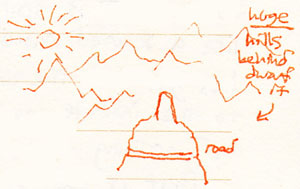
The Tower. Huge hills behind dwarf it. It’s very hilly, and there is a modern city. Buttercup and I work in the same office. I’m VP and a worker but I prefer the VP position, manipulating things so I don’t have to work. Buttercup and I are in love; we love each others’ company. The job might be some sort of telecom.
So I’m driving home with Buttercup and it’s evening. The roads are all very steep, as much up and down as right and left. I’m driving crazy, very uncontrolled, almost getting in accidents, then looking for turn-offs to hide in if we are pursued. At one point I take as a point of reference a small egg-shaped car and zip through a bunch of red lights faster than a car should be able to go. Then, terrified, I ask Buttercup “What’s wrong with me? Am I on drugs?” She says “Yes”. I seem to think back and remember that I was taking some sort of stimulant I had thought wasn’t a big deal.
Warped Space and Mind: As ever on Arcology Hill, space is very warped. The roads are twisted and wild, and space inside my house is malleable in a strange way. Then there’s the warped mind sensation as well, the feeling of being out of control, of being in a wild and unstable mental state. A decade later, looking back, I’m so glad to have stopped going to this place.
See “The Great Hills” in dreams-intro.php for more about the shape of these hills.
The Tiny World Effect
The tiny world effect is one where it appears as if the world is a sphere the size of a house. Things appear and disappear rapidly over the horizon as we move forward. The physical context drops quickly away. It’s like a visual representation of shortened context. Things disappear quickly out of our attention when attention shifts.

-
Ultra Oberlin 1996 • age 22
I left the inn and started walking down Main Street towards Banana House. The land was extra curved (the tiny planet effect), and things rose rapidly over the horizon. As I got near the intersection, the sky turned bright yellow and I saw the new downtown Oberlin.
Curved Land: This is an interesting effect, having perhaps something to do with being more in the now, which is evident by the colors, brightness, and good feelings.
Flying and Scale
A feeling of expansiveness might be related to having a smaller size — a smaller penetration into physical space. This is an effect of being at higher frequencies, closer to the Source. Here we have vast amounts of space to move in and little weight — you can see how in higher realms it feels easier to fly. Gravity is a fading habit.
-
From Skateboarding to Flight 1997 • age 23
The dream continues down this lane to the forested front of Blaine House. I’m flying now, and the little hills at the far side of the forest path in the front woods are incredibly exaggerated. Instead of slight three-foot slopes they were mountainous. It seems that slopes and hills are always super exaggerated when flying. This is part of the low gravity feeling I feel.
Spacetime Distortion: I begin this dream skateboarding, doing jumps and tricks. This could be reflected in astral body movement, and I may have left my body in tiny sphere form. This is supported by the fact that I move to the exterior of Blaine House, which represents my physical body. My tiny size could be why the hills appear to be mountainous. This might be what is behind Arcology Hill — especially if that’s a representation of my head.
-
Mountaintop Flying 1996 • age 22
It began as a ride at the fair. I was in a little roller coaster car on this track on the side of a mountain. At one point the car flew up at the peak and jumped this rock. I realized then that gravity didn’t matter so much. I jumped the next peak and began to fly. I was flying fast through this jagged mountain range with steep angles. When I landed I had this total physical body rush.
Space and Gravity: The more vast and incredible the lands become in the astral, the less gravity seems to have an effect. This coincides with a reduction in my size. The lands spread out into huge mountains and spires and we feel lighter and more free. I often describe “steep angles” at times like this — a feeling that is difficult to explain. It’s related to pulling away from my mind sphere, how it drops off in a fisheye manner.
What I describe as “steep angles”. This is a common feeling on Arcology Hill. Purchase from Shutterstock here -
Mountain Flying 1997 • age 22
Falling asleep, I dreamed of the very tall green mountains in bright sunshine, like in Mario Land, and of course I could fly.
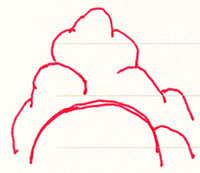
The shape of hills, with clouds above 
Round-topped hills in the Super Mario games
[Arnold-Forster’s] commonest flying dreams were in “lofty rooms and the great staircases of palatial buildings which I do not know,” although they sometimes occurred in the British Museum or other public galleries. (Garfield 162)CDLDer • modern • Garfield
Hills Rising Against Us
Hills are extremely meaningful in the dream world. When steep enough, they are essentially barriers. At times I’ve been prevented from going somewhere by a hill or cliff that rises up before me as I approach it or attempt to climb it.
This may be the effect of trying to leave a rote by spatial means rather than by pulling back out of it the way we came in.
-
The Wrong Hero 2001
[Ernest is driving a car, and I’m outside the window]
He gets to the bottom of the hill and turns a corner. A block down, I disconnect and go back to the hill. But now it’s twice as steep and part of a crazy dragster track. This unbalanced guy is trying desperately to get his dragster up to the top of the near-vertical hill. I try to get up there too but instead turn around and continue on these endless sky highways.
Hills: Because returning up the hill is impossible, I end up taking the sky highways, possibly exiting what might have been a rote in the same way I came in.
-
The Island of Fire 2000
Mistaking this as the island from earlier, I remember the danger we were in. I look up to a cliff above us and see a trail of lava coming down. Soon the gully at the bottom is filled with lava. I’m afraid, and I’m having trouble getting up the way we came as the slope has become much steeper, and the vegetation is now just grass — no trees and plants to grab onto. I struggle to climb up.
The Unclimbable Slope: Here’s another example of a place that becomes difficult to climb out of. Space bends and works against me, keeping me in.
It’s likely I descended into a rote from the top of the slope, which means I’m physically trying to climb out of a place I just need to pull back from.
-
The Sliding House 2023
I went across the street to the neighbor’s house. The driveway went steeply down, and I spoke with them briefly. There was nothing there. But apparently this house didn’t want me to leave. When I turned around, the driveway had become an asphalt cliff face going up several stories.
Trapped: In the end, I was able to fly up over this driveway cliff barrier.
Astral Events
-
World Religious Conference 1997 • age 22
I was transported to this big international city scene. It was a big, big event like a world conference, and I was very happy to be there. I was filled with light and energy and I started leaping high in the air speaking the voice of truth: “Knowledge without love is like skin filled with skin! It cannot operate without a heart and a complex inside!” I yelled it out to people as I leap-frogged them. I jumped straight through Emma.
Then I visited a hospital. I was in this huge underground chamber. I think most of the people there were Jewish. There was this old man who looked like a rabbi there, and he was just all love. He had just arrived. He took the sick and troubled one by one and spoke their inner voice to them and was right and helpful each time. I watched with awe and longing to be like him. I was so filled with love and joy that I began to shake, to vibrate. The light was getting brighter around me and I could feel dimensions beginning to shift.
I’m not sure what interrupted me, but things became different. The hospital became a cathedral and the rabbi became a cripple who was carried by a huge strong man. Suddenly a huge contingent of very colorfully-decorated people came flooding in. Some were very, very tall. They were the Islamic representatives.
There was some trouble above. Curious, I went up the concrete steps and passages to investigate. Outside, army and police officials were restraining a group of people. There was fire, orange and red banners, and a big amphitheater-type place, which was mostly cleared out except for military men in the first number of rows. Then I saw someone running towards the cathedral opening and I could read their thoughts: “1,000 years of blood and fire for the. . . . Christians? Death and fury to the Quakers!” I ran downstairs to warn them but got lost. Buttercup was down there! Then I woke up.
Astral Realms: This is a very clear, very true dream. Notice the huge religious gatherings, gurus and healers, ancient grudges, and the truest thing of all — the beautiful love I felt for the loving rabbi that filled me with light and vibrations.
-
When Everyone Stopped 2006 • 5:45 AM
We returned to town and sat at an outdoor table by a restaurant. There were tons of people at other tables, talking, shopping, all adding to a background crowd babble. And then it happened. Everyone finished their sentence at the same moment and STOPPED TALKING. Within moments it became dead silent. I felt this VERY strange dizzy feeling in my stomach. Others’ perplexed looks made me think they felt it, too. I fell from my chair to my knees. What was this? Was gravity changing? Had the world stopped turning? Some sort of radiation? Then I came from full REM to waking in a matter of seconds, and STILL have the feeling right now. Did something big just happen?!
Everyone Stopped: Written at the time: The dizzy feeling is very strong. Surely all these people were not thought forms which I controlled. The silence was intense — like we all had this constant background awareness of something, and then whatever it was just stopped. I half expect to check the news and see some major thing had happened — but there was nothing in the news.
Dramatic Changes in Consciousness
Astral Drugs
I sometimes experience altered states of mind from astral drugs in the dream state. The effects are instantaneous, and not always related to my expectations. These experiences point to the possibility that there are astral substances that can have psychological effects, but I don’t know how that would work since everything is made of the same astral matter.
Any mental state we’ve experienced in physical life can be reproduced, as well as some we haven’t. Consciousness is so flexible that the memory of the effect is enough to bring it back fully, much in the same way that any style we’ve experienced can be perfectly reproduced. These altered states are a style of experience.
-
Drunk Dreaming
After an unhappy visit with Kayla, I go to a McDonalds in Moscow where people were winning food. A friend won three free hard drinks and gave me one of the winning coupons. It said ages 17+, so I decided “what the heck, just so I can say I’ve done it.” I ordered an O.I.L., which looked brown and carbonated. I asked what O.I.L. stood for. The kids working there said “oil of tequila(?)”, “animal(?) blood”, and “liquor.” They looked scared and grossed out, but I drank some anyway. It was really thick. Then time slowed down, and it became hard to walk. It was kind of fun. I was drunk. But it didn’t last.
Drunk, Asleep: I wonder if the effects were due to my expectations. If the age was 17+, then this was before I’d actually had alcohol.
-
The Insanity Creature of the Tower 1996 • 3:15 AM • age 22
A new herb: Bolero The teacher had found a new herb, it was the opposite effect of marijuana, reversed it, he said, produced a purplish hazy effect. It was called . . . bolero? The leaves were thin with little symmetrical holes in them. The teacher was prepping me.
There was a familiar girl with me, a friend. We were dressed in white clothing. . . . We walked up a set of wide steps. There was some horrible equipment belonging to the girl: a head clamp, a draining device, mirrors, and various horrible things. . . . She had given me some intense drug, and used the draining equipment. The light was strobing. . . . I could control the drug-induced madness at times, but it snuck in everywhere, through those little mirrors that reflected out lies.
The strobing light and drug weirdness were to confuse me, but I stood up, walked around, and cleared my head. I turned off the strobe, almost became lucid, then woke up. That was my success.
The Madness Drug: In my experience, astral drugs have immediate effects, as they don’t need to be metabolized. It’s likely then that once I had given in to her, the girl had given me the bolero, causing the madness and strobing light, and then drained me.
-
Wacky Salve 1996 • age 22
I’m on a mountain with a friend. He has this tube of vaseline-like gel that he tells me is some powerful drug. We taste some and immediately go wacky. Then I have to make this dangerous journey across little rope ladders to get two more packages from this guy. He warns us that we’ll die if we eat a whole one.
-
Influence and Purple Goo 2001
I’m in this big bright enclosed glass area. It feels like a rave or party on a cruise ship. I discover this Galvatron transformer in gun mode that shoots a viscous purple gel at people that makes them freeze, fall to the floor, and experience ecstatic emotions. So I go around the party squirting people, and I become quite popular.
References: Galvatron is a transformer that transforms into a purple laser canon. BP is a gas station chain.
Purple Goo: Here’s another thick, gel-like astral substance that has an immediate psychological effect on people.
-
The Home for Shape-Changers and Psychics 2004
Then I remember being in a room with a friend and the witch-lady. There’s a dark bed in it, and outside it’s the darkest night. She dumps a bucket of medications and pills onto the bed, saying there are two new pills my friend should try — like DD2T and D2DT. One is in “tab” form like LSD with pictures on them. The other is a pill. I look through some of the tabs, then give him one, but I begin to have colorful LSD-like hallucinations. I basically freeze up and watch the brilliant colors melt through my mind. I reason that the tabs must have worked through simple contact.
Then I’m in a desk in a classroom next to my red-haired friend, still color-hallucinating.
Astral Drugs: Yet again, an astral drug has a significant effect on me. I’m not expecting it to do anything, so it doesn’t appear to be a matter of expectation.
-
The Reluctant Hero 2011 • 2 AM
In THIS particular playing of the story, I kept getting in car accidents — big, head-on collisions that totally wrecked the cars involved. It happened twice while driving around town with some friends, and then again after I’d had three drinks, so I was a bit woozy. The policeman said I was in big trouble since they’d taken my license already. . . . [Much later] I stumbled forward in a stupor.
A Drunk Stupor: It seems that part of the rote is having too much to drink. Perhaps the drunken stupor is a part of the story.
-
The Dark Engine 2022
Before bed, Ruby and I were talking about ayahuasca. I was saying that while I often hear the disclaimer that “one doesn’t need psychedelics to have intense spiritual experiences”, and I believed that may be true for some, I didn’t feel like I could get anywhere close without them. Well, my dream self decided to prove me wrong. In the middle of the night, I became aware of being in a wildly altered state, a dark engine of power flowing through me. By dark I meant I felt a very dark inky brown fluid churning through my consciousness. It colored the dreams that followed.
Psychedreamic State: It’s clear our dream selves can reproduce any altered state of consciousness we’ve ever experienced, and likely many new ones.
I wonder at this inky darkness I’ve experienced on several occasions. On my last mushroom trip (which was rather weak), I felt it, saw it. Then it was a deep inky red. Why is it so murky?
-
The Gods of Art 2025 • 7 AM
I was at a school — some wild school of creativity. I felt high. But it was normal to us. . . . I was invited to the place where the artists lived. I went immediately. It was a multistory building, a little bit slummy. They didn’t care, that didn’t matter to them. . . . Eventually I came around to the front, re-entered the house, and saw a woman there. She had been in the periphery a few times as I explored, and now I focused in on her. She was tall, with a unique style of hair and dress. . . . She asked me if I wanted to try a drug called Smoop (or something). Not recognizing it, I at first declined. I didn’t know how long it lasted, what it did, if there was addictiveness, side effects, all that. But eventually I decided to try it. She poured a little bit of a clear substance on my hands, and called it an “ink”. Up to this point in the dream, I hadn’t thought of the word “ink” to describe any of this art, so I thought it strange for a drug to be an “ink”. When the clear ink hit my hands, they gave off two huge pulses, and then it was on. As psychedelic as it was before, it increased dramatically. I went deeper into the art of the place.
I walked around, met people, took a pull from a guy with a pipe like a staff. He wanted me to inhale 2 1/2 feet of smoke in one go. I tried but had no idea how to get that exact amount. He looked like a wizard.
[There’s a big parade]
And even in this part, the drug was in full effect, making everything artistically fascinating and trippy in a way I hadn’t experienced before. I awoke a little bit, in bed. My body felt completely comfortable, paralyzed, at peace. I slowly awoke, moving just a finger or two. In that nearby space, I felt like I was still on the strong hallucinogen, until I got up out of bed to write this down. AMAZING.
Astral Drugs Have Real Effects: I’ve always felt that being high on marijuana brings me much closer to the dream state. Now here I am in the dream state, feeling high. Marijuana has had a long history of enhancing the arts, both in creation and enjoyment. This is because it can bring us into a state of intensified openness, further up the stream towards the now.
This artists’ community is producing incredible art, and continuing this tradition. The “ink” drug has an instant effect on me, intensifying the artistic flow.

Location-Based Effects
It’s well known that consciousness changes as one’s frequency increases and decreases. But some changes in consciousness appear to be related to different locations very near to each other.
-
The Madness 2015 • 4 AM
There was a long crescent area that went around the rink, and at the far end there was a doorway to stairs going down. It was quite dark, and the people over there were mostly dressed in black outfits and costumes, but I could see glowing dust on them. The stairway heading down had that same glowing dust on the stairs. The announcer said in a half-joking voice, “I wouldn’t go down there!”
At some point I went down there. It was a series of underground rooms. The order here is all scrambled, as I seemed to relive it and go through it several times. . . . Progressively things got more wild and crazy, the people gathering down there acting more and more drunk. It was fun. It was more an uninhibited, raucous drunk. Not blurry or clumsy. I was having a blast and laughing and being so funny. But there was an edge of madness to it all. . . . The growing madness manifested in crazy imagery; things bending and twisting and kaleidoscoping all about, like circus funhouse mirrors. . . . I knew I had to rescue Buttercup and Fiona from the madness. I focused myself into perfect clarity of purpose and went through the threshold and down the stairs. The madness reeled around me, more wild than ever, but I stayed separate from it. I went down 2-3 levels and finally found them in a crazy scene. . . . [I rescue them, then try to escape]
This is where I woke up, as Bodhi came into the room. I woke up right away, fully awake, and upon taking him to the potty, that’s when I noticed the trippiness of my mental state.
Drug-Based and Location-Based: This is interesting. The whirling drunken madness was only in the basement rooms. On the main floor, my consciousness and the surroundings were normal.
-
Weed Beer 2023 • 2:30 AM
I’m at a bar in a city with three friends, including Buttercup and a guy I took to be Lucas. The bar has tall ceilings, mostly concrete, and black railings. We’re the only ones in the small front area. We sit at a table and look at the drink menus. They’re large, with pictures of the drinks next to their names. I’m drawn to two tan/orange beers. The waiter comes and when it’s my turn I ask his opinion. He starts talking and mentions the weed beer but he’s talking too fast and he gets self-conscious and says he said too much, that was just information for those in the back. Then he walks away and I’m not sure if he took an order for me or not.
I go into the back — to check my order? I don’t recall getting or drinking the weed beer. But as I arrive in the back, I find myself high/tripping/drunk in this wild psychedelic state. Everything has taken on this green tinge with bursts of orange and pink appearing in the upper part of my vision. I’m super focused in the now and feel like I’m melting into everything. There are a lot more people back here. I meet a woman’s eyes and she says something like “nice hat” and I felt that I could have just stood there and melted into a deep connection with her — with anyone back there, but I was heading back to my group in the front. I made some joke about how the hanging lights back here looked like Tibetan hats and how the Tibetans would be missing them, but continued walking and came back around to the front of the bar. I saw my companions in a blissed-out state, apparently also under the effect of the weed beer. Buttercup was leaning over against Lucas, who was now shirtless, and was similarly slumped to the side. . . . Something about this brings my consciousness back to my body in bed. I was lying there, thinking about what had just happened, still totally feeling like I was in this psychedelic state. I was amazed at how much of an intense, wild state of mind I could be in while dreaming.
Weed Beer: In dreams, dramatic psychedelic changes in consciousness are usually triggered by contact with a certain substance or being in a certain environment. In this case, we weren’t effected until I went into the back, and then it seemed to be affecting everyone, even those in the front.
When I refocused in the physical, I brought that psychedelic state of mind with me.
Astral Warfare
-
Astral Warfare — Mind Bombs 1997 • 3 AM • age 23
It’s an ocean-based civilization built along the sea on purple rock under a massive overhang. The feeling was of both being crushed in a bit and feeling free and light. . . . The government started with their mind-bombs. First they set off one that didn’t seem to work, but the next made space and colors fluctuate wildly. There would be rapid color shifts and the room would seem to spin or rock, and everything outside would seem to stretch, move, rock, and twist so that if you were to try to target them, you’d fail. I experimented with targeting a car and found the aim of my finger constantly moving downwards.
So eventually we got away but I felt like we had all just taken very hard drugs and were stumbling and slow.
Mind Bombs: What a horrible weapon. If this was an underwater civilization, it could have been shockwaves disrupting people’s senses.
Sri Yukteswar: “Among the fallen dark angels expelled from other worlds, friction and war take place with lifetronic NOTE: pranic bombs or mental mantric* vibratory rays. These beings dwell in the gloom-drenched regions of the lower astral cosmos, working out their evil karma.” (Yogananda 402)AoaYwisdom • Hinduism • Yogananda
These sound like mythological stories. I would not have paid them much mind had I not experienced similar psychological bombs myself. They’re quite terrifying.
Changes in Energy
-
Robotech Vortex 1997 • age 23
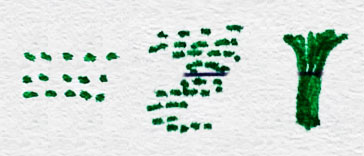
from haze to vortex I remember a view screen, perhaps, or a window in the big ship which reveals a brown haze of points. As my perspective twists and turns around it begins to look like a big spiral and then a vortex. I’m shooting down beside it at an immense speed with this great sound ringing all through me and around me like the THX sound. I felt a rush, a speeding up, and was filled with more energy afterwards. I felt more brave, alive, and playful.
The THX sound: Vortex, Sound, Energy: A change of perspective revealed the haze of dots to be a vortex, which I rush towards. The sound reminds me of the yawning mawing sound I heard in “Going Under” when I moved consciously from waking reality to dream reality.
-
Suicide and Dream Fire 1998 • 5:20 AM • age 24
Buttercup was going away for the day and I decided to kill myself. I’m standing on the street and put a gun to my head and shoot! Then I concentrate and say “5, less blood to see, 4, less blood to see, 3, 2, 1” and I look from a third person perspective and see myself standing there. There’s no blood, but I’m pale. Then I go back into my body perspective and think that Buttercup would probably have preferred to be there when I died than find me later. Since I found I was not actually dead yet, I assume death is on the way. I begin to wander.
My consciousness is changing. It gets clearer and clearer and I feel almost exactly like I’m on LSD. There’s this swirling energy in my head which lights up and clarifies the visual field wherever it’s at, leaving the places without it darker and blurrier. It would flow along the edges of things like doors and enter objects. There were multiple swirls at any given time.
Inner DreamFire: The decision to kill myself was totally out of place, but it led to some interesting experiences. The dreamfire might have been prana or some other energy coming into play and flowing into forms in the dream environment.
-
Cricket Crushing 1997 • age 23
This dream was ultra clear and in vibrant color. I was in my room at college. There were two ladies there and some crickets. I crushed one with a pool ball and then let the cats eat it. Another cricket under my desk gave off lights as I slowly squished its rear segment. The lights and energy released made me feel dizzy and strange.
Drunk on Life Force: Did I release some energy by squishing the cricket? What a strange effect! Was it a thought-form created by me and I released my energy back to myself by squishing it?
Memory in the Dream State
Memories
In the now of dreaming, our waking memories can be difficult to access. When we do remember, we may move into that memory and experience it as the world around us, as if it is happening again right now.
Whatever our attention focuses on is happening now.
Memories are an essential object of consciousness — we can enter them, move freely within them, and alter them. Even here in our physical bodies, when we remember, we are opening and going into the memory of that experience. In our moment-to-moment waking life, we are all recording memories of our experience. Most day-to-day experiences are dimly attended to by our attention and as such will likely never be recalled or shared with others. Others are important, life-shaping experiences that held the full weight of our attention and shine bright in our memory (both positive and negative experiences).
The process of interacting with rotes is described in “Interacting with Memories” in attention.php.
For the basics on memory, see “Memory” in attention.php.
Seeing Memories in Your Head
When we remember something in the dream state, we “see it in our head” as clearly as the scenery around us. This happens both with our own memories and memories shared by others. We can fully go inside it, seeing it instead of the scenery around us, or we can partially go inside it, which results in us projecting it to varying degrees into the scenery around us, usually merging the two experiences in strange ways.
-
Colorado Volcanoes National Park 2024 • 5:30 AM
Buttercup and I are on our way to Volcano National Park in Colorado. We’ve been there once before. It’s a drive around this mountainous area that includes a volcano and a glowing lake of lava. . . . I can see the route perfectly on a map in my head.
Remembering a Map: Here I’m likely looking at a memory, since I’ve been here before.
-
Stealing the Password 2025 • 3:45 AM
The characters and context from this dream are all from about 20-25 years ago, when I was working at Definition 6. The first thing I remember is a sort of stand-off with my boss. . . . He’s trying to subtly antagonize me into revealing if my server is at home or elsewhere by suggesting that I “go home, to the garage” to turn off the accounts. . . . I say that I can do it from here. In my mind I see the server, which is being hosted offsite (as it was 25 years ago), and I see my home computers, which are from that era, too.
Seeing Memories: This is a memory of a server and computers I no longer have.
Creating Memories
By thinking back to a scene and imagining, we’re able to create new memories that appear to be in the past.
-
The Superhero’s End 2011
Just when we were at the end of our patience, the food was brought out. There were a series of offensive things that happened, though I particularly remember adding to the story later on at some point to justify the violence to come — looking back and remembering new things that hadn’t happened before (and experiencing them distantly as I “remembered” them). The first was that I tried some chocolate thing but didn’t like it so I spat it out. The waiter who cleared my plate came back with powdered chocolate in a little bag — the very chocolate I had spat out, and offered it to me rudely. Then he took our centerpiece as he left. He also brought me this awful orange stew with a squeezed-out orange on top. Those two things were added later. But there was plenty originally.
Creating Memories: I was aware of creating new memories, with the purpose of justifying the violence to come. This sort of relief of cognitive dissonance happens in waking life, but it actually takes form in dreams.
Difficulties with Memory
Searching Memories Is Usually Creative
“Searching memories” is very purposefully worded. We remember things naturally in the dream state, but when we search for something specific in our memory, we often create what we’re looking for. We use the same specific search process as in the physical world — we imagine what we’re looking for to hold up as the target while we scan our memory for matches. However, in the dream state, that initial imagination is vivid enough to be mistaken for the match itself. We perceive it happening in the “now” of the dream, even though it’s understood as having happened in the past.
-
Betrayal of Memory 1997 • age 23
I was hanging out with Buttercup a lot. Then I feared having slept with Nika. I searched my memory for it and there it was. Oh, god! Anyone else? I searched and found Paige, too. Oh no! I began to dwell on this and feel really guilty. I thought “I’ll be good, do the right thing, and tell Buttercup” But she was so happy when I got to her that I was weighing the options.
By merely searching your memory for a thing, you can find it!
Looking for Something: Looking for a memory in a dream is sometimes equivalent to going into a fantasy. This is specific search at work.
-
Adventures at College 1998 • age 24
I asked if she had sex with them (which was impossible since I followed them right in, and also something I hadn’t been concerned about earlier). Betrayed by her memory, she said “yes”.
Creating Memories: She searches her memory and finds (creates) what she’s looking for. It wasn’t even possible.
-
Disney Park Madness 2025 • 3:45 AM
He also brought me a large box that seemed like it had been meant to be delivered to me. It was a bike pedal and something else, packed as if it were bought used. I quickly remembered/concocted a story that I had bought this as part of a video game for Bodhi when he was really into trucks, and told the guy I must have ordered it 10 years ago because he was 14 now (this is correct as of two days ago). I asked him to return it and credit me the $15.
Concocting Memories: There was no video game like this in physical life. And yet I remember Bodhi’s correct age just two days after his birthday.
False Memory Rationalizations
We may unwittingly create memories to fit a past event someone is referring to, or to explain how we got into a specific situation. This is a form of explanation rationalization. The goal is the same as other rationalizations — to quiet the waking mind, which might panic at not remembering something it should know or not knowing how it got somewhere.
-
Reviewing Is Recreating 1997 • age 22
The car was bashed into the back of this other car at a gas station’s repair shop. . . . I kept going back and replaying the scenes before to determine how this had happened. Eventually I created a reality where the original crashed car was the result.
Memories and Time: Here’s a great example of time in dreams. We can “go back” to see what caused an event, but when we do, we are actively creating it in the present while understanding that event as having been in the past. It’s like an explanation rationalization but with a fully-imagined scene.
Our creativity is in play wherever we are focused, no matter what “time” we’re focused in.
-
Home Near the Tower 1999 • 3 AM • age 25
[I] zip through a bunch of red lights faster than a car should be able to go. Then, terrified, I ask Buttercup “What’s wrong with me? Am I on drugs?” She says “Yes”. I seem to think back and remember that I was taking some sort of stimulant I had thought wasn’t a big deal.
Oh Yeah. . . .: Trying to make sense of my mental state, I try to remember when I took drugs and end up creating the scene. Another memory created as an explanation rationalization.
Verifying Others’ Memories Is Difficult
-
The Mistake 1997 • age 23
Buttercup and I are living on the top floor/attic of this new house. We’re so in love and hanging out with so many friends. It’s a nice house, too, and the area is naturally beautiful. It’s probably a higher realm. We have an entirely new network of friends. There’s this middle-eastern girl, a friend of a friend, who asks me for a ride home and I say okay. I’m flying her over a sea in a plane and she’s telling me how good I was last night in bed. I remember absolutely nothing of this but my first instinct is to accept it as true and try to remember. I work hard at this and begin to remember the previous night bit by bit. There doesn’t seem room for this to have happened and I can come up with so many reasons why I would never do it and why, if I did, I would remember it. . . . I remembered the final missing moments of “last night” which proved that nothing happened and I angrily told the girl off. I thought I must have been drinking and that’s why I had such trouble remembering. I told her she lied and I have a wonderful girlfriend and would never cheat on her and wasn’t even slightly attracted to her. She seemed hit pretty hard but she deserved it, I thought.
Dream Memory: I finally succeeded in not falling into another’s idea of who I was. The middle-eastern girl probably was projecting the image of someone else onto me. I had to go through tremendous effort to discern whether or not this event had occurred. I finally managed to do it without going into a fantasy memory and avoided a huge guilt-scene. Unfortunately, I didn’t realize that she was mistaking me for someone else and I let her have it.
Believing Mistaken Memories About Us
-
Dr. Eye Plucker 1997 • age 22
Part two is on some big bridge, and Liz is following Buttercup and me blurting out comments about how I cheated on Buttercup a long time ago and should tell her. So I finally did (I was making it up via suggestion) and she was crushed, but then got over it quickly.
Suggestion: I never cheated on Buttercup. In a dream, however, I accepted the suggestion of it as if it were true. This is more likely the less lucid we are. So we continue on under false assumptions.
For her part, it seems like her waking self was momentarily awakened to react to it, but then it fell back asleep.
Determining the Source of Memories
Determining the source of memories (astral or physical) is an important skill, as our actions mean different things in different contexts.
The waking self often mistakes astral experiences in the dream state as physical experiences.
-
Caught Cheating 2025 • earlier still
Much earlier in the night, I was hanging out in a mall in Minnesota. Word had gotten out that I had been cheating on Raven. I remembered “damn, that’s right, every time I traveled to visit an old girlfriend or a college, I pretty much always ended up sleeping with someone”. There was a bunch of people from my high school chasing me, kicking me, shouting at me. “But wait,” I reasoned, “this was not cheating on Raven, since we were long broken up, but Buttercup. Is that really true?” I wondered. “No, that was all in dreams. I never cheated.” Now, rather than believing I deserved this abuse, I knew I didn’t and pushed back at my attackers.
Astral or Physical?: I needed to remember if these memories were astral or physical, as it makes a big difference. Rather than getting caught in the drama, I refocus on my broader self context and am able to correctly determine that these were astral memories.
Photos Fade to Black
It’s impossible to take and keep photos in the dream state. The dream state is a more fluid, flowing state of now than the physical. Fresh creativity flows into everything. A static, flat, stationary picture can only exist so long as it is continuously maintained in attention.
-
The Office Tower Party 2025 • 6 AM
I found myself in another amazingly stylized area. I tried to take pictures. I eventually got the game-related photos app [on my phone] and took some, but each one ended up being something really weird that quickly faded to black. . . . Coming back to Buttercup and Gwen, I saw them dressed in some amazing new flapper-style clothes, and after struggling with the game app, I began to take some pictures with the weird photos app. I took a few, and when I went to look at them, each photo of them turned out in a completely different style — different colors, contrasts, time periods, even cartoon style. I wondered if it was one photo and I was scrolling through infinite possible styles. Each faded to black after a second or two. Frustrated, I put it away.
Disappearing Photos: Each photo turned out weirdly different from what I took, or wildly stylized. The wild creativity of the astral was apparent in the styles. While memory is perfect, we often relive our memories and creatively change them from the original as we explore other possibilities.
Each photo fades to black. In the physical, the same thing would happen visually, if not for the quick movements of eye saccades. Sensory adaptation sets in, and everything fades to black. In other words, we can only see when we see change. Maybe that’s a quality of consciousness itself.
The Lighting of the Memory
While our mind as assembler usually makes everything fit together seamlessly, sometimes the lighting of the original memory is visible even when integrated into a scene.
-
Memory Rooms and Exploding Dreamstuff 1997 • 6 AM • age 23
I peeked out and saw Emma come around the entranceway and peer over. That room was playing a memory of her and had the same ambient light that the memory was recorded in, which didn’t match with the silvery-dawn light of the rooms around her.
Echoes: I could tell Emma’s appearance wasn’t true, as the light she was bathed in didn’t actually match the ambient light of the dream. It was a memory being replayed just as it was recorded.
The original lighting is probably visible here because she’s in a separate room, which allows her part of the scene to have its own lighting.
False Awakenings and the Near-Realm
A false awakening happens when we think we have awakened from the dream state (or returned from an OBE), but we are actually still OB or dreaming.
The Nature of False Awakenings
What can happen many times is that you will think you are awake back here on the physical, but in fact you are NOT. This is called a “false awakening” by Oliver Fox. . . . Basically, you will come out of the OOBE and think you are physical again, but you will actually still be projecting! A number of times I have woken up from an OOBE, laid gathering my memories and promptly gotten up and started recording my experience in my journal only to discover I was not really awake here in the physical! . . .
If you do not realize you had a false awakening, it will become like a normal dream and you may go off and do other things, characteristic of your dream behavior, only to find yourself waking up for real here in the physical sometime later. APCOBEr, LDer • modern • DeGracia
Types of False Awakenings
There are three distinct types of false awakenings. A “false awakenings dream” is an ordinary dream of waking up, usually to write it down or communicate the dream to someone. “Awakening into the near realm” occurs when we exit our dream back into the near realm near our sleeping body. Finally, a “suspenseful false awakening” is an awakening into the astral or etheric body. One awakens in bed in the near realm into a strangely charged atmosphere.
False Awakening Dreams
In a false awakening dream, we dream that we have woken up, and may begin to write down our experiences or begin our day.
You think you are awake. So you get up, eat breakfast and fret about not going OOB. Then you wake up. That’s a good example of your mental ability to project a reality. LLDOBEOBEr • modern • Wilson
At the end of a dream I am writing my dream with a pencil across the pillow. It is something about Western philosophy. I force myself to sit up and see whether the writing is clear. I find it is only a series of dots and dashes. I then force myself actually awake to write. (Garfield 170)CDLDer • modern • Garfield
I then began a totally weird false awakening. . . .
I opened my eyes, looked left and saw the chest of drawers besides my bed that had been placed there yesterday when I moved my room about. First thought was to write my OOB down, so I jumped out of bed and went to another drawer on the other side of the room. I pulled out a writing pad (and possibly pen?) and moved back toward the bed. I then noticed that Vortigem Tarrant (Capital Radio DJ) was sitting in a chair to my right. A couple of kids were also to me (sic) left in the room. In addition, my dog was sniffing around near the kids. Still, my suspicions weren’t aroused! As I told Vortigem about having “had an amazing OOB — best one yet out of 40/50”, my dog jumped on the bed and got hidden beneath the folds of the duvet as I tucked myself in.
Then woke up for real and was totally confused. Going to that drawer across the room, I found no such writing pad — it was on the floor. And the pen was on the chest of drawers to my left. What was interesting was that in the false awakening, my room was just as it really is. I had only changed it over yesterday after 4 years! JoATOBEr • modern • Moon
Subject E: “I awoke to the realisation that the bedside radio was still on. Someone passed the door on the way downstairs. I turned the music low; strange, I thought, the radio being on at this time of night – what was the time? I reached out of bed to look at the clock (about six feet away) but as I did so an eerie feeling came over me, and I hesitated; yet everything looked perfectly natural so I went ahead, against a mounting tension of the atmosphere, and picked up the clock – hereupon it suddenly changed in my hands! Hastily I put it down; its black dial had turned white and hands moved to the nine and ten. I recognised this was the false awakening. Pausing a moment to ponder the significance of the position of the hands (for I knew this could not represent the actual time) I dived back under the blankets. Monsters were pressing on me, I called for help but could not wake up – not until I had seized the monsters and fought them, and flung them on the floor.” (Green and McCreery 69)LDPLDer • modern • Green & McCreery
Repeated False Awakenings
A cycle of dreams within a dream can continue through three or four dreams. (Garfield 158)CDLDer • modern • Garfield
The philosopher Bertrand Russell, interestingly, reports appearing to wake up hundreds of times in succession after an anaesthetic (Russell, 1948, pg. 186). (Green and McCreery 66)LDPLDer • modern • Green & McCreery
Delage: “One night I was woken by urgent knocking at the door of my room. I got up and asked: ‘Who is there?’ ‘Monsieur,’ came the answer in the voice of Marty, ‘it is Madame H . . . who is asking for you to come immediately to her house.’ . . .
“‘Just give me time to dress’, I said, ‘and I will run.’ I dressed hurriedly, but before going out I went into my dressing-room to wipe my face with a damp sponge. The sensation of cold water woke me and I realized that I had dreamt all the foregoing events. . . . So I went back to sleep. But a little later, the same knocking came again at my door. ‘What, Monsieur, aren’t you coming then?’
“‘Good heavens! So it is really true, I thought I had dreamt it.’
“‘Not at all. Hurry up. They are all waiting for you.’
“‘All right, I will run.’ Again I dressed myself, again in my dressing-room I wiped my face with cold water, and again the sensation of cold water woke me and made me understand that I had been deceived by a repetition of my dream. I went back to bed and went to sleep again. The same scene re-enacted itself almost identically twice more.”
When Delage “really” awoke the next morning, he could see the “whole series of actions, reasonings and thoughts had been nothing but a dream repeated four times in succession with no break in my sleep and without my having stirred from my bed.” (LaBerge 130-131)LDLDer, researcher • modern • LaBerge
Awakening into the Near Realm
We can also awaken from a dream into the near realm near our sleeping body. From this point we may hear telepathic conversations going on around us by others sleeping nearby, or engage in any manner of social dreaming.
-
Telepathic Songs and Conversations 1996 • age 22
Context: I'm sleeping in the same room with Emma and Ruby.
I wasn’t sure if I was truly awake, but I heard Emma and Ruby talking in their sleep. Randomly at first, then kinda together, then Ruby was singing and Emma joined in from time to time. They talked and it was as if I was only hearing half the conversation at times. I was somewhat bothered that it had woke me up and was going to ask them to be quiet, but instead dreamed that I recorded it on my portable tape recorder. I got a good bit, then the tape jammed.
Later, in another dream, I went to unjam it and checked to see if I had actually recorded it and I did, but it sounded a little different. Awake, I realized I didn’t actually record anything.
The Dream Self: I must have been dreaming, and was “awakened” back to the vicinity of my body by the telepathic conversation. At this point I think I’m awake, and so I make the recording and then put it out of my mind.
-
So I Have a Rat 2023
Buttercup, who does not like rats, was dreaming that she was holding a rat in her hand, much in the way one holds a burrito. It was her first memory of the dream, so she doesn’t know how she got it. The rat was alive, but not struggling. She was presented with the conundrum of what to do when you find yourself with a rat in your hand. She was so flummoxed that she “woke up” in our bed. She was still dreaming, however.
She stretched her arm out and grabbed something on the night stand. It was a rat! So once again, she had a rat in her hand.
Wake Up!: The strangeness of the situation caused her to wake up into the near realm.
Suspenseful False Awakenings (OB)
Paralysis, the Expectant Atmosphere, Growing Light
In a suspenseful false awakening, we find ourselves in a trance-like state near or within the physical body, but conscious in the near realm. Common experiences include paralysis, the expectant, electric atmosphere, and the slowly growing diffuse light.
The second classification of false awakenings is one in which the dreamer seems to awaken in a realistic manner, in his own bedroom setting, but in addition, there is a strange atmosphere. I call it Suspenseful False Awakening. The dreamer usually remains in his or her own bed. . . . Suspense, excitement, or apprehension come immediately or in a few minutes. This type of false awakening differs from the first type in that it always (rather than sometimes) begins with the dreamer in bed. (Garfield 159)CDLDer • modern • Garfield
The subject seems to wake in his or her bed in the normal way, but the atmosphere seems stressed, electrified or tense, and he or she has a feeling of foreboding or expectancy. In a false awakening of this kind ominous and anxiety-producing noises may be heard, and “apparitions” may be seen. (Green and McCreery 69)LDPLDer • modern • Green & McCreery
Dreams of the wrong-waking-up class are undoubtedly demoniacal, uncanny, and very vivid and bright, with a sort of ominous sharpness and clearness, a strong diabolical light. (Van Eeden)aSoDLDer, OBEr • Van Eeden
Case No. 731—W. F. Thomas
“About the middle of the night I ‘awoke’—in my physical body I thought. The appearance of everything was identical with the normal physical scene, but (1) a beautiful pale blue phosphorescence pervaded the atmosphere, causing a shadowless, dawnlike light on everything; (2) the air was electric with atmosphere crackling in my ears; (3) I felt different—wide awake, excited, and apprehensive; (4) I had a feeling of expectancy.” (Crookall 89-90)CBAPresearcher • modern • Crookall
I passed from unremembered dreams and thought I was awake. It was still night, and my room very dark. Although it seemed to me that I was awake, I felt curiously disinclined to move. The atmosphere seemed changed, to be in a “strained” condition. I had a sense of invisible, intangible powers at work, which caused this feeling as of aerial stress. I became expectant. Certainly, something was about to happen. Suddenly the room was faintly illuminated. A soft greenish glow, suggesting phosphorescence, was emanating from a glass-doored Japanese cabinet beside my bed. From this source, it spread slowly and evenly, like a luminous gas—a cold, spectral light, of unvarying brightness. For a while I stayed motionless, watching it. I did not feel afraid, but I was filled with wonder. Then, wishing to observe more closely the source of this mysterious light, I made an effort to overcome my strange disinclination to move. Instantly the light vanished and things were as usual. I was really awake now, with my head half raised from the pillow.
Note: I did not know it, but I could have left my body quite easily (by the method of instantaneous projection) when in this condition. (Fox 48-49)
I heard also, when in this state, in addition to physical sounds, several strange noises: crackling sounds suggesting electrical phenomena; roaring and whirring noises as of gigantic machines; a peculiar snapping sound . . . sounds like the surging of an angry sea and rushing winds; and sometimes voices calling. (Fox 62)APrOBEr • modern • Fox
Friendly Visitations
In the following experiences, the mental contact preceding a friendly visitation calls one back to their own physical body. These must be physically-focused visits, as we can communicate by thought with anyone in the dream state without being called back to our physical bodies.
I opened my eyes with a start. The clock by my bed read 3:30 A.M. The room, normally dimly lit by the night-light on my dresser, was now glowing with an unearthly illumination. The air was very cold and subtly vibrating. My body was electrified, my heart racing, all my senses alert. I had experienced these sensations enough to know what they meant—I was being visited by an otherworldly presence. . . .
I sat up in bed and centered myself with a prayer for protection and clarity. I became very still. My awareness moved from its normal parameters into a less limited realm. . . .
Immediately I recognized this energy. It was Sandy, a client who had died of chronic heart disease a few nights before. . . .
He appeared before me youthful, vigorous, and radiant. (Fairchilde 1)VftAchanneled • modern • Fairchilde
I told [my mother] I was expecting an astral visit from Barrow, and must go back to my bedroom and await his coming. Instantly I was caught up, as though in some invisible current, and borne back to my body. I awoke—at least, I was certainly under the impression that I was awake—and was much annoyed. . . .
At this point I became aware of two things: (1) that a sudden almost indescribable change had been effected in the atmosphere, which seemed charged with expectation (the “before a storm” sensation intensified) and rarefied, or perhaps compressed. It seemed to me that the atmosphere was being strained. . . . (2) That my bedroom door, which had been shut, was now ajar—a faint golden light streaming through the opening. . . .
Literally in a flash, my friend came. He did not enter by the door. He appeared instantaneously, in an egg-shaped cloud of intense bluish-white light, and stood by my bed, gravely regarding me. He was dressed in a white robe (possibly his nightshirt); and as my eyes recovered from the dazzling effect of his sudden appearance, I saw that inside the blush-white ovoid surrounding him, were bands of color—deep red, rose-red, violet, blue, sea-green and pale orange. . . . The pale orange was centered around the head, shooting upwards from it in a widening conical ray, until it reached the ceiling. . . . He did not speak, but I felt that he was telling me mentally not to be afraid. . . . All this happened in a moment or two; then . . . he vanished as suddenly as he had come. (Fox 49-50)
I passed from an unremembered dream to find myself apparently awake in the darkness of my room. In a moment or two, I became aware of that curious change in the atmosphere, which has already been described. The thought came to me that something unusual was about to happen, but I had no idea as to the form this expected manifestation would take. Then, with startling suddenness, an ovoid of blush-white appeared a few feet from my bed, and in it was a seemingly solid figure, which I instantly recognized. The apparition was clothed in a simple white robe of intense brilliance, but no astral colors were discernible. . . . I stretched out a hand to touch the figure, and then it immediately vanished. (Fox 52-53)
Some time in the night, while it was still dark, I woke—but it was the False Awakening. I could hear the clock ticking and dimly see the objects in the room. I lay on the left side of my double bed, with tingling nerves, waiting. Something was going to happen. . . .
Suddenly there appeared a large egg-shaped cloud of intensely brilliant bluish-white light. In the middle was Elsie, hair loose, and in her nightdress. She seemed perfectly solid as she stood by a chest of drawers near the right side of my bed. Thus she remained, regarding me with calm but sorrowful eyes, and running her fingers along the top and front side of a desk which stood on the drawers. She did not speak.
For what seemed to be some seconds I could not move or utter a word. Again I felt the strange paralysis. . . . Wonder and admiration filled me, but I was not afraid of her. At last I broke the spell. Rising on one elbow, I called her name, and she vanished as suddenly as she had come. . . .
The following evening we met and I found Elsie very excited and triumphant.
“I did come to you!” she greeted me. “I really did.” . . .
She described how she was running her fingers along a projecting ridge on the front of this desk. (Fox 57-58)APrOBEr • modern • Fox
Near-Realm Nasties
It is from the near realm that we can sometimes encounter those focused in the lowest astral frequencies, those still clinging onto the physical. They may attempt to antagonize us in order to absorb our emotional energy, as they have cut themselves off from the flow from the Source.
Sometimes after the False Awakening I had the rather frightening experience of feeling an apparently solid hand touching or gripping me. . . . On one occasion I was seized by steel-like arms and squeezed until I seemed to be gasping for breath. At last I managed to cry out, and as the trance was broken, I saw a misty white shape dissolving in the night. One apparition of a non-human kind particularly impressed me. . . . My visitor resembled a conical mass of glistening snow and nearly reached the ceiling. It had no features, but two blazing blue eyes completed the picture. (Fox 61-62)APrOBEr • modern • Fox
See “Lower Astral Inhabitants” in planes-of-consciousness.php.
The Electric Atmosphere from Trance States
This same state of mind and its accompanying phenomena can also occur during the trance state preceding sleep or an OBE.
As I opened my astral eyes, I turned right round within my physical body so that I faced the other direction. Great forces seemed to be straining the atmosphere, and bluish-green flashes of light came from all parts of the room. I then caught sight of a hideous monster—a vague, white, filmy, formless thing, spreading out in queer patches and snake-like protuberances. It had two enormous round eyes, like globes filled with pale blue fire, each about six or seven inches in diameter. . . .
Once more I turned within myself and viewed the room. The monster had gone, but the flashings continued for a little while. These too subsided, and then the room seemed just as usual, except for the fact that it was dimly and evenly illuminated by no visible source of light. . . .
NOTE: He leaves his body and travels about, then: My body called me back. I made the journey home in a flash and found myself still in the Trance Condition. . . .
Just as I was about to leave my body, I heard my wife say with peculiar distinctness: “No! You must not do it again now, or I shall be frightened.” I thought her voice was probably only an illusion and so hesitated. Then she spoke again: “Wake up dear!” I still thought the voice was most likely unreal in the physical sense, but. . . . I broke the trance quite easily and questioned her. She had not spoken and had no recollection of seeing me leave my body. (Fox 92-95)APrOBEr • modern • Fox
It was likely his wife subconsciously communicating with him, from a level where she observed his experiences.
In my drowsy condition, I used to watch these mounting spots [from a fish-tail burner NOTE: a heating device] as they traversed the dark space and became lost in the outer brightness, and sometimes things would suddenly “go wrong.” The light of the gas-flame grew dim and that mysterious pale-golden light from nowhere suffused the room. I would hear strange noises, crackling and snapping noises, while little shafts of blue flame, like miniature lightning, darted from the corners of the room. And then came the apparition: a man with a grotesquely horrible face, a wolf with eyes of fire, a lion, a huge serpent, a great black bear standing erect so that it reached the ceiling—I saw all these at different times. And I just yelled and yelled. The apparition would stay quite still, glowering at me, and I could hear my mother running up the stairs in answer to my frantic S O S; but as soon as she turned the door-knob, the fearsome beast vanished and things “came right” again.
Such apparitions, lights and sounds are common happenings in that trance condition which forms the prelude to a conscious projection. (Fox 20-21)APrOBEr • modern • Fox
Intuition and Direct Knowing
I awoke from a dream in the middle of the night on July 7th, 2023 at about 2:40 am. I had seen an image and had some important thoughts on it, so I woke myself up to write it down. After doing so, I kept falling back asleep and finding the thoughts and revelations continuing, and I woke myself a few more times to write down thoughts. Among them:
Thought forms are 5-dimensional objects. Their melting is their fading from the 4th dimension which is attention. It’s a slow transition out of the 4th dimension as our attention turns elsewhere.
It sounds just like the revelations I have from marijuana. No surprise, as that state is very close to dreaming. We have access to all that higher (frequency) subconscious knowledge every night.
See also “Communicating with the Dream Self” in nature-of-dreams.php and “Channeling” in communication.php.
Direct Knowing
Frequently in dreams I just know things without any source of knowing. When I wonder something, the answer may appear instantly in my head or through the context of the dream. In some cases, this may be the back story that comes with rotes. In others it may be a communication coming from someone. Either way, questions are often automatically answered in dreams, just as when I’m in touch with my subconscious intuition through psychedelics. Whatever the reason, in the dream state we simply know things.
It is almost impossible for you to be aware of the full perceptions possible, for the ego would not stand for it. Often, even in simple dreams, however, you will feel concepts or understand a particular piece of information without a word being spoken. (Roberts 326)SD&Pchanneled • modern • Seth
In the dreaming state you are presented with certain kinds of immediate knowledge. It often appears out of context in usual terms. (Roberts 276)
In dreams the reasoning mind loosens its hold upon perception. From your standpoint you are almost faced with too much data. The reasoning mind attempts to catch what it can as it reassembles its abilities toward waking, but the net of its reasoning simply cannot hold that assemblage of information. Instead it is processed at other levels of the psyche. (Roberts 279)DEVF1channeled • modern • Seth
-
The Armageddon Clock 1988 • age 14
I was in Narnia, adventuring on some snow-covered slopes. I came to some rocky land and a black 5’ x 5’ pile of shaped stones. I knew that if one of the top two stones touched the pedestal, the world would end. I moved some stones around and one part of the top one touched the pedestal. I reluctantly went over and pulled a string attached to a huge clock-like device which would cause the sky to darken and monsters to appear.
Dream Knowing: Some dream situations are presented complete with related information — such as the piled stones and pedestal. We find ourselves knowing something about the objects or situation in front of you, without questioning how we know.
-
The Space Probes 1996 • age 22
I’m in space. It’s all hazy and there’s a sun off in one direction. I see a huge gray Star Trek ship go by overhead and recognize it as a long-forgotten probe. It sucks up the haze and leaves a trail of thick black smoke behind it. I know it should be destroyed, because the work it’s doing is not necessary anymore.
-
The Sewers Beneath the Dark Tower 1997 • age 22
I can tell Lucius’s about to lie because his moustache isn’t real.
Moustache of Lies: Now this is strange. . . .
-
Adventures at College 1998 • age 24
She smiled at me with bright eyes and I seemed to know her name was Brooke. I imagined what it’d be like if we were friends for a while.
Her Name: Smiling at me with bright eyes is making a connection with me. I assume I knew her name through that connection. It was likely also the connection over which I imagined our friendship.
-
The Elevator 2000 • age 25
The elevator stopped and the quality of light was different — it was daytime with odd tints and overtones of feeling. I opened the door to a blue sky with puffy clouds in a Renaissance town of fantastic wealth and variety. Things were very different than any history of ours. Information came naturally to me, and I knew that there were very powerful groups of people. One group stuck to lavish costumes of all black. There was quite an energy in the air and a lot of people. We climbed a hill to what looked like a resting area with picnic tables all about us. My invisible guide was with me the whole time. I was going to ask this woman a question. I thought she had a lot to tell me but she would likely first ask what faction I was part of . . . and then suddenly I was back in the elevator.
Information Came to Me: The Renaissance town didn’t seem like a rote except that contextual information was coming to me.
-
Lucid: Colored Pots and Pans 2000
Before us was a wide river and across that a woods with assorted buildings and a neon sign that I recognized as Atlanta for some reason. That’s where we wanted to go. But a few steps more and we saw that the road, now concrete, came to a sudden end some ten feet over the river. There was confusion in the group and I explained that the reason for this was that we had to face something in the large structure first.
We turned to it and not much was visible — just some bits sticking out of the top of the sandy/muddy hill. There was an opening barely large enough to slide in through and a flexible area that revealed lines of blue energy when pushed on. I said “no, no” and gathered their attention. I knew I could easily get to the bottom of this through dream law. I mentally pried open the ground and created a big opening for everyone. The ground was pliable and the opening started small and was stretched open. We entered.
There were many levels but I remember few details. I taught them a lot of things, though I resisted being too much of a teacher. At one point we crossed a road under open sky. I said that if they ignored the cars they would pass right through them, as they do with one another, but if they became anxious and believed they would feel the impact of getting hit, they would.
Then we went into another room and I taught them how to open doors in walls. “Begin by sticking a pin-like extension of your mind into the wall.” Two of them were lined up with me, trying it. The appearance was like sticking a pin into clay. “Then, when it’s in, expand it, stretch it open into whatever shape you like — circle, square, patterned frame, etc.”
Next we came upon a big mechanical fish. I knew it was the second-to-last level and we entered through the mouth. I told the others to get their bats or weapons out in preparation for lots of little guys.
A Knowing: In this dream, I somehow know all kinds of things. I know that we need to face challenges in the structure before we can cross the stream. I also knew specifics of each of the challenges. But how? I didn’t get the impression that I’d been there before.
-
The Autistic Dreamer 2011
I’m in a dimly lit house with some friends. We walk into another room and find a tall, dark-featured man in there with a dark brown aura. I know that it’s someone autistic or mentally disabled who lives most of his life in the dream world.
How Do I Know?: This information is just a part of the scene as contextual information.
-
Fiona’s Shop 2024 • 6 AM
So from there I go to visit Fiona’s new restaurant. It’s on the ground floor of a skyscraper. I wonder what’s above, then know that it’s floor after floor of apartments. I peer through the ceiling to see the hallways of doors.
To Wonder Is to Know: I only have to wonder for the information to come to me.
-
The Annoying Kid 2025
At some point I decided to go higher up. I somehow discerned that there were people more directly responsible. I looked up their address — it was in the big city. I got schematics of their house and memorized them, noting that there was a well-armed safehouse under it with an entrance through a kitchen tile. There were armed men in there. So Buttercup and I traveled to their apartment.
Getting Information: This is within a rote, which was revealed later when it fast forwarded. By simply wanting contextual information, it came to me, in as much detail as I wanted.
-
Teacher on Concentric Isle, East Timor 1999 • age 25
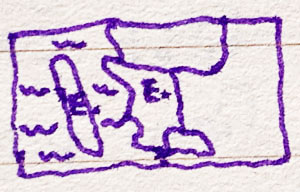
Inaccurate map of East Timor Wow! A beautiful true dream! I am flying high over the ocean, near the clouds with my teacher: a tall, lanky black man with an African look. We are traveling to East Timor, an island called something like “Concentric Isle” but also like “geometric” and “symmetric”. It’s a long thin oval of forests, mountains, and beach of fantastic beauty. I wonder what East Timor actually is and a map flashes up in my head, showing that it’s an island and a portion of the mainland.
We arrive at my teacher’s house by the sea. It’s warm and incredibly beautiful.
East Timor: I wondered and got a visual response.
There is a country called East Timor in Indonesia. The “mainland” I mentioned was a much larger island next to Concentric Isle. It has a region called Pante Macassar that looks somewhat like the map I saw, but there is no small, long island off the coast.
Question and Answer
Sometimes I ask a question, either out loud or in my head, and receive an answer. This is a slower, more physical rationalization of direct knowing.
-
Bedroom Window Gateway 1997 • age 23
Buttercup wanted to go somewhere out of the rain, and there was a dry place in the world down there, in the caves by the water — that’s where we had to jump. But it was a mile down this time. I had done it countless times before but now I hesitated.
“Is there any other way?” I thought. Instantly a scene appeared in my head: a computer screen with fluffy clouds and options of places to go. All I had to do was select my destination and I was there, without the nasty drop.
Ask and Know: I get an answer to my question about if there is another way down. It comes in the form of direct knowing with a visual counterpart.
Who is answering?
-
The Neighborhood Construction Ship 2001
I’m at Blaine House with Ruby and it’s bustling with people. I look out the kitchen window to see this immense airship made of metal girders carrying enormous amounts of building supplies. It stretches from right overhead to beyond the distant horizon. “What? How?” I asked, astonished. The phone rings and I pick up. A person answers my questions, explaining that it’s space folding (a reference to a method of travel from Robotech). It seems to have enough material to build an entire city.
References: Robotech is an animated sci-fi series.
Knowing the Answers: I wonder something and the answer comes to me rationalized as a phone call. But where did that knowing actually come from? Was this a rote and the knowing was from the person whose memory it was?
Guiding Voices
-
Like Warcraft, but a Whole World! 1997 • age 22
I’m slipping bombs into this piping system. Then I realize I must build. I go up to the castle to claim part of it as mine. But it’s not abandoned and I run into a bunch of orcs. I scurry away and find a bunch of my fellows — team orange! A voice whispers to me: “There’s more of them, but you can still win. Use your shield-men wisely!” . . . I restarted the scenario.
The voice speaks to me as I go immediately to explore: “The orcs aren’t here yet. They’re returning from a mission.” I start heading to where I found my allies last time and march right into a large enemy troop. I run through them and they split up and I’m back where I first saw them. I go to the corner. I review their stats with help from the voice and find they’re too much to handle.
Guiding Voice: This was a voice without a body or source, that spoke to me with helpful information. Was it a part of me?
Flow States
Flow states are like a cross between intuition and channeling. We step aside and allow a greater self to operate through us.
-
Guided in Dreams 1996 • 5:05 AM • age 22
Straightforward, easy-to-understand dreams tonight. I’ve been following desires, floating around through downtown San Francisco. I really am traveling around. I love this! Everything is being shown and explained to me. The Source is more aware, more alive, all in the now. It is clear and focused. It is the whole hologram, across all of time. Any knowledge you want.
Motivations move us forward. Belief in a goal increases our motivation. Focusing on a destination creates movement towards it.
I really feel as if I have been guided tonight. I’m so peacefully detached and unemotionally involved — only excited and fascinated by learning, not survival. That’s a great success. To be successful there, on the other side, we need to be stronger than our physical fears.
This is just coming to me so easily. I just figured I’d remember and didn’t need to write it down, because it’s so clear there. I really must explore this fearlessness more!
Calm Knowing and Guidance: I’m in the same connected flow state here in the dream state that I get in while high. Information is coming to me — in my dream self focus. My waking self is asleep. That’s why I feel peacefully detached. I’m not projecting drama all over my surroundings, and so I can observe, listen, and learn.
True dreaming occurs when the waking self with all its physically-based fears is kept quiet, sleeping. Once it awakens within the dream, it projects physical limitations, fears, and desires onto everything.
-
World Religious Conference 1997 • age 22
Soon afterwards, Emma appeared in the same shimmering semitransparent form. I forget how it happened (maybe I touched her), but I was transported somewhere else.
I was transported to this big international city scene. It was a big, big event like a world conference, and I was very happy to be there. I was filled with light and energy and I started leaping high in the air speaking the voice of truth: “Knowledge without love is like skin filled with skin! It cannot operate without a heart and a complex inside!” I yelled it out to people as I leap-frogged them. I jumped straight through Emma.
Channeling Truth: This is one of those wonderful times where a greater spirit fills you and speaks through you. It’s an incredible feeling.
-
Hanging Out 2020 • 7 AM
They were sprawled out on the floor or sitting, physically close and touching. They seemed like boyfriends and girlfriends or close friends. I felt left out. I climbed out to the outside of the balustrade and hung onto the bars. I projected my feelings into a full-throated song about how the two girls I wanted most didn’t want me back. It came out fully formed, creative, musically interesting. I sang maybe 5-6 lines.
My Song: I love doing this. Music comes through me, fully-formed. A statement of my feelings in dynamic and interesting music.
-
Final Exams 1998 • age 24
I dreamed that it was final exam time in my classes. In one that might have been history, I had a big project planned. I had made baked-clay houses, land, people and horses and painted most of them. I was nervous about being in front of the class and took a Percoset to mellow. I thought back to my last exam and how at the end I’d lost my fear and smiled and really got into it. I wanted to start out like that this time.
I went to the front and the lights dimmed. A spotlight was on me and I set it up and began talking and play-acting the figures. After maybe 10 minutes I fell into this kind of trance and began telling a story with great spirit. Now, in the trance, I was expressive and the story flowed through me. The whole class was gaping, leaning forward, way into it. Soon it was very rowdy. I had them. Everett was in the audience, smiling and laughing like in elementary school. Everyone was drinking beer now, shouting out “yeah!” and having a good time. It seemed to last over an hour. Then the teacher turned on the light and class was over.
Trance: Getting my waking mind out of the way was what was needed here, as it let me channel through something real that really connected with the rest of the class.
Tanya: “In the dream I was in a rink with a number of other people. We were playing hockey and I was skating in the manner I always had, competent yet hesitant. At that moment I realized I was dreaming so I told myself to allow my higher knowledge to take over my consciousness. I surrendered to the quality of complete skating. Instantly there was no more fear, no more holding back and I was skating like a pro, feeling as free as a bird.
“The next time I went skating I decided to experiment and try this surrender technique. So I hit the ice . . . and my feet followed my heart. I was free on the ice. . . . I’ve skated with that freedom ever since.” (LaBerge 190)LDLDer, researcher • modern • LaBerge
Questioning Flow States
-
How Do I Know That? 1996 • age 22
I was performing at this rock concert with lots of others on the strangest stage. After playing the first part of a song, I started to wonder how it was that I knew this song, at which point I forgot the rest. Then I was just messing around, trying to play some song I knew. Everyone joined in, and it went really well. Then I started reading this thing to opera music in the opera style and it was really funny. But I couldn’t see the words so well so someone else took over.
Questioning: Questioning how we know something engages the waking self, and often breaks us out of the flow state we’re in. If I hadn’t questioned how I knew the song, I’d have been able to finish it. The waking self needs to stand aside to engage in flow states.
In terms of rotes, we go from riding along with the character playing the song to taking over the character with our own will — one which doesn’t know the song.
Antagonism and Energy Absorption
Antagonism in the nonphysical is primarily due to people and their thought forms at slower frequencies. These people are at lower frequencies because they have cut off their own access to the Source. There are also places that seem designed to ensnare dreamers where people of this sort gather (see “Places Made to Prey On Dreamers” above).
There is but one goal in this antagonism — to elicit emotional reactions from the dreamer or OBEr. These reactions cause an expression of energy that can be absorbed by those doing the antagonizing. They come to believe this is the only way of getting energy — at least, without opening up and seeing themselves truly.
That basic life energy is the only thing of value to those in the astral — the only form of interpersonal commerce. Knowledge and overcoming fears and desires are the keys to becoming immune to antagonism. Additionally, we can avoid these people and places by focusing on higher things, which takes us out of their slower range of frequencies.
Who Antagonizes
Two kinds of obstacles are met in the invisible realms. The first of these are beings living in a lower stratum of the fundamental matter, and the second are images created by ourselves or by unknown intelligences.
To defend yourself from any of these, all you have to do is to call your guides, to raise the consciousness to a higher and purer level. . . .
The obstacles we are likely to meet in the Invisible world are the results of the inferior quality of our own aspirations, which place us provisionally at the mercy of the lower vibrations of matter and its denizens.
Remember, also, that a thought is often enough to cause an entity which pleases or displeases us to appear or disappear. (Yram 96, 98-99)PAPOBEr • Yram
See also “Stuck in the Near Realm - Earthbound Souls” in returning-home.php.
Kinds of Antagonism
Containing
Containing or trapping someone causes an energetic release as the person struggles to escape and becomes frustrated or panicked.
The main aim of antagonistic forces seems to be to hinder the experimenter. They therefore produce images which try to imprison the student in space, or they attempt to sap his vitality.
The first kind are many in number: barriers, very narrow tubes, boxes, cages, and prisons. . . . Agents such as grease and glass are also used. . . .
In the second instance, pointed objects are created, or mirages of rain, which draw away the student’s strength and force him to return to his physical envelope. . . .
All these hindrances are produced when we leave our room in order to reach a new dimension. (Yram 105)PAPOBEr • Yram
I found myself outside my body, in my own room. . . .
I went towards the door, intending to pass through it. I had hardly done this when a new room appeared and kept me prisoner. . . . I dispelled the illusion, but immediately another room took its place, this time one with a window. In order to leave this room I broke the window-panes. Still under the power of the mysterious influence, the glass broke into sharp points. . . . I decided to risk it and tried to squeeze my way past the jagged edges guarding this opening. . . . I was neither cut nor scratched. I felt only a strange discomfort which drew away my strength, as if it had been held in a reservoir from which it was rapidly being emptied. I had to return to my body. (Yram 106)
Sometimes obstacles crop up during a projection. . . . I was wandering about a town built in the ether when, arriving at a certain spot, I saw, to my great surprise, that the streets were closing up in front of me. Soon I found myself in a sort of tube shut up at both ends. Immediately I invoked my guides. (Yram 107-108)
Another day, after having projected my astral body in the room where I lay, I rose perpendicularly into space. Suddenly a series of thatched roofs came in my way, doing their best to stop this ascent. Aided by prayer, I managed to see daylight and carry on. (Yram 108-109)
I tried to lift out. I couldn’t, there were voices and I was being stopped. Instead, I willed myself to go to the left. At first, I moved slowly, then faster. Seems I outwitted whatever was trying to stop me leaving my body. I kind of ran out of steam some distance outside the house. Felt I was being pursued and then caught. Was frightened and wiggled back to my body. JoATOBEr • modern • Moon
Energy Sapping
Dr. Wiltse: A small, densely black cloud appeared in front of me and advanced towards my face. I knew that I was to be stopped. I felt the power to move or to think leaving me. My hands fell powerless to my sides, my shoulders and head dropped forward, the cloud touched my face and I knew no more. (Muldoon 30)PotABOBEr • Spiritualism • Muldoon
Magnetic Resistance
The evil influence of the people by whom I was surrounded came to me in the form of invisible electro-magnetic waves of an extraordinary power of resistance. (Yram 103)
I travelled hundreds of miles, intending to visit one of my friends living on earth, when a grating suddenly sprang up before me. By an effort of will I forced it to disappear and continued my journey. Already I was near my goal. I could actually feel the magnetic aura of the person in question, when I had the very definite impression of being attracted by two opposing forces. One was pushing me towards my goal, the other was pulling me back. Despite my efforts, I had to yield to the second force and come back to my body. (Yram 108)PAPOBEr • Yram
Nightmares and Emotional Memories
Some experiences in the dream state are memory or story rotes passed along by others. In this case any antagonistic forces within are part of the story. In memories, we’re dealing with recordings and the antagonists are not people who can absorb our energy.
However, our emotional reactions while within the memory are real. Are we merely observing the story? Or have we inhabited a character in the story and started to change the plot? If so, we have become emotionally involved. We express those emotions in the body left outside of the memory while experiencing it.
So passing a rote of a dramatic, scary, or emotional story may still have the intended effect of making us express energy that can be absorbed by the one who passes us the memory. For this reason, some in the lower astral may pass us nightmares or emotionally draining memories.
Facing Antagonists
There are two sources of antagonistic forces — external and internal. External antagonists are independent people and their thought forms in the lower astral. Internal antagonists are our own thought forms created from our fears.
When we are the cause, the best and most straightforward way to be free of them is to remove our attention from them. Our attention is what creates and sustains them. Fighting them will only provide them with more energy.
If the source is external, then the goal is to make you express negative emotions. Don’t let them get to you. Don’t be fooled, don’t open the rote, don’t get emotionally involved. This takes practice and knowledge.
In either case, the answer is to calmly move our attention elsewhere. It’s the waking self that feels the need to engage, to fight for its life, to defend its reputation, to flee. This all comes from the physical and is not helpful in the dream state.
Facing Antagonists Violently
This can feel good, as we give in to behavior that has been bottled up in the physical. It’s also likely that the energy of the violence directed at the antagonist fills them up temporarily, allowing them to settle down into themselves. However, our own tendency towards violence does get strengthened.
A man comes out of his seat and deliberately and aggressively stands in our way. I say to myself, “This is a lucid dream and no harm can come from this, so I’m going to kick this guy in the nuts.” With that I kick him in the testicles and he folds up with great, shrieking convulsions. (Kelzer 246)tSatSLDer • modern • Kelzer
In the hypnotic study that Bruce Dane carried out in my laboratory, one of the hypnotic subjects had been experiencing a long-standing recurrent nightmare involving a particular frightening male figure. Following her experience in the laboratory, this figure appeared in several dreams, but each time he did, the dreamer was able to become lucid. The first time he appeared in her dreams at home, her immediate response was to turn and yell at him to scare him away. She did the same thing the second time he appeared. The third time he appeared, she was gratified to report that her response had been more creative in that she had materialized a bag of “magic darts” to throw at him. . . . In yet another lucid dream, the same subject was able to enlist a dream figure’s help in holding some male attackers at bay until the police could arrive. When the attackers began shooting at her, she materialized a crash helmet for herself and turned their bullets into popcorn balls! (Van de Castle 448-449)ODMresearcher • modern • Van de Castle
She keeps engaging with him, and he keeps returning.
Tholey: After my father’s death in 1968, he often appeared to me in my dreams as a dangerous figure, who insulted and threatened me. When I became lucid, I would beat him in anger. He was then sometimes transformed into a more primitive creature, like a dwarf, an animal, or a mummy. Whenever I won, I was overcome by a feeling of triumph. Nevertheless, my father continued to appear as a threatening figure in subsequent dreams. (Garfield 141-142)CDLDer • modern • Garfield
Transformations After Violence
I dreamed I was having dinner with a rather uptight group of psychologists when a woman across the table suddenly started recriminating with me for leaving the world of the academic elite and lowering my standards to those of the Sunday newspapers. I protested that this was an exaggeration, and that I believed the layman was entitled to at least some of our ideas, especially as he was paying for our research. At this she literally spat across the table that I was bringing the whole profession into disrepute, that we must retain some vestige of authority, and so on. My fury rose to such a pitch that I had an irresistible desire to beat her up, and no sooner had I become aware of this desire than I realized with the utmost clarity that I was dreaming and could do exactly what I wanted because dream bodies cannot get hurt.
So, leaning across the table, I grabbed her by the hair, punched her face, and knocked her front teeth out. This inspired me to further violence and with an exhilaration I have never previously experienced I dragged her onto the floor and began to beat up her body in the same way. Of course, she fought back, and I could still feel the slashing of her fingernails across my cheek and the kicks of what felt like hobnailed boots on my back. At last I detected the waning of her strength, and the fight was over. Then the scene changed, and I found myself in another room walking toward this woman, who was now transformed and wearing a nurse’s uniform. As we approached each other, I reminded myself that I must not magically change the events of my lucid dream but allow them to happen spontaneously and observe the outcome. I noted that she was smiling now and that her front teeth were back in place. She then put out her arms to me in a friendly gesture, and we hugged each other.
I woke up with a great sense of well-being, as if my humanistic underdog had really made its protest against my academic topdog. . . . I felt it not just in my mind but throughout my whole body.
(Faraday, 1972 p. 310) (Green and McCreery 133-134)LDPLDer • modern • Green & McCreery
She is very thankful for the energy boost and temporarily becomes her better self.
Facing Antagonists Peacefully
An alternative to turning our attention away from external antagonists is that we can feed them with calm, open, loving attention. This direct flow into them can have transformative effects, as they immediately cease trying to scare or frustrate energy out of us. The flow of energy ends the hunger for the time being, and they return to their normal selves. This is but a momentary relief, however. They need to fully reconnect with the Source to make the flow a permanent one from within themselves, and that requires internal change. Without that, they will return to their antagonistic behavior as their energy dwindles.
In these dreams, I noted on many occasions what seemed to be the manifestation of some underlying divine law. If the shape of horror was faced boldly, it would either be dissipated or actually changed into a thing of beauty, and the latter always happened when my compassion was aroused and conquered my aversion. (Fox 29-30)APrOBEr • modern • Fox
What we consider unacceptable within ourselves and in others must be confronted lucidly, modified through dialogue and interaction, and wedded to our conscious selves. (Kelzer xv-xvi)tSatSLDer • modern • Kelzer
They Become Friendly
Dreams are full of misunderstandings. People come across each other from completely different contexts and misunderstand each other’s actions. What seems like an enemy might not be.
That aside, I think in some cases the relationship actually changes at the moment of confrontation. What happens is that instead of trying to force emotional energy out of you, you provide a full stream of it with your open attention. Suddenly satisfied, the antagonists relax into a better version of themselves.
-
Field of Beasts 2000 • age 25
I’m out exploring in these fields that are divided up into squares like sod fields. They have a light dusting of white snow. Suddenly this bear runs up to me and bear-hugs me from one side and this raccoon hugs me from the other. It’s a very warm sensation. Then this host of creatures that I was previously scared of comes out of the woods and runs towards me. I run back through the fields I came from and into this building. They chase me, and are joined by a big fleshy ogre. I’m with Buttercup now and we flee down hallways. We get to the car and quickly pull out. We drive through the narrow lots and smash into another car. I think to myself “No, that’s no good. Let’s try again.”
So I’m back at the first hallway in the building and cause the hallway between myself and the oncoming group to glow with hot yellow light. Then I cause a tornado to appear in the middle. But it doesn’t stop the fleshy ogre, who runs right through it. I flee, then change my tactic. I let him catch me. He stops short, huffing, and says “I wondered if you could make me a CD.” I said I would, then left.
Fwwieend?: Well this is odd. Was this just some big misunderstanding? It all starts off with a friendly bear hug. And then the ogre just wants me to make him a CD.
C.D.Y.: I’m in a dark, poor section of a city. A young man starts chasing me down an alley. I’m running for what seems to be a long time in the dream. Then I become aware that I am dreaming and that much of my dream life is spent running from male pursuers. I say to myself, “I’m tired of this never-ending chase.” I stop running, turn around and walk up to the man. I touch him and say, “Is there anything I can do to help you?” He becomes very gentle and open to me and replies, “Yes. My friend and I need help.” I go to the apartment they share and talk with them both about their problem, feeling compassionate love for them both. (Sparrow 26)
Sparrow: “I run to the north and hear the man calling to his companions to join him in the pursuit. . . .
“We hear the gang storming up the stairs. I see a man going to meet them with a gun. . . . I decide to withdraw. I awaken.”
As the dreamer goes back to sleep, there is an immediate confrontation with the unfinished situation:
“From a distance I see the same group of men who were in the previous dream. As they approach, I decide not to escape. They come up to me like a group of dogs, just waiting for a wrong move. But as I laugh nervously, they begin to slap me on the back, and smile in a playful manner.” (Sparrow 20-21)LDDCLLDer • modern • Sparrow
They Transform
Saint-Denys wrote, “Just as the monsters were about to start pursuing me again, I suddenly became aware of my true situation. My desire to rid myself of the illusory terrors gave me the strength to overcome my fear. I did not flee, but instead, making a great effort of will, I put my back up against the wall, and determined to look the phantom monsters in the face. This time I would make a deliberate study of them, and not just glance at them as I had on previous occasions. . . .
“I stared at my principal assailant. He bore some resemblance to one of those bristling and grimacing demons which are sculptured on cathedral porches. Academic curiosity soon overcame all my other emotions. . . . The monster’s features were all precise and realistic. . . . The result of concentrating my attention on this figure was that all his acolytes vanished, as if by magic. Soon the leading monster also began to slow down, lose precision, and take on a downy appearance. He finally changed into a sort of floating hide.”
And that was the end of Saint-Denys’ nightmares. (LaBerge 176-178)LDLDer, researcher • modern • LaBerge
During another experiment I was being chased by an individual whose thoughts created cubes in which he tried to shut me up. Suddenly he attacked me. I had the feeling of being kicked twice on the head. Despite the pain, I managed to free myself and take up the offensive. I destroyed his thought-forms and rose above him to a somewhat higher stratum. Still, he did his best to follow. Being unable to reach me, his powerful will took the shape of stones which it seemed that he was throwing at me. Tired of his insistence, I became aggressive and raised a huge bench over his head. . . . Luckily I stopped in time, put down my weapon, and forgave him. Immediately a strange metamorphosis took place, and I saw this entity turn into a dog. (Yram 101-102)PAPOBEr • Yram
Facing Our Fears
In the dream state, we can practice facing our physical fears, knowing nothing can hurt us.
Fear only enters the astral from the physical. In the flesh it is a part of life, because in the physical world, fear helps us keep our physical bodies alive. In the astral there is no death, only the memory and habit of the fears we bring with us.
One man who was very fearful of heights used his lucid dreams of flying to gradually rise higher and higher. As he became able to ascend further in his dreams without discomfort, his waking apprehension gradually decreased. (Van de Castle 449)
A woman with a long-term fear of bugs decided in a lucid dream to shrink herself to such a degree that cockroaches seemed ten feet tall. . . . She looked at a cockroach close up and “we had a nice talk.” The dreamer next “dreamt myself into being a bug so I could see what it was like. . . . I looked at this bug and saw him the way that other bugs must see him.” . . . When she woke up she wasn’t afraid of bugs anymore and could pick one up if she had to. (Van de Castle 449-450)ODMresearcher • modern • Van de Castle
Dream Languages, Styles, and Rulesets
As we’ve seen, nonphysical experiences take the physical forms that have the closest meaning to us. But we are complex creatures. We know different sets of rules for different games or social situations, countless artistic styles, and we may know different languages. These are all different ways our dream experience can physicalize while still having meaning to us.
Imagine a dream experience in terms of a musical, or in terms of your favorite video game.
Applying Different Rulesets
Physical World Rules
Life in the physical world is the primary external ruleset we apply to dreams. See “Waking Influences on Dreams” in nature-of-dreams.php.
Video Game Rules
Dreams that are about a video game are invariably a cross between real life and that game. They’re always fully realized 3D places with realistic imagery (not pixelated) but they often follow the plot and rules of video games.
-
Scratching Boy George 1989 • age 14
[My Wadsworth and I] saw a wooden ship floating by, so I jumped on. . . . I had the hammer from Zelda II, and went around hitting parts of the ship with it, hoping to reveal treasure like in the game. I went to the front and put two glowing lumps that were each about three feet long into the furnace. Then the ship started sinking. We all jumped out, and soon fell down a waterfall. There were two more waterfalls, and after the first, I caught a quick-moving side stream. No one got hurt. We came to the shore by a cave-like opening with a huge metal door inside. . . . I opened it, and found the world of Zork.
References: Zelda II and Zork are video games.
Video Game Behavior in Dreams: Here I go from one video game context to another. When I am really into a video game, I sometimes take the game behavior into the dream. Here I search the ship for treasure using a magic hammer.
An interesting thing about Zork: as a text-based game, all the imagery for it is created in my head. I don’t recognize the appearance of the huge metal door at the time in the dream, but it matches the description from the game, and the image I imagined for it.
-
The Best Video Game Ever 1997 • age 22
I find Zelda for Nintendo 64, so I pop it in and start playing. There’s a number of selection screens asking to select view, asking if you like the Co-op Bookstore or not, and other options. Finally it started. It showed a sloppily-rendered world overview, and you scrolled down into the city you wanted. At this point, it became real.
We went to a big castle. There was a giant spider and I killed it with the “step” command. Then I opened a chest, then another that contained a packing peanut, and I used that to magically open a third, which contained one of my suitcases filled with games, clothes, and supplies.
References: The Co-Op Bookstore is the bookstore at Oberlin.
Mixed Context: This was a humorous combination of Zelda scenery, text-based gaming (the “step” command), and my waking life.
Absorbing New Rulesets
A rote can even come with its own set of rules that get absorbed as backstory.
-
Magic Users 2016
I was a magic user. I lived in an upper apartment in a concrete-floored, cinder-block apartment building. The building was a block wide, and maybe 10 stories tall. It had warehouse-style windows, each with 9 square panes. One window in my apartment had a broken pane in the middle. This was where one would magically gain entrance. There had to be a breach. I repaired it a few times by putting paper on it, sometimes with a note to would-be intruders. The paper prevented long-distance entry, but if I were standing outside, I could punch through the paper and magically enter through the 10 inch square opening (apparently size wasn’t a consideration).
The most common form of magic was this: you’d point your wand to one point, tap it there, then point to another point, and tap it twice there. It would form an invisible path. At times something at the starting point would travel along the path to the ending point. At other times, the path could be traversed by walking or running — typically when the caster was at the starting point. A more complex form of this was adding a vertical dimension to this. With this I could walk into the air from the start to the end point. Fewer people could do this. I could also do completely vertical versions, launching things up and down.
There was a battle in a large sand lot. There were maybe 5 people involved, including myself. There was a stronger magic in use as well, like the travel spell, but it ripped a portal in the air for instantaneous travel. The portal started as a vertical line maybe 10 feet tall and the space around the line rippled the light behind it, more and more until it opened and a brighter opaque light came out. One would then enter it and appear elsewhere. I was capable of this, but it took a lot of effort, while I could do the travel spell effortlessly. The battle was a little more like a duel, chase and dodge.
[There’s a huge story that follows]
The Rules of Magic: We can even absorb and apply the rules of a new system of magic! What’s wild about this rote is that it comes with its own well-defined magic system — how to cast the spells in different ways, with different effects, and how they each have different levels of difficulty. This isn’t remotely related to anything I’ve heard of before.
-
Click Switch
I had the power to switch things by clicking them with my gaze. I would gaze at something, click it with my mind, then gaze at something else and click it with my mind. Upon the second click, the two things would switch places. I switched some clothing with a purple shirt. I switched a car with a helicopter.
Astral Control: This shows a degree of control over the astral that surprises me. This is certainly inspired by computer interaction with the clicking. The expectation that two things would instantly switch places made it happen.
Applying Different Styles
Another influence on dreams is that of styles. Whatever style of experience is most freshly in our minds may influence the physical form of the dream environment. This can include any kind of artistic style or uncommon ways of interacting with the world.
Communication Through Computer Windows
These dreams happened during a time when I was playing with the UI of my Mac, changing the appearance of scrollbars, menus, colors, and backgrounds.
I think these are especially revealing in that they reveal different streams of communication coming into the dream.
-
Conversing with Ghosts 1997 • age 22
There was a group of ghosts I conversed with through two computer windows open in the air before me (a Mac dream interface!). I asked them questions, took notes, and got their names — one was Link or Lars.
Mac Dream Interface: I was communicating through two Mac windows in the dream, an unusual physicalization of the energy bridges between myself and two ghosts.
-
Old Buddies 1997 • age 23
I’m traveling to Spring Lake Park, fast-floating. I arrive and start looking for Manville. The school is empty, but I find him in an asphalt patch with a small backpack and three decks of Magic Adventures. He said it was his last gift request from Brandon, so they could still be together by playing games. In another dream window I was getting a call which I had to transfer from another network but no one was there, so I started speaking weird nasty gibberish into it.
These dreams were framed in brilliant colors, like deep blues with gem-like scroll bars. These are the window effects I was looking for in Kaleidoscope yesterday!
References: Kaleidoscope was a Mac UI customization extension.
Mac Style: Here we are in the world of computers, with dreams and outside communications separated into different windows.
Cinematography
-
The Green Dragon of Sauron 2004
I was living through a grander and brighter retelling of The Return of the King. Aragorn, Gimli, and Legolas were traveling on oliphaunts on this green grassy hilly land. There was a scene of each coming at the camera, in a style like comics but vivid, well-defined, and realistic. Then the camera spun around 180 degrees to a shot of a dark land with a stone monolith, lit by gray moonlight, the grasses making everything look hairy. A threatening landscape. Then back to our heroes, charging towards this dark land. They’re mounting a hill and crossing . . . a cave through a mountain pass. . . . As they exit the cave tunnel, they enter the land of the stone monolith, but in daylight. The camera scrolls forward to show the monolith, and Sauron’s army gathered in all directions around it.
References: Oliphaunts are giant war elephants from Lord of the Rings.
Cinematography: The third person perspective took on dramatic cinematography here, soaring above the characters, taking dramatic turns to reveal the scenes. This is, of course, my own perspective as I soar about.
-
The Buried Building 2024
I’m riding on a bike, escaping. Perhaps I’d stolen something? But I pass a tank on the road. It turns its turret around and fires at me. Focusing in on the moment, I see the explosive canister pass by my head. In slow motion it continues forward ahead of me, then explodes. The explosion is cloudy rather than fiery. A circular hole is left in the ground, and beneath it a 2-3 story drop . . . [down in the hole, we happen upon a wolfman] I narrate that “at this point, something small happens, but it’s the most important moment of his life”. I zoom in and time slows as the wolfman picks up one of the jars to look at it, and a tiny spider climbs down onto his hand and bites him. The bite makes him indestructible.
Attention Cinematography: This is the cinematography of attention. Time slows, and you zoom in for highly dramatic moments where attention goes in deep, getting closer and expanding into time. This common movie style is based on the true action of attention.
In the same way, your typical movie “training montages” are periods of little attention, showing a slow progression over a contracted period of time.
The Language of Dreams
Spoken Languages
-
Barcelona Dreams 2000 • age 25
Most of the night I was pleasantly engrossed in building structures out of Spanish.
Building Structures: I’m not quite sure what I meant with this, but I was in Barcelona at the time, and took three years of Spanish in high school, so I think I was refreshing myself with the language and the structure of sentences.
Programming Languages
-
Dreaming in HTML 1997 • age 22
The dream was in terms of HTML.
Dream Language: Dreams speak to us in the most fitting language, even changing from hour to hour. A day of Warcraft and the dreams may speak to me in terms of Warcraft. A day of web programming, and the dreams may speak to me in terms of HTML.
-
I Ate Your Sandwich 1997 • age 22
After working with Photoshop today, tonight’s dreams were of graphics styles language. Amazingly neat and informative but beyond my memory’s grasp, once again.
Dream Language: This time in the “language” of Photoshop.
Music in Dreams
-
A Wild Night Out 2003

Corridors now nearly closed I’m walking with someone who at times appears as Buttercup or Kai. We’re walking through blue-walled corridors and memories — through passages nearly closed, once open long ago, but now a squeeze, dusty with cobwebs.
The city is like San Francisco and New York City. There are lots of people and shops — everything is packed in. In the background, Alfred Waits singing Fiona Apple’s “Slow Like Honey”. I can hear people’s thoughts. We had to walk through what was now someone’s apartment. After showing us through, they telepathically complained that they should put locks on the door. We’re looking for a pool. The dream is poetic, crazy. There’s poetry in everything. Wild sudden sex, empty rooms.
I throw my sandals through a crack, hope to find them later. REM plays “End of the World As We Know It” in a smokey bar. People crowd around. A girl with black tights on a table cheers. . . . A bum roots in a fountain. Kai, a man in a suit with a hat, says he’s going to vote for the “straight man” this time. Last time he chose mushroom — a card with a Mario mushroom flashes in his hand.
References: Alfred Waits, Fiona Apple, and REM are bands.
A Dream to Music: This dream is to Alfred Waits singing Fiona Apple’s “Slow Like Honey” — this is a song cover that doesn’t exist in the physical. The music seems to give it a wild style, like beat poetry, short scenes passing by, my mind open to receiving people’s thoughts and experiences as we wander through what seems like the near realm of a busy city.
-
Turbo
I run through the lunchroom and the school closely chased by a Mr. Plant look-alike. I’m running at turbo speed, but so is he. We run to the song “Good Lovin’” by The Rascals.
Soundtrack: This dream came complete with a soundtrack!
Variable Tempo and Volume
Something with a steady beat undergoes alterations as our attention shifts to and from it.
-
Mordred’s Hell 1997 • age 23
Mordred’s my focus this time. I find his house. It’s sunny and his parents are outside. I go to them and say hi. Then I set up my computer nearby (which broke in an earlier dream) and set their boom box to play Ween. Before too long I realized how totally weird what I was doing was and packed up and decided to go see Mordred now. . . . Here’s a note about the Ween CD: Once I put it in I didn’t focus much on it and it was going by really fast. When my attention went to it, it slowed down and got louder. The effect of my attention was just like being high, but to a larger degree.
References: Ween is a band.
Background Music: Being high on marijuana feels just like dreaming while in the body. I have experienced this kind of attention-modulated experience in that state, but in the dream, it was to a much higher degree. When getting less attention, music seems to pass by rapidly, but in the dream, it also gets softer. Without physical ears that must hear, nonphysical “sound” requires attention to perceive.
-
The Red Scooter 2000 • age 25
Then we left. We can hear this Fiona Mclaughlin and Smashing Pumpkins concert and we drive around looking for it. The traffic is so fast that we miss our turn. We turn around and end up listening from this apartment complex. There are really weird speed effects and accelerations going on.
References: Smashing Pumpkins and Fiona McLaughlin are bands.
Variable-Speed Music: This is another case of music in dreams where the tempo and speed is variable and strange. I wonder if the dream self focus has difficulty maintaining a regular tempo, as attention phasing on and off it speeds it up and slows it down.
The Stages of Sleep
Brainwave Frequencies
Scientists have determined several distinct brainwave patterns during wakefulness and sleep based on EEG measurements. Gamma (heightened perception) is 30-140 Hz, Beta (awake) is 15-30 Hz, Alpha (relaxed) is 8-12 Hz, Theta (deeply relaxed) is 4-7 Hz, and Delta (deep, dreamless sleep) is 0.5-3 Hz.
The higher the frequency (Hz) measured in the physical brain, the more physically-focused the mind is — the more consciousness is phased towards the physical. Think of it this way — let’s say we have 200 Hz of consciousness available. When only 1 Hz is focused in the physical, where is the rest focused?
See also “Physics: Brainwaves and Frequency” in flow-into-us.php.
Beta — Normal Waking Consciousness
Beta was not meant to carry the full weight of conscious activity, however, although its accelerating qualities can lead to initiations into “higher” realms of consciousness. . . . The other patterns (delta, theta, and alpha) are highly important to physical and mental stability, being very interwound with cellular consciousness. In cases usually called schizophrenic, the beta acceleration is not supported by the stabilizing attributes of the other known frequencies.
It is possible, then, for a brain to register all of the known patterns at once, though your machines would note only the predominating rhythm.
A kind of inverted beta pattern, difficult to describe, often appears suddenly in the midst of the other ranges, driving through them, accelerating consciousness to a high degree of creativity. . . . Other activity escapes [your machines]. They cannot note the rapidity with which you move through all of the known patterns constantly. . . .
In between one moment and the next of the waking day, there are, in your terms, long delta and theta waves that you cannot recognize. They are not recorded by your machines because quite literally they go in a different, “unofficial” direction. Each official waking brain wave is a peak in your world of a far deeper “wave” of other experience, and represents your points of continuity.
Each beta wave rides atop the other patterns. In normal sleep, the “conscious” wave rides beneath the others, with the face of consciousness turned inward, so to speak. All the recognized characteristics of consciousness are “inverted,” probing other realities than the one you know. They are quite effective and lightning fast. In sleep the beta waves are not turned off—the “conscious” part of you, with its beta rhythms, is elsewhere. . . .
The normal waking consciousness, with its characteristic patterns, can indeed follow [into sleep]. A mixture of brain waves would result. Consciousness as you think of it expands tremendously under such conditions. . . .
People of various nations do differ to some extent in their prevalent brain frequencies. . . . All in all, however, the beta has predominated, and been expected to solve many problems unsuited to its own characteristics. (Roberts 704-705)UR2channeled • modern • Seth
The Stages of Sleep
Stage 1 is a short period when a person is first falling asleep. This is a relaxed wakefulness, where alpha waves transition to theta waves. This is where we experience hypnagogia. Hypnic jerks reveal that there is some dream activity at this phase, as they result from intending to engage in dream actions while the body’s muscles are not entirely suppressed yet.
Stage 2 is light sleep, where temperature drops, muscles relax, and heart rate and breathing slow. Dreaming is very rare. This stage shows “sleep spindles,” which are short bursts of high brain activity, and “K-complexes”.
Stage 3 is deep sleep, which increases the physiological changes in Stage 2. EEGs show delta waves, which are high-amplitude, low-frequency waves of 0.5–4 Hz. Dreaming sometimes occurs here, but much less than in Stage 4. Most of the time asleep in the first half of the night is in this stage.
Stage 4 is REM sleep and vivid dreaming. Brain activity increases, with brainwaves being similar to waking.
Stages 2-4 cycle throughout the night. As sleep progresses, Stage 3 (deep sleep) periods shorten and Stage 4 (dreaming) periods lengthen.
(Sources: Wikipedia, The Sleep Foundation)
These are just the outward physical signs of the true action going on within our consciousness. It’s like trying to figure out what’s going on in a movie while standing outside the theater. To understand the various states of sleep from the inside, see “The States of Consciousness” in nature-of-dreams.php.
There are several very definite stages of sleep, and they all perform various services for the personality. They are also signals for different layers of consciousness, realization, and activity. (Roberts 246)SSchanneled • modern • Seth
Following REM awakenings, subjects typically reported that they had been dreaming, following non-REM awakenings, that they had been “thinking.” (Van de Castle 265)ODMresearcher • modern • Van de Castle
Stage 1 — Hypnagogia
Stage 1 typically lasts 1 to 7 minutes, but can be extended beyond that through our focus.
[REM activity] was not present during the onset of sleep; subjects awakened at this time reported imagery that differed from that of actual dreams: floating, drifting, seeing flashing lights, and so forth. (Van de Castle 231)ODMresearcher • modern • Van de Castle
The floating and drifting sensations are indicative of the separation of the astral body.
This stage is covered in detail in “The Boundary of Dreams” above.
Stage 2 — NREM Light Sleep
Thinking in REM vs NREM
When awakened during NREM periods, subjects often report a fairly logical preoccupation with recent events, that is, the ideation is relatively bland and innocuous, there is less distortion, many pure memories are related to recent activities, and the subject himself labels the experiences as “thoughts,” not “dreams” (Foulkes, 1962) (Moss 45-46)HIoDhypnosis • modern • Moss
If subjects are awakened after REM bursts, their images are generally visual in nature, but if they are awakened after intervals of no eye movements during REM sleep, their reports are more conceptual in nature and are similar to those obtained from non-REM sleep. (Van de Castle 272)ODMresearcher • modern • Van de Castle
Just as in waking life, we may turn within to think for a little bit, even within a fully physical-appearing environment.
Dreaming in REM vs NREM
Subjects classified as dreamers, on the average, reported content more often after non-REM awakenings (53 percent) than did nondreamers after REM awakenings (46 percent). This pattern became more pronounced as the night progressed; dreamers reported more content from non-REM awakenings during the last four hours of sleep (67 percent) than during the first four hours (17 percent). . . .
REM reports were longer, displayed more intense visual imagery, and showed a higher degree of integration and continuity; specifically, the dreamer often engaged in physical movement, several scene shifts occurred, and the dreamer displayed more emotional involvement. The non-REM reports seemed to involve more recent events or daytime concerns of the subject without too much distortion, although some of them did sound very dreamlike. . . . Non-REM imagery started to take on more “dreamy” aspects during the latter part of the night; a late non-REM report might resemble a REM report from early in the night. (Van de Castle 265-266)ODMresearcher • modern • Van de Castle
The increased continuity and emotional involvement of REM reports reflects the stronger involvement of the waking self, rationalizing the experiences and mistaking it for physical life. This indicates our focus is in a Waking Self Fragment, possibly the dream self putting the waking self through challenges and tests.
You’ll find that your dream reports from REM periods are more dramatic, like a horror film or spy story; those from your non-REM periods are calmer and thoughtlike, more like a documentary film. (Garfield 35)CDLDer • modern • Garfield
Light and Heavy Sleepers
Light sleepers reported dreaming after 71 percent of their non-REM awakenings, while only 21 percent of the deep sleepers reported dreaming after their non-REM awakenings. Among the light sleepers, the differences between REM and non-REM reports were very minor, and they generally classified themselves as dreaming when awakened from either stage of sleep. It was only the deep sleepers who were likely to label their non-REM reports as involving thinking. . . . Light sleepers had faster heart and respiration rates, higher body temperature, and more body movements and awakenings during sleep. (Van de Castle 269)ODMresearcher • modern • Van de Castle
It appears that light sleepers don’t move very far out of the physical reference point.
Stage 3 — Deep Sleep
Deep sleep is a focus beyond the waking self, perhaps state 6) True Astral Experiences or beyond.
Deep or “delta” sleep represents the point where consciousness is completely detached from physical reality. (Monroe 63)FJOBEr • modern • Monroe
Dreamless State of Union (The Upanishads)
Th Upanishads describe deep sleep as a state of unity.
The Spirit of man hastens to that place of rest where the soul has no desires and the Spirit sees no dreams.
What was seen in a dream . . . is seen to be a delusion. But when like a king or a god the Spirit feels ‘I am all,’ then he is in the highest world. It is the world of the Spirit, where there are no desires, all evil has vanished, and there is no fear. . . .
NOTE: Where nothing filters your experience
The Soul in the embrace of Atman NOTE: unchanging, eternal, innermost self, the Spirit of vision, feels only peace all around. All desires are attained, since the Spirit that is all has been attained, no desires are there, and there is no sorrow.
NOTE: How can there be sorrow when you are in the fullness of the now? There is only being.
There a father is a father no more. . . . The worlds are no longer worlds. . . .
There the Spirit sees not, but though seeing not he sees. How could the Spirit not see if he is the All? But there is no duality there, nothing apart for him to see. . . .
NOTE: A state of being. By not seeing one thing, we become all.
For only where there seems to be a duality, there one sees another, one feels another’s perfume, one tastes another, one speaks to another, one listens to another, one touches another and one knows another.
But in the ocean of Spirit the seer is alone beholding his own immensity.
NOTE: It is the only thing to see
This is the world of Brahman NOTE: the Source. (unknown 135-137)SuTwisdom • Vedic • unknown
In dreams the mind beholds its own immensity. What has been seen is seen again, and what has been heard is heard again. What has been felt in different places or faraway regions returns to the mind again. . . .
But when the mind is overcome by its own radiance, then dreams are no longer seen: joy and peace come to the body. (unknown 72)PUwisdom • Vedic • unknown
Attention is so undivided, its own light (radiance) is perceived.
For ever remaining the same, the Spirit of man wanders in the world of waking life and also in the world of dreams. He seems to wander in thought. He seems to wander in joy.
But in the rest of deep sleep he goes beyond this world and beyond its fleeting forms. (unknown 134)SuTwisdom • Vedic • unknown
For more, see “Transcendent States of Being” in skylike-awareness.php and “The One, The Many, and the Flow” in unity-of-consciousness.php.
Stage 4 — REM — Vivid, Emotional Dreaming
REM — Closer to the Physical
REM sleep or no REM sleep, your dreams exist constantly beneath consciousness, even in the waking state. The personality is constantly affected by them. . . .
The eye movements noted in the beginning of REM sleep are only indications of dream activity that is closely connected with the physical layers of the self. These periods mark not the onset of dreams but the return to the personality from deeper layers of dream awareness to more surface ones. The self is actually returning to more surface levels to check upon physical environment. . . .
The self travels to areas of reality that are far divorced from the physical areas of mobility. The muscles are lax then because physical activity is not required. The energy that is not being expended physically is used to sustain mental actions. The chemical excesses built up in the waking state are automatically changed as they are drained off, into electrical energy which also helps to form and sustain dream images. (Roberts 222-223)SD&Pchanneled • modern • Seth
REM dreams likely happen when the dream self, in its own terms, “dreams”. It goes from socializing into a dream — whether that be entering a rote, reverie, or just free dreaming. We may become focused in the hypnotic waking self or into a Waking Self Fragment, who gets emotionally involved in these physical-seeming dreams.
Those who remember dreams in NREM sleep are remembering higher (frequency) experiences, true levels of dreaming by the dream self, further out beyond the physical.
Checking in on the Physical
There are marked differences associated with age. A normal newborn infant spends approximately 50 percent of its sleeping time in the REM stage, and the time premature infants spend in REM sleep has been reported to be as high as 70 to 80 percent. . . . The REM percentage figure for children decreases to the level found for adults by about the fourth year. (Van de Castle 233-234)ODMresearcher • modern • Van de Castle
Children dream vividly and more often. They return more frequently, however, to periods of near wakefulness in order to check their physical environment, since they are not as sure of it as adults are. In deep periods of sleep, children range further away, as far as dream activities are concerned. (Roberts 223)SD&Pchanneled • modern • Seth
Vivid, Emotional Dreaming
Because REM dreaming involves the waking self, it is more emotional and dramatic. This corresponds with states 4) Waking Self Fragment and 5) Rationalized Astral Experiences.
Sleep talking throughout the night is a common occurrence. . . . It changes in tone, growing more expressive and emotional during REM periods. (Moss 56)HIoDhypnosis • modern • Moss
Lucid Dreaming and REM
State 3) Lucid Dreaming always occurs during REM sleep. The full waking self focus without the dream projections is state 4) Out of Body Experience.
Lucid dreaming occurs during REM periods. . . .
The longer you wait before returning to sleep, the less likely it is for lucid dreams to occur. When you awaken from REM dreaming, you brain persists in a REM-like state for several minutes afterwards. (LaBerge 156-157)LDLDer, researcher • modern • LaBerge
The EEG pen tracings, an objective record of Worsley’s physiological activity, indicated both that he was fully asleep in a REM period and that he gave the prearranged ocular signal. Worsley was awakened and reported an unmistakable lucid dream. (Van de Castle 444)ODMresearcher • modern • Van de Castle
Physiological Correlates of Dream Activity
Eye Movement
The eye movements in dreams reflect where we’re looking in the dream.
The researchers found that there were three cases in which only vertical eye movements had preceded the awakening. In these cases, the subjects’ dreams involved action in the vertical plane such as throwing a basketball toward a net, looking down to pick up another ball, then shooting again. There was one instance where purely horizontal movements were observed; this subject reported seeing two people throwing tomatoes at each other. Dreams reported on ten occasions, when few or no eye movements had appeared for a minute before investigators woke the subjects, involved the dreamer watching something at a distance or just staring fixedly at some object. (Van de Castle 231)ODMresearcher • modern • Van de Castle
Breathing
Voluntary control of the mental image of respiration during lucid dreaming is reflected in corresponding changes in actual respiration. (LaBerge 86)LDLDer, researcher • modern • LaBerge
Physiological Changes
Researchers discovered more and more physiological changes that accompany REM periods: The pulse rate quickens and becomes irregular; the breathing rate becomes faster and irregular; the blood pressure becomes irregular; males have full or partial penile erections, females have erect nipples, an engorged clitoris, and lubricated genitals; large muscles become limp, while small muscles in the face or fingers twitch sporadically. (Garfield 35)CDLDer • modern • Garfield
Body Movement
Reaching for a jacket was associated with EMG activity from an arm, and in a dreamer who reported jumping over a line, EMG activity was shown for the leg, arm, and trunk muscles. . . . Electrodes attached to the chin and lip areas of subjects detected significant EMG activity during conversational dreams, but not during visual dreams. (Van de Castle 273)ODMresearcher • modern • Van de Castle
This should be no surprise, as we’re doing these actions mentally, and only our body paralysis prevents actual movement.
Body Position Changes and Dream Changes
If a large body movement occurred, the continuity of the dream was interrupted. The presence of a body movement seemed to signal the conclusion of some specific dream activity, because the dreamer frequently reported being located in a different setting or being engaged in different activities after the body movement occurred. (Van de Castle 258)ODMresearcher • modern • Van de Castle
Things Influencing Sleep Stages
Socializing
Experimental studies have clearly established that when a person engages in singular quiet daily activities, he or she actually has more dreams (increased amount of REM) than when engaged in busy social activities. Subjects who studied, read, wrote, and so on in a room alone all day showed lengthened REM cycles at night (as much as 60 percent more REM). Relative isolation increases dreaming (and total isolation can produce hallucinations in normal people). (Garfield 92)CDLDer • modern • Garfield
Engaging in solo activities while awake is a focus that continues into our sleep, as we engaging in dreams (the nonphysical equivalent of watching movies and playing video games).
Engaging socially has the same effect — a continuation of that same behavior when falling asleep. This translates to nonphysical socializing — an activity quite different from REM dreaming. I’ve noticed that after a night of parties and socializing, I continue socializing in the near realm after falling asleep. see “Continuing Parties After Falling Asleep” above.
Sleep Deprivation
Reduction in total sleep time appears to be at the expense of rapid eye movement (REM) sleep. (Lewis 49)DEresearcher • modern • Lewis
This shows that dreaming (challenges and entertainment) is the least important part of sleep.
Learning
Researchers have frequently observed increased REM following new learning. (Garfield 92)CDLDer • modern • Garfield
This fits with Seth’s description of the stages of sleep. He states that deep sleep is a period of higher learning, and REM lets us put the new learning to use in physical terms.
See “Moving Into Dream States” in nature-of-dreams.php.
Senses in the Dream State
For the primary section on nonphysical senses used in the dream state, see the whole of “Higher Sense Perception” in higher-sense-perception.php.
Closing Your Eyes in Dreams
The astral body is simply a familiar form we project out of habit. We don’t actually use the eyes from that body to see. We simply peer through that body unobstructed. Our ability to see isn’t blocked by closing our eyes, wearing blindfolds, or being within a vehicle rationalization. Our perception is higher-dimensional, and is not blocked by any astral structure when we want to see through it.
Even so, our expectations can get involved and alter our experience.
-
Practicing Clairvoyance 1997 • age 22
There was a huge expanse of the dream where I was with Joan and Emma and other spiritually-focused people. I fully developed and recognized my ability to see with my eyes closed! I blindfolded myself and walked about seeing everything clear as day, reading from books, describing pictures, proving it again and again. I was so excited! I really did it! But it was a dream. . . . I was seeing in a different way, a view screen at another angle, where the picture formed out of the darkness. It was like looking through a short tunnel, but extra clear and sharp at times.
Astral Sight: This tunnel effect is similar to my hypnagogic clairvoyance experiences. I wonder if, expecting to be unable to see, I was seeing using a similar method — “a viewscreen at another angle”.
-
The Book of Synesthesia 1998 • age 24

The visual field behind closed eyes Buttercup and I were with some friends in this forest. Buttercup went on a run. I was sitting or lying down somewhere and closed my eyes. After a few moments of darkness, I could see again. The visual field was smaller than usual and kind of jittery around the edges — like the drawing — but as clear as usual.
Higher Body Clairvoyance: When I was able to see again, the effect wasn’t just of returning my previous vision, but more like the tunnel vision of the near realm clairvoyance I have experienced in hypnagogia. Was it another way of seeing?
The drawing I made is similar to when I can see my visual field in psychedelic states. It was monocular in this case (a single field with tighter circles in the center), rather than binocular as it appears within the body (see drawings).
-
The Chamber Beneath Blaine House 2000
Floating along, I closed my eyes. The scene dimmed and then reappeared in full light. But this, I thought, was in my head. I focused on creating a thought form and suddenly held a sprig of spruce in my hands. I then “opened my eyes,” causing a flash of dark as my inner sight moved to my outer sight (or because I expected it) and there was the sprig.
Closing Your Eyes in Dreams: I experienced a momentary darkening due to the expectation of my eyelids closing. Then, with my sight undiminished but believing my eyes closed, I “opened my eyes” which caused a similar flash or dark in order to frame the idea of the light coming back.
Remote Viewing
We need only think of someone to see them and their surroundings in our mind. With a stronger focus, we actually go to them. This is essentially a telepathic window but without the telepathy.
-
Benji Adams, Virginia Senator 2025
I learned that the government sessions went all day long for three weeks, and they had taken our phones when we first went in. I had recently been hanging out with Buttercup and the kids and I had to let them know I’d be occupied for the next three weeks. I saw them in my mind, hanging out not far away.
Seeing Distant: The idea that they “took our phones” probably made me think I couldn’t communicate with them through my mind.
See “Telepathic Windows” in communication.php.
How Light Affects Near Realm Vision
-
A Melange of Dreams 2001
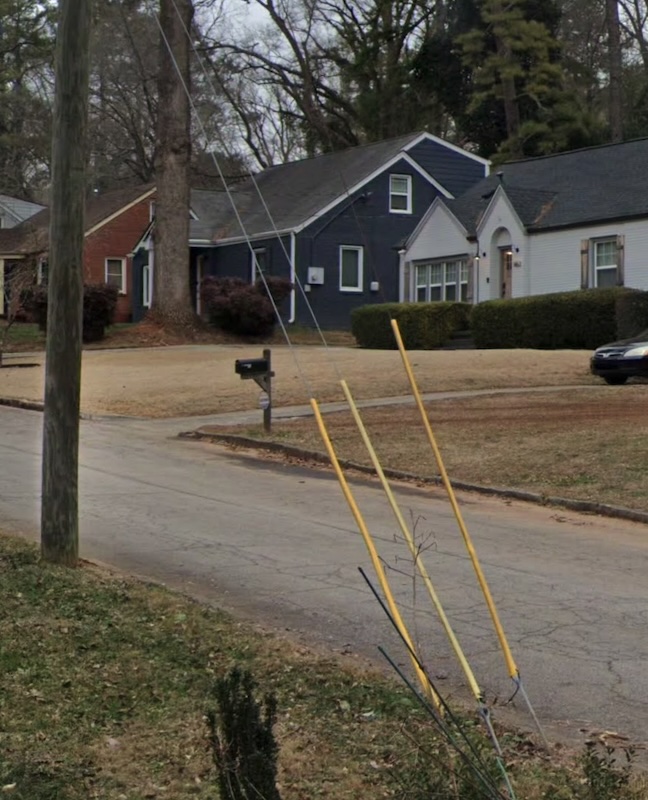
The street light support cables. Image credit to Google MapsI found myself in the near realm outside the apartment. There was a lot of interaction with neighbors, though I’ve forgotten most of it. At one point I was straightening this bent street light support cable cover. There were three — two covers were yellow, and one was white.
Upon waking I looked out the window and saw the plastic coverings on the cables. By the amber light of the street light, one appeared white and two yellow, like in the dream. But by daylight, they appear as two different shades of yellow. We must see physical light when in the near realm, unless memory is the reason I saw it this way. But if I recall, nothing else was colored in that orange light.
Near Realm Vision: This is really interesting. Either light from the physical is perceived when OB, or that the imagery was coming from my memory — even though I see this area most in the day.
It is interesting when possible to determine the inconsistencies of observation of Locale I NOTE: the physical/near realm activities while in the Second State NOTE: out of body. Except in unusual instances, most “visual” input registers in shadings of black and white. This seems true under any lighting conditions. However, strong light and shadow create wrong perceptions. For example, a strong light reflecting from the dark hair of a man brings the impression that he is blond rather than dark. (Monroe 66)JOotBOBEr • modern • Monroe
Blurry Vision Expectations
Around 6th grade I developed terrible vision. I wore glasses for years, then contacts, then experienced the wonder of Lasik in my mid-20s and could see normally again.
During the period of poor natural vision, going to bed meant I removed my contacts or glasses, meaning my entrance into and out of the dream world was with blurred vision, an expectation that occasionally made its way into my dreams.
-
Frequency Fall 1997 • age 22
I went to the bathroom, complaining about my contacts. A nurse appeared and put them in vaseline after I took them out. I looked around and my vision was all fuzzy. I thought, “Well, okay, this is a dream. I can see okay if I try.” So I did and everything got clear and a little further away.
Dream Vision: Here’s a great example of expectations. Taking my contacts out, I naturally expected things to be blurry, and they were. But when I was reminded that it was a dream and that the blurriness was unnecessary, my sight became clear again.
-
Between Classes 2010
A girl that reminded me of Rhonda was there, and she had her glasses in her hand. Still in my sleeping position, I reached out my hand for them and she handed them to me. She said she needed them back soon or . . . something bad would happen. I quickly put them on and saw the world as slightly distorted through low-prescription glasses. Then I handed them back.
Vision: Here my vision is distorted by someone’s glasses. An effect of expectation, just as removing my glasses or contacts in other dreams led to blurry vision.
Requesting Clarity
As strange as it seems, we can get clear perception in the dream state or an OBE by simply asking for it. I’ve read countless instances of this, and eventually tried it myself — it worked.
-
Friends and Dream Awareness 1997 • age 22
Brendan and I went into the garage. I thought I had forgotten my glasses and contacts because I couldn’t see clearly. I said “Clarity now!” and my vision became clear.
Getting Clarity: Going to the garage from Blaine House would indicate a switch out of my body. This would put me in the etheric body near the physical, a position from which vision is sometimes unclear.
My vision just after separation was often blurry and out of sync. I could quickly improve it, however, by demanding “Clarity now.” (Buhlman 33)ABtBOBEr • modern • Buhlman
Precognitive Dreams
Our higher-frequency selves have access to tremendous amounts of information that remain subconscious to our waking selves. At those far more intelligent levels, we decide what we allow the waking self to know. Part of the challenge of incarnating on Earth is forgetting who we are and not knowing what is coming. But at times we allow ourselves glimpses.
We have access to subconscious information and higher sense perception in the dream state.
-
Car Wreck Precognition? 1997 • age 23
Yesterday I couldn’t get the Bjork lyrics “all these accidents that happen” out of my head. Then I dreamed of looking for cars in a really dark car lot while Buttercup had dreams of dying in a wreck. Today Buttercup got into a car accident and while she was unhurt, the car was totaled, setting us on the search for a new one. Uncanny!
Precognition: Big events cast their shadows ahead of them, and in the dream state we can pick up on them. These are things that may seem out of the ordinary, but not worth mentioning until the event that followed.
In the early 1990s, when I was in high school, I was part of a youth group. A few times a year, we traveled for gatherings with youth groups in other regions — some out of state. I made many friends and we would write letters to each other (this was before the internet). These letters had no schedule. Sometimes someone would write, sometimes not. But over and over I would dream about a specific friend the night before their letter would arrive. It became such a predictable pattern that after such a dream, I’d awake knowing that a letter from a specific person would be arriving that day.
How do I explain this? It’s likely the friend sending the letter had me in their thoughts as they imagined me receiving and reacting to their letter and wondering what I would write back. This probably led to them reaching out to me in their thoughts during dreams, which would cause us to meet up in the dream world.
This is likely, and would explain me dreaming about them in the days following their sending of the letter. But as to the to-the-day specific timing of these dreams, what with letters traveling across states taking a range of days to weeks to arrive, there might have been more to it — a looking forward, or feeling in the night some reflection of excitement or connection from the next day.
A very remarkable feature in my dream life in those days was the prophetic nature of some of the dreams, especially those dreamed towards the morning. The reenaction of the dream scene or the fulfillment of the presage that very day, or during the course of the next few days was so remarkable that I never ceased to wonder at the occurrences. . . .
One dream scene showed me reading a letter from a friend whom I had not met in years. . . . The same day. . . . I found a letter from him amongst the others delivered to me.
I saw a relative in my dream whom I had not met for months and he called on the same day. (Krishna 279)LWKmeditator • Hinduism • Krishna
I dreamed of Oberlin after being accepted but before I ever saw it. The hills, rooms, halls, computers . . . expectations and fears of what it would all be like. There were rooms of sex and drugs, and the newness of moving in. Some aspects were taken from SSU memories.
Mass Shared Dreams
In the dream state we have access to the mass movements of consciousness that end up resulting in physical events.
Mass or shared dreams . . . are shared at one time or another by the majority of living persons on your planet. . . .
The dreams usually are not precognitive, although they might appear to be, since many of the dream events will later occur. They are not precognitive, however, because in a large measure they bring about or cause the later events.
They occur, comparatively speaking, just above that layer which Jung refers to as the collective unconscious. If you could tune into these dreams, you would have a good idea of the main events of the future because you would see them being born. They are concerned with significant events that affect many countries. They represent deep intents, wishes and purposes. . . .
One man passionate willing good or evil can overbalance literally a hundred men. And in the dream state, also, leaders can be born and make themselves known. The people already know them in mass dreams before they are recognized in physical reality. (Roberts 278-279)SD&Pchanneled • modern • Seth
When I first saw Barrack Obama speaking in 2004 (four years before running for president), I knew very little about him. But about 5-10 minutes into his speech, I became certain that he was going to be president, and I said out loud “He’s going to be our next president”. He was elected president in 2008.
Impending Illness and Death in Dreams
Impending Illness
Information about impending illness likely comes from the deeper awareness that comes from the shortened context of the dream state. When high, I can feel the energy flows of the body much more clearly. Some of the following perceptions are due to that more subtle energy sense.
It’s also possible that some of these were dreams of future events — especially those which showed no symptoms upon waking.
Sensed
Some are sensed directly, without rationalization.
A man who dreamed that his leg was turned to stone . . . developed a paralysis of this leg a few days later. (Van de Castle 364)
[A minister of justice] dreamed that he suffered from apoplexy (stroke) and died of this condition three days later. (Van de Castle 365)
Macario himself dreamed of a pain in his throat, awoke feeling well, but later that day developed severe inflammation of his throat. (Van de Castle 365)ODMresearcher • modern • Van de Castle
Sensed and Rationalized
Some are sensed, and then rationalized in the context of the dream.
[A man] dreamed on two successive occasions that his ear was being beaten with a stone. Soon afterward, he developed a serious inflammation of the ear on the same side as he had been beaten in his dream. (Van de Castle 365)
[A woman] had recurring nightmares of dogs tearing at her stomach a few months before she was diagnosed with stomach cancer. (Van de Castle 366)
A woman who dreamed that a stranger threw oil over her and set it on fire came down with typhoid fever three days later. (Van de Castle 368)
The night before he experienced a perforated ulcer, a twenty-nine-year-old man dreamed in which he was eating pizza and his stomach “broke open.” A forty-year-old man who had a recurrent dream about a rat gnawing in the lower right part of his abdomen was eventually diagnosed as having a duodenal ulcer. (Van de Castle 368)
[A journalist] had a dream in which torturers were placing hot coals beneath his chin. He felt the heat start to sear his throat and screamed in desperation as “the coals gnawed his larynx.” He awoke very disturbed and received a long-distance call from his girlfriend, who had just experienced a horrible dream of being with him in a bed filling with blood. In a later dream, medicine men stuck hypodermic needles into what he called his “neck brain. . . . ” A physical checkup confirmed the presence of cancer in his thyroid gland, which is located near the larynx. (Van de Castle 366)
In his dream, he was on a stage receiving tremendous applause, which he acknowledged with a bow. He then opened his violin case and took out, not a violin, “but a machine gun and swiftly I put the muzzle to my mouth and rat-a-tat-tat I blow my brains out. . . . I fall to the ground”. The patient woke from his dream and experienced a massive heart attack a few minutes later. (Van de Castle 367)
For nearly a year, [a woman] repeatedly dreamed that a woman resembling a nurse held a lighted candle toward the dreamer’s left leg. At first the nurse did not burn the dreamer, but as the dreams continued, the nurse came closer and did seem to burn the dreamer. . . . She developed an infection in the bone marrow of her left leg. (Van de Castle 369)ODMresearcher • modern • Van de Castle
Symbolically Communicated
Some are clear symbolic messages to the waking consciousness coming through the dream.
A patient with breast cancer dreamed her head was shaved and the word cancer written on it. She awoke with the knowledge that her cancer had metastasized (spread) to her brain. . . . Three weeks later, her dream diagnosis was confirmed. (Van de Castle 366)ODMresearcher • modern • Van de Castle
Impending Death
A woman dying of cancer had recurring dreams of being on the bank of a river and seeing a hand beckoning from the other side. As the days passed, the width of the river gradually decreased until, a few days before her death, it had narrowed to a tumbling spring which she knew she could step across easily. (Van de Castle 355-356)ODMresearcher • modern • Van de Castle
Crossing a river is a very well-known physical representation of death.
Remembering Dreams
Remembering Dreams
Why Remembering Is Difficult
Our experiences in the dream state follow our attention, with varying degrees of adherence to physical laws. They can go so many levels deep — stories within reveries within gateways, with varying levels of projection. Add to this the ability to rewind stories and taking different actions, visual communications from people not present, expectations coming true, rationalizations from our waking selves, and sensations from our sleeping environment, and it’s no wonder they’re hard to remember.
Imagine the confusion if someone were observing your experiences, but couldn’t tell the difference between your physical life and the experiences of the characters in books you were reading, movies and shows you were watching, your daydreams, news and web sites you were reading, and stories other people were telling you. If they thought all of that was actually your direct experiences, then you’d have an idea of how confusing our dream life can be to our waking self.
A key part of understanding our dreams is being aware of what we’re thinking at any given time — especially what we want, fear, or simply expect to happen. If what we’re focusing on happens, we know we’re the cause of it. That self awareness lies at the center of understanding our dreams. It’s also important to understand how consciousness works so that we can make note of the various scene transitions.
By becoming more aware of your consciousness as it operates in physical life, you can learn to watch it as it manipulates through these other less familiar areas. Probable realities are only probable to you because you are not aware of them. . . .
You can learn to “shift gears,” stand aside from your own experience, and examine it with much better perspective.(Roberts 251)SSchanneled • modern • Seth
Difficulty Remembering Transitions
One of the general challenges of consciousness is retaining continuity across transitions. This is true even in the physical. While biking home, I may decide I need to charge my battery, but often forget when I arrive and enter the house. Imagine how much more difficult it can be in the dream state when suddenly moving through gateways, entering and exiting memories, moving through telepathic crossings, and experiencing scene changes when our focus changes.
Transitions are the hardest part of dreams to remember. They can be sudden or gradual, but often feel like entirely different dreams, and we’re unsure how we got from one to the other. “The next thing I remember” often accompanies a scene transition.
Wrote a twentieth-century Indian master, Sri Aurobindo Ghose, “. . . it is even possible to become wholly conscious in sleep and follow throughout from beginning to end or over large stretches the stages of our dream-experience; it is found that then we are aware of ourselves passing from state after state of consciousness to a brief period of luminous and peaceful dreamless rest, which is the true restorer of the energies of the waking nature, and then returning by the same way to the waking consciousness. It is normal, as we thus pass from state to state, to let the previous experiences slip away from us; in their turn only the more vivid or those nearest to the waking surface are remembered: but this can be remedied—a greater retention is possible or the power can be developed of going back in memory from dream to dream, from state to state, till the whole is once more before us. A coherent knowledge of sleep-life, though difficult to achieve or to keep established, is possible.” (LaBerge 136)LDLDer, researcher • modern • LaBerge
The true art of dreaming is a science long forgotten by your world. . . .
A practitioner of this ancient art learns first of all how to become conscious in normal terms, while in the sleep state. Then he becomes sensitive to the different subjective alterations that occur when dreams begin, happen, and end. (Roberts 182)URchanneled • modern • Seth
-
Map Gateway 1997 • age 22
I look at a US map. I see that some pyramids and a sphinx are near San Francisco and I mark down that I want to visit them. Also it seems like the lava dreamscape with the ocean is in San Fran.
Maybe we had arrived in San Fran, but wherever we were we were searching this area of hilltops for a home. . . . Oh! Upon further reflection, I think it was the US map with pyramids and such that brought me to San Fran — I first got caught up in the sphinx surrounded by advanced preservative technology.
Remembering Gateways: It’s easy to miss the transition in gateways. You remember being in one place, then suddenly you’re in another. Here it takes me a minute to piece together that the sphinx on the map was the gateway for my arrival in San Francisco.
Multiple Versions — Rewind and Retry
Another confusing factor in remembering dreams is that we have the ability to rewind and retry scenes. This is only possible in rotes (memories), but a similar experience could be the result of a short subdream happening in realtime.
The result is that we’ll remember a scene happening multiple times in different ways, which our waking self has trouble making sense of.
See “Rewind and Retry” in attention.php.
Things that Enhance Recall
Bringing Consciousness Over
When I spend time trying to retain consciousness while falling asleep, it can pay off in vivid dream recall, complete with being able to recall exact quotes. This helps build a bridge to other levels of reality.
-
Lucid Dream: Bruce’s Arm and the School Bus 1997 • 10:13 AM • age 23
I went to bed at 2:30 AM, got up around 9 AM to drive Buttercup to work, and then went back to sleep around 9:15 AM. I tried holding my inner eyes open from 9:15-9:30 AM but to no avail. So I just went to sleep, lights out. The window was open with lots of singing birds. Temperature very comfy.
[I have an incredible lucid dream]
Why It Worked: It’s been said that a reliable way to have a lucid dream is to awaken in the morning, get out of bed for a short time, and then return to sleep. I have driven Buttercup to work, come back, and tried to dream lucidly many times, but haven’t succeeded. What was the difference this time? I think that holding my inner eyes open was the key factor, something I haven’t been doing lately. This is a technique in which I focus intently on the darkness in front of my closed eyes, watching it intently as I fall asleep.
Shifting to Physical Focus
Shifts to physical focus while dreaming seem to increase dream recall, as it’s involving the waking self more often.
-
The Joined Trees 2024
All four of my lucid dream alarms went off last night. Each time my focus flashed to the physical side, I felt I wasn’t within a dream. But those little shifts in awareness back and forth have definitely increased my dream recall.
Playing Audio Messages: I set up audio messages to play into my earbuds during the night. This kept calling my waking self into the dream state, which has increased my dream recall.
Open Windows
Having the windows open provides fresh air, which I feel makes my dreaming more vivid. Additionally, the sounds from outside that it lets in momentarily rouse the waking self’s focus more often, keeping it nearby while dreaming.
-
The Monkin — The Little People 1995 • 3.5 hours in • age 20
I awaken 3.5 hours into sleep at 6:30 AM. The window is open, and there is morning light.
Morning Light, Morning Air: I think there may be something to the idea that fresh air makes me dream more intensely, and remember my dreams much more.
Remembering While in Bed
The best time to remember dreams is right after waking up. Remain in a sleepy waking state without moving, and allow scenes to pop in and expand. A single scene can unfold the rest of the dream experience.
The best time to begin developing skill in dream recall is in the morning from a natural awakening. When you awaken spontaneously in the morning, you are awakening directly from a REM period. Any time that you awaken by yourself you awaken from a dream. . . .
Knowing that you have just completed a dream, the next step is crucial: don’t open your eyes! Lie still with closed eyes and let images flow into your mind. . . . The tiniest fragment of the last dream can serve as a hook for the whole night’s series. . . . In reverse order the scenes of the last dream appear. It is not like a film run backward; the whole scenes, in complete sections, line up in reverse order. . . .
NOTE: They line up as you remember causes and causes of causes. Especially the gateways.
Let your mind wander over images of the people close to you, your family, your intimate friends. Like rifling the pages of a photographic book, you may hit upon the image you seek in passing. You will know. . . .
Hermann Rorschach . . . observed that is was necessary to lie still when awakening because any quick motor movement like jumping out of bed disrupts memory of the dream. . . . Allow yourself to recall whatever dreams come to you in the position in which you awake. Lie still and let the images flow. Then roll over. . . . For some as yet unknown reason, additional dream recall often comes when you move gently from one position and settle into another. . . .
NOTE: I’ve noticed this as well. The position of the body is stored as an aspect of the memories.
One research team clearly established that dream recall is richest and most detailed immediately after a REM period ends. Researchers awakened sleepers at four different times: (1) when the EEG machine showed they were experiencing REM: sleepers reported, as expected, an ongoing dream story: (2) during a body movement immediately after REM stopped: sleepers awakened at this point describe complete, vivid, specific dream stories; (3) sleepers were awakened five minutes after REM stopped: they reported vague snatches of dream stories; and (4) sleepers were awakened ten minutes after REM stopped: most of these sleepers had no dream recall or only a blurry impression of a dream. . . .
You can actually train yourself to awaken after a dream story is completed naturally. (Garfield 204-208)CDLDer • modern • Garfield
Being Reminded During the Day
-
The Turtle and the Eel 1994 • age 19
I try to incubate a dream about Kayla, but no luck. . . . [I dream about trying to free people from a death camp]
Wait wait wait! I forgot the coolest of all dreams! An hour later something reminded me of it. I did connect with Kayla! We were canoeing in the boundary waters with some friends, surrounded by a pine forest and clear water, watching the stars.
References: The boundary waters are the lakes at the border of Minnesota and Canada.
Remembering Dreams: Here’s a good example of how I remember dreams. Sometimes I’ll awaken with a memory still in my mind — a single character or scene usually, and then I sort of unwind the memory from there. Often this is done in reverse, as the most recent dream is the clearest in my head. Later in the day, certain things might trigger memories of other dreams, but by this time, some details may have faded.
New Life Experiences
-
The Rogue Faction
I was watching a show that felt like the future. There was a greater intelligence, a higher world, a more advanced humanity. It was riotously creative and complex. The setting was a futuristic city. . . . The scope was vast, and I was rapt. I felt I had not dreamed this freely in ages. This was after 4 days on vacation, without a computer.
Recharged Dreams: My new experiences and break from the repetition of daily life inspired newly empowered, fresh, expansive dreaming. New experiences awaken the mind — new ideas to explore, new connections to follow.
As attention is freed up from routines, it’s available to flow into new experiences.
Alcohol
I often find that I have vivid dreams and good dream recall after a night of going out, drinking alcohol, and socializing.
-
Influence and Purple Goo 2001
What vivid dreams! After a night of drinking, it’s always like that.
Valuing Dreams
Dreamers who regard dreams as important and even vital to success in life will receive and remember helpful dreams. (Garfield 84)
Value your dreams. Don’t reject any one of them. The dream you dismiss as ridiculous or trivial . . . may be the very one with great potential to blossom beautifully. . . . Attend patiently to all your dreams and they will provide you with remarkable insights about yourself. (Garfield 204)CDLDer • modern • Garfield
This is true. Some of my most valuable and revealing dreams I almost didn’t write down, not thinking them worth writing at first. For example:
It can be so easy for the waking mind to dismiss dreams. As we switch to our waking context, the threads of our dreams rapidly lose relevance and the interests of the day grab us. But grabbing hold of that one single thread we do recall can bring back an entire scene which can lead to more scenes, bringing back really important and revealing details.
-
The DeadStorm 2010
I was in a medieval village, with lots of people everywhere. It felt sort of like a Renaissance Festival but everyone was in costume and it went on as far as the eye could see. There was a storm overhead. I was in a black tent building selling swords and various things. I floated out and peered up at the storm. “Wouldn’t that be cool if there was a black path of the storm coming right overhead, like a dark road?” I thought, and looked up to see it become so. “Darker,” I thought, and it darkened. “Darker still,” I thought. Then I turned to one of the villagers and cast words into his mind, which he spoke, “What dark and foreboding sign is this in the clouds?” Then with glee, I asked myself, “So what comes down this frightening dark path in the sky? Demon horsemen. The undead.” I looked up, and there were the hoofs of horsemen showing through the dark clouds in the sky, galloping overhead.
[I continue to consciously create and act in the fully immersive scene]
Dismissing Dreams: Written at the time: Even as I was getting up and considering whether to write down the above dream, I thought dismissively for a moment, “Ah, that wasn’t a dream, was it? I was just thinking it.” Even while knowing it was more real than anything, that I was there, that I was inside the action, and it was fully realized. But one context, compared to the other, will always seem that way. The waking world seems that way to the dream self.
Writing Down Dreams Daily
In one study, researchers found that dreamers who have trained themselves to self-awaken from REM periods can do so with remarkable accuracy. In another study, students learned to substantially increase their dream recall during the first two weeks of keeping a regular dream journal and meeting with a group three hours a week to discuss dreams. When they were given a special task one night to use their dreams to creatively solve a problem, there was four times as much dream recall as on other nights. (Garfield 218)CDLDer • modern • Garfield
Seth: “You know very well, because it has happened many times, that if you do not write [the dream] down you will forget it—and only part of you wants to.”
“I usually tell myself,” Stewie said. “But then, I seem to make a judgment, like, if it’s good, I’ll write it down; if it’s a bad dream, then I won’t.”
“That is your problem!” Seth stated. “You should not make a judgement! Simply write [the dreams] down!
“The very habit [that is] set up when you write down your dreams and recall them, opens up channels between what you think of, now, as your conscious and unconscious selves. The training teaches you to switch from one level of reality to another. (Roberts 400)
Each time you remember to wake up and record a dream, you are doing something with your consciousness, and it is important. For you think enough of your interior life to consciously record it as a physical event in your time. And with your beliefs, that is important. (Roberts 420)CWSchanneled • modern • Seth
Telling Dreams to a Friend
I often find that when I’m telling my dreams to someone, I’ll sometimes remember more details in the process.
Many people find that telling a dream to a friend helps them to recall it. The very act of putting the dream into words and trying to explain or express it seems to stimulate both recall of the dream and insight into aspects of it. (Garfield 214)CDLDer • modern • Garfield
What Hinders Recall
Sleeping In
Sleeping in has always caused me to forget dreams, as they fade over time. At best I lose the details and at worse, I completely lose the threads of context and it fades away completely.
Snoozing is equally bad. When my alarm goes off and I hit snooze, I often begin a new dream that breaks off my memory of the previous one. Each snooze does the same, and I end up remembering very little.
-
Distracted from Lucidity 1997 • age 22
I had crazy dreams all night. I remember very little, as I slept in.
Writing Down Dreams While Still Dreaming
After an amazing dream, I may write it down after waking up in the near realm, or while still within the dream. Having accomplished that, I then go on to new adventures.
I often dreamed I was recording the dream. Occasionally, however, I felt certain I was actually recording because I could feel myself writing with what I believed to be the pen on what I believed to be the pad. On rousing further, I discovered I was actually tracing words with my fingers on my skin. In one case, the thigh of my right leg served as a pad and in another my right cheek. (Garfield 212)CDLDer • modern • Garfield
Emotional Attachment
If you’re having some incredible experience but are unable to pull yourself out of it to write it down, it’ll transition into dreams and you’ll have forgotten by morning. No doubt some of the most amazing dreams are forgotten because I am too involved to leave them.
A Mindset of Fear and Rigidity
In dream travel it is quite possible to journey to other civilizations—those in your past or future, or even to worlds whose reality exists in other probable systems. There is even a kind of “cross-breeding,” for you affect any system of reality with which you have experience. There are no closed realities, only apparent boundaries that seem to separate them. The more parochial NOTE: narrow your own world view, however, the less you will recall of their dreams or their activities, or the more distorted your “dream snapshots” will be. (Roberts 423)UR2channeled • modern • Seth
Low dream recallers seem to be conformist, self-controlled, and defensive; they are likely to be more confident and less self-aware than habitual high dream recallers. (Garfield 217)CDLDer • modern • Garfield
These are all signs of a fear-dominated mindset, one more likely to filter experiences to a very narrow band of reality.
Vince Foulkes: “Hypnagogic dreamers tended to have greater social poise, to be more self-accepting, to be less rigidly conforming to social standards, and to be more adept at producing voluntary waking fantasy. . . . ” They also pointed out that strong similarities existed between the rigid “authoritarian personality” syndrome and the characteristics of individuals who seemed unable to spontaneously enter into lively hypnagogic imagery. (Van de Castle 268)ODMresearcher • modern • Van de Castle
Even recalling a tiny portion of a dream in the space of months was an achievement for [Florence]. . . .
“You are still afraid of your inner self,” [Seth] began. “You still do not trust your dreams.” (Roberts 398-399)CWSchanneled • modern • Seth
Dream Names and Words
Always record a unique verbal expression immediately. If I awaken with a dream poem in mind and I also recall the entire preceding scene, I dare not describe the scene first and then the poem. . . . I write the poem itself immediately. (Garfield 212)CDLDer • modern • Garfield
I love it when I remember weird names of things from the dream world.
-
Sound the Nome
I got off the bus with this girl who was coming with me. Eventually, in my old room, I say disappointedly that the only two movies I own are “Sound the Nome” (sounds like “gnome”) and Sixth Sense.
-
The Stinging Ocean 1996 • age 21
Manville turned into a big “N’gtoash Nisk” with a spiny head.
-
Badgerdoo — The Future of Video Games 1996 • age 22
The Cloerma of Badgerdoo was the name of this game.
-
The Magua Discol 1998 • age 23
Outside everyone was turning around to see their new sign. In yellow and white with an edge of blue lightbulbs was “THE MAGUA DISCOL.”
-
Indraheen 2024
A middle-aged Indian woman with short hair sat across from me at the table, casually levitating a biscuit while she listened. . . . She somewhat shyly said her name was “Indraheen” but then got up and left, disappearing around a dark corner behind her. I realized I had been too forward and scared her off. I woke up, remembering her name.
Indraheen: I looked the name up upon waking. Indra is the god of the sky, weather, rivers, and war. The suffix “heen” in Hindi means “without”. Together, it means “Indra-less”.
-
Taciter 2025 • 8 AM
I’m reading a black and white line-drawn comic about some animal gods coming out of hibernation to train someone. One goes to an old man named Taciter to complain that another isn’t doing their job.
-
The Funny Show 2026 • 5:30 AM
[The football player’s] hair was this enormous flat top shaped like a wedge. He went up to a orange-red patch in the field and pressed the top of his flat top into it. When he lifted up his head, his flat top had picked up that color. A bunch of other copies of himself went up to the orange-red patch and did the same. They all started slamming the top of their heads into the ground . . . as a celebration? This was so amazing and unexpected that we all started doing our own version of it to the beat. . . . It was called “niffling”.
Miscellaneous
Miscellaneous
The World’s Attitude Towards Dream Abilities
Throughout history, there have been shifting attitudes towards the sort of magical-seeming powers we have in dream state. In the Western world we are coming out of a long era that has been hostile to it. In the last century, popular culture has come to embrace the idea of superheroes who are invulnerable, who can fly, shape-shift, or use magic. Comics and fantasy lead the way, inspired by our experiences in the dream state. And these in turn capture our imagination, our desire to go beyond our physical limitations.
-
The Home for Shape-Changers and Psychics 2004
Context: I used to work at MLT Creative with Allen, Saul, Wilson, and Vortigem.
This home was a cross between MLT Creative and a sort of retreat home. The house is of the classic haunted house style, like those in Savannah. There are several people from MLT there, including Allen. Wilson was there earlier but left. Then a bunch of people that I knew (but not in waking life) arrived. It felt like I was there several days. In the beginning it was pretty normal, though I felt there was something secretive going on. The leaders — Allen and the rest — knew a lot they weren’t saying.
The tall metal sculpture Here’s one scene: In the center of the house, there’s this open column that goes up all four stories. Someone builds this little one-story sculpture of two-colored metal at the bottom. But then this hefty magician-looking guy whirls to the top of it and pulls all these slivers of silver or gold metal from out of the air and extends the statue all the way to the ceiling, hovering over it. There are lots of people about and it’s generally thought of as someone’s eccentricity showing — like someone who hasn’t taken his medication. People gather to watch. Then two black-haired teens — a Filipino boy and girl — step up and pull out bows and arrows and fire them at the statue. The boy’s arrow hits this curve in the statue, which causes the arrow to curve around and fly straight up. The girl tries and tries to do the same but can’t get it to work. This sort of thing is clearly not allowed in the Home (where’d they get the weapons?) but everyone stares, transfixed. Then some leadership characters arrive and take care of the situation.
From time to time in the days following, people make mention of beasts and monsters, with one conversation where everyone admits what they shape-change into under the guise of “If you could transform into something, what would it be?” Now over the months there, in the evenings, I’d seen some odd things but never put it together — people being rushed off in fits, stories that didn’t seem like they could be anything more than stories. . . . But slowly it came together.
There was a large red-haired guy I thought of as a friend. He transformed into a large red wolf monster, but he wasn’t too dangerous. There was this guy I found interesting but hadn’t approached yet. He transformed into a horrible room-sized mass of purple hooks — like gonzo noses or bent pipes — in a dark black cloud. Both these two would transform unexpectedly. I surreptitiously discovered that Allen himself became a great white-furred yeti wolfman, but it was rare and highly controlled, as it was with most of the leaders. One leader was a woman who generally seemed like a witch. As I began to put it together, I realized that the younger people in the home showed more psychic abilities than shape-changing ones.
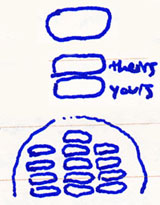
Mental screens There was one point where I was outside the home in a parking lot. It was night. The parking lot was a huge dirt and gravel area filled with cars. I began experiencing something like a hallucination — seeing through other minds. In waking life, we see through a single wide screen located in the darkish orb of our minds. But we can add another screen above ours and see through another mind screen as well. The velvety black sphere of mind can expand and expand to contain an unlimited number of screens. Someone was leading me back to the home. I asked them: “What if someone could see through every single mind? Wouldn’t that make them crazy?” and as I spoke it the black sphere of my mind expanded exponentially, opening up mind screen after mind screen until there were hundreds, each one the size of my own usual mind screen, and each letting more light into the velvet space of my mind until it was a sort of pre-dawn bluish gray. But all the viewpoints made me reel and I closed it down. “That was psychic,” I thought. In opening all those minds, I learned much about the transformations and what goes on at night. Then I’m in a truck being driven back to the home. I take turns looking at others and seeing their psychic abilities/ailments.
The final scene is just before I awoke. Things broke down. I ended up in a swamp, just outside the Home. With me were the leaders, including Allen, the witch-lady, and someone like Saul from MLT with a camera. Saul accidentally dropped a bunch of coins and two yellow disks of film into the tar-like mud but only caught one disk and didn’t see the other one fall. I nabbed it. Holding it, I was able to see more pictures of what goes on at night — a taming of the chaos of the transformations. I ended up running back indoors with them where they had a discussion of what to do. Saul noticed the missing disk and went searching for it. He had a device that could locate it — it beeped and flashed a light when he got close. I didn’t want him to discover it on me so I left it on a counter near a laptop where he did find it.
Then I remember being in a room with a friend and the witch-lady. There’s a dark bed in it, and outside it’s the darkest night. She dumps a bucket of medications and pills onto the bed, saying there are two new pills my friend should try — like DD2T and D2DT. One is in “tab” form like LSD with pictures on them. The other is a pill. I look through some of the tabs, then give him one, but I begin to have colorful LSD-like hallucinations. I basically freeze up and watch the brilliant colors melt through my mind. I reason that the tabs must have worked through simple contact.
The classroom scene Then I’m in a desk in a classroom next to my red-haired friend, still color-hallucinating, when something happens. The dark nighttime scene where it’s just he and I in the room begins to cross-fade into a morning-light version of the room packed with people at their desks. I am very aware of this happening. It takes maybe 5-10 seconds. I’m talking to my friend, then say “Hey, what’s this? It’s daylight. It was just night a second ago and I have no memory of what happened between then and now!” But of course nothing happened. It just changed around me. Everyone seems alive and awake, but I can see their monster shapes as faint outlines within them. Each one is different — from furry wolves or bears to the undead to bizarre twisted monstrosities. And as I watch, everyone in the room begins to change shape. Some more quickly, some less quickly. But it’s dim daylight like just after sunrise so there’s not a lot of fear. Some of the leaders bring in a blonde teenage boy in a big cage and I ask my friend about it. He says “He’s one of the dangerous ones.” The leaders change their minds at the top of the stairs and lead the cage back down, but just before he’s out of sight I see him transform into this furious wicked werewolf. I pretend not to have seen, because it seems we’re not supposed to know.
Now everyone is transforming, and I look down at my hands — they’re slightly blistered but the skin is sunken in. “Oh no! Not undead!” I think. “That’s the worst.” I try to will my skin back to normal but only succeed in stopping the transformation from progressing. I run over to the teacher for help and she looks me over and says: “It’s your name: Adams. Change it and you’ll be fine. Change it to Sam Eckerd.” My name — I’d never thought of that — like in The Addams Family. My skin was like Lurch’s. “But Eckerd?” I thought. “Like the drug store?”
The Home for Shapeshifters and Psychics: A place like this is practically an inevitability in the astral world. This place has probably been around a long time, reflecting older attitudes. Someone fearful, intending to do good, sees a dreamer or disembodied spirit do what any consciousness can do — change shape, fly, communicate telepathically, create something out of thin air, and so on. Not realizing that they are both in the astral world, they are horrified to find themselves in the presence of a witch, werewolf, or someone with their own particular “ailment”. There are three stages along this path — 1. Kill them, 2. Suppress them and try to make them normal, and 3. Teach them to embrace and control their abilities. This home is somewhere between stage 2 and stage 3. It’s run by shape-shifters and psychics, and while it suppresses the unsupervised use of abilities, the goal is to teach, even if it’s not entirely open.
Dream Interpretation
Dream interpretation relies upon the silly notion that everything experienced in the dream state has a secret meaning and stands for something entirely different from what it is. This is an attempt to make some sense of dreams when a true understanding is lacking. The same attempt to find meaning in physical life has led to superstitious beliefs in signs, lucky charms, incantations, and personifying natural forces as various gods or spirits that can be negotiated with.
Other Times and Worlds
While our consciousness in the dream state is often focused on things related to our physical life, we are free to experience anything, including other times and worlds.
Traveling to Distant Worlds
-
The Disc 1997 • age 23
Context: I was reading a book with aliens in it.
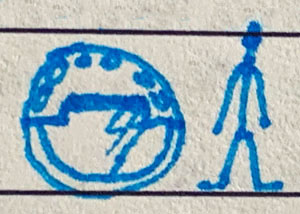
Alien and magic disc I was shopping in a grocery store when these really interesting-looking tall aliens gave me this magic disc. There were these controls all over the top front area. I gripped on tight, pressed one button, and shot up really fast into the sky. I was traveling rapidly through space. It seemed like a colored haze at times and then came together. I went to this planet that was supposed to be Neptune. I descended and came down in this area with trees near a red pond. It was red because it was saturated with tiny red motes. I glided smoothly over the pond and saw a tribe of dark-skinned nature people nearby. There was probably a slight awakening because the dream jarred and repeated with a friend coming with me. He overturned the disc and it got lost. We swam in the red pond over to a small wooden enclosed dock where we met two people like us, but who had been trapped there for many years. I flew out searching for the disc and my searching made tons of buttons and such appear but not the disc. Then a dwarf/elf flew by and dropped off a disc for me and the two others but not my friend.
Odd: My focus on the science fiction book probably brought me to a like-minded community in the astral, leading me to this unique experience.
-
A Distant World 2000 • age 25
I’m in a plane-like ship traveling with friends through a cloudy nebula near the center of a galaxy where the stars were profuse. It was absolutely amazing and beautiful beyond words. I remembering thinking “I should take a picture” and scrambling for a camera, but right when I got it we were out of the nebula. Soon we were descending into a strange world. It was misty and cool and this different kind of pine tree was everywhere. The plane was piloted by a young person, and after a soft descent, we landed in this lake. The plane was pale, smooth, rounded and small — a rapidly shrinking thought form. We made for the shore.
There were pine cones everywhere and I thought “Hey — I’ll take one of these back to Earth.” I was reprimanded by some older new-ager so I played it off as a joke. The buildings were cube-shaped, seemingly made of wood and glass. They were brown, jade, and gray. We went into a low building by the lake. Inside were Ranier, Buttercup, Aurelia, and Fiona, along with others I didn’t know. We played a game of questions that was a little risqué at times. During such times the lights dimmed.
Then we met a Japanese man from Miajima and told him that after this, we’d be going to some park in Japan. Soon we headed out and there was this large hill with a winding path. We were beginning a trek. We were going to split up at this point and meet again later.
Another World: This sure seems like a different world. I’ve read many accounts of travels out of body or in the dream state to other worlds. As distance isn’t a barrier, the only impediment is having a connection to it, having a reason to go.
Distant or Future Civilizations
-
The Hole in the Sky
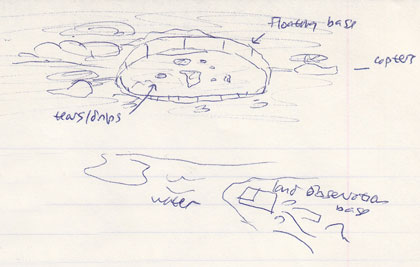
Hole in the sky with observatory below There’s this hole in the sky that has an airborne base holding it stable. The hole started as a big ring, with a really powerful whirlwind of energy coming down. But now it’s reduced to just small color-flashing globs. I decide to try to release some of the hole’s energy. Disaster. This red plasma pours out of the holes and falls into the sea. All sea life becomes comatose: living, but with lifeless eyes, just floating. The water turns black. I’m getting yelled at by some female scientist for my foolishness. The mistake will have more consequences, as well.
Otherworldly: Dreams like this tell stories so far beyond my understanding that I have to believe I’m peeking in on some other world and unable to grasp what’s happening.
-
Prisoner of Atlantis
The floor of the sea, the rock slid aside 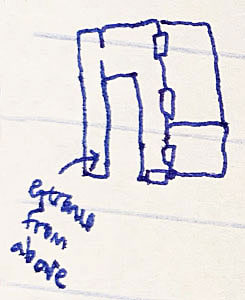
The interior of the chamber Juno and I are in scuba gear, walking on the ocean floor. We’re near this large, engraved rock. We recall stories that a person from Atlantis lives there. This rock had never been found, and the story was considered only a legend. This wasn’t our original reason to be there (or so we told the ones in the boat high above). Juno and I grabbed the huge rock and lifted, and incredibly, it slowly rose! We slid it aside. This revealed an entranceway cut out of the stone below (see map). We swam down. A woman in some kind of gear quickly poked her head and arm out of the door. I was filled with awe at the sight of her. I walked toward her and held out my hand. She took it and smiled. We followed her through a door into this room that looked like a lived-in bedroom. There was a much less watery feel in here. It was filled with a strange, slightly sparkly substance, which allowed us to walk as if on the surface. Without thinking, I took off my gear, took a deep breath, and found I could breathe. Turning back to the woman, I found her without her gear on. She looked just like Juno, except with a different quality about her. Her hair seemed lighter, as if she herself shone a bit. I was kinda attracted to her. She wore these bright and colorful fish-laden designs. I asked her many questions and she answered them all. She was an Atlantean, but was locked up in this prison by Atlas, a computer law-keeping machine. However, she wasn’t all that lonely. We were down there a long time, then took her up to the surface to show her surface life.
Underwater: There are hints of a very interesting backstory here, with a computer law-keeping machine that can imprison people from Atlantis.
-
Astral Warfare — Mind Bombs 1997 • 3 AM • age 23
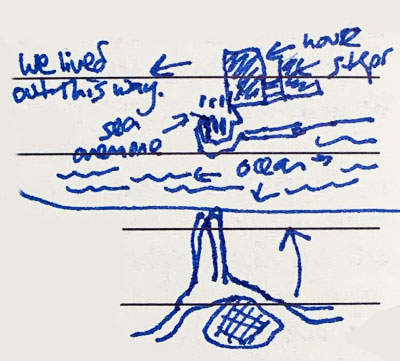
Detailed map I caught a recurring dream spot. It’s at the bottom of the hill and up a bit. I am here very often — it’s an ocean-based civilization built along the sea on rock under a massive overhang. The feeling was of both being crushed in a bit and feeling free and light.
I had this large group of partying friends, and I had gotten initiated into a beautiful native cult where I had gotten a mask, a tribal totem and symbol of inclusion, called something like the “semi-sloppily-made” something. Then there was a great dance where I couldn’t see very well, and there was such love and energy flowing from everyone. The first few were wearing blue masks. Everyone showed their own personal talents in the dance. Then some friends were there and were telling me that the government wanted me to return to school. At this point I felt like a little boy. In the rest of the dream, I was my age (23) or a little younger. I said I wouldn’t be taken away, ever, by anyone. I think I felt we were “on drugs” at this point now.
So what happened was that the government started with their mind-bombs. First they set off one that didn’t seem to work, but the next made space and colors fluctuate wildly. There would be rapid color shifts and the room would seem to spin or rock, and everything outside would seem to stretch, move, rock, and twist so that if you were to try to target them, you’d fail. I experimented with targeting a car and found the aim of my finger constantly moving downwards.
So eventually we got away but I felt like we had all just taken very hard drugs and were stumbling and slow. We had driven to a port to the North. Inside, some of the buildings were spacious, elegant, and very rich.
I had a vision of our room — me and my native love. It was green, had big windows, and silky fishnet curtains draped around all over. I so wanted to return to her. I had felt embarrassed about being so drugged up. There were lots of people living on the street. The house was on a ridge of green, and a slight valley lead up to the hill with a town I often dream of. I think the Dark Tower may be nearby.
A similar feel I was desperately trying to get home to find my love. She was thin and had green hair. There was a hexagon area with rows of red then green jellyfish anemone things, rocking back and forth in the tide. Someone had said you could slip through them without harm but I was always afraid, so I jumped over a corner of it. Coming down to the ocean, around this way was a long way home that I often went by mistake. I came down a craggy decline with broken glass on it. There were crabs on it and a walkway by the ocean.
I had such love for this girl and wanted so badly to be with her that I awoke to put my arms around Buttercup. I was a little sweaty and very hot.
It’s like this picture I have, walking down to the shore! The angles were much more steep. I have been in this dream place so many times before. Every night, I think, Every one! An oceanic civilization with a crazy government out of control? An underwater civilization? Shockwaves underwater can disrupt creature’s senses.
Ocean Civilization: In this exceedingly real, reoccurring place, the war is incredibly astral in form. No physical fighting, but “mind bombs” which distort the structure of astral matter to confuse and disable the enemy. What a vivid description. I don’t like this place. I never have.
-
Tribal Gore 1997 • age 22
I’m a young boy, adopted by a Native American tribe in their arid lands. One day my blonde, blue-eyed parents, brother, and sister return to me. A nasty fight with the tribe ensues, where I try to defend my original family while my tribe tries to slaughter them. There’s a lot of blood and my little brother and I get run through by a 7-foot fork.
Then there’s a big dramatic burial ceremony where the body is pressed into the earth in the front yard of Blaine House. The hole is 6-7 feet deep and bright red with blood. The tribe spray-paints it blue, then gets in and goes through these elaborate rites to free the soul and say goodbye to all the memories of who they were and where they lived.
Past Life Tribe: Is this a past life memory? Interestingly, I just read of a number of tribal cultures which, when a member of their tribe dies, go through elaborate rituals to scare their spirit off or hide from it by moving or changing their names.
Truly Bizarre Dreams
-
The Sponge Car
It was a dark atmosphere, and we were running from malicious people. They were trying to get in a shiny black sedan. The first time Buttercup saw it, she noticed it was spongelike. She knew if she didn’t pay attention to it, it would become more spongelike. The second time she looked at it, it was actually made of sponges, with odd corners poking out. It was yellow and green like the sponges we usually use. The malicious people got into the car and it didn’t really work.
Spongelike: What on earth is this about? Why is this car being irresistibly drawn towards spongehood?
-
The Monkin — The Little People 1995 • 3.5 hours in • age 20
We went to the bottom and I noticed a dark face in the wood. Manville told me to begin scratching at the bark of the tree to protect it. I did and rubbed off all this shreddy bark. Then Manville started scratching on his brown shirt and underneath was a blue, green, and red shirt like it. I scratched the back of my pants (jeans material) to reveal new clothes, but I continued all the way up to my head and under my hair was this long, silver-white hair. I felt it was a sign of wisdom, something special that doesn’t happen to everyone. Manville’s Emma came out and asked what we were doing, but her presence didn’t stop my transformation.
Transformation: I’m not sure what to make of the scratching off of layers of clothing and skin to reveal something beneath it. This is the only time I’ve dreamed of something like that. Maybe it was related to the etheric or astral body.
-
Dark Shadow Vehicle Lifegiver Man 1995 • age 21
We went into this dark place and there were people playing on this keyboard on this big tech array. I was unbearably attracted to it and someone said “let him play!” I rose into the air within a dark shadow. My hat turned into a bat (the mammal kind) and went to one of the consoles. This spooked one of the people there, but another calmed her. Some living metal creatures also came into being and aided my interface with the machine. I started designing these big, impossibly bulky metal planes and became frustrated, saying “but look at them, they could never fly.” One of the people there said “but they can, because you bring them to life!”
I then returned outside and began walking north with my guard again. I thought about my powers. To the left was a gang war outside a gas station. . . . I furrowed my brow, sent off my bat hat, and started calling cars to life everywhere in this parking lot and sending them after the gangs.
And His Bat Hat: What on Earth is happening in this dream?
-
Singing Baboons 1997 • age 22
I was walking around this strange land and heard “O, Do Not Forsake Me” by They Might Be Giants being sung by a beautiful voice. I looked up and saw that it was coming from a baboon in a tree. There were many more in the tree, and they all joined in, singing harmonies, as did I. We sang it through a second time and I hit the low ending. I was proud and friends complemented me.
“O Do Not Forsake Me” by They Might Be Giants: -
Psychedelic Jive Man 1997 • age 22
Buttercup, I, and this jive-talking black guy were out in nature. The story was that I was her wimpy geeky boyfriend and she was attracted to the commandeering, confident black dude. Of course, I was jealous. Then we came across this skinny black guy stuck in a pit and Buttercup went to rescue him. I thought she’d get stuck too so I went to help her. Skinny as the guy was, he got up and lifted a one-ton keg and threw it out of the pit. It landed on the jive guy and squished him all up. The result is that he became this big-headed super guy who could read everyone’s thoughts and only tell the truth. I said “Hey, that’s like me on mushrooms!” He said “Yeah, exactly what I said.”
Then Buttercup started crying and asking him to tell her why I had always lied to her. I wanted to say “No, that really isn’t true!” and I guess I/we did so by returning to past events at Oberlin, one by one, and going into them. Oh, and by the way, it suddenly turned to night.
Someone Else’s Story: This was clearly a rote, because it came with backstory and we were all playing parts. It also went really weird with the first guy getting squished and transforming. It was clearly a silly story but here I am taking it seriously and defending myself.
-
Cheetahs Love Sandwiches 1997 • age 22
I was hanging out with Buttercup and this guy. We climbed this big oak tree and threw sticks at a small abandoned house. To our amusement, they stuck upright in the roof. Then I got really scared of heights and the guy started screaming that a cheetah was stealing his lunch.
The scene instantly changed to the upper floor of a library. He couldn’t catch the cheetah, who was chewing on and slowly engulfing his sandwich. Knowing that I understood cats, I set off to catch him. The cheetah came to where I was and tried to dart past but I leapt on him and rode him. He was still chewing as he ran. However, my weight didn’t slow him down. So I rubbed his nose and steered his head into the bookcases and eventually he slowed down and stopped near Buttercup and the guy. He had finished the sandwich but was now really affectionate to us.
Super Weird: The stick-throwing game is weird enough, but the cheetah eating someone’s lunch from out of nowhere in another scene entirely? Wonderfully weird.
-
The Mulcher 1997 • age 22
I was in a department store with this big mulching machine. It was mulching some naked people, including Sophie. I was saying my goodbyes and felt kinda grossed out and guilty.
-
Brendan’s Playhouse Cats! 1997 • age 23
Here’s part of a song that was coming through Melody and Brendan’s mean cat: “Then we’ll ask him a question, and if he says ‘eight!’, then psychic talking cat sperm is sure to be great!”
-
Pure Testosterone 2001
It was night. I entered the monstrous mechanical auditorium and went to the left. Here I saw the ultimate power-up ammo for my rocket launcher. I jump to it and cry out “Revolution!” I leap up into the air with incredible power. Time slows down as I shoot a shape/symbol at each “teacher” in the place who was after me and my thoughts. I was a rampant force, unstoppable, uncatchable, always on the move. My being expanded, smeared across time, and I landed on the table in the middle.
I turned my attention to the prisoners. Ani DeFranco was somewhere among them, perfect, beautiful. She was called Ani Cross now. I climbed this tower of prisoners, each encased in a postcard-type thing, and asked where she was. One helped me. I found her and asked what I could get her to eat. Anything she asked for, I would get. She blew me off as another suitor, but I wouldn’t flag. I followed her and spoke with her again and again until she was on my side, till she knew me. I had a girlfriend now but would lose her in a moment for Ani. . . . White, diminutive aliens were among the prisoners, disguised as humans for ten years. They’d been watching me and they said that glorious things came from my head. There was a formula or small device that was central to their people. They called on it, took it into their egg-shaped ship, and flew off.
The complex was huge. I returned with some others to the auditorium and there were reenactments of my earlier “enlightenment”. But I called forward to the air and radiated enormous power, reducing the contents of the room to a flowing stream of light, pushing the floor down until a sphere of energy was established.
Then I began the changes outside. A tiger attempted to jump the wire fence. It was difficult to stop her. I wanted to, but her mate was calling her from outside. Eventually she made it and I let her go, hoping she’d be okay in the land between cities.
Hilarious!: This is like some adolescent 80s testosterone awesome fest. It’s like something Napoleon Dynamite would have come up with. Even the way I wrote it was totally in the character of the dream. AWESOME.
-
Road Sign 2026
The moment before I finally woke up, I was going down this road, and saw a diamond-shaped yellow road sign that said “Become a black person”.
Boring Memories
Not all memories are worth sharing. Some are just boring.
-
In Someone’s Else’s Story 1996 • age 22
Someone’s telling me about their experience and I start living it: I (as him) go with someone to interview this religious fellow. We go to talk to him and he’s rude and disgusting. He/I sarcastically say “Oh, how loving and compassionate. What a holy man.” He sends us upstairs to talk to someone else, who brushes us off. Then when pressured, he allows an interview and starts talking about where he and the religious guy came from, including their high school. He tells us about some play that grades 30, 60, & 880 put on that was big and national. They did something with a knight whose leg was cut off and he explained the trick they used to do it (he was contorting). A rascally dwarf type of guy there said to me “You should enjoy this, it’s humor!”
Ramblings: This fellow upstairs rambled on and on, going off on his own tangents and making little sense to me. Why would I care about all this? Why did someone share this stupid, boring rote?
Animals Can See Spirits
-
Lucid Dream: Bruce’s Arm and the School Bus 1997 • 10:13 AM • age 23
I came upon the kittens and went right up to them. They were very startled, then cautiously curious. They ran and then one of them threw something at me! . . . This morning, the kittens seemed a little hesitant to approach, then both sniffed me profusely before relaxing.
The Kittens: We had two kittens at the time. It’s been said that animals can see astral forms — dreamers, ghosts, etc. Here we have an experience where I visit the kittens in a semi-conscious OBE and they react to me as if I were a ghost — familiar but unfamiliar. The next morning they are uncertain of me. They seemed to have some kind of astral defense as well — their ability to “throw something at me”.
Temporal Oddities
-
OBE at the Dark Tower 1997 • age 22
Approaching the Dark Tower, the freeway seemed to rest on the treetops, and a beautiful sunset was going on as we drove. As I drove, I overlooked a forest where Ranier was. I threw grapes out the window to him. After the drive I went to see Ranier in the woods and when I arrived, the grapes I threw finally finished falling through the trees.
Time Twist: I threw the grapes from the tree freeway and much later in the dream I went to the forest and saw them finish their fall, as if I had to be present for them to continue their existence. This seems really important. Does time not progress unless someone is there to witness it? Or do I have to be present for my thought forms to continue? Or did they fall again because I was thinking about them?
Quieting of the Mind: The mind becomes charged up by the day’s activities and to reach the relaxed state of meditation or sleep, one must pass through the fading lights of what the mind was most recently focused on, followed by the more intense body-based emotions, before one can just let go and follow a more personal or social interest into a dream.