Attention
The Nature of Attention
We are a focus of consciousness. We focus ourselves into a spotlight of attention. We are only conscious of what we focus attention on. Our attention is our presence. We are a focal point for the flow of the ever-renewing conscious light of the Source. We are that Pure Essence, projected into our environment to be experienced by us.
We have no experience without consciousness. Even the brightest sensation or reality doesn’t exist to us without our attention. Conversely, everything we can imagine does exist — it only requires our attention to be real to us. It is our consciousness which experiences, through the presence of our attention.
When eating, I realized I wasn’t “hanging out in my mouth,” enjoying the sensations and tastes, and so I returned there and Mmmmmm!
When your attention is completely focused on something other than the cold, then you feel no cold. It’s not getting any attention.
Attention Carries Its Focus into the Now
Our focus brings things into the light of the now.
Our focus brings its object into the light of the now by directing the flow from the Source to it. When we focus on a past experience, we are bringing it forward into the now, to be empowered with that light. We bring it before the Source, hold it aloft, saying “shine upon this and make it grow,” and of course it does because the Source is a flow of unconditional love.
This is related to The Astral World Is Written Through Attention.
Attention Enlarges
The first quality of attention is that it enlarges whatever we focus it upon. It does this by increasing our psychological time, our frequency of consciousness. This increases our sensory resolution. We get a clearer picture, a more detailed sound. A higher frequency audio recording, for example, would sound more clear. In this way, attention allows us to see things in more detail, to experience things more fully.
Attention enlarges an experience by increasing our psychological time, and thus our frequency of consciousness.
Attention adds its energy to any experience, intensifying it. Through attention we can focus on a selective input, enlarging it beyond others. Attention can focus exclusively on one sense, or one voice in a crowd.
Think of yourself, your mind, as a shining surface within a circle that can contract and grow small or expand and grow larger, smooth and glowing. A thought, like a speck of dust, floats down, touches the surface and immediately the surface contracts to a pin point and is concerned with a fear in that speck of thought. Hot cinders of irritation lodge on this smooth surface of content and happiness; the circle contracts and the cinder seems to become a mountain in proportion to the surface. (Strong 12)LotSBwisdom • Strong
For how attention increases the frequency of consciousness and thus the experience of psychological time, see Attention Increases Frequency.
Attention Becomes
The Nature of Becoming
The Nature of Becoming
This is the key aspect of attention. BECOMING is the center of everything. BECOMING is the ultimate joy.
Our attention directs the light of consciousness. The nature of this light is that it becomes whatever we focus it on. It takes on its form. And since we are that light, we become what we focus on. We project our light, ourselves, into that form and we experience that form through being it. In essence, we only ever experience ourselves: the forms our attention takes.
This is the same process by which the Source creates and becomes all of creation. The individual is just a smaller focal point of the Source.
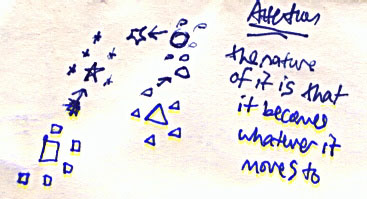
The light of consciousness pours out of us like hot liquid light. It flows into whatever we focus on, taking its form. As our attention shifts, the light takes on different forms, moment to moment. When the heat of our attention moves off of something, that form begins to cool. We’re no longer focusing on it, but it still exists in our mental space until it fades away and we forget about it.
Our attention must release its last form to become something new. Our attachments cause attention to stick to things in our past. To become something and to hold on to it is to stop becoming and start projecting. A fluid, unattached attention allows us to have bright new experiences, and learn at incredible rates.
Our attention flows naturally outward when we are open, trusting, accepting, embracing our experience (see Love, Expansion, Being In The Now). At other times, it flows inward into past thoughts and experiences, strengthening them with new attention.
Be aware. . . . Be aware of something. . . . Be aware of being that which you were only aware of. (Goddard 129)Rmystic • New Thought • Goddard
Patanjali: “The Self taketh the same form as the fluctuations [of mind-stuff].” (Patajali 22)TYSDwisdom • Tibetan • Dvagpo-Lharje
From The Nirvanic Path: The Yoga of the Uncreated:
E’er inseparable the thing that sees is from the thing that’s seen. (Dvagpo-Lharje 137)TYSDwisdom • Tibetan • Dvagpo-Lharje
Merging of Energies
Rhubarb Deva: Whenever anyone contributes attention or feeling to a plant, part of that person’s being mingles with part of our being, and the one world is fostered. (Maclean 200)THASchanneled • modern • Maclean
Personalities can send a portion of their energy into various kinds of form.
Perhaps reincarnations are over for a given individual . . . yet within him is still some sense of yearning for the natural earth with which he has been so often involved. So he may project a fragment of his consciousness in such a way into an animal form. When this is done, the earth is then experienced in the way natural for the form. A man is not an animal, then, nor does he invade the body of one.
He simply adds some of his energy to that present in the animal, mixing this vitality with the animal’s own. . . .
In such interrelationships, the . . . identities are each immeasurably enriched by the added perception of the others. (Roberts 307-308)SSchanneled • modern • Seth
Harmony means feeling the vibration of the moment, of the person, place, or circumstances you are now experiencing, and blending with it. Blending does not mean matching. Singing in harmony does not mean singing in unison. It does mean singing together. (Walsch 235)FWGchanneled • modern • Walsch
Everything is living and everything has a place in my one life. . . . You are simply surrounded by life; you are a life force moving among other life forces. As you recognize this and open up to them, you draw near to them and become one with them, and work with them in my purposes. (Maclean 51)THASchanneled • modern • Maclean
Becoming to Experience
We become a thing to experience it. As consciousness, we can only know that which we become, what which we ARE. We have an innate desire to be things, to move into things, to become other people and things. We hear a song and we want to sing along. We see a hill and we want to climb upon it. We see the motion of the trees and want to sway with it. We want to be like a person we admire. We are attracted to things. We learn and expand ourselves in this way.
Believed limits on what we can become limit your experiences. The more we free ourselves from our limits and attachments, the more we can become.
When my attention was on my girlfriend giving me a massage, I felt my attention’s ghostly hands overlapping hers and I experienced the massage more intensely. You have to become a thing to experience it.
When our attention (which is what we are) shines out onto something, it literally takes the shape of that thing. We become that which we focus on. The more I focus on girlfriend, the more I become her — the more my face takes on the shape of HERS. I saw myself through her, and felt her love for me from her perspective.
The path to happiness is to open ourselves to feeling connected to more and more. We see the sameness in more and more, and become more. To become something is to accept it as part of us, as good, as alike, as a place where it is okay to act freely, without fear. Focusing on a blade of grass with Deep Attention, we see its struggle, its life, its expression, its likeness to us, and we become it. We allow it in, we let it inspire us. We become that grass — our essence takes on its shape and we know the world through it.
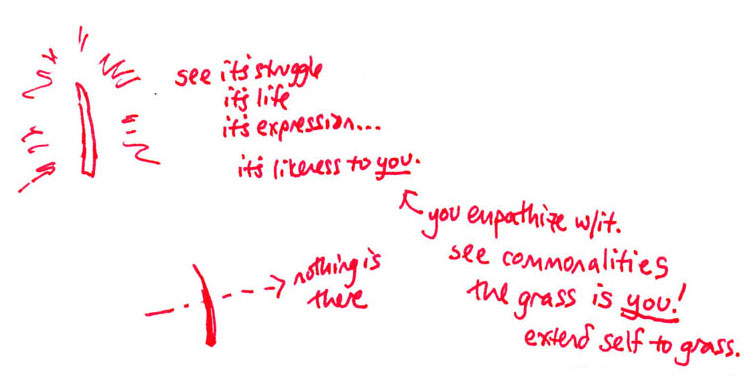
See commonalities. The grass is you! Extend yourself to the grass. Nothing is there.
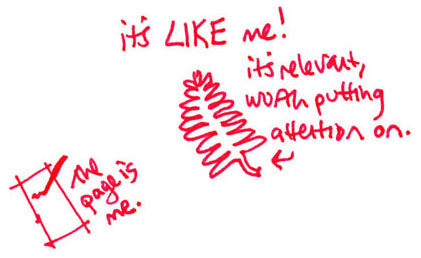
When we become a thing, it gains relevance and meaning. We can become a song, a vista, or a conversation, simply by letting our full attention embrace it without conditions. We expand our selves by seeing similarities.
At a higher level, we acknowledge that we are, in a very real way, anything we focus on. Upon seeing a street light in the dark, we notice that it is us, our own mind that is shining so brightly. We ARE that light.
On LSD or mushrooms, we tend to lose the boundaries of our self, and operate from this perspective naturally. We are what we focus on:
During the pure experience of Ascendant consciousness NOTE: pure consciousness . . . the knower, the known and the process of knowing have all united. (MSI 103)Ewisdom • modern, Hindu • Isham
Feeling Through Becoming
What you are feeling is what you are being. . . . Feeling is the language of the soul. . . .
In every single moment of now you are “being” something. And what you are feeling tells you exactly what you are being. Your feelings never lie. . . . You can change how you are feeling by simply changing how you are being. (Walsch 197)FWGchanneled • modern • Walsch
Whatever we are focusing on (whether it be something in the outside world or a thought from within), our attention takes the shape of, and we become. We take on the feeling associated with that. Feeling is the sense of the soul — a sort of long-distance touch in which we resonate with what we’re focusing on.
Becoming to Communicate
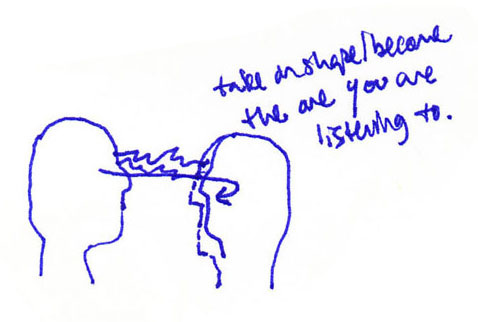
Becoming is central to communication. When talking with someone, as our attention expands towards them, we begin to match their body rhythms and motions in real time. This is called entrainment, and it’s a result of becoming. When this happens, our understanding increases and our communication becomes more deep and real.
See Entrainment Through Becoming and Empathy Through Becoming.
We are always in communication with one thing or another. Always. Whatever our attention becomes creates a connection to us through which communication occurs. Remember that the flow comes through our attention. If our focus is on a leaf, we can find that truth is communicated to us through using the leaf as a metaphor. The Pure Essence (the light of our attention) communicates to us, using our present experience as a metaphor.
Becoming Is Loving
In a very real way, we love whatever our attention is on. Love is a free flowing of energy. Through our attention, we are giving ourselves, the light of our consciousness, to that focus. We are choosing to become it. We are growing it with the light of our attention.
Love is the light of our attention openly and freely flowing into and becoming its object. It’s a sharing and merging of consciousness.
Attention focuses light, becomes something, and that becoming is love.
This combines all the central concepts. Put another way:
Whatever we focus on — that is what we love.
Living in the now, with full attention, one loves naturally. Through opening up to what we’re experiencing, we let it into us. We love what is in the past when we give attention to past experiences. This attachment serves to empower existing thoughts and ideas.
When the light of someone else’s attention shines on you, it embraces you, accepts you, becomes you. This is love! It is an energy that wraps you within itself, merging with you, energizing you. It entrains to you, takes your shape, joins with your energy.
This is what the Source does to become you. It shines out fully into the pattern that is you, holding back nothing, unconditional. It’s this unconditional love from the foundations of reality that gives you your existence.
What about when someone is focusing on you negatively? Someone focusing on you with anger or fear is not seeing you, not becoming you. They are instead focusing on an internal pain point from their past and projecting it onto you. It is directed towards you, but you are not the actual focus. They are focusing on, energizing that point of pain, thereby “loving” it.
One becomes one with what one loves. (Maclean 159)THASchanneled • modern • Maclean
We love whatever we put our attention on — we open to it, shine out upon it, become it.
They said . . . ‘Love attracts all creation.’ . . .
When open and pulsing with life—which is rare—you are powerhouses of love to all you contact. Generally, you are closed, having cut yourselves off from the whole. (Maclean 158-159)THASchanneled • modern • Maclean
Love (attention) attracts us to someone, draws us close to someone as we project ourselves into them. We must be open to do so. Becoming is easy — we close is due to fear from past experiences, past conflicts.
See Love and Fear.
Our Limitations on Becoming
Without fear, our attention naturally flows into everything. However, if we reject certain experiences, certain people, certain things, we pull back our attention from those experiences. Doing so keeps us separate from those things. We pull back from the moment when in the presence of something you dislike. We close, put up a wall, refuse to become.
In terms of social conditioning, if we believe happiness should only be experienced under certain conditions, we pull back and only engage our attention under those conditions. We accept what we believe we deserve by being present with our attention for it. In other words, we empower that experience with the agreement of your attention. When nothing is good, we withdraw completely, becoming nothing.
This is an exact correlate to pulling back from the now. When we don’t want an experience, we pull back from the now. We close, withdraw attention, and we don’t become that experience.
Becoming What We Don’t Want
When you think “I am going to fail,” your attention is on that thought and its implications, and since you are more in that reality than the reality where you succeed, your mind follows through to make it so.
Fears are responsible for this. While the goal is to protect us in that possibility, the result is to make it more likely.
If we focus attention on what we hate, we become that so long as our focus lasts. Why? Because we believe it has power over us. We may focus on it to better understand it, but in so doing, we become it.
A generation that hates war will not bring peace. A generation that loves peace will bring peace. (Roberts 174)SSchanneled • modern • Seth
Experiences of Becoming
Joining Consciousness
In Hawaii this skill is called kulike a rough translation of which is “to make subconscious patterns.” . . .
My first experience in kulike took place in West Africa under the guidance of a Hausa shaman. One night in a hut in northern Dahomey (now Benin), he guided me into a very deep trance and helped me to merge my spirit with that of a cooperative leopard. I spent the rest of that night as the leopard, hunting, feeding, resting, observing, and feeling tremendously, vibrantly aware, alive, and full of energy. . . . For several years after my return from Africa, numerous people told me that I reminded them of a leopard in some ways. (King 275)GHLcompilation • modern • many
Tours of Becoming
This section contains wonderful “tours of becoming” — people becoming various things, one after another, through joining of consciousness. We see the role acceptance plays in becoming. Once we become something, we can speak from their viewpoint — translate their feelings into our own words.
I am very relaxed, and feel a sense of floating. I can see a frog in front of me. Now I am getting closer. Wow, I am going into the frog to experience the consciousness of being a frog. . . .
I can see out of the eyes of this frog. There’s a bug. Oh, it’s going to grab the bug in its mouth. . . .
Now I’m floating again. I really couldn’t get that relaxed in the frog. My helpers are indicating to me that I must relax and let go if I am to experience universal consciousness.
Goodness—there’s a snake! Oh, they’re going to send me into a snake. I have a fear of snakes. . . .
I am going inside the snake. Wow, it’s better inside than out!
I am beginning to feel a sense of attunement with the earth. There is an earth energy inside this reptile because it is so close to the earth. I feel a great sense of peace and gentleness. I feel that I am supposed to talk for the reptile. . . .
“There is such joy in being a part of the grass and the earth. I never want to harm anyone. I believe in harmony. But I am forced to protect myself.
“I can tell a lot about the human by the vibrations of the footsteps. Most of the time we know when to get out of the way to keep from being killed. Humans kill to kill. We kill to survive.” . . .
I am moving into another area of consciousness. I can see a rose. . . .
As I come into the rose I sense its consciousness communicating the following. . . . “When [humans] look upon us and experience the joy of beauty, they are experiencing their own true natures.” . . .
It was such a good feeling being inside it that I would like to have just stayed there. But the message is that I can live in this rose-consciousness of pure beauty and joy anyway. I am in this consciousness. . . .
I’m floating again, Oh, I can see grass below me. What beautiful green. I’m going into it. What a good feeling! I’m sensing that levels of color in nature are so important. Color is all a part of the vibration of the consciousness level of everything. . . .
Green is the color that brings balance into the universe. . . . I feel such a freshness, and a feeling of floating. There is a great feeling of freedom and strength that comes from the level of consciousness of a blade of grass. Strength and vitality are the basis of the grass-consciousness.
I sense the grass saying, “I am surrounding humans for a very specific purpose. They come into contact with us almost every day of their lives. We give strength and vitality to those who will accept it from us. Humans receive such great joy in running barefoot in our midst. Humans should never lose this vitality.” . . .
I’m floating over some trees. I’m going into them. I’m in the trunk of a large pine tree. . . .
The tree says, “What a great feeling of grandeur I have as I look out over my brother and sister trees. I feel such freedom, even though I am rooted in the ground. I give strength and inspiration to humans. I feel stability. . . .
“If humans would relate at least five minutes a day to their favorite tree by sitting under us, touching us, climbing us, they would become revitalized. We act as a battery for humans. . . . Our purpose in life is to bring stability and regeneration.” . . .
As the consciousness of this pine tree I have experienced a sense of infinity, an endless source of energy. . . .
I’m floating again. I’m looking down upon a great body of water. I’m starting to get the feeling of flow and movement. . . .
I feel that I am the consciousness of rain falling down through the atmosphere. Oh, what a great feeling of freedom, movement, joy, freshness! I’m coming down through the atmosphere as a raindrop. I am floating free. (McKnight 73-77)CJOBEr • modern • McKnight
The whirlwind approaches me very slowly, deliberately trying not to frighten me. Swirling gently before me, it is now clear, sparking with tiny iridescent lights that seem to swim within the depths of the nebulous Being—for I perceive that this is an intelligent Being. . . .
At least fifty feet high, it is maybe even wider, yet as I watch, I see it change. A faintly glittering tendril of breeze unfolds from the Being and approaches me. Very softly, without alarming me, it circles my light body. . . . As I relax, it seems that my light body brightens. Very gently, as though opening a soft toy with a zipper, the breeze somehow opens and enters my body of light. It feels weird, as though a warm chill is moving within me. I am gently probed and prodded. . . .
It is sensitive to my feelings. Somehow, the breeze touches a chord within me, and the feeling it evokes in me is experienced by the breeze. This is repeated many times, ranging from feelings of great love, joy, and amazement, to ones of fear, sexuality, anger, and even disgust. . . .
Part of me cringes in shame at what must be revealed in some of my darker feelings, yet even as this happens, I feel an acceptance and healing from the breeze as it circles and spirals through my inner Being. . . .
How long this examination takes, I have no idea, but there is a moment when, as though becoming a vacuum, the breeze draws me into its greater Being, and I am engulfed.
I am expanding. Instead of being enclosed in the Being, I am expanding beyond all belief. My senses are becoming more acute, my sense of Being vast. I am the whirling energy of Air, and in this exultation my Beingness expands tenfold. . . .
I thrill, as in totally new ways I am seeing anew. I see not with vision, but by being that which I make contact with. . . . Nothing is seen beyond Self, yet all is sensed and experienced. I am the Being of Air experiencing the human experiencing the Being of Air! I am of many dimensions. I am aware of my Beingness in many physical and nonphysical realms, and in no one place is my focus more centered, my Beingness more complete. I am truly a multidimensional Being of a vast and limitless potential. . . .
In my new and expansive Beingness, I am not alone. I contain an essence of all that I—the Being of Air—have encountered and experienced. In some timeless way, all that was still is, continuing in this incredible Being. . . . How long ago these were first encountered is unknowable, but in essence they remain as part of the Being of Air. I realize that I, too, will leave some essence of myself in this entity, even after I have departed, for such is the nature of this Being. . . .
Suddenly, from within my swirling, mystical Beingness, a flock of small birds bursts into flight, flying out into the magical countryside. And, with the birds, I fly. Even as I fly, I am aware that I am still within the Being of Air, for this Being seems to have no defined border of where it ends, no real demarcation. . . .
I fly into a wood of tall green trees, experiencing the essence of a small bird. . . . I am aware of never having been physical. In my humanness, I feel a surge of surprise, for it has never occurred to me that there may be earthlike creatures who have not taken on a physical form. . . .
Perching on a branch of a tall, supple, willowlike tree, I sing, purely to release the joy that I contain. . . .
My Song is pure vibrating harmony. . . .
Time is meaningless. I may sing for a micro-moment, or for all eternity; each is the same. The part and the Whole cannot be separated. . . .
I am a skylark in a physical Earth. . . .
As a crow, my interpretation of the Song is a joy to all of my kind. . . . I am never alone, nor can I conceive of aloneness . . . for the Song is our bonding. . . .
With the wind stroking the feather of my face, I am an eagle high in the sky. . . .
Within that fleeting moment, when as eagle I killed the young kangaroo joey, our spirits merged, nourishing in a very real way the spirit of kangaroo. The price paid was the eagle’s meal. Such is all Nature.
With this insight, I am released from the Spirit of Birds, spiraling once more in the swirling energy of this limitless Being of Air. . . .
For and endless nontime, I touch countless insects, flowers, and plants. I absorb their essence, imparting this and how I—a human Being—experience it to the Being of Air. And within all this, I am aware of the Being of Air growing and expanding, for this—experience—is the substance of its own nourishment and growth.
I, too, am nourished. . . . The inquiring tendril of breeze read my psyche, finding the full depth and intensity of my longing to connect with the deepest essence of Nature. (Roads 61-67)
At no time did it ever communicate with me on a mental level. It shared my Beingness with its Beingness, and its Beingness with my Beingness! But it never once used words or gave me a clue about what was happening to me. (Roads 70-71)IaTROBEr, LDer • modern • Roads
I love these experiences.
Becoming All
This ability to merge with and join consciousness with anything is because consciousness is the foundation of everything. The ability is inherent in consciousness. In the following experiences, people don’t just join with specific things, but with a greater, broader consciousness altogether.
As I watched the first splinter of orange sun peek over the horizon, I noticed a strange buzzing sound in my ears, and everything I looked at started to sparkle and wink. The horizon began to shimmer. Then suddenly everything changed in a way I had never experienced before. . . .
I wasn’t just seeing with my eyes—I was perceiving everything around me. I was seeing, sensing, becoming, being the sand, the waves, the endless orange and pink sky. . . . Suddenly I was all energy, and everything around me was all the same energy, flowing within me and without me. What I normally thought of as solid matter was now a seamless reflection of all this golden energy. My body seemed to melt away totally. I became one with the sand and the surf—and then, for a moment, with all of creation. I felt tremendously expanded and alive. . . .
This energy I felt within myself could never be destroyed. (Bowman 28-29)CPLresearcher • modern • Bowman
Moira: “At that instant, as I looked at the tree, it was as if I had X-ray vision—I could see inside the tree—and I could see all these cells working away like mad. As I looked at them I became a cell, and there I was and I had a consciousness. I couldn’t think or reason, but I had a feeling of joy that I was there doing something to help the universe go round. I was helping bring up all this sap or whatever it was, up into me to pass on to the next one . . . to the top of the tree. And there was a feeling of joyous participation in something that just went on and on. . . .
“Then the same thing happened again—I suddenly had this X-ray vision—I could see through all the trees, through everything, and I could see that absolutely everything in the universe was interconnected, and interdependent. There was nothing separate, not a thing. Then I saw that even the air between things was just teeming with organisms, and they were all interconnected and all for a purpose. They were all doing things. They were going into me and coming out, going into the earth and coming out, going into the trees and coming out. I could see that absolutely everything was interconnected. And I thought, ‘So that’s how it works!’
“I completely lost consciousness of myself—I don’t know how long it lasted—I could see through all the trees, all the buildings, and I could see to infinity. Then the next thing I knew, I was out in space somewhere, and I knew that the same power that was holding all the planets and everything in space was the same power that was in me. . . . I didn’t see God—I felt I was God! . . . I knew I knew everything, I knew there was an absolute reason for being, and I knew that the universe was all one—almost as if the universe was me and I was the universe.
“I don’t know how long that lasted, but when it finished I came back, and it was as if I was numb. . . . As I walked out of the sunlight I had the most amazing feeling of waves and waves and waves of ecstasy going through me, vibrating all through me to the tips of my fingers. It was bliss!” (Sutherland 134-136)WtLresearcher • modern • Sutherland
Attention Feeds Thought Patterns
Attention Moves by Phasing
Attention leads to a stream of becoming. The light of consciousness can only become one thing at a time. Computers operate the same way. But our attention can and often does rapidly flash back and forth between several things. Splitting of attention in this way is called “phasing”.
Consider a series of moments, like the individual frames in a movie reel. Attention doesn’t cut instantly from being 100% on one thing to 100% on another — it interweaves between different things, easing smoothly in and out of each focus, blending from one subject to another. This shifting between interwoven frequencies is called phasing. We accelerate our attention into one focus, then decelerate from that one as we accelerate into another, then another.

An example of this would be if we’re on a walk, and had 100% of attention on a conversation, but then we see a large puddle across the path up ahead. As we approach it, it gradually pulls 5% then 20% then 50% of our attention until it we’re standing in front of it. We’re phasing our focus to the puddle. Once we reach it, it has all of our attention. We find a way around it, and then our attention phases quickly back towards the conversation.
As we withdraw attention from one focus, it starts to slow as the new focus picks up speed. The switch of our “primary focus” occurs by something new having the most frames, which means it has the most attention. It becomes the brightest thing in the attention field.
This motion by phasing means that different ideas or images can be interlaced with each other, flashing rapidly back and forth, combining creatively. In this way it can be a source of creativity.
Phasing is how we travel and shift between focuses in nonphysical states of consciousness. see Phasing and Tuning Consciousness.
The Splitting of Attention
Attention doesn’t always have a clear primary focus. It can remain roughly divided between two or more focuses for periods of time.
Interspersed with these larger focus shifts are everything else taking up smaller fractions of our attention. Thought processes that run in the background are like distractions, for they take a percentage of the total capacity to themselves. In fact, these distractions usually take up a large percentage of our attention, at times leaving perhaps 30%–40% free for our conscious use.
We’ll cover this splitting of attention in great detail in Deep Attention.
The Light of Attention
Projecting Light from a Higher Dimension
The Light of the Mind
The light of our attention is the higher-dimensional light of consciousness shining through us. We focus that light either into the now of experience or into our past experiences. When we open, we project that light outward into the now. When we focusing on the past, we close, and project that image before us.
On MDMA (ecstasy):
As I opened up, the area of attention in my visual field expanded. I was taking in a wider and wider breadth of events. Even my periphery was clear enough that if it was interesting enough, my attention could focus on it without moving my eyes.
Visual attention was increasing, I was almost projecting everywhere I looked. And now everything comes alive. There is a whitewash to everything, but a clear one, as if all the murk and dust has left my visual field. A bright light shines through everything, brighter, lighter, whiter.
Thomas Merton: “But what a thing it was, this awareness: it was so intangible, and yet it struck me like a thunderclap. It was a light that was so bright that it had no relation to any visible light and so profound and so intimate that it seemed like a neutralization of every lesser experience.
“And yet the thing that struck me most of all was that this light was in a certain sense ‘ordinary’—it was a light (and this most of all was what took my breath away)—that was offered to all, to everybody, and there was nothing fancy or strange about it.” (Burnham 199-200)EJexperiencer • modern • Burnham
Seeing the Light of Others
The light of our own attention is experienced as a brightness and clarity to our senses, a quickness of thought, a deeper connection while talking with someone. But we can also feel and sometimes see the light of attention coming from others.
The Light in Our Eyes
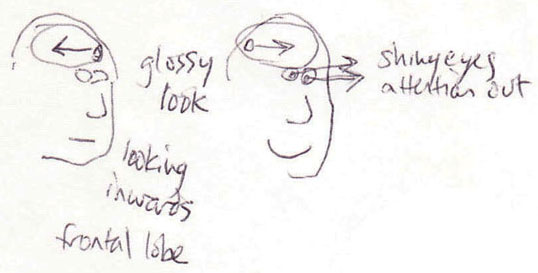
We can see the sparkle of the light in someone’s eyes when they’re keenly focused on something around them. The eye motion is faster, more snappy. Their eyes seem more clear, reflective, wet, and focused. They are open and focused outward in the moment.
By contrast, when attention is focused inward on past experiences, we have an unresponsive, glassy-eyed look. We can be a) internally focused in thought, or b) focused on an internal image which is projected outward. In these cases, there is no sparkle, no motion, because outer awareness is lacking or being filtered by the projection.
Anime has been pushing the boundaries of animation as long as its been around. I’m amazed by how accurately they’ve picked up on and animated emotional meaning. Compare the eyes:

She is projecting, rejecting the situation.
back and forth movement of the sparkle.
The back-and-forth movement of the sparkle is the motion of the internal rocking of their energy. It’s an outward reflection of their internal energy — one we can perceive energetically when we connect with someone. Below is same character, eyes still sparkling, but calmer. Note the sparkle movement is subtler, slower.
The Light of Expression
How big and expressive we are reflects how present we are here in the physical. This may be either in enthusiasm or anger. In so doing, we’re saying the physical is worthy of attention. Coming closer to the now while focusing outward means we project more light of attention into the world.
I can sometimes almost SEE the light projecting out of people as they express themselves. It shines from their faces, like brighter or dimmer TV screens.
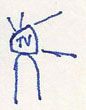
shining out
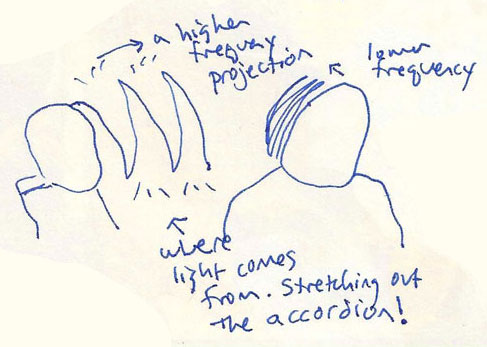
Where light comes from. Stretching out the accordion!
This is the experience of someone “beaming at you”. This phrase reflects the deeper reality.
The light of others’ attention is visible to our subconscious. That light comes from people openly expressing themselves with excitement, with attention in the now (the only point where expression can take place). The amount of light shining out is equivalent to the amount of attention focused in the now, and its appearance is very interesting.
Consider a view of a layer of the world that is entirely dark, made of dense, scribbly black lines. The only light visible here comes from conscious expression. It happens through the expansion of these scribbly black lines. To the degree that attention is present, they open up like a folding fan or accordion, and from the opening comes the light of consciousness into the physical world. The light comes out sideways through the expanded area.
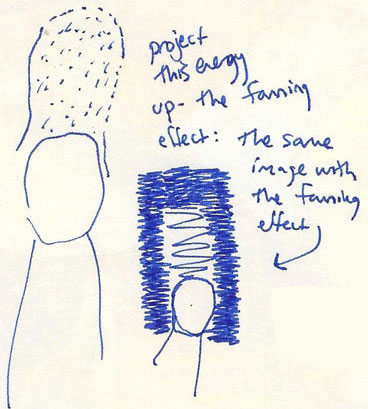
The same image with the fanning effect.
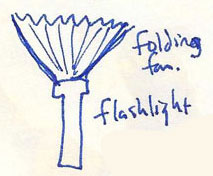
Imagine a flashlight affixed to the base of a folding fan. When the fan is closed, the light is blocked. As the fan opens, more and more light shines through. This is an imperfect analogy though, as the light is projected not from the side where the flashlight is, but revealed through the expansion of space ahead of you.
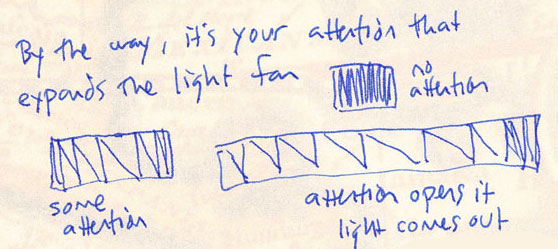
No attention, some attention. Attention opens it. Light comes out.
It’s the frequency of your attention, the weight of it. As you attend to something with more attention, that light is projected forward out of you into the world.
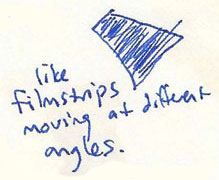
The light coming through could also be seen as filmstrips at different angles. You could look at the brightness of a thought as an angle into the dimension of attention. True 90° lets 100% light through, at 0°, without attention, it is dark.
Feeling the Light
We all know the feeling of being watched. When someone looks at us, focuses on us, the light of their attention touches us, and we can sometimes feel it. This is the energy of the connection someone makes to us, even if it’s a one-way focus. It’s the feeling of a charged connection opening.
This light is additive. Two people watching you shines even more light. That light of attention is what entertainers and children seek.
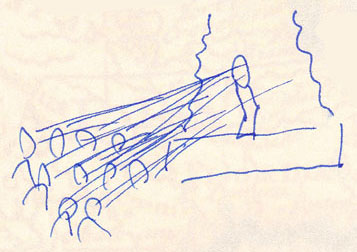
Performers often say they use the audience’s energy to perform and speak.
This phenomenon is at work when we’re walking along and our path is about to cross with someone else’s. We cross the path of their attention, their expected movement. Or when someone walks between two people talking or passing a ball to each other. When this happens, people often shuffle along a little faster and say “sorry”, or change direction to get out of the way.
We may be feeling the light of someone’s attention turning to us while they pause their intended action.
The Flash of Fear
When we feel a sudden fear, we give off a flash of light.
When meditating or relaxing into sleep, we enter into a state of free, unfocused attention, a readiness for becoming. In this state, a loud sound sends ripples through your being — you fully become it and resonate with it. When this happens, I see black and white static flash across my whole visual field behind my closed eyes, and I feel it across my whole body.

-
Auric Static 2002
When a sudden noise rang out, I felt a moment of fear. My visual field jumped from a mushy black to a bright gray with dull blue horizontal lines for a moment.
A fright can also appear as black and white horizontal bands. Tim Burton intuitively uses this style in some of his spooky characters.


I’ve seen/felt these psychic flashes from other people as well:
I was speaking to my girlfriend (as part of a humorous situation). As a joke, I suddenly began increasing my voice to a very loud tone, but it scared her so much that I felt this flash come from her and she jumped back. I felt it strongly. In that instant, I saw myself from her point of view, with horror. My mood of humor instantly changed to apology. Her fear hit me like a wave, and I felt her emotional response. She forced a communication with me by being so loud. At that moment, I became focused into her perspective. That’s an example of the basic energetic communication we make on a daily basis, whether or not we are consciously aware of it.
After playing a soccer game, I suggested to a woman I’d been chatting with that she come out and play soccer with us again. Upon saying that, I saw that flash from her, feeling instantly that it triggered a fear. I don’t know why. I don’t even remember what she said after that. But that was the only time she played with this group.
Another time, I was talking to the father of one of my son’s teammates. I referred to his “wife” and felt that flash from him. A moment later, I remembered that they were divorced.
Lisa saw a nurse come into the hospital room. . . . “She took one look at my body lying on the bed, and I perceived a flash of anxiety and concern.
“She called for orderlies, interns, and other nurses. . . .”
Wave after wave of anxiety and concern began to buffet her from the group of medical personnel. (Steiger 21)OwtLNDErs • modern • Steiger
Wherever any tremendous mental disturbance has taken place, wherever overwhelming terror, pain, sorrow, hatred, or indeed any kind of intense passion has been felt, an impression of so very marked a character has been made upon the astral light that a person with even the faintest glimmer of psychic faculty cannot but be deeply impressed by it, and it would need but a slight temporary increase of sensibility to enable him to visualize the entire scene—to see the event in all its detail apparently taking place before his eyes. (Leadbeater 83-84)APclairvoyant • Theosophy • Leadbeater
This is significant. The light of our attention reveals our higher-dimensional emotional expression. A steady beam of attention in the now is an expression of love and happiness. A bright flash followed by darkness is an expression of fear. A dim light shows light engagement. Dimmer yet shows boredom. A steady inner focus projecting out shows a steady fear, anger, or desire.
Our Focus
The Nature of Focus
(It is focus of attention, of consciousness. . . . No other energy available to you as human is as powerful. As a lens will direct energy you call light, so you can use consciousness.) (Monroe prologue)FJOBEr • modern • Monroe
Focus is consciousness fastened on a point. — Patanjali
. . . Consider the example of the laser -- all the photons march together in step -- this leads to great power. A 75 watt beam of laser light can be bounced off of the moon. Seventy-five watts of random, diffused light will scarcely travel a few miles. This is an analogy of the difference between the incoherent functioning of the Waking State and the coherence of Ascendant Consciousness NOTE: pure consciousness. This difference is measurable by the EEG -- the Waking State is characterized by a chaotic admixture of brain waves. . . . During the experiences of the . . . higher states, however, the brain exhibits perfect orderliness. (MSI 191-193)Ewisdom • modern, Hindu • Isham
Freedom to Choose Our Focus
Our focus of attention determines our experience. For example, if we are at a concert, we can have a great experience by focusing on the music and our friends. Or we can have a bad experience by focusing on the size of the crowd, the loudness of the music, or the high prices of drinks. The quality of our experience is determined entirely by the particular focus of our attention.
Dr. Peebles: So, look at the little miracles that you have in your own lives, as human beings on Earth, and remember when you chose to either disbelieve or simply ignore, or to downplay that light or symphony or that orgasm, that rapture and that pleasure of life—and through guilt, through self-punishment, through priorities of safety and sanctuary and so forth, you see it but you choose not to be touched by it.
So you see, we cannot literally take our hand of light into your heart and make it okay, even when you are over here. So we dance for you, we entertain you, we give you symphonies of life, and you have every opportunity to be thrilled to the core of your being, but it must be suggestive—it must be no more and no less than your own free will to translate as you prefer.
[This universal truth] is what guarantees the light of life. Without that free will, you don’t have life, there is no life. There’s only movement. (Pendleton 102)TDAchanneled • modern • Pendleton
“There is nothing either good or bad but thinking makes it so.” — Shakespeare Qwisdom • various
Inward and Outward Focus
Time spent in an inward focus only chase the memory of the the Pure Essence. Time spent in this focus is draining. The light of the now is our source of energy, and when we’re looking at the past, we’re spending energy. Even the brightest memory is dim compared to the light of the moment. Too much focus in the past leads to depression.
But not all turning inward is negative:
All this I’m writing took place in two minutes. Such an amazing landslide of information. Fear drove me inward and filled my mind with thoughts, but the fascination with observing it pulled me in another direction completely and I started watching.
What’s happened is that I’ve turned my attention outward onto my inner mental processes. It’s in this inward-turned curious state where much of my discoveries take place.
See also The Light in Our Eyes.
Breathing Reflects Our Focus
Breathing fuels sensory perception. When openly experiencing the physical world, we breathe freely. When we switch to an internal focus (often a fear), we stop breathing while we hold onto that focus. Concentration on breathing brings us back into the present, and we will begin to feel relaxed and energized.
Likewise, as we concentrate on awareness, we find ourselves starting to breathe again. It’s an automatic response. Breathing is releasing. Going outside always helps me calm myself and feel better. Outside these internal tensions and vibrations are released into a huge space.
A particular mood, feeling, or thought is always accompanied, manifested, or reflected by a prana or breathing of corresponding character and rhythm. Thus anger produces not merely an inflamed thought-feeling, but also a harsh and accentuated ‘roughness’ of breathing. On the other hand, when there is calm concentration on an intellectual problem, the thought and the breathing exhibit a like calmness. When the concentration is in a state of profound thinking, as during an effort to solve a subtle problem, unconsciously the breath is held. . . . In deep samadhi no thought arises; so there is no perceptible breathing. (Chang xxix-xxx)TYSDwisdom • Tibetan • Dvagpo-Lharje
Our breathing reflects our focus. An outward focus calls for increased breathing, while an inward one calls for less. Fearing expression stops the breath, but mortal fear increases it.
The Wandering Mind
When focused inward, the mind naturally wanders as it goes from one thing to the next. The mind primarily wanders by following associations. One thought leads to another, sometimes in familiar patterns. This wandering is also at least partially driven by the “Fading Lights Model” (see thoughts.php), where our attention is drawn to the next brightest thing in our recent experiences.
Focus keeps the mind from wandering. Our attention is creative — it’s able to change things, while wandering just follows habits of thought.
Intense Outward Focus
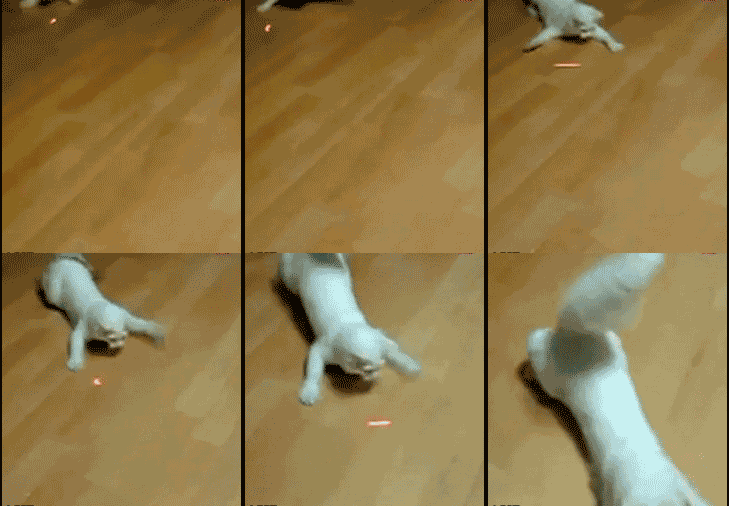
Cat’s eyes following so fast, so exact. Shining out, locked onto the world, totally present.
When high, it’s fascinating to watch when something grabs a cat’s attention. They widen their eyes and lock onto it and become it so fully, they can perform amazing feats.
Sensations and Attention
The Energy of Sensations
Bright lights, loud sounds, pumping music, sensual touch — our physical senses pull our attention to them and the energy coming in helps fuel our attention. Drumming and rock concerts energize us and pull us out of our inner focuses. The stronger the sense input, the stronger the impression it makes on consciousness.
I could feel the music as actual pinpricks of energy moving in waves across my body. This energy could be channeled towards anything: talking, dancing, etc. The music of Orishas came in cool waves.
The energy gained from the waves of sound hitting my body was a real transfer of energy. My body could use that energy to dance, move, etc. It’s stronger the louder the music is.
The Energy of Pain
The pressure points I hold — my arm against a table, my legs crossed, my foot pressed down against other foot — build up a sensation there. I always put heavy pain/pressure on part of my body. A hand, a finger, a foot. The dully painful sensation comes in as energy. The pain is my fuel. The pain is the spotlight. It provides energy, focus.
I do this all the time while working on something that takes mental effort. I’m doing it now. I have my legs crossed, and the pressure on my upper leg has built to hurt quite a lot, but I ignore it. When sitting straight, I rest one foot on the other to the same painful effect. Being high, this was the first time I noticed it consciously as a pattern. And I’ve done it for years.
I’m holding my breath to dive deep into thoughts, depending on pain instead of breathing for fuel.
Memory
The Nature of Memory
The Nature of Memory
Memory is a central aspect of the nature of consciousness. Memory is the result of our attention being focused on something. Its limits define us as individuals. Its span at differing frequencies defines the span of our consciousness.
Consciousness consists of a flow, its memory, and the changing focuses of self that develop out of it.
The flow of attention either a) records new memories, or b) intensifies existing memories.
All the primary functions of consciousness work through projection — projection of memories from the past into our present experience.
One of the primary characteristics defining the human experience is our long, heavy memory full of attachments that pulls us out of our present experience. In altered states of mind when this effect is lessened or removed, we find an entirely different, uplifting and positive experience awaits us in the present. More on that to come.
All of the past experiences we carry with us are constrictions of the very fabric of our being. Simply recognizing something means it lives within us.
Attention Charges Memories
The clarity of a memory is equal to our attention on the original experience. In this way, experiences that are emotional, new, shocking, or thrilling are stored much more brightly. This is because we focus the light of our attention on that experience. Repetitive everyday experiences barely make an impression on memory because they barely have our attention.
When walking through the park but thinking about a project we’re working on, our memories will have a little content from the park but our new thoughts on your project will be remembered clearly. Similarly, someone who is depressed will find they ruminate on negative thoughts and experiences and form very few new memories.
As an example, it’s been found that we have better memory for upside-down sentences, because more attention is given to reading it. (TO DO: cite this if you keep it)
For more, see The Nature of Attention.
Changing Emotional Reactions
We can remember a time when we were physically hurt, but we don’t actually re-experience the physical pain when we think of it. We remember that there was pain.
It’s the same for emotions. We remember how we felt at the time, but emotions only occur in the present. A memory may reactivate the same emotion we had at the time, but this emotional reaction is newly happening now. What this tells us is that we still feel the same way about that memory. But our emotional reactions may change over time.
Think of a time we were very angry and went overboard. We were angry at the time, but looking back, we might now feel embarrassment over how we acted. We remember being angry, but the emotion the memory triggers now is different. The same goes for any change of perspective. If we forgive someone who wronged us, then the memory of what they did will no longer trigger anger in us.
Thus memories don’t contain the actual emotions we recall — just our knowledge of having felt them.
The Indexes of Memory
Memories contains a number of indexes by which they are associated. Physical indexes include time of day, season, location, how long ago it was, the people involved, the physical objects involved, and body position at the time of the memory. Emotional frequency is a primary nonphysical index.
Each index is a path by which memory associations can happen; paths by which the memory can be called to mind through one’s current environment or currently-engaged memory.
The Body Position Index
I found that as I was thinking, different body positions associated with those thoughts lit up, as if every thought has an associated body position. This correlates with the idea of mental pain points being stored as muscle tension.
I feel my body holding on like it froze up from the last experience, where I was talking to Buttercup and lost my train of thought. I was a little embarrassed, and unsure of her reaction to that. My body stayed in that exact position so long as I held my attention on that past experience. There is a physical body position stored with each memory.
For many years, Reichian therapists have been documenting conscious memory patterns in specific muscle groups in the body. They have found that they can alleviate specific psychological conditions by manipulating particular pressure points on the body. (Ryerson and Harolde 54)SCchanneled • modern • Ryerson & Harolde
These memory patterns are what clairvoyance can see as pictures in the aura.
The Frequency Spectrum of Memories
Memories Record All Frequencies
While our physical selves rarely have access to it all, at higher frequencies, the full and true experience is recorded — what really happened in an objective manner, with all the subtle signals, causes, and reactions that our higher self sees.
I can experience any season of my life in an expanded fashion, using a heightened memory that actively recreates events, giving me awareness of an event as I once experienced it—but expanded to include all those personal details that escaped me at the time, the subconsciously perceived events that couched the physical one. (Roberts 123)AJoaAPchanneled • modern • James
We are conscious of so much more at higher frequencies, at subconscious levels. Those details are recorded with the memory, even though we are usually not consciously aware of them at the time. In this kind of remembering experience, we are aware of all the energy dynamics and subtext that happened in past events.
This explains the increased detail and empathy we have in the life review.
See We Know Everything at Higher Frequencies and The Life Review.
Our Subjective Experiences
Our memory in the physical is famously poor. We remember not objective reality but our subjective experience of it — the way we saw that through our focuses and past experiences. This includes the context of our past experience, expectations, beliefs, and where our attention was focused.
This means that while the full experience is recorded at, say, 800 MHz, the memory of the physical self only includes the narrow band of, say, 0-100 MHz. This partial experience is what we remember. The self is built out of only the range of experience we’re conscious of and the memories generated by that narrow range.
But that’s not all. Memories change slowly over time. We frequently replay emotional experiences, and each replay warps it according to what our attention is focused on when viewing that memory. That’s covered in the next section.
Keeping Memories Alive Through Replays
We strive to give certain memories enough attention that they won’t fade away, REPEATING THEM to keep them present. As something approaches the limit of memory, we double back and HIT it with attention, copying it into the now again to get charged up with light. We’re sort of like light-based memory copying machines.
But each copy is an ATTENTION-BASED repetition. The particular aspects we focus on might grow way beyond the original, while others, lacking attention, fade away. It’s well known in psychology that memories get highly warped over time. They become caricatures, cartoonish, our gradually-warped repetitions of the past brought back into the present. The further the memory is in the past, the more times we’ve COPIED them into the present, the more warped they become by our attention. They become a memory of a memory of a memory. . . .
We either experience the now, or copy past experiences we want to hold on to into the now. We repeat these past experiences in the now of psychological time, the only time that matters to consciousness. These repetitions form the past experience review show. The biggest hits, all the oldies. Replayed in the now, broadcast again and again.
Our attachments are things we don’t want to let go of, we don’t want to forget, so we have to copy them forward with us. Carry them into new nows. That’s the weight of our past experiences. We drag past experiences with us into the present, obscuring and influencing our experience of the now.
We keep memories alive through our attention to inspire or protect us. Glory and trauma are replayed in people like echoes. This keeps the memories present to them. They remain at that frequency, returning their attention to those events again and again. This is because little new attention is being paid into the now. The now can’t compare with the brightness of the memory.
Think of each memory as a spinning metal flower facing upwards. Our attention speeds up the spin which causes it to rise higher into the light of our mind (or simply cast more flashes of light). Imagine that each petal is a reflective ridge. The faster they spin, the more apparent petals they have, and the more they flash a reflection of themselves to us. This describes The Recurrence of Strong Experiences.

This might be how The Chakras work.
All memories gradually slow and darken, eventually flowing out of memory to the higher frequencies of our self, where the details fade and it is processed into wisdom.
Interweaving Memory Projections
Every repetition copies the past experience into the present. We are only ever experiencing the present, even if what we’re doing is using it to REPEAT THE PAST, which we project into the present. A full focus on the past copies the memory more fully into the present.
But if we have a split focus, that copy becomes interwoven with the present. We remix these memories and beliefs with the present. We see the world through their lenses. Try them on again, see how well they fit now.
Holding Our Context
The entire current context of our lives is kept “present” to us by continuously charging each part up with phased moments of attention. On a larger scale, this includes who we are, where we live, our relationships, and other long-term context. On the smaller end, this includes what we need to do or buy, the current place we are within different projects, what’s coming up on the schedule, and so on. Without these tiny moments of attention, they fade away. There is a pressure, an anxiety in this that prevents us from fully relaxing our attention into a regenerative state or fully engaging with anything else.
Without this habitual flexing of attention into a familiar shape, we would forget things, make mistakes, and in the extreme forget who we think we are. Phasing attention is that foundational to the individuality of consciousness.
Washing Away Past Experience
When we become present in the now the waveform expands and appears up close, eclipsing everything else around it. Our focus does that — bends the experience of the waveform, expands it, like a drop of water expanding whatever is under it. Our consciousness goes into higher frequencies of psychological time relative to physical time as it focuses.
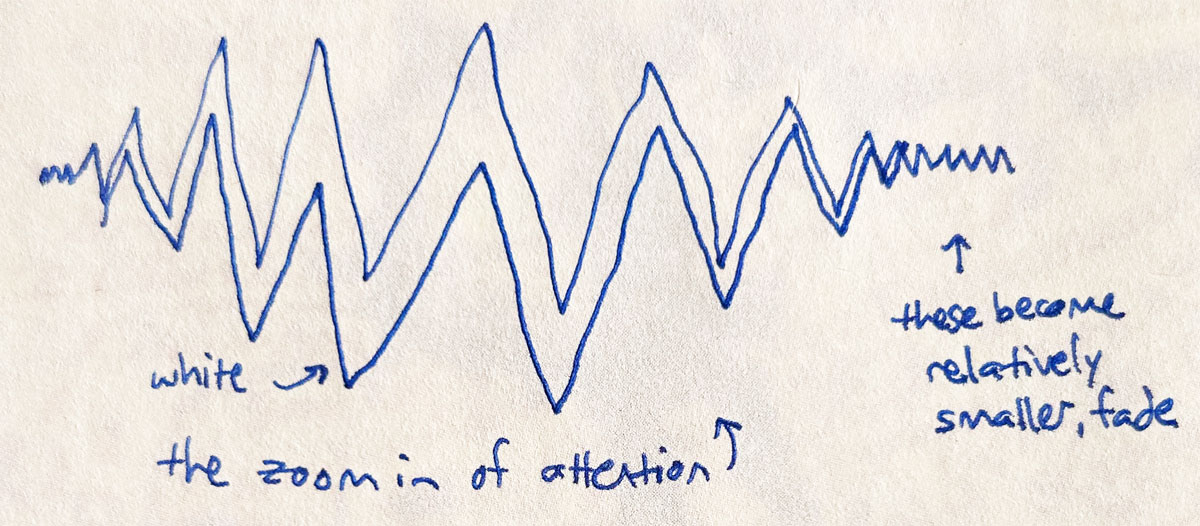
The past is washed away when we come closer to the now. It becomes relatively smaller. It shrinks down to almost nothing in comparison. It’s washed away in the big wave of our being PRESENT. It makes those fading lights fade into the past even more quickly. It falls faster into the psychological past.
A situation that didn’t actually bother us? We say “that’s ancient history” because we moved on. We’re not dwelling on it. It’s disappeared almost entirely into the past.
Memories are also washed out during deep relaxation or in sleep. see Relaxation and Energy Field Rotation.
Catching a Fading Memory
I was still speaking the sentence I had decided to speak long moments before, but my mind had moved on to other thoughts, and this interrupted the earlier train of thought I was speaking. I tried to get back to what I was saying, searching. . . .
Trying to finish a sentence, and I’m chasing the memory of what I was trying to say, trying to catch its frequency index as it falls away into the past, straining to focus “faster”, trying to catch up with its relative flow backward from the now on the beam of psychological time.
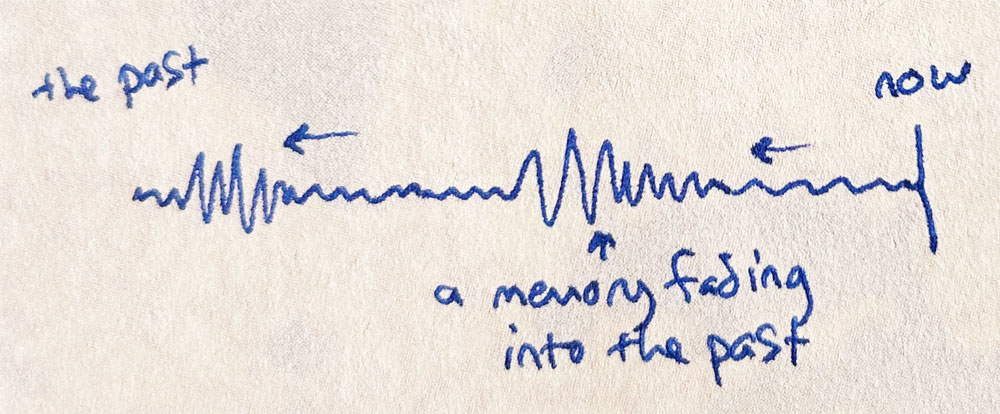
We forget our childhood because we can’t race back that fast or far on the stream of memory. We can only catch our copies, which we more and more dwell on to hold onto ourselves. We lose frequency TO look back in the past, and BY looking back in the past. Every time we look back, we are taking on size by focusing on something, and dropping away from the Source.
If we focus on anything other than the Source, it will slowly drop away the moment we release it.
Our memories are all there, just shrunk down too small to see anymore, or too far away to catch.
Phased Attention and Memories
The way we return to (and enter back into) memories is the exact process of entering and exiting memories. We phase our attention into one, leaving a portion of it behind, a foot in the door that we can return to when we’re done. In this way, we retain our context outside the memory. While inside, we periodically bounce back to it to refresh it within our memory.
The Recurrence of Strong Experiences
In altered states, I’ve seen how strong experiences return to mind at regular intervals. When attention shines especially bright during a positive or negative experience, it records a brighter memory, and it flashes out to our attention periodically, pulling us out of the present. If we give it our attention each time, it can quickly form a habitual thought.
The thought is the thinker. There is no one behind it. The thought is thinking itself. It comes uninvited. (Dass 88)JoAwisdom • modern • Dass
I have two models for how this might work. The first is the “Flash Bounce Model”. In this model, strong experiences return to the mind at steadily increasing intervals.
The Flash Bounce Model
The Flash Bounce Model describes how emotionally-charged experiences return at intervals to our attention. The experience flashes brightly and then returns (bounces back) at progressively longer intervals. Each time it is slightly dimmer until the experience has no more charge left.
Let’s say we have an intense experience. At first we can’t stop thinking about it — it takes 100% of our attention. Then it fades to 90% as we’re able to think of and attend to other things. It continues to fade but keeps reappearing to our attention, and our thoughts return to it, but with longer intervals in between as time passes. After a day, our thoughts return to it every 2 hours, then every 4 hours, then every 6. A year later, it might surface once every couple months. But it’s still there.
I’m aware of my every thought. I can tell you every thought I’m having, including distractions, interruptions, and all that. Experiences come with more attention, so the flashes/bounces are louder and longer. I have more time to review each experience, learning more from it, and letting it flow out into further context to gather more knowledge/relevance.
When surprised by a big truck, my girlfriend saw the whole thing repeat itself three times, in three loud bounces (she has an extreme startle reaction called Jumping Frenchman). The bounce is loud and long, then gets softer and shorter with longer times between as it fades.
Attention on it increases its energy and it bounces back to our awareness more often and more brightly until we again stop feeding it with our attention.
The Fading of Sensory Input
Interestingly, sensory input fades out in the exact same manner.
Bright images burned into the retina flicker slower and slower as they fade away.
Awake at 4 AM, I’m watching behind my eyes, looking at the diffuse moving lights of satori. I see the satori turning into that EKG squiggle pattern I’ve seen before, and from there into the pages of a book viewed from the side. The page imagery remains so long as my attention remains on it, then fades away in flash bounce fashion once attention is withdrawn. Flash bounce is the turning away of attention in terms of phasing. In this case it went from a steady image to nothing in about 2 seconds. More intense emotional experiences are phased away from much more slowly.
See Attention Moves By Phasing for how phasing works.
The Fading Lights Model
The second model is the “Fading Lights Model”, which we can think of as a contextual filter, always on but slowly fading. The bright experience returns to mind periodically as we settle down below the threshold of the slowly fading experience. Overall I think this model works better.
In the Fading Lights Model, these experiences are slowly fading Specific Search filters. They get charged up when we’re in situations that are similar to when the experience was recorded, and our mind wanders back to them.
Experiences that carry strong emotions gradually lose their brightness over time, and it’s not until our mind begins to calm down that they once again become the brightest light and our attention turns to them. If the experience was negative, these moments of reliving difficult experiences can be uncomfortable, and we often avoid them through distractions. But when the mind again begins to rest, there they are again, the brightest thing in our quieting mind.
I often find as I’m falling asleep, unresolved things from the day reappear to my attention, and I think about them, reliving them, considering what I could have or should have done differently.
In the engaged attention of playing a soccer game, for example, I’m not going to think about a minor issue from earlier in the day. But it may come up on the drive home or as I’m falling asleep later.
These fading lights draw our attention out of the moment. They’re past experiences that STICK and keep coming back. They are projecting themselves into the now, making comparisons, hoping to grow from attention by finding a match, thus reinforcing themselves. Looking for a match and not finding it helps them to fade. They spend their energy and are not reinforced with more.
This is similar in effect to the Flash Bounce Model, because it explains the reoccurring but fading nature of strong experiences at irregular intervals without being a recurring “bounce”. Even so, I have experienced what seemed like obvious bounces.
If you tell yourself that sexual feeling is wrong, and organize your daily programming in that fashion, then when you “meditate,” or dispense with that orientation, you may suddenly find yourself presented with material that you consider unsavory. . . . When you begin to alter your perception, then, and your habitual picture of reality drops away, you may well find yourself encountering in distorted fashion elements of your own reality that you have up to then studiously denied or ignored.(Roberts 399)UR2channeled • modern • Seth
In meditation, we pass down through all the fading lights of our recent thoughts and experiences. That includes denied and ignored thoughts, which receive regular attention as they pop up and we push them away.
Through Association
Thoughts also return to us through association. When we enter into an experience or train of thought that reminds us through association of a certain charged experience or habitual thought, our attention will be drawn to that associated thought again, charging it up more with our attention.
This morning I was thinking about soccer, about upcoming Atlanta United games, about the new players (related excitement), then about my own soccer team (related dissatisfaction). At some point I jumped tracks to mental spaces dealing with other things. Much of our thinking is through associations within and between thought clouds like this. Our attention is just following the brightest lights.
As a rule we do not realize what controls the occurrence of ideas and memories and how they are called forth. Consider the following: we are riding in a train, wrapped up in our own thoughts, when suddenly our thinking takes a completely new turn—we remember something that happened many years ago. We weave this into our present thoughts. What we do not notice is that our eyes, looking through the window, fell upon a person resembling someone involved in the event we recalled. But we are not conscious of what we saw. We are aware only of the effect it had produced in us. . . .
We may dislike a certain color and not know why; we have forgotten that a teacher, who tormented us years ago, used to wear a coat of that color. Countless illusions are based on such connections. (Steiner 124-125)HTKHWclairvoyant • modern • Steiner
The Thoughts of Others
We may also pick up the thoughts of others when our mind quiets down. These impressions are mixed in with our own fading lights, and can attract our attention, leading to streams of associations.
See The Open Thought Stream and The Influence of Undirected Thoughts and Emotions.
Accepting and Releasing Memories
“Swallowing” Our Experiences
There are certain experiences whose memory we don’t want to accept as being true. We don’t want to swallow it — in a very literal energetic way.
There’s another reason to keep memories alive — denial. When we keep spinning up a memory, it’s not allowed to sink away down the vortex tunnel, out of our memory and into our reincarnating self. We keep the memory near us, in recent memory, not letting it flow away (see Keeping Memories Alive Through Replays). Following the analogy, we would keep chewing our food. Only when we accept it can we release it from our attention can it fade into our past, flowing into the reincarnating self, where we extract wisdom from it and it becomes a part of us.
We are creatures who feed on experiences. The more difficult or important ones we keep chewing on, keeping them close, in our mouth, in our experience.
We forget something, forgive it, when we pay it no more attention.
Memories Fade to General Impressions
Even the brightest memories fade over time. The specifics fade and the memory fades into our essential feelings or impressions — the meaning of a thing. We may not remember the specific wording of a story from our childhood, but we do recall that the squash created havoc when it grew to humongous proportions. We are left with general understandings of most things.
Similar memories begin to overlap, generalizing the impressions. This is the fog of memory, the mixing of several experiences into a general impression. The general impression of each experience is what we remember as the details of our experiences get lost. This is what we’re aware of on a conscious level. But subconsciously all the individual details remain.
Experiences become general impressions as they fade further into the past, out of the range of our conscious self, but they are still within the range of our higher self, whose higher frequency can essentially hold more, seeing further into the past before a memory needs to be copied. The higher self has a more expansive present. At higher levels it can see memories across lifetimes. It is this expanded memory which can inform the actions of the current physical self.
Our different selves can be defined by the range of their memories.
Interacting with Memories
Memories as Nonphysical Objects
To consciousness, memories are things. They are not vaguely defined, hard to locate wisps of the past. They are nonphysical objects with definite shape, color, action, interface, and natural laws of engagement. They are stored by nonspatial index in our minds. When we’re not focusing on them, they shrink down to nothing. Under the influence of our focus, they enlarge out around us to their full dimensions, enclosing us within their environment and context.
- Memories can be entered and exited by anyone with the address. This can go any number of layers deep.
- Within a memory, we can watch from a floating perspective, or inhabit (jump into) any of the characters.
- While inhabiting a character, we can change that character’s actions.
- We can change the story at any time through imagination or projection.
Entering and Exiting Memories
Descending into Memories
From my few remembered experiences, rotes are about the size of a soccer ball, and they are usually passed to you around chest level. Due to this positioning, as we enter a memory rote, we scale down into it from above.
-
Civil War Stories 1996 • age 22
I zoomed in from far above to a civil war scene in the south. An army in blue was riding back to camp. The focus was on the lead slave in this group of slaves on horseback.
-
The Best Video Game Ever 1997 • age 22
I’m in a toy store with this boy, looking for WarCraft 2 Expansions. Instead, I find Zelda for Nintendo 64, so I pop it in and start playing. . . . Finally it started. It showed a sloppily-rendered world overview, and you scrolled down into the city you wanted. At this point, it became real.
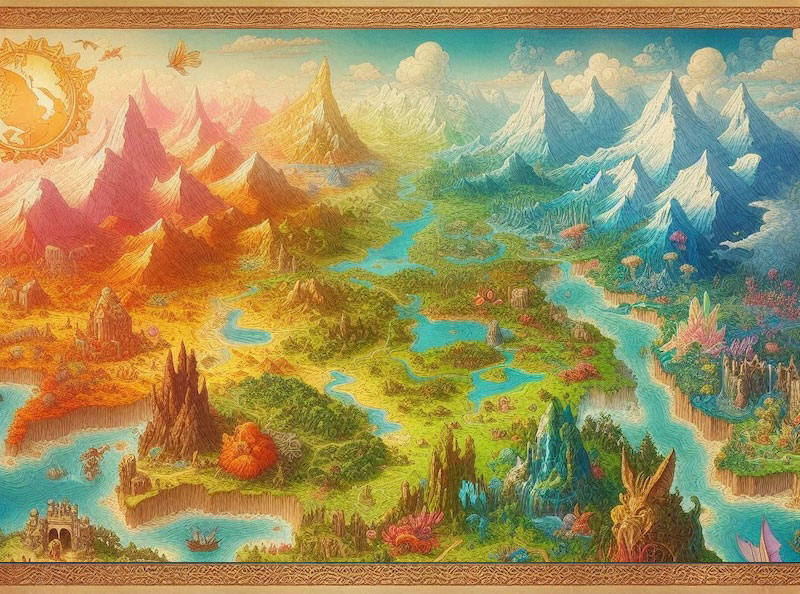
A video game world overview We went to a big castle.
World Overview: The descent into the rote begins as the common video game world overview from which I “scrolled down” into the city.
-
The Book of Dreams 1997 • age 23
I think I went into the cover picture as I descended slowly (I thought I was sky diving) onto a beautiful snowy mountaintop.
Skydiving Into a Rote: Here I take my descent into the rote (as it enlarges around me) to be skydiving, which is pretty accurate imagery, without any visual rationalization.
-
The Island of Fire 2000
Soon the boys and I leave, driving along the foresty road. We stop at the side of the road and descend this steep slope to a barren rocky plain that sputters from weird holes. . . . There’s a break in memory and we’re back at the forested slope. This time we’re descending with a huge group of Renaissance Festival people into a clearing in a thick forest.
Slope and Sky: Here I’m descending into two rotes. In both cases, it’s from the perspective of being on the side of a forested road, so instead of descending from the sky, we’re descending down a steep slope.
-
Hang Glider Descent 2001
I find myself descending on a hang glider (with a floor) into a New York countryside. It was driven by another person and we had a soft landing.
Rationalized Descent: This was a rationalized descent into a rote.
Rising Out of Memories
The converse of descending down into a memory is rising back out of it when it’s over. It’s not something I’ve often remembered, as the exit is usually instantaneous.
-
Super Hero Lava Pool 1995 • age 20
We play football and volleyball. (foggy)
Then I go exploring underground with GenX. [there’s this long adventure with superheroes and a lava pool]
The guy who wrote the story writes to Marvel and says “There. Now stop writing your crap.” I go out above and find Sid and the others still playing volleyball.
References: GenX is a Marvel superhero team.
Returning Above: I begin the rote by “exploring underground” — my rationalization of going down into the rote. After finishing the story rote, I “go out above”, back to the volleyball scene I was in before. This is my spatial rationalization of descending down into the rote and rising back out of it.
-
The Mirror People 2012
I am back on the road on the west side of the school, and it’s dark again. Another attack is coming — this time from five administrators. The road is lit up with these bright square glyphs — each about the size of a house, and one under each house, so that it’s like a grid. I begin to lift off the ground, and the world bends away spherically. The grid flexes into different hills, and I somehow know that one neighborhood I come to is known as “The Whale”. It’s got a big bend, like a big hill, and it’s very large. I feel myself being drawn down into it, and I’m trying to pull up. It’s around here where I wake up.
Massive Spatial Distortion: I’m trying to leave, and as I rise up out of the rote, the world below becomes more spherical. But then I’m pulled back down. This seems like another attempt to prevent me from leaving. Thankfully, I remember that I can wake myself up for a certain escape.
In and Out of Memories
Transitions are the hardest things to remember in dreams, so if we can remember one, we can get a really clear idea of what’s going on. Otherwise we end up remembering different dream scenes without knowing how they’re related.
-
The Island of Fire 2000
I’m upstairs in a house with Deaner, who’s showing me pictures in his photo album. I spend some time on a Tahiti-like island, which was probably a rote or subdream based on a photo, and return to find Deaner (who looks different) waiting for me. I am trying hard to be entertaining and only sometimes succeeding, but there is friendly chemistry . . . [we hang out]
Soon the boys and I leave, driving along the foresty road. We stop at the side of the road and descend this steep slope to a barren rocky plain that sputters from weird holes. We block the sputtering holes, throw stuff into them, and play about with rocks. Then as we drive off, big rocks start to shoot out of one of the holes, barely missing people. I feel bad for starting such a thing. As we drive away, I realize it’s the Tahiti-like island. There’s a massive fire on the top of the cliffs, threatening to spread downwards. There are lava flows and fireballs as we leave.
There’s a break in memory and we’re back at the forested slope. This time we’re descending with a huge group of Renaissance Festival people into a clearing in a thick forest. Everyone’s dressed up and speaking in accents. I just sort of don my costume by thought as we enter the scene. I choose to be a funny guy and I’m cracking all sorts of jokes. A friend becomes this warrior wearing a helm with detachable bull horns.
Mistaking this as the island from earlier, I remember the danger we were in. I look up to a cliff above us and see a trail of lava coming down. Soon the gully at the bottom is filled with lava. I’m afraid, and I’m having trouble getting up the way we came as the slope has become much steeper, and the vegetation is now just grass — no trees and plants to grab onto. I struggle to climb up. . . . A friend, Buttercup I think, is also there, walking on the lava and sinking a little with each step. I explain how it’s impossible to walk on lava like that because you’d burn up. The lava turns out to be red and glowing and pliable but not hot. I see a row of the renaissance people including a queen in pink and a prince sitting on a wooden ornamental bench ON the lava.
References: Deaner is from the band Ween.
In and Out of Multiple Rotes: The real situation (NREM true dream) is that I’m hanging out with someone I take to be Deaner. He’s showing me photos, and I jump into one. This may be a rote or a subdream. I then return from it and continue hanging out.
Then a bunch of us travel a little ways down the road and enter a rote of a barren, rocky volcanic plain on what I take to be the same island. I rationalize this as us “descending” down a steep slope at the side of the road. We exit the rote, rationalized by driving uphill, and we’re back at the side of the road again. I take the transition to be “a break in memory”.
We then enter another rote about a Renaissance Festival, descending once again into the scene. Because spatially we seem to be descending the same slope, I take this to be on the same island, even though it looks very different. Because of that, I bring my expectation of lava with me and project lava into the scene. Everyone is walking around on the earth like normal — only I see the lava.
This is the quintessential dream, a real social dream experience with rotes, rationalizations, confusion, and projection.
-
The Band Murder 1999 • age 25
This time when I return to the dream he’s Trent Reznor and I’m a girl with a giant turtle. There’s infinite complexity that I’m missing. In the main room is a big orgy to 70s music. The blonde cat-like elf woman from Stardust is there. She goes to Trent and he drowns her in a bathroom.
Then I’m outside the building by some housing near a city river bank talking to this girl who said her Emma knew about that happening, that she knows everything. Perhaps she was the original storyteller? Because my curiosity brought me back into the scene as I said “Then what?”
This time I’m Trent. The dead woman is on the ground and opens her eyes and looks at him. She asks why he did it. He grabs a knife from the table and slits her throat. As he began to do this, I promptly jumped out of him and watched from a more distant angle. “Benji, wake up!” I awaken.
References: Trent Reznor is the lead singer in the band Nine Inch Nails.
Stepping Out of a Rote: How interesting that I was able to step out of the rote and talk to the person whose memory it was, then return to it.
-
The Whale-Chasing Machine 1997 • age 23
I’m watching humpback whales flee in terror from something. They circle in front of this wall of stone, then smash into it. They lick the algae to see if there’s a way through. Beyond the wall is a black area on the ocean floor. A cheetah is running by on the top of the wall (underwater!). A whale bumps the wall, almost hitting the cheetah, and something from the black area is knocked loose and floats to the surface. It’s a microbe or disease.
Suddenly the sea surface is a tabletop with myself and other students standing around it. The teacher says “Who do you think gets affected by this disease?” He tells us to launch these rubber bands in the air towards the table. He’s hoping they land randomly on all the models of plants and creatures around but they all land on the grass, so he redistributes them. We were talking about the effects of a whale-chasing machine and how a virus could wipe out everything.
And to Illustrate: Here I’m in a class and the demonstration is a rote — it becomes a total 3D wraparound reality. After reaching the end, I scroll back out into the classroom.
-
Uncle John’s Puffball Mushroom Farm 2023 • 7 AM
I was at Uncle John’s house. He had this wild pine forest in his yard, and he was growing something out there. At one point, I found a puffball mushroom growing. He saw it and decided this was the crop he wanted to pursue. The next time I was out in the yard, he had a patch of soccer-ball sized puffball mushrooms growing out there among the pine needles. I was impressed! The next time I looked, there were several patches like that, some growing to basketball size or larger. The next time, he had built a volcano-shaped mound in the center of them, about 8 feet tall, which held water and would spray it out to water the mushrooms. He was harvesting them while still in their firm stage, cutting big slices of them. . . . Buttercup and the family are at a huge mall, in a movie theater watching a movie. It was the mushroom farm movie! I remember pulling out of the movie a few times to adjust some of my belongings nearby or say something to Buttercup, who was sitting next to me. This explains all the “the next time I looked” up above. I kept coming out of the movie rote for various reasons and returning to find things progressed!
A Movie Theater: What a catch! I didn’t put this together until I was writing the dream down. The puffball mushroom dream, seemingly entirely disconnected from the dream about the mall, falls right into place as the movie that we’re watching in the mall movie theater, and the breaks in continuity were the brief scenes in which I pulled back out of the movie rote for various reasons to address something in the movie theater!
The interruptions where I returned from the mushroom farm to the movie theater may have been related to the sounds of Buttercup and Gwen getting up and getting ready for the day.
-
Fantastic Solstice 1997 • age 23
Here’s the book:
Every other page was a big splash picture that, of course, I went into. It seemed to start with a part called “The Dragon Pits”. It seemed we were going to go deep into them for a treasure, but it ended up being a tower. We were seeking something like the “true jade” that was only ever used to make book pages. All around us near the opening were merchants selling rainbow-colored crystal idols. I was the hero in the story and there was a mentor with me. . . . [I go to the tower, search within, then transform it]
I turned and saw what must have been a big gem heave itself from the tower and roll straight for me. It was now, however, a HUGE black rock. Fear shot up inside of me and I wanted to leap aside but I held my ground as the rock got to me. The lens disappeared and turned into a beam of light which picked me up off the ground. It filled me completely with love, life, ecstatic energy. The scene scrolled back for a second and there I was in a big dark place like a movie theater, surrounded by motionless people, but I was floating above my seat, bending over backwards and shaking in blissful rapture. I remember the judgements I expected from those around me but I let the energy run. Then, back in the book, I was convinced. That was the most beautiful, powerful thing I have ever experienced and it changed me. I set off to return to my companions.
Ranier and I took Buttercup to a muddy place to prepare for the next chapter of Solstice where there was a huge endless bug storm.
References: Solstice was the name of a BBS I once had. The Space Needle is a tower in Seattle.
Stage of the Mind: The greater context of this adventure was once myself reading a book, but when it zoomed out later — exited the book gateway, I was in a theater. I was as affected there by the ecstatic light as I was in the dream scene, but my reaction was closer to what it’d be if I were awake, publicly in the full embrace of ecstasy.
This shows that a) when we enter a rote or gateway, we are projecting into it, while also remaining outside it, and b) that what’s going on inside the rote/gateway can affect us outside of it as well, in real-time. Here it seems I’m the only one in the theater having an ecstatic experience within this rote.
-
The Funny Show 2026 • 5:30 AM
I ended up meeting the guys behind the show. They were all young, around 20. I felt totally at ease with them. The goal was humor and I was all in. . . . We were watching the Superbowl. The field was dirty, sort of an amateur quality. There was a running play, and when the runner was tackled, he fumbled the ball. Players scrambled for it, but it went out of bounds. Who had touched it last? The scene scrolled back to see. It sort of focused on a player that melded almost perfectly with the colors and paint of the field. He got up. I was fascinated by what I saw. The painted colors of the field had all stuck to him, I reasoned. His hair was this enormous flat top shaped like a wedge. He went up to a orange-red patch in the field and pressed the top of his flat top into it. When he lifted up his head, his flat top had picked up that color. A bunch of other copies of himself went up to the orange-red patch and did the same. They all started slamming the top of their heads into the ground . . . as a celebration? This was so amazing and unexpected that we all started doing our own version of it to the beat. Not head-slamming, but high-fives or banging something to the beat. It was called “niffling”.
Responding Together: We begin watching the Superbowl rote together. We’re so amused by the “niffling” that we join in with it outside the rote. Experiencing a rote like this is just like watching a video with friends.
-
The Office Tower Party 2025 • 6 AM
There’s a big office celebration. As part of it, we were introduced to this new game. I think there were a bunch of people standing around a floor-to-ceiling gateway door. The game was going on inside. It had a kind of sepia-tone style to it. You only had to focus in on it and you were there. Inside, it kept the orientation of the door at first — mostly vertical with a little bit of depth, but once I picked a zone, it opened up fully with depth, like moving inward from an overworld map. It was incredible! Instant action and quests, so many characters to choose from. It was happening so fast I could barely keep up with the plot. . . . I went back and forth, in and out of the game through the whole dream. It became a game on my phone, which I could re-enter just by bringing it up in front of me and entering it. The trouble was, the rest of the party in the office building was so amazing, I kept wanting to take pictures of it. And every time I took out my phone, there was the game, and I couldn’t get it to quit so I could take pictures. At one point, someone else, seeing my frustration, asked me to hold out the phone and she calmly tapped a few things until it quit. However, it didn’t go to my regular phone screen but an incredibly cool game-related photo app. . . . [I explore more of the party]
I think at this point I went back into the game again, and as I played, I made this huge leap to a new area. However, this leap was also reflected in the office building, and I found myself on the outside stairs on the 2nd level.
Handheld Rote: Once I’m introduced to this game rote, it becomes something I can return to at any time. It becomes associated with my phone, however, and pulls at my attention every time I want to use it to take a picture.
In fact, I wonder if I’m dreaming the game at one level and the office celebration at another level the whole time, with my attention shifting back and forth between them.
The big jump I take at one point that affects my position outside the rote, again showing that what we do within the rote can affect the phased part of our consciousness outside of it as well.
I gaze around me. I am no longer in a room, but in a soft twilight landscape of sand and low dunes. A feeling of peace pervades the atmosphere. . . . I notice a very fine, hairlike plant growing over the sand, so fine it is hardly visible. The fact that it is a pale blue color no longer seems odd. The grass tree is reassuring, even though its long sweeping needle-thin, grasslike foliage is a deep blue. . . .
I stroke the foliage in the way I often physically do, when an odd thing happens. Tiny sparks of light—not electrical—leap from the foliage to my hands, and they carry a communication. As each spark of light touches me, it ignites an inner knowing. . . .
This grass tree look-alike is an intelligent, aware entity. . . .
As I . . . stroke the grass tree Being, a particularly large spark of light ignites a vast insight. This insight is in the form of vision, inner knowing, and pure experience all rolled up into one package. It takes me less than a micromoment to receive it, but some timeless moments to assimilate it. In essence, the grass tree Being reveals that on Earth there are spiritual Beings of pure energy in every plant. . . . Although the death of a plant does not disrupt or disturb the spiritual Beings that express their energy in the plants, it does cause a displacement. In those moments of displacement—measured in hours, months, or even years on Earth—the Beings of energy that express through the forms of plant life, return instantly to their metaphysical realm of pure spirit. . . .
I know this entity. In some other nonphysical realm, I have shared experience with this Being. . . .
The foliage rustles gently, encouraging me once again to caress the needle-fine fronds. As I do so, a huge burst of sparkling lights dazzles me, engulfing me in a brilliant shower of illumination. And I am elsewhere.
I am surrounded by a non-physical realm of stunning beauty. (Roads 154-156)IaTROBEr, LDer • modern • Roads
Roads has entered a memory and experiences a beautiful world of nature spirits.
Entering Together
We can enter memories together. One example is where a story or memory is being shown in a movie theater.
This can work in several different ways. We can watch the scene in realtime without pausing, rewinding, or inhabitation (jumping into characters). At the point of inhabitation, however, I suspect a person must be in their own subjective version of the story. You couldn’t have two people inhabiting the same character, making different choices. However, I suspect multiple people could inhabit different characters in a shared subjective space. Or they could appear in the scene as new characters — as themselves.
-
The Whales of Maui 1994 • age 19
We were running around, searching for the challenges. The object was to find the challenge, pass it, then receive the key. With the key you could lock shut any challenge you wished. I passed the dragon challenge, then another, then got caught up in the mobster/Johnny Dangerously one. I replayed it a few times, bringing some girl along after a while. For a moment it felt like the movie True Romance.
References: Johnny Dangerously and True Romance are movies.
Entering a Rote Together: Bringing the girl along into the mobster/Johnny Dangerously rote changed the feel of it to one that was still violent, but more focused on relationships: True Romance.
-
The Island of Fire 2000
We stop at the side of the road and descend this steep slope to a barren rocky plain that sputters from weird holes. We block the sputtering holes, throw stuff into them, and play about with rocks. . . . There’s a break in memory and we’re back at the forested slope. This time we’re descending with a huge group of Renaissance Festival people into a clearing in a thick forest.
Entering Together: Both times, a group of friends including Deaner descend into the rotes together.
Playback in Memories
Playing and Pausing
Monroe describes interacting with a memory from the physical. In the astral, the relaxation and isolation is not necessary:
Running a rote NOTE: memory is much like trying to recall the memory of an event out of the past. The difference rests in the immediate clarity of every detail once the unrolling process begins. Best results appear to be obtained if one is in a relaxed state and isolated. It is important to remain completely awake physically. . . . Then simply think of the ident—the subject of the rote—and wait. . . . If you feel you might have missed something, you can RESET and start again, either at the beginning or at any given serial point in the information/experience. You can hit a mental PAUSE button if the phone rings, although this often requires a complete rework back to the relaxation state if so interrupted. However, the rote will still be there—“open” at the point you left it. This takes time and patience, thus the need for isolation. (Monroe 238)FJOBEr • modern • Monroe
Restarting
Restarting is most common in game-like rotes.
-
Pirate Ship Warfare 1996 • age 22
I was playing pirate ship warfare with some friends. It seemed to be taking place with models in a really big pool. In each game we would shrink down to be aboard our own huge pirate ship. At first we just threw vegetables across the water at each other. Then we decided to start using cannons and it was really cool. When one of us would win, the scene would reset and we’d go again. So cool!
Resetting and Rotes: If a scene resets like this, it may be a rote, which can be replayed at will.
-
Like Warcraft, but a Whole World! 1997 • age 22
The orcs/men have this big black skeleton bug dragon. It has no wings, but instead has hundreds of spiny bug legs. He climbs atop this short spiral spire and shoots brown acid down into the battle. It was at this point that I restarted the scenario.
The voice speaks to me as I go immediately to explore: “The orcs aren’t here yet. They’re returning from a mission.” I start heading to where I found my allies last time and march right into a large enemy troop.
Restart: The helpful voice keeps me appraised of the situation as I rewind the rote.
-
Most Beautiful Rain Fairies 1998 • 2:25 AM • age 24
There’s a repeating dream within the stadium in the form of Final Fantasy Tactics where I’m given a guitar that turns into a gun and I need to slay this George Clinton character. I’m unleashing water in different directions, and there are many repetitions. In the final repetition, all the children come to the opposite side of the stadium where I was and gather around me. A boy in the front looks at me sternly. His eye contact seems to have initiated a change in attitude that changes the scene to this:
It begins like another repetition but this plant-like light green creature leaps off the edge of a balcony and hits a switch which turns on a sprinkler system. The creature flies over the tops of the trees and plants itself in the middle of the stadium, which is like a greenhouse now.
References: George Clinton is a funky musician.
Repetitions: Here’s an example of dream repetition. The basic plot is the same each time with different decisions or different elements thrown in. But oddly enough, the final repetition with the plant thing is totally different. It was less of a replay and more of an entirely new game, initiated by the boy.
-
The Reluctant Hero 2011 • 2 AM
In THIS particular playing of the story, I kept getting in car accidents — big, head-on collisions that totally wrecked the cars involved. It happened twice while driving around town with some friends, and then again after I’d had three drinks, so I was a bit woozy. . . . In the final part, I was trying to save the dorm. This time I was resistant. I didn’t want to be the hero this time. I just wanted to walk away and not be in trouble. But people would die without my help. And my friends were there, helping me, pushing me on.
Replaying: I’m recalling multiple runs through this rote, and wanting to take a different path as I experience it again. In the previous runs, I’d run into the dorm, save people, and end up in trouble.
Rewind and Retry
Rewinding is only possible in rotes. However, since our memory is a rote, we can re-experience anything by simply remembering it. When rewinding via memory, it is like any rote in that it takes us out of objectivity into a subjective space. In short, we can jump around in time subjectively, but cannot affect time or reality for others.
We rewind for various reasons. Sometimes we rewind a rote because it was fun and want to experience it again. Sometimes we want to try to avoid a bad outcome by making a different choice.
You often go back in time, so to speak, and “relive” a particular event so that it has a different ending, or say things that you wish you had said. (Roberts 251)SSchanneled • modern • Seth
-
Army of Me 1996 • age 22
This Nazgul-like thing ran out past us with a baby and cut off its ears, nose, and tongue. . . . This was far too horrible for me and so the scene rotated 360 degrees and replayed itself in a less horrible way:
The Nazgul instead realized it wasn’t really Baby Thoofoo (or something that sounded like it was said with a speech impediment) and got a doll in a box, which it took to be the REAL baby, and bounced the end of a car on its face.
References: Nazgul are very evil characters from The Lord of the Rings.
Censorship: I essentially altered this story to be less horrible by replaying the scene in a different way.
-
Wadsworth’s Revenge 1996 • age 22
I saw little lights, flames from Wadsworth’s HellCat missiles, going up into the night sky. The first one I thought was headed for Finney Chapel (then I thought it was a different college), then one for another school and for different places where I had friends. . . . I knew I was going to be alone. Then one missile went straight up, half-lit like a firework as it hit a helicopter, which then fell to the earth and exploded. Everything turned black and white as the explosion slowly filled land and sky, rocketing outward, lifting huge chunks of earth into the sky. The explosion came closer and closer, with no sign of stopping. I knew I was nowhere NEAR far enough and began to run, then turned and resigned myself to my fate.
“But”, I thought, “here’s what would have happened in another version.” It was prelaunch time again. The missiles all went up, but not the Oberlin one, somehow, or it hadn’t killed everyone. There was dirt all over the somewhat diminished crowd outside the house. Then there was a scene in the town nearby where I was looking for survivors, but most people there were fine.
References: Finney Chapel is a building at Oberlin.
Possibilities: I was about to die when the story ended and another possibility was taken.
-
Save and Revert 1997 • age 22
Buttercup and I are wandering about a dangerous run-down city. The sky is murky and brown. At certain spots in the dream I would SAVE and then return if things got bad to do it with better preparation or do it differently. In some areas, my fear, I believe, was conjuring up bad stuff, like gangs. One came after us — teens with death-ray guns were harassing us. I realized that they intended to rape her, and that it was my fear that created that. I did not want it to continue. I said to Buttercup “Revert?” and she accepted. So we went back to an earlier scene and took another route.
Try Again?: Rotes can be rewound or restarted as often as you like. They’re essentially like recorded movies. The idea of saving and reloading has made its way from dreams into video games.
-
The Nun in the Wall 1997 • age 22
Then this big Asian/Native American guy came up to me and started beating me up. . . . I came back later at night determined to kick the shit out of this guy. I found him and when my first attempt to kick him down the stairs failed, I replayed the scene and succeeded. He went limp and didn’t fight back. After I was through with him an old attendant saw his body and thought he was dead, but I checked and he wasn’t.
Replay by Will: My Dream Self knows I can replay a situation with a different, more satisfying outcome. This means I’m in a rote.
-
Field of Beasts 2000 • age 25
This host of creatures that I was previously scared of comes out of the woods and runs towards me. I run back through the fields I came from and into this building. They chase me, and are joined by a big fleshy ogre. I’m with Buttercup now and we flee down hallways. We get to the car and quickly pull out. We drive through the narrow lots and smash into another car. I think to myself “No, that’s no good. Let’s try again.”
So I’m back at the first hallway in the building and cause the hallway between myself and the oncoming group to glow with hot yellow light. Then I cause a tornado to appear in the middle. But it doesn’t stop the fleshy ogre, who runs right through it. I flee, then change my tactic. I let him catch me. He stops short, huffing, and says “I wondered if you could make me a CD.” I said I would, then left.
Double Take: Unexpected!
-
The Orange Light 2014 • 3:40 AM
I see a girl (maybe 6-8 years old) and a seven-foot tall tree. The story unfolds to me — there was an orange light on the tree that turned on and then killed a bunch of people and destroyed a bunch of things. Instantly my thoughts turn angry against it. The orange light comes on. I know not to look at it, because once it’s on for 7 seconds, it visits nuclear death upon the ones triggering it. As I become distracted, it turns off.
Now this scene I replayed later on, and so the two are mixed, but I recall mistaking the girl for the source of the orange light. So at least the second time, probably both, I was facing the tree from up close while the girl circled around it maybe 10 feet away. I made sure to keep her out of my sight by keeping the tree between us as she walked around. . . . [I do a bunch of training simulations to practice controlling my anger]
I revisit the 7 foot tree, replay that scene again, and the orange light never comes on.
Trying Again: Not only can I redo a scene I just completed, but I can go back to that scene much later on, taking with me the memory of what I learned since the last time.
-
Performances 2026
I was playing the part of a witch. . . . I wore a white witch’s mask with green around the eyes. . . . I either performed it twice or there was a rewind and replay. The second time there were four witches wearing the same mask, appearing together in the same scenes, helping each other out.
Afterwards, one woman complimented my singing voice. Later in the night I thought this was evidence that I was still working with The Funny Show guys. There were some funny parts in the play, but it felt more like a high school production.
References: The Funny Show is a show I watched in an earlier dream.
From the Top: The second time around, could this be multiple people inhabiting the same character in the play, making it appear to be four witches? There were about 3-4 people that made The Funny Show.
Someone on the other end of the phone had a message for me. . . . The message said “When you are in your dreams and you shift over to a person, place or event, picture your dreams as frames of a movie.. You can rewind the whole dream to that frame, then re-start it back up!” TVOSOBEr • modern • Warner
Navigating Possibilities
We interact with possibilities within rotes by rewinding and retrying things. Outside of rotes, we can navigate possibilities to some extent by changing what we see coming. Our attention is how we navigate the world of consciousness. We can “peek” into a possibility with a little bit of our attention, and then choose something else.
-
Looking for the Ball 2025
I noticed there was a path [the ball] could have rolled that would have taken it a block’s distance down a road through the parking lot. I decided I should probably go check. . . . I kept walking, and noticed I was in my underwear and a shirt. I thought I should get some shorts but dismissed it — nah, no one cares. For a moment I was looking into the possibility of following that thread, a path in the dream where a security officer comes up to talk to me about my lack of pants, but I looked away, deciding against it.
I got to the parking section at the end of the lane. There was a big silvery metal grate there with spaces large enough climb through. . . . Beneath the grate was a pristine glowing tiled chamber with shallow waterways of pure, clean water. I would have been tempted to go down there at other times, but not today.
Looking Down Possibilities: I began to see the scene with the security guard as a possibility created by my thoughts about walking around in my underwear. The emotional response of embarrassment is what began to call forward this scene. I decided against that path, so although I saw it briefly, like looking through a small window, it didn’t actually happen. I didn’t take that path, which would have made it my main storyline.
The possible scene with the security guard was like a small video in the scene before me, getting larger as I gave it attention. Had I continued giving it attention, it would have enlarged around me and become my reality. This is how consciousness navigates possibilities. Experience gives us foresight as we recognize what’s coming and why, and the chance to choose differently before it reaches us.
This is similar to how we can rewind rotes to make different choices. We go down a possibility branch, then, not liking the result, return to the branching point and make a difference choice. However, this wasn’t a rote, so the mechanism was slightly different.
A second choice presents it to me a minute later with the chamber beneath the grate. Subterranean dream exploration held a great draw for me for many years, but I’ve lost interest in it over the years. Here I remember this as I feel the slight draw of the chamber, but choose against going in.
Subtle Retries
Sometimes we don’t remember deciding to rewind and retry — we just have memory of things happening two different ways.
-
Forge Ball 1992 • age 17
I turn and see my undercover compatriot standing in the raised doorway. (VERSION 1:) He sets an arrow and fires it at the floor near a brigand. Then to me he says “Come up and help me finish off these foul darklings!” I say “No, I’m starting to like these guys!” Then I run off with him. (VERSION 2:) I see my compatriot in the doorway. He beckons to me, and we sneak hastily out. (Both versions merge back together at this point).
We run out of the forest, and soon enter a field.
Multiple Plot Lines: I don’t remember the order of the replays here, but I think I “rewrote” the version where my companion wanted to kill the brigands.
-
Bad Service 1997 • age 23
I tell everyone to rip out all the phones so he can’t call for help, and they do. Then I start a riot, and we all commence to trash the store. . . . I find I have written plans for the riot and decide to destroy them because I don’t want to be caught. In one version of the dream I burn them. In another, I throw them away in “another store” (which is the same store after a blank-out of forgetting).
References: McGillicutty was our landlord at Banana House.
Two Versions: It’s strange how this happens sometimes. I think it’s likely the throwing away version happened first. I must have realized that throwing it away wasn’t secure enough so I rewound the scene burned it instead.
Rewound by Others
The only time I’ve seen this, it was done by a malevolent entity.
-
Endless Nightmare from Hell 1997 • age 23
In the end only the three of us could stop [the demon]. I finally snuck up on him and pounced. He said “You think you can beat me?” He froze me in the air and unleashed his deep demonic hate power. I knew I couldn’t beat that level of violence and hate. I tried to gouge his eyes out but he kept rewinding me and freezing me.
Rewind and Retry by ANOTHER: This is the only time I’ve seen another entity in the dream use rewind and retry.
However, note that I was aware of the rewinding, so my action was being rewound but not my awareness.
Fast Forward — Time-Spanning Memories
Time-spanning memories and stories skip forward in time to key moments, sometimes several times.
-
Cross-Time Storytelling 1993 • age 19
This dream tells a story first in one time, then a hundred years later and so on — across several genres.
Cutter is still leader. The elves use less and less magic, and then use guns. One elf is wounded by a gunshot while a young elf was trying to save an older one from a boar. There are many poisonous snakebites.
The next scene is the elves living in a 1400s-1600s type city, in a Renfest-like environment, or a less techno future. The elves are mingling with the people and having a big party behind some buildings. . . . There was a really killer spaceship scene, as well.
References: Elfquest is a series of graphic novels, and Cutter is the leader of the elves.
Moving Through Time: Dreams like this are likely a rote, telling a story through time.
I had this dream in 1993. Beginning in 1994, the Elfquest universe did something completely new — it jumped forward in time. There were stories told in times where guns had just been developed, and even a futuristic space series. Was I connecting with the authors, who at this time might have been planning these series?
-
My Kitty Son 1994 • age 19
I’m at this new college campus and I’m pregnant! It’s nearly time to give birth so I go to the doctor’s office. I give birth without any help and I cut the umbilical cord. They say I did it wrong and get to work fixing it. I notice the baby is not being held and I push the doctors aside and hold him. It’s half cat, half human. But I love him.
I’m taking him home, but on the way he escapes. I follow the sounds he’s making and find him waiting outside my door! He must have followed my smell to the room. I bring it in and Rand stops by. My son smells him, then comments on his personality. I’m in awe: the child is amazing! I begin to teach him, and he grows fast. Soon he’s walking on two legs. Someone is visiting and says something about the devil. My son, without me having ever commented on the subject, says that there is no such thing. He continues to learn and grow.
Growing Up: Time passes as the child grows and learns to walk on two legs.
-
The Elevator 2000 • age 25
I was a computer programmer in this strange world. I went to Subway to work on a job for them. I needed the manager for something but couldn’t get ahold of him, so I left a phone message. Then I came back in 3 days and the manager (an old friend) wondered why the job wasn’t done. I explained. Then I’m in the elevator.
Days Pass: Another time-spanning dream. The story skips through time, like a book or movie would.
-
The Home for Shape-Changers and Psychics 2004
This home was a cross between MLT Creative and a sort of retreat home. The house is of the classic haunted house style, like those in Savannah. There are several people from MLT there, including Allen. Wilson was there earlier but left. Then a bunch of people that I knew (but not in waking life) arrived. It felt like I was there several days. . . . From time to time in the days following, people make mention of beasts and monsters, with one conversation where everyone admits what they shape-change into under the guise of “If you could transform into something, what would it be?” Now over the months there, in the evenings, I’d seen some odd things but never put it together — people being rushed off in fits, stories that didn’t seem like they could be anything more than stories. . . . But slowly it came together.
Then I’m in a desk in a classroom next to my red-haired friend, still color-hallucinating, when something happens. The dark nighttime scene where it’s just he and I in the room begins to cross-fade into a morning-light version of the room packed with people at their desks. I am very aware of this happening. It takes maybe 5-10 seconds. I’m talking to my friend, then say “Hey, what’s this? It’s daylight. It was just night a second ago and I have no memory of what happened between then and now!” But of course nothing happened. It just changed around me.
Days Pass and Months of Memory: Days pass in this rote the story progresses in jumps. I’d also written, “Now over the months there, in the evenings, I’d seen some odd things but never put it together” It seemed like I had these memories. This is part of the backstory of the story rote.
In a rare observation, I watch this happen around me. A scene at night cross-fades to a new scene in the morning, with a bunch of new people there.
-
My New Favorite Movie 2023 • 3:30 AM
[After inspiring a spontaneous group song and having people join me, I blow up something in my driveway]
Wondering now if the “movie” was over, I headed back out into the neighborhood. Walking along, I came to this prison-like area surrounded by a chain link fence with guards. I think I was still with my friend from the beginning. We spoke to the guards, and four of the original group were let out. They were mad at me. For leaving them for the scene with the explosion? It felt as if some time had passed. I felt like this story deserved a better ending, so this part was now happening. We resolved the anger and went on to find more of the group from before. . . . They had each become hostile to me over time, and we were going out to fix it, and it was to end in a grand way.
I don’t recall the specifics, but it did come to that grand conclusion near the bunker house, upon a set of bleachers. And as it did, I felt so moved and connected that I declared that this was my new favorite movie.
Time Secretly Passes: I wonder if my explosion experiment had caused time to pass quickly, because things in the surrounding area changed. The people who had joined me earlier were in a prison-like area and mad at me. This was unexpected. The scene had continued on without me, and no small amount of time had passed.
-
The Naked Touchdown 2024
I’m watching this rote of an American Football play. My perspective is from above. It’s a running play where everyone is crowded into the middle. From this mob, a single black man springs out and jumps over the line for a touchdown. The odd thing is he’s all brown, head to toe. My mind is trying to figure out why this is weird . . . and then it comes to me: he’s entirely naked! I rewatch the scene and this time I see it for what it is. . . . The viewpoint begins rapidly shifting between blurry moving scenes, before settling on a scene of the entire team in a crowd and they’ve taken off their clothes in solidarity. Their wives are there, fully dressed, and one player tries to get his wife to take off her clothes, too, but she’s having none of it.
Later On: After the naked touchdown, the rote seems to speed past some scenes to the next interesting moment — the whole team getting naked. This seems to be a part of the “standard edit”, reinforced by where people’s attention goes in previous viewings. I bet you could watch the boring parts if you wanted.
-
The Annoying Kid 2025
At some point I decided to go higher up. I somehow discerned that there were people more directly responsible. I looked up their address — it was in the big city. I got schematics of their house and memorized them, noting that there was a well-armed safehouse under it with an entrance through a kitchen tile. There were armed men in there. So Buttercup and I traveled to their apartment. It was very upscale, with large windows as walls (I’m seeing through the walls again). It’s along a wide river. We go inside. Nobody is home, so we start looking around. Then some couples enter. I feel like they’re young parents. They’re shocked to see us, and we explain why we’re there. I’m the focus, not Buttercup, and I’m acting relaxed and casual, and they are put somewhat at ease. Then the owners come home. The others explain that we were there when they arrived. I explain the situation, sitting on the floor against the wall, telling them about the kid who comes to our back porch every couple hours throughout the night, interrupting our sleep. They listen, accept us as guests in their apartment, always with the subtext of that safehouse below and possible violence.
But then time begins to speed up, and we keep getting together, becoming friends, enjoying many gatherings and good times. Scenes quickly flash past covering different days and events together. An unexpected turn.
What Came Next: What most certainly was a tense situation with a potential for violence resolved in an entirely unexpected way — long-term friendship. This was revealed as the rote fast-forwarded into the future.
Replaying Favorite Stories
Once we experience something, whether it be our own experience or someone else’s, we can go back to it and re-experience it, or share it with others.
-
The Reluctant Hero 2011 • 2 AM
In THIS particular playing of the story, I kept getting in car accidents. . . . In the final part, I was trying to save the dorm. This time I was resistant. I didn’t want to be the hero this time. I just wanted to walk away and not be in trouble. But people would die without my help. And my friends were there, helping me, pushing me on.
So all these people were planning this scary Halloween event. But I knew it was going to start the dorm on fire, so we had to short out the power. . . . I yelled down to all the people below: “Run through the walls of the house! Run straight through!” I did it to illustrate, and burst out between the rolls. Others followed along, and the house sort of collapsed, but I apparently saved everyone from the fire. That’s how the story went, at any rate. It almost seemed like we were kids, trying to relive a famous story, but not quite getting it right. And I’ve relived this story before. . . . But then I saw the military buses coming. I knew how the story went: I was in deep trouble, but saving the dorm had made me a hero. Still, I dreaded what was coming. . . . They called two people forward, but they called them by their actions, not their names. I stumbled forward in a stupor and leaned forward at the bottom of the ridge. The two who were called were friends of mine, and they went to stand above. Many others joined them. They saw me down below and reached out hands to pull me up. That was a key part of the story. I took the hands and was lifted up into their ranks, feeling safe from the retribution of the police and military. It was the end of the tale.
A Well-Known Tale: At several points in the dream, I was aware that this was a story, and I knew things because I knew the story. We were trying to relive it, playing the parts of characters in it, and the repetitions showed that we were retrying parts of the story (and even the entire thing) several times.
Story rotes and simulation rotes work the same. I think the main difference is the purpose.
Memories Come with Context, Backstory
Memories can make sense to us in two ways. The first is that context and backstory is provided automatically when we enter one, or at any time we wonder something.
The second is by painting over everything with the closest matching people, objects, and locations from our waking experience (see How We Understand Others’ Memories).
If we’re experiencing the original story with unknown characters and locations, then the context comes in through backstory. In other words, we just know.
-
Nightly Dream Dates 1998 • age 23
Last night, after a great party with Buttercup and some friends, I dreamed:
Buttercup and I were in a lodge, at a rally. We would meet out of our bodies in the hall near a radiator and go on a date each night. A little exchange with my dream self and waking self let me know that most people dream from within their bodies in bed, and that we had left ours. Buttercup and I were semitransparent and glowed brightly.
[We fall through the wall into a mountainous landscape]
References: Rallies are youth group gatherings put on by Unity Church.
Rote About OBEs: This rote comes with backstory: we “go on a date each night”. This sets the stage for the unusual experience that happens one night.
-
Giving Flying Lessons 2016 • 8 AM
We went up the front steps to take a look inside. Myself and one of the other characters went in first. Instantly I knew the place was haunted. We walked in the front hallway about 10 feet with information about the hauntings of the house flooding my mind, including something about them trying to bury the banister to stop the hauntings. Just as we were walking past the banister, a ghost of a little blonde girl appeared, and we screamed and ran out.
Information Flooding My Mind: Here’s a great example of relevant information flooding into my mind as I enter a new place. In this case the knowing comes directly, without trying to rationalize it as a phone call, or reading a sign.
-
A Great Love 1997 • age 23
There was this rocky cliff of tan stone by the ocean. It was a hard climb to the top but I managed it. At the top was an old house where the meanest redneck people lived. Memories of 8-tracks, tapes, and a mean basset hound came to me. The man there had tried to make me go away. I was returning to collect what was owed me. Somehow I wasn’t afraid. Their meanness couldn’t touch me. They owed me $100 worth of specific things and I was here at last to take it.
A Rote With Backstory: This rote comes with backstory about the basset hound, the redneck house, and what was owed me. In this story, the debt-collector that rescued the dog would be the role that most interested me. Later, my own love of animals came out when I was finally with the dog.
-
The Switcheroo 2026 • 3 AM
I’m at an unfamiliar college campus, visiting this on and off casual love interest. But I wasn’t the only one interested in her. There was a girl who was more seriously into her. . . . Later, I was at a party. . . . I had a thing for this one dark-skinned woman in a tight, dark green dress. . . . There was another person I liked, who I had a history with — a light-skinned woman of a similar height.
Backstory: This untranslated rote comes with all the backstory I need to understand it.
Backstory on Request
When we wonder about a part of the story that we missed, the scene often comes to us as a secondary memory. After seeing what we missed, we return to the present moment in the primary memory.
The same effect can be achieved by a message rote from someone who was there.
-
The Superhero’s End 2011
Outside was a big square, and I waited for the others there. I heard this crash and went in to investigate. Our table was upside down, with the rest of our party standing around it. I was so pleased! I wanted to see what happened, and the scene played out — they had lifted the entire full table of food and flipped it over, smashing everything to the ground underneath it.
Scene Playback: I want to know what happened, and I see it. I wonder what the mechanism is for this. Replaying a part of a dream is easy in rotes, but can it happen even if I wasn’t there when it happened? Was I wandering off from the experience of the rote’s originator?
-
The Orange Light 2014 • 3:40 AM
I am living in this house with Buttercup and the kids. While there, I hear this loud grinding, buzzing sound for about 7 seconds. I hear a mental news report or people’s thoughts, talking about the destruction that took place, and I go outside to investigate. I see a girl (maybe 6-8 years old) and a seven-foot tall tree. The story unfolds to me — there was an orange light on the tree that turned on and then killed a bunch of people and destroyed a bunch of things. Instantly my thoughts turn angry against it. The orange light comes on. I know not to look at it, because once it’s on for 7 seconds, it visits nuclear death upon the ones triggering it. As I become distracted, it turns off.
Receiving Background Information: I wonder what the sound is and the answer comes to me in the form of a mental news report and hearing people’s thoughts, then switches to a rote showing me what happened outside.
Sometimes backstory comes as you enter the rote or as it progresses. At other times, it comes in response to wondering.
-
Lucidly Ending a Bad Dream 1997 • age 23
Then I recall fog, darkness, then a JUMP! Buttercup and I are in a car teetering over a cliff, but she is able to back the car away from the edge. She is injured in the back so I carry her, floating part of the way, to safety. I ask what happened and I see the story of this guy holding her by the jewelry out the window of a building and my rescue attempt which got me beat up. We leave the building.
Rote Replay: The answer to my question of what happened was a immersive replay of the experience — a rote. And I was in it! Either I blacked out that part, or we entered a rote in the middle of the story, and when I asked what happened, the original character’s past actions came to me as backstory.
Memories Within Memories
We can enter memories within memories. It seems there is no end to the possible recursion. Similarly, we can enter gateways and within find other gateways which we go through, then receive a story rote from someone, which we enter and live through, which includes its own subdreams and gateways. There are no limits to where consciousness can go and the transitions it can make.
-
Nightly Dream Dates 1998 • age 23
Buttercup and I were in a lodge, at a rally. We would meet out of our bodies in the hall near a radiator and go on a date each night. A little exchange with my dream self and waking self let me know that most people dream from within their bodies in bed, and that we had left ours. Buttercup and I were semitransparent and glowed brightly. We looked at each other happily, and then I leaned back into the radiator and found myself elsewhere.
Buttercup and I were now two luminescent men with grayish golden hair. We had a small piece of mountain land with soft grass and a small, muddy-bottomed lake. The land was for running her horses. Earlier, there was a thunderstorm while we were at a larger horse-running land.
References: Rallies are youth group gatherings put on by Unity Church.
Rotes Within: I’m within the OBE rote (containing backstory), and then appear in the mountains. Our luminescent bodies carry over from the first to the second, along with the idea that it’s Buttercup and I.
In the rote, Buttercup and I inhabit the characters, so the story feels like it’s about us. In the second scene, the characters are both men, but one is Buttercup and one is me. Perhaps we are identifying with the characters without inhabiting them.
The transition is strange, but it’s either a rote or a gateway within the original rote.
-
The Game Sphere 2025 • 5 AM
I was in a space filled with a light purple diffuse light. In the center was a boxy 80s-style arcade game. I stepped into this game sphere. . . . I meant to just try it out, to take a peek. BUT. Once I was in there, it was an immersive wraparound fully real experience, and there was constant motion — flying around, falling, great leaps.
I started in this one world I’m not familiar with. It had all these characters and this specific art style, and it was clear that it was supposed to be an appealing familiar universe, but I didn’t know it. Still, the action drew me in, and I immediately got into it. After a while, it switched to another layer — another unfamiliar franchise. I played, but didn’t like the art style or characters as much. Then, I moved into the next layer. I called out in recognition “Frieren”! That’s an anime series I heard was good but maybe only ever watched one episode. So in I went.
And in each layer, I’m bringing with me some characters from the previous one as allies. I play this one, leaping, flying, spiraling through action and adventure. In my mind I’m beginning to desire certain franchises to join in… and I’m excited that in the next layer it’s something more my style. I find myself in a world where all the characters are stylized Santas — in different colored suits — some in military style or American patriotic style, all vastly creative and humorous. I’m the normal familiar Santa in a red suit. All have big beards, but of different shades and colors. The scenery is dry with sand dunes.
Although happy with the setup, I decide I’ve played long enough. I can’t figure out how to exit. I start calling out commands like “quit!” and “exit!” but it’s not working. I’m reaching out, trying to interact with the game machine itself, and only feeling an extremely thin, filmy gauze-like material. I start to get frustrated and panicky. “I would like to exit the game now!” Suddenly, to my lower right I see a hand-sized circle light up in green about an arm’s length away. I press it and feel relief as I step out of the game . . . but I then realize I’ve only stepped out of the Santa layer. I’m back in the Frieren layer. I repeat the command to exit the game, and the circular button appears, this time in blue. I press it and exit into the previous layer. Two more times I do this before I find myself in front of the game sphere. I had meant to only spend a few minutes in it, but I had spent, by my dream’s own measurement, something like 4-7 hours. . . . How wild! The game sphere was totally vivid and enrapturing for all the senses. It was nonstop motion, often fighting, but with other challenges as well. I’m reminded of Seth’s “eye within an eye” imagery. I’ve had other dreams like this, where, while within one rote, I go into another, and another, so that I’m several stories deep.
In and Out of Rotes: The game sphere was responsible for the specific rotes that followed with each one. The first were worlds and characters I didn’t even recognize. It wasn’t until I began to focus on what I’d like that one came that was more my style.
And, interestingly, I exit out of each rote in turn, the reverse of how I entered them. That means the previous context remains when I enter a new one.
-
Buttercup’s Defense 1997 • Nap, 4:30 PM • age 22
The castle was attacked by a horde of Native Americans. As a huge cannon ball rolled past me, I asked “But how could bow and arrow and axe defeat a huge castle with armor, metal, and cannons?”
Suddenly I am in a convenience store. I’m a boy, reading a pamphlet on a special display about that very battle. I look up to my mother for answers. She explains: “The mortar that built the castle (the metal rods through the stones) could only hold so much weight. The castle was overpopulated with so many people that the steel came out and part of it collapsed.” She accidentally bumped the cardboard display and the far wall piece fell over. “Kinda like that,” she said, smiling.
Exiting a Gateway: Already in a rote as a little boy in a convenience store, I originally went in to the medieval scene through a pamphlet and only remembered my return. This exiting out of the story to ask a question about it reminds me of the Princess Bride. The classics, as always, reference higher truths.
-
The Most Beautiful Story (A Remake) 2023 • 2:30 AMmature content
It was about a cat. It was about me and an Indian girl. It was about love. First it was the story, and then, the second dream, was making the story into a movie out of found material — a literal reflection of the original story coming through my waking mind. . . . We’re maybe 18, the Indian girl and me. We just met and fell deeply for each other. We were at her house, in her bedroom. Her parents were home. They didn’t know we were in love. . . . I was a guest in their house. I was so in love with the Indian girl. It was all in the eyes — an electric connection. We were having sex. A third person was in the room, a white boy, and we let him have a go (or more likely, I had jumped out of the white boy partway through the sex, and observed it from outside). We hid the evidence (a soiled dress) under the bed. Her parents were coming, so we got dressed quickly. Her Emma came in, searching for a dress for the Indian girl to wear to a special occasion. Her Emma showed it to me. It was very revealing. I wanted to be at that occasion.
In the middle of the story, the white boy (played by me), goes out in his car at night. He drives up to a very large, expensive, brightly lit car. It belongs to the girl’s father. There is some kind of encounter . . . a chase? Something. When trying to film the scene later, I’m “driving” around with a camera, filming. I’m about 20 feet in the air, flying, but I don’t realize it in the dream. . . . There’s nothing like actual filming involved — I’m just having an experience that I can use to make the movie. That’s all I need to do. I eventually come across a big fancy car that will play the part of the father’s car.
Two Rotes Deep: The original story is the star-crossed love story of an Indian girl and a white boy. While deeply in love, he knew they could never be together, so he left a note giving his blessing for her to marry another. Their love affair was discovered and her father chased him away. She was forced to marry another, and felt guilty for a long time, until this letter was discovered. The letter said he wanted her to be happy, find love with another.
An Indian man has seen this story and wants to make a movie about it. This rote is the story of him doing so. He begins by representing the white boy as a white cat who was adopted by the Indian girl. It doesn’t entirely make sense as a cat, and he switches back to the white boy as the movie continues.
Look at this perspective! I believe I’m an Indian guy because I say “white guy” here, which is my usual assumed viewpoint. I would never say that unless I wasn’t one.
So I as the dreamer am inhabiting an Indian guy who is inhabiting the white guy who is in love with the Indian girl. From time to time he goes into the rote of the original story. As the sex scene progresses, I (the Indian guy) jump out of the white guy, and for a moment believe he is a third person in the room.
In the next scene, the Indian guy is playing the white guy in the story, going up to her father’s expensive car. This is followed by a car chase. He flies about, “filming” the scenes simply by experiencing them.
This is the rote of someone in the astral experiencing a rote of a love story, jumping in and out of the main character, while making a “movie” about it. Wild.
For more, see Gateways, Memories, and Subdreams.
Character Inhabitation
Character inhabitation is a key part of rotes. It happens naturally when you become interested in a character you’re observing. You empathize with that character, maybe desire to take certain action, to be part of the scene. So you jump into them. Once inside, you experience the story from their perspective. You can passively observe from within, or take over the action.
I tend to think that rotes contain the full personalities of all the characters, and they will respond authentically to the new directions our actions take, similar to creating a new timeline in the physical universe.
If you think about it, the whole idea of jumping into a character is very natural to us. That’s precisely what we do when we engage with a good book, show, or movie. We experience the action from the perspective of a character — we feel that character’s pain and joy. In a rote, it goes a step further — we actually jump into their body, experience the story directly from their perspective, and respond as if it were us.
To see a rote truly, we need a certain detachment. If we could watch without emotion and desire, we wouldn’t change the story — we’d experience what really happened without getting involved and changing it. But stories often seduce us, trigger our fears and desires, our issues, and we become a player instead of an observer. When that happens, we learn by doing and seeing the results of our actions.
This is the same process that draws us to a new incarnation in the physical world, which is, essentially, entering the story rote of a physical life.
-
Civil War Stories 1996 • age 22
I zoomed in from far above to a civil war scene in the south. An army in blue was riding back to camp. The focus was on the lead slave in this group of slaves on horseback. As he was riding into camp, I jumped into him, lost balance, and fell off the horse. The captain demoted me to a lower rank. Then I sat on a log with this lanky blonde fellah and couldn’t understand a word he was saying.
Then I was in a classroom filled with young, grey-uniformed soldiers. I was trying hard to do well, to be the master’s best soldier, though I didn’t plan on going to war. There were hurdles and blue clown uniforms.
Slave’s Perspectives: Here I find myself following the story of a slave (or two?) in the civil war, and inhabiting them.
Written at the time: Transitions follow our curiosity, the way we get pulled into a movie or book or story someone tells. I go into the scene and take on the personality I am closest to or want to be. I jump into a person’s body and I am them, and can exert control, including redoing things I don’t like. When the sub-story ends, I return to the one surrounding it.
-
In Someone’s Else’s Story 1996 • age 22
Someone’s telling me about their experience and I start living it: I (as him) go with someone to interview this religious fellow. We go to talk to him and he’s rude and disgusting. He/I sarcastically say “Oh, how loving and compassionate. What a holy man.” He sends us upstairs to talk to someone else, who brushes us off.
Dual Self Within a Rote: I think frequently the “we” in dreams is the dreamer as an observer/inhabitor within someone else’s rote. Here it’s clear: I’m living through his experience. The sarcastic comment “Oh, how loving and compassionate. What a holy man” sounds like something I would say. I regularly refer to myself inhabiting his character as “we”.
This may explain some circumstances of the “dream friend”, where I almost always feel like I’m with someone in my dreams.
-
The Real Office 2010
We begin talking about the real characters The Office is based on. We were looking at pictures of them, as if on an iPad in front of us. . . . Then there’s a transition to the girl who Minnie is based on, though she was blonde and looked totally different. This becomes a story about her — she’s the main character. I inhabit her at most times but am sometimes outside watching. She was given a quest to seek out several people scattered all over. I forget the common element, but she was to go talk to them.
We arrive at the first house. By “we” I mean this real-life Minnie and myself as inhabiter/observer. It’s a farm house in a big field of short green grass with some beautiful trees. A little ways off is a college, reminiscent of SSU in its rural setting. It’s nicely manicured and has huge, beautiful trees. Minnie goes to the front door and knocks. A motherly woman answers and I jump out of Minnie to watch 3rd person. Minnie bursts out awkwardly something like “Hi, could I talk to your son hot manly chest.” She seemed to get excited and lose control at the “hot manly chest” part. There’s this moment of embarrassment, and then she goes inside and I inhabit her again. She goes upstairs and enters this huge unfinished room and the guy we’re looking for is there. She starts talking about the defects of the room, how wooden beams are rotten in areas, or worn. The guy says that it’s probably related to the restaurant upstairs and she’s so charmed that there is a restaurant up there. We/they start talking, and walk outside onto the lawn.
I feel I take over the character more at this point, and it’s me talking. I tell him how lucky he is to be living in such a beautiful place with so much sky, grass, trees, and open space.
References: The Office is a TV series. SSU is a college I went to.
Inhabitation: This is an exceptionally clear example of character inhabitation. The iPad was a rationalization of a rote of information about the real characters from The Office. I enter a story about the real-life Minnie. I was very aware of jumping in and out of her perspective at different points. When I was watching her, it was her that was speaking — the delight with the restaurant was hers, not mine. As was the “hot manly chest” bit. When I was inhabiting her, I at times just observed, and at others controlled the action. On the lawn I took over completely and talked straight from my perspective about how lucky he was to live there.
-
Extravagent Sandwich Love 1997 • age 22
We’re in this bar and Ween is playing. They start doing this song called “Sandwich” where they keep pulling food items out of a bag and eating them with such joy. After the sandwich is a cookie and they get so into it! I become one of them and they take it sooo slow, rolling their necks, flexing more and more, twisting and mashing it into their faces (my face). Pure brilliance! Then I wake up.
Inhabitation: They look like they’re having such fun that I become one of them. Inhabitation happens when someone is experiencing something that really draws our attention and interest, whether it be joyful or exciting or challenging. If we’re interested, we can jump inside and experience it firsthand.
-
Like Warcraft, but a Whole World! 1997 • age 22
I run into a bunch of orcs. I scurry away and find a bunch of my fellows — team orange! A voice whispers to me: “There’s more of them, but you can still win. Use your shield-men wisely!” I realize there’s 2-3 shield guys and I inhabit one of them. The battle is intense and fun as I personally engage in the fight. I stave off attack after attack and use my shield to smash and knock down the orcs (which aren’t orcs at all up close but men my age). Sid is one of them. I realize this only after I slit his neck. I’m apologetic but he smiles and insists I shouldn’t be. He falls over. I feel a bit weird but keep going.
Character Inhabitation: Myself and some others are inhabiting characters in a big Warcraft battle. Inhabitation works just as well in fictional video game rotes.
-
Stinky Williams 1996 • age 21
I was arresting “Stinky Williams”. We were wearing these big white energy suits with big gun fingers. Then I turned into Stinky. They forced me into this medical wing and locked me in a room with a gun which they told me to hide.
Sympathy: It isn’t uncommon for me to switch which character I’m inhabiting. It happens when I get more involved in a different person’s situation than I am in mine. At that point I leap into the new character’s body and follow him around from his perspective instead.
If his part wasn’t part of the continuing story, that’s no obstacle — you just make it up as you go.
-
Tribal Gore 1997 • age 22
I’m a young boy, adopted by a Native American tribe in their arid lands. One day my blonde, blue-eyed parents, brother, and sister return to me. A nasty fight with the tribe ensues, where I try to defend my original family while my tribe tries to slaughter them. There’s a lot of blood and my little brother and I get run through by a 7-foot fork.
Then there’s a big dramatic burial ceremony where the body is pressed into the earth in the front yard of Blaine House.
Character Inhabitation: Notice how I begin with “I’m a young boy”. I’m someone else in the beginning. Once he dies, I jump out again and write “the body is pressed into the earth”.
You may find yourself, for example, in the middle of a battle that was once planned in some general’s mind, a battle that never materialized in physical reality. In such a case, incidentally, you were not a part of the battle and could not be harmed. However, you might be attracted enough to project yourself spontaneously into the body of one of the soldiers, in which case you could experience pain until your own fear pulled you back. (Roberts 321-322)SD&Pchanneled • modern • Seth
Hervey de Saint-Denys: “I dream I am the spectator at some terrible accident; the sight of a wounded man fills me with pity; I imagine what he must be suffering; and it is then I who am the wounded man.” (Van de Castle 95)ODMresearcher • modern • Van de Castle
The Nature of Inhabitation
Inhabiting a character in a memory is a sort of projection. In form, it’s similar to our inhabitation of a physical body, but in practice it’s a temporary phasing of consciousness into a character which is at the same frequency as us. It’s a natural, effortless becoming as our desire moves/phases our focus.
When you explore the inside of a concept, you act it out. You form a temporary but very vivid image production. . . . When you understand a concept in such a way the knowledge is never forgotten. It becomes part of your physical cells and your electromagnetic structure. . . .
You would not think of what it was like to be a bird. You would momentarily be one. This does involve a projection of sorts . . . a pseudo-projection. (Roberts 326-327)SD&Pchanneled • modern • Seth
We learn best by experiencing something firsthand.
Instantly an amazing thing happened. Instead of perceiving these instructions as coming from the light beings, I simply began experiencing the exercises I was to go through. . . . The breathing process seemed to have a great deal to do with the transition between the physical and nonphysical dimensions. At this point, I perceived my “light” body to be directly over my physical body. What was more strange was that a third dimension of my self was observing my other two bodies going through this process! . . .
I was being instructed to build an “energy balloon” around my physical body using a breathing technique. I was instructed to visualize myself in the middle of a very large balloon, and to experience my physical body as floating lightly in the middle of this balloon. (McKnight 37-38)CJOBEr • modern • McKnight
Phasing is a wild ability. John has received an instructional memory. A tiny part of his attention remains outside the memory while he projects/phases the larger part of himself into it. Inside the memory, he watches the demonstration of astral body separation. He projects/phases a part of his attention into the astral body in the demonstration to experience it firsthand, while part of his attention remains outside (yet still within the memory), watching.
Changing Perspectives
We easily and naturally jump in and out of characters in rotes. We may jump out when the character is in danger or doing something we disagree with. Or we might just jump out to see the scene from a different angle. As this occurs, I find I change my writing style to refer to what’s happening from the perspective of I, we, or he/she.
We can also change who we’re inhabiting. Typically we inhabit one character in a rote, but sometimes we jump from one to another as the story moves and changes.
-
The Band Murder 1999 • age 25
I was Lance, hanging out with Ruby. I was being sweet. . . . Then the flow of the dream was interrupted. “Sam, wake up!”
When I return to the dream, I’m the girl, hanging out with Ragnarok from Gabe’s band. . . . He begins to film. “Sam, wake up!”
This time when I return to the dream he’s Trent Reznor and I’m a girl with a giant turtle. . . . In the main room is a big orgy to 70s music. The blonde cat-like elf woman from Stardust is there. She goes to Trent and he drowns her in the bathroom.
Then I’m outside the building by some housing near a city river bank talking to this girl who said her Emma knew about that happening, that she knows everything. Perhaps she was the original storyteller? Because my curiosity brought me back into the scene as I said “Then what?”
This time I’m Trent.
Inhabitation: Here we see several different ways character inhabitation can play out.
At first I saw Lance hanging out with Ruby. I jump into Lance, at which point I felt the main character was ME, meaning Lance must be behind me.
In the next scene, I’m the girl, who the action is now focused on.
After the next interruption, I inhabit the girl again. But then I jump out, seeing her now as the woman from Stardust, and watch as Trent drowns her in the bathtub. Finally, after stepping out of the rote to talk to the girl whose memory it is, I return as Trent since the girl was dead.
In this rote I’m inhabiting characters, but it doesn’t seem that I’m changing the plot. Rather, I’m curious about what happened and why.
-
The Green Dragon of Sauron 2004
The tunnel erupted in flame. We realized it was a green dragon. Legolas made it out but we never heard from the “friend” again. Another note: I am saying “we” because I was at times a third person observer of the three heroes, and at times had jumped into Aragorn and become that character. . . . I was fully inhabiting Aragorn now. . . . I turned around and saw a silhouette of the dragon head descend slowly from above the door frame! A perfectly chilling scene. I darted out, left 1st person Aragorn in time to see a spear-like tongue from the dragon spear him in the foot, then the thigh. He cried out in pain. I thought of him grabbing the tongue and slicing through it but he didn’t. Then I was him again, but in my present position and I hurled a sword into the alcove where I could see the silhouette of the coils of the dragon.
References: Aragorn & Legolas are from Lord of the Rings.
Inhabitation: Here I jump in and out of Aragorn, the character I most empathize with. Note that once I’m out of him, he doesn’t follow my desired actions.
In the last scene, I become Aragorn standing where I am, rather than inhabiting jump into his existing injured body. I simply feel I am him, take his shape, and continue the action.
-
The New Apartment 2001
I was at the table with Buttercup and Alexandra and other friends. There was a scene where I was Alexandra, looking out of her eyes and appreciating my friendship. Then I (as Alexandra) was wandering about in the foyer looking for a bathroom. There were a few but there were large windows in each. . . . Back at the table I (as myself) was eating corn and potatoes.
Interesting! Boring. . . .: I jump into Alexandra for a bit when she’s appreciating my friendship. I want to experience that feeling! But when Alexandra goes wandering in search of a bathroom, I get bored and jump back out and being myself.
Jumping Out Due to Horrible Actions
We can end the inhabitation if the character we’re inhabiting (but not controlling) does something horrible.
We can jump out whenever we like, including if the situation is just awkward, like in “The Real Office”, or if someone else’s experience seems more interesting.
See also Jumping Out When In Danger. We can do this whether we are inhabiting a character in a rote or just in our own dream body (inhabiting ourselves).
-
The Band Murder 1999 • age 25
This time I’m Trent. The dead woman is on the ground and opens her eyes and looks at him. She asks why he did it. He grabs a knife from the table and slits her throat. As he began to do this, I promptly jumped out of him and watched from a more distant angle. “Benji, wake up!” I awaken.
Rejected Action: As Trent begins to slit her throat, I find I no longer have any interest in being him and I jump out.
-
Twisted Bridget and the Color Vortexes 2003
Bridget and I apparently exit to a hallway in Northtown Mall, and we have words. I call her Megan, and at times she appears like this emotionally twisted blonde character from 6 Feet Under. I follow her out to the sidewalk. It’s night. I am watching myself yell at her from the doorway. She turns and walks away and I see myself kick her in the arm. She drops her purse and stumbles. She sends a kick back my way. It weakly connects. I watch the other me chase her around the parking lot kicking and hitting her and I decide it’s time to intercede. I walk calmly and steadily towards them, without emotion. They are running all over, but I eventually reach myself and hold myself back, realizing the strangeness of the situation. I calm myself and send myself away, then look at Bridget with a half-smile because I just saved her from myself. She had dropped some batteries from one of her grocery bags in the tussle and I point it out. She snatches them up saying “very nice” angrily, then gets into her car and leaves, I think.
References: 6 Feet Under is a TV series.
The Inhabited: This dream is very revealing. We can clearly delineate myself as the dreamer from the character I’m inhabiting in the story rote. The way the character is acting is very unlike me. This is a story about someone other than me, but the main character is male and told from the perspective of the male, so I was initially experiencing it from that perspective.
I was passively inhabiting the main character until his behavior became unacceptable to me, and so I jumped out. Then I intervened as myself to stop the action because what the character was doing was so disturbing to me.
The Effects of Jumping in or Out
Usually jumping in or out of a character doesn’t affect them, but sometimes it clearly does.
-
Civil War Stories 1996 • age 22
I zoomed in from far above to a civil war scene in the south. An army in blue was riding back to camp. The focus was on the lead slave in this group of slaves on horseback. As he was riding into camp, I jumped into him, lost balance, and fell off the horse. The captain demoted me to a lower rank.
Whoopsie: It seems like my jumping into him caused him to fall off his horse.
-
The Real Office 2010
A motherly woman answers and I jump out of Minnie to watch 3rd person. Minnie bursts out awkwardly something like “Hi, could I talk to your son hot manly chest.” She seemed to get excited and lose control at the “hot manly chest” part. There’s this moment of embarrassment, and then she goes inside and I inhabit her again.
Jolt from Jumping Out: It felt like the act of me jumping out of Minnie caused her to lose control and say the “hot manly chest” bit. As if my departure jolted or confused her momentarily.
Why did I jump out in the first place? My anxiety at talking to his Emma? Hers? Did I feel like she was about to blurt out something awkward?
Messing Them Up by Conflicting Wills
-
The Destructive Plane 1996 • age 22
[I’m at a Tori concert in the Westwood Elementary gym] I imagined my hands moving along with hers, playing the notes of “Horses” or “Flying Dutchman”. She started making lots of mistakes, then stopped playing. Now I was back in the crowd.
References: Tori Amos is a musician.
Conscious Effort: When you bring conscious effort into a flow-like activity like playing the piano, you can mess it up completely. Apparently my imaginative link to her messed up her playing. Perhaps it was a partial inhabitation? Note how when I stopped, I was “back in the crowd”.
-
Performances 2026
I was playing the part of a witch. I began as a normal person. At some point there was an explosion dealing with pumpkins and I wore a pale pumpkin-head mask. Then for the rest I wore a white witch’s mask with green around the eyes. It was a musical, and I was singing my part in a sort of gravely but strong voice. Of course I didn’t know the part, but I was doing it spontaneously, letting it come through me. At times I was watching from outside myself, at other times from within — and those times I would make mistakes, like forgetting a line or being in the wrong place. When I did, the others would help me along, bringing me the right mask or helping with the lines. It was done in an excited, lighthearted way, as if the perfection of the performance didn’t really matter.
A New Will: When I inhabit a character, its behavior is now up to me. Since I don’t know the part in this play, I begin to make mistakes.
Access to Their Knowledge
-
Star Trek VII 1997 • age 23
Bomb orbiting the planet In this, the next Star Trek movie, our home planet was threatened by the largest bomb ever made. It was long and pointy and came to rest in an exact orbit over our home planet — a planet of red lava and scattered dark lands. We were in this huge ship, very much like Space Station Benji (I think it was). We stopped it directly under the tip of the bomb, ready to try and drag it out from the planet when it finally fired up. I had extensive knowledge of the planets and star systems in the area. I think it was near the center of a galaxy because the stars were very close to each other. I understood the very complex technology in the ship. How wonderful to be in a life like this!
How Did I Know That?: When we inhabit someone, it seems we have access to their knowledge. The things I knew! Backstory is typically more contextual knowledge.
Rare Memories Experienced Without Inhabitation
For me, it’s unusual for a memory to hold my attention without being drawn in to inhabit a character. But it is possible to just listen and observe as a third party. This takes an emotional detachment that comes from practice. We don’t see the true memory if we jump in and start changing it.
-
The Rogue Faction
I was watching a show that felt like the future. There was a greater intelligence, a higher world, a more advanced humanity. It was riotously creative and complex. The setting was a futuristic city. . . . I remember following one guy around. He was once a great man but diminished now. . . . In what felt like episode 2, we met the animal controllers.
Just Watching: This is one of those cases where the feeling that I’m watching a show/movie persists through the entire experience. At no point to I jump into (inhabit) any of the characters. Usually I would jump into a character, experience it firsthand, and eventually go off the rails into my own adventures. But I got to “episode 2” knowing that I was still watching a show/movie.
-
Bed and Breakfast and Company 2000
I watched a tale about a criminal who was importing something secret. It appeared to be a whale for a while, but then the secret was revealed — it was a giant squid! It looked like a giant jellyfish. I was not actually present in the scenes of this story, but an omnipresent hovering viewpoint hearing the criminal tell the story, hearing his voice and seeing his thought forms. A storytelling!
Detached Rote: Perhaps I didn’t inhabit anyone because I wasn’t drawn to any of the characters. I have no interest in crime stories, nor am I a giant squid.
From Fact to Fiction
Most rotes end up veering from the original story into our own subjective story. Once we get pulled into the plot, inhabit a character, and start making our own choices with them, this alters what happens.
Even though your experience isn’t what happened in the original rote, it is your true experience, stored as such in your memory.
-
Hazel’s Wedding 2009
I’m sitting against a wall. Hazel and her husband are across the way. He feels bad and indicates that he’s sending me a text with his phone. I wait and wait and then it arrives on my phone. It’s a movie of Hazel and him biking fast on these narrow cliff paths in another country, by the sea. It’s dry and there are people around. Soon I am with them in the scene and I thrill at the ride.
Eventually we end up at a tall Victorian house on the rocks and go inside. The feel is kind of steam punk, like the movie Wild Wild West. There are lots of prostitutes sleeping in narrow shelves up the wall, some with babies. There’s a pharmacy and since it’s the past now, maybe 1920s or 1900s, I’m looking for interesting banned products. I find something: xlth. . . . Soon it breaks out into a wild adventure with evil cannons on the cliffside and attacking forces and breaking into the upper levels of the house.
Lost in the Rote: It begins as a rote of Hazel and him biking by the sea. But after we get to the steampunk Victorian house, my interest in finding currently banned drugs within the pharmacy turns it into a fantasy dream of my own.
Changing a Memory by Wondering
We can change a memory simply by wondering what would happen if something were different. What we’re thinking about simply happens. This makes it hard to verify something, as the fact of looking for something actually creates it.
This can be done without character inhabitation.
-
The Naked Touchdown 2024
I’m watching this rote of an American Football play. My perspective is from above. It’s a running play where everyone is crowded into the middle. From this mob, a single black man springs out and jumps over the line for a touchdown. The odd thing is he’s all brown, head to toe. My mind is trying to figure out why this is weird. “Oh! He’s not wearing his jersey!” I realize. I reasoned that someone must have pulled it off as he was running through the crowd of players. But that doesn’t explain it entirely. Something is still off . . . and then it comes to me: he’s entirely naked! . . . I have to tell Buttercup. I exit the rote and go to her. . . . Now I’m wondering if his penis was visible (it wasn’t in the original — he was face down). This time as he jumps over the touchdown line, his lower body is twisted around and it was visible.
I Wonder: How flexible a rote is, that you can change how it plays out just by wondering.
My wondering about something within a rote makes it so. I’m looking for it, and so I project it into the scene, just like in the astral world at large. In fact, rotes are experienced at the same frequencies of consciousness as the world around us, and so they follow the same rules within as without, with a few minor differences (such as the possibility of character inhabitation in a rote).
Since our memories are rotes, this shows how easy it is to alter a memory.
Zooming In: I zoom in to the rote from above. This is the natural perspective when entering rotes. We enter the scene by zooming in the way one does with a camera. Since rotes are often passed at chest level, we look down at it, giving the feeling of descending into the rote.