The Nature of Thought
The Nature of Thought
Our experience of reality is the meeting point between the objective world in the present moment and the subjective world of our past.
Our attention constantly shifts focus between three primary focuses. The first focus is outward in the now without projections. This is pure experience. The second is an outward focus but through projections from our past. This is where our past interfaces with the present. We’re recognizing or looking for something in the outside world. The third focus is inward upon experiences from the past, unrelated to the present situation. This latter can be considered thinking. These are also projections, but upon an inner screen of the mind.
Anytime we project, we are adding something from the past to our present experience.
Our attention is a flow of light. That light pours into whatever we focus on, and gives it reality in the higher, inner dimensions of consciousness. The more we focus on something, the more life force we pour into it, and the longer the form or belief lasts and influences us, recurring to our attention as a habitual suggestion.
Thought is the result of any focus of attention on past experience.
Thought is a 4th-dimensional projection formed by our focus of attention. As a thought impinges into the 4-dimensional astral world, it instantly takes on form. Thought forms exist in the interior, higher frequencies, in the astral and mental realms, which bridge the 3-dimensional physical universe with the higher dimensional reality that sustains it.
While the astral and mental planes precede the physical in the flow, the forms that consciousness creates while in the physical are the “effect” that physical reality has on the higher frequencies of consciousness.
Thought is the result of the energy of life colliding or resonating with previous impressions. This movement is itself nothing other than consciousness vibrating. (MSI 221)Ewisdom • modern, Hindu • Isham
The thought is the thinker. There is no one behind it. The thought is thinking itself. It comes uninvited. (Dass 88)JoAwisdom • modern • Dass
The thought is an echo from the past, recurring naturally or lit up by some association. It presents itself to the attention because the attention has been interested in it in the past, has charged it up in the past.
The following was written while emerging from the dream state, in unusual handwriting:
“There’s nothing theoretical about thought. It’s the realest [sic] thing in the universe. Thought moves and thought does. It moves against and into. It is a force, a thing, a reality.”
- Source uncertain (Pendleton 63)TDAchanneled • modern • Pendleton
Thoughts Are Observed by Consciousness
The movements of consciousness are not conscious in and of themselves. They are observed by consciousness. . . .
Only from the standpoint of Perpetual Consciousness NOTE: pure consciousness do we clearly witness the thoughts and experiences of life as separate from the Reality of the knower. Withdraw the light of the inner Self, and what continuance do the movements of thought have? (MSI 298)Ewisdom • modern, Hindu • Isham
Awareness precedes all thinking, so the thinking mind isn’t the source of awareness. (Dass 158)EtS-RDwisdom • modern • Dass
Thoughts Are Limitless
Because thoughts are higher-dimensional, they can instantly reach everywhere in the physical universe; across worlds, across dimensions, across time.
(speaking for the helpers): As [thoughts] come into being they are immediately dispersed into the atmosphere. Thoughts are powerful, and are at an extremely high frequency. They are limitless in their ability to travel and penetrate. (McKnight 57)CJOBEr • modern • McKnight
Attention Empowers Thoughts
We become what our attention focuses upon. It becomes real to us. It grows.
When we focus our attention on a past experience, the flow creates or strengthens that memory, thought, or belief and its related forms in the higher frequencies of consciousness. Each has its corresponding specific searches, looking out to strengthen itself. This creates habits of thought.
Knowing this, our attention can be seen as agreement, support, pouring life and vitality into whatever we focus on. So why would we ever focus on the negative?
For example, seeing a car heading towards us causes a state of panic and fear. Once we have avoided the car, the danger has passed and the panic and fear would instantly disappear, but all too often we pour more attention into this fear and remain troubled for hours, days, or even longer. We may carry a general fear of cars with us for the rest of our life, dragging the moment of fear along with us long after it is over.
What the mind accepts is that which the individual agrees with through his attention by letting the two become one. (King 9-10)IADchanneled • Theosophy • Germain
Do not personally give any more conscious consideration, either of you, to events that you do not want to happen. Any such concentration, to whatever degree, ties you in with those probabilities, so concentrate upon what you want. (Roberts 184)DEVF1channeled • modern • Seth
Focus Brings Us There
What happens when we focus on a thought? That focus puts us there, projecting that scenario outwards around us. Typically this is a weak, vague projection, done with a small fraction of our attention. But with a unified attention, we can feel like we’re actually there — so much so that it’s a small step to move the physical body to the matching location.
I thought of the video game I was just playing. It came forward so fully in my head that I was there, in that room, watching the screen. It would only take the slightest nudge of permission to get up and walk over there.
This same thing happens when we’re dreaming, but without the input of our physical senses to contradict it, we find we actually ARE there.
Uncontrolled Thought
Most people are not in charge of their own thoughts, said the kahunas, and constantly bombard their high self with an uncontrolled and contradictory mixture of plans, wishes, and fears. This confuses the high self and is why most people’s lives appear to be equally haphazard and uncontrolled. Powerful kahunas who were in open communication with their high selves were said to be able to help a person remake his or her future. (Talbot 220)HUscientific, researcher • modern • Talbot
The Expression of the Flow
Directing the Flow
As seen in How We Direct The Flow, we direct the flow of the pure light of consciousness through our focus of attention. The light shines through that focus and takes its form, if it has one. If it doesn’t, the focus changes its color and creates abstract vibrational forms that appear in our energy field or aura.
In this section, we’ll focus on colors and abstract forms.
The aura is a band of etheric substance surrounding our physical body that reflects our seven levels of self. It consists of seven layers of middle-physical substance vibrating a little more quickly than the physical body itself. It is at the fringes of human perception. . . . Our essence “shining through” our personality is like a “light bulb” lighting up the various colors and shapes of our aura. When false personality obscures essence, the aura reflects this with grayer colors: heavy blocks can show up as patches of black. The aura is constantly changing, reflecting the person’s internal “climate.” (Hoodwin 350)JoYSchanneled • modern • Hoodwin
The flow into us is intercepted by and colored by our desires, fears, expectations, and past experiences. Instead of shining clearly through us, they result in projections, colors, patterns.
[Masters] seem as gods in comparison with lower humanity, because every sheath in Them is translucent, and the Light of the Spirit shines through unchecked. (Besant 47)SLwisdom • Theosophy • Besant
Every activity of the outer that qualifies [God’s energy] carries with it the inherent faculty of sound and color. . . .
God’s Perfection naturally has no discoloration within it. . . . Every student must take the responsibility of his own activity in qualifying the energy he sends forth. (King 71-72)IADchanneled • Theosophy • Germain
Our ever-changing directing of the pure white light of our attention creates the various colors of the aura.
Thought Creates Vibration and Form
Every thought gives rise to a set of correlated vibrations in the matter of this [mental] body, accompanied with a marvelous play of color, like that in the spray of a waterfall as the sunlight strikes it, raised to the nth degree of color and vivid delicacy. The body under this impulse throws off a vibrating portion of itself, shaped by the nature of the vibrations—as figures are made by sand on a disk vibrating to a musical note NOTE: a chladni plate - see below—and this gathers from the surrounding atmosphere matter like itself in fineness from the elemental essence of the mental world. We have then a thought-form pure and simple, and it is a living entity of intense activity animated by the one idea that generated it. If made of the finer kinds of matter, it will be of great power and energy. (Besant and Leadbeater 8)TFclairvoyant • Theosophy • Besant & Leadbeater
Each definite thought produces a double effect—a radiating vibration and a floating form. The thought itself appears first to clairvoyant sight as a vibration in the mental body, and this may be either simple or complex. If the thought itself is absolutely simple, there is only the one rate of vibration and only one type of mental matter will be strongly affected. . . .
The majority of human thoughts, however, are by no means simple. Absolutely pure affection of course exists; but we very often find it tinged with pride or with selfishness, with jealousy or with animal passion. This means that at least two separate vibrations appear both in the mental and astral bodies—frequently more than two. The radiating vibration, therefore, will be a complex one, and the resultant thought-form will show several colors instead of only one. (Besant and Leadbeater 11-12)TFclairvoyant • Theosophy • Besant & Leadbeater
A Detailed Example
The following example brilliantly shows the steps involved in the creation of a thought form. It begins with the intention (mental image) which causes vibrations to expand outward. This causes the mental elemental essence to take form which then travels to its destination and takes form in astral matter.
The experiment was tried of sending an affectionate and helpful thought to an absent friend in a far-distant country.
The result was very remarkable: a sort of vibrating shell, formed in the matter of the plane, issued in all directions around the operator, corresponding exactly to the circle which spreads out in still water from the spot where a stone has been thrown into it, except . . . extending itself in many dimensions instead of merely over a flat surface. These vibrations, like those on the physical plane, though very much more gradually, lost in intensity as they passed further away from their source, till at last at an enormous distance they seemed to be exhausted, or at least became so faint as to be imperceptible. . . .
All the rays thrown out cross in all directions without interfering with one another in the slightest degree, just as rays of light do down here. This expanding sphere of vibrations was many-coloured and opalescent, but its colours also grew gradually fainter and fainter as it spread away.
The effect on the elemental essence of the plane was, however, entirely different. In this the thought immediately called into existence a distinct form resembling the human, of one colour only, though exhibiting many shades of that colour. This form flashed instantaneously across the ocean to the friend to whom the good wish had been directed, and there took to itself elemental essence of the astral plane, and thus became an ordinary artificial elemental NOTE: thought form of that plane, waiting . . . for an opportunity to pour out upon him its store of helpful influence. In taking on that astral form the mental elemental lost much of its brilliancy, though its glowing rose-colour was still plainly visible inside the shell of lower matter which it had assumed, showing that just as the original thought ensouled the elemental essence of its own plane, so that same thought, plus its form as a mental elemental, acted as soul to the astral elemental—thus following closely the method in which the ultimate spirit NOTE: the Source itself takes on sheath after sheath in its descent through the various planes and sub-planes of matter. (Leadbeater 27-29)DPclairvoyant • Theosophy • Leadbeater
The Vibrational Form
If our attention is focused upon a feeling or a thought unrelated to a specific physical form, then we only project the natural energetic shape that energy gives off. This is one of the types of thought forms described by Besant and Leadbeater.
3. That which takes a form entirely its own, expressing its inherent qualities in the matter which it draws round it. . . . In this third group we have a glimpse of the forms natural to the astral or mental planes. Yet this very fact, which makes them so interesting, places an insuperable barrier in the way of their accurate reproduction.
Thought forms of this third class almost invariably manifest themselves upon the astral plane, as the vast majority of them are expressions of feeling as well as of thought. (Besant and Leadbeater 28)TFclairvoyant • Theosophy • Besant & Leadbeater
[Thought forms] appear to be blobs of varying brightness and form. These thought forms have additional colors superimposed on them, actually emanating from the emotional level. The color represents the person’s emotion that is connected to the thought form. The clearer and more well-formed the idea, the clearer and more well-formed is the thought form associated with that idea. (Brennan 50)HoLclairvoyant • modern • Brennan
Three general principles underlie the production of all thought-forms:
1. Quality of thought determines color.
2. Nature of thought determines form.
3. Definiteness of thought determines clearness of outline. (Besant and Leadbeater 21)TFclairvoyant • Theosophy • Besant & Leadbeater
A thinking mind’s precise thought appears as a formation with distinct contours, while a confused idea appears as a blurred and foggy formation. (Steiner 161)Tclairvoyant • Theosophy • Steiner
Forms Created Through Vibration
A sound plate is made of brass or plate-glass. Grains of fine sand are scattered over the surface, and the edge of the plate is bowed. The sand is thrown up into the air by the vibration of the plate, and re-falling on the plate is arranged in regular lines. By touching the edge of the plate at different points when it is bowed, different notes and hence varying forms, are obtained. . . . The shapes pictured are due to the interplay of the vibrations that create them. (Besant and Leadbeater 18)
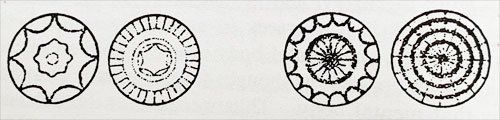
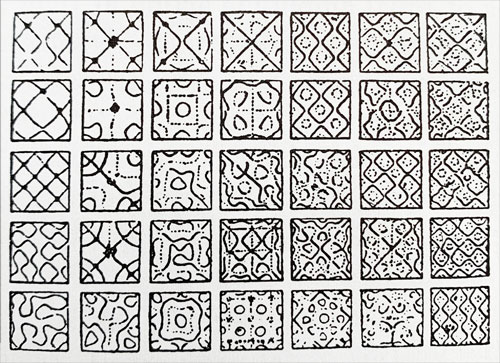
[Pendulums] suffice to demonstrate how readily vibrations may be transformed into figures.(Besant and Leadbeater 20)TFclairvoyant • Theosophy • Besant & Leadbeater
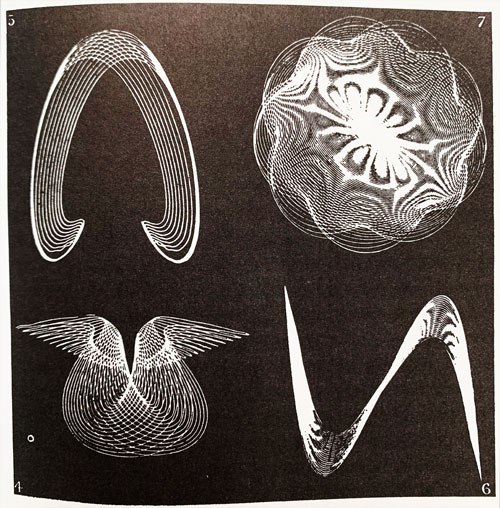
Sound Vibrations Create Forms
When, for example, a musical note is sounded, a flash of color corresponding to it may be seen by those whose finer senses are already to some extent developed. . . . Sound produces form as well. . . . Every piece of music leaves behind it an impression of this nature. . . .
The same piece of music if accurately played will always build the same form, but that form will be enormously larger when it is played upon a church organ or by a military band than when it is performed upon a piano, and not only the size but also the texture of the resultant form will be very different. (Besant and Leadbeater 67)
Such forms remain as coherent erections for some considerable time—an hour or two at least; and during all that time they are radiating forth their characteristic vibrations in every directions, just as our thought-forms do. (Besant and Leadbeater 69)
It is usually surrounded by many other minor forms, the result of the personal feelings of the performer or of the emotions aroused among the audience by the music. (Besant and Leadbeater 75)TFclairvoyant • Theosophy • Besant & Leadbeater
To play upon a musical instrument, or to sing, is to create color. . . . The musical thought-form produces no sound itself. It is the result of sound. (Borgia 112)LWUchanneled • modern • Benson
Emotion Creates Colors
Waves of Emotion
Waves of emotion are produced by the spotlight of our attention shining on a certain feeling, or a thought that triggers a feeling. While empowered with attention, that feeling is amplified through our auric field, shining out its corresponding colors and forms. The effect is like a ray of sunlight hitting a prism, shining out a particular color so long as the attention is held on it.
The mental body is composed of matter of several degrees of density, which we commonly arrange in classes according to the sub-planes. . . . There are thus many varieties of this mental matter, and it is found that each one of these has its own especial and appropriate rate of vibration, to which it seems most accustomed, so that it very readily responds to it, and tends to return to it as soon as possible when it has been forced away from it by some strong rush of thought or feeling. When a sudden wave of some emotion sweeps over a man, for example, his astral body is thrown into violent agitation, and its original colors are for the time almost obscured by the flush of caramine, of blue, or of scarlet which corresponds with the rate of vibration of that particular emotion. This change is only temporary; it passes off in a few seconds, and the astral body rapidly resumes its usual condition. Yet every such rush of feeling produces a permanent effect: it always adds a little of its hue to the normal coloring of the astral body, so that every time that the man yields himself to a certain emotion, it becomes easier for him to yield himself to it again, because his astral body is getting into the habit of vibrating at that especial rate. (Besant and Leadbeater 11-12)TFclairvoyant • Theosophy • Besant & Leadbeater
This illustrates how “habits of thought” make it easier to return to those thoughts.
If a person has a strong feeling, his quiescent aura will suddenly be permeated with another color and form correlating to his emotional state. . . . If the person has not released the feeling, it will remain in his aura (usually faded) until he does. . . . The colors and forms may rapidly flash and move out of the auric field, or they may simply fade away over a period of a few minutes or even a few weeks. They may even be colored over or masked by other colors and forms in a layered effect. . . . Every thought, feeling, and experience a person has affects and changes his aura. Some effect always remains. (Brennan 90)HoLclairvoyant • modern • Brennan
One of the earliest “explosions” of the human energy field I observed remains one of the most vivid. In 1972 during a bioenergetics-primal scream intensive workshop, I watched Linda light up like a Christmas tree as she screamed about the death of her father from cancer. Bright beams of red, yellow, orange and some blues streamed from her head. . . .
People flash bright colors when they are engaged in feelings or actions. When they are quiet, the auric field returns to a stable “normal” state for that person. (Brennan 89)HoLclairvoyant • modern • Brennan
Within the aura, streams of different colors present a true and ever-changing picture of our inner life in all its variability. (Steiner 161)Tclairvoyant • Theosophy • Steiner
At times a person may throw off color blobs of energy into the air around him. This is especially observable when someone is releasing feelings. (Brennan 50)HoLclairvoyant • modern • Brennan
Specific Colors / Emotions
Spiritual feelings have a range of colors: blue for the speaker of truth, purple for spirituality and silvery gold for purity. . . .
Envy appears to be dark, dirty green and sticky, as in “green with envy.” Sadness is dark gray and heavy as in the cartoons of people with dark clouds over their head. (Brennan 91-92)HoLclairvoyant • modern • Brennan
These phrases and images are higher perceptions making their way into the waking consciousness. They are picked up and spread as ideas by those who recognize them.
Intense jealousy creates a brownish-green, murky color in the aura of the person holding this type of thought. . . . A loving thought will produce shades of yellow. (Browne 166)RotOSclairvoyant • modern • Browne
Red is Anger
Just as we’d expect, red represents anger. This is how it’s been portrayed in art, animation, and cartoons, which give us an opportunity to include what we feel and sense in what we see.
The quality of the color red is what denotes anger. Bright red orange is not anger; it is related to vibrant life force. . . .
Someone who is angry has a dark red color. When this anger is expressed, it shoots off the person in flashes like bolts of lightning or round sparks that move away from the person. . . .
An example in which the person did not release her anger and pain. . . . As the red spot emerged from the throat area, it slowly moved outward. A moment later the group leader made a comment to her that was, in my opinion, hurtful. At this point, the red spot quickly moved back toward her body and into her heart area. When it hit her heart, she started crying. The crying was not of the cathartic type. It was rather “poor me, the victim.” My interpretation of this event is that she had stabbed herself in her heart with her own anger. . . .
Frustration and irritability will probably have dark reddish tones (red with anger), but are mostly apparent from their irregular vibrations that beat against another person’s energy field, causing very unpleasant sensations. Usually one’s friends react to this interference by trying to elicit a direct expression of negative feelings, which are much more pleasant to deal with. For example, one will say, “Are you angry?” Another will blurt out angrily, “No!” Thus some of this annoying interference is released. (Brennan 91-92)HoLclairvoyant • modern • Brennan
Gray is Fear
Fear . . . has a whitish-gray prickly appearance in the aura, as in white with fear. It is very unpleasant looking and has a repulsive odor. (Brennan 92)HoLclairvoyant • modern • Brennan
The effect of fear upon the astral body is very striking. A sudden shock of terror will in an instant suffuse the entire body with a curious livid grey mist, while horizontal lines of the same hue appear, but vibrate with such violence as to be hardly recognizable as separate lines. . . . All light fades out for the time from the body, and the whole grey mass quivers helplessly like a jelly. (Leadbeater 91)MV&Iclairvoyant • Theosophy • Leadbeater
See The Flash of Fear.
The Lights of Different Levels
Within the auric streams and rays surrounding a person, three different types of color phenomena are distinguishable. . . . The first type of color is relatively dull and opaque in character, although even it seems fleeting and transparent in comparison to the type of color seen by our physical eyes. Within the spiritual world itself, however, these colors make the space they occupy comparatively opaque, as if they were filling it with figures of mist. The second type of color is all light, so to speak; these colors light up the space they occupy so that it too becomes all light. But the third type of color phenomenon is totally different from the other two in its radiating, sparkling, glittering character. These colors do not simply fill the space they light up; they shine and radiate right through it. There is something active and inwardly mobile about them, as if they were constantly creating themselves from within, while the other colors have something quieter and more lackluster about them. . . .
[These three color types] interpenetrate in a great variety of ways. It is possible to watch all three kinds mixing and mingling in the same place in the aura. . . . We can sort things out by turning our supersensible attention to only one of the three at a time. . . .
The threefold human aura is the supersensibly perceptible expression of the three components of the human being’s essential nature—body, soul and spirit. . . .
The more a person rids him- or herself of physical urges, the less prominent the first part of the aura becomes. Meanwhile, the second part becomes larger and larger, filling the body of colors within which the physical human being dwells with its radiating energy. And the more a person proves to be a servant of the eternal, the more the third part of the aura is revealed. (Steiner 166-168)Tclairvoyant • Theosophy • Steiner
The more our minds are clear and open to higher guidance, the more light shines through our thinking.
Color Harmonics
When a note is struck on the piano, a wave form of that note is emitted. The resonance of that first wave excites a vibration in other notes of mathematical equivalence. . . . The second note vibrates because its natural frequency (measured in cycles per second) is triggered into movement by a complementary frequency in the original note. This phenomenon is known as harmonic, or sympathetic, vibration. Each harmonic is a mathematical multiple (in cycles per second) of the fundamental note. . . .
The frequencies of visible color have a harmonic relationship to the frequencies of auric color; auric colors may exist in both lower and higher harmonics of visible color. . . . If we see red in the aura of the woman, however, that red could indicate either pain or anger. These two reds in the aura look identical, but they are not the same. The lower two or three harmonics of the color red reflect pain in the physical body. In the higher red harmonics (or vibrations) there exists the same drive or action that pain excites someone to, but it is not pain itself. At least it is not physical pain; it could be existential pain. It could also be rage or anger. (Bruyere 64-65)WoLclairvoyant • modern • Bruyere
We Are Open Systems
As the Source flows into us, we are constantly directing its flow into various thoughts and emotions. These produce constantly varying vibrations, forms, and colors that flow out from each of us. These can not only be felt by others, but can influence others on both mental and emotional levels.
This forms the basis of our higher levels of communication — the constant subconscious communication that goes on at all times. These subtle communications may instead reach our physically-oriented consciousness as feelings about the present situation.
If we accept the idea that we are dynamic systems which are constantly receiving and radiating energy, we can understand the degree to which human beings affect one another’s emotional fields. This varies, of course, according to the inner stability and integration of the individual. When a person identifies himself with his emotions, he naturally responds readily to the emotions of others. He may be a warm and loving person, but he may also become the victim of other people’s emotional disturbances. . . .
We might say, therefore, that the astral body of each one of us is the result both of individual emotional activity, whether or not consciously directed, and of interaction with other energies within the general astral field. Every person is in continuous exchange with other people and with the environment as a whole. . . . The astral field, like all the rest, is universal, and therefore there are no real barriers within it, although local conditions can enhance or inhibit its flow. (Karagulla and Kunz 51-52)C&HEFclairvoyant • modern • Karagulla & Kunz
As we think, thoughts go out to mold the thoughts and lives of others. (Besant 97)SLwisdom • Theosophy • Besant
By the power of imagination all men, certainly imaginative men, are forever casting forth enchantments, and all men, especially unimaginative men, are continually passing under their power. . . . If I can unintentionally cast an enchantment over persons, there is no reason to doubt that I am able to cast intentionally a far stronger enchantment. (Goddard 14)Rmystic • New Thought • Goddard
See Constant Subconscious Telepathy and Entrainment - Our Connection.
Thought Forms in the Aura
Vibrational Shapes vs. Originating Thoughts
As we’ve seen, each thought and feeling has an energetic effect that can be seen by clairvoyants. This is distinct from the imagery of the experience that caused it.
One striking illustration is that of a force raying outward, the projection of an earnest prayer. Another prayer is seen producing forms like the fronds of a fern, another like rain pouring upwards. . . . A rippled oblong mass is projected by three persons thinking of their unity in affection. A young boy sorrowing over and caressing a dead bird is surrounded by a flood of curved interwoven threads of emotional disturbance. A strong vortex is formed by a feeling of deep sadness. . . . It is clear that in these pictures that which is obtained is not the thought-image, but the effect caused in etheric matter by its vibrations, and it is necessary to see clairvoyantly the thought in order to understand the results produced. (Besant and Leadbeater 3-4)TFclairvoyant • Theosophy • Besant & Leadbeater
[Those who have developed their inner senses] experience another being’s feelings as raying out toward them like rays of light. . . . For them, one person’s thought about another person is not invisible, it is a perceptible process. . . . [The thought] produces effects on the spiritual world and it is this process that is perceptible to the spiritual eye. The thought is an actual reality streaming out from one person toward the other. (Steiner 160)Tclairvoyant • Theosophy • Steiner
In more developed inner senses, our innate ability to pick up others’ thoughts and feelings is experienced so intensely that synesthesia takes place.
This radiating vibration conveys the character of the thought, but not its subject. (Besant and Leadbeater 14)TFclairvoyant • Theosophy • Besant & Leadbeater
Auric Movies
Behind each color, vibration, and abstract form that thoughts and emotions produce is the immersive recording of the originating experience (unless that experience is presently occurring). Some clairvoyants can tap into this auric movie or memory to see what’s causing current emotions. This is a way of seeing what one’s focus is. If we’re feeling something, then the originating event is in our attention’s focus, whether we are conscious of it or not.
In 1996, I went to get a reading at the Berkeley Psychic Institute. They looked at and described the layers of my aura. It was accurate and insightful. They knew, by looking at “bubbles in my aura”, that Wadsworth was distant and sought expression at work, away from home.
Rich says she often sees what looks like a little transparent movie going on around a client’s head. . . . “I can see what they’ve thought of and what’s happened to them during the last six months. Recently I told a client that I could see her home and she had masks and flutes hanging on her wall.” . . .
Dryer says she sees what look like three-dimensional movies in a person’s energy field. “Usually they’re in color, but they can also be brown, or look like tintypes. Often they depict a story about the person that can take anywhere from five minutes to an hour to unfold. . . .
When she chooses one and starts to watch it, it seems to expand and fill the entire room. “If I see something going on with a person’s shoulder, such as an injury, suddenly the whole scene widens.” (Talbot 181-182)HUscientific, researcher • modern • Talbot
Auric Thought Forms
Some clairvoyants can see habitual topics of thought as thought forms in a person’s aura.
Another [quality of the human energy field] is the aura’s ability to manifest as an amorphous blur of energy, or occasionally form itself into three-dimensional images. Talented psychics often report seeing such “holograms” floating in people’s auras. These images are usually of objects and ideas that hold a prominent position in the thoughts of the person around whom they are seen. Some occult traditions hold that such images are a product of the third, or mental, layer of the aura. . . .
[Beatrice] Rich often sees images floating around or hovering near her clients. Once she saw silver spoons, silver plates, and similar objects circling around a man’s head. . . . Finally she told the man and discovered that he was in the import/export business and traded in the very objects she was seeing circling his head. . . .
Dryer has had many similar experiences. Once during a reading she saw a bunch of potatoes whirling around a woman’s head. . . . She . . . asked the woman if potatoes had any special meaning for her. . . . “She was from the Idaho Potato Board,” says Dryer. . . .
On one occasion Dryer saw a wispy and holographiclike layer of mud clinging to a woman’s hands and arms. . . . She was a sculptor and had tried out a new medium that morning that clung to her arms and hands exactly as Dryer had described. (Talbot 179-180)HUscientific, researcher • modern • Talbot
How Thoughts Take Form
Thinking is a lot like blowing bubbles. Our attention is the wind, blowing wherever we focus it. The medium of our mind is the membrane of bubble solution. The wand is the specific thought — imagine in this case that the shape of the bubble is based on the shape of the wand. The wind of our attention constantly blows through the wand of our thought, taking shape in the bubble solution. In this way, we are creating or strengthening an endless stream of forms.

Now, due to thought’s higher-dimensional nature, we have a sea of bubble solution instead of a flat membrane. Our attention can focus anywhere within that sea — not just at the surface of the membrane. Whatever we focus on determines the form. The forms created are based on our original perceptions and are as real as the original they’re based on. They remain invisibly linked to us, and last as long as attention remains on them, before slowly shrinking away. They behave as we expect them to, responding instantaneously to our expectations.
Now one final change — our attention is closer to a flow of hot liquid light, flowing through past impressions, projecting out into the forms. This is the way in which attention becomes that which it focuses on. It literally takes that form.
Angels (channeled): Thoughts contain a force that creates . . . the very thing upon which they focus. (Fairchilde 134)VftAchanneled • modern • Fairchilde
Cayce: “What one thinks continually, they become.”
Cayce: “Thoughts are things and as their currents run through the environs of an entity’s experience these become barriers or stepping-stones, dependent upon the manner in which these are laid.” (Lynn and Cayce 54)NDchanneled • modern • Lynn & Cayce
We are our attention, and attention becomes, so what we think, we literally become. We take on that form, and strengthen it, increasing our tendency to take it on again.
The Mental Image
Mental Images Generate Thought Forms
Mental images are essentially our library of beliefs, concepts, and past experiences. They provide the shape that will be given form by the flow of attention.
Let us now consider . . . the thought-form pure and simple in relation to the ensouled thought-form. . . . The soul breathes out the thought, and the sound makes form in astral matter. . . . These mental images in the human mind, when outbreathed, become the manifested universe of their creator. He peoples his current in space with a world of his own. . . . The mental image itself remains, as has been already said, in the consciousness of its creator, but its vibrations passing outside that consciousness reproduce its form in the denser matter of the lower astral plane. This is the form that affords the casing for a portion of the elemental energy, specializing it for the time that the form persists, since the manasic NOTE: mental element in the form gives a touch of individuality to that which ensouls it. This is the active entity NOTE: thought form. . . . It is this astro-mental image NOTE: thought form that ranges over the astral plane, keeping up with its progenitor the magnetic tie spoken of, reacting on its parent, the mental image, and acting also on others. The life-period of an astro-mental image may be long or short, according to circumstances, and its perishing does not affect the persistence of its parent; any fresh impulse given to the latter will cause it to generate afresh its astral counterpart. (Besant 24-25)Kclairvoyant • Theosophy • Besant
Mental Images and Specific Search
The mental image is what we focus on when we’re trying to find something. Specific Search works by focusing on a mental image, and projecting it out into the physical world where it lights up if it finds a match.
When focused in the physical, we’re unaware that we’ve created a thought form. However, that thought form is visible in the dream state.
The Elemental Essence — Thought-Responsive Matter
The Responsive Medium of Thought
Consider a flat white screen upon which we can project two-dimensional movies. Now imagine an endless three-dimensional transparent sea in which we can project three-dimensional movies. This gives a general idea of what the theosophists call the elemental essence.
Attention projects a thought or mental image outward into this sea, where it is instantly filled with the elemental essence to take form as a thought form. Once attention is withdrawn, the elemental essence then gradually drains from the form, causing the thought form to shrink and melt away.
The elemental essence exists in many frequencies and forms into what is considered the basic matter of each frequency domain.
Leadbeater & Besant have several alternate names for thought forms, including “active entities”, “astro-mental images”, “artificial entities”, “elementals”, and others.
The elemental essence [is] that strange half-intelligent life which surrounds us in all directions, vivifying the matter of the mental and astral planes. This matter thus animated responds very readily to the influence of human thought, and every impulse sent out, either from the mental body or from the astral body of man, immediately clothes itself in a temporary vehicle NOTE: body of this vitalized matter. Such a thought or impulse becomes for the time a kind of living creature, the thought-force being the soul, and the vivified matter the body. . . . Each thought draws round it the matter which is appropriate for its expression, and sets that matter into vibration in harmony with its own. (Besant and Leadbeater 15)TFclairvoyant • Theosophy • Besant & Leadbeater
What we find is a vast store of elemental essence, wonderfully sensitive to the most fleeting human thought, responding with inconceivable delicacy in an infinitesimal fraction of a second to a vibration set up in it even by an entirely unconscious exercise of human will or desire. But the moment that by the influence of such thought or exercise of will it is moulded into a living force—into something that may correctly be described as an elemental NOTE: thought form—it at once ceases to belong to the category we are discussing, and becomes a member of the artificial class. Even then its separate existence is usually of the most evanescent character, and as soon as its impulse has worked itself out it sinks back into the undifferentiated mass of that particular subdivision of elemental essence from which it came. (Leadbeater 48-49)
When any portion of this essence remains for a few moments entirely unaffected by any outside influence it is absolutely without any definite form of its own, though even then its motion is rapid and ceaseless; but on the slightest disturbance, set up perhaps by some passing thought-current, it flashes into a bewildering confusion of restless, ever-changing shapes, which form, rush about, and disappear with the rapidity of the bubbles on the surface of boiling water. (Leadbeater 52)APclairvoyant • Theosophy • Leadbeater
The movement of consciousness upon itself creates a motion or vibration upon Substance NOTE: the elemental essence, the force of which is equal to the embodiment of the thought set in motion. . . .
Let us suppose, for illustration, that the Universe is nothing but water, permeated by an Infinite Intelligence. Imagine that every time this Intelligence moves, or thinks, ice is formed in the water, exactly corresponding to the thought. We might have countless pieces of ice of different form, color, and size, but these pieces of ice would still be water! If we could heat the entire mass, it would melt, and all forms would again become fluid. (Holmes 141)SoMwisdom • New Thought • Holmes
A brilliant metaphor — higher frequencies of consciousness are brighter, more fluid, and “hotter” such that thought forms quickly melt back into the substance of the plane. At the source, it’s so hot nothing can take form at all. In the cold outreaches of the universe, here in the physical, forms stay crystallized in the cold for long periods, only being broken down through physical processes.
See The Objective Field - Thoughts Influence Probabilities for some great information on how this field or essence influences physical reality.
Its Habitual Forms
[These evanescent shapes] have usually a certain appropriateness to the character of the thought-stream which calls them into existence. . . . This elemental kingdom as a whole is very much what the collective thought of humanity makes it. . . .
[The “elemental”] is simply a latent force, which needs an external power to set it in motion. . . . Although all classes of the essence have the power of reflecting images from the astral light as described above, there are varieties which receive certain impressions much more readily than others—which have . . . favorite forms of their own into which upon disturbance they would naturally flow unless absolutely forced into some other, and such shapes tend to be a trifle less evanescent than usual. (Leadbeater 52, 54-56)APclairvoyant • Theosophy • Leadbeater
The Infinite Potential Pattern
On psychedelics, I experienced something similar — an energetic field of perception that can be projected upon and takes any shape.
This is the “Infinite Potential Pattern” that receives thoughts. It is a static-like energy pattern with infinite potential to become anything. Lights, sounds, and thoughts show on it.
Monroe’s M Field
I’m unsure if this is the same subjective medium described by Leadbeater & Besant. To Monroe it is the medium of thought and emotion. However, he doesn’t mention its relation to forms. Perhaps he can hear the originating sounds but not see the forms created by them.
There is a broad field of energy which for convenience is called (M). . . . It is the only energy field common to and operational both within and outside time-space and is present in varying degrees in all physical matter. . . .
All living organisms use (M) to communicate. Animals are more aware of (M) radiation than humans, who, with few exceptions, have no awareness of it at all.
Thought is a much-used perturbation of (M), and emotions are bands of (M) adjacent to thought. Love is also a band of (M) adjacent to thought. . . . Thought affects and modulates (M) radiation. . . .
Humans are subject to constant (M) input from other sources, including human sources, without the conscious knowledge of either sender or receiver.
The I-There NOTE: reincarnating self is composed solely of (M), “There” being outside time-space but within the (M) Field. Humans who are not mind-active in time-space, who are phased out during sleep, unconscious, or otherwise, are operating in the (M) Field with a lesser phase relationship to the physical. (Monroe 185-186)UJOBEr • modern • Monroe
For more, see Hearing Emotions.
Purity of Thought Determines Frequency of Essence Affected
In order that an aspiration or a thought-force should result in existence on [the heaven-world] NOTE: the upper astral plane, its dominant characteristic must be unselfishness.
Affection for family or friends takes many a man into the heaven-life. . . .
There is the love which pours itself out upon its object, seeking for nothing in return—never even thinking of itself, but only of what it can do for the loved one; and such a feeling as this generates a spiritual force which cannot work itself out except upon the mental plane NOTE: that same plane. But there is also another emotion which is sometimes called love—an exacting, selfish kind of passion which desires mainly to be loved—which is thinking all the time of what it receives rather than of what it gives. . . . The force which it sets in motion will never rise above the astral plane NOTE: the lower-to-mid astral plane. (Leadbeater 48-49)DPclairvoyant • Theosophy • Leadbeater
If a thought be purely intellectual and impersonal—for example, if the thinker is attempting to solve a problem in algebra or geometry—the thought-form and the wave of vibration will be confined entirely to the mental plane. (Besant and Leadbeater 24-25)TFclairvoyant • Theosophy • Besant & Leadbeater
That a higher love (emotion) relates to the mental plane is further evidence that Besant & Leadbeater’s mental plane can be thought of as the upper astral (emotional) plane.
The Power of Higher Thoughts
The further up the stream of the microgeny the thought originates, the more powerful it is.
Leadbeater’s progressively faster frequencies of consciousness are the astral, mental, buddhic, and nirvanic:
Our ordinary thought begins in the mind-body on the lower mental levels and clothes itself as it descends with the appropriate astral elemental essence; but when a man has advanced so far as to have his consciousness active in the true self in the higher heaven-world, his thought commences there and clothes itself first in the elemental essence of the lower levels of the mental plane, and is consequently infinitely finer, more penetrating, and in every way more effective. If the thought be directed exclusively to higher objects, its vibrations may be of too fine a character to find expression on the astral plane at all; but when they do affect this lower matter they will do so with much more far-reaching effect than those which are generated so much nearer to its own level.
Following this idea a stage further we see the thought of the initiate taking its rise upon the buddhic plane, above the mental world altogether, and clothing itself with the elemental essence of the highest heavens for garment, while the thought of the Adept pours down from nirvana itself, wielding the tremendous, the wholly incalculable powers of regions beyond the ken of mere ordinary humanity. (Leadbeater 121-122)DPclairvoyant • Theosophy • Leadbeater
These are thoughts originating progressively further up the stream, with greater and greater power.
Differences in Thought-Reactivity
On the mental as on the astral plane there was present an elemental essence. . . . It was, if possible, even more instantaneously sensitive to the action of thought here than it had been in that lower world. (Leadbeater 27)DPclairvoyant • Theosophy • Leadbeater
Each environment and dimension within the interior of the universe has specific similarities and differences.
The most significant difference appears to be the degree of responsiveness to thought. . . . Some nonphysical environments are easily molded by thought while others are extremely resistant. (Buhlman 67)
[Natural (raw) energy environments] are often observed as misty voids, empty space, or featureless, open areas consisting of white, silver, or golden clouds of energy.
Natural energy environments are extremely sensitive to thought. Any focused thought will instantly mold the immediate energy environment. (Buhlman 95)ABtBOBEr • modern • Buhlman
Delayed Responsiveness in the Physical
Angels (channeled): Because of the slowed vibrational rate in your world there is a longer time between the thought and the manifestation of that thought. This gives you the opportunity to make alterations in your direction, to rethink things before taking action—to learn to take responsibility for what you have created. (Fairchilde 147)VftAchanneled • modern • Fairchilde
Dr. Peebles: Depending on what vibratory plane you are responding to, things become things from thoughts more rapidly. . . . The slower vibrations of Earth, where there’s a delay in thoughts becoming things, is by intention so that you can study the process of that. (Pendleton 36)TDAchanneled • modern • Pendleton
Subject: In the spiritual world, a thought is as good as done. Merely thinking the thought produces the desired effect. In the physical, things are not quite that easy; thus the human must learn patience. . . .
On Earth we are given much more time between the thinking and the materialization of the thought, so that we have a chance to change our mind. (Cannon 135-136)BDLhypnosis • modern • Cannon
It’s a difficult jump between thoughts instantly becoming reality in the nonphysical, and thoughts becoming reality in the physical. In the physical, things don’t just appear. So how does this work?
This is a reference to the internal reality, about swells of thought and feeling in the astral that are felt by larger and larger groups of people. These feelings draw our interest to new beliefs and perspectives, and then slowly build into social movements and change at larger levels. And that eventually results in change in the physical world. The changes occur through us, from the inside, and then we act to bring them about in the physical.
To see how this works in more detail, see Physical Reality out of Dreams and How Consciousness Forms Physical Matter.
The Unresponsive Virgin Matter
The Boundary of Our System
This is fascinating.
When you travel beyond a certain range of intensities, even pseudo-objects NOTE: thought forms must vanish. They exist in a cluster about, and connected to, your own system. The lack of these, obviously, means that you have gone beyond your own camouflage system NOTE: the physical imagery you experience and project. If it were possible, you would then travel through a range of intensities in which no camouflage existed. Then you would encounter the pseudo-camouflage of the next system. This would or would not be physical matter, according to the system. You would then encounter the heart of the camouflage area. . . .
There is little communication within the uncamouflaged areas. They act as boundaries, even while they represent the basic stuff of which all camouflage is composed NOTE: the elemental essence. . . .
The undifferentiated layers are composed of the vitality that forms the camouflage of all systems. . . . You are in touch with infinity in such areas, since it is only camouflage that gives you the conception of time.
Now, during some projections NOTE: out of body experiences, you may be aware of nothing as far as surroundings are concerned. . . . If this occurs, you will be traveling through such an uncamouflaged area. You could then expect to encounter next a more differentiated environment, that seems to become clearer as you progress toward the heart of another system.
The completely uncamouflaged layer would be rather bewildering. You might automatically be tempted to project images into it. They would not take, so to speak, but would appear and disappear with great rapidity. This is a silent area. Thoughts would not be perceived here, as a rule, for the symbols for them would not be understood. (Roberts 376-377)SD&Pchanneled • modern • Seth
This also describes the voids between frequency domains of consciousness — the reason why we have multiple selves.
Let us now consider some of the characteristics of the virgin substance which lies outside and beyond our evolutionary system. . . .
This new substance had the property of a kind of mechanical inertia. . . .
Neither thought, desire, will, nor any attraction of our own world has power over this matter, and equally, the matter has no magnetic effect on us.
Seen in bulk, this matter has the colour of freshly cut ebonite. It gives out no vibration. It has no elasticity. . . . Here we feel nothing, and we are not aware of the very least reaction. According to the density of this virgin substance so we have the impression of standing before a thick wall or in a mist, neither so solid nor so dark. . . . In order to penetrate into it we must make a definite mechanical effort. With arms outstretched we must push this matter aside in order to break through, when we have the quite material sensation of moving in a sort of “paste” which does not stick and is not cloying. . . .
Though the powers of thinking, reasoning, and consciousness itself are clear, they have not the sensitivity even of that experienced in the lowest strata of our cosmic ether. . . .
A substance so material . . . might well be the root of matter. (Yram 182-183)PAPOBEr • Yram
Thought Forms
The result of the flow of attention through a mental image into the elemental essence is a thought form.
Here we focus on thought forms as reproductions of physical forms — people, objects, and environments.
How important are thought forms? Every form, person, and environment we experience in the dream state and between our physical lives are thought forms. They comprise the world we occupy outside the physical, for as long as we are physically focused. Thought forms exist on the way to physical reality, coming before it in the stream of the microgeny and therefore influencing it.
A great variety of illustrative examples on the creation of, interaction with, and release of thought forms can be found in Thought Forms.
Nature of Thought Forms
Imagination has very accurately been called the creative faculty of the mind, and it is so in a more literal sense than many may suppose who use the phrase. This image-making capacity is the characteristic power of the mind, and a word is only a clumsy attempt to partially represent a mental image. . . .
A thought-form, then, is a mental image, created—or moulded—by the mind out of the subtle matter of the higher psychic plane. (Besant 9-10)Kclairvoyant • Theosophy • Besant
There are to be found on the Astral, or on the earth plane by means of astral vision, a great class of entities, or semi-entities, which occultists know as “artificial entities” NOTE: thought forms. . . .
They are the creations of the minds of men. . . . They are not entities, in the strict sense of the term, having no life or vitality except that which they borrow from, or have been given by their creators. . . .
The majority of these artificial entities, or thought-forms, are created unconsciously by persons who manifest strong desire-force, accompanied by definite mental pictures of that which they desire. (Panchadasi 87)AWunknown • New Thought (Theosophy) • Atkinson
Life embodies itself in forms, and the life-energy which comes forth from that aspect of the Self which is knowledgeable molds the matter of the mental plane into thought-forms. The vibrations that affect the mental body determine the materials that are built into its composition. (Besant 28)SLwisdom • Theosophy • Besant
(The combination of) thought, emotion, and desire creates form, possesses energy, (and) is made of energy. It will show itself in as many ways as possible. . . .
But whether you have a physical form or not, if you have emotion or feelings, these will take form. They have a reality. If you think strongly of an object, somewhere it will appear. (Roberts 145)SSchanneled • modern • Seth
Created Through Projection
Moment to moment our focus shapes the stream of conscious light coming through us into vibrations, colors, abstract forms, and thought forms.
Any time our attention is focused on past experience, we create or energize thought forms. Thought forms are the projections of our desires, fears, expectations, and other past experiences. They are projected into the astral/dream plane of consciousness — a fluid but objective shared nonphysical reality.
When we are focused in the physical world, our thought forms act as specific searches, through which we seek to find their match. They operate on the principle of like attracts like. Matches and near-matches attract our attention. When focused outside the physical (such as in the dream state), these forms become what we’re looking for, visible to us and part of our environment.
When a man thinks of his friend he forms within his mental body a minute image of that friend, which often passes outward and usually floats suspended in the air before him. In the same way if he thinks of a room, a house, a landscape, tiny images of these things are formed within the mental body and afterwards externalized. This is equally true when he is exercising his imagination; the painter who forms a conception of his future picture builds it up out of the matter of his mental body, and then projects it into space in front of him, keeps it before his mind’s eye, and copies it. (Besant and Leadbeater 26-27)TFclairvoyant • Theosophy • Besant & Leadbeater
All these images are stored within the mind. Our attention enlarges them and projects them out around us into our surroundings at astral frequencies.
The same thing is done in the physical. The world we perceive around us is projected there. Light enters the curved plane of our eyes, is converted into neural signals, and then the brain projects the perceived world around us.
Nonphysical Projections of Physical Forms
Thought forms are nonphysical three-dimensional projections of forms experienced in the physical universe.
Thought forms exist in the nonphysical dimensions of consciousness. They are best seen as 4th-dimensional objects as they can easily pass through physical objects or travel any distance almost instantly. Attention flowing through a mental image experienced in the physical causes it to take on three-dimensional form. When attention moves away from that mental image, its thought form slowly melts away from those dimensions and disappears.
The Source flows into us and is given new form through our focus. Just like us, thought forms exist from the Source outward, the light of consciousness having passed through the higher frequencies within our own consciousness out through our focus into form in the slower astral frequencies. As such, they also exist in the higher-frequency domains, as brighter, more vibrant forms, the brighter “soul” within their own temporary astral bodies.
Outside of the physical universe, things aren’t divided by time and space. Everything exists as a higher-dimensional concept. For example, instead of countless cats scattered across time and space, there is rather the concept of a cat. From that perspective, all physical cats are projections of this one concept into various coordinates in time and space. Each cat, then, is one instance where that higher-dimensional concept intersects with the physical.
The Objectivity of Thought Forms
Thought forms are objective creations. I’ve had many experiences in the dream state in which I create a thought form and others interact with it, or I interact with something others have created.
The astral material . . . is shaped and formed only by the thought and imaginative power of the minds of those inhabiting that plane. . . . They have an independent existence of their own, being composed of astral material, though shaped, formed and built up directly by the mind-power of the astral dwellers. . . .
The astral scenery, etc., survives the passing away of the mind which built it up, and disintegrates only after the passage of considerable time. . . . As for the power of imagination of man, do not be deceived for a moment—for this is one of the most efficient powers in nature, and operates strongly even on the material plane, though on the Astral its power is more easily recognized by the senses. (Panchadasi 60-61)AWunknown • New Thought (Theosophy) • Atkinson
Two Kinds of Projections
Thought forms are the projections of our consciousness. In my own experience, there are two kinds of projections.
The first is projections that create (and maintain) something new. The second is projections onto something that already exists.
Projections That Create
Our projections can create the form of a new person, object, or place where there was none. The result is a new objective thought form that others can interact with so long as someone’s attention sustains it.
Projecting onto Objective Things
We can also project our forms onto an existing person, object, or place. This usually happens when we’re looking for or expecting something. Projections of this sort lead to mistaken identity, and entirely subjective experiences based on an objective scene.
This kind of projection is also used to make the meaning of a nonphysical experience understandable to our physically-oriented consciousness. In these cases, the feelings are primary, and the we project the physical forms that we connect with those feelings. see Translating Nonphysical Experiences.
Similarly, this kind of projection makes the meaning of someone else’s experience understandable to us. For example, if someone is sharing an experience they had with their mother, our own mother is often projected onto the mother in the memory so that we immediately understand the meaning. This makes it less true, more but easily accessible to us. see Mapped Identities.
While it’s often our familiar physical interpretations (projections) that we perceive, it’s not always the case. We can see the original forms. At that level of perception, the necessary understanding and context flows into us as part of the scene. In the example above, I would see the other person’s unfamiliar mother, but would instantly and fully understand who it is and their relationship to the sharer of the experience.
On all the outer and inner planes of human consciousness what one really sees are the mind’s picturized interpretations of thoughts or vibrations coming from the minds of others. (Benner 315)WttKchanneled • New Thought • Benner
You perceive only your own constructions. If a “ghost” wants to contact you therefore, he can do so through telepathy, and you can yourself construct the corresponding image you desire. Or the individual might send you a thought-form at the same time that he telepathically communicates with you. (Roberts 146)SSchanneled • modern • Seth
I saw Charles dressed in his uniform because that was what he was wearing the last time I had seen him and so I, unknowingly, had made a thought-form of him dressed in his uniform, and the plastic astral matter had immediately responded to my thought. He told me also that even if Charles had thought about what he was wearing before seeing me, I should not have seen him dressed in the type of clothing he had imagined, unless he had mentioned it to me. I would always see him dressed as I imagined he would be. (Richelieu 44)ASJOBEr • modern (Theosophy) • Richelieu
We perceive our own projections until we stop projecting. Did the observer actually change the astral matter in any objective way? In my experience it’s like we have a screen around us that we project onto, which colors and obscures our true seeing. The thought forms themselves are objective, but we are projecting a subjective image onto them.
Jesus, the angels and platform, disintegrated into a giant sphere of light once Carter Mills no longer needed their shape or form to put him at ease. (Atwater 74)BtLNDEr, researcher • modern • Atwater
The Astral World Is Written Through Attention
The astral frequencies of consciousness are the nonphysical borderlands of the physical multiverse. They are populated by forms projected into them by those who are experiencing or have recently experienced life in the physical.
When we are focused in the present, the Source flows into our perceptions, taking the form of and becoming whatever we focus on. By the mere fact of our higher frequency of attention taking that form, we create that form in the higher frequency realities outside (but connected to) the physical universe — in the astral plane of consciousness.
His mentor, he said, impressed on him that “. . . all our brains are just end-organs projecting as it were from the three-dimensional universe into the psychic stream . . . and flowing with it into the fourth and the fifth dimensions.”
Accordingly, the doctor commented, he could see this “condensation of the psychic stream” forming a kind of cloud around each living brain. (Steiger 147)OwtLNDErs • modern • Steiger
This is a great consciousness-first perspective. Imagine a higher-dimensional point of view from within the great flow. A barely visible 3D human brain would be seen causing shapes, colors, and pictures to appear in that stream, condensing thoughts and sense impressions out of the flow, giving them higher-dimensional existence through the application of its attention.
This is how the astral world is written. Our own attention takes the shape of physical forms, creating them in the astral frequencies of consciousness. Our emotional experience at the time determines where in the astral frequencies they are created. The forms of negative experiences are created in the lower astral, and the forms of positive experiences are created in the higher astral.
Creating Forms in Higher Frequencies
By casting our attention into the world, we enlarge and bring forward experiences into the higher frequencies. In this way, our attention draws the forms that attract it closer to the Source.
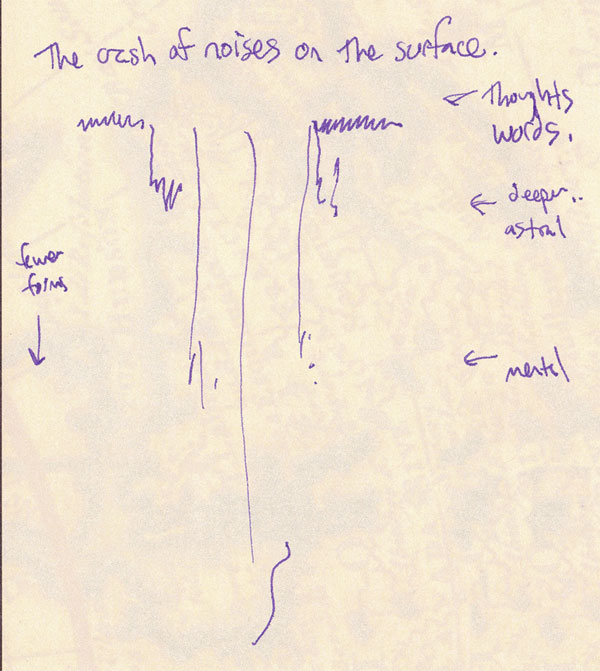
In the image above, the top is the surface of the sea of our inner reality, our daily conscious awareness crashing about in the noise of external words. The bottom is more deep, closer to the Source, further up the stream.
When an experience touches us, it is because it is charged with feeling and enlarged through our attention. The form of that experience is recorded in the deeper, more fluid levels of the sea — the astral, the mental. This is how those frequencies become worlds are populated with forms. The deeper you go, the fewer forms you encounter.
My attention on writing makes it more real, more astral! The mere perception of it here in the physical with attention speeds it up, “writes” it to the astral! The frequency (position in the astral) is the amount of light on it from our attention. The realms are the totality of experiences made at each specific frequency of attention. Attention on a form creates it as a thought form in the astral. The astral world’s forms are made by the imprint of attention on the physical world! Higher realms would be composed of forms from happier, brighter, more open experiences.
The astral world is an organization of human experience by frequency (feeling) rather than time or place. It’s a reorganization by a more meaningful measure — the feeling of the experiences. Physical time doesn’t matter to the higher self. It was only a limitation while in the physical body. From a given frequency of attention (astral subplane), we can see our other experiences at that same level. “Like attracts like” can be understood in one way as “we perceive that which is at the same frequency as us.”
The astral world changes form through time as new experiences are had by the overall population and attention slowly fades from old ones.
Attachments come from physical and social conditions, and fix our attention to dim forms receding into the past. These needs always come with associated fears, giving them life in the lower astral. Without attachments, our undivided attention in the now would write everything we experienced into the higher astral realms, because our every moment would be our ideal life.
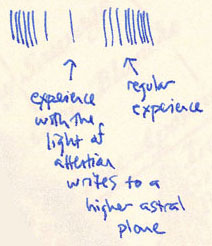
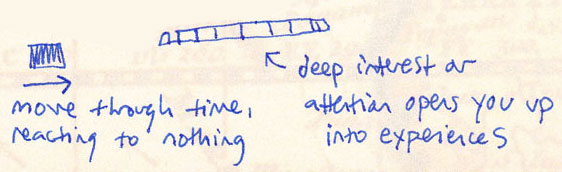
Imagine the image above as a folding fan, spreading open at the center. Each tick (or fold) is a physical moment. Moments without attention gather into a sort of darkness of non-experience — the dark, more compact parts at either side. The spread-out part in the middle shows the light of attention as expanded awareness, more psychological time relative to physical time. Literally, a higher frequency of consciousness.
Misattribution
All of this creation is due to our attention on the experiences of the physical world. We form attachments to these forms when we mistake them for the light of our own attention. Then we seek after the forms, hoping to recapture that experience. THIS IS THE ESSENTIAL MISTAKE. But attachment is not necessary. The Pure Essence flows ever into the now, waiting for us to open up and experience it.
The Lifespan of Thought Forms
Thought forms are created and sustained through our attention. They outlast the attention that created them, but slowly melt away unless they are given more attention.
Thoughts and ideas are not unlike the ripples, eddies, and whirlpools that form in a flowing stream, and like the whirlpools in a stream some can recur and persist in a more or less stable way, while others are evanescent and vanish almost as quickly as they appear. (Talbot 59)HUscientific, researcher • modern • Talbot
Intensity or Repetition of Thought
When the human mind formulates a definite, purposeful thought or wish . . . the effect produced is of the most striking nature. The thought seizes upon the plastic essence, and moulds it instantly into a living being of appropriate form—a being which when once thus created is in no way under the control of its creator, but lives out a life of its own, the length of which is proportionate to the intensity of the thought or wish which called it into existence. It lasts, in fact, just as long as the thought-force holds it together. Most people’s thoughts are so fleeting and indecisive that the elementals NOTE: thought forms created by them last only a few minutes or a few hours, but an often-repeated thought or an earnest wish will form an elemental whose existence may extend to many days. (Leadbeater 67-68)APclairvoyant • Theosophy • Leadbeater
Leadbeater is referring to directed thought forms when he says they are “in no way under the control of its creator”. Those we create near us in the dream state can be given further impulses according to our continued attention and new expectations.
The life-period of these ensouled thought-forms depends first on their initial intensity, on the energy bestowed upon them by their human progenitor; and secondly on the nutriment supplied to them after their generation, by the repetition of the thought either by him or by others. Their life may be continually reinforced by their repetition, and a thought which is brooded over, which forms the subject of repeated meditation, acquires great stability of form on the psychic NOTE: astral plane. So again thought-forms of a similar character are attracted to each other and mutually strengthen each other, making a form of great energy and intensity, active in this astral world. (Besant 14)Kclairvoyant • Theosophy • Besant
Every thought you have—in spirit and in the physical—takes a form. . . .
Some thoughts that pass through our minds quickly don’t create lasting forms. Others, because of their intensity or because of repetition, will become a powerful form with color and sound. . . . The longer you hold the thought, the more power it builds. . . . Thoughts that are held create strong patterns that build our auras. (Browne 165-166)RotOSclairvoyant • modern • Browne
The original intensity behind the construction NOTE: thought form determines its duration. . . . Left alone, any such construction will eventually vanish. It will leave a trace, however, in electromagnetic reality where it can then be activated by anyone when certain conditions are met or are favorable.
Denying energy to such a construction can be like pricking a balloon. . . . Then all attention must be taken from it, for it thrives upon attention. (Roberts 363-364)SD&Pchanneled • modern • Seth
The Ambient “Heat” of Higher Frequencies
There is an ambient light in the astral world, which is brighter as the frequency of consciousness increases. It can be thought of as the “heat” that melts thought forms that aren’t in our direct attention. The higher the frequency, the more heat, and the faster unattended thought forms melt away. At much higher frequencies, they melt away so rapidly that they disappear as soon as our attention leaves them.
This is because the fullness of our attention in the now is dependent upon releasing it from our memory, the context we carry around with us, which includes our desires, fears, and expectations. These past experiences hold bits of our attention out of the now, maintaining the forms of our extended context, the perceived “reality” we carry around with us.
See Deep Attention.
Thought Forms in the Dream State
The world around us in the dream state and between physical lives is entirely made up of thought forms. At these frequencies, our own bodies are even thought forms. For my revealing experiences creating and interacting with thought forms in the dream state, see Thought Forms.
The Effect of Thoughts
The Effect of Thoughts
Everything in this section applies both within the physical and outside of it (in the dream state or between physical lives). The only difference is that outside the physical, our consciousness is tuned to perceive thought forms rather than the physical world.
It also applies regardless of whether a thought has a specific form or not. Leadbeater and Besant wrote in terms of forms which they saw clairvoyantly. Since every thought has a form, abstract or specific, every reference to thought forms can be replaced with thought, and vice versa.
Our Thought Atmosphere
The thoughts that rise up in our minds are echoes of where we’ve put our attention in the past. They’re calling out to us for more of the attention that gave them life.
In the ordinary state thousands of voices sound at once creating what we call our “consciousness,” our thoughts, our feelings, our moods, our imagination. These voices drown the sound of that inner voice. . . . The being to whom this voice belonged knew everything, understood everything and above all was free from thousands of small and distracting “personal” thoughts and moods. He could take everything calmly, could take everything objectively, as it was in reality. (Ouspensky 289)
The consciousnesses of the physical body . . . were completely immersed in themselves. . . . Their nature and the form of their existence consisted in their continually speaking of themselves—what they were, what they needed, what they wished, what was pleasant for them, what was unpleasant, what dangers threatened them, what could ward off or remove these dangers.
In the ordinary state we do not hear these voices separately; only the noise produced by them or their general tone is felt by us as our physical state or mood. (Ouspensky 292)ANMUpsychedelic • Theosophy • Ouspensky
These are the little voices which I’d had with me all my life, and which finally went quiet when I got high on marijuana for the first time. see Marijuana - My First Time.
Importantly, consciousness is not made up of these voices, but rather constantly distracted by them and pulled into focusing on them.
“EVERY thought of man . . . passes into the inner world, and becomes an active entity NOTE: thought form. . . . It survives as an active intelligence—a creature of the mind’s begetting—for a longer or shorter period proportionate with the original intensity . . . which generated it. Thus a good thought is perpetuated as an active, beneficent power, an evil one as a maleficent demon. And so man is continually peopling his current in space with a world of his own, crowded with the offspring of his fancies, desires, impulses and passions; a current which reacts upon any sensitive or nervous organization which comes in contact with it, in proportion to its dynamic intensity. . . . The Adept evolved these shapes consciously; other men throw them off unconsciously.” — Master K.H., The Occult World, pp. 89,90, Fourth Edition (Master K.H. 2)Kclairvoyant • Theosophy • Besant
The largest class of astral entities NOTE: thought forms, is also much the most important to man. Being entirely his own creation . . . its action upon him is direct and incessant. It is an enormous inchoate mass of semi-intelligent entities, differing among themselves as human thoughts differ. (Leadbeater 67)APclairvoyant • Theosophy • Leadbeater
Every one of you has thoughts that you pour out into the world by your daily thinking. You are creating the possibilities of the future and making or marring the potencies of today. (Besant 97)SLwisdom • Theosophy • Besant
Surrounding each individual is a thought-world created by him or her. . . .
The “Divine Presence” NOTE: the Source within is likened unto the pit or seed of a peach; the thought-world around It unto the pulp of the peach. The pulp represents not only the thought-world created by the individual, but also the Universal Electronic Substance NOTE: the elemental essence, ever present, waiting to be acted upon by the conscious determination of the individual—to be precipitated into his visible use as the form of whatsoever he may desire. (King 89)IADchanneled • Theosophy • Germain
The Influence From and Growth of Thoughts
This section reflects The Workings of the Holographic Mind.
The whole of our beliefs, past experiences, desires, and fears live within us, looking out for themselves in our present experiences. They are mental seeds, seeking to grow through attention. By altering our experience, by dimming the light in everything but what they seek, they divert our attention back to them, resulting in confirmation and growth.
The light we direct (and have directed) into past experiences causes them to project out into our current experience.
We empower thoughts with our attention. We charge them up and in the absence of direct attention, they glow like an ember, passively shining out their filters into our experience, looking for a match.
Filtering Experience
Just as we are a holographic consciousness, so are our thoughts — we direct into them the very consciousness that flows into us, and thus they have the same nature. And so each thought projects itself outwards, coloring our perceptions while searching for confirmation of itself and further attention.
If the man’s thought is about himself, or is based upon a personal feeling, as the vast majority of thoughts are, it hovers round its creator and is always ready to react upon him whenever he is for a moment in a passive condition. . . . It is nothing but the natural reaction upon him of his own thought-forms. Each man travels through space enclosed within a case of his own building, surrounded by a mass of the forms created by his habitual thoughts. Through this medium he looks out upon the world, and naturally he sees everything tinged with its predominant colors, and all rates of vibration which reach him from without are more or less modified by its rate. Thus until the man learns complete control of thought and feeling, he sees nothing as it really is, since all his observations must be made through this medium, which distorts and colors everything like badly-made glass. (Besant and Leadbeater 16-17)TFclairvoyant • Theosophy • Besant & Leadbeater
This thought form atmosphere is quite literally the workings of specific searches and the effects of our past experiences. It is merely visualized through clairvoyant vision. In addition, the idea that the relaxed attention is drawn to the brightest thought among those in your mind describes the “Fading Lights” model of attention (see below).
Your own thought-forms can be definite aids when you are in the proper mental condition, and they can impede your progress if you are not. For example, a man in a desperate frame of mind is more apt to emphasize the unpleasant aspects of the news and to see bitterness rather than the joy in the faces of those he meets. He will ignore a contented child playing on one side of the street and notice, instead, a dirty ragged child, even though he be further away. (Roberts 363)SD&Pchanneled • modern • Seth
Our thoughts and beliefs filter our experience, which result in confirmation bias.
See Confirmation Bias.
Thoughts Seeking Attention, Forming Habits
Thought forms are Specific Search filters. Each looks out into our experience, pulling at our attention, then growing from it when they get it. They are a recurring influence on us, pulling us to their way of thinking.
They seek to repeat positive experiences and protect against negative experiences. They seek to reinforce beliefs and expectations.
This illustrates the ease with which we return to habitual ways of thinking, established paths that our attention repeatedly flows into.
The thoughts themselves are but mental forms, but when you think them with feeling of any kind you fill these forms with life and they become as living things which ever return to you, their parent, to be fed with more living power. . . . All the thoughts which persistently influence your mind and harass you, are only your mental children clamoring for food and attention, and compelling more worrying, anxiety, or fear from you: all of which are excellent food containing rich vital power, and which makes them grow rapidly. (Benner 13)WOchanneled • New Thought • Benner
Thought-forms are connected with their progenitor by what—for want of a better phrase—we must call a magnetic tie; they react upon him, producing an impression which leads to their reproduction. . . . Where a thought-form is reinforced by repetition, a very definite habit of thought may be set up, a mould may be formed into which thought will readily flow—helpful if it be of a very lofty character, as a noble ideal, but for the most part cramping and a hindrance to mental growth. (Besant 14)Kclairvoyant • Theosophy • Besant
I have observed in the dream state that thought forms are attached to their creator by a silver cord that is usually invisible. It’s usually not part of the form being projected, as it has no 3-dimensional projection, but it acts as an attention supply line from its creator.
Since the ordinary man’s thoughts refer very largely to himself, the elementals they form remain hovering about him, and constantly tend to provoke a repetition of the idea they represent, since such repetitions, instead of forming new elementals, would strengthen the old one, and give it a fresh lease of life. A man, therefore, who frequently dwells upon one wish often forms for himself an astral attendant which, constantly fed by fresh thought, may haunt him for years, ever gaining more and more strength and influence over him. . . .
Furthermore, it appears to be actuated, like most other beings, by an instinctive desire to prolong its life, and thus reacts on its creator as a force constantly tending to provoke the renewal of the feeling which called it into existence. It also influences in a similar manner others with whom it comes into contact, though its rapport with them is naturally not so perfect. (Leadbeater 68-69)APclairvoyant • Theosophy • Leadbeater
Each human being is constantly creating waves and currents of emotional energy by the ways he responds to the world around him. In our immediate neighborhood, we “people” our space with our emotional images, whether positive, negative or neutral. In turn, these images crowd in upon us and encourage us to repeat the same feelings that fostered them. Thus we develop habitual emotional patterns. The material of the astral world is very impressionable, and responds quickly to the thought-forms or images which we imbue with our feelings. Such images may melt like snow in the sun and vanish, but others may be more enduring and stay with us a long time. (Karagulla and Kunz 51)C&HEFclairvoyant • modern • Karagulla & Kunz
For centuries we have been developing certain kinds of “energies” which live at our expense. We feed from our vitality a mass of beings, embryos of life, which we have attracted by our manner of thinking and acting, and we must expect a reaction on their part. (Yram 28-29)PAPOBEr • Yram
Dealing with Negative Thoughts
The moment you let fear enter the mind, you are sucked into the emotional or astral plane. . . . Calmly . . . face it there and see it for just what it is—a craven creature of your own imagining, which has come to you to be fed, for it has no life but what you give it by recognition and tremblingly entertaining it. . . .
Every disciple must learn, the moment any fear of whatsoever nature appears, to detect it immediately and to call it forth into the open, compel it to stand in front of him as it were, so that he can look it squarely in the face and see it for the cowardly thing it is—usually some form of selfish quality that is being disturbed in its mental dominion and thus seeks to maintain its hold over the soul. (Benner 201-202)
If any such thoughts come begging for admittance—the fearful, doubting, worrying, unhappy, self-pitying, hateful, jealous ones—it is only self crying out, thinking of itself first, not concerned about others. . . .
Watch all the thoughts that come claiming your attention, and learn to discriminate between them, to know their source, whether they are your own creations or some one’s else; and particularly to note how many of the negative ones are your own, and how they keep coming back to you to be fed by more of the feelings which gave them birth and have kept them alive since. (Benner 220-221)WttKchanneled • New Thought • Benner
Overwhelmed by Strong Thoughts
The ability to create strong thought-forms can also react upon us negatively, for if they become too rigid they can surround and imprison us within a wall of our own making, thus preventing the inrush of new ideas and fresh mental energy. We then become ideologues, or fanatics who reject all but their own interpretations of truth. (Karagulla and Kunz 61)C&HEFclairvoyant • modern • Karagulla & Kunz
Positive Thoughts
There are conditions under which the grace and strength peculiar to a higher plane may in a measure be brought down to a lower one, and may spread abroad there with wonderful effect. This seems to be possible only when a special channel is for the moment opened; and that work must be done from below and by the effort of man. . . . When the thought or feeling is absolutely unselfish, its energy . . . pierces through the plane above because only in that higher condition, with its additional dimension, can it find room for its expansion. But in thus breaking through, such a thought or feeling holds open a door of dimension equivalent to its own diameter, and thus furnishes the requisite channel through which the divine force appropriate to the higher plane can pour itself into the lower with marvelous results, not only for the thinker but for others. (Besant and Leadbeater 37-38)TFclairvoyant • Theosophy • Besant & Leadbeater
Note that this higher power flows through an open channel. The more we open up, the more the higher frequencies of the flow come through us.
If . . . the thought be of a spiritual nature, if it be tinged with love and aspiration or deep unselfish feeling . . . its influence is exceedingly powerful, and every such thought is a mighty force for good which cannot but produce a decided effect upon all mental bodies within reach, if they contain any quality at all capable of response. (Besant and Leadbeater 24-25)TFclairvoyant • Theosophy • Besant & Leadbeater
Aggregate Social and Cultural Thoughts
Our collective thoughts form powerful thought cultural beliefs that can strongly influence the way we see things. They can be difficult to see, much less extract ourselves from.
Elementals NOTE: thought forms have a tendency to be attracted towards others of a similar kind. . . . To these aggregations of similar thought-forms are due the characteristics, often strongly marked, of family, local and national opinion; they form a kind of astral atmosphere through which everything is seen, and which colours that to which the gaze is directed. . . . Such family, local or national . . . surroundings largely modify the individual’s activity and limit to a very great extent his power of expressing the capacities he may possess. Suppose an idea should be presented to him, he can only see it through this atmosphere that surrounds him. (Besant 18-19)Kclairvoyant • Theosophy • Besant
Thought Forms as Gods, Ghosts, and Protective Spirits
Our cultural beliefs in gods, demons, and spirits give a certain life to those ideas. Neil Gaiman does a particularly good job of describing this in certain parts of The Sandman, where old gods who no longer have many believers have lost their former power.
TO DO: Find and include example panels
Many a time a mother’s loving thoughts and prayer have formed themselves into an angel guardian for the child. . . . Such guardians may often be seen by clairvoyant vision, and there have even been cases where one of them has had sufficient strength to materialize and become for the moment visible to physical sight. A curious fact which deserves mention here is that even after the passage of the mother into the devachanic NOTE: the upper astral plane condition the love which she pours out upon the children she thinks of as surrounding her will react upon the real children still living in this world, and will often support the guardian elemental which she created while on earth. (Leadbeater 71-72)APclairvoyant • Theosophy • Leadbeater
Another, and quite a large, class of these artificial Astral entities, consist of thought-forms of supernatural beings. . . .
Many “family ghosts” have been created and kept in being in the same way, by the constantly repeated tale and belief in their reality, on the part of generation after generation. In this class belong the celebrated historic ghosts who warn royal or noble families of approaching death or sorrow. . . .
Repeated thought, and repeated belief, will serve to keep alive and to strengthen these entities—otherwise they will disappear in time.
Many supernatural visitors, saints, semi-divine beings, etc., of all religions have been formed in this way. . . . In many temples in oriental countries, there have been created, and kept alive for many centuries, the thought-form entities of the minor god and saints, endowed in thought with great power of response to prayer, offering, and ceremonies. Those accepting the belief in these powers, are brought into harmony with its vibrations, and are effected thereby, for good or evil. . . .
Many of the effects of sorcery, black-magic, etc., were produced in this way—the element of belief, of course, adding greatly to the effect. The Voodoo practices of Africa, and later, of Martinique; and the Kahuna practices of Hawaii, are based on these same principles. The effect of “charms,” etc., depend on the same laws, including the effect of faith. (Panchadasi 88-91)AWunknown • New Thought (Theosophy) • Atkinson
Directed Thoughts
Directed Thoughts and Emotions
Think of directed thought forms as simple robots, sent off to do a job. Thought forms simply contain the will of the thought they were created with. Without continuous energy from someone’s attention, they shrink and eventually disappear.
Thought-forms may also be directed by their progenitor towards particular persons, who may be helped or injured by them, according to the nature of the ensouling elemental; it is no mere poetic fancy that good wishes, prayers, and loving thoughts are of value to those to whom they are sent; they form a protective host encircling the beloved, and ward off many an evil influence and danger. (Besant 16)Kclairvoyant • Theosophy • Besant
If the man’s thought or feeling is directly connected with someone else, the resultant thought-form moves towards that person and discharges itself upon his astral and mental bodies. (Besant and Leadbeater 16)
Thought-forms directed towards individuals produce definitely marked effects, these effects being either partially reproduced in the aura of the recipient and so increasing the total result, or repelled from it. A thought of love and of desire to protect, directed strongly towards some beloved object, creates a form which goes to the person thought of, and remains in his aura as a shielding and protecting agent; it will seek all opportunities to serve, and all opportunities to defend, not by a conscious and elaborate action, but by a blind following out of the impulse impressed upon it, and it will strengthen friendly forces that impinge on the aura and weaken unfriendly ones. Thus may we create and maintain veritable guardian angels round those we love, and many a mother’s prayer for a distant child thus circles round him, though she knows not the method by which her “prayer is answered”. (Besant and Leadbeater 28-29)TFclairvoyant • Theosophy • Besant & Leadbeater
Still more pregnant of result for good or evil are a man’s thoughts about other people, for in that case they hover not about the thinker, but about the object of the thought. . . . If the wish be a definite one, as, for example, that he may recover from some sickness, then the elemental NOTE: thought form will be a force ever hovering over him to promote his recovery, or to ward off any influence that might tend to hinder it, and in doing this it will display what appears like a very considerable amount of intelligence and adaptability, though really it is simply a force acting along the line of least resistance—pressing steadily in one direction all the time, and taking advantage of any channel that it can find, just as the water in a cistern would in a moment find the one open pipe among a dozen closed ones, and proceed to empty itself though that. . . .
A feeling of envious or jealous hatred towards another person will send an evil elemental to hover over him and seek for a weak point through which it can operate. (Leadbeater 68-70)APclairvoyant • Theosophy • Leadbeater
Strong wishes for good, as well as strong curses for evil, tend to manifest form and a semblance of vitality in the shape of these artificial entities NOTE: thought forms. These entities, however, are under the law of thought-attraction and go only where they are attracted. Moreover, they may be neutralized, and even destroyed, by positive thought properly directed. (Panchadasi 88)AWunknown • New Thought (Theosophy) • Atkinson
Sometimes [Lawrence] NOTE: her spirit guide returns my cry for help with a loving thought form. When he does this, I feel wrapped in a blanket of comfort. Other times he just shows up. Sometimes it seems that he doesn’t respond. The truth is, he answers by saying nothing. His silence lets me know that I can handle the particular situation myself. (Browne 169)RotOSclairvoyant • modern • Browne
“A mother’s Ego NOTE: reincarnating self, filled with love for the imaginary children it sees near itself, living a life of happiness, as real to it as when on earth—that love will always be felt by the children in flesh. It will manifest in their dreams and often in various events. . . . Love is a strong shield and is not limited by space or time. . . .” Key to Theosophy, p. 102. Third Edition.
But this is a very different thing from the “Spirit” of the mother coming back to earth to be the almost helpless spectator of the child’s woes. (Besant 85)DAclairvoyant • Theosophy • Besant
We can so surround one with Love that that very influence floods in upon him and it may in an instant change his whole life, his whole thought. . . . We are only placing an influence that he may accept. (Spalding 146)MotFE4wisdom • Spalding
Rejected Directed Thoughts
It occasionally happens, however, that [a directed artificial elemental NOTE: thought form] is for various reasons unable to expend its force either upon its object or its creator, and in such cases it becomes a kind of wandering demon, readily attracted by any person who indulges feelings similar to that which gave it birth, and equally prepared either to stimulate such feelings in him for the sake of the strength it may gain from them, or to pour out its store of evil influence upon him through any opening which he may offer it. (Leadbeater 70)APclairvoyant • Theosophy • Leadbeater
Thought Form Projections of Ourselves
We are where our attention is. When focusing intently on someone or something at a distance, we may project a thought form of ourselves, either intentionally or unintentionally. In my understanding, this is done through phasing, or what I call “Projection Movement”. A fraction of us is moving there.
See Phasing and Tuning Consciousness.
Depending on the strength of our focus, amplified by our emotional state, that thought form may be perceived by the person we’re focusing on. This is much easier to perceive in the dream state, or when the mind is relaxed and unfocused.
When a man thinks of himself as in some distant place, or wishes earnestly to be in that place, he makes a thought-form in his own image which appears there. Such a form has not infrequently been seen by others, and has sometimes been taken for the astral body or apparition of the man himself. In such a case, either the seer must have enough of clairvoyance for the time to be able to observe that astral shape, or the thought-form must have sufficient strength to materialize itself—that is, to draw round itself temporarily a certain amount of physical matter. The thought which generates such a form as this must necessarily be a strong one, and it therefore employs a larger proportion of the matter of the mental body, so that though the form is small and compressed when it leaves the thinker, it draws round it a considerable amount of astral matter, and usually expands to life-size before it appears at its destination. (Besant and Leadbeater 26)TFclairvoyant • Theosophy • Besant & Leadbeater
Besant in Lucifer: “A thought-form may assume the shape of its projector. If a person wills strongly to be present at a particular place, to visit a particular person, and be seen, such a thought-form may take his own shape. . . . Such a thought-form might convey a message, if that formed part of its content, setting up in the astral body of the person reached vibrations like its own, and these being passed on by that astral body to the brain, where they would be translated into a thought or a sentence.” (Leadbeater 34)DPclairvoyant • Theosophy • Leadbeater
If you have . . . a highly vivid desire to be somewhere else, then without realizing it consciously a pseudophysical form NOTE: thought form, identical with your own, may appear in that very spot. . . .
Such an image may be perceived by those who have developed use of the inner senses. Any intense mental act—thought or emotion—will not only be constructed in some physical or pseudophysical manner, but will also bear ta (sic) some extent the imprint of the personality who originally conceived it. . . .
Each individual actually sends such replica images of himself out frequently. . . .
If the desire were still more intense, the energy core would be greater, and a portion of your own flow of consciousness would be imparted to the form, so that for a moment you in your room might suddenly smell the salt air, or in some other way perceive the environment in which this pseudoimage NOTE: thought form stands. (Roberts 85-86)
If you think strongly of being in another location, a pseudoimage NOTE: thought form of yourself will be projected out from you to that place, whether or not it is perceived and whether or not you yourself are conscious of it, or conscious in it. (Roberts 145)SSchanneled • modern • Seth
In my experiences with “Projection Movement”, I’ve never had a strong enough consciousness to experience from the focused-upon location. But the fact that it is possible shows that my understanding of it is correct.
M.C.: Then one may say that the form of an adept appearing at a distance from his body . . . is simply an image?
H.P.B.: Exactly. It is a walking thought.
M.C.: In which case an adept can appear in several places almost simultaneously.
H.P.B: He can. . . . It must be understood that not all of even the astral adept is present in each appearance. . . . Each thought has a shape which borrows the appearance of the man engaged in the action of which he thought. (Blavatsky 174-175)SiOresearcher • Theosophy • Blavatsky
This would be due to phasing — flashing moment to moment between his present position and where he is appearing.
Thought Form Projections vs Astral Travel
You send pseudoforms NOTE: thought forms of yourself out from yourself of which you are not aware; and this is completely aside from the existence of astral travel and projection, which is a more complicated affair. . . .
All of these forms are called secondary constuctions NOTE: thought forms, for as a rule full consciousness of the personality is not in them. They are automatic projections.
Now, in primary constructions, a consciousness, usually fully aware and alert, adopts a form—not his “native” one—and consciously projects it, often into another level of reality. Even this is a rather complicated endeavor, and one seldom used for purposes of communication. (Roberts 145-146)SSchanneled • modern • Seth
Unintentional Thought Form Projections of Ourselves
These unintentional thought form projections are simply the result of thinking about a person, location, or action. This opens the energy bridge to the object of focus.
While Awake
I was sitting one evening . . . in the large dining-room. . . . Suddenly I seemed to see my wife bustling in through the door of the back dining-room, which was in view from my position. She was in a mauve dress. I got up to meet her, though much astonished, as I believed her to be at Tenby. . . . As I advanced, the figure disappeared. On inquiry, I found that my wife was spending that evening at a friend’s house, in a mauve dress, which I had most certainly never seen. I had never seen her dressed in that color. My wife recollected that at that time she was talking with some friends about me, much regretting my absence.
- Alex S. Beaumont (Gurney, Myers and Podmore 91)
I went on Saturday afternoon [last] to see an old man and woman named Bedford. . . . I determined, without saying a word about it to either Mr. or Mrs. Bedford, to give her a curtain. This (Monday) afternoon I again went to see the old couple. . . . After a few remarks he said, “My wife has seen you yesterday (Sunday) morning; she turned her head towards the side of the bed and said, ‘Is that her? . . . It is Mrs. Gladstone, and she is holding up a curtain with both her hands’ (imitating the posture), ‘but she says it is not long enough. Then she smiled and disappeared.’” . . . I exclaimed, “That is just what I did yesterday morning whilst I was dressing. I went to a cupboard in my room, and took out a piece of serge, which I thought would answer the purpose, and held it up with both hands to see the length, and said to myself, ‘It is not long enough.’”
- Augusta Gladstone (Gurney, Myers and Podmore 93-94)
Miss L., some years before I made her acquaintance, occupied much of her time in visiting the poor. One day, as she walked homewards, she felt cold and tired, and longed to be at home, warming herself at the kitchen fire. At or about the minute corresponding to this wish, the two servants being in the kitchen, the door-handle was seen to turn, the door opened, and in walked Miss L., and going up to the fire she held out her hands and warmed herself, and the servants saw she had a pair of green kid gloves on her hands. She suddenly disappeared before their eyes, and the two servants in great alarm went upstairs and told the mother what they had seen. . . .
In about half-an-hour the veritable Miss L. entered the house, and going into the kitchen warmed herself by the fire; and she had on a pair of green kid gloves which she had bought on her way home.
- G. Wyld (Gurney, Myers and Podmore 626)PotL2researcher • Society for Psychical Research • Gurney, Myers, & Podmore
While Dreaming
I then had a singularly clear and vivid dream. . . . I dreamed that I was stopping with the family of the lady who subsequently became my wife. . . . On arriving in the hall, I perceived that my fiancée had been detained downstairs, and was only then near the top of the staircase. I rushed upstairs, overtook her on the top steps, and passed my two arms round her waist, under the arms, from behind. . . .
On this I woke, and a clock in the house struck 10. . . .
I received a letter from the lady in question: “Were you thinking about me, very specially, last night, just about 10 o’clock? For, as I was going upstairs to bed, I distinctly heard your footsteps on the stairs, and felt you put your arms around my waist.”
- P. H. Newnham (Gurney, Myers and Podmore 226)PotL1researcher • Society for Psychical Research • Gurney, Myers, & Podmore
I have myself had an exceedingly interesting experience . . . viz., my own appearance at the supposed deathbed of my sister, when we were 3,000 miles apart. She was attended on this particular night by another sister, who distinctly saw me go into the room, and lean over my darling young sister. The latter was too ill to speak, but she whispered, “Tara is here; now I am happy.” . . .
On the night referred to, I had a most vivid dream of seeing her, in a bed not in her own room, and of seeing my other sister in attendance. I leaned over her and said, as I thought, “Emma, you will recover.” . . . My dream, and my appearance to my two sisters, occurred at as nearly as possible the same time. I was so life-like to my younger sister that she thought I had really arrived on a visit . . . to my elder sister I was shadowy below my knees, but perfectly natural in appearance.
- Mrs. T. (Gurney, Myers and Podmore 597)PotL2researcher • Society for Psychical Research • Gurney, Myers, & Podmore
Reciprocal Cases — Thought-Forms That Perceive or OB Visits
While trying to catch a horse, I was kicked in the face. . . . I had two teeth split and a severe rap on the chest. . . . I was standing leaning against the stable wall, when I saw on my left, apparently quite close, the young lady I have mentioned. She looked pale. . . . Her eyes . . . appeared troubled and anxious. There was not merely a face, but the whole form, looking perfectly material and natural. . . .
The first words the young lady said when I met her were, “Why, I expected you all yesterday afternoon. I though I saw you looking so pale, and your face all bleeding.” I was very much struck by this and asked her when this was. She said, “Immediately after lunch.” It was just after my lunch that the accident occurred.
- Jno. T. Milward Pierce (Gurney, Myers and Podmore 157)
My wife dreamt that she was in a well-remembered room, at the base of the building, in company with four females. . . . They were talking and laughing and preparing to retire to their several sleeping apartments. . . . She followed them upstairs, entered with two of them into a bedroom, saw “Bessie” place some things in a box, undress, and get into bed; then she went to her, took her by the hand, and said, “Bessie, let us be friends.” . . .
[The writer of the letter] and her friend, “Bessie,” had gone to bed one Sunday night, when an alarming cry from the latter brought the other to her bedside: “I have just seen ——” (my wife); “she touched me and said, ‘Let us be friends.’”
- F. K. Munton (Gurney, Myers and Podmore 159-160)
On the day mentioned, at about noon, Margaret and Constance were in the garden of B Rectory, running down a path which was separated by a hedge from an orchard adjoining; they distinctly heard themselves called twice, apparently from the orchard, thus: “Connie, Margaret—Connie, Margaret.” They stopped, but could see no one, and so went to the house. . . . Mrs. W., Margaret’s mother, assured the girls no one had called them from the house. . . .
On the following day, Mrs. W. drove over to inquire for the sick boy Edward. In the course of conversation, his mother said that the day before he had been delirious, and had spoken of Constance and Margaret, and he had called to them in his delirium, and had then said, “Now I see them running along the hedge, but directly I call them they run towards the house.” . . . These words were spoken by Edward at the same time at which the two girls had heard themselves called.
- M. K. S. (Gurney, Myers and Podmore 164-165)PotL2researcher • Society for Psychical Research • Gurney, Myers, & Podmore
Purposeful Thought Form Projections of Ourselves
At 9:30 p.m., I went into a room alone and sat by the fireside, and endeavored so strongly to fix my mind upon the interior of a house at Kew . . . that I seemed to be actually in the house. During this experiment I must have fallen into a mesmeric sleep, for although I was conscious I could not move my limbs. . . .
At about half-past 9 [Mrs. L.] had seen me in the passage, going from one room to another, and at 12 p.m., when she was wide awake, she had seen me enter the bedroom and walk round to where she was sleeping, and take her hair (which is very long) into my hand.
- S. H. B. (Gurney, Myers and Podmore 106-107)
I proposed to make trial whether I could will them to think I was coming to see them at that moment. . . . “It is positively very ridiculous, but I could have sworn some third person was in the room, and that impression is connected with an idea of Henry Thompson.”
- H. S. Thompson (Gurney, Myers and Podmore 99)PotL1researcher • Society for Psychical Research • Gurney, Myers, & Podmore
For the last year. . . . I have been in the habit of mesmerizing NOTE: hypnotizing a fellow-student of mine. . . . Last Friday evening he expressed his wish to see a young lady living in Wandsworth, and he also said he would try to make himself seen by her. I accordingly mesmerized him. . . . When he came round he said he had seen her in the dining-room, and that after a time she grew restless, and then suddenly looked straight at him and then covered her eyes with her hands. Just after this he came round. Last Monday evening we did the same thing, and this time he said he thought he had frightened her, as after she had looked at him for a few minutes she fell back in her chair in a sort of faint. . . . On Wednesday morning he received a letter from this young lady asking whether anything had happened to him, as on Friday evening she was startled by seeing him standing at the door of the room. After a minute he disappeared, and she thought that it might have been fancy; but on the Monday evening she was still more startled by seeing him again, and this time much clearer, and it so frightened her that she nearly fainted.
- H. Percy Sparks (Gurney, Myers and Podmore 671-672)PotL2researcher • Society for Psychical Research • Gurney, Myers, & Podmore
Habits of Thought
Attention and Habit
As we’ve seen, every time we repeat a thought (and its resulting feeling), it grows a little more from the attention we provide it. It gains in power, and returns to us again. In this way we form habits of thought that we fall back into whenever we’re not paying attention. Only new conscious attention can change these habits. Without attention, we are only following these old patterns, acting by habit.
Habit takes over where attention leaves off.
Anything done without attention is done out of habit. This happens anytime our attention isn’t present. Being distracted or tired, we may easily slip into old habits. Without attention, the current situation is seen as essentially the same as one in the past, and so we repeat the same behaviors and reactions we had the last time.
When high, our Deep Attention on one thing can easily leave other things with almost none, leading us to act out of habit in those other areas.
I stopped eating because I was full . . . 6 times. Background loops continue unnoticed until some attention is paid to stop them.
The popcorn-eating subroutine went on between my mouth (the neural light) and my hand which was robotically grabbing and shoveling it into my mouth while the rest of my mind was engaged in a conversation with someone.
These are background habitual processes. I get a signal from my body that says I’m full so I stop eating. But either I forget I had that signal or the habit of eating returns and I start again. We have many such background mental loops going on outside our attention. We set them in motion and then forget about them, and they continue to affect us until we once again pay attention in order to stop them.
Without the application of fresh conscious attention, one continues to follow habitual patterns.
When you start walking, you would walk and walk and walk, were it not for your conscious mind stopping you. And, when you are standing, you would stand and stand and stand, did not your conscious mind start you moving. (Muldoon 66)
Once you are in motion, the subconscious Will is in control, but the moment you give a conscious suggestion that you will stop, you stop. (Muldoon 71)
All we need to do is to suggest to ourselves that we walk, and the subconscious Will will keep us walking until it receives further instructions. The subconscious Will, therefore, is not so mysterious after all—we are using it every day. . . .
Long-standing habit and intense desire root themselves in the subconscious mind. . . .
That is why habits are so difficult to break—because they are expressed by the subconscious mind, in which they are rooted. (Muldoon 170, 172)PotABOBEr • Spiritualism • Muldoon
These habits are the pathways of thought repeatedly charged by our attention. This charge makes them the default choice when no new attention is involved. They act as little subroutines — like repeatedly eating popcorn while focused elsewhere. This is a general principle of consciousness. We coast along based on past decisions and don’t change without a fresh addition of attention in the now. Attention is always a brighter focus than habit, as even the light of long-standing habit is always slowly fading.
Procedural Behaviors
Procedural behaviors are learned behaviors that we can access as a whole. They include physical behaviors such as speaking or running, as well as regular steps to accomplish a goal. The purpose of procedural behaviors is to increase our ability to accomplish our goals while freeing up valuable attention. Since the behavior then comes naturally and takes less effort, we can turn our attention to other things. For example, we can put our full attention on feeling the flying sensations of riding a bike while relying on the habituated knowledge of how to ride a bike.
New attention on a long-habituated procedural behavior might cause us to stumble and make mistakes. Consider the kind of speaking mistakes we might make when talking to someone really important to us for the first time. Fumbling one’s words while talking to a crush for the first time is a classic example.
Habitual Responses
We also learn ways to respond to various situations. Those learned behaviors become our default reactions — the way we will act in the same situation unless there are important differences.
The problems arise when we are paying very little attention to the current situation and miss the factors that make it different from previous situations. We react with habitual past behaviors that may not be appropriate. A lack of attention allows many different experiences to be perceived as the same. With attention in the now, our reactions can be consciously chosen.
Habits of Thought
Forming Habits of Thought
Let us suppose we could take ready-made a mind, with no past activity behind it. . . . Such a mind might be imagined to work with perfect freedom and spontaneity, and to produce a thought-form; it proceeds to repeat this many times, until a habit of thought is made, a definite habit, so that the mind will unconsciously slip into that thought, its energies will flow into it without any consciously selective action of the will. Let us further suppose that the mind comes to disapprove this habit of thought. . . . It has now become a limitation; but if it is to be gotten rid of, it can only be by the renewed spontaneous action of the mind. (Besant 15)Kclairvoyant • Theosophy • Besant
Because thoughts are specific searches and limit our experience to what they seek, we increasingly become subject to growing confirmation bias (filtering out anything that disagrees with our views), until these thoughts are so well established and deeply entrenched, it becomes very difficult to change them. As our available attention diminishes, the ability to overcome a lifetime of thinking a certain way becomes nearly insurmountable.
Beliefs
Beliefs are long-term habitual thoughts that strongly shape our experience through their inherent specific searches.
Beliefs are the results of giving certain thoughts a lot of our attention. Sometimes this happens all at once, as during an emotionally-charged experience, but more often they grow through repeated attention over a longer period of time. Through our attention, they grow and grow and become firmly established ways of seeing the world.
Like any thought, they look for themselves in our experience so they can grow in the light of our attention. In so doing, our beliefs shape our experience. They form the context of our experience. Imagine we go out for a drink. If our belief context is the idea that we live in an unfair world, then the high price of the drink is an example of that. Or maybe we believe that we live in a world of many wonderful new experiences — this drink is instead an example of that. In both cases, that original belief gets strengthened.
Beliefs are also passed from person to person, without the need for any direct evidence or observation. This is how any information outside our direct experience is spread, including scientific knowledge, cultural beliefs, and world news. Beliefs don’t even need to be stated directly. We are adept at picking up the hidden beliefs behind people’s behavior, especially at a young age.
In terms of psychodynamics, there exist “spaces of reality” or “belief systems” containing groups of thought forms which are associated with conceptions and misconceptions of reality. Each thought form contains its own definitions of reality, such as, all men are cruel; love is weak; being in control is safe and strong. From my observations, as people move through daily experience they also move through different “spaces” or levels of reality defined by these groups of thought forms. The world is experienced differently in each group or space of reality.
These thought forms are energetic, observable realities which radiate colors at various intensities. . . . Thought forms are created, built and maintained by their owners through habitual thoughts. The more definite and clear the thoughts, the more definite the form. The nature and strength of emotions associated with the thoughts give the form its color, intensity and power. These thoughts may or may not be conscious. For example, a thought form can be built from constantly thinking of a fear like “He’s going to leave me.” The creator of the thought form will act as if it is going to happen. . . . The more this is given power, by putting energy into it either consciously or unconsciously, the more effective it will be in creating the feared result. Usually these thought forms are so naturally a part of the personality that the individual doesn’t even notice them. They begin to form in childhood and are based on a child’s reasoning, then integrated into the personality. They are like extra baggage a person carries about within himself, not noticing their effect, which is very great. These conglomerate thought forms, or belief systems, attract many “effects” in one’s outer reality. (Brennan 93-94)HoLclairvoyant • modern • Brennan
Habitual thoughts become very powerful “well-formed” forces that then affect our lives. (Brennan 50-51)HoLclairvoyant • modern • Brennan
These mental spaces are groups of related thoughts. Some spaces, given attention, might lead us towards others in a train of habitual association.
See Association.
William Butler, in his book How to Read the Aura, has observed that particular thought forms remain stationary in the energy field until triggered by an internal or external energy input. These forms then move through the aura in a chronic sequence but are not released. They simply play themselves out and become dormant until gaining enough energy through the individual’s habitual semi-conscious thoughts and related feelings. They also gain energy by attracting similar thoughts and feelings from other people. . . . If you keep telling yourself that you are dumb, unworthy, ugly or fat, soon others will agree with you. This energy is added to your personal stockpile until your thought form has enough energy (reaching critical mass) to be triggered. You will then fall into a state in which you are convinced you are dumb, ugly, unworthy, or fat, until the energy in the thought form is dissipated for the time being. (Brennan 94-95)HoLclairvoyant • modern • Brennan
Overcoming Habitual Thoughts
Our thoughts obscure the world as it truly is. They pull us back from the moment. By focusing on them, we are seeing through the past, dimming the present with our projections. This is essentially because our attention is on something we think is more important than the present moment.
The man is limited by his past thoughts, by his wasted opportunities, by his mistaken choices, by his foolish yieldings. . . . The first step towards freedom will be to accept his limitations as self-made. . . . He is always himself, the free soul, in the midst of his prison house, and he can hew down the walls he himself has built. (Besant 58-59)Kclairvoyant • Theosophy • Besant
Attention Overcomes Habit
We fall into habit whenever our attention is elsewhere. But fresh attention can take us out of habit. With attention on something that we’ve habituated, we can take conscious control of our thoughts and actions. With enough attention, we can even change the habit.
All programs can be rewritten, all unfortunate realities erased, before they oppress. . . . This is the only intelligent way to experience human life. . . . Anyone can change individual destiny. (MSI 226)
There is no inevitability about the future. (MSI 312)Ewisdom • modern, Hindu • Isham
Life begins at the end of your comfort zone. (Walsch 213)FWGchanneled • modern • Walsch
That’s the point at which your attention becomes engaged.
For more on our relationship with arising thoughts, see Through Stillness and Silence.
Facing Dissociated Thoughts
One type of habitual thought is a dissociated thought, one that is resisted and rejected. Attention is spent trying to avoid thinking it. This can include thoughts about experiences that are painful or which we consider shameful.
She usually avoided this pain by staying on the surface of the thought form (and, therefore, in unreality). . . .
Usually, expressing and releasing the feelings is the key to breaking out of a cyclical thought pattern. Most of the time these forms have become dissociated in the first place in order for the person not to experience the feelings contained in them. The individual spends a lot of effort during his daily life trying to avoid setting the thought form in motion, because it may evoke the unwanted feeling. Even though the person avoids situations that would evoke such feelings, it does not completely work, because he is continually recharging the though forms. (Brennan 95)HoLclairvoyant • modern • Brennan
They grow due to the attention put into the avoidance. Avoidance requires attention.
What is the difference between thoughts that should be starved of attention and those which should be expressed in order to release them? The experience is one thing. The fear of it is another. Starving the fear of attention stops charging it up, which will allow the experience to naturally fade. The other option is acknowledging and living through the experience, which will clear up the fear of it.
The breaking point comes when the client is able to hold one of the thoughts, which has particularly strong emotional content, long enough to express this emotion. Usually, if the client is able to tolerate the anger or pain associated with the thought, he is able to break out and connect to the deeper levels inside the thought form. (Brennan 95)HoLclairvoyant • modern • Brennan
This opens the frozen moment in time that closes off the negative experience like a cyst. Seeing it, experiencing it, allows us to go through it, accept it, release it.
I just had an experience.. A very negative experience from the past came forward in my consciousness. One that has remained in this cyst-like protective state. I sat in the uncomfortable feeling, knowing that only through attention and acceptance can it be released. As I did, I felt long forgotten “flavors” of myself, of my consciousness returning; bright strands of myself reaching way back to ancient origins, coming alive. The most precious treasure is locked away within these cysts, waiting to return to you. Innocence, lost, but temporarily.
When the forms are brought to the focus of the consciousness by expressing the feelings associated with them and releasing those feelings, they are then possible to change. . . . When the invalid assumptions (remember they are based on logic from childhood) are uncovered, seen and released, they can be replaced by a more mature, clear view of reality, which in turn leads to the creation of positive life experiences. (Brennan 94)HoLclairvoyant • modern • Brennan
Causal Attribution
Our understanding of how things work is through causal attribution. When something happens, we want to understand what caused it. The causes we believe in are specific searches, looking out at events and seeing if they fit. The more we believe in something, the more we see it at work around us.
Every new attribution sends out ripples to others we have and adjusts them all slightly.
Errors in Attribution
Most of our misunderstandings come from incorrect attribution. For example, perhaps we’re feeling down. We become aware of the feeling first, and look for a reason. We may decide that it must be because of some recent interaction with a friend, and we may attribute our feelings to that. But in actuality it could be anything — a hormonal imbalance, a reaction to something you ate, the beginning of an illness, etc.
Over-generalization & over-specificity are forms of misattribution which lead to mistaken understandings. Over-generalization is far more common, as generalization allows us to broaden our understanding.
Over-Generalization
Generalizations based on race or gender are a prime example. This is where stereotypes begin, and can lead to racism and sexism.
For example, let’s imagine we are hurt by a man. The broadest generalization is that the world is awful and life is terrible. This is an attitude that you sometimes see with toddlers. Their entire focus is on the experience, and for the moment they know nothing else.
If we broaden our focus a little bit, we may instead generalize that all people are terrible, or maybe just that all men are terrible. But if you know more than one person, or more than one man, than this will clearly be seen as too general.
Broadening our focus further, we focus on the specific person who hurt you. But we’re not there yet — this person is also kind sometimes. A wiser person will focus in on the particular behavior that hurt you. Wiser still, and the cause is understood to be the beliefs that factored into the behavior. At each step, our anger is directed towards a more specific thing until maybe it’s no longer anger at all. In fact, you may realize the inherent pain that caused such a belief in him and want to help.
The broadest attributions result in the broadest specific searches. Someone who believes all men are dangerous is going to be triggered a lot more than someone who only looks for a specific hurtful behavior.
Generalizing Beliefs
Insight Through Generalized Knowledge
Our own beliefs are generalized from our observations.
We distill generalizations from our experiences.
After we have an intense experience, we may seek to gain insight from it. I often find, after I have an intense or interesting experience, that I generalize it into a broader rule. As an example, I had this experience:
I thought of the video game I was just playing. It came forward so fully in my head that I was there, in that room, watching the screen. It would only take the slightest nudge of permission to get up and walk over there.
Immediately afterward, I extract a more general insight from it:
Thinking of something makes it present, projects it around us as if we’re there. From there, it’s a small step to move the physical body to the matching location.
This version is a generalized idea which has expanded reach and application. This is a step on the scale from experience to insight. At the level of the Source, that insight is the unconditional self-giving nature of the signal, the light. The ultimate insight, it applies to everything, but isn’t very specific.
The microgeny pulsing from the Source begins as that signal, without any context. At the other end, way out here in the physical, we tend towards so much context that we lose the signal. By releasing context, our consciousness is allowed to speed up, and we bring in insight. We gain perspective, a sense of overall direction.
Reducing Generalized Fears
One way to reduce your fears is through a broadening of experience. In the example above, it would be hard to attribute the fear to all men when you have several good male friends. These experiences makes the fear more specific — it is activated a lot less than before.
If we were so afraid of dogs that we never approached one again, that general fear could continue forever. Our lives would be very stressful. The more specific our attribution is, the smaller our fear.
For example, if you were bit by the first dog you ever encountered, dogs in general may become the target of your fear. Next time you see a dog, it comes up to lick you, but you scream in fear. However, if you allow the experience and nothing bad happens, you now have conflicting ideas about dogs. You are surprised, confused, and you begin to think. If your first experience was traumatic enough, you begin to think that you were lucky this time and continue to fear, though a bit less. If not, you think about it, and by thinking and observing (being present for it), you can come to a more specific understanding. The dog that hurt you was big and bristly while this one was small with soft fur. You could come to the conclusion that only big dogs are scary. Your fear then becomes more specific to big dogs and it no longer applies to small ones. But you’ve made an attributive mistake — it isn’t the size of the dog that matters. It was the body language, the behavior. Should you have a bad experience with a different small dog, the general fear of all dogs will return.
Helpful Generalizations
Once we focus in on the correct cause, then at that point generalizations can help us.
If we begin to understand a few dogs’ body language, we might be able to apply that to all dogs, and even different animals as well. When we realize that other animals have their own types of behaviors that signal fear, then we can expand its usefulness.
In this way experience helps us zero in on specific causes, reducing fears and increasing knowledge.